correlation for malicious bot detection. PhD thesis,
University of Nottingham.
Access from the University of Nottingham repository: http://eprints.nottingham.ac.uk/11359/1/thesis_final.pdf
Copyright and reuse:
The Nottingham ePrints service makes this work by researchers of the University of Nottingham available open access under the following conditions.
· Copyright and all moral rights to the version of the paper presented here belong to the individual author(s) and/or other copyright owners.
· To the extent reasonable and practicable the material made available in Nottingham ePrints has been checked for eligibility before being made available.
· Copies of full items can be used for personal research or study, educational, or not-for-profit purposes without prior permission or charge provided that the authors, title and full bibliographic details are credited, a hyperlink and/or URL is given for the original metadata page and the content is not changed in any way.
· Quotations or similar reproductions must be sufficiently acknowledged.
Please see our full end user licence at:
http://eprints.nottingham.ac.uk/end_user_agreement.pdf A note on versions:
The version presented here may differ from the published version or from the version of record. If you wish to cite this item you are advised to consult the publisher’s version. Please see the repository url above for details on accessing the published version and note that access may require a subscription.
Detection
by Yousof Ali Abdulla Al-Hammadi,
Thesis submitted to The University of Nottingham
for the degree of Doctor of Philosophy, April 2010
I would like to thank Emirates Telecommunications Corporation - ETISALAT and Khalifa University of Science, Technology and Research for their financial support and consistent encouragement to complete my PhD.
I would like express my sincere thankfulness to my supervisor Prof. Uwe Aickelin for his guidance, advise, support and encouragement during my PhD studies at the University of Nottingham. I would also like to thank Dr. Julie Greensmith for her help, comments and her guidance to the right direction which improve the quality of my research.
I also would like to thank my friends Jan Feyereisl, Feng Gu, Qi Chen and Gianni Tedecsco, Jamie Twycross and Robert Oates for their support, valuable assistance and time we spent together.
Contents
List of Tables vii
List of Figures ix
1 Introduction 1
1.1 Motivation 2
1.2 Aims and Scope 6
1.3 Contribution 8 1.4 Thesis Outlines 11 1.5 Summary 13 2 Literature Review 14 2.1 Introduction 14 2.2 Malicious Codes 15
2.3 Intrusion Detection Classification 17
2.4 Bots and Botnets 19
2.5 Previous Botnets/Bots Detection 39
2.6 Critical Assessment and Relation to our Work 56
3 Methodology 60
3.1 Introduction 60
3.2 Windows Architecture and Windows API function calls 62
3.3 API Hooking 63
3.4 Framework for Botnet/Bots Detection 70
3.5 Botnet Detection through Logs Correlation 70
3.6 Bot Detection through Activities Correlation 75
3.7 IRC Bot Detection using Spearman’s Rank Correlation 78 3.8 IRC Bot Detection using the Dendritic Cells Algorithm - DCA 82 3.9 P2P Bot Detection using the Dendritic Cells Algorithm - DCA 93
4 Host-Based Botnet Detection 95
4.1 Introduction 95
4.2 Methodology 96
4.3 Design and Implementation 96
4.4 Results and Analysis 101
4.5 Discussion and Conclusion 106
5 Host-Based Detection for IRC Bot using SRC Algorithm 108
5.1 Introduction 108
5.2 Keylogger Concept 110
5.3 Spearman’s Rank Correlation (SRC) Algorithm 116
6 Host-Based Detection for IRC Bots using Dendritic Cell Algorithm
(DCA) 132
6.1 Introduction 132
6.2 Human Immune System 133
6.3 Artificial Immune Systems (AISs) 136
6.4 Danger Theory Approaches 139
6.5 Methodology 151
6.6 Experiments 159
6.7 Results and Analysis 160
6.8 Conclusions 175
7 Host-Based Detection for Peer to Peer (P2P) Bots using DCA 180
7.1 Introduction 180
7.2 Background and History 181
7.3 DCA for detecting P2P Bots 186
7.4 Evaluation 199
7.5 Summary and Conclusions 214
8 Summary, Conclusion and Future Work 220
8.1 Conclusions 220
8.2 Evaluation of Aims 221
8.3 Critical Assessment of our Work 228
8.4 Future Work 230
Bibliography 232
A Publications 250
A.1 Conference Papers: 250
A.2 Journal Paper 251
C Hooking Techniques and Steps 256
C.1 System-wide Hook Types 256
C.2 Hooking Steps by Manipulating modules IAT 257
C.3 Steps for hooking external process and DLL injection 259
D Signal and Antigen Log File Example 260
D.1 A Sample of Antigen Log File 260
List of Tables
2.1 The time-line of using P2P protocols and bots. . . 34
2.2 Examples of existing IRC and P2P bots. . . 40
2.3 Existing Techniques Characteristics . . . 59
4.1 Change in Log File Sizes Correlation . . . 99
5.1 Spearman’s Rank Correlation Example . . . 118
5.2 Spearman’s Rank Correlation (SRC) value which represents the corre-lation between two datasets. . . 129
6.1 Signal Weight Values. . . 144
6.2 Signals Definition . . . 145
6.3 Spearman’s Rank Correlation (SRC) value which represents the corre-lation between two datasets. . . 164
6.4 The results of the MCAV/MAC values generated from DCA using signal weightW S3. The values that have asterisks are not significant 165 6.5 Weight sensitivity analysis for the bot’s MCAV values . . . 173
6.6 Weight sensitivity analysis for the bot’s MAC values . . . 174
7.1 Values of PAMP signal for P2P experiments . . . 190
7.2 The results of the MCAV/MAC values generated from DCA using signal weightW S3 . . . 194
7.3 The effect of applying dynamic threshold on false positive values and true positive values for the MCAV. . . 197
7.4 The effect of applying dynamic threshold on false positive values and true positive values for the MAC. . . 198
7.5 The results of using a non-DCA algorithm when (1) applying different sensitivity values (SV) to calculate the Anomaly Correlation Value (ACV) and (2) considering the frequency of API function calls per process for P2P bots. . . 217
7.6 The effect of changing threshold value on false positive and true positive values for ACV. . . 217
7.7 The effect of changing signal values for experiment PhatE2.2 on the
MCAV/MAC values. . . 218
7.8 The effect of changing signal values for experiment PmE2 on the MCAV/MAC values. . . 218
7.9 The mean MCAV/MAC values generated from DCA using signal weight W S3 for a virus detection . . . 219
B.1 Glossary A. . . 253
B.2 Glossary B. . . 254
List of Figures
1.1 Exponential growth of IRC bots from year 2001. The above two figures
are taken from [64]. . . 4
1.2 The top figure represents new bots sending spam by month while the bottom figure represents the Global Spam Volumes and Spam as a Percentage of All Mail. . . 5
2.1 Basic IRC Operation . . . 20
2.2 Structure of an IRC Channel Botnet. . . 25
3.1 Windows Architecture showing the User Mode and the Kernel Mode. 63 3.2 Message Handling in Windows Environment. . . 66
3.3 Portable Executable File - PE. . . 69
3.4 Framework for detecting botnet/bot. . . 71
3.5 Botnet Model for detecting bots. . . 74
3.6 SRC Model for detecting a singel bot. . . 80
3.7 Server-Client model to support the DCA. The input signals and antigen are collected by the monitoring program and it is passed to the server using the client. . . 87
3.8 Abstract model of the DCA. . . 89
4.1 API function calls: (a)Before Interception vs. (b)After Interception. . 97
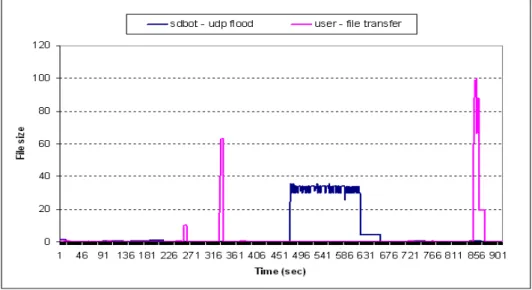
4.2 Change of log file size (a user transfers files vs. a bot using UDP flood. (100 bytes ≡275085 bytes). . . 102
4.3 Normal users behaviour without sending files. (100 bytes≡2754 bytes).103 4.4 Normal users behaviour with sending files. (100 bytes ≡7248 bytes). 104 4.5 Attack behaviour without flood. (100 bytes ≡ 4121 bytes). The dots represents a high correlation between bots. . . 104
4.6 Attack behaviour with UDP flood. (100 bytes ≡ 94050 bytes). . . 105
4.7 Correlation between log files. . . 105
4.8 The ROC curve - false positive rate vs. true positive rate. The per-centages represent the threshold used. . . 106
5.1 The results of experiment E1. The bot connects to the IRC server, joins the specified channel and remains inactive waiting for the botmaster’s commands. . . 122 5.2 The results of experiment E2. The bot receives commands from the
botmaster. The amount of outgoing traffic increases as the bot re-sponds to the botmaster’s commands. . . 123 5.3 The results from the third experiment - scenario E3.1. The botmaster
has not activated the keylogger command. The user on the infected machine types long sentences. . . 124 5.4 The results from the third experiment - scenario E3.2. The botmaster
has not activated the keylogger command. The user on the infected machine types short sentences. . . 125 5.5 The first scenario E4.1 in experiment four. The botmaster activates
the keylogger. The user on the infected machine types long sentences. 126 5.6 The second scenario E4.2 in experiment four. The botmaster activates
the keylogger. The user on the infected machine types short sentences. 126 5.7 The results from Experiment E5. The mIRC client connects to the
IRC server. The client has normal conversation and simple commands with another client. . . 127 6.1 An overview of the DCA showing the input data (signals and antigen),
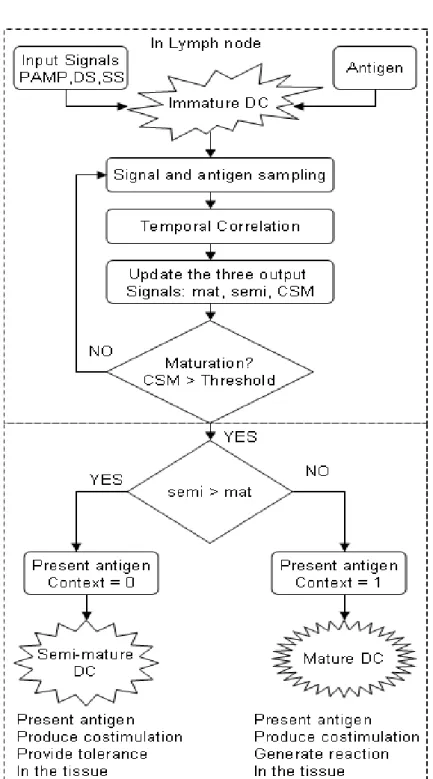
the data sampling and maturation phases and finally the analysis stage which generates MCAV/MAC values. The above figure is taken from Greensmith Thesis [46]. . . 146 6.2 Bot’s MCAV values generated by DCA using signal weight W S3. . . . 167 6.3 IRC client’s MCAV values generated by DCA using signal weightW S3. 168 6.4 Bot’s MAC values generated by DCA using signal weight W S3. . . . 169 6.5 IRC client’s MAC values generated by DCA using signal weight W S3. 170 6.6 Bot’s mean MCAV values generated by DCA using different signal
weight values (WS1-WS5). . . 171 6.7 IRC client’s mean MCAV values generated by DCA using different
signal weight values (WS1-WS5). . . 172 6.8 Bot’s mean MAC values generated by DCA using different signal weight
values (WS1-WS5). . . 173 6.9 IRC client’s mean MAC values generated by DCA using different signal
weight values (WS1-WS5). . . 174 6.10 Affect of changing signal weights of bot’s MCAV values on DCA
de-tection performance. . . 175 6.11 Affect of changing signal weights of IRC client’s MCAV values on DCA
detection performance. . . 176 6.12 Affect of changing signal weights of bot’s MAC values on DCA
6.13 Affect of changing signal weights of IRC client’s MAC values on DCA detection performance. . . 178 7.1 P2P structure:napster . . . 182 7.2 P2P structure:Gnutella (source:http://www.howstuffworks.com) . . . 183 7.3 Phatbot’s MCAV generated by DCA using signal weightW S3. . . 196 7.4 Firefox’s MCAV generated by DCA using signal weightW S3. . . 197 7.5 IceChat’s MCAV generated by DCA using signal weightW S3. . . 198 7.6 WASTE client’s MAC values generated by DCA using signal weight
W S3. . . 199 7.7 Phatbot’s MAC values generated by DCA using signal weight W S3. . 200 7.8 Phatbot’s MAC values generated by DCA using signal weight W S3. . 201 7.9 Icechat’s MAC values generated by DCA using signal weightW S3. . . 202 7.10 WASTE client’s MAC values generated by DCA using signal weight
W S3. . . 203 7.11 Peacomm’s MCAV generated by DCA using signal weight W S3. . . . 204 7.12 Firefox’s MCAV generated by DCA using signal weight W S3. . . 205 7.13 Firefox’s MCAV generated by DCA using signal weight W S3. . . 206 7.14 Peacomm’s MAC values generated by DCA using signal weight W S3. 207 7.15 Firefox’s MAC values generated by DCA using signal weight W S3. . . 208 7.16 Firefox’s MAC values generated by DCA using signal weight W S3. . . 209 7.17 The affect of applying a dynamic threshold values on the MCAV for
all experiments. . . 210 7.18 The affect of applying a dynamic threshold values on the MAC for all
experiments. . . 211 7.19 The ROC analysis for applying a dynamic threshold values on the
anomaly correlation value (ACV) for VS=20. . . 212 7.20 The PAMP signal used for DCA input to detect other malicious software.214 7.21 The danger signal (DS) used for DCA input to detect other malicious
Over the past few years, IRC bots, malicious programs which are remotely controlled by the attacker, have become a major threat to the Internet and its users. These bots can be used in different malicious ways such as to launch distributed denial of service (DDoS) attacks to shutdown other networks and services. New bots are implemented with extended features such as keystrokes logging, spamming, traffic sniffing, which cause serious disruption to targeted networks and users. In response to these threats, there is a growing demand for effective techniques to detect the presence of bots/botnets. Currently existing approaches detect botnets rather than individual bots. In our work we present a host-based behavioural approach for de-tecting bots/botnets based on correlating different activities generated by bots by monitoring function calls within a specified time window. Different correlation algo-rithms have been used in this work to achieve the required task. We start our work by detecting IRC bots’ behaviours using a simple correlation algorithm. A more in-telligent approach to understand correlating activities is also used as a major part of this work. Our intelligent algorithm is inspired by the immune system. Although the intelligent approach produces an anomaly value for the classification of processes, it generates false positive alarms if not enough data is provided. In order to solve this problem, we introduce a modified anomaly value which reduces the amount of false positives generated by the original anomaly value.
We also extend our work to detect peer to peer (P2P) bots which are the up-coming threat to Internet security due to the fact that P2P bots do not have a centralized point to shutdown or traceback, thus making the detection of P2P bots a real challenge. Our evaluation shows that correlating different activities generated by IRC/P2P bots within a specified time period achieves high detection accuracy. In addition, using an intelligent correlation algorithm not only states if an anomaly is present, but it also names the culprit responsible for the anomaly.
Chapter 1
Introduction
The Internet is persistently threatened by many types of attacks such as viruses, worms and trojan horses. These attacks have a negative impact on the Internet, and result in delays due to congestion, extensive waste of network bandwidth as well as corruption on users’ computers and data. In addition, some of these attacks are used to control Internet hosts and then use these hosts to launch denial-of-service (DoS) attacks against other entities. If an attacker can gain access to network hosts, this can lead to enormous damage to the network such as disrupting e-commerce sites, news outlets, network infrastructure, routers and root name servers. An attacker can accelerate the process of gaining access to computers by using malicious software’s such as viruses, worms or trojan horses. Viruses and worms exploit vulnerabilities in host software in order to automatically propagate between Internet hosts. These viruses and worms can carry an arbitrary malicious piece of software, called bot, for remote management. This can enable attackers to gain access to users’ personal infor-mation like passwords, credit card numbers, confidential documents, address books, archived email or user activities. Moreover, these attacks could disturb, corrupt, or even change this information.
Recently, there have been several studies on how to detect botnets, group of bots, based on analysing network traffic or looking for well known bots signatures. These techniques have helped to understand different types of signatures that botnets use. We will discuss some of these techniques in Chapter 2, Section 2.5. However, the problem of detecting and reacting to an individual bot running on the system remains
unsolved. While there are several techniques available for detecting the signatures of botnets using signature-based detection discussed in Section 2.5.3, these techniques are unable to detect new types of attacks carried out by the bots due to the lack of prior signatures. An alternative approach is to use anomaly detection, which tries to detect abnormal patterns of behaviour. An open problem is how to develop an anomaly detection technique that can efficiently and accurately detect the activity of botnets/bots.
Even though many techniques using anomaly detection have been proposed as dis-cussed in Section 2.5.4, they focus on detecting botnets using network-based anomaly detection or they ignore detecting an individual bot running on the system by corre-lating different behaviours. In order to overcome these problems, we present different approaches to detect botnets/bots based on correlating different activities on the system.
1.1
Motivation
One of the most important issues in network security that the administrators have to handle carefully is the existence of bots/botnets. In this work, our main interest is to detect the existence of this kind of threat. This is due to many reasons which are listed below:
• Data regarding bots is rarely available. This is due to the fact that the botnet data can contain sensitive information. As a result, making this data publicly available can be dangerous.
• Little research has been conducted in order to detect botnets using anomaly detection for an individual bot running on the system. Previous research fo-cuses on detecting botnets using non-productive resources, called honeypots. Furthermore recent research by others tries to detect the botnet by analysing network traffic looking for known botnet signatures. This is a classical way of detecting malicious patterns on the network. In addition, most of the existing research work focuses on detecting botnets rather than an individual bot.
• Botnets pose a severe threat to Internet security. For example, an army of sev-eral thousand bots can exhaust the bandwidth of a large number of systems or networks. An attacker can use the botnet to perform malicious activities [9]. These activities include performing DDoS which causes a loss of connectivity or services to legitimate users by consuming large amounts of the victim’s band-width or overloading the computational resources of the victim’s host. Another malicious activity include spreading massive email spam. Mcafee reports that the percentage of spam emails have increased from approximately 30% in the second quarter of 2006 to more than 80% in the same quarter of 2008 [104]. MessageLabs reports that botnets are responsible for distributing 87.9% of all spams and there is an increase of 2.9% from the second quarter of 2009 [105] and most of these spam emails come from the botnets. In addition, the attacker can usephishing e-mails to expand his botnets.
A third malicious activity is identity theft. Identity theft is performed in two ways. The bot master can use packet sniffers to watch for the interesting clear-text data passing by the victim’s machine, thus, retrieving sensitive information such as user name and password. Another way of having sensitive information is by implementing a keylogger which records all keystrokes typed, screen, or websites visited and send them to the attacker. The concept and the implemen-tation of the keylogger are presented in Chapter 5.
Another important activity used by attackers is to make revenue by extorting
on-line business companies. In addition, the attacker can make revenue by renting his botnets to other malicious users. Furthermore, the attacker can use the bot to disable the Anti-Virus processes on the infected machines.
• During the past few years, there was an exponential growth of using botnets to perform large number of malicious activities ranging from Internet Relay Chat (IRC) bots and Peer-to-Peer (P2P) bots as shown in Figure 1.1. Mcafee [104] also reports that they have observed fourteen million new bots in the second quarter of the year 2009, in comparison to nearly twelve million new bots in the first quarter in the same year which is approximately an increase of more than
Figure 1.1: Exponential growth of IRC bots from year 2001. The above two figures are taken from [64].
Figure 1.2: The top figure represents new bots sending spam by month while the bottom figure represents the Global Spam Volumes and Spam as a Percentage of All Mail.
As a result of the upcoming threats posed by bots, we decided to investigate this area in more detail and come up with new ideas of collecting botnet/bots data and detect their behaviour. Since most of the existing bots target Windows operating systems, our first step is to develop a program which monitors the interaction of these bots in Windows environment. In addition, our model is expected to detect these
bots without prior knowledge of its signature as compared to the existing methods. Furthermore, the module should not depend on one type of behaviour in order to detect the malicious activity but should rather correlate different activities to enhance the detection mechanism. Moreover, the model should use an intelligent way of combining these behaviours to enhance the detection process. The module should be able to detect different types of malicious bots such as IRC bots, HTTP bots or Peer to Peer bots.
1.2
Aims and Scope
Many existing techniques use Intrusion detection systems in order to detect and pre-vent malicious activities on the network/systems. Intrusion detection is the ability of the system to detect and identify unauthorized activity by monitoring inbound network traffic. Intrusion detection reports malicious activity on the system to the security staff. In this thesis, we focus on extrusion detection rather than an intrusion detection. Extrusion detection is the ability of the system to recognize malicious ac-tivity by inspecting the outbound traffic [14]. Our aim is not to prevent the attack using well know techniques such as filtering known signatures but rather to detect a bot on a compromised host with a minimum number of false alarms without using a pre-defined set of signatures. The main aim of this work is to detect the existence of botnets on multiple systems and an individual bot on a single system respectively by correlating different bot’s behaviours in Windows environment. This task is achieved by monitoring selected Application Programming Interface (API) function calls ex-ecuted by the running processes on the systems within a specified time window. In addition, different correlation algorithms are examined in order to enhance the de-tection process. Another aim is to verify that the correlation algorithms can detect different kind of bots which use different command and communication protocols such IRC bots and P2P bots.
Hypotheses
• Do we use Intrusion or Extrusion Detection: Which system is more suitable for bot detection, intrusion detection systems or extrusion detection systems and why? Our assumption is that the bots are already installed on the victims’ hosts, through an accidental opening of emails, which contains ‘trojan horse’ or by visiting malicious websites and downloading malicious programs. In such a case, we are not attempting to prevent the initial bot infection but to limit its activities whilst on a host machine. Therefore, we use an extrusion detection system since our main focus is to detect botnets/bots and this could be a better solution for this task.
• Detection method and Data Collection: How are we going to detect botnets/bots? Are we using signature-based detection or anomaly-based detection? The method that we have used in this work is to collect our data by monitoring and intercept-ing specified API function calls executed by processes (discussed in Chapter 3 which represent bot‘s activities and then correlate these activities within a spec-ified time period. This method is a behavioural-based detection method and no signatures are needed in order to detect these bots. Does this method achieve the required task?
• One activity or different activities: Does one activity (e.g. bot implemented with keylogging functionality discussed in Chapter 3) represent enough evidence to detect the existence of bots? Do we need to monitor different activities and what are they? Are the activities related? If yes, how do we correlate these activities?
Does the process of correlation increase the detection performance and reduce false alarms?
• Botnet Detection: Are we interested in detecting botnet? How difficult is it to detect botnets? How many hosts to monitor? Can a simple correlation algorithm detect the botnet since they exhibit similar actions? What are the advantages and disadvantages of using such a technique? Can we detect botnet
if we have different types of bots, each acting in a different manner? Do we need a more intelligent correlation algorithm? These types of questions will be addressed in Chapter 4.
• Bots Detection: Why we are interested in bots detection? Can we detect a single bot running on the infected host? What kind of technique do we use for bots detection. What are the most interesting behavioural actions of bots? Can we monitor and correlate these actions? How to correlate these actions? Is a simple correlation algorithm suitable for correlating different actions and thus detecting malicious activity? What are the consequences of using a simple correlation method? Can a more intelligent correlation algorithm enhance the detection performance in comparison to using a simple correlation method? Do we need a training phase when using such an algorithm to detect bots? What are the requirements which increase the detection performance? What types of input data do we need to change the input data every time new bots appear? Can our framework detect bots with low false positives and high true positives? This aim will be explored in Chapter 5 and 6 respectively.
• Command and Control C&C Structure: Can our framework detect different types of command and control structures other than IRC bots such as P2P bots? This issue will be addressed in Chapter 7.
• Evaluation: How good our algorithm is in comparison to the existing methods? How resilient the algorithm is to the change in bot‘s behaviour? What will happen if the behaviour or implementation of a bot changes? These questions will be studied and evaluated in Chapter 7.
1.3
Contribution
We can summarise our contribution on botnet/bot detection area according to the following points:
for bots signatures. Other techniques use anomaly-based detection in order to detect existing bots. Other techniques use behavioural-based detection to detect these bots by monitoring system calls or API function calls. Because our approach is based on behavioural-based detection, we focus on monitoring API function calls in Windows environment. In contrast to existing approach, we target specific API function calls executed by the processes in order to de-tect malicious activities. Rather than using existing monitoring software which monitors many function calls, we developed a tool to monitor the most frequent function calls used by most of the common bots to perform malicious activi-ties. These function calls represent (1) network activity: the communication functions which are needed to contact the botmaster or other bots, (2) process activity: file access function calls in order to store the data and finally (3) user activity: the keyboard status function calls to detect the keylogging activities on the system. Monitoring only the most important function calls used by bots can reduce the size of the data and the time for processing the collected data of function calls.
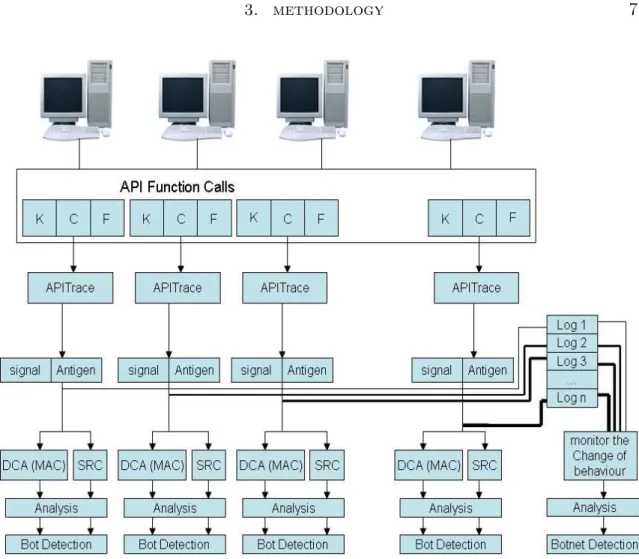
• Based on that, we have developed a framework for detecting bots which is ideal for both detecting botnet and an individual bot.
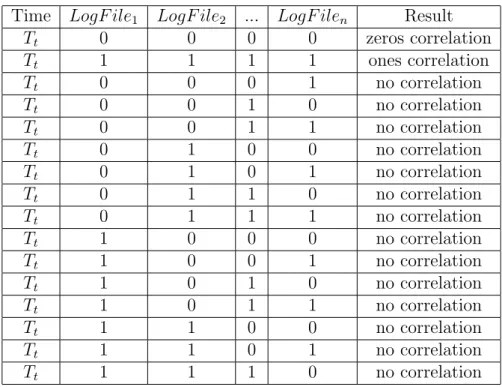
1. for the botnet detection, we notice that many existing techniques use network-based techniques and look for botnet signatures in order to detect the botnet on the network. These techniques have many issues such as they may fail to detect new bots when the signatures are changed or they only have been developed to detect one type of bots. Little research has been conducted on host-based botnet detection. Because bots exhibit similar activities when they receive commands from their master, we implement a host-based botnet detection by monitoring the correlation of different activities from different sources within a specified time window. In com-parison to existing techniques, no bot‘s signatures are being analysed to perform the detection. In addition, this technique can detect different types of bots regarding of their communication protocols.
2. for the individual bots detection, we notice that most of the existing tech-niques detect botnet rather than individual bots. To the best of our knowl-edge, only one or two methods were used for a host-based bots detection. As a result, we focus on detecting an individual bot running on the system and find a simple and effective solution in terms of detection performance and analysing the collected data and the time for generating the results. We start with a simple correlation technique represented by a Spearman’s rank correlation (SRC) algorithm which is used to correlate different activ-ities generated by processes and find the relationship between them. This method only states if there is malicious activity on the system but does not specify which process causes this malicious activity.
3. By applying the SRC algorithm, we noticed that this algorithm can be defeated in many ways such as allowing the bot to perform actions in dif-ferent time periods and thus defeating the correlation between activities. In order to solve the problems generated by the SRC algorithm, an intelli-gent way of correlating different activities is used to enhance the detection mechanism. This is represented by a Dendritic Cell Algorithm (DCA). The DCA performs multi-sensor data fusion on a set of input activities, and this information is correlated with potentially anomalous ‘suspect entities’. One advantage of using such algorithm is that the correlation between mul-tiple data can be in different time periods. In addition, the DCA consists of multiple agents, the cells, and each cell has its own judgment on the active process based on the information it received. This process adds a robustness to the system because the decision is made by the majority of agents instead of one agent. In comparison to the SRC and other existing host-based bots detection techniques, the DCA does not only specify if there is a malicious activity on the system but it also indicates the mali-cious processes. In this algorithm, we modify the old anomaly value which is the mature context antigen value (MCAV), used in DCA, and present the MCAV antigen coefficient (MAC) to increase the detection sensitivity
and reduce the false positive alarms generated by the MCAV value. • Our framework, either botnet detection or bots detection, does not depend on
one type of botnet command and control structure. The framework can detect IRC bots in addition to the Peer-to-Peer bots. Although not tested with bots that use a hybrid structure, we expect that our algorithm can also detect these kinds of bots.
• A comparison between our framework and some of the existing methods is pre-sented to measure the performance of our framework. We have also developed a non-DCA algorithm for detecting bots and compare its detection performance to the DCA. The results show that the DCA achieves a better detection per-formance than the developed algorithm.
• We also examine how the detection algorithm is resilient to the changes in bots. This step can show if the DCA is applicable for new types of bots which exhibit different behaviours than the current one.
• The final step that we have performed is to prove that the DCA can detect malicious processes other than bots and can be applied in many security areas. A detailed description of these techniques and their advantages and disadvantages will be addressed in the Methodology chapter.
1.4
Thesis Outlines
This thesis is structured as follows. First, we start with the literature review chapter by defining different kinds of malicious softwares (malwares) that can affect our sys-tems and networks. These malicious softwares include viruses, worms, rootkits and bots. Second, we present different ways of classifying intrusion detection techniques such as network-based vs. host-based intrusion detection techniques and signature-based vs. anomaly-signature-based intrusion detection techniques. Third, we move more specif-ically toward the topic of this thesis by presenting the definition of bots, their history,
the life cycle of bots and the command and control structure which is used by at-tackers to remotely control the bots. We also present the definition of botnets, their types, how they operate and communicate, scale of botnets, botnet architectures and the malicious use of botnets. In addition, we present some examples of existing bots which include some peer-to-peer bots and future bots. Fourth, we discuss some of the previous bots/botnet detection techniques and list their advantages and disadvan-tages. Finally we present a critique of the existing algorithm techniques and compare and contrast them with our work.
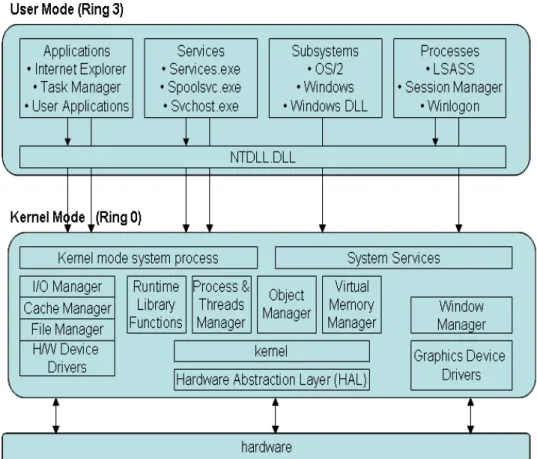
Because we are targeting bots which operate on windows environment, chapter three starts by giving a brief introduction on windows architecture and windows Application Programming Interface (API) function calls. Second, in order to collect the data, we use the hooking techniques. These techniques are based on intercepting API function calls which are explained in details in this chapter. Third, we present an abstract view of our framework for detecting botnets and an individual bot on a system. Fourth, we introduce our algorithm for detecting botnets by correlating log files in detail. Fifth, we also introduce our algorithm for detecting an individual bot on a system using different correlation methods such as the Spearman’s rank correlation algorithm (SRC) and the Dendritic Cell Algorithm (DCA) and discuss their inputs, analysis, outputs and assumptions being used while implementing these algorithms and finally the strengths and weaknesses of each algorithm. We also present how the DCA is capable of detecting different bots, which use different command and control mechanism mainly P2P protocol. Finally, we summarize and conclude the chapter.
In chapter four, we present the design and the implementation of the algorithm for detecting botnets by correlating log files from different sources. We discuss different experiments that we have conducted to achieve this task and show the results of using such an algorithm. We finally summarize and conclude our findings.
In chapter five, we present the design and the implementation of Spearman’s rank correlation (SRC) algorithm used for detecting individual bots running on a host based on correlation of different activities, mainly keylogging activity. In Chapter six, we use an advanced correlation algorithm, the Dendritic Cell Algorithm (DCA), for correlating different behaviours of an individual bot on the system and compare the
results obtained with SRC algorithm. We also have conducted different experiments to achieve this task. Furthermore, we analyse and discuss the results of both the algorithms and we summarize and conclude our findings.
We further extended the scope of our research by presenting the detection of peer to peer (P2P) bots which is explained in chapter seven. We discuss how to detect such kinds of bots by using the DCA algorithm. Different experiments have been conducted to verify that the DCA can detect such bots. We analyse and discuss the results of detecting such bots. We evaluate the DCA algorithm with other existing techniques and develop a new algorithm to compare our results. We also show how resilient the DCA is to changes in the bot and what happens if a bot changes its behaviour? We also examine if the DCA is suitable for detecting malicious software other than bots. Finally we present our conclusion.
The final Chapter (Chapter eight) is about our conclusions that we have derived from this work, the critical assessment of the algorithms which describes how well the Spearman’s rank correlation algorithm and the DCA algorithm performed and what needs to be done in the future in order to improve the algorithms for botnets/bots detection.
1.5
Summary
Botnets and Bots pose severe threats to our networks and systems. In order to reduce the impact of this threat, we need to find a way of detecting these bots to reduce its negative impacts. In this work, we try to detect these bots by correlating different activities within a specified time period.
Chapter 2
Literature Review
2.1
Introduction
Over the last decade, Internet is widely used by many people all over the world due to its availability and low cost. As more and more people use the Internet, network security as well as system security, become important elements to the users. This is because the Internet faces different types of threats from the attackers using malicious softwares (Malwares). Malware is a script or macro which is defined as a software used to breach a computer system’s security policy [133]. Malwares are usually classified based on their activities. For example, a virus is a piece of malicious software which spreads from one computer to another by copying itself into files and then copies itself to the victim machines. Another example is a worm which is also a malicious code that acts as a virus but rather than transmitting to files, it copies itself via networks. These malwares are used as a mean of vandalism to attack victim machines. Recently, many attackers shifted their attacking strategy from vandalism through the use of viruses and worms to financial gains. To achieve this goal, the attackers have to have a large number of compromised machines all over the world to attack a single entity. These compromised machines are controlled remotely by a single or a group of hackers and called bots. The use of bots focuses on establishing Distributed Denial of Service (DDoS), extortion, spam, phishing and identity theft. In order to understand these types of threats, it is useful to distinguish between worms, viruses and bots. In the next section, we will present different types of malware and
intrusion detection systems. Our focus will be on bots and botnets, what are they, how they operate, examples of these bots and existing methods to detect these bots.
2.2
Malicious Codes
Internet faces different types of attacks generated by malicious softwares - malwares. In order to detect these attacks, researchers should differentiate between the behaviour of the malwares. In this section, we will present different types of malwares including viruses, worms, rootkits and bots and explain their functionalities.
2.2.1 Viruses
A virus consists of two parts, insertion code and the payload. The insertion code adds a copy of itself to other executable programs to infect other programs while the payload involves the malicious activities which may produce serious damage to the files or system [5][133][139]. A virus requires manual interaction to be activated, and cannot run independently on its own power [114]. Viruses can propagate through file-to-file replication [165]. There are some techniques which a virus creator takes into account before designing a virus. These techniques include propagation, which allows the virus to transfer from one file to another and infection method, which relates to files selection to infect, code placement into victim files and the execution strategy. Some viruses adapt encryption techniques on their payload in order to evade detection. Other viruses use polymorphism techniques (having different types of virus code to achieve the same goal) to hide their activities from signature scanners.
2.2.2 Worms
Spafford [139] defines a worm as a piece of malicious program that can run by itself and can propagate a fully working version of itself to other machines through the network without infecting files. The word worm is derived from the word ’tapeworm’ used to describe a program in John Brunner’s 1972 novel [107], the Shockwave Rider, which lives inside the host and uses its resources to maintain itself and spread to other
machines. This cycle is repeated to increase the number of infected hosts [114]. A worm is like a virus but consists of three parts. The first part is designed to search for vulnerable targets based on information found on the currently infected host or based on port scanning. The second part is responsible for transferring the worm code from one host to another, and the final part is responsible for code execution. Most of the worms are designed to consume network resources rather than host damaging by consuming bandwidth or establishing distributed denial of service by exploiting the targets [133].
2.2.3 RootKits
A rootkit [133][68][175] is a collection of tools that is used by the attacker to gain administrator access privileges on a host. Rootkit allows the attacker to sniff network traffic to gather information about the system or networks, to apply keystrokes log-ging to retrieve sensitive information typed by the user such as credit card numbers, passwords or personal information, or to hide the attacker’s presence as well as to hide the malicious programs from rootkit scanners. The rootkit can act as a back door which allows the attacker to gain access to the victim’s machine at any time.
2.2.4 Bots
A bot is a malicious piece of software that can be installed on a user machine with-out his/her knowledge. Once it is executed, the bot connects to the IRC server and joins the channel specified by the attacker. These bots are controlled remotely by the attacker. Therefore, the main difference between the worm and the bot is that the bot offers a remote controlled channel to the attacker. Today’s bots combine features of viruses and worms. For example, they propagate like worms through net-work shares, file-sharing platforms, peer-to-peer netnet-works, backdoors left by previous worms and/or exploit vulnerabilities. They also can hide their existence like viruses using rootkits. Bots can communicate with others using different types of protocols such as IRC, HTTP or Peer-to-Peer protocols.
2.3
Intrusion Detection Classification
Intrusion Detection System is the process of gathering and analysing information from different sources within the networks or systems for detecting events to track security violations or attempts [78][95]. These events include network attacks against vulner-able services or host-based attacks such as unauthorized access. Intrusion detection systems usually store a database of well known attack signatures and compare the activities that monitor within the networks or systems with the signatures they have. If a match is found, they generate different types of alerts based on the type of attack. These alerts are then forwarded to the system administrator who tries to discover and process the alerts. The main goal of intrusion detection systems is to detect and then deflect unauthorized attempts to the system or network. Intrusion detection systems can be classified on the basis of activities, traffic or systems they monitor. They can be divided into network-based, host-based or application-based intrusion detection systems. Intrusion detection can also be classified based on event analysis such as a signature-based (misuse) intrusion detection or anomaly-based intrusion detection. In this section, we will describe different types of intrusion detection systems based on their classification.
2.3.1 Network-based IDS vs Host-based IDS
Network-based intrusion detection systems (NIDS) monitor the entire network rather than individual systems looking for the attack signature without interfering with network operation. Thus, a single alert will be produced rather than multi-alerts from each host. Network-based IDS can be a reactive intrusion detection system that can respond to the given attack without alerting the system administrators. Such actions include reconfiguring the network or blocking malicious data. One problem of having network-based IDS is that they may not be able to monitor and analyse all traffic on high-speed networks. This is because it is very difficult to capture all packets when data processing can not cope with the speed and throughput of networks. The packets which are not analysed on time can be dropped and these packets may contain the attack signature [176]. In addition, they may suffer from
false positives by identifying an attack which is in reality normal behaviour and false negatives by missing an intrusion attempt. Furthermore, if the packets are encrypted, network-based IDS may not able to analyse these traffic.
On the other hand, host-based intrusion detection systems (HIDS) monitor and analyse system network traffic, activities and attempts to access operating and file systems. They can also monitor abnormal activities of processes and search through log files and alert the users for possible attacks. Host-based IDS can use host-based encryption services to examine the content of encrypted traffic, thus protecting the entire host. One of the disadvantages of using host-based IDS is that they need to be installed in every single host. If the host is compromised, the attacker can disable host-based IDS. Moreover, host-based IDS consume a lot of host resources such as processing time, memory and storage. Anti-virus tools and system calls-based monitoring are examples of host-calls-based detection [38]
An application- based IDS monitor’s events that happen on some applications and detect the attack, based on log file analysis. They also can examine the content of encrypted packets by using application-based encryption services. The disadvantage of using application-based IDS is that they are more prone to attacks and consume host resources [4][32].
2.3.2 Signature-based detection vs Anomaly Detection
Intrusion Detection Systems (IDS) for detecting bots in networks can be classified into two general categories: Signature-based Detection and Anomaly-based Detec-tion. Signature-based detection is based on defining malicious patterns that the system has to detect [96]. For example, an Intrusion Detection System (IDS) that analyses web server traffic might look for the string ‘phf’ as an indication of a CGI attack [10]. Signature-based detection suffers from the problem that it cannot detect new malicious behaviours. It requires that a signature of each attack be known in order to find attacks. If the signature is not known, then signature-based detection will fail to detect these malicious attacks. Examples of signature-based intrusion detection are Snort [138] and Bro [119] which consist of a large number of previous
attack signatures on their database to detect the attack.
In contrast to signature-based detection, anomaly detection differs by constructing a profile of normal behaviours or activities on the network, and then looking for activities that do not fit the normal profile [4][32][96]. Since not all the abnormal activities in the network are suspicious, anomaly detection has the problem of raising false alarms when it encounters normal traffic that it has not seen before. However, anomaly detection has an important advantage that it can be used to detect new malicious activities for which there is no known signature. For this reason, our focus is on how to develop anomaly detection techniques for bots.
2.4
Bots and Botnets
2.4.1 Bots History
IRC history
IRC stands for Internet Relay Chat, which provides a way of communication with connected users in a real time [84][113][159][168]. It is mainly designed for group (many-to-many) communication in discussion forums called channels. In addition, IRC allows uni-cast communication [118]. The user can monitor a conversation be-tween multiple users and can participate in the conversation. IRC was created in late August 1988 by Jarkko Oikarinen to replace a program called MUT (Multi-User Talk) on a BBS called OuluBox in Finland and to allow a maximum of 100 users to communicate concurrently [84][118][168]. In 1993, the first IRC protocol was defined by RFC1459. Later on, it was updated to include RFC2810, RFC2811, RFC2812, and RFC2813 [79].
IRC Operations
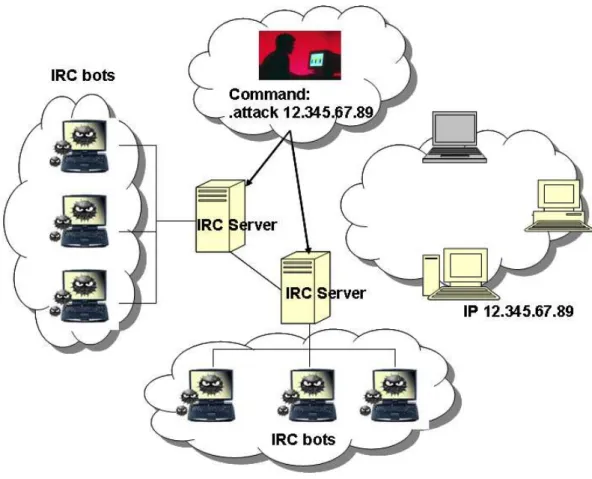
Once a user connects to the IRC server, s/he can join a channel where other users are already there as shown in Figure 2.1. If s/he is the first user who joins the channel, s/he will be the channel operator. Any user submits a message to the server publicly, the other users can see her/his message on the channel [84][113][26].
Figure 2.1: Basic IRC Operation
IRC has multiple channels. Therefore, if any user wishes to join a channel s/he should have the IRC client, know the IP server and also should know the channel name. A user can connect to IRC server through predefined ports (6660-7000/tcp). The most common port of the IRC server is 6667/tcp. Each channel has one or more operators to manage the channel. The channel operator’s privileges can be obtained by one of the following methods. The first method is that the user creates that channel and becomes its operator. The second method to obtain operator privileges is through an Approved Channel Operator (AOP) list. In addition to sharing text messages between users on the channel, IRC has other functionalities. For example, IRC can allow file transfer between users, execute peer-to-peer capabilities, and run an automated program, termed ’a bot’, to monitor IRC channels. Moreover, IRC has
many commands that can be used by users. In this section, we will define the most common commands, which are used by users.
• NICK and USER: are used to label a user and user’s host equivalent to an ID. • PASS: set or send a password.
• JOIN: enter a channel, often secret.
• MODE: modify channel settings (eg. invisible).
• PING and PONG: maintain the connection to IRC server. • PRIVMSG: send a message to a channel or user.
• DCC SEND: transfer files from one user to another.
IRC and Bots Relationship
In the 1990’s, users developed new tools such as logging channel statistics, running games, and providing a mechanism for file distribution to automate certain tasks and to defend them against attacks [159]. These automated tools are termed bots. The IRC bot is a non-human client that has been programmed to respond to various events and to help maintain the channel operator status on a particular channel [168][84]. A bot can be used to manage operations such as granting operator status to recognised users. Other users have created attack tools to kill channels and remove users from these channels and to fight back. These tools are called malicious bots [118]. By the end of 1990’s, bots were programmed to do some malicious activities. One of these activities was to establish distributed denial of service (DDoS) attacks against IRC servers. This was due to the loss of operator privileges on IRC channels when the server crashes or disconnects, and another member of the channel is assigned as a new operator when the server is up. As a result, people started to attack IRC servers so that they acquire the privileged operator status in a given channel. DDoS is established when many bots are gathered together, which form a botnet, under a control of their master.
According to Trend Micro [165], the first bot to appear was in 1999 and was named PrettyPark. PrettyPark bot implements a way of controlling malicious program re-motely using IRC networks. The PrettyPark bot has a limited set of functionalities such as the ability to connect to the IRC server, steal basic system information, lo-gin names, nicknames and email addresses. More advance bots were created after PrettyPark and have more sophisticated functionalities.
Most of the bots used, to attack IRC did not use IRC to communicate. At the start of 2000, many sites such as Yahoo, eBay, Amazon, and CNN have been attacked by a Canadian hacker [118]. During 2002, new communication protocols for bots/botnets were developed. From 2003, bots used different techniques to spread. These tech-niques include exploiting vulnerabilities, buffer overflow, droppers (programs that are used to install malicious software in a target host), and dictionary attack.
Bots should be available and active most of the time on the channel, therefore, they are run from high availability servers with reliable and fast Internet connections. Furthermore, they are controlled from a shell account on the server [84]. Nowadays, bots can be delivered by most of the ways that current malware can. Today, bots are used for extortion [159], spam and phishing, identity theft, and malware seeding.
2.4.2 Bot’s Life Cycle
Initial Infection and Propagation
Bots can spread and propagate only if there are existing vulnerable hosts. The at-tacker appends the bot by gaining access to the victim’s host. The victim’s host is infected with a bot by exploiting some operating system or application vulner-ability [126], through malicious websites, by opening emails that contain malicious data, or downloading malicious payload from P2P networks [177][113]. The malicious payload is polymorphic and transparent to the user. The user has no clue that his computer is being used for malicious purposes. Once a bot is installed on a victim’s machine, it changes the system configuration to start each time the system boots [126]. The bot might have the functionality to spread itself by sending out more emails or scanning more computers [113], thus creating a botnet. If an attack is detected, it
can only be traced back to the source, not to a botmaster.
Command and Control server (C and C)- Remote Control Channel
Once the bot is installed, it has an instruction to connect to command and control (C&C) server to receive commands [177][113]. Command and control allows control of compromised machines from one centralised system, typically through IRC chan-nel. The bot (i.e. infected machine) connects infected machines to the IRC server with a randomly generated nickname [126]. Then, the bot joins the attacker’s chan-nel with a predefined password, and remains dormant waiting for the command from the botmaster. The botmaster authenticates the identity of the bots using a pass-word, ensuring that the bots cannot be controlled by others. Once authenticated, the botmaster issues commands in the channel and all bots react and respond to the commands [177][113].
Accepting Instructions
The botmaster logs into the IRC server and starts issuing commands. Commands are sent to infected machines via the controllers. These commands can include instruc-tions such as downloading additional payload to bots. In addition, the botmaster can transfer files to/from bots, perform DoS attack, or use them for other malicious activities.
Spread to additional machines
Botmaster uses C&C to exploit new vulnerabilities of other systems which allow bots to spread to other machines through the local networks, often bypassing firewall and IDS.
2.4.3 Botnets
Introduction to Botnets
Bots, which have infected a large number of vulnerable computers across the world, forms a botnet. Botnets have become the current threat to the most interconnected systems [113]. According to Bacher et al. [9], several thousand bots can take down any website or network instantly, thus, making botnets loaded and powerful weapons. A bot, a term derived from the word RoBot, is a piece of computer code, which runs on a client system and connects to the IRC server to join a specific channel. A bot can automatically execute predefined commands such as updating itself or installing new malicious software [118][113]. A botnet is a network of compromised machines infected with malicious programs (bots, zombies) that can be remotely controlled by an attacker through a Command and Control (C&C) infrastructure on IRC channel or Peer-to-Peer (P2P) network [118][113][76]. Botnets often consist of thousands of compromised machines, which enable the attacker to cause a serious damage. Botnets are used for DDoS attacks against the target machine to suspend services by utiliz-ing the available bandwidth. To establish DDoS attacks, the botmaster instructs an army of compromised machines (bots) to attack the victim’s machine simultane-ously [118][113].
Type of Botnets
There are many types of botnet; hub-leaf and channel. The Hub-leaf botnet is made by installing two bots on the victim’s machine. The first bot is configured as a hub while the other bot is configured as a leaf. Additional bots can be configured as leaves, which connect to the hub bot. The resulting connection will form a star architecture. Hub-leaf botnets do not typically communicate through an IRC, but rather on configurable ports. Another type of botnet is called a channel botnet as shown in Figure 2.2, which allows bots to communicate through an IRC channel. Once a bot is configured on a victim’s machine, it joins a predefined channel. The botmaster issues commands by posting messages to the IRC server. Bots read these messages, interpret and react to them. Another type of bot includes AOL bot [177],
which logs on to a set of AOL servers to receive commands. In addition, P2P bot uses peer-to-peer file sharing applications to spread, or to communicate with other bots [159].
Figure 2.2: Structure of an IRC Channel Botnet.
Techniques for Creating Botnets
In the past, the intention of malicious users and hackers was to attack systems espe-cially IRC servers and control channels. They also used botnets for communication, resource sharing, and curiosity. Nowadays, malicious users have moved a step for-ward. With the rapid growth of e-commerce and online financial transactions, the aim of malicious users, has shifted from curiosity to financial gain [76]. To achieve this goal, a powerful weapon is needed. Therefore, botnets were used to perform this task.
One way the attackers can create a botnet is to look for vulnerable systems to ex-ploit. Vulnerable systems are carefully selected rather than randomly. For example, attackers are targeting broadband connections to maintain the availability and the capacity. These two factors give the attacker powerful botnets. Attacker’s are also attracted by the high speed connectivity available on systems at universities. These systems give the attackers fast connection, the storage capacities they need, and less time to attack them because they are poorly secured. Furthermore, the attackers target sensitive military and government systems which have lots of valuable infor-mation, which can financially benefit them. In addition to vulnerability exploitation, attackers use social engineers to compromise vulnerable systems, thus, creating their botnets. Social engineering is a way of convincing naive users to take actions s/he would not otherwise take. Email, web browser, and instant messaging applications are ways of applying the social engineering attack.
Another way of creating botnets is by stealing them from another bots herder, known as ‘hijacking’ botnets. Most bots come with the functionality of sniffing the network. If an attacker notices that there is a competing botnet communication, he will try to hijack that botnet. In addition to hijacking other bot- masters, the attacker can advertise her/his botnet for sale or rent. The Botnets market is very competitive and whoever wants to rent a botnet, has to pay well.
How Botnets Work and Communicate
Most bots are controlled via IRC on ports 6660-7000. The most common port that IRC servers use is port 6667. Once a bot is setup on a victim’s machine, it connects back to the IRC server, which runs a specific channel for bots and botmaster to log into. The botmaster will try to hide his botnet from the IRC server owner/admin by using certain mode commands [118]. In addition, botnets use dynamic Domain Name Server (DNS) from providers that offer dynamic DNS services. There are two reasons for using dynamic DNS services. Firstly, it makes the process of tracking botnets more difficult. Secondly, these services when configured are setup with a very short Time to Live (TTL). If the botnet server gets disconnected, the botnet will be
lost for a short time until a new IRC server is specified or the original server comes back on-line with a new IP address [40][118][159]. Inside the channel, the botmaster will issue some instructions for bots. The first command may allow bots to search for other victims, thus, propagating to other networks. There are many methods for propagation. These methods include:
• Vulnerabilities exploitation: The attacker may combine different vulnerabilities to gain control of computers in case if one vulnerability cannot provide the level of access desired. Some of the common vulnerabilities which help in spreading bots are:
1. Remote Procedure Call - RPC
2. Distributed Component Object Model - DCOM 3. Local Security Authority Subsystem Service - LSASS 4. MSSQL
• Dictionary attack
• Server Message Block (SMB)
• Existing backdoors from the previous worm attack
• Download malicious files from a website via droppers (e.g. email) • Peer-to-Peer files sharing.
In addition, the bot may be updated or new components can be installed.
Command and Control (C&C) Technologies
There are four technologies by which attackers can control their botnets. The first way to control botnets is through IRC Servers for Command and Control. IRC is the most commonly used C&C server by attackers. The advantage of using such technology is that it requires minimum effort and management. Attackers can easily issue commands that instruct bots to perform malicious activities in the channel. In
addition, these channels can be private in which no other users can join [76]. Another way that the attacker can control the botnet is by using Web-Based (HTTP) Com-mand and Control. Some bots are configured to instruct the compromised machines to connect to the web-based C&C server providing the machine’s IP address, port, and machine identification. The compromised machine accesses a PHP script on a malicious website. In order to track and control a botnet, the attacker uses a web interface. The interface is used to send commands to the individual’s compromised machine or to the whole botnet via HTTP responses. The third way to control the botnet is through using Peer-to-Peer (P2P) Command and Control. The IRC server C&C architecture is a centralised method for controlling botnets. If this server is down, the attacker could lose his/her botnet control. In addition, the botnet which uses a centralised server can be detected easily. In order to avoid detection when us-ing IRC protocol, some attackers use P2P networks in order to control their botnets. P2P networks have no real server that can be shutdown to disable the botnet. The final way of controlling the botnet is through the DNS server Command and Con-trol. In this way, the botmaster employ DNS tunneling to communicate with his/her bots [24]. Tunneling techniques are used to tunnel traffic in and out of the firewall and intrusion detection systems. The advantage of using the DNS server as a C&C mechanism is that the DNS server is very popular, used by anyone, and permitted by the majority of firewalls. In addition, the bots can use free DNS hosting services to query about the location of IRC servers which are controlled by the attackers.
2.4.4 Scale of Botnets
It is difficult to estimate the accurate size of botnets due to the distributed and anonymous nature of this problem [113]. According to NISCC [113] and Overton [118], UK has the largest zombie PC population over the world and more than one million connected PC’s are zombies. There were more than 300,000 Internet connected zombie networks in 2004. Approximately, 25% of infected PC’s are controlled by hackers. Broadband connection is responsible for the 93% increase in infected PC’s in 2004. A recent paper by Bacher et al. [9] used honeynet over a period of four months to
monitor botnets activities that have different size and structure. A honeynet is an entire network of systems which consists of multiple honeypots and firewalls [98][93]. Honeypot is a resource that is not meant to provide any service to legitimate users [13]. The only traffic that a honeypot receives is probe traffic or other malicious traffic. Thus, any traffic that is captured at the honeypot is assumed to be unauthorized and malicious, and can be analysed to identify any threatening activities [13]. According to Bacher et al. [9], they have observed and tracked more than 100 botnets during these four months. They have logged 226,585 unique IP addresses logging into one of the IRC botnet C&C channels [113][118]. The size of botnet ranged from several hundred to more than 50,000 zombies. They also observed 226 DDoS attacks against 99 unique targets. The logged bots are being ordered to update themselves or to download and run new malware. Other studies by Cooke [26] and Jahanian [80] show that botnet sizes range from several hundreds to few thousands infected hosts.
Even with these statistics, the actual size of each botnet is difficult to estimate due to a number of factors. These factors include simultaneous bots logging, having more than one bot on a single compromised host, and networks that block bots from con-necting to the server. The size of botnets varies. Nowadays, botnet controllers prefer small, more manageable botnets, which are easier to control and protect, rather than having a botnet with thousands of bots. Actually, there is limited information about the geographical distribution of bots and botnet controllers [113]. It is hard to track back the malicious users who control the botnets. Although analyzing the attacks may reveal the location of compromised hosts, and identify the location of a control server, it is difficult to identify the location of bot controllers. The only fact that we can state about the size of botnets is that there are existing botnets of sufficient size that can successfully attack almost any Internet connected application [113].
2.4.5 Botnet Architectures
Different botnets use different topologies in order to communicate. In this section, we will describe these topologies in detail which include centralised, decentralised and hybrid topology.
Centralised
The centralised topology consists of a single point in which all bots receive commands and data from the botmaster. For example, IRC is a centralised C&C structure in which all the infected hosts try to connect to the IRC server and join the same channel. In a similar way, the botmaster connects to the IRC server and joins the same channel in which he starts to communicate with the bots by initiating different types of commands. The advantage of using this method is that the IRC network provides flexibility to control the bots and there is little latency. The disadvantage of using this method is that the botnet can easily be detected and can be lost or the command and control server will be disrupted or shutdown, thus, the botmaster will not be able to communicate with his bots [142][65][26][57].
HTTP-based represents another way of controlling bots using a command and control server, usually on port 80. In this method, the botmaster publishes his com-mands on the web server and the bots get these comcom-mands. The advantage of using this method is that HTTP traffic is widely used thus making botnet detection more difficult in comparison to the IRC server. Moreover, the IRC traffic is usually blocked by most firewalls but not HTTP traffic [142][65].
Decentralised
In addition to the centralised topology, botmasters create another way of controlling bots through peer-to-peer networks. In this method, the botmaster communicates with bots directly or the bots can connect to each other. All peer nodes are equal as they do not have a centralised point which can be shutdown to disable botnets. The advantage of using this method is that peer to peer communications are harder to detect than the centralised communications. In addition, if one bot is discovered, this will not have implications on the remaining bots [142][65][26].
Hybrid
In this case, each bot has its own peerlist to communicate with other bots. The botmaster will send the command to one or more bots and these bots will try to
com-municate with the bots on their list. If communication is established, the command will be forwarded to the other peers. The disadvantage of this method is that the de-livery of the commands is not guaranteed and could be delayed. On the other hand, it will be hard to detect the origin of the botmaster by tracking the commands [142][65].
2.4.6 Malicious Activities
Originally, bots were used to monitor and manage IRC channels. As more and more users joined the channels, operators started to kick/ban misbehaving users from the channels. As a result, banned users started to develop malicious bots to attack IRC servers and channels. There are two primary malicious usages of botnets. First, the botmaster uses his/her botnet for file transfer and distributed file storage. The traffic on these private networks is hard to detect. Second, botnets are used to launch a DDoS attack against channel operators or webservers [113][76]. There are many ways by which botnets are used to deny services. One way is to allow bots to flood a site with too much traffic, thus consuming the application’s connection bandwidth, which results in legitimate users unable to access the service [113]. In addition, systems that are not being directly attacked by DDoS, could be affected as large botnets could gen-erate enough malicious traffic to overwhelm the ISP [113]. Diversity of botnets allows the attacker to launch DDoS attacks from different source addresses, which make it difficult to shutdown or filter. In addition, botnets are used for scanning, exploit-ing vulnerabilities, distributed computation, email spammexploit-ing/bombexploit-ing, and malware distribution [84][159]. Moreover, botnets can be used to steal system information and user data, terminate programs [177], and P2P propagation [164][159]. Nowadays, bots are designed to have a key logger, functions to grab cached passwords, and a function to capture a screenshot of infected machines. Some of these usages are explained in detail below.
• Distributed Denial of Services (DDoS): DDoS attack means attacking targets in order to exhaust system resources required to provide a service, slowing or stopping a legitimate request. This includes ICMP, ECHO, UDP, and SYN flooding [76].
• Email/Instant Message Spamming: Botnets are used to distribute unsolicited email (spam) and pop-up advertisements (adware) [40]. They can also be used to send a specified message to any open IM windows on the infected ma-chines [159]. In September 2004, Spamhaus [140] estimated that 70% of all spam emails were distributed by botnets. In addition, with botnet delivering spam, it is difficult to detect the IP of malicious user’s. Furthermore, a bot can hijack the victim’s Internet connection, and distribute spam emails from there. • Key Logging, Packet Sniffing: Computer systems are targeted by malicious users because they contain valuable information. Therefore, bots can be pro-grammed to record the victim’s key strokes. It can be coded to filter specific keywords of user personal or confidential information such as ’username’, ’pass-word’, ’bank’ or email contacts [40][76]. Moreover, bots can be programmed to sniff the packets that the victim sends out over the Internet, therefore, reveal-ing some important personal and financial, or trade secrets information such as license keys for games, music, software, and even details of other botnets. The botmaster could command his/her bots to scan the victim’s hard drive search-ing for files, or transfer files without the knowledge of the victim [159][113]. By using the above mentioned function, the botmaster can earn a profit by trading or selling the information that he gained.
• Vulnerability Scanning and Exploitation: Most recent bots contain some sort of vulnerability scanning functionality such as port scanner, or exploit scanner. Their code includes functions to automatically scan the local area network, or scanning random IP addresses. Bot
![Figure 1.1: Exponential growth of IRC bots from year 2001. The above two figures are taken from [64].](https://thumb-us.123doks.com/thumbv2/123dok_us/791073.2599999/17.892.169.786.149.916/figure-exponential-growth-irc-bots-year-figures-taken.webp)