Generalized Boosted Models:
A guide to the gbm package
Greg Ridgeway
August 3, 2007
Boosting takes on various forms with different programs using different loss functions, different base models, and different optimization schemes. The gbm package takes the approach described in [2] and [3]. Some of the terminology differs, mostly due to an effort to cast boosting terms into more standard sta-tistical terminology (e.g. deviance). In addition, the gbm package implements boosting for models commonly used in statistics but not commonly associated with boosting. The Cox proportional hazard model, for example, is an incred-ibly useful model and the boosting framework applies quite readily with only slight modification [5]. Also some algorithms implemented in the gbm package differ from the standard implementation. The AdaBoost algorithm [1] has a particular loss function and a particular optimization algorithm associated with it. The gbm implementation of AdaBoost adopts AdaBoost’s exponential loss function (its bound on misclassification rate) but uses Friedman’s gradient de-scent algorithm rather than the original one proposed. So the main purposes of this document is to spell out in detail what the gbm package implements.
1
Gradient boosting
This section essentially presents the derivation of boosting described in [2]. The gbm package also adopts the stochastic gradient boosting strategy, a small but important tweak on the basic algorithm, described in [3].
1.1
Friedman’s gradient boosting machine
Friedman (2001) and the companion paper Friedman (2002) extended the work of Friedman, Hastie, and Tibshirani (2000) and laid the ground work for a new generation of boosting algorithms. Using the connection between boosting and optimization, this new work proposes the Gradient Boosting Machine.
In any function estimation problem we wish to find a regression function, ˆ
f(x), that minimizes the expectation of some loss function, Ψ(y, f), as shown in (4).
ˆ
f(x) = arg min
Initialize ˆf(x) to be a constant, ˆf(x) = arg minρP N
i=1Ψ(yi, ρ). Fort in 1, . . . , T do
1. Compute the negative gradient as the working response
zi=−
∂
∂f(xi)Ψ(yi, f(xi))
|
f(xi)= ˆf(xi)(1)
2. Fit a regression model,g(x), predicting zi from the covariatesxi. 3. Choose a gradient descent step size as
ρ= arg min ρ N X i=1 Ψ(yi,fˆ(xi) +ρg(xi)) (2)
4. Update the estimate off(x) as ˆ
f(x)←fˆ(x) +ρg(x) (3)
= arg min f(x)Ex h Ey|xΨ(y, f(x)) x i (4)
We will focus on finding estimates off(x) such that ˆ
f(x) = arg min
f(x)Ey|x[Ψ(y, f(x))|x] (5)
Parametric regression models assume thatf(x) is a function with a finite number of parameters,β, and estimates them by selecting those values that minimize a loss function (e.g. squared error loss) over a training sample ofN observations on (y,x) pairs as in (6). ˆ β= arg min β N X i=1 Ψ(yi, f(xi;β)) (6)
When we wish to estimatef(x) non-parametrically the task becomes more dif-ficult. Again we can proceed similarly to [4] and modify our current estimate off(x) by adding a new function f(x) in a greedy fashion. Lettingfi=f(xi), we see that we want to decrease theN dimensional function
J(f) = N X i=1 Ψ(yi, f(xi)) = N X i=1 Ψ(yi, Fi). (7)
The negative gradient of J(f) indicates the direction of the locally greatest decrease inJ(f). Gradient descent would then have us modify f as
ˆf ←ˆf−ρ∇J(f) (8)
whereρis the size of the step along the direction of greatest descent. Clearly, this step alone is far from our desired goal. First, it only fits f at values of
x for which we have observations. Second, it does not take into account that observations with similarxare likely to have similar values off(x). Both these problems would have disastrous effects on generalization error. However, Fried-man suggests selecting a class of functions that use the covariate information to approximate the gradient, usually a regression tree. This line of reasoning produces his Gradient Boosting algorithm shown in Figure 1. At each itera-tion the algorithm determines the direcitera-tion, the gradient, in which it needs to improve the fit to the data and selects a particular model from the allowable class of functions that is in most agreement with the direction. In the case of squared-error loss, Ψ(yi, f(xi)) =PNi=1(yi−f(xi))2, this algorithm corresponds exactly to residual fitting.
There are various ways to extend and improve upon the basic framework suggested in Figure 1. For example, Friedman (2001) substituted several choices
in for Ψ to develop new boosting algorithms for robust regression with least absolute deviation and Huber loss functions. Friedman (2002) showed that a simple subsampling trick can greatly improve predictive performance while simultaneously reduce computation time. Section 2 discusses some of these modifications.
2
Improving boosting methods using control of
the learning rate, sub-sampling, and a
decom-position for interpretation
This section explores the variations of the previous algorithms that have the potential to improve their predictive performance and interpretability. In par-ticular, by controlling the optimization speed or learning rate, introducing low-variance regression methods, and applying ideas from robust regression we can produce non-parametric regression procedures with many desirable properties. As a by-product some of these modifications lead directly into implementations for learning from massive datasets. All these methods take advantage of the general form of boosting
ˆ
f(x)←fˆ(x) + E(z(y,fˆ(x))|x). (9) So far we have taken advantage of this form only by substituting in our favorite regression procedure for Ew(z|x). I will discuss some modifications to estimating Ew(z|x) that have the potential to improve our algorithm.
2.1
Decreasing the learning rate
As several authors have phrased slightly differently, “...boosting, whatever flavor, seldom seems to overfit, no matter how many terms are included in the additive expansion”. This is not true as the discussion to [4] points out.
In the update step of any boosting algorithm we can introduce a learning rate to dampen the proposed move.
ˆ
f(x)←fˆ(x) +λE(z(y,fˆ(x))|x). (10) By multiplying the gradient step byλas in equation 10 we have control on the rate at which the boosting algorithm descends the error surface (or ascends the likelihood surface). When λ = 1 we return to performing full gradient steps. Friedman (2001) relates the learning rate to regularization through shrinkage.
The optimal number of iterations, T, and the learning rate, λ, depend on each other. In practice I setλto be as small as possible and then selectT by cross-validation. Performance is best whenλis as small as possible performance with decreasing marginal utility for smaller and smallerλ. Slower learning rates do not necessarily scale the number of optimal iterations. That is, if when
λ = 1.0 and the optimal T is 100 iterations, does not necessarily imply that whenλ= 0.1 the optimalT is 1000 iterations.
2.2
Variance reduction using subsampling
Friedman (2002) proposed the stochastic gradient boosting algorithm that sim-ply samples uniformly without replacement from the dataset before estimating the next gradient step. He found that this additional step greatly improved per-formance. We estimate the regression E(z(y,fˆ(x))|x) using a random subsample of the dataset.
2.3
ANOVA decomposition
Certain function approximation methods are decomposable in terms of a “func-tional ANOVA decomposition”. That is a function is decomposable as
f(x) =X j fj(xj) + X jk fjk(xj, xk) + X jk` fjk`(xj, xk, x`) +· · ·. (11)
This applies to boosted trees. Regression stumps (one split decision trees) de-pend on only one variable and fall into the first term of 11. Trees with two splits fall into the second term of 11 and so on. By restricting the depth of the trees produced on each boosting iteration we can control the order of approximation. Often additive components are sufficient to approximate a multivariate function well, generalized additive models, the na¨ıve Bayes classifier, and boosted stumps for example. When the approximation is restricted to a first order we can also produce plots ofxj versusfj(xj) to demonstrate how changes inxjmight affect changes in the response variable.
2.4
Relative influence
Friedman (2001) also develops an extension of a variable’s “relative influence” for boosted estimates. For tree based methods the approximate relative influence of a variablexj is
ˆ
Jj2= X
splits onxj
It2 (12)
whereIt2 is the empirical improvement by splitting onxj at that point. Fried-man’s extension to boosted models is to average the relative influence of variable
xj across all the trees generated by the boosting algorithm.
3
Common user options
This section discusses the options to gbm that most users will need to change or tune.
3.1
Loss function
The first and foremost choice isdistribution. This should be easily dictated by the application. For most classification problems either bernoulli or
Select
a loss function (distribution)
the number of iterations,T (n.trees)
the depth of each tree,K(interaction.depth)
the shrinkage (or learning rate) parameter,λ(shrinkage)
the subsampling rate,p(bag.fraction) Initialize ˆf(x) to be a constant, ˆf(x) = arg minρPN
i=1Ψ(yi, ρ) Fort in 1, . . . , T do
1. Compute the negative gradient as the working response
zi=−
∂
∂f(xi)Ψ(yi, f(xi))
|
f(xi)= ˆf(xi)(13)
2. Randomly selectp×N cases from the dataset
3. Fit a regression tree withK terminal nodes, g(x) = E(z|x). This tree is fit using only those randomly selected observations
4. Compute the optimal terminal node predictions,ρ1, . . . , ρK, as
ρk = arg min ρ
X
xi∈Sk
Ψ(yi,fˆ(xi) +ρ) (14)
whereSk is the set ofxs that define terminal nodek. 5. Update ˆf(x) as
ˆ
f(x)←fˆ(x) +λρk(x) (15)
wherek(x) indicates the index of the terminal node into which an obser-vation with featuresxwould fall. Again this step uses only the randomly selected observations
outcomes the choices aregaussian(for minimizing squared error),laplace(for minimizing absolute error), and quantile regression (for estimating percentiles of the conditional distribution of the outcome). Censored survival outcomes should requirecoxph. Count outcomes may use poisson although one might also considergaussianor laplacedepending on the analytical goals.
3.2
The relationship between shrinkage and number of
it-erations
The issues that most new users of gbm struggle with are the choice ofn.trees
andshrinkage. It is important to know that smaller values of shrinkage
(al-most) always give improved predictive performance. That is, setting
shrink-age=0.001 will almost certainly result in a model with better out-of-sample
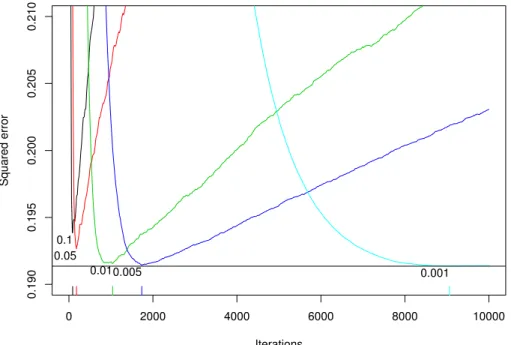
predictive performance than settingshrinkage=0.01. However, there are com-putational costs, both storage and CPU time, associated with setting shrink-ageto be low. The model withshrinkage=0.001 will likely require ten times as many iterations as the model withshrinkage=0.01, increasing storage and computation time by a factor of 10. Figure 3 shows the relationship between predictive performance, the number of iterations, and the shrinkage parameter. Note that the increase in the optimal number of iterations between two choices for shrinkage is roughly equal to the ratio of the shrinkage parameters. It is generally the case that for small shrinkage parameters, 0.001 for example, there is a fairly long plateau in which predictive performance is at its best. My rule of thumb is to set shrinkage as small as possible while still being able to fit the model in a reasonable amount of time and storage. I usually aim for 3,000 to 10,000 iterations with shrinkage rates between 0.01 and 0.001.
3.3
Estimating the optimal number of iterations
gbm offers three methods for estimating the optimal number of iterations after the gbm model has been fit, an independent test set (test), out-of-bag estima-tion (OOB), andv-fold cross validation (cv). The function gbm.perfcomputes the iteration estimate.
Like Friedman’s MART software, the independent test set method uses a sin-gle holdout test set to select the optimal number of iterations. Iftrain.fraction is set to be less than 1, then only thefirst train.fraction×nrow(data) will be used to fit the model. Note that if the data are sorted in a systematic way (such as cases for which y = 1 come first), then the data should be shuffled before running gbm. Those observations not used in the model fit can be used to get an unbiased estimate of the optimal number of iterations. The down-side of this method is that a condown-siderable number of observations are used to estimate the single regularization parameter (number of iterations) leaving a reduced dataset for estimating the entire multivariate model structure. Use
gbm.perf(...,method="test") to obtain an estimate of the optimal number
0 2000 4000 6000 8000 10000 0.190 0.195 0.200 0.205 0.210 Iterations Squared error 0.1 0.05 0.010.005 0.001
Figure 3: Out-of-sample predictive performance by number of iterations and shrinkage. Smaller values of the shrinkage parameter offer improved predictive performance, but with decreasing marginal improvement.
If bag.fraction is set to be greater than 0 (0.5 is recommended), gbm
computes an out-of-bag estimate of the improvement in predictive performance. It evaluates the reduction in deviance on those observations not used in se-lecting the next regression tree. The out-of-bag estimator underestimates the reduction in deviance. As a result, it almost always is too conservative in its selection for the optimal number of iterations. The motivation behind this method was to avoid having to set aside a large independent dataset, which reduces the information available for learning the model structure. Use
gbm.perf(...,method="OOB")to obtain the OOB estimate.
Lastly, gbm offers v-fold cross validation for estimating the optimal num-ber of iterations. If when fitting the gbm model, cv.folds=5 then gbm will do 5-fold cross validation. gbm will fit five gbm models in order to compute the cross validation error estimate and then will fit a sixth and final gbm model with n.treesiterations using all of the data. The returned model ob-ject will have a component labeled cv.error. Note that gbm.more will do additional gbm iterations but will not add to the cv.errorcomponent. Use
gbm.perf(...,method="cv")to obtain the cross validation estimate.
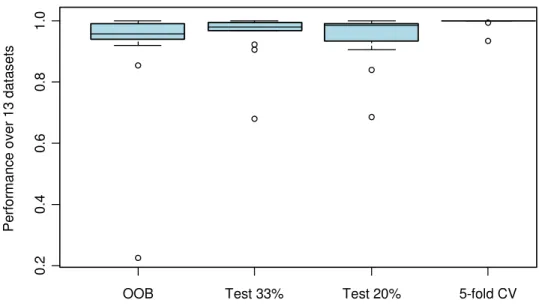
OOB Test 33% Test 20% 5-fold CV
0. 2 0. 4 0. 6 0. 8 1. 0
Method for selecting the number of iterations
P er fo rm an ce o ve r 1 3 da ta se ts
Figure 4: Out-of-sample predictive performance of four methods of selecting the optimal number of iterations. The vertical axis plots performance relative the best. The boxplots indicate relative performance across thirteen real datasets from the UCI repository. Seedemo(OOB-reps).
Figure 4 compares the three methods for estimating the optimal number of iterations across 13 datasets. The boxplots show the methods performance rela-tive to the best method on that dataset. For most datasets the method perform similarly, however, 5-fold cross validation is consistently the best of them. OOB, using a 33% test set, and using a 20% test set all have datasets for which the perform considerably worse than the best method. My recommendation is to use 5- or 10-fold cross validation if you can afford the computing time. Otherwise you may choose among the other options, knowing that OOB is conservative.
4
Available distributions
This section gives some of the mathematical detail for each of the distribution options that gbm offers. The gbm engine written in C++ has access to a C++ class for each of these distributions. Each class contains methods for computing the associated deviance, initial value, the gradient, and the constants to predict in each terminal node.
In the equations shown below, for non-zero offset terms, replacef(xi) with
4.1
Gaussian
Deviance P1 wi X wi(yi−f(xi))2 Initial value f(x) = P wi(yi−oi) Pw i Gradient zi=yi−f(xi) Terminal node estimatesPwi(y i−f(xi)) Pw i
4.2
AdaBoost
Deviance P1 wi X wiexp(−(2yi−1)f(xi)) Initial value 1 2log P yiwie−oi P(1−yi)w ieoi Gradient zi=−(2yi−1) exp(−(2yi−1)f(xi)) Terminal node estimatesP (2yi−1)wiexp(−(2yi−1)f(xi)) Pw iexp(−(2yi−1)f(xi))
4.3
Bernoulli
Deviance −2P1 wi Xwi(yif(xi)−log(1 + exp(f(xi))))
Initial value log
P wiyi Pw i(1−yi) Gradient zi=yi− 1 1 + exp(−f(xi)) Terminal node estimates
P wi(yi−pi) Pw ipi(1−pi) wherepi= 1 1 + exp(−f(xi)) Notes:
For non-zero offset terms, the computation of the initial value requires Newton-Raphson. Initializef0= 0 and iteratef0←f0+
P wi(yi−pi) Pw ipi(1−pi) wherepi= 1 1 + exp(−(oi+f0)) .
4.4
Laplace
Deviance P1w i Pwi|y i−f(xi)|Initial value medianw(y)
Gradient zi= sign(yi−f(xi)) Terminal node estimates medianw(z)
medianw(y) denotes the weighted median, defined as the solution to the equation Pw iI(yi≤m) Pw i = 12
gbm() currently does not implement the weighted median and issues a
warning when the user uses weighted data withdistribution="laplace".
4.5
Quantile regression
Contributed by Brian Kriegler.
Deviance 1 P wi αP yi>f(xi)wi(yi−f(xi)) + (1−α)P yi≤f(xi)wi(f(xi)−yi)
Initial value quantile(wα)(y)
Gradient zi=αI(yi> f(xi))−(1−α)I(yi≤f(xi)) Terminal node estimates quantile(wα)(z)
Notes:
quantile(wα)(y) denotes the weighted quantile, defined as the solution to the equation P wiI(yi≤q) Pw i =α
gbm() currently does not implement the weighted median and issues a
warning when the user uses weighted data withdistribution=list(name="quantile").
4.6
Cox Proportional Hazard
Deviance −2P wi(δi(f(xi)−log(Ri/wi))) Gradient zi=δi− X j δj wjI(ti≥tj)ef(xi) P kwkI(tk≥tj)ef(xk) Initial value 0
Terminal node estimates Newton-Raphson algorithm 1. Initialize the terminal node predictions to 0,ρ= 0
2. Letp(ik)= P jI(k(j) =k)I(tj≥ti)ef(xi)+ρk P jI(tj ≥ti)ef(xi)+ρk 3. Letgk=Pwiδi I(k(i) =k)−p(ik)
4. LetHbe ak×k matrix with diagonal elements (a) Set diagonal elementsHmm=Pwiδip
(m)
i
1−p(im)
(b) Set off diagonal elementsHmn=−Pwiδip
(m)
i p
(n)
i
5. Newton-Raphson updateρ←ρ−H−1g
Notes:
ti is the survival time and δi is the death indicator.
Ri denotes the hazard for the risk set, Ri=P N
j=1wjI(tj≥ti)ef(xi)
k(i) indexes the terminal node of observation i
For speed, gbm() does only one step of the Newton-Raphson algorithm rather than iterating to convergence. No appreciable loss of accuracy since the next boosting iteration will simply correct for the prior iterations inadequacy.
gbm() initially sorts the data by survival time. Doing this reduces the
computation of the risk set fromO(n2) toO(n) at the cost of a single up
front sort on survival time. After the model is fit, the data are then put back in their original order.
4.7
Poisson
Deviance -2 1 P wi Pw i(yif(xi)−exp(f(xi))) Initial value f(x) = logPw iyi Pw
ieoi
Gradient zi=yi−exp(f(xi)) Terminal node estimates log
Pw iyi P
wiexp(f(xi))
The Poisson class includes special safeguards so that the most extreme pre-dicted values aree−19 ande+19. This
References
[1] Y. Freund and R.E. Schapire (1997). “A decisitheoretic generalization of on-line learning and an application to boosting,”Journal of Computer and System Sciences, 55(1):119-139.
[2] J.H. Friedman (2001). “Greedy Function Approximation: A Gradient Boosting Machine,”Annals of Statistics 29(5):1189-1232.
[3] J.H. Friedman (2002). “Stochastic Gradient Boosting,”Computational Statistics and Data Analysis 38(4):367-378.
[4] J.H. Friedman, T. Hastie, R. Tibshirani (2000). “Additive Logistic Regression: a Statistical View of Boosting,”Annals of Statistics 28(2):337-374.
[5] G. Ridgeway (1999). “The state of boosting,”Computing Science and Statistics