Florida International University
FIU Digital Commons
FIU Electronic Theses and Dissertations University Graduate School
3-27-2015
Constructing Secure MapReduce Framework in
Cloud-based Environment
Yongzhi Wang
School of Computing and Information Sciences, [email protected]
Follow this and additional works at:http://digitalcommons.fiu.edu/etd
Part of theComputer Security Commons
This work is brought to you for free and open access by the University Graduate School at FIU Digital Commons. It has been accepted for inclusion in FIU Electronic Theses and Dissertations by an authorized administrator of FIU Digital Commons. For more information, please [email protected].
Recommended Citation
Wang, Yongzhi, "Constructing Secure MapReduce Framework in Cloud-based Environment" (2015).FIU Electronic Theses and Dissertations.Paper 2238.
FLORIDA INTERNATIONAL UNIVERSITY Miami, Florida
CONSTRUCTING SECURE MAPREDUCE FRAMEWORK IN CLOUD-BASED ENVIRONMENT
A dissertation submitted in partial fulfillment of the requirements for the degree of
DOCTOR OF PHILOSOPHY in COMPUTER SCIENCE by Yongzhi Wang 2015
To: Dean Amir Mirmiran
College of Engineering and Computing
This dissertation, written by Yongzhi Wang, and entitled Constructing Secure MapReduce Framework in Cloud-based Environment, having been approved in respect to style and intellectual content, is referred to you for judgment.
We have read this dissertation and recommend that it be approved.
_______________________________________ Xudong He _______________________________________ Geoffrey Smith _______________________________________ Bogdan Carbunar _______________________________________ Gang Quan _______________________________________ Jinpeng Wei, Major Professor Date of Defense: March 27, 2015
The dissertation of Yongzhi Wang is approved.
_______________________________________ Dean Amir Mirmiran College of Engineering and Computing _______________________________________ Dean Lakshmi N. Reddi University Graduate School Florida International University, 2015
© Copyright 2015 by Yongzhi Wang All rights reserved.
DEDICATION To my family.
ACKNOWLEDGMENTS
I would like to express my sincerest gratitude to all those who contributed to the success of my PhD study and the completion of this dissertation. Special thanks to the members of my committee, Drs. Xudong He, Geoffrey Smith, Bogdan Carbunar and Gang Quan for their insights and rigorous questioning that has resulted in the focus that resulted in this work. I especially would like to express my foremost gratitude to Dr. Jinpeng Wei who guided me through this process, going above and beyond in due diligence and patience.
I own a great debt to Dr. Sundaraja Sitharama Iyengar for his strongest support in the most difficult time during my PhD study, which helped me to go through the hardness. I am also grateful to Ms. Olga Carbonell for her consistent help and support in providing suggestions and preparing all the required paperwork.
Finally, I would like to thank my family. I thank my parents, Mr. Junjun Wang and Ms. Yanyun Dong, for their endless loves and supports. I also thank my wife, Ms. Lan Yu, for all her patience, understanding and sacrificing. Last but not least, I also thank my son, Qiaoze Wang, who gives me numerous moments of joy and the strength required to finish the research and to write this dissertation.
This dissertation is partially funded by the Florida International University Dissertation Year Fellowship.
ABSTRACT OF THE DISSERTATION
CONSTRUCTING SECURE MAPREDUCE FRAMEWORK IN CLOUD-BASED ENVIRONMENT
by Yongzhi Wang
Florida International University, 2015 Miami, Florida
Professor Jinpeng Wei, Major Professor
MapReduce, a parallel computing paradigm, has been gaining popularity in recent years as cloud vendors offer MapReduce computation services on their public clouds. However, companies are still reluctant to move their computations to the public cloud due to the following reason: In the current business model, the entire MapReduce cluster is deployed on the public cloud. If the public cloud is not properly protected, the integrity and the confidentiality of MapReduce applications can be compromised by attacks inside or outside of the public cloud. From the result integrity’s perspective, if any computation nodes on the public cloud are compromised, those nodes can return incorrect task results and therefore render the final job result inaccurate. From the algorithmic confidentiality’s perspective, when more and more companies devise innovative algorithms and deploy them to the public cloud, malicious attackers can reverse engineer those programs to detect the algorithmic details and, therefore, compromise the intellectual property of those companies.
In this dissertation, we propose to use the hybrid cloud architecture to defeat the above two threats. Based on the hybrid cloud architecture, we propose separate solutions to
address the result integrity and the algorithmic confidentiality problems. To address the result integrity problem, we propose the Integrity Assurance MapReduce (IAMR) framework. IAMR performs the result checking technique to guarantee high result accuracy of MapReduce jobs, even if the computation is executed on an untrusted public cloud. We implemented a prototype system for a real hybrid cloud environment and performed a series of experiments. Our theoretical simulations and experimental results show that IAMR can guarantee a very low job error rate, while maintaining a moderate performance overhead. To address the algorithmic confidentiality problem, we focus on the program control flow and propose the Confidentiality Assurance MapReduce (CAMR) framework. CAMR performs the Runtime Control Flow Obfuscation (RCFO) technique to protect the predicates of MapReduce jobs. We implemented a prototype system for a real hybrid cloud environment. The security analysis and experimental results show that CAMR defeats static analysis-based reverse engineering attacks, raises the bar for the dynamic analysis-based reverse engineering attacks, and incurs a modest performance overhead.
TABLEOFCONTENTS
CHAPTER PAGE
1. INTRODUCTION ... 1
1.1 Motivation and Contribution ... 1
1.2 Outline ... 6
1.3 Publications ... 6
2 PRELIMINARY KNOWLEDGE ... 7
2.1 MapReduce ... 7
2.2 Software Obfuscation ... 10
3 INTEGRITY ASSURANCE MAPREDUCE ... 11
3.1 System Motivation ... 11
3.2 System Architecture and Design Overview... 12
3.3 System Assumption and the Attacker Model ... 13
3.3.1 System Assumption ... 13
3.3.2 Attacker Model ... 15
3.4 System Design ... 15
3.4.1 Map Phase Integrity Check ... 16
3.4.2 Reduce Phase Integrity Check ... 20
3.5 Theoretical Study ... 26
3.5.1 Quantitative Analysis ... 26
3.5.2 Simulation Result ... 37
3.6 Optimal Parameter Searching Algorithms ... 40
3.6.1 Model the System as a Two-player Zero-sum Game ... 40
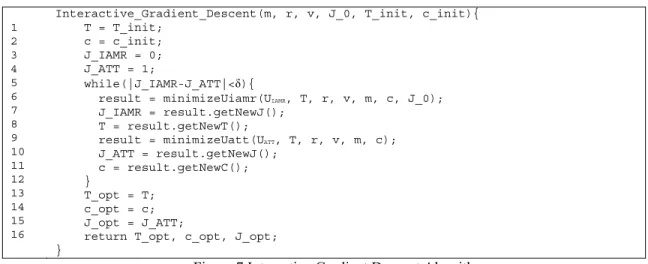
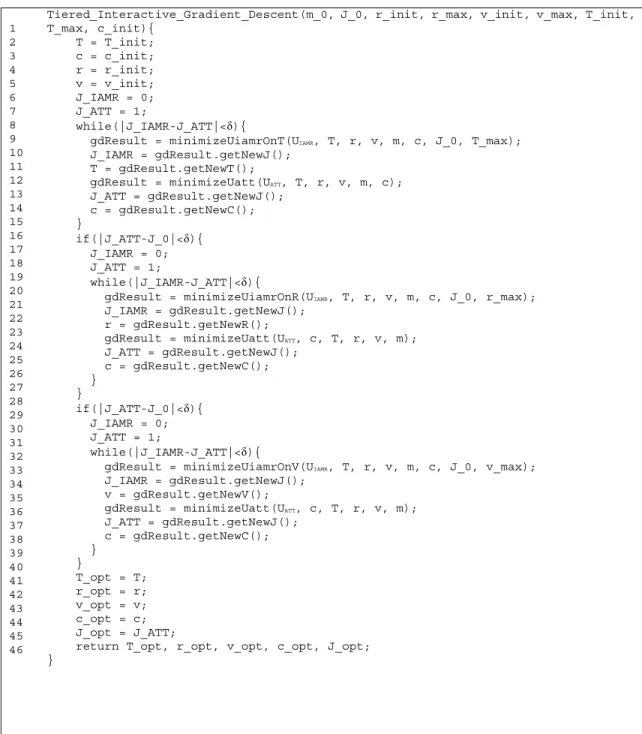
3.6.2 Interactive Gradient Descent Algorithm ... 42
3.6.3 Tiered Interactive Gradient Descent Algorithm ... 50
3.7 Experimental Results ... 57
3.7.1 Experiments on the Result Checking Technique ... 58
3.7.2 Experiments on the Parameter Searching Algorithm ... 63
3.8 Related Work ... 66
3.9 Summary ... 69
4 CONFIDENTIALITY ASSURANCE MAPREDUCE ... 71
4.1 System Motivation ... 71
4.2 Architecture and System Overview ... 76
4.3 System Assumptions and Attacker Model... 82
4.4 Design Details ... 84
4.4.1 Transforming the Original Condition ... 84
4.4.2 Inserting Fake Branch Statements ... 88
4.4.3 Speed up Control Flow Queries with the Continuous Cache ... 95
4.4.4 CFQ Function Encryption ... 97
4.4.5 Loop Transformation ... 98
4.6 System Implementation ... 109
4.6.1 Condition Transformation ... 109
4.6.2 Fake Branch Statement Insertion ... 110
4.6.3 Private Program Implementation ... 111
4.6.4 Hadoop Job Obfuscation ... 111
4.6.5 CFQ Function Encryption ... 112
4.6.6 Loop Transformation ... 113
4.6.7 Obfuscation Case Study ... 113
4.7 Experiments ... 116 4.7.1 Performance Test ... 117 4.7.2 Scalability Test ... 119 4.7.3 Discussion ... 122 4.8 Related Work ... 123 4.9 Summary ... 126 5 DISCUSSION ... 128
5.1 Integrity Assurance MapReduce ... 128
5.2 Confidentiality Assurance MapReduce ... 129
6 CONCLUSION ... 131
REFERENCES ... 133
LISTOFTABLES
TABLE PAGE
TABLE 1 IAMR System Modeling Parameters and Measurement Metrics ... 29
TABLE 2 Categories of Tasks Based on Assignment Conditions ... 34
TABLE 3 The Probability, Workload and Verifier Overhead of Each Category ... 35
TABLE 4 IAMR System Modeling Parameters for Reduce Phase ... 36
TABLE 5 The Job Error Rate, Overhead and Verifier Overhead of Wordcount Application with Map Phase Integrity Check ... 59
TABLE 6 The Performance of Map Phase IAMR ... 61
TABLE 7 The Performance of Reduce Phase IAMR ... 62
TABLE 8 Parameter Settings in TIGD Experiments ... 64
TABLE 9 Results in TIGD Experiments ... 64
TABLE 10 Hadoop Jobs Used in the Experiments ... 117
TABLE 11 CFQ Function Invocation Statistics and Cache-hit Rates ... 119
TABLE 12 Scalability Test with Word Count ... 120
TABLE 13 Scalability Test with Pi ... 121
LIST OF FIGURES
FIGURE PAGE
Figure 1 MapReduce Example: Word Count... 9
Figure 2 The Architecture of Integrity Assurance MapReduce ... 13
Figure 3 The Workflow of Integrity Assurance MapReduce ... 19
Figure 4 Locating Map Output Between Key 2 and Key 9 using Key Table ... 24
Figure 5 Workflow of IAMR in the Reduce Phase ... 25
Figure 6 Simulation of IAMR Analysis ... 38
Figure 7 Interactive Gradient Descent Algorithm ... 45
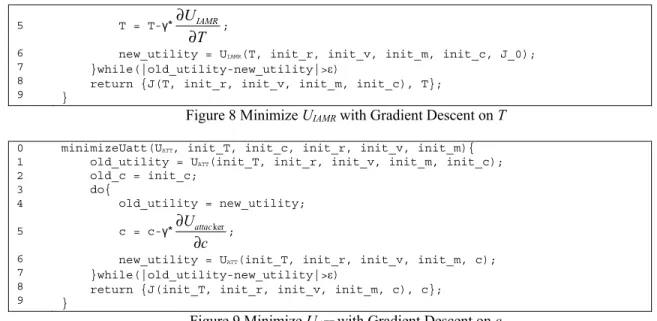
Figure 8 Minimize UIAMR with Gradient Descent on T ... 47
Figure 9 Minimize UATT with Gradient Descent on c ... 47
Figure 10 Tiered Interactive Gradient Descent Algorithm ... 53
Figure 11 Minimize UIAMR with Restricted Gradient Descent on T ... 54
Figure 12 Malicious Worker Elimination Progress ... 60
Figure 13 TIGD and IGD algorithm execution details ... 66
Figure 14 The Amazon Elastic MapReduce Use Case and the Attacker Model ... 72
Figure 15 Implementation of Canny Edge Detector Program ... 74
Figure 16 Condition Transformation of the Canny Edge Detector Implementation in Figure 15 ... 78
Figure 17 Execution Scenario of Confidentiality Assurance MapReduce ... 82
Figure 18 Condition Normalization Rule in Original Branch Statement Transformation 85 Figure 19 Example of Transforming Normalized Condition ... 87
Figure 20 Variable Range Evaluation Algorithm ... 90
Figure 21 Example of Inserting Fake Condition ... 95
Figure 23 CFQ Function Encryption ... 98 Figure 24 Example of Loop Transformation ... 100 Figure 25 Obfuscation of SortGenMapper.addKey in TeraGen job ... 115
ABBREVIATIONS AND ACRONYMS
AST Abstract Syntax Tree
AWS Amazon Web Services
CAMR Confidentiality Assurance MapReduce
CFQ Control Flow Query
DFS Distributed File System
EC2 Elastic Compute Cloud
EMR Elastic MapReduce
IAMR Integrity Assurance MapReduce
IGD Interactive Gradient Descent
LHS Left Hand Side
LTPG Loop Transformation Parameter Generation
RCFO Runtime Control Flow Obfuscation
RHS Right Hand Side
S3 Simple Storage Service
TIGD Tiered Interactive Gradient Descent
1. INTRODUCTION 1.1 Motivation and Contribution
Big Data becomes a buzzword in recent years when sizes of computing jobs scale up rapidly. The traditional computing model can no longer satisfy the speed requirement of such large-scale jobs. One direction to address such a challenge is to process computing jobs in a parallel approach. MapReduce is a generalized parallel computing paradigm that is widely used in various applications, including web search engine, geo-informatics system, and so on. MapReduce applications normally are deployed to a cluster consisting of hundreds or thousands of computation nodes to achieve high parallelism. However, most MapReduce customers cannot afford or do not want to invest in computer clusters of such a large scale. The emergence of Cloud Computing provides an economical alternative for those users to deploy arbitrary large-scale clusters on demand. With the public cloud, MapReduce users can deploy virtualized clusters on the public cloud based on their demands. They only need to pay the cloud vendor based on the resources they used. Such a new model not only reduces users’ IT infrastructure cost, but also boost their productivities.
Today, many cloud vendors are offering MapReduce computation services (e.g.,
Amazon Elastic MapReduce (EMR) and Microsoft Daytona) on their public clouds.
However, a lot of companies or individuals are still reluctant to move their computations to the cloud due to security concerns. Indeed, those worries are necessary. For instance, [1]
pointed out a security vulnerability that Amazon Elastic Compute Cloud (EC2) suffers
from: some members of the EC2 community can create and upload malicious Amazon
virtual machines that contain compromised applications, including MapReduce. Even worse, since the cloud service is opaque to the cloud user, the service providers and the government authorities might abuse their privileges to violate the security guarantee of the public cloud without notifying the cloud customer. For example, the 2013 global surveillance disclosure [18] revealed that the National Security Agency of the US government spies on the online activities of the Internet users with or without the knowledge of Internet corporations. Under such a situation, a service that can outsource computation without outsourcing security is needed to earn customers’ confidences.
The above vulnerabilities exist due to the reason that the entire service is deployed to the public cloud. In the case of MapReduce computing, the entire computation is performed on the public cloud. If the computation node in the public cloud is compromised, the computation integrity and the confidentiality can be compromised. In this dissertation, we specifically explore the following two security problems.
1. The result integrity problem.
The MapReduce job is usually executed on a cluster, which consists of a number of computing nodes. The task result of each node will contribute to the accuracy of the final job result. If any computation node on the public cloud is compromised, this node can return incorrect task results and therefore render the final job result inaccurate. In this situation, a solution is needed to protect the integrity of task results and the entire job result.
2. The algorithmic confidentialityproblem.
Nowadays, more and more companies are devising their innovative algorithms to provide various information services, including business analytics, geospatial
mapping/searching, bioinformatics analysis, image processing, etc. When those companies deploy their services to the public cloud [33][34][35][36], they hope that the algorithms in their services are not revealed to others, especially to their business competitors. However, if the hacker is able to compromise the public cloud, the hacker can perform reverse engineering attacks on the company’s program to find out its algorithmic details. By doing so, the hacker can offer a similar service with the same level of service quality. Under this situation, a solution is needed to protect the confidentiality of the algorithm details in the outsourced program.
In this dissertation, we propose to use a unified architecture, the hybrid cloud architecture, to address the above two problems. The hybrid cloud architecture consist of a trusted private cloud and an untrusted public cloud. The intuition of our solution is as follows. Since the private cloud is trusted, we can leverage its trustworthiness to obtain the control of the computation; meanwhile, we utilize the public cloud to perform the majority of computations. Since the private cloud can be deployed in users’ premises, users control the security.
Based on the hybrid cloud architecture, we propose separate solutions to address the result integrity problem and the algorithmic confidentiality problem. To address the result
integrity problem, we propose a novel MapReduce framework, called Integrity Assurance
MapReduce (IAMR). IAMR can guarantee high result integrity of MapReduce
computations, even if the computation is executed on a public cloud that contains malicious computing nodes. IAMR overlays MapReduce computations on the hybrid
technique to assure high result integrity of MapReduce computations. The result checking technique performs probabilistic task replication on the public cloud, performs probabilistic task verification on the private cloud, and maintains trust management for each worker to ensure the participating computing node are benign.
Our theoretical analysis shows that IAMR can guarantee a very low job error rate. For example, when we set the batch size as 50 and the replication probability as 0.5, we can guarantee less than 1% of job error rate when half of workers on the public cloud are malicious. Based on our theoretical analysis, we model the IAMR and the attacker as a two-player zero sum game and propose two algorithms to search for optimal parameter
values for IAMR: Interactive Gradient Descent (IGD) algorithm and Tiered Interactive
Gradient Descent (TIGD) algorithm. The IGD algorithm can find the parameter settings for IAMR based on the user’s accuracy requirement. The TIGD algorithm can find the parameter settings not only based on the user’s accuracy requirement, but also on user’s system restriction settings.
We implemented a prototype system that caters to a real hybrid cloud environment (a
hybrid cloud consisting of a local private cloud and Amazon public cloud1) and performed
a series of experiments to evaluate its performance. Our experimental results show that IAMR can guarantee a very low job error rate and maintain a moderate performance overhead. For instance, it introduces 19% to 83% of delay in the map phase depending on the replication probability, and 29% of delay in the reduce phase.
In order to address the algorithmic confidentiality problem, we propose the
Confidentiality Assurance MapReduce (CAMR) platform. CAMR performs a novel control
flow obfuscation technique called Runtime Control Flow Obfuscation (RCFO) on outsourced MapReduce jobs to hide information on program predicates and complicate the control flow graph. RCFO transforms each original MapReduce job program into two programs: the public program and the private program. The private program is executed on the trusted private cloud. It maintains the information of program predicates and determines the runtime control flow. The public program executes the majority computation on the public cloud, but it needs to query the private program to determine the runtime control flow. In order to further protect the control flow, RCFO also performs the
fake branch statements insertion method, the CFQ function encryption scheme and the
loop transformation technique to further raise the bar for reverse engineering attacks. To
reduce the performance overhead, RCFO maintains a continuous cache to reduce the
cross-cloud communication.
We developed a prototype system that caters to a real hybrid cloud environment (a
hybrid cloud consisting of a local private cloud and Amazon EMR2). Our prototype system
can automatically apply RCFO on MapReduce job programs and run the obfuscated job on the hybrid cloud environment. Our experimental results show that the average performance overhead ranges from 14.9% to 33.2% when the obfuscation degree increases from 0 to 1.0.
We declare that our solutions in this dissertation are not only restricted to MapReduce itself. Since MapReduce represents a wide class of outsourced computing paradigms, our solutions can be applied to a wide range of outsourced computing scenarios without major modification. The detailed discussion will be performed in Chapter 5.
1.2 Outline
The rest of this dissertation is organized as follows: Chapter 2 introduces the background knowledge involved in this dissertation. Chapter 3 presents the motivation, assumption, design details, experimental results, and the related work of the IAMR framework. Chapter 4 presents the motivation, assumption, design details, implementation details, experimental results, and the related work of CAMR framework. Chapter 5 discusses the generalization of our solutions to other outsourced computing scenarios. Chapter 6 makes the conclusion of this dissertation.
1.3 Publications
Based on our works in this dissertation, we published the following papers in peer-reviewed journals and conferences:
• Yongzhi Wang, Jinpeng Wei, "Toward Protecting Control Flow Confidentiality in
Cloud-based Computation", Elsevier Journal of Computers and Security. Volume 52, pp. 106-127, July 2015. Doi: 10.1016/j.cose.2015.04.005.
• Yongzhi Wang, Jinpeng Wei, Yucong Duan "Securing MapReduce Result
Integrity via Verification-based Integrity Assurance Framework". International Journal of Grid and Distributed Computing (IJGDC). Vol. 7, No. 6 (2014), pp.53-70
• Yongzhi Wang, Jinpeng Wei, Mudhakar Srivatsa "Cross Cloud MapReduce: A
Result Integrity Check Framework on Hybrid Clouds". International Journal of Cloud Computing (IJCC), Vol. 1, No. 1, 2013.
• Yongzhi Wang, Jinpeng Wei, Mudhakar Srivatsa, Yucong Duan, and Wencai Du.
Management Applications". The First International Workshop on Knowledge Management and Big Data Analytics (KMBA), Oct 6 - 9, 2013, Santa Clara, CA, USA.
• Yongzhi Wang, Jinpeng Wei, and Mudhakar Srivatsa. "Result Integrity Check for
MapReduce Computation on Hybrid Clouds". The 6th IEEE International Conference on Cloud Computing (IEEE CLOUD 2013), June 27 - July 2, 2013, Santa Clara, CA.
• Yongzhi Wang, Jinpeng Wei, Mudhakar Srivatsa. "Cross Cloud MapReduce: an
Uncheatable MapReduce". The 33rd IEEE Symposium on Security and Privacy (IEEE S&P), San Francisco, CA, May 20-23, 2012. Poster paper.
• Yongzhi Wang, Jinpeng Wei. "VIAF: Verification-based Integrity Assurance
Framework for MapReduce". The Fourth IEEE International Conference on Cloud Computing (CLOUD 2011), July 4-9, 2011, Washington DC.
2 PRELIMINARY KNOWLEDGE
In this chapter, we introduce the background knowledge involved in this dissertation. Specifically, we will briefly introduce MapReduce and discuss basic concepts about software obfuscation.
2.1 MapReduce
MapReduce [5] is a parallel programming model for large-scale dataset processing. It usually has been implemented as a distributed system deployed on a cluster. In MapReduce,
each computation request issued by the user is called a job. Each job is usually broken
and a number of workers. The master controls the entire computation by managing jobs, scheduling tasks, and maintaining load balance, etc. Workers are hosts that contribute computation resources to execute tasks assigned by the master. In MapReduce, data are stored in the Distributed File System (DFS). Each job usually retrieves input data from the DFS and stored the result back to DFS when the job is finished.
Each MapReduce job consists of two consecutive phases: the map phase and the reduce
phase. The workers executing tasks in the map phase are called mappers. The tasks
executed in the map phase are called map tasks. The workers executing tasks in the reduce
phase are called reducers. The tasks executed in the reduce phase are called reduce tasks. In the map phase, the input data are fetched from the DFS and are divided into several chunks. Each data chunk will be assigned to one map task and processed independently. Each map task result consists of a collection of tuples with the format of <key, value>. The tuples in each task result are sorted by key. Each task result is stored in its worker’s local storage, and will be used as input in the reduce phase. In the reduce phase, each reduce task
only processes the map task output tuples with certain keys. Therefore a special function
called partition determines to which reduce task a map task output tuple should be assigned based on the content of the “key” in that tuple. Such a process is called shuffle. After the
shuffle process, each reduce task will execute the reduce function to aggregate assigned
tuples and generate the job output.
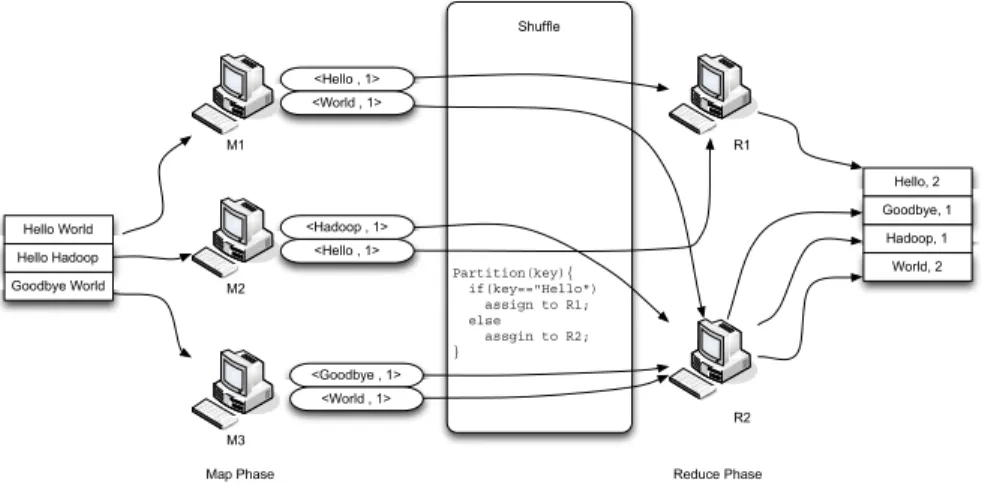
Figure 1 shows the workflow of a MapReduce application, Word Count. Word Count computes the number of occurrences of each word in the provided input text files. In the example, the input data are stored in the DFS and are broken down into three chucks. Each chuck is sent to a mapper (M1, M2 or M3). Each map task computes the occurrence of each
input chuck and stores the result in its local storage. After that, the map task output goes through the shuffle function partition and sends the tuples with key “Hello” to reducer R1 and sends other tuples to reducer R2. Each reduce task aggregates tuples with the same key (i.e., accumulate the occurrences of each distinct key) and outputs its result tuples into DFS. The generated result indicates the occurrences of each word in the input text files.
Figure 1 MapReduce Example: Word Count
MapReduce is usually deployed on a computer cluster in order to process computing tasks in a parallel manner. However, many users such as small companies and individuals do not want to or cannot afford investing a dedicated cluster to process MapReduce jobs. Fortunately, public cloud vendors offer services that enable users to set up virtualized clusters on demand and execute their MapReduce jobs on those clusters. As a return, the cloud vendor charges the cloud user based on the cluster size and the use time.
For example, Amazon EC2 and Windows Azure allow users to rent virtualized
computers and run their applications on it. By using such a service, a MapReduce user can set up her own cluster based on the computation size and pay the fee only based on the resources she uses. Such a service still requires the cloud user to setup a cluster. Cloud vendors also offer MapReduce computing services (e.g., Amazon Elastic MapReduce),
Hello World Goodbye World Hello Hadoop <Hello , 1> <World , 1> <Hadoop , 1> <Hello , 1> <Goodbye , 1> <World , 1> Partition(key){ if(key=="Hello") assign to R1; else assgin to R2; } M1 M2 M3 R1 R2 Map Phase Shuffle Reduce Phase Hello, 2 Hadoop, 1 Goodbye, 1 World, 2
which automatically set up MapReduce clusters based on user’s requirement. With such services, users do not have to setup cluster by themselves. They only need to upload their jobs and data to the public cloud and initiate the computation. The cloud service will take care of other details.
2.2 Software Obfuscation
Software Obfuscationgenerally refers to a process of transforming a program P through
an obfuscator O into a program O(P) such that O(P) has the equivalent functionality of P
(correctness), is resilient against a reverse engineering attack (resilience) and is not significantly slower than P (efficiency). Collberg et al. [17] classify obfuscation methods into three categories: lexical obfuscation, data obfuscation and control flow obfuscation. Lexical obfuscation typically scrambles the program identifiers to confuse the attacker. Data obfuscation modifies the data structure to hide the information. Control flow obfuscation transforms the program to make the control flow unintelligible. Because control flow obfuscation is the most direct way of protecting the confidentiality of the program algorithm, in this dissertation, we explore that direction to protect the algorithmic confidentiality.
3 INTEGRITY ASSURANCE MAPREDUCE
In this chapter, we present the design of the Integrity Assurance MapReduce. We start with the system motivation. Following the motivation, we describe our system architecture and the design overview, define the system assumption and the attacker model, present the design details, and perform the theoretical analysis. Based on the theoretical analysis result, we present algorithms to search for the optimal system parameter values. We present the experimental results and discuss the related work in the last part of this chapter.
3.1 System Motivation
MapReduce usually requires to be deployed to a large computer cluster. Since many small companies or individuals cannot afford or do not want to invest in computer clusters of such a large scale, they usually will choose to outsource their computation to public computing service platforms such as Volunteer Computing [45][37] and Cloud Computing [38][39]. Volunteer Computing platforms have long been blamed as unaccountable due to the existence of malicious nodes [40][41]. Cloud Computing platforms have better security guarantee than volunteer computing platforms. However, it is still possible for a skillful hacker to breach the security of commercial clouds. For instance, [42] pointed out a security vulnerability that Amazon EC2 suffers from: some members of the Amazon EC2 community can create and upload malicious Amazon Machine Images which, if widely used, can flood the community with hundreds of infected virtual machine instances. Along the same line, Bugiel et al. [2] perform a systematic study of the security status of public AMIs and report various vulnerabilities of Amazon EC2.
The above threats put MapReduce customers in a dilemma: using public clouds has economic advantage but incurs the risk of getting incorrect computation results; on the
other hand, avoiding the public cloud completely (i.e., running everything “in house” or in the private cloud) can guarantee result accuracy, but there will be less economic benefit. Under this situation, an economical solution that can guarantee high result integrity is needed.
3.2 System Architecture and Design Overview
Based on the above motivations, we propose the Integrity Assurance MapReduce (IAMR). IAMR employs a hybrid cloud architecture, which consists of a private cloud and a public cloud. The master that is in control of the entire computation runs on a private cloud. Workers run on the untrusted public cloud. Since the public cloud is untrusted, the workers deployed to it can be malicious. We introduce a special type of workers, called
verifiers, and deploy them on the private cloud. The verifier is trusted. It can be used to detect malicious workers on the public cloud. The key rationale of our solution is to retain control and the trust “at home”, while delegating the more resource-intensive computations to the public cloud. Since our research focuses on the integrity of computation, we assume the DFS is trusted. Therefore, we deploy the DFS on the public cloud (See Section 3.3) to reduce cross-cloud data transmission. The architecture of IAMR is shown in Figure 2.
Based on this architecture, we leverage the trustworthiness of the master and the verifiers to propose the result checking technique to enhance the result integrity. The result checking technique performs probabilistic task replication on the public cloud, performs probabilistic task verification on the private cloud, and maintains a trust management mechanism for each worker to distinguish malicious workers from benign workers. Due to the different characteristics of the map phase and the reduce phase, IAMR performs the result checking technique on different objects. In the map phase, the technique is
performed on map tasks. In the reduce phase, IAMR factors each reduce task into multiple
sub-tasks and applies the technique on sub-tasks.
Figure 2 The Architecture of Integrity Assurance MapReduce
3.3 System Assumption and the Attacker Model 3.3.1 System Assumption
We make the following assumptions based on our proposed architecture. We assume that the private cloud is deployed within the user’s organization, and thus is trusted. In other words, the master and the verifiers are trusted. On the public cloud, we assume the infrastructure provided by the cloud provider, such as the virtualized hardware and the network, is trusted. However, we assume virtual images used by the cloud user are untrusted. That makes the workers running on the public cloud untrusted. Since our system only focuses on the MapReduce computation, we assume the Distributed File System (DFS) is trusted. For example, the integrity of DFS can be guaranteed by the storage integrity assurance techniques, such as [3] and [4].
In IAMR, the master requires that each worker who runs a task/sub-task to submit the hash value of the task/sub-task result to the master. We assume the submitted hash value to be consistent with the actual task/sub-task output. Such an assumption can be realized by applying the commitment-based protocol proposed in [8] (i.e., the previous worker commits the task output to the master by the hash value. The later worker who takes the previous task’s output as input will calculate the hash value of input, and send the
calculated hash value to the master. The master compares the two hash values to ensure the previous worker does not lie).
Finally, we assume that the MapReduce job has the following properties:
Property 1. The tasks/sub-tasks of that job should be deterministic. In other words,
multiple executions of the same task/sub-task by honest workers should return the same result.
Property 2. The job should be big enough so that it will be broken down into a big number
of tasks. For those jobs, each task’s result should equally contribute to the entire job’s result. We also assume that accepting a small number of incorrect task results should only affect the job’s precision, without affecting its correctness. Therefore, the portion of tasks that return correct results determines the precision of a job result.
We argue that Property 2 is a reasonable assumption. Firstly, one primary reason for the cloud user to use public clouds is that the computation workload is significantly large. Otherwise, the user would perform the computation locally. Secondly, high parallelism is a necessary factor to address the challenge of computing load scaling up. In parallel computations, each task result usually is equally important to the job result. In fact, such classes of jobs widely exist in the field of statistics, machine learning, and data mining. For some computations whose accuracy can be affected by any incorrect task results, that computation usually can be broken down into multiple jobs. For the jobs whose accuracy is not sensitive, we can perform our proposed solution on those jobs. For other jobs, we can compute the job on the trusted private cloud. For example, some big data analytics
computation is performed in a chain of MapReduce jobs (e.g., Apache Pig3, Apache
Mahout4, etc.). Our solution can be applied to the jobs that satisfy Property 2. For jobs that do not satisfy Property 2, we can compute those jobs on the private cloud directly.
3.3.2 Attacker Model
We model the attacker as an intelligent adversary that controls the malicious nodes on the public cloud. It receives and correlates information collected by malicious nodes and coordinates them to cheat at the best time in order to introduce as many errors as possible to the final result without being detected. For example, if the master replicates the same task on two malicious workers, the adversary can instruct them to return the same erroneous results (i.e., to collude), so that simply comparing the results cannot detect that error. We call such malicious workers collusive workers.
3.4 System Design
In both the map phase and the reduce phase, IAMR defines three types of tasks: the
original task, the replication task, and the verification task. The original task and the replication task are executed on the public cloud. The verification task is executed in the verifier on the private cloud. The replication task repeats the original task’s work to validate the original task’s result. Since replication tasks are executed on untrusted workers, the verification tasks are launched non-deterministically to verify replication tasks’ results in order to detect collusive workers.
In the map phase, the replication and verification task completely repeat the original map task’s work. In the reduce phase, each original reduce task is broken down into a number of small parts (see Section 3.4.2). Each replication/verification reduce task repeats only one part of the original reduce task. Each part of a reduce task is called a sub-task. In both the
Map phase and the Reduce phase, IAMR performs a probabilistic two-layer check
technique on each returned original task/sub-task result. Specifically, IAMR performs probabilistic task replications on the public cloud and performs probabilistic task verifications on the private cloud. In addition, IAMR maintains trust management for each worker. The master only accepts a worker’s task/sub-task results in a batch when all the tasks/sub-tasks in that batch do not fail on probabilistic two-layer checks.
The task/sub-task assignment in IAMR differs from the original MapReduce. Rather than passively waiting for the worker to ask for task/sub-task, the master of IAMR randomly selects a worker to assign a certain task/sub-task. When a worker finishes its assigned task/sub-task, IAMR requires the worker to return the result. In order to reduce the communication cost, the worker only returns the result’s hash value to the master. Since the replication task and the verification task are only used to evaluate their original task’s correctness, the actual result of the replication/verification task/sub-tasks will not be stored back to the DFS.
Since map and reduce phases have different characteristics (i.e., some jobs may contain a small number of reduce tasks. Yet each reduce task contains a significant workload), we propose different designs for the two phases. We present the system design for the map phase in Section 3.4.1 and the design for the reduce phase in Section 3.4.2.
3.4.1 Map Phase Integrity Check
IAMR applies the two-layer check on each returned map task result. In the first-layer,
IAMR creates a replication task and assigns the task to another randomly selected worker. The replication task is assigned with a rule called hold-and-test. The hold-and-test rule is that a replicated task can be assigned to a worker only when the master receives its original
task result. By doing so, even if an original task is assigned to a malicious worker, the malicious worker cannot safely commit a cheat. This is because by the time the malicious worker receives a task, it cannot tell whether a replicated task corresponding to the assigned task will be generated, and whether this replicated task will be assigned to another collusive worker. If that malicious worker cheats and a replicated task is generated and assigned to a benign worker, the cheat will be detected (For the detailed analysis of the hold-and-test technique, please refer to Section 3.5.1). When a worker returns the replication task result, IAMR compares the original task result with the replication task result. If the two results are not consistent, at least one of the two workers is cheating. IAMR will generate a verification task and assign it to a verifier to determine the malicious worker(s). If the two results are consistent, IAMR will perform the second-layer check. In the second-layer check, IAMR creates a verification task and assigns it to a verifier to verify the consistent results. If the consistent results are different from the verification task result, we know that the two mappers are both malicious. The goal of the second-layer check is to detect collusive workers.
Performing two-layer check on each task will incur significant performance overhead. To reduce the overhead, IAMR creates the replication task and the verification task with a certain probability. Specifically, for each original map task, IAMR creates the replication
task with a replication probability, and creates a verification task with a verification
probability.
Since the two-layer check is performed in a probabilistic manner, there is a possibility that some incorrect results can evade the check. In order to overcome this drawback, IAMR performs a trust management technique to improve the job accuracy. The idea is that the
master performs the probabilistic two-layer check on each mapper for a period of time. The master accepts a mapper’s original task results in a batch when that mapper did not fail any two-layer check during that period. The number of original tasks on which the master performs the probabilistic two-layer check before accepting their results is called the batch
size. Notice that since the two-layer check is performed in a probabilistic manner, the
original task that is not replicated or verified is also counted for the batch size. However, the replicated task will not be counted. The intuition of this mechanism is that observing a mapper for a longer period without detecting misbehave gives the master more confidence that the mapper is benign.
In order to achieve the above mechanism, the master maintains a history cache for each mapper to record the original tasks (not the replicated task) that this mapper has completed and passed the probabilistic two-layer check. Specifically, the history cache for each mapper records the task id and the hash value of the task results of the original map tasks that mapper has computed. Note that the actual task result is buffered in the mapper’s local storage. When a mapper accumulates batch size of tasks in its history cache without failing any two-layer check, the mapper becomes trusted temporarily. The master thus accepts all the task results buffered in the mapper’s local storage and empty its history cache. After that, this mapper becomes untrusted again. The mapper has to accumulate another batch size of tasks on its history cache without failing the two-layer check in order to submit the next batch results to the master. If a mapper fails any two-layer check before submitting batch size of tasks, the mapper is determined to be malicious and is added to a black list. Meanwhile, the task results buffered in this mapper’s local storage are discarded, and the corresponding tasks cached in the history cache will be rescheduled.
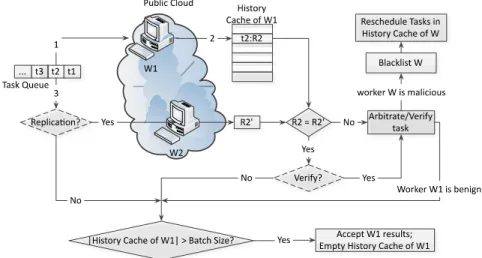
Figure 3 presents the workflow of IAMR. In this figure, W1 and W2 are two workers randomly chosen from the public cloud. The “Arbitrate/Verify task” step is a step executed by the verifier on the private cloud. The remaining components in the figure are all performed on the master. Notice that in this figure, IAMR applies the hold-and-test rule to assign the original and the replicated tasks: the “replication” decision (step 3) is made after
W1 returns the original task result R2 (step 2). This assignment sequence makes it difficult for malicious workers to collude because they cannot predict whether the replication task will be assigned to another collusive worker. A detailed discussion about this rule is presented in Section 3.5.1.
Figure 3 The Workflow of Integrity Assurance MapReduce
If the total number of original map tasks in a job is less than the batch size, IAMR will directly assign all tasks to verifiers, since no mapper can accumulate batch size of tasks in its history cache and thus guarantee expected accuracy. This will not incur significant workload to the verifier if the batch size is a reasonable number. Meanwhile, the accuracy is still guaranteed. If the number of the original map tasks is large enough, a higher batch size will guarantee a higher accuracy, as shown in our simulation in Section 3.5.2.
3.4.2 Reduce Phase Integrity Check
In the reduce phase, the approach presented in Section 3.4.1 can be directly applied only if the number of reduce tasks is large enough (i.e., bigger than the batch size). However, in some applications, the reduce task number is smaller than the batch size, even though the computing workload for each reduce task is significant. For instance, the word count application with the default partition function contains only one original reduce task. However, this single task will process intermediate results generated from each map task, which can be a heavy workload. For example, our experiments showed that in a word count job processing a file with 628 Megabyte of text, the single reduce task will process 2.7M of records (1.07GB of data) in the input and generate 598K of records in the output, and take 262 seconds to complete. In this case, directly verifying the entire reduce task is expensive in terms of computation and communication cost. Therefore, we propose to break down each original reduce task into many sub-tasks and apply the two-layer check technique on each sub-task. We present the technical details in Section 3.4.2.1. Based on the basic
reduce phase integrity check technique, we present the request bucketing technique in
Section 3.4.2.2 to limit the sub-task number into a small value without sacrificing the result accuracy.
Break Down Reduce Tasks into Sub-tasks
Our reduce phase integrity check design is based on the following intuition. Remember
that each record in MapReduce computation is in a format of <key, value> tuple. We
observe that both the map task and the reduce task outputs are sorted by key. For each key in the reduce output, if we can precisely pinpoint the map output tuples that are related to that key, we can reproduce the portion of the reduce task that is related to that key. We call
each portion of reduce task as sub-task. Therefore, each original reduce task can be divided into multiple sub-tasks, each of which is related to one key. By applying two-layer check to each sub-task, we can guarantee high accuracy of the original reduce task. Here, we temporarily define each sub-task to cover one key. We will extend this concept later for practicality reason.
Our reduce phase integrity check uses the same high-level ideas as the map phase. Each original sub-task returns its result to the master in the form of a hash value (we call each returned sub-task result as a report). The master applies the first-layer (i.e., replication) and second-layer (i.e., verification) check on each report with replication probability and verification probability, respectively. The generation of a replication sub-task is decided after the report of an original sub-task is returned to the master (i.e., hold-and-test). We regulate that an original reduce task result is accepted by the master only when all its sub-tasks pass the probabilistic two-layer check, which is essentially a trust management mechanism. The batch size is therefore the number of sub-tasks in the original reduce task. If the number of sub-tasks in an original reduce task is smaller than the batch size, IAMR directly generates a verification reduce task to verify the entire original reduce task.
The above idea only works conceptually. In order to make it practical, we need to extend the concept of sub-tasks and reports, and overcome the following three challenges.
1) Creating a sub-task for each key would incur significant overhead. It is because in
many cases, the amount of keys in a reduce task can be huge (e.g., a word count job with 628 Mega bytes of input text file will generate more than 598,000 keys).
2) The accuracy only relies on the two-layer checks of the sub-task reports submitted
these reports to the master, the master would have no way to detect the error.
3) The replication and verification sub-tasks should efficiently locate the portion of
map task output with the key they are interested in.
We address the first challenge by extending the concept of report and sub-task to cover a range of consecutive keys, instead of just one key. With this improvement, the number of sub-tasks will be reduced.
For the second challenge, IAMR requires that consecutive reports in the original reduce task must overlap in one key. In addition, the first and last report in each original reduce task should cover the first and the last key of the task output, respectively. The master will check those requirements when it receives reports. Since the reduce task result is sorted by key, this requirement ensures that no key in the output is skipped in the reports. In case that the master does not know the first and the last key in the original reduce task output, the master can insert dummy records in the job input data, which will generate reduce result tuples with predictable smallest and largest keys. For instance, when the type of the key in a job is integer, the master can insert special records with their keys as
Integer.MIN_VALUE and Integer.MAX_VALUE, respectively. When the reduce task is
complete, the job output can be sanitized by removing the output records related to those dummy input records.
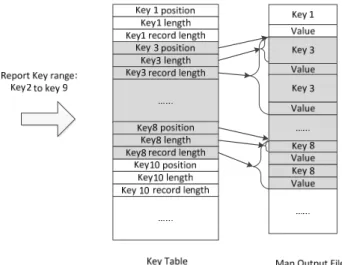
For the third challenge, each map task in IAMR builds a key table to facilitate the record look up in the map task output, as shown in Figure 4. When a sub-task wants to fetch the map output within a certain key range (e.g., Key 2 to Key 9) from the map task output file, it will locate the position through the key table of that task. In the original MapReduce, each map task stores the map output file locally, which consists of key-value pairs sorted
by key. Usually, the lengths of keys and values vary. Notice that multiple key-value pairs can have the same key (e.g., Key 3). For brevity, we call consecutive key-value pairs in the map output file with the same key as a block. Each record in the key table corresponds to a block in the map output file. It has three fields, indicating the start position of the block, the length of the key, and the length of the block. Since the lengths of keys and values vary, each access to a key on the map output file needs to go through the key table, which has the fixed record length. The key table records are sorted by key, IAMR can apply binary search to look up the records within the request key range. However, each key comparison in the binary search needs to fetch the key in the map output file through the key table. When the binary search finds the keys (e.g., Key 3 through Key 8) between the request range (e.g.,
Key 2 to Key 9), the key position and the record length direct the reducer to fetch the portion of map output.
Since it is the mapper who creates the key table, a malicious mapper can manipulate the content in its key table to fool IAMR. As a defense, IAMR requires each map task to submit the hash value of its key table to the master along with that of task result. Therefore the key table has the same accuracy as the map task result. The consistency between the hash value and the actual key table can be guaranteed by the commitment-based protocol [8].
Figure 4 Locating Map Output Between Key 2 and Key 9 using Key Table
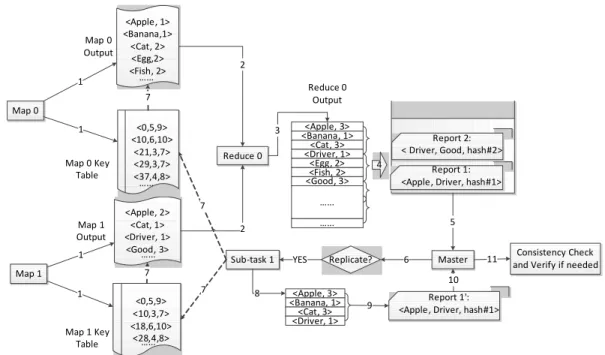
Figure 5 shows the workflow of IAMR in the reduce phase when executing the word count application. Remember the word count application calculates the frequency of each word appeared in a collection of text files. For simplicity, our example only has two map tasks (map 0 and map 1) and one original reduce task (reduce 0). As Figure 5 shows, each
map task creates a key table (Step 1). When the original reduce task (reduce 0) starts to
output (step 3), sub-task reports (e.g., Report 1 and Report 2) are sent to the master
sequentially. The report format is <start key, end key, hash value of the output records covered in the key range> (Step 4). Since consecutive reports must overlap in one key
(According to the solution of challenge 2), the key “Driver” appears in both report 1 and
report 2. When the master receives report 1 (Step 5), it launches the first-layer check by initiating a replication sub-task (with replication probability). The replication sub-task fetches input with a key range of (Apple, Driver) from each map task (map 0 and map 1) through key tables (Step 7). When it completes reducing (Step 8), the replication sub-task sends a report to the master (Step 9), and the master compares the report with the original sub-task report (Step 10). If they are consistent, a second-layer check is performed to verify
the consistent results. The verification sub-task will be created if necessary (Step 11). Map 0 Map 1 Reduce 0 <Apple, 1> <Banana,1> <Cat, 2> <Egg,2> <Fish, 2> <Apple, 2> <Cat, 1> <Driver, 1> <Good, 3> <0,5,9> <10,6,10> <21,3,7> <29,3,7> <37,4,8> <0,5,9> <10,3,7> <18,6,10> <28,4,8> 1 1 1 1 <Apple, 3> <Banana, 1> <Cat, 3> <Driver, 1> <Egg, 2> <Fish, 2> <Good, 3> …... Reduce 0 Output Report 1: <Apple, Driver, hash#1>
Report 2: < Driver, Good, hash#2> 2 2 3 Master 5 Replicate? 6 Sub-task 1 YES …... 4 7 7 <Apple, 3> <Banana, 1> <Cat, 3> <Driver, 1> 8 7 7 Map 0 Output Map 1 Output Report 1': <Apple, Driver, hash#1> 9
10
Consistency Check and Verify if needed 11 Map 1 Key Table Map 0 Key Table …... …... …... …...
Figure 5 Workflow of IAMR in the Reduce Phase
Request Bucketing to Reduce Sub-task Number
One drawback of reduce phase design in Section 3.4.2.1 is that in order to achieve high accuracy, IAMR will generate a large number of sub-tasks. Each sub-task will be executed as an individual reduce task. Such a reduce task needs to connect to each map tasks, locate the map output position, and fetch only a small portion of data. In addition, setting up and tearing down each sub-task consume a certain amount of resource. As a result, a big
number of sub-tasks can introduce a big performance delay. We propose the request
bucketing technique to merge multiple sub-tasks into one reduce task to improve
performance, without sacrificing the accuracy.
The idea of request bucketing is as follows. We create several replication buckets ready to receive replication sub-task requests. Each bucket has a limited capacity. Whenever the master receives a sub-task report from original reduce task and decides to generate a
replication sub-task (first-layer check), instead of generating a reduce task just for that
single sub-task, the master randomly chooses a bucket and stores the sub-task request to
this bucket. When a bucket achieves its capacity, the master generates a replication reduce task to compute all the sub-task requests in that bucket. Meanwhile, the bucket is emptied. The master will randomly choose a worker to execute this replication task. The replication task will send multiple replication sub-task reports back to the master, each of which will correspond to one original sub-task report. When a report passes the first-layer check, the master will apply the second-layer check to those sub-tasks. Similar to the replication buckets, the master also creates several verification buckets to accumulate the verification sub-task requests. When a verification bucket is full, the master will generate a verification reduce task to compute all the requests in that bucket.
Although the request bucketing technique merges multiple sub-tasks into one reduce task, it does not undermine the accuracy with the following reasons. First, the two-layer check is still performed on each original reduce sub-task. Second, the replication and verification sub-tasks are assigned to workers randomly.
3.5 Theoretical Study 3.5.1 Quantitative Analysis
Since in the map phase and the reduce phase, IAMR performs the same two-layer check technique (only on different objects), we can use a similar model to analyze both phases. Even though the request bucketing technique merges sub-tasks to execute, the assignment of sub-task requests to the buckets and the assignment of buckets to the workers are all randomized. This is equivalent to the effect of assigning each sub-task request to workers randomly.
Based on the above reason, we perform a unified analysis on both the map phase and the reduce phase in Section 3.5.1.1. The only difference is that in the map phase, our analysis focuses on “tasks”, while in the reduce phase, our analysis focuses on “sub-tasks”. To simplify our expression, we use the term “task” at some places. However, the reader should understand that it refers to the “sub-task” if it is discussing the reduce phase. We discuss security analysis specific for the request bucketing technique in Section 3.5.1.2
Unified Analysis on the Map Phase and the Reduce Phase
We first analyze the adversary strategy of malicious workers. Based on that, we perform quantitative analysis on accuracy and overhead.
Adversary Strategy: We denote the malicious worker fraction on the public cloud as m.
We assume that the adversary controls all malicious workers. In other words, all malicious workers are collusive, and there exists only one collusive group. Assuming that the goal of the adversary is to inject as many errors as possible and yet not to reveal the malicious workers, we analyze the strategy of the adversary under IAMR as follows. Suppose a task is assigned to a malicious worker, two cases are possible for the adversary.
Case 1 If the adversary has not seen a similar task (i.e., the one with the same input) before, it has to make a decision on whether to cheat, and remembers the decision, the current task and the returned result. Due to the existence of hold-and-test rule, the adversary is not allowed to defer the decision to the time that it sees the replica of the current task. If the decision is not to cheat, the worker is obviously safe (i.e., not to be caught). If the decision is to cheat, the malicious worker can survive the first-layer check only when either the current task is not replicated, or the replica of the current task is assigned to another malicious worker.
Case 2If the adversary has seen a similar task before, it is assured that the current task is a replication task. It can simply ask the worker to take the same action for the current task as the one it has seen before. In this case, it is guaranteed that the malicious worker will survive the first-layer check.
Since in Case 2 the adversary just follows its decision made previously in Case 1, the risk of revealing a malicious worker is essentially determined by the adversary’s decision in Case 1. Because the master controls task assignment and replication in a randomized manner, the adversary in Case 1 cannot predict whether cheating at the current task is safe or not. On the other hand, since the master constantly applies the two-layer check on tasks in a randomized manner, the adversary cannot tell whether cheating at the current task has a smaller chance of detection than cheating at other tasks. Therefore, the only thing the adversary can do in Case 1 is to make a random guess/predict in terms of whether the cheat can be detected or not. We model the adversary’s decision making behavior in Case 1 as a
random variable, cheat probability, marked as c. Note that adversaries who cheat rarely
(e.g., only cheat once in hundreds of tasks) can still fit in our model because we can set c as a small value close to 0.
We study the accuracy and the overhead of IAMR by modeling the system and performing the probability analysis. We model the system as two participating parties: the
malicious worker, modeled with the malicious worker fraction (m) and the cheat
probability (c); the IAMR, modeled with the replication probability (r), the verification
probability (v) and the batch size (T). The system modeling parameters and the
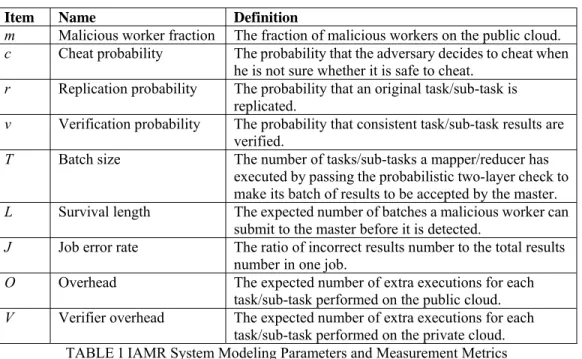
measurement metrics are shown in TABLE 1. We perform a series of probabilistic analysis and present our analysis result in Theorem 1.
Item Name Definition
m Malicious worker fraction The fraction of malicious workers on the public cloud.
c Cheat probability The probability that the adversary decides to cheat when
he is not sure whether it is safe to cheat.
r Replication probability The probability that an original task/sub-task is
replicated.
v Verification probability The probability that consistent task/sub-task results are
verified.
T Batch size The number of tasks/sub-tasks a mapper/reducer has
executed by passing the probabilistic two-layer check to make its batch of results to be accepted by the master.
L Survival length The expected number of batches a malicious worker can
submit to the master before it is detected.
J Job error rate The ratio of incorrect results number to the total results
number in one job.
O Overhead The expected number of extra executions for each
task/sub-task performed on the public cloud.
V Verifier overhead The expected number of extra executions for each
task/sub-task performed on the private cloud.
TABLE1IAMR System Modeling Parameters and Measurement Metrics
Theorem 1.Assuming that the assignment of tasks/sub-tasks is uniformly distributed
across all workers on the public cloud, and the detected malicious workers are not
added to the black list, the probability for a malicious mapper/reducer to survive after executing n original tasks is
S
n=
(1
−
cr
+
crm(1
−
v))
n(1) The survival length of a malicious mapper/reducer is
) 1 /( T T S S L= − (2) The job error rate is
J
=
m(c(1
−
r)
+
crm(1
−
v))(1
−
cr
+
crm(1
−
v))
T−1 (3) Let
− = + − − + + − − − = 2 0 ) 1 ( ) 1 ( 1 T k k S m mv m rc rcmv rcm rcv rv rc UO=(m+r−mr−m(1−r)ST−1+mr(1−v)(1−c+cm)(rc−rcm+rcmv) Sk
k=0 T−2
) /U (4)The verifier overhead for each task/sub-task is
V=((1−m)r(cm+v−vmc)+mr(c+v−vc−cm+cmv)ST−1+rcm(1−m+mv)(1+rv−rvc) Sk k=0
T−2
) /U(5)Proof: Sn,the probability of a malicious mapper/reducer to survive after executing n
original tasks/sub-tasks is the probability summation of all permutations on n independent events. Each event should fall into one of the below three cases.
1. The worker does not cheat. The probability in this case is (1-c);
2. The worker cheats, but the task/sub-task is not replicated. The probability in this
case is c(1-r);
3. The worker cheats, and the task is replicated. However, the other worker
executing the replication task/sub-task can collude with it. When the consistent results pass the first-layer check, the task result is not verified. The probability in this case is crm(1-v).
By summing up the probability of different permutations of above three cases on n independent events, we have
= − = − − − − − − = n i i n j j i n j i n c c r crm v j i n i n S 0 0 )) 1 ( ( )) 1 ( ( ) 1 (By applying the multinomial theorem, we have
S
n=
(1
−
cr
+
crm(1
−
v))
nSetting n=T, we have ST, the probability that a malicious mapper/reducer submit a batch
of task/sub-task to a master. The probability that a malicious worker can submit exactly k
the (k+1)th batch) is ( ) (1 )
T k
T S
S ⋅ − .
The expected number of batches a malicious worker can submit (survival length) is
therefore. T T T k k T S S S S k L − = − ⋅ =
∞ = 1 ) 1 ( ) ( 0We are now deriving the value of J. Suppose the batch size is T, the scenario that the master accepts exactly k out of T incorrect task results consists of (T-k) events that the worker does not cheat, and k events that the worker cheats but undetected. That is
Δk= T T−k k i (1−c)T−k(c(1−r))i(crm(1−v))k−i i=0 k
The expected number of tasks returning incorrect results in a batch (i.e. in T tasks) is
E = (k× Δk) k=0 T
= (k× T T−k k i (1−c)T−k(c(1−r))i(crm(1−v))k−i i=0 k
) k=0 T
The batch error rate of T tasks is therefore T E
e = /
Since the assignment of tasks/sub-tasks on the public cloud is uniformly distributed on all workers and the malicious worker fraction m stays constant, we have the job error rate
= ∗ + (1 − ) ∗ 0 = ∗
= (
− (1 − ) (1 − ) (1 − ) )
We are now simplifying the equation J. By reorganizing equation J and applying
= (
− (1 − ) ( (1 − ) (1 − ) ))
= (
− (1 − ) ( (1 − ) + (1 − )) )
To simplify the formula representation, we define
= 1 − = (1 − )
By replacing k with T-l, we have
= (( − ) ) Expanding , we have = ( ( − 1)! ! ( − − 1)! ) = − 1 = ( − 1 + − 1 )
By binomial definition, we have = (!∙( )!
)! . By factorial definition
n!=(n+1)!/(n+1), we have 0!=1!/1=1 and (-1)!=0!/0=1/0. By replacing with
= − 1 +( − 1)! ! (−1)! = − 1 + 11 0 = ( ( + ) + 0) = ( (1 − ) + (1 − ))(1 − + (1 − ))
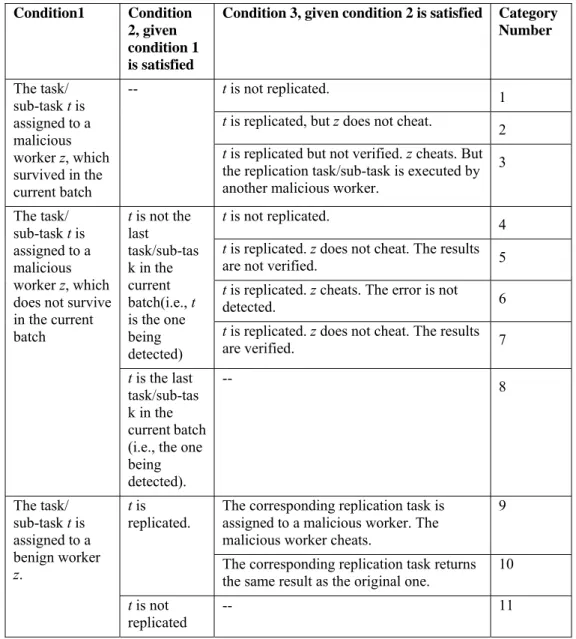
In order to calculate the overhead and the verifier overhead, we divide the original tasks/sub-tasks into 11 different categories based on different conditions the task/sub-task may encounter, as shown in TABLE 2.
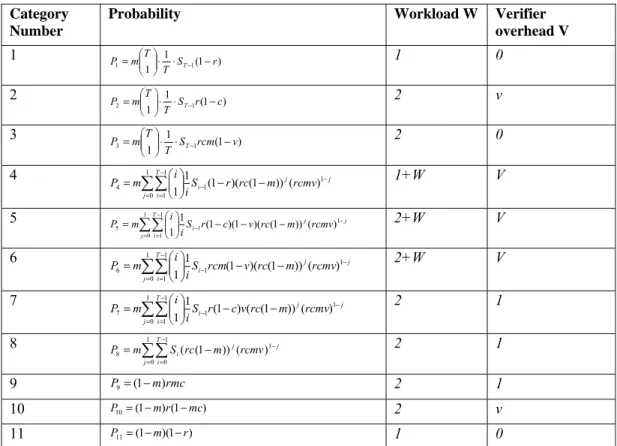
We summarize the probability, workload and verifier overhead of each category in
TABLE 3. Here we define workload as the number of executions each task/sub-task has to
run on the public cloud, marked as W. It includes the original task/sub-task execution and
the task/sub-task overhead. Therefore, we have W=1+O, where 1 corresponds to the
original task/sub-task and O corresponds to the overhead.
Since the categories summarized in TABLE 3 are mutual exclusive and exhaustive, we
have ∑ = 1.
We calculate the expected workload by combining the probability and workload under each category.
Condition1 Condition 2, given
condition 1 is satisfied
Condition 3, given condition 2 is satisfied Category Number The task/ sub-task t is assigned to a malicious worker z, which survived in the current batch -- t is not replicated. 1
t is replicated, but z does not cheat. 2
t is replicated but not verified. z cheats. But the replication task/sub-task is executed by another malicious worker.
3 The task/ sub-task t is assigned to a malicious worker z, which
does not survive in the current batch t is not the last task/sub-tas k in the current batch(i.e., t is the one being detected) t is not replicated. 4
t is replicated. z does not cheat. The results
are not verified. 5
t is replicated. z cheats. The error is not
detected. 6
t is replicated. z does not cheat. The results
are verified. 7
t is the last task/sub-tas k in the current batch (i.e., the one being detected). -- 8 The task/ sub-task t is assigned to a benign worker z. t is
replicated. The corresponding replication task is assigned to a malicious worker. The malicious worker cheats.
9
The corresponding replication task returns the same result as the original one.
10 t is not
replicated -- 11
Category Number
Probability Workload W Verifier
overhead V 1 1 0 2 2 v 3 2 0 4 1+W V 5 2+W V 6 2+W V 7 2 1 8 2 1 9 2 1 10 2 v 11 1 0
TABLE3The Probability, Workload and Verifier Overhead of Each Category
) 1 ( 1 1 1 1 S r T T m P ⋅ ⋅ T − = − ) 1 ( 1 1 1 2 S r c T T m P ⋅ ⋅ T − = − ) 1 ( 1 1 1 3 S rcm v T T m P ⋅ ⋅ T − = − j j i j T i rcmv m rc r S i i m P − − = − = �