Electricity demand forecasting
Assessment of the draft Electricity Demand and
Generation Scenarios (EDGS)
NZIER report to MEUG
14 May 2015
L13 Grant Thornton House, 215 Lambton Quay | PO Box 3479, Wellington 6140 Tel +64 4 472 1880 | [email protected]
© NZ Institute of Economic Research (Inc) 2012. Cover image © Dreamstime.com
NZIER’s standard terms of engagement for contract research can be found at www.nzier.org.nz.
While NZIER will use all reasonable endeavours in undertaking contract research and producing reports to ensure the information is as accurate as practicable, the Institute, its contributors, employees, and Board shall not be liable (whether in contract, tort (including negligence), equity or on any other basis) for any loss or damage sustained by any person relying on such work whatever the cause of such loss or damage.
About NZIER
NZIER is a specialist consulting firm that uses applied economic research and analysis to provide a wide range of strategic advice to clients in the public and private sectors, throughout New Zealand and Australia, and further afield.
NZIER is also known for its long-established Quarterly Survey of Business Opinion and Quarterly Predictions.
Our aim is to be the premier centre of applied economic research in New Zealand. We pride ourselves on our reputation for independence and delivering quality analysis in the right form, and at the right time, for our clients. We ensure quality through teamwork on individual projects, critical review at internal seminars, and by peer review at various stages through a project by a senior staff member otherwise not involved in the project.
Each year NZIER devotes resources to undertake and make freely available economic research and thinking aimed at promoting a better understanding of New Zealand’s important economic challenges.
NZIER was established in 1958.
Authorship
This paper was prepared at NZIER by David de Boer It was quality approved by Mike Hensen
Contents
1. Our assessment ... 2
1.1. Are the EDGS relevant ... 2
1.2. A good time to get it right ... 5
1.3. The EDGS forecasts ... 7
1.4. What do we suggest... 8
1.5. Key issues for consumers... 8
2. Responses to MBIE ... 10
Tables Table 1 EDGS development summary ... 4
1.
Our assessment
1. The Ministry of Business, Innovation & Employment (MBIE) is seeking
submissions on the Electricity Demand and Generation Scenarios ( EDGS), a consultation paper that describes eight scenarios for electricity demand and generation over the period 2015 to 2050. The EDGS is to be used by the Commerce Commission when it evaluates Transpower proposals for major capital investment in the transmission network. Schedule D of the Transpower capex IM details the need for these scenarios which will replace the 2010 Statement of Opportunities (SOO) that we understand are being used in the absence of a final MBIE version of EDGS.
2. The Ministry is seeking feedback from stakeholders via 10 specific questions
from the EDGS consultation paper. We have set out our responses on these questions in section 2 of this report and in the sections below we also provide our comments on the approach of the Ministry in this (their third) attempt to
define potential scenarios to guide transmission investment requirements.1
1.1.
Are the EDGS relevant
3. The Ministry has had the EDGS process in development for more than 4 years.
This period has overlapped with the finishing up of a period of major investment by Transpower in the transmission grid. The 2015 version of the EDGS was preceded by a first draft in 2012 and a second draft in 2013. The delay with publishing final scenarios has been partly attributed to there being no major plans for transmission investments.
First EDGS – 2012
4. The first draft EDGS published in 2012 by the Ministry were built on a limited set
of scenarios that reflected a longer term ‘grid equilibrium’ view. Demand forecasts were built from the demand growth assumptions that were published in the 2011 MED Energy Outlook (essentially a steady 1.2% pa growth throughout the period). The original 2012 EDGS did include a high level consideration of peak demand at both national and regional level – using the
2011 Transpower forecasts for peak demand.2
5. The generation forecasts in the draft 2012 EDGS were limited to 4 reasonably
simple scenarios (a reference case and 3 variations). Distributed generation capacity was held constant at 2011 levels.
6. New generation was forecast using the revised GEM model and a narrow set of
resource (fuel) assumptions that resulted in wind being the dominant generation choice. The 2011 update of generation costs in the GEM model carried the caveat that a high level of uncertainty remained about the results with an estimate of +/- 30% around the central estimate.
1 Previous attempts were published in the 2012 EDGS consultation paper and the Energy Insight in 2013. 2
Energy Outlook - 2013
7. The draft EDGS were updated in 2013 and published as the MBIE Energy Outlook
(EO). The 2013 EO included a base case scenario that was very similar to the 2012 reference case. The demand forecast in the 2013 EO was changed downwards from the 2012 EDGS (reduced from 1.2% pa growth to 1.1%) while high growth (1.3% pa) and a low growth (0.9% pa) scenarios were added. The reduction in demand growth was forecast to be in less energy intensive sectors of the economy. The EO noted that demand growth for energy had slowed after 2004 to be 0.5% on average.
8. Other than the optimistic demand outlook the EO was notable for the limite d
supply side scenarios – with three generation scenarios that were built around assumptions regarding geothermal availability, fossil fuels costs and the timing and implementation of carbon emissions agreements.
9. The possibility of Tiwai Point closing was introduced in the 2013 EO - the closure
was assumed to be complete by 2018.
May 2015 EDGS
10. The forecasts seem to suggest recent flat demand will revert to steady growth of
around 1 percent at the beginning of the forecast period. Six of the eight scenarios are based on medium growth assumptions for household numbers, demand per household GDP and solar energy uptake.
11. They do however retreat from the wider regional scope and peak demand
forecasts that the original publication included. Forecasts of regional pe ak demands are specifically excluded.
Our main concerns
12. Our main comments on the EDGS are that:
forecast growth in electricity demand seems optimistic in comparison the
average rate of change in electricity demand over the past five years
the absence of regional peak demand signals and the mixed messages in
paragraphs 44 to 48 about how Transpower peak demand is used in and reconciled to EDGS peak demand forecasts reduce the usability of the EDGS forecasts to the Commission for assessing Transpower capital expenditure proposals
13. We note that MBIE has undertaken to consider and address some aspects of
these issues in its response to stakeholder feedback at the EDGS workshop held
on 21 April.3 However this submission is based on the EDGS consultation paper
released before the workshop. In the following paragraphs we explain our views on these issues in more detail.
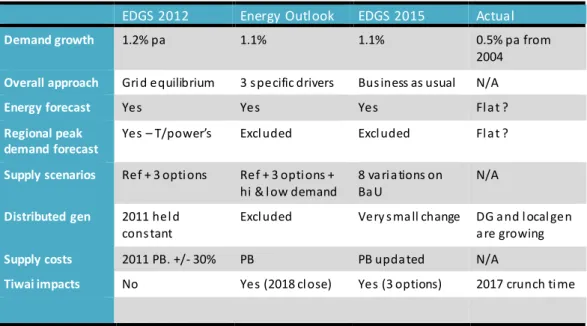
14. We have tried to capture the key assumptions/elements from each of the three
EDGS drafts in the following table to illustrate what we see as a fairly rigid and optimistic outlook. We have commented on actual recent outcomes that are relevant to each of the forecast assumptions/elements.
3
See: http://www.med .govt .nz/secto rs-industries/energy /en ergy-mod elling/mod ellin g/el ectricity-d emand-and-generation-scenarios/stakeholder-workshop-21-april-2015
Table 1 EDGS development summary
EDGS 2012 Energy Outlook EDGS 2015 Actual
Demand growth 1.2% pa 1.1% 1.1% 0.5% pa from 2004
Overall approach Gri d equilibrium 3 s pecific drivers Bus iness as usual N/A
Energy forecast Yes Yes Yes Fl a t ?
Regional peak demand forecast
Yes – T/power’s Excl uded Excl uded Fl a t ?
Supply scenarios Ref + 3 opti ons Ref + 3 opti ons + hi & l ow demand
8 va ri a tions on Ba U
N/A
Distributed gen 2011 hel d cons tant
Excl uded Very s ma ll change DG a nd l ocal gen a re growing
Supply costs 2011 PB. +/- 30% PB PB upda ted N/A
Tiwai impacts No Yes (2018 cl ose) Yes (3 options) 2017 crunch ti me
Source: NZIER
15. The consumer environment for electricity consumption and peak demand in
2015 is different than that of pre 2010 and what has emerged is that the short and medium term future environment will change further. Consumers increasingly have different options for sourcing and consuming electricity which are likely to alter the pattern and size of peak demand.
16. The need to have an independent check and balance of the forecasts that are
used to justify transmission investment remains as important however. The prudence of the Commission capex approvals depends on their ability to conduct an independent appraisal and to maintain the efficiency of the whole system. The persistence of the flat to declining demand trend exposes the existing network to being less used and with higher cost per consumer than expected. Adding further to that situation is not a desirable outcome.
17. By defaulting to Transpower forecasts for national and regional peak demand
the Ministry is placing considerable burden on those parties who evaluate any capex proposals that Transpower may provide to the Commission for approval. Interested parties will need to be able to not only examine the capex proposal but also the Transpower peak demand forecasts that underpin the capex.
18. At this stage of the process we are left with several serious questions. Firstly by
forecasting only national energy consumption the EDGS are short changing the very process that they are meant to be fulfilling. Also the EDGS have for 5 years persisted with an optimistic demand outlook which continues to run counter to the real world as it unfolds. Therefore, we are left wondering whether the latest scenarios, and indeed the whole process, are simply out of sync with reality and out of date. If this is the case then it leaves the detail as being less fit-for-purpose in Transpower capex decision making processes.
1.2.
A good time to get it right
19. The importance of timeliness for this consultation should not be misunderstood
or discounted. The Commission is about to start a review of the IM’s for distribution companies. An essential input to its deliberations is that the IM’s need to be fit for purpose in the future scenarios that are agreed as most likely to eventuate. Also, the need for EDGS type of forecasts, out-dated or not, as a test for Transpower capex applications may be highlighted as essential input into the wider Transpower IM’s.
20. Regardless of the needs that emerge from the IM review, the need for a
structured independent view of possible electricity demand futures remains as important however. Transmission and distribution network performance needs to be configured and operated to meet consumer demand for their desired quality and quantity of electricity. This varies by customer class, by region, by service type and by the options that consumers have for energy supply. Increasingly they may be able to generate/store some or all of their own electricity needs.
21. The EA have their own view of possible demand and supply side technology
futures that (we presume) will contribute to how they develop their views on the way transmission and distribution pricing should be restructured going forward. There needs to be a way for interested parties to assess their views of possible futures and the impacts of pricing changes on those futures.
22. There is a growing level of uncertainty about where demand for electricity could
track in the future. It seems to us that EA, Transpower and MBIE each have differing views. The potential for change with the consumer side dynamics is placing increasing pressure on supply side economics and operations which together places greater importance on forecasting possible futures.
23. Per household demand for electricity has been declining. There are several
possible explanations for this but what is important for the EDGS to explicitly consider whether the decline is likely to reverse in the foreseeable future.
24. The following paragraphs (23 to 25) are a lift out from an advisory memo we
recently provided to MEUG regarding the fitness for purpose of the Input Methodologies that the Commission use to regulate the revenues of regulated
networks. These views could equall4y be applied to the fitness for purpose of the
draft EDGS forecasts.
Twin pressures – flattening demand and disruptive
supply-side change
25. Declining demand growth for energy, climate change concerns, strong
growth of renewable local generation of electricity, energy storage systems and demand management as well as the use of smart technology in the operational management of grids have all combined to jump start what is now regarded as potentially the most profound changes to the energy
4
See MBIE Household sales-based electricity cost data on web at http://www.med .govt .nz/sectors-industri es/energy /en ergy-modelling/data/prices/elec tricity-prices and document UL http://www.med.govt .nz/secto rs-industries/energy /en ergy-modelling/data/prices/elec tricity-prices/s ales-based- resid ential-pric es.pdf
industries since the initial development of the networks. These changes appear to be neither short term nor cyclical. They are structural, long term and are changing the economics of this energy ‘eco-system’. It will get more complex and messy. Interestingly, disruption is not limited to the energy industry but is also visible in a number of others, including finance and telecommunications.
26. Overseas, questions are now being asked about whether electricity markets
regulated or not, are meeting today’s consumer needs and what sorts of changes are required to meet future outcomes. There is concern that if each of technology, markets and regulation do not keep pace with the accelerating rate of change then suboptimal outcomes for all concerned could well result. We share these concerns and believe that the timing of the IM review is the appropriate and provides the opportunity for us all, to take stock of whether the existing IMs will limit the benefits to consumers that will flow from these changes. We believe that greater benefit will arise from a deliberate ‘re-tooling’ of the IM regulatory structures that currently appear to favour certainty over improved consumer outcomes.
27. Regulators in other countries are examining in detail how their energy
sectors are performing and whether changes to regulations are required in light of this disruption – we believe that this is the opportunity for the Commission to do the same – a wider rather than a narrow review is required.
28. The Commission has responded to our (and others) views regarding the system
changes that are emerging and they are in the process of considering how the scope of the IM review should be reshaped in response. We strongly believe that the EDGS scenarios should likewise be reshaped to reflect the potential for these same changes. As they currently sit - forecasting a ‘business as usual’ resumption of steady demand growth as the likely future will simpl y not do.
29. We note that MBIE has responded to the feedback from the EDGS workshop by
accepting several actions including5:
adding a scenario that reflects higher uptake of new technology -this would
consider more solar PV, electric vehicles, and residential wood burning.
reduce the projection of residential electricity demand per household in the
base case and the high growth case and also explore data sources to improve the proposed residential electricity demand model
work with Transpower and other relevant parties to create its own process
to verify Transpower’s regional and peak demand forecasts
30. This all suggests to us that, to be fit for purpose, the scenarios of possible demand and supply futures should reflect the realities and uncertainties of the demand environment that is emerging (such as – demand growth has been flatter than expected, demand location is important, customer requirements for quality and quantity of supply are changing) as well as the increased accessibility of distributed generation options that could rapidly replace central generation. Now is the time to get this right.
5
Paraphrased from http://www.med.govt.nz/s ectors-industries/en ergy /energy-mod ellin g/modell ing/el ectric ity-demand-and-generation-scenarios/stakeholder-workshop-21-april-2015
1.3.
The EDGS forecasts
31. Given our comments above regarding the heightened probability of a future that
is some distance away from ‘business as usual’ what specifically do we see as possible improvements to the 2015 draft EDGS and what are our suggestions for a way forward.
32. Firstly we question the role of the EDGS forecasts in the Commission decisions
about Transpower capex (which is directly connected to the prices that Transpower charges for use of its transmission grid). In our view the draft forecasts have a low level of macro demand credibility for the reasons we set out above. They are missing the essential detail on regional demand and the capacity of regionally located generation of any type.
33. They also have only partial consideration of the potential for disruptive
technology and demand side activities to change the shape of the future. In a similar fashion there is only limited consideration of the disruptive consequences of Tiwai Point closing or reducing energy offtake. We acknowledge that the system impacts would be hard to pin down but a continuation of business as usual seems unlikely to us.
34. The other aspect that troubles us is that considerable activity is unfolding in the
energy-regulation space that will impact the shape of demand and generation in the near future. Transmission and distribution pricing reviews are likely to result in a reallocation of costs across consumers which in turn would likely see a demand response. This activity needs to be undertaken with a well-founded view of the possible ‘demand/generation’ futures and uncertainties agreed across system participants. While system participants will have differing views on aspects of the system that are driven by their objectives and incentives, it makes little sense to us to have views of the future that cannot be reconciled.
35. Our views on the reality of the changes that are underway are consistent with
recent advice from MBIE. In its brief to incoming Ministers – October 2014, MBIE highlighted that material change was already underway and that the changes would bring opportunities to improve the economic performance in the energy sector.6 In a similar fashion discussions and presentations at the Smart Grid Forum have highlighted the likelihood of earlier rather than later adoption of
technical change in the electricity sector.7
36. At this point we would make mention of a very similar (but larger!) process to
the EDGS and the MBIE Energy Outlook that takes place in the US. In its April 2015 Outlook the Energy Information Administration (EIA) has changed the timing and content of the forecasts to reflect the dynamics of the changes that are taking place and re-shaping energy markets. In addition to their major updates they now publish 2 yearly updates of a ‘short version’ Outlook to keep pace with emerging changes. They too have a ‘business as usual’ reference case
6
See http://www.mbie.govt.nz /about-us/publications/BIMs/2014-bims/energy-resources.pdf)
7
See http://www.mbie.govt.nz /about-us/publications/BIMs/2014-bims/energy-resources.pdf) for MRP’s view on how soon electric vehicles will be on NZ road en-masse – half a million by 2025 whereas MBIE is picking 2040 for that many in their reference case.
that reflects what is ‘known’ as well as the probable changes to regulation,
technologies and markets.8
37. We are not advocating a similar approach for MBIE but the scope and flexibility
of the EIA approach to energy system modelling demonstrates the type of approach that we believe is needed to improve the scenario forecasts fitness for purpose – which is to provide the Commission with an ‘arms-length’ assessment of the requirement for investment in the transmission network to assist the Commission to make decisions Transpower proposals that benefit consumers.
1.4.
What do we suggest
38. To improve the fitness for purpose of the EDGS forecasts MBIE should:
Implement the actions accepted by MBIE after the workshop and
summarised in paragraph 28 above
develop a forecast approach that explicitly considers:
the expected level of variation in future electricity demand and
generation, preferably with some assessment of the relative likelihood of scenarios or of different outcomes within the forecast range,
the expected location of demand and supply as Transpower
investments are essentially about correcting the mismatch between the location of generation and demand, and
analysis of the potential that factors may add measurable uncertainty
to the forecasts but are not included explicitly in the forecast because the data is not available or does not reflect their expected impact.
Describe the degree of independence/correlation for the various
assumptions and provide a rating of their relative likelihood of different combinations of the assumptions to make it easier for the Commission to consider the risks and uncertainty in Transpower capital expenditure proposals.
1.5.
Key issues for consumers
39. Pulling all these requirements together suggests to us that MEUG should argue
that there needs to be a ‘whole of system’ view and that MBIE needs to think about a forecasting approach that will capture the dynamics of the electricity system, rather than just components of it. This is the type of approach that is emerging in the US.
40. Any one of the many variables, or combinations of vari ables in the system can
affect the system overall and disrupt the demand/supply combinations. We are thinking that the ultimate development of the EDGS forecasting approach would
8
The National Energy modelling system used by the EIA for developing its Outlook makes extensive use of modules (sub models) that develop supply and demand scenarios for each type of energy activity. Each activity is characterised by a range of factors that shape the activity. For example residential demand is characterised by 24 different end user services, 3 types of housing, 50 end user technologies and is described by 9 different regions.
need to accommodate possible futures for any or all of the variables in the system, as follows: Transmission variables Distribution variables GXP Direct connect - Drivers - cogen Local Gen Commercial Industrial Household
Demand & pricing
Demand & pricing
Demand & pricing
Drivers & elasticities
GIP
Generation variables
Drivers & elasticities Drivers & elasticities
2.
Responses to MBIE
To give our advice focus and be able to provide input on the matters that we think need attention, we use the MBIE question structure to submitters as the backbone.
Question 1: Do you agree with this description of the purpose of the EDGS, including the material in the appendix?
In principle we agree with the description of the purpose of the EDGS forecasts as
described in the section “Purpose of the EDGS9” and “Appendix 2: Role of the EDGS in
regulating Transpower’s capital expenditure10”. We do however suggest that the
intent of this purpose is to provide the Commerce Commission with an “arms length” set of forecasts for electricity generation and demand. Other than assessing capital expenditure proposals by Transpower, the Commission can also use the forecasts to separate the task of defining the need for future transmission network investment from the task of assessing whether the Transpower proposals meet these requirements efficiently. We qualify this agreement as follows.
For a set of forecasts to be useful in assessing a Transpower proposal we suggest they would need to fully consider:
the expected level of variation in future electricity demand and generation,
preferably with some assessment of the relative likelihood of scenarios or of different outcomes within the forecast range,
the expected location of demand and supply as Transpower investments
are essentially about correcting the mismatch between the location of generation and demand, and
analysis of the potential that factors may add measurable uncertainty to
the forecasts but are not included explicitly in the forecast because the data is not available or does not reflect their expected impact.
We agree that Transpower and the Commerce Commission need the flexibility to develop and consult on alternative demand and generation scenarios as the EDGS forecasts “age” or if they do not reflect the context of a Transpower proposal. However the EDGS forecast include explicit assumptions about the location of future generation and implicit assumptions about the location of future demand. These assumptions provide a basis for describing how regional peaks might be expected to change over time.
We suggest that these could and should be communicated in the EDGS as part of the “arms-length advice” to the Commerce Commission about factors affecting the evolution of the need for transmission capacity. This dynamic approach is widely used overseas and requires regular updates to adequately capture the changes as they evolve. We suggest that MBIE should plan to resource itself to meet this need.
9 Paragraphs 35 to 40, pp 14 to 15. 10
Question 2: In the absence of regional and prudent peak demand projections being a part of the EDGS, the Ministry would like to ask for your feedback on the best way to independently verify regional and prudent peak demand projections.
We find the phrase “independent verification” difficult to apply to the peak demand of the EDGS forecasts. As the EDGS forecasts seem to be developed using an iterative process with Transpower it seems difficult to separate the elements of the EDGS forecasts into an independent Ministry view and a Transpower dependent view. Even if this separation could be made it does not seem to be relevant to the issues faced by the Commission in using the EDGS forecast as the basis for assessing Transpower capital expenditure proposals.
We suggest that, in using EDGS to assess Transpower proposals, the real issues for the Commission is the extent to which both the EDGS/Transpower forecasts of the location of peak supply and demand are accepted by stakeholders and the
differences between stakeholders and Transpower views are understood. This will then allow the Commission to focus its assessment on the efficiency of the
Transpower proposal in addressing an agreed supply demand mismatch, rather than having to form a view on the predicted mismatch as part of the assessment of the investment proposal.
We further suggest that as the owner of the EDGS and in view of the iterative process used by the Ministry and Transpower to develop annual and peak demand
forecasts11:
the Ministry needs to explicitly link its generation and energy demand
scenarios to Transpower's peak demand forecasts
Transpower assumptions and forecast methodology for regional peaks
should be disclosed as part of, or alongside, the EDGS forecasts.
Effectively the EDGS forecasts and the Transpower regional and prudent peak demand forecasts should be part of a ‘whole of system’ consultation on the EDGS forecasts.
Question 3: Do you agree that the key uncertainties identified in this section, and the proposed eight equally weighted scenarios, sufficiently represent overall uncertainty for the purpose of the EDGS?
No. The risk of flat or falling demand and shifts in the location of demand seem to be understated by the EDGS scenarios. Also the scenarios do not give a clear sense of the likely range of outcomes and present a limited and inflexible view of how the drivers of the scenarios might combine.
We are sceptical about several aspects of the demand growth in the EDGS scenarios:
assumed demand growth in the residential and industrial sectors does not
seem to reflect recent flat/falling demand in both of these sectors. 12
11
Paragraph 44
12
Our understanding of the EDGS forecast is that the demand forecasts use an equation structure based on long-term trends in electricity demand, population and GDP growth, plus an adjustment for the uptake of electric vehicles and Solar PV. The variation between the high medium and low growth scenarios is driven by variations in the forecast population and GDP growth, along with a high and low variant on the uptake for solar PV and electric vehicles. To us the low growth in demand
following from the MBIE workshop it is clearer how potential assumptions about innovation such as solar PV and electric vehicles have been
considered.
Grafting an “immediate return to growth” scenario on to a period of weak demand along with projections of adoption of new technology suggests to us that the EDGS forecasts are exposed to a higher degree of uncertainty than if recent demand growth had followed this trend.
We also suggest that the presentation of the EDGS as “eight equally weighted” scenarios does not inform users about the different levels of uncertainty about components of the forecasts, the expected range of reasonably likely outcomes, or
whether the forecasts have a downward or upward bias.13 (A medium demand
growth scenario is applied to six of the eight of the EDGS scenarios). Also, the scenario approach is relatively inflexible in how it allows different factors to combine – for example the outlook for change in Tiwai demand is limited to a partial or full shutdown in 2017 and is not combined with a low demand scenario.
It is not clear how EDGS forecast would mesh with the more probabilistic approach used by Transpower particularly with regard to the question of whether demand patterns and peaks are more likely to vary in one location than in another.
Question 4: Do you have any specific feedback on the proposed EDGS capital cost assumptions which are sourced primarily from the PB generation data update 2011?
No comment
Question 5: Is the variation in key assumptions consistent with the scenario design and future uncertainty?
No. As a guide for the assessment of Transpower capital expenditure proposals the scenarios do not seem to reflect the full range of reasonably likely combinations of demand and supply conditions. The EDGS guide is not clear on which demand and supply side drivers are independent and which are expected to be weakly or strongly correlated. For example:
high solar energy and electric vehicle uptakes are both correlated with
medium electricity demand under the low carbon scenario but are not considered for low or high electricity demand.
reductions variations in Tiwai load are not combined with low demand
growth
most of the variations in the generation scenarios are modelled under
medium demand growth while for the high and low growth scenarios, the
generation scenarios use the medium supply assumption. 14
since 2009 suggests that the relationships between population/GDP and electricity demand are changing, although it is unclear whether this is structural shift.
13
We note the argument by the Ministry in paragraph 60 that the CAPEX IM refers to scenarios but we also not e that each scenario must be given a weight. We suggest that the Ministry provides more detail on how the scenarios were created and compared such that each is be given “equal weight”.
14
This approach seems to exclude some of the potential tail scenarios where there may be more extreme mis-matches between demand and supply. Admittedly some of the differences that could arise from the many possible permutations of supply and demand assumptions may be mitigated by the pricing responses built into the model. Also we are not convinced that the Ministry has supported its assertion that the eight scenarios it has presented should be equally weighted.
Some form of independence/correlation matrix for the various assumptions and a rating of their relative likelihood would make it easier to consider these questions and for the Commission to consider the risks and uncertainty in Transpower capital expenditure proposals.
The above comments are separate from the comments we have made about the apparent optimism bias in the demand forecasts.
Question 6: Given the current flat demand environment, should we put more weighting on low demand growth scenarios?
Yes but additional weighting on low growth scenarios will be of limited use to the Commissions decision-making unless it also provides insight into how the lower growth in demand may affect the level and location of peak loads.
A limited modelling response to the current flat demand problem should consider two issues:
are the structural relationships between electricity demand and population
(or household composition) and GDP changing?
if demand growth is expected to revert to average rates over what time is
this transition expected to occur.
A more comprehensive response should consider the uncertainty for electricity demand, supply and distribution models created by the adoption of innovative technologies such as electric vehicles and solar PV (with various battery storage options).
The purpose of this response would be to make it easier for the Commission to assess the conditions under which capital expenditure proposed by Transpower would build “unlikely to be fully used” assets and whether some groups of consumers would be able to avoid the cost of these assets more easily than others.
Question 7: Does the high uptake of electric vehicles (and Solar PV) that are used in our Global Low Carbon Emissions scenario adequately reflect future uncertainty?
No. The forecasts are a reasonable high-side estimate of the adoption rate of solar PV and electric vehicles given the Ministry’s base case forecast for these technologies. However the forecasts do not describe the triggers that could lead to step-changes or regional variation in the rate of adoption.
Question 8: Should we put more weighting on the low gas availability option given the current level of oil prices?
Question 9: Does the range of retirement for the Huntly units across the scenarios adequately reflect the associated uncertainty?
No comment
Question 10: Are there any comments on the build schedules or other key results published in this document and the accompanying excel files?