A
Study
of
the
Spanish
‐
Chinese
Export
‐
Import
Pork
Chain
Chen Ji, Sara Peña, Julián Briz, and Isabel de FelipeDepartment of Agricultural Economics, Polytechnic University of Madrid, Spain [email protected]; [email protected]; [email protected]
Abstract
China opened its pork import market to Spain in 2007. With this background, we introduce the concept of the Spanish‐Chinese Export‐Import pork chain. An explorative study based on the interview of 22 Spanish meat companies and two experts from meat exporting promotion institutions is conducted. The study gives an example and evidence to international chain management studies. It identifies the main problems of the chain and generates conclusions accordingly, as a first step for the Spanish pork industries to develop market strategies.
Keywords: Spanish‐Chinese pork chain, International chain management, International trade
1 Introduction
Pork sector is the most important livestock sector both in China and Spain. China is the biggest pork producer and consumer in the world and Spain is the second biggest pork producer in Europe (FAOSTAT, 2009). Both China and Spain play important role in the international pork market.
China keeps importing pork from United States, Canada and Brazil since 1990s (UNCOMTRADE, 2009). In 2007, General Administration of Quality Supervision, Inspection and Quarantine of the People’s Republic of China (AQSIQ) and Ministerio de Medio Ambiente y Medio Rural y Marino (MARM) in Spain signed the agreement in trading pork. Since then, Spain got the legal right to export pork to Mainland China (MARM, 2008), and the products allowed to be exported are fresh pork (frozen), offal (feet, stomach and gut excluded) and cured pork products.
However, the amount of pork and is products that Spain exported to China was 165,100 kg in 2008, which accounts for less than 0.04% of pork that China imported from the world (UNCOMTRADE, 2009). Furthermore, though the Spanish pork and its products have a good quality standard, only eleven pork companies have got their legal entrance to China (MARM, 2009a). Up to now, the movement of pork through the Spanish‐Chinese pork chain is not smooth and there must be difficulties existing in this international pork chain that hinder the movement of pork from Spanish producer to Chinese consumer.
2 Objectives
The main objective of this study is to motivate the movement of pork from Spain to China through analyzing the difficulties and problems in the Spanish‐Chinese pork chain. As pork production in Spain is increasing year by year and national consumption is reaching its saturation, the sub‐objective of this study is to establish strategies for the Spanish pork companies to export their pork products to china. Finally, the case study of Spanish‐Chinese pork chain also aims to give an example and indications of global chain studies.
Therefore, the research includes the explorative study of the chain structure, governance of the chain, information use and exchange, quality management system and imported pork price issues.
3 Theoretical background
Supply Chain Management (SCM) has received a lot of attention by managers and academics during the last decade, but no clear definition exists (Van Plaggenhoef, 2007). Cooper et al. (1997) have summarized that SCM spans the entire chain from primary producer to ultimate consumer that evolves through several stages of increasing inter‐firm integration and coordination. It seeks to fulfill the goals of providing high value with an appropriate use of resources and building competitive chain advantages.
Supply chain management is a cross‐function that includes the bidirectional flow of products (materials and services) and information, and the associated managerial and operational activities from producer to consumer (Cooper et al. 1997). The ultimate goal of SCM is accurate information and a smooth, continual high quality product flow between partners to maximize buyers’ satisfaction (Van der Vorst, 2000). In other words, SCM manages both visible raw material flow and invisible flow such as information flow and cash flow, which in our case is adopted to manage the flow of pork between Spain and China that goes through the whole chain (see Figure 1). Stakeholders, include all the socioeconomic agents which participate directly or indirectly in the food chain performance. Their interaction and the way they react to market challenges will influence the chain performance. Using SCM to identify the problems in these invisible flows and manage them is supposed to promote the movement of pork in the Spanish‐Chinese pork chain.
Raw material flow
Information flow
Cash flow
Figure 1. Movement of raw material flow, information flow and cash flow through the pork chain
Source: drawn by the authors
Supply chain management is not just a domestic phenomenon; supply chains transcend national boundaries, imposing the challenges of globalization on managers who design supply chains for existing and new product lines (Meixell et al. 2005). However, experts maintain that global supply chains are more difficult to manage than domestic supply chains (Dornier et al., 1998; Wood et al., 2002; MacCarthy et al., 2003). The main difficulties include the substantial geographical distances, different local cultures, languages and practices that diminish the effectiveness of business processes. Variability and uncertainty of currency exchange rates, economic and political instability and changes in the regulatory environment increase the risk of the chain (Dornier et al., 1998) and affect the financial performance of the supply chain (Carter et al., 1988, 1989).
Spanish‐Chinese Export‐Import pork chain meets these uncertainties under global context; we try to investigate these difficulties in order to improve the chain actors’ performance. At the same time, the analysis and conclusions will give an example and indications to global chain studies.
Stakeholders: associations, governments, transporters, veterinarians, monitoring agencies
4 Methodology
The method used for the analysis of this chain is the case study since the purpose of the article is to do an explorative study of the international pork supply chain between Spain and China. George et al (2004) define “case" as an instance of a class of events. A case study approach allows examining a subject in depth. Data have been collected systematically and information has been analyzed. As a result, there is a deeper understanding of the selected case in order to point out what is important for future researches (Lynn, 1991). Case studies lead themselves to both generating and testing hypotheses (Flyvbjerg, 2006).
This study chooses the case of the Spanish‐Chinese pork chain as research object, it gives an analysis of the chain structure, governance, information use and exchange, quality management and imported pork price issues by doing a broad interviews to the 22 Spanish companies and key experts and stakeholders in the chain. Specific conclusions and critical implications have been generated with regard to the chain defects, as well strategies for the Spanish pork exporting companies are developed, which are indicative for further international chain studies. Secondary sources such as trade databases, reports from the institutions and other references have been studied to provide detailed information about certain aspects of the chain.
5 Main Findings
Several main findings have been generated according to the interviews we have done, which will be described on the following section, giving attention to the structure of the chain, governance forms, information use and exchange, quality management and imported pork price issues.
The 22 Spanish meat companies were chosen randomly on the ¨Agricultural Products Fair Week‐‐2010¨ in Barcelona, Spain. Another two experts from Promotora d´Exportacions Catatanes SA (Prodeca) and Federació Catalana d´indústries de la Carn (FECIC) are also interviewed. The basic information of the 22 companies is described in table 1.
More than 50% of the companies we interviewed are from Cataluña zone, where is the biggest pig production area in Spain. These companies dedicate in diverse business, including meat industries, meat processing and slaughterhouse and deboning houses. 95% of the companies showed their high willingness to export to China and five of them have got the authorities to export to China, which is half of the number of the total 11 companies in Spain who have got the permission. Four of these five companies are exporting offal as they said currently China has more interest in importing offal, two of them have got the right to export ham without bone and three of them are also exporting frozen pork. In the 17 companies which still have not got the permission, 10 of them wish to export cured ham as they consider cured ham has more value‐added, six of them would like to export offal as offal is one of their main products series and three of them would like to export fresh pork.
Table 1. Basic information of the 22 companies interviewed
Source: Generated by the interview
5.1 Structure of the chain and actors implied
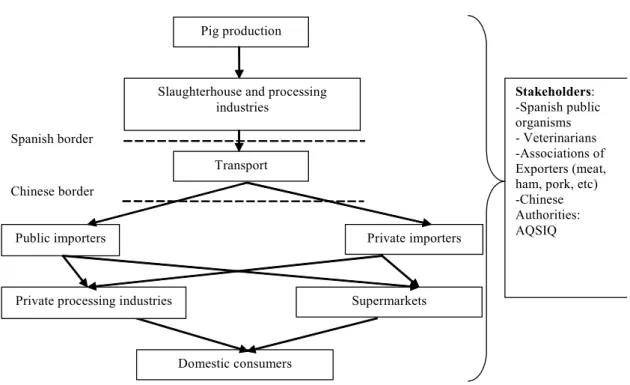
First of all, we define the chain structure (see Figure 2). At the beginning phase of the trade between the two countries, the chain structures differ according to different types of products exported. The four companies that have got the authority export frozen pork and offal products through public or private importers, later the importers distribute the pork products to processing industries or supermarket or hypermarket. However, the two Spanish companies distribute cured pork products directly through Hotel and restaurants in China. At present, most of the frozen pork and offal are imported through private importers in China. The Spanish meat industries contact these private importers with the help of Instituto Español de Comercio Exterio (ICEX) in Spain. The Chinese importers distribute the frozen pork and offal to the supermarket such as Carrefour. The cured pork products are distributed directly through Hotels and foreign restaurants in China, but the amount is very limited.
As this is an international chain, the role that third parties such as institutions or associations play is very important. It is positive that Spain and China now have good diplomatic relations. AQSIQ sends inspectors to visit Spanish companies in order to authorize them for exports. The same organism inspects the product on the boarders and also authorizes Chinese companies for imports. AQSIQ, the Chinese monitoring institution, is in charge of trade food safety, standardization, certification and accreditation activities.
Location Murcia (2), Barcelona(4), Girona (4), Olot (2), Salamanca (2), Burgos (1), Valdepeñas (1), Toledo (1), Lugo (1), Teruel (1), Granada (1), Montesquiu (1), León (1)
Dedication Meat industry (8), Meat processing (8), Slaughterhouse and deboning house (6)
Interest in exporting to China
Yes (21), No (1) If it is exporting to China Yes (5), No (17)
The products exported Offal (4), Frozen Pork (2), Ham without bone (2) The products wish to
export
Figure 2. Structure of the Spanish‐Chinese pork chain for frozen pork and offal
Source: drawn by the authors
Figure 3. Structure of Spanish‐Chinese pork chain for cured pork products
Source: drawn by the author
5.2 Governance of the chain
China and Spain have similar structures in the pork producing sector. Spot relations dominate the market, and just the big companies develop more integrated schemes. In Spain, it is mainly led by feed industries while in China big processing companies lead the integration.
In general, it can be said that the relation between actors in the Spanish part are long term because of the long history of the companies. The nature of the relation is formal, and it is made formal as there is a need to have transport guides because of track and tracing regulations in Europe with no exception of the kind of pork product or destination (European Parliament, 2002). The kind of contract applied is usually classical in the form of an invoice.
Pig production
Slaughterhouse and processing industries
Public importers Private importers
Supermarkets Domestic consumers Stakeholders: -Spanish public organisms - Veterinarians -Associations of Exporters (meat, ham, pork, etc) -Chinese Authorities: AQSIQ Transport Spanish border Chinese border
Private processing industries
Pig production Slaughterhouse and processing industries Transport
Hotels and Restaurantes Domestic consumers
Stakeholders: Spanish public organisms, Veterinarians, Associations of exporters etc.
Chinese Authorities (AQSIQ), Associations of importers etc.
Spa
in
The relation between the Spanish meat industries and the importers in China is quite new which is now in a spot market position. The linking way between the Spanish companies and Chinese meat industries depends a lot on the company scale and their business content. As most of the Spanish meat companies are small and medium sized companies, 60% showed that if they could export to China, they will try to establish joint venture with the Chinese meat companies. Several big companies will choose to invest 100% privately funded companies in China. The slaughterhouses mainly choose to connect directly with the importers.
However, at this beginning phase of trade, none of these four companies we interviewed has established Spanish‐Chinese joint ventures in distributing their pork till now, which is one of the reasons why the movement of pork from Spain to China is still slow. Once there are Spanish‐Chinese joint ventures established, the bilateral relationship will be long‐term and the movement of pork will be smooth. The relationship between the meat industries and hotels and restaurants is also spot relationship, the meat industries provide the amount the hotel and restaurant require.
5.3 Information Use and Exchange along the chain
Easing and speeding the exchange of real‐time information enables improvement of collaboration throughout the whole supply chain (Van der Vorst et al., 2002). A complete, timely and effective information use and exchange in the Spanish‐Chinese pork chain influence the movement of pork products. Here we emphasize the safety and quality information and information about products and market.
Safety and quality information in the agri‐chain is often transmitted through a traceability system, which refers to the “property of the result of a measurement or the value of a standard whereby it can be related to stated references, usually national or international standards, through an unbroken chain of comparisons all having stated uncertainties” (Taverniers et al., 2004). In our case, the traceability of quality information is possible to be realized by labeling of the products. AQSIQ sets the following requirements: name of the product, product weight, name and address of a manufacturer, its registration number, storage conditions, and production date should be stated both in Chinese and English. The product name and registration number of the slaughterhouse / establishment should also appear on the packaging, making all of them traceable.
In the pork chain in Spain, the farm, slaughterhouse and processing industry are required to have a traceability system which is called Sistema integral de trazabilidad animal (integrated animal traceability system, SITRAN) composed by Registro general de explotaciones ganaderas (general register of the livestock farm, REGA) and Registro de identificación individual de animales y movimientos (individual animal identification and movement register, RIIA‐REMO), where the information is registered and stored using information and communication technology (ICT).
Here, we notice that AQSIQ requires the information properly translated into Chinese. It happens frequently that Chinese consumers misunderstand how to eat the imported food product due to the incorrectly translated instructions of the labels into Chinese language. (Yuan, 2005).
With regard to the information of products and market, we find that the companies who have got the permission, especially the companies who are exporting cured pork, have studied Chinese market. One of the companies has established a workshop to prepare for the exporting to China. They studied Chinese market and Chinese consumers according to the studies done by Spanish embassy in China. On the other hand, some companies did not study
the Chinese market and they had some misunderstandings about the consumers’ eating habits of pork.
On the other hand, we find that the information of Spanish pork products is not exchanged to the Chinese market and consumers with efficiency, in other words, the Spanish meat industries still have not made enough effort to make their products well known in China. An expert in commercial affair views that the Spanish pork companies prefer to leave work after exporting to the Chinese distributors and concentrate in their production without many motivations in communicating with the Chinese consumers. Actually, as the Chinese consumers have a different habit of consuming pork, many consumers find exotic to consume ham directly like in Spain, the consuming habits are not well accepted in China.
5.4 Quality Management Systems
The Chinese government is paying more and more attention to safety and quality in the pork sector due to the frequently happened pork safety issues in recent 10 years in China. The newly happened Irish poisoned pork incident (China’s quality affair news, 2008) in 2008 made AQSIQ tighten the monitoring of imported pork. To ensure the safety and quality of imported Spanish pork, AQSIQ has set a series of standards that farms, slaughterhouse, deboning industries, processing unities, packaging and labeling should meet and defined the responsibilities that the Spanish pork safety and quality monitoring institutions should take. Spain pays attention to safety and quality of pork and its products. The Spanish pork feed producer and pig slaughterhouse implement the ISO 9000: 2000 system while HACCP is obligatory. The system called Sistema Nacional de Identificación y Registro de los Movimientos de los Porcinos (national system of identification and registration of the movements of pigs, SIMOPORC) requires the registration of farms and movements of batches of pigs between farms (MARM, 2009d). At the same time, Spain also has adopted the regulations and laws set by European Union, such as EC No.2160/2003 and RD 636/2006 to control the diseases of zoonotic and aujeszky. Furthermore, Spain has a system called Red de Alerta Sanitaria Veterinaria (Veterinary Health Alert Network, RASVE) which is a pioneer in the world (MARM, 2009c). It combines all information and techniques of animal health in order to conduct an epidemiological warning. Thus, it facilitates the decision makers to prevent, control and eradicate the diseases.
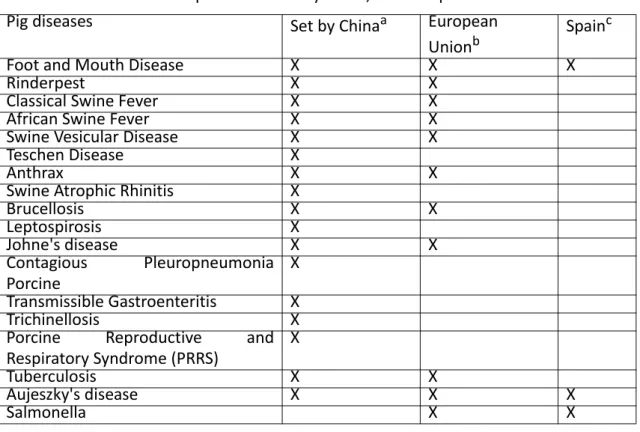
However, although the Spanish meat industries show high interests in exporting their products to China, only 11 companies have got the permission. 90% of the companies we interviewed consider the biggest difficulty for them to export is the trade barriers set by China in the form of a high quality management standard that is hard to meet. To the Spanish farms, the Spanish side should officially confirm that the raising farm is free of diseases listed in table 2 in the first six months of raising pigs.
We find that the non‐existence of diseases such as Contagious Pleuropneumonia, Porcine Transmissible Gastroenteritis, Trichinellosis, Porcine Reproductive and Respiratory Syndrome (PRRS) are required by the Chinese government while not by the European Union and Spain. The Chinese government sets standards considering its national situation, which is different from the standards of EU or Spain, making it more difficult for Spanish pork companies to get exporting permission.
In addition, a manager of export sector considers that the Chinese authority asked them for certifications whenever it thinks necessary without writing them down clearly in a document, which made it difficult for the meat industries to prepare and conduct the exportation.
Table 2. Disease control requirements set by China, EU and Spain
Source: MARM, 2009b; European Food Safety Authority (EFSA), 2009
As stated above, the quality management control of China has formed a trade barrier between the two countries.
5.5 Imported pork price issues
In this part, we give a brief analysis of the imported pork price, which is closely related with value‐added in the chain. It is given the average prices of pig meat and its products on the Chinese borders. There are three groups of products worth analyzing which are: meat (as fresh, chilled or frozen), edible offals and cured or processed pork products. Spain competes with countries such as USA, Canada, Denmark or France that have been exporting since the 1990s.
The companies consider that it is difficult for them to compete with the local producers in terms of the price of offal as the local offal is cheaper than imported ones. The Spanish companies have to decide the price of the products considering the price of other exporters, transportation cost and tariffs, which are shown in the figure 4, table 3 and table 4 respectively.
Pig diseases Set by Chinaa
a. Pig diseases that should not exist in the pork exported to China from Spain
European Unionb
b. European Union standards in controlling the pig diseases (as Spain is a member of European Union, the
standards here are also adopted in Spain)
Spainc
c. Special national programs in Spain to control pig diseases
Foot and Mouth Disease X X X
Rinderpest X X
Classical Swine Fever X X
African Swine Fever X X
Swine Vesicular Disease X X
Teschen Disease X
Anthrax X X
Swine Atrophic Rhinitis X
Brucellosis X X Leptospirosis X Johne's disease X X Contagious Pleuropneumonia Porcine X Transmissible Gastroenteritis X Trichinellosis X
Porcine Reproductive and Respiratory Syndrome (PRRS)
X
Tuberculosis X X
Aujeszky's disease X X X
Figure 3. Fresh, chilled or frozen meat import prices to China
Source: UNCOMTRADE database 2009
China has captured the attention of many industries because of the possibility of exporting processed products, mainly cured and dry meats as one of the specialties in Spain. The exports in 2008 of hams were of 1,633 kg at an average price of 21.67 $/kg.
Table 3. Estimated sea transport charge from Spanish harbours to different harbours in China in air‐conditioned containers (Euros)
Source: Illán, 2007
Table 4. Tariff barriers for pork products in China
Source: Euro‐Lex, 2009
Destination port Shanghai Huangpu
(Guangzhou)
Xingang (Tian Jin)
Transport days 23 days 24 days 24 days
Type of container 20´ 40´ 20´ 40´ 20´ 40´
Total Price (Euros) 3691.18 4040.15 3923.02 4427.02 3691.19 4039.15
Pork product Characteristics Generic tariff (%) Most favorable nation (Spain among others) (%)
Meat Fresh/chilled 70 20
Frozen 70 12
Edible offals Fresh/chilled 70 20
Frozen 70 12
Livers Fresh/chilled/
frozen
70 20
Fresh, chilled or frozen meat import prices to China
0,00 0,20 0,40 0,60 0,80 1,00 1,20 1,40 1,60 1,80 2,00 199 5 1996 199 7 199 8 199 9 200 0 200 1 2002 200 3 200 4 2005 200 6 200 7 200 8 Years P ric e ( $ /k g ) Mundo EEUU Canadá Dinamarca Francia
6 Conclusions and implications
From the analysis stated above, we get several conclusions and implications as follows: First of all, the structure of the Spanish‐Chinese pork chain differs according to different products and their different distribution channels.
Secondly, governance between Spanish industries and Chinese importers is a spot market relationship, which is not long‐term and stable governance, it is one of the reasons why the movement of pork is not smooth and trade amount is not big. It also means that Spanish companies should compete with all the possible exporters when China needs to import pork. Joint ventures would be a suggestive form to strengthen the bilateral relationship considering that many of the Spanish companies are small and medium sized.
Thirdly, the information exchange is neither sufficient nor efficient. The Chinese consumers still do not know well about the Spanish pork products and Spanish companies still needs to study more about Chinese market. This is also one of the defects that hinder the movement of pork from Spain to China. It is implied that Spanish companies needs to make more effort in promoting their products in Chinese market.
Fourthly, the Chinese government has a special attention to food safety of imported products. The high quality standards set by China have in reality formed a trade barrier between the two countries, that’s one of the main reasons why the movement of pork is hindered. On one hand, it is necessary for the Spanish pork sector to keep the production safe and with a secure control system of disease spread; on the other hand, China should give more liberty to pork trade between the two countries.
At last, the Spanish companies should develop proper price strategies to make their products price competitive. Factors such as cost of production, transportation, tariff, expected profit margin and competitors’ price should be carefully calculated.
The case study of the Spanish‐Chinese pork chain gives evidence to the existed theory that global chain is dynamic and vulnerable as it is influenced by external factors such as trade barriers. On the other hand, the study also confirms the supply chain theory that the defects in short‐term governance form, information exchange hinder the movement of raw material through the chain.
7 References
Carter, J.R., and S.K. Vickery, 1988. Managing volatile exchange rates in international purchasing. J. Purch. Mater. Manag. 24, 13–20.
Carter, J.R. and S.K. Vickery, 1989. Currency exchange rates: their impact on global sourcing. J. Purch. Mater. Manag. 25, 19–25.
China’s quality affair news, 12 December, 2008. The monitoring and quarantine institutes in China are taking emerging actions to handle with the event that the Irish pork is polluted by Dibenzo‐p‐Dioxin. Available at: http://www.jxzj.gov.cn/info/ content.asp?id=20815, viewed on 30th, November, 2009
Cooper, M.C., M.D. Lambert and J.D. Pagh, 1997. Supply Chain Management More than a new name for logistics. Int. J. Logist. Manag. 8 (1), 1‐13
Dornier, P.P., R. Ernst, M. Fender, and P. Kouvelis, 1998. Global Operations and Logistics: Text and Cases. John Wiley & Sons, Inc., New York.
European Food Safety Authority, 2009. viewed on 30th November, 2009 http:// www.efsa.europa.eu/EFSA/efsa_locale‐1178620753812_home.htm
European Parliament, 2002. Regulation (EC) N0 178/2002 of the European Parliament and of the council of the 28 January 2002. Of. J. Eur. Com. L31/1‐L31/24
FAOSTAT (Food and Agricultural Organization of the United Nations statistics database), 2009. Available at: http://faostat.fao.org/default.aspx viewed on 2nd, December, 2009
Flyvbjerg, B., 2006. Five misunderstanding about case‐study research. Qual. Inquiry. 12, 219‐
245
George, A.L. and A. Bennett, 2004. Case Studies and Theory Development in the Social Science. Belfer Center for Science and International Affairs, John F. Kennedy School of Government, Harvard University, the United States, pp. 17‐18
Illán, E. 2007. El mercado de la carne de porcino fresca y congelada en China, Oficina Económica y Comercial de la Embajada de España en Pekín. p24, p50, p53. Available at: http://www.icex.es/icex/cda/controller/pageICEX/
0,6558,5518394_5519172_5547593_4108496_49_CN_p5658362,00.html
Lynn, D., 1991. The application of case study evaluations. Practical Assessment, Research & Evaluation, 2(9) viewed on 2nd December, http://pareonline.net/getvn.asp?v=2&n=9 MacCarthy, B.L. and W. Atthirawong, 2003. Factors affecting location decisions in
international operations—a Delphi study. IJOPM. 23, 794–818.
MARM, 2008. Procedimiento de registro de empresas alimentarias para la exportación a la Republica Popular China de carne y productos cárnicos cuados de la especie porcina, p1. MARM, 2009a. Listado de establecimientos españoles de producción y procesado de carne y productos cárnicos de porcino para exportar a la R.P. China. Report published by Spanish agricultural ministry on August 20th, 2009. Viewed on 27th November, 2009 MARM, 2009b. Nota Informativa sobre la exportación de carne y productos porcinos a la
República Popular de China?http://cexgan.mapa.es/Modulos/ NotasInformativas.aspx?pais=0, viewed on 28th, December, 2009
MARM, 2009c. Red de Alerta Sanitaria Veterinaria http://www.mapa.es/es/ganaderia/pags/ rasve/pr_rasve.htm, viewed on 29th, November, 2009
MARM, 2009d. Sistema Nacional de Identificación y Registro de los Movimientos de los Porcinos http://www.mapa.es/ca/ganaderia/pags/simoporc/simoporc.htm viewed on 2nd, December, 2009
Meixell, M.J. and V.B. Gargeya, 2005. Global supply chain design: A literature review and critique. Transportation Research Part E 41, 531‐533
Taverniers, I., M. De Loose and E. Van Bockstaele, 2004. Trends in quality in the analytical laboratory. I. Traceability and measurement uncertainty of analytical results. Trends Anal. Chem. Vol. 23. No. 7, 483
UNCOMTRADE (United Nations Commodity Trade Statistics Database), 2009. http:// comtrade.un.org/db/, viewed on 1st, December, 2009
Van der Vorst, J.G.A.G., 2000. Effective Food Supply Chains, Generating, modelling and evaluating supply chain scenarios, Wageningen University, Wagenningen, The Netherland, 305p.
Van der Vorst, J.G.A.G., S. Van Dongen, S. Nouguier and R. Hilhorst, 2002. E‐business initiatives in food supply chains; Definition and typology of electronic business models. International Journal of Logistics: Research and Applications, 5 (2): 119‐138
Van Plaggenhoef, W., 2007. Integration and self regulation of quality management in Dutch agri‐food supply chains, Ph.D thesis of Wageningen University, Wageningen, the Netherland, 70p.
Wood, D.F., Barone, A.P., Murphy, P.R., Wardlow, D.L., 2002. International Logistics, AMACOM, New York.
Yuan, G.F., 2005. Non‐standardized labeling make the consumers’ misunderstanding in eating, the instructions of the imported food should be regulated. Xinhua net, Available at: http://news.xinhuanet.com/cic/2005‐08/04/content_3308012.htm 4, August, 2005, viewed on 2nd December, 2009