Demand for and Value of Credence
Characteristics: Case Beef
Terhi Latvala
Jukka Kola
Paper prepared for presentation at the Xth EAAE Congress ‘Exploring Diversity in the European Agri -Food System’,
Zaragoza (Spain), 28-31 August 2002
Copyright 2002 by Terhi Latvala and Jukka Kola. All rights reserved. Readers may make verbatim copies of this document for non-commercial purposes by any means,
Contributed paper proposal submitted for the 10th Congress of the EAAE, 28-31 August, 2002, Zaragoza Spain
Demand for and Value of Credence Characteristics: Case Beef
Terhi Latvala & Jukka Kola
Department of Economics and Management University of Helsinki, Finland
[email protected] [email protected]
Abstract
The aim of this study is to evaluate both qualitatively and quantitatively the value of new information about and the information systems set for credence characteristics of beef. Economics of information is our theoretical framework. The quantitative approach focuses to measure the ex ante value of credence characteristics, and the method of contingent valuation is applied for this purpose. Results indicate that 59 % of Finnish consumers are willing to pay more to get information about safety and quality of beef products. Consumers are most concerned with diseases caused by food of animal origin. Genetically modified organisms (GMOs) are not considered as the most hazardous risk factor in food products. However, if the beef products contain GMOs used in animals, then consumers also start requiring additional information.
1. Introduction
Recent food crises in Europe have raised public concerns of the quality and safety of food. The problem is that consumers cannot be sure of quality of products when they make their purchasing decisions. Especially in meat markets the significance of information and knowledge is emphasised, because consumers often do not know prior to, but often also after, the purchase of meat whether it is of good or poor quality in terms on many quality attributes, safety in particular. Consumers’ increasing concern towards food safety issues has increased the demand for quality attributes. Most quality properties of food products can be considered as credence characteristics as their quality cannot be inferred before, and sometimes not even after the purchase (Darby and Karni 1973; Caswell and Mojduzska 1996).
The phenomenon of imperfect and asymmetric information leads to several problems in food markets. As consumers are unable to reliably identify differences in quality levels of food products, they are not willing to pay for better food safety. Consequently, producers cannot receive sufficient compensation to cover the higher costs due to changes in production practices aimed at improving food quality. Hence, the lack of information prevents economic incentives from springing up to ensure production of foodstuffs of higher quality and safety (Weiss 1995, 69-70).
Lack of information is a typical example of market failure. As this study examines the role of information in the beef supply chain and consumers' willingness to pay for information in terms of quality and safety characteristics, the economics of information constitutes an appropriate theoretical framework for this. Like other markets, the functioning of the food market suffers from imperfect and asymmetric information. This phenomenon is today at least as topical and difficult as it was in the 1970s, when American professors of economics George Akerlof, Michael Spence and Joseph Stiglitz studied the information problems in the market and laid the foundations for the economic approach used in this paper
and many other studies in this field of quality, safety and overall credence characteristics of goods we frequently buy, use and consume. These professors were awarded the Nobel prize for economics in 2001, which shows that such an approach is still valid and necessary.
In Finland there have not been similar, widely affecting food crises such as BSE or FMD common in many other EU countries1. Yet, previous studies also in Finland show that consumers desire more and more information about quality and safety aspects of food. Additional information was desired particularly regarding meat and meat products (Järvelä 1998a, 1998b). Because present supply of quality information is imperfect, consumers accept a label of origin as a signal of food safety and quality (Finfood 2000).
There are two, parallel information-based policies in beef supply chain, which will enhance the amount of credence characteristics about beef quality and safety. Firstly, The National Quality Strategy is launched by all parties involved in foodstuffs production and processing to express competitive advantages and strengths of Finnish food products relating to quality, safety, ethics, and ecology. The flow of information within the vertical chain of distribution will be systematically collected and stored in a special data bank. The purpose of this regulatory development is to reduce information imperfections within the supply chain. Secondly, a beef identification and labelling system in the European Union was developed primarily to reassure the safety of beef products and to increase transparency and traceability of beef products in the supply chain. Future developments of this labelling system could include more information about the origin of a product, animal welfare and other properties connected with a production process. Through these systems more information about credence characteristics of beef safety and quality will be available to consumers. However, benefits of additional food safety and quality information to consumers are not adequately well studied.
1 The first, and this far also the only BSE case was found in Finland in December 2001, and no FMD cases were detected
This study pursues to meet this demand for additional research by making an attempt to find out whether consumers are willing to pay for additional information about beef quality and safety. Consequently, the aim of this study is to evaluate both qualitatively and quantitatively the value of new information about and the information systems set for credence characteristics of beef. Economics of information is employed as the theoretical framework. The quantitative approach focuses to measure the ex ante value of credence characteristics, and the method of contingent valuation is applied for this purpose.
The structure of the article is the following. After the introductory chapter we discuss and evaluate qualitatively in Chapter 2 the role of information in the market in the framework of the economics of information. Chapter 3 presents the methodology in terms of survey design and the method of contingent valuation. The results of the study are shown and discussed in Chapter 4. Finally, Chapter 5 provides the summary and conclusions of the study.
2. The role of information in the market
Consumers lack information about quality properties of most goods on the market. Within the economic framework the information problems on the market were studied as early as 1970, when Akerlof showed that markets fail in the presence of information asymmetry. He argued that bad quality ultimately drives out good quality from the market, if there exists information asymmetry between sellers and buyers. If quality cannot be signalled, good quality products cannot get a price premium and, accordingly, only bad quality products will be offered for sale (Akerlof 1970).
Becker (2000, 108) applies this example to the functioning of the meat market. In today’s meat chain the raw material is purchased from further and further away, which means that information on the
characteristics of the meat is not available in the same way as earlier when it was bought directly from the local producers. The production of high quality foodstuffs costs more, and if there is no additional price for higher quality on the market the quality will deteriorate and only lower quality products enter the markets. This means that the quality of the products in the consumption is also weaker. However, the consumers might be willing to pay more for higher quality, thus compensating for the higher production costs, if the differences in the quality were efficiently communicated to the consumers.
Important progress was made when goods were categorised into search, experience and credence quality attributes on the basis of how consumers can evaluate the quality aspects of products (Nelson 1970, Darby and Karni 1973). A search good is one whose quality is determined before purchase, an experience good is one whose quality is determined after purchase, and quality of a credence good cannot be determined either before or after the purchase.
Many of the characteristics relating to the safety of foodstuffs are classified as credence quality attributes, because it is difficult for the consumers to assess them by themselves, and in order to obtain more information on them they have to rely on the seller or outside observers (Andersen 1994, 6). In the case of food risks that can only be found in the long term it is very difficult to establish the connection between the quality of the original food product and the illness it may have caused (Henson ja Traill 1993, 157).
Based on the above classification, Becker (2000, 98) highlights the costs due to the need to acquire more information. The costs are the lowest in the case of quality attributes that are based on external observation which are available through the senses. Assessing the quality of experience good in advance involves high costs, but these attributes can be assessed quite easily and at low cost in connection with or after the use. However, in the case of credence attributes the assessment of the quality involves high costs both before and after the consumption.
The availability of quality information is very important for the functioning of the market. Markets function quite well in terms of the characteristics, or attributes, that are based on external observation, and to some extent for the part of the experience quality attributes because the consumers learn about quality after using the product. However, both private and public measures are needed for the markets to function properly in terms of the credence quality attributes in order to guarantee that there is availability and quality of the necessary information (Caswell ja Mojduszka 1996, 1251).
As stated above, food safety is usually defined as credence attribute since consumers cannot measure the quality and cannot learn his or her experience in consuming the product (Henson and Traill 1993). Such quality properties included in this study are environmental impacts, animal welfare, and a country of origin. Most of these properties are connected with features derived from a production process.
The amount of information available from the credence characteristics is crucial. Information is usually considered as a public good, and for that reason it is undersupplied in the market (Henson and Traill 1993). The nature of public good is nonrival and nonexcludable. However, Antle (1999) argues that information can be considered as a club good that is nonrival but excludable. In that case the role of government is to create the legal framework that enables consumers to obtain and use information. Consequently, one important question is that which actor(s) in the food chain should offer the required information, by what means and at what cost. Different types of contracts and quality systems could be an answer also for the demand for credence characteristics in the food products. These contracts and systems, their contents and impacts, urgently need further research, including the more novel netchain analyses, in order to make the food chain to operate efficiently (see e.g. Ziggers et al. 1998; Lazzarini et al. 2001; Omta et al. 2001; Vertanen 2001).
3. Methodological alternatives and survey design
There is no market data available for examining willingness to pay (WTP) for new, additional information. The most commonly used method to measure economic benefits for a nonmarket good is the contingent valuation method (CVM). In this method consumers are asked ex ante their WTP in order to obtain a benefit, which is presented in hypothetical scenario concerning the good in question.
The other well-known and quite often employed methods are cost-of-illness (COI) method and hedonic price (HP) analysis. In the COI method the calculated values are ex post values. The COI method usually includes three cost groups, which are the actual costs, foregone incomes and production losses due to the illness and its management. The clear advantage of the COI method is that it uses statictical data that is relatively easily available. The usefulness of the method can be improved by making sensitivity analyses for the different cost groups. The weakness of the method is its inaccuracy in terms of the economic measurement, as it does not take into account economic values expressed by individuals with regard to e.g. own health. Consequently, the COI method does not correspond to the utility concept of the economic theory and it underestimates actual social benefits (Buzby et al. 1996).
The HP analysis takes advantage of market transactions when it measures benefits, or utility. In relation to the subject of this study, the objective of the HP analysis is to distinquish safety characteristics of food products from other product characteristics (Jensen and Basiotis 1993). Hence, the HP analysis could be useful in the situations, in which food products with clearly observable safety characteristics are sold on the market. For instance, the difference between the market prices of conventional and organic food products can be interpreted to represent the price estimate for how much consumers value organic products, which they perceive as safer than conventional food products due to e.g. lower pesticide residues. However, usually the safety or credence characteristics of food products cannot be explicitly
determined, and, accordingly, the appropriate data is not available for the HP analysis. The lack of such product characteristics that could be objectively measured considerably hinders the applicability of the HP analysis for that kind of research problems, which are relevant for studies like that of ours here.
According these evaluations of the COI and HP methods, which are based on wider assessments in the relevant literature, we choose the contingent valuation as the most applicable method for our objectives. It is most often used method in studies dealing with food quality and safety characteristics. The difficulty of the CV method is usually that it is used for valuation of a good, often a public good, without a price on some imaginary markets. In our study this is not so serious a problem as we do have a real, private good, i.e. beef, with a price on actual markets. Consumers need to assess only the additional characteristics in association to the good, and not the entire good as such as it is often the case with public goods. Lee and Hatcher (2000) regard the CV method as the best, when the good under evaluation is information that is attached to certain characteristics of a good. The CV method is often flexible enough to measure both the value and intensity of key characteristics of goods for consumers. In addition, the CV method is often the only option, because there are no suitable data available for the other methods.
As a research method the CV method requires a survey, in which the consumers/citizens are asked how much they would be willing to pay for the supply or production of a public good, e.g. the reduction of health risk (Henson 1996). A survey can be complemented by experimental methods in order to be able to assess concumer benefits more accurately and reliably (Jensen and Basiotis 1993). Due to time and cost constraints we, however, refrained from executing any experimental methods to complement our CV method.
In our survey we asked consumers how much they would be willing to pay for additional information concerning quality and safety characteristics of beef. The survey was pre-tested during January 2000 in a
mid-size food retail store in Helsinki. In addition, comments and suggestions for improvement in the questionnaire were asked from experts of relevant research institutes in Finland.
The main survey was conducted with the aid of the GallupKanava panel in March 2000. The GallupKanava is a system, in which answers and information is collected via personal computers from overall 1,300 regular respondents for different surveys and opinion polls. One third of the sample is changed annually in the GallupKanava system. In our study the statistically representative sample comprised of 1,000 households. The answers were given by those persons, above 15 years of age, in the household who usually make the purchasing decisions, i.e. there could be more than one respondent in a household. The CV questionnaire included questions about consumers’ (1) buying and preparing habits of beef, (2) paying attention to present labels and other information, (3) risk perceptions, (4) awareness of food safety risks, and (5) demographics.
4. Results
The total of usable questionnaires were 1,640. Of the 1,640 respondents 22% were the primary shoppers for the household and 54% “split shopping duty in half” with someone else. 95 % of the respondents eat beef, or food products made from beef, one third of them at least weekly. Hence, they know the product and are assumed to some extent to be aware of the characteristics associated to beef and food products based on beef.
Firstly the respondents were asked how often they pay attention to the present information or labels in beef products. Results indicate that most important information or properties in the present situation are the dates of expiration and packaging, and colour of beef. The third important factor to which consumers
clearly pay attention was the label marked ‘Finnish Beef’. The price of beef was mentioned as the fourth important factor.
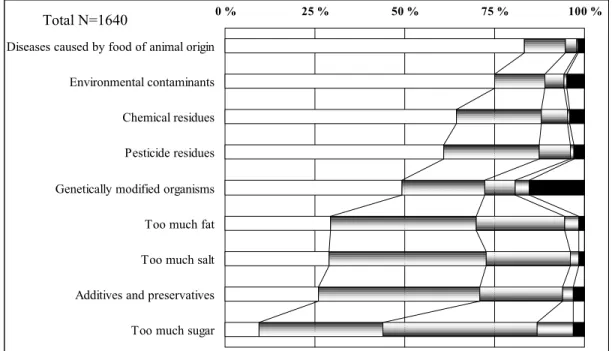
Among the respondents the concern towards foodborne diseases of an animal origin (salmonellosis, E.coli O157:H7) was higher than concern for other risk factors in food (Figure 1). Concerning need for additional information, consumers desire more information about (1) the control of food of animal origin, (2) GMOs used in animals, (3) a country of origin and (4) if hormones are used in animal production.
0 % 25 % 50 % 75 % 100 %
Diseases caused by food of animal origin Environmental contaminants Chemical residues Pesticide residues Genetically modified organisms Too much fat Too much salt Additives and preservatives Too much sugar
Extremely hazardous Quite hazardous In some degree hazardous Not at all hazardous Do not know
Total N=1640
Figure 1. Comparing food safety concerns.
All of the respondents were given a brief description of the new data bank system, which is currently under development. 75% of respondents indicated that new quality data system, which would give more information to consumers, would be beneficial to them. The aim of the question was that the respondents
could express their opinion without linking this to their WTP. After the description of the beef identification and labelling system, they were asked about WTP for additional information about beef.
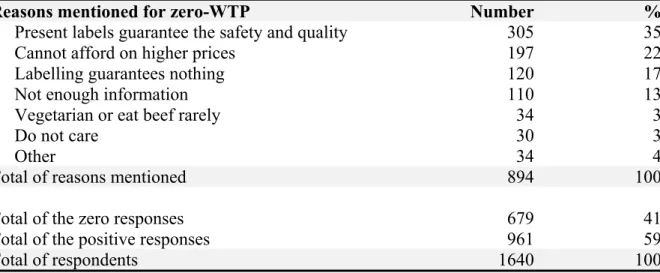
59% of the respondents were willing to pay a premium to get additional information. The main reason behind zero-WTP (41 % of the respondents) was that consumers were satisfied with the present information of labels (35%). The other reason mentioned was that they simply cannot pay more. Thirdly, it emerged that 17% of the zero-WTP respondents lack trust on this system or they did not get enough information about it (13%) (Table 1).
Table 1. Reasons for zero-WTP.
Reasons mentioned for zero-WTP Number %
Present labels guarantee the safety and quality 305 35
Cannot afford on higher prices 197 22
Labelling guarantees nothing 120 17
Not enough information 110 13
Vegetarian or eat beef rarely 34 3
Do not care 30 3
Other 34 4
Total of reasons mentioned 894 100
Total of the zero responses 679 41
Total of the positive responses 961 59
Total of respondents 1640 100
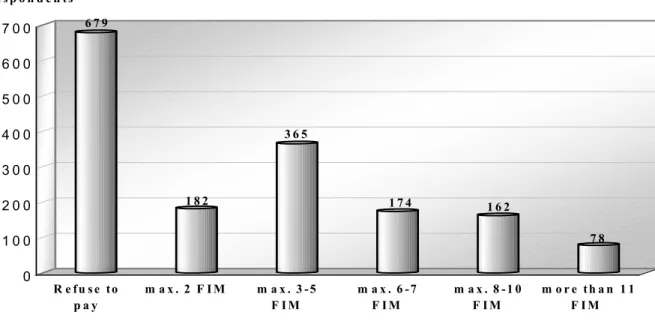
In our study two different methods are employed to elicit consumers’ WTP for information provision about beef safety and other quality attributes. In the dichotomous choice (DC) method consumers choose between “yes” or “no” to valuation questions. We also used polychotomous choice (PC) where respondents are given a multiple choice. The rationale behind the PC method is that it provides more information to the researcher than does the DC question because more can be learned about the intensity of a consumer's intentions towards the scenario. Results are presented in figure 2. The "yes"-respondents,
i.e. 59 % of the sample who were willing to pay a higher price for beef in order to receive additional safety information, were offered a sum, which varied between FIM 2-16 per kg of beef. They were also provided the information stating that the average prices for ground beef and roast beef were FIM 33/kg and 50/kg, respectively. 50 % of the total respondents were willing to pay at the maximum FIM 14/kg more for beef in order to receive additional safety information from beef.
6 7 9 1 8 2 3 6 5 1 7 4 1 6 2 7 8 0 1 0 0 2 0 0 3 0 0 4 0 0 5 0 0 6 0 0 7 0 0 R e f u s e t o p a y m a x . 2 F I M m a x . 3 - 5 F I M m a x . 6 - 7 F I M m a x . 8 - 1 0 F I M m o r e t h a n 1 1 F I M N u m b e r o f r e s p o n d e n t s
Figure 2. Frequencies of WTPs presented as a multiple choice question.
(the average prices for ground beef and roast beef were FIM 33/kg and 50/kg, respectively)
5. Conclusions
In this study beef was selected to represent food products, which would possess such safety and quality characteristics that are regarded as important by consumers in general. Moreover, for beef it could be technically possible to provide very in detail information in Finland, for the Finnish beef labelling system could produce quality information even on an individual animal basis. However, at the moment this
information shrinks to the mere mentioning of “Finnish beef” as it finally reaches consumers. Nevertheless, the Finnish quality strategy is an example of a comprehensive action aimed at improving and confirming quality in the entire food chain, all the way to consumers.
The consumers clearly demand and give high value to both information and quality, including in particular the safety of food products. The findings of this study demonstrate that 59 % of consumers require more information about the quality attributes of beef products. Zero WTP was mainly due to existing satisfaction with the present labels. Consumers are most concerned with food of an animal origin. Although genetically modified products are not considered as hazardous as other risks in food, consumers would desire to be informed, if animal genes were genetically modified. Consumers desire for additional, better information of the following issues, in a priority ranking order: (a) the control of food if animal origin, (b) the use of GMOs in livestock production, (c) the country of origin, and (d) the use of hormones in livestock production.
In the future the demand for better information of all quality attributes of food products will be satisfied to a growing extent by electronic data bases and other electronic business means of modern information technology. Then consumers will easily be able to check, inter alia, the origins, production practises, and processing- and delivery-related details of food products. This creates a new possibility to develop local, high quality and very safe products for certain, selected consumer segments, which are looking for more reliable and consistent information than what is currently available for their choices and purchases of food products. Hence, further research should be directed at a more accurate analysis of different consumer groups and their characteristics by e.g. cluster analysis. In addition, the statistical modelling of willingness-to-pay with regard to both the dichotomous question structure and multinomial logit analysis is a part of the future research in this field.
Acknowledgements
We would like to thank the Finnish Ministry of Agriculture and Forestry, which provided funding for this research project (Latvala 2001).
References
Akerlof, G. A. 1970. The Market for ‘Lemons’: Quality Uncertainty and the Market Mechanism. Quarterly Journal of Economics. 84: 488-500.
Andersen, E. S. 1994. The evolution of credence goods: A transaction approach to product spesification and quality control. MAPP Working paper 21. Aarhus. 31 p. Available: http://www.mapp.hha.dk/. Date: 12.05.1999.
Antle, J. M. 1999. The New Economics of Agriculture. American Journal of Agricultural Economics 81: 993-1010.
Becker, T. 2000. A framework for analysing public and private food quality policy: meeting consumer requirements? In Becker, T. (Ed.) Quality Policy and Consumer Behaviour in the European Union. pp. 91-110. FAIR CT95-0046. Vauk. Kiel. 280 p.
Buzby, J. C., Roberts, T., Lin, C.-T. J, & MacDonald J. M. 1996. Bacterial Foodborne Disease: Medical Costs and Productivity Losses. 81 p. Available: http://www.econ.ag.gov/epubs/pdf/aer741. Date:
26.06.1998.
Caswell, J. A. & Modjuzska, E. M. 1996. Using Informational Labeling to Influence the Market for Quality in Food Products. American Journal of Agricultural Economics 78: 1248-1253.
Darby, M. and Karni, E. 1973. Free Competition and Optimal Amount of Fraud. Journal of Law and Economics 16: 67-88.
Finfood. 2000. Puolet kuluttajista päättelee ruoan alkuperän joutsenlipusta. Date: 07.03.2000. Available: http://www.finfood.fi.
Henson, S. 1996. Consumers willingness to pay for reductions in the risk of food poisoning in the UK. Journal of Agricultural Economics 47(3): 403-420.
Henson, S. & Northern, J. 2000. Consumer Assessment of the Safety of Beef as the Point of Purchace: A Pan-European Study. Journal of Agricultural Economics 51(1): 90-105.
Henson, S. & Traill, B. 1993. The demand for food safety. Market imperfections and the role of government. Food Policy 18: 152 – 162.
Hooker, N. H. & Caswell, J. A. 1996. Regulatory Targets and Regimes for Food Safety: A Comparison of North American and European Approaches. In: The Economics of Reducing Health Risk from Food. Available: http://agecon.lib.umn.edu/. Date: 18.05.1998.
Jensen, H. & Basiotis, P. 1993. Food Safety/Food Quality Data. In Eastwood, D. and Senauer, B. (eds.) Emerging Data Issues in Applied Food Demand Analysis. Proceedings of a Workshop Held by the S216, Food Demand and Consumption Behavious Regional Committee, October 1993.
Järvelä, K. 1998a. Kuluttajien mielipiteet elintarvikkeisiin liittyvistä terveysvaaroista ja
elintarvikevalvonnasta. National Food Administration. Research Notes 1/1998. 54 pp. Brief summary in English “Consumers’ opinions regarding health risks posed by foodstuffs and food control.” Helsinki. Järvelä, K. 1998b. Kuluttajien käsitykset lihasta ja liha-alasta - Laadullinen tutkimus. National Consumer Research Centre 14. Brief summary in English “Consumer views about meat and the meat sector – A qualitative study.” 123 p. Helsinki.
Kola, J. (ed.) 2001. Elintarviketuotannon turvallisuuden ja tuotannon ekonomiaa. University of Helsinki. Department of Economics and Management. Reports No.13. Agricultural Policy. 99 p. [Food Quality and Safety and Production Ethics in Economic Research: Introduction to Reseach Themes and Approaches.] Latvala, T. 2001. Kuluttajien informaatiotarpeet elintarvikkeiden turvallisuus- ja laatuominaisuuksista: tapaustutkimus naudanlihasta. In: Kola, J. (ed.) 2001. Elintarviketuotannon turvallisuuden ja tuotannon ekonomiaa. University of Helsinki. Department of Economics and Management. Reports No. 13: 27-67. Agricultural Policy.
Lazzarini, S.G., Chaddad, F.R. & Cook, M.L. 2001. Integrating Supply Chain and Network Analyses: The Study of Netchains. Journal of Chain and Network Science 1(1): 7-22.
Lee, K.H. & Hatcher, C.B. 2000. An Analyst’s Guide to Willingness-to-pay for Use in Cost-Benefit Analysis. Consumer Interest Annual 46:128-133.
Ministry of Agriculture and Forestry, Foodstuffs Quality Management Group. 1999. Foodstuff Production in Finland: Quality Strategies and Goals. The Ministry of Agriculture and Forestry. August 1999.
Nelson, P. 1970. Information and Consumer Behaviour. Journal of Political Economy. 81: 729-754. Omta, S.W.F., Trienekens, J.H. & Beers, G. 2001. Chain and Network science: A research Framework. Journal of Chain and Network Science 1(1): 1-6.
Vertanen, A. 2001. Laatusopimusten ja –merkkien käyttö naudanlihan tarjontaketjussa. University of Helsinki. Department of Economics and Management. Reports No 14. Agricultural Policy. [English summary: Use of quality contracts and labels in the beef supply chain]. 73 p.
Weiss, M D. 1995. Informational Issues for Principals and Agents in the ”Market” for Food Safety and Nutrition. In Caswell, J. A. (Ed.) Valuing Food Safety and Nutrition. p. 69-79. Colorado. Available: http://agecon.lib.umn.edu/. Date: 07.08.1998.
Ziggers, G., Trienekens, J. & Zuurbier, P. (eds.) 1998. Proceedings of the Third International Conference on Chain Management in Agribusiness and the Food Industry; Wageningen Agricultural University.
Nom du document : 064-jukka-kola
Dossier : C:\Documents and Settings\gilles\Bureau\EAAE
Modèle : C:\Documents and Settings\gilles\Application
Data\Microsoft\Modèles\Normal.dot
Titre : IAMA World Food and Agribusiness Congress
Sujet : Auteur : tlatvala Mots clés : Commentaires : Date de création : 07/03/2002 20:31 N° de révision : 2 Dernier enregistr. le : 07/03/2002 20:31 Dernier enregistrement par : GILLE Temps total d'édition : 1 Minute
Dernière impression sur : 07/03/2002 20:31 Tel qu'à la dernière impression
Nombre de pages : 15
Nombre de mots : 4 166 (approx.)