Information Security Metrics
State of the Art
DSV Report series No 11-007
Mar 25, 2011
Rostyslav Barabanov (Writer)
Stewart Kowalski (Editor)
iii
Abstract
Managing something that is not measured is difficult to near impossible and Information Security is not an exception. Effective measurement and reporting are required in order to demonstrate compliance, improve effectiveness and efficiency of controls, and ensure strategic alignment in an objective, reliable, and efficient manner.
The main purpose of the report is to examine the present state of the art of information security measurement from an organizational standpoint and to present the reader with enough relevant information so as to facilitate a holistic understanding of the area. To a lesser degree, this document may be used as a high-level guidance on the common challenges of information security measurement and possible ways for addressing them, and on where to find more in-depth information on the subject.
This report is produced as part of the Controlled Information Security (COINS) research project funded by the Swedish Civil Contingencies Agency (MSB).
Keywords: Information Security, Security Governance, Security Management, Security Metrics, Security Measures, Security Measurement.
iv
Table of contents:
1 Introduction ... 1 1.1 Background ... 1 1.2 Motivation ... 2 1.3 Purpose ... 2 1.4 Scope ... 2 1.5 Disposition ... 32 Concepts and Theory ... 4
2.1 Definition of "Metrics" ... 4
2.2 Attributes of Metrics ... 6
2.2.1 What constitutes "Good" Metrics ... 6
2.2.2 Dimensions of Measurement ... 7
2.3 Applications of Metrics ... 8
2.3.1 Security Management Component ... 8
2.3.2 Relationship to Risk Management ... 9
3 Standards and Initiatives ... 10
3.1 Overview of Standards ... 10 3.1.1 NIST SP 800-55 ... 10 3.1.2 ISO/IEC 27004 ... 13 3.1.3 Other Standards ... 17 3.2 Research Initiatives ... 18 3.2.1 CISWG ... 18 3.2.2 CIS ... 19 3.2.3 @Stake ... 20 3.2.4 Microsoft ... 21 3.2.5 ISECOM ... 21 3.2.6 NIST ... 22 3.2.7 SwA Forum/WG ... 24
v 3.2.8 Securitymetrics.org ... 25 3.2.9 ISACA ... 25 3.2.10 OWASP ... 27 3.2.11 Forrester Research ... 28 4 Practice -- Strategy ... 30 4.1 Success Factors ... 30
4.1.1 Roles and Responsibilities ... 30
4.1.2 Other Critical Factors ... 31
4.1.3 Common Challenges ... 31 4.2 Metrics Prioritization ... 33 4.3 Value of Security ... 34 4.3.1 Return on Investment ... 35 4.3.2 Value of "Intangibles"... 35 5 Practice -- Operations ... 36 5.1 Metrics Development ... 36 5.1.1 What Do We Measure? ... 36 5.1.2 How Do We Measure? ... 37 5.2 Measurement Operation ... 38 5.2.1 Information Sources ... 38 5.2.2 Useful Technologies ... 39 5.3 Metrics Reporting ... 40 6 Discussion ... 42 6.1 Summary ... 42 6.2 Open Issues ... 43 References ... 44 Appendix A ... 52 Acronyms ... 56
1
1
Introduction
This chapter serves to introduce the reader to the general premise of this report as well as to explain its purpose, scope, and structure.
1.1
Background
To paraphrase the frequently quoted (and misquoted) expression by Lord Kelvin, unless something can be measured, our knowledge of it is insufficient. The readily understood implication of this in the reality of management is that our ability to manage something is directly dependent on our knowledge of it, and that managing something that cannot be (or is not being) measured is generally difficult to near impossible.
This has become increasingly apparent in the field of information security over the past decade (IATAC, 2009) and measurement is, for instance, an explicit requirement in the ISO/IEC 27001 standard (ISO/IEC, 2005). As a consequence, a considerable number of research initiatives have been emerging and culminating in best practice and regulatory standards, methodologies, frameworks, compilations, tools and technologies, etc, being developed or adapted to cover/support security metrics.
The greatest driver for this development for most organizations is the recently amplified regulatory environment, demanding greater transparency and accountability. However, organizations are also driven by internal factors, such as the needs to better justify and prioritize security investments, ensure good alignment between security and the overall organizational mission, goals, and objectives, and fine-tune effectiveness and efficiency of the security programmes.
For instance, a survey by Frost & Sullivan showed that the degree of interest in security metrics among many companies (sample consisted of over 80) was high and increasing (Ayoub, 2006); while, in a global survey sponsored by ISACA, dependable metrics were perceived to be one of the critical elements of information security programme success by many security professionals and executives, though, they were also deemed difficult to acquire (O’Bryan, 2006).
The emphasis on governance also entails a need for proper measurement and reporting on all the echelons within the organization, starting at the highest level. Another survey instigated by ISACA showed that organizations that are missing an information security governance project had identified metrics and reporting as the areas in their information security programmes where the lack of quality was most noticeable (Pironti, 2006). The
2
correlation shown in this study underlines the need to recognize that measurement and reporting are connected with management on all organizational levels.
1.2
Motivation
This report is produced as part of the Controlled Information Security (COINS) research project funded by the Swedish Civil Contingencies Agency (MSB). The aim of the COINS project is to support government agencies in achieving an adequate level of information security, with a particular focus on communication of security issues (both internally as well as externally).
One earlier intermediate result of the COINS project (Hallberg & Lundholm, 2009) dealt with the development of information security metrics based on organizational modelling. Two different models were utilized to study a Swedish agency. The input for the models was based on review of security documentation as well as security personnel interviews and metrics were devised based on the analysis provided by the models.
1.3
Purpose
This report endeavours to investigate and outline the present state of the art of metrics and measurement in the field of information security as of the time of its writing, which is achieved through a comprehensive literature review. The goal is to provide the reader with enough diversified illustrative information on the subject so that an overall, holistic view of the state of the art can take shape and to direct the reader towards the various relevant sources of information if a more in-depth knowledge about some or all aspects of the subject matter are being sought.
The report examines both theoretical and practical issues concerning the subject matter and thus may prove to be informative for both security researchers and practitioners in academic, industrial, and/or governmental institutions on different echelons within their respective organizations, but it is mainly targeted at those primarily concerned with the management/governance facets of information security.
1.4
Scope
This report aspires to provide illustrative examples of the current knowledge base, best practice and regulatory standards, theoretical frameworks, tools and technologies, and directions in research that are explicitly connected to the development, implementation, and maintenance of information security metrics. This report is thus intended to aid the reader in forming an overall, holistic view of the state of the art in information security metrics but is not meant to be treated as an exhaustive resource.
3
The intention with this report is also that it not be nation-specific. The implication is, for instance, that overviews of national standards or governmental guidelines are generally omitted from the report, unless said standards or guidelines have received some degree of international recognition.
This document deliberately differentiates between information security management (or governance) and systems/software security engineering metrics, and is written with the former (management) perspective in mind. The engineering security metrics standpoint is not covered by this report, but that is not to say that all technical metrics are deemed irrelevant in this context (i.e. the end-state, integration, and operations of systems and software solutions are of relevance to this report but it is not concerned with the design and development thereof).
1.5
Disposition
The following is the list of chapters comprising this report and their brief descriptions: Chapter 1 – (This chapter) the introductory chapter that gives the reader a premise of what, why, and how this report is set to convey.
Chapter 2 – The purpose of this chapter is to better familiarize the reader with present understanding of what constitutes information security metrics, and what role they play and what purpose they serve in the overall information security management.
Chapter 3 – This chapter serves to give the reader an overview of relevant established standards and a number of research initiatives that collectively should provide a holistic view of the area from a more theoretical perspective.
Chapter 4 – This chapter examines certain practical concerns connected to information security measurement that are of more strategic nature, including metrics prioritization, critical success factors, roles and responsibilities, and ROI. Methods and guidelines that help resolve those issues are discussed.
Chapter 5 – This chapter examines certain practical concerns connected to information security measurement that are of more operational nature, including the development, implementation, and maintenance of metrics. Relevant methods, guidelines, tools, and technologies are discussed.
Chapter 6 – This is the concluding chapter that reflects on the information compiled in this report, and summarizes and comments on some of the key issues discovered while the literature review was being conducted.
4
2
Concepts and Theory
This chapter explains what metrics are, what constitutes "good" metrics, and how they can be used to enhance information security effectiveness/efficiency. The purpose is to provide the reader with conceptual basis needed to better understand the remainder of this document and to demonstrate the degree to which different publications agree (or disagree) in defining these concepts.
2.1
Definition of "Metrics"
A degree of ambiguity exists with regard to the exact definition of the term metric, or security metric, in the Information Security community. Generally, the terms (security) metric and measure tend to be used interchangeably. A trend can be observed of the latter progressively replacing the former in the established standards and common use (IATAC, 2009).
The said ambiguity partially stems from the fact that many publications do not explicitly identify the context in which the term is used in the term's definition, presupposing that the context is readily understood in view of the nature of the publication. Confusion may then arise when the term is used out of the context that it was originally intended for. A notable case in point is the occurrence of the term security metrics in both the area of Information Security (IS) Management and in the area Software Engineering/Assurance, even though the two assume substantially dissimilar contexts. Therefore, taking care in specifying the context when using the generic term security metrics is advisable when it may not be readily understood.
The following is a list of definitions proposed by some of the prominent publications on the subject:
• Measure - A variable to which a value is assigned as the result of measurement.
Where measurement is defined as the process of obtaining information about the effectiveness of Information Security Management Systems (ISMS) and controls using a measurement method, a measurement function, an analytical model, and decision criteria (ISO/IEC, 2009a).
• (IS) Measures - the results of data collection, analysis, and reporting, which are
based on, and monitor the accomplishment of, IS goals and objectives by means of quantification (Chew et al., 2008).
• Metric - a consistent standard for measurement, the primary goal of which is to
5
• Metric - a proposed measure or unit of measure that is designed to facilitate
decision making and improve performance and accountability through collection, analysis, and reporting of relevant data (Herrmann, 2007).
• Metrics - broad category of tools used by decision makers to evaluate data. A
metric is a system of related measures that facilitates the quantification of some particular characteristic. In simpler terms, a metric is a measurement that is compared to a scale or benchmark to produce a meaningful result (McIntyre et al., 2007).
• Security Metrics - the standard measurement of computer security (Rosenblatt,
2008).
Although the specifics of the different definitions are subject to some variation, certain common characteristics generally emerge. Namely, metrics/measures are considered to be measurement standards that facilitate decision making by quantifying relevant data, where measurement refers to the process by which they are obtained.
A distinction can also be drawn between a metric and a measurement (another term for the latter is primitive, as used by Herrmann). The underlying difference and relationship between the two is that the latter is more basic, it quantifies only a single dimension of the object of measurement that does not hold value (facilitate decision making) in itself (e.g. number of employees in an organizational unit that have received security training as required by the policy), while the former is derived from two or more of the latter to demonstrate an important correlation that can aid a decision (e.g. dividing the previous example by the total number of employees in the same organizational unit results in an informative measure).
This can be refined even further. ISO/IEC 27004 identifies derived measures, which are a function of two or more base measures (same as the above example), and indicators, which are a function of two or more base/derived measures combined with a predefined decision criteria (i.e. targets) for measurement (though, all three layers can collectively be referred to as measures). Alternatively, Herrmann and certain other publications use the term aggregate metric when referring to measures derived from two or more other, simpler measures.
This report uses the terms metrics and measures interchangeably. For the purposes of clarity and consistency, ISO/IEC terminology is used as the primary frame of reference, although the sections of this report describing other methodologies and frameworks will attempt to stay true to their respective terminologies as much as possible, as long as it does not create inconsistencies within this document.
6
2.2
Attributes of Metrics
This section offers an extended explanation and description of what constitutes (proper) metrics, and possible ways of classifying them (at a high level).
2.2.1
What constitutes "Good" Metrics
A number of different publications on the subject, including standards, frameworks, and various books and articles by independent experts recommend that, in order to properly serve their intended purpose, information security metrics should possess certain "ideal" characteristics.
One of such sets of ideal characteristics (Jelen, 2000), originally coined by John Wesner and sometimes cited by other sources, advises that metrics should be "SMART", that is, specific, measurable, attainable, repeatable, and time-dependent. Some other examples of proposed definitions of ideal security metric characteristics include accurate, precise, valid, and correct (Herrmann, 2007); meaningful, reproducible, objective and unbiased, and able to measure progression towards a goal (Chapin & Akridge, 2005); consistently measured, cheap to gather, expressed as a cardinal number or percentage and using at least one unit of measure, and contextually specific (Jaquith, 2007).
Although the specific terminology among the various sources differs, it can be said that "good" metrics are, in general, expected to possess the following qualities:
• Metrics should measure and communicate things that are relevant in the specific context for which they are intended, and be meaningful (in both the content and the presentation) to the expected target audience.
• The value of metrics should obviously not exceed their cost. Measures should be cheap/easy enough to obtain so that potential inefficiencies of data collection do not pull the resources needed for subsequent stages of measurement or in other parts and functions of the organization.
• The timeliness and frequency of measurement has to be appropriate for the rate of change of the targets of measurement so that the latency of metrics does not defeat their purpose. It should also be possible to track changes over time.
• Good metrics should ideally be objective and quantifiable. This implies that they have to be derived from precise and reliable numeric values (and not qualitative assessments, which have potential for bias), and likewise be expressed by using readily understood and unambiguous units of measure.
7
• Metrics have to be consistently reproducible by different evaluators under similar circumstances and, therefore, a sufficient level of formality is expected from the defined measurement procedures.
It can also be recognized that most, if not all of the above can be augmented through a high degree of standardization and, wherever possible, automation of the measurement related processes.
2.2.2
Dimensions of Measurement
A number of taxonomies exist that put forward high level categorizations for information security measures. Some prominent examples of classifications that are applicable from a management/organizational perspective include*†
• Governance, Management, and Technical (CISWG, 2005).
:
• Management, Operational, and Technical (Savola, 2007).
• Organizational, Operational, and Technical (Seddigh et al., 2004; Stoddard et al.,
2005).
• (Information Assurance) Programme Development, Support, Operational, and Effectiveness (Vaughn, Henning, & Siraj, 2003).
• Organizational and Performance, Operational, Technological, Business Process,
Business Value, and Compliance (Pironti, 2007).
• Implementation, Effectiveness and Efficiency, and Business Impact (Chew et al.,
2008).
• In (CIS, 2009), though not explicitly stated, proposed metrics can potentially be categorized by their target audience, which is Management, Operations, or both (compare this to some of the previous classification examples).
• Classification of IS metrics using a Balanced Scorecard based taxonomy, that is, into Financial, Customer, Internal Business Processes, and Learning and Growth, also has some proponents (Jaquith, 2007).
*
Seddigh et al., Savola, and Vaughn, Henning, and Siraj, propose elaborate taxonomies consisting of multiple tiers. For illustrative purposes, only one (most applicable and easily comparable) tier of each taxonomy is listed here. Notably, Vaughn, Henning, and Siraj taxonomy includes a Technical Target of Assessment classification tree in addition to the Organizational Security one that is shown here.
†
This section provides only a brief overview of security metrics taxonomies and the similarities and dissimilarities between them. An extended discussion on the subject is provided in the Appendix A of this report by courtesy of Laleh Pirzadeh Irannezhad from the Chalmers University of Technology.
8
While there is no single, widely accepted unified model or terminology when it comes to the categorization of information security measures, even at a high level of abstraction, some of the above do share similarities. It can also be noted that, in some of the cases, there is a tendency to separate the social and the technical facets of security.
What can be generally accepted is that metrics are multidimensional. They have lateral (administrative functions) and hierarchical (administrative levels) properties, where the lower level metrics may "roll up" into the higher level ones. They differ in the collection, analysis, and reporting frequency and period; where the latter can be dependent on the security programme's maturity, a possible means for classification in itself, as especially evident from (Chew et al., 2008). Metrics can also be leading or lagging indicators, that is, reflect either future or previous security conditions (Jansen, 2009).
2.3
Applications of Metrics
This section explains the roles and purpose of information security metrics in the overall organizational context.
2.3.1
Security Management Component
In most general terms, within the scope and context of this report, security metrics can be considered a part or extension of an organization's information security management system/programme. Thus, it can be said that the applications of security metrics are as extensive as the reach of security management in the organization (and scale over time accordingly). This perspective is adopted in the ISO/IEC 27004 and the NIST SP 800-55 information security measurement standards (ISO/IEC, 2009a; Chew et al., 2008), and various other sources on which this report is based.
When properly designed and implemented, metrics can be used to identify and monitor, evaluate and compare, and communicate and report a variety of security related issues; facilitating decision making with a degree of objectivity, consistency, and efficiency that would not otherwise be feasible. Some of the major uses of information security metrics from the organizational perspective include:
• Demonstrating compliance or verifying the extent to which security requirements have been satisfied, with regards to both external agents (e.g. laws, regulations, standards, contractual obligations) and internal ones (e.g. organizational policies and procedures).
• Increasing transparency and improving accountability by facilitating detection of specific security controls that are not properly implemented (or not at all) or are otherwise ineffective, and the stakeholders in charge.
9
• Improving effectiveness and efficiency of security management by providing the means to monitor and gauge the security posture in view of different events and activities, correlate implementation of particular security strategies with changes in posture, display trends, and quantify progress towards objectives.
• Supporting resource allocation related decisions by providing quantitative means to either justify and reflect on the prior/current information security spending or plan and prioritize future investments.
• Enabling quality assurance and assessment of suitability when acquiring security products or services from third parties and providing means to compare different products and services.
Some things lend themselves to measurement better than others (i.e. some information is inherently easier to collect and quantify). Nonetheless, even though relative simplicity combined with high precision are generally considered to be some of the main merits of (good) measures, a strong argument can be made in favour of using statistical methods to simply reduce uncertainty concerning a "less tangible" target rather than to eliminate it completely, when the latter is not practicable, so that educated decisions about it can still be made (Hubbard, 2007).
2.3.2
Relationship to Risk Management
Security metrics share a notable relationship with risk management. It can be said that many of the decisions that the security metrics support are in essence risk management decisions, since the ultimate purpose of all security activities is management of security risks. Therefore, metrics can supplement specific risk management activities by directly contributing input for analysis as well as an organization's overall capability to deal with the risks it faces by facilitating continual improvements to security. Conversely, in order to properly direct and prioritize the information security measurement efforts in view of the organization's actual business risks, output from the risk assessment activities must be used.
This relationship is, for instance, highlighted in the ISO/IEC 27004 standard, where it is both explicitly stated that an organization is required to have a sound understanding of the security risks it faces prior to developing metrics and performing measurement, and that the output of measurement can substantiate risk management processes (ISO/IEC, 2009a). Thus, the relationship between security measures and risk management is both interdependent and mutually beneficial.
10
3
Standards and Initiatives
This chapter provides an overview of established (internationally recognized) standards and a number of research initiatives instigated by various industry, state, and academic institutions, which address the subject of information security (management) metrics.
3.1
Overview of Standards
This section presents an overview of the relevant information security metrics related standards. The two main standards covered here are NIST SP 800-55 (Revision 1) and ISO/IEC 27004.
3.1.1
NIST SP 800-55
National Institute of Standards and Technology Special Publication 800-55 comprises a set of guidelines on the development, selection, and implementation of system- as well as programme-level information security measures that can be applied towards helping an organization to assess the state of security controls, policies, and procedures that it currently has in place, and make better-informed risk-based decisions with regards to the prioritization of security controls, allocation of security resources, and validation of security investments.
The current version of the standard, published in July 2008, NIST SP 800-55 Revision 1, Performance Measurement Guide for Information Security (Chew et al., 2008), builds up on the preceding edition of the same standard that was published in 2003, NIST SP 800-55, Security Metrics Guide for Information Technology Systems (Swanson et al., 2003), while also incorporating the contents of the NIST Draft SP 800-80, Guide to Developing Performance Metrics for Information Security, and is in alignment with security controls found in the NIST SP 800-53, Recommended Security Controls for Federal Information Systems (Ross et al., 2007). The most notable improvement in the current version over the previous one is the inclusion of the programme-level perspective (in addition to the system-level perspective) on information security measures.
The NIST SP 800-55 Revision 1 document structure and topics covered are as follows:
• Introduction - Explains the document's purpose, scope, audience, structure, and history; and also discusses the critical success factors for an Information Security Measurement Programme (ISMP).
• Roles and Responsibilities - Discusses the roles and responsibilities of the key stakeholders in the organization with respect to the establishment and success of an ISMP as well as the overall Information Security Programme.
11
• Information Security Measures Background - Describes the background and benefits of implementation, discusses the definition and the different types of IS Measures, and goes further into the success factors behind an ISMP.
• Legislative and Strategic Drivers - Explains the relationship between overall organizational mission, goals, and objectives, and IS performance measurement; and also reflects on certain legislative considerations in the U.S. context.
• Measures Development Process - Proposes a methodology for the measures development process and describes it in detail step by step. Measures template and formulation instructions are also provided.
• Information Security Measurement Implementation - Explains the process and the related success factors of the implementation of an information security measurement programme.
The report also includes an Executive Summary. In addition, Appendix A provides some sample measures that can be tailored for specific organizational needs or be used as a frame of reference for creating new measures.
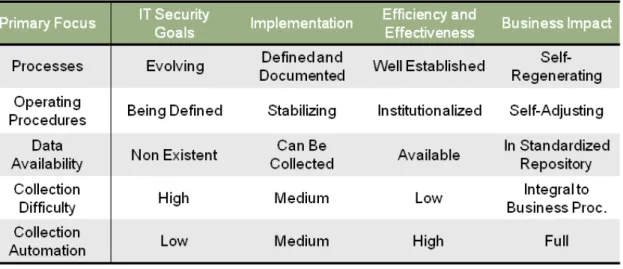
One of the highlights of the standard is the inclusion of a capability maturity model that links the organization's IS programme maturity level to the goals (and capabilities) of the ISMP, as illustrated by Figure 1.
Figure 1: Information Security Programme Maturity and Types of Measurement. As implied by the above figure, the types and primary targets of measurements in the organization vary depending on the level of maturity of its IS programme, as does the
12
organization's ability to perform them. For instance, the model suggests that it is more sensible as well as more feasible for an organization to focus on measurements of the security controls coverage (i.e. degree of implementation) at the earlier stages of its IS programme's maturity, with the main focus gradually shifting towards the effectiveness and efficiency measures as the coverage objectives (ideally, 100%) for various security controls are met. The ultimate goal is a high degree of measurement automation with the main focus of measurements being the impact that Information Security has on the organization's mission, goals, and objectives.
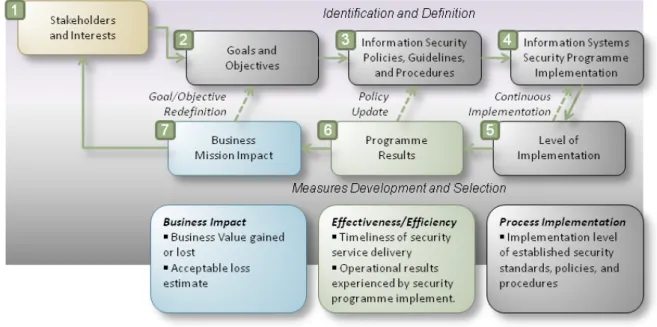
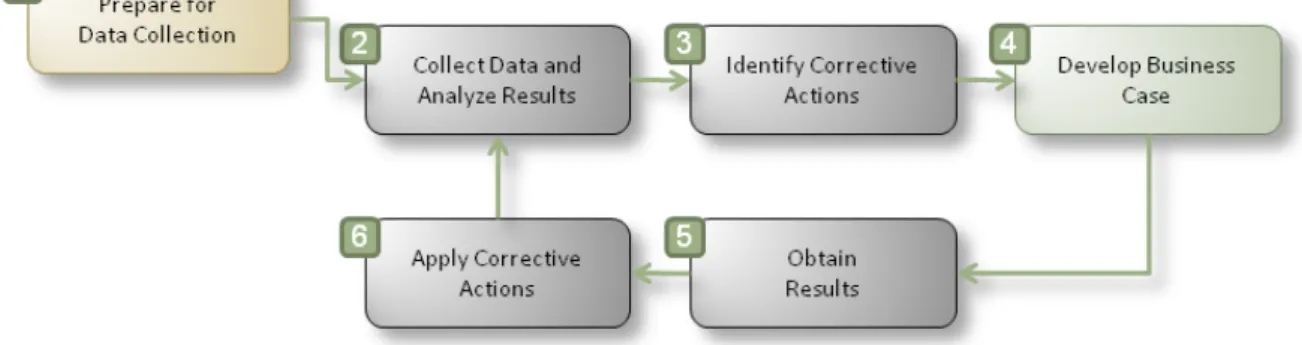
The methodology proposed in NIST SP 800-55 (Rev. 1) consists of two main processes; the first one is concerned with the development of measures (as portrayed on Figure 2), while the second one addresses their implementation (as shown on Figure 3). Both of the processes are iterative.
Figure 2: Information Security Measures Development Process.
The measures development process serves to device the original set of measures when first initiated and to select/redefine the successive sets of measures upon each iteration depending on the organization's priorities for a given time period. The process is divided into two types of activities, identification of the (current) state of the IS programme in a larger organizational context and establishment of measures that are most appropriate with respect to the former. The model of the process depicted on Figure 2 illustrates the general relationship between the activities (e.g. information security policies, guidelines, and procedures are derived from goals and objectives; process implementation metrics are more fundamental than effectiveness and efficiency metrics; development/selection activities provide feedback for the related identification/definition activities, such as the
13
effectiveness/efficiency metrics facilitating (continuous) appropriate changes to policies, guidelines, and procedures). However, the standard does not insist that the activities be followed in that specific sequence.
Figure 3: Information Security Measurement Programme Implementation Process. The measures implementation process illustrated by Figure 3 describes the initial phase, responsible for putting an ISMP in place; as well as the consequent iterative multi-phase process, which ensures that the established measures are continuously applied towards monitoring and improvement of information security in the organization, and tracks the changes introduced by the process itself with every iteration to make sure that progress is made.
3.1.2
ISO/IEC 27004
ISO/IEC 27004, Information Technology -- Security Techniques -- Information Security Management -- Measurement (ISO/IEC, 2009a), published December 2009, is a recent international standard, and as such it draws from the expertise of a number of different national standards authorities and experts worldwide (including the materials from NIST SP 800-55 Rev. 1). The standard was devised in order to address a requirement in the related ISO/IEC 27001, Information Technology -- Security Techniques -- Information Security Management Systems -- Requirements (ISO/IEC, 2005), which states that the effectiveness of the Information Security Management System (ISMS)*
*
Information Security Management System is defined by ISO/IEC as "part of the overall management system, based on a business risk approach, to establish, implement, operate, monitor, review, maintain and improve information security", where management system is defined as a "framework of policies, procedures, guidelines and associated resources to achieve the objectives of the organization".
controls must be measured. Thus, ISO/IEC 27004 can be used in conjunction with ISO/IEC 27001 (as to demonstrate compliance with the latter), but can also be used in a standalone capacity. In the latter case, it serves as a guidance document for development/implementation of metrics that can facilitate assessment of effectiveness/compliance of existing IS controls
14
and processes, and prioritization of associated improvement plans; and to substantiate IS risk management and management review processes. The standard also assumes a more implicit, yet important to point out connection to another closely related standard, ISO/IEC 27005, Information Technology -- Security Techniques -- Information Security Risk Management (ISO/IEC, 2008); specifically, it is assumed that the organization has performed IS risk assessment in accordance with ISO/IEC 27005 and is aware of the IS risks it has to deal with when developing measures and initiating measurement. The ISO/IEC 27004 document structure and topics covered are as follows:
• Introduction - Introduces the document and provides an executive summary.
• Scope - Specifies the scope of the document.
• Normative References - List of other ISO/IEC standards that are essential for the application of the document.
• Terms and Definitions - Provides a vocabulary of applicable terms.
• Structure of This International Standard - Explains the document structure.
• Information Security Measurement Overview - Outlines the ISMP, including its place in the overall ISMS and the contributing success factors. Introduces the conceptual models on which the standard is based.
• Management Responsibilities - Explains the roles and the responsibilities of management and relevant stakeholders with regard to ISMP.
• Measures and Measurement Development - Describes the activities involved in development and selection of IS measures and measurement processes in an organization-specific context.
• Measurement Operation - Describes the activities involved in the operation of an ISMP, including integration of ISMP into the overall ISMS, and data collection, storage, and verification.
• Data Analysis and Measurement Results Reporting - Provides guidance on how to analyze collected data and communicate the analysis results to relevant stakeholders.
• ISMP Evaluation and Improvement - Lists the related activities and provides guidelines for planning, identifying, and implementing appropriate improvements to an ISMP.
15
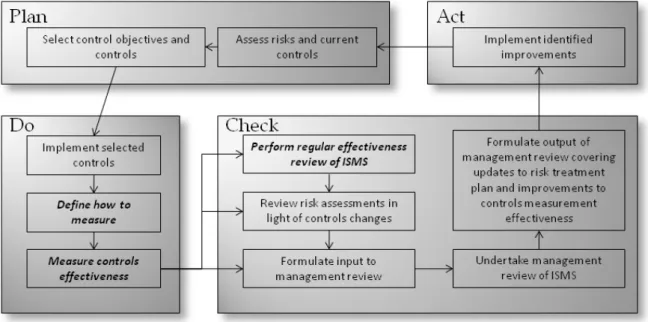
A template for an information security measurement construct and some measurement construct examples are also included in the document in Annex A and B, respectively. The standard advices that an organization's ISMP should be completely integrated into the ISMS, with all measurement related activities being coordinated with overall ISMS operations. The organizational and operational structure of an ISMP, including its scope and complexity, is dependent on the capabilities of the ISMS into which it is integrated; the initial scale of the measurement programme being limited to highest priority items, but increasing over time as the programme (as well as the overall ISMS) matures. It is also possible that more than one ISMP may be needed, depending on the organization's size. Adoption of a Plan-Do-Check-Act (PDCA) model (as specified in ISO/IEC 27001) is recommended in order to facilitate the implementation of an ISMP. The role of an ISMP and its activities in the context of the overall ISMS PDCA cycle is illustrated on Figure 4 below.
Figure 4: Measurement Inputs and Outputs in ISMS PDCA Cycle of Information Security Management (summarized; measurement activities are highlighted). ISO/IEC 27004 identifies four major processes that collectively comprise an ISMP (each corresponds to a specific chapter in the standard; see document structure outline above for a short description). They are as follows:
• Measures and Measurement Development
• Measurement Operation
16
• ISMP Evaluation and Improvement
Order of execution of the above processes is not (necessarily) strictly sequential. In an already established ISMP, Measurement Operation and Data Analysis and Measurement Results Reporting are inherently continuous processes; with specific activities varying in frequency, depending largely on the type/object of measurement in question. Measures and Measurement Development as well as ISMP Evaluation and Improvement processes are more periodic in relation; their frequency being decided by management, depending on the organization's current needs and priorities. However, the first three of the above processes can be thought of as sequential in terms of their input-output relationships to one another; and the ISMP Evaluation and Improvement process can be conceptualized as running in parallel with all three, providing feedback for each one of them, as well as closing the feedback loop for the overall measurement programme.
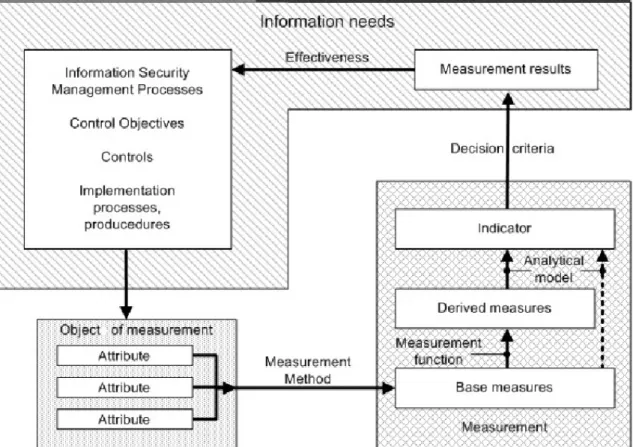
The basis and the suggested format for the development of measures and measurement is described in the standard in an especially detailed way. The document introduces and elaborates on a IS measurement model presented on Figure 5 below.
Figure 5: Information Security Measurement Model (precisely as it is depicted in ISO/IEC 27004, First Edition (ISO/IEC, 2009a).
17
The IS measurement model is based on the concepts found in ISO/IEC 15939, Systems and software engineering -- Measurement process (ISO/IEC, 2007). The model depicts the relationship between the information needs of an ISMS and IS measurement, where the latter is broken down into a number of basic elements that, together, systematically comprise IS measurement; the elements and connection between them are explained in the standard in detail.
The current version of the standard as of the time of this report (First Edition, published on December 15, 2009) suffers from a number of errors and inconsistencies throughout the document (e.g. on the IS measurement model portrayed on Figure 5, the upper-left text box includes the entry "Implementation processes, producedures"; "producedures" is an apparent spelling error; even when read as "procedures", as presumably intended, the meaning of the entry as a whole is still not readily evident as it is not identified the implementation of what specifically is being referred to in this instance; bearing in mind that a large portion of the standard is based/expands on the model in question, this can be viewed as a major issue). This may give rise to an impression that the release of the standard was rushed. One possible interpretation of the current state of ISO/IEC 27004 may be that there is a pressing need for the availability of this standard.
3.1.3
Other Standards
Two additional standards that, although having a much narrower scope and applications than NIST SP 800-55 and ISO/IEC 27004, may be deemed relevant within the scope of this report are ISO/IEC 15408 and FIPS 140-2.
ISO/IEC 15408, Information technology -- Security techniques -- Evaluation criteria for IT security (ISO/IEC, 2009b), otherwise known as the Common Criteria, is a three-part international standard that specifies a framework for evaluation of security properties of individual IT products. The standard defines seven Evaluation Assurance Levels (i.e. an indication of the depth/extent of an evaluation), which represent the level of assurance that the Target of Evaluation (i.e. the IT product in question) satisfies with regard to its Security Target (i.e. definition of the claimed security properties); Security Targets can be based on end-user formulated Protection Profiles (i.e. definitions of the requirements for particular uses of particular (types of) IT products).
ISO/IEC 15408 establishes the basis for measurement of the assurance level of security provided by specific products in specific environments and, thus, can facilitate decisions concerning the suitability of products to particular organizational context/needs and can also provide a point of reference for comparing the relative levels of assurance provided
18
by similar products. However, the standard's usability can be greatly limited by the time and associated costs of the evaluation process (due to its complexity).
Federal Information Processing Standards Publication 140-2, Security Requirements for Cryptographic Modules (FIPS, 2002), lays down a set of specifications for cryptographic modules used within security systems/products, defining four increasing security levels. In relation to ISO/IEC 15408, the standard assumes lower abstractness and a narrower scope. FIPS 140-2 is also connected to ISO/IEC 15408 in that it references the latter in respect to the operating system requirements, providing a list of Protection Profiles and specifying Evaluation Assurance Levels, and additional requirements.
The Cryptographic Module Validation Program (CMVP), operated jointly by NIST and the Communications Security Establishment Canada (CSEC) (accredited testing laboratories also exist in certain European and Asian countries), provides a framework for validating cryptographic modules against the standard and, thus, measuring and ranking the level of security they provide/possess.
FIPS 140-2 is to be superseded by its successor, FIPS 140-3, which is in a revised draft stage as of the time of this writing (FIPS, 2009). FIPS 140-3 incorporates new security features/requirements, which account for advances in technology and security methods that have occurred since the publication of FIPS 140-2.
3.2
Research Initiatives
This section lists a number of prominent contributions to the cause of establishing more quantitative and rational decision-making in security management practices by different industry, government, and academia supported research initiatives. The efforts outlined here focus on various aspects of security measurement and include examples of metrics compilations, measurement frameworks and methodologies, collaborative forums, and more. This list is intended to be illustrative of the present state of the art and directions in research but is not meant to be exhaustive.
The initiatives outlined here are listed by organizations where they were conceived. The ordering only serves to improve readability of the document and takes no other factors into consideration.
3.2.1
CISWG
Corporate Information Security Working Group, convened in 2003 by the United States House of Representatives sponsored Government Reform Committee, Subcommittee on Technology, Information Policy, Intergovernmental Relations, and the Census, delivered
19
the Report of the Best Practices and Metrics Teams in 2004, and then a revised version in 2005 (CISWG, 2005).
The report is meant to produce a compilation of metrics that are practical (operationally actionable and economically feasible) for organizations of different types and sizes. The report differentiates three distinct levels of IS metrics, which are as follows:
• Governance - metrics that address the responsibilities of the Board of Directors (or Trustees) and associated controls.
• Management - metrics linked to the responsibilities of the general management and associated controls.
• Technical - metrics that deal with controls contained within and executed by an IT environment.
The CISWG report also separates the metrics into three different subsets, which are the following:
• All - complete set of metrics established in the report; to be used as a reference and is stated to likely be impractical for implementation in its entirety.
• Baseline - minimum essential set of metrics to be used as a first step on a way to gradual implementation of a more comprehensive metrics programme.
• SME - metrics suitable for implementation in small and medium enterprises (500 employees or less).
The report acknowledges that the initial scale of the IS metrics implementation is reliant on the organization's present IS management capability and its potential is best realized over time as the capability matures. The above separation is, thus, meant to serve as a guidance towards gradual implementation of IS metrics, taking into account the current capability of the organization's IS management.
3.2.2
CIS
The Center for Internet Security (CIS) is a non-profit organization that seeks to provide consensus best practice standards and resources, intended to facilitate rational security decision-making. CIS has launched a security metrics initiative and formed a consensus team consisting of one hundred industry experts and stakeholders with a diverse set of backgrounds. The team produced a security metrics report in 2009 (CIS, 2009).
The report contains in total twenty metric definitions, which are categorized and divided among the following six business functions:
20 • Incident Management • Vulnerability Management • Patch Management • Application Security • Configuration Management • Financial Metrics
In addition to detailed metric definitions, the report offers comments regarding possible information sources, ways of prioritization (existing methods/tools that can facilitate it), aptness for automation, and possible means of visualization for each metric or category of metrics.
The work continues and efforts are being made to improve the existing metrics, develop new metrics (for above six as well as other business functions), and establish a common electronic format that will enable convenient distribution of metric definitions, data sets, and results.
3.2.3
@Stake
@Stake is a (former) information security consulting company, acquired by Symantec in 2004, that employed many established IS professionals and researched, developed, and applied in the industry a number of IS solutions. One of the company's contributions to the IS management field is the so called Business-Adjusted Risk (BAR) technique (Geer, Hoo, & Jaquith, 2003).
BAR is a method for assessing application security; it classifies security defects by their respective vulnerability type and, in a fashion similar to an Annualized Loss Expectancy (ALE) calculation, determines the score based on the following two factors:
• Business Impact - extent of damage (e.g. financial impact, negative exposure) that the organization would incur if the defect was exploited.
• Risk of Exploit - ease of exploitation by attacker, considering the required level of expertise, available resources, etc.
BAR classifies five separate scores for each of the above, with the total BAR score being the product of the two (i.e. BAR = Business Impact x Risk of Exploit).
BAR is intentionally simplistic, making it fast but not especially precise. Although it has been used successfully, providing consistent results, the method's application is limited
21
by the fact that it does not quantify risk in terms of money or time and its dependence on present availability of known exploits (i.e. the score is highly temporal and does not provide a good representation of risk over time) (Jaquith, 2007).
3.2.4
Microsoft
A measure for assessing the security level of a software system dubbed Relative Attack Surface Quotient (RASQ) was originally informally introduced at Microsoft in 2003. The proposed measurement methodology has since been progressively developed, becoming increasingly better formalized, by security researchers at the Carnegie Mellon University (Howard, Pincus, & Wing, 2003; Manadhata & Wing, 2004; Manadhata, Kaynar, & Wing, 2007).
The methodology proposed and explored in the original model and subsequent research is based on the concept of attack surface, which is said to be the combination of actions performed by a system that are transparent to the user and system resources employed by those actions. In essence, the metric is aimed at modelling threats to a system with respect to attack opportunities that result from exposure of the system's attack surface (i.e. the more actions/resources are available to the system's users, the more potential attack vectors there are). The method also acknowledges and accounts for the fact that different types of resources available to a system have different likelihoods of becoming attack opportunities.
The initial scope of the methodology was highly qualitative, aimed at measuring relative level of security provided by one version of a system with respect to another taking into account the design differences, limiting the usefulness of the model. However, over the years, the methodology has progressed into a more quantitative and practical metric by incorporating a systematic method/framework of identifying attack vectors based on an input/output automata model of a system.
3.2.5
ISECOM
The Institute for Security and Open Methodologies is a non-profit organization made up by a collaborative community of security experts that conducts open and neutral, peer-reviewed security-centric research, and provides security tools, best practice standards, certification, and awareness training.
One lasting, reputable research project by ISECOM is the Open Source Security Testing Methodology Manual (OSSTMM), which originally started out in 2000 and is still ongoing. OSSTMM is a consensus peer-reviewed methodology for performing operational security testing and measurement. It aims to incorporate and integrate with various international
22
standards, regulations, best practices, and ethical concerns. The latest finalized version of the manual is 3.0 (Herzog, 2010),.
The scope of the methodology encompasses a wide range of operational security issues and is organized into the following five channels (modules) that comprise three security classes:
• Human - Physical Security class.
• Physical - Physical Security class.
• Wireless - Spectrum Security class.
• Telecommunications - Communications Security class.
• Data Networks - Communications Security class.
The manual provides a method for measuring operational security by the means of Risk Assessment Values (RAVs). RAV is a essentially an attack surface metric and, therefore, it is conceptually similar to RASQ, but assumes notably higher abstractness and a wider scope. The RAV calculates an Actual Security metric, a scale value of the overall attack surface, which is a function of the following three separately quantified areas:
• Porosity - a measure of security with regard to existing "openings" in terms of visibility, trust, and access relationships/vectors.
• Controls - a measure of security with regard to existing counter-measures that provide impact/loss protection/reduction.
• Limitations - a measure of security in regard to known flaws and restrictions in the operations (porosity) and controls.
By balancing the above three metrics, RAVs show the correlation between the extent of attack surface exposure and security controls (e.g. are the existing controls inadequate, adequate, or excessive for certain types of attacks; how much potential damage can be caused by a successful attack; etc). RAVs do not calculate risk, however, as they do not calculate probabilities.
3.2.6
NIST
Advancement of measurement science is stated to be part of NIST's mission and one of its core competencies on the institution's website*
*
http://www.nist.gov
23
standard (NIST SP 800-55), certain other initiatives instigated by NIST have resulted in noteworthy contributions to security measurement.
The Security Content Automation Protocol (SCAP) (Quinn et al., 2009) is a collection of specifications intended to standardize the way security software solutions communicate software security flaw and configuration information. SCAP incorporates several existing standards*
Another of NIST's projects, Software Assurance Metrics And Tool Evaluation (SAMATE), is concerned with, among other things, measuring the effectiveness of various software assurance tools and developing metrics towards that end so that it becomes possible to compare different tools (and their versions) and verify the claims made by their vendor (Black, 2007). SAMATE is at present mostly focused on Source Code Security Analyzers and Web Application Vulnerability Scanners, but some efforts pertaining to Binary Code Scanners evaluation have also been made. Project's members have over the past years organized and contributed to numerous workshops and conferences. SAMATE's findings and deliverables have resulted in a number of papers being published (e.g. Fong at al., 2008; Okun, Guthrie, Gaucher, & Black, 2007) as well as specification documents such as the NIST SP 500-268 (Black, Kass, & Koo, 2007) and NIST SP 500-269 (Black, Fong, Okun, & Gaucher, 2008). NIST also maintains SAMATE Reference Dataset (SRD), which is a community repository of sample programs with documented security flaws that can be used to evaluate the software assurance tools (whereas by evaluating different tools against the same set, comparison can be made).
as its components, namely, XCCDF, OVAL, CPE, CCE, CVE, CVSS, and, as of the Revision 1 version that is currently in the draft stage, OCIL. The protocol essentially constitutes an approach to automating security measurement and reporting (as well as other aspects of operational information security management). SCAP also incorporates the National Vulnerabilities Database, which is a repository of standardized vulnerability management data managed by NIST. NIST operates SCAP Validation Program designed to validate a security product's ability to support certain SCAP capabilities. The protocol is gradually gaining widespread support.
NIST, together with researchers from the Concordia and the George Mason universities, has also been working on designing security metrics and measurement approaches that are based on attack graphs. These efforts are, in general, conceptually similar to attack surface based metrics research, but they are targeted at networks rather than individual systems. Attack graphs provide an abstraction (model) of a network architecture, which allows to enumerate network vulnerabilities and their interdependencies. Metrics can be
*
24
created that take into account these interdependencies and possible attack paths rather than only measure and/or count the individual vulnerabilities (Wang, Singhal, & Jajodia, 2007a; Wang et al., 2008). Several different metrics have been proposed based on this general concept, such as the attack resistance of various network configurations (Wang, Singhal, & Jajodia, 2007b), a quantitative assessment of network security risk based on known vulnerabilities (Noel, Wang, Singhal, & Jajodia, 2010), and the k-zero day safety metric that is based on the number of unknown vulnerabilities needed to compromise a network asset (Wang, Singhal, Jajodia, & Noel, 2010).
3.2.7
SwA Forum/WG
The Software Assurance (SwA) Forum and Working Groups (WG) are joint ventures co-sponsored by the US Department of Homeland Security (DHS), Department of Defense (DoD), and NIST, created in order to facilitate collaboration among software and cyber-security professionals. The forum follows a format similar to that of a conference, while the working groups function as venues for collaboration towards advancements in SwA, with the Measurement WG being one of them. The sessions are held semi-annually and, by virtue of being open to the public, include participants from governmental, industrial, and academic institutions alike.
One outcome of this collaboration that is important within the scope of this document is the Practical Measurement Framework for Software Assurance and Information Security (Bartol, 2008). The framework aims to provide a common approach to measurement of software assurance by leveraging several existing methodologies rather than creating a new one, namely, NIST SP 800-55 (Revision 1), ISO/IEC 27004, ISO/IEC 15939, CMMI*
The framework is a practical guidance document rather than a prescriptive standard. It identifies objectives and information needs of different stakeholders, and offers a list of related sample metrics; provides high-level guidance and outlines a process for metrics implementation; and overviews useful data sources for measurement. The five featured methodologies are compared in the document as to aid the readers in selecting the one Measurement and Analysis Process Area, and CMMI Goal-Question-(Indicator)-Measure. The framework is intended to be scalable in scope and is designed to satisfy information needs of the relevant stakeholders at different levels within both the organizations that wish to acquire software products and those that supply them.
*
Capability Maturity Model Integration is a scalable process improvement method developed at the Software Engineering Institute of the Carnegie Mellon University. More information is available on the official website at http://www.sei.cmu.edu/cmmi/.
25
most suitable to their needs and/or help to translate and communicate similar concepts between the different methodologies that may be in use.
3.2.8
Securitymetrics.org
Securitymetrics.org is a community website, established in 2004 by Andrew Jaquith, for (and by) information security practitioners and decision-makers, which serves to further more empirical (rather than qualitative) security practices through the combined efforts of its members. The website provides a news portal, knowledge repository, and a forum for discussion and collaboration (in the form of a members-only mailing list).
One notable undertaking initiated by members of the community is the Metrics Catalog Project. The project's objective is to maintain and continuously develop a free, publicly-available, centralized security metrics repository, which allows its users to share, refine, organize, and rate metrics definitions/specifications. The metrics management platform on which the catalogue is based is developed by PlexLogic.
Another noteworthy initiative incited by the securitymetrics.org community is Metricon, an annual conference (originally launched in 2006) dedicated to security metrics, which serves as a forum for re-examining past and state-of-the-art practices, and establishing new approaches with emphasis on practical applications.
More detailed information, including links to the abovementioned metrics catalogue and the Metricon conference proceedings, is available on the website itself*
3.2.9
ISACA
.
ISACA (formerly known as Systems Audit and Control Association but currently referred to only by its acronym) is a global non-profit membership association consisting of over 95,000 members worldwide. ISACA provides and facilitates IT and information systems related research, education, certification, and resource sharing and is widely recognized for its frameworks and best practice standards, which include the Control Objectives for Information and Related Technology (COBIT), IT Assurance Framework (ITAF), Risk IT, Val IT, and Business Model for Information Security (BMIS).
ISACA has published a number of articles concerning information security metrics in its journal over the past several years. One such publication (Chapin & Akridge, 2005), for instance, overviews a number of traditional (i.e. commonly employed) security metrics and suggests a list of ideal characteristics deemed essential to devising proper security metrics, then concludes that, in practice, most commonly used metrics do not meet the
*
26
criteria dictated by the ideal characteristics. Next, the paper goes on to accentuate the importance of and examine the possible methods/models for integrating the (capability) maturity aspect of a security programme into measurement, as well as the posture (i.e. quality of implementation of the individual programme maturity elements).
Another example (Axelrod, 2008) starts off with a discussion on ambiguity and disparity between the certain proposed "ideal" definitions of metrics and what actually is or would be practical in real world application. The paper's main contribution is a classification of eight metrics categories (existence, ordinal, score, cardinal, percentage, holistic, value, and uncertainty) and an examination of their respective pros and cons, that is, how and where they are useful, what can and cannot each of the categories of measures be used to indicate in a meaningful way.
Yet another example (Pironti, 2007) articulates a number of measures development and implementation related good practices and certain possible commonly associated pitfalls in a broad context of information security governance. The article puts together several suggestions that include using Key Performance Indicators (KPIs), keeping in mind both the specific target of measurement and intended audience when devising metrics (as to avoid unnecessary complexity resulting in ineffective metrics), accentuating consistency of the measurement related processes, aligning metrics with business goals, and making use of a baseline metrics framework (and then adding or removing measures in view of the evolving business risks and needs). The publication also examines different types of metrics and effective ways of reporting them, considering the intended audience and its interests and requirements.
The IT Governance Institute (ITGI), established by ISACA, has produced two documents of educational nature with a broader scope, Information Security Governance: Guidance for Boards of Directors and Executive Management (second edition; original published in 2002) (ITGI, 2006) and the lower level Information Security Governance: Guidance for Information Security Managers (ITGI, 2008). The two publications, while dealing with IS governance in general, advocate the use of metrics at the involved organizational levels and explain their place and importance in effective security governance. The documents are intended to be complementary, the latter extending on the former. The higher level document mainly suggests where metrics can be used to assess performance. The lower level document is more elaborative on the subject of metrics; an argument is made that standard IS metrics (e.g. downtime due to malicious software, number of vulnerabilities uncovered with network scans, percentage of servers patched, etc) as well as commonly used ALE calculations tend to fall short of delivering a complete and accurate picture of how secure the organization is overall. It is further explained that there is a tendency to
27
use metrics that are readily available regardless of how relevant or informative they are in actuality. Subsequently, guidance is provided on the effective measures development and monitoring methods, while it is generally advised that the following should be taken into consideration:
• What is important to information security operations
• The requirements of IT security management
• The needs of business process owners
• The requirements of senior management
ISACA is also directing a currently ongoing project named Information Security Program Metrics. The goal of the project is to expand upon the Information Security Governance: Guidance for Boards of Directors and Executive Management report noted above and to further clarify the concepts related to measurement of the IS programme's performance as well as offer additional guidance on the development of business-oriented IS metrics and reports for security managers. The project is expected to be concluded in the fourth quarter of 2010, according to ISACA's website*
3.2.10
OWASP
as of the time of this writing.
The Open Web Application Security Project is a non-profit open international community managed and supported by the OWASP Foundation. It is dedicated to providing forums, documents, and tools, which are meant to facilitate both development and operation of applications that are secure and trustworthy. The project is perhaps best recognized for its widely adopted OWASP Top Ten awareness document that lists the most critical web application security flaws at the time of each publication.
The most notable contribution to the field of security measurement produced by OWASP is the Application Security Verification Standard (OWASP, 2009). One of the three primary stated objectives of the standard is to serve as a metric for the degree of trustworthiness of Web applications (the other two are to serve as guidance for the application security control developers and a basis for specifying security requirements in procurement contracts). The specified approach is conceptually similar to the ISO/IEC 15408 and FIPS 140-2 standards previously described in this chapter, with the main difference being its focus on security of Web applications. The framework is intended to normalize the ranges in both breadth and depth of assessments of Web application security (whereas Common Criteria would allow for more varied ranges in coverage and rigor between assessments, depending on
*
28
the specific Protection Profiles and/or Security Targets used). The standard defines four hierarchical security levels against which applications can be evaluated, while levels one and two are further subdivided into two subset levels each.
OWASP lists two other security measures related projects on its website*
3.2.11
Forrester Research
as having the "alpha status" at the time of this writing. The Application Security Metrics Project's goal is to establish a baseline set of security metrics that are found to be effective, while the Web Application Security Metric using Attack Patterns Project is focused at developing a tool that is expected to create attack patterns based on security requirements collected from the user. The two projects appear to be ongoing, though, due to both still being in relatively early stages in development, little information has been published about them thus far.
The independent research company Forrester Research has produced a sizeable amount of publications concerning security measurement and reporting in the past few years. A multitude of issues covered across these articles is often addressed with a more hands-on approach that is founded in the outcomes of real life surveys and case studies, which are targeted at the industrial sector. The research conducted by Forrester is proprietary and is accessible to their clients for a fee, while brief executive summaries are available free of charge from the company's website†
One of the publications made available by Forrester (Koetzle et al., 2006) examines the issues of prioritization of measurement while also providing certain guidelines regarding its implementation. Some of the advice given include designing metrics with (potential) automation in mind, emphasising individual stakeholder accountability, and focusing on more than just compliance metrics. The document recommends that the following areas be given priority when creating metrics:
.
• Business Continuity
• Security Configuration Management
• Identity Management • Incident Response • Security Awareness * http://www.owasp.org † http://www.forrester.com/rb/research
29
Another document (Kark et al., 2008), based on the outcome of a survey that consisted of over 20 companies with security metrics programmes in place, proposes the following three security metrics best practices, where the general message is that an organization must consider and focus on the big picture rather than get lost in technicalities:
• Be very selective in picking the metrics
• Think beyond the security organization
• Focus on reporting and presentation
The article in question also helps identify possible challenges, outlines relevant research and case studies, and offers supplemental material that includes a "Self-Diagnostic Tool For Security Metrics Capabilities".
Numerous other instances of research that are directed at examining the current trends and developments, and/or establishing best practice guidelines in security measurement and reporting are performed and published by the company, some of which also include more issue-specific descriptive case studies (e.g. Case Study: Eastman Kodak Company Takes A Tiered-Risk Approach To Security Metrics, Case Study: Harland Clarke Turns To Corporate Objectives For Defining Security Metrics, Case Study: Verizon Business Builds An Asset-Based Security Metrics Programme, Case Study: DTCC Implements A Process-Based Approach To Security Metrics).