How farm labor organization affects technology
adoption: the case of Integrated Pest Management
(IPM)
Beckmann, Volker; Irawan, Evi; Wesseler, Justus
Veröffentlichungsversion / Published VersionArbeitspapier / working paper
Zur Verfügung gestellt in Kooperation mit / provided in cooperation with:
SSG Sozialwissenschaften, USB Köln
Empfohlene Zitierung / Suggested Citation:
Beckmann, V., Irawan, E., & Wesseler, J. (2009). How farm labor organization affects technology adoption: the case of Integrated Pest Management (IPM). (Institutional Change in Agriculture and Natural Resources (ICAR) : Discussion Papers, 21). Berlin: Humboldt-Universität Berlin, Institut für Wirtschafts- und Sozialwissenschaften des Landbaus, Fachgebiet Ressourcenökonomie. https://nbn-resolving.org/urn:nbn:de:0168-ssoar-125930
Nutzungsbedingungen:
Dieser Text wird unter einer Deposit-Lizenz (Keine Weiterverbreitung - keine Bearbeitung) zur Verfügung gestellt. Gewährt wird ein nicht exklusives, nicht übertragbares, persönliches und beschränktes Recht auf Nutzung dieses Dokuments. Dieses Dokument ist ausschließlich für den persönlichen, nicht-kommerziellen Gebrauch bestimmt. Auf sämtlichen Kopien dieses Dokuments müssen alle Urheberrechtshinweise und sonstigen Hinweise auf gesetzlichen Schutz beibehalten werden. Sie dürfen dieses Dokument nicht in irgendeiner Weise abändern, noch dürfen Sie dieses Dokument für öffentliche oder kommerzielle Zwecke vervielfältigen, öffentlich ausstellen, aufführen, vertreiben oder anderweitig nutzen.
Mit der Verwendung dieses Dokuments erkennen Sie die Nutzungsbedingungen an.
Terms of use:
This document is made available under Deposit Licence (No Redistribution - no modifications). We grant a exclusive, non-transferable, individual and limited right to using this document. This document is solely intended for your personal, non-commercial use. All of the copies of this documents must retain all copyright information and other information regarding legal protection. You are not allowed to alter this document in any way, to copy it for public or commercial purposes, to exhibit the document in public, to perform, distribute or otherwise use the document in public.
By using this particular document, you accept the above-stated conditions of use.
INSTITUTIONAL
CHANGE
IN AGRICULTURE AND
NATURAL RESOURCES
Discussion Paper
THE EFFECT OF FARM LABOR ORGANIZATION ON IPM ADOPTION
Empirical Evidence from Thailand
VOLKER BECKMANN,EVI IRAWAN AND
JUSTUS WESSELER
ICAR Discussion Paper 21/2009
Discussion Papers
Edited by Volker Beckmann and Konrad Hagedorn Humboldt-Universität zu Berlin
Institut für Wirtschafts- und Sozialwissenschaften des Landbaus Fachgebiet Ressourcenökonomie
Humboldt University Berlin
Department of Agricultural Economics and Social Sciences Chair of Resource Economics
Luisenstr. 56, D-10099 Berlin Germany Phone: ++49 30 20936305 Fax: ++ 49 30 20936497 Email: [email protected] [email protected] http://www.agrar.hu-berlin.de/wisola/fg/ress/ Managing Editor: Volker Beckmann Editorial Board: Franz W. Gatzweiler
Markus Hanisch Martina Padmanabhan Christian Schleyer
ICAR Discussion Papers are reports prepared by members of the Division of Resource Economics, Humboldt University Berlin or external authors working on topics of institutions and institutional change in agriculture and natural resource management. The papers have received limited reviews. Views and opinions expressed do not necessarily represent those of the Division of Resource Economics. Comments are highly welcome and should be sent directly to the authors.
ISSN 1613-3455 (Printausgabe) ISSN 1613-4862 (Internetausgabe)
Technology Adoption
The Case of Integrated Pest Management (IPM)
Volker Beckmann
*, Evi Irawan
*and Justus Wesseler
** *Humboldt University Berlin,Institute of Agricultural Economics and Social Sciences Division of Resource Economics
Email: [email protected] **Wageningen University,
Environmental Economics and Natural Resource Group.
ICAR Discussion Paper 21/2009 December 2009
Abstract
This paper examines the effect of labor organization on integrated pest management (IPM), using cross section data collected from a participatory farming system survey of 157 durian growers in Chanthaburi, Thailand, in 2005. In contrast to many studies of IPM adoption, this work uses the form of farm labor organization as an endogenous factor for identifying the rate of IPM adoption among durian growers. The instrumental variables method was employed to econometrically relate a set of alleged variables as instruments of labor organization to the rate of IPM adoption. Results show that, among others, farms employing hired labor have a significantly lower adoption rate of IPM.
Keywords: Labor Organization, IPM Adoption, 2SLS, Farm Labor, Agricultural Extension
JEL classifications: Q16, J2, J43
Acknowledgement
The authors gratefully acknowledge financial support received from the German Research Foundation (DFG). We express our gratitude to Patcharee Menakanit and Cherdpong Chompoorat, Department of Agricultural Extension, and Dr. Chaiwat, Rajamangala University of Technology, Chantaburi, for their support during implementation of the durian survey in Chanthaburi, Thailand. We thank also Daniel Müller and Bekele Hundie for their valuable comments on an earlier draft version of this paper.
1
Introduction
Since the pioneering work of Grilichs (1957), the adoption of technological innovations has received a great amount of attention in agricultural economics, with the fast growing literature having been reviewed by Feder et al. (1985), Feder and Umali (1993), and, most recently, by Sunding and Zilberman (2001).
Sunding and Zilberman (2001) view adoption of new technology as part of the larger process of innovation. The process starts with discovery, continuing with development and dissemination of the new technology. Once a new technology is available, studies on adoption examine the determinants of adoption or non-adoption at a particular time, either at an individual or aggregate level. Adoption studies differ from studies on diffusion, which explicitly take time and space into account.
The economic literature usually assumes that a new technology will be adopted if it is profitable (Feder et al., 1985). The underlying theoretical model is that of the profit-maximizing firm or utility-profit-maximizing household. The profitability of a new technology is determined by attributes of the technology and a number of farm-specific factors, such as farm size, risk and uncertainty, human capital, labor availability, credit constraints, information constraints and supply constraints of complementary inputs (Feder et al., 1985).
While farm and household characteristics and the features and attributes of new technology are often considered as determinant factors of technology adoption, the relationship between farm labor organization and technology adoption is often neglected or overlooked (Beckmann and Wesseler, 2003). Likewise, the different forms of farm labor organization do not appear as either endogenous or exogenous variables in existing models.
The linkage between technology and organization can be explained in two ways. Technology adoption may define the manner in which production should be organized; on the other hand, it is also possible that the given structure of production organization may define which technology is suitable to be adopted. This reciprocal relationship has been explored in studies on the connection between information technology and organization (e.g. Borghans and ter Weel, 2006), but has not yet become a concern for agricultural innovation-adoption studies.
In this paper, we investigate the link between farm labor organization and adoption of integrated pest management (IPM). Empirical studies on the adoption of IPM in the United States (McNamara et al., 1991; Fernandez-Cornejo et al., 1994; Fernandez-Cornejo, 1996, 1998) have shown a significant negative impact of off-farm income on the adoption of IPM,
confirming that opportunity costs of labor are an important variable in explaining the rate of adoption. Mancini et al. (2006) find that cotton planting farm households in India using hired labour had a significantly lower IPM adoption rate and that IPM adoption did results in a redistribution of household labor organisation. Particulalry, the amount of female labour did increase and housholds more constraint with respect to female labour did show a lower adoption rate. Other commonn factos explaing IPM adoption rate include the IPM training method (van den Berg and Jiggins, 2007), age of the decision maker, household size and education and knowledage level as well as market access (see Table A-1 for an overview). However, the explicit consideration of labor organization has been neglected up to now.
This analysis is based on the results of a survey among IPM-trained durian farmers in Thailand. The results show that labor organization has a highly significant impact on the adoption rate of IPM. In the following, we first briefly present the theoretical framework, based on Beckmann and Wesseler (2003). Second, we present some background information on pest management in durian farming systems in Thailand. Then we describe the survey, the data set and the empirical model used, ending with a presentation and discussion of the results.
2
Integrated Pest Management and Farm Labor Organization
IPM developed as a response to health and environmental problems related to the misuse of chemical pesticides (Morse and Buhler, 1997). Although it has been widely promoted as a sustainable means of pest control since the 1960s, there is no general agreement on its definition (Orr, 2003). However, a common meaning is that IPM’s goal is to reduce the use of chemical pesticides in controlling pest problems. For the purposes of this empirical study, we define IPM as a plant protection technology that integrates biological, mechanical, cultural, and chemical pest management practices, based on continuous pest monitoring, and aims at reducing the application of chemical pesticides. This excludes organic farming practices, which prohibit the application of chemical pesticides by definition.
IPM can be characterized as a disembodied technology (Sunding and Zilberman, 2001) that is (1) complex and knowledge intensive as well as (2) as labor and managerial intensive. Under IPM, actions taken for the reduction of pest density or plant diseases so that they are below the economic threshold are based on agroecosystem analyses, using information about pests and diseases collected from the field at different times during the cropping cycle. Without any knowledge and skills related to agroecosystem analysis, it is difficult for a farmer to apply recommended IPM practices. Due to its complexity, IPM poses a challenge to
agricultural extension strategies. One successful dissemination strategy for IPM, specifically in developing countries, is through the use of Farmer Field Schools (FFS) (Schmidt et al., 1997). The general approach is to train a group of farmers in IPM during a cropping season. Under the guidance of trainers, farmers implement field trials and compare the results. It is expected that farmers will adopt at least some of the IPM techniques learned at the FFS (Horstkotte-Wesseler, 1999). Studies evaluating the impact of FFS IPM training at the farm level report a significant impact from such participation on farm yields and profits and a decline in pesticide use (van den Berg and Jiggins, 2007).
IPM is generally more labor and managerial intensive than the application of chemical pesticides alone, as it depends on the generation and application of knowledge concerning pests and diseases in the field at different points in time during the cropping cycle. An IPM-strategy substitutes capital (expenses for pesticides) and labor time spent on spraying for labor time spent on the implementation of IPM measures (Fernandez-Cornejo, 1996; Morse and Buhler, 1997; Schillhorn van Veen et al., 1998; Pingali and Gerpacio, 1998; van de Fliert and Proost, 1999). Labor-related indicators are, therefore, central to evaluating the viability and sustainability of IPM as well as the assessment of effects on labor demand and employment (Lee et al., 2006). Ruben et al. (2006) even argue that promoting labor-intensive technologies may be inappropriate in situations where the opportunity costs of labor are high or rising.
The principal challenge facing farmers in organizing pest management activities is the division of tasks among people working on a farm. Assuming that farm size is fixed, the development of the farm labor organization for a specific farm depends, among other things, on the division of labor tasks. Most often, farm labor organization is structured around a combination of owner, family members, and hired permanent or seasonal laborers (Roumasset, 1995). Whether a certain task is carried out by the owner or somebody else depends mainly on differences in the opportunity and transaction costs of labor (Beckmann, 1996, 2000).
The organization of tasks of an IPM practice consists of two main categories of tasks. The first category consists of managerial tasks, mainly decision making activities. The second category consists of operational tasks, including the performance of activities that have been decided upon by decision makers. Each task requires different provisions of human capital, incentives, and transaction costs. Take pest and disease monitoring practices as an example. The person who undertakes this set of tasks has to be able to select which pests and diseases are dangerous for the crops, identify natural enemies of pests and diseases, and determine the critical level of density. In contrast, operational tasks, such as spraying pesticides, may be
assigned to any person without any specific provisions. Thus, the problem of limited substitutability of labor is rather obvious in applying IPM as a plant protection strategy. A farmer who wants to adopt IPM practices is likely to adopt those practices that fit well within the form of labor organization on his farm or, rather, organizes existing farm labor in a way that is suitable for IPM and does not simply hire additional labor to perform IPM practices.
The interaction between IPM adoption and farm labor organization has been analyzed theoretically by Beckmann and Wesseler (2003). The authors use a cost-benefit analysis model and define the maximum number of labor days a farmer is willing to spent on IPM practices. They distinguish between three different forms of labor organization and discuss the following scenarios: (1) owner-operated, (2) owner-operated in combination with family members or permanently hired labor, and (3) owner-operated in combination with short-term hired labor. The comparative advantage of IPM is highest under owner-operated pesticide application, followed by family-member or permanent hired-labor-operated pesticide application and, finally, short-term hired-labor-operated pesticide application. The main economic reasons are that hired labor is difficult to empoly in many IPM tasks and that hiring labor to spray pesticides may give the opportunity to externalise health costs.
Based on the model of Beckmann and Wesseler, we empirically test the hypothesis that farm labor organization has a significant impact on IPM adoption. The analysis is based on a case study among IPM-trained durian farmers in Chanthaburi, Thailand. We chose durian farms as our case study because of the wide variation of farm-labor organization that can be found in durian farming systems.
3
Pest Management and IPM in Durian (Durio zibethinus) Farming
Systems
Durian can be considered a vulnerable fruit tree as the fruit is susceptible to many pests and diseases. These pests and diseases eat, infest, and parasitize parts of the durian trees, damage their production capabilities and, in some cases, even kill them. Disthaporn et al. (1996) differentiate between major and minor pests and diseases. Major pests and diseases which can regularly cause damage include Psyllids (Allocaridara malayensis), fruit borers (Conogethes punctiferalis), seed borers (Mudaria luteileprosa), African red mites (Eutetranychus africanus) and root and stem rot (Phytophthora palmivora). Minor pests and diseases which can cause occasional damage include stalk-eating caterpillars (Orgyla postica), mealy bugs
(Pseudococcus sp), Rhizoctonia leaf blight (Rhizoctonia sp), and algal disease (Cephaleuros virescens).
Monitoring of the trees helps fruit growers to decide whether or not to implement measures to control pests and diseases. In many cases, this includes the application of pesticides, but it can also mean pruning, controlling humidity by irrigation, hormone traps, and other non -pesticide interventions (Disthaporn et al., 1996; Salakpeth, 2000; Subhadrabandhu and Ketsa, 2001). Yet, there are many cases where durian farmers apply pesticides based on a regular schedule. Table 1 lists common pesticides used among durian farmers to control pests and diseases.
Table 1: Common Pesticides Used in Durian Farming in Chanthaburi, Thailand
Common Name WHO
Classification* Main use Unit
Average use rai/year
1. Abamectin Unlisted Insecticide liter 1.24
2. Carbaryl II Insecticide kg 0.48
3. Chlorpyrifos II Insecticide liter 0.47
4. Cypermethrin II Insecticide liter 0.52
5. Dicrotophos Ib Insecticide liter 0.59
6. Glyphosate U Herbicide liter 0.97
7. Metalaxyl III Fungicide liter 0.24
8. Methamidophos Ib Insecticide liter 0.62
9. Propargite III Acaricide liter 0.52
10. Sulphur U Fungicide kg 1.70
Note: 1 rai = 0.16 hectare
*WHO class Ia = extremely hazardous, Ib highly hazardous, II= moderately hazardous, III= slightly hazardous, U= unlikely to be hazardous in normal use.
Source: Own Survey 2005
Pesticide application includes several activities, namely identifying suitable pesticides, composing or mixing pesticides (if any), and spraying. In some cases pesticides are also painted on the trunk and applied on the ground. Pesticides are commonly sprayed by using a knapsack sprayer or power sprayers. Farmer usually hires-in farm labor to spray pesticides. Yet, some farmers do all activies on pesticides application by themselves or with family members.
An IPM strategy to control a certain pest or disease includes a number of different practices and also, may be able to serve other purposes. Take fruit thinning for example. This practice is aimed to control fruit and seed borer pests (Conogethes punctiferalis and
practice to promote growth, shape, and quality of the fruits (Subhadrabandhu and Ketsa, 2001).
Some IPM practices, such as monitoring, weeding, pruning, trapping insects, and watering, are undertaken during the entire durian tree production cycle. Other IPM practices are implemented at certain stages of the cycle and depend on the presence of pests and diseases. Under IPM, chemical pesticide applications are regarded as a last resort when other IPM practices cannot suppress pests and diseases (Disthaporn et al., 1996; Elsey and Sirichoti, 2003).
The list of IPM practices considered within this study, which can be found in the appendix, is based on the recommendations provided in Disthaporn et al. (1996) and was generated with regard to activities identified during the survey.
4
Methods
4.1Data CollectionOur empirical model is based on data from a farming system survey of 157 IPM-trained durian farmers in Chanthaburi, an eastern province in Thailand, where durian tree is extensively grown (Elsey and Sirichoti, 2003). As of 2001, durian farmers in Chanthaburi contributed 45.57% of their crop to national production (Food Market Exchange, 2003). Durian is mainly produced fresh for the local market (85%), while about 10% is for export and only 5% is processed (Department of International Trade, 2003).
IPM for durian trees was introduced in Chanthaburi in the early 1990s by means of participatory extension programs which were adapted from the Farmer Field School (FFS) approach for rice farming. The IPM extension program was taken over by the Provincial Office of the Department of Agricultural Extension; since then, the IPM extension program has become part of the regular agriculture extension program (Menakanit, 2001).
The survey was conducted in five districts of Chanthaburi province, based on the method suggested by Njenga et al. (2000). Six survey teams, each comprised of two students studying fruit science at the Rajamanggala Institute of Technology in Chanthaburi, were employed as data collectors or enumerators under supervision of the researchers. Prior to survey implementation, the students were trained on how to collect data from farmers and transfer the data to the survey instruments. During the survey, a team of two enumerators visited each farmer’s orchard and walked through the orchard together with the farmer while conducting an interview regarding pest management practices being employed by the farmer. The
interviews were guided using four survey instruments: a questionnaire containing general questions concerning the farm household, a gross margin analysis form, a farm labor activity matrix form, and a checklist of pest-management tasks. The enumerators also made sketches to illustrate the orchards they had visited. These sketches are important for checking whether information provided by the farmers is plausible.
The 157 farms were drawn randomly from the list of farm households that had at least participated at one IPM training session conducted by the Department of Agriculture Extension, Chanthaburi. Based on information from the Provincial Office of the Department of Agricultural Extension in Chanthaburi, the forms of labor organization of durian production can be divided into 5 groups, including owner-operated farms, family-operated farms on which the owner and other family members work together, and firm-like-operated farms in which owner and family members as well as farm laborers, either seasonal or permanent, work together. The sampling was done from the list of IPM participants, stratified according to labor organization, as presented in Table 2.
Table 2: Farm Labor Organization of Durian Production in Chanthaburi
Form of farm labor organization Sampling
frame Sample
Owner operated 128 9
Family operated 659 48
Operated with seasonal labor 810 59
Operated with permanent labor 370 27
Operated with seasonal and permanent labor 175 13
Total 2142 157
Source: Own Survey 2005
4.2The Econometric Model
While theory implies that farm labor organization is important for determining IPM adoption, from an econometric perspective, it generates problems when empirically testing the model, the most important of which occur when measuring opportunity costs of labor and health costs due to pesticide exposure. The assessment of opportunity costs of labor requires complete information about available opportunities to earn income with regard to the personal characteristics of the farm laborers in question. Likewise, health costs due to pesticide exposure are not easy to discern in an empirical study because of time-lag effects due to pesticides on human health and the inability to control for several factors other than pesticide
exposure that can cause impaired health. To resolve this problem, the specification of the empirical model consists of several variables used as proxies for the theoretical variables.
Previous empirical adoption studies have commonly used multivariate logit, probit, tobit, or poisson models in testing factors for technology adoption (McNamara et al., 1991; Fernandez-Cornejo et al., 1994; Fernandez-Cornejo, 1996, 1998; Maumbe and Swinton, 2003). These different models are applied according to the different ways that IPM adoption can be measured. In this study, we use the ratio of labor-time spent for IPM over pesticide application as the measure for IPM adoption. This IPM adoption measure, denoted by IPM, is a censored variable defined as: IPM equals IPM* when IPM*> 0, but zero when IPM*=0. Estimating the model by OLS would yield biased and inconsistent estimates of the effect of farm labor organization on IPM adoption. One way to address this problem is by taking into account the partially discrete and partially continuous nature of our dependent variable through estimation via a tobit model. Nonetheless, the use of maximum-likelihood estimator for the tobit model assumes that errors are normal and homoscedatic (Long, 1997).
The key variable we use to measure labor organization is the share of hired labor from the total labor time spent on pest management. Here some additional econometric issues arise. The share of hired labor may be endogenous and the coefficient estimate biased. Unobserved heterogeneity and omitted variable bias may exist if the share of hired labor can be explained by variables that are also associated with IPM adoption. Another endogenous issue arises from the reciprocal relationship between IPM adoption and farm labor organization. On the one hand, the existing farm labor organization may influence the extent to which IPM practices are adopted, while on the other hand, IPM adoption may also results in a reorganization of farm labor.
To account for the endogeneity of hired labor share, an instrumental variable estimation procedure (IV) may be used. The potential IVs are off-farm work by the decision maker and other family members as well as the number of family members, the number of fruit trees planted on the farm. When assessing the need for pest and disease control, particularly small-scale farms are likely to pay more attention to the number of productive fruit trees, since they affect current on-farm income. Thus, in one production cycle the amount of labor spent on pest management may, among other things, depend on the number of productive trees.
Another IV choice affecting labor organization is made regarding the actual labor-market conditions for hiring labor to spray pesticides. Typically, the amount of hired labor employed in farming activities is associated with labor availability in the market. If conditions on the
labor market are attractive, then a farmer may be better off hiring-in labor as a substitute for his own labor, which is then used for other on-farm tasks of for off-farm work.
If encountered errors satisfy the assumptions of the maximum likelihood estimator for a tobit model, then we use an IV tobit estimator, as described in Newey (1987). Otherwise, we will employ 2SLS or General Method of Moment (GMM) estimation procedures after transforming the dependent variable to one most closely resembling a normal distribution. Formally, our empirical model is:
* 1 2 1 2 1 1 2 2 i i i i i i i i IPM L Z L Z Z
β
γ ε
ν
= + + = ∏ + ∏ + (1)for i=1,...,n farms in the sample. The vector IPM measures the rate of IPM adoption. Vector-matrix L captures the share of hired labor, which is measured according to the share of hired-labor days in relation to total labor days devoted to pest management and can be explained by the farm labor organization captured by the instrumental variable vector-matrix
Z2, which includes the number of productive Durian trees, whether or not the farm owner and/or other family members work off-farm, the number of family members more than 15 years old and the ease of hiring labor. L* is the instruments vector-matrix. Z1 is a vector of
exogenous explanatory variables, including the formal education of a farm’s owner, the number of attended IPM training sessions, knowledge of IPM and perception of the health effects of pesticides, pest pressure, and whether or not a farm has a mixed orchard. Errors are assumed to be normally distributed, (
ε
i,ν
i)∼
N(0,σ
2). β is the structural parameter measuringthe share of hired labor and
γ
is the vector of structural parameters of the other explanatory variables, and ∏1and ∏2are matrices of reduced-form parameters.5
Empirical results
5.1Data description5.1.1 General Farmer and Household Characteristics
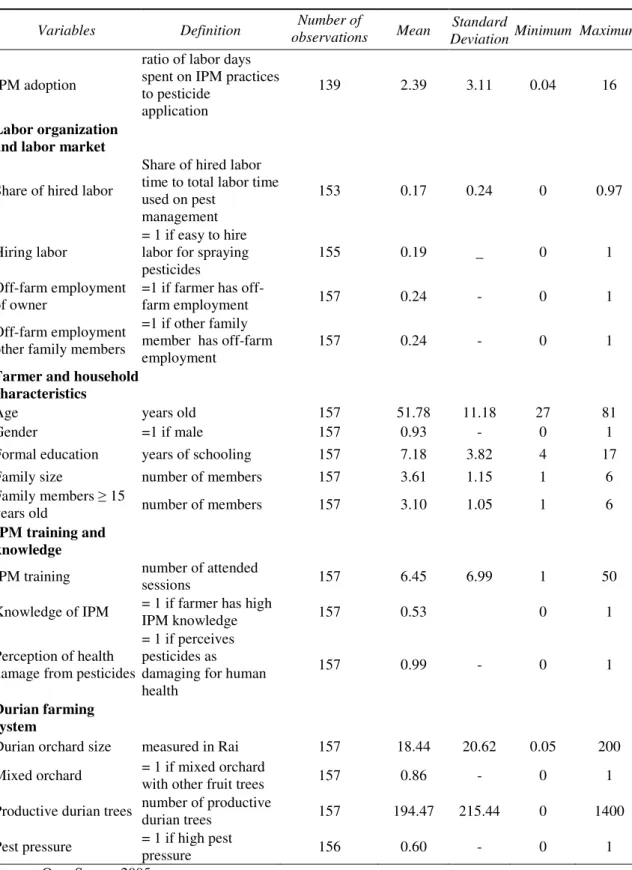
Of the 157 farmers surveyed, 146 were male and 11 were female, averaging 51.78 years in age (range 27 - 81) and with 7.18 years of schooling (range 4 -17). On average, a household of surveyed farmers can be characterized as a small family consisting of 3.61 people, with 3.10 adults (see Table 3).
Table 3: Descriptive Statistics of Durian Farm Households
Variables Definition observations Number of Mean Standard
Deviation Minimum Maximum
IPM adoption
ratio of labor days spent on IPM practices to pesticide
application
139 2.39 3.11 0.04 16
Labor organization and labor market
Share of hired labor
Share of hired labor time to total labor time used on pest
management
153 0.17 0.24 0 0.97
Hiring labor
= 1 if easy to hire labor for spraying pesticides
155 0.19 _ 0 1
Off-farm employment of owner
=1 if farmer has
off-farm employment 157 0.24 - 0 1
Off-farm employment other family members
=1 if other family member has off-farm employment
157 0.24 - 0 1
Farmer and household characteristics
Age years old 157 51.78 11.18 27 81
Gender =1 if male 157 0.93 - 0 1
Formal education years of schooling 157 7.18 3.82 4 17 Family size number of members 157 3.61 1.15 1 6 Family members ≥ 15
years old number of members 157 3.10 1.05 1 6
IPM training and knowledge
IPM training number of attended
sessions 157 6.45 6.99 1 50
Knowledge of IPM = 1 if farmer has high
IPM knowledge 157 0.53 0 1
Perception of health damage from pesticides
= 1 if perceives pesticides as damaging for human health
157 0.99 - 0 1
Durian farming system
Durian orchard size measured in Rai 157 18.44 20.62 0.05 200 Mixed orchard = 1 if mixed orchard
with other fruit trees 157 0.86 - 0 1 Productive durian trees number of productive
durian trees 157 194.47 215.44 0 1400 Pest pressure = 1 if high pest
pressure 156 0.60 - 0 1
5.1.2 IPM Training, Farmers’ Knowledge about IPM and Perception Towards Pesticide Health Risks
IPM training in the survey area is part of the regular agricultural extension program. In our survey, all farmers reported having attended IPM training programs provided by agricultural extension workers. Farmers attended on average 6.45 sessions, with a range of 1 to 50 sessions. We also assessed farmers’ knowledge on IPM and the effects of pesticides on human health. During interviews, farmers were asked to enumerate four IPM strategies. Farmers were given a high IPM knowledge score if they could mention at least three IPM strategies. Judged by this criterion, on average, over 50% of the farmers received a high IPM knowledge score. Attendance at training sessions combined with the IPM knowledge scores confirm our a priori expectation that most farmers are generally familiar with IPM practices.
To assess farmers’ perceptions about the effects of pesticides on human health and the environment, we asked for their opinions about the importance of possible risks from the use of pesticides on their farms, characterizing them as “very important”, “somewhat important” or “not important”. Ninety-nine percent of the respondents perceived the risk of pesticide use on human health as being very important.
5.1.3 Durian Orchard Characteristics
Most durian orchards are mixed (86%), wherein durian trees are inter-planted with other fruit trees, such as rambutan (Nephelium lappaceum), mangosteen (Garcinia mangostana) and langsat (Lansium domesticum). The average area allocated for durian trees was about 18.44 rai, ranging between 0.05 rai and 200 rai.
The average number of productive durian trees was about 195, with an average gross production value of about 885.84 Baht (≈ 17.51 Euro) per productive tree per season1. We also asked about the pest threats encountered during the last season. Respondents were asked to name the most problematic pests and diseases on their farms, scaled from 1 to 5 according to severity. A high pest threat was then set to =1 if the farmer scaled above 3 for severity of the pest. Coded according to this scale, about 60% of durian farmers (i.e. 94 farmers) said that they faced high pest threats in their durian orchard.
5.1.4 Labor Market and Farm Labor Organization
To assess the labor market situation in the research location, we asked the farmers about their opinions on hiring casual labor for spraying pesticides by using closed-ended, yes or no,
1
questions. Nineteen-percent (30 farmers) said that it was easy to hire farm labor. The average wage paid for casual and permanent labor was 167.64 (≈ 3.31 Euro) and 163.17 Baht (≈ 3.23 Euro) per work day, respectively.
Off-farm employment is often considered as a key factor influencing the adoption of IPM (Neill and Lee, 2001; Mahmoud and Shively, 2004). On the one hand, off-farm employment of the person managing the farm may increase the hiring of labor to cope with labor activities. Durian farms where the person managing the farm also works off-farm can be expected to have a lower IPM adoption rate. On the other hand, off-farm employment of the person managing the farm reduces the labor time available for monitoring hired labor and results in less use of hired labor. This increases the adoption rate of IPM. Off-farm employment of other family members increases the need to hire additional farm labor. Durian farms where family members other than the person managing the farm work off-farm can be expected to have a higher share of hired labor and, hence, will have a lower IPM adoption rate. To capture these perspectives in our survey, we asked farmers about their off-farm employment. Twenty four-percent (38) of the farm owners reported participating in off-farm employment and twenty four-percent (37) reported off-farm employment of other family members.
The link between adoption of IPM and labor organization in durian farming becomes obvious when pest management activities are disaggregated into pest monitoring, pesticide application, and IPM activities (Table 4). Farm owners and family members are mainly responsible for pest monitoring. On average, each year they spent 12.93 labor days per farm on pest monitoring; in contrast, hired laborers spent 0.04 labor days on the same activities. Likewise, IPM activities are mainly conducted by the owner and/or family members. On average, hired laborers spent 2.67 labor days on IPM activities, whereas owners and family members spent 21.23 labor days. Pesticide application is a rather shared activity, where owners, family members, and hired laborers work together. Owners and family members spent 9.12 labor days and hired laborers spent 11.45 labor days on average on pesticide application.
Table 4: Labor Use in Pest Management Activities (in Labor-Days) Owner & family
members
Hired labors Pest Management Activities
Mean Standard Deviation Mean Standard Deviation Pest Monitoring 12.93 13.32 0.04 0.48 Pesticide Application 9.12 11.28 11.45 31.99 IPM Activities 21.23 22.26 2.67 10.49
5.1.5 IPM Adoption
One way to measure IPM adoption is by using a dichotomous approach (e.g., Fernandez-Cornejo et al., 1994; Maumbe and Swinton, 2003), for which an IPM adopter is usually defined as a farmer who employs one or more IPM practices. Although this approach differentiates between adopters and non-adopters, the critical drawback lies in its inability to measure the degree of IPM adoption.
For the purpose of this study, IPM is defined as any single pest management measure that does not use chemical pesticides to control pests and diseases. For our purposes in measuring the degree of IPM adoption, then, we include situations where farmers integrate several IPM practices, but exclude pest management strategies that solely rely on chemical pesticides. To measure the intensity of labor used in IPM, we referred to the list of 45 IPM practices (see Appendix 1). According to the definition we employed, farmers adopted 10 IPM practices, on average, and 5 farmers did not implement any IPM practices. The greatest number of IPM practices adopted was 34.
The degree of IPM adoption was determined by the ratio of labor time used for IPM practices over labor used for pesticide application. In making this measurement, labor time used for weeding and pruning is excluded, as those activities are common for all farms and are very labor intensive, hence greatly reducing the variance of our IPM adoption measure. The data shows that 13 farms in our sample did not use any chemical pesticides and 2 farms relied on calendar-based spraying of chemical pesticides. The amount of labor used for IPM activities on average was 2.4 times higher than the amount of labor used for the application of pesticides, while the minimum level was 0.04 and the maximum level was 16.
5.2Econometric Results
For the estimation of the model, 21 observations were dropped because of missing data regarding exogenous and endogenous variables. Additionally, one outlier farm, with a size of 200 rai, was also excluded from the estimate. Consequently, the final number of observations for the empirical test included 135 farms.
The first procedure of empirical model estimation is to test multicollinearity among independent variables. As can be seen, the variance inflation factor (VIF) values for the sample are low, with a mean VIF closer to 1 (see Appendix 2), implying that multicollinearity should not be a problem for the present sample. The second procedure is then to test the normality assumption of the tobit model. This assumption is critical. If normality is not satisfied, the tobit estimator will be inconsistent (Long, 1997). We tested the normality
assumption using the conditional moment test with bootstrapped critical values, proposed by Drukker (2002). The normality test was performed using a regular tobit instead of an instrumental variables version, as we were not aware of a statistic available to test the null of multivariate normality of the errors in the instrumental variables tobit model. The results reported are for a tobit model with the share of hired labor variable included as an explanatory variable. The test results signals a strong rejection of the null hypothesis that the errors are normally distributed (Appendix 3). Transforming the value of IPM adoption to natural logarithms can solve this problem, but has caused the value of IPM adoption not to be zero-censored anymore2. Thus, using a IV-tobit estimator is not appropriate.
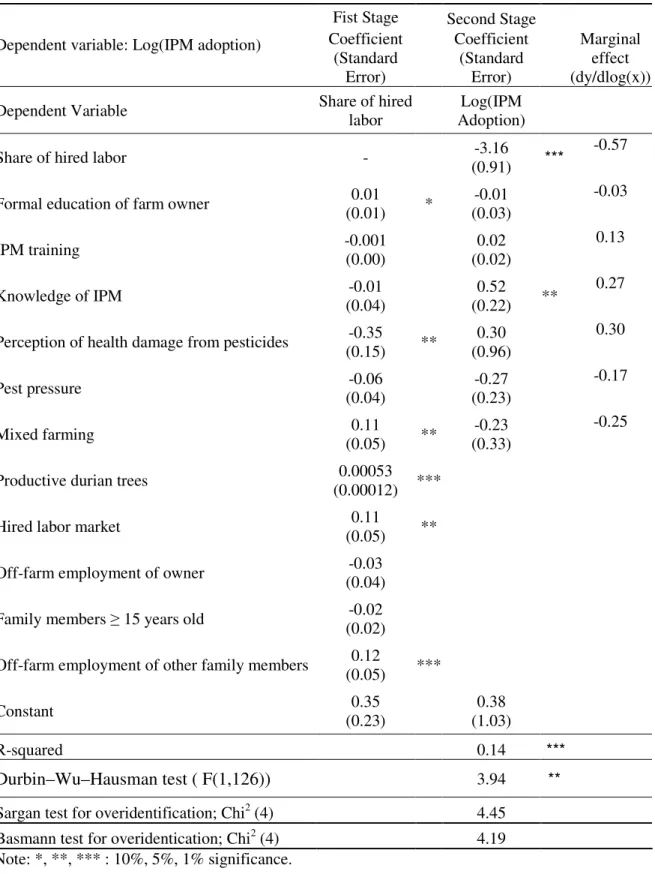
The other estimation procedures that take into account the problem of endogeneity are 2SLS and GMM. However, 2SLS will produce consistent but inefficient estimates if errors do not satisfy the homoscedascity assumption (Verbeek, 2000). Thus, in addition to testing the presence of endogeneity of the share of hired labor variable, it is necessary to test the homoscedasticity of the errors term for the empirical model estimated. Using the Durbin– Wu–Hausman testing procedure, it is indicated that the share of hired labor variable is indeed an endogenous variable. Likewise, a homoscedaticity test (Pagan-Hall test) for the errors of the estimated model, using a 2SLS procedure, cannot reject the null hypothesis, that the errors are homosdedatic, at the 1% level of significance. This implies that the estimated empirical model satisfies the homoscedaticity assumption. Furthermore, the model was also tested for overidentification. Using the Sargan and Basmann test revealed that the null hypothesis, that the instruments are uncorrelated with the error term, cannot be rejected at the 5% level of significance, suggesting that we should be satisfied with this specification of the equation. Thus we report the 2SLS results, as they provide more insights into the labor organization issues under study. The empirical results obtained from estimating the 2SLS model are summarized in Table 5.
2
Using ladder command in STATA, it appears that logarithms transformation most closely resembles a normal distribution (see Appendix 4).
Table 5: Instrumental Variable Estimates (2SLS) of IPM Adoption
Fist Stage Second Stage
Dependent variable: Log(IPM adoption) Coefficient (Standard Error) Coefficient (Standard Error) Marginal effect (dy/dlog(x)) Dependent Variable Share of hired
labor
Log(IPM Adoption) Share of hired labor - -3.16
(0.91) ***
-0.57 Formal education of farm owner 0.01
(0.01) * -0.01 (0.03) -0.03 IPM training -0.001 (0.00) 0.02 (0.02) 0.13 Knowledge of IPM -0.01 (0.04) 0.52 (0.22) ** 0.27 Perception of health damage from pesticides -0.35
(0.15) ** 0.30 (0.96) 0.30 Pest pressure -0.06 (0.04) -0.27 (0.23) -0.17 Mixed farming 0.11 (0.05) ** -0.23 (0.33) -0.25 Productive durian trees 0.00053
(0.00012) *** Hired labor market 0.11
(0.05) ** Off-farm employment of owner -0.03
(0.04) Family members ≥ 15 years old -0.02
(0.02) Off-farm employment of other family members 0.12
(0.05) *** Constant 0.35 (0.23) 0.38 (1.03) R-squared 0.14 *** Durbin–Wu–Hausman test ( F(1,126)) 3.94 **
Sargan test for overidentification; Chi2 (4) 4.45 Basmann test for overidentication; Chi2 (4) 4.19 Note: *, **, *** : 10%, 5%, 1% significance.
Source: Own Calculation
As can be seen, the labor organization coefficient takes the hypothesized sign and is statistically significant at the 1% level. As expected, the degree of IPM adoption decreases
significantly with a greater share of hired-labor used in pest management. The higher the share of hired labor, the less time is spent on monitoring and biological and mechanical pest management activities relative to chemical pesticide application. This result highlights how the difficulties in delegation of tasks influences farmers’ adoption decisions and confirms our hypothesis that the organization of labor has a significant impact on the adoption of IPM.
Remarkably, the coefficient is highly significant. An increase in the share of hired labor by one percentage point decreases IPM adoption, meaning the time spent for non-pesticide-related pest management activities, by about 0.57. The first stage results confirm that the number of productive durian trees, labor market conditions and off-farm employment do have a significant indirect effect on IPM adoption. Also, the sign for number of family members is positive, as was expected. The results are in line with the theoretical framework developed by Beckmann and Wesseler (2003). While the share of hired labor increases with an increase in owner and family member off-farm activities, the share decreases with an increase in the number of adults in a farm household.
Interestingly the coefficient for knowledge on IPM strategies shows the expected sign and is statistically significant at the 5% level. It shows that having a high level knowledge on IPM strategies increase the degree of IPM adoption by about 0.27. This is similar to what Maumbe and Swinton (2003) found in their IPM adoption study, where the adoption of IPM among cotton farmer is influenced by farmer awareness concerning IPM technology.
6
Conclusion
In this paper, we have carried out an analysis of the effect of farm labor organization on IPM adoption. Empirical evidence on IPM adoption in developing countries is mostly measured using dichotomous choice approaches that do not consider the intensity of labor spent on each IPM practice. This paper has addressed this gap, using the results of a farm survey among IPM-trained durian farmers in Thailand.
Our empirical model confirms a strong and highly significant effect of farm labor organization on IPM adoption, as hypothesized in the theoretical model. Farms with a higher share of hired labor are more likely to exhibit a lower adoption rate of IPM: an observation that can be explained by the differences in the opportunity costs and transaction costs of labor, as hypothesized by Beckmann and Wesseler (2003). In situations where farmers have opportunities for off-farm employment or the labor market for pesticide application is easily accessible, adoption of IPM practices faces additional constraints and will be lower than otherwise. In this respect, much emphasis has been placed on training farmers in IPM
practices in order to raise their awareness, in the hope ‘that these efforts pay off in experimentation and knowledge creation by farmers themselves, and ultimately to sustained IPM practice by them’ (Feder and Quizon, 1999, p. 5). Our findings suggest, that these pay-offs will be less strong in regions with a more differentiated organization of agricultural labor: not because farmers are not aware, but because of the lack of economic incentives related to adoption.
The importance of farm labor organization’s affect on the degree of IPM adoption implies that IPM adoption is not merely a matter of the level of farmers’ knowledge of IPM, but rather the manner in which the farmer divides pest management tasks among farm laborers. The successful promotion of IPM can, thus, be aided by paying attention to labor organization. Crops for which the use of hired labor for pest management is lower will be more suitable for introducing IPM. For crops where farmers make use of a relatively high amount of hired labor for pest management, it will be more difficult to reduce the amount of pesticide use via IPM. This is a challenge for agriculture extension to develop programmes for those farm households..
Our results apply to the case of durian. One may argue that durian is a very specific fruit tree and, thus, the results may not apply to other fruit trees or annual crops, such as cotton or rice. Actually, however, the study by Mancini (2006, chapter 4) on IPM adoption and labor organization in cotton production in India provides similar results and supports our findings.
The results have important implications for technology-adoption studies beyond the specific case for IPM. In general, non-pesticide-based pest management methods require a higher degree of skills on the part of the decision maker. Also, many programmes to compensate farmers for performing environmental services do require a higher degree of managerial skills. We hypothesize that the adoption of practices taught through such programmes will be greater among farms with less use of hired labor.
References
Beckmann, V. and J. Wesseler (2003). How Labour Organization May Affect Technological Adoption: An Analytical Framework Analysing the Case of Integrated Pest Management. Environment and Development Economics 8, 1-14.
Beckmann, V. (1996). Transaction Costs and Institutional Choice in Agriculture: The Example of Family vs. Hired Labour, Paper presented at the VIIIth EAAE Congress in Edinburgh, Scotland, September 3-7.
Beckmann, V. (2000). Transaktionskosten und institutionelle Wahl in der Landwirtschaft. Zwischen Markt, Hierarchie und Kooperation, Berlin: Edition Sigma.
Borghans, L. and B. ter Weel (2006). The Division of Labour, Worker Organisation, and Technological Change. Economic Journal 116: F45-F72.
Department of International Trade (2003). Hi-Light Information on Durian. <http://www.dit.go.th/agriculture/durian/chart-1.jpg> (accessed on April 20th, 2005). Disthaporn, S., C. Kraturuek and S. Sutthiarrom (1996). Manual for Integrated Pest
Management in Durian. Thai-German Project IPM in Selected Fruit Trees, Department of Agriculture and Department of Agricultural Extension, Thailand. Drukker, D. (2002). Bootstrapping a Conditional Moments Test for Normality after Tobit
Estimation. The Stata Journal 2, 125-139.
Elsey, B. and K. Sirichoti (2003). The Theory and Practice of Workplace Learning in the Adoption of Integrated Pest Management by Tropical Fruit Growers in Thailand.
Journal of Workplace Learning 15, 53-62
Feder, G., R.E. Just and D. Zilberman (1985). Adoption of Agricultural Innovations in Developing Countries: A Survey. Economic Development and Cultural Change 33, 255-298.
Feder, G. and D.L. Umali (1993). The Adoption of Agricultural Innovations: A Review.
Technological Forecasting and Social Change 43, 215-239.
Feder, G. and J. Quizon (1999). Integrated Pest Management in Asia: Are There Real Returns to IPM and its Diffusion? In: Waibel, H., G. Fleischer, P. Kenmore and G. Feder (eds). Evaluation of IPM Programs: Concepts and Methodologies. Pesticide Policy Paper Series 08, Institute of Horticultural Economics, Hannover, Germany.
Feder, G., R. Murgai, and J. Quizon (2004). Sending Farmers Back to School: The Impact of Farmer Field Schools in Indonesia. Review of Agricultural Economics 26, 45-62. Fernandez-Cornejo, J., B.D. Beach, and W.Y. Huang (1994). The Adoption of IPM
Techniques by Vegetable Growers in Florida, Michigan, and Texas. Journal of Agricultural and Applied Economics 26, 158-172.
Fernandez-Cornejo, J. (1996). The microeconomic impact of IPM adoption: theory and application. Agricultural and Resource Economic Review 25(2): 149-160.
Fernandez-Cornejo, J. (1998). Environmental and economic consequences of technology adoption: IPM in viticulture. Agricultural Economics 18(2):145-155.
Food Market Exchange (2003). Durian Growing. <http://www.foodmarketexchange.com/ datacenter/product/fruit/durian/details/durain_02_grow.html> (accessed on May 5th, 2006).
Godtland, E.M., E. Sadoulet, A. de Janvry, R. Murgai, and O. Ortiz (2004). The Impact of Farmer Field Schools on Knowledge and Productivity: A Study of Potato Farmers in the Peruvian Andes. Economic Development and Cultural Change 53, 63-92.
Griliches, Z. (1957). Hybrid Corn: An Exploration in the Economics of Technical Change.
Econometrica 25, 501-522.
Horskotte-Wesseler, G. (1999). Socio-economics of Rice-aquaculture and IPM in the Philippines: Synergies, Potentials, and Problems. International Center for Living Aquatic Resources and Management, Manila.
Lee, D.R., C. Barrett, and J.G. McPeak (2006). Policy, Technology, and Management Strategies for Achieving Sustainable Agricultural Intensification. Agricultural Economics 34, 123-127.
Long, J.S. (1997). Regression Models for Categorical and Limited Dependent Variables. California: Sage Publications, Inc.
Mancini, F. Wesseler, J., & Jiggins, J.L.S. (2006). The Effects of Integrated Pest Management on Labour Organization and Gender Roles in Small Cotton Farms in India. In F. Mancini (Ed.) Impact of Integrated Pest Management Farmer Field Schools on Health, Farming Systems, the Environment, and Livelihoods of Cotton Growers in Southern India (pp. 41-52.) Publsihed doctoral dissertation, Wageningen University, The Netherlands.
Mahmoud, C. and G. Shively (2004). Agricultural Diversification and Integrated Pest Management in Bangladesh. Agricultural Economics 30, 187-194.
Maumbe, B.M. and S.M. Swinton (2003). Adoption of Cotton I.P.M. in Zimbabwe: The Role of Technology Awareness and Pesticide-related Health Risks. Journal of Sustainable Development in Africa 5(2), 60-86.
McNamara, K.T., M.E. Wetzstein, and G.K. Douce (1991). Factors Affecting Peanut Producer Adoption of Integrated Pest Management. Review of Agricultural Economics 13, 129-139.
Menakanit, P. (2001). Plant Pest Management Curriculum Development in Thailand. In: Soon, L.G., C. Shen and P.K. Saha (eds) Curriculum Development for Plant Pest Management in Asia-Pacific. Proceedings of the Expert Consultation on Plant Pest Management Curriculum Development for University and Related Institute Education in Asia-Pacific held from 25–28 April, 2000 at the Regional Office for Asia and the Pacific (RAP), Food and Agriculture Organization of the United Nations, Bangkok, Thailand.
Morse, S. and W. Buhler (1997). Integrated Pest Management: Ideals and Realities in Developing Countries. Boulder: Lynne Rienner Publishers.
Newey, W.K. (1987). Efficient Estimation of Limited Dependent Variable Models with Endogenous Explanatory Variables. Journal of Econometrics 36, 231-250.
Neill, S. and D.R. Lee (2001). Explaining the Adoption and Disadoption of Sustainable Agriculture: The Case of Cover Crops in Northern Honduras. Economic Development and Cultural Change 49, 793-820.
Njenga, A., M. Eckert and J. Wesseler (2000). Improving Resource Allocation for Sustainable Development through Participatory Farming Systems Analysis. Poster presented at the XXIV conference of the International Association of Agriculture Economists: Tomorrow’s Agriculture: Incentives, Institutions, Infrastructure, and Innovations. Berlin, Germany.
Orr, A. (2003). Integrated Pest Management for Resource-Poor Farmers: Is the Emperor Naked? World Development 31, 831-845.
Pingali, P.L. and R.V. Gerpacio (1998). Toward Reduced Pesticide Use for Cereal Crops in Asia. In: Lutz, E. (ed), Agriculture and the Environment: Perspectives on Sustainable Rural Development. Washington, D.C.: World Bank, 254-270.
Roumasset, J.A. (1995). The Nature of the Agricultural Firm. Journal of Economic Behaviour and Organization 2, 161-177.
Ruben, R., G. Kruseman and A. Kuyvenhoven (2006). Strategies for Sustainable Intensification in East African Highlands: Labor Use and Input Efficiency.
Agricultural Economics 34, 167-181.
Salakpeth, S. (2000). Durian Production in Thailand. Hawaii. Tropical Fruit Growers Tenth Annual Tropical Fruit. Conference, Hilo, Hawai, 21 October 2000
Schillhorn van Veen, T.W., D.A. Forno, S. Joffee, D.L. Umali and S. Cooke (1998). Integrated Pest Management: Strategies and Policies for Effective Implementation. In: Lutz, E. (ed), Agriculture and the Environment: Perspectives on Sustainable Rural Development. Washington D.C.: World Bank, 242-253.
Schmidt, P., J. Stiefel and M. Hürlimann (1997). Extension of Complex Issue: Success Factors in Integrated Pest Management. St. Gallen: Swiss Center for Development Cooperation in Technology and Management.
Schulz-Greve, W. (1994). Die Zeitallokation landwirtschaftlicher Haushalte. Kiel: Vauk Verlag.
Subhadrabandhu, S. and S. Ketsa (2001). Durian: King of Tropical Fruit. New York: CABI Publishing.
Sunding, D.L. and D. Zilberman (2001). The Agricultural Innovation Process: Research and Technology Adoption in a Changing Agricultural Sector. In: Gardner, B. and G. Rausser (eds.), Handbook of Agricultural and Resource Economics. Amsterdam: North Holland.
van de Fliert, E. Adn J. Proost (1999). Introduction. In: van de Fliert, E. and J. Proost (eds),
Women and IPM: Crop Protection Practices and Strategies. Amsterdam: KIT Press, 11-14.
van den Berg, H. and J. Jiggins (2007). Investing in Farmers – The Impacts of Farmer Field Schools in Relation to Integrated Pest Management. World Development 35(4):663-686.
Verbeek, M. (2000). A Guide to Modern Econometrics. West Sussex, UK: John Wiley & Sons Ltd.
Appendices
Appendix 1. Common IPM practices in durian farming, Chanthaburi, Thailand
No Method
1 monitoring of Psyllid
2 apply yellow sticky traps for Psyllid 3 Water jet spray against Psyllid
4 application of threshold level to control Psyllid 5 monitoring for African red mite (white paper) 6 control red mites by using mini sprinkler 7 release of predatory mites
8 application of threshold level to control mites 9 Rhizoctonia monitoring
10 Rhizoctonia leaf blight pruning 11 Algal disease monitoring
12 Algal disease cut and burn leaves and twigs 13 application of threshold level to control Algal spot 14 Phytophtera monitoring
15 use lime to increase soil ph-level 16 spread trichoderma mix
17 removing infected Phytophtera parts 18 Monitor stalk eating caterpillar
19 Light trap for caterpillar
20 Thinning of fruits affected by caterpillar 21 Using of neem exytracts
22 Fruit borer monitoring (check five fruits per tree) 23 Remove one of the impaired fruits and burn 24 Separate impaired fruits with a card board 25 Use of Neem extract
26 Blue light trap 27 Bagging of fruits 28 Monitoring mealy bugs
29 Thin and burn infested fruits 30 Wash mealy bugs from fruits 31 Monitoring for seed borer (daily) 32 Cut down fruits with infested signs 33 Use light trap
34 Use Neem extract 35 Monitor for fruit rot
36 Burn infected fruits
37 Monitoring for Longhorn beetle at night 38 Slash and burn infected trees
39 Rice hull with fusarium to control larvae
40 Pruning 41 Wax on cuts
42 Rearing station for predators
43 Stimulate flushing 44 Record keeping
45 Regular control of the sprayer Source: Own Survey 2005
Appendix 2. Variance Inflation Factor (VIF)
The Variance Inflation Factor (VIF) and tolerance (1/VIF) are both used to measure the degree of multicollinearity of the i-th independent variable with the other independent variables in a regression model. A rule of thumb is that there is evidence of collinearity if the mean of VIF is 10 or higher (or, equivalently, tolerances of .10 or less) (Baum, 2006).
Variables VIF 1/VIF
Share of hired labor 1.54 0.65
Formal education of farm owner 1.20 0.83
IPM training 1.09 0.92
Knowledge of IPM 1.05 0.95
Perception of health damages of pesticides 1.09 0.92
Pest pressure 1.12 0.89
Mixed farming 1.10 0.91
Productive durian trees 1.37 0.73
Hired labor market 1.13 0.89
Off-farm employment of owner 1.07 0.94
Family members ≥ 15 years old 1.26 0.80
Off-farm employment of other family members 1.20 0.83
Mean VIF 1.18
Appendix 3. Normality test
A normality test of the errors is conducted after running a tobit model, using a test procedure proposed by Drukker (2002). The null hypothesis is that the errors will be normally distributed. Our estimation shows that the value of the conditional moment is 102.18 (Prob> Chi2=0.000). Since the computed Chi2 exceeds the critical Chi2 value at 1 percent significance, therefore the null hypothesis is rejected, thus confirming the alternative hypothesis that the errors are not normally distributed.
Appendix 4. Dependent variable transformation
Transformations such as square roots and logarithms are often employed to change distribution shape, with the aim of making skewed distributions more symmetrical and perhaps more nearly normal. Using the ladder command in STATA, we can select which transformation closely resembles a normal distribution. The null hypothesis is that the distribution is normal.
. ladder ipm_adoption
Transformation formula chi2(2) P(chi2) --- cubic ipm_ad~n^3 . 0.000 square ipm_ad~n^2 . 0.000 raw ipm_ad~n 60.21 0.000 square-root sqrt(ipm_ad~n) 21.93 0.000 log log(ipm_ad~n) 2.19 0.335 reciprocal root 1/sqrt(ipm_ad~n) 55.68 0.000 reciprocal 1/ipm_ad~n . 0.000 reciprocal square 1/(ipm_ad~n^2) . 0.000 reciprocal cubic 1/(ipm_ad~n^3) . 0.000
It appears that the log transformation most closely resembles a normal distribution. The other transformations are significantly non-normal. The figure below visually illustrates the change of distribution of IPM adoption data before and after transformation.
0 .1 .2 .3 .4 D e n si ty 0 5 10 15 ipm_adoption
Before: IPM adoption After: log(IPM adoption)
0 .1 .2 .3 D e n si ty -4 -2 0 2 4 lnipm
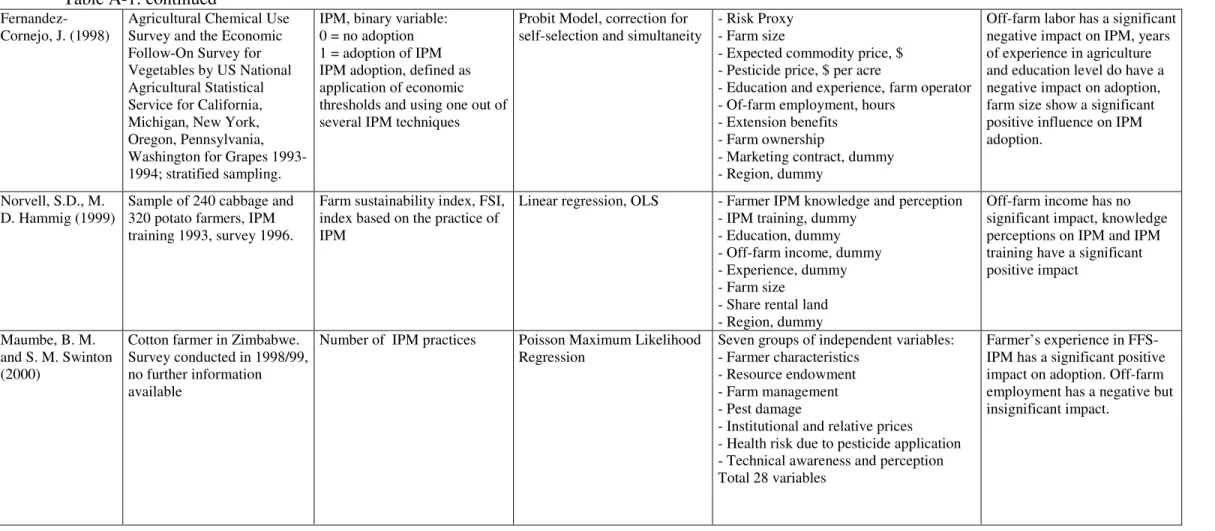
McNamara, K.T., M.E. Wetzstein and G.K. Douce (1991)
Georgia survey data of peanut farmer, 1985, random sample, 220 observations
IPM, binary variable: 0 = no adoption 1 = adoption of IPM IPM adopter: more than 25 percent of the acreage is scouted
Logit Model -Producer characteristics (age, education, experience, farm income etc.)
- Management practices (literature read, extension requested, forward contracting, etc.)
- Farm structure (acreage, irrigation, percent peanuts, etc.)
- Extension IPM
Percent farm income, age, education, forward contracting, and extension IPM have significant positive impact on adoption
Fernandez-Cornejo, J., B. D. Beach, and W. Y. Huang (1994)
Agricultural Chemical Use Survey and the Economic Follow-On Survey for vegetables of the US National Agricultural Statistical Service for Florida, Texas and Michigan, 1990-1991; stratified sample.
IPM, binary variable: 0 = no adoption 1 = adoption of IPM IPM adopter: every farmer using one out of several IPM techniques.
Logit Model, weighted least square Maximum Likelihood Method
- Farm size, Dummy - Operator labor, hours - Unpaid family labor, hours - Debt to asset ratio
- Fraction of area under irrigation - Livestock production fraction - Fraction of acres owned by operator - Crop insurance dummy
- Number of vegetables - Regional dummy
- Binary variables for production of vegetables (melon, tomato, sweet corn, onion, cabbage, asparagus, cucumber, snap beans)
Labor input in crop
management and unpaid family labor do have a significant positive impact on adoption.
Fernandez-Cornejo, J. (1996),
Agricultural Chemical Use Survey and the Economic Follow-On Survey for vegetables of the US National Agricultural Statistical Service for California, Florida, Georgia, Michigan , New Jersey, New York, North Carolina and Texas for tomatoes 1992-1993; stratified sampling. 199 observations.
IPM, binary variable: 0 = no adoption 1 = adoption of IPM IPM adoptor: not further defined in the text.
Probit Model, correction for self-selection and simultaneity
- Expected crop price – Days of off-farm work – Experience of the operator – Education
– Fraction of areas owned – Risk-aversion proxy - Farm size, dummy
- Contract for output, dummy - Use of extension services, dummies - Regional dummies
Off-farm income has a negative impact on adoption, years of experience in
agriculture and education level do have a negative impact on adoption.
Table A-1: continued
Fernandez-Cornejo, J. (1998)
Agricultural Chemical Use Survey and the Economic Follow-On Survey for Vegetables by US National Agricultural Statistical Service for California, Michigan, New York, Oregon, Pennsylvania, Washington for Grapes 1993-1994; stratified sampling.
IPM, binary variable: 0 = no adoption 1 = adoption of IPM IPM adoption, defined as application of economic thresholds and using one out of several IPM techniques
Probit Model, correction for self-selection and simultaneity
- Risk Proxy - Farm size
- Expected commodity price, $ - Pesticide price, $ per acre
- Education and experience, farm operator - Of-farm employment, hours
- Extension benefits - Farm ownership
- Marketing contract, dummy - Region, dummy
Off-farm labor has a significant negative impact on IPM, years of experience in agriculture and education level do have a negative impact on adoption, farm size show a significant positive influence on IPM adoption.
Norvell, S.D., M. D. Hammig (1999)
Sample of 240 cabbage and 320 potato farmers, IPM training 1993, survey 1996.
Farm sustainability index, FSI, index based on the practice of IPM
Linear regression, OLS - Farmer IPM knowledge and perception - IPM training, dummy
- Education, dummy - Off-farm income, dummy - Experience, dummy - Farm size
- Share rental land - Region, dummy
Off-farm income has no significant impact, knowledge perceptions on IPM and IPM training have a significant positive impact
Maumbe, B. M. and S. M. Swinton (2000)
Cotton farmer in Zimbabwe. Survey conducted in 1998/99, no further information available
Number of IPM practices Poisson Maximum Likelihood Regression
Seven groups of independent variables: - Farmer characteristics
- Resource endowment - Farm management - Pest damage
- Institutional and relative prices
- Health risk due to pesticide application - Technical awareness and perception Total 28 variables
Farmer’s experience in FFS-IPM has a significant positive impact on adoption. Off-farm employment has a negative but insignificant impact.
Discussion Papers
Edited by Volker Beckmann and Konrad Hagedorn
21/2009 Volker Beckmann, Evi Irawan and Justus Wesseler. The Effect of Farm Labor Organization on IPM Adoption: Evidence from Thailand, December 2009.
20/2008 Insa Theesfeld, Christian Schleyer, Jean-Marc Callois and Olivier Aznar.Ex-ante Policy Assessment from an Institutional Perspective. A Procedure for Institutional Compatibility Assessment (PICA). February 2008.
19/2007 Clem Tisdell. Behaviours of Conservation Organizations and their Environmental Implications: Analysis based on New (and not so new) Institutional Economics. December 2007.
18/2007 Franz W. Gatzweiler and Jörg Volkmann. Beyond Economic Efficiency in Biodiversity Conversation, August 2007.
17/2007 Fekadu Beyene. The Role of Customary Institutions in Managing Conflict on Grazing Land: A Case Study from Mieso District, Eastern Ethiopia, March 2007.
16/2006 Stefan Jungcurt and Thomas Meyer: Consolidation, Delimitation and Stalemate. Disruptive Interplay and Strategic Incentives in the CBD-TRIPS Relationship, November 2006.
15/2006 Tatiana Kluvánková-Oravská and Veronika Chobotová: Shifting Governance in Slovensky Raj National Park, July 2006.
Published as: Kluvánková-Oravská, Tatiana and Veronika Chobotová (2006). Shifting Governance. Managing the Commons: the Case of Slovensky Raj National Park. Sociologia 38 (3), 221-244.
14/2006 Bekele Hundie. Explaining Changes of Property Rights among Afar Pastoralists, Ethiopia, July 2006.
13/2006 Andreas Thiel: Institutions of Sustainability and Multifunctional Landscapes. Lessons from the Case of the Algarve, March 2006.
12/2006 Volker Beckmann, Claudio Soregaroli, Justus Wesseler: Governing the Co-Existence of GM Crops: Ex-Ante Regulation and Ex-Post Liability under Uncertainty and Irreversibility, March 2006.
11/2005 Katharina Rauchenecker und Volker Beckmann. Jagdgenossenschaften und Wildtiermanagement. Zur Rolle der Zwangsmitgliedschaft, November 2005. Veröffentlicht als: Rauchenecker, Katharina und Volker Beckmann (2007). Jagdgenossenschaften und Wildtiermanagement. Zur Rolle der