* Corresponding author. ORCID ID: 0000-0002-5994-0553 Peer review under responsibility of Bussecon International Academy.
Effect of fairness and knowledge on tax compliance for Micro, Small,
and Medium Enterprises (MSMEs)
Ajeng Rachma Pertiwi
a, Syaiful Iqbal
b, Zaki Baridwan
ca,b,c Accounting Department, Faculty of Economics and Business, Brawijaya University, Indonesia
A R T I C L E I N F O
Article history: Received 29 November 19 Received in revised form 12 Dec 19 Accepted 14 December 19
Keywords: Tax Fairness Tax Knowledge Tax Compliance
Micro Small and Medium Enterprises (MSMEs)
JEL Classification: H21; D03
A B S T R A C T
This study aims to empirically examine the effect of tax fairness and tax knowledge on tax compliance for Micro, Small and Medium Enterprises (MSMEs). Azmi and Perumal (2008) identified five of tax fairness dimensions: general fairness, exchanges with the government, special provisions, tax rates structure, and self-interest. Tax knowledge related to tax calculation, tax payment, and tax reporting. This study used a survey method by distributing the questionnaire. The sample used was Micro, Small and Medium Enterprises (MSMEs) in Malang city through the cluster random sampling method. The data obtained were 107 respondents who were processed with the help of SPSS 24. Two regression analyses used in this study are multiple linear regression analysis and simple linear regression analysis. The results of the study using multiple linear regression analysis showed that the three dimensions of tax fairness that affect MSMEs compliance are general fairness, tax rates structure, and self-interest. The results from the simple linear regression analysis show that tax knowledge influences MSMEs' compliance.
© 2019 Bussecon International Academy. Hosting by SSBFNET. All rights reserved. Peer review under responsibility of Bussecon International Academy & SSBFNET.
Introduction
Compliance of taxpayers is the fulfillment of tax obligations as a form of taxpayer's contribution to the country's development. Tax compliance greatly affects the revenue or state income. This is due to Indonesia adopting a self-assessment system, which is a tax collection system that provides authority, trust, a responsibility to taxpayers to count, calculate, pay, and report on the amount of tax that must be paid (Waluyo, 2010: 8).
Micro, Small and Medium Enterprises (MSMEs) are one of the taxpayer models that dominate and become an economic milestone in Indonesia. MSMEs dominate the business structure in Indonesia around 99.99 percent, while large businesses only contribute to the business structure in Indonesia by 0.01 percent (Ministry of Cooperatives and SMEs the Republic of Indonesia, 2017). The role of MSMEs also dominates the Gross Domestic Product (GDP) to reach 60 percent with a total GDP of 7,704,635.8 Trillion per year. The Indonesian Micro, Small and Medium Enterprises Association (AKUMINDO) recorded the contribution of the MSME sector to GDP in 2018 increasing to 60.34 percent (Lukihardianti, 2019). However, the large number of business operators and the contribution of MSMEs to GDP has not been comparable with tax revenues from the MSME sector. This is because the level of compliance of UMKM taxpayers is still relatively low.
Several attempts were made by the Government to improve taxpayer compliance, especially MSME taxpayers, including by providing fiscal intensive through reducing the tax rate to 0.5 percent as stipulated in Government Regulation No. 23 of 2018. This
Research in Business & Social Science
IJRBS VOL 9 NO 1 ISSN: 2147-4478
Available online at www.ssbfnet.com Journal homepage: https://www.ssbfnet.com/ojs/index.php/ijrbs
regulation is a substitute regulation of Government Regulation No. 46 of 2013. In the beginning Government Regulation No. 46 of 2013 was issued to provide regulatory certainty and ease in fulfilling tax obligations for SMEs. Problems related to Government Regulation No. 46 of 2013 began to emerge, many MSME taxpayers complained because they felt it did not meet aspects of fairness. The emergence of Government Regulation No. 23 of 2018, which became effective as of July 1, 2018, is a breath of fresh air for MSME taxpayers. This regulation will be an attraction for MSMEs to enter tax administration. This facility can be useful for taxpayers depending on the perception of taxpayers.
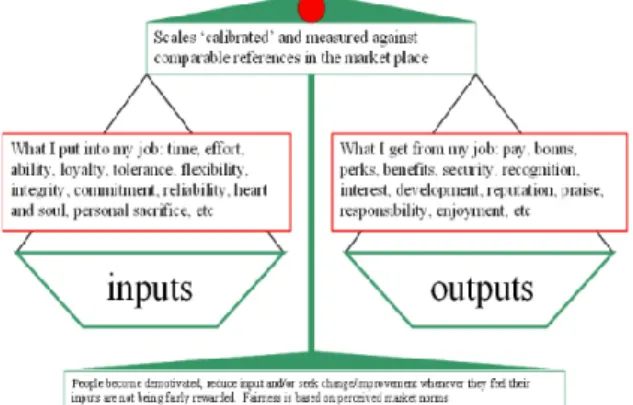
The perception of tax fairness is one of the non-economic variables of tax compliance behavior. Vogel, et al (2005) explain the related dimensions of tax fairness that taxpayers tend to avoid paying taxes if they consider the tax system unfair (Berutu and Harto, 2012). This shows the importance of the dimensions of tax fairness in influencing taxpayer compliance. In line with the equity theory that considers inputs and outputs as an assessment of fair/equal treatment. This theory is built from one's belief in a sense of fairness and feelings of unfairness that will have an impact on behavior.
Many factors cause perceptions among taxpayers to vary, such as knowledge, experience, and point of view. Tax knowledge serves as a guideline for taxpayers in carrying out tax obligations. Taxpayers know and understand all the provisions related to tax obligations that apply, taxpayers will easily carry out their tax obligations (Zuhdi, et al 2015). In accordance with the attribution theory which explains that a person's behavior is formed from internal or external attribution sources. Internal strengths (personal forces) are the result of one's ability, power, and effort.
Based on previous research on tax fairness (Wulandari and Budiaji (2017); Berutu and Harto (2012); Azmi and Perumal (2008)) and tax knowledge (Mintje (2016); Damajanti (2015) and Handoyo and Candrapuspa (2017)) on compliance behavior is known to have inconsistencies in research results. Besides that, it is different from previous studies on tax fairness which are studied using the Theory of Planned Behavior (TPB) in this study, tax fairness is studied using the equity theory. TPB does not focus on perceptions of the taxpayer's assessment of fairness aspects but rather focuses on the relationship between the beliefs, attitudes and behavioral controls that are perceived to influence the intentions and behavior of taxpayers. This study examines the effect of perspective tax fairness using five dimensions of tax fairness according to Gerbing (1988) by adding tax knowledge variables as independent variables and focusing on Government Regulation No. 23 of 2018 towards MSME tax compliance.
Literature Review
Equity Theory
Equity theory is a theory that was introduced by John Stacy Adams in 1963. Equity theory is an awareness of the dimensions of assessment of each individual as a form of a broader sense of fairness. Muhadi (2015) states that equity theory is built from one's belief in a sense of fairness and feelings of unfairness so that it will have an impact on motivation, attitudes, and behavior. Adams (1963) concluded that a sense of inequality/unfairness can create physical tension whose magnitude is proportional to the perceived imbalance.
Equity theory focuses on input and output. Inputs represented by contributions include performance, sacrifice, commitment, effort, experience, status, intelligence, and others. The output is everything that is obtained and felt. Redmond (2010) explains that equity theory is based on a person's motivation based on a consideration of a sense of fairness when compared to others. Individuals will make a comparison person by comparing inputs and results between individuals, and then responding to reduce unfairness that occurs (Luthans, 2005). Individuals can lose motivation which will affect attitudes and behavior if they feel their input is not valued fairly. The individual's perception of the input and results of oneself and others may be inaccurate or irrational but this perception needs to be managed effectively.
Attribution Theory
Attribution theory is a theory that explains a person's behavior that was triggered by Fritz Heider. Attribution theory explains the causes of various behaviors that afflict a person (Darwati, 2015). This theory explains the process of how to determine the causes and motives of one's behavior. Attribution theory refers to how a person explains the causes of other people's behavior or themselves that will be determined whether from internal, for example, the nature, character, attitude, etc. or externally such as the pressure of a situation or certain circumstances that will affect the behavior of individuals (Luthans, 2005 ).
According to Fritz Heider in Darwati (2015) there are 2 (two) sources of attribution to behavior that consist of internal or dispositional attributions and external or environmental attributions. According to Mustafa (2011) internal attribution is attribution attached to personal or personal qualities and qualities. Meanwhile, according to Darwati (2015) external attributions are environmental forces that change a person's behavior.
Taxpayer Compliance
The definition of compliance in terminology means obedience, discipline, according to the rules and so on. Compliance in taxation can be defined as a condition where taxpayers fulfill all tax obligations and carry out their rights in the field of taxation (Rahayu, 2010: 138). Kiryanto (2000) defines taxpayer compliance as entering and reporting in due time the information needed, filling in the correct amount of tax owed and paying taxes on time, without any inspection action. There are two types of compliance, formal compliance and material compliance. Formal compliance is a condition where taxpayers fulfill tax obligations formally in accordance with the provisions in tax laws. Material compliance is a condition of taxpayers substantively or essentially fulfilling all material provisions of taxation.
Tax Fairness
Gerbing (1988) defines the dimensions of tax fairness into five dimensions, namely general fairness, exchanges with the government, special provisions, tax rates structure, and self interest.
a) General fairness relates to whether taxpayers feel that the existing tax system has been running as it should according to applicable regulations and not deviate. Research conducted by Wulandari and Budiaji (2017) and Azmi and Perumal (2008) shows that the general fairness dimension significantly influences tax compliance behavior. On the other hand, Berutu and Harto's research (2012) does not prove the influence between the dimensions of general fairness and the distribution of tax burden with the behavior of individual taxpayer compliance. Therefore, hypothesis 1a is:
H1a: General fairness affects MSME tax compliance.
b) exchanges with the government relates to the provision of public facilities and also the good bureaucratic arrangements that the government achieves on the implications of several taxes paid by taxpayers. Research conducted by Wulandari and Budiaji (2017), and Berutu and Harto (2012) show that the exchanges with the government dimension do not affect compliance. This study is in line with the research of Azmi and Perumal (2008) which shows that there is no influence of exchanges with the government dimension on compliance behavior in Malaysia. Thus, hypothesis 1b is:
H1b: exchanges with the government affects MSME tax compliance.
c) Special provisions relating to tariffs or applicable tax provisions that are only given to special groups, which have been adjusted to government regulations. Research conducted by Wulandari and Budiaji (2017), and Berutu and Harto (2012) show that the dimensions of special provisions do not affect compliance. This study is also in line with the research of Azmi and Perumal (2008) showing that the dimensions of special provisions do not prove an influence on compliance behavior in Malaysia. Thus, hypothesis 1c is:
H1c: Special provisions affects MSME tax compliance.
d) tax rates structure is related to the level of tax rates imposed on taxpayers. The results of Wulandari and Budiaji (2017) and Berutu and Harto (2012) research show the same results, namely that the tax rates structure has a significant effect on tax compliance behavior. Research conducted by Azmi and Perumal (2008) also shows the same results that the dimensions of the tax rates structure influence the compliance behavior in Malaysia. Therefore, hypothesis 1d is:
H1d: tax rates structure affects MSME tax compliance.
e) self interest relates to a person's perceptions and feelings when comparing the tax burden paid with the burden of other taxpayers. The results of Berutu and Harto's research (2012) are in line with the research of Azmi and Perumal (2008) which show that the dimension of self interest significantly influences tax compliance behavior. On research by Wulandari and Budiaji (2017) does not prove the influence between the dimensions of self interest and taxpayer compliance behavior. Thus, hypothesis 1e is:
Tax Knowledge
Mardiasmo (2016:7), tax knowledge can be interpreted as everything that is known and understood in connection with tax law, both material tax law and formal tax law. There are several types of knowledge, which are as follows (Damajanti, 2015): implicit knowledge, explicit knowledge, empirical knowledge, and rationalism knowledge. Mintje (2016) research results show that tax knowledge variables influence compliance. On the other hand, research by Damajanti (2015) and Handoyo and Candrapuspa (2017) provide different results that the variable tax knowledge does not affect tax compliance. Therefore, the second hypothesis is:
H2: Tax knowledge affects MSME tax compliance.
Research and Methodology
This research is explanatory research, using a quantitative approach based on a positive paradigm. The population taken in this study is tax payers for Micro, Small and Medium Enterprises (MSMEs). Sampling was conducted in this study using a cluster random
sampling method, including the type of probability sampling. The cluster random sampling method is a sampling technique on an
element that consists of smaller elements (Sekaran, 2017). Samples used in this study are the Micro, Small and Medium Enterprises (MSMEs) of Malang City, the results of the largest scaled-down elements. This study uses a minimum sample size of 100 samples. The type of data used in this study is primary data. Primary data is research data obtained directly from original sources or not through intermediaries (Indriantoro and Supomo, 2014: 146-147). The data collection method uses a literature study and documentation. The scale used in this study is a Likert scale, the answers to the statements in the questionnaire were given a score of 1-5, namely Strongly Agree (SS): 5, Agree (S): 4, Neutral (N): 3, Disagree (TS): 2, and Strongly Disagree (STS): 1 (Ghozali, 2018: 41).
Data Analysis Technique
Data analysis includes descriptive statistical tests, data quality tests by conducting data validity and reliability tests, classic assumption tests using normality, multicollinearity, and heteroscedasticity tests. Regression analysis used is multiple linear regression
methods and a simple regression analysis method (Ghozali, 2018: 149) with the help of SPSS 24. Hypothesis testing uses the
t-test and the coefficient of determination test (R2).
Hypotheses 1a to 1e were tested using research model 1, namely testing the effect of five dimensions of tax fairness with MSME tax compliance.
𝑌
𝑖𝑡= 𝛼
0𝑖𝑡+ 𝛽
1𝑖𝑡𝑋
1𝑖𝑡+ 𝛽
2𝑖𝑡𝑋
2𝑖𝑡+ 𝛽
3𝑖𝑡𝑋
3𝑖𝑡+ 𝛽
4𝑖𝑡𝑋
4𝑖𝑡+ 𝛽
5𝑖𝑡𝑋
5𝑖𝑡+ 𝜀
𝑖𝑡Where Y is UMKM tax compliance; a is the value of intercept (constant); b1, b2, b3, b4, and b5 are the coefficients of the regression
direction; X1 is general fairness; X2 is exchanges with the government; X3 are special provisions; X4 is a tax rate structure; X5 is a
self interest; e is an error.
Hypothesis 2 was tested using research model 2, namely testing the effect of tax knowledge with MSME tax compliance.
𝑌
𝑖𝑡= 𝛼
0𝑖𝑡+ 𝛽
6𝑖𝑡𝑋
6𝑖𝑡+ 𝜀
𝑖𝑡Where Y is UMKM tax compliance; a is the value of intercept (constant); b6 is the coefficient of regression direction; X6 is tax
knowledge; e is an error.
Result and Discussion
Validity and Reliability Test
Based on the results of data collection from respondents, the validity and reliability of the research instruments were tested. The validity test results for all research instruments produce a probability value smaller than 0.05 so that all research instruments are valid. The reliability test results are as follows:
Table 1: Reliability Test Results
No Variable Cronbach’s Alpha Description
1 general fairness (X1) 0,915 Reliable
2 exchanges with the government (X2) 0,794 Reliable
3 special provisions (X3) 0,791 Reliable
4 tax rate structure (X4) 0,714 Reliable
5 self interest (X5) 0,813 Reliable
6 tax knowledge (X6) 0,864 Reliable
The reliability test results show that each variable has a Cronbach's Alpha value greater than 0.60, meaning it meets the requirements as expressed by Ghozali (2018). It can be concluded that this research instrument is reliable.
Normality Test
The normality test uses the One-Sample Kolmogorov-Smirnov Test.
Table 2: Kolmogorov-Smirnov Test One Sample Test Results
Regression Model Asymp. Sig. (2-tailed)
Regression Model I 0,200
Regression Model II 0,164
Source: Primary data processed 2019
The test results are presented in Table 2. It can be concluded that in this study the residual value was normally distributed with an asymptotic significance value greater than 5 percent.
Multicollinearity Test
This test is only carried out on the first regression model. In the second regression model multicollinearity test is not carried out because the regression used is simple linear regression. Multicollinearity test results are presented in the following Table 3.
Table 3: Multicollinearity Test Results
Variable VIF
Regression Model I
general fairness (X1) 1,414
exchanges with the government (X2) 1,112
special provisions (X3) 1,044
tax rate structure (X4) 1,198
self interest (X5) 1,419
Source: Primary data processed 2019
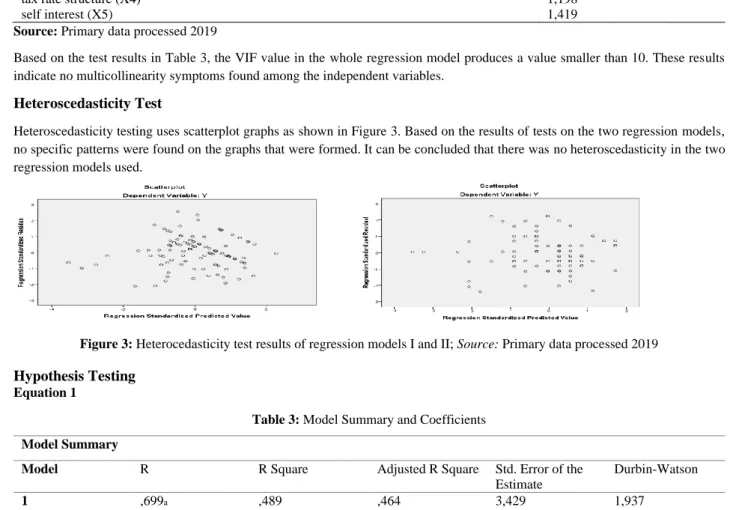
Based on the test results in Table 3, the VIF value in the whole regression model produces a value smaller than 10. These results indicate no multicollinearity symptoms found among the independent variables.
Heteroscedasticity Test
Heteroscedasticity testing uses scatterplot graphs as shown in Figure 3. Based on the results of tests on the two regression models, no specific patterns were found on the graphs that were formed. It can be concluded that there was no heteroscedasticity in the two regression models used.
Figure 3: Heterocedasticity test results of regression models I and II; Source: Primary data processed 2019
Hypothesis Testing
Equation 1
Table 3: Model Summary and Coefficients
a. Predictors:(constnt) X5, X3, X2, X4, X1 b. Dependent Variable: Y
Model Summary
Model R R Square Adjusted R Square Std. Error of the
Estimate
Durbin-Watson
Coefficients a
Unstandardized Coefficients Coefficient Statistics
Model B Std. Error Standardized
Coefficients Beta
t Sig. Tolerance VIF
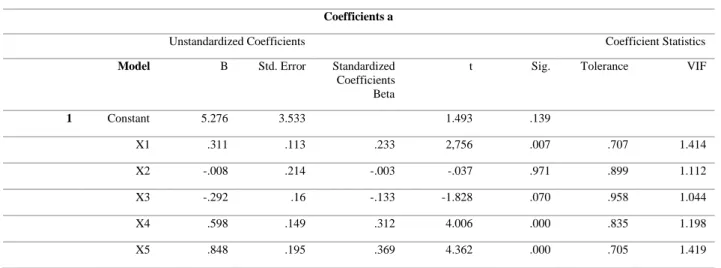
1 Constant 5.276 3.533 1.493 .139 X1 .311 .113 .233 2,756 .007 .707 1.414 X2 -.008 .214 -.003 -.037 .971 .899 1.112 X3 -.292 .16 -.133 -1.828 .070 .958 1.044 X4 .598 .149 .312 4.006 .000 .835 1.198 X5 .848 .195 .369 4.362 .000 .705 1.419 a. Dependent Variable: Y
Source: Primary data processed 2019
Findings and Discussion
Adjusted R Square value for the first regression model of 0.464 or 46.4 percent. The remaining 53.6 percent is explained by other factors that can affect MSME tax compliance. Based on the results of regression testing the following results are obtained:
i. The significance value for the general fairness variable of 0.007 is smaller than 0.05, so general fairness has a significant effect on MSME tax compliance. In line with Supramono and Damayanti (2015: 17) which explains that the tax imposed on taxpayers must be proportional to the ability to pay (ability to pay).
ii. The significance value for exchanges with the government variable is 0.971 greater than 0.05, so exchanges with the government does not have a significant effect on MSME tax compliance. This finding shows that exchanges with the government overpayment of income tax according to Government Regulation no. 23 of 2018 which has been done by MSME taxpayers has not been felt. In the equity theory, the focus is on input and output, if the input that has been given is in the form of sacrifice to pay taxes in proportion to the output in the form of benefits obtained and felt. This will be able to influence the level of tax compliance of MSME.
iii. The significance value for the special provisions variable of 0.070 is greater than 0.05, then the special provisions do not have a significant effect on MSME tax compliance. MSME taxpayers assess related to special provisions contained in Government Regulation no. 23 of 2018 specifically regarding the imposition of a period not meeting aspects of fairness. According to Redmond (2010) in equity theory, a person's motivation is based on a consideration of a sense of fairness when compared to others. MSME taxpayers can lose motivation which will have an impact on the attitude and behavior of tax compliance.
iv. The significance value for the tax rate structure variable is 0,000 less than 0.05, the tax rate structure has a significant effect on MSME tax compliance. Taxpayers assess the imposition of tax rates contained in Government Regulation no. 23 of 2018 amounting to 0.5 percent has fulfilled the aspect of fairness. For taxpayers of the MSME sector considers that the imposition of a fair tax adjusted to the level of income will affect taxpayer compliance.
v. The significance value for the self-interest variable of 0,000 is 0.007 smaller than 0.05, so self-interest has a significant effect on MSME tax compliance. Taxpayers assess the imposition of tax in Government Regulation no. 23 of 2018 that was paid was fair/comparable to income and compared to other MSME business taxpayers. This motivates taxpayers to be obedient.
Equation 2
Table 4: Model Summary and Coefficients
a. Predictors:(constnt) X6 b. Dependent Variable: Y
Model Summary
Model R R Square Adjusted R Square Std. Error of the
Estimate
Durbin-Watson
Coefficients a
Unstandardized Coefficients Coefficient Statistics
Model B Std. Error Standardized
Coefficients Beta
t Sig. Tolerance VIF
1 Constant 5.006 1.969 2.543 .012
X6 .985 .092 .722 10.696 .000 1.000 1.000
a. Dependent Variable: Y
Source: Primary data processed 2019
In the second regression model, the Adjusted R Square value is 0.517 or 51.7 percent. The remaining 48.3 percent is explained by other factors that can affect MSME tax compliance. The significance value for the variable tax knowledge is 0,000 less than 0.05, then tax knowledge has a significant effect on MSME tax compliance. This finding shows that with tax knowledge related to Government Regulation No. 23 of 2018 can facilitate taxpayers in meeting tax obligations and increase taxpayer compliance. This is in line with attribution theory which refers to the behavior of others or himself which will be determined whether from internal, for example, nature, character, abilities, attitudes, etc. that will give effect to individual behavior (Luthans, 2005). Knowledge is part of the internal attribution in the form of self-ability so that the knowledge possessed will affect taxpayer compliance.
Conclusions
Based on the results of the research conducted, it can be concluded that the dimensions of tax fairness that affect MSME tax compliance are general fairness, tax rate structure, and self-interest. The dimensions of tax fairness that do not affect MSME tax compliance are exchanges with the government and special provisions. Taxpayers consider fair or equal feelings, if taxpayers feel their inputs are valued fairly then they will not lose motivation which impacts tax compliance behavior. From the results of the study, it can also be concluded that tax knowledge affects the tax compliance of MSMEs. Having tax knowledge will make it easier for taxpayers to fulfill tax obligations and increase taxpayer compliance.
The theoretical implication of this research is to contribute to the development of the equity theory and attribution theory which is the basis for determining factors that can influence behavior, especially tax compliance behavior. The practical implications of this research can be taken into consideration by the government in determining policies regarding tax regulations so that it will increase state revenue from the tax sector.
The limitation of this study is that there are still some other variables that can explain and possibly have an effect on MSME tax compliance. Suggestions given for further research can add other variables that affect MSME tax compliance or can also add moderating or intervening variables such as socialization and can make a qualitative approach to strengthen conclusions with observations to objects completed with interviews.
References
Adams, J. (1963). Toward An Understanding of Inequity. Journal of Abnormal and Social Psychology, 67(5), 422–436.
Azmi, A. A., & Perumal, K. A. (2008). Tax Fairness Dimensions in an Asian Context: The Malaysian Perspective. International Review of Business, 4(5), 11–19.
Berutu, D. A., & Harto, P. (2012). Persepsi Keadilan Pajak Terhadap Perilaku Kepatuhan Wajib Pajak Orang Pribadi (WPOP). Diponegoro Journal of Accounting, 2(2), 1–10.
Damajanti, A. (2015). Pengaruh Pengetahuan Terhadap Kepatuhan Wajib Pajak Perorangan Di Kota Semarang. Jurnal Dinamika Sosial Budaya, 17(2), 12–28. https://doi.org/10.26623/jdsb.v17i1.499
Darwati, Y. (2015). Keterlambatan Mahasiswa dalam Studi Ditinjau dari Teori Atribusi dari Weiner (Upaya Mencari Solusi atas Keterlambatan Mahasiswa dalam Studi di Prodi Psikologi Islam STAIN Kediri). Universum, 9(1), 57–65.
Gerbing, M. D. (1988). An Empirical Study of Taxpayer perceptions of fairness. University of Texas.
Ghozali, I. (2018). Aplikasi Analisis Multivariate dengan Program SPSS. Semarang: Badan Penerbit Universitas Diponegoro. Handoyo, S., & Candrapuspa, H. M. (2017). Knowledge of Fraud and Taxpayer Compliance. JEJAK: Jurnal Ekonomi Dan
Kebijakan, 10(1), 385–397. https://doi.org/10.15294/jejak.v10i2.11303
Indriantoro, N., & Bambang, S. (2014). Metodologi Penelitian Bisnis untuk Akuntansi dan Manajemen. Yogyakarta: BPFE. Kementerian Koperasi dan UKM Republik Indonesia. (2017). Perkembangan Data UMKM dan Usaha Besar Tahun 2016 - 2017.
Retrieved July 15, 2019, from www.depkop.go.id
Kiryanto. (2000). Analisis Pengaruh Penerapan Struktur Pengendalian Intern Terhadap Kepatuhan Wajib Pajak Badan Dalam Memenuhi Kewajiban Pajak Penghasilannya. EKOBIS, 1(1), 41–52.
Luthans, F. (2005). Organizational Behaviour. Seventh Edition. New York: McGraw-Hill. Mardiasmo. (2016). Perpajakan. Yogyakarta: Penerbit Andi.
Mintje, M. S. (2016). Pengaruh Sikap, Kesadaran, Dan Pengetahuan Terhadap Kepatuhan Wajib Pajak Orang Pribadi Pemilik (Umkm) Dalam Memiliki (NPWP) (Studi pada Wajib Pajak Orang Pribadi Pemilik UMKM yang Terdaftar di KPP Pratama Manado). Jurnal Riset Ekonomi, Manajemen, Bisnis Dan Akuntansi, 4(1), 1031–1043.
Muhadi, M. (2015). Analisis Pengaruh Equity Terhadap Niat Untuk Keluar Organisasi. Jurnal Manajemen Kesehatan Yayasan RS.Dr. Soetomo, 1(1), 58–73. https://doi.org/10.29241/jmk.v1i1.43
Mustafa, H. (2011). Perilaku Manusia dalam Perspektif Psikologi Sosial. Administrasi Bisnis Universitas Prahyangan Bandung, 7(2).
Pemerintah Republik Indonesia. (2008). Undang Undang No 36 Tahun 2008 tentang Pajak Penghasilan.
Pemerintah Republik Indonesia. (2013). Peraturan Pemerintah Nomor 46 Tahun 2013 Tentang Pajak Penghasilan atas Penghasilan dari Usaha yang Diterima Atau Diperoleh Wajib Pajak yang Memiliki Peredaran Bruto Tertentu.
Pemerintah Republik Indonesia. (2018). Peraturan Pemerintah Republik Indonesia Nomor 23 tahun 2018 Tentang Pajak Penghasilan Atas Penghasilan Dari Usaha Yang Diterima Atau Diperoleh Wajib Pajak Yang Memiliki Peredaran Bruto Tertentu.
Rahayu, S. K. (2010). Perpajakan Indonesia, Konsep, dan Aspek Formal. Yogyakarta: Graha Ilmu.
Redmond, B. F. (2010). Lesson 5 : Equity Theory : Is What I Get For My Work Fair Compared To Other. Work Attitude and Motivation, The Pennsylvania State University: S.N, 20–29.
Sekaran, U., & Baugie, R. (2017). Metode Penelitian Untuk Bisnis (Pendekatan Pengembangan Keahlian). Jakarta: Salemba Empat. Supramono, & Damayanti, T. (2015). Perpajakan Indonesia Mekanisme & Perhitungan. Yogyakarta: Andi.
Waluyo. (2010). Perpajakan Indonesia. Jakarta: Salemba Empat.
Wulandari, S., & Budiaji, A. (2017). Pengaruh Persepsi Keadilan Pajak Dalam Peraturan Pemerintah Republik Indonesia Nomor 46 Tahun 2013 Terhadap Kepatuhan Dalam Memenuhi Kewajiban Perpajakan. ISLAMICONOMIC: Jurnal Ekonomi Islam, 8(2), 239–268. https://doi.org/10.32678/ijei.v8i2.71
Zuhdi, F. A., Topowijono, & Azizah, D. F. (2015). Pengaruh Penerapan E-SPT dan Pengetahuan Perpajakan Terhadap Kepatuhan Wajib Pajak (Studi Pada PKP yang Terdaftar di KPP Pratama Singosari). Jurnal Perpajakan (JEJAK), 7(1), 1–7. https://doi.org/10.1007/978-3-531-92674-2_11