Implementing Agreement on Photovoltaic Power Systems
Task 9
Deployment of Photovoltaic Technologies:
Co-operation with Developing Countries
16 Case Studies on the Deployment of Photovoltaic
Technologies in Developing Countries
September 2003
To obtain additional copies of this report or information on other IEA-PVPS publications please visit the IEA PVPS website:
Table of Contents
Foreword ...iv
Scope and Objective ...v
Keywords...v
Acknowledgements ...vi
Abbreviations and Acronyms...vi
Summary ...1
SECTION 1 - Introduction ...3
1.1 Institutional and Financial Infrastructure Framework ...3
1.2 Financing Solar Home Systems ...4
1.3 Capacity Building ...5
1.4 Quality Assurance ...6
1.5 Implementation models ...7
1.6 Programme Design, Planning and Implementation...7
SECTION 2 - Case Studies ...9
2.1 A Success Story in Kiribati ...10
2.2 Decentralised Rural Electrification Case Study of Morocco: The First Large-scale Experiences...13
2.3 Drinking Water Supply with Photovoltaic Water Pumps (PVP) ...18
2.4 Global Environment Facility (GEF)/World Bank Assisted China Renewable Energy Development Project PV Component ...27
2.5 JICA PV Project - Case of Zimbabwe ...32
2.6 Lessons from the Regional Solar Programme (RSP) in the Sahelian countries...38
2.7 Need, Policy, Market Development: PV-Dissemination in Namibia ...41
2.8 PV Electrification of Rural Schools in South Africa ...50
2.9 Resource-Conserving Irrigation with Photovoltaic Pumping Systems in Chile ...55
2.10 Water Desalination Powered by PV System in Syria ...64
2.11 Solar Energy for Health Improvement in Mozambique...73
2.12 Solar Energy for Village Electrification in China...77
2.13 The Photovoltaic Market Transformation Initiative ...81
2.14 The Take off of the African Commercial PV Sector...90
2.15 The World Bank Energy Services Delivery Project: Credit Program and Capacity Building - Solar Home Systems...93
FOREWORD
The International Energy Agency (IEA), founded in November 1974, is an autonomous body within the framework of the Organisation for Economic Co-operation and Development (OECD) which carries out a comprehensive programme of energy co-operation among its 23 member countries. The European Commission also participates in the work of the Agency.
The IEA Photovoltaic Power Systems Programme is one of the collaborative R&D agreements established within the IEA and, since 1993, its participants have been conducting a variety of joint projects in the applications of photovoltaic conversion of solar energy into electricity.
The overall programme is headed by an Executive Committee composed of one representative from each participating country, while the management of individual research projects (Tasks) is the responsibility of Operating Agents. Currently activities are underway in five Tasks.
The 21 members of IEA PVPS are: Australia (AUS), Austria (AUT), Canada (CAN), Denmark (DNK), European Commission, Finland (FIN), France (FRA), Germany (DEU), Israel (ISR), Italy (ITA), Japan (JPN), Korea (KOR), Mexico (MEX), The Netherlands (NLD), Norway (NOR), Portugal (PRT), Spain (ESP), Sweden (SWE), Switzerland (CHE), the United Kingdom (GBR), and the United States (USA).
The objective of Task 9, which started in May 1999, is to increase the overall rate of successful deployment of PV systems in developing countries, through increased co-operation and information exchange with developing countries and the bilateral and multilateral donors.
Thirteen countries1 participate in the work of Task 9, which is an international collaboration of experts appointed by national governments and also includes representatives of the World Bank and United Nations Development Programme. Developing country representatives are invited to participate.
This report has been prepared under the supervision of Task 9 by:
Z. Li, R. Gunning, R. Oldach and K.Syngellakis IT Power, GBR
G. Stapleton GSES, AUS
H. Muller and R. Posorski GTZ, DEU
H. Tikkanen NAPS Systems Oy, FIN
A. Shanker IED, FRA
Takayuki Tani IEEJ, JPN
Hideo Senba Shikoku Research Institute, JPN
Takayuki Nakajima Japan Photovoltaic Energy Ass, JPN
FP van der Vleuten Free Energy Europe, NLD
A. Arvidson SEI, Sweden
in co-operation with experts of the following countries: Canada, Denmark, Finland, France, Germany, Italy, Japan, Sweden, Switzerland, and the United States of America. Each case study expresses the views of the individual authors and does not necessarily represent a consensus of opinion of Task 9 Experts. This document is one of a series being published by Task 9. The complete series of documents comprises:
¾ PV for Rural Electrification in Developing Countries – A Guide to Institutional and Infrastructure Frameworks.
¾ Summary of Models for the Implementation of Photovoltaic Solar Home Systems in Developing Countries.
¾ PV for Rural Electrification in Developing Countries – A Guide to Capacity Building Requirements.
1 Australia, Canada, Denmark, Finland, France, Germany, Italy, Japan, the Netherlands, Sweden, Switzerland, the
¾ Financing Mechanisms for Solar Home Systems in Developing Countries: The Role of Financing in the Dissemination Process.
¾ The Role of Quality Management, Hardware Quality and Accredited Training in PV Programmes in Developing Countries.
¾ PV for Rural Electrification in Developing Countries - Programme Design, Planning and Implementation.
¾ Sources of Financing for PV Based Rural Electrification in Developing Countries.
SCOPE AND OBJECTIVE
This document describes 16 case studies of the deployment of photovoltaic (PV) systems in developing countries. In PV system deployment, whether by commercial means or through an organised government or donor programme, the nature of the institutional and financial framework, the implementation and financing mechanisms used and the level of capacity building and quality assurance affect the success of the PV deployment. The case studies offer examples of different deployment structures, highlight success factors and lessons learnt from each experience and stress the influence of local circumstances in each country and region. This guide should be useful to all the decision-makers in the process of developing a PV project, be they bilateral and multilateral institutions, host governments in developing countries, PV project developers and sponsors, PV producers and suppliers, entrepreneurs, or NGOs. The case studies presented can help decision-makers learn from past experiences of PV
deployment, in particular with regard to the institutional framework, financial mechanisms and implementation models. As well as these themes the case studies can also offer examples of the overall process of project planning, design and implementation.
The guide should be read in conjunction with the following six guides, also developed by Task 9 and published by the IEA PVPS. These are:
• Institutional and Financial Infrastructure Framework for PV Deployment in Developing Countries;
• Summary of Models for the Implementation of Photovoltaic Solar Home Systems in Developing Countries - Part 1: Summary and Part 2: Practical Experience;
• The Role of Quality Management, Hardware Quality and Accredited Training in PV Programmes in Developing Countries;
• Financing Mechanisms for Solar Home Systems in Developing Countries: The Role of Financing in the Dissemination Process;
• PV for Rural Electrification in Developing Countries – A Guide to Capacity Building Requirements;
• PV for Rural Electrification in Developing Countries - Programme Design, Planning and Implementation.
Although this document focuses on PV systems, many of the issues that are discussed in the case studies are equally applicable for other technologies. This document does not cover the detailed technical aspects of PV systems or the issue of recycling old batteries. It should also be noted that in a number of developing countries, the bulk of the PV market comes from
“professional” applications – relatively large scale applications such as telecom relays, remote army and marine applications. These applications are not covered by this document.
KEYWORDS
Keywords: developing countries, PV, deployment, solar home systems, institutional infrastructure, financing, capacity building, implementation, quality assurance.
ACKNOWLEDGEMENTS
The authors would like to thank the experts from the participating countries for their contribution to this report.
Every effort has been made to ensure the accuracy of the information within this report. However, mistakes with regard to the contents cannot be precluded. Neither the authors, nor the IEA PVPS shall be liable for any claim, loss, or damage directly or indirectly resulting from the use of or reliance upon the information in this study, or directly or indirectly resulting from errors, inaccuracies or omissions in the information in this study.
ABBREVIATIONS AND ACRONYMS
A Amp
ABET Adult Basic Education and Training AC Alternating Current
Ah Ampere hour
AU Administration Unit
AusAID Australian Agency for International Development
AV Audio Visual
BMZ German Federal ministry for Economic Cooperation and Development
BOS Balance of System
CDER Centre de Développement des Energies Renouvelables CEB Ceylon Electricity Board
CER Cumulated Energy Requirements CFL Compact Fluorescent Lamps
CILSS Comité Inter-Etat de Lutte contre la Sécheresse au Sahel
DC Direct Current
DME Department of Minerals and Energy DOE Department of Energy
DoE Department of Education DSC District Service Centres
EMT External Management Training ESCO Energy Service Company ESD Energy Services Delivery
ETC Economic and Trade Commission
EU European Union
EWs Extension Workers
FAO Food and Agriculture Organisation
FSP Foundation of the peoples of the South Pacific
FY Financial Year
GDP Gross Domestic Product GEF Global Environment Facility GOC Government of China
GSES Global Sustainable Energy Solutions Limited
GTZ Deutsche Gesellschaft für Technische Zusammenarbeit GmbH
GWh Giga Watt hour
IFC International Finance Corporation IMF International Monetary Fund
IREDA Indian Renewable Energy Development Agency ISP Institute for Sustainable Power
JICA Japan International Co-operation Agency KCB Kenya Commercial Bank Group
KVA Kilo Volt Ampere
KW Kilowatt
LED Light Emitting Diode LPG Liquid Petroleum Gas
LV Low Voltage
MAD Moroccan dirhams
MOA Ministry of Agriculture MOF Ministry of Finance
MOST Ministry of Science and Technology
MV Medium Voltage
MW Megawatt
MWp Megawatt peak
MRO Ouguiya (Mauritanian currency) NAD Namibian Dollar
NBFI Non Banking Financing Institution NDC Namibian Development Corporation NDP National Development Plan
NGO Non Government Organisation
NORAD Norwegian Agency for Development Cooperation ONE Office Nationale de l'Electricité, Morocco
PCI Participating Credit Institutions
PERG Global Rural Electrification Programme PIU Project Implementation Unit
PMO Project Management Office PMU Project Management Unit
PV Photovoltaic
PVMTI Photovoltaic Market Transformation Initiative PVP Photovoltaic Pumping
QC Quality Control
QNERI Qinghai New Energy Research Institute RDP Reconstruction and Development Programme
RE Renewable Energy
REFAD Renewable Energy for African Development
RERED Renewable Energy for Rural Economic Development Programme RFP Request for Proposals
RO Reverse Osmosis
RSC Regional Service Centres RSP Region Solar Programme
SACCO Savings and Credit Cooperative Society SADC South African Development Community
SADCC South African Development Co-ordination Conference SAZ Standard Association of Zimbabwe
SEC Solar Energy Company
SEEDS Sarvodaya Economic Enterprises Development Services SEIAZ Solar Energy industries Association of Zimbabwe
SELF Solar Electric Light Fund
SEPA State Environmental Protection Agency SETC State Economic and Trade Commission SHS Solar Home System
SIA-SL Solar Industry Association of Sri Lanka
SYP Syrian Pound
SPIRE South Pacific Institute for Renewable Energy SPLC Solar Power and Light Company
SRI Shells Renewables India
SSAEL Shri Shakti Alternative Energy Ltd TAU Technical Assistance Unit
UNDP United Nations Development Programme
UNPEDP United Nations Pacific Energy Development Programme USAID United States Agency for International Development USD United States Dollar
V Volt
VCR Video Cassette Recorder
Wp Watt peak
WSS World Solar Summit 1996 XOF Franc Africain
SUMMARY
PV has considerable potential to contribute to meeting the energy needs of rural and remote communities in developing countries. This document describes 16 PV deployment programmes in developing countries. These case studies provide experiences and lessons learnt on the importance of an appropriate institutional and financial framework, of sufficient capacity building and quality assurance and of choosing the right implementation and financing mechanisms to ensure the development of a sustainable PV market. Table 1 on the next page gives a summary of the experiences of each case study in relation to each one of these aspects.
The 16 case studies summarised in this document cover deployment of PV technologies in 27 countries. These countries are: Kenya, Morocco, Mali, China, Kiribati, Mozambique, Namibia, Zimbabwe, Zambia, Syria, Chile, India, Argentina, Brazil, Indonesia, Jordan, the Philippines, Tunisia, Burkina Faso, Cap Verde, Chad, Gambia, Guinea Bissau, Mauritania, South Africa, Niger and Senegal. The views in each case study reflect those of the author.
Nearly all of these case studies refer to programmes set up between the host country and bi-lateral and multi-bi-lateral donor agencies and institutions. These agencies and institutions include, amongst others, the World Bank, the European Commission, the Global Environment Facility (GEF), JICA, GTZ and other bi-lateral agencies, national governments and institutions and local counterparts. However, one case study refers to purely commercial (market-driven) sales of PV systems in Africa.
Some case studies cover a programme implemented in just one country, others like the African commercial case study, PVMTI programme and PV Pumping case studies, concern
programmes that cover several countries. These case studies serve to highlight differences in the same programme between different countries, depending on local conditions.
The deployment of PV often focuses on Solar Home Systems (SHSs) however a considerable proportion of the PV market in developing countries consists of larger systems providing electricity for social services and economic activities. Some examples of PV deployment to facilitate social services are:
• light for schools, mosques, churches, communal centres, etc;
• light and refrigeration for health centres;
• pumping and desalination for drinking water for communities.
Applications of electricity generated from PV used for economic activities include pumping and desalination for irrigation in agriculture and animal herding. This document includes case studies covering deployment of PV for social as well as economic purposes.
There are considerable differences between the ‘social market’ and the private market for SHS. The ‘social market’ generally consists of larger sized systems but fewer in number. In most cases, donor organisations are involved and the clients are not individuals but social entities (schools, health clinics, etc) that have different legal status and organisational characteristics. In Section 1 of this document some of the experiences and lesson learnt from the case studies are highlighted in each of the six areas of institutional framework, capacity building,
implementation models, financing solar home systems, quality assurance and programme design, planning and implementation. The 16 case studies are presented in Section 2.
Country / Countries of PV Deployment Title of Programme / Project Institutional Framewo rk Cap acity Building Imp lemen tatio n Mode ls Fina nc ing SHS Quality Assu ran ce
Kiribati PV Rural Electrification in Kiribati x x
Morocco Decentralised Rural Electrification Case Study of Morocco: The FirstLarge-scale Experiences x x x Argentina, Brazil, Indonesia, Jordan, the
Philippines, Tunisia, Zimbabwe Drinking Water Supply with Photovoltaic Water Pumps (PVP) x x
China GEF / World Bank Assisted China Renewable Energy DevelopmentProject PV Component x x x x x
Zimbabwe JICA PV Project - Case of Zimbabwe x x x
Burkina Faso, Cap Verde, Chad, Gambia,
Guinea Bissau, Mali, Mauritania, Niger, Senegal Lessons from the Regional Solar Programme (RSP) in the Saheliancountries x x x
Namibia Need, Policy, Market Development: PV-Dissemination in Namibia x x
South Africa PV Electrification of Rural Schools in South Africa x x x x
Chile Resource-Conserving Irrigation with Photovoltaic Pumping Systems inChile x
Syria Water Desalination Powered by PV System in Syria x
Mozambique Solar Energy for Health Improvement in Mozambique x x x
China Solar Energy for Village Electrification in China x x x
India, Kenya, Morocco The Photovoltaic Market Transformation Initiative x x x
Morocco, Mali, Kenya The Take off of the African Commercial PV Sector x x
Sri Lanka The World Bank Energy Services Delivery Project: Credit Programme andCapacity Building - Solar Home Systems x x x x x
Zambia Rural PV Electrification through Energy Service Companies in Zambia x x x x x
SECTION 1 - INTRODUCTION
These 16 case studies formed part of the information source for the formulation of the following guides:
• Institutional and Financial Infrastructure Framework for PV Deployment in Developing Countries;
• Financing Mechanisms for Solar Home Systems in Developing Countries - The Role of Financing in the Dissemination Process;
• The Role of Quality Management, Hardware Certification and Accredited Training in PV Programmes in Developing Countries;
• PV for Rural Electrification in Developing Countries - A Guide to Capacity Building Requirements;
• Summary of Models for the Implementation of Photovoltaic Solar Home Systems in Developing Countries - Part 1: Summary and Part 2: Practical Experience;
• PV for Rural Electrification in Developing Countries - Programme Design, Planning and Implementation.
Section 1 summarises the experiences and lesson learned from the case studies in relation to the topic areas of these six guides. The case studies are presented in Section 2. The views in each of the case studies reflect those of the author.
1.1
Institutional and Financial Infrastructure Framework
The institutional and financial infrastructure framework covers a wide range of issues that includes the role of government, the legal framework, market barriers, technical capacity, use of local institutions such as non-governmental organisations (NGOs) and the role of the private sector. Market forces and government programmes both play their part in promoting the adoption of PV in developing countries today. However, widespread opinion across a broad range of actors recognises a clear need to strengthen the institutional and financial framework in support of the long-term market development and deployment of PV to global rural
communities.
This requires the adoption of a lifecycle approach and a re-emphasis on the provision of a sustainable service. Too many past PV projects have resulted in early system failure with inadequate provision for rectification. In such incidences, consumer disillusionment and
negative press have been the natural consequence, to the detriment of the wider adoption of PV technology.
There are two general approaches to PV deployment in developing countries:
Direct sales to customers (commercial). This is roughly an unrestricted market in which PV dealers and developers conduct direct sales. The product sold is composed of a solar home system (SHS) purchased by individual households. Several countries in Africa have developed a PV sector that supplies household solar energy systems on a strictly commercial basis. Rural electrification programmes and rural development programmes where PV has a role to play. Characterised by the fact that project developers and project managers are the principal actors deciding the products and prices in the market. The product range usually varies between PV mini-grids, large-scale SHS implementation programmes and PV for the following public and social end-uses: telecommunications, water pumping, refrigeration, and lighting for schools.
However, the influence of programmes on the commercial PV sector of a country can be difficult to predict. In China, the direct subsidy to the PV companies in the framework of a rural
It can be seen from the case studies that at the institutional level the issues that need to be addressed are:
• Regulation and the Public Authority. The positive role of Public Authorities and the Regulator is significant yet requires further development in practice;
• How to create an enabling environment for the key roles of end-user or end- user groups, the service provider, and the independent facilitator to act as mutually supportive agents;
• PV lifecycle (in the context of either the open market or government sponsored programmes) and in particular the need to develop provision of:
1) After-sales services through service providers;
2) Consumer awareness programmes as well as mechanisms to empower consumers either individually or through the facilitation of consumer groups;
3) Standards and accreditation schemes to ensure appropriate system quality, installer and maintenance personnel.
• How to define the role and harness the value of NGOs.
As demonstrated in the case studies, the establishment of a long-term sustainable PV market in developing countries depends primarily on the success in building an appropriate infrastructure framework with distribution, financing, installation and an after-sales structure. Once an
institutional and financial framework exists in which a sustainable PV market can be established this in turn will offer assurance to end-users.
When governments, donors and utilities install grid power systems they make sure that they have the means to operate, maintain and regulate them – this is equally relevant to PV systems. All forms of electricity generation require financial resources and management, and operational structures.
Good examples of remediation action taken at the institutional level, after system failures appeared, are demonstrated in the case studies on Kiribati and South Africa. In both cases the result was a more successful PV deployment programme.
1.2
Financing Solar Home Systems
The lack of financial services for users of Solar Home Systems (SHS) is often regarded as the main barrier for their commercial dissemination and is often the justification for donor assisted programmes. The case studies shed some light on the question of whether commercial SHS dissemination in remote rural areas could be made easier if financial services were available. In many of the case studies new financial services have been created to fit into existing financial structures, in order to be sustainable once a programme has finished and to avoid distortions of local financial systems.
It is clear from case studies and general experience that formal and informal financial intermediaries alike only offer SHS credits in exceptional cases. Even in the micro-finance sector there are relatively few known examples where SHS financing has been provided with any consistency. Although the SHS target group partly comprises the same microfinancing institution clientele, SHS are still not simply incorporated in the credit programmes offered. Alternative types of dissemination and financing are operating in various countries. The promoters are PV dealers and suppliers, but also other potential distribution channels such as the retail trade. However, the interest rates charged are often prohibitive for rural populations. By refinancing the retail dealer / supplier, commercial banks are also participating in SHS activities, even though only indirectly and with a limited amount of risk.
The case studies show that projects are learning from the experience of the past, and include the creation of more affordable types of financing models for the dissemination of SHS in the project objectives (eg. the micro-finance institution SEEDS in the Sri Lanka PV programme).
The case studies also show some results that differ from commonly held views. For example, customers are often prepared to pay more on a monthly basis to own an SHS than they were previously paying for kerosene and battery lighting. This is partly due to the higher quality light provided by the SHS.
Factors that contribute to a poor credit repayment performance are technical unreliability, a less than assured durability of vital components (e.g. battery), and also lack of awareness of the known limitations of the SHS by the end-users. The end-user needs to be not only capable of coping with the repayment of credit, but also with considerable operating costs that follow the purchase of a SHS. This highlights the fact that for the poorest segments of the rural population the SHS is a technology that is still often not affordable, even with subsidies and smaller
systems. One example of lack of deployment penetration to the rural poor can be found in the Namibia case study.
There are few instances of the classic problem of the past of lost, stolen or broken systems, suggesting that even though there are still significant improvements that have to be made, PV deployment programmes are learning from past lessons. This has to be done by providing a financing mechanism that provides for operation and maintenance costs and an implementation model that deters selling on systems and thefts. A good example of this can be found in the Rural PV Electrification through Energy Service Companies in case study from Zambia.
1.3
Capacity Building
Capacity building activities for all levels of project participants can be essential to the successful implementation of a PV project. This is demonstrated in the case studies.
Successful project implementation is closely linked to the readiness, preparation and available capacity in the institutional infrastructure of a country for a PV deployment project. Project implementation can be delayed or postponed for several years due to national institutional co-ordination issues, a situation which can have a devastating effect for commercial actors involved in the project, such as PV companies that had agreed to participate in the project. Delay in project implementation discourages private companies, especially small local companies from participating in projects and thus should be avoided at all costs. In the framework of a PV deployment programme, capacity building activities include:
• Providing training to project staff and government officials on project implementation and management, including project monitoring and evaluation.
• Providing business training and business consultant services to increase the commercial capabilities of local PV companies;
• Capacity building for quality assurance; and
• Public information campaigns to give consumers objective information about PV systems. At the very minimum, capacity building should focus on those that will be using the system on a daily basis and who will be responsible for its maintenance. In the case of a health centre this will be the staff and in a household this will be the occupant.
In China, capacity building activities were undertaken at the project preparation stage in order to strengthen institutional capabilities for PV quality assurance, project management and public awareness and to increase the commercial capabilities of the PV companies. There is evidence of a strong link between capacity building and the effective application of quality standards and smooth implementation of a project.
The impact of capacity building activities is to greatly improve the commercial capabilities of small PV companies. Small-scale PV companies often lack commercial capabilities, which makes it difficult for them to get a loan from a commercial bank or to develop a business plan. Projects offering business training workshops and business tutoring services including
financing, accounting and business development plans for local PV companies increase their chance of success in creating a sustainable market for PV systems.
A further issue highlighted in the case studies is capacity building for the PV system installers and end-users. In addition to training the installers the initial training programme needs also to include plans for updated re-training and continued training of the local users. This has proved to be necessary in order to prepare for new people moving into the area or trained people leaving the area, as well as re-training for the maintenance staff / responsible persons.. The quality and quantity of instruction given to installers and end-users must be recorded and assessed. Only in this way can it be improved progressively. In the case of "social "use of PV systems such as schools or health centres, the case studies suggest that constant re-training of the staff with regards to operation and maintenance is important, particularly during the first 2 or 3 years after installation in order to ensure the best possible exploitation of the PV systems. The studies confirm that a local institution must take charge of the long-term re-training and updating the training material if necessary. Programmes partly or entirely funded by foreign agencies must make provision for this in the programme preparation phase to ensure a smooth hand-over of responsibilities to local actors. This could mean ensuring local staff have the capacity to train new staff.
When a PV deployment programme is due to come to an end, planning and preparation must be carried out in order to pass on the responsibility for the training to the appropriate local institution after the end of the funded programme. In the case of PV systems installed in health centres in Mozambique, it was the Ministry of Health which was best placed to assume the responsibility for training and re-training clinic staff.
1.4
Quality Assurance
Quality Assurance activities are important in ensuring that a long-term sustainable PV market is established. For a PV implementation programme, or indeed any rural electrification
programme, there are three important areas of quality control:
• quality management – which the covers the operational procedures of the organisations involved – from PV system installers and hardware suppliers to financiers and service providers.
• technical standards – compliance with technical standards provides a degree of assurance that components meet agreed performance criteria .
• quality of training – ensures that system design, installation, commissioning and maintenance personnel have been trained to an agreed level of ability.
The case studies suggest that to some extent the PV market is slowly developing its own in-built quality control system. Panels that have a very high failure rate are not bought again and
customers will choose another brand that has a better reputation for good quality in the field. However, the ability of consumers to make an informed judgement depends on the information available to them and the end-user capacity to understand available information. This factor varies greatly between and within countries. Often urban consumers are much better informed than those in the countryside, whom the media and communications networks do not reach. An important role of quality assurance in a World Bank funded project in China is highlighted in the case studies. The whole technical specification for the solar home system components (module, controller, DC/AC inverter and DC lights) was called ‘the World Bank Standard’ by the PV companies involved in the project. This turned into one of the major advantages for the PV companies qualified to the standard competing against others in the SHS market in western China. Prior to the project, there had been no regulated or comprehensive standard for SHS in the market. As the public lacked awareness of SHS quality, the market competition was based mainly on price . As a result, the quality of the systems was neglected and unreliable PV
procedure has greatly improved the PV systems' quality and is clearly essential to create a long term and sustainable SHS market.
The availability of good quality local spare parts needs to be clarified as part of the process to enable smooth replacement of faulty appliances, thus ensuring proper operation of the installed system.
Another quality assurance issue stressed in the case studies is one that often does not get as much attention as system specification and quality of components. It is the issue of
transportation. Special attention should be given to packaging and transportability of the equipment. This particularly important when the PV systems are meant for remote villages, where access can be difficult and transport distances long.
1.5
Implementation models
The high capital cost of PV systems has created the need to develop new and innovative implementation models in order to encourage widespread affordability and acceptance of the technology. A range of different implementation approaches for SHS can be seen in the case studies, from direct sales to fee-for-service models.
The case studies describe implementation for SHS but also for larger systems. When developing a new market for SHS, it is vital that an informed choice on the most appropriate implementation model is made. The case studies describe many different implementation models, however, it is important to recognise that local conditions will demand tailored solutions and approaches. One model may work very effectively in one country but be fundamentally flawed in its application to another country or area. Some typical characteristics of the different models, their advantages and disadvantages, are presented in these case studies. For more examples on implementation models for SHS please refer to the guide: Summary of Models for the Implementation of Photovoltaic Solar Home Systems in Developing Countries, Part 2: Practical Experience.
The case studies also describe solutions for "social" applications such as health centres and schools. In these cases the government or a donor agency pay the capital cost of the system and a fund for operation and maintenance must be set up to ensure the long-term sustainability of the project. Again, this often involves fee collection from the end-user. In social applications, the implementation must place an additional emphasis on end-user involvement, community organisation and a structured framework for the operation for maintenance of the PV system. When developing a new market for PV systems, it is vital that an informed choice on the implementation model is made. An inappropriate approach to the deployment of solar home systems will result in a failure to develop a sustainable market for PV. It is important to
recognise that local conditions will demand tailored solutions and approaches, or combinations of the models described. A good example of this is the Morocco case study where 4 different types of implementation approaches were used.
It cannot be stressed enough that flexibility and pragmatism are crucial in developing a
successful implementation strategy. Changes in approach may also be required as the scale of the project expands and the target area is widened. Therefore continual monitoring and
evaluation is necessary.
1.6
Programme Design, Planning and Implementation
Planning for and developing a PV project or programme is a multi-phase challenge. Many issues need to be considered before implementation can begin. As many programmes in the past were not entirely successful, it is useful to learn from past experiences and this is one of the objectives behind the compilation of the case studies in this report.
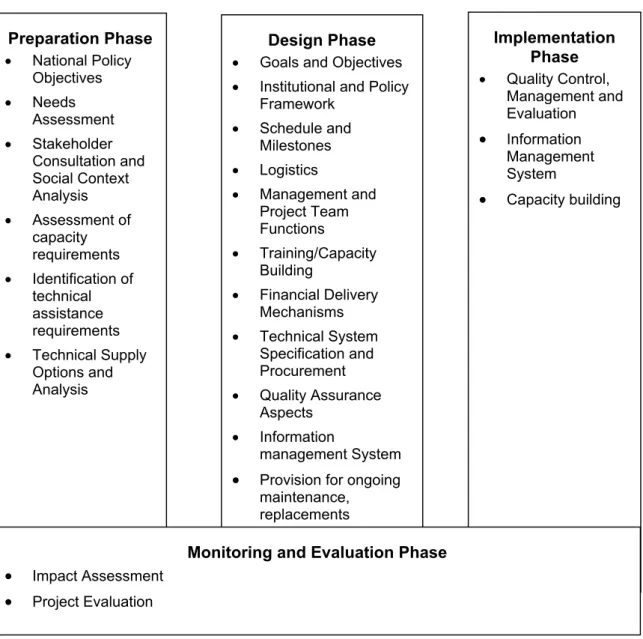
addition, they must put significant effort into assessing the needs to be addressed by a particular PV programme, consulting with stakeholders, analysing potential technological solutions, and then designing a solution that will yield the desired benefits at appropriate costs. The case studies can give input to those project developers who are interested in implementing or improving support programmes for the deployment of solar photovoltaic systems for rural electrification by providing some examples of the process of planning and implementing a PV project. Figure 1 gives an overview of the activities carried out in each phase of a PV project.
Figure 1. Overview of the activities carried out in each of the different phases.
Figure 1 was taken from the Task 9 document: PV for Rural Electrification in Developing Countries -Programme Design, Planning and Implementation.
Implementation Phase • Quality Control, Management and Evaluation • Information Management System • Capacity building Design Phase
• Goals and Objectives
• Institutional and Policy Framework • Schedule and Milestones • Logistics • Management and Project Team Functions • Training/Capacity Building • Financial Delivery Mechanisms • Technical System Specification and Procurement • Quality Assurance Aspects • Information management System • Provision for ongoing
maintenance, replacements Preparation Phase • National Policy Objectives • Needs Assessment • Stakeholder Consultation and Social Context Analysis • Assessment of capacity requirements • Identification of technical assistance requirements • Technical Supply Options and Analysis
Monitoring and Evaluation Phase • Impact Assessment
SECTION 2 - CASE STUDIES
2.1 PV Rural Electrification in Kiribati
2.2 Decentralised Rural Electrification Case Study of Morocco: The First Large-scale Experiences
2.3 Drinking Water Supply with Photovoltaic Water Pumps (PVP)
2.4 GEF / World Bank Assisted China Renewable Energy Development Project PV Component
2.5 JICA PV Project - Case of Zimbabwe
2.6 Lessons from the Regional Solar Programme (RSP) in the Sahelian countries 2.7 Need, Policy, Market Development: PV-Dissemination in Namibia
2.8 PV Electrification of Rural Schools in South Africa
2.9 Resource-Conserving Irrigation with Photovoltaic Pumping Systems in Chile 2.10 Water Desalination Powered by PV System in Syria
2.11 Solar Energy for Health Improvement in Mozambique 2.12 Solar Energy for Village Electrification in China 2.13 The Photovoltaic Market Transformation Initiative 2.14 The Take off of the African Commercial PV Sector
2.15 The World Bank Energy Services Delivery Project: Credit Program and Capacity Building – Solar Home Systems
2.1
PV Rural Electrification in Kiribati
Case study prepared by Takayuki Tani, IEEJ, JPN
Introduction
Kiribati has a population of only some 80,000 on 33 dispersed islands in the Pacific Ocean. The main income of Kiribati depends on the fishery licence from the vast exclusive economic zone, about 3.5 million square kilometres, and other industry is very small. Therefore, it sometimes needs foreign aid to develop its national infrastructure.
From independence (1980), the government has focused on the electrification of the country but only some vicinities of its capital area have been electrified. According to the results of the preliminary study for electrification, they found the electric demand of rural areas is too small and distributed to recover capital investment for electrification. So the government decided to electrify those areas by distributed type small generation.
Kiribati is located in the centre of the Pacific Ocean and has an abundance of solar energy resources. Other renewable energies such as wind or hydro are not usable. Small diesel generation is one way of electrification but the transportation of fuel between islands and even within islands is not easy. Therefore, the Kiribati government decided to adopt photovoltaics for rural electrification.
Project Background
Initial PV Trial – Failure
The first attempt to introduce PV nationally dates back to 1984 when Solar Energy Company (SEC) was established by the Foundation of the peoples of the South Pacific (FSP), using USAID funding. SEC was formed as a private company and carried out the sales of PV systems or components and their installations. According to this plan, technical training for SEC staffs was done under the cooperation of the UN Pacific Energy Development Program (PEDP) and the South Pacific Institute for Renewable Energy (S.P.I.R.E). The trained staff were to be available not only for free technical consultation with users at the office but also for some maintenance services on the site with the necessary charge.
At first, this went well apparently. About 270 SHSs were sold to private customers and some larger systems were sold to government facilities. But PV sales became lower and lower every year and in 1989 SEC almost went bankrupt.
At this time SEC became a national company, 99% of its shares were transferred from FSP to the Kiribati government. The government still had a strong will to develop PV rural electrification and had responsibility for SEC. Therefore it requested the Forum Secretariat Energy Division to fund the survey of all the PV purchasers in order to identify the reason for the PV business decrease.
From the survey, they found that almost all the systems were not properly maintained, some were without maintenance, some were replaced with improper components, some didn't have their charge controllers, some panels were heavily in the shadow, etc. Average lifetime of those systems was less than three years. The purchasers’ dissatisfaction was spread around the country resulting in a very negative reputation for PV, then PV sales dwindled within a few years after the project.
This means that a cash sales approach is not sustainable in Kiribati and the government and SEC decided to change the PV business model from sales style to utility style, what we call ESCO, with the recommendation of S.P.I.R.E.
The first attempt was indeed a failure but this very experience led Kiribati to succeed in PV rural electrification several years later.
Project Description
In 1990, the Japan International Cooperation Agency (JICA) did a study on implementing renewable energy programme in the South Pacific countries and as a result of the study, JICA and Kiribati agreed to carry out an institutional programme on PV rural electrification in the country. This time both JICA and Kiribati put a strong focus on implementing a sound
institutional structure of ESCO style PV electrification, because of the experience of SEC’s near bankruptcy. Only 55 SHSs were installed in the unelectrified villages of Kiribati's capital island of Tarawa, but the management system was deliberately and carefully implemented.
The system is described as follows:
• System hardware is composed of a 120 Wp solar panel with mounting pole and fitting structure, 100 Ah wet lead battery, charge controller, a 11 W fluorescent lamp, 9 W fluorescent lamp and interior wiring. Ownership of panel, battery and charge controller (power part) belongs to SEC and that of appliances and interior wiring (consumption part) belongs to users.
• Those who want to install the system must pay initial down payment of 90 AUD (1 AUD=0.5 USD) and monthly fee of 9 AUD.
• SEC can remove the systems of those who do not pay monthly fee more than 3 months continuously.
• SEC is in charge of the power part and users are in charge of consumption part, that is, SEC must maintain the power part such as battery water supply and replacement and users must take care of consumption part such as replacing troubled fluorescent lamps.
• Above responsibility is defined in the MOU between SEC and users before installation.
• A field technician is selected in the site. He is trained by SEC before the system introduction and must take care of the systems at the site at least once a month. He also must collect monthly fee from users.
• Field technicians are paid. SEC pays their salary from the collected PV fee.
• A senior engineer resides in SEC head office and takes care of field technicians. Twice a year he visits every site and deals with the more complicated technical problems which field technicians cannot deal with.
At first, some minor troubles happened. Some batteries run dry because the field technician neglected his duties. Old men in the village sometimes requested the field technician to share the collected fee for other public use according to their traditional custom of “give and share”. Some families were deprived of their systems because of the outstanding fee payment. These troubles occurred in the first one or two years but all were arranged with the cooperation of SEC, users and JICA. From those experiences SEC gained the know-how that field technicians should be selected from amongst the reliable people in the village - usually people more than thirty years old who have some position in the community. Young men are good for absorbing technical knowledge but they do not have a high enough position in society to do their job against older men. In this respect the institutional aspect is very important in creating a sound management system.
Outstanding payments and system transfer is an unhappy situation for both the users and SEC, but strict execution of the contract is the most important way to establish a sound fee collection system. After several systems were actually transferred, no further outstanding payments occurred.
Seven years have passed, and all the systems now work well and the management system also works as planned. Most batteries came to the end of their useful life and they were all replaced under the supervision of SEC using the collected fee.
Project Impact
After the JICA project, another 250 SHSs were introduced through EU cooperation. Its
management system was the same as the one developed by JICA, but this was another trial to test the sustainability in the remote islands. Most systems were installed in the outer islands and they also succeeded in setting up a sustainable management system.
By combining the JICA and EU projects, a total of 305 systems are now well operated and maintained in Kiribati. From these projects, a sustainable technical and institutional base for PV rural electrification was established in the country, leaving one important aspect - economic sustainability - still not established.
Currently the operation of the 305 systems brings a negative balance. The deficit is made up from the profit of other sections of SEC. SEC has three sections, one is the utility section which is in charge of the SHSs introduced by the two projects, another is the customer section which is in charge of installation and maintenance of independent users and the last is the
manufacturer section which produces some peripherals of PV systems.
The Kiribati government is now introducing PV systems for its rural facilities little by little within its own budget, and some independent users such as churches, companies and individuals also install PV systems privately. All these systems are installed and maintained by SEC under the same ESCO style maintenance contract. When there is a large system installation, then this section makes some profit.
The charge controller produced by the manufacturer section has good reliability and is suitable for use in the salty wind environment of the islands. This technology was transferred from an EU consultant in the project. It has a good reputation and is sometimes exported to other countries bringing in some profit for SEC.
Even after all these efforts, the economic condition of SEC is not stable because of the constant deficit of the utility section. At this point it is important to reduce and clear this deficit. An EU consultant analysed the economics of the utility section, concluding that the number of SHSs should be expanded to 2 000 to get beyond the break even point. On the basis of this result, Kiribati and EU are now planning a new project of expanding to 1 500 SHSs with consultation for business improvement. However, a total of 1 805 systems is still just below the break even point. This means that the economic sustainability of SEC after the new project will depend upon whether or not the management capability of SEC is much improved by the consultation. Another effort is still needed for future success and it is on course to be realised.
2.2
Decentralised Rural Electrification Case Study of Morocco: The
First Large-scale Experiences
Case study prepared by A. Shanker, IED, FRA
Project Aim and Objective
It is impossible to discuss decentralised electrification in Morocco without citing the Global Rural Electrification Programme (PERG). This scheme, launched by the Office National d'Electricité (ONE) in August 1995 and approved by the government of Morocco, has a threefold aim. - Participatory: This programme was drawn up jointly with local Communes Rurales
(equivalent to local municipalities) in rural areas, and it is carried out only with their consent
and commitment to providing funding in the order of 20 %. The beneficiary households also incur roughly 25 % of costs. We will examine below solutions that have been adopted when rural governments are unable to fund their share.
- Geographical: This programme covers all the rural districts in the Kingdom. This aspect of PERG raises no major problems, insofar as the ONE grid covers practically all rural
communes, excepting thoseserved by multi ”communes” water and electricity supply
syndicates.
- Technological: The programme envisions two kinds of electrification, through grid connection or decentralised power. All types of technologies are used for decentralised power, but mainly those that rely on renewable resources.
It is PERG's ambition to boost the rate of rural electrification from close to 20 % in 1995 to 80 % by 2006, which means bringing electricity to more than 1 500 000 households in a little over ten years. Clearly this massive electrification can be achieved only by grid connection in the vast majority of cases.
Project Description
Project Infrastructure and Institutional Issues
The principal criterion of eligibility that has been chosen is the per-household cost calculated for each village, specifically in the perspective of grid connection. The databases required for these calculations have been compiled through fieldwork by a prospecting committee made up of the commune, the Local Authority and ONE. This procedure is designed to prevent objections to the data used. The maximum allowable cost figure determining eligibility for grid connection is 25,000 MAD2/household. This first criterion limits grid connection to fairly sizeable groups of households, and eliminates extremely isolated villages. A second criterion measuring the density of households within a village will be discussed below.
The programme is organised in tranches, by rising per-household cost. The second tranche currently being implemented (year 2000) is within the threshold of 10 000 MAD / household. PERG is thus implemented by Province, District and by year under a master plan drawn up by ONE, ensuring that each district president is informed of the provisional programmes planned for his jurisdiction.
Using this method, some 200 000 households have been identified as potential candidates for off-grid electrification. The decision of implementation, i.e. the programming of the installation, while benefiting from the PERG framework, is left to the initiative of either the Communes, or village associations. We will discuss below the strategy adopted in these cases.
To properly understand the following section, it should be underscored that the choice of the mode of electrification is not imposed by ONE, but is the outcome of negotiations, and perhaps
even a debate in the “Commune” council. ONE's role is limited to making proposals and recommendations pertaining to options supported by technical and financial studies. The
partnership with the Communes is one of the most important features of the PERG concept, and we want to stress it. No PERG electrification project, regardless of the entities involved, can be undertaken without the assent of the Commune. This assent is materialised by an agreement drawn up between the two parties.
Project Financing
Here we would like to underscore that the financial contribution from the district, set at 20 % of the average cost resulting from a cost balancing mechanism at the national level, and
discounted over the period of the PERG scheme, amounts to 500 MAD per household and per annum for a period of five years. In this way, the funds that the Commune must reserve for electrification can be budgeted in advance. This contribution is a set figure when the project is eligible for the ongoing tranche, i.e. when the preliminary study determines that the cost is equal to or less than the set ceiling. When the estimated cost is higher (and this is the case for
projects that are not eligible for grid connection, among others) the Commune must pay the cost in excess of the ceiling.
This supplement must be paid in full before work begins. This payment is made in exchange for the advancement of the project or grid eligibility, and is incurred by the Commune if it so
desires.
It is clear that the Commune president is likely to choose grid connection, for reasons that are often electoral. And if the cost is prohibitive, he may prefer to wait, rather than opting for decentralised power right away, even though this option is the least costly for the community. This attitude is further justified by the fact that Communes are generally made up of several villages, which may be of quite different population density; consequently they are given different treatment under the PERG scheme.
Project Implementation
• Strategy Adopted
The analyses carried out by ONE of the more than 36 000 villages in its database have highlighted one feature of rural settlement in Morocco: its low population density.
We announced an initial criterion to determine villages' eligibility for grid connection, i.e. a maximum per-household cost of 25 000 MAD. But this criterion gives no indication of the geographic dispersion of households within a single village. We therefore introduced a second criterion; namely the cost of the low-voltage network required to supply all the households in a village. On the basis of this cost we established a cut-off criterion that we set at 19,000 MAD per household. This criterion, which we feel is a good indicator of the dispersion of households, enabled us to identify 200 000 households for which grid connection is not advisable because it is costly. We have specified that these households are in villages that are not connected to the grid, and are not scheduled to be connected. For even in villages that are slated for grid
connection, there may be outlying households that are distant from the village centre, and these are not considered in the estimation. These cases, although less frequent, give rise to a steady stream of protest.
The simplest solution and the one best suited to meet the objectives of large-scale decentralised electrification consists in equipping households with individual Solar Home Systems (SHS). This is also less expensive for the community. The main reasons are given hereafter.
Field surveys taken by ONE in a sample of rural grid-connected villages show that over 60 % of power consumption is devoted to household conveniences, primarily lighting and TV/radio appliances. Provided it is properly maintained, the SHS is perfectly well suited to this kind of use and is largely sufficient, given the limited needs of rural households.
The overall investment required for the SHS (including solar panel, battery, regulator, CFL lamps and accessories) is lower than that for conventional equipment, when connection costs and interior installation are taken into account.
The monthly bill for the PV installation is limited to reimbursement of maintenance costs, which are spread out over the period of the contract. Currently this bill varies between 50 and
100 MAD.
This equipment is now considered to be technically reliable, given the technological progress that has been made. The solar panel has an estimated useful life of over 15 years. As for the "solar" battery, with rational use, its useful life can exceed four years.
Now that the technological choice has been made, a number of management frameworks need to be worked out, their feasibility tested, and a large-scale PV action plan established. Our development strategy is built upon three strong points:
- Technical aspects: a complete standard SHS, ready to install, comprising a "generation" module made up of a 50 Wp panel, a battery and a regulator, and a "distribution" module made up of CFL lamps and accessories.
- Financial aspects: establishing a level of subsidy and payment schemes that are compatible with the financial resources of rural households.
- Organisational aspects: development of management frameworks or business models aiming at the sustainability of the PV service for a sufficiently long period of operation (at least seven years).
• Initial small-scale pilot projects: direct action
The reserved attitude of Commune Presidents toward PV energy constitutes one of the major problems we encounter in developing this type of electrification solution. This factor depends more on the surrounding context than on ONE's own capacities. It is easy for ONE to launch ambitious conventional electrification schemes, because of the utility’s natural monopoly as the only (or nearly only) operator of the medium-voltage grid in rural areas. But is much harder to set up a broad Decentralised Rural Electrification scheme.
Another difficulty stems from the specific nature of the mode we have selected, namely the PV SHS, for this product is considered as individual "domestic" equipment. It is therefore
apprehended as private property, and is subject to the same rules of trade as other household goods (electrical appliances, for example). Furthermore, several other operators are active in equipping villages with PV systems, under various auspices: NGO acting under programmes providing assistance to village associations, aide from various outside entities involved in the development of poor Communes, etc.
We have undertaken the first projects by direct action. By this we mean operations conducted entirely by our own teams. The first households equipped are ONE customers, and ONE procures, installs and maintains the SHSs. ONE also handles billing of the monthly fees. The financial arrangement comprises:
- An advance payment of 1 440 MAD by the beneficiary household, and monthly payments of 60 MAD over a period of 7 years,
- A supplementary participation by ONE which covers the remaining equipment costs. The initial pilot projects served as a test for our operational units, as well as publicising this mode of electrification to elected officials and households.
• Second Approach: direct action with subcontractors
This approach is a variant of the direct action approach, in which the installation, after-sales services and billing are contracted to a private company which is selected by competitive bidding and paid by ONE for its services. The number of households included under this
approach exceeds 1 500, and is the result of work carried out jointly with village associations and the communes involved.
• Third approach: partnerships
Under this formula tasks are divided between ONE and a private company selected through competitive bidding.
- ONE provides the module and battery, and verifies that the project is properly executed and that customers get good service.
- The contractor provides the rest of the SHS, equipment installation, maintenance and after-sales service for a renewable period of 5 years.
The financial arrangements stem from this distribution of tasks. The ONE subsidy covers the cost of acquisition of the panel and the battery. The beneficiary household pays an advance and monthly payments (set by the terms of the tender) directly to the contractor.
This approach is being used for a scheme covering 7 000 households in a southern province. Close to 900 households had been equipped as of end of August 2000.
• Fourth approach: fee for service
The lessons learnt from these first three approaches are primarily:
- Technical: customer satisfaction achieved with the after-sales service;
- Financial: low and irregular bill recovery rate, the need to find payment modalities better suited to villagers' incomes;
- Organisational: the long delay between the customer's application and actual installation of the SHS is a handicap for the scheme. Stock management of equipment supplied by ONE is also a source of malfunction.
In light of this experience we have developed a new approach that is inspired by Anglo-Saxon "fee for service" systems. This scheme is summarised below.
Objectives:
1) Increase the pace of rural electrification by launching a tender for the installation of 20,000 kits over 5 years;
2) Open markets to competition throughout the country; 3) Encourage heavy involvement of the private sector.
Organisation: The contractor is chosen by competitive bidding on the basis of the lowest cost for services provided to households. The contractor provides all services, including supply and installation of all equipment. Needless to say, high quality of hardware and services is one of the requirements of the terms of reference. ONE pays receipts from users to the contractor. The period of the contract is set at 10 years.
Financial: The subsidy paid by ONE is set at 4 500 MAD per household equipped. The subsidy is paid directly to the contractor upon presentation of supporting documentation. The beneficiary household, customer of ONE, pays to ONE the advance and monthly payments set by the contractor with the lowest bid. Collection of payments is one of the services ensured by the contractor.
Ownership of equipment: ONE retains ownership of the "generation" unit and the household owns the interior installation.
Other features of this approach should be pointed out.
The contractor receives a list of villages that are potentially favourable to rural electrification, for information. The contractor is responsible for contacting new customers and promoting the product.
If several contractors are selected they may be in competition within a single region, or even within a single village.
The Commune involved and ONE sign an agreement authorising the electrification scheme within the limits of its territory.
To ensure the success of this project ONE is particularly careful in selecting contractors, who must submit tenders that meet ONE's requirements from an administrative and technical standpoint.
In our view this approach is likely to be highly successful, for the following reasons: - It builds upon lessons learned from previous experience;
- It avoids the problems faced by Commune Presidents who must decide in favour of PV, and this is an important factor. In effect, with the contractor's marketing efforts aimed directly at the beneficiary households, the choice and decision centre will shift to households, and the president and / or Commune council will only have to show their approval.
To complete this overview of decentralised rural electrification, we will briefly mention some other projects undertaken for village electrification by isolated mini grids.
The first case is electrification by a diesel generating set. In most of these projects the service is conceived as pre-electrification prior to grid extension. The genset is re-used in other villages and the LV network remains. It should be noted that ONE undertakes few projects of this nature, given the operating costs and the resulting deficit for the utility, because the retail price per kWh is the same as for grid-connected customers. For the executed projects, ONE has devised a subcontracting scheme involving a young agent, chosen from the village, to hold down the costs mentioned above. However, we will not discuss this interesting case in greater detail here.
The second type of scheme involves other renewable energy resources. These projects are the following.
Mini hydropower plants: two sites, Agadir N'Ait Mhamed and Askaw, are being equipped on the southern slopes of the High Atlas range, at respectively 2 100m and 1 600m above sea level. The 200 kW and 300 kW turbines will supply MV and LV serving 63 villages with close to 1,600 households. The three Communes involved and the beneficiary households contribute to project funding under PERG. Electricity will be billed at the national kWh rate. Construction work has started and commissioning is scheduled mid-2001.
Two villages located on the Atlantic coast in the province of Essaouira have been equipped with wind turbines: a 25 kW unit serves 70 homes in Moulay Bouzerktoun; two 25 kW units supply 50 homes and a few small hotels in Sidi Kaouki.
This overview covers only projects already implemented or in the implementation phase. It is clear that the PERG design offers a remarkable degree of flexibility and openness. The proof is the wide range of formulas adopted and the significant volume of completed installations. Other projects are under study, including a portfolio of remote hydropower sites in mountainous areas. ONE draws upon the expertise of the Centre de Développement des Energies Renouvelables (CDER) which has provided invaluable support for PERG, in identifying zones with significant wind power potential, as well as assisting ONE in technical matters. The two organisations have signed a partnership agreement to formalise this support.
2.3
Drinking Water Supply with Photovoltaic Water Pumps (PVP)
Case study prepared by R. Posorski, GTZ, DEU
Introduction
The availability of clean drinking water is a basic human need. Nevertheless, World Bank estimates put the number of people in remote rural areas of developing countries with no access to clean water at roughly one billion.
Dirty and polluted water sources have a strong negative impact on health. Getting water from remote sites is troublesome and time consuming. Poor water supply contributes to the migration of rural people into overcrowded cities.
Consequently, government-sponsored programmes dedicated to the long-term improvement of drinking water supplies in rural areas are being conducted in numerous developing countries. Since most rural areas are not and will not be electrified for decades to come, national water authorities have to rely on diesel pumps in most of those programmes. Due to poor
maintenance, breakdowns and lack of fuel, they are often out of service.
Here solar energy opens up new options for pumping water. Photovoltaic pumping systems require little service and no fuel. They can offer a reliable and environmentally sound alternative. Often, they constitute the only reliable solution to the problem of drinking water supply in remote areas. However, a lack of experience with PVP technology, as well as the comparatively high initial costs, has precluded its widespread application up to now.
Aims and objectives
The objectives of the PVP programme were to:
• Demonstrate the technical maturity of PVP;
• Determine the conditions for a cost-effective utilisation of PVP;
• Clarify the ecological benefits and the level of acceptance on the part of users and operators;
• Adapt PVP technology to the users need and to the climate conditions, the aim being to develop a marketable product;
• Clarify the opportunities for future PVP applications as well as their potential for dissemination.
Project Background
Due to the reliability of photovoltaic pumping systems a huge potential for dissemination in non-electrified, rural areas can be expected. In order to demonstrate the technical maturity of PVP and to clarify the prerequisites of a broad utilisation, the German Government funded an “International Field-testing and Demonstration Programme for Photovoltaic Water Pumps (PVP)”. The PVP programme was being conducted by the Deutsche Gesellschaft für Technische Zusammenarbeit (GTZ) GmbH.
The programme started in 1990 and was finished in 1998. It was followed by a second programme investigating the utilisation of PVP for irrigation3.
The GTZ implemented the PVP Programme in co-operation with national energy and water authorities in Argentina, Brazil, Indonesia, Jordan, the Philippines, Tunisia and Zimbabwe. In the course of the PVP Programme, a total of 90 PVP systems have been installed at selected sites in the project countries. Those systems provide potable water to people of the village communities and their livestock.
Project Description
The PVP Programme analysed the opportunities for future PVP applications as well as their potential for dissemination. Consequently, the PVP Programme was designed primarily as a demonstration and field-testing programme, with water utilities and PVP
suppliers/manufacturers as the main addressees. The results of the PVP projects provided a decision-making basis for:
• National or regional water utilities to assess PVP as a viable, least-cost option for rural drinking water supply, and
• PVP suppliers / distributors for product adaptation and marketing.
The overall idea was to achieve a major advance toward commercialisation of PVP technology by demonstrating its feasibility at a significant number of sites.
This was done in combination with thorough preparation of counterpart institutions and personnel, intensive interlinking with industry, and a comprehensive performance monitoring programme. The transfer of expertise to counterparts and of experience to the industry was crucial.
Key measures implemented have been:
• Site selection, ordering and commissioning of PVP systems,
• Monitoring the technical PVP operation and cost-relevant factors,
• Measures for community participation and sociological monitoring of the PVP communities,
• Training of water utilities' technical staff, planners and decision-makers,
• Adaptation of country-specific planning procedures,
• Promotion of technology and know-how transfer by involving national companies in the supply and maintenance process,
• Dissemination of project results and public relations work.
The conceptual approach behind the PVP Programme did not envisage competition between the PVP systems and hand pumps, wind pumps, grid-fed electric pumps or large diesel pumps. However, it regards PVP as an alternative to small diesel pumps at remote sites for
communities with populations of 500 to 2000, since these usually experience: