The next step for
Location Based Services
How vertical integration, easy to use
applications and the right business model
can help to turn LBS into a success
Location Based Services (LBS) are being introduced by an increasing number of operators in several parts of the world. In certain countries, for example in the US, this is driven by regulatory de-mands for accurate positioning of cell phones when a call to the emergency number 911 is placed. In other countries it has been dri-ven purely by the market potential for LBS as such.
So far LBS have not been the success many hoped for. In this white paper we argue that the foremost reasons for the slow up take are that the services offered today is simply to slow and complicated to use. We do believe in integration of LBS in many other services, but it will take some time before this is done in a way that is really appealing to end users.
Already now, it is possible to introduce appealing services within certain areas. One such area is child tracking and alert or positioning services for the elderly. However, a successful service will require some vertical integration, dedicated devices and end-to-end management of the service. Such
a service could be delivered by existing operators, but we believe that the first ones to make it hap-pen may very well be dedicated service providers.
About Northstream
Northstream provides strategic technology and business advice to the global wireless industry. Northstream has assembled a multinational team with some of the world’s best experts and analysts on wireless communication and technology that supports many of the industry’s leading companies in their strategic and tactical challenges towards continued growth.
Contents
Analysis of competitive forces ...2
Regulatory framework determines entry barriers for new players ...3
Service providers may create an illusion of competitiveness ...4
Mobile number portability contributes to bargaining power of buyers ...6
Substitutes mainly threatening growth of mobile voice services ...7
Reduced bargaining power of suppliers has positively impacted competition ...8
Correlation of sound competition and continued mobile revenue growth ...8
Opportunities for mobile operators in highly competitive markets ...9
Conclusions ... 11
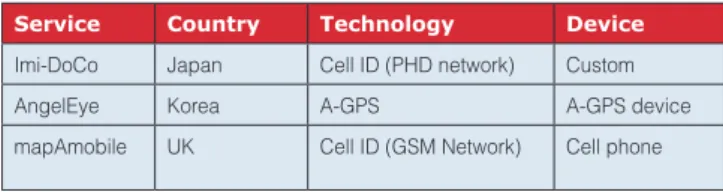
Introduction For the past several years, more and more operators all over the world have introduced location based services (LBS) in their service portfolio. In certain countries, e.g. in the US, regulatory demands on mandatory positioning of cell phones calling the emergency number 911 has accelerated the deploy-ment of the infrastructure needed in the mobile net-works. In other countries, e.g. in the UK and Italy, operators like 3 have made LBS an integral part of their service offering when rolling out their new 3G networks. Despite the investments made so far, we have yet to see any substantial success stories based on LBS. In this white paper we try to explain why LBS have not been able to meet the high expectations and what kind of services really have the potential to lead the way and succeed. As an example of a service with high potential we use tracking of children and elderly in need of special attention or care. Status of the LBS market Location Based Services offered today Currently the LBS market is dominated by conve-nience oriented, user centric services. Several opera-tors have location based services integrated as a part of their portal offering. This is the case with DoCoMo’s i-Mode services, Vodafone Live! and Hutchisons 3G-portals. Typical services offered are friend finders, directory services, points of interest, and different types of navigation services. Some of the services offered are quite advanced. In some cell phones you can find features similar to the ones in a EUR 2000 in-car GPS navigation system, but for a fraction of the cost. Several tracking services exist already today, but so far none have been able to combine sufficient technical performance in a stand-alone managed service with a low-cost dedicated device. Korea and Japan have been pioneer markets. Already in 1998 DoCoMo launched the Ima-DoCo service, using the high cell ID accuracy of the PHS network to offer tracking applications such as fleet-management and child tracking. Ima-DoCo uses a specialised device supplied by Sharp, and offers an accuracy of between 50-500m, and is reported to have approximately 60,000 subscribers. In February 2002 KTF launched AngelEye. This became Korea’s first tracking service for children and elderly. AngelEye is an A-GPS based service and the users are charged approximately EUR 10 per month the service plus an additional charge for data usage. The UK based company mapAmobile offers a tracking service that works for customers in e.g. Vodafone, Orange, T-mobiles and O2’s UK net-works. It’s available online, via Carphone Warehouse Contents Introduction ... 2
Status of the LBS market ... 2
Location Based Services offered today ... 2
Why LBS have not been able to meet expectations ... 3
People tracking could lead the way ... 3
Why people tracking? ... 3
Requirements on a people tracking service ... 3
The business model ... 3
Benefits of a customised device ... 5
Challenges to overcome ... 5
Conclusions ... 6
and a number of other retail outlets. Registration starts at GBP 29.99 and tracking of additional phones is charged GBP 10 each. Every time a position is requested, 30p is charged.
Table 1. Example of tracking services
Why LBS have not been able to meet expectations
There are some LBS applications that have become fairly popular in certain user segments, but the real success has failed to materialise.
The foremost reason for the lack of success of LBS in its current format is performance and usability. Although the functionality is there, most services are simply to slow and to cumbersome to use. This is driven both by poor UI design and poor browser performance in most cell phones.
To make a service successful demand and a willingness to pay for the service as such is not enough. The service must also be delivered in a way that meets the expectations of the end users. Anyone that has tried to key in a 20-letter address on his or hers cell phone, wait for the processing and try to follow the directions presented while driving under-stands why there is still a market for integrated navi-gation systems for cars despite much higher prices.
A similar problem exists with friend finder servi-ces. Most people don’t want to allow their friends to track their whereabouts all the time, so all friend finder services includes the option to turn off the ability to be positioned. Default is that positioning is not allowed, which means that one must actively switch it on before using the service. In theory it’s simple, but in practice turning this functionality on or off requires 5-6 clicks and maybe 60 seconds of wait-ing time. This is enough to make most users loose interest and just leave it in the non-active mode.
Eventually, better user interfaces and increased device performance will enable a pleasant user expe-rience for portal based services with LBS functionali-ty integrated as a natural extension of the service. In the short term however, we believe that what is needed is simple, easy-to-use applications with a clear value proposition to the end users. We believe that the technology development has progressed far enough to enable services like this to emerge and be successful.
People tracking could lead the way
Why people tracking?
It’s easy to come up with examples of situations where you would like to keep track of someone’s or something’s position. Examples could be asset track-ing, tracking of stolen cars, courier shipments, people or pets. We believe that one of the most obvious areas to explore would be simple tracking of people and pets. By simple, we mean that in a first version the service would fit for normal situations. These include parents that wish to see if their children are still in school or tracking of a dog or cat that has disappea-red. In this form, the service would not be suited for tracking abducted kids or stolen pets. This requires a much more advanced service. Still it would be percei-ved as attractive for parents and pet owners. Alert and positioning services for elderly would firstly target semi-independent people, and people in need of spe-cial medical attention or spespe-cial care. The version of the service targeting elderly would require a slightly different approach than, for example, tracking a child.
Requirements on a people tracking service
What is needed for the service to become successful is that someone can deliver a managed, end-to-end so-lution. This requires a high degree of vertical integra-tion, making sure that technology, business model and market requirements are well aligned.
We believe that the technology used will need to enable a positioning accuracy of 50-200m to be really useful. Preferably sub 50m. The coverage area will need to be extensive and the service will also need to work indoors within the coverage area. Battery life time of the device will also be a critical parameter, as will the ability to withstand rough treatment and for some segments the ability to activate on demand, switch the functionality off or reduce the accuracy of the positioning.
The service would not only enable simple posi-ioning, but also be able to generate alarms when someone leaves a pre-defined area (geo-fencing) or approaches a preset location (arrival notification).
One important aspect is that the product must work out-of-the-box. Simply unpack, and activate by phone or over the web. Credit card billing could be used to bypass the need of an additional credit-check.
The business model
A people tracking service, for example child locator, could but would not necessarily be sold or operated by the traditional telecom operators. The market po-tential of the service is small compared to the ope-rator’s core business and the distribution channels
Service Country Technology Device Imi-DoCo Japan Cell ID (PHD network) Custom AngelEye Korea A-GPS A-GPS device mapAmobile UK Cell ID (GSM Network) Cell phone
and branding may not be a perfect match. Instead a service provider could very well offer the service to end users. Of course this would require some form of an MVNO agreement, for location information and network use, to be signed with a network operator.
We believe that the suitable distribution channels would be traditional electronic retailers for the child tracking service. For a corresponding service for elderly, the retail channels might be hospitals, phar-macies or health care outlets. Branding could vary.
It could be co-branded with an operator, but also branded differently depending on target segment.
In our opinion the business model of a people tracking service looks very attractive, especially if the necessary network infrastructure is already in place. A tracking service demands very little in form of net-work resources consumed, but at the same time deli-vers a high perceived value to the users of the service. Studies made in the US have indicated a willingness to pay for a child tracking device of approximately
Technology Typical accuracy Device
requirements Network requirements Indoor positioning Cell ID 1000m - 250m None None If cell phone coverage AGPS 50m - 20m Integrated GPS receiver Limited May not always work*
TDOA 150m - 50m None Yes If cell phone coverage
EOTD 250m - 100m EOTD software Limited If cell phone coverage
Table 2. Basic Data - selected positioning technologies * Requires free line-of-sight to GPS satellites
Overview of selected positioning technologies
Different applications put different requirements on the accuracy of the position obtained. Some of the most common positioning technologies for cellular networks are Cell ID, A-GPS and TDOA. Various tech-nologies have different characteristics, making them more or less suitable for a specific use. A-GPS is the most accurate, but has some coverage limitations which make it less accurate indoors. A serious draw-back with A-GPS is that it requires the device to be equipped with a GPS-data unit. This limits the amount of already existing devices that can be used for positioning, but also somewhat increases the complexity the positioning devices. TDOA is the technology that will deliver a reasonable accuracy and still work indoors and with existing devices.
Cell ID
Cell ID (CID) is the simplest and cheapest way to position a cell phone within a network. Basically it approximates the position of the phone with the position of the antenna currently used for communication with the mobile device. This method is very simple and inexpensive, but accuracy in the positioning is not very good. The accuracy depends on the size of the cell. E-CID (Enhanced Cell ID) is an improved version of CID that takes into account the time it takes for the signal to propagate from the antenna to the phone and back and certain power measurements. The accuracy is somewhat better than with pure CID but varies with geography and the traffic pattern in the cell.
A-GPS
A-GPS (Assisted-GPS) uses the signals from GPS (Global Positioning System) satellites operated by the US Department of Defence. By using the cellular network to send a reference signal to the cellular device, search time can be reduced, accuracy improved and power consumption reduced. A-GPS is accurate but puts some requirement on the devices used. The cellular device needs to contain a GPS radio receiver, an antenna and a processor for measurements. The calculation of the position can be done by a server in the network, and the results transmitted back to the phone. A-GPS is very accurate, 20 m is not unreasonable, but has some coverage limitations indoors or in other situations when free line of sight to the satellites can’t be established. The A-GPS functionality will naturally add some to the manufacturing cost of the device.
TDOA
TODA (Time Difference of Arrival) uses time difference measurements for the signal from the cellular device to the network to calculate the device’s position relative to several base stations. TDOA requires careful time synchronisation to generate an accurate result. TDOA is more accurate than Cell-ID but less accurate than A-GPS.
EOTD
EOTD (Enhanced Observed Time Difference) is similar to TDOA but uses the time difference measure-ments for the signal from the network to the device. This requires the devices to be equipped with EOTD software, but demands less in form of infrastructure investments in the network.
USD 80-100. The corresponding number for the monthly service fee is USD 20.
We believe that a subscription based model is suitable. For a monthly fee of, say EUR 15 for the service and maybe EUR 2-3 per additional device associated with the account, a user would be allowed to access a web site and read the position of the devi-ces connected to the account. The account could also be accessed by the browser in a WAP- or Internet-enabled cell phone or PDA.
Of course it’s also possible to use a pay-per- positioning model, or various bundles including bundling with a family subscription from the cell phone operator. For people not willing to pay upfront for the device, one could add rent for the device on top of the monthly fee.
Benefits of a dedicated device
To be able to offer an attractive tracking service, we believe that a dedicated tracking device is essential. A regular cell phone can of course serve as a tracking device as well, but using a dedicated device has several advantages.
• Designed to purpose
A dedicated device could be designed for use by kids or on pets, and in other situations where using the cell phone for positioning would not be an option. The form factor could be optimised and some devices could also be designed for easy integration with items such as backpacks, belt-buckles or clothing.
• Easy to use
A dedicated tracking device would be tailor-made for this particular purpose and thus very easy to use compared to a cell phone. Depending on the target segment, it could also incorporate selected services, for example push-to-talk or emergency alerts. These selected services could be made easily accessible from dedicated buttons.
• Perceived as operator independent
The service can easily be offered to all customers on the market, and does not have to be associated with a specific operator.
• Low Price
By excluding everything but the bare minimum the price could be kept low. Standardised chip-sets are becoming available in large quantities and manufacturing could be done at a relatively low cost provided that volumes are adequately high.
• Good battery performance
A device designed for this specific purpose could be designed to consume much less power than a traditional cell phone.
• High reliability
Reduced complexity would enable the design of a device with higher reliability and less sensitivity to rough treatment.
Challenges to overcome
There are a number or risks and issues that need to be addressed in order for a tracking service to be successful. Some are relative straight forward, for example to secure sufficient technical performance, while others involve ”soft values”, for example trust and how to deal with personal integrity issues and abuse.
Personal Integrity
A service based on tracking of individuals differs in some important aspects from tracking of assets or pets. Positioning someone always interferes with the personal integrity of the individual being positioned. In practice this means that a tracking service needs to be based on the voluntary participation of the indi-vidual being positioned. In existing friend finder services it is always possible to switch off the ability to let other people read your position.
At the end of the day, a certain amount of trust and respect for the individual is necessary for the service to work properly. This is not something that technology can solve, but an important role of technology is to enable a sound use of the service. A device designed for elderly could for example be possible to switch off or only activated in case of emergency. It could also be equipped with the possi-bility to change the accuracy of the positioning. Abuse
A service with dedicated devices for tracking people could easily be subject for abuse. A device could be hidden in someone’s belongings or in someone’s car, making unauthorised surveillance of the person’s whereabouts possible. This is of course unlawful, but will also likely put some requirements on the service provider to minimise this type of misuse. The most obvious way to do this would be to contrac-tually regulate the intended use and to design the positioning devices to make unauthorised surveil-lance more difficult.
Conclusions
To make a location based service successful several factors need to be in place. There has to be a demand for the particular service, there has to be technology available for someone to provide the service in a user friendly way at an acceptable price level, and there must be a viable business model.
The demand for certain services has not been questioned. What has been missing so far is the ease-of-use.
We believe that tracking services, e.g. child tracking, is an area that has the potential to emerge as one of the first really successful LBS applications. Specialised, low cost devices and an end-to-end managed service will play an important role in making this happen.
List of abbreviations
A-GPS Assisted GPS (positioning technology) CID Cell ID (positioning technology)
E-CID Enhanced-Cell ID (positioning technology) EOTD Estimated Observed Time Difference
(positioning technology) GPS Global Positioning System LBS Location Based Services TDOA Time Difference of Arrival
(positioning technology)
UI User Interface
Contact
Northstream has studied all aspects of mobile services. Please contact us if you would like to find out more about this or about our company and the services we provide.