57
Islamic Banks’ Risks and Profitability
A Case Study on Islamic Banks in Indonesia
Sutrisno
Universitas Islam Indonesia
[email protected]
Abstract
The development of Islamic banks shows excellent growth in terms of assets, third party funds, and financing. However, the growth of Islamic banks, which is approximately 5%, is relatively small nationally. For this reason, researches on Islamic banks always attracts attention. The purpose of this study is to analyze the factors that influence the profitability of Islamic banks. The profitability of Islamic banks is measured using return on assets (ROA), while the factors suspected of affecting profitability are capital risks are measured using the capital adequacy ratio (CAR), financing risk is measured using non-performing financing (NPF), operating risk is measured using operational costs to operational income ratio (OCOI), and company’s size (SZ). The population of this study is 13 Islamic banks with a sample of 7 banks implementing a purposive sampling method. The observation period is 8 years (2011-2018), with quarterly data. The analysis tool to test the hypotheses is multiple regression. The results showed that capital risk (CAR) had a significant but negative effect on profitability, operating risk (OCOI) had a significant but negative effect. While financing risk (NPF) and company’s size (SZ) had no significant effect on profitability.
Keyword: capital risks, financing risks, operational risks, profitability
JEL : G21
DOI : 10.24002/kinerja.v22i2.2701
Received : 10/23/2019 Reviewed: 01/29/2019 Final Version: 02/20/2020
1. INTRODUCTION
Banks encounter capital risk because bank’s capital is regulated by the government through the Financial Services Authority (OJK). Bank’s management must be able to manage capital as efficiently as possible, meaning that it cannot be too small and may not be too large. There is a contradiction between large CAR
58
and profitability. If the capital is too small, it will be subject to sanctions from the OJK, but it can increase profitability because it can channel funds efficiently. However, if it is too large, it will be inefficient and can reduce profitability. Bank’s capital risk is measured using Capital Adequacy Ratio (CAR). The results of the study are also inconsistent, as Idris et.al (2011) and Ruslim (2012) discovered that CAR had no effect on profitability. On the contrary, Akhtar et.al (2011) and Syafri (2012) discovered that CAR had a significant but negative effect on profitability. While Yusuf and Suryaatmadja (2018) and Olalekan and Adeyinka (2013) discovered a positive and significant effect between CAR and profitability.
The profitability of Islamic banks is obtained from the financing provided, meaning that the greater the financing provided provides opportunities for increased profitability. The expansion of financing provided without good analysis has the potential to increase financing problem or often referred to as non-performing financing (NPF). The size of the NPF will bear an impact on reducing profits because the NPF will be considered as cost, thereby reducing bank profits. Norman et.al (2015) in Bangladesh, Akhtar et.al (2011) detected a significant and negative effect of NPF on profitability. On the contrary, Sutrisno (2016) detected that NPF had a insignificant effect on profitability.
Bank’s management can also manage assets and other resources to be efficient. Operational risks are faced by banks when they want to improve their efficiency in operating costs. Often, the operating costs are higher than the operating income so that the bank experiences losses. Thus, bank’s management in addition to increasing revenue through increased financing must also reduce operating costs in order to increase profits. The operating costs which are deducted by the ratio of operational costs to operational income (OCOI) greatly affect profitability. A high OCOI will cause a decrease in profitability. The results of the research of Yusuf and Suryaatmadja (2018), Olalekan Ariyan (2010) and Adeyinka (2013) and Ariyani (2010) discovered that OCOI had a significant and negative effect on profitability.
Profitability can also be obtained based on the size of the company, thus large banks possess the opportunity to get large customers both in terms of fundraising and financing. Since, large banks are more trusted by the public, so they can obtain large customers who are able to contribute to profitability. Akhtar et al (2011), Zeitun (2012) and Idris et al (2011) discovered a positive influence between company’s size and profitability. While Nouaili et.al (2015) discovered that company’s size had no effect to profitability.
2. LITERATURE REVIEW
2.1. Capital Risks and Profitability
Capital becomes a very important aspect for banks, because in addition to being a source of funds to finance banks’ operations, it also functions as a back-up
59 to cover losses if banks’ performance has decreased. Capital also serves to increase public’s trust. With a large bank capital, the public believes that the bank is able to back up if it suffers losses, so the public is willing to save their funds in the bank. The banks’ capital is so important that the government through OJK regulates banks’ capital strictly. Banks must provide capital as measured by a capital adequacy ratio or a minimum Capita Adequacy Ratio (CAR) of 8%, and must provide a capital buffer of 2.5%. Banks must be able to maintain that the CAR is not less than the minimum requirement but also not too large which indicates the bank is less efficient. Thus, bank’s management is able to optimize its capital so that profitability increases. The results of the research of Akhtar et.al (2011) and Syafri (2012) showed that CAR had a significant but negative effect on bank’s performance. This is due to the bank’s CAR being too large so that the bank is less efficient towards profitability.
H1: Capital adequacy ratio affects the profitability of Islamic banks in Indonesia 2.2. Credit Risks and Profitability
The main income of Islamic banking comes from financing disbursed, thus the higher the financing disbursed the more potential to increase revenue. On the other hand, financing has risks if not managed carefully. Financing must go through a financing analysis process that involves financing and management. When the precautionary principles are ignored, it is possible that the financing provided results in non-current levels of payment both in terms of principal and for the results. The financing risk is called non-performing financing (NPF). NPF is a financing problem and will be a cost, thereby reducing profitability. The management must be able to reduce the NPF as low as possible, because OJK has directed a maximum NPF of 5%. If a bank’s NPF is more than 5%, the bank will be regarded as an unhealthy bank. The results of research of Akhtar et.al (2011), Syafri (2011) and Norma et.al (2015) discovered that NPF had a significant and negative effect on profitability.
H2: Non-performing Financing has a negative effect on the profitability of Islamic banks
2.3. Operational Risks and Profitability
Operational risks are measured by a comparison between operational costs and operational income (OCOI). Operational risks occur if the management is unable to control operational costs so that OCOI experiences an increase which causes losses. Operational costs consist of sharing revenue costs, customers costs, human resource costs, overhead costs and other operational costs. In addition to being able to increase financing, the management must also be able to press OCOI in order to increase profitability. The results of the research of Yusuf and Suryaatmadja (2018), Olalekan Ariyan (2010), Adeyinka (2013) and Ariyani (2010) discovered that OCOI had a significant and negative effect on profitability.
60
2.4. The Size of the Company and Profitability
One of the goals of the company, including banks, is to be able to grow into a large company. The size of the company is usually measured by the total assets owned. The bigger the bank, the more trusted by the public will be, so that the bank has no difficulty in raising public funds or channeling financing. Therefore, large banks possess more ability to obtain profitability than banks with small size. Large banks also possess a large network of branch offices, making it easier to attract customers. The results of research by Akhtar et al (2011), Zeitun (2012) and Idris et al (2011) discovered positive effect between company’s size and profitability.
H4: The bank’s size has a positive effect on the profitability of Islamic banks
3. METHODOLOGY
3.1. Populations and Samples
The populations of this study were Islamic commercial banks which were Islamic banks operating in Indonesia, which until now there are 13 banks. The samples were taken as many as 7 Islamic banks implementing a purposive sampling method. The observation period was eight years, starting in 2011 until 2018 with quarterly data. The data was taken from the websites of each Islamic commercial bank and from the FSA.
3.2. Research Variable
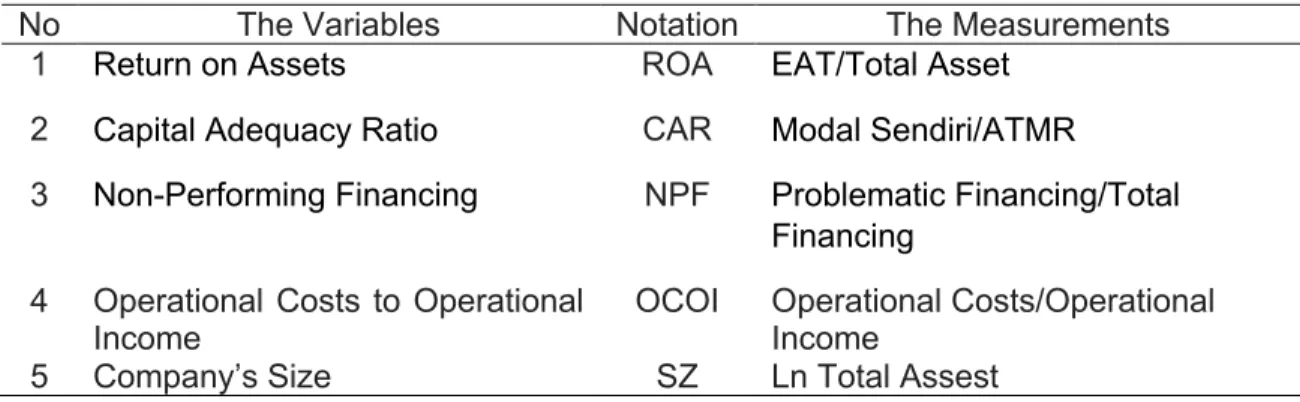
The research variables consist of the dependent variable namely profitability of Islamic banks as measured by return on assets (ROA) and independent variables consisting of capital risk (CAR), financing risk (NPF), operational risk (OCOI) and company’s size (SZ). The measurements are as follows:
Table 1: The Variables and Their Measurements
No The Variables Notation The Measurements
1 Return on Assets ROA EAT/Total Asset 2 Capital Adequacy Ratio CAR Modal Sendiri/ATMR
3 Non-Performing Financing NPF Problematic Financing/Total Financing
4 Operational Costs to Operational
Income OCOI Operational Costs/Operational Income
61 3.3. Data Analysis
In order to test the hypothesis, a multiple regression analysis tool is used with a partial test (t test) with a significance level of 0.05. The regression equation is as follows:
ROA = α + β1CAR + β2NPF + β3OCOI + β4SZ
4. RESULT AND DISCUSSION
4.1. Descriptive Statistics
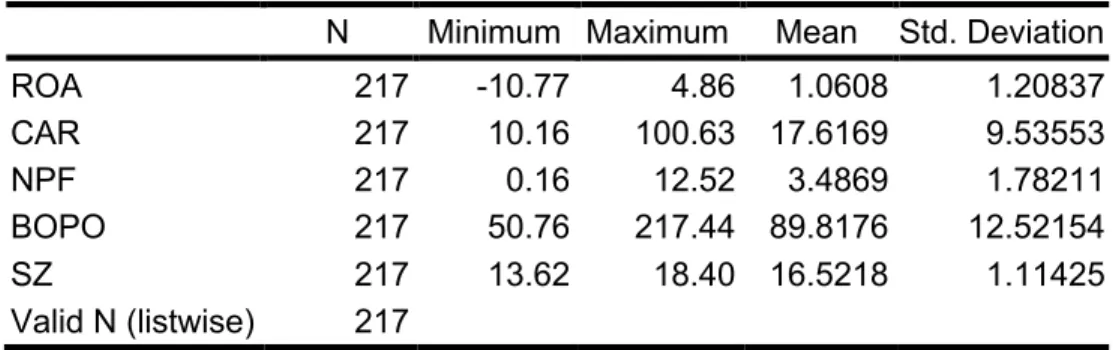
In order to find out the description of the research data, after the research data was tabulated it was processed using SPSS version 21.0. Thus, it was obtained descriptive statistics as follows:
Table 2. Descriptive Statistics
N Minimum Maximum Mean Std. Deviation
ROA 217 -10.77 4.86 1.0608 1.20837 CAR 217 10.16 100.63 17.6169 9.53553 NPF 217 0.16 12.52 3.4869 1.78211 BOPO 217 50.76 217.44 89.8176 12.52154 SZ 217 13.62 18.40 16.5218 1.11425 Valid N (listwise) 217
Based on the data in the table, it can be explained that profitability was measured by ROA had a maximum value of 4.86% and a minimum value of -10.87% with an average of 1.06%. These results indicated that the level of profitability of Islamic banks was still very low and some even experienced a loss of 10.77%. The cap as measured by CAR showed that it was still inefficient because the average of 17.62% was far above the minimum requirement of 8%, with a minimum value of 10.16% and a very high maximum value of 100.63%. The credit risk (NPF) had a very small minimum value of 0.16% and its maximum value was far above the maximum 5% requirement, with a relatively small average of 3.49%. OCOI, which showed the level of efficiency of Islamic banks, had a pretty good average value of 89.82%, and a minimum value of very low 50.76%, but a maximum value of 217.44% which indicated a very large loss.
4.2. Hypothesis Test Results
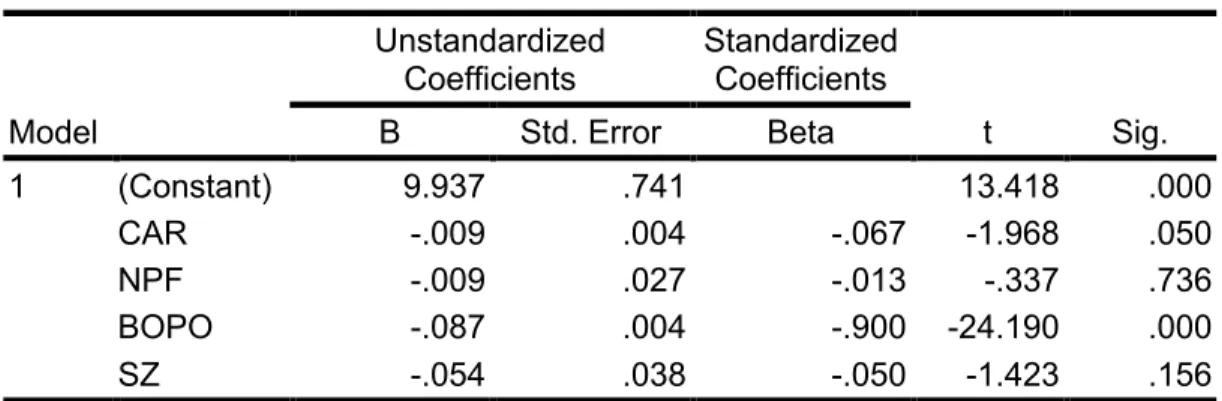
By utilizing multiple regression analysis tools, the results of hypothesis testing which relationship was indicated by the t test with the results of the significance were as in the table below:
62
Table 3. Hypothesis Test Results
Model Unstandardized Coefficients Standardized Coefficients t Sig. B Std. Error Beta 1 (Constant) 9.937 .741 13.418 .000 CAR -.009 .004 -.067 -1.968 .050 NPF -.009 .027 -.013 -.337 .736 BOPO -.087 .004 -.900 -24.190 .000 SZ -.054 .038 -.050 -1.423 .156
a. Dependent Variable : ROA
Source: Processed data
Based on the results of the previous hypothesis test with a significance level of 0.05, it could be concluded that capital risk (CAR) had significant and negative effect on profitability. NPF had no effect. While operational risk (OCOI) had a significant and negative effect on profitability. Furthermore, the company’s size (SZ) had no significant effect on profitability.
Capital Adequacy Ratio (CAR) had a significant and negative effect, meaning that if CAR increased, bank’s profitability would have decreased. This result was likely due to inefficient bank management and banks were unable to raise public funds so it required large capital. This could be seen from the average CAR of Islamic banks which was too high at 17.6% even though the minimum requirement was only 8%. CAR was the amount of capital provided by the bank’s owner, the higher the bank's CAR, the healthier it was, but in operational terms it indicated that the bank was not efficient in managing its capital. Banks needed to do capital management so that the amount of CAR was not too large so as to increase profitability. These results supported the research of Sutrisno (2016), Akhtar et.al (2011) and Syafri (2012) which discovered that CAR had a significant but negative effect on bank’s performance. Likewise, the findings of Ismaulina and Zulfadhli (2016) and Norman et.al (2015) also discovered a significant and negative effect between CAR and profitability.
Credit risk (NPF) had no significant effect on profitability, meaning that the size of the NPF did not affect profitability. In theory, NPF has a negative effect on profitability, howvwer, since the management of Islamic banks could control the NPF, so that the NPF did not affect profitability. This result could be seen in the data that the average Islamic bank’s NPF of 3.49% was still below the minimum requirement. These results supported the research of Yusuf and Suryaatmadja (2018) and Sutrisno (2016) which discovered that there was no significant effect between NPF and profitability of Islamic banks.
63 Operational risk (OCOI) had a significant and negative effect, meaning that the higher the BOPO would reduce profitability. OCOI was a bank’s operational’s expense, so if this variable increased it would have reduced the profits obtained. Therefore, bank’s management must be very careful in managing the bank so that operational costs were not too high. Banks must be able to maintain cost efficiency by reducing unnecessary costs (Ismaulina and Zulfadhli, 2016). These results supported the results of research by Adeyinka (2013) and Ariyani (2010) which discovered that OCOI had a significant and negative effect on profitability. Similar results were also found by Yusuf and Suryaatmadja (2018) and Olalekan Ariyan (2010).
The size of the company (SZ) did not affect the profitability of Islamic banks, meaning that the size of Islamic banks could not be used as a measure of bank’s performance. In theory, the greater the size of the bank, the more potential it has to obtain higher profitability, because the public has more trust in large banks, so that large banks are able to mobilize public funds and channel them better than smaller banks. If the size of the bank did not affect profitability, it meant that Islamic banks had not been able to use the potential size of the bank to get better performance. However, many studies had discovered insignificant effects between bank’s size and bank’s performance. Nouaili et.al (2015) and Srairi (2009) discovered that company’s size had no effect on profitability.
5. CONCLUSION
Based on the hypothesis, the results of hypothesis testing, and discussion, it can be concluded that there are two variables which hypotheses are proven, namely capital risk (CAR) has significant and negative effect, and operational risk (OCOI) has significant and negative effect on profitability. While the two other variables have no significant effect on profitability, namely financing risk (NPF) and company’s size (SZ).
Based on these findings, it is suggested that bank’s management is able to conduct capital management so that it is more efficient and not too large. Furthermore, the bank’s management must also be able to control operational costs so that it can reduce OCOI in order to increase profitability. This research still has many weaknesses, thus other researchers who want to test the factors that affect profitability can add other variables which are not examined in this study.
64
REFERENCE
Akhtar, F., Muhammad, A.K. & S. Shama, 2011. Factors influencing the profitability of islamic bank of Pakistan. International Research Journal of Finance and Economics, 66, pp.125-132.
Ariyani, D., 2010. The effect of CAR, NPL, OEOI and LDR to ROA on commersial bank in Inodnesia. Thesis, Economic Faculty, Universitas Diponegoro, Semarang. Bashir, Abdel-Hameed M,. 2003. Determinants of Profitability in Islamic Banks: Some Evidence from the Middle East. Islamic Economic Studies, Vol. 11(1).
Ismaulina & Zulfadhli, 2016. Effect of Capital Adequacy, Liquidity and Operational Efficiency to Profitability in Bank Syariah Mandiri (Period 2008 s.d. 2015). Jurnal Ilmiah Syari‘ah, Volume 15(1), pp. 43-54.
Noman, A.H., Pervin, S., Chowdhury, M.M & Banna, H,. 2015. The Effect of Credit Risk on the Banking Profitability: A Case on Bangladesh. Global Journal of Management and Business Research.Vol15 (3). 1-9.
Nouaili, M., Abaoub, E., & Ochi, A,. 2015. The Determinants of Banking Performance in Front of Financial Changes: Case of Trade Banks in Tunisia. International Journal of Economics and Financial. Vol 5 (2). 410-417.
Olalekan, A & Adeyinka, S,. 2013. Capital Adequacy and Banks' Profitability: An Empirical Evidence from Nigeria. American International Journal of Contemporary Research. Vol. 3(10), pp. 87-93.
Ruslim, 2012. The effect of capital adequacy ratio (CAR), non performing loan (NPL), and loan to deposit ratio (LDR) to return on asset (ROA) on islamic bank banking in Indonesia. Thesis, Economics and Business Faculty, Universitas Hasanuddin, Makassar.
Srairi, S.A,. 2009. Faccotrs influencing the profitability of conventional and islamic banks in GCC countries. Review of Islamic Economics. 11 (1), pp.5-30.
Sutrisno. 2016. Risk, Efficiency and Performance of Islamic Bank: Emipircal Study on Islamic Bank in Indonesia. Asian Journal of Economic Modelling, Vol 4(1), pp. 47-56
Syafri, 2012. Factors affecting bank profitability in Indonesia, paper: The 2012 International Conference on Business and Management, Thailand.
Yusuf, M & Surjaatmadja, S,. 2018. Analysis of Financial Performance on Profitability with Non-Performance Financing as Variable Moderation (Study at Sharia Commercial Bank in Indonesia Period 2012–2016). International Journal of Economics and Financial Issues, Vol 8(4), pp.126-132.
65 Zeitun, R., 2012. Determinant of islamic and conventional banks performance ini GCC countries using panel data analysis. Global Econony and Finance Journal, 5(1), pp. 53-72.