B
ANKINGR
EFORMS INS
YRIAFaeyzh B
ARHOOM, József V
ARGAKaposvár University, Faculty of Economic Science, H-7400, Kaposvár Guba Sándor utca 40.
ABSTRACT
The Banking Sector plays an important role in the economic development of a country. In developing countries, especially in Syria, the banking sector represents the backbone of the Syrian economy and has been playing an important financial intermediary role since 2003. The Syrian authorities embarked on a reform agenda to develop the financial sector and improve intermediation. A number of laws and regulations have been put in force. This paper seeks to provide an overview of the Syrian banking system reform process through examining and analyzing the financial indicators of the banks in Syria, for the period (2000-2010). This study adopted analytical descriptive method in research based on the analysis of the data annual reports. The study found out that despite the achievements made so far, considerablechallenges remain,including the establishment of indirect monetary instruments, the reduction of the role of the government in credit allocation, and the removal of the large excess liquidity in the banking system and the Syrian money market is still insufficiently developed.
Keywords: Syrian banks, credit, monetary policy, deposits, banking reforms.
INTRODUCTION
Finance and banking are the blood of trade, commerce and industry. Nowadays, the banking sector acts as the backbone of modern business. Development of any country mainly depends on the banking system (Nilesh and Baban, 2014; Joseph, 2014), the performance of banks can be affected by bank specific and macroeconomic factors (Al-Tamimi, 2010; Aburime, 2008). Bank specific factors are individual bank characteristics which affect the bank’s performance, these factors are basically influenced by the internal decisions of management and board (Rao, 2014). On the other hand, macroeconomic variables are country wide factors which are beyond the control of the bank and affect the profitability of banks (Samhan and
Al-Khatib, 2015; Ongore and Kusa, 2013). Dixit (2016) and Aslam et al. (2016) found
that the size, deposits, financing, market share, economic growth and inflation are the factors that are significantly affect on the performance of banks, while (Godlewski, 2006) distinguishes internal and external default factors: excess credit risk and poor corporate governance in banks are the main internal default factors, while macroeconomic factors, market structure, regulatory and institutional environment are external factors. He concluded that in the absence of adequate investment opportunities for banks, mismanagement of companies may create an incentive for managers to try to increase their income by providing loans to high risk borrowers. The strengthening of the financial system supports the prospects for sustainable economic growth (Upadhyay, 2016; Kbiltsetskhlashvili, 2008). Analysis
of the development of commercial banking services in Georgia and other transition countries indicates several features, typical of the start-up phase of financial sector reforms and the main pillars of the success of the reform of the Georgian banking sector is a stable economic policy, as well as the stability of the currency and stimulation of the policy of the central bank, and the development of banks is necessarily driven by monetary reform that creates a credible and independent central regulatory authority. (Aita, 2008) Commercial banks' compliance with prudential regulations is an important stability factor of the banking system.
Supervisory authorities in the financial system monitor financial intermediaries and their risks, and ensure compliance with regulations. Comprehensive risk analysis in the banking system requires the integration of inherent heterogeneity in banks and adaptive behavior in response to shocks and changes in working conditions and the regulatory environment (Chan-Lau, 2017; Chaudhary and Sharma, 2011). The central bank should continue to strengthen prudential supervision of vulnerable commercial banks and take immediate corrective measures to encourage banks to address specific weaknesses. Kozmenko et al. (2016) while Goodlowski (2006) can see that the environment itself can cause increased risk in developing economies and the role of the institutional and regulatory environment as a source of excess credit risk, the risk of default, the excessive risk incentives, as they create them, reduce the existence of the rule of law as a key determinant of effective regulation environment.
The regulator may fail to impose regulatory discipline, as established in the review by Kane (1989) that examined the causes of crisis in the loan industry. Gow
and Swinnen, (2001) assert that weak contract enforcement is a feature of transition
economies, primarily caused by the reforms experienced by enforcement institutions. While, poorly rated banks appear to be providing financial services that are otherwise lacking in the system and therefore central bank interventions must be weighed against possible adverse impacts on the availability of bank credit (Kozmenko et al., 2016). Goodlowski (2006) observed that the regulator’s forbearance consists of non-intervention in a troubled bank, it does not have a preventive or corrective action against a troubled bank. But the regulator rather bails out the troubled bank. As Koford and Miller, (2006) discuss, banks trend to develop in such environments which allow transactions to happen, but which may have undesirable societal consequences. Another aspect of the operation of banking markets is dependence on the legal system. Detragiache et al., (2005) find that the financial sector's performance in low-income countries is influenced negatively by corruption, which raises the cost of doing business and implies uncertainty about property rights while decreasing the efficiency of the system.
The banking sector represents the backbone of the Syrian economy and plays an important financial intermediary role (Al-Jafari and Alchami, 2014), during the last two decades, a great importance was accorded to the reform of laws, decisions and other legislation regulating the banking and financial activities. One of the most important of them is the reinforcement of the banking and the financial sector. The decision to open the Syrian banking sector to private investments in 2001, as part of the government’s policy to move to a social-market economy, came after
decades of the nationalization of private banks in Syria in the 1960s and the ensuing monopoly of state banks over the banking and financial sector.
Between the years 2005 and 2011, Syria witnessed a substantial inflow of foreign capital primarily from the Regional Arab banks of the Gulf countries but the private banks’ capital remained limited and private banks followed a conservative operational and lending approach as in India (Mohan and Ray, 2017) and that is ascertain (Detragiache et al., 2005) that foreign banks are more cautious and these banks have not expanded their activities on a large scale, although they are dynamic and bring modern payment instruments . Thus, the role played by the public sector in the domain of banking services continues to be dominant. Even though they are rigid, insufficiently adapted to the current needs of the sector, and they lack managerial skills and adequate human resources for improving their activity. The banking industry has not yet reached international standards and its contribution to investment financing is also limited. These findings underscore a critical issue that this paper seeks to provide an overview of the Syrian banking system reform process and the challenges facing the Syrian banking and analyses the underlying institutional and systemic barriers that could hinder future progress.
O
VERVIEW OF THES
YRIANF
INANCIALS
ECTORThe decision to open the Syrian banking sector to private investments by a new law in 2001 – Law n. 28 on Banks - , the reform process of existing laws, legislation and decisions in the monetary and financial field continued, as part of the government’s policy to move to a social-market economy, coming after decades of the nationalization of private banks in Syria in the 1960s and the ensuing monopoly of state banks over the banking and financial sector.
The new banking law allows Syrian individuals and institutions to establish 100% privately-owned banks, and allows Arab and foreign individuals and institutions to set up banks with up to a 49% stake, in association with the Syrian private and public sector. A private bank’s capital should not be less than $30 million, and no single individual may own more than 5% of a bank's shares. In 2010, the Syrian government issued law No. 3 amending some articles of law No. 28 of 2001. It increased the level of foreign ownership stake in private banks from 49% to 60% - in an effort to boost foreign investors’ confidence and attract foreign direct investments in the erstwhile fledgling banking and financial sector. The number of working private banks in Syria is 14 banks, 3 of them are Islamic banks. The majority of these banks are correlated with regional banking groups of long experience and history.
The Syrian authorities embarked on a reform agenda to develop the banking sector and improve intermediation. A number of laws and regulations have been put in place. Furthermore, substantive progress towards current account convertibility and exchange rate unification has been made. Moreover, the authorities fully liberalized bank lending rates and rates on foreign currency deposits and loans, but, this interest rate liberalization has not been fully applicable for public banks. Thus, the lack of competition on the market reduces the interest
rate of ability to reflect the real cost of borrowing and the real return of lending, as a result, no equilibrium can be achieved between investments and savings. Overall, banking intermediation has increased substantively, although it remains low by regional standards (IMF, 2010).
Due to several reasons including economic planning and management, the big volume of the public sector, the financial sector has not witnessed any significant growth. Its contribution to the GDP is modest (4%) compared to other countries. This reflects the low level of subsector indicators, credit facilities to private sector constituted about 23% of GDP in 2010, and the financial sector has failed to play its expected role in the economic reform process. The low growth in the financial sector deprives the private sector from necessary development resources. Private sector access to funding is still very limited due to the lack of financing and credit channels and appropriate financial products. This has led to a situation where the public-sector banks accumulate cash surpluses while the private sector resorts to its own resources or to foreign banks, which collect higher interest rates to cover cross-border risk. Saving increases are not interpreted into investment increases due to the inability of the banking sector to turn them into investment through credits. The matter is that it hurts various production areas including the private sector.
The capital adequacy ratio for the consolidated banking sector was reported to be about 20 percent in 2010. Moreover, there is a high level of liquidity in the Syrian economy, as measured by the percentage of currency outside banks in the GDP. In addition, the ratio of domestic credit held by local banks to the GDP indicates that the banking sector has been underperforming since 2003, an ongoing trend in spite of the expansion in private and public banking activities. The average non-performing loans (NPL) ratio is low. However, the NPL of public banks were 6% in 2010, public banks are not allowed to default because the government supports them. In the event of financial trouble, they receive support from the rest of the banking system and from public money.as it happened in case of the support of the industrial bank in 2006.The government also facilitates loans for large projects, especially public sector projects, while lending to small and medium-sized enterprises is very limited, that has negatively impacted the growth process due to the absence of appropriate regulation and the lack of protection against non-repayment; the low levels of financial disclosure on the borrowers’ side makes banks even more reluctant to lend to SMEs. Furthermore, Public companies and state-owned companies do not deal with public banks despite the fact that there is no legislation that prevents them from dealing with private banks. Finally, despite the achievements in banking sector made so far, considerable challenges remain, it suffers from several problems affecting its performance, like other Syrian economic sectors. The most important of these problems are the national economy structure and environment, and the public sector monopoly, as well as, the challenges imposed by increasing competition of the neighboring financial markets.
The banking sector suffers distortion in the distribution of the financial resources by the different economic sectors, which leads to a severe decrease in the rates of savings, investment and production growth. The dominance of cash transactions due to poor and limited banking services results in huge amounts of
cash in circulation. The structure of the liabilities of the Syrian banking sector indicates a high percentage of demand deposits compared to deposits and a high percentage of unclassified debts. Foreign currency assets constitute a high percentage of total assets and high proportion of credits is granted to the public sector. The government finances the deficit through loans from the public banks, which create pressures on the financial resources available for the private sector. In spite of the existing control system over foreign currency, 80% of imports are done through unlicensed currency exchange dealers and through the neighboring markets. The absence of a sovereign credit-related assessment of Syria opens the door for risk exaggeration (IMF, 2010).
PERFORMANCE OF THE SYRIAN BANKING SECTOR (2000-2010)
The performance of the banking sector is more closely linked to the economy than perhaps that of any other sector. In 2010, this sector witnessed satisfactory performance parallel to the improvement in economic activity. The banking activity measured by the consolidated assets of the operating banks increased by 3.5% on the basis of the national currency. Deposits that account for two-thirds of the banks' budgets remain the main driver of activity during 2010, recording a 1.10% increase on the basis of the national currency. And private bank loans also recorded an increase of 2.12%. This growth in loan volumes was notable at a time when the banking sectors around the world declined in the banking activity in light of the reduction of the economic leverage around the world after the global financial crisis, as a result, several reform measures have been introduced in the financial sector since 2000, which helped to improve the financial services sector, which we will now assess by looking at some standards indicators.
Summary balance sheet of the banking system
A consolidated summary balance sheet of the whole banking system is established. Similar components of both (central bank and local banks) balance sheets have been integrated together with items of the same nature in assets and in liabilities and some components have been cancelled in the consolidation.
On asset side we find net foreign assets and various types of credits, net credit to the government, credit to public sector, claims on private sector (Resident) and other domestic assets. The total liability side of the balance is called the broad money (M2). Net foreign assets of commercial banks are usually related to their foreign trade or international finance activity. At the end of 2006, commercial banks accumulated 16.6 billion US dollars and gradually decreased to 13.6 billion (Central Bank of Syria, 2010) US dollars by the end of 2010, and despite this contraction, commercial banks’ net foreign assets still represented 30.04% of total assets in 2010. Table1 shows the second part of banking asset, net credit to the government, which is a relatively minor item in the books of commercial banks. In many countries, commercial banks hold treasury bills. In Syria, however, where such securities did not exist before 2010, the item credits of commercial banks to the government represented 5.1% of total assets. It shows that net credit to the government was negative in 2000.
The third part of banks assets and the most important (after net foreign assets) is credits to the public economy, that is to enterprises from the public. The credits to the public sector grew by 12.15% over the period (2000-2010). These credits represent 28.91% of total assets.
While credits to the private sector (or to cooperatives, households etc.) began to outweigh credits to the public sector from 2005, there was a spectacular growth of credits to the private sector between 2005 and 2010 at an average growth rate of (22.92%).
Table 1
Balance sheet of the Syrian banking system (2000-2010) (%)
The total liability side of the balance is called the monetary base, as it is supposed to determine the entire money supply in the economy and to be the main instrument of control that the central bank may use to monitor this total money supply. The Syrian central bank uses the symbol M0 to denote the monetary base or reserve money. On the liability side there are also three main types of liabilities that represent different forms of means of payments pertaining either to the central bank or to commercial banks. It represents the total money supply available in the country. They are cash money (or currency in circulation outside the banking system), demand deposits and other deposits. Cash is by far the most important part of M1, which reflects the low development of payments through checks and transfers. Until 2003, the share of cash slightly declined, but from 2004 onwards, the share of cash grew strongly. Currency outside banks grew by an average 10.24% per year over the period 2000-2010. Looking more precisely at deposits, there is a distinction between three types of deposits: demand deposits, time and savings deposits and foreign currency deposits.
Demand deposits are broken up into public sector and private sector deposits, together they made up for 44.70% of money supply (M1) in 2000, and 38% in 2010. In Syria, total currency outside banks and demand deposits is called Money supply (M1). Although time deposits and savings deposits increased from 172 billion in 2000 to 668 billion in 2010, this increase will not significantly affect the proportion of time deposits and savings deposits from total deposits. The percentage increased from 29.27% to 32.71% in 2010. But the share of foreign currency deposits (added to import deposits) increased from 7.83% of total labilities in 2000 to15.18% in 2010.There has been a process of substitution of domestic currency deposits with foreign currency deposits, as well as a remarkable increase in imports in the last five years translated into higher flows of foreign exchange, leading to an increase in both import and foreign currency deposits. In addition, the increase in private banking activities prompted importers and depositors to transfer their foreign currency deposits from the black market into formal financial institutions.
Distribution of Deposits at Local Banks
The total amount of bank deposits is still weak in spite of the increase in deposits from 362 billion SY in 2000 to1387 billion SY 2010 due to the improvement of the activities of the banking sector in recent years. Despite the decline in the share of public banks in total deposits since 2004 due to the emerging private sector, following reforms that gave private activities a larger role, public banks still maintain their first rank in terms of total deposits, and they are relatively wide-spread, compared to private banks in addition to the adoption of public institutions in the settlement of more than reliance on private banking transactions. (Figure 1) show that the market share of public banks reached the equivalent of 67.06% of total deposits in 2010, while private banks have total deposits of about 540 billion Syrian pounds, which is equivalent to 32.04% of the total market share of total bank deposits, out of which about 5% is of Islamic banks. Commercial Bank of Syria has got first rank in terms of the volume of deposits, followed by Real Estate Bank.
Figure 1
Deposits of public and private banks (2000-2010)
Source: Based on Central Bank data http://www.banquecentrale.gov.sy/main-eg.htm Regarding the structural distribution of deposits, savings and demand deposits have a high percentage of total deposits. The relative share of demand deposits and savings reached approximately 91.83% in 2000 and gradually it decreased to reach about 57% in the last three years as a result of an increase in the proportion of long-term time deposits from 1.75% in 2000 to 27.2% in 2010 and foreign exchange deposits from 6.42% to14.6% (as we see in Table 2), over the same period due to the reasons mentioned above.
Table 2
Distribution of deposits at local banks
Year 2000 2001 2002 2003 2004 2005 2006 2007 2008 2009 2010
46.3% 41.2% 42.2% 43.8% 41.9% 43.2% 34.9% 35.4% 34.9% 36.3% 38.0% 45.6% 46.1% 45.8% 48.5% 45.7% 37.0% 29.5% 25.5% 22.0% 21.0% 20.2% 1.7% 1.5% 1.3% 1.3% 2.8% 6.7% 16.1% 19.0% 22.9% 26.4% 27.2% 6.4% 11.1% 10.8% 6.4% 9.6% 13.1% 19.4% 20.2% 20.1% 16.4% 14.6% Source: Based on Central Bank data http://www.banquecentrale.gov.sy/main-eg.htm
Distribution of Local Banks Credit
There is a high level of liquidity in the Syrian economy, as measured by the percentage of currency outside banks in the GDP, it increased from 22.5% in 2000 to reach 26.5% in 2003 and then fell gradually to reach 20.1% in 2010. In addition, the ratio of domestic credit held by local banks to the GDP 26.2% in 2000, but from 2004 onwards it was increasing towards 49% in 2010, which was still weak compared to the neighboring countries, which is evidence of a very low lending activity from commercial banks in spite of the expansion in private and public banking activities.
Table 3 shows that despite the low credit to the government during (2000-2010),
the share of non-financial public enterprises is still very high, and received more than 50% of total credits with limited growth in the credits provided to the private sector (included cooperatives, households etc.). The credit facilities are not distributed according to a clear development vision. For example, the share of wholesale and retail trade in local bank credit remains the largest, more than 47% of such resources, in spite of its marked declining trend. By contrast, the share of mining and manufacturing is the lowest, yet increasing. This might be a good indicator of the improvement in credit allocation by local banks, as local banks seem to diversify their portfolio loans in order to minimize default and insolvency risks. So doing, they provide credit to different economic sectors, which ultimately makes growth stronger. With this the level of private credit remains below the levels required to support private sector contribution in the Syrian economy, in particular SMEs.
Table 3
Distribution of Local Banks Credit
Year 2000 2001 2002 2003 2004 2005 2006 2007 2008 2009 2010
-11.6% 3.8% 15.8% 14.4% 17.6% 23.3% 22.6% 14.4% 4.9% 6.3% 7.9% 32.4% 28.1% 28.8% 32.6% 36.9% 40.5% 40.1% 41.3% 42.6% 45.1% 47.3% 79.2% 68.1% 55.4% 53.0% 45.5% 36.2% 37.3% 44.4% 52.5% 48.5% 44.9% 26.2% 29.0% 28.5% 31.2% 31.6% 36.5% 37.3% 36.6% 37.4% 43.5% 49.0% Source: Based on Central Bank data http://www.banquecentrale.gov.sy/main-eg.htm
Financial intermediation
Table 4 shows ratios of financial indicators that are commonly used to assess the
degree of financial intermediation of an economy, measuring the size of the financial sector’s components relative to each other and to the whole financial system. We can also see from the same table that the ratio of deposit money bank assets to total assets in 2000-2009 was lower than the central bank assets ratio, but
in 2010 it became higher it. This might be considered as an indicator of financial reforms and financial liberalization, as it reflects weak banking activity.
Table 4
Ratios of financial intermediation indicators.
Source: Based on Central Bank data http://www.banquecentrale.gov.sy/main-eg.htm The second set of indicators that measure the importance of the financial sector’s components in the economy is based on their ratio to the GDP. We see from the table above that the ratio of central bank assets/GDP was volatile during the first three years, but after the start of economic and financial reforms, it declined gradually from 80% in 2003 to 47.5% in 2010, this might be considered a good indicator. Another indicator is the percentage of deposits of GDP, which fell from 58% in 2003 to 44% in 2008 and then increased to 47.5% in 2010, which was still weak compared to the neighbouring countries.
Also, the ratio of credit to non-financial public enterprise sector/GDP is one of the commonly used indicators of financial intermediation, this ratio measures the financial resources directed to the non-financial public enterprise sector by deposit money banks, which took a declining trend starting at 21% in 2000 to reach 13% in 2005 and then it returned to rise to 22% in 2010,and this is a good indication of interest in economic institutions which are the driving force of growth in developing countries, as well as the ratio of private credit by deposit money banks regarding GDP. This indicator measures the financial resources directed to the private sector by deposit money banks; as such, it reflects the accessibility of credit to the private sector, which is a major source of productive investment in developed economies. We also note that this indicator increased significantly during the period (2000-2010). This indicates an increase in interest in the private sector and reliance on it as one of the main sectors of the Syrian economy. This means
that the economy is moving in the right direction as long as the credit is used to finance production projects.
The size of public and private banks
In spite of the increase in private banking activities over the recent years, public banks withhold the biggest leverage over the banking industry in Syria. For instance, according to central bank statistics, the total number of branches of operating banks in Syria was 513 branches in 2010, the number of private bank branches reached 208, compared to the number of public bank branches 305 at the same time. However, banks worked to extend their networks, to cover more cities and to open new branches. But, when the Syrian crisis started everything stopped.
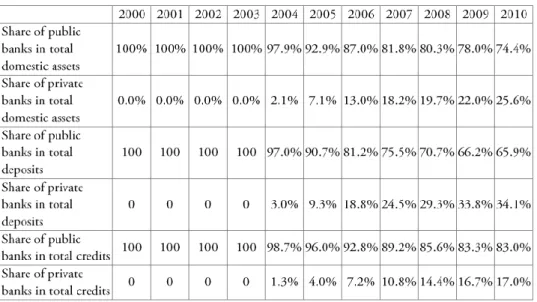
Table 5 shows also that the share of public banks in total assets is much higher
than the share of private banks. But this percentage has been decreasing since 2005 and this is a good indicator. In addition, the share of public banks in deposits and loans is also significantly higher than the share of the private sector. Nevertheless, it seems that the share of the private sector is increasing, which reflects the growing role of private banks in the Syrian banking system and the overall improvement of the country’s financial system.
Table 5
The share of banks in totals assets
Source: Based on Central Bank data http://www.banquecentrale.gov.sy/main-eg.htm
CONCLUSION
After four decades of a government monopoly on banking, the sector was liberated, a great importance has been attributed to the reform of laws, decisions and other legislations regulating the banking and financial activities, and banking services
improved in general. However, the capital of private banks remained limited and these banks have not expanded their activities on a large scale. The Syrian money market is still insufficiently developed; consequently, the Syrian banking sector has many challenges, the central bank of Syria lacks effective monetary policy tools and independence. Hence, the study recommends that it is important to develop indirect monetary policy instruments and to liberalize interest rates further, to facilitate the securitization of Islamic banking assets, to reduce reliable financial soundness indicators for banks, and to restructure the public banks strengthening bank supervision to calculate capital adequacy measures to develop the HRM function, to develop systemic liquidity management by creating money and foreign exchange instruments and markets, and issue Islamic bonds by the government to enhance the development process.
REFERENCES
Aburime, U.T. (2008): Determinants of Bank Profitability: Company-Level Evidence from Nigeria. [online] <URL: https://ssrn.com/abstract=1106825> Aita, S. (2008): The Political Economy of the Banking Sector in Syria. The Conference on Economic Reforms in Syria. Damas. [online] <URL: http:// www.economistes-arabes.org/fr/wp-content/uploads/2016/10/aita_banking_ politicaleconomy-new.pdf>
Al-Jafari, M.K., Alchami, M. (2014): Determinants of Bank Profitability: Evidence from Syria. In: Journal of Applied Finance & Banking, 4. 1. 17-45 p.
Al-Tamimi, H.A. (2010): Factors Influencing performance of the UAE Islamic and Conventional National Banks. In: Global Journal of Business Research, 4. 2. 1-9. p. Aslam, M.K., Inamullah, Ismail, M. (2016): Determinants Affecting the Profitability
of Islamic Banks: Evidence from Pakistan. In: International Journal of Operations and Logistics Management, 5. 2. 115-127. p.
Central Bank of Syria (2010): Quarterly Statistical Bulletins. [online] <URL: http:// www.banquecentrale.gov.sy/reports/Q-bulletin/Q-bulletin 2010 1-2-3-4.pdf> Chan-Lau J.A. (2017): ABBA: An Agent-Based Model of the Banking System.
International Monetary Fund Working Paper No. 17/136 32. p. [online] <URL: https://www.imf.org/~/media/Files/Publications/WP/2017/wp17136.ashx> Chaudhary, K., Sharma, M. (2011): Performance of Indian Public Sector Banks and Private. In: International Journal of Innovation, Management and Technology, 2. 3. 249-256. p.
Detragiache, E., Gupta, P., Tressel, T. (2005): Finance in Lower-Income Countries: An Empirical Exploration. International Monetary Fund Working Paper No. 05/167 48. p. [online] <URL: https://www.imf.org/external/pubs/ft/wp/2005/ wp05167.pdf>
Dixit, D. (2016): Performance Analysis of Private Sector and Public-Sector Banks with Reference of ICICI Bank and State Bank of India. In: International Journal of Applied Research, 2. 9. 443-449. p.
Godlewski, C. (2006): Regulatory and Institutional Determinants of Credit Risk Taking and a Bank’s Default in Emerging Market Economies: A Two-Step Approach. In: Journal of Emerging Market Finance, 5. 2. 183–206. p.
Gow, H., Swinnen, J. (2001): Private Enforcement Capital and Contract Enforcement in Transition Economies. In: American Journal of Agricultural Economics. 83. 3. 686-690. p.
International Monetary Fund (IMF) (2010): Syrian Arab Republic: 2009 Article IV Consultation. IMF Country Report No. 10/86 40. p. [online] <URL: https://www.imf.org/external/pubs/ft/scr/2010/cr1086.pdf>
Joseph, A.L. (2014): A Study on Analyzing the Trend of NPA Level in Private Sector Banks and public-Sector Banks. In: International Journal of Scientific and Research Publications, 4. 7. 1-9. p.
Kane, E.J. (1989): The S&L Insurance Mess: How Did It Happen. Washington DC: Urban Institute Press, ISBN-13: 978-0877664697 200. p.
Kbiltsetskhlashvili, T. (2008): Development of the Banking System in Georgia. In: IBSU Scientific Journal, 2. 1. 45-65. p.
Koford, K., Miller, J. (2006): Contract Enforcement in the Early Transition of an Unstable. In: Economic Systems. 30. 1. 1-23. p.
Kozmenko, S., Shkolnyk, I., Bukhtiarova, A. (2016): Dynamics patterns of banks evaluations on the basis of Kohonen selforganizing maps. In: Banks and Bank Systems (open-access), 11. 4. 179-192. p.
Mohan, R., Ray P. (2017): Indian Financial Sector : Structure, Trends and Turns. International Monetary Fund Working Paper No. 17/7 35. p. [online] <URL: https://www.imf.org/~/media/Files/Publications/WP/wp1707.ashx> Nilesh, L., Baban, M. (2014): A Study Banking Sector in India and Overview of
Performance of India. In: Review of Research 3. 6. 56-65. p.
Ongore, V.O., Kusa, G.B. (2013): Determinants of Financial. Performance of Commercial Banks in Kenya. In: International Journal of Economics and Financial Issues, 3. 1. 237-252. p.
Rao, K.M. (2014): An analysis on the performance of private and public-sector banking. In: International Journal of Business and Administration Research Review, 2. 5. 104-109. p.
Samhan, H.M., Al-Khatib, A.Y. (2015): Determinants of Financial Performance of Jordan Islamic Bank. In: Research Journal of Finance and Accounting. 6. 8. 37-48. p.
Upadhyay, S.M. (2016): A Comparative Study of Performance of Largest Public Sector and Private. In: International Journal of Research in IT and Management, 6. 4. 95-100. p.
Corresponding author:
Faeyzh BARHOOM
Kaposvár University, Faculty of Economic Science H-7400 Kaposvár Guba S. u. 40.