Lodge
Leadership
Development
Planning
LODGE LEADERSHIP DEVELOPMENT
PLANNING GUIDE
ORDER OF THE ARROW
BOY SCOUTS OF AMERICA
TABLE OF CONTENTS
I. PREFACE ... 5
II. THE LODGE LEADERSHIP DEVELOPMENT COMMITTEE... 6
Section 1: Forming the LLD Committee ... 6
Section 2: Training the Committee... 7
Section 3: Year-Round Lodge Training Plan... 7
A. What elements should be included in a training plan or schedule? ... 7
B. How can training be incorporated into already-existing lodge programs? ... 7
C. How much training is too much training? ... 7
III. THE LODGE LEADERSHIP DEVELOPMENT EVENT ... 8
Section 1: Getting Started ... 8
A. Establishing a Date... 8
B. Brainstorming: “Asking the Right Questions”... 8
C. Establishing the Vision ... 8
Section 2: Establishing the Plan ... 8
A. Communicating with the Key 3 ... 8
B. Planning the Curriculum ... 8
C. Scheduling... 9
D. Facility and Logistical Needs ... 9
E. Training Needs ... 10
F. Recognizing Resources ... 10
G. Backdating... 11
Section 3: Recruiting, Selecting, and Training the Staff... 11
A. Trainers and Support Staff... 11
B. Additional Staff Responsibilities ... 12
C. Staff Attitude ... 13
D. Learning Techniques ... 13
E. Support Staff... 14
F. Staff Preparation ... 14
Section 4: Incorporating Lodge Personality ... 15
Section 5: Promotion, Evaluation, and Recognition ... 16
A. Promotion... 16
B. Evaluation ... 16
C. Recognition... 16
I. PREFACE
The following is a guide to assist the Lodge Leadership Development committee in the process of planning the Lodge Leadership Development Event. This guide directly accompanies the LLD program, and serves as a model to organize a lodge’s event. Section III of this guide explains the tools needed to successfully plan and conduct the Lodge Leadership Development event for the lodge leadership for that year; the LLD website provides all the same resources while encouraging year-round training using those materials. This guide also is specific to the planning of LLD and the creation of an LLD committee. LLD will change with time, and with these changes include an update in the philosophy of the program. The program is typically changed to coincide with changes in the Order. The LLD topics might be the same but the focus and emphasis on specific areas may be drastically different than in previous versions. Before beginning the planning process it is important that you are familiar with all aspects of the LLD program; although the guide will walk you through parts of the program, it does not cover everything. This guide serves as a resource to allow you to deliver a top quality LLD event as well as tailor the program to the needs of your lodge leaders.
To address your questions or concerns and to access the most up to date content please refer to the LLD website at http://lld.oa-bsa.org.
II. THE LODGE LEADERSHIP DEVELOPMENT COMMITTEE
The LLD committee is essential to initiate the planning process for the Lodge Leadership Development event. The LLD committee reports to the lodge chief. The committee should be in place to offer year-round training opportunities that stem from the annual Lodge Leadership Development event. Committee members should understand that although they are year-round trainers, the annual LLD event should be held as the highlight of the lodge’s training activities.
The LLD committee should serve as the key staff members for the LLD event, subsequently planning and executing all aspects of the event. In a later section the formation and structure of the LLD staff will be discussed. For those lodges that may not have the LLD committee in place, it is essential that this committee is established first.
Section 1: Forming the LLD Committee
The LLD committee is an operating committee within the lodge that reports directly to the lodge chief. The committee chair should be appointed by the lodge chief; an adviser should be appointed by the lodge adviser. The chair should be a youth member with thorough knowledge of the LLD program as well as the fundamentals of leadership development. The chair and adviser should have completed the program previously, and possess strong training, planning, and leadership skills. A commitment to providing a progressive, high quality year round lodge training program should be among the characteristics of the committee leadership.
1) The committee should consist of active experienced youth and adult members who fit into one or more of the following categories.
A) Past lodge or chapter officer/adviser B) Experienced, innovative, OA trainer C) Successful completion of the LLD program
2) The committee size can vary, and should be left to the discretion of the chair. However, the chair should strive to maintain a well-balanced committee, whose composition reflects that of the lodge membership.
3) The committee should be organized so that each member has a specific area of responsibility. The following is a suggested way to organize the committee for the purpose of conducting the LLD event. Depending on the size of your LLD event, one person may be responsible for the more than one area.
A) Training coordinator – Recruits all trainers, identifies training topics, and acquires training aids and resources.
B) Logistics – Secures physical needs for the event, such as location, equipment, housing, food, etc. C) Communication – Responsible for all promotion, correspondence with participants and staff,
registration needs, etc.
D) Evaluator – Conducts the assessment surveys and assimilates syllabi via the LLD event designer program online; conducts evaluation process with the assistance of the training coordinator. E) Secretary – Keeps notes of committee meetings; assists with promotion and registration. F) Treasurer – Develops and manages the committee budget.
Section 2: Training the Committee
The chair should familiarize the committee members with the goals and purposes of the LLD—improving year-round lodge training programs. The chair and his adviser should then introduce the committee to all components of the LLD. This could include a mock assessment, a review of the website features, a keyword search, a review of available training syllabi and training support documents, etc. After gaining a complete understanding of the program, cooperative effort should begin between the LLD committee and the Lodge Executive Committee (LEC) to establish goals and direction for all training within the lodge. Members of the committee should learn to become proficient trainers using the available resources.
Section 3: Year-Round Lodge Training Plan
The Lodge Leadership Development committee should be responsible for planning and coordinating all lodge training activities. The committee must ensure that the lodge’s training needs are met through multiple, fresh, and innovative training opportunities throughout the year.
One of the most important keys to providing a successful year-round training program is creating a plan. Training is most effective when it coincides with normal events and functions already put on by the lodge. Integrating training as part of your annual program is the best way to do this—not only can people expect some form of leadership development or knowledge-based training whenever they attend certain lodge functions, but they also come to appreciate training as a normal occurrence.
No matter how obvious it may seem, opportunities to advance lodge members’ knowledge about various aspects of the Order come often. In fact, nearly every event that requires advance preparation also requires some degree of skill and planning. This skill does not come naturally for everyone, but rather, is learned through experience, training, and leadership growth. It is the role of the lodge to provide
opportunity for leaders to grow so that they will be prepared to lead in their own servant roles.
The Lodge Leadership Development operating committee should establish its plan for year-round training as part of the lodge’s annual planning process. This is an ideal time to meet with other lodge leaders about the various programs that will be put on throughout the year, and to discuss expectations in terms of the lodge’s goals toward providing quality training opportunities to its members.
A. What elements should be included in a training plan or schedule?
Almost every operation of the lodge can be incorporated with some degree of training. Most topics already have training syllabi and resources related to them, making it easy to provide such opportunities. Any topic with training resources can and should be included in a lodge’s year-round training plan.
B. How can training be incorporated into already-existing lodge programs?
For example, suppose unit election season is approaching. Your lodge chief recommends that unit leaders be contacted next month about having the OA visit them. However, also suppose that your lodge leaders are young and may have little or no experience ever planning and conducting unit visitations, other than their own. This would be the perfect opportunity to offer a training session to your lodge leaders about how to plan and conduct a unit visitation. This could easily be done as part of an LEC meeting or at a lodge fellowship or service event. And perhaps an invitation to this meeting or event could be given to those who will likely be conducting the unit elections, besides just the key LEC members.
C. How much training is too much training?
It might seem that training opportunities are everywhere. But in reality, this is only true for the Arrowman who is highly active and likely already has ample experience. The average Arrowman seeks to provide service to Scouting, but doesn’t necessarily make it to all the events that key lodge leaders attend. But that does not discount the fact that training opportunities should be offered to those individuals so that they can also grow as leaders and gain the skills necessary to perform their servant roles, too. Offering more training might mean attendance is lower, but overall there are more opportunities.
III. THE LODGE LEADERSHIP DEVELOPMENT EVENT
Section 1: Getting Started
With the LLD committee in place, the members are expected to serve as the LLD event key staff. Other Arrowmen may be recruited to fill any additional roles during the event that may not necessarily be used at other training events (i.e., the evaluator). The following steps outline the process that key staff members should take to get the LLD event started in the right direction.
A. Establishing a Date
The date of the Lodge Leadership Development event should be determined by the LLD Committee and the Lodge Executive Committee. Once the lodge has established a date for the LLD event, it should remain a permanent fixture of the lodge and council calendar. This will make it easier for the lodge to plan LLD for the future. By this date the lodge’s entire leadership team should be assembled by the new lodge chief and the lodge adviser. The LLD committee chair appointment may come at a different time in order to accommodate advance planning for the LLD event.
In lodges where several months elapse between officer elections and installation, the entire executive committee is in place at the beginning of the new officers’ term of office. In these instances the training can be scheduled towards the end of the transition period. In lodges where the newly elected officers begin their terms immediately, the event should be held within a month of the election. The new chief needs to make key appointments right away. It is pertinent that all lodge leaders participate in the LLD event.
B. Brainstorming: “Asking the Right Questions”
After the key staff has been formed, an initial brainstorming session should be held. During this session the chairman should encourage a free flow of ideas as well as encourage each committee member to establish their own individual goals for LLD. This is where the committee should consider possible ways of executing the event, possible trainers, recognizing resources, promotion ideas, etc.
C. Establishing the Vision
After the initial brainstorming session, the goals and ideas should be prioritized and condensed in to one statement that governs the execution of the LLD event. Your plan should include a statement of what will be accomplished during the event. Be sure the committee shares the same vision and that all of its goals properly support that vision.
Section 2: Establishing the Plan
A. Communicating with the Key 3
After initial brainstorming has taken place by the committee, those ideas must be shared with the lodge Key 3. The Key 3 will assist in prioritizing the goals set by the LLD committee in hopes to create an LLD event that meets the needs of the lodge. They will work more closely with the committee throughout the remainder of the planning process.
B. Planning the Curriculum
Step 1: Before beginning this process it is recommended that the evaluator have some indication as to the composition of the intended audience for the individual sessions. For example, are your lodge leaders very experienced or are they brand new? Does your lodge have an extensive history or is it a newly formed lodge? The LLD event designer program will ask similar questions in order to generate a recommended list of training topics that are appropriate for your LLD program. This is a good time for the evaluator to collaborate with other members of the key staff.
Step 2: Conduct the Assessment – In order to conduct the assessment, access the event design program by following the steps listed below. These steps are also included on the LLD website
(http://lld.oa-bsa.org).
Start this process by clicking the “Design LLD Event” button on the LLD homepage. 1) Print Assessment Questionnaires
2) Enter Lodge Key 3 Assessment
3) Enter General Membership Assessment 4) Review Assessment Results
5) Begin Forming Your LLD Event
Note: Lodge Key 3 and General Membership Assessment Questionnaires are to be completed at an LEC meeting or an event prior to LLD.
Step 3: Once the list of recommended training sessions has been produced you then select ability levels for each training session. Several of the LLD sessions have more than one ability level; they are
considered beginner, immediate, and advanced. Often each level is a continuation of the previous session therefore it is up to the evaluator and the training coordinator to determine which ability levels are most appropriate for the target audience given the specific topic at hand.
If you wish to train specific sessions that are not included in the computer-generated recommended training list, you may request specific sessions or topics by conducting a keyword search on the website. The LLD event designer program will generate several sessions that may be directly or indirectly related to the topic.
C. Scheduling
During the assessment, one of the main questions that should have been answered is: “How long will the training event be?” Will it be a one-day workshop or a weekend conference? The schedule will be determined by the evaluator after consulting with the key staff. When working through the online system, various syllabi and other options are pulled together to create a model schedule. If your lodge conducts special events or activities during LLD events, the key staff should keep that in mind when creating the final schedule.
Your lodge may want to include planning time for officers and advisers, giving the new officers a chance to brainstorm and set goals for the upcoming year. Perhaps the first LEC meeting could follow the training sessions. Remember other activities must be related to the central purpose of LLD training. The event should also not be coupled with another lodge event, or training activity.
D. Facility and Logistical Needs
When choosing a facility for the LLD event you must consider several factors. How many people are being accommodated? What type of financial resources are available? What is the council and lodge policy regarding training events or facilities usage? You should also consider the preferences of the lodge Key 3, and the LEC members as well.
Make certain that the facility can adequately support the training event. Carefully examine all training rooms and equipment; make sure there is an understanding as to what can and cannot be used or brought into a facility. The facility must be able to support your number of participants, the needs of the trainers, and the needs of the programs. Training rooms should be equipped with a sufficient number of electrical outlets for audio-visual equipment. Rooms should be well lit, comfortable, and functional.
Logistical needs will vary from lodge to lodge, however these areas should require the following considerations:
1) Sleeping Quarters – There should be sufficient housing, toilet, and shower facilities to accommodate all staff and participants. Make sure separate facilities are established for youth and adults, and proper arrangements are made for female members.
2) Food Service – All meals should be served in a room other than the meeting room, preferably in close proximity to the meeting space. Eating areas should be large enough to seat all attendees at one time and not in shifts. This room should also be available for cracker-barrels and snacks.
Beverages, water, and light refreshments should be easily available at consistent times during the event.
3) Parking – Parking should be of sufficient quantity in a safe location reasonably close to the sleeping facilities.
4) Meeting Space – The meeting room should be within walking distance of the eating and sleeping facilities and large enough to hold enough tables and chairs to accommodate the size of your group and all training equipment. Sufficient wall space should be available for posters, comment boards, and promotion material.
Training equipment should include but is not limited to: ! 1 supply table
! 1 small presentation table for presenter notes or LCD projector ! 2-3 other tables for resources/library material
! 1-2 easels
! Surge protectors and extension cords for any audio-visual needs that presenters may use ! TV/VCR/DVD large enough for easy viewing by all participants
! Laptop with LCD projector
! A source for printing, or making copies can be helpful as well
5) Staff Staging Area – A small room near the main meeting room where materials can be spread out for the various sessions or storage, etc. Staff can also use this to prep for upcoming sessions and to hold staff briefings as needed.
E. Training Needs
Notebooks, paper, and pens for taking notes during the event should be provided for all participants. The notebook can include sections for additional resources--lodge resources, job descriptions, and
promotional items. If you do not intend to provide these items for your participants or trainers, be sure to inform them in advance.
Inform all trainers as to what support materials will be provided for them. It would be beneficial to request that trainers ask for additional support items or equipment needs well before the training event.
F. Recognizing Resources
Resources are those people or items needed to support the LLD program. These could include but are not limited to: trainers, training equipment, contact people, physical materials, etc. Your initial resources include this guide, the LLD website, and your lodge. Secondly, any publication provided by the LLD
program, the National Order of the Arrow Leadership Development Committee, your region, section, and lodge training committee, all of which are easily accessible.
Note: Reference material can also be found under the “Planning Support” section of the LLD website.
Your committee is your next resource. Each staff member has a few immediate resources that they can use which include the council, the LEC, the participants, the committee members, the budget provided by the lodge to the committee, etc. The key to recognizing resources is to use that which is available first and then ask around for other resources.
When considering needs that must be met, it is a good idea to create a needs list and resources to consider for each need.
G. Backdating
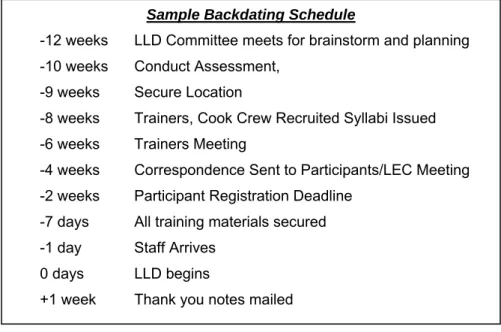
Backdating is the process by which a timeline is created to achieve the objectives of the plan. The plan is mapped out in a logical process that can be easily followed. It should be flexible and should be modified to meet individual lodge needs. The plan that allows the committee members to ensure every aspect of the training session is prepared properly. The backdating includes deadlines for all training, logistics, and correspondence to participants and staff. It includes the specific tasks that must be performed, when they should be completed, and resources needed to support those tasks. The backdating schedule is
established by the LLD chair and distributed towards the end of the initial brainstorming session.
Figure 1. Sample Backdating Schedule
Section 3: Recruiting, Selecting, and Training the Staff
The Lodge Leadership Development staff brings the program to life. The staff demographics will depend on the number of participants that will be in attendance, the number of training sessions that will be conducted, and the amount and type of resources that are available to you.
A. Trainers and Support Staff
Having an excellent training staff is crucial to the success of LLD. It is best that you have a diverse group of trainers with various training experiences and expertise. The training coordinator should be in charge of recruiting and preparing all trainers, including those who may serve as key staff members. Consider your audience when recruiting trainers as well. Does your audience require a more mature tone for the
Sample Backdating Schedule
-12 weeks LLD Committee meets for brainstorm and planning -10 weeks Conduct Assessment,
-9 weeks Secure Location
-8 weeks Trainers, Cook Crew Recruited Syllabi Issued -6 weeks Trainers Meeting
-4 weeks Correspondence Sent to Participants/LEC Meeting -2 weeks Participant Registration Deadline
-7 days All training materials secured -1 day Staff Arrives
0 days LLD begins
training session or would younger trainers work better? Make sure the training staff is composed of a mix of youth and adults to add a variety of perspectives from all age groups. Whenever possible, you should feature the youth trainers, who are advised and coached by the adult staff. Does your lodge have the training personnel available to support your event? If not, you should seek trainers in neighboring lodges, or through the resources of the section.
All trainers must understand the vision and purpose of LLD, and should be committed to maintaining these tenets throughout the event. Since the syllabi are available for them, try to match the
characteristics of the trainer with the topic and the method of execution for the training session. Each session syllabus has developed a brief description of the type of trainer to be recruited to present that session. The LLD sessions convey a specific message in a well planned and executed manner. If the trainers desire to change the delivery method of the session, make sure they convey the same material and offer the same focus of the session.
The size of the staff depends more on the available resources than on the number of lodge leaders to be trained. A team of five to ten staff members lightens the load on everyone and keeps fresh faces before the learners. There are some general characteristics to look for as you select your staff.
Staff members should have:
! Successful experience as a trainer. ! Successful service as a lodge leader.
! No significant leadership role in the coming year. Use past lodge officers who no longer play a day-to-day role in the lodge. Add the Arrowmen who attended the National Leadership Seminar. Age should not be a barrier; look for your resources, often past officers can be recruited to help present sessions.
The Key 3 helps organize the event, but both the chief and adviser should do little or no training in it. The reason is simple: the adviser’s goal is to help the lodge chief build the lodge leadership team. Thus the incoming chief, officers, and chairmen must be participants. If the incoming chief has been to the event before, he may be unhappy as a participant, but he can emphasize the importance of the event to his peers, as a participant sitting at a table with his new leadership team. There will be two opportunities for the chief to be in front of the group. The opening session and the closing sessions are designed such that the lodge chief may be included. These two sessions will give the new chief a dynamic opportunity to begin to build his team. The lodge chief is responsible for making sure the event happens, but does not have to be an actual trainer to be involved. He can introduce each trainer and help with transitions from one session to the next.
B. Additional Staff Responsibilities
The staff also has additional responsibilities when not teaching or leading a session. These responsibilities should include:
! To set the example for appropriate behavior (and therefore help to control behavior) ! To set an example for active participation and note-taking
! To help stimulate discussions and involvement of all participants at the tables ! To help reinforce learning points when necessary or appropriate
! To help establish friendships among participants in the true spirit of Brotherhood
! To help relate discussions of earlier sessions in subsequent sessions, which they themselves may have responsibility to present
! Prepare the physical arrangements for the next session
The layout of the training room should give everyone in the event an assigned seat which eliminates a staff or lodge officer table in the back of the training room. Remember that the participants learn from you and your staff all the time by example. They are snap-shooting everything you and your staff does. You are constantly “on stage.” Make it a good performance; keep things new every time. Staff that may need preparation time for an upcoming session should be encouraged to leave and return to the training room during breaks rather than during the sessions themselves. This disruption can be kept to a minimum.
C. Staff Attitude
Staff members are “on stage” throughout the event from the time the first participant arrives until the last one departs for home. This will require a high-energy commitment from the staff. In many ways it is like “theater;” staff members are all “acting” in their roles as trainers, helping the new lodge leadership discover their new role in the betterment of the lodge. Staff conveys a unique and fun attitude that is critical to the success of the event.
By their actions, staff must walk the talk of the event and convey a sense of excitement about the joy and fun of exploring how to be better lodge leaders. The event is but one step in the process of evolving and becoming a better lodge officer. Staff needs to work to keep all participants actively involved in the process. If the staff is having fun and learning new things about the lodge, the new lodge officers are more likely to have fun and learn things too. It is this show, this attitude, this approach that helps make the event work.
D. Learning Techniques
A number of different learning techniques are employed in the training in order to keep energy levels high. These include group/table discussions and reporting out, group challenge projects, games, and visual application learning techniques (role-plays, audio-visuals). While lecture presentation formats are necessary, they have been kept to a minimum. Debriefings following experiential activities often work well to cover learning points. There are opportunities for all of the trainers to be creative in the method of presentation.
Using Visual Aids
Visual aids allow some of the easiest and most effective methods of enhancing your presentation because:
! Visual aids make you more persuasive.
The Wharton School at the University of Pennsylvania found that presenters using visuals
conduct meetings in 28 percent less time, increase audience retention as much as five times, and get proposals approved twice as often.
! People can grasp more information.
A recent study at Harvard University showed that people comprehend about seven percent of information delivered verbally. They comprehend 87 percent when the information is delivered both verbally and visually.
! Visual aids add variety and emphasis to your presentation. ! Your message is presented both orally and visually.
Some people process information best orally (by hearing it); others process it best visually (by seeing it). When you use visual aids with a presentation, you communicate with both types of people.
! Visuals help organize your presentation.
! Visuals help you to be concise.
When you plan visuals, you are forced to distill your ideas down to their essence.
! Visuals can help to facilitate meetings.
A chart or graphic on a flipchart, for example, can capture individual and collective thoughts in a dynamic way.
If additional visual tools are used to make the session better, a few rules should be followed in developing your visual training aids.
Namely, use visual aids to: ! Clarify a point. ! Emphasize a point. ! Add variety. ! Change focus.
! Record the main points of a meeting or presentation. ! Enhance your professional image.
! Mark off your presentation as special. Avoid using visual aids when:
! They distract or detract from the focus of your presentation. ! They are of poor quality.
! They are irrelevant (even though it is interesting). ! They are solely a time-filler.
! They are outdated.
! They do not suit your purpose. ! They do not fit your audience.
E. Support Staff
A support staff can be helpful in the execution of the LLD event especially if it is a weekend event or if you must accommodate large numbers. The support staff serves under the leadership of the logistics and communication key staff. The support staff consists of the cook crew, registration team, promotions team, logistics team, and back-up trainers.
The support staff can also be reserved for those “trainers-in-training,” and are able to benefit from the LLD program. They may also include your younger Arrowmen who do not hold a specific position but are your up and coming lodge members that demonstrate the potential to rise to future leadership positions.
F. Staff Preparation
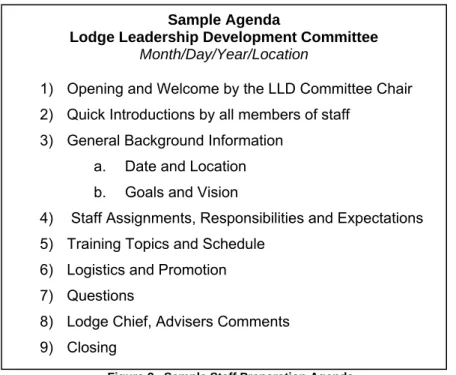
It is recommended to conduct a planning staff meeting about six weeks prior to the Lodge Leadership Development event. This can be before a Lodge Executive Committee meeting, in advance of a lodge event, or even before a chapter event, so long as all of your Lodge Leadership Development event staff is present. The LLD committee chair, with the support of the lodge chief, should run this meeting.
The following diagram is an example of a sample agenda for the Lodge Leadership Development committee meeting, recommended in the backdating to take place six weeks prior to the LLD event.
Figure 2. Sample Staff Preparation Agenda
Section 4: Incorporating Lodge Personality
The LLD event has been constructed for the entire Order of the Arrow program. It is designed to accommodate lodges of different sizes and resources. As a result of this, ample room is available for lodges to incorporate their own personalities and traditions into the program. The goal of incorporating the lodge personality is to create a meaningful and special LLD for the participants. Enhancing the LLD event with the things that make your lodge unique will result in an experience that will inspire and guide your lodge leaders throughout the year.
Take an opportunity to review those sessions that are intended to inspire, as well as include the opening session, the LLD recognition banquet, and the closing ceremony. Use the banquet and the ceremony to bring out the special qualities of your lodge. Remember, you have been provided with a template for your LLD event, but take the opportunity to give some thought to enhancing the program.
The following is a compilation of a few suggestions that can bring individuality and that special quality to the LLD event:
! Along with the LLD logo, use your lodge totem or logo as an accompaniment for your correspondences, with your participants and staff.
! Use facilities that your lodge expects to use for lodge training.
! Conduct LLD in a similar fashion to your best lodge events. Include social activities and competitions during training breaks.
! If your lodge frequently has banquets or barbeques consider having one with the LLD event. ! Include ample time in your schedule to promote upcoming events, and other lodge activities. ! Include any previous activities that have been done at LLD that are beneficial.
Sample Agenda
Lodge Leadership Development Committee
Month/Day/Year/Location
1) Opening and Welcome by the LLD Committee Chair 2) Quick Introductions by all members of staff
3) General Background Information a. Date and Location b. Goals and Vision
4) Staff Assignments, Responsibilities and Expectations 5) Training Topics and Schedule
6) Logistics and Promotion 7) Questions
8) Lodge Chief, Advisers Comments 9) Closing
! Decorate the training facilities with items that identify your lodge.
! Do not skimp on tradition! If your lodge has maintained specific traditions such as swearing in newly elected lodge officers, having chapter competitions, etc., make sure you do not leave them out of your LLD event program.
! Permit time for teambuilding, reflection, goal setting, and advising that may not be covered in the LLD sessions you have chosen but are necessary for your lodge’s success. The “Planning Support” tab on the LLD website contains documents that may serve as guides to executing any of the activities above.
! Have fun! Incorporate lodge tradition, Scouting spirit, games, music, or whatever comes to your imagination. Keep the participants happy, and make training an enjoyable experience.
Note: Make sure that any element that is added, will not take away from the LLD event. The objective of LLD is training, make certain that training and leadership development remains the primary focus of the event.
Section 5: Promotion, Evaluation, and Recognition
A. Promotion
Promoting the event is under the direction of the communications key staff member. When promoting the event, focus on encouraging your newly elected lodge and chapter officers to attend. Basic information such as location, times, what to bring, etc. should be a highlight of the promotion. List some of the activities that will take place including specific training sessions, special events, invited guests, etc. Present the event as something they truly want to come to, not one where they have to. However, it is not necessary to give participants a complete agenda for the event. Offer enough information to get them excited and to let the know what to expect.
Take the opportunity to promote the LLD event at lodge events, chapter events, through post-card mailers, emails, websites, and flyers.
B. Evaluation
In order to understand how to improve future LLD event, a good evaluation for participants and staff must be conducted. Participant evaluation forms are included on the website; however, staff evaluations can be conducted via the participant form, through conversations, or a debrief after the event. Keep in mind that evaluation is an ongoing process. Conduct an informal evaluation during the event to ensure that you are relating with the participants and that they are benefiting from the event. It will also help you focus on specific issues or topics that may arise that you have not included in your scheduled sessions but need to address during the event. Including some session specific questions will give you instant feedback to evaluate if the session was well received and understood.
C. Recognition
Recognizing the participants, as well as the staff, is an essential part to wrapping up the LLD event. People are more likely to participate or volunteer again if their efforts are noticed. A standardized national LLD “trained” patch is available through the national office. An order form is available on the LLD
website. Feel free to offer other recognition in addition to those recommended.
IV. APPENDICES AND SUPPORT DOCUMENTS
All of the following may be found in the “Planning Support” section of the LLD website (http://lld.oa-bsa.org):
! Advising guides
! Lodge Leadership Development logo
! Lodge Leadership Development participant patch order form ! Lodge officer oath of office
! Lodge Orientation Guide (Jumpstart) ! Lodge Program Resource Book ! Order of the Arrow logo
! Order of the Arrow Strategic Plan
! Participant completion certificate template ! Participant and staff name tag template ! Recognition items
! Religious service ! Resource guides ! Staff thank you card