Supply chain quality management: an implementation framework Joash Mageto and Rose Luke
Department of Transport and Supply Chain Management, University of Johannesburg, Johannesburg, South Africa
Abstract
While firms across the globe compete by developing efficient and effective supply chains, it has been a daunting task integrating quality management practices in their supply chains. Researchers have made an attempt to develop conceptual models for integrating supply chain management and quality management. However, little is known about implementation of the supply chain management-quality management (SCM-QM) integration models in firms. Thus, the purpose of this paper is to examine the concepts of SCM and QM and propose a SCM-QM implementation framework. An extensive review of relevant literature helped to identify the dimensions of SCM and QM and those common to both. SCM-QM integration can be achieved following an agreed SCM quality standard by suppliers, internally and customers. In addition, successful implementation of the SCM-QM framework can be operationalized through procurement, internal logistics and physical distribution. The findings extend the literature on theoretical models of SCM-QM integration by providing an implementation framework. The knowledge is likely to inform regulatory agencies as well as business managers on appropriate SCM-QM implementation to attain improved quality of delivered products and services across supply chains.
Key words: Supply chain; quality management; implementation framework; 1.0 Introduction
SCM includes collaboration of firms performing upstream and downstream supply chain activities up to the point where the ultimate customer receives the goods or services (CSCMP, 2018). The concept of SCM has become a source of competitiveness in organisations globally because of its potential to enable firms deliver high quality goods to meet customer requirements at the lowest possible cost (Huo, Zhao & Lai, 2014a). Similarly, Fernandes, Sampaio, Sameiro and Truong (2017) argued that SCM could offer firms a competitive advantage, if well managed, as it contributes significantly to customer satisfaction by meeting their needs.
Consequently, quality management (QM) enhances the competitiveness of firms by ensuring that they offer goods and services that meet their customers’ expectations (Fernandes et al., 2017). QM practices should be integrated with SCM to overcome the
emerging quality challenges as supply chain complexity increases in the current global business environment (Dellana & Kros, 2014). Successful SCM-QM integrated frameworks should be customer-driven, spanning multiple industries and firms to include all partners so as to achieve supply chain excellence. Some of the firms that have achieved the integration include Samsung (Sharma, Garg & Agarwal, 2012), Apple (Mollenkopf, Stolze, Tate & Ueltschy, 2010), Toyota (Yang & Yang, 2013), IKEA (Hellström & Nilsson, 2011), EABL in Kenya (Njagi & Shalle, 2016) and Coca-Cola across the world (Coca-Cola, 2019). Despite many firms have made a deliberate effort to integrate SCM with QM practices, quality mishaps always come up resulting in product recalls indicating that there might be weaknesses in the implementation of the integrated
frameworks. The cost of not implementing quality in SCM is huge as most of the product recalls include vehicles, food stuffs and household items (Good Housekeeping, 2018). Therefore, there is need to provide guidance on SCM and QM integration and how the developed frameworks can be implemented successfully in firms.
Although there are many studies that have examined SCM and QM separately, there is limited understanding of SCM-QM integration and even less is known regarding implementation frameworks in firms (Dellana & Kros, 2014; Huo et al., 2014a; Zeng, Phan
& Matsui, 2013). For instance, Fernandes et al. (2017) examined supply chain quality
management influence on organizational performance; Huo et al. (2014a) investigated
antecedents of supply chain quality integration; and Gunasekaran and McGaughey (2003) examined the similarities between SCM and QM. As such, Fernandes et al. (2017)
made a call to researchers to conduct in-depth research about the concept of SCM-QM integration and guide supply chain managers especially on the implementation of the conceptual models.
Therefore, the aim of this paper is to discuss the concept of SCM and QM, identify the points of integration for a SCQM model, propose an implementation framework of SCM and QM integration and discuss the benefits of the framework to firms. The implementation framework presented bridges the gap left by previous researches that have focussed on integration and common aspects of SCM and QM (Quang, Sampaio, Carvalho, Fernandes, An & Vilhenac, 2016).
The purpose of this paper was attained after an extensive literature review following an integrative approach. The peer reviewed articles were identified from the largest online electronic database - SCOPUS. The search words were “supply chain quality management” and “supply chain quality management framework”. The paper presents a literature review on SCM, QM practices, and SCM and QM integration, proposed SCM-QM integration and implementation frameworks and finally the benefits of implementing SCM-QM integration.
2 Supply chain management
SCM focuses on the management of all the logistics activities and relationships associated with SC partners and suppliers in order to satisfy customer requirements. Customer satisfaction refers to delivering a product of the right quality and quantity at the right time and at minimum cost (Lin, Chow, Madu, Kuei & Yu, 2005).
The SCM concept has continued to grow in importance in organisations across the world since the 1980s due to its focus on building collaboration internally, as well as with external supply chain members (Seuring & Gold, 2013). SCM helps firms to access low cost supplies from partners, which allows them to focus on core business activities to achieve high levels of competitiveness. To achieve greater success through SCM, firms are advocating for an integrated SCM, which is likely to result in minimized supply chain costs and inventory investments, reduced lead-times, increased customer service levels and value to customers (Fernandes et al., 2017; Guimenez & Ventura, 2003). The
benefits are likely to accrue when all members of a supply chain have a coordinated approach of managing supply chain activities including quality management.
Gunasekaran and McGaughey (2003) asserted that successful SCM could be associated with proper sourcing, responsive logistics, supplier management and customer relationship management that are linked by information communication technologies (ICT). The authors furthermore asserted that SCM requires enterprise resource planning (ERP) systems that integrate different functional areas, including inventory management, procurement, distribution and finance to facilitate sharing of information to reduce transaction costs. Typical dimensions of SCM have been identified in prior literature and include pursuing partnerships, application of information technologies, achieving operational flexibility, performance measurement, top management commitment and demand forecasting (Lee & Kincade, 2003; Talib, Rahman & Qureshi, 2011; Zhong, Ma, Tu & Li, 2016). Therefore, knowledge of the dimensions help to lay emphasis that overall supply chain quality can be achieved when the QM implementation focuses on each of the SCM dimensions.
3 Quality management practices
Quality management refers to a philosophy that focuses on the management of design, production and delivery of products that are fit for purpose and free from defects, when viewed from the customer’s perspective (Hassan, Mukhtar, Qureshi & Sharif, 2012;
Fernandes et al., 2017). Application of QM principles includes processes in design,
sourcing, production as well as the delivery of the product to the ultimate customer (Fernandes et al., 2017). Talib et al. (2011) argued that in the quality management
philosophy, continuous improvement is pursued endlessly in every process so as achieve excellence, efficiency and competitiveness.
Huo et al. (2014a) argued that QM focusses on product and delivery quality, cost of quality
and flexibility dimensions. Organisations can improve their quality performance by maintaining close relationships with suppliers as well as customers (Kannan & Tan, 2005; Singer, Donoso & Traverso, 2003; Sroufe & Curkovic, 2008; Stanley & Wisner, 2001;
Talib et al., 2011).
Successful implementation of QM in an organisation requires top management support, education and training, process redesign and proper leadership (Fernandes et al., 2017).
In addition, Gunasekaran and McGaughey (2003) claimed that QM can be successful when there is enterprise-wide integration of processes such as marketing, production, distribution, finance and human resources. Integration of these processes and functions is likely to promote teamwork and continuous improvement which support high customer satisfaction (Gunasekaran & McGaughey, 2003; Fernandes et al., 2017). Gunasekaran
and McGaughey (2003) argued further that QM needs close cooperation with suppliers and other channel partners who are committed to pursuing the same quality agenda. The importance of following a quality management framework has been established in prior studies as improvement of production performance, customer satisfaction as well as organizational performance (Gunasekaran & McGaughey, 2003; Hassan et al., 2012;
Gunasekaran and McGaughey (2003) identified factors that facilitate attainment of QM, which are likely to also impact SCM dimensions identified in the preceding section. The factors include continuous training and education, formation of quality cross-functional teams, effective communication within the organization as well as their suppliers and customers, encourage teamwork to accomplish tasks, empowerment of workers, quality work life and application of technology.
Current business environments are highly competitive due to globalization. This means that goods from international sources have access to local markets, thus, effectively competing with the local firms. According to Hassan et al. (2012), application of QM
principles has facilitated firms to improve their competitiveness globally by focusing on proper designs that meet the needs of the customer. However, some firms implement a quality management framework internally, which does not extend to a product’s supply chain, resulting to quality problems across the distribution network. This implies that quality products are can be dispatched from production, but the quality is compromised during distribution resulting in the delivery of defective products to the customer. Some of the defects have been blamed on poor handling and distribution processes. Therefore, it is imperative that quality management principles be implemented right from sourcing, production, distribution and handling up to the point when the customer receives the product. Thus, there is need for supply chain management and quality management integration.
4 Supply chain management and quality management (SCM-QM) integration
SCQM integration refers to the “integration of quality management among upstream suppliers, downstream customers and functional units within an organisation” (Huo et al.,
2014a). In addition, SCQM integration is the formal coordination of business processes with all supply chain partners to improve product quality and create value to customers (Mellat-Parast, 2013; Lin & Gibson, 2011; Robinson & Malhotra, 2005). The integration of QM into SCM is an important concept that is likely to enable supply chains to achieve the efficiencies that are required to compete globally (Fernandes et al., 2017).
Consequently, the integration results in the manufacture and delivery of high quality products (Dellana & Kros, 2014).
Quality problems do arise in supply chains and may result in health issues, accidents or in some cases product recalls in the local markets as well as globally. A survey of product recalls across the world reveals that goods ranging from toys (due to suffocation and laceration problems), food (due to beef packaged without a standard mark of quality), beer (due to suspected to have broken glass) and vehicles have had quality breakdowns related to steering malfunction, faulty door and air bags among others (Good Housekeeping, 2018). To conduct a product recall, the manufacturer or supplier must have a good SCQM integration framework that allows them to identify the fault and how it occurred and devise a means of correcting it as well as avoid a repeat. This implies that product recalls due to quality issues can be done more swiftly in QM integrated supply chains. Therefore, delivery of defective products (whether the problem was created by
the suppliers or the distributors) can pose serious risks to customers, and likely to ruin a company’s image and negatively affect profitability (Huo et al., 2014a).
Supply chain quality management can be viewed from many perspectives including ISO 9000 series, country/region specific quality standards or total quality management (TQM) philosophy. ISO is a formal quality standard recognised globally. ISO certification not only helps enterprises maintain a quality standard internally but also to enhance corporate image as well as compliance with government regulations (Dellana & Kros, 2018). TQM is a management philosophy that advances high efficiency, product excellence, employee empowerment and continuous evaluation to increase firm performance and competitiveness (Gunasekaran & McGaughey, 2003:361; Sahoo & Yadav, 2017). Dellana and Kros (2018) claimed that ISO 9000 series certifications largely incorporated TQM principles in their standard in 2000 thus effectively meaning that an ISO 9000 certified enterprise might be following the TQM philosophy. Psomas, Fotopoulos and Kafetzopoulos (2011) argued that organisations with elaborate QM systems easily achieve SCM-QM integration especially through TQM and ISO certifications, which results in high product quality and customer service. This implies that SCM operations of all stakeholders in a supply chain are integrated and managed as a single entity, aimed to deliver value to the ultimate customer (Kannan & Tan, 2005; Fernandes et al., 2017). Thus, integrating quality in supply chains is likely to result in
delivery of high-quality products to all supply chain partners including the final customer (Fernandes et al., 2017). Therefore, the TQM philosophy as well as ISO 9000 standard
have tenets that are likely to enhance SCM-QM integration (Dellana & Kros, 2018). Talib et al. (2011) investigated the link between TQM and SCM and established common
characteristics between the two concepts as being customer-centric with a focus on continuous improvement to meet dynamic market expectations. As such, Gunasekaran and McGaughey (2003) claimed that TQM can only thrive when there is support from top management and strong relationships are maintained with suppliers. In addition, effective relationships with suppliers ensure that quality is a responsibility of all supply chain members. Dellana and Kros (2014) claimed that incorporating TQM philosophy into SCM is likely to result in increased SCM quality. Although, manufacturers generally advance quality management to their customers downstream, Sila, Ebrahimpour and Birkholz (2006) established that they rarely include their upstream supply chain partners, especially powerful suppliers; this may impact negatively on SC quality.
Huo et al. (2014a) argued that quality management principles should be extended from
the internal environment to the suppliers and customers because certain products are designed, produced and delivered to final customers by partner organisations. The extension is likely to result in high quality products and reduction of supply chain costs. The extension can be championed through the three dimensions of SCM-QM integration as gleaned from literature (Huo et al. 2014a; Huo, Qi, Wang & Zhao, 2014b; Zhang, Guo,
Huo, Zhao & Huang, 2019). The dimensions can be summarised to include (1) internal quality integration, (2) supplier quality integration and (3) customer quality integration. Internal quality integration comprises of cross-functional quality teams collaboratively involved in developing product designs, procedures and processes to meet customer
requirements (Flynn, Huo & Zhao, 2010; Zeng et al., 2013; Zhang et al., 2019). On the
external quality integration (that is, supplier and customer integration), the customers and suppliers are involved in developing inter-organisational strategies, practices and procedures and quality focused processes to meet customer quality requirements (Sroufe & Curkovic, 2008; Huo et al., 2014a). Therefore, a SCM quality focus should be applied
to select and develop suppliers as well as improve customer processes and customer relations (Kaynak & Hartley, 2008; Foster, 2008).
Adherence to quality management principles can vary according to industry class or position in the supply chain, however, this variation in quality can be minimized or eliminated once a manufacturer integrates its quality program upstream and downstream parts of the supply chain (Dellana & Kros, 2014). Therefore, integration of SCM and quality management practice allows firms upstream and downstream to pursue a uniform quality agenda for the benefit of the ultimate customer (Dellana & Kros, 2018; 2014). Past studies that have focused on SCM-QM integration have reported mixed findings on its effect on performance. For instance, Swink, Narasimhan and Wang (2007) claimed that supplier integration has a negative effect on performance, however integration with customers had no effect. Another study by Koufteros, Vonderembse and Doll (2002) reported an indirect positive effect of customer integration and indirect negative effect of supplier integration on performance. Zhong et al. (2016) established that SCM-QM
integration contributed positively to firm performance. Although literature provides mixed findings as mentioned, development of an integration framework might reduce the discrepancies and provide a guideline to deliver positive results to firms in a supply chain. 5 Proposed SCM-QM integration framework
Talib et al. (2011) observed that SCM and QM share common characteristics that are
likely to improve customer satisfaction as well as organizational performance. However, researchers have not developed frameworks that can guide organisations on how to integrate QM in SCM to achieve excellence in supply chain performance.
Sharma et al. (2012) claimed that SCM focuses on how to reduce supply chain cost and
increase customer service levels, as well as on the strategic partnerships that are necessary to enhance the two objectives. Similarly, QM as a philosophy focuses on cost reduction, production of high quality products that satisfy customer requirements, employee empowerment and measurement of results (Dellana & Kros, 2018). Therefore, SCM and QM share common dimensions and can be beneficial to all supply chain partners when they are integrated (Dellana & Kros, 2018; Fernandez et al., 2017;
Gunasekaran & McGaughey, 2003; Talib et al., 2011).
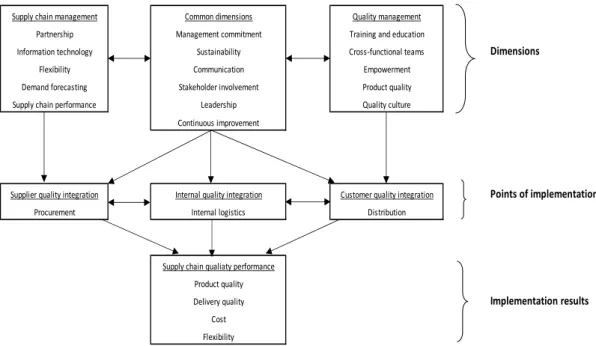
Lack of “…programs and techniques that encourage culturally diverse workforces” (Gunasekaran & McGaughey, 2003:361) have impeded the integration of QM with SCM. To overcome the SCM-QM integration challenges, their common dimensions are identified to help in integration as well as successful implementation. The dimensions related to SCM and QM and interaction with the common dimensions is illustrated in the proposed SCQM integration framework (Figure 1). The proposed model extends the
existing literature by identifying an enhanced list of variables for SCM, QM and the common dimensions. The model illustrates how the constructs interact, the points of integration (supplier, internal and customer) and implementation (procurement, internal logistics and distribution) as well as the likely impact areas of a firm’s SC.
Figure 1: Proposed model for supply chain quality management Source: Fernandez et al. (2017); Machado et al. (2016)
SCM and QM share a number of features that, if well implemented within an organisation and among all supply chain partners, will create value for the customer. The common dimensions must be aligned across the supply chain to achieve integration. Huo et al
(2014a) argued that the SCM philosophy advances continuous improvement dimension, which is a core dimension in quality management. Pursuing continuous improvement means that organisations within a supply chain are able to identify problems and continuously devise innovative ways to get solutions to remain competitive (Zhong et al.,
2016).
Top management commitment to SCM and QM is essential for the success of the integration agenda. Management is responsible for designing internal functions. In SCM terms, leadership designs supply networks, inventory management, production planning, supplier management and communication management. Leadership is also responsible for developing quality strategies, training human resources, planning and information flow. Top management are also expected to provide guidance in strategy and resources that will support the SCM-QM integration as argued by Talib, Ali and Idris (2014). The SCM and QM philosophies all advocate for top management support to achieve the objective of cost reduction and customer satisfaction (Zhong et al., 2016), Therefore,
proper strategic planning which comes from management guides successful SCQM integration which positively influences supply chain quality performance in terms of
Supply chain management Common dimensions Quality management Partnership Management commitment Training and education
Information technology Sustainability Cross‐functional teams Dimensions Flexibility Communication Empowerment
Demand forecasting Stakeholder involvement Product quality Supply chain performance Leadership Quality culture
Continuous improvement
Supplier quality integration Internal quality integration Customer quality integration Points of implementation Procurement Internal logistics Distribution
Supply chain qualiaty performance Product quality
Delivery quality Implementation results Cost
product and delivery quality, reduction of costs and improvement of operational flexibility (Huo et al., 2014a).
To achieve the objectives of both SCM and QM as well as integration, it is important that all stakeholders are involved in the design of strategies, procedures and processes (Yu, Jacobs, Salisbury & Enns, 2013; Bon & Mustafa, 2013). Similarly, Zeng et al. (2013)
argued that collaboration among supply chain partners in terms of quality leads to improved supply chain quality performance. High levels of high quality communication among supply chain partners are critical to SCM and QM success as well as SCM-QM integration (Li et al., 2005; Talib, Rahman & Qureshi, 2010).
Successful enterprises form strong collaborations and implement sustainability across the supply chain. Sustainability refers to development of businesses that are economically, socially and environmentally viable with suppliers and customers so as to reduce costs and environmental impact (Seuring & Gold, 2013). Leigh and Li (2015) argued that sustainable businesses are more successful than their competitors. Therefore, sustainability should be a point of SCM-QM integration to achieve high supply chain quality performance.
Successful SCM-QM integration is dependent on leadership (Soares, Soltani & Liao, 2017). Leadership focuses on providing an environment in which workers are committed to achieve high quality goals. Leadership is charged with creating a stable business environment in the supply chain to promote high performance (Sharif & Irani, 2012). Therefore, leadership is an important dimension in achieving SCM-QM as well as high supply chain quality performance (Azar, Kahnali & Taghavi,2010).
QM dimensions were identified as training and education, creation of cross-functional teams, product quality, maintaining a quality culture and employee empowerment (Huo
et al., 2014a; Soares et al., 2017). The dimensions selected are those most likely to
impact on supply chain quality performance. The identified dimensions interact with the common dimensions (Figure 1) to promote quality management goals among the supply chain partners. The collaborating enterprises are expected to train and educate their workers on quality matters to achieve continuous improvement (Soares et al., 2017). The
cross-functional teams are expected to identify quality problems within the enterprise as well as from the external environment and provide solutions as well as preventive measures (Huo et al., 2014b). Zhong et al. (2016) argued that maintaining a quality culture
requires the sharing of values, beliefs and attitudes between employees, customers and suppliers to promote a healthy relationship to achieve high performance. Thus, employees should be empowered to make decisions to deliver high quality products and services (Talib et al., 2011).
In terms of SCM, five dimensions were identified namely partnership, information technology, flexibility, demand forecasting and supply chain performance (Gunasekaran & McGaughey, 2003; Zhong et al., 2016). The firms in a supply chain network are
expected to develop a partnership to achieve the common goals of high quality at low cost to meet customer requirements. To maintain a good partnership relationship,
appropriate information technology should be used to promote quality communication among partners (Zhong et al., 2016). Information sharing creates supply chain visibility
which allows for operational flexibility as well as accuracy in demand forecasting for proper decision making from top management (Huo et al., 2014b). Finally, measurement
of various supply chain metrics such as cost savings, customer satisfaction, delivery performance, and product quality among others help management to design better strategies (Dellana & Kros, 2018; Mishra, Gunasekaran, Papadopoulos & Dubey, 2018; Soares et al., 2017; Talib et al., 2011).
Regarding SCM-QM integration, three areas of SCM where QM should be incorporated were identified as procurement, internal logistics and distribution (Fernandes et al., 2017;
Huo et al., 2014a; 2014b). Procurement includes all inbound supply chain activities such
as sourcing, appraisal and selection of suppliers, determining material requirements, ordering and order receipts and payments (Akbari, 2018). Quality management practices should be incorporated in each of the procurement activities so that the selected suppliers are trained and remain committed to supplying high quality materials (Zhong et al., 2016).
Close relationships should be developed with the suppliers through enhanced communication and alignment of strategies to have a common approach to reduce procurement costs, improve quality of goods procured so as to achieve high supply chain quality performance (Dellana & Kros, 2018).
Internal logistics refers to the value adding supply chain activities within the organization that involve the movement and storage of inventories (Akbari, 2018). Management is expected to design the activities to achieve a seamless flow of goods and information between internal departments by eliminating all non-value adding activities. As such, leadership is expected to create a conducive environment where employees will contribute innovatively on how to identify and solve internal quality problems as well as how to design internal logistics processes with a quality focus (Huo et al., 2014a).
Maintaining value adding activities and continually improving internal processes is likely to reduce cost, improve quality of products and customer satisfaction as well as supply chain quality performance (Sharma et al., 2016).
Finally, distribution is a supply chain function that involves the movement of inventories from the suppliers’ source to the final customers’ destination (Sanders, 2012). The activities under distribution include design of the distribution channel with supply chain partners, transportation, warehousing, materials handling, packaging, inventory management and information flows between the supply chain partners (Fernandes et al.,
2017). It is expected that each of the activities in the distribution network from the supplier to the customer should be designed jointly with supply partners and integrate quality factors in each so as to reduce cost, improve product/service quality, achieve desired operational flexibility and improve overall supply chain quality performance. Hitherto, past SCM frameworks such as the one developed by Cooper and Ellram (1993) focussed on SCM implementation in firms. Later frameworks have focussed on SCM and QM integration (Fernandez et al., 2017). However, limited studies have focussed on
SCM-QM implementation frameworks and this paper aims at bridging the gap by proposing an implementation framework.
6 SCM-QM implementation framework
Developing an effective SCM-QM integration framework is the first step in achieving supply chain quality. However, the framework should be implemented and supported diligently by all supply chain partners to achieve expected quality improvements and supply chain performance. If a partner fails to implement it adequately a weak link will be created which can result in quality or supply chain problems that might negatively affect customer satisfaction. In this study and as per the developed integration framework the following steps are proposed for implementation:
1. The first step requires that every supply chain member diligently develops and implements an internal quality system that is in tandem with the customer expectations. This is in line with Lin and Gibson (2011) who argued that each SC member should develop a SCM quality management system internally that focuses on meeting customer requirements. Similarly, Zeng et al. (2013) claimed that the quality system should be
implemented internally and its performance evaluated regularly to identify areas of improvement. Therefore, internal quality monitoring forms the fundamental step in SCM-QM process implementation.
2. The second step requires enterprises to select suppliers and other supply chain partners who will support the supply chain quality management agenda. The selection criteria may include suppliers with a quality standard certification (for example, ISO 9001:2015), membership to an industry quality award system, or general compliance to government set quality standards (Dellana & Kros, 2014; 2018; Fernandes et al., 2017;
Sharma et al., 2012). In addition, it may require alignment of quality standards among the
supply chain partners for uniformity as a prerequisite for SCQM integration and implementation at the in-bound level of the supply chain (Huo et al., 2014a; Sharma et
al., 2012). The enterprises might be required to create and nurture supply chain quality
management teams that will oversee the alignment as well as manage the relationships between stakeholders (Fernandes et al., 2017). The enterprises should also design and
develop distribution channels that will not compromise that quality of the goods as they move to the final customer. To maintain the expected downstream quality standards, the
right downstream partners should be selected.
3. The third step requires supply chain partners to integrate the quality standards in each level (that is, in-bound level through procurement, internal logistics and out-bound level through distribution) as well as in every supply chain activity including procurement, relationship management, transportation, warehousing and all other upstream and downstream functions (Fernandes et al., 2017; Sharma et al., 2012). This may require
that the service providers (for example 3PLs) involved in in-bound, and out-bound logistics be also incorporated in the SCM-QM drive.
4. Incorporate an appropriate information technology system to allow real-time information sharing internally and externally with supply partners (Fernandes et al., 2017;
Gunasekaran & McGaughey, 2003; Soares et al., 2017). To achieve the expected level
of communication, each of the SC partner should possess the right IT capabilities which may be outsourced or shared with more established partners. The IT will help to track products and identify likely quality problems before they occur, or trace to know the source and make corrective action. Some of the technologies that can be applied include the blockchain technology.
5. Finally, quality in the supply chain will be achieved when there is continuous measurement of product/service quality, delivery quality, supply chain cost and flexibility (Dellana & Kros, 2018). Continuous measurement is likely to help identify quality problem. Selected quality teams will then provide solutions that address the problems and continually improve processes to create value for the customer as well as improve supply chain quality performance (Soares et al., 2017).
Therefore, successful implementation of the proposed framework will depend on management’s ability to coordinate the SCM and QM activities among collaborating firms in addition to commitment, offering leadership, involving stakeholders, better communication, pursuing sustainability and continuous improvement. Finally, implementation requires managers to diligently monitor quality at procurement, internal operations and along the physical distribution network to accrue the benefits of SCM-QM. 7 Benefits of the SCM-QM integration framework
The proposed SCM-QM integration framework is likely to influence (1) product or service quality, (2) supply chain flexibility, (3) delivery quality and (4) supply chain cost (Huo et
al., 2014a; Dellana & Kros, 2018). It is proposed that internal quality integration which
brings together cross-functional teams helps in designing activities and processes to prevent defects, reduce cycle times and eliminate interruptions to improve on time delivery performance. This is consistent with (Gunasekaran & McGaughey, 2003; Soares
et al., 2017) who claimed that integrating QM and SCM ensures that non-value adding
activities in the supply chain are identified and eliminated to achieve high supply chain quality performance.
Supplier quality integration calls for close collaboration between supply chain partners in product designs and quality strategies. The collaborations are likely to get rid of quality problems and associated costs as also concluded in Huo et al. (2017). Similarly, the
proposed benefit is consistent with Wang et al. (2004) who concluded that SCM-QM
integration is likely to improve quality of supply chain processes resulting in cost reduction, optimal resource utilisation and high operational efficiencies.
Customer quality integration is likely to design communication systems that collect relevant customer feedback. This proposal is aligned with the findings of Zeng et al.
(2013) who argued that SCM-QM integration leads to improved communication among all the supply chain partners. The information will be used to improve quality of products and quality throughout the distribution network in order to minimize costs and improve customer satisfaction.
8 Conclusion
The growing complexity of SCM is a challenge to practitioners as well as researchers. Complexity is partly due to the involvement of many organisations with diverse cultures, operating procedures and which are located in different parts of the globe. However, successful SCM-QM integration and implementation requires the diverse organisations to have a standard quality system to deliver high value products at the right time to meet customer requirements. To achieve the right SCM quality management system, relevant
dimensions were identified as focus areas for management to attain integration. Further, the proposed SCM-QM implementation framework is likely to guide supply chain managers on operationalise the integration at the three levels of the SC (that is, upstream during procurement activities, internally through internal logistics activities and downstream by managing quality of the distribution activities). The proposed framework might not be a surefire solution for each firm, industry or region, but it provides guidance. Future researchers may consider testing the proposed framework in selected supply chains (for example, milk, beef, vegetables, sugar or steel).
References
Akbari, M. (2018). Logistics outsourcing: a structured literature review. Benchmarking: An
International Journal, 25(5), 1548-1580.
Azar, A., Kahnali, R. A. & Taghavi, A. (2010). Relationship between supply chain quality management practices and their effects on organisational performance. Singapore
Management Review, 32(1), 45-69.
Bon, A. and Mustafa, E. (2013). Impact of total quality management on innovation in service organizations: literature review and new conceptual framework. Procedia
Engineering, 53, 516-529. doi:10.1016/j.proeng.2013.02.067.
Coca-Cola (2019). Supply chain overview. Available from: https://coca-colahellenic.com/en/operations/supply-chain/supply-chain-overview/. Accessed on 16 April 2019.
Dellana, A. S. & Kros, F. J. (2018). ISO 9001 and supply chain quality in the USA.
International Journal of Productivity and Performance Management, 67(2), 297-317.
Dellana, A. S. & Kros, F. J. (2014). An exploration of quality management practices, perceptions and program maturity in the supply chain. International Journal of Operations
& Production Management, 34(6), 786-806.
Fernandes, A. C., Sampaio, P., Sameiro, M. and Truong, H. Q. (2017). Supply chain management and quality management integration: A conceptual model proposal. International Journal of Quality & Reliability Management, 34(1), 53-67.
Flynn, B. B., Huo, B. and Zhao, X. (2010). The impact of supply chain integration on performance: A contingency and configuration approach. Journal of operations
management, 28(1), 58-71.
Foster Jr, S. T. (2008). Towards an understanding of supply chain quality management. Journal of operations management, 26(4), 461-467.
Good HouseKeeping (2018) Latest product recalls. Available from https://www.goodhousekeeping.com/latest-product-recalls/, accessed on 21/08/2018. Gunasekaran, A. and McGaughey, R. E. (2003). TQM is suppy chain management. The
Hassan, M., Mukhtar, A., Qureshi, S. U. and Sharif, S. (2012). Impact of TQM practices on firm's performance of Pakistan's manufacturing organizations. International Journal of
Academic Research in Business and Social Sciences, 2(10), 232.
Hellström, D., & Nilsson, F. (2011). Logistics-driven packaging innovation: a case study at IKEA. International Journal of Retail & Distribution Management, 39(9), 638-657.
Huo, B., Zhao, X. & Lai, F. (2014a). Supply chain quality integration: antecedents and consequences. IEEE Transactions on Engineering Management, 61(1), 38-51.
Huo, B., Qi, Y., Wang, Z., & Zhao, X. (2014b). The impact of supply chain integration on firm performance: The moderating role of competitive strategy. Supply Chain
Management: An International Journal, 19(4), 369-384.
Kannan, V. R. & Tan, K. C. (2005). Just in time, total quality management, and supply chain management: understanding their linkages and impact on business performance. Omega, 33(2), 153-162.
Kaynak, H. and Hartley, J. L. (2008). A replication and extension of quality management into the supply chain. Journal of Operations Management, 26(4), 468-489.
Koufteros, X. A., Vonderembse, M. A. and Doll, W. J. (2002). Integrated product development practices and competitive capabilities: the effects of uncertainty, equivocality, and platform strategy. Journal of Operations Management, 20(4), 331-355.
Lee, Y. and Kincade, D. H. (2003). US apparel manufacturers’ company characteristic differences based on SCM activities. Journal of Fashion Marketing and Management: An
International Journal, 7(1), 31-48.
Leigh, M. and Li, X. (2015). Industrial ecology, industrial symbiosis and supply chain environmental sustainability: a case study of a large UK distributor. Journal of Cleaner
Production, 106, 632-643.
Lin, C., Chow, W. S., Madu, C. N., Kuei, C. H. and Yu, P. P. (2005). A structural equation model of supply chain quality management and organizational performance. International
journal of production economics, 96(3), 355-365.
Lin, L., & Gibson, P. (2011). Implementing supply chain quality management in subcontracting system for construction quality. Journal of System and Management
Sciences, 1(1), 46-58.
Mellat-Parast, M. (2013). Supply chain quality management: An inter-organizational learning perspective. International Journal of Quality & Reliability Management, 30(5),
511-529.
Mishra, D., Gunasekaran, A., Papadopoulos, T., & Dubey, R. (2018). Supply chain performance measures and metrics: a bibliometric study. Benchmarking: An International
Journal, 25(3), 932-967.
Mollenkopf, D., Stolze, H., Tate, W. L., & Ueltschy, M. (2010). Green, lean, and global supply chains. International Journal of Physical Distribution & Logistics
Njagi, M. M., & Shalle, N. (2016). Role of supplier relationship management on procurement performance in manufacturing sector in Kenya: A case of East African Breweries. International Academic Journal of Procurement and Supply Chain
Management, 2(1), 1-20.
Psomas, E.L., Fotopoulos, C.V. and Kafetzopoulos, D.P. (2011), “Core process management practices, quality tools and quality improvement in ISO 9001 certified manufacturing companies”, Business Process Management Journal,17(3), 437-460.
Quang, H. T., Sampaio, P., Carvalho, M. S., Fernandes, A. C., An, D. T., & Vilhenac, E. (2016). An extensive structural model of supply chain quality management and firm performance. International Journal of Quality & Reliability Management, 33(4), 444-464.
Sadikoglu, E. and Olcay, H. (2014). The effects of total quality management practices on performance and the reasons of and the barriers to TQM practices in Turkey. Advances
in Decision Sciences, 2014.
Sahoo, S., & Yadav, S. (2018). Total quality management in Indian manufacturing SMEs.
Procedia Manufacturing, 21, 541-548.
Salah, S., Rahim, A., & Carretero, J. A. (2011). Implementation of Lean Six Sigma (LSS) in supply chain management (SCM): an integrated management philosophy. International
Journal of Transitions and Innovation Systems, 1(2), 138-162.
Sanders, N.R. (2012), Supply Chain Management: A Global Perspective, John Wiley &
Sons, Inc., NJ.
Seuring, S. and Gold, S. (2013). Sustainability management beyond corporate boundaries: from stakeholders to performance. Journal of Cleaner Production. 56, 1-6,
available at: http://dx.doi.org/10.1016/j.jclepro.2012.11.033.
Sharif, A.M. and Irani, Z. (2012). Supply chain leadership. International Journal
Production Economics,140(1), 57-68.
Sharma, A., Garg, D., & Agarwal, A. (2012). Quality management in supply chains: The literature review. International Journal for Quality Research, 6(3), 193-206.
Sila, I., Ebrahimpour, M. and Birkholz, C. (2006). Quality in supply chains: an empirical analysis. Supply Chain Management: An International Journal, 11(6), 491-502.
Singer, M., Donoso, P. and Traverso, P. (2003). Quality strategies in supply chain alliances of disposable items. Omega, 31(6), 499-509.
Soares, A., Soltani, E., & Liao, Y. Y. (2017). The influence of supply chain quality management practices on quality performance: an empirical investigation. Supply Chain
Management: An International Journal, 22(2), 122-144.
Sroufe, R. and Curkovic, S. (2008). An examination of ISO 9000: 2000 and supply chain quality assurance. Journal of operations management, 26(4), 503-520.
Stanley, L. L. and Wisner, J. D. (2001). Service quality along the supply chain: implications for purchasing. Journal of operations management, 19(3), 287-306.
Swink, M., Narasimhan, R. and Wang, C. (2007). Managing beyond the factory walls: effects of four types of strategic integration on manufacturing plant performance. Journal
of operations management, 25(1), 148-164.
Talib, H., Ali, K. and Idris, F. (2014). Critical success factors of quality management practices among SMEs in the food processing industry in Malaysia. Journal of Small
Business and Enterprise Development,21(1), 152-176.
Talib, F., Rahman, Z. and Qureshi, M.N. (2011). A study of total quality management and supply chain management practices, International Journal of Productivity and
Performance Management, 60(3), 268-288.
Talib, F., Rahman, Z. and Qureshi, M.N. (2010). Integrating total quality management and supply chain management: similarities and benefits. The IUP Journal of Supply Chain
Management,VII(4), 26-44.
Yang, C. C., & Yang, K. J. (2013). An integrated model of the Toyota production system with total quality management and people factors. Human Factors and Ergonomics in
Manufacturing & Service Industries, 23(5), 450-461.
Yu, W., Jacobs, M. A., Salisbury, W. D. and Enns, H. (2013). The effects of supply chain integration on customer satisfaction and financial performance: An organizational learning perspective. International Journal of Production Economics, 146(1), 346-358.
Zeng, J., Phan, C. A. and Matsui, Y. (2013). Supply chain quality management practices and performance: An empirical study. Operations management research, 6(1-2), 19-31.
Zhang, M., Guo, H., Huo, B., Zhao, X. & Huang, J. (2019). Linking supply chain quality integration with mass customization and product modularity. International Journal of
Production Economics, 207, 227-235.
Zhong, J., Ma, Y., Tu, Y. & Li, X. (2016). Supply chain quality management: an empirical study. International Journal of Contemporary Hospitality Management, 28(11),