MCO 10110.14M LFS
9 Jul 2009 MARINE CORPS ORDER 10110.14M
From: Commandant of the Marine Corps To: Distribution List
Subj: MARINE CORPS FOOD SERVICE AND SUBSISTENCE PROGRAM
Ref: (a) DOD Instruction 1338.10, “Department of Defense Food Service Program,” June 5, 1991
(b) BUMEDINST 10110.6
(c) DOD Directive 5101.10, “DOD Executive Agent (DOD EA) for Subsistence,” September 27, 2004 (d) MCO 5200.24D (e) MCO 1200.17 (f) MCO 1510.72B (g) NAVMC Dir 3500.35 (h) MCO P3500.72A
(i) DOD 7000.14-R, “Department of Defense Financial Management Regulations (FMRS),” September 15, 2008
(j) MCO 7500.4A
(k) Federal Acquisition Regulation (FAR), October 17, 2008
(l) Guidebook for Performance Based Services Acquisition (PBSA) in the Department of Defense, January 2, 2001
(m) USD (AT&L) Memo, Acquisition of Services Policy dtd 2 Oct 06 (n) ASN (RDA) Memo, Acquisition of Services dtd 29 Jan 07 (NOTAL) (o) Joint Federal Travel Regulations, Volume 1, “Uniformed
Service Members,” December 1, 2008 (p) MCO P10150.1
(q) MCO 4855.10B (r) NAVMED P-5010-1 (s) BUMEDINST 4061.2
(t) DOD Directive 3235.02E, “DOD Combat Feeding Research and
Engineering Program, DOD Combat Feeding Research and Engineering Board, and DOD Nutrition Committee,” May 21, 2004
(u) MCO P4400.39H (v) NAVMC 2733 (w) 31 U.S.C. 1517 (x) 37 U.S.C. 1011 (y) SECNAV M-5210.1 (z) MCO 10110.42B (aa) MCO P10110.31H
(ab) Defense Federal Acquisition Regulations Supplement (DFARS) and Procedures, Guidance, and Information (PGI), Part 208, Subpart 208.4, March 21, 2006
(ac) U.S. Department of Health and Human Services, Public Health Service, and Food and Drug Administration FDA Food Code of 2005
Distribution STATEMENT A: Approved for public release; distribution is unlimited.
(ad) Executive Order 11157, “Prescribing Regulations Relating to Incentive Pay for Hazardous Duty, Special Pay for Sea Duty and Duty at Dertain Places, Basic Allowances for Subsistence and Basic Allowances for Quarters,” June 22, 1964
(ae) Unified Facilities Criteria Guide (UFC) 3-701-07, “DOD Facilities Pricing Guide,” July 2, 2007
(af) MCO 4450.10C (ag) MCO P11000.5 (ah) MCO P11000.12 (ai) MCO P7100.8 (aj) MCO P1700.27 (ak) MCO P1020.34
(al) DOD Directive 6400.4, “DOD Veterinary Services Program,” August 22, 2003
(am) MCO 10110.48 (an) MCO 10110.38C (ao) JAGINST 5800.7D
(ap) Department of the Army Pamphlet 30-22 (DA PAM 30-22)
(aq) Field Manual (FM) 10-23, “Basic Doctrine for Army Field Feeding and Class I Operations Management” (NOTAL)
(ar) MCRP 4-11.8A (as) SECNAV M-5214.1
Encl: (1) Marine Corps Food Service and Subsistence Manual
1. Situation. To promulgate policy for the Marine Corps Food Service and Subsistence Program, per references (a) through (as).
2. Cancellation. MCO P10110.14L, MCO P10110.34E, MCO P10110.40B, and MCO P10110.17C.
3. Mission. To issue policies for the management, operation, budgeting, and administration of garrison mess halls, field messes, and subsistence
management. 4. Execution
a. Commander’s Intent and Concept of Operations
(1) Commander’s Intent. Commanders at all echelons are responsible for implementation of the policy and procedures contained herein for the Marine Corps Food Service and Subsistence Management Program within the Marine Corps.
(2) Concept of Operations. This revised Order reflects substantial changes and should be reviewed in its entirety.
b. Subordinate Element Missions. Installation Commander's appoint a food service officer (Military Occupational Specialty 3302) to function as a special staff officer who recommends action and interprets policies and directives that concern appropriated fund food service matters within the command. The food service officer ensures the policies, standards, and criteria of the Food Service and Subsistence Program are maintained per this order and exercises command supervision, financial responsibility, and
management control of food service functions, as stated in the enclosure, to include contracted food service operations as stated in this manual.
5. Administration and Logistics. Upon signature, this Order effectively cancels directives cited in paragraph 2.
6. Command and Signal
a. Command. This Order is applicable to the Marine Corps Total Force except when superseded by other Reserve directives.
b. Signal. This Order is effective the date signed.
E. G. Usher III
Deputy Commandant for
Installations and Logistics DISTRIBUTION: PCN 10210710000
3 3
TABLE OF CONTENTS
IDENTIFICATION TITLE PAGE Chapter 1 GENERAL POLICY AND RESPONSIBILITIES...1-1 1. General...1-1 2. Mission...1-1 3. Objectives...1-1 4. Administration...1-1 5. DOD Responsibilities...1-2 6. Commandant of the Marine Corps (CMC)...1-2 Responsibilities
7. Evaluating Food Service...1-9 8. Recommendations for Program Improvement...1-9
Chapter 2 FOOD SERVICE PERSONNEL RESPONSIBILITIES,...2-1 QUALIFICATIONS, AND DUTIES
1. General...2-1 2. Food Service Organization...2-1 3. Food Service System...2-1 4. Other Activities...2-1 5. FSO Responsibilities...2-2 6. Food Management Team (FMT) Mission and...2-3 Responsibilities
7. Occupational Field (OccFld) 33 Duties...2-6 and Tasks
8. Food Service Training...2-6
Chapter 3 BUDGETING AND REPORTING OF MILITARY PERSONNEL...3-1 MARINE CORPS (MPMC/1105) SUBSISTENCE FUNDS
1. General Information...3-1 2. MPMC/1105 Subsistence Allotments...3-2 3. Memorandum Records...3-3 4. Department of Defense Activity Address...3-3 Codes (DODAAC)
5. Appropriation and Accounting Data, and...3-4 Requisitioning Instructions for Procurement
of Subsistence Responsibilities
6. Contractor Managed CONUS Garrison...3-4 Mess Hall Operations Responsibilities
7. Contracted Field Meals During Active Duty...3-4 Training Exercises, Contingencies,
and Mobilization
8. Contracted Field Meals During Reserve...3-5 Training/Exercises, Contingencies,
and Mobilization
9. Field and Garrison Mess Hall Feeding...3-5 Budget and Reporting Requirements
10. Reporting Mess Hall/Food Service System...3-9 Operational Deficiencies
11. Reimbursements to the MPMC/1105 Subsistence...3-9 Account
TABLE OF CONTENTS
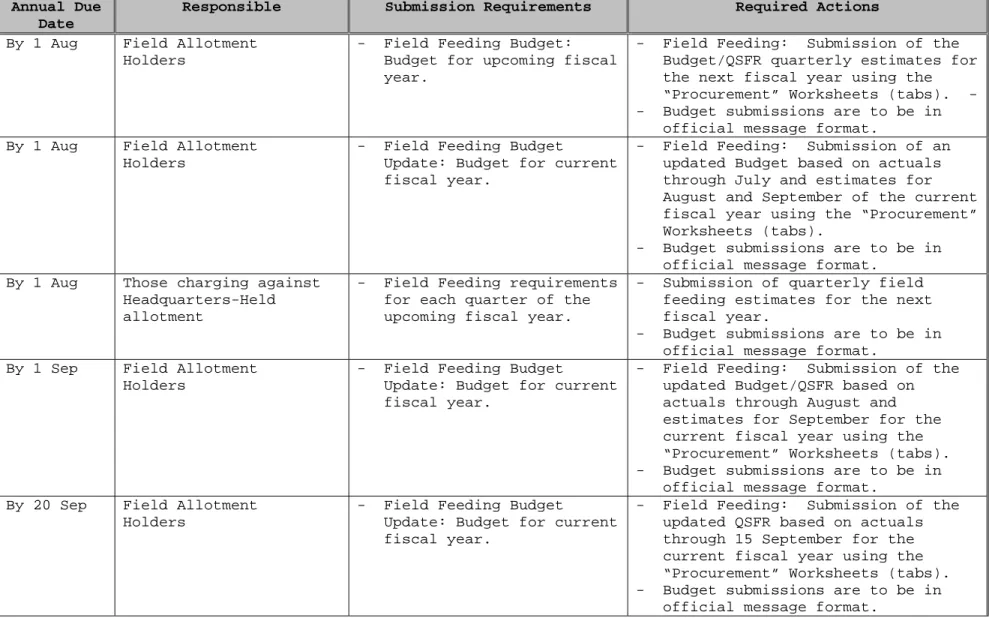
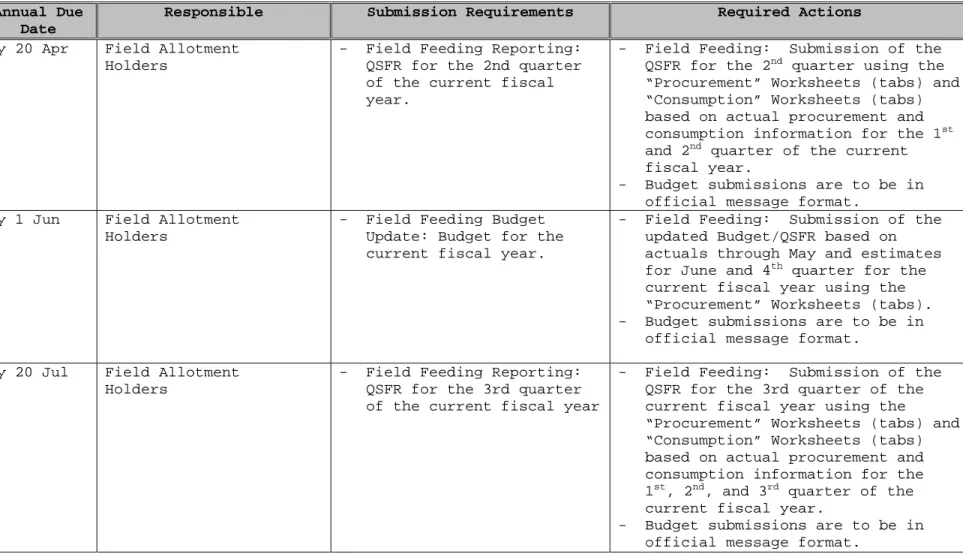
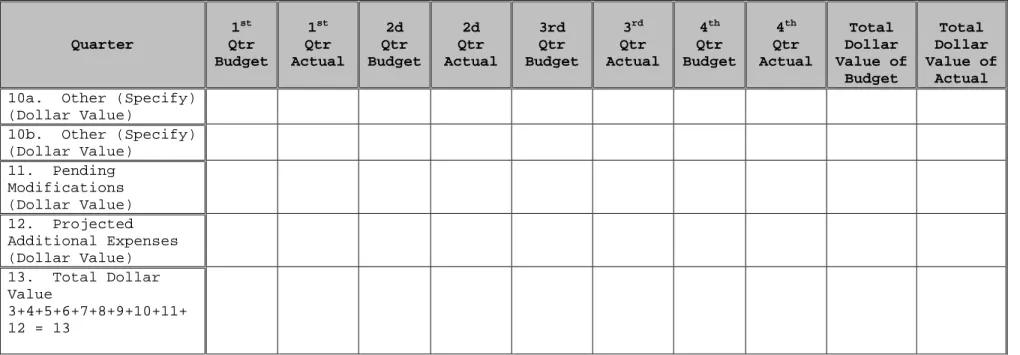
IDENTIFICATION TITLE PAGE 12. Correction of Erroneous Appropriation Data...3-11 13. Reimbursement by Check...3-11 Figure 3-1 Timetable for MPMC/1105 Subsistence...3-12 Funds Budget and Reporting Requirement
for Field Feeding
Figure 3-2 Garrison Subsistence Budget Worksheet...3-15 Format (Military Managed Garrison Mess
Halls)
Figure 3-3 Garrison Subsistence Budget Worksheet...3-16 Format (Contractor Managed Garrison Mess
Halls)
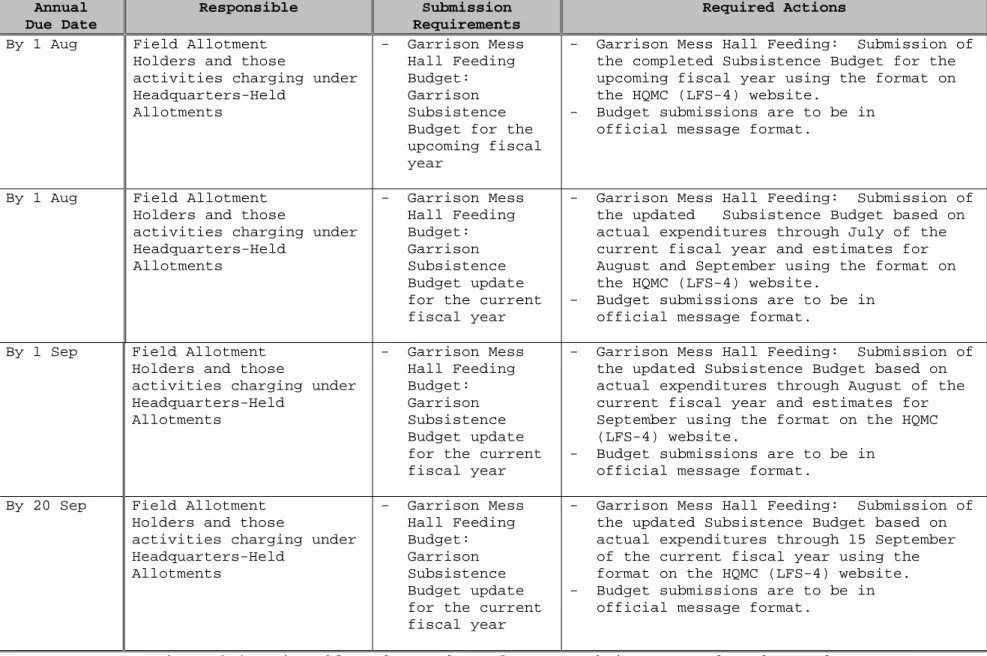
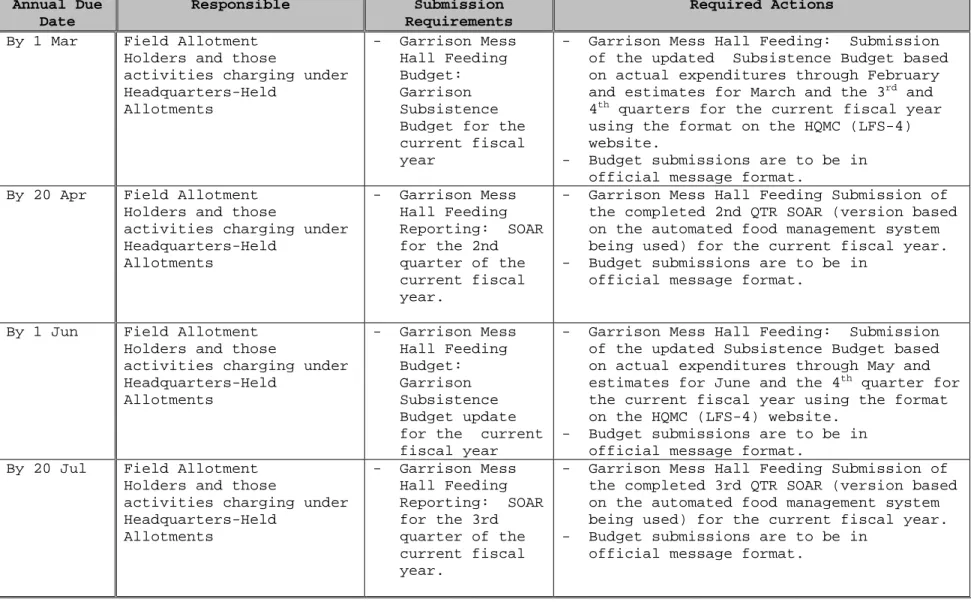
Figure 3-4 Timetable and Procedures for MPMC...3-18 Subsistence Funds Budget and Reporting
Requirements for Garrison Mess Hall Feeding
Chapter 4 FOOD SERVICE CONTRACTS...4-1 1. General...4-1 2. Performance Based Services Acquisition...4-1 3. Performance Responsibility...4-1 4. Contract Administration Plan ...4-2 5. Food Service Contract Types...4-2 6. Use of Military Personnel for Mess Attendant...4-2 Services
7. Contract and Directives Conflict...4-2
Chapter 5 PERSONNEL AUTHORIZED TO SUBSIST IN...5-1 APPROPRIATED FUND MESS HALLS
1. Purpose...5-1 2. General Provisions...5-1
Chapter 6 PERSONNEL AUTHORIZED TO SUBSIST AT GOVERNMENT...6-1 EXPENSE AND PAYMENT FOR MEALS AND RATIONS
1. General...6-1 2. DOD Established Meal Rates...6-1 3. Payroll Deduction...6-3 4. Payment for Meals or Rations Provided/...6-4 Consumed
5. Other Situations Requiring Payment or...6-4 Reimbursement for Meals and Rations
Provided/Consumed
Figure 6-1 Category of Personnel and Applicable...6-6 Meal Rates and Reimbursement Method
i Enclosure (1) ii Enclosure (1)
TABLE OF CONTENTS
IDENTIFICATION TITLE PAGE Chapter 7 ACCOUNTING FOR PERSONNEL FED...7-1 1. General Provisions...7-1 2. Identifying Personnel Authorized to...7-1 Subsist at Government Expense
3. Identifying Personnel Not Required to...7-1 Pay for Meals at the Time of Consumption
4. Accounting for Personnel Fed in...7-1 Garrison Mess Halls
5. Combined Cashier and Meal Verification...7-2 Supervisor Duties
6. Appointment and Control Procedures for...7-2 Handling Cash Collections
7. Accounting for Personnel Authorized...7-5 To Subsist at Government Expense
In Recruit Training, Officer Candidate School, Schools of Infantry, and Brigs
8. Accounting for Meals Provided for...7-5 Consumption Away from the Mess Hall
9. Accounting for Personnel During Combat, Field...7-6 Exercises/Training, and Mass Troop Movements
10. Accounting for Meals Provided During...7-6 Emergency/Disaster Feeding
Figure 7-1 Sample Meal Verification Supervisor...7-8 Appointment Letter
Figure 7-2 Sample NAVMC 10789 Meal Verification...7-9 Record
Figure 7-3 Use and Completion of the NAVMC Form...7-11 10789, Meal Verification Record
Figure 7-4 Sample Cashier Appointment Letter...7-14 Figure 7-5 Sample NAVMC 10298 Cash Meal Payment...7-16 Sheet
Figure 7-6 Instructions for Use and Completion...7-17 of the Form NAVMC 10298, Cash Meal Payment Sheet
Figure 7-7 Sample Installation Food Service...7-22 Collection Agent Appointment Letter
Figure 7-8 Sample Mess Hall Collection Agent...7-25 Appointment Letter
Chapter 8 GARRISON MESS HALL SUBSISTENCE...8-1 INVENTORY MANAGEMENT
1. Mess Hall Inventory Levels...8-1 2. Subsistence Adjustment Inventory...8-1 Tolerance Level
3. Source of Subsistence Supplies...8-1
TABLE OF CONTENTS
IDENTIFICATION TITLE PAGE 4. Requisitioning and Issuing Requirements...8-2 5. Receipt of Subsistence...8-2 6. Unitized Ration Components Remaining from...8-3 Field Exercises/Training for Use in
Garrison Mess Halls
Chapter 9 SPECIAL FEEDING REQUIREMENTS...9-1
1. General...9-1 2. Recreational Event Meals...9-1 3. Boxed Meals...9-1 4. Coffee Messes...9-1 5. Beverages for Security Guards...9-2 6. Fruit Support for Conditioning Hikes...9-2 7. Hot and Cold Beverage Support During...9-2 Extreme Climatic Conditions
8. Two Meal Concept...9-2 9. Operation of Fast Food/Carryout Service...9-2
Chapter 10 GARRISON MESS HALL BASIC DAILY FOOD...10-1 ALLOWANCE (BDFA)
1. The BDFA and Food Cost Index (FCI)...10-1 2. Computation of the BDFA...10-1 3. Authorized Increases to the BDFA...10-2 4. Exceeding the Total BDFA...10-2 5. Feeding Within 5 Percent of the Total BDFA...10-2
Chapter 11 FOOD SERVICE AUTOMATED FOOD MANAGEMENT...11-1 SYSTEM
1. Automated Food Management System Use...11-1 2. Maintenance...11-1 3. Training...11-1 4. Automated Food Management System...11-1 Operations
Chapter 12 MAJOR GENERAL W.P.T. HILL MEMORIAL AWARDS PROGRAM...12-1 FOR FOOD SERVICE EXCELLENCE
1. General...12-1 2. Information...12-1 3. Active Garrison Mess Hall and Field Mess...12-1
Eligibility and Evaluation Procedures
4. CONUS Regional Technical Review Group Rules...12-3
and Procedures
5. Reserve Field Mess Eligibility and Evaluation...12-4 Procedures
TABLE OF CONTENTS
IDENTIFICATION TITLE PAGE 6. Major General W.P.T. Hill Memorial Awards...12-4
Evaluation Team
7. Major General W.P.T. Hill Memorial Awards...12-5 Conference and Ceremony Attendance
8. Attendees...12-5
Chapter 13 ACTIVATION, DEACTIVATION, AND...13-1 CONSOLIDATION OF MESS HALLS
1. Consolidation of Mess Halls...13-1 2. Annual Usage and Consolidation...13-1 Review
3. Mess Hall Design Capacity...13-1 4. Permanent Deactivation of Mess Halls...13-2 5. Temporary Deactivation of Mess Halls...13-3 6. Activation of Mess Halls...13-3
Chapter 14 MARINE CORPS FACILITIES AND HQMC...14-1 GARRISON PROPERTY PROGRAMS
1. Scope...14-1 2. Sustainment, Restoration, and...14-2 Modernization of Facilities
3. HQMC Facilities Sustainment, Restoration,...14-4 and Modernization (FSRM) Program
4. HQMC Garrison Property Programs...14-4
Chapter 15 EQUIPMENT CLASSIFICATION AND ACQUISITION...15-1 1. Personal Property...15-1 2. Equipment Identification and...15-1 Specifications
3. Sources of Supply for Garrison...15-2 Equipment and Supplies
4. Equipment Deficiencies...15-3 5. Life Expectancy and Replacement...15-3 Of Food Service Equipment
6. Five Year Long Range Equipment and...15-4 Procurement and Replacement Plan
7. Mess Hall Equipment Replacement...15-4 Record (MERR)
8. Equipment Parts Lists, Operation, and...15-5 Maintenance Instructions
9. Food Service Equipment Maintenance...15-6 10. Carbonated Beverage Dispensers...15-7
TABLE OF CONTENTS
IDENTIFICATION TITLE PAGE 11. Bulk Cereal Dispensers and Condiment...15-8 Dispensers
12. Contractor Installed Equipment...15-8 Figure 15-1 Food Service Equipment Life Expectancy...15-9 Figure 15-2 Long Range Equipment Procurement and...15-11 Replacement Program
Figure 15-3 Mess Hall Equipment Replacement Record...15-12
Chapter 16 FOOD SERVICE SUPPLIES AND ORGANIZATIONAL...16-1 CLOTHING
1. Mess Hall Supplies...16-1 2. Dinnerware and Tableware Requirements...16-1 3. Military Food Service Personnel...16-1 Organizational Clothing
4. Civilian Contractor Food Service...16-2 Employee Uniforms
Figure 16-1 Dinnerware and Tableware Requirements 16-3
Chapter 17 INSPECTION OF SUBSISTENCE SUPPLIES AND...17-1 UNSATISFACTORY AND HAZARDOUS SUBSISTENCE
REPORTING
1. Inspection of Subsistence Supplies 17-1 2. Installation Product Quality Evaluation...17-2 Program (IPQEP)
3. DSCP Nonhazardous Unsatisfactory...17-3 Subsistence
4. Non-DSCP Nonhazardous Unsatisfactory...17-4 Subsistence
5. DOD Hazardous Food and Nonprescription...17-4 Drug Recall System
Chapter 18 SURVEYS AND INVESTIGATIONS...18-1 1. General Information...18-1 2. Surveys Without Formal Investigation...18-1 3. Survey Procedures...18-1 4. Action by Installation Commander...18-2 5. Accountability...18-2 6. Investigations Definition and Purpose...18-2 7. When an Investigation is Required...18-2 8. Request for an Investigation...18-2 9. Notification Procedures...18-3 10. Conduct of the Investigation...18-3 11. Credit for Losses...18-3 12. Maintain on file...18-3
TABLE OF CONTENTS
IDENTIFICATION TITLE PAGE Chapter 19 FOOD SAFETY...19-1 1. General Information...19-1 2. Physical Examination of Food Service...19-1 Personnel
3. Food Safety Training Program...19-1 4. Sources of Food Safety Training...19-2 5. Person in Charge Duties and Knowledge...19-3 Demonstration
6. Mess Hall and Production Facility Inspection...19-5
Chapter 20 NUTRITIONAL STANDARDS...20-1 1. General Information...20-1 2. DOD Nutrition Committee...20-1 3. DOD Combat Feeding Research and...20-1 Engineering Program (CFREP)
4. The Surgeon General, Department of...20-2 the Army (TSG, DA)
5. U.S. Army Research Institute of...20-2 Environmental Medicine (USARIEM)
6. U.S. Army Natick Soldier Research,...20-2 Development and Engineering (NSRDEC)
DOD Combat Feeding Directorate (CFD)
7. Joint Services Operational Rations...20-3 Forum (JSORF)
8. Nutritional Standards...20-3 9. MDRIs...20-3 10. Basic Nutrients...20-4 11. Nutrient Database...20-4 12. Nutritional Standards for “A” Ration...20-4 Menu Planning
13. Dietary Guidelines for Americans...20-5 14. USDA Food Guide Pyramid...20-7 15. Nutritional Standards for Operational...20-7 Rations (NSOR)
Chapter 21 GARRISON MESS HALL MASTER MENU PLANNING...21-1
1. General Information...21-1 2. Factors Affecting Menus...21-1 3. Menu Planning Tools...21-1 4. Menu Standards...21-2 5. Developing Meals for the Master Menu...21-4 6. Frequency Charts...21-5 7. Posting of Menus...21-5 8. Menu Planning Board...21-5 9. New Recipes...21-7
TABLE OF CONTENTS
IDENTIFICATION TITLE PAGE
Figure 21-1 Standard Breakfast and Breakfast/Brunch Menu...21-8 Figure 21-2 Standard Lunch, Dinner, Holiday, and...21-10
Special Meals Menu
Figure 21-3 Standard Fast Food/Condiment Menu...21-12 Figure 21-4 Standard Beverage and Self Serve Condiment...21-14 Menu
Figure 21-5 Standard Salad Bar Menu...21-17 Figure 21-6 Standard Recreational Menu...21-19 Figure 21-7 Standard Breakfast Box Lunch Menu...21-21 Figure 21-8 Standard Lunch/Dinner Box Lunch Menu...21-22
Chapter 22 EXPEDITIONARY FEEDING...22-1 1. General...22-1 2. Marine Corps Expeditionary Feeding Policy...22-1 3. Concept of Organization...22-1 4. Concept of Employment...22-1 5. Operation Plan (OPPLAN)...22-2 6. Tactical Feeding...22-3 7. Field Food Service Equipment...22-3 8. Maintenance...22-5 9. Budgeting and Reporting Responsibilities...22-5 10. Field Accounting Forms...22-5 Figure 22-1 Food Service Operational Planning for...22-7 Training Exercises
Figure 22-2 Food Service Operational Planning for Deployment....22-8 Figure 22-3 Instructions for Completion of the...22-9 Man-Day Fed Report (NAVMC 565-1)
Figure 22-4 Sample Man-Day Fed Report (NAVMC 565-1)...22-11 Figure 22-5 Instructions for Completion of Stock...22-12 Record and Inventory Control Card (NAVMC 708 Card)
Figure 22-6 Sample Stock Record and Inventory Control...22-14 Card (NAVMC 708 Card)
Figure 22-7 Instructions for Completion of Cook’s...22-15 Worksheet (NAVMC 36)
REPORTS REQUIRED
REPORT TITLE REPORT SYMBOL PARAGRAPH
I. QUARTERLY SUBSISTENCE FINANCIAL REPORT (QSFR)
EXEMPT Enclosure (1)
Ch 3, PARA 9.d.2
II. MAN-DAY FED REPORT EXEMPT Enclosure (1)
CH 6, PARA 4.d.1 CH 6, PARA 4.d.2 CH 6, PARA 5.a CH 7, PARA 9.a CH 7, PARA 10.b CH 22, PARA 10 CH 22, PARA 10.a
III. SUBSISTENCE OPERATIONAL ANALYSIS REPORT (SOAR)
MC-7220-01A MC-7220-01B
CH 3, PARA 9.e.2
IV. UNSATISFACTORY MATERIAL REPORT
DD-10110-06 CH 17, PARA 1.d CH 17, PARA 3.d
V. COMBAT ACCOUNTABILITY MC-7220-13 CH 7, PARA 9
VI. INVESTIGATION OF LOSS, DAMAGE, DESTRUCTION, OR THEFT OF SUBSISTENCE
EXEMPT CH 18, PARA 10.a
Chapter 1
General Policy and Responsibilities
1. General. This chapter provides detailed information on the mission, objectives, and responsibilities for the Marine Corps Food Service and Subsistence Program.
2. Mission. The mission of the Marine Corps Food Service and Subsistence Program is to manage personnel and other resources needed to prepare and serve meals to authorized patrons of appropriated mess halls and under field conditions, for subsistence management, quality assurance surveillance, and to provide a trained food service force capable of responding to
expeditionary operations worldwide.
3. Objectives. The objectives of the Marine Corps Food Service and Subsistence Program are outlined in reference (a). The objectives are: a. Ensure an effective food service and subsistence program in time of peace and war.
b. Ensure the efficient and effective use of personnel, materiel, and financial resources while providing the highest standards of food service under garrison and field conditions.
c. Provide standard methods, techniques, and procedures in food service operations and an auditable accounting system. Food service accounting and reporting procedures will be sufficiently detailed and controlled to provide common data throughout the Marine Corps.
d. Ensure that a positive, dynamic, and continuing educational and training program is maintained to support the food service program. e. Provide adequate and efficient food service facilities and equipment capable of offering cafeteria style service with multi-entrée choices (fast food and regular menu meals). This service should be equal to that service offered in a first class commercial food service establishment.
f. Provide standardized procedures for the recovery of established operating and food costs for meals provided to eligible personnel. g. Provide standards for contracted food service operations.
h. Ensure the development of standard menus and recipes to increase popularity and nutritional value of meals offered under garrison and field conditions.
4. Administration. Administration of the food service program by Marine Corps activities is a function of command. Commanders shall ensure that personnel under their charge are provided with food which is of good quality, sufficient quantity, and is well prepared. Commanders shall publish up-to-date supplemental instructions to Marine Corps directives concerning
reporting requirements, accounting and cost control, automated food management programs, control of waste, appointment of collection agents, requisitioning, receipt and storage procedures, inspection of subsistence supplies, procurement of food service equipment and supplies, expeditionary feeding, and other related procedures.
5. DOD Responsibilities
a. The Undersecretary of Defense, Acquisition, Technology and Logistics (USD(AT&L)). The USD (AT&L) is responsible for providing overall policy guidance and direction to the DOD Food Service Program. This program is established and operated through the Combat Feeding Research and Engineering Board (CFREB). The Director, Defense Research and Engineering (DDR&E) shall oversee and monitor the DOD CFREB to ensure that it is responsive to the needs of the DOD Components and to the objectives and standards of the DOD Food Service Program.
b. The Assistant Secretary of Defense (Health Affairs) (ASD(HA)). The ASD(HA) is responsible for providing policy and guidance for sanitation methods, nutrition education, and nutrition standards.
c. The Surgeon General, United States Army. The Surgeon General, United States Army (USA), exercises DOD responsibility for Nutritional Standards and Education. Reference (b) is the joint regulation which provides the
nutrition allowances, standards, and education and defines the nutrition responsibilities of the Surgeon General of the Army, the Navy, and the Air Force. This regulation provides the Military Dietary Reference Intakes (MDRI), sets the nutrient standards for packaged operational rations, and provides nutrition education guidance for promoting a healthy diet. It applies to all active and reserve elements of the services.
d. Director, Defense Logistics Agency. The Defense Logistics Agency (DLA) is a DOD defense agency. The director reports to the USD, AT&L through the Deputy Under Secretary of Defense, Logistics and Materiel Readiness. DLA provides worldwide logistics support for the missions of the Military
Departments and the Unified Combatant Commands under conditions of peace and war. The Director, DLA is designated as the DOD Executive Agent (EA) for Class I Subsistence (See reference (c)). As the DOD EA for Class I
Subsistence, the director:
(1) Plans for, procures, manages, distributes, and insures the
wholesomeness of subsistence products throughout the supply chain. Delivers items to locations mutually agreed to by the Military Services, the Combatant Commands, and the DOD EA.
(2) Maintains authorized war reserve stocks.
(3) Chairs the Joint Subsistence Policy Board for planning, coordinating, and resolving subsistence related issues.
6. Commandant of the Marine Corps (CMC) Responsibilities a. The CMC
(1) The CMC designates force command and operating units authorized and/or required to operate food service systems.
(2) When in garrison at a permanent Marine Corps installation, operating force units shall operate within the food service system established at the installation. This includes providing qualified and sufficient military personnel to operate both military and contractor operated mess halls.
(3) Installation Commanders who operate individual consolidated food service systems have financial responsibility for the entire food service organization. This financial responsibility shall not be delegated to subordinate commanders even though they may be operating individual mess halls within the system.
b. The Deputy Commandant, Installations and Logistics (DC, I&L). The DC, I&L acts on behalf of the Commandant in designated matters of logistics policy and management, and coordinates logistics actions with other agencies. The DC, I&L has staff cognizance over the Marine Corps Food Service and
Subsistence Program and serves as the program advocate.
c. The Assistant Deputy Commandant, Installations and Logistics
(Facilities) (ADC, I&L(LF)). The ADC, I&L(LF) through the Services Branch and Food Service and Subsistence Section develops plans, policies, programs, doctrine, and standards for the management of the Marine Corps Food Service and Subsistence Program under field and garrison conditions. The ADC, I&L (LF) holds Section 1517, Revised Statute, U.S. Code responsibility for the Military Personnel Marine Corps (MPMC) Subsistence in Kind (SIK) account (Basic Symbol 1105).
d. Headquarters Marine Corps (HQMC) Food Service and Subsistence Section (LFS-4)
(1) Develops plans, policies, programs, doctrine, and standards for the management of the Marine Corps Food Service and Subsistence Program under field and garrison conditions.
(2) Provides field and garrison policy guidance, interpretation, and technical assistance to commanders on the Marine Corps Food Service and Subsistence Program.
(3) Programs, budgets, monitors execution, and reports on the MPMC/1105 subsistence funds for all commands.
(a) Prepares timely submissions of annual, quarterly, and
periodic subsistence budgets and updates to the CMC, Programs and Resources (P&R).
(b) Oversees and reports the execution of the MPMC/1105 subsistence funds to the CMC (P&R).
(c) Reviews and consolidates budget updates from field allotment and operating target (OPTAR) holders for the MPMC/1105 subsistence account. (d) Provides Navy Comptroller (NAVCOMPT) Form 372 to field allotment holders quarterly, or as required.
(e) Approves requests for increases to the annual and quarterly budget submissions of MPMC/1105 subsistence funding levels for garrison mess hall feeding, expeditionary feeding, and food service contracts. (f) Reviews, consolidates, and reports annual
operational ration requirements to the Defense Supply Center, Philadelphia (DSCP), DLA.
(g) Reviews, consolidates, and reports changes to the war reserve quantities, to include prepositioned stocks, Marine Expeditionary Force (MEF) safety levels, and training stocks to the DSCP, DLA.
(4) Coordinates food service matters with the offices of the
Secretary of Defense, the Secretary of the Navy, other Services, and private industry.
(5) Coordinates with Surgeons General on the establishment of
appropriate nutrition, menus, recipes, and dietary standards for Marine Corps personnel.
(6) Coordinates, budgets for, monitors, and determines
the requirements associated with the requirements for field food service equipment and Class I War Reserve Material (WRM) for the Maritime
Prepositioning Ships (MPS), Marine Corps Prepositioning Norway (MCPP-N), and other requirements.
(7) Coordinates all advocate matters pertaining to officer and enlisted military occupational specialty (MOS) 33XX tables of organization (T/O), structure additions, deletions, and realignments.
(8) Coordinates all advocate matters for assignment of FSO (MOS 3302) and senior enlisted food service Marines (MOS 3381).
(9) Supports nominations to the Marine Aide Program and acts a liaison between the Fleet Marine Force and the Marine Aide Program. (10) Acts as the Marine Corps voting member for the CFREB, Joint Subsistence Operational Ration Forum (JSORF), and Joint Subsistence Policy Board.
(11) Validates submissions and provides technical advice associated with the HQMC Garrison Property Programs and Facilities Sustainment,
Restoration, and Modernization (FSRM) Programs to the CMC (LF).
(12) Validates and provides technical advice for all advocate matters to the Commander Marine Corps Systems Command (COMMARCORSYSCOM) for the
development and procurement of field food service equipment and other food service related requirements.
(13) Validates all advocate matters pertaining to all directives and correspondence concerning the training curricula, qualifications,
allocations, policies, and duties of food service personnel, Occupational Field 33 (OccFld 33).
(14) Administers the Marine Corps Food Management Teams (FMT). Provides technical direction, develops FMT policy and procedural guidance, prepares and administers the program budget and sponsors the program T/O. (15) Administers Food Service Contracts for the Regional Garrison Food Service Contract. Develops and approves statements of work, contract administration plans, quality assurance surveillance plans, provides
technical advice, and approves contract modifications.
(16) Coordinates all food service actions incident to the
accomplishment, review and comment for General Accounting Office (GAO),
Defense Audit Service, and Navy Audit Service (instances of fraud, waste, and abuse), and Navy Audit Service reports.
(17) Validates all proposed or revised military and federal specifications, purchase descriptions, and procurement deviations for subsistence items and equipment.
(18) Administers the annual Major General William Pendleton Thompson (W.P.T.) Hill Memorial Award Program for Food Service Excellence.
(19) Serves as the functional manager and subject matter expert for all food service automated accounting and ordering systems.
(20) Develops procedures for computation and use of the Basic Daily Food Allowance (BDFA) and other allowance methodologies. Reviews and
evaluates requests from activities for supplemental and special allowances, increases to the BDFA, and authorized on-hand inventory levels.
(21) Reviews and validates command requests for the storage of operational rations.
(22) Designate a HQMC Contracting Officer Representative for the Regional Garrison Food Service Contract at the enterprise level.
e. All Installation Commanders
(1) Appoints an FSO, MOS 3302, to function as a special staff officer to provide the day-to-day management, recommend action, and interpret
policies and directives that concern appropriated fund food service matters and food service and subsistence program matters. In the absence of an FSO or at commands that do not have a T/O for an FSO, the senior enlisted food service Marine (MOS 3381) or federal civilian employee will perform the duties of the Assistant Contracting Officer’s Representatives (ACOR).
(2) Ensures the policies, standards, and criteria of the Marine Corps Food Service and Subsistence Program are maintained per the guidance
contained in this Order.
(3) Exercises command supervision, financial responsibility, and management control of food service functions, to include both military and contracted food service operations.
(4) Recommends policy or procedural improvements to the CMC (LFS-4). (5) Provides well managed, financially stable, quality food service mess halls for all customers.
(6) Publishes command directives for accomplishing program objectives.
(7) Makes maximum use of technical assistance available from the FMTs.
(8) Approves the disestablishment of appropriated fund mess halls on the installation to include isolated sites and notifies the CMC (LFS-4). Requests approval for the establishment of appropriated fund mess halls to the CMC (LFS-4).
(9) Establishes internal control procedures to ensure that personnel not authorized subsistence-in-kind (SIK) makes payment to the Government for those meals.
(10) Authorizes only eligible patrons to subsist in appropriated fund mess halls.
(11) Provides an effective training program to ensure food service personnel are qualified in their assigned jobs, attend required MOS schools, perform training per Marine Corps directives, and are capable of meeting mission requirements.
(12) Identifies new and replacement mess hall food preparation and serving equipment (FPSE) requirements to HQMC (LFS) during the annual budget call. Ensures funds allocated annually by HQMC for FPSE are treated as a dedicated funding stream to the mess halls.
(13) Identifies new and replacement furniture and furnishings in the command’s annual budget submission to the Personnel Support Equipment (PSE) Program. Ensures that priorities are given to mess hall needs in the local distribution of PSE funds allocated annually by HQMC.
(14) Programs for the sustainment, restoration, and modernization of food service facilities.
(a) Prioritizes mess hall infrastructure maintenance that falls within local maintenance and repair authority to sustain an effective
operational environment, void of health, safety, and environmental concerns. (b) Submits timely maintenance and repair projects for needs above local authority to HQMC (LFF).
(c) Prioritizes mess halls among requirements commensurate with the service that they provide and the impact on the individual Marine if facilities are inadequate. The same intent applies to requests for new construction of mess halls.
(15) Promotes a comprehensive nutrition program for all operational mess halls on the installation.
(16) Approves reporting requirements per this Order to be forwarded to HQMC (LFS-4).
(17) Establishes a Patron Education Program as part of the welcome aboard brief and thereafter, incorporates it into the unit's training cycle.
(18) Makes periodic, unannounced visits to mess halls in order to observe the operation and to solicit comments from patrons.
(19) Provides FMT personnel administration, equipment (ADP, office furniture, and training aids), administrative supplies, utilities and maintenance of assigned office spaces, to include the assignment and maintenance of vehicles for transportation support, when applicable. (20) Establishes an annual master menu review board to provide an avenue for food service personnel and patrons to provide recommendations to the installation or regional master menu.
f. Installation Commanders with Regional Garrison Food Service Contract Administration
(1) Executes contract administration of applicable food service contracts and ensures acceptable contractor performance.
(2) Provides personnel to serve as Contracting Officer’s
Representatives (CORs) and Assistant Contracting Officer’s Representatives (ACORs) to administer the day-to-day quality assurance and technical
requirements of contracted food service operations. The Procurement Contracting Officer (PCO) will appoint CORs and Assistant Contracting Officer’s Representatives (ACORs).
(3) Directs contract quality assurance, utilizing the approved Quality Assurance Surveillance Plan (QASP).
(4) Directs liaison, when appropriate, with HQMC and senior contractor representatives to resolve regional issues.
(5) Assigns prisoner mess attendants and supervision for prisoners in designated contractor operated mess halls supporting Brig operations, where applicable.
(6) Assigns food service subject matter experts to serve as Quality Assurance Evaluators (QAE’s) and ensures formal school training is provided. (7) Establishes a written agreement with MEF Commanders to ensure sufficient staffing of Marine food service specialists is provided in Management and Mess Attendant (M&MA) contractor-managed mess halls.
g. Installation Commanders with Regional Garrison Food Service Contract Operations
(1) Provides personnel to serve as ACOR to administer the day-to-day quality assurance and technical requirements of contracted food service operations.
(a) Appropriate senior food service personnel will be assigned ACOR duties for all food service contracts.
(b) The Procurement Contracting Officer (PCO) will appoint CORs and ACORs.
(2) Assigns food service subject matter experts to serve as QAEs and ensures formal school training is provided.
(3) Directs contract quality assurance, utilizing the approved QASP, and provides results and required operational data to the COR.
(4) Supports HQMC (LFS-4), PCO, and COR in contract administration. (5) Conducts liaison, when appropriate, with the ACOR and contractor management representatives to resolve local issues. If the matter cannot be resolved, engages the COR for further assistance.
(6) Assigns prisoner mess attendants and supervision for prisoners in designated contractor operated mess halls supporting Brig operations, where applicable.
h. Activity Commanders Receiving MPMC/1105 Subsistence Field Allotments and OPTARs
(1) Prepares timely submissions of annual, quarterly, and periodic
subsistence budgets and updates to HQMC (LFS-4), via message or as directed. (2) Ensures the accuracy, completeness, timeliness and documentary
support during execution of the MPMC/1105 subsistence funds to ensure an overobligation does not occur.
(3) Submits requests for increased MPMC/1105 subsistence funding for garrison mess hall feeding, expeditionary feeding (to include individual ration allocation increases), and Food Service Contract modifications to HQMC (LFS-4) prior to execution of required funding.
(4) Prepares timely submissions of quarterly subsistence reports to HQMC (LFS-4).
(5) Reports changes of quantities of operational rations designated as war reserve requirements, to include prepositioned stocks, and MEF safety levels to HQMC (LFS-4).
(6) Reports onhand quantities of training stocks to support contingency feeding to HQMC (LFS-4).
i. Operating Force/Unit Commanders (1) Contractor Managed Mess Halls
(a) Assigns a senior Staff Noncommissioned Officer (SNCO) Marine food service specialist (MOS 3381) in designated M&MA to coordinate with the contract mess hall manager for accomplishment of the feeding mission. Senior SNCO’s shall assign and supervisor Marine food service specialists in the performance of designated tasks (cooking, baking, and fast food functions). (b) Assigns Marine food service specialists (MOS 3381) in
designated M&MA contractor-operated mess halls. Ensures staffing levels are maintained per written agreement or additional guidance provided by the MEF and retains administrative and operational control of those Marine food service specialists assigned to accomplish the feeding mission.
(c) Coordinates with the MSC FSO to notify the installation commander when operational commitments will not permit the assignment of sufficient Marine Food Service Specialists to support M&MA mess hall requirements.
(d) Coordinates all field meals, special feeding, and prepared individual ration enhancement requirements with the ACOR.
(e) Provides mess hall patrons for the annual local Master Menu Planning Board to provide input and preferences. Recommended changes will be addressed at the annual Master Menu Planning Board.
(f) Identifies changing needs and requirements to the ACOR. (g) Provides customer comments to the ACOR regarding contractor performance.
(h) Makes periodic, visits to mess halls where their Marines and Sailors subsist in order to ensure the food served is of adequate quality and quantity.
(i) Facilitates and fosters contractor communication by inviting the mess hall manager to attend regular staff meetings.
(2) Operating Force/Unit Commanders supporting Military Managed Mess Halls
(a) Assigns a senior (SNCO) Marine food service specialist (MOS 3381) in designated mess halls to coordinate and assist the mess hall manager in accomplishment of the feeding mission.
(b) Assigns Marine food service specialists in designated mess halls and ensure staffing levels are maintained.
(c) Coordinates with ACOR and mess hall manager for all unit field meals, special feeding, and prepared MRE enhancement requirements. (d) Provides mess hall patrons for the annual local Master Menu Planning Board to provide input and preferences. Recommended changes will be addressed at the annual Master Menu Planning Board.
(e) Makes periodic, visits to mess halls where their Marines and Sailors subsist in order to ensure the food served is of adequate quality and quantity.
7. Evaluating Food Service
a. Food Service Officers and technicians shall perform routine visits of food service operations to observe the efficiency and effectiveness of the operation.
b. For contract operations, QASP includes checklists to evaluate performance requirements per the contract required services.
8. Recommendations for Program Improvement. Field personnel may send recommendations or proposed changes in food service publications, policies, techniques, and procedures through the normal chain of command to the CMC (LFS-4) for evaluation. Direct communication is authorized between
installation commanders and the HQMC (LFS-4).
Chapter 2
Food Service Personnel Responsibilities, Qualifications, and Duties 1. General. Good supervision is synonymous with good management and is necessary at each level of command to reach the goals set by the Marine Corps Food Service and Subsistence Management Program. This chapter describes the responsibilities within the Marine Corps food service organization. 2. Food Service Organization. With the outsourcing of CONUS Marine Corps mess hall services, there are two types of garrison mess hall operations. a. Military Managed Mess Hall Operations. The installation commander gives the commanding officer (CO) with operational control of each mess hall the authority to carry out the program. The FSO functions as a special staff officer for the installation commander and is responsible for supervising food service activities.
b. Contractor Managed Mess Hall Operations. The installation commander has operational control of each mess hall. The FSO functions as a special staff officer for the installation commander and is responsible for managing and supervising food service activities.
3. Food Service System. The installation commander is responsible for the Food Service and Subsistence Program for garrison mess halls. Financial responsibility for the food service system is vested in the installation commander by the Marine Corps Manual. This responsibility cannot be delegated to a subordinate commander.
a. Consolidated Food Service System
(1) When two or more mess halls are aboard the same installation, a consolidated food service system will be established. A consolidated food service system performs the overall food service and subsistence management to include accounting and reporting functions for all mess halls within the system.
(2) A consolidated food service system will have an FSO to provide technical direction and staff surveillance over appropriated fund food service activities.
b. Individual Food Service System
(1) When one mess hall is aboard an installation, an individual food service system will be established. The individual system performs the
overall food service and subsistence management to include accounting/reporting functions.
(2) An FSO is not normally assigned to an activity operating under an individual food service system.
4. Other Activities. MPMC/1105 subsistence accounts at Marine Corps
activities that do not have an FSO will be organized and operated within the supply officer’s account.
5. FSO Responsibilities. When an FSO (MOS 3302) is not assigned to an activity the senior food service Marine (MOS 3381) or federal civilian employee will perform the FSO duties.
a. Advises the commander on matters pertaining to the Installation Food Service and Subsistence Program.
b. Develops command plans, policies, procedures, and methods to promote an effective food service program.
c. Monitors food service operations, military and contractor, to include Master Labor Contracts (MLC) as stated in established policies and
procedures.
d. Budgets for, administers, executes, and provides day-to-day fiscal responsibility for the MPMC/1105 subsistence funds and Operation and Maintenance, Marine Corps(O&MMC)/1106 food service account.
e. Plans, budgets for, and requisitions subsistence, supplies, equipment, and furnishings.
f. Incorporates basic internal management controls in plans, guidance, and procedures governing the food service operations per reference (d). g. Provides technical direction and subject matter expertise to unit commanders for food service training of the core capability mission essential tasks (MET). Assists commanders in developing, executing, and monitoring food service training of the core capability MET for food service personnel. h. Maintains food service personnel training information to ensure the required MOS and professional military education training requirements are completed.
i. Conducts surveys of food, equipment, and personnel and submits recommendations of the results to the commander.
j. Coordinates with manpower and personnel staff officers to ensure proper assignment of food service personnel (OccFld 33).
k. Coordinates the activities of the FMT when aboard the installation. l. Conducts frequent staff visits to mess halls to ensure that food service operations are complying with food service orders and directives. m. Conducts at the minimum semi-annual Technical Inspections of mess halls to ensure proper accounting, food preparation, quality of meals served, and the proper use of personnel, facilities and equipment.
n. Conducts appropriate surveys of individual food preferences and
advises the subsistence vendor representative of the need, acceptability, and desirability of subsistence items.
o. Conducts pre-deployment briefs regarding food service matters in support of expeditionary feeding. Prepares food service and subsistence support plans for strategic and tactical requirements.
p. Interprets and disseminates food service information.
q. Oversees O&MMC funds to units for expendable items and supplies. r. Initiates corrective action, when needed, pertaining to the receipt, storage, preparation, and serving of food.
s. Coordinates and advises the facilities maintenance officer regarding the functional layout of equipment for all sustainment, restoration, and modernization programs and equipment replacement.
t. Ensures that all QAE personnel have attended formal schools training or an approved training course in quality assurance surveillance.
u. Supervises the activities of the installation's food service office collection agent for funds collected from the sale of meals.
v. Conducts liaison with the HQMC Director, Food Service and Subsistence Program (LFS-4), the contracting officer, and senior contractor
representatives to resolve contract issues.
w. Conducts contract quality assurance, utilizing the Quality Assurance Surveillance Plan (QASP), documents results and required operational data for the HQMC Director, Food Service and Subsistence Program (LFS-4).
x. Conducts liaison and participates in on-going meetings with the senior contractor representatives to resolve contract issues.
y. Monitors and ensures the financial stability of food service operations and the food service system and takes corrective measures when necessary.
z. Prepares timely reports for submission to HQMC (LFS-4). aa. Computes the Total BDFA and other allowance methodologies. ab. For Marine Corps Bases, Okinawa, Japan, the FSO:
(1) Budgets for the replacement, maintenance, and repair of Class 2 food service equipment such as walk-in refrigerators and freezers built within the structure of the DOD Dependents Schools.
(2) Supervises and ensures the Cook Chill centralized food production facility is operating in accordance with guidelines mandated in references (r) and (ac).
ac. Ensures an energy conservation program is implemented at each operational mess hall per reference (v).
6. Food Management Team (FMT) Mission and Responsibilities
a. The FMT provides the CMC (LFS-4) with direct representation by assessing and reporting the effectiveness of those processes, policies, and procedures that have an impact on food service readiness. Their goal is to emphasize conformity with Marine Corps standards, enhance food service readiness capability, achieve economy, and increase overall management effectiveness.
b. The CMC (LFS-4) manages the FMT program, provides personnel
authorizations, and assigns personnel to carry out the FMT program. Each team consist of commissioned and SNCO (E-6 and above), and an Army Veterinary Tech Specialist. Team members must have extensive technical knowledge and practical experience in specific and required functions of food service operations.
c. Mission. The mission of the FMT is to: (1) Support garrison operations by:
(a) Assessing the effectiveness of mess hall operations, installation food service programs, and food service training.
1. Review mess management practices to include personnel, facilities, equipment, subsistence, quality assurance, customer comments, and other resources.
2. Review the performance of contractor and Government responsibilities at installations with food service contracts.
3. Review food service training plans to ensure a comprehensive program is instituted.
(b) Enhance the readiness of installation food service and subsistence programs.
(2) Support field feeding operations by:
(a) Assessing the effectiveness of unit field feeding operations, field food service programs, and mission dependant food service training. 1. Review mess management practices to include, personnel, subsistence management, equipment maintenance, and readiness.
2. Review field food service training plans to ensure a comprehensive program is instituted.
(b) Enhance the readiness of field food service and subsistence programs.
(3) Promote sound food service practices to enhance the war fighter's ability to project and sustain military operations throughout the world. (4) Provide technical, managerial, and training assistance tailored to the needs of the visited activity in all areas related to the Marine Corps food service and subsistence programs.
(5) Provide quality training in all areas food service management and operationsusing various techniques such as lecture, demonstration, and
practical application.
(6) Provide amplifying guidance for Marine Corps food service directives and technical publications.
(7) Assist with the implementation of new Marine Corps food service and subsistence program initiatives.
(8) Obtain feedback at the conclusion of each FMT visit to improve future management assistance.
d. FMT Objectives. The FMT objectives are to:
(1) Apprise the CMC (LFS-4), commanders, and food service officers on the effectiveness of their Installation or field food service program. (2) Identify significant deficiencies and trend areas that impede mission accomplishment or adversely affect service-member participation in feeding programs.
(3) Provide a written summary of findings and recommended corrective action.
(4) Provide recommendations to the CMC (LFS-4) to resolve issues beyond the control of commanders and food service officers.
(5) Recommend to the CMC (LFS-4) additional assistance to those
installations or field activities with specific areas of concern or problems. (6) Validate the effectiveness of standard Marine Corps policies and procedures; provide suggestions for improvement to the CMC (LFS-4).
(7) Ensure all personnel understand and are aware of their specific roles and responsibilities, and to provide training in all aspects of food service.
e. FMT Visits
(1) FMT visits are coordinated through the CMC (LFS-4). Generally, the FMT will be scheduled to make visits annually based on Marine Corps priorities and financial constraints.
(2) An annual message will be published for each FMT scheduled visit by the CMC (LFS-4). The message will identify the dates of the FMT visits. This schedule will be modified only upon approval of the CMC (LFS-4).
Commanders requiring specific areas of assistance during the FMT visit will identify the requirements to CMC (LFS-4) 10 days prior to each FMT visit for scheduling considerations.
(3) The CMC (LFS-4) will send a letter identifying specific dates and expectations to the commands scheduled for a FMT visit 20 days prior to the FMT scheduled evaluation. It is requested that commanders provide maximum participation for the training provided during these visits. If unusual circumstances occur and rescheduling is required, units desiring to reschedule will submit a request to reschedule to the CMC (LFS-4).
(4) Special requests from commanders desiring an assistance visit by FMTs for other than regularly scheduled visits must request this assistance to the CMC (LFS-4). This request will indicate the unit or mess hall,
specific area of assistance or training required, and the length of the visit desired. During funding constraints, requesting units may be required to provide adequate funding for the FMT team TAD (travel, per diem, and incidental expenses) to perform an assistance visit.
(5) The FMT OIC will attend an in brief if desired by the Commanding Officer or the designated representative, and food service officers.
f. FMT Visit Assessment
(1) The assessment will entail reviewing organizational processes for the purpose of determining the general pattern of operations and whether deficiencies exist within the methods of management. FMTs are to determine whether the organization is performing effectively and efficiently by
reviewing all facets of food service management and training that is inherent to the organization being analyzed.
(2) For installations with contractor managed mess halls with
operational control and oversight of garrison mess halls is the installation commander’s responsibility, the FMT OIC will attend the FMT out brief with the Installation Commander or designated representative and the FSO. The out brief will focus on significant findings and recommendations of corrective action for the installation food service program. A report of corrective action is required to be submitted within 30 days from the out brief to the CMC (LFS-4) noting the action taken to correct the significant findings noted on the summary of observation.
(3) The FMT OIC will attend the FMT out brief with FSO’s and CO’s with operational control of mess halls. The brief will detail significant findings and recommendations of corrective action for the mess hall
evaluated.
(4) A report detailing all discrepancies noted during the FMT visit aboard the installation will be provided to the FSO, food technician, mess hall manager, contracting officer representative, applicable contractor personnel, and CO with operational control of mess halls. This report will be retained in accordance with administrative retention procedures.
(5) When visiting operational units, the FMT OIC will attend the FMT out brief with the FSO and unit commander. The brief will detail significant findings and recommendations of corrective action for the unit evaluated. 7. Occupational Field (OccFld) 33 Duties and Tasks. The duties,
qualifications and lists of tasks for the food service OccFld 33 are contained in references (e) and (g).
8. Food Service Training. The Training and Readiness (T&R) Program is the Marine Corps’ primary tool for planning, conducting and evaluating training, and assessing training readiness. The T&R concept begins with entry-level training of individual Marines and therefore, fully supports the Marine Corps’ building block approach to training. Basic occupational training is the foundation for subsequent Managed-On-The-Job-Training (MOJT) and unit training.
a. Military Food Service Personnel Training
(1) Commanders assume responsibility for all career progression
training beyond the entry-level through the evaluation of Military on the Job training (MOJT) and assignment to follow-on formal schools. T&R Manuals are used to evaluate a Marine’s proficiency in the tasks required for a specific MOS. They outline the structure for an individual training program based upon a logical progression of increasingly more challenging events. They
define the events to be accomplished under specified conditions and describe the requirement for periodic revalidation of proficiency.
(2) Reference (g) establishes core capability Mission Essential Tasks (MET) for readiness reporting and required events for standardization
training of Marines and Navy personnel whose primary mission is to carry out food service garrison and expeditionary operations. Additionally, it
identifies core entry-level training requirements for MOS 3302 and 3381. (3) FSOs, food service technicians, and managers will provide subject matter expertise and technical direction to commanders for the core
capability MET for food service garrison and expeditionary operations. They will thoroughly familiarize themselves with references (f) through (h) to assist in the development, execution, monitoring, and documenting of food service training of the core capability MET.
b. Contractor Personnel Food Service Training
(1) Contractor personnel are required to attend food service training per Marine Corps directives and publications, and their contract.
(2) The cost of all food service training will be at the cost of the contractor, unless specifically stated at Government expense in the contract. Food Service Officers and technicians will ensure this is outlined in all Statements of Work.
Chapter 3
Budgeting and Reporting of Military Personnel Marine Corps (MPMC/1105) Subsistence Funds
1. General Information
a. The information in this chapter will be used to provide specific guidance on the intended use, responsibilities, budgeting, and reporting requirements for the Military Personnel Marine Corps (MPMC) Subsistence in Kind (SIK) funds (Basic Symbol 1105).
b. The use of appropriated MPMC/1105 subsistence funds, mess hall facilities and/or staff (military or civilan), or equipment for the
preparation, sale, or issue of subsistence (in the raw state or prepared) for other purposes than outlined in paragraph c of this chapter is not
authorized.
c. Funds provided under this category are to be used specifically for procurement of subsistence in support of the following:
(1) Garrison mess halls
(a) Meals prepared, served and consumed in a garrison mess hall by authorized patrons in accordance with the approved master menu.
(b) Meals/meal support prepared in the garrison mess halls for consumption away from the mess hall in accordance with the approved master menu are listed below.
1. Boxed meals.
2. Recreational meals.
3. Containerized field meals for personnel conducting field training/exercises.
4. Hot and cold beverage support. 5. Fruit support for hikes. 6. Central Production Facility.
(2) Field Feeding. Feeding while conducting field training or exercises, in addition to mobilization or expeditionary operations. (a) Operational Rations: Unitized Group Rations; UGR-H&S, UGR-B or UGR-A. Individual Rations/Packaged Operational Rations (POR); Meals Ready to Eat (MRE) or First Strike Ration (FSR).
(b) Ultra High Temperature (UHT) Milk.
(c) “A” Ration enhancements for unitized rations and individual rations.
(d) Host Nation Support/Messing.
(e) Contracted Field Meals. 2. MPMC/1105 Subsistence Allotments
a. Reference (w) forbids the expenditure or obligation of funds in excess of those authorized. The U.S. Code reference requires that an actual or apparent 1517 violation be investigated, and, if the violation is
confirmed, a report forwarded to the Comptroller of the Navy. Reference (j) provides the Department of the Navy procedures set forth in the reference on command investigation and reporting of actual and apparent administration control of funds violations.
b. Field allotments are authorized for the following activities: (1) COMMARFORPAC
(a) Suballotments for the procurement of subsistence in support of garrison mess hall operations for Marine Corps Base Hawaii; MCAS Iwakuni; MCB Camp Butler; and Mujuk Korea.
(b) Suballotments for the procurement of operational rations, “A” Ration enhancements, host nation support and contracted meals in support of field feeding.
1. CG I MEF (I MEF Headquarters and subordinate operating force commands).
2. CG III MEF (III MEF Headquarters and subordinate operating force commands).
3. CG MAGTF Training Command, Twentynine Palms (training exercises that are conducted aboard MCAGCC).
4. CO MCB Camp Pendleton (Camp Pendleton, WFTBN/MCRD San Diego).
5. CO MCAS (Yuma).
(2) COMMARFORCOM. Suballotments for the procurement of operational rations, “A” Ration enhancements, host nation support, and contracted meals in support of field feeding:
(a) CG II MEF (II MEF Headquarters and subordinate operating force commands).
(b) CO MCB Camp Lejeune.
(3) CO MCB Quantio for the procurement of operational rations and “A” Ration enhancements.
(4) CG MCRD Parris Island for the procurement of operational rations (and “A” Ration enhancements).
(5) CG MARSOC for the procurement of operational rations (and “A” Ration enhancements).
c. MPMC/1105 Subsistence Funds will be provided to MARFORCOM, MARFORPAC, MCB Quantico, and MCRD Parris Island on a NAVCOMPT 372. Commands do not require a signed copy of the NAVCOMPT 372 to distribute funds, they can
suballot funds in the Standard Accounting Budget and Reporting System (SABRS) to the dollar value identified on the CMC (LFS-4) funding message upon
receipt.
d. OPTARs are authorized for the following activities for procurement of MREs in support of training. OPTAR holders shall submit annual budget
requirements to HQMC (LFS-4) and obtain authorization prior to placing requisitions with DSCP:
(1) MCSFBN Norfolk. (2) EWTGLANT. (3) EWTGPAC.
3. Memorandum Records. Both field allotment holders and Headquarters-held activities operating under an OPTAR should maintain memorandum records per reference (i). Frequent communications will be maintained between the official accounting office and fund administrator (food service
officer/technician) to maintain financial stability. Coordination between accounting offices, DSCP, DLA and food service offices should be effected in an effort to identify and reconcile any significant differences in
obligations. These records will be retained per reference (y) SSIC 10110.1. 4. Department of Defense Activity Address Codes (DODAAC)
a. A DODAAC is a unique six-position, alphanumeric code assigned to identify a specific unit, activity, or organization for various
administrative and resource management functions; such as supply, procurement, personnel, and transportation support.
b. A DODAAC is required for subsistence management to identify the specific activity for delivery of subsistence, through the use of the automated food management system for ordering, and billing accurately. A DODAAC is very often referred to as a “ship to” address. DSCP will not deliver operational rations to a delivery site or “A” Rations to garrison mess halls that are not an established DODAAC in the Defense Automatic Addressing System (DAAS) Center.
c. Units requiring establishment of a new DODAAC will request to COMMARCORLOGCOM, Data Management Section, Albany, GA. Requests for
assignment of a new DODAAC will include complete type address codes (TAC) for; (TAC) 1 (mailing); TAC 2 (shipping); and TAC 3 (billing). In addition, for overseas activities, the TAC 2 address must include the Air Terminal Identifier, Break Bulk Point, and Port Designator (commonly referred to as ATI, BBP, and PD, respectively), which can be obtained from the military transportation office supporting the activity.
d. Changes to fund codes or the DODAAC requires the STORES Military Standard Requisition and Issue Procedures (MILSTRIP) information to be changed by DSCP (Systems and Technology Branch) and a copy of the modified MILSTRIP information to be sent to item managers; e.g., DSCP prime vendor, DSCP operational rations, DSO, and the vendors to ensure orders are received and accurate billing occurs.
5. Appropriation and Accounting Data, and Requisitioning Instructions for Procurement of Subsistence Responsibilities
a. Fund Code. CMC (LFS-4) will publish, via message, a listing of fund codes to be used for the procurement of subsistence.
b. Subsistence Ordering Procedures. DLA STORES is the mandatory automated method of ordering subsistence. The automated food management system will automatically create document numbers and will no longer be provided by the HQMC (LFS-4) for ordering subsistence. During deployments, when a DSCP vendor is not available or loss of connectivity with the
automated food management system occurs, commands are authorized to open purchase subsistence within their budgeted funding level. This process should be the exception, not the norm. Subsistence purchases procured using MILSTRIP requests will cite the following information.
(1) Field Allotment holders will use fund codes stated in appropriate message and cite the procuring command DODAAC.
(2) Headquarters Held Allotment holders will use fund codes stated in appropriate message.
6. Contractor Managed CONUS Garrison Mess Hall Operations Responsibilities a. The funding for the contractor managed CONUS mess hall operations is managed as a Headquarters-Held Allotment. Invoice payments will be certified and executed for payment by the COR as outlined in the contract
administration plan.
b. Requests for modification that requires additional funding must be submitted to HQMC (LFS-4) and funding approval received from the CMC (P&R) prior to negotiating and executing the contract modification.
7. Contracted Field Meals During Active Duty Training Exercises, Contingencies, and Mobilization
a. Contracted field meals and host nation support/messing is not a
substitute for essential Marine Air Ground Task Force (MAGTF) organic feeding and Combat Service Support (CSS) feeding capabilities. The use of a
commanders organic and CSS feeding capability will be the first viable option for field feeding. This maintains the proficiency of food service personnel on field equipment, ration preparation, field sanitation, and ensures the required rotation of operational rations to support the war reserve
requirements. The approved Marine Corps field feeding policy is one MRE and two hot meals per day; therefore when contracting for meals, HQMC (LFS-4) will only provide reimbursement for the Breakfast and Dinner meals at the discounted meal rate.
b. Contracted field meals and host nation support/messing requires review of the cost per meal, menu, and other associated costs prior to funding being provided to HQMC (LFS-4) by the CMC (P&R). When contract feeding is approved for funding, the MPMC appropriation will reimburse the contractor at the published USD(C) discount meal rate (i.e., contracted breakfast meal will apply only the discount meal rate for breakfast to the MPMC appropriation, not the entire daily discount meal rate). Commanders requesting contracted field meals will pay the difference between what the MPMC appropriation will reimburse and the cost of the contracted meals, to