University of Wollongong
Research Online
Faculty of Informatics - Papers (Archive)
Faculty of Engineering and Information Sciences
2008
Development and performance evaluation of a
flexible, low cost MANET
Mehran Abolhasan
University of Wollongong, [email protected]
Brett Hagelstein
University of Wollongong, [email protected]
Jerry Chun-Ping Wang
University of Wollongong, [email protected]
D. Franklin
University of Wollongong, [email protected]
Farzad Safaei
University of Wollongong, [email protected] See next page for additional authors
Research Online is the open access institutional repository for the University of Wollongong. For further information contact the UOW Library: [email protected]
Publication Details
Abolhasan, M., Hagelstein, B., Wang, J., Franklin, D. R., Safaei, F. & Wysocki, T. A. (2008). Development and performance evaluation of a flexible, low cost MANET. International Conference on Signal Processing and Communication Systems (pp. 1-6). Gold Coast, QLD: IEEE.
Development and performance evaluation of a flexible, low cost MANET
Abstract
Performance evaluations of multi-hop ad hoc network routing protocols have been primarily conducted
through analytic and simulation-based studies, which frequently fail to accurately predict real-world
performance and behaviour. One reason for this is the challenge in developing low cost, representative test
beds with the degree of flexibility and mobility required. We have developed a Portable Wireless Ad hoc Node
(PWAN) device which establishes multi-hop routes using the OLSR routing protocol. The PWAN’s
performance has been investigated using two test bed configurations to evaluate its capacity under conditions
of high node density in a short-range, multi-hop environment. Our results illustrate that such networks are
capable of providing high quality connections when traffic density is low. However, the network link quality
deteriorates dramatically as the traffic level increases, and the network topology becomes unstable until the
traffic level is reduced.
Keywords
Development, performance, evaluation, flexible, low, cost, MANET
Disciplines
Physical Sciences and Mathematics
Publication Details
Abolhasan, M., Hagelstein, B., Wang, J., Franklin, D. R., Safaei, F. & Wysocki, T. A. (2008). Development and
performance evaluation of a flexible, low cost MANET. International Conference on Signal Processing and
Communication Systems (pp. 1-6). Gold Coast, QLD: IEEE.
Authors
Mehran Abolhasan, Brett Hagelstein, Jerry Chun-Ping Wang, D. Franklin, Farzad Safaei, and Tadeusz A.
Wysocki
Development and Performance Evaluation of a Flexible, Low Cost MANET
M. Abolhasan, B. Hagelstein, J.C-P. Wang, D.R. Franklin, F. Safaei T. WysockiTelecommunications and Information Technology Research Institute University of Nebraska - Lincoln University of Wollongong CEEN, Peter Kiewit Institute 200D, 1110 S 67th St Wollongong NSW, 2522, Australia Omaha, NE, USA
[email protected] [email protected]
Abstract— Performance evaluations of multi-hop ad hoc network routing protocols have been primarily conducted through analytic and simulation-based studies, which fre-quently fail to accurately predict real-world performance and behaviour. One reason for this is the challenge in de-veloping low cost, representative test beds with the degree of flexibility and mobility required. We have developed a Portable Wireless Ad hoc Node (PWAN) device which es-tablishes multi-hop routes using the OLSR routing protocol. The PWAN’s performance has been investigated using two test bed configurations to evaluate its capacity under condi-tions of high node density in a short-range, multi-hop envi-ronment. Our results illustrate that such networks are capa-ble of providing high quality connections when traffic den-sity is low. However, the network link quality deteriorates dramatically as the traffic level increases, and the network topology becomes unstable until the traffic level is reduced.
I. INTRODUCTION
A mobile ad hoc network (MANET) is a dynamic, multi-hop wireless network established across a collec-tion of mobile nodes on a common wireless channel. MANETs differ from traditional wireless networks by en-abling nodes to communicate without requiring a cen-tralised infrastructure such as a wireless access point. This emerging technology is often proposed as a next-generation communications system to provide robust, flexible and versatile wireless communication in the ab-sence of functional infrastructure.
A growing number of routing protocols have been pro-posed specifically for use in MANETs. According to Kotz et al. [6], most studies in this area focus on using sim-ulation results to evaluate the performance of the pro-posed algorithms since this provides a low cost method of conducting large scale experiments in a controlled manner. However, simulations inevitably require sim-plification and approximation of the real-world environ-ment. For example, it is challenging to accurately model the RF channel in complex environments such as three-dimensional spaces within buildings. This may lead to er-roneous assumptions that compromise the real-world per-formance of the protocol. Pawlikowski et al. state that that “one cannot rely on the majority of the published re-sults on performance evaluation studies of telecommuni-cation networks based on stochastic simulation, since they lack credibility” [9]. The existence of these shortcomings
highlight the need for proposed MANET protocols and algorithms to be implemented on real-world test beds to prove their worth.
According to recent surveys performed by Kiess et al. [5] and Kropff et al. [7], numerous test beds have been implemented worldwide for evaluating the performance of real-world ad hoc networks. For example, Lundgren et al. provide a Linux distribution which can be installed on portable computers to rapidly provide ad hoc network connectivity [8].
Our contribution to this area has been the development of a wireless ad hoc network test bed that consists of a large number of self-contained and self-configured nodes, called Portable Wireless Ad hoc Nodes (PWANs). These nodes are based around a battery powered, Linux-based embedded system with multiple network radios. They are configured with a variety of ad hoc routing protocols and provide a range of convenient tools for network diagnos-tics, performance evaluation, data logging and network-wide configuration, as well as a set of test applications to quantitatively evaluate link quality.
In this paper, we describe the PWAN system and present experimental results from a series of indoor multi-hop networking tests. The paper is structured as follows: Section II presents an overview of the Optimised Link State Routing Protocol (OLSR), which is used for estab-lishing multi-hop ad hoc routes; Section III provides a detailed description of the PWAN nodes; Section IV de-scribes the test bed setup and details the scenarios used to investigate the performance of the PWANs; Section V presents test bed results and discusses its performance over each scenario; finally, Section VI presents the con-clusions of the paper.
II. OLSR PROTOCOLOVERVIEW
There are four main routing protocols currently be-ing considered for standardization by the IETF MANET group: Ad hoc On Demand Distance Vector (AODV) [2], Dynamic Source Routing (DSR) [4], Optimized Link-State Routing (OLSR) [3], and Topology Broadcast Based on Reverse-Path Forwarding (TBRPF) [1]. We chose OLSR as the routing protocol in our test bed.
In contrast to classic reactive routing protocols such AODV or DSR, OLSR is a proactive routing protocol that
978-1-4244-4242-3/08/$25.00 ©2008 IEEE
Published in Signal Processing and Communication Systems, 2008. ICSPCS 2008. 2nd International Conference on 15-17 Dec. 2008 Page(s):1 - 6
maintains consistent optimal routes to all nodes in the network. OLSR inherits the stability of the classic link state routing algorithm, and has the advantage of provid-ing immediate route information due to its proactive na-ture. It is an optimised form of a pure link-state proto-col since it effectively minimises the redundant transmis-sion of flooding messages by utilising multipoint relays (MPRs). MPRs are arbitrary subsets of single-hop sym-metric neighbours that a node selects for flooding its mes-sages. The MPR is selected as the smallest set of one-hop neighbours that allows all nodes to be covered within two hops.
In the OLSR protocol, two types of control mes-sages are exchanged by the nodes: HelloandTopology Control (TC) messages. The Hellomessages are used for local topology discovery, and consists of three in-dependent tasks: link sensing, neighbour detection, and MPR selection signaling. A node sendsHellomessages to advertise itself and provide a list of neighbouring nodes with which it has connectivity through a local broadcast. Upon the reception ofHellomessages, the mobile node is able to identify both its immediate and two-hop neigh-bours, and also selects its MPR. ATCmessage is flooded to all MPRs to announce the new node. This enables remote MPRs to maintain network-wide routing infor-mation and construct the global routing table using the shortest-path algorithm.
III. SYSTEMDESIGN
The aim of our experimental study was to investigate the performance of multi-hop ad hoc networks in indoor scenarios. A number of Portable Wireless Ad hoc Nodes (PWANs) were developed to facilitate this test.
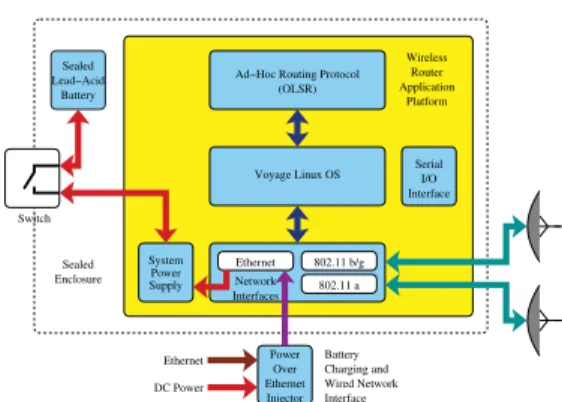
The PWAN architecture is based on the Wireless Router Application Platform (WRAP) from PCEngines as shown in Figure 1. The WRAP used provides a highly flexible node base that includes two Ethernet interfaces, two mini-PCI slots, a compact flash memory socket and a serial port. The AMD Geode CPU is appropriate for portable, battery powered applications and the entire WRAP con-sumes approximately 5W under load.
The PWAN operates using SAND OS, our custom Linux installation based on Debian Linux, which runs from the Compact Flash memory. SAND OS provides the flexibility to install Linux drivers and applications into the Linux kernel version 2.6.23. The multi-hop ad hoc net-working capability was provided by OLSR version 0.5.5. A variety of wireless network interfaces are available for the mini-PCI platform. The PWAN has been tested us-ing WiFi IEEE 802.11a/b/g network interfaces available from Ubiquiti, EnGenius and Wistron Neweb. Each of these interfaces uses an Atheros chipset and can be used in conjunction with the MadWiFi Linux driver. Interfaces
Ethernet 802.11 b/g 802.11 a
Serial I/O Interface Ad−Hoc Routing Protocol
(OLSR) Voyage Linux OS Wireless Router Application Platform Battery Lead−Acid Sealed Power System Supply Power Over Ethernet Injector Network Interfaces Sealed Enclosure Switch Ethernet DC Power Battery Charging and Wired Network Interface
Fig. 1. Portable Wireless Ad hoc Node (PWAN) Architecture
Fig. 2. Portable Wireless Ad hoc Node (PWAN) prototype
were configured to operate in IEEE 802.11g mode for these experiments.
A custom weather-proof enclosure was developed to house the PWAN. Each PWAN contains a 12V 7.2Ah sealed lead-acid battery that enables it to be used without mains power for up to ten hours and allows the node to be deployed in locations without access to a mains power supply. This battery may be charged by connecting an ex-ternal 12V DC power supply to the PWAN. The node has also been configured to be powered or recharged using a Power Over Ethernet (PoE) supply to minimise the num-ber of external connections required. Figure 2 illustrates the PWAN prototype device.
We also developed a modified PWAN prototype that could be used to investigate the performance of Voice over Internet Protocol (VoIP) over a multi-hop ad hoc net-work. Two options were considered when designing this system: firstly, a purely software-based VoIP implemen-tation known as a softphone; and secondly, a dedicated VoIP hardware platform. Employing a softphone would require each device to carry a display or to be operated using a laptop and this would significantly reduce the flex-ibility and convenience of the PWAN. The second option of incorporating a VoIP board into the existing PWAN ar-chitecture would allow voice calls to be made via the in-terface of an analogue handset telephone. The latter was
Battery Charging and Wired Network Interface Ethernet 802.11 b/g 802.11 a Serial I/O Interface Ad−Hoc Routing Protocol
(OLSR) Voyage Linux OS Wireless Router Application Platform Battery Lead−Acid Sealed Power Over Ethernet Injector Network Interfaces Sealed Enclosure Switch Ethernet DC Power
Ethernet VoIP Board VoIP Engine TelephonePort Power System Supply Power System Supply Handset
Fig. 3. VoIP-enabled PWAN architecture
Fig. 4. VoIP-enabled PWAN prototype
a simpler, more cost-effective and more elegant solution. A VoIP board was integrated into a number of PWAN de-vices as shown in Figure 3.
The VoIP board chosen for our experiments was the ZyXEL Prestige 2002. This allows VoIP connections to be established in either a peer-to-peer manner or connected to a server over the Internet, and also provides an ana-logue telephone interface to greatly increase the PWANs flexibility as a VoIP device. The VoIP cards were config-ured to make peer-to-peer calls and were interfaced with the WRAP board using an Ethernet connection as shown in Figure 4. The WRAP boards then acted as a gateway for the VoIP platform and routed data using the OLSR protocol to establish voice calls over a multi-hop ad hoc network.
LIFT
Node 8 Node 9 Node 10 Node 11 Node 2 Node 3 Node 4 Node 6 Node 7 Node 1 Node 5 FHR 128 128A 129 130 131 131A 131B 132 132A 133 134 135 136 137 138 duct duct VOID VOID VOID L1 1P1 1C1A 1C1 89m2 11m2 161m2 S4 49m2 81m2 100m2 30m2 11m2 39m2 131m2 29m2 100m2 12m2 12m2 12m2 1T4 1T5 S5 dn up dn B35SAP8 B35SAP7 B35SAP9 B35SAP10
Building 35, South Wing, Level 1
Fig. 5. Node layout of multi-hop ad hoc test bed
IV. TESTBEDMODEL ANDSCENARIOS
Two different test bed configurations were employed to investigate the performance of the PWANs. In the first configuration, eleven PWANs were located in one room and all external antennas were removed to simulate the effects of a longer propagation path between the PWANs while minimising the amount of interference from outside networks. The objective of this test bed topology was to investigate the capacity of the nodes under high node den-sities and we refer to this topology as the “Node Capacity” configuration. In the second scenario, an omni-directional antenna was connected to each node and nodes were dis-tributed between three rooms in two separate buildings as shown in Figure 5. This topology is referred to as the “Multi-hop Ad hoc” configuration. All nodes were set to operate in ad hoc mode and the OLSR protocol was enabled in both scenarios. This enabled the characteris-tics of a multi-hop ad hoc network to be monitored even though the actual data tansmission may have only been over a single-hop communication.
Testing scripts were written that simultaneously intro-duced ICMP (ping) traffic between pairs of nodes in the network. The test started with two nodes transmitting to two arbitrary nodes, possibly other transmitting nodes. This created four data flows when the return data path is accounted for. Each ping session was set to transmit us-ing a packet size of 576 bits. This effectively simulated a bi-directional constant bit rate traffic flow between the specified end-points. The number of ping flows in the network was progressively increased for each test run to evaluate the performance of the network under increasing load. This began by configuring two additional nodes to transmit data that produced a total of eight flows. This was repeated until 24 simultaneous data flows were at-tained. Three different tests were performed with differ-ent packet transmission rates for each set of flows. Data was transmitted at intervals of 0.2, 0.02 and 0.004s, which corresponds to a packet rate of 5, 50 and 250 packets per second (pkt/s) respectively. Each test was run for a period
of five minutes.
The average throughput, packet delivery ratio (PDR) and average round trip delay (ARTD) were measured for each network configuration to evaluate its performance. The throughput measures the average data transmission rate achieved per flow. The PDR is the rate of successful packet delivery, that is, the ratio of the number of pack-ets received at the destination to the data packpack-ets sent by the source. The ARTD metric measures the length of time it takes for a packet to complete a round trip between the source and destination, or two complete flows. ARTD was used instead of the end-to-end delay (EED) metric, since EED requires accurate clock synchronisation at all nodes. Better synchronisation techniques to allow accurate EED may be investigated in the future.
A real voice call was established through the network using two VoIP-enabled PWANs in addition to the quan-titative data transmission test. The VoIP test involved ob-serving the voice quality and the stability of the voice con-nection during each of the network loading tests.
V. RESULTS
The following sections present the results for the “Node Capacity” and “Multi-hop Ad hoc” test beds respectively.
A. Node Capacity Test Bed
Our initial run of this experiment used the default OLSR parameters. This test showed that the network became highly unstable as the number of data flows in-creased. This was due to the loss of vitalTCpackets reach-ing the MPRs. We tuned the OLSR parameters to produce fewerHelloand TCpackets and re-ran the experiment. We found that the overall network stability was dramati-cally improved for routes between static nodes. This also meant that the network topology had more inertia and took longer to update routes. This was ideal for our static node experiments and all ensuing tests used the tuned OLSR parameters.
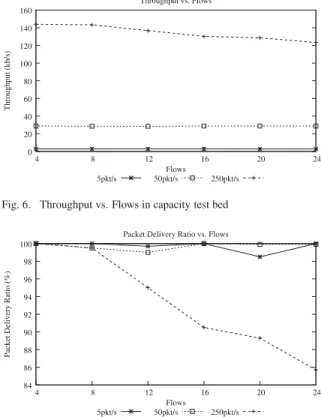
Figure 6 plots the data throughput results versus the number of simultaneous data flows. It was found that when the data packet dissemination rate was set to 5pkt/s and 50pkt/s the throughput graph stays fairly flat as the number of flows in increased. A slight drop in through-put was experienced when the data rate was increased to 250 packets per second. This drop in throughput in this case was caused by high levels of contention, which meant fewer control packets were able to travel through the net-work to maintain an up-to-date netnet-work topology. This was evident by monitoring the route table, which became highly unstable and loops began to occur even with the tuned OLSR parameters.
We also observed that VoIP call at this rate was not stable and often resulted in a break in connection. How-ever, this total single-hop bandwidth equates to more than
0 20 40 60 80 100 120 140 160 4 8 12 16 20 24 Throughput (kb/s) Flows Throughput vs. Flows 5pkt/s 50pkt/s 250pkt/s
Fig. 6. Throughput vs. Flows in capacity test bed
84 86 88 90 92 94 96 98 100 4 8 12 16 20 24
Packet Delivery Ratio (%)
Flows Packet Delivery Ratio vs. Flows
5pkt/s 50pkt/s 250pkt/s
Fig. 7. Packet Delivery Ratio vs. Flows in capacity test bed
70 simultaneous, bi-directional VoIP calls using a 24kb/s sampling quality. This is significantly greater than the ex-pected end-use and is satisfactory for the purpose of this test.
Figure 7 illustrates the packet delivery ratio (PDR) ver-sus flows. These results show that the network achieved over 98% delivery for both 5pkt/s and 50pkt/s transmis-sion rates. The delivery ratio for the 250pkt/s began to drop when 12 or more flows were used. Again, this was caused by the network becoming unstable as a result of control packet loss and interference.
Figure 8 illustrates the route trip delay (RTD) as the number of flows was increased. It can be seen that the network maintained a RTD of less than 3ms for both the 5pkt/s and 50pkt/s scenarios. This represents an approxi-mate average end-to-end delay of 1.5ms assuming similar forward- and reverse-path delays. The delay began to sig-nificantly increase in the 250pkt/s test when the number of concurrent flows were increased to 16 or more.
TheTCpacket loss due to network contention was the limiting factor in the single-hop network capacity test. The network performance may be significantly improved if the routing tables were able to be accurately maintained. This performance was significantly improved by tuning the OLSRTCparameters to decrease the frequency of the routing table updates. This also had the effect of taking
0 10 20 30 40 50 60 70 80 4 8 12 16 20 24
Round Trip Delay (ms)
Flows Round Trip Delay vs. Flows
5pkt/s 50pkt/s 250pkt/s
Fig. 8. Round Trip Delay vs. Flows in capacity test bed
a longer time to recover network stability after the data throughput was decreased at the end of a test.
However, the results suggest that the network is capable of supporting many simultaneous, bi-directional, single-hop VoIP calls. This was confirmed by making an ac-tive VoIP call with what we consider a reasonable call clarity in conjunction while maintaining a mid-range net-work traffic test. Actual voice quality testing is beyond the scope of this paper although we hope to examine this further in a future study.
B. Multi-hop Ad hoc Test Bed
We measured the performance of the flows that trav-elled over two or more hops to investigate the network’s multi-hop performance. The four flow base test consisted of two data flows over a two-hop connection and another two flows over a three-hop connection. Four single-hop flows were then added to increase the network conges-tion. The network loading was then increased until there were 24 simultaneous data flows. The two-hop data flow performance was used in preparing the following results.
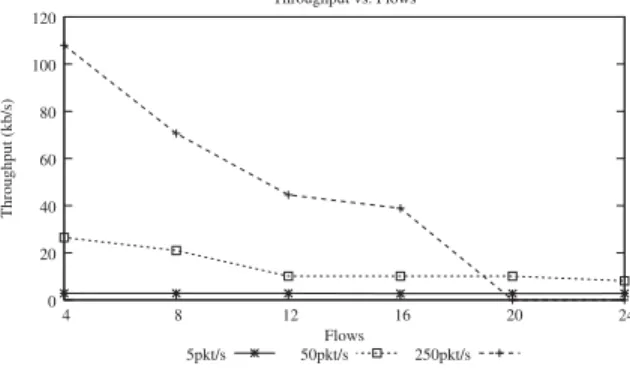
Figure 9 presents the throughput of a multi-hop route as the number of concurrent flows was increased. The throughput stayed consistent for the 5pkt/s test as the number of flows was increased. However, the through-put began to drop significantly when the number of flows was increased using a dissemination rate of 50pkt/s. This trend was more evident in the 250pkt/s test where multi-hop communications could not be established when more than 16 flows were present.
The packet delivery ratio results versus the number of flows is presented in Figure 10. A PDR of over 94% was achieved for all flow levels in the 5pkt/s scenario. How-ever, the PDR levels begins to fall significantly after four flows in the 50pkt/s test. Network congestion had an even greater effect on PDR at 250pkt/s which saw PDR drop to less than 50% when the number of flows were increased to eight and become unusable at 20 flows.
Figure 11 illustrates the average round trip delay ver-sus the number of flows. Again, the 5pkt/s scenario has
0 20 40 60 80 100 120 4 8 12 16 20 24 Throughput (kb/s) Flows Throughput vs. Flows 5pkt/s 50pkt/s 250pkt/s
Fig. 9. Throughput vs. Flows in multi-hop test bed
0 10 20 30 40 50 60 70 80 90 100 4 8 12 16 20 24
Packet Delivery Ratio (%)
Flows Packet Delivery Ratio vs. Flows
5pkt/s 50pkt/s 250pkt/s
Fig. 10. Packet Delivery Ratio vs. Flows in multi-hop test bed
the best performance where an average RTD of less than 3.5ms was maintained irrespective of the number of flows. Using 50pkt/s, the average delay slowly increased toward 20ms as the number of flows was increased to 24. When the dissemination rate was increased to 250pkt/s, the RTD increased dramatically when the number of flows was in-creased to eight and continued to increase until multi-hop connections were unable to be established at 16 flows.
Two observations can be made from these results. Firstly, the introduction of single-hop traffic has a sig-nificant effect on the multi-hop flows. This is because contention increases at each node, which creates further
0 20 40 60 80 100 120 140 160 180 200 4 8 12 16 20 24
Round Trip Delay (ms)
Flows Round Trip Delay vs. Flows
5pkt/s 50pkt/s 250pkts
delays. Secondly, the loss ofTCpackets reduces the accu-racy of the routing table at each forwarding node, which adds further delay to the delivery of each packet as it trav-els towards the destination. These are the same symptoms founds in the single-hop experiment. However, the effects were amplified in a multi-hop environment where data packets must contend with other packets at every node in the path to its destination.
VI. CONCLUSIONS ANDFUTUREWORK
In this paper, we have investigated the performance of a multi-hop ad hoc network in an indoor environment using a real test bed. Our test bed consisted of a number of cus-tom developed Portable Wireless Ad hoc Nodes (PWANs) which used the OLSR routing protocol to establish multi-hop routes. It was found that the PWANs provide a suit-able platform for both network testing and also for a low cost general-purpose ad hoc network including VoIP com-munication.
Two different scenarios were created to investigate both the effect of high node density and the behaviour of multi-hop routes as the level of traffic was increased. Our stud-ies showed that a multi-hop network becomes highly un-stable at high data traffic levels. This was primarily due to high levels of contention, which increased the amount of control packet loss and caused routing errors in the OLSR protocol. This not only decreased the data throughput for each route, but required several seconds for the network to reach stability after the traffic levels were reduced.
TheTCpacket loss due to network contention was the limiting factor in the single-hop network capacity test. The network performance may be significantly improved if the routing tables were able to be accurately main-tained. A possible solution for this could include making the routes effectively static by further tuning the OLSR topology parameters, although this would make the net-work less able to handle dynamic nodes. We are also in-vestigating a more radical solution that places control and data packets on different radio channels that will effec-tively eliminate contention on control packets.
In summary, the PWANs that we have created provide a good test bed for examining the performance of multi-hop ad hoc routing protocols in a real-world test. We multi-hope to continue using the PWAN platform to perform head-to-head comparisons of different routing protocols in a real test bed in the near future and to compare these results against those obtained by simulation.
REFERENCES
[1] B. Bellur, R.G. OGIER, and F.L Templin. Topology broadcast based on reverse-path forwarding routing protocol(tbrpf). In
Inter-net Draft, draft-ietf-maInter-net-tbrpf-06.txt, work in progress, 2003.
[2] S. Das, C. Perkins, and E. Royer. Ad Hoc On Demand Distance Vector (AODV) Routing. InInternet Draft,
draft-ietf-manet-aodv-11.txt, work in progress, 2002.
[3] P. Jacquet, P. Muhlethaler, T. Clausen, A. Laouiti, A. Qayyum, and L. Viennot. Optimized Link State Routing Protocol for Ad Hoc Networks, IEEE INMIC Pakistan. 2001.
[4] D. Johnson, D. Maltz, and J. Jetcheva. The Dynamic Source Rout-ing Protocol for Mobile Ad Hoc Networks. InInternet Draft,
draft-ietf-manet-dsr-07.txt, work in progress, 2002.
[5] Wolfgang Kiess and Martin Mauve. A survey on real-world imple-mentations of mobile ad-hoc networks. Ad Hoc Netw., 5(3):324– 339, 2007.
[6] David Kotz, Calvin C. Newport, Robert S. Gray, Jason Liu, Yougu Yuan, and Chip Elliott. Experimental evaluation of wireless simu-lation assumptions. InMSWiM, pages 78–82, 2004.
[7] Matthias Kropff, Tronje Krop, Matthias Hollick, Parag S. Mogre, and Ralf Steinmetz. A survey on real world and emulation testbeds for mobile ad hoc networks. InProceedings of 2nd International Conference on Testbeds and Research Infrastructures for the
De-velopment of Networks and Communities (TRIDENTCOM), March
2006.
[8] H. Lundgren, D. Lundberg, J. Nielsen, E. Nordstrm, and C. Tschudin. A large-scale testbed for reproducible ad hoc proto-col evaluations. InIEEE Wireless Communications and Networking
Conference (WCNC), March 2002.
[9] K. Pawlikowski, H. D. J. Jeong, and J. S. R. Lee. On credibility of simulation studies of telecommunication networks.