Escola de Engenharia
Pedro Vasconcelos Castro Lopes Faria
Remote Electronic Voting
Studying and Improving Helios
Remote Electronic Voting
Studying and Improving Helios
Pedro Vasconcelos Castro Lopes Faria
Dissertation submitted in partial fulfillment of the requirements for the degree of Master in Informatics Engineering at the University of Minho, under the
supervision of Jos´e Carlos Bacelar Almeida
Departamento de Inform´
atica
Escola de Engenharia
Universidade do Minho
Braga, December 30, 2012
A former North American President once said that the ballot is stronger than the bullet. In fact, the most civilized and organized way for a people express their opinion is by voting. However, there are people with bad intentions that affect voting and elections, being normal situations of coercion, collusion, fraud or forgery that disturb and cause alterations in the outcome of a vote. Thus, it becomes necessary to find ways to protect the voters, through vote secrecy and transparency, so that in end of a voting, democracy and justice prevail. Since the secret ballot papers until the electronic voting machines, passing through punched cards, technology in voting systems is evolving to ensure a greater security in elections, as well as greater efficiency, lower costs and other characteristics wanted in this type of systems. Nowadays, remote electronic voting is seen as the ultimate goal to achieve. The difficulty of developing such system is to ensure that it meets all the security requirements without infringing each other and without compromising the usability of the system itself. Thus, cryptography becomes an essential tool for obtaining security and integrity on electronic voting systems.
This master thesis focuses on the world of electronic voting, in particular, the remote electronic voting. The objective is to find a system of this kind, with real world applications, to be studied and analyzed in a security point of view. Hence, we made a research on voting and, more deeply, a research on electronic voting schemes, in order to learn how to conceive it, which include the different stages that compose an election, types of voting and the entities involved, and what requirements to fulfill, both the security and functional. Because cryptography is used in most schemes, a detailed study was also performed on the primitives most common in protocols of electronic voting. However, there are not many schemes that pass from theory to practice. Fortunately, we found Helios, a well known scheme that implements various cryptographic techniques for everyone, under certain assumptions, be able to audit polls conducted with this system. A study was performed in order to explain how it was constructed and to identify its strengths and weaknesses. We also present some ongoing work by different people to improve Helios. Finally, we propose improvements on our own, to fight against coercion, to decrease the levels of assumptions and overcome corruption issues. Furthermore, we propose measures to protect the virtual voting booth and a mobile application to cast votes.
Um antigo Presidente norte americano disse um dia queo voto ´e mais forte que a bala. De facto, a forma mais civilizada e organizada de um povo exprimir as suas opini˜oes ´e atrav´es de vota¸c˜oes. Infelizmente, tamb´em este mundo ´e afec-tado por pessoas com m´as inten¸c˜oes, sendo normais as situa¸c˜oes de coa¸c˜ao, conluio, fraude ou falsifica¸c˜ao que perturbam e causam altera¸c˜oes no resultado de uma vota¸c˜ao. Assim, torna-se necess´ario arranjar formas de proteger os votantes, atrav´es de segredo de voto e transparˆencia, de forma que, no final, a democracia e justi¸ca de uma vota¸c˜ao prevale¸cam. Desde dos boletins de papel secreto at´e `as m´aquinas de voto electr´onico, passando pelas punched cards, a tecnologia em sistemas de vota¸c˜ao vem evoluindo de modo a garantir uma maior seguran¸ca em elei¸c˜oes, assim como maior eficiˆencia, menor custos e out-ras caracter´ısticas que se querem neste tipo de sistemas. Nos dias de hoje, o voto electr´onico remoto ´e visto como o grande objectivo a cumprir. A grande dificuldade de se desenvolver tal sistema ´e garantir que o sistema cumpra todos os requisitos de seguran¸ca sem que se violem entre si e sem que isso prejudique a usabilidade do sistema em si. Assim, a criptografia torna-se uma ferramenta essencial para se obter seguran¸ca e integridade em sistemas de voto electr´onico. Esta tese de mestrado foca-se no mundo do voto electr´onico, mais especi-ficamente o voto electr´onico remoto. O grande objectivo seria arranjar um sistema desse tipo, que tivesse aplica¸c˜ao real, para ser estudado e analisado do ponto de vista de seguran¸ca. Fez-se ent˜ao uma pesquisa necess´aria sobre vota¸c˜oes e, mais aprofundada, uma sobre esquemas de voto electr´onico, de modo a aprender como se concebem, tanto as fases que a constituem como as entidades que normalmente fazem parte, e quais os requisitos a cumprir, tanto os funcionais como os de seguran¸ca. Como a criptografia entra em grande parte dos esquemas, tamb´em um estudo aprofundado foi realizado sobre as primiti-vas mais comuns em protocolos de voto electr´onico. No entanto, n˜ao existem muitos esquemas que passem da teoria `a pr´atica. Felizmente, encontrou-se o Helios, um sistema que p˜oe em pr´atica diversas t´ecnicas criptogr´aficas para que qualquer pessoa, dentro de certas assump¸c˜oes, possa auditar vota¸c˜oes conduzi-das por este sistema, ficando a privacidade nas m˜aos do Helios. Um estudo foi realizado de modo a explicar como foi constru´ıdo e identificar os seus pontos fortes e fracos. Tamb´em s˜ao apresentados alguns trabalhos em curso sobre este sistema. Finalmente, prop˜oem-se outros tipos de melhoramentos que visam: combater coa¸c˜ao, diminuir o n´ıvel das assump¸c˜oes e ultrapassar problemas de corrup¸c˜ao. Prop˜oem-se ainda medidas para proteger a cabine virtual de vota¸c˜ao e uma aplica¸c˜ao m´ovel.
First of all, I want to thank Professor Jos´e Carlos Bacelar Almeida for the overall support, the research guidance and also for all the suggestions that improved this dissertation. I am also grateful to: Professor Manuel Barbosa, for suggesting Helios as a case study; Professor Jos´e Valen¸ca, for interesting discussions about e-Voting; and to Gon¸calo Hermenegildo from MULTICERT, for giving me an insight about voting in Portugal.
To all my friends, roommates and Confraria do Matador, thank you for your support and positive thinking. I also want to thank the SSaaPP project members for their understanding and patience during the last stage of this work. A special thanks to Leonel, I am very grateful for all the help you pro-vided and for the endless discussions we had about security.
I wish to thank Vˆania. You always kept me happy during the darkest hours. And finally, I don’t have the words to describe how much thankful I am to my parents and sister. Thank you for everything.
This document is a master thesis in Informatics Engineering (area of Cryp-tography and Security) submitted to Universidade do Minho, Braga, Portugal.
Notes to the reader:
• All links were checked at end of writing this document - 30 December.
• Throughout the document the academic plural appears often in the text to describe the work developed. This form was intentionally used for two reasons: first, some of the work here presented was done in cooperation; and second, the plural can help the reader to feel more closely connected with the work done.
• Some images may be hard to understand. In the electronic version of this document, they are links if one wishes to download and see them in full size.
1 Introduction 1 1.1 Motivation . . . 3 1.2 Objectives . . . 4 1.3 Contributions . . . 5 1.4 Roadmap . . . 6 2 Electronic Voting 9 2.1 Pros and Cons ofe-voting . . . 10
2.2 Conceptual Perspective . . . 11
2.2.1 Voting and Ballot Types . . . 12
2.2.2 Generic Model. . . 15 2.2.3 Entities Involved . . . 17 2.3 Voting Requirements . . . 19 2.3.1 Security properties . . . 20 2.3.2 General Requirements . . . 22 2.4 Summary . . . 23 3 Cryptographic Primitives 25 3.1 Homomorphic Encryption . . . 26 3.1.1 ElGamal . . . 27 3.1.2 Exponential ElGamal . . . 28 3.2 Mix-Nets. . . 28 3.3 Blind Signatures . . . 30 3.4 Other primitives. . . 33 3.4.1 Re-Encryption. . . 33 3.4.2 Deniable Encryption . . . 34 3.4.3 Zero-Knowledge Proofs . . . 34 3.4.4 Secret Sharing . . . 36
3.5 Schemes and designs . . . 38
3.5.1 Cramer, Gennaro and Schoenmakers scheme . . . 38
3.5.2 The Fujioka et al. Voting Scheme . . . 39
3.5.3 Boneh and Golle’s mix-net . . . 40 ix
3.6 Summary . . . 42
4 Helios 45 4.1 The IACR Contest . . . 45
4.1.1 The Contestants . . . 48
4.1.2 Why Helios? . . . 53
4.2 Overview. . . 54
4.2.1 Pre-election Stage. . . 54
4.2.2 Voting . . . 58
4.2.3 Post-voting and Results . . . 59
4.3 Backstages . . . 60
4.3.1 Pre-election Constructions . . . 60
4.3.2 Encrypting Ballots . . . 62
4.3.3 Tallying and Decryption . . . 65
4.4 Assumptions & Improvements . . . 65
4.4.1 Assumptions. . . 66
4.4.2 Improvements . . . 67
4.5 Summary . . . 69
5 Improvements 71 5.1 Working against coercion . . . 72
5.1.1 The problem. . . 72
5.1.2 One possible solution . . . 73
5.2 Pseudonyms . . . 77
5.2.1 The need of registration . . . 78
5.2.2 Independent entities . . . 79
5.3 Corrupted RA . . . 82
5.3.1 Zero Knowledge Sets . . . 82
5.3.2 How does it fit . . . 84
5.4 Protecting the booth . . . 85
5.4.1 Phishing attack . . . 86
5.4.2 Code Signing . . . 87
5.5 Adding more mobility . . . 88
5.6 Summary and final notes . . . 91
6 Conclusions 93 A Complements 103 A.1 Brief History of Voting Technologies. . . 103
A.1.1 Secret Paper Ballot . . . 103
A.1.2 Lever machine . . . 104
A.1.3 Punchcards . . . 104
A.1.5 Direct-recording Electronic . . . 105
A.2 Additional Lessons on Cryptography . . . 106
A.2.1 Hard Problems . . . 106
A.2.2 Paillier Encryption . . . 107
A.2.3 Informally Explaining ZKP . . . 108
A.2.4 Blind Schnorr Signature . . . 109
A.2.5 Guillou-Quisquater identification scheme . . . 110
A.3 Less Important Figures . . . 112
A.3.1 Helios . . . 112
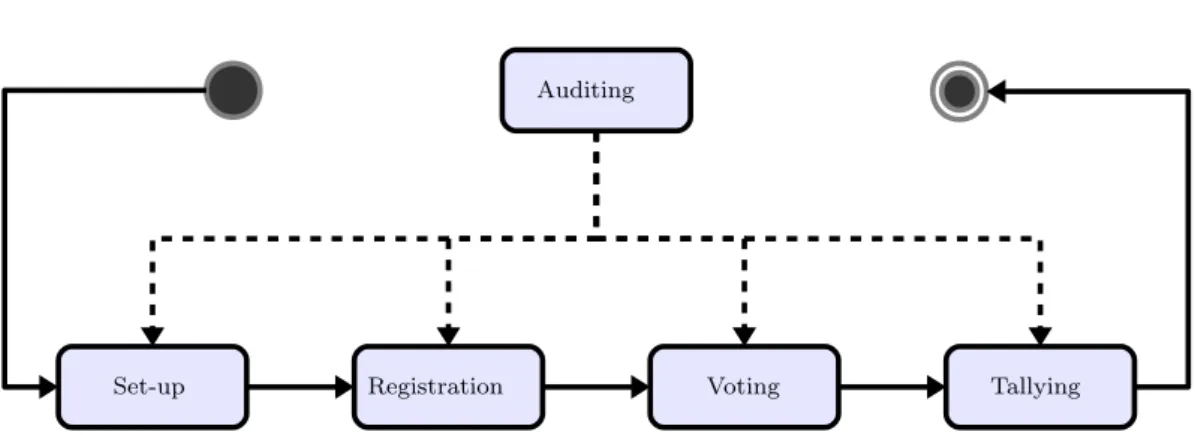
2.1 General diagram of voting activities . . . 16
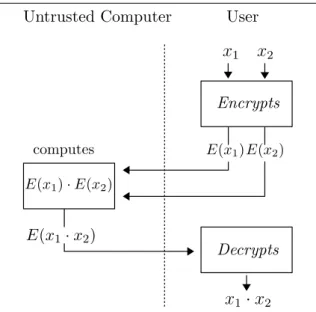
3.1 The user delegates, safely, mathematical computations to the untrusted computer. . . 26
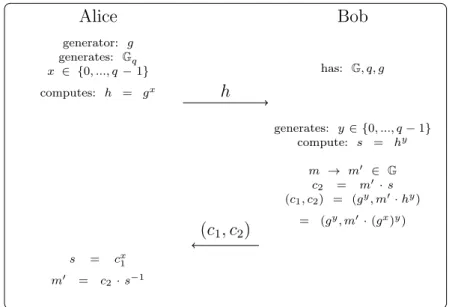
3.2 ElGamal Encryption . . . 27
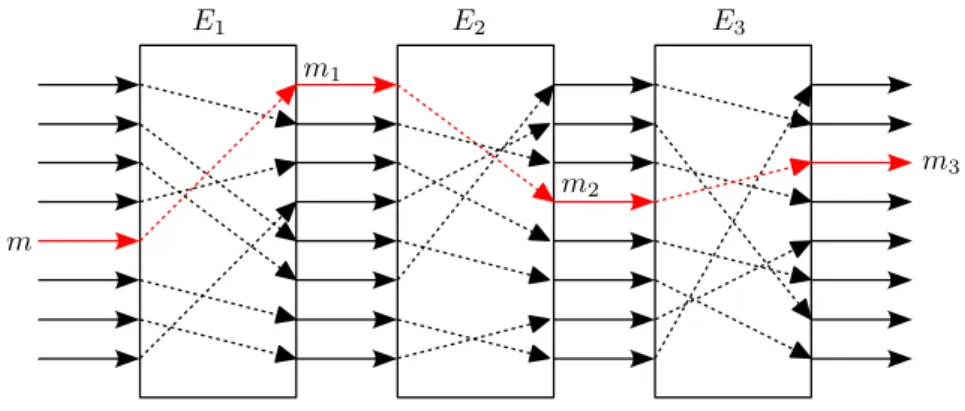
3.3 Mix-net example. . . 29
3.4 Classical RSA Signature . . . 32
3.5 Blind RSA Signature . . . 33
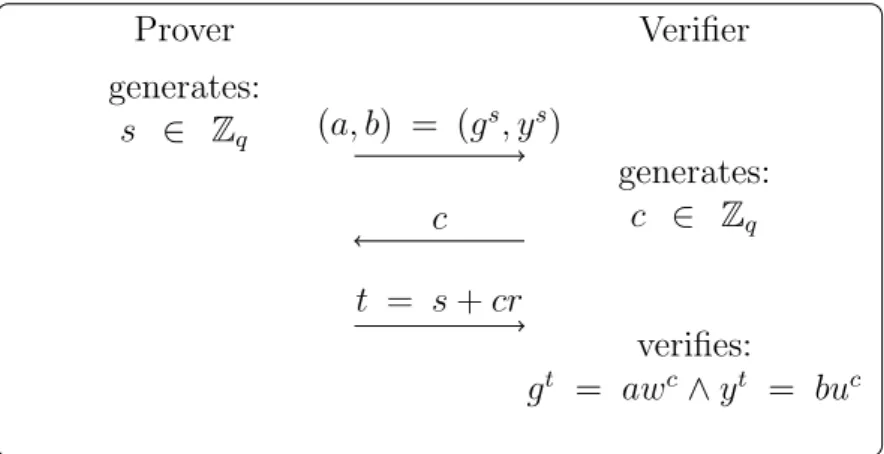
3.6 Proving the equality of two discrete logarithms. . . 35
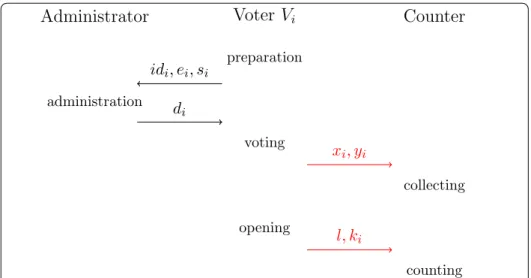
3.7 Fujioka et al. voting scheme. . . 40
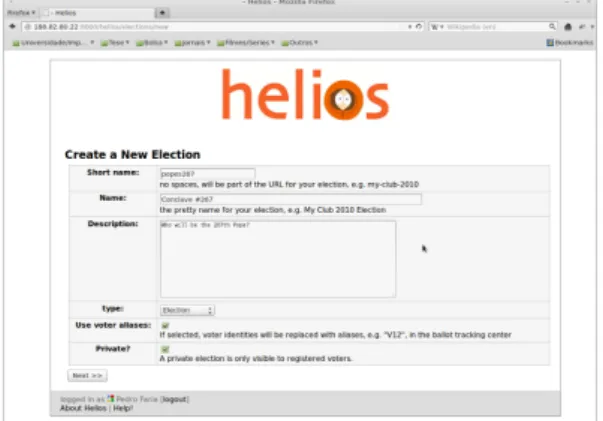
4.1 Set of parameters to create an election. . . 55
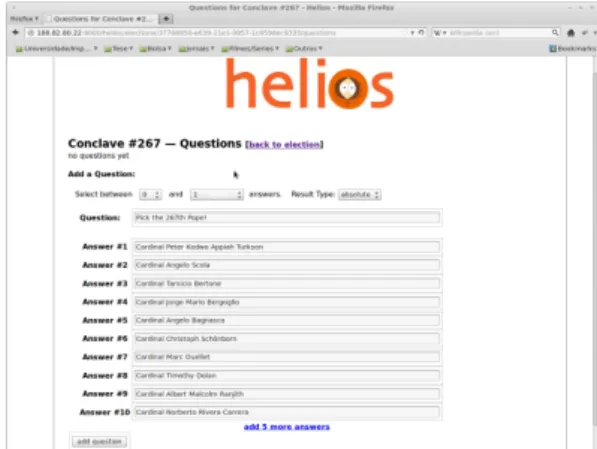
4.2 Creating questions and corresponding rules. . . 56
4.3 Choosing the next Pope. . . 59
4.4 Final results. . . 60
4.5 Moments before the election is finished. . . 67
5.1 Different periods of coercion time. . . 73
5.2 Registration with two passwords. . . 75
5.3 Amount of time needed to successfully coerce a voter. . . 76
5.4 New entity introduced in Helios. . . 78
5.5 Registration stage. . . 79
5.6 Publishing electors list. . . 80
5.7 Voting. . . 80
5.8 Summing the Zero-Knowledge Sets (ZKS) protocol. . . 83
5.9 Embedding the ZKS protocol. . . 85
5.10 Result of signed scritps. . . 87
5.11 Minimal representation of the application’s packages. . . 89
5.12 Home frame.. . . 90
5.13 Picking options. . . 90
5.14 Encrypting. . . 91
5.15 Inserting the credentials. . . 91 xiii
A.1 Ballot box.. . . 103
A.2 Lever Machine. . . 105
A.3 Datapunch. . . 105
A.4 Optical Scan. . . 106
A.5 DRE Machine. . . 106
A.6 Paillier Encryption. . . 108
A.7 The cave. . . 108
A.8 Classical Schnorr Signature . . . 110
A.9 Blind Schnorr Signature . . . 111
A.10 Guillou-Quisquater identification scheme. . . 111
A.11 Login page. . . 112
A.12 Home page of the election. . . 112
A.13 After uploading the list of voters. . . 112
A.14 Adding trustees warning. . . 112
A.15 Waiting for the upload of the public key. . . 113
A.16 Invitation to participate in the election as a trustee. . . 113
A.17 Checking the secret key. . . 113
A.18 Voting instructions. . . 113
A.19 Encrypted vote fingerprint. . . 113
A.20 Auditing a ballot. . . 113
A.21 Confirmation of credentials. . . 113
A.22 Upload of the secret key. . . 113
A.23 Final verification. . . 114
A.24 Smart ballot tracker with the administrator’s point of view.. . . 114
A.25 Default booth home. . . 114
2.1 Single candidate ballot example . . . 12
2.2 Multiple candidate ballot example . . . 12
2.3 Eurovision ballot example . . . 13
2.4 Referendum ballot example . . . 13
2.5 Write-in ballot example . . . 13
2.6 A three round election . . . 14
2.7 Preferential ballot example. . . 14
2.8 Single transferable vote . . . 15
4.1 Example of a list of voters . . . 57
4.2 Example of a generated pair of keys. . . 58
4.3 Election structure . . . 61
4.4 ElGamal Encryption (ElGamal) public key structure . . . 61
4.5 Question structure . . . 62
4.6 Vote structure . . . 63
4.7 Encrypted answer structure . . . 63
4.8 Individual and Overall Proofs . . . 64
5.1 New voter structure jointly with election information. . . 76
5.2 Conversion of JSON structure to Java class. . . 90
API Application Programming Interface BB Bulletin Board BS Blind Signature CA Certificate Authority DE Deniable Encryption DoS Denial-of-Service DDH Decision Diffie-Hellman
DLP Discrete Logarithm Problem
DRE Direct-recording Electronic
DS Digital Signature
E2E End-to-End
e-voting Electronic Voting
EEG Exponential ElGamal Encryption
ElGamal ElGamal Encryption
HTML HyperText Markup Language
HE Homomorphic Encryption
i-voting Internet Voting
IACR International Association for Cryptologic Research
JS JavaScript
JSON JavaScript Object Notation
mixnet Mixed Network
PKC Public-key Cryptography
RA Registration Authority
RSA Rivest, Shamir and Adleman
SBT Smart Ballot Tracker
SHA Secure Hash Algorithm
SS Secrete Sharing
URL Uniform Resource Locator
ZKP Zero-Knowledge Proof
Introduction
The first lesson is this: take it from me, every vote counts.
Al Gore
The above quote came four years after one the biggest scandals regard-ing elections. It was the year 2000, and it opposed Al Gore against George W. Bush for the position of the President of the United States1. What was later known as the Florida recount, started with different television companies announcing different winners before the polling was over. In a close race, in which the winner won by less than 500 from 6.000.000 votes, there was a lot of controversy involved in the tallying stage. Even a few years later, some independent studies continue to give different winners for that election. But, leaving aside conspiracy theories, some problems were actually found involving voting technologies. The biggest was on the usability and design of ballots2,
where using the called butterfly ballots resulted in casting wrong votes. This and other problems, urge the need to make reforms on the voting system of that country.
More recently, last year in Russia a wave of protest arose all over the country. It started precisely with the 2011 Russian legislative elections , where a large number of people, under the slogan “For Fair Elections”, contested the election results3 by claiming that most of the major problems that affect
1Complete story of the presidential election and scandal:
http://en.wikipedia.org/ wiki/United_States_presidential_election,_2000
2(In Portuguese) The problem:
http://www.publico.pt/Cultura/ quando-o-design-corre-mal-1559435.
32011-2012 Russian Protests: http://en.wikipedia.org/wiki/2011%E2%80%932012_ Russian_protests.
elections had happened4, such as:
• Election fraud and falsification of several partial election results;
• Obstruction of observers;
• Illegal campaigning;
• Multiple voting;
• Coercion with threats of violence;
But even small organizations, cities or villages are susceptible to corruption in elections. For instance, currently, more than one fifth of the surveyed voters in A¸cores are “ghost-voters”, i.e. dead people with permission to vote5. If this at first sight may not seem like a big deal, one may think that the extra votes would be simply discarded, given corruption it may lead to other severe problems. For instance, one may use the extra votes for vote buying or ballot stuffing.
There are many more examples of fraud, corruption, mistakes or deceptions regarding real-world elections. To overcome these problems, new voting types, voting systems and new technologies are always emerging in order to create truly fair and transparent elections. But new solutions promote new ways of corruption, so they are always temporary and subject to improvement. For instance, regarding voting technologies, if lever machines and punchcards are history, the Direct-recording Electronic (DRE) voting machine, was already introduced over 20 years ago and is still suffering changes. In turn, although it was the first to appear, paper ballots have not yet loose importance in voting systems, being normally the first choice when creating elections. Even so, some countries have already established elections that ran exclusively on Electronic Voting (e-voting) machines, being Brazil the first country to run government elections solely in DRE machines. Estonia in turn, is seen as the most technologically advanced country when the matter is voting systems. In spite the lack of security and the still not achieved security requirements, they already conducted online elections, a kind of remote e-voting, which by now is seen as the greatest and last goal of voting systems. Unfortunately, some countries are still far from conducting such elections, due to financial difficulties, high standards for security requirements or even legal issues. For
4Guardian news:
http://www.guardian.co.uk/global/2011/dec/10/ russia-elections-putin-protest.
5The complete story: http://www.publico.pt/Pol%C3%ADtica/ mais-de-um-quinto-dos-recenseados-nos-acores-sao-eleitoresfantasma-1566193.
example, in the Constitution of the Portuguese Republic, the 121th article states: the right to vote in national territory is exercised in person6.
1.1
Motivation
Online elections is already a service wide explored in the market. From a quick research, one is able to find several companies, such as SimplyVoting, Election Buddy or Votenet7, that provide solutions whose goal is to achieve the main
re-quirements of elections: secrecy and democracy. But since “in business, silence is golden”, most companies, to protect their business, fall into the mistake of making end-users to blindly trust that their votes are not tampered or their privacy violated. Such conclusion is pointed out in [Gerck et al., 2002], where they also claim that e-voting is not like any other electronic commerce, since they meet different criteria. For instance, a receipt from an electronic trans-action cannot be like a receipt from a casted vote, since it could lead to severe problems.
Thus, there is a need to create systems that can be fully audited by any-one who uses it. Even for security reasons, is not good to rely on obscurity. Using an interesting analogy of [Schneier, 1996], taking a letter, locking it in a safe, and hide it somewhere in the world for one to crack it is not achieving security. On the other hand, provide documentation of the safe, its “source code” and all kind of specifications and one still not be able to crack it, that is achieving security. The same principles should be followed when designing voting systems. Here, cryptography plays an important role, providing the tools necessary to create protocols where the voting requirements are fulfilled, and each end-user will be able to verify it.
Nevertheless, there is always a need of an assumption of trust in order to prove the security of an e-voting scheme. The problem with most of online voting services is the high level assumption of trusting in the system for all integrity and privacy matters related to elections. In literature, is common to find authors that express concern about it, and not only in e-voting schemes. One practical solution is the inclusion of external entities on the designs to split or share responsibilities of election’s roles, and can be seen in famous
e-voting schemes, such as [Fujioka et al., 1993, Benaloh and Tuinstra, 1994]. Thus, many schemes may guarantee its safety without having too strong
as-6 (In Portuguese) Constitution:
http://www.fd.uc.pt/CI/CEE/OI/Constituicao_ Portuguesa.htm.
7Company’s websites: http://www.simplyvoting.com/ http://electionbuddy.com/ http://www.votenet.com/
sumptions.
Finally, there is a special problem regarding remote electronic elections, more concretely Internet Voting (i-voting) that uses personal computers as voting booths, which is the one of the main reasons why the remote e-voting
hypothesis seems so unreal among renown experts, or that it will take years, or even decades, to achieve in a large scale [Gerck et al.,2002]. The problem is that since personal computers are involved, there is no way to guarantee that they are not tampered, with no virus, worms, spyware or any kind of malware. There are solutions, as the use of Live CDs, but since there is no protected environment, one is only capable of postponing the problem. Nevertheless, we believe that if the postponement is great enough, it is justifiable to create and apply security techniques and add them to voting systems.
1.2
Objectives
The main objective of this work is to create, or improve, measures that assure security on a remote e-voting system. With that in mind, the path to reach that goal will consist in:
• Entering deeply on the e-voting world. Understand the usual require-ments and the security properties of general voting systems. Understand also the workflow of an election and learn both the entities and the voting types involved.
• Studying the cryptographic primitives that are usually used to improve security on e-votingsystems. For each item found, see how it is applied in a scheme and the advantages that it brings.
• Researching remotee-votingsystems, more concretelyi-votingsystems. From the available systems found, choose one based on the documen-tation, on the tests performed, on its characteristics and cryptographic techniques involved. Also, the chosen system must open-source, in order to work on it and perform changes if necessary.
• Inventing new ways to improve or modify the security on the chosen system in order to overcome the limitations, faults or fails encoutered on that system.
1.3
Contributions
This work presents an overview of the e-voting world, with special attention to the conceptual perspective of an election and the voting requirements. Hav-ing a good understandHav-ing of how an election works would be an essential and necessary step for evaluating and making changes on a system. Therefore, the conceptual perspective covers the different kind of voting types, the main stages of an election and the entities involved.
This work also presents the most used primitives when creating e-voting
protocols. So for each one of three main primitives, an informal explanation, with the help of simple analogies, was given, a well cited scheme was chosen to demonstrate its utility and a technique that applies it was described. For the rest of the primitives, a detailed description was presented. Nevertheless, they are of crucial importance to understand the rest of the work.
Helios was the chosen system to work on, due to its characteristics, easy of use and the fact of being open-source. Based on the documentation, source code, papers documenting attacks and uses, thesis, and numerous tests, we present a description of the workflow and techniques used in this system. We also present several ongoing works that aim to improve security on Helios, which include decreasing the level of assumptions of this system and overcome encountered flaws. Finally, we try to improve the system on our own, by:
• Improving coercion-resistance in Helios: based on other schemes, we choose to modify the system to have two kind of passwords for the voter to use in different kind of situations. This do not solve the problem, but may increase greatly the protection of the voter. Unfortunately, this also leaves some open problems, specially the discussion of whether is more relevant to have universal verifiability or coercion-resistance.
• Adding an extra entity to the system: using the approach of divide to conquer, used in many schemes, this idea occur to solve the biggest as-sumption of Helios, “Trust Helios for privacy”, and a small contradiction detected, when using private elections, if using Helios alone, the access to the virtual booth is not anonymous.
• Resolving a particular corruption problem: regarding the registration stage, we design a solution based on a Zero-Knowledge Proof (ZKP), to help to prevent fake voters from entering in an election.
• Improving authenticity and integrity on virtual booths: add a feature whose goal is guaranteeing that the booth in which the voter is casting
his vote is authentic. The solution was conceived with code signing.
• Improving mobility: A prototype on an Android application for Helios was developed. The goal of this tool was to provide a native application that allow voting from a smartphone without recurring to the phone’s slow browser.
1.4
Roadmap
This work is divided into 6 Chapters. The first chapter, the current one, presents an introduction to all the work undertaken for this dissertation.
Chapter 2 introduces the e-voting world. It starts by describing the ad-vantages of e-voting systems. Then, explains how an election works by presenting the most used voting types, the entities that are usually found in ane-votingsystem and a detailed stages of an electronic election. This chapter ends with a list of security properties and general requirements of this kind of systems.
Chapter 3 presents the cryptographic primitives most used on voting schemes. It gives emphasis to the three most used: Homomorphic Encryption (HE), Blind Signature (BS) and Mixed Network (mixnet). For each one of these primitives, it describes one well known scheme that use the primitive and a detailed technique that implements it. The chap-ter also presents four other primitives: ZKP, Deniable Encryption (DE), Re-Encryption and Secrete Sharing (SS).
Chapter 4 first starts by presenting a contest for e-voting systems and de-scribes the contestants. Then, this chapter analyses a remote e-voting
system called Helios. By using an example, it describes how an elec-tion works and what is possible to do. Next, the backstage of Helios is explained, mentioning the techniques involved. Finally, some security assumptions and current works on this system are presented.
Chapter 5 is divided in five sections. The first explains how a new measure to improve coercion-resistance was created. The second introduces a new entity to the system that will provide a significant decrease on the biggest assumption of Helios. The third deals with a registration problem and the corruption that may derive from it. The fourth with lack of trust in a virtual booth and how to guarantee it. Finally, the last section presents a prototype of an Android application.
In the last chapter we present the conclusion of this dissertation, summa-rizing the developed work and describing what can be done in the future based on it.
Electronic Voting
At the bottom of all the tributes paid to democracy is the little man walking into the little booth with a little pencil, making a little cross on a little bit of paper.
Sir Winston Churchill, 1944
Democracy, like many other concepts, has its origin in ancient Greece. It is usually described as a type of political regime in which the power to rule and make decisions belongs to “the people”. There are two forms of democ-racy: direct democracy, in which people express their will in each particular subject; and the most common form of democracy, the so-calledrepresentative democracy, in which they express their will by electing a set of representatives, which in turn make the decisions for them. But both forms of democracy have one crucial point in common: they depend on processes of choice made by the people. This process is generally performed by voting.
Thus, voting can be described as a decision process, in which voters, i.e.
those previously designated to participate in the voting process, express their opinion through a predetermined choice. The vote then becomes an important process to the preservation of democracy. However, to avoid pressure on vot-ers and coercion by othvot-ers, it is necessary that the vote is secret. Therefore, there is a need to create mechanisms and schemes that result in systems that ensure the privacy of voters in order to increase fairness in elections, and thus preserve democracy.
In this chapter, an overview about voting, with more emphasis in Electronic Voting (e-voting), will be presented. It will start with a brief analysis of pros and cons of usinge-votingsystems in Section2.1. In Section 2.2, a conceptual
perspective of a general voting system will be given, referring various types of voting, a generic model of a voting system and some common entities involved in it. Section2.3will be divided into two subsections, both talking about voting requirements: one to security properties and the other to general requirements. Finally, section 2.4 will summarize this chapter. A small extra section about the history of voting technologies is given in AppendixA.1.
2.1
Pros and Cons of
e-voting
Although the discussion of pros and cons of e-voting may lead to an exten-sive debate, this section will only briefly summarize points of advantages and disadvantages that can be easily found in the literature.
Preparation. Starting with the preparation of an election, e-voting may require a big initial investment for equipment, cost of planning and testing phases. On the other hand, classical paper ballots are easier to understand, do not require complex testing and equipment is far more simple. But this only regards one first election. For further elections, e-voting will not require the initial investment, since the equipment already exists, the planning may be adapted and the testing may have already been done. In turn, classical paper ballot must need new equipment, at least for ballots, and has higher costs of manpower. Moreover, ine-votingis possible to make last minute changes, for example changing the layout of the ballot, and that may not imply having extra costs.
Voting process. Regarding the voting process, e-voting also offers several advantages. The first is the higher level of usability when comparing with paper ballots. It may prevent the casting invalid ballots, since that ballot may be evaluated when filling it. With electronic ballots, ambiguity may be eliminated, since the ballot may contain far more information than the paper version. Concerning people with disabilities or difficulties, electronic ballots can be easily modified to improve the usability according to the person’s disability, for instance audio ballot for blind people or extra languages for foreign voters. Another advantage is thate-votingwill probably speed up the voting process, e.g no waiting lines for submitting a ballot. An important feature of e-voting
is the possibility of re-voting, i.e. modify the first casted vote, which in the classical paper ballots is not possible. Finally, voting can be made from any poll station, and ultimately, can even be made in home.
Vote counting and results. In several e-votingsystems is possible to pro-tect the integrity of an election under some assumptions, which on the other kind of voting systems, the voter must blindly trust on the election’s results. However, e-voting systems are technically more evolved. Hence, for the ma-jority of the voters the whole election’s process may by a huge black box. In other words, most people will not understand what is happening and why they can trust in the system. Fraud and tampered results are harder to obtain with
e-voting systems. Mainly because modifying a digital ballot is not so trivial when comparing with its paper version. Digital ballots are also easily stored and can be audit in a later stage of the election. Recounting is another pro argument, since it is an easy process with no high costs attached. On the other hand, if it is harder to corrupt elections, it is also harder to find corruption. Tampering ballots can be made is such a low level that it makes almost im-possible to track corrupted ballots to auditors. When using paper ballots, the entire process can be seen, from the moment that the voter cast a vote, to the transportation of the ballot box and tallying. Even so, e-voting brings more benefits, for instance the time for tallying is way more faster when comparing with paper ballots, and the results far more accurate, because errors are more likely to happen when the count is made by humans than by machines.
Other con arguments. Since software is involved with electronic machines, there is always the chance of a particular voting booth be tampered. The machines are prone to hacking and any kind of malware, such as worms, virus,
trojan orphishing attacks. Finally, an error in a centralized system may affect and compromise an entire election.
2.2
Conceptual Perspective
As much as a voting system uses the latest developments/resources regarding web servers, cryptographic techniques, everything related to security, it will never be safe if it does not have a strong security model behind it, i.e. if the model is inconsistent and the tools are not correctly used it becomes impos-sible to guarantee the safety of the system. Thus, it is necessary to define a model that pay attention to every entity and requirement of the system.
In this section, we will introduce the reader to different types of polls, to a generic description of a e-voting system and to a set of the normally used entities and a description of their roles.
2.2.1
Voting and Ballot Types
When modelling a voting system, the type of voting may influence the archi-tecture of the system and technical characteristics, such as security or data storage. Therefore, it is essential to consider any kind of voting to have a well prepared system. In this subsection, several of the most used voting types are introduced.
Single candidate selection This is the most common type of voting, and can be mostly found in government elections. From a set of two or more candidates, the voter can choose at most one, or he can leave his vote blank. In the end, wins the candidate with a higher number of votes. Example 2.1 simulates a ballot.
Candidate Vote
Alice Bob
Eve X
Example 2.1: Single candidate ballot example
Multiple candidate selection A bit different from the previous case. Now the voter, from a set of candidates, has a minimum and a maximum of possible selections. Like the previous example, wins the candidate with a higher number of votes. Examples can be viewed in 2.1 and 2.2.
Candidate Vote
Alice X
Bob
Eve X
Example 2.2: Multiple candidate ballot example
Weighted multiple candidate selection Given an X number of points, a voter may distribute them in a list of candidates. It may have some rules associated, such for example, the voter can not give all the points to a single candidate. With its popularity increasing, a example of its use in the real world can be seen popular showEurovision Song Contest, where a country award a set of points from 1 to 8, then 10 and finally 12 to other songs in the competition. An illustration of the vote is simulated in2.3.
Country Votes Albania Austria 3 Belgium . . . United Kingdom 5 Ukraine 10
Example 2.3: Eurovision ballot example
Vote changing (a.k.a. Re-Voting) More a property than a type of voting,
Vote changing elections allow a voter to change his vote until the dead-line, where it is casted. This kind of voting usually increases the security complexity of a voting system.
Referendum Commonly used in political affairs, where the people is called to directly decide on a problem, a referendum is a particular kind of voting. It may be seen as a “yes or no” question, just like in Example2.4, where the voter can even left his vote in blank, if he can not decide.
Question Yes No
Should the driving age be lowered to 16? X
Should the drinking age be lowered to 12? X
Example 2.4: Referendum ballot example
Write-in A Write-in vote is a kind of open vote. The voter answers to a decision writing his choice in a ballot. Although it is useful and necessary in some situations, for instance when the voter’s choice is not on the set of the candidates and there is a field called “Other” where the voter can write his choice, these kind of votes are usually hard to cast and evaluate. Example of aWrite-in ballot in 2.5.
Candidate Vote
Alice Bob Eve
Other Charlie
Runoff voting Generally, some elections require that the winner must be elected with more than 50% of the casted votes. As a result, the concept of aRunoff voting was born. This kind of election is a continuous process, where after each round, the weakest candidate is eliminated until there is one with more votes than the sum of the remaining votes. Table 2.8
exemplifies a three round election.
Candidate Vote Alice 15% Bob 35% Charlie 10% Eve 40% Candidate Vote Alice 25% Bob 35% Eve 40% Candidate Vote Alice (winner) 60% Eve 40%
Example 2.6: A three round election
Preferential voting Similarly to the Weighted multiple candidate selection, in the Preferential voting the voter also has the opportunity to give to each candidate a different preference. Ordinarily, the voter order the list according to his preference, as we can see illustrated in table2.7.
Candidate Vote
Alice 1
Bob 4
Charlie 3
Eve 2
Example 2.7: Preferential ballot example
Single transferable voting This kind of voting mixes the last two voting types and allows multiple winners. It is seen as the most fair voting type, since it minimizes the waste votes, i.e. votes that were discarded since did not choose any of the winners. It has several counting methods, depending on goal of the election. The following example simulates an election with this kind of voting1.
Imagine an election to nominate the three best chess players of the world. From a set of 10000 voters, each one of them fills a preferential ballot and submit to a ballot box. Then, a quota must be defined. In this case, it will be the Droop quota:
votes needed to win = valid votes cast winners+ 1 + 1
Thus, the quota will be 2501. Then, a count is made for each preference and the result will be the first table of Example2.8. Since only one person has win, the surplus of votes will divided according to the preferences of the extra votes. In this case the surplus was 3000, in which 2001 votes have as second preference Dave and 999 Eve. Dave will be the second winner with 3001 votes, and the 500 extra votes are equally divided between Bob and Charlie. Because no winner is found, the candidate with less votes is removed and his votes are divided between the other two final candidates. In the end, Eve has more votes than Bob, so she is the third and last winner.
Candidate Vote Alice 5501 Bob 2000 Charlie 699 Dave 1000 Eve 800 Candidate Vote Alice (win) 2501 Bob 2000 Charlie 699 Dave 3000 Eve 1799 Candidate Vote Alice (win) 2501 Bob 2250 Charlie 949 Dave (win) 2501 Eve 1799 Candidate Vote Alice (win) 2501 Bob 2250 Charlie (lost) 0 Dave (win) 2501 Eve 1799 Candidate Vote Alice (win) 2501 Bob (lost) 2408 Charlie (lost) 0 Dave (win) 2501 Eve (win) 2590
Example 2.8: Single transferable vote
2.2.2
Generic Model
To give a general overview of how a voting system works, we present a generic model based in some different schemes, studies and projects[M¨agi, 2007,Ryan et al., 2009, Sampigethaya and Poovendran, 2006, Mercuri, 2001, Cranor and Cytron, 1997, Aditya et al., 2004b]. A general view of the activities involved in a election is summed up in Figure2.1.
Auditing
Registration Voting Tallying
Set-up
Figure 2.1: General diagram of voting activities
The next list describes each stage. It is important to note that this is an attempt to describe the behavior of an election in the most abstract possible way, in order to cover all voting schemes. Thus, the technical stages that generally fall into e-voting systems (e.g. data storage) will not be described.
Set-up is also known as Announcement stage, is the initial stage where the voting parameters are initialized. This covers the candidates, the voters, the authorities, the type of the election (e.g. counting rules or ballot validity rules) and voting procedures.
Registration is the phase where is generated the election list, i.e. the public list with all the eligible voters. For this purpose, each voter must register accordingly to different criteria defined in the previous stage, which will determinate their eligibility.
Voting starts with the authentication of the voter. If he is an eligible one, he will have access rights to vote. To do so, first the user needs to authenticate, using some kind of credentials, for example, an identity document. Afterward, there are two steps to a voter be able to cast his vote:
• Voter choice - the step in which the voter picks his candidate. It should be done in a private place, to avoid any kind of intimidation or coercion by a malicious party.
• Vote submission - in an anonymously way, to ensure that his vote is untraceable, the voter save his vote. In the secret paper ballot, this is done by folding the ballot and inserting it in a sealed ballot-box.
Tallying is the set of the actions necessary to compute the voting final result. To achieve the result, it goes through three processes:
• Ballot Collecting - after the voting stage, the ballots are gathered. This process varies depending on the technology that is being used. For instance, in a secret paper ballot, the ballots are collected after an authorized entity opened the sealed ballot-box.
• Ballot Validation - each one of the votes collected previously is validated. This way only correct ballots are counted in the final result.
• Compute/publish tally - the valid votes are counted and tabulated, accordingly to the counting rules (as seen in Subsection2.2.1). Later on, after the results of each polling station is aggregated, the final result is published.
Auditing is a phase to check the good functioning of the system. It may occur in parallel with the election and it is done by an authorized entity, which has, as an assignment, the following:
• Verifying the Announcement stage - check if the set up has been done correctly. One example may be verifying the existence of bias regarding candidates.
• Verifying the Registration stage - verifies if every possible eligible voter is in fact eligible.
• Verifying the Voting stage - see if every vote has been made accord-ing to the rules.
• Verifying the Tallying stage - verifies if the final tally is the right result. For instance, may check for signs of double voting.
2.2.3
Entities Involved
In addition to the previous definitions and descriptions, it is also important to describe a few entities that belong in most voting systems. Some of these entities are not mandatory, some only take part in a voting system if its task is needed, and some may even make the role of others beyond their own. With this in mind, the next list provides a overview of the most common entities.
• Voter - the voter is the main entity that belongs in every voting sys-tem. One should not try to predict his behaviour and model a system based on that. Instead, the system should be prepared to any kind of action/behaviour of the voter, being or not ethical.
• Authority - the authorities are the entities responsible to manage, secure and judge elections. A common mistake when modelling a voting system,
which leads to a great lack of security, is to trust in a single entity to be responsible for all of those roles. Therefore, the authorities usually divide into:
– Administrator - the entity that manage the election. Usually re-sponsible to spread ballot forms, publishing voting related informa-tion, recruiting local officials, announcing the final result, etc.
– Collector - the collector task is to aggregate and tally the votes. A common security requirement is that his relation with the adminis-trator should be collusion-proof.
– Mixer - this entity is ordinarily a computer server whose only as-signment is to shuffle a great number of votes, in order to make them untraceable.
– Talliers - usually, the tallier and the collector are the same entity. Has the task of processing the votes and compute the final tally.
– Trustees - the trustees have as a sole purpose to prevent that the security of a system depends on the honesty of only one entity. For instance, in a tallying stage of an election, it could be only possible to count the votes if all trustees are present. Schemes that have only one trustee can be considered susceptible to corruption.
– Bulletin board - some e-voting schemes may need Bulletin Board (BB). This entity is usually a server and its job is to post public information in order to the election be universally verifiable.
• Candidates - the entities that compete in an election. They do not interact directly with a voting system and can assume many different forms, such as political parties, Yes/No (for public referendums), real people, etc.
• Auditors - when an election is over, there is a need to guarantee that the system has not been tampered. Hence, a special entity, in this case the auditor, has the job to audit and verify every voting phase, checking for system anomalies and collusions of the other entities. His work is inversely proportional to the level of security of the system. They are also known asscrutineers.
• Adversaries - the adversaries are the malicious entities that must be considered in any system. For instance, they could be:
– Corrupted entity - one of previous entities that interferes or modifies the system only for personal gain;
– Crackers - malicious hackers that attack the system at the behest of someone;
– Coercers - entities that force voters to vote in a certain way;
– Bribers - someone that pays a voter to corrupt his judgement, in this case the ballot.
2.3
Voting Requirements
Throughout the time [Jones, 2009, Grimm et al., 2006, Gerck et al., 2002,
Adida, 2006], the requirements of voting systems have been a subject of dis-cussion. As a result, there are considerable differences in the voting systems available on the market, designed and conceived according to the needs that the developers considered more important. Some opt to give more importance to requirements related to accessibility or mobility, e.g. “the voting system must be simple to understand and operate”, some choose requirements re-garding security above all, e.g. “the voting system must guarantee anonymity of the voter , and some even choose to specialize in different kind of elections. Nevertheless, there is some agreement regarding the basic requirements.
In 1993, Michael Shamos [Shamos, 1993] suggest, in form of command-ments, a few fundamental security requirements for e-voting systems, listed next in decreasing order of importance:
i. Thou shalt keep each voter’s choices an inviolable secret.
ii. Thou shalt allow each eligible voter to vote only once, and only for those offices for which she is authorized to cast a vote.
iii. Thou shalt not permit tampering with thy voting system, nor the ex-change of gold for votes.
iv. Thou shalt report all votes accurately.
v. Thy voting system shall remain operable throughout each election.
vi. Thou shalt keep an audit trail to detect sins against commandmentsii-iv, but thy audit trail shall not violate commandment i.
Each one of the six commandments refers to one (or more) security proper-ties. Some of those properties are still debatable, whether they are relevant to a voting system, or even if one contradicts another. The forthcoming subsections present a set of the most important properties of ane-votingsystem, the first regards the security ones and the latter is related to the general requirements that are usually evaluated in a e-voting system.
2.3.1
Security properties
The following set of definitions were chosen taking into account its informality, abstraction and acceptance. This is because some authors diverge on the definitions, and even adapt them to their own voting schemes.
Correctness Voting schemes must be error-free. The votes must be correctly recorded and tallied. Votes of invalid voters should not be counted in the tally. [Sampigethaya and Poovendran, 2006]
This property is also known as Accuracy. An underlying property can be deducted from it:
• Integrity: in the context of an election system is the property that guarantees that the result of the election is not manipulated or al-tered in any way. This means that all the steps involved in process-ing the votes preserve the actual information and not a tampered one. [Ryan et al., 2009]
Privacy In a secret ballot, a vote must not identify a voter and any trace-ability between the voter and its vote must be removed. Maximal privacy is achieved by a voting scheme, if the privacy of a voter is breached only with a collusion of all remaining entities (voters and authorities).
[Sampigethaya and Poovendran, 2006]
Uncoercibility In order to avoid coercion, a voting system needs to satisfy two properties, Receipt-freeness and Coercion-resistance. Although the goal of these properties is the same, both meet different criteria, as de-fined by [Ryan et al., 2009]:
• Receipt-freeness: is the requirement that voters are not able to prove to a third party how they voted. In other words, voters should not have, or be able to generate, evidence of how they voted. This is important to avoid vote selling, or demonstrating to a coercer after the election that the voter has voted in a particular way. A receipt can provide evidence that some vote was cast, but not which vote was cast.
• Coercion-resistance: means that the system provides mechanisms that would foil any potential coercer, who is in a position to require a voter to vote in a particular way. Even if the voter is interacting with the coercer during the voting process, the coercer should not be able to establish whether the vote was cast in the way demanded.
Verifiability is the need to verify if the results are correct. It can be expressed in two forms:
• Individual Verifiability (a.k.a. Ballot casting assurance) Each eligi-ble voter can verify that his vote was really and correctly counted.
[Rjaskova, 2002]
• Universal VerifiabilityAny participant or passive observer can check that the election is fair, i.e. the published final tally is really the sum of the votes. [Rjaskova, 2002]
Later, in [Ryan et al.,2009], the authors had the need to add a notion of End-to-End (E2E) verifiability, which means that the verification, indi-vidual or universal, can be made by anyone. This is the strongest notion of verifiability, and currently is the main goal of manye-votingschemes.
Robustness This is concerned with resilience in the face of random faults as well as deliberate attempts to disrupt the election, such as denial of ser-vice attacks. One aspect of this is an ability to recover from cheating when it is detected. Another aspect is the ability to run the election even in the face of a minority of dishonest election authorities, for example tellers refusing to decrypt ciphertexts, or mix servers failing to operate. Tech-niques such as fault tolerance, threshold cryptography and voter-verifiable paper audit trails can be used to provide robustness. [Ryan et al., 2009]
Democracy is a set of security properties related to the proper functioning of a voting system:
• Prevention of Multiple Voting: This ensures that all voters are al-lowed to vote only once, such that each voter has equal power in deciding the outcome of the voting. [Aditya et al., 2004a]
This property is sometimes known as Unreusability or Uniqueness.
• Completeness: A secret ballot protocol is said to be complete if the ballot of an eligible voter is always accepted by the adminis-trator. [Juang and Lei,1997]
• Eligibility: Only authorized voters are allowed to vote, preventing fraudulent votes from being counted in the tally stage.[Aditya et al.,
2004a]
Fairness No participant can gain any knowledge, except his vote, about the (partial) tally before the counting stage (The knowledge of the partial tally could affect the intentions of the voters who have not yet voted).
2.3.2
General Requirements
Adding to the previous security properties, there are also some non-functional and general requirements to improve the quality of a voting system. The next list describes some of the most considered requirements:
Usability This property is the set of functional requirements related to user-interfaces. For instance, a vote-casting interface should protect the voter from accidentally cast a wrong vote. [Mercuri, 2001]
Auditability Every system should offer measures to an entity be capable of checking the correctness and integrity of an election. This entity could be a specialized one, but the ideal is for everyone, regardless of being an active part or not of the election, be able to audit the system. This ideal is also known as open-audit.
Efficiency When evaluating a system with this property, one must consider, regarding the technologies and schemes associated to the system, aspects of efficiency, e.g. storage complexity or communication complexity. [ Ot-suka and Imai, 2010]
Scalability The complexity of the protocols used in a voting scheme, is a ma-jor factor in its practical implementation. An efficient voting scheme has to be scalable with respect to storage, computation, and communi-cation needs as a fraction of the number of voters. [Sampigethaya and Poovendran, 2006]
Availability Since there is a timely nature of elections, availability for the duration of the voting session, as well the tabulation period, is critical. At any time, some kind of backup should be available. [Mercuri,2001]
Flexibility (or Maintainability) The scheme is adaptable in terms of number of authorities or security/efficiency trade-off choice. It should also be able to choose from all kind of tallying methods. [Sako and Kilian, 1995]
Fault Tolerance A voting system must ensure that certain capabilities (such as ballot data retention) remain available in the event of failures (like power failure, hardware failure, or software error). The voting system must be capable of remaining in a secure state after a failure so that its relevant security policies continue to be enforced. [Mercuri,2001]
Convenience A system is convenient if it allows voters to cast their votes quickly, in one session, and with minimal equipment or special skills.
Mobility A system is mobile if there are no restrictions (other than logistical ones) on the location from which a voter can cast a vote. [Cranor and Cytron, 1997]
2.4
Summary
This chapter gave an overview of the e-voting world. Section 2.1 justifies the need of research in this area, by showing numerous advantages of choosing electronic elections over other technologies, specially paper ballot, and the dif-ficulties of using it. As stated in [Gerck et al., 2002], the e-voting technology is still far from being universally acceptable. Other voting technologies, like optical scan (see Appendix A.1), offer reasonable balances of security, ease of use, cost, simplicity and reliability.
A conceptual perspective ofe-votingelections has been given in Section2.2. It starts by presenting some of the most used voting types. It is important to note that a good voting system must provide some of those voting types. Then, a generic model of an election is presented and tries to cover all the election stages. For last, some entities that usually belong in voting systems are presented.
The final section talks about voting requirements. The general require-ments and the security properties are defined according to the most complete definition found in literature. This consisted in a big problem, since there is no complete standard list for voting requirements. Thus, for each property found, it was decided to choose the definition most concise and cited. A com-mon problem during this stage was finding properties that contradict other properties. In the next chapter, the reader will see how cryptography enters ine-votingschemes to achieve the properties discussed in this chapter.
Cryptographic Primitives
Let us never forget that government is ourselves and not an alien power over us. The ultimate rulers of our democ-racy are not a President and senators and congressmen and government officials, but the voters of this country.
Franklin D. Roosevelt
Lately, the voting system world is trying to enter in the digital information era. But one of the main reasons that it had not achieved such goal, is the lack of security concerning it. There are numerous universities, companies and investigators trying to create the ultimate system. One of the resources that many of them rely on, is cryptography, which plays an important role on most of the voting schemes proposed so far.
The goal of this chapter is to give the reader a decent background on cryptographic primitives focusing on the three most followed philosophies when creating Electronic Voting (e-voting) protocols:
• Based on Homomorphic Encryption (HE), in Section3.1;
• With the use of Blind Signature (BS), which is described in Section 3.3;
• And finally, using Mixed Network (mixnet), as seen in Section 3.2. Later, Section 3.4 will explain other primitives that are recurrently used, but without the same frequency. Finally, an example of ane-votingscheme will be presented in Section3.5for each one of the main primitives. It is recommended that the reader that has good knowledge of the area proceed to the next chapter.
3.1
Homomorphic Encryption
Homomorphic Encryption (HE) is a kind of encryption used when one wishes to compute some specific operations over a ciphertext which returns the same ciphertext as the one returned by the encryption of the result of those same operations over the plaintext. As stated in [Fontaine and Galand,2007], there are a lot of different situations where this kind of encryption could be proved useful, for instance: e-voting, electronic auctions, lottery protocols, water-marking or fingerprinting protocols, secure multi-party computation, etc.
As an example, consider the delegation of computation to an untrusted computer. Thanks to HE, it is possible to achieve the following scenario, where one has two messages,x1 and x2, and wants the untrusted computer to
compute x1·x2, as seen in Figure 3.1.
x1 x2 Encrypts E(x1)E(x2) computes E(x1)·E(x2) E(x1·x2) Decrypts x1·x2 User Untrusted Computer
Figure 3.1: The user delegates, safely, mathematical computations to the untrusted computer.
In this case, the untrusted computer will never learn the values ofx1 andx2,
as well as the value of its multiplication. Of course, it is hard to achieve both security and fully homomorphic properties in the same encryption algorithm. But there are some well known cryptosystems that preserve homomorphic properties for some operations, for instance, the Rivest, Shamir and Adle-man (RSA) signature described in 3.3. Another cryptosystem that is partially homomorphic is the ElGamal, as can be seen in the next subsection.
3.1.1
ElGamal
The ElGamal Encryption (ElGamal) was created by Taher Elgamal in 1984, at the same time as the less known ElGamal signature, both published in [El Gamal,1985]. It is an algorithm on the asymmetric key encryption category and its security depends on the hardness of resolving the Discrete Logarithm Problem (DLP) (see Appendix A.2.1).
Alice generator: g generates: Gq x ∈ {0, ..., q−1} computes: h = gx s = cx1 m0 = c 2·s−1 Bob has: G, q, g generates: y∈ {0, ..., q−1} compute: s = hy m → m0 ∈ G c2 = m0 ·s (c1, c2) = (gy, m0·hy) = (gy, m0·(gx)y) h (c1, c2)
Figure 3.2: ElGamal Encryption
As shown in Figure 3.2, the ElGamal is a scheme between two parties, Alice and Bob. This kind of Public-key Cryptography (PKC) consists of three stages:
• Key generation - After the generation of a multiplicative cyclic group G of orderq and with generatorg, Alice chooses a random x, which will be the private key, from {1, ..., q−1} and computes h = gx. Finally, she publishes h along with G, q, g.
• Encryption- the next step starts with Bob choosing ayfrom{1, ..., q−1}
and computingc1 =gy. He proceeds to calculate the shared secrets =hy
and converts the message m into a element m0 of G. The last action of Bob is to the second commitment c2 = m0 ·s and send the ciphertex
(c1, c2) to Alice.
• Decryption - decrypting the ciphertext involves the calculation, this time by Alice, of the shared secret s = cx
1. Afterwards, she computes m
0 =
The multiplicative homomorphism property, as the one needed by theUser
in Figure 3.1, can be proven inElGamal:
E(m1)·E(m2) = (gy1, m1 ·hy1)·(gy2, m2·hy2) =
(gy1+y2,(m1·m2)hy1+y2) = E(m1·m2)
3.1.2
Exponential ElGamal
The Exponential ElGamal Encryption (EEG) was created due to the need of additive homomorphism in several protocols[Adida,2006]. The difference from the standardElGamallies on minor changes in the Encryption and Decryption stage:
• Encryption- instead ofm, Bob usesgm0 when creatingc
2, which results in gm0·s. The stage ends in the same way, with Bob sending the ciphertext (c1, c2) to Alice.
• Decryption - decrypting is also similar with the regular ElGamal. The additional step is to calculate the discrete logarithm of c2·s−1.
Again, an homomorphism, this time the additive, can be proven usingEEG: E(m1)·E(m2) = (gy1, gm1 ·hy1)·(gy2, gm2 ·hy2) =
(gy1+y2,(gm1+m2hy1+y2) = E(m
1+m2)
Other additive homomorphism can be seen in the Paillier Encryption scheme (appendix A.2.2).
3.2
Mix-Nets
Introduced by David Chaum in 1981 [Chaum, 1981], mixnet has been a great solution for many security problems regarding anonymity. Roughly speaking,
mixnet can be seen as a black box that takes a sequence of messages as an in-put and returns it encrypted and in a different order. In the world ofe-voting, it turns useful to disguise the order of incoming of votes. Thus, through a se-ries of permutations from several different black boxes, the order of incoming votes becomes practically irrelevant, decoupling the voter from the vote and providing anonymity.
Figure 3.3 shows the case of a message m and its transformations when passing through amixnet. Each box, under the name ofEx, corresponds to a
received message and encrypt it with his own key. Hence, m goes from the fifth position to the first and becomes m1 = E1(m). Then, in the mixer E2,
goes to the fourth slot, and it is encrypted again. And so on, until the final
mixer returns the message m3 = E3(E2(E1(m))).
m E1 m1 m2 E2 E3 m3
Figure 3.3: Mix-net example.
The biggest advantage of this cryptographic primitive is the joint work of several mixers and the level of trust that comes from them. For instance, fromK mixers, if K−1 are dishonest and collude with each other, themixnet
will still be provably secure if the remaining mixer does his job honestly and correctly. This primitive does not exist on its own, i.e. it is the joint work of several other primitives, such as HE, Zero-Knowledge Proof (ZKP) or re-encryption, that create mixnet. In the work of [Adida, 2006], one can find a dedicated space tomixnet, together with a complete table of compared designs of this still well researched primitive.
Additional Notes
Overcoming the anonymity, or untraceability, problem is the main purpose of mixnet. But in some cases, like e-voting schemes, it is needed a proof of correctness. This requirement usually adds complexity to the design ofmixnet
and affects the scheme on which it is involved. To help the evaluation of such schemes, a categorization of the security level of mixnet is made, as stated in [Adida, 2006].
Levels of privacy. Regarding the privacy of mixnets, since its design de-pends on simpler cryptographic techniques, i.e. standard encryption algo-rithms or more common primitives, its security will depend on computational assumptions of those techniques. Thus, one has to evaluate the level of the
proofs, which are defined according to the amount of leakage that the proof may have:
• Complete & independent - taking Figure 3.3 as an example, message m can be permuted to any other slot. Additionally, if a subset of transfor-mations between input and output of a mixer is revealed, the proof of correctness will not affect the remaining messages.
• Complete but dependent - differs from the previous level in a way that if the subset is revealed, additional correspondences may be leaked by the proof.
• Incomplete - the proof leaks information about correspondences, for in-stance, when proving the shuffling on E1, a verifier may know that m
has gone from the fifth slot to the first.
Levels of soundness. Proving the correctness of amixnet can be made us-ing ZKP (will be described in 3.4.3) or other mechanisms that a verifier may learn something about the shuffling. If using ZKP, a prover with bounded computational resources has a negligible chance of successfully proving an in-correct shuffle. Otherwise, a regular prover may have some more probability cheating a verifier.
This issues are both linked and affects the usability of amixnet. Achieving the maximum level of security is hard and if achieved, it may be proved useless due to high computational requirements. Nevertheless, ine-voting, for keeping the election results uncompromised, because of the large amount of messages involved, an intermediate level of privacy can be enough without compromising the election results.
3.3
Blind Signatures
In literature can be found numerous ways to explain blind signatures, gener-ally making use of analogies. The best way to illustrate the concept is with an example taken from the original paper written by by D. Chaum when he first introduced it (can be found in [Chaum, 1982]).
In a voting election by secret ballot, in which the voters send their vote by mail, there is an entity called trustee who is responsible for managing the election. His concern is to ensure everyone who votes are authorized to do so. On the other hand, each voter is concerned about the privacy of his vote, even
from the trustee, that one malicious entity may be able of corrupting it, and also the possibility that his vote is not counted.
The solution to this problem is to combine two envelops: One regular enve-lope and one made of carbon paper1 inside it (analogy of the blind signature’s implementation). The protocol between the voter and the trustee is split in three stages:
i) In the first stage, the voter fills a ballot with a random id and puts it inside of acarbon paper envelope, which in turn will be inside of a regular envelope (envelope A). He then writes his address and the trustee’s address in envelope A and sends it.
ii) The second stage begins with thetrustee checking if the sender can vote. If he does, the trustee opens envelope A. Next, he discards envelope A and signs the carbon paper envelope, which is implying that the ballot inside the carbon paper envelope will be marked with his signature. He puts it inside a new envelope (envelope B) with the voter address and sends it.
iii) Finally, the voter opens envelope B and discards it, opens the carbon paper envelope and discards it, put the ballot in a anonymous envelope (envelope C) with only trustee’s address and sends it to him.
When all voters have been through this process and sent their envelopeC, thetrustee gathers all the votes and verifies each one of them, searching for his signature. He then publishes the results and put in public display all the votes. At the end, the voter’s concerns are resolved because they can see if their vote is right and becausetrustee could not, in any moment, violate the voter’s privacy and check for it (the voter search for his vote by its random id). In turn, the trustee’s concern is also resolved because only the votes with his signature are validated.
Blind RSA Signature
The RSA algorithm is one of the most known and used algorithms for
PKC, which was invented in 1977. Its use extends to Digital Signature (DS) and its security is based on presumed difficulty of the factoring problem (see AppendixA.2.1).
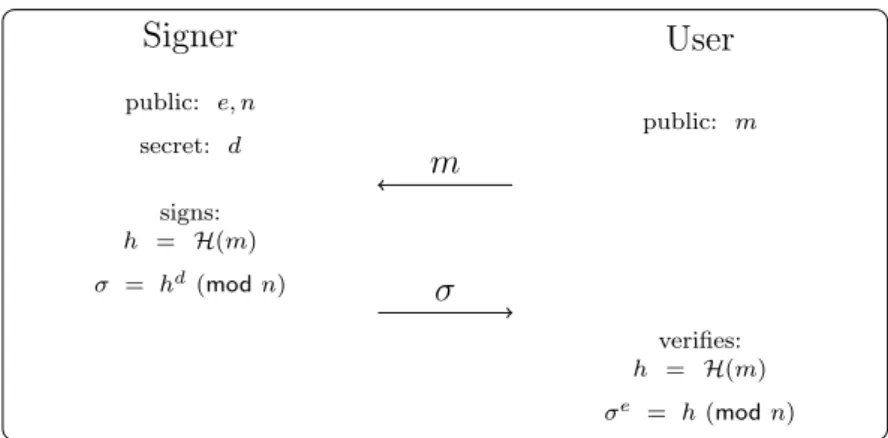
As shown in Figure 3.4, a standard RSAsignature scheme usually consists on three phases: the request, the signing and the verifying phase. A Signer
generates a large public number n product of two large and secret primes p andq, and a pair of keys (e, d), the public key and the private key respectively. It is also important to mention that the private key d is the multiplicative inverse of e modulo (p−1)(q−1). Signer public: e, n secret: d signs: h = H(m) σ = hd(modn) User public: m verifies: h = H(m) σe = h(modn) m σ
Figure 3.4: Classical RSA Signature
The scheme starts with the Signer and a user agreeing on a public hash function H. Then, the user makes a request by sending a message m to the Signer. Next, the Signer creates a signature σ by signing m, σ = H(m)d(modn), and sends it to the user. Finally, the user checks its valid-ity by verifying the equation σe = H(m) (modn).
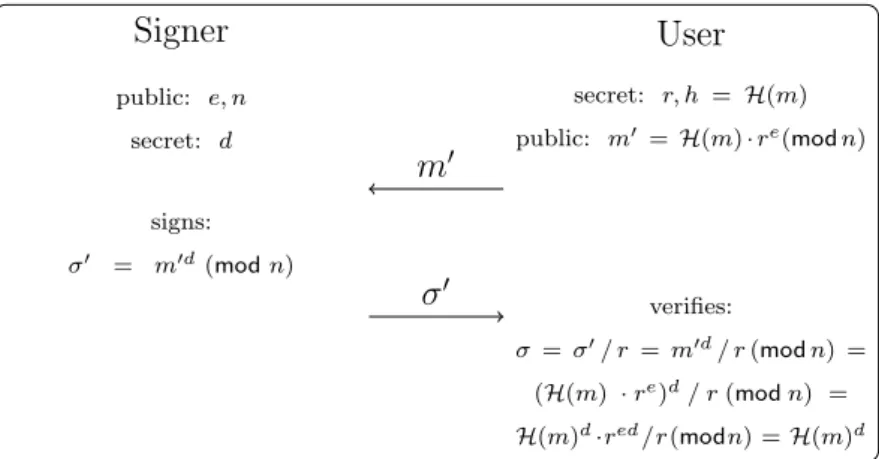
The blind RSA signature differs from the regular DS on the request and
verifying phases. In therequest phase, instead of sending mto the Signer, the user “blinds” it by creating and sendingm0 = H(m)·re(modn). TheSigner normally signsm0 creating signatureσ0 = m0d(modn) and sends it