Assessing Collaboration in a Web-based Constructivist
Learning Environment: A Malaysian Perspective
Fui Theng Leow
Faculty of Science, Technology, Engineering and Mathematics INTI International University, Malaysia
Mai Neo
Faculty of Creative Multimedia Multimedia University, Malaysia
This paper focuses on studying the students’ collaborative processes within a web-based learning environment. A constructivist web-based learning environment was designed using Jonassen’s (1999) CLE model, and centered around a multimedia group project and the use of web 2.0 tools. The project was undertaken by students at INTI International University, Malaysia, and worked in a project group of 4 members. This study assesses students’ perception, attitude change, language acts through the use of several data collection instruments, including questionnaires, open-ended questions, interview, and students’ interaction records in web-based applications. Factor analysis was performed on quantitative data, whereas the framework of CMCL was used to investigate the qualitative data to identify the collaboration and communication through their communicative acts during project development process. Results showed that group collaboration provided peer support, increased their motivation and satisfaction, and more communication and interaction were stimulated in the learning process.
Keywords: collaborative learning, communicative acts, web 2.0 tools, constructivist learning environment, Malaysian classroom learning
Introduction
Today, the job employers are looking at graduates to have skills and abilities beyond the textbook and course syllabus (Tan, Teo & Chye, 2009). It now becomes an added advantage if graduates are able to adapt to different situations, learning independently, and be comfortable interacting with people with different backgrounds. Therefore, nurturing such potential employees has become the main objective for reforming the education context today. The traditional approach of teaching which emphasized on individual ability in re-producing the knowledge is no longer suitable for this competitive job market. Instead, knowledge sharing and collaboration are more in demand, and acquiring such skills would require educational learning environments to promote active learning process and experiences in collaborative learning (Chiong & Jovanovic, 2012; Thanh-Pham, 2010). Up to date, most of the studies on online collaboration place focus around the ways of creation or effective factors for bringing the success of online collaboration (Chiong & Jovanovic, 2012). However, it has fewer studies on the values or aspects of the processes in the collaboration and communication, especially when students were collaborating and interacting on project tasks with the use of web-based social tools. In addition, Cecez-Kecmanovic and Webb (2000) highlighted that the social nature of learning is a key feature to differentiate collaborative learning from individual learning, and such social interactions need to be mediated through the language used to comm c No fo g g od y’s w b 2 0 oo s mo c p b o s ppo h o collaborative activities and asynchronous communication. Hence, this study focuses on assessing the students’ collaboration and communication processes within a web-based constructivist learning with the
incorporation of Jonassen’s (1999) components of constructivist learning environments. The objective of this study is to identify the important aspects from both quantitative data and qualitative data, in order to investigate the essential values which can harness the key collaborative features for increasing the student engagement in the collaborative learning process, therefore the current model of collaborative learning can be extended by including the dimension of using web 2.0 social tools.
Collaborative Learning in Classroom Setting
Studies on collaborative learning reveal that students who learn in isolation do not learn as much as students who have connection to a network of social relation that establishes the peer interaction (Pun, 2012). This peer interaction integrates many perspectives which motivate students in playing a role in the community, solving high-level problems, and producing better intellectual outcomes (Pun, 2012). Collaborative learning is defined as a learning method which has common goals in an activity that require a group of students to communicate in order to obtain the learning resources, and construct a shared conception or joint solution to a problem (Garcia, 2012; Suh, 2011). Many researchers have shown that the educational advantages of collaborative learning make student learning more effective and much appreciated by the students (Chiong & Jovanovic, 2012). This is because the collaborative work group can nurture the student confidence to be more matured and skillful in self-reflection, which will improve their understanding on the topics being studied. In addition, small collaborative work groups also strengthen the leadership among the members as it requires equal distribution and
contributions from each member, which can be considered as training for learners to solve conflicts and establish trust among themselves (Finegold & Cooke, 2006). Other researchers have also found that the learners derive a sense of enjoyment when working collaboratively as it brought them a better learning experience, showed them different perspectives and achieve better academic results (Chiong & Jovanovic, 2012). Thus, more and more educational institutions have refined their instructional approaches and curricula to complement these current directions and practice, by increasing team-based projects and assignments, which require collaboration among team members. Today’s graduates are not only expected to be more responsible in continuous learning and be able to interact to build knowledge, but they are also evaluated on varied skills in adapting to different situations and in socialising with different people who comes from different cultural backgrounds (Chiong & Jovanovic, 2012; Pun, 2012). This is due to the advancement in ICTs and network facilities that enable connections and communication of all geographically distributed tasks and people. Therefore the roles and approaches of learning are evolving from individual performance to collaborative group assignment. In order to be more competent and stay competitive, students in tertiary studies need to be exposed to collaborative group-based coursework in order to obtain the skills and experiences which can then be transferred to this work environment (Chiong and Jovanovic, 2012).
Constructivist Learning Environments as a Platform for Collaboration
Collaborative learning is underpinned by constructivist learning approaches of Piaget (1952), Bruner (1985), and Vygotsky (1978), where students play active roles in their learning process, outside of a teacher-centric environment, and take ownership and responsibility for their learning outcomes. Collaborative learning is not only for students to articulate their viewpoints to others, but also for creating new knowledge, clarifying or building upon existing knowledge and deriving new meaning. In such a learning environment, students engage in collaborative activities, tap into their teamwork skills, and use some solutions to accomplish their tasks. So everyone in the group is responsible for managing group process, resolving conflicts and negotiating their outcomes and contributions to their learning goals, thus, gaining a holistic collaborative learning experience. Constructivist learning environments incorporated the key features such as ill-structured problems, collaborative activities, facilitation and support, and reflection. Jonassen (1999) suggested a model for designing constructive learning environments (CLEs) with the following:
1. Conception of the problem. A problem for the students to begin their learning development, and such problems should be grounded in a relevant context to the student to manipulate and support.
2. Interpretation. Students interpret and develop solutions to their problems, based on prior experiences, and some related cases can be provided to scaffold their memory with different perspectives.
3. Information sources to support the understanding of the problem. The learning environment provides the information that learners need to understand and solve problems, and additional information (text documents, graphics, sound, video, and animation resources) can be accessed through World Wide Web.
4. Cognitive tools. Learners interpret and manipulate aspects of the problem through the World Wide Web as a cognitive tool, which allow them to visualise and construct mental models of their solutions, performance tools, information tools and knowledge modeling tools.
5. Conversation and collaboration tools. Learners form communities to negotiate and co-construct meaning through some useful tools. Students require a platform to share and exchange their ideas and create a community to solve their problem collaboratively, and to facilitate and foster communities of learners. Jonassen (1999) posited that an essential part of the learning problem is that it has to be interesting, engaging and appealing. It must also be authentic, personally relevant, challenging and interesting to learners, and provide a physical simulation of the real-world task environment. By collaborating with one another, students are exposed to multiple perspectives to their learning problems, enabling them to engage in collaborative activities with their team members, as well as with the instructor, who acts as a facilitator and guide. In addition to this, the web has been a key component for such collaborative activities to take place. In recent years, there has been a growing interest in Web 2.0 tools that are also known as web-based ‘collaborationware’ such as wikis, blogs and podcasts (Boulos, Maramba, and Wheeler, 2006). The availability of these Web 2.0 tools such as social networking sites, blogs and wikis, students are provided with many opportunities to generate user content and participation. These tools successfully invite students and learners to participate, as they would be more inclined to participate and collaborate in a platform that is familiar to them (McCarthy, 2010). Furthermore, Web 2.0 tools like blogs can be written by one or more contributors and this feature engages the content creator and the readers to participate in the sharing of knowledge and debates. When used in the right context, these
technological tools can “encourage learners’ deeper engagement with learning materials” and as such have the potential to be powerful collaborative tools for information sharing (Boulos et. al, 2006). This is further supported by Parker and Chao (2007)who state that Web 2.0 technologies have the potential to “complement, enhance, and add new collaborative dimensions to the classroom”. Therefore, this study sought to incorporate web 2.0 tools into the CLE to provide more opportunities for student collaboration.
Successful collaborative learning also requires that students engage is not only collaborative product outcomes but also in the development of their communicative acts (Cecez-Kecmanovic and Webb, 2000). There is a need to not only evaluate students’ perceptions on the collaborative processes but also in the value of their
collaborative learning (Treleaven 2003). Cecez- Kecmanovic and Webb (2000) developed the framework of Communicative Model of Collaborative Learning (CMCL) based on the social theoretical foundation of collaborative learning, to study the productivity of the collaborative learning context and the way to improve the practices. Specifically, the communicative analysis focuses on the flow of linguistic acts in student discussions, and how these discussions contribute to the collaborative learning processes. The CMCL assesses student communicative acts across 2 dimensions:
1. Dominant orientation of learners shows if students were orientated towards learning, achieving ends or self-representation and promotion
2. Domain of knowledge identifies students’ orientation towards the subject, norms and rules or personal experiences, desires and feelings.
Therefore, this study sought to develop a collaborative web-based learning environment, and investigated the aspects on how students collaborate and communicate while developing a group-based multimedia project.
Methodology
This study is to look into the process of collaboration and communication within a web-based approach in constructivist learning environment. The study consisted of 104 students who were taking the selected subject, a common subject that offered to all IT Degree students at INTI International University in year 2012 and 2013. The learning environment adapted Jonassen’s (1999) CLE model, where students were required to work on a group-based multimedia project as for fulfilling their coursework requirement. Each of the students was allowed to form their own project group which comprises of 4 to 5 members, and then they were required to work collaboratively with their peers to share opinions and experiences, maintain good relationship and interaction with the group members, and solve the given problems with their new knowledge. As for the communication and discussion of the project development, all students were strongly recommended to interact through several web 2.0 social tools. In order to encourage fair contribution, each group member is required to contribute at least one part in the multimedia application.
In this study, both quantitative data and qualitative data were collected to assess the student perceptions on the collaborative learning, and to investigate their language acts which recorded while interacting with others. Data collection instruments included: 1) - a questionnaire which was used to collect the student feedback, consist of
40 survey items, and measure on a 5-point Likert scale, ranging from ‘5-Strongly Agree’ to ‘1-Strongly
Disagree’, 2) - open-ended questions and interview to collect the students’ feedback on learning experience, and 3) – recorded details in web 2.0 social tools. A total of 104 completed set of questionnaire were collected. Data from the questionnaires were analysed in SPSS software, whereas student comments and feedback were assessed by using the framework of CMCL. Figure 1 shows the project design and student learning workflow. As can be seen, the design of the multimedia group project was made consistent with the constructivist learning approach which centred at an issue which required students to propose new ideas, and develop a multimedia application. Each student needed to do background study individually, and then share their findings, followed by developing the multimedia application based on their assigned task or personal strength. In the entire planning and development process, all students collaborated and communicated through the web 2.0 social tools. In fact, the lecturer who designed such learning approach also involved in the process of students’ online
communication and interaction, so that she can be a facilitator through the student learning process. In addition, she also collected the details in students’ collaboration and communication for more analysis as she also played a main researching role in this current study. Figure 2 below shows the collaborative process of students.
- Figure 1: Students’ learning workflow in the learning environment
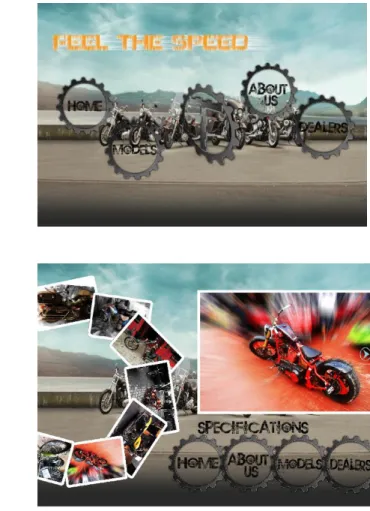
Figure 2: Discussion and sharing of work progress among the members in Facebook project group (left), and the screenshots of their final work (right)
Results and Data Analysis
The results and data analysis are based two types of data: quantitative data and qualitative data. Firstly, the quantitative data from the survey results was processed by using SPSS software to carry out with the factor analysis. This is to find a number of constructs that representing the relationship among sets of interrelated variables from the item response (George & Mallery, 2011). A principle component analysis (PCA) was conducted on 40 survey items with orthogonal rotation (varimax). By using Kaiser-Meyer-Olkin (KMO) measure to verify the sampling adequacy, it was found that KMO = .856, which is a great value according to Field (2009). As for Bartlett’s test of sphericity X2 (780) = 2372.533, p <.001, this indicated that the correlations between items were sufficiently large for PCA. Next, the eigenvalues for each component were obtained, and nine components were found to have eigenvalues over Kaiser’s criterion of 1, so this combination was capable of explaining 67.041% of the variable variances. However, when scree plot was used to study the inflexions, it justified for retaining both components 3 and 9. Based on both criterions, it was decided that three components were retained in the final analysis. Lastly, there were 37 survey items selected and each had been clustered into one of the three components.
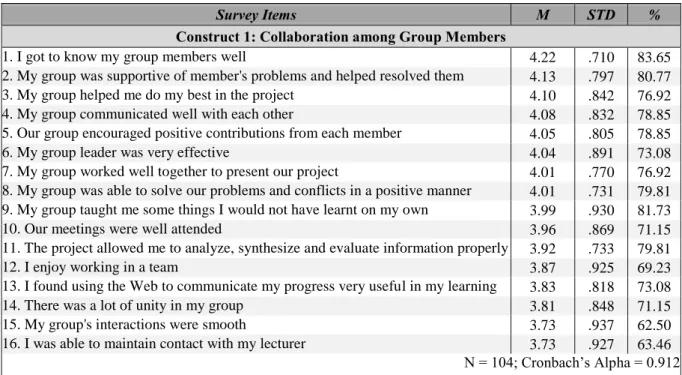
Each component was represented as a construct with a suitable theme: construct 1 - ‘Collaboration among Group Members’; construct 2 – ‘Personal Satisfaction and Self-Enhancement’; construct 3 - ‘Communication and Interaction’. Table 1 below presents the responses of item which loaded high onto each of the three identified constructs. The items responses include mean score (M), standard deviation (STD), percentage of cumulative percentage of agree and strongly agree responses (%). Specifically, in Table 1, there are a total of 16 survey items loaded onto the first construct, 16 survey items were loaded onto the second construct, and 5 survey items loaded onto the third construct.
to George & Mallery (2003), it can be deemed as reliable when the Cronbach Alpha is over 0.7. Based on the statistical result from 104 students’ input, the value of Cronbach Alpha shows 0.912 for construct 1; 0.909 for construct 2; and 0.762 for construct 3 (see Table 1).
Table 1: Responses of survey items for each of the constructs
Survey Items M STD %
Construct 1: Collaboration among Group Members
1. I got to know my group members well 4.22 .710 83.65
2. My group was supportive of member's problems and helped resolved them 4.13 .797 80.77
3. My group helped me do my best in the project 4.10 .842 76.92
4. My group communicated well with each other 4.08 .832 78.85
5. Our group encouraged positive contributions from each member 4.05 .805 78.85
6. My group leader was very effective 4.04 .891 73.08
7. My group worked well together to present our project 4.01 .770 76.92 8. My group was able to solve our problems and conflicts in a positive manner 4.01 .731 79.81 9. My group taught me some things I would not have learnt on my own 3.99 .930 81.73
10. Our meetings were well attended 3.96 .869 71.15
11. The project allowed me to analyze, synthesize and evaluate information properly 3.92 .733 79.81
12. I enjoy working in a team 3.87 .925 69.23
13. I found using the Web to communicate my progress very useful in my learning 3.83 .818 73.08
14. There was a lot of unity in my group 3.81 .848 71.15
15. My group's interactions were smooth 3.73 .937 62.50
16. I was able to maintain contact with my lecturer 3.73 .927 63.46 N = 104; Cronbach’s Alpha = 0.912
Survey Items M STD %
Construct 2: Personal Satisfaction and Self-Enhancement 17. The project increased my understanding on how to manage and develop an
interactive application 4.15 .760 82.69
18. The project made me want to do my best 4.09 .684 84.62
19. I found the project to be challenging yet stimulating to do 4.02 .824 79.81 20. I am now able to apply my skills in a more effective manner on future projects 4.00 .724 82.69 21. The project enhanced my learning of interactive multimedia 3.97 .717 77.88 22. The collaboration was a challenge but I enjoyed it 3.94 .879 75.00 23. I enjoyed using the web to acquire information for my project 3.91 .802 74.04 24. I learn more from the collaboration than on my own 3.90 .795 75.96 25. This project allows me to develop skills needed in the real-world 3.89 .736 77.88
26. I am now a better learner 3.87 .789 66.35
27. I am very satisfied with my contribution to the project 3.86 .756 69.23 28. This course has given me confidence in my newly acquired skills and knowledge 3.85 .734 75.00 29. I saw the relevance between the course and real world situations 3.84 .849 74.04
30. I enjoyed working on a project like this 3.84 .915 69.23
31. I am now able to think critically about developing interactive web applications 3.82 .810 69.23
32. I was very motivated to do this project 3.74 .836 71.15
N = 104; Cronbach’s Alpha = 0.909 Construct 3: Communication and Interaction
34. I was able to interact well with my classmates 3.82 .734 73.08 35. We were able to present our project well using multimedia 3.80 .793 67.31 36. My group was able to make and follow a set agenda 3.72 .730 66.35 37. We were able to organise our work effectively 3.70 .880 63.46 N = 104; Cronbach’s Alpha = 0.762
Besides the quantitative data, it also includes the qualitative data which can further support the survey results, and it consists of students’ comments, feedback, and communication transcripts during the activities within the learning environment. All these qualitative data was analyzed by using the Cecez-Kecmanovic and Webb’s (2000) Communicative Model for Collaborative Learning (CMCL) along the two dimensions of communicative analysis: 1-knowledge domain of linguistic acts; 2-learners’ dominant orientation.
Table 2 presents the breakdown of CMCL with three domains (1 to 3), and three orientations (A to C), hence forming a framework which has the cell arrangement with 3 x 3 scheme. In each cell (ranging from A1 to C3), the students’ comments or communication responses which collected during the data collection process, were analysed and then sorted into a cell based on the types of communicative acts in their collaboration and interaction processes. These comments and responses can then be used to identify more aspects and understand the students’ perspectives.
Table 2: Students’ collaborative communication responses
1 - Subject Matter 2 - Norms & Rules 3 - Personal Experiences,
Desires & Feeling A –
Learning A1 - Understanding on the Project Topic -“…sharing new info with group member it help each of us to have variety type of idea, we learn more.” -“…when we think doing
this way… then when another idea pop-up, we change, to improve...” -“…different people to went
through the coding, and I found the problem….” -“…when there are some
trouble with the Flash part and we will be called to fix and solve the problem”
A2 - Approaches on Acquiring Information
- “…member designed their interface and presented it, we voted the best.” - “…when we finished our
part, we will ask each other to check. If some of the members are not like it, we will try to change it…” - “…I feel it's convenience
to communicate by the chat box….”
- “We have face to face conversation and using Dropbox to share work…”
A3 - Experience in Managing Learning Process
- “…it helps us to recall back what we learned from our lab classes and do more self research regarding those skills and project topic…” - “This project we not only
apply what we learn in the class but also do reached about which we not learn in the class.”
- “We will know each other's strengths and weakness.” - “…I’m happy that I have
members with dedication.” B –
Achieving Ends
B1 - Achieving Project Tasks - “We can done one flash
application without any bug, within the time complete all parts…” “…done the project as
proposed in the proposal, having fully function features and high quality.” -“During the break, we had
to meet up 3 times and stayed from early noon till early night to try to do as much as we can…” -“… [1 member] failed to
complete his task, we shared the work of his…”
B2 - Delegating Project Tasks to Members
- “we held meetings, each member would describe their respective interest regarding the project and then we would divide the job appropriately.” - “…Photoshop work is
done by other mates…the flash part i did as that it is where my strength…” - “We made a schedule that
listed down the activities to complete the project…”
B3 - Students’ Feeling on the Project Tasks
- “…I feel happy that could finish the project in this short period of time.” - “…I felt really proud for
every one of them and also myself pay lots of effort” - “…each one knew what was
doing and accomplished his part without delay…made our project a good result.” - “…my group is the best
because we was work very hard and manage work with consistency and make the project in perfect work.” C –
Self-representation & Promotion
C1 - Students’ Opinion on the Project Topic
- “I find this project very helpful where I understand Adobe Photoshop… and got an experience with Flash.” - “…self-study helps me to
understand more on the topic and also enhance the skills…”
- “They ask me to join because I got new ideas then they like my ideas, so we work together...” - “…I’m the one choose
the themes for the project and did the proposal…”
C2 - Working with Team and Protocols
- “…I need to call meetings, finalize ideas, manage the project...”
- “I was the driving force…organising work sessions and reinstating the theme of the project...” - “…we take diploma
together so we familiar with the personality and the pattern of doing work” - “I chose my members
because I know them for quite long and we've already worked together on other projects.”
C3 - Students’ Feeling on the Group Works on Overall
- “The motivation is you know this is your part, and what you can do, and you have the freedom to do.” - “…I enjoyed doing this
project because I am a creative person and I could engage my creative on the project…”
- “…I like to see some other people's design, so I can absorb the ideas...” - “…I realized that there are
many things that I do not know… the way on making a product stands out...”
Discussion
From the data analysis of this study, there are some important aspects found about the student learning experiences especially in the collaborative and interactive processes when learning and working on the group project with the web-based collaborative approach. These aspects were divided into two parts, from the quantitative data or qualitative data respectively.
1. Collaboration among Group Members
Based on the results, it shows that group collaboration encouraged the students to perform better, and when they received peer encouragement, their confidence level in working with the project were also increased. This can be seen from some significant result, there is 78.85% of students agreed that their group encouraged positive contribution from each member based on their own strengths during the project development process (see Item 5 in Table 1). On the other hand, 79.81% of students agreed that the project gives them the chances to analyze and evaluate the information, so encourage them to open their mind and think out of the box (see Item 8 in Table 1). Besides the increase of confidence level, peer support also enhances their work performance, and this can be noticed from the significant results: 80.77% of students agreed that their problems were resolved by their group’s support, allowing them to continue with other work in the development process (see Item 2 in Table 1). 81.73% of students agreed that through the support of group, their knowledge was enhanced, which would not be learned all individually (see Item 9 in Table 1). Hence, the students learned to support each other to enhance the project works, which subsequently improving their communication skills to cooperate and interact with each other. It can be found through some of the significant results: 83.65% of students agreed that through group collaboration, they become more familiar and better understood their group members (see Item 1 in Table 1). 78.85% of students responded that they could communicate well with their members for more information, so potentially improve the quality of group discussion (see Item 4 in Table 1).
2. Personal Satisfaction and Self-Enhancement
It was found that personal satisfaction was an important aspect for student learning, and can be gained from having motivation in the learning process and in being challenged in its complexity. This can be seen in the students’ response: 84.62% of students agreed that the project had motivated them to willingly devote their effort in the development process for better outcomes (see Item 18 in Table 1), and 79.81% of students agreed that the project given was challenging their ability and knowledge but they realized that this project is stimulating and provoking their dedication and efforts (see Item 19 in Table 1). It was also found that from having better understanding or acquiring new skills, they became more capable in managing the project development and in unleashing their potential for future advancement. Obviously, there are 82.69% of students agreed that through working in the development process of the project, they could gain more understanding on the way to manage and develop an interactive application (see Item 17), and 82.69% of students agreed that they were able to apply the newly acquired skills on future projects with more effective manner than this round (see Item 20). The new enhancements bring the enjoyment in learning to a higher level, and therefore it is believed that it has been transformed into a part of personal satisfaction. Some significant results show that 75% of students agreed that they did enjoy with having the collaboration although it was a challenge for them (see Item 22 in Table 1), and 75.96% of students reported that the collaboration mode made them to learn more than self-learning (see Item 24 in Table 1).
3. Communication and Interaction
The design of this learning approach was found to be able to foster communication and interaction, especially when discussing the ideas, interacting for better decision and presenting the outcomes. This can be seen in the students’ response that 82.69% of students agreed that they were able to interact with other members by contributing and exchanging individual ideas (see Item 33 in Table 1), and 73.08% of students agreed that they were able to interact with their classmates for discussion and gaining new information (see Item 34 in Table 1). Besides that, collaborating on group project also stimulated students’ communication and interaction in the process of planning and negotiating for tasks and work schedules, particularly 66.35% of students agreed that their group was able to make and follow a set agenda for working out the project tasks with their group members (see Item 36 in Table 1), and 63.46% of students agreed that they felt pleasant as they were able to organize their work more effectively than previous work (see Item 37 in Table 1).
4. Students were Oriented to Learning
The CMCL analysis for the students’ communicative acts and their feedback showed that each of the domains and orientations in the model was useful to assess different conditions in students’ learning process, and multiple perspectives were found. However, due to the page constraints, this paper only reports some significant perspectives. It can be noticed that when students were oriented to learning, they were able to share their
knowledge and work together to solve problems for gaining more knowledge for project work. This is because they realized that they could become more knowledgeable when sharing or combining ideas from members, and then through solving problems together, students could find the solutions from different perspectives, hence better contents and outcomes could be developed (see cell A1 in Table 2). Besides, when oriented to learning, the students became more creative and dedicated to design several ways for developing ideas and making fair decision, including collect all feedback, and vote for the best during the meeting with members, as well as communicate with their members by using features in Facebook and sharing files through Dropbox cloud computing storage (see cell A2 in Table 2). In addition, when students were oriented to learning, they did not hesitate to share their experience and thoughts with others for increasing the mutual understanding. Students also realized that the process of gaining more mutual understanding were the important experience in enriching their thoughts in the learning process (see cell A3 in Table 2).
5. Students were Oriented to Achieving Goal
Besides oriented to learning, some students were oriented to achieving their goal. In this condition of learning process, their main concerns were about completing the task as much as possible based on the requirements, and then fulfill it through using various possible ways for obtaining good outcome. Hence it was found that there were cases where the students willing to work with some alternative ways in order to complete project tasks (see cell B1 in Table 2). As for the approach to ensure the completion for achieving the goal, the students then learned to delegate the task and set some rules, including based on own abilities, or voluntary basis as they worked together before. Occasionally, it was found that the students also used some other methods just to complete the tasks more efficiently (see cell B2 in Table 2). As for personal feeling and experience, the students felt good and proud when their aims or goals were achieved with successful outcomes. They also feel grateful and able to appreciate by their group members for maintaining the teamwork in achieving the goals (see cell B3 in Table 2).
6. Students were Oriented to Self-Representation and Promotion
The third learning condition is when the students were oriented to self-representation and promotion. They highlighted that their own skills had been enhanced through practicing in the project development process, and because of this, many student highlighted his/her ideas, materials, skills applied were the main contribution towards the project tasks (see cell C1 in Table 2). As for the way for self-promotion, the students took the chance to show their leadership skills and provide some instructions in the group especially for leading the direction and organizing the teamwork. In addition, the students did less or need not self-introduction as the members already knew each other prior to forming group (see cell C2 in Table 2). On other hands, the students also expressed their overall feelings towards their own performance and contributions, the most significant ones include the students felt quite motivated for being able to display their personal abilities and new skills, and throughout the entire process they were able to understand their own interest, strength and weakness (see cell C3 in Table 2).
Conclusion
In this study, the students learned to collaborate and communicate in a constructivist learning environment which centered at a problem-based multimedia group project. Students determined the selection of information based on prior knowledge, expectation and perceptions, then engaged in social negotiation to discover and formalize the solutions, as posited by Bruner (1990) and Cakir (2008). The survey result and analysis showed that by embedding web-based collaborative approach in the classroom learning, support and encouragement among the peers were strengthened, students’ satisfaction and motivation gained in the learning process were enhanced, and students were more engaged to interact and communicate. On the other hand, the students’ language acts which used to express their expectations, attitudes, and interact with peers were analysed by using the different dimensions in the framework of CMCL. The findings showed that students gained various
experiences which bring the positive changes in the attitude for all dimensions and knowledge domains in the collaborative activities throughout the project development process. In all, the findings of this study provided deeper insights and more perspectives into the process of collaboration and communication in constructivist learning approach. As for the next stage of study, the research analysis can be advanced further for mapping the aspects found from the respective quantitative and qualitative data analysis. Therefore, the essential values can be explored on how students construct their collaboration and communication with their peers in the learning processes, particularly coming from different dimensions and domains. These new values will be used to develop a framework as a practical guide for Malaysian educators in order to better understand the level of student communication and interaction, so that more efforts can be made for sustaining and improve
References
Boulos, M.N.K., Maramba, I., & Wheeler, S. (2006). Wikis, blogs and podcasts: A new generation of Web-based tools for virtual collaborative clinical practice and education, BMC Medical Education, 6(41). Bruner, J. (1990). Acts of Meaning. Cambridge, MA: Harvard University Press.
Cakir, M. (2008). Constructivist Approaches to Learning in Science and Their Implications for Science Pedagogy:A Literature Review. International Journal of Environmental & Science Education, 3(4), 193-206.
Cecez-Kecmanovic, D. & Webb, C. (2000). Towards a communicative model of collaborative web-mediated learning. Australian Journal of Educational Technology, 16(1), 73-85.
Chiong, R. & Jovanovic, J. (2012). Collaborative Learning in Online Study Groups: An Evolutionary Game Theory Perspective. Journal of Information Technology Education, 11, 81-101.
Field, A. (2009). Discovering statistics using SPSS (3rd ed.). London: Sage.
Finegold, A. & Cooke, L. (2006). Exploring the attitudes, experiences and dynamics of interaction in online groups. The Internet and Higher Education, 9(3), 201-215.
Garcia, P.G. (2012). Collaborative Learning Activities in Online Courses: Issues and Strategies. ASEAN Journal of Open Distance Learning, 4(1), retrieved 31st May 2013.
George, D. & Mallery, P. (2011). IBM SPSS Statistics 19 Step by Step: A Simple Guide and Reference (12th ed.).
NJ: Pearson Prentice Hall.
Jonassen, D. (1999). Designing Constructivist Learning Environments. In C.M. Reigeluth (Ed.), Instructional design theories and models: A new paradigm of instructional technology (2nd ed.), 215–240. Mahwah, NJ: Lawrence Erlbaum Associates.
Parker, K.R. & Chaor, J.T. (2007). Wiki as a Teaching Tool. Interdisciplinary Journal of Knowledge and Learning Objects, 3, 57-72.
Pun, S. K. (2012). Collaborative Learning: a Means to Creative Thinking in Design. International Journal of Education and Information Technologies, 6(1), 33-43.
Suh, H. (2011). Collaborative Learning Models and Support Technologies in the Future Classroom.
International Journal for Educational Media and Technology, 5(1), 50-61.
Tan. O. S., Teo, C. T., Chye, S. (2009). Problem-Based Learning And Creativity. Oon-Seng Tan (Ed.) Cengage Learning Asia Pte. Ltd., Singapore, pp.1-14.
Treleaven, L. (2003). Evaluating a communicative model for web mediated collaborative learning and design. Australian Journal of Educational Technology, 19(1), 100-117.
Author contact details:
Fui Theng Leow, [email protected] Associate Professor Dr Mai Neo, [email protected]
Please cite as: Leow, F.T. & Neo, M. (2013). Assessing Collaboration in a Web-based Constructivist Learning Environment: A Malaysian Perspective. In H. Carter, M. Gosper and J. Hedberg (Eds.), Electric Dreams. Proceedings ascilite 2013 Sydney. (pp.503-513)
Copyright © 2013 Fui Theng Leow & Mai Neo.
The author(s) assign to ascilite and educational non-profit institutions, a non-exclusive licence to use this document for personal use and in courses of instruction, provided that the article is used in full and this copyright statement is reproduced. The author(s) also grant a non-exclusive licence to ascilite to publish this document on the ascilite web site and in other formats for the Proceedings ascilite Sydney 2013. Any other use is prohibited without the express permission of the author(s).