Shape-Memory Effect
From
temporary
shape...
T
>
46
8
C
...to
permanent
shape
1. Introduction
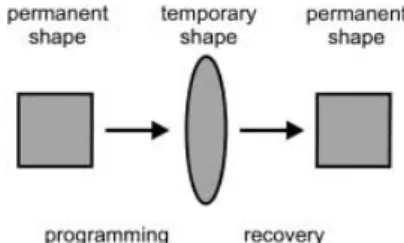
Shape-memory materials are stimuli-responsive materials. They have the capability of changing their shape upon application of an external stimulus. A change in shape caused by a change in temperature is called a thermally induced shape-memory effect. The main focus of this review article is on thermoresponsive memory polymers. The shape-memory effect is not related to a specific material property of single polymers; it rather results from a combination of the polymer structure and the polymer morphology together with the applied processing and programming technology. Shape-memory behavior can be observed for several polymers that may differ significantly in their chemical composition. How-ever, only a few shape-memory polymers are described in the literature. The process of programming and recovery of a shape is shown schematically in Figure 1. First, the polymer is conventionally processed to receive its permanent shape. Afterwards, the polymer is deformed and the intended temporary shape is fixed. This process is called programming. The programming process either consists of heating up the sample, deforming, and cooling the sample, or drawing the
Figure 1. Schematic representation of the thermally induced one-way shape-memory effect. The permanent shape is transferred to the temporary shape by the programming process. Heating the sample to a temperature above the switching transitionTtransresults in the recovery of the permanent
shape.
sample at a low temperature (so called ™cold drawing∫). The permanent shape is now stored while the sample shows the temporary shape. Heating up the shape-memory polymer above a transition temperature Ttrans induces the
shape-memory effect. As a consequence, the recovery of the stored, permanent shape can be observed. Cooling down the polymer below the transition temperature leads to solidification of the material, however, no recovery of the temporary shape can be observed. The effect described is named as a one-way shape-memory effect. By further programming, including mechan-ical deformation, the work piece can be brought into a temporary shape again. This new temporary shape does not necessarily match the first temporary shape.
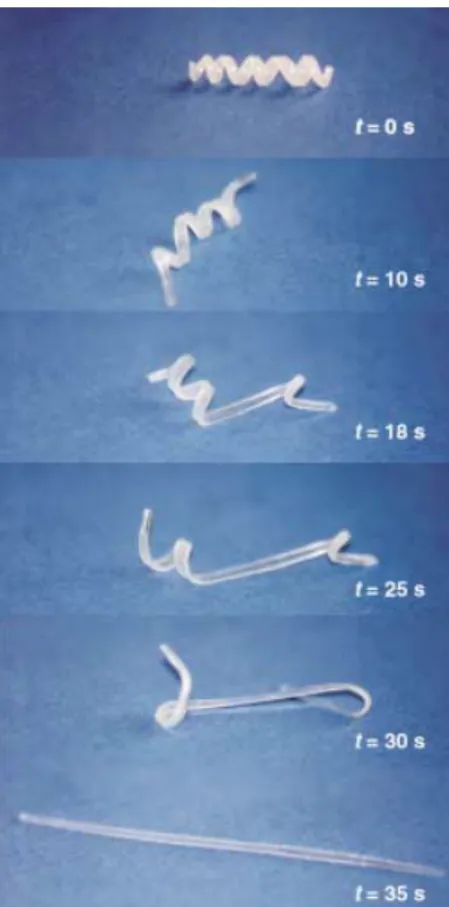
In Figure 2 a picture sequence demonstrates impressively the performance of shape-memory polymers. The permanent shape of the polymers formed from1and2is that of a rod,
Shape-Memory Polymers
Andreas Lendlein* and Steffen Kelch
Material scientists predict a prominent role in the future for self-repairing and intelligent materials. Throughout the last few years, this concept has found growing interest as a result of the rise of a new class of polymers. These so-called shape-memory polymers by far surpass well-known metallic shape-memory alloys in their shape-shape-memory properties. As a consequence of the relatively easy manufacture and pro-gramming of shape-memory polymers,
these materials represent a cheap and efficient alternative to well-established shape-memory alloys. In shape-memo-ry polymers, the consequences of an intended or accidental deformation caused by an external force can be ironed out by heating the material above a defined transition tempera-ture. This effect can be achieved be-cause of the given flexibility of the polymer chains. When the importance of polymeric materials in our daily life
is taken into consideration, we find a very broad, additional spectrum of possible applications for intelligent polymers that covers an area from minimally invasive surgery, through high-performance textiles, up to self-repairing plastic components in every kind of transportation vehicles.
Keywords: block copolymers ¥ mate-rial science ¥ polymers ¥ shape-mem-ory polymers
[*] Dr. A. Lendlein, Dr. S. Kelch Institut f¸r Chemie
GKSS Forschungszentrum
Kantstrasse 55, 14513 Teltow (Germany) Fax: (49) 3328 352 452
which has been deformed to a spiral (temporary shape) during the programming process. Under the influence of hot air having a temperature of 708C the permanent shape is recovered as soon as the switching temperature Ttrans is
reached. The permanent shape is recovered with a precision of more than 99 % with appropriately optimized program-ming conditions. This precision makes these materials suitable for highly demanding applications.[1]
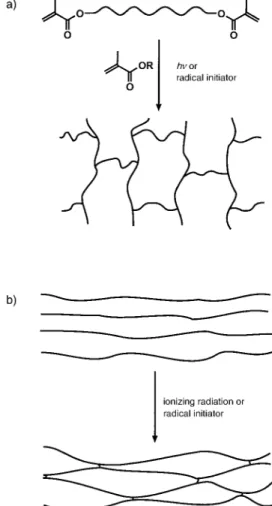
Since the 1960s, polyethylene that is covalently cross-linked by means of ionizing radiation has found broad application as heat-shrinking film or tubing, especially for the insulation of electric wires or as protection against corrosion of pipe lines.[2±7]These materials are marketed under the catchphrase
™shrinkable materials∫. The mechanism of the heat-shrinking process is in analogy with the thermally induced shape-memory effect. Here, the permanent shape is also fixed by covalent cross-links and the switching process is controlled by the melting temperature of the polyethylene crystallites. More and more reports about linear, phase-segregated multiblock copolymers, mostly polyurethanes, can be found in
the literature under the name of the generic term ™shape-memory polymers∫ (see Section 2.4.1). These elastic materials show at least two separated phases. The phase showing the highest thermal transitionTpermacts as the physical cross-link
and is responsible for the permanent shape. Above this temperature the polymer melts and can be processed by conventional processing techniques such as extrusion or injection molding. A second phase serves as a molecular switch and enables the fixation of the temporary shape. The transition temperature for the fixation of the switching segments can either be a glass transition (Tg) or a melting
temperature (Tm). After forming the material above the
switching temperature, but belowTperm, the temporary shape
can be fixed by cooling the polymer below the switching temperature. Heating up the material above Ttrans again
cleaves the physical cross-links in the switching phase. As a result of its entropy elasticity (see Section 2.1.3) the material is forced back to its permanent shape. Polyurethanes with shape-memory properties have found application as, for example, components in auto chokes. In this application it is
Andreas Lendlein, born in 1969 in Bendorf (Germany), studied chemistry at the Johannes Gutenberg Universityof Mainz (1988 ± 1993). In 1993 ± 1996 he did his dissertation with Prof. Dr. Ulrich W. Suter at the material science department of the Swiss Federal Institute of Technology (ETH) in Zurich, Switzerland. In his Ph.D. thesis he dealt with degradable and biocompatible multiblock copolymers with hard segments based on bacteriallyproduced polyesters. In 1996, after a short post-doctoral stayin Zurich, he was awarded the ETH Medal, and in 1997 he moved, as a visiting scientist, to the group of Prof. Dr. Robert Langer at the Massachusetts Institute of Technology(MIT) in Cambridge, USA. Since
1998 he has been head of the department for the Development and Engineering of New Biomaterials, which he established at the German Wool Research Institute at the RWTH Aachen and he habilitated from the Chair of Textile Chemistryand Macromolecular Chemistryat the Universityof Technology, Aachen. He recentlyaccepted a position as full professor at the Universityof Potsdam (Germany) and as director of the Institute of Chemistryat the GKSS Research Center in Teltow (Germany). Currently, he is working on the development of intelligent polymers, especially block copolymers and multiphase covalent networks, the processing of these materials, as well as their application in the biomedical field. Besides his academic career, in 1998 he founded, together with Robert Langer, the start-up companymnemoScience GmbH of Aachen, which he runs as managing director. He has received numerous grants, among others, Studienstiftung des deutschen Volkes (1989 ± 1993), Fritz-Ter-Meer Stiftung (1989 ± 1992), Gottlieb Daimler- und Karl Benz-Stiftung (1993 ± 1996), as well as the Liebig Stipendium of the Fonds der Chemischen Industrie (1997 ± 1999). In 1998 he was laureate in the BioFuture Contest of the Ministryfor Education and Research (BMBF), in 1999 he was honored byPinguin Stiftung, in 2000 he received the Hermann-Schnell award of the GDCH, as well as the Innovationspreis of Zenit e. V.
Steffen Kelch, born in 1967 in Mannheim (Germany), studied chemistry from 1989 to 1995 at the University of Karlsruhe (TH) and did his dissertation from 1995 ± 1999 at the Polymer Institute there in the group of Prof. Dr. Matthias Rehahn. In his Ph.D. thesis he dealt with the synthesis and characterization of high molecular weight coordination polymers. In 1996 he worked in the group of PD Dr. Walter Caseri at the Institute of Polymers of the Swiss Federal Institute of Technology in Zurich on the modification of inorganic surfaces. During his doctorate and thereafter as a research associate at the German Plastics Institute (DKI) in Darmstadt he worked on the characterization of polyurethane networks. Since 2000 he has worked as a research scientist in the department for the Development and Engineering of New Biomaterials at the German Wool Research Institute at the Universityof TechnologyAachen.
Figure 2. Transition from the temporary shape (spiral) to the permanent shape (rod) for a shape-memory network that has been synthesized from poly(e-caprolactone) dimethacrylate (1) and butylacrylate (2;co-monomer content: 50 wt %; see Section 2.6.2). The switching temperature of this polymer is 468C. The recovery process takes 35 s after heating to 708C.
not the shape-memory effect that is used, but the property of the polymer to soften upon being heated up above the switching temperature.[8±19]
A substantially new development in connection with the design of shape-memory polymers are polymer systems. These are families of polymers in which macroscopic proper-ties (for example, mechanical properproper-ties or Ttrans) can be
controlled by a specific variation of molecular parameters. This makes it possible to tailor the specific combination of the properties of the shape-memory polymers that are required for specific applications just by a slight variation of the chemical composition. The shape-memory material presented in Figure 2 belongs to a family of multiphase polymer networks that are biocompatible and biodegradable. Such materials are highly interesting for applications in the field of minimally invasive surgery (see Section 2.6).
There are other classes of materials such as metallic alloys, ceramics, and gels that show thermoresponsive mem-ory properties. A short overview about these other shape-memory materials is given before shape-shape-memory polymers are discussed in detail.
1.1. Metal Alloys
The one-way shape-memory effect as described at the beginning was observed for the first time by Chang and Read in 1951 for a gold ± cadmium alloy.[20]In 1963 Buehler et al.
described the shape-memory effect of nitinol, an equiatomic nickel ± titanium alloy.[21] Here, the shape-memory effect is
based on a martensitic phase transition taking place without diffusion (Figure 3). To generate the martensitic phase the
Figure 3. Schematic representation of the mechanism of the shape-memory effect for metallic alloys based on a martensitic phase trans-formation.
material is cooled from a high temperature or parent phase showing a cubic symmetry (austenitic phase) down to a low temperature phase with lower symmetry (martensitic phase). The formation of the martensitic phase can be controlled by a temperature program which includes heating to temperatures up to 4508C. The temporary shape of the material can now be produced by deformation of the material in the martensitic phase. The austenitic phase is reached upon heating the sample above the phase transition temperature and a recovery of the original external shape for deformations of up to 8 % can be observed.
Since nitinol is an equiatomic Ni-Ti alloy, possible fluctua-tions in stoichiometry have a strong influence on the resulting properties of the material. A deviation in the nickel content of 1atom % can shift the switching temperature up to 100 K. Besides the one-way shape-memory effect, nitinol exhibits so called superelasticity. Superelasticity is based on the phenom-enon that the martensitic phase is not stable above a certain temperature in the absence of an external force. Above this temperature an external deformation will spontaneously be recovered.[22a,b,e,f, 23±29]
The Ni-Ti and Cu-Zn-Al alloys all found technical appli-cation. Nitinol is widely used for the manufacture of surgical devices and implants because of its biocompatibility.[22h, 30, 31]
Cu-Zn-Al alloys are often used for nonmedical applications as a result of their advantageous thermal and electrical con-ductivity and their better ductility. Cu-Al-Ni as well as iron-based alloys such as Fe-Mn-Si, Fe-Cr-Ni-Si-Co, Fe-Ni-Mn, or Fe-Ni-C alloys have also been investigated in regard to their shape-memory properties. Fe-Mn-Si alloys, in particular, find applications as materials for screwed joints that can be heated after being screwed together to obtain further compres-sion.[22c,d, 23]
Metallic alloys with shape-memory properties can show a two-way shape-memory effect after a certain ™thermal
train-ing∫. In this case the material does not only ™remember∫ the external shape in the parent phase but also the external shape in the martensitic phase. By this, it is possible to produce a defined structure at a defined temperature that has been programmed before.[22a, 27, 30]
1.2. Ceramics
With certain ZrO2ceramics, the transition from a tetragonal
to a monoclinic structure occurs as a martensitic phase transition which is induced thermally or by the application of stress. These materials are called martensitic ceramics. The transformation back from the monoclinic to the tetragonal symmetry can occur thermoelastically, which is why marten-sitic ceramics show a thermoresponsive shape-memory ef-fect.[22g, 23, 24]
1.3. Gels
A remarkable property of polymer gels is their ability to react to changes in the external conditions by considerable volume changes, swelling or shrinkage. The external stimulus is not only limited to temperature changes. Volume changes can also be triggered by a variation in the pH value, the ionic strength, or the quality of the solvent. In addition to this, it is possible to stimulate certain gels by the application of electric fields or light. The crucial point with gels is their poor mechanical stability.[32±45]
Hydrogels with hydrophobic, crystallizable side chains, and cross-linked poly(vinyl alcohols) show a thermoresponsive one-way shape-memory effect.[32, 33, 37, 39, 40]Hydrogels formed
from copolymerized acrylic acid 3 and stearyl acrylate (4) cross-linked with methylenebisacrylamide (5) show a strong temperature dependence in their mechanical properties.
Below 258C these polymers behave like tough polymers, while above 508C softening enables the materials to be extended up to 50 %. The softening results in a decrease of the elastic modulus by three orders of magnitude. The mechanical stability below 508C arises from the crystalline packing of the stearyl side chains. Above this temperature, the aliphatic side chains are amorphous and contribute to the flexibility of the hydrogels. The stretched shape can be maintained by applying the deformation force during the cooling process. When the material is heated up again above the transition temperature the one-way shape-memory effect takes place and the external shape in which the material was produced initially is recovered. The permanent shape is predetermined by the covalent polymer network.[36, 39]
Linear poly(vinyl alcohol) molecules form hydrogels as a result of the formation of physical cross-links through
hydro-gen bonds and microcrystallites. Above a temperature of 508C the physical cross-links melt and results in an increasing loss of stability. Above a temperature of 808C the physically cross-linked hydrogels become soluble in water. Chemically cross-linked hydrogels whose permanent shape is stable above 808C can be obtained by cross-linking the
poly(vinyl alcohol) 6 with glutaraldehyde. After melting the physical cross-links in boil-ing water, these chemically cross-linked
hy-drogels can be streched by 200 %. By immersion of the system in methanol, a poor solvent, the elongation, and thus the temporary shape, can be fixed by deswelling and formation of physical cross-links. The permanent shape can be recovered by exposing the gel to boiling water.[32]
An example of materials with a thermally induced two-way shape-memory effect are modulated gels. Such gels consist of layers and can perform even more complex shape changes. They contain two types of layers: a thermosensitive control layer (control element) and a substrate layer (substrate element) which is not sensitive to changes in temperature. The control layer consists of an ionic gel made from the copolymer10prepared fromN-isopropylacrylamide (NIPA,
7) and sodium acrylate (8) cross-linked with methylenebisa-crylamide (5). A tenfold change in volume can be reached as a consequence of a thermally induced abrupt change in the gels microstructure. The gel is swollen below the lower critical
solution temperature (LCST) of 378C. Exceeding this tem-perature causes shrinkage of the gel and the resulting decrease in the thermodynamic quality of the solvent produces a polymer-rich phase. The substrate layer can consist of a gel formed from polyacrylamide (PAAM) cross-linked with5. At temperatures above 378C, the control layer shrinks drastically while the substrate layer does not undergo any noticeable changes in volume. To connect the two different layers, one side of the control layer, which consists of cross-linked copolymer 10, is exposed to an aqueous solution of acrylamide (11). In this way, the acrylamide solution diffuses into the control layer for a certain time period. The acrylamide is then polymerized by the addition of a radical initiator and5to form an interpenetrating network. The bigel strip bends uniformly upon heating to form an arch. A further rolling-up of the gel structure can be realized by an additional increase in temperature or by producing a longer sample. The change in shape is reversible and the system can switch between two defined shapes depending on whether it is below or above the transition temperature. By producing a modulated gel consisting of several alter-nating layers it is possible to obtain spirally, cylindrically, wavy structures, or any kind of bent, ribbonlike struc-ture.[35, 41]
2. Thermally Induced Shape-Memory Effect in
Polymers
Before the molecular mechanism of the thermally induced shape-memory effect is explained in detail, the basic princi-ples of entropy elasticity are discussed. Methods for the quantification of shape-memory properties are presented and the corresponding physical quantities are introduced based on a description of the macroscopic shape-memory effect. A structured overview of thermoplasts and polymer networks that show shape-memory properties will be concluded by a summary of current research work in the field of shape-memory polymers. Polymers developed for biomedical appli-cations in particular will be focused upon.
2.1. Thermodynamic Aspects Significant for the Shape-Memory Effect of Polymers
2.1.1. Chain Conformation of Linear, Amorphous Polymers In the amorphous state, polymer chains take up a com-pletely random distribution in the matrix, without the restriction that is given by the order of crystallites in semicrystalline polymers. All possible conformations of a polymer chain have the same inner energy. IfWexpresses the probability of a conformation, a strongly coiled conformation, which is the state of maximum entropy, represents the most probable state for an amorphous linear polymer chain according to the Boltzmann equation [Eq. (1), Sentropy,
kBoltzmann constant].[46]
S klnW (1)
2.1.2. Transition from the Glassy State to the Rubber-Elastic State
In the glassy state all movements of the polymer segments are frozen. The transition to the rubber-elastic state occurs upon increasing the thermal activation, which means that the rotation around the segment bonds becomes increasingly unimpeded. This situation enables the chains to take up one of the possible, energetically equivalent conformations without disentangling significantly. The majority of the macromole-cules will form compact random coils because this conforma-tion is entropically favored and, as a result, much more probable than a stretched conformation (see Section 2.1.1).
In this elastic state a polymer with sufficient molecular weight (Mn>20 000) stretches in the direction of an applied
external force. If the tensile stress is only applied for a short time interval, the entanglement of the polymer chains with their direct neighbors will prevent a large movement of the chain. Consequently, the sample recovers its original length when the external stress is released. In this way, the sample shows a kind of memory for the nonstretched state. This recovery is sometimes called ™memory effect∫, and is based on the sample×s tendency to return to its original, most randomly coiled state that represents the most probable state. However, if the external tensile stress is applied for a longer
time period, a relaxation process will take place which results in a plastic, irreversible deformation of the sample because of slipping and disentangling of the polymer chains from each other. The tendency of the polymer chains to disentangle and to slip off each other into new positions enables the segments to undergo a relaxation process and to form entropically more favorable random coils.
In a similar way, an increasing rise in temperature above the glass transition temperature favors a higher segment mobility and a decrease in the mechanical stress in the elastic material being stretched by an external force.[47, 48]
2.1.3. Entropy Elasticity
The described slipping or flow of the polymer chains under stress can be stopped almost completely by cross-linking the chains. The cross-linkage points act as anchors or ™permanent entanglements∫ and prevent the chains from slipping from each other. The cross-links can either be chemical and/or physical. Those materials are called elastomers.
Chemically cross-linked polymers form insoluble materials which swell in good solvents. Their shape is fixed during the cross-linking and can not be changed afterwards.
Thermoplastic elastomers contain physical netpoints. A requisite for the formation of the netpoints is the existence of a certain morphology of a phase-separated material, as found for block copolymers containing thermodynamically immis-cible components. The highest thermal transition Tperm is
related to the hard-segment-forming phase. If this thermal transition is not exceeded, these domains will stabilize the permanent shape by acting as physical netpoints in the material. Thermoplastic elastomers are very soluble in suitable solvents and can be processed from the melt.
Besides the netpoints, networks contain flexible compo-nents in the form of amorphous chain segments. If the glass transition temperature of these segments is below the working temperature, the networks will be elastic. They show entropy elasticity and can be stretched with a loss of entropy. The distance between netpoints increase during stretching and they become oriented. As soon as the external force is released, the material returns to its original shape and gains back the entropy lost before. As a result, the polymer network is able to maintain the mechanical stress in equilibrium.
Elastomers exhibit some extraordinary properties: they warm up when they are stretched; the elastic modulus increases upon heating; the coefficient of thermal expansion for a stretched elastomer is negative above the glass transition temperature; below the Tgvalue the sample behaves like a
glass and contracts if it is further cooled down (Figure 4). While the coefficient of
ther-mal expansion is negative for a stretched sample, it is pos-itive for an unloaded sample. The inner energy of an ideal elastomer will not change if it is stretched. For this reason, the Helmholtz equation for the free ener-gyUis reduced according to
Figure 4. Plot of the stresssin an elastomer which is stretched and then kept under constant strain over a temperature range above and below theTgvalue.
Equation (2). From the stress ± strain behavior of a polymer network with a low degree of cross-linking and netpoints that
U TDS (2)
are sufficiently far away from each other, the change in free energy for the stretching of a standard volume is given by Equation (3).Nis the number of chain segments between the netpoints andlx,ly, andlzrepresent the elongation ratios in three dimensions (ll/l0), wherelrepresents the length of the
segments between the netpoints in the stretched state, andl0 represents the length of the segments in the unloaded state.[46, 47]
U 1
2N k T(l
2
xl2yl2z 3) (3)
2.2. Molecular Mechanism of the Shape-Memory Effect of Polymers
An elastomer will exhibit a shape-memory functionality if the material can be stabilized in the deformed state in a temperature range that is relevant for the particular applica-tion. This can be reached by using the network chains as a kind of molecular switch. For this purpose the flexibility of the segments should be a function of the temperature. One possibility for a switch function is a thermal transition (Ttrans)
of the network chains in the temperature range of interest for the particular application. At temperatures above Ttrans the
chain segments are flexible, whereas the flexibility of the chains below this thermal transition is at least partly limited. In the case of a transition from the rubber-elastic or viscous state to the glassy state, the flexibility of the entire segment is limited. If the thermal transition chosen for the fixation of the temporary shape is a melting point, strain-induced crystal-lization of the switching segment can be initiated by cooling the material which has been stretched above theTtransvalue.
The crystallization achieved is always incomplete, which means that a certain amount of the chains remains amor-phous. The crystallites formed prevent the segments from immediately reforming the coil-like structure and from spontaneously recovering the permanent shape that is defined by the netpoints. The permanent shape of shape-memory networks is stabilized by covalent netpoints, whereas the permanent shape of shape-memory thermoplasts is fixed by the phase with the highest thermal transition atTperm.
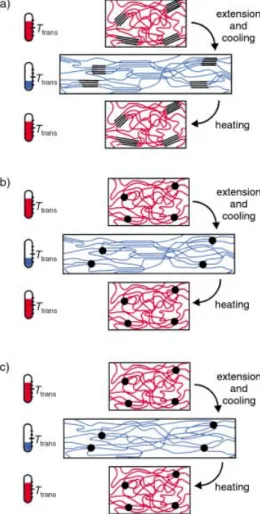
The molecular mechanism of programming the temporary form and recovering the permanent shape is demonstrated schematically in Figure 5 for a linear multiblock copolymer, as an example of a thermoplastic shape-memory polymer, as well as for two covalently cross-linked polymer networks.
The ™memory effect∫ mentioned in Section 2.1.2 is not a shape-memory effect. This expression describes the property of an elastomer one would not expect for an amorphous polymer chain. The ™memory effect∫ represents a problem in the processing of non-vulcanized natural rubber. In the case of a quick deformation of the amorphous material by a sudden subsequent decrease or removal (or reduction) of the external force, the polymer re-forms its original shape. Such polymers
Figure 5. Schematic representation of the molecular mechanism of the thermally induced shape-memory effect for a) a multiblock copolymer with
TtransTm, b) a covalently cross-linked polymer withTtransTm, and c) a
polymer network withTtransTg. If the increase in temperature is higher
thanTtransof the switching segments, these segments are flexible (shown in
red) and the polymer can be deformed elastically. The temporary shape is fixed by cooling down belowTtrans(shown in blue). If the polymer is heated
up again, the permanent shape is recovered.
will also exhibit a shape-memory effect if a suitable program-ming technique is applied. In this case, temporary entangle-ments of the polymer chains which act as physical netpoints can be used for the fixation of the permanent shape. This thermal transition can be used as a switching transition if the glass transition of the amorphous material is in the temper-ature range that is relevant for a specific application. In Section 2.4.2 this shape-memory mechanism is explained for a high molecular weight, amorphous polynorbornene.
2.3. Macroscopic Shape-Memory Effect and Thermomechanical Characterization
2.3.1. Cyclic, Thermomechanical Characterization
The shape-memory effect can be quantified by cyclic, thermomechanical investigations. The measurements are performed by means of a tensile tester equipped with a thermochamber. In this experiment, different test protocols
are applied that differ, for example, in the programming procedure (cold drawing at T<Ttransor temporarily heating
up of the test piece to T>Ttrans) or in the control options
(stress or strain controlled). A single cycle includes program-ming the test piece and recovering its permanent shape. A typical test protocol is as follows: first, the test piece is heated up to a temperature Thighabove the switching temperature
Ttransand is stretched to the maximum strainem. In the case of
thermoplasts it is important not to exceed the highest thermal transition Tperm which would cause the polymer sample to
melt. The sample is cooled down below the transition temperatureTtransunder a constant strainemto a temperature
Tlow, thus fixing the temporary shape. Retracting the clamps of
the tensile tester to the original distance of 0 % strain causes the sample to bend. After heating the sample up toThigh>
Ttrans, it contracts and the permanent shape is recovered. The
cycle then begins again.
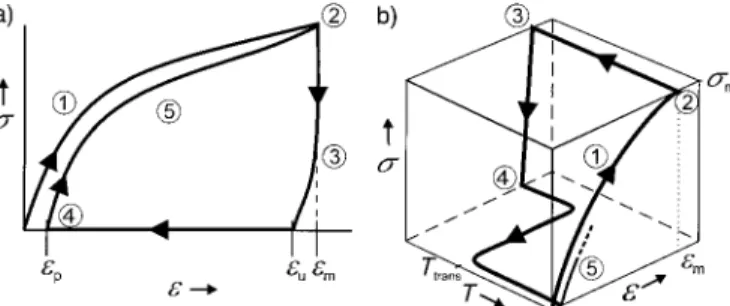
The result of such a measurement is usually presented in a
e±scurve (Figure 6 a;stensile stress). This is the reason for this test protocol being called a ™two-dimensional measure-ment∫. Figure 6 represents schematic curves. Different effects can result in changes to the curve, particularly when the stretched sample is cooled down (position2 in Figure 6 a). Among others, the following effects play a role in these changes: differences in the expansion coefficient of the stretched sample at temperatures above and belowTtransas a
result of entropy elasticity (see Section 2.1.3, Figure 4), as well as volume changes arising from crystallization in the case of
Ttransbeing a melting point.
Figure 6. Schematic representation of the results of the cyclic thermome-chanical investigations for two different tests: a)e-s diagram: 1– stretching toemat Thigh;2–cooling toTlowwhileemis kept constant; 3–clamp distance is driven back to original distance; 4–ate0 % heating up toThigh;5–start of the second cycle. b)e-T-sdiagram:1–
stretching toematThigh;2–cooling down toTlowwith cooling ratekcool
dT/dtwhilesmis kept constant;3–clamp distance is reduced until the
stress-free state s0 MPa is reached; 4–heating up to Thigh with a
heating ratekheatdT/dtats0 MPa;5–start of the second cycle.
In addition to the elastic modulusE(Thigh) atThigh, which
can be determined from the initial slope in the measurement range 1 (Figure 6 a), the elastic modulus of the stretched sample atTlowcan also be determined from the slope of the
curve at 3 (Figure 6 a). The important quantities to be determined for describing the shape-memory properties of the material at a strainemare the strain recovery rateRrand
the strain fixity rateRf. Both can be determined according to
equations (4), (5), and (6) from cyclic, thermomechanical measurements.
The strain recovery rate Rr quantifies the ability of the
material to memorize its permanent shape and is a measure of how far a strain that was applied in the course of the programming em ep(N 1) is recovered in the following
shape-memory transition. For this purpose the strain that occurs upon programming in the Nth cycle em ep(N ) is
compared to the change in strain that occurs with the shape-memory effect em ep(N) [Eq. (4)]. ep(N 1) and ep(N)
Rr(N)
em ep N
em ep N 1
(4)
represent the strain of the sample in two successively passed cycles in the stress-free state before yield stress is applied. The total strain recovery rateRr,totis defined as the strain recovery
after Npassed cycles based on the original shape of the sample [Eq. (5)]. The strain fixity rateRfdescribes the ability
Rr,tot(N)
em ep N
em
(5)
of the switching segment to fix the mechanical deformation which has been applied during the programming process. It describes how exactly the sample can be fixed in the stretched shape after a deformation to em. The resulting temporary
shape always differs from the shape achieved by deformation. The strain fixity rateRfis given by the ratio of the strain in the
stress-free state after the retraction of the tensile stress in the
Nth cycleeu(N) and the maximum strainem[Eq. (6)].[1]
Rf(N)
eu N
em
(6)
As indicated in Figure 6, the first few cycles can differ from each other. The curves become more similar with an increas-ing number of cycles. The process of deformation and recovery of the permanent shape becomes highly reprodu-cible. The changes in the first few cycles are attributed to the history of the sample, thus, processing and storage play an important role. During the first cycles a reorganization of the polymer on the molecular scale takes place which involves deformation in a certain direction. Single polymer chains arrange in a more favorable way in regard to the direction of deformation. Covalent bonds may be broken during this process.
An important variable that can not be determined by a two-dimensional measurement isTtrans. In this respect, the
three-dimensional test record is interesting, and is shown schemati-cally in Figure 6 b. In contrast to the two-dimensional measurement, the sample is cooled down in a controlled way at a strain of em and a constant tensile stress sm. The
change in strain in this region is influenced by the temperature dependence of the coefficient of thermal expansion of the stretched polymer (see Section 2.1.3) and volume effects based on the thermal transition at Ttrans (for example, a
crystallization process). Having reached Tlow, the strain is
driven back until a stress-free state is reached. The sample is then heated up toThighin a controlled way. In the course of this
means that the clamps follow the movement of the test piece. The mechanical movement occurring in the course of the shape-memory effect is recorded as a function of the temper-ature. Both the temperature interval as well asTtransin which
the shape-memory effect takes place can be determined from the interpretation of thee-Tplane of thee-T-sdiagram.
2.3.2. Bending Test for the Determination of the Shape-Memory Effect
In the course of the bending test a sample is bent at a given angleqiat a temperature above the switching transition and is
kept in this shape. The so-deformed sample is cooled down to a temperature Tlow<Ttrans and the deforming stress is
re-leased. Finally, the sample is heated up to the measuring temperatureThigh>Ttransand the recovery of the permanent
shape is recorded. The deformation angle qf varies as a
function of time. The recovery rateRbis calculated from the
ratio of the different angles before and after recoveryVfand
the deformation angle Vi in the temporary shape
[Eq. (7)].[18, 19]
Rb
qi qf
qi
(7)
2.3.3. Shrinkage Determination of Heat-Shrinkable Products
The test samples stretched at room temperature are kept under a constant stress of about 0.2 MPa and heated above
Ttrans. In the case of polyethylene cross-linked by means of
ionizing rays, the material is heated up above the melting point of the PE crystallites. The shrinkage is then given by the ratio [Eq. (8)], where llstr/l0, lstr is the length of the
stretched sample, and ls the length of the sample after the
shrinkage process. Partly, instead of the original length of the samplel0, the stretching ratiol, the ratio of the length of the
stretched sample lstr and l0, is used. The shrinkage process
depends on the temperature Thigh. Therefore, the shrinkage
ls(t) is often determined as a function of time for a given
shrinkage temperatureThigh.[49, 50]
Heat shrinkage [%] lstr ls
lstr l0
100 lstr ls
lstr 1 l1
100 (8)
2.4. Physically Cross-Linked Shape-Memory Polymers
2.4.1. Linear Block Copolymers
In this section shape-memory polymers are presented that form part of the class of linear block copolymers. The mechanism of the thermally induced shape-memory effect of these materials is based on the formation of a phase-segregated morphology, which has been described in Sec-tion 2.2, with one phase acting as a molecular switch. Through the formation of physical netpoints, the phase with the highest thermal transition Tperm on the one hand provides the
mechanical strength of the material, especially at T<Tperm,
and on the other hand is responsible for the fixation that determines the permanent shape. The materials are divided into two categories according to the thermal transition of the particular switching segment on which the shape-memory effect is based. Either the transition temperature Ttrans is a
melting temperatureTmor a glass transition temperatureTg.
In the case of a melting temperature, one observes a relatively sharp transition in most cases while glass transitions always extend over a broad temperature range. Mixed glass transition temperatures Tg mixbetween the glass transition of the
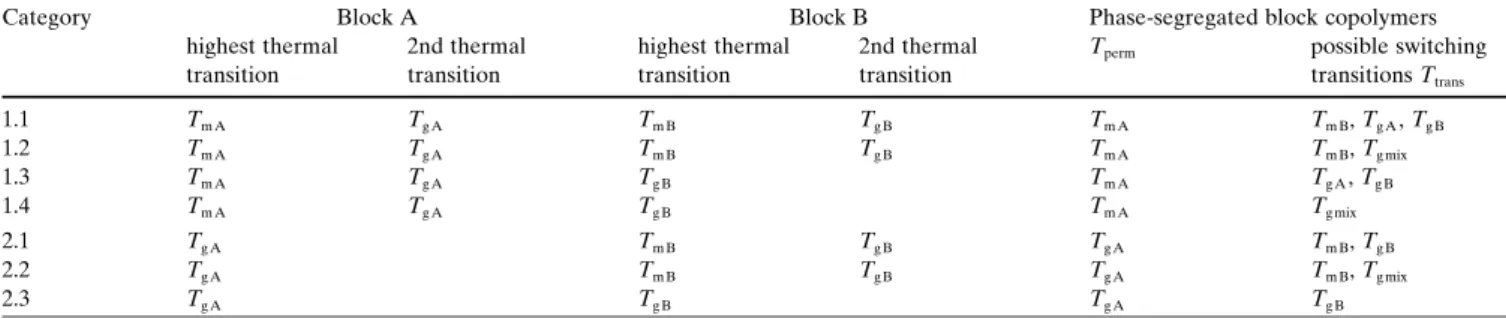
hard-segment- and the switching-hard-segment-determining blocks may occur in the cases where there is no sufficient phase separation between the hard-segment-determining block (block A) and the switching-segment-determining block (block B). Mixed glass transition temperatures can also act as switching transitions for the thermally induced shape-memory effect. Table 1gives an overview of the various possible combina-tions of hard-segment- and switching-segment-determining blocks in linear, thermoplastic shape-memory polymers.
All the linear polyurethane systems presented in the following paragraph are synthesized according to the prepol-ymer method. Thermoplastic polyurethane elastomers are produced on an industrial scale by means of this technique. In this process, isocyanate-terminated pre-polymers are ob-tained by reaction of difunctional, hydroxy-terminated oli-goesters and -ethers with an excess of a low molecular weight diisocyanate (Scheme 1, 1st reaction step). Low molecular weight diols and diamines are added as so called chain extenders to further couple these prepolymers. Linear, phase-segregated polyurethane- or polyurethane ± urea block co-polymers are obtained in this way (Scheme 1, 2nd reaction step). Each polymer chain contains segments of high polarity composed of urethane and urea bonds that are linked through
Table 1. Possible combinations of hard-segment- (block A) and switching-segment-determining blocks (block B) in linear, thermoplastic block copolymers with thermally induced shape-memory effects. In the block polymers in category 1the permanent shape is determined by the thermal transition at melting (TpermTm A), in category 2 at the glass transition (TpermTgA) of the hard-segment-determining block.
Category Block A Block B Phase-segregated block copolymers
highest thermal transition 2nd thermal transition highest thermal transition 2nd thermal transition
Tperm possible switching
transitionsTtrans 1.1 Tm A Tg A Tm B Tg B Tm A Tm B,Tg A,Tg B 1.2 Tm A Tg A Tm B Tg B Tm A Tm B,Tg mix 1.3 Tm A Tg A Tg B Tm A Tg A,Tg B 1.4 Tm A Tg A Tg B Tm A Tg mix 2.1 Tg A Tm B Tg B Tg A Tm B,Tg B 2.2 Tg A Tm B Tg B Tg A Tm B,Tg mix 2.3 Tg A Tg B Tg A Tg B
Scheme 1. Prepolymer method for the synthesis of thermoplastic poly-urethanes. R and R'are short chain groups with two free valences.
chain-extender molecules. As a consequence of their high intermolecular interaction, they form the so called hard segments. Strictly speaking, they represent the hard-segment-forming phase that is embedded in an amorphous elastic matrix. This amorphous matrix, with its low glass transition temperature lying far below the normal operating temper-ature, forms the so called soft segment. In the case of polyurethanes with shape-memory effects, this segment serves as a switching segment. For this purpose it is modified in such way that the thermal transition is located in a temperature range relevant for the respective application. Hard segment ™clusters∫ with dimensions under 1mm are formed by the phase-separation process that occurs. These clusters have high
TgorTmvalues and act as multifunctional physical netpoints.
These so-called plastic domains act as a reinforcing filler. Their ability to deflect mechanical energy by deformation enables the growth of microcracks to be prevented. They also impart cross-breaking strength and impact strength to the material.[51]
In the following paragraph polymer systems are introduced whose shape-memory effect can be triggered by the transition of a melting point. Shape-memory polymers withTtransTm
are represented by polyurethanes, polyurethanes with ionic or mesogenic components, block copolymers consisting of poly-ethyleneterephthalate (12, PET) and polyethyleneoxide (13, PEO), block copolymers containing polystyrene (14) and poly-(1,4-butadiene) (15), and an ABA triblock copolymer made from poly(2-methyl-2-oxazoline) (16, A block) and poly-(tetrahydrofuran) 17 (B block). Polyurethane systems with
TtransTgare then introduced. Table 2 gives an overview of
the chemical composition of the linear block copolymers and their respective transition temperatures that resulted in switching transitions, as well as the variability in the switching temperatures.
The thermal transitions of the pure polymer blocks of those shape-memory materials mentioned in paragraph 2.4.1are listed in Table 3.
2.4.1.1. Multiblock Copolymers with TtransTm
Polyurethanes with a Poly(e-caprolactone) Switching Segment
Kim and co-workers synthesized polyesterurethanes (PEUs, Table 2, first entry) with a hard-segment-determining block of methylenebis(4-phenylisocyanate) (18, MDI) and 1,4-butanediol (19) by using the pre-polymer method.[13, 14, 52]
The highest thermal transition Tperm corresponding to the
melting temperature of the hard-segment-determining blocks is found in the range between 200 and 2408C. Poly(e -caprolactone)diols with a number-average molecular weight (Mn) between 1600 and 8000 form the switching segments. The switching temperature for the shape-memory effect can vary between 44 and 558C depending on the weight fraction of the switching segments (variation between 50 and 90 wt %) and the molecular weight of the used poly(e -caprolactone)-diols. The crystallinity of the switching segment blocks determined by comparision of the partial melt enthalpies with the melt enthalpy of 100 % crystalline poly(e -caprolac-tone) (20) becomes higher as the weight fraction and the molecular weight of the poly(e-caprolactone)diols used in-creases. Hence, the crystallization of the poly(e-caprolactone) segments is hindered by incorporating them into the multi-block copolymers. The crystallinity observed is between 10 and 40 %. No crystallization can be observed when the poly(e -caprolactone)diol has a number-average molecular weight below 2000, presumably, because of the low degree of phase separation. In cyclic thermomechanical measurements, an increase of the initial slope with the number of cycles is found. A behavior which is named ™cyclic hardening∫ can be observed during the initial four to five cycles. This effect is caused by a relaxation of the material in the stretched state which results in an increasing orientation and crystallization of the chains. As a consequence, the resistance of the material against the strain grows with the number of cycles. The materials reach constant strain recovery rates after the third cycle. Polyurethanes formed from a high molecular weight poly(e-caprolactone) and a high weight fraction of hard-segment-determining blocks show the best shape-memory properties: the strain recovery rate increases up to 98 % with strains emof 80 %. Moreover, the shape-memory properties
are strongly influenced by the degree of strain applied: the strain recovery rates reached decrease with applied strains of
250 % from rates of more than 90 % to rates of 80 %. Besides the crystallinity of the switching segments, the decisive factors that influence the recovery properties are the formation and stability of the hard-segment-forming domains, especially in the temperature range above the melting temperature of the switching-segment crystallites. Above a lower limit of the hard-segment-determining blocks of 10 wt %, the hard-seg-ment domains are no longer sufficiently pronounced to function efficiently as physical cross-links. A slight increase in the switching temperature can be observed during the initial three cycles. This behavior is interpreted as the destruction of weak netpoints followed by an increasing formation of an ideal elastic network. Tables 4 and 5 show values determined for the shape recovery and shape fixity rates. The samples were stretched at room temperature after a thermal pretreatment at 808C.
Incorporation of Ionic Components into the Hard-Segment-Forming Phase
Several investigations have dealt with the question as to whether the incorporation of ionic or mesogenic moities into the hard-segment-forming phase can influence the
mechan-ical and shape-memory properties through the introduction of additional intermolecular interactions by possibly enhanc-ing the degree of phase separation. For this purpose, poly-ester urethanes have been synthesized by the pre-polymer method using MDI and 1,4-butanediol as the hard-seg-ment-determining block. Half of the chain-extending 1,4-butanediol in the hard-segment-forming phase was substitut-ed by 2,2-bis(hydroxymethyl)propionic acid (21) so as to introduce additional intermolecular interactions.[17]
Poly-(e-caprolactone)diols with number-average molecular weights between 2000 and 8000 were used as the switching-segment-forming phase. The weight fraction of the switching
segment was around 70 wt % for materials based on poly(e -caprolactone)diols with number-average molecular weights between 2000 and 8000 and varied between 55 and 90 wt % for poly(e-caprolactone)diol with a molecular weight of 4000. The switching temperatures for the shape-memory effect were between 44 and 558C. A hard-segment phase additionally stabilized by ionic interactions can be formed by neutraliza-tion of the propionic acid moities with triethylamine. These multiblock copolymers having polyelectrolyte character are so called ™ionomers∫. As a result of their additional Coulomb
Table 2. Overview of linear, thermoplastic block copolymers with thermally induced shape-memory effects.
Category according to Table 1Hard-segment-forming phase Switching-segment-forming phase Ttrans[8C] Ref.
Multiblock copolymers with TtransTm
1.1 MDI/1,4-butanediol poly(e-caprolactone) (Mn1600, 2000,
4000, 5000, 7000, and 8000) Tmof poly(e-caprolactone) crystallites: 44 ± 55 [13, 14, 52] 1.1 MDI/1,4-butanediol dime-thyloylpropionic acid poly(e-caprolactone) (Mn2000, 4000, and 8000) Tmof poly(e-caprolactone) crystallites: 45 ± 55 [17] 1.2 (mesogenic segments cause
further transitions)
MDI/BEBP or BHBP poly(e-caprolactone) (Mn4000) Tmof poly(e-caprolactone)
crystallites: 41± 50
[53] 1.2 (mesogenic segments cause
further transitions)
HDI/4,4'-dihydroxybiphenyl poly(e-caprolactone) (Mn4000) Tmof poly(e-caprolactone)
crystallites: 38 ± 59
[54]
1.2 (mixedTgat 25 ± 158C) poly(ethylene terephthalate) poly(ethylene oxide) (Mn4000, 6000,
10 000) Tmof poly(ethylene oxide) crystallites: 40 ± 60 [15, 16, 55] 2.1PS (14) poly(1,4-butadiene) (15) Tmof polybutadiene crystallites: 45 ± 65 [56, 95]
2.1(ABA triblock copolymer) poly(2-methyl-2-oxazoline) poly(tetrahydrofuran) (Mn4100 ±
18 800)
Tmof poly(tetrahydrofuran)
crystallites: 20 ± 40
[57]
Multiblock copolymers with TtransTg
1.1 (separateTgvalues for
poly(tetrahydrofuran) seg-ments withMn1000, 2000, 2900) MDI/1,4-butanediol poly(tetrahydrofuran) (Mn250, 650, 1000, 2000, 2900) Tgof poly(tetrahydrofuran) segments or mixedTg: 56 ± 54 [18, 19]
1.2 (mixedTgfor
poly(tetra-hydrofuran) segments with
Mn250, 650)
1.3 MDI/1,4-butanediol poly(ethylene adipate) (Mn300, 600,
1000, 2000)
Tgof poly(ethylene adipate)
segments: 5 ± 48
[11]
1.2 ± 1.4 2,4-TDI or MDI poly(propylene oxide) (Mn400, 700,
1000)
Tg: 45 ± 48 [58, 59]
carbodiimide-modified diiso-cyanates (MDI and HDI)
poly(butylene adipate) (Mn600, 1000, 2000)
ethylene glycol or bis(2-hy-droxyethyl)hydrochinone
poly(tetrahydrofuran) (Mn400, 650, 700, 850, 1000)
combination of (2,2' -bis(4-hy-droxyphenyl)-propane (bis-phenol A) and ethylene oxide
combination of (2,2' -bis(4-hydroxy-phenyl)-propane (bisphenol A) and propylene oxide (Mn800)
interactions, they exhibit a higher elastic modulus and higher mechanical strength than the systems containing uncharged hard segment blocks. The transition from the uncharged multiblock copolymers to ionomers results in an increase in the elastic moduli to between 24 and 34 % at 258C, depending on the molecular weight and the weight fraction of the poly(e -caprolactone)diols used. An increase in the elastic moduli between 38 and 156 % is observed at 658C. In addition, an
increasing hard-segment content increases the mechanical stability of the materials. The charged systems show up to approximately 10 % higher strain recovery rates and equal strain fixity rates relative to the uncharged systems. Table 6 displays the strain fixity and strain recovery rates for two materials with and without ionomer, both based on poly(e -caprolactone)diol with a number-average molecular weight of 4000 and a poly(e-caprolactone) content of 70 wt %.
Incorporation of Mesogenic Components into the Hard-Segment-Forming Phase
In the case of the incorporation of mesogenic diols such as 4,4'-bis(2-hydroxyethoxy)biphenyl (22, BEBP) or 4,4' -bis-(2-hydroxyhexoxy)biphenyl (23, BHBP) into the hard-seg-ment-determining blocks based on MDI, an increased sol-ubility of these blocks in the switching segment made of poly-(e-caprolactone) (Mn4000) is observed.[53] As a
conse-quence, a mixed Tgvalue of the hard-segment- and
switch-ing-segment-forming phase occurs. The strain-induced
fixa-Table 3. Thermal properties of the pure polymer blocks.
Polymer block Block type Tm[8C] Tg[8C]
MDI/1,4-butanediol A 200 ± 240[60] 125[62] 193 ± 232[61] 100[63] poly(e-caprolactone) B Mn1600: 46.3 60[67] Mn4000: 53.5 Mn7000: 55.9[64] Mn>10 000 (semicristalline): 59 ± 64[65, 66] poly(tetrahydrofuran) B Mn250: 7.9 Mn250: 95[70] Mn650: 20.2 Mn1000: 23.6 Mn2000: 27.7 Mn2900: 45.8[68] 57[69] 848C[71] poly(ethylene adipate) B 46[72]
poly(ethylene terephthalate) A 260 (semicrystalline)[73] 81(semicrystalline)[75]
280 (semicrystalline, equilibrium)[74] 125 (semicrystalline and oriented)[76]
poly(ethylene oxide) B Mn1400 ± 1600: 45 ± 50 Mn1900 ± 2200: 50 ± 52 Mn3500 ± 4000: 59 ± 61 Mn5000 ± 7000: 60 ± 63 Mn8500 ± 11 500: 63 ± 65[77] 69[78] 67[79] PS(14) A 270[80] 100 (amorphous)[82] 240[81] 90[83] poly(1,4-butadiene) (15) B 97 (modification I) 107[86] 145 (modification II)[84, 85]
Polyethylene A 134 (90 % crystalline, linear PE) 125 to 120 (g)
115 (60 % crystalline; LDPE)[87] 80 to 40 (b)[88]
poly(vinyl acetate) B 31[89]
polyamide-6 (nylon-6) A 215 ± 220[90] 40[92]
223[91]
poly(2-methyl-2-oxazoline) A 480[93]
Table 4. Dependence of the strain recovery rate after the first cycle (Rr(1)
in %) at em80 % on the switching segment content SC [wt %] for
different molecular weightsMnof the used poly(e-caprolactone)diols.[14]
Mn SC Rr(1) Mn SC Rr(1)
4000 8198 7000 92 60
5000 89 50 7000 88 93
5000 84 96 7000 85 95
5000 80 98 7000 8198
Table 5. Dependence of the strain recovery rate (Rr) and strain fixity rate
(Rf) after the first and fourth cycle on the switching segment content
SC [wt %] and the strainem for different molecular weightsMnof the
poly(e-caprolactone)diols used.[13]
Mn SC em Rr(1) [%] Rr(4) [%] Rf(1) [%] Rf(4) [%] 2000 70 200 48 20 95 98 2000 55 200 73 65 58 60 4000 75 600 75 60 85 90 4000 70 200 82 73 92 95 8000 55 200 62 52 88 90
Table 6. Comparison of strain recovery rate (Rr) and strain fixity rate (Rf)
atem200 % and a switching segment content of 70 wt % for ionomers and
the corresponding non-ionomers.[17]
Rr(1) [%] Rr(4) [%] Rf(1) [%] Rf(4) [%]
ionomer (charged) 66 45 95 95
tion observed is attributed to crystallization of the switching-segment blocks. An increase in the strain fixity rate of more than 20 % is observed in the case of the polymers with added BEBP with a switching-segment content increasing from 60 to 80 wt % and a strainemvalue of 100 %. Materials with added
BHBP show an increase in the strain fixity rate of 5 to 10 % with a strainemof 100 to 300 %. Table 7 shows an overview of
the recorded shape-memory properties. The strain recovery rates observed at a strainemof 100 % correspond to those with
a hard-segment-forming phase containing MDI/1,4-butane-diol.
Block Copolymers Made of Polyethylene Terephthalate (12) and Polyethylene Oxide (13)
A further example of shape-memory polymers withTtrans
Tmare linear, phase-separated block copolymers with a
hard-segment-forming phase based on PET and switching-segment blocks of PEO.[15, 16, 55, 94]The highest thermal transitionT
perm
is the melting point of the PET blocks at 2608C. The thermally induced shape-memory effect is triggered by the melting temperature of the PEO crystallites and can be varied between 40 and 608C depending on the molecular mass of the PEO blocks or on the PET content (see Table 2).
The crystalline fraction of the switching segments increases as the molecular weight of the PEO blocks grows. Simulta-neously, the melting temperature of the PEO blocks increases as their molecular weight increases. The crystallization of the PEO blocks is more and more hindered as the weight fraction of PET increases. As a consequence, the melting temperature of the switching segment with the same molecular weight decreases in the case of a polymer with an increased content of hard-segment-determining PET blocks. Streching a sample
at a temperature near the melting temperature of the PEO segments results in the crystallites of the PEO segments becoming parallelly orientated. They change their shape from spherulitic to fibril-like structures. If these structures are too well developed they hinder the recovery process. This is why a change in the strain recovery rate as a function of the applied strain em is observed depending on the composition of the
copolymer or on the developed morphology. To investigate the strain recovery rate the samples were stretched above the melting point of the PEO crystallites at 588C, cooled down, and heated up again with a heating rate of 1K min 1. The
shrinkage observed upon heating increases with an increasing molecular weight of the PEO segments up to strainsem(up to
100 %). After reaching a maximum at a strain of around 150 %, the observed shrinkage decreases again. The series of block copolymers investigated here shows improved strain recovery rates if the weight fraction of PET increases. This behavior is explained with the formation of more stable physical bonds in the better aggregated PET blocks. The temperature at which the highest recovery rate can be observed is the so-called recovery temperature Tr. This
temperature is found in the range of the melting temperature of the PEO switching segment. Tables 8 and 9 show typical shape-memory properties of PET/PEO block copolymers.
Block Copolymers Made of Polystyrene (14) and Poly(1,4-butadiene) (15)
The poly(1,4-butadiene) blocks in phase-segregated block copolymers consisting of 34 wt % PS and 66 wt % poly(1,4-butadiene) are found to be semicrystalline with a hightrans
ratio.[56, 95] The melting temperature of the
poly(1,4-buta-diene) crystallites represents the switching temperature for the thermally induced shape-memory effect. The glass tran-sition of the polystyrene is the highest thermal trantran-sitionTperm
and is found at 908C. Thus, polystyrene supplies the
hard-Table 7. Dependence of the strain recovery rate (Rr(4)) and strain fixity
rate (Rf(4)) of multiblock copolymers with a hard-segment-forming phase
of MDI/1,4-butanediol after the fourth cycle on the switching segment content SC [wt %], the strainem, and the added mesogenic diols.[a]
Additive SC em[%] Rr(4) [%] Rf(4) [%] BEBP 80 100 80 98 BEBP 71100 80 95 BEBP 57 100 85 75 BHBP 80 100 85 85 BHBP 70 100 80 80 BHBP 59 100 85 80 BHBP 80 300 68 95 BHBP 70 300 73 90 BHBP 59 300 63 85
[a] The values are calculated from Figures 2 ± 4 in ref. [53].
Table 8. Dependence of the strain recovery rate after the first cycle (Rr(1))
and the recovery temperature Tr on the switching segment content
SC [wt %] and the strain em for different molecular weight Mn
poly-(ethylene oxide)diols taken from Table 2 in ref. [15]. . Mw SC Tr[8C] Rr(1) [%] em[%] 2 000 73 ± ± ± 4 000 68 43.0 89.8 85 6 000 79 48.0 98.7 120 6 000 74 47.5 99.1120 6 000 68 46.8 98.9 120 10 000 83 54.5 99.5 150 10 000 78 53.4 99.7 150
Table 9. Dependence of the strain recovery rate after the first cycleRr(1)
(in %) at em180 % and Tm[8C] on the switching segment content
SC [wt %] for different molecular weightMnpoly(ethylene oxide)diols in
Table 2 in ref. [16].
Mw SC Tm Rr(1) Mw SC Tm Rr(1)
4 000 72 45.2 84 6 000 74 46.5 92
4 000 68 43.9 85 10 000 83 54.5 93
segment-determining blocks. The high glass transition tem-perature of the polystyrene blocks hinders the polybutadiene chains from slipping off each other upon stretching. The elastic properties, which are not only responsible for the elastic strain but also for the recovery because of the material×s entropy relaxation, are attributed to the amorphous areas of the polybutadiene phase. For a material with a poly(1,4-butadiene) content of 86 mol % and a weight-aver-age molecular weight of 70 000, the formation of two crystal modifications in the polybutadiene blocks is reported. One of the observed crystal modifications is stable at room temper-ature. First, the low temperature modification converts into the high temperature modification upon heating up to temperatures higher than 458C. Only if a temperature of 658C is exceeded does the poly(1,4-butadiene) reach a completely molten, amorphous state. A reversible solid-state transformation is possible between the two crystal modifica-tions. Whereas, a melting point usually guarantees a sharp transition, here, the existance of the two different crystal modifications does not allow an exact tuning of the switching temperature. A high strain recovery rate in the range of 80 % is observed (T808C) upon application of a maximum strain
emin the range of 100 %.Rrstill reaches values of around 60 % at a maximum strainemof more than 400 %. The appearance
of the shape-memory effect is explained by the formation of oriented crystallites upon application of high elongations of up to 600 %. These oriented crystallites form a fibril-like structure with high regularity over large distances. The single fibrils are linked through amorphous 1,4-polybutadiene chains that are anchored in several crystallites at the same time. The highly ordered morphology described remains stable even after heating above 808C.
ABA Triblock Copolymers Made from Poly(tetrahydrofuran) (17) and Poly(2-methyl-2-oxazoline) (16)
ABA triblock copolymers with a central poly(tetrahydro-furan) block (B block) with number-average molecular weights between 4100 and 18 800 and equipped with terminal poly(2-methyl-2-oxazoline) blocks (A block) with molecular weights of 1500 are obtained by cationic ring-opening polymerization.[57]The A blocks exhibit glass transition
tem-peratures around 808C and represent the hard-segment-forming phase. The poly(tetrahydrofuran) blocks are semi-crystalline and exhibit a melting temperature between 20 and 408C, depending on their molecular weight. These melting temperatures are used as switching temperatures for a thermally induced shape-memory effect. As the thermal data of the two different segments do not differ significantly from the values of the respective homopolymers, one can assume that the material shows microphase separation. The materials with poly(tetrahydrofuran) blocks having a molecular weight greater than 13 000 exhibit very good mechanical strength at room temperature. In contrast to pure poly(tetrahydrofuran), the block copolymer materials show elastic properties and incomplete softening even above the melting temperature of the poly(tetrahydrofuran) segments. This observation is interpreted as the formation of a network with physical cross-links by the poly(2-methyl-2-oxazoline) blocks. These
blocks solidify below 808C to form a glass. If a sample with a number-average molecular weight of the central poly(tetra-hydrofuran) block of 19 000 is stretched to 250 % elongation at 228C, half the elongation will be kept after releasing the external stretching force. A nearly complete recovery takes place upon heating the sample to 408C.
2.4.1.2. Multiblock Copolymers with TtransTg
In phase-segregated block copolymers a glass transition can also be used as the switching transition for the shape-memory effect. A prerequisite is a glass transition that takes place within a narrow temperature range and above the usual operating temperature of this material. In the following paragraph, polymer systems are introduced whose shape-memory effect can be triggered by using a glass transition. All examples are polyurethane systems, in which the hard-seg-ment-forming phase is synthesized from MDI/1,4-butanediol. The switching segment blocks are mostly polyethers such as poly(tetrahydrofuran) but also polyesters such as poly-(ethylene adipate) (24) are used. In the case of an almost complete phase separation, the
glass transition temperature used as the switching transition
can origin from the pure
switching-segment blocks. In the case of less-separated
phas-es, which can typically be found for short switching-segment blocks, a mixed Tgvalue from the glass transition
temper-atures of the hard-segment-forming and the switching-seg-ment-forming phase can occur. This mixed Tgvalue can be
found between the glass transition temperatures of the pure hard-segment- and switching-segment-determining blocks.
An example of materials with a mixed Tgvalue are the
systems with poly(tetrahydrofuran) switching-segment blocks having number-average molecular weights of 250 and 650 that have been provided with a hard-segment-forming phase from MDI and 1,4-butanediol by using the pre-polymer meth-od.[18, 19]The highest thermal transitionT
permcorresponding to
the melting temperature of the hard-segment-forming phase can be found between 200 and 2408C. The phase-segregated block copolymers containing a switching segment with a molecular weight ofMn250 exhibit aTgvalue in the range
between 16 and 548C, depending on the hard-segment content (hard-segment content between 57 and 95 wt %), aTgvalue
between 13 and 388C for a switching segment with a molecular weightMn650 (hard segment content between 32
and 87 wt %), and a Tgvalue between 36 and 228C for a
switching segment with a molecular weight of Mn1000
(content of hard segment determining blocks between 23 and 81wt %). A mixed Tgvalue can not be observed if
poly-(tetrahydrofurans) with a molecular weight of 2000 or 2900 are used because of the good separation of the different blocks. Here, the occurring glass transition temperatures of the poly(tetrahydrofuran) blocks are also dependent on the hard-segment content because the hard segments restrict the mobility of the switching-segment chains.
The shape-memory behavior is determined by means of a bending test (see Section 2.3.2). In the course of the bending
test, the sample is bent at a certain angleqiat 808C and kept in
this deformation. The deformed sample is quickly cooled down to 208C and the external force is released. Finally, the sample is brought to the test temperature and its recovery to the original angle is recorded. The deformation recovery rate is calculated from Equation (7). TheTgvalue increases with
increasing amounts of the hard-segment-determining blocks. As a consequence, the temperature at which the shape-memory effect is triggered rises. The deformation recovery rate increases with increasing amounts of the hard segment, and reaches values of up to 99 % for the material synthesized from a poly(tetrahydrofuran) with Mn250 and a
hard-segment content of 75 wt %. Complete recovery of materials prepared from a switching segment with Mn650 is only
reached for a hard-segment content of 87 % and higher. A constant recovery rate of 95 % is reached after approximately 100 repetitions of the bending experiment. If the deformation recovery rate is plotted against the temperature, an increase in the switching temperature with increasingTg, or increasing
hard-segment content, can be found, as expected.
Materials obtained from low molecular weight poly(tetra-hydrofurans) but with a high weight fraction of the hard-segment-forming phase show more or less complete defor-mation recovery. The block copolymers with high amounts of hard segments (between 67 and 95 wt %) show almost complete recovery, independent of the molecular weight of poly(tetrahydrofurans). The deformation recovery rate is higher as the molecular weight of the switching segment decreases. This effect is caused by an increased restriction of the shorter switching-segment chains to coil themselves. A large amount of hard-segment-determining blocks limits the twisting and coiling of the switching segment chains and thus considerably controls the shape-memory properties. In mate-rials with high molecular weight poly(tetrahydrofuran) blocks, the hard-segment-determining blocks can not fulfill this task effectively. Here, the more intense twisting of the chains clearly results in lower recovery rates. This effect can only be compensated for by increasing the proportion of hard-segment-determining blocks.
Block copolymers containing a hard-segment-forming phase of MDI and 1,4-butanediol and a switching segment based on poly(ethylene adipate) (24) can be triggered by a glass transition temperature.[11]The glass transition
temper-ature obtained with switching segment blocks with weight-average molecular weights of 300, 600, and 1000 at a constant hard segment content of 75 mol % decreases from 48 to 58C with increasing molecular weight of the poly(ethylene adip-ate)diols used. TheTgvalue of the switching-segment phase in
a block copolymer prepared from poly(ethylene adipate)diol with a molecular weightMw600 increases from 13 to 358C as the hard-segment content increases (from 75 to 90 mol %). This effect is caused by an increased hindrance in the mobility of the switching-segment chains. Cyclic, thermomechanical tensile tests (em100 %) of a material synthesized from a
polymer with Mw600 and a hard segment content of
88 mol % (69 wt %) show that the remaining strain after recovery epincreases with the number of cycles. The strain
recovery rate decreases from 85 % after the first cycle to 70 % after the fourth cycle. This behavior is a sign of increased
fatigue in the material as the number of cycles increases; this fatigue is caused by an increase in the slippage of the amorphous segments.
Since the 1980s Mitsubishi Heavy Industries have marketed shape-memory polymers that are triggered by means of a glass transition temperature. Hayashi and co-workers have descri-bed polyurethane systems with shape-memory properties that exhibit a glass transition temperature in the range between 30 and 308C and discussed their application as auto chokes or thermosensitive switching valves.[9, 58]An extension of these
polyurethane systems was described in a patent in 1992.[59]
Here, materials with glass transition temperatures in the range of 45 to 488C are described. This patent refers to the production of fabrics using threads made of polyurethane elastomers showing the shape-memory effect. These are supposed to enhance the crease resistance of the fabrics. Other applications discussed are moisture-permeable mem-branes in breathable fabrics whose permeability shows a sharp rise above theTgvalue because of a higher segment mobility.
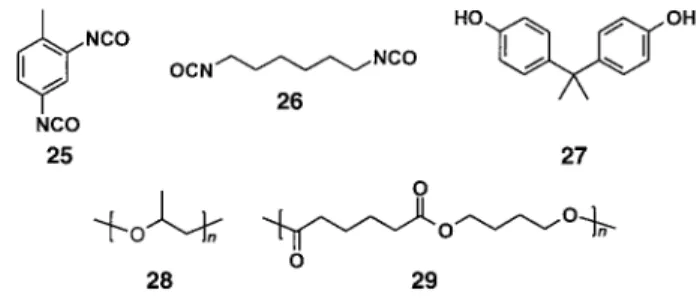
Table 2 presents a summary of the possible composition of the hard-segment- and the switching-segment-forming phases prepared at Mitsubishi. The hard-segment-determining blocks can be formed by toluene-2,4-diisocyanate (25, 2,4-TDI), MDI (18), carbodiimide-modified diisocyanates such as MDI and hexamethylene diisocyanate (26, HDI), and chain ex-tenders such as ethylene glycol, bis(2-hydroxyethyl)hydro-quinone, or a combination of 2,2' -bis(4-hydroxyphenyl)pro-pane (27, bisphenol A) and ethylene oxide. The
switching-segment-determining blocks can be formed by polyethers, for example, PEO (13, Mn600), poly(propylene oxide) (28,
Mn400, 700, 1000), poly(tetrahydrofuran) (17, Mn400,
650, 700, 850, 1000), or a combination of bisphenol A and propylene oxide (Mn800), or oligoesters, for example,
poly(butylene adipate) (29,Mn600, 1000, 2000).
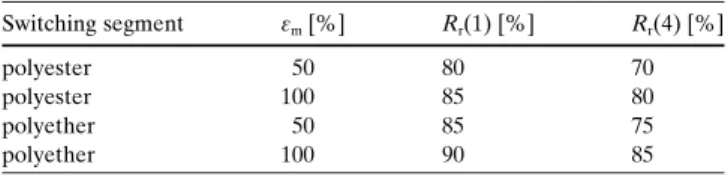
The results of cyclic, thermomechanical tensile tests with maximum elongationsemof 50 and 100 % for two materials
differing in E modulus above their Tg values of 458C are
reported: one material with polyester switching blocks and a relatively high E modulus and another material with poly-ether switching blocks with a low E modulus. In the course of the cyclic, thermomechanical tensile test, the test pieces were stretched at a temperature Thigh of 658C to the maximum
elongation em mentioned above. The samples were then
cooled down to a temperatureTlowof 258C and kept for five
minutes at this temperature–the deformation was fixed by cooling below the system×s glass transition temperature. Subsequently, the external stress was released, the sample
![Table 4. Dependence of the strain recovery rate after the first cycle (R r (1) in %) at e m 80% on the switching segment content SC [wt%] for different molecular weights M n of the used poly(e-caprolactone)diols](https://thumb-us.123doks.com/thumbv2/123dok_us/926492.2620008/12.892.70.821.96.589/dependence-recovery-switching-segment-content-different-molecular-caprolactone.webp)
![Table 9. Dependence of the strain recovery rate after the first cycle R r (1) (in %) at e m 180% and T m [ 8C] on the switching segment content SC [wt %] for different molecular weight M n poly(ethylene oxide)diols in Table 2 in ref](https://thumb-us.123doks.com/thumbv2/123dok_us/926492.2620008/13.892.70.432.559.717/dependence-recovery-switching-segment-content-different-molecular-ethylene.webp)