Haibin Wang
Florentin Smarandache
Yan-Qing Zhang
Rajshekhar Sunderraman
Interval Neutrosophic Sets and Logic:
Theory and Applications in Computing
truth-membership function indeterminacy-membership function falsity-membership function Neutrosophication Neutrosophic Inference Neutrosophic Rule Base Neutrosophic
Type Reduction Deneutrosophication
Crisp Output Input
Hexis 2005
Theory and Applications in Computing
Haibin Wang
1Florentin Smarandache
2Yan-Qing Zhang
1Rajshekhar Sunderraman
11Department of Computer Science Georgia State University Atlanta, GA 30302, USA
2Department of Mathematics and Science University of New Mexico
Gallup, NM 87301, USA
Hexis Arizona
This book can be ordered in a paper bound reprint from:
Books on Demand
ProQuest Information & Learning (University of Microfilm International)
300 N. Zeeb Road P.O. Box 1346, Ann Arbor
MI 48106-1346, USA
Tel.: 1-800-521-0600 (Customer Service) http://wwwlib.umi.com/bod/search/basic
Peer Reviewers: This book has been peer reviewed and recommended for publication by: Dr. Albena Tchamova, Bulgarian Academy of Sciences, Sofia, Bulgaria.
Dr. W. B. Vasantha Kandasamy, Indian Institute of Technology Madras, Chennay, India. Dr. Feijun Song, Florida Atlantic University, Dania, USA.
Dr. Xiaohong Yuan, North Carolina A & T State University, Greensboro, USA
Cover design by Xiaoyuan Suo.
Copyright 2005 by Hexis and Authors.
Many books can be downloaded from the following E-Library of Science: http://www.gallup.unm.edu/∼smarandache/eBooks-otherformats.htm
ISBN: 1-931233-94-2
Standard Address Number: 297-5092
Contents
Preface iii
1 Interval Neutrosophic Sets 1
1.1 Introduction . . . 1
1.2 Neutrosophic Set . . . 4
1.3 Interval Neutrosophic Set . . . 6
1.4 Properties of Set-theoretic Operators . . . 14
1.5 Convexity of Interval Neutrosophic Set . . . 15
1.6 Conclusions . . . 16
1.7 Appendix . . . 16
2 Interval Neutrosophic Logic 21 2.1 Introduction . . . 21
2.2 Interval Neutrosophic Propositional Calculus . . . 23
2.2.1 Syntax of Interval Neutrosophic Propositional Calculus . . . 23
2.2.2 Semantics of Interval Neutrosophic Propositional Calculus . . . 24
2.2.3 Proof Theory of Interval Neutrosophic Propositional Calculus . . . 25
2.3 Interval Neutrosophic Predicate Calculus . . . 27
2.3.1 Syntax of Interval Neutrosophic Predicate Calculus . . . 27
2.3.2 Semantics of Interval Neutrosophic Predicate Calculus . . . 29
2.3.3 Proof Theory of Interval Neutrosophic Predicate Calculus . . . 30
2.4 An Application of Interval Neutrosophic Logic . . . 32
2.5 Conclusions . . . 38
3 Neutrosophic Relational Data Model 39 3.1 Introduction . . . 39
3.2 Fuzzy Relations and Operations . . . 42
3.2.1 Set-theoretic operations on Fuzzy relations . . . 42
3.2.2 Relation-theoretic operations on Fuzzy relations . . . 43 i
3.3 Neutrosophic Relations . . . 43
3.4 Generalized Algebra on Neutrosophic Relations . . . 47
3.5 An Application . . . 51
3.6 An Infinite-Valued Tuple Relational Calculus . . . 54
3.6.1 An Example . . . 57
3.7 A Generalized SQL Query Construct for Neutrosophic Relations . . . 58
3.7.1 Infinite-Valued Conditions . . . 59
3.7.2 An Example . . . 62
3.8 Conclusions . . . 63
4 Soft Semantic Web Services Agent 65 4.1 Introduction . . . 65
4.2 Background . . . 67
4.2.1 Traditional Web services . . . 67
4.2.2 Semantic Web . . . 68
4.2.3 Semantic Web Services . . . 68
4.2.4 Soft Computing Methodology . . . 68
4.2.5 QoS Model . . . 69
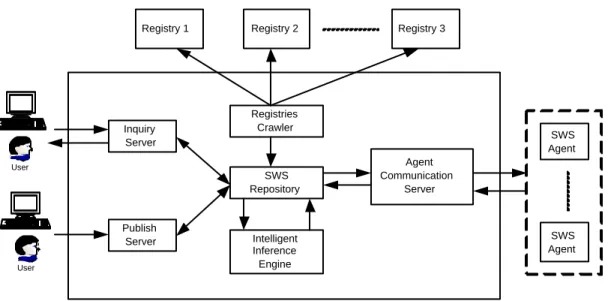
4.3 Architecture of Extensible Soft SWS Agent . . . 69
4.3.1 Registries Crawler . . . 70
4.3.2 SWS Repository . . . 71
4.3.3 Inquiry Server . . . 72
4.3.4 Publish Server . . . 73
4.3.5 Agent Communication Server . . . 74
4.3.6 Intelligent Inference Engine . . . 74
4.3.7 Design of Intelligent Inference Engine . . . 75
4.3.8 Input neutrosophic sets . . . 76
4.3.9 Neutrosophic rule bases . . . 76
4.3.10 Design of deneutrosophication . . . 76
4.3.11 Genetic algorithms . . . 76
4.3.12 Simulations . . . 78
4.4 Related Work . . . 78
Preface
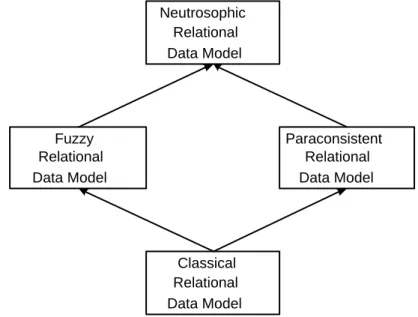
This book presents the advancements and applications of neutrosophics. Chapter 1 first introduces the interval neutrosophic sets which is an instance of neutrosophic sets. In this chapter, the definition of interval neutrosophic sets and set-theoretic operators are given and various properties of interval neutrosophic set are proved. Chapter 2 defines the interval neutrosophic logic based on interval neutrosophic sets including the syntax and semantics of first order interval neutrosophic propositional logic and first order interval neutrosophic predicate logic. The interval neutrosophic logic can reason and model fuzzy, incomplete and inconsistent information. In this chapter, we also design an interval neutrosophic inference system based on first order interval neutrosophic predicate logic. The interval neutrosophic inference system can be applied to decision making. Chapter 3 gives one application of interval neutrosophic sets and logic in the field of relational databases. Neutrosophic data model is the generalization of fuzzy data model and paraconsistent data model. Here, we generalize various set-theoretic and relation-theoretic operations of fuzzy data model to neutrosophic data model. Chapter 4 gives another application of interval neutrosophic logic. A soft semantic Web Services agent framework is proposed to faciliate the registration and discovery of high quality semantic Web Services agent. The intelligent inference engine module of soft Semantic Web Services agent is implemented using interval neutrosophic logic.
The neutrosophic logic, neutrosophic set, neutrosophic probability, and neutrosophic statistics are increasingly used in engineering applications (especially for software and information fusion), medicine, military, cybernetics, physics.
In order to familiarize the reader with the concepts of neutrosophics here below we present their definitions and short explanations, followed by new research subjects in the field.
Neutrosophic Logic is a general framework for unification of many existing logics. The main idea of NL is to characterize each logical statement in a 3D Neutrosophic Space, where each dimension of the space represents respectively the truth (T), the falsehood (F), and the indeterminacy (I) of the statement under consideration, whereT, I, F are standard or non-standard real subsets of ]0−,1+[.
For software engineering proposals the classical unit interval [0,1] can be used. T, I, F are independent components, leaving room for incomplete information (when their superior sum<1), paraconsistent and contradictory information (when the superior sum>1), or complete information (sum of components = 1). As an example: a statement can be between [0.4,0.6] true, 0.1 or between (0.15,0.25) indeterminate, and either 0.4 or 0.6 false.
Neutrosophic Set.
Let U be a universe of discourse, and M a set included in U. An element x from U is noted with respect to the set M as x(T, I, F) and belongs to M in the following way: it is t% true in the set, i% indeterminate (unknown if it is) in the set, and f% false, where tvaries in T, ivaries inI, f varies inF. Statically T, I, F are subsets, but dynamicallyT, I, F are functions/operators depending on many known or unknown parameters.
Neutrosophic Probability is a generalization of the classical probability and imprecise probability in which the chance that an event A occurs ist% true - wheret varies in the subsetT, i% indeterminate - where i varies in the subset I, and f% false - where f varies in the subset F. In classical probability nsup ≤ 1, while in neutrosophic probability nsup ≤3+. In imprecise probability: the probability of an
event is a subsetT in [0,1], not a numberpin [0,1], what’s left is supposed to be the opposite, subsetF (also from the unit interval [0,1]); there is no indeterminate subset I in imprecise probability.
Neutrosophic Statistics is the analysis of events described by the neutrosophic probability. The function that models the neutrosophic probability of a random variablexis called neutrosophic distribution: N P(x) = (T(x), I(x), F(x)), where T(x) represents the probability that value x occurs, F(x) represents the probability that valuex does not occur, and I(x) represents the indeterminate / unknown probability of value x.
Neutrosophy is a new branch of philosophy that studies the origin, nature, and scope of neutralities, as well as their interactions with different ideational spectra. The neutrosophics were introduced by Dr. F. Smarandache in 1995. This theory considers every notion or idea hAi together with its opposite or negationhAnti−Aiand the spectrum of “neutralities” hN eut−Ai (i.e. notions or ideas located between the two extremes, supporting neitherhAinorhAnti−Ai). ThehN eut−Ai andhAnti−Aiideas together are referred to asiN on−Ai. According to this theory every ideahAitends to be neutralized and balanced by hAnti−Ai andhN on−Aiideas - as a state of equilibrium.
In a classical way hAi, hN eut−Ai, hAnti−Ai are disjoint two by two. But, since in many cases the borders between notions are vague, imprecise, it is possible thathAi,hN eut−Ai,hAnti−Ai(andhN on−Ai
of course) have common parts two by two as well.
Neutrosophy is the base of neutrosophic logic, neutrosophic set, neutrosophic probability and statistics. The NEUTROSOPHIC WORLD is expanding with new research subjects:
1. Neutrosophic topology including neutrosophic metric spaces and smooth topological spaces
2. Neutrosophic numbers and arithmetical operations, including ranking procedures for neutrosophic numbers
3. Neutrosophic rough sets
4. Neutrosophic relational structures, including neutrosophic relational equations, neutrosophic similar-ity relations, and neutrosophic orderings,
5. Neutrosophic geometry 6. Neutrosophic probability
v 7. Neutrosophic logical operations, including n-norms, n-conorms, neutrosophic implicators,
neutro-sophic quantifiers
8. Measures of neutrosophication 9. Deneutrosophication techniques
10. Neutrosophic measures and neutrosophic integrals 11. Neutrosophic multivalued mappings
12. Neutrosophic differential calculus 13. Neutrosophic mathematical morphology 14. Neutrosophic algebraic structures 15. Neutrosophic models
16. Neutrosophic cognitive maps 17. Neutrosophic matrix
18. Neutrosophic graph 19. Neutrosophic fusion rules 20. Neutrosophic relational maps 21. Applications:
neutrosophic relational databases, neutrosophic image processing, neutrosophic linguistic variables, neutrosophic decision making and preference structures, neutrosophic expert systems, neutro-sophic reliability theory, neutroneutro-sophic soft computing techniques in e-commerce and e-learning Readers can download e-books on neutrosophic logic (a generalization of the fuzzy logic and IFL), neutrosophic set (generalization of the fuzzy set and IFS), neutrosophic probability (generalization of classical and imprecise probabilities) from this site: www.gallup.unm.edu/∼smarandache/philos.htm.
Researchers interested in neutrosophics can contact Dr. Florentin Smarandache, University of New Mexico, Department of Mathematics and Science, 200 College Road, Gallup, NM 87301, USA, E-mail: [email protected].
May 2005 Haibin Wang
Florentin Smarandache Yan-Qing Zhang Rajshekhar Sunderraman
An Ode to Fuzzy & Neutrosophic Logic and their Creators
When everything seems a murky mess and you are forced to second guess
The way you are headed when you’re going straight
And whether you’re there on time ‘cause early may be late! When your eyes start playing tricks - it’s neither night nor day But the magic hour; when you just can’t for sure say
The white from the black as mostly all is grey Take a moment to close your eyes and thank Zadeh!
For inventing a way to tell black from white and the big from the small When none knows for sure how black is black or how tall is tall! ‘Cause when chance becomes a possibility, you know you sure can bet That you’re in one group or the other, ‘cause you’re in a fuzzy set! When you are in a pensive mood having a hard think
On deep issues like the origin of Man and why there is a missing link! Whether the egg came before the hen like the dough came before the bread Whether atoms are really balls of matter, whether Schr¨odinger’s cat is dead! Whether bulls will keep tossing the markets up while the big bears hibernate And all these answers may be True or False only if they aren’t Indeterminate! It is not always easy to take a side as will become apparent
But if you will still prefer to have a say over remaining silent Then you’ll have to make a choice based on the information at hand And it won’t be easy as you’ll feel as lost as Alice in wonderland! Arguments will be as strong for one side as for any other
And just when you feel too weighed down to even stop and bother; In will come Smarandache waving his wand of neutrosophic logic And suddenly all will make perfect sense - like a spell of magic! Fusing information into knowledge is what neutrosophy aims to do Does not matter if information is partial, incoherent and paradoxical too! What Zadeh started and Smarandache perfected; has now come here to stay Helping us to find order in chaos like the proverbial needle in a stack of hay! Generalizing the rules of Probability into a philosophy quite brand new A new branch of science has emerged that has detractors but very few!
Sukanto Bhattacharya Alaska Pacific University Anchorage, AK 99508, USA
Chapter 1
Interval Neutrosophic Sets
A neutrosophic set is a part of neutrosophy that studies the origin, nature, and scope of neutralities, as well as their interactions with different ideational spectra. The neutrosophic set is a powerful general formal framework that has been recently proposed. However, the neutrosophic set needs to be specified from a technical point of view. Now we define the set-theoretic operators on an instance of a neutrosophic set, and call it an Interval Neutrosophic Set (INS). We prove various properties of INS, which are connected to operations and relations over INS. Finally, we introduce and prove the convexity of interval neutrosophic sets.
1.1
Introduction
The concept of fuzzy sets was introduced by Zadeh in 1965 [Zad65b]. Since then fuzzy sets and fuzzy logic have been applied in many real applications to handle uncertainty. The traditional fuzzy set uses one real number µA(x) ∈[0,1] to represent the grade of membership of fuzzy set A defined on universe
X. SometimesµA(x) itself is uncertain and hard to be defined by a crisp value. So the concept of interval
valued fuzzy sets was proposed [Tur86] to capture the uncertainty of grade of membership. Interval valued fuzzy set uses an interval value [µL
A(x), µUA(x)] with 0 ≤ µAL(x) ≤ µUA(x) ≤ 1 to represent the grade of
membership of fuzzy set A. In some applications such as expert system, belief system and information fusion, we should consider not only the truth-membership supported by the evidence but also the falsity-membership against by the evidence. That is beyond the scope of fuzzy sets and interval valued fuzzy sets. In 1986, Atanassov introduced the intuitionistic fuzzy sets [Ata86] that is a generalization of fuzzy sets and provably equivalent to interval valued fuzzy sets. The intuitionistic fuzzy sets consider both truth-membership and falsity-membership. Later on, intuitionistic fuzzy sets were extended to the interval valued intuitionistic fuzzy sets [Ata89]. The interval valued intuitionistic fuzzy set uses a pair of intervals [t−, t+], 0≤t− ≤t+≤1 and [f−, f+], 0≤f−≤f+ ≤1 witht++f+≤1 to describe the degree of true
belief and false belief. Because of the restriction that t++f+ ≤1, intuitionistic fuzzy sets and interval valued intuitionistic fuzzy sets can only handle incomplete information not the indeterminate information and inconsistent information which exists commonly in belief systems. For example, when we ask the
opinion of an expert about certain statement, he or she may say that the possibility that the statement is true is between 0.5 and 0.7 and the statement is false is between 0.2 and 0.4 and the degree that he or she is not sure is between 0.1 and 0.3. Here is another example, suppose there are 10 voters during a voting process. In time t1, three vote “yes”, two vote “no” and five are undecided, using neutrosophic notation,
it can be expressed as x(0.3,0.5,0.2). In time t2, three vote “yes”, two vote “no”, two give up and three
are undecided, it then can be expressed as x(0.3,0.3,02). That is beyond the scope of the intuitionistic fuzzy set. So, the notion of neutrosophic set is more general and overcomes the aforementioned issues.
In neutrosophic set, indeterminacy is quantified explicitly and
truth-membership, indeterminacy-membership and falsity-membership are independent. This assumption is very important in many applications such as information fusion in which we try to combine the data from different sensors. Neutrosophy was introduced by Florentin Smarandache in 1980. “It is a branch of philosophy which studies the origin, nature and scope of neutralities, as well as their interactions with different ideational spectra” [Sma99]. Neutrosophic set is a powerful general formal framework which generalizes the concept of the classic set, fuzzy set [Zad65b], interval valued fuzzy set [Tur86], intuitionistic fuzzy set [Ata86], interval valued intuitionistic fuzzy set [Ata89], paraconsistent set [Sma99], dialetheist set [Sma99], paradoxist set [Sma99], tautological set [Sma99]. A neutrosophic setAdefined on universeU. x=x(T, I, F)∈A with T, I and F being the real standard or non-standard subsets of ]0−,1+[. T is the degree of truth-membership function in the set A, I is the degree of indeterminacy-membership function in the set Aand F is the degree of falsity-membership function in the setA.
The neutrosophic set generalizes the above mentioned sets from philosophical point of view. From scientific or engineering point of view, the neutrosophic set and set-theoretic operators need to be specified. Otherwise, it will be difficult to apply in the real applications. In this chapter, we define the set-theoretic operators on an instance of neutrosophic set called Interval Neutrosophic Set (INS). We call it as “interval” because it is subclass of neutrosophic set, that is we only consider the subunitary interval of [0,1].
An interval neutrosophic set A defined on universe X, x = x(T, I, F) ∈ A with T, I and F being the subinterval of [0,1]. The interval neutrosophic set can represent uncertain, imprecise, incomplete and inconsistent information which exist in real world. The interval neutrosophic set generalizes the following sets:
1. the classical set, I =∅, infT = supT = 0 or 1, infF = supF = 0 or 1 and supT+ supF = 1. 2. the fuzzy set,I =∅, infT = supT ∈[0,1], infF = supF ∈[0,1] and supT + supF = 1.
3. the interval valued fuzzy set, I =∅, infT,supT,infF,supF ∈ [0,1], supT+ infF = 1 and infT + supF = 1.
4. theintuitionistic fuzzy set, I=∅, infT = supT ∈[0,1], infF = supF ∈[0,1] and supT+ supF ≤1. 5. theinterval valued intuitionistic fuzzy set,I =∅, infT,supT,infF,supF ∈[0,1] and supT+supF ≤
1.
1.1. INTRODUCTION 3
7. the interval valued paraconsistent set, I =∅, infT,supT,infF,supF ∈[0,1] and infT + infF >1.
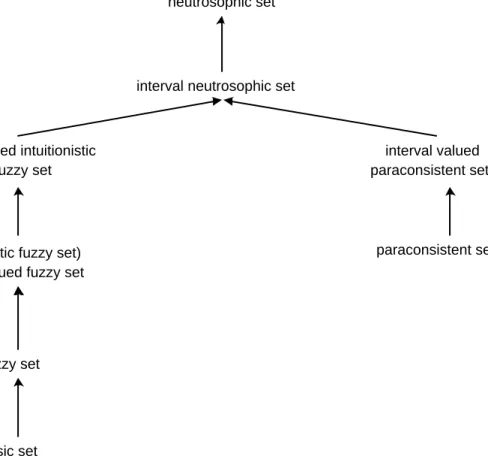
The relationship among interval neutrosophic set and other sets is illustrated in Fig 1.1.
neutrosophic set
interval neutrosophic set
interval valued intuitionistic fuzzy set
(intuitionistic fuzzy set) interval valued fuzzy set
fuzzy set
classic set
interval valued paraconsistent set
paraconsistent set
Figure 1.1: Relationship among interval neutrosophic set and other sets Note that → in Fig. 1.1 such as a→bmeans that b is a generalization of a.
We define the set-theoretic operators on the interval neutrosophic set. Various properties of INS are proved, which are connected to the operations and relations over INS.
The rest of chapter is organized as follows. Section 1.2 gives a brief overview of the neutrosophic set. Section 1.3 gives the definition of the interval neutrosophic set and set-theoretic operations. Section 1.4 presents some properties of set-theoretic operations. Section 1.5 defines the convexity of the interval neutrosophic sets and proves some properties of convexity. Section 1.6 concludes the chapter. To maintain a smooth flow throughout the chapter, we present the proofs to all theorems in Appendix.
1.2
Neutrosophic Set
This section gives a brief overview of concepts of neutrosophic set defined in [Sma99]. Here, we use different notations to express the same meaning. Let S1 and S2 be two real standard or non-standard
subsets, then S1 ⊕S2 = {x|x = s1 +s2, s1 ∈ S1 and s2 ∈ S2}, {1+} ⊕S2 = {x|x = 1++s2, s2 ∈ S2}.
S1 S2 ={x|x=s1−s2, s1 ∈S1 and s2 ∈S2}, {1+} S2 ={x|x= 1+−s2, s2 ∈S2}. S1S2 ={x|x=
s1·s2, s1 ∈S1 and s2∈S2}.
Definition 1 (Neutrosophic Set) Let X be a space of points (objects), with a generic element in X
denoted by x.
A neutrosophic setAinX is characterized by atruth-membership functionTA, aindeterminacy-membership
function IA and a falsity-membership function FA. TA(x), IA(x) and FA(x) are real standard or
non-standard subsets of ]0−,1+[. That is
TA:X → ]0−,1+[, (1.1)
IA:X → ]0−,1+[, (1.2)
FA:X → ]0−,1+[. (1.3)
There is no restriction on the sum of TA(x), IA(x) and FA(x), so 0− ≤ supTA(x) + supIA(x) +
supFA(x)≤3+.
Definition 2 The complementof a neutrosophic set A is denoted by A¯and is defined by
TA¯(x) = {1+} TA(x), (1.4)
IA¯(x) = {1+} IA(x), (1.5)
FA¯(x) = {1+} FA(x), (1.6)
for all x in X.
Definition 3 (Containment) A neutrosophic setAiscontainedin the other neutrosophic setB,A⊆B, if and only if
infTA(x)≤infTB(x) , supTA(x)≤supTB(x), (1.7)
infIA(x)≥infIB(x) , supIA(x)≥supIB(x), (1.8)
infFA(x)≥infFB(x) , supFA(x)≥supFB(x), (1.9)
1.2. NEUTROSOPHIC SET 5
Definition 4 (Union) The union of two neutrosophic sets A and B is a neutrosophic set C, written as C =A∪B, whose truth-membership, indeterminacy-membership and falsity-membership functions are related to those of A and B by
TC(x) = TA(x)⊕TB(x) TA(x)TB(x), (1.10)
IC(x) = IA(x)⊕IB(x) IA(x)IB(x), (1.11)
FC(x) = FA(x)⊕FB(x) FA(x)FB(x), (1.12)
for all x in X.
Definition 5 (Intersection) The intersection of two neutrosophic sets A and B is a neutrosophic set
C, written as C = A∩B, whose truth-membership, indeterminacy-membership and falsity-membership functions are related to those of A and B by
TC(x) = TA(x)TB(x), (1.13)
IC(x) = IA(x)IB(x), (1.14)
FC(x) = FA(x)FB(x), (1.15)
for all x in X.
Definition 6 (Difference) The differenceof two neutrosophic setsAandB is a neutrosophic setC, writ-ten as C =A\B, whose truth-membership, indeterminacy-membership and falsity-membership functions are related to those of A and B by
TC(x) = TA(x) TA(x)TB(x), (1.16)
IC(x) = IA(x) IA(x)IB(x), (1.17)
FC(x) = FA(x) FA(x)FB(x), (1.18)
for all x in X.
Definition 7 (Cartesian Product) Let A be the neutrosophic set defined on universe E1 and B be the
neutrosophic set defined on universe E2. If x(TA1, IA1, FA1)∈ A and y(TA2, IA2, FA2) ∈ B, then the cartesian
product of two neutrosophic sets A and B is defined by
1.3
Interval Neutrosophic Set
In this section, we present the notion of the interval neutrosophic set (INS). The interval neutrosophic set (INS) is an instance of neutrosophic set which can be used in real scientific and engineering applications.
Definition 8 (Interval Neutrosophic Set) Let X be a space of points (objects), with a generic element in X denoted by x.
An interval neutrosophic set (INS)AinX is characterized by truth-membership functionTA,
indeterminacy-membership functionIAand falsity-membership functionFA. For each pointxinX,TA(x), IA(x), FA(x)⊆
[0,1].
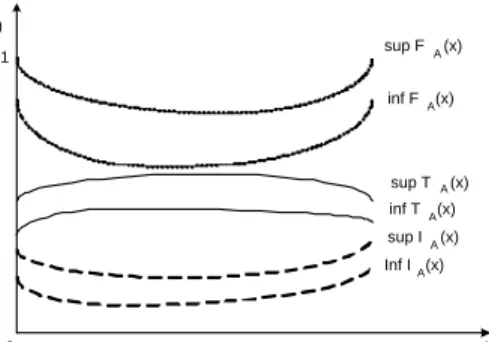
An interval neutrosophic set (INS) inR1 is illustrated in Fig. 1.2.
0 X TA(x) IA(x) FA(x) 1 sup FA(x) inf FA(x) sup TA(x) inf TA(x) sup IA(x) Inf IA(x)
Figure 1.2: Illustration of interval neutrosophic set in R1 When X is continuous, an INSA can be written as
A=
Z
X
hT(x), I(x), F(x)i/x, x∈X (1.20)
When X is discrete, an INS Acan be written as
A=
n
X
i=1
hT(xi), I(xi), F(xi)i/xi, xi ∈X (1.21)
Consider parameters such as capability, trustworthiness and price of semantic Web services. These parameters are commonly used to define quality of service of semantic Web services. In this section, we will use the evaluation of quality of service of semantic Web services [WZS04] as running example to illustrate every set-theoretic operation on interval neutrosophic set.
Example 1 Assume that X = [x1, x2, x3]. x1 is capability, x2 is trustworthiness and x3 is price. The
1.3. INTERVAL NEUTROSOPHIC SET 7
option could be degree of good, degree of indeterminacy and degree of poor. A is an interval neutrosophic set of X defined by
A=h[0.2,0.4],[0.3,0.5],[0.3,0.5]i/x1 +h[0.5,0.7],[0,0.2],[0.2,0.3]i/x2 + h[0.6,0.8],[0.2,0.3],[0.2,0.3]i/x3.
B is an interval neutrosophic set of X defined by
B =h[0.5,0.7],[0.1,0.3],[0.1,0.3]i/x1 +h[0.2,0.3],[0.2,0.4],[0.5,0.8]i/x2 + h[0.4,0.6],[0,0.1],[0.3,0.4]i/x3.
Definition 9 An interval neutrosophic set A is empty if and only if its infTA(x) = supTA(x) = 0,
infIA(x) = supIA(x) = 1 andinfFA(x) = supTA(x) = 0, for all x in X.
We now present the set-theoretic operators on interval neutrosophic set.
Definition 10 (Containment) An interval neutrosophic setAis containedin the other interval neutro-sophic set B, A⊆B, if and only if
infTA(x)≤infTB(x) , supTA(x)≤supTB(x), (1.22)
infIA(x)≥infIB(x) , supIA(x)≥supIB(x), (1.23)
infFA(x)≥infFB(x) , supFA(x)≥supFB(x), (1.24)
for all x in X.
Definition 11 Two interval neutrosophic setsAandB are equal, written as A=B, if and only ifA⊆B
and B⊆A
Let 0 =h0,1,1i and 1 =h1,0,0i.
Definition 12 (Complement) Let CN denote a neutrosophic complement ofA. ThenCN is a function
CN :N →N
and CN must satisfy at least the following three axiomatic requirements:
1. CN(0)= 1 and CN(1) = 0 (boundary conditions).
2. Let A and B be two interval neutrosophic sets defined on X, if A(x) ≤ B(x), then CN(A(x)) ≥
CN(B(x)), for all x in X. (monotonicity).
3. Let A be an interval neutrosophic set defined on X, then CN(CN(A(x))) = A(x), for all x in X.
(involutivity).
There are many functions which satisfy the requirement to be the complement operator of interval neutrosophic sets. Here we give one example.
Definition 13 (Complement CN1) The complement of an interval neutrosophic set A is denoted by A¯
and is defined by TA¯(x) = FA(x), (1.25) infIA¯(x) = 1−supIA(x), (1.26) supIA¯(x) = 1−infIA(x), (1.27) FA¯(x) = TA(x), (1.28) for all x in X.
Example 2 Let A be the interval neutrosophic set defined in Example 1. Then,
¯
A=h[0.3,0.5],[0.5,0.7],[0.2,0.4]i/x1 +h[0.2,0.3],[0.8,1.0],[0.5,0.7]i/x2+h[0.2,0.3],[0.7,0.8],[0.6,0.8]i/x3.
Definition 14 (N-norm) Let IN denote a neutrosophic intersection of two interval neutrosophic sets A
and B. Then IN is a function
IN :N ×N →N
and IN must satisfy at least the following four axiomatic requirements:
1. IN(A(x),1) =A(x), for allx in X. (boundary condition).
2. B(x)≤C(x) implies IN(A(x), B(x))≤IN(A(x), C(x)), for allx in X. (monotonicity).
3. IN(A(x), B(x)) =IN(B(x), A(x)), for all x in X. (commutativity).
4. IN(A(x), IN(B(x), C(x))) =IN(IN(A(x), B(x)), C(x)), for all x in X. (associativity).
Here we give one example of intersection of two interval neutrosophic sets which satisfies aboveN-norm axiomatic requirements. Other different definitions can be given for different applications.
Definition 15 (Intersection IN1) The intersection of two interval neutrosophic sets A and B is an
in-terval neutrosophic setC, written asC =A∩B, whose truth-membership, indeterminacy-membership, and false-membership are related to those of A and B by
infTC(x) = min(infTA(x),infTB(x)), (1.29)
supTC(x) = min(supTA(x),supTB(x)), (1.30)
infIC(x) = max(infIA(x),infIB(x)), (1.31)
supIC(x) = max(supIA(x),supIB(x)), (1.32)
infFC(x) = max(infFA(x),infFB(x)), (1.33)
1.3. INTERVAL NEUTROSOPHIC SET 9
for all x in X.
Example 3 Let A and B be the interval neutrosophic sets defined in Example 1. Then, A ∩ B =
h[0.2,0.4],[0.3,0.5],[0.3,0.5]i/x1 +
h[0.2,0.3],[0.2,0.4],[0.5,0.8]i/x2 +h[0.4,0.6],[0.2,0.3],[0.3,0.4]i/x3.
Theorem 1 A∩B is the largest interval neutrosophic set contained in both A andB.
Definition 16 (N-conorm) LetUN denote a neutrosophic unionof two interval neutrosophic setsAand
B. Then UN is a function
UN :N ×N →N
and UN must satisfy at least the following four axiomatic requirements:
1. UN(A(x),0) =A(x), for all x in X. (boundary condition).
2. B(x)≤C(x) implies UN(A(x), B(x))≤UN(A(x), C(x)), for allx inX. (monotonicity).
3. UN(A(x), B(x)) =UN(B(x), A(x)), for all x in X. (commutativity).
4. UN(A(x), UN(B(x), C(x))) =UN(UN(A(x), B(x)), C(x)), for all x in X. (associativity).
Here we give one example of union of two interval neutrosophic sets which satisfies above N-conorm axiomatic requirements. Other different definitions can be given for different applications.
Definition 17 (Union UN1) The union of two interval neutrosophic sets A and B is an interval
neu-trosophic set C, written as C = A∪B, whose truth-membership, indeterminacy-membership, and false-membership are related to those of A andB by
infTC(x) = max(infTA(x),infTB(x)), (1.35)
supTC(x) = max(supTA(x),supTB(x)), (1.36)
infIC(x) = min(infIA(x),infIB(x)), (1.37)
supIC(x) = min(supIA(x),supIB(x)), (1.38)
infFC(x) = min(infFA(x),infFB(x)), (1.39)
supFC(x) = min(supFA(x),supFB(x)), (1.40)
Example 4 Let A and B be the interval neutrosophic sets defined in Example 1. Then, A ∪ B =
h[0.5,0.7],[0.1,0.3],[0.1,0.3]i/x1 +
h[0.5,0.7],[0,0.2],[0.2,0.3]i/x2+h[0.6,0.8],[0,0.1],[0.2,0.3]i/x3.
The intuition behind the union operator is that if one of elements in Aand B is true then it is true in A∪B, only both are indeterminate and false inA and B then it is indeterminate and false inA∪B. The other operators should be understood similarly.
Theorem 2 A∪B is the smallest interval neutrosophic set containing both A andB.
Theorem 3 Let P be the power set of all interval neutrosophic sets defined in the universe X. Then
hP;IN1, UN1i is a distributive lattice.
Proof Let A, B, C be the arbitrary interval neutrosophic sets defined on X. It is easy to verify that A∩A =A, A∪A=A (idempotency), A∩B =B∩A, A∪B =B∪A (commutativity), (A∩B)∩C = A∩(B∩C),(A∪B)∪C=A∪(B∪C) (associativity), andA∩(B∪C) = (A∩B)∪(A∩C), A∪(B∩C) = (A∪B)∩(A∪C) (distributivity).
Definition 18 (Interval neutrosophic relation) Let X andY be two non-empty crisp sets. An inter-val neutrosophic relation R(X, Y) is a subset of product space X ×Y, and is characterized by the truth membership functionTR(x, y), the indeterminacy membership functionIR(x, y), and the falsity membership
function FR(x, y), where x∈X and y∈Y and TR(x, y), IR(x, y), FR(x, y)⊆[0,1].
Definition 19 (Interval Neutrosophic Composition Functions) The membership functions for the composition of interval neutrosophic relations R(X, Y) andS(Y, Z) are given by the interval neutrosophic sup-star compositionof R and S
TR◦S(x, z) = sup y∈Y min(TR(x, y), TS(y, z)), (1.41) IR◦S(x, z) = sup y∈Y min(IR(x, y), IS(y, z)), (1.42) FR◦S(x, z) = inf y∈Y max(FR(x, y), FS(y, z)). (1.43)
If R is an interval neutrosophic set rather than an interval neutrosophic relation, thenY =X and supy∈Y min(TR(x, y), TS(y, z)) becomes supy∈Y min(TR(x), TS(y, z)), which is only a function of the
out-put variable z. It is similar for supy∈Y min(IR(x, y), IS(y, z)) and infy∈Y max(FR(x, y), FS(y, z)). Hence,
the notation of TR◦S(x, z) can be simplified to TR◦S(z), so that in the case of R being just an interval
neutrosophic set, TR◦S(z) = sup x∈X min(TR(x), TS(x, z)), (1.44) IR◦S(z) = sup x∈X min(IR(x), IS(x, z)), (1.45) FR◦S(z) = inf x∈Xmax(FR(x), FS(x, z)). (1.46)
1.3. INTERVAL NEUTROSOPHIC SET 11
Definition 20 (Difference) The difference of two interval neutrosophic sets A and B is an interval neutrosophic setC, written asC=A\B, whose truth-membership, indeterminacy-membership and falsity-membership functions are related to those of A andB by
infTC(x) = min(infTA(x),infFB(x)), (1.47)
supTC(x) = min(supTA(x),supFB(x)), (1.48)
infIC(x) = max(infIA(x),1−supIB(x)), (1.49)
supIC(x) = max(supIA(x),1−infIB(x)), (1.50)
infFC(x) = max(infFA(x),infTB(x)), (1.51)
supFC(x) = max(supFA(x),supTB(x)), (1.52)
for all x in X.
Example 5 Let A and B be the interval neutrosophic sets defined in Example 1. Then, A \ B =
h[0.1,0.3],[0.7,0.9],[0.5,0.7]i/x1 +
h[0.5,0.7],[0.6,0.8],[0.2,0.3]i/x2 +h[0.3,0.4],[0.9,1.0],[0.4,0.6]i/x3.
Theorem 4 A⊆B ↔B¯ ⊆A¯
Definition 21 (Addition) The addition of two interval neutrosophic sets A and B is an interval neu-trosophic set C, written as C =A+B, whose truth-membership, indeterminacy-membership and falsity-membership functions are related to those of A andB by
infTC(x) = min(infTA(x) + infTB(x),1), (1.53)
supTC(x) = min(supTA(x) + supTB(x),1), (1.54)
infIC(x) = min(infIA(x) + infIB(x),1), (1.55)
supIC(x) = min(supIA(x) + supIB(x),1), (1.56)
infFC(x) = min(infFA(x) + infFB(x),1), (1.57)
supFC(x) = min(supFA(x) + supFB(x),1), (1.58)
for all x in X.
Example 6 Let A and B be the interval neutrosophic sets defined in Example 1. Then, A +B =
h[0.7,1.0],[0.4,0.8],[0.4,0.8]i/x1 +
h[0.7,1.0],[0.2,0.6],[0.7,1.0]i/x2 +h[1.0,1.0],[0.2,0.4],[0.5,0.7]i/x3.
Definition 22 (Cartesian product) The cartesian productof two interval neutrosophic sets A defined on universe X1 and B defined on universe X2 is an interval neutrosophic set C, written as C =A×B,
whose truth-membership, indeterminacy-membership and falsity-membership functions are related to those of A and B by
infTC(x, y) = infTA(x) + infTB(y)−infTA(x)·infTB(y), (1.59)
supTC(x, y) = supTA(x) + supTB(y)−supTA(x)·supTB(y), (1.60)
infIC(x, y) = infIA(x)·supIB(y), (1.61)
supIC(x, y) = supIA(x)·supIB(y), (1.62)
infFC(x, y) = infFA(x)·infFB(y), (1.63)
supFC(x, y) = supFA(x)·supFB(y), (1.64)
for all x in X1, y in X2.
Example 7 Let A and B be the interval neutrosophic sets defined in Example 1. Then, A ×B =
h[0.6,0.82],[0.03,0.15],[0.03,0.15]i/x1 +
h[0.6,0.79],[0,0.08],[0.1,0.24]i/x2 +h[0.76,0.92],[0,0.03],[0.03,0.12]i/x3.
Definition 23 (Scalar multiplication) The scalar multiplication of interval neutrosophic set A is an interval neutrosophic setB, written asB =a·A, whose truth-membership, indeterminacy-membership and falsity-membership functions are related to those of A by
infTB(x) = min(infTA(x)·a,1), (1.65) supTB(x) = min(supTA(x)·a,1), (1.66) infIB(x) = min(infIA(x)·a,1), (1.67) supIB(x) = min(supIA(x)·a,1), (1.68) infFB(x) = min(infFA(x)·a,1), (1.69) supFB(x) = min(supFA(x)·a,1), (1.70) for all x in X, a∈R+.
Definition 24 (Scalar division) The scalar division of interval neutrosophic set A is an interval neu-trosophic set B, written as B = a·A, whose truth-membership, indeterminacy-membership and falsity-membership functions are related to those of A by
infTB(x) = min(infTA(x)/a,1), (1.71)
supTB(x) = min(supTA(x)/a,1), (1.72)
infIB(x) = min(infIA(x)/a,1), (1.73)
supIB(x) = min(supIA(x)/a,1), (1.74)
infFB(x) = min(infFA(x)/a,1), (1.75)
1.3. INTERVAL NEUTROSOPHIC SET 13
for all x in X, a∈R+.
Now we will define two operators: truth-favorite (4) and false-favorite (∇) to remove the indeterminacy in the interval neutrosophic sets and transform it into interval valued intuitionistic fuzzy sets or interval valued paraconsistent sets. These two operators are unique on interval neutrosophic sets.
Definition 25 (Truth-favorite) The truth-favoriteof interval neutrosophic set A is an interval neutro-sophic set B, written as B = 4A, whose truth-membership and falsity-membership functions are related to those of A by
infTB(x) = min(infTA(x) + infIA(x),1), (1.77)
supTB(x) = min(supTA(x) + supIA(x),1), (1.78)
infIB(x) = 0, (1.79)
supIB(x) = 0, (1.80)
infFB(x) = infFA(x), (1.81)
supFB(x) = supFA(x), (1.82)
for all x in X.
Example 8 LetAbe the interval neutrosophic set defined in Example 1. Then,4A=h[0.5,0.9],[0,0],[0.3,0.5]i/x1+ h[0.5,0.9],[0,0],[0.2,0.3]i/x2 +
h[0.8,1.0],[0,0],[0.2,0.3]i/x3.
The purpose of truth-favorite operator is to evaluate the maximum of degree of truth-membership of interval neutrosophic set.
Definition 26 (False-favorite) The false-favorite of interval neutrosophic set A is an interval neutro-sophic set B, written asB =∇A, whose truth-membership and falsity-membership functions are related to those ofA by
infTB(x) = infTA(x), (1.83)
supTB(x) = supTA(x), (1.84)
infIB(x) = 0, (1.85)
supIB(x) = 0, (1.86)
infFB(x) = min(infFA(x) + infIA(x),1), (1.87)
supFB(x) = min(supFA(x) + supIA(x),1), (1.88)
Example 9 LetAbe the interval neutrosophic set defined in Example 1. Then,∇A=h[0.2,0.4],[0,0],[0.6,1.0]i/x1+ h[0.5,0.7],[0,0],[0.2,0.5]i/x2 +
h[0.6,0.8],[0,0],[0.4,0.6]i/x3.
The purpose of false-favorite operator is to evaluate the maximum of degree of false-membership of interval neutrosophic set.
Theorem 5 For every two interval neutrosophic sets A and B:
1. 4(A∪B)⊆ 4A∪ 4B
2. 4A∩ 4B ⊆ 4(A∩B)
3. ∇A∪ ∇B⊆ ∇(A∪B)
4. ∇(A∩B)⊆ ∇A∩ ∇B
1.4
Properties of Set-theoretic Operators
In this section, we will give some properties of set-theoretic operators defined on interval neutrosophic sets as in Section 1.3. The proof of these properties is left for the readers.
Property 1 (Commutativity) A∪B =B∪A, A∩B =B∩A, A+B =B+A, A×B =B×A Property 2 (Associativity) A∪(B∪C) = (A∪B)∪C, A∩(B∩C) = (A∩B)∩C, A+ (B+C) = (A+B) +C, A×(B×C) = (A×B)×C. Property 3 (Distributivity) A∪(B∩C) = (A∪B)∩(A∪C), A∩(B∪C) = (A∩B)∪(A∩C). Property 4 (Idempotency) A∪A=A, A∩A=A, 44A=4A,∇∇A=∇A.
Property 5 A∩Φ = Φ, A∪X =X, where infTΦ = supTΦ = 0, infIΦ = supIΦ = infFΦ = supFΦ = 1
and infTX = supTX = 1, infIX = supIX = infFX = supFX = 0.
Property 6 4(A+B) =4A+4B, ∇(A+B) =∇A+∇B.
Property 7 A∪Ψ =A, A∩X =A, where infTΦ = supTΦ = 0, infIΦ = supIΦ = infFΦ = supFΦ = 1
1.5. CONVEXITY OF INTERVAL NEUTROSOPHIC SET 15
Property 8 (Absorption) A∪(A∩B) =A, A∩(A∪B) =A
Property 9 (DeMorgan’s Laws) A∪B = ¯A∩B¯, A∩B = ¯A∪B¯.
Property 10 (Involution) A=A
Here, we notice that by the definitions of complement, union and intersection of interval neutrosophic set, interval neutrosophic set satisfies the most properties of class set, fuzzy set and intuitionistic fuzzy set. Same as fuzzy set and intuitionistic fuzzy set, it does not satisfy the principle of middle exclude.
1.5
Convexity of Interval Neutrosophic Set
We assume that X is a real Euclidean spaceEn for correctness.
Definition 27 (Convexity) An interval neutrosophic set A is convex if and only if
infTA(λx1+ (1−λ)x2) ≥ min(infTA(x1),infTA(x2)), (1.89)
supTA(λx1+ (1−λ)x2) ≥ min(supTA(x1),supTA(x2)), (1.90)
infIA(λx1+ (1−λ)x2) ≤ max(infIA(x1),infIA(x2)), (1.91)
supIA(λx1+ (1−λ)x2) ≤ max(supIA(x1),supIA(x2)), (1.92)
infFA(λx1+ (1−λ)x2) ≤ max(infFA(x1),infFA(x2)), (1.93)
supFA(λx1+ (1−λ)x2) ≤ max(supFA(x1),supFA(x2)), (1.94)
for all x1 and x2 in X and all λin [0,1].
Fig. 1.2 is an illustration of convex interval neutrosophic set.
Theorem 6 If A andB are convex, so is their intersection.
Definition 28 (Strongly Convex) An interval neutrosophic set A is strongly convex if for any two distinct points x1 and x2, and any λin the
open interval (0,1),
infTA(λx1+ (1−λ)x2) > min(infTA(x1),infTA(x2)), (1.95)
supTA(λx1+ (1−λ)x2) > min(supTA(x1),supTA(x2)), (1.96)
infIA(λx1+ (1−λ)x2) < max(infIA(x1),infIA(x2)), (1.97)
supIA(λx1+ (1−λ)x2) < max(supIA(x1),supIA(x2)), (1.98)
infFA(λx1+ (1−λ)x2) < max(infFA(x1),infFA(x2)), (1.99)
supFA(λx1+ (1−λ)x2) < max(supFA(x1),supFA(x2)), (1.100)
for all x1 and x2 in X and all λin [0,1].
1.6
Conclusions
In this chapter, we have presented an instance of neutrosophic set called the interval neutrosophic set (INS). The interval neutrosophic set is a generalization of classic set, fuzzy set, interval valued fuzzy set, intuitionistic fuzzy sets, interval valued intuitionistic fuzzy set, interval type-2 fuzzy set [LM00] and para-consistent set. The notions of containment, complement, N-norm, N-conorm, relation, and composition have been defined on interval neutrosophic set. Various properties of set-theoretic operators have been proved. In the next chapter, we will discuss the interval neutrosophic logic and logic inference system based on interval neutrosophic set.
1.7
Appendix
Theorem 1 A∪B is the smallest interval neutrosophic set containing both A andB.
Proof Let C = A ∪ B. infTC = max(infTA,infTB), infTC ≥ infTA, infTC ≥ infTB. supTC =
max(supTA,supTB, supTC ≥ supTA, supTC ≥ supTB. infIC = min(infIA,infIB), infIC ≤ infIA,
infIC ≤infIB,
supIC = min(supIA,supIB), supIC ≤ supIA, supIC ≤ supIB, infFC = min(infFA,infFB), infFC ≤
infFA, infFC ≤infFB.
supFC = min(supFA,supFB), supFC ≤ supFA, supFC ≤ supFB. That means C contains both A and
B.
Furthermore, if D is any extended vague set containing both A and B, then infTD ≥ infTA, infTD ≥
infTB, so infTD ≥ max(infTA,infTB) = infTC. supTD ≥ supTA, supTD ≥ supTB, so supTD ≥
max(supTA,supTB) = supTC. infID ≤ infIA, infID ≤ infIB, so infID ≤ min(infIA,infIB) =
infIC. supID ≤ supIA, supID ≤ supIB, so supID ≤ min(supIA,supIB) = supIC. infFD ≤ infFA,
infFD ≤ infFB, so infFD ≤ min(infFA,infFB) = infFC. supFD ≤ supFA, supFD ≤ supFB, so
supFD ≤min(supFA,supFB) = supFC. That impliesC⊆D.
Theorem 2 A∩B is the largest interval neutrosophic set contained in both A andB.
Proof The proof is analogous to the proof of theorem 1.
Theorem 3 Let P be the power set of all interval neutrosophic sets defined in the universe X. Then
hP;IN1, UN1i is a distributive lattice.
Proof Let A, B, C be the arbitrary interval neutrosophic sets defined on X. It is easy to verify that A∩A =A, A∪A=A (idempotency), A∩B =B∩A, A∪B =B∪A (commutativity), (A∩B)∩C = A∩(B∩C),(A∪B)∪C=A∪(B∪C) (associativity), andA∩(B∪C) = (A∩B)∪(A∩C), A∪(B∩C) = (A∪B)∩(A∪C) (distributivity).
1.7. APPENDIX 17
ProofA⊆B ⇔infTA≤infTB,supTA≤supTB,infIA≥infIB,supIA≥supIB,infFA≥infFB,supFA≥
supFB⇔infFB ≤infFA,supFB≤supFA,
1−supIB≥1−supIA,1−infIB≥1−infIA,infTB ≥infTA,supTB≥supTA⇔B¯ ⊆A¯. Theorem 5 For every two interval neutrosophic sets A and B:
1. 4(A∪B)⊆ 4A∪ 4B
2. 4A∩ 4B ⊆ 4(A∩B)
3. ∇A∪ ∇B⊆ ∇(A∪B)
4. ∇(A∩B)⊆ ∇A∩ ∇B
Proof We now prove the first identity. LetC =A∪B. infTC(x) = max(infTA(x),infTB(x)),
supTC(x) = max(supTA(x),supTB(x)),
infIC(x) = min(infIA(x),infIB(x)),
supIC(x) = min(supIA(x),supIB(x)),
infFC(x) = min(infFA(x),infFB(x)),
supFC(x) = min(supFA(x),supFB(x)).
infT4C(x) = min(infTC(x) + infIC(x),1),
supT4C(x) = min(supTC(x) + supTC(x),1),
infI4C(x) = supI4C(x) = 0,
infF4C(x) = infIC(x),
supF4C(x) = supIC(x).
infT4A(x) = min(infTA(x) + infIA(x),1),
supT4A(x) = min(supTAx+ supIA(x),1),
infI4A(x) = supI4A(x) = 0,
infF4A(x) = infIA(x),
supF4A(x) = supIA(x).
infT4B(x) = min(infTB(x) + infIB(x),1),
supT4B(x) = min(supTBx+ supIB(x),1),
infI4B(x) = supI4B(x) = 0,
infF4B(x) = infIB(x),
supF4B(x) = supIB(x).
infT4A∪4B(x) = max(infT4A(x),infT4B(x)),
supT4A∪4B(x) = max(supT4A(x),supT4B(x)),
infI4A∪4B(x) = supI4A∪4B(x) = 0,
infF4A∪4B(x) = min(infF4A(x),infF4B(x)),
Because, infT4(A∪B) ≤infT4A∪4B, supT4(A∪B) ≤supT4A∪4B, infI4(A∪B)= infT4A∪4B= 0, supI4(A∪B)= supT4A∪4B= 0, infF4(A∪B) = infF4A∪4B, supF4(A∪B) = supT4A∪4B,
so, 4(A∪B)⊆ 4A∪ 4B. The other identities can be proved in a similar manner.
Theorem 6 If A andB are convex, so is their intersection.
Proof Let C=A∩B, then
infTC(λx1+ (1−λ)x2)≥min(infTA(λx1+ (1−λ)x2),infTB(λx1+ (1−λ)x2)), supTC(λx1+ (1−λ)x2)≥
min(supTA(λx1+ (1−λ)x2),supTB(λx1+ (1−λ)x2)), infIC(λx1+ (1−λ)x2)≤max(infIA(λx1+ (1−
λ)x2),infIB(λx1+ (1−λ)x2)), supIC(λx1+ (1−λ)x2)≤max(supIA(λx1+ (1−λ)x2),supIB(λx1+ (1−
λ)x2)), infFC(λx1+ (1−λ)x2)≤max(infFA(λx1+ (1−λ)x2),infFB(λx1+ (1−λ)x2)), supFC(λx1+ (1−
λ)x2)≤max(infFA(λx1+(1−λ)x2),infFB(λx1+(1−λ)x2)), SinceAandB are convex: infTA(λx1+(1−
λ)x2)≥min(infTA(x1),infTA(x2)), supTA(λx1+ (1−λ)x2)≥min(supTA(x1),supTA(x2)), infIA(λx1+
(1−λ)x2)≤max(infIA(x1),infIA(x2)), supIA(λx1+ (1−λ)x2)≤
max(supIA(x1),supIA(x2)), infFA(λx1+ (1−λ)x2)≤
max(infFA(x1),infFA(x2)), supFA(λx1+ (1−λ)x2)≤
max(supFA(x1),supFA(x2)),
infTB(λx1+(1−λ)x2)≥min(infTB(x1),infTA(x2)), supTB(λx1+(1−λ)x2)≥min(supTB(x1),supTA(x2)),
infIB(λx1+ (1−λ)x2)≤
max(infIB(x1),infIA(x2)), supIB(λx1+ (1−λ)x2)≤
max(supIB(x1),supIA(x2)),
infFB(λx1+ (1−λ)x2)≤max(infFB(x1),infFA(x2)),
supFB(λx1+ (1−λ)x2)≤max(supFB(x1),supFA(x2)),
Hence,
infTC(λx1+ (1−λ)x2)≥min(min(infTA(x1),infTA(x2))
,min(infTB(x1),infTB(x2))) = min(min(infTA(x1),infTB(x1)),
min(infTA(x2),infTB(x2))) = min(infTC(x1),infTC(x2)), supTC(λx1+(1−λ)x2)≥min(min(supTA(x1),supTA(x2)),
min(supTB(x1),supTB(x2))) = min(min(supTA(x1),supTB(x1)),
min(supTA(x2),supTB(x2))) = min(supTC(x1),supTC(x2)),
infIC(λx1+ (1−λ)x2)≤max(max(infIA(x1),
infIA(x2)),max(infIB(x1),infIB(x2))) = max(max(infIA(x1),
infIB(x1)),max(infIA(x2),infIB(x2))) = max(infIC(x1),infIC(x2)),
supIC(λx1+ (1−λ)x2)≤max(max(supIA(x1),supIA(x2))
,max(supIB(x1),supIB(x2))) = max(max(supIA(x1),supIB(x1)),
1.7. APPENDIX 19
infFC(λx1+ (1−λ)x2)≤max(max(infFA(x1),infFA(x2)),
max(infFB(x1),infFB(x2))) = max(max(infFA(x1),infFB(x1)),
max(infFA(x2),infFB(x2))) =
max(infFC(x1),infFC(x2)), supFC(λx1+ (1−λ)x2) ≤max(max(supFA(x1),supFA(x2)),
max(supFB(x1),supFB(x2))) = max(max(supFA(x1),supFB(x1)),
max(supFA(x2),supFB(x2))) = max(supFC(x1),supFC(x2)).
Theorem 7 If A andB are strongly convex, so is their intersection.
Chapter 2
Interval Neutrosophic Logic
In this chapter, we present a novel interval neutrosophic logic that generalizes the interval valued fuzzy logic, the intuitionistic fuzzy logic and paraconsistent logics which only consider truth-degree or falsity-degree of a proposition. In the interval neutrosophic logic, we consider not only truth-degree and falsity-degree but also indeterminacy-degree which can reliably capture more information under uncertainty. We introduce mathematical definitions of an in-terval neutrosophic propositional calculus and an inin-terval neutrosophic predicate calculus. We propose a general method to design an interval neutrosophic logic system which consists of neutrosophication, neutrosophic inference, a neutrosophic rule base, neutrosophic type reduction and deneutrosophication. A neutrosophic rule contains input neutrosophic linguistic variables and output neutrosophic linguistic variables. A neutrosophic linguistic variable has neutrosophic linguistic values which defined by interval neutrosophic sets characterized by three membership func-tions: truth-membership, falsity-membership and indeterminacy-membership. The interval neutrosophic logic can be applied to many potential real applications where information is imprecise, uncertain, incomplete and inconsistent such as Web intelligence, medical informatics, bioinformatics, decision making, etc.
2.1
Introduction
The concept of fuzzy sets was introduced by Zadeh in 1965 [Zad65b]. Since then fuzzy sets and fuzzy logic have been applied to many real applications to handle uncertainty. The traditional fuzzy set uses one real valueµA(x) ∈[0,1] to represent the grade of membership of fuzzy set A defined on universeX. The
corresponding fuzzy logic associates each propositionp with a real valueµ(p)∈[0,1] which represents the degree of truth. SometimesµA(x) itself is uncertain and hard to be defined by a crisp value. So the concept
of interval valued fuzzy sets was proposed [Tur86] to capture the uncertainty of grade of membership. The interval valued fuzzy set uses an interval value [µL
A(x), µUA(x)] with 0≤µAL(x)≤µUA(x)≤1 to represent the
grade of membership of fuzzy set. The traditional fuzzy logic can be easily extended to the interval valued fuzzy logic. There are related works such as type-2 fuzzy sets and type-2 fuzzy logic [KM98, LM00, MJ02]. The family of fuzzy sets and fuzzy logic can only handle “complete” information that is if a grade of truth-membership isµA(x) then a grade of false-membership is 1−µA(x) by default. In some applications
such as expert systems, decision making systems and information fusion systems, the information is both uncertain and incomplete. That is beyond the scope of traditional fuzzy sets and fuzzy logic. In 1986, Atanassov introduced the intuitionistic fuzzy set [Ata86] which is a generalization of a fuzzy set and provably equivalent to an interval valued fuzzy set. The intuitionistic fuzzy sets consider both truth-membership and false-truth-membership. The corresponding intuitionistic fuzzy logic [Ata88, AG90, AG98] associates each proposition p with two real values µ(p)-truth degree and ν(p)-falsity degree, respectively, where µ(p), ν(p) ∈ [0,1], µ(p) +ν(p) ≤ 1. So intuitionistic fuzzy sets and intuitionistic fuzzy logic can handle uncertain and incomplete information.
However, inconsistent information exists in a lot of real situations such as those mentioned above. It is obvious that the intuitionistic fuzzy logic cannot reason with inconsistency because it requiresµ(p)+ν(p)≤
1. Generally, two basic approaches are used to solve the inconsistency problem in knowledge bases: the belief revision and paraconsistent logics. The goal of the first approach is to make an inconsistent theory consistent, either by revising it or by representing it by a consistent semantics. On the other hand, the paraconsistent approach allows reasoning in the presence of inconsistency as contradictory information can be derived or introduced without trivialization [dACM02a]. de Costa’s Cw logic [Cos77b] and Belnap’s
four-valued logic [Bel77a] are two well-known paraconsistent logics.
Neutrosophy was introduced by Smarandache in 1995. “Neutrosophy is a branch of philosophy which studies the origin, nature and scope of neutralities, as well as their interactions with different ideational spectra” [Sma03]. Neutrosophy includes neutrosophic probability, neutrosophic sets and neutrosophic logic. In a neutrosophic set (neutrosophic logic), indeterminacy is quantified explicitly and truth-membership (truth-degree), indeterminacy-membership (indeterminacy-degree) and false-membership (falsity-degree) are independent. The independence assumption is very important in a lot of applications such as informa-tion fusion when we try to combine different data from different sensors. A neutrosophic set (neutrosophic logic) is different from an intuitionistic fuzzy set (intuitionistic fuzzy logic) where indeterminacy member-ship (indeterminacy-degree) is 1−µA(x)−νA(x) (1−µ(p)−ν(p)) by default.
The neutrosophic set generalizes the above mentioned sets from a philosophical point of view. From a scientific or engineering point of view, the neutrosophic set and set-theoretic operators need to be specified meaningfully. Otherwise, it will be difficult to apply to the real applications. In chapter 1 we discussed a special neutrosophic set called an interval neutrosophic set and defined a set of set-theoretic operators. It is natural to define the interval neutrosophic logic based on interval neutrosophic sets. In this chapter, we give mathematical definitions of an interval neutrosophic propositional calculus and a first order interval neutrosophic predicate calculus.
The rest of this chapter is organized as follows. Section 2.2 gives the mathematical definition of the interval neutrosophic propositional calculus. Section 2.3 gives the mathematical definition of the first order interval neutrosophic predicate calculus. Section 2.4 provides one application example of interval neutrosophic logic as the foundation for the design of interval neutrosophic logic system. In section 2.5 we conclude the chapter and discuss the future research directions.
2.2. INTERVAL NEUTROSOPHIC PROPOSITIONAL CALCULUS 23
2.2
Interval Neutrosophic Propositional Calculus
In this section, we introduce the elements of an interval neutrosophic propositional calculus based on the definition of the interval neutrosophic sets by using the notations from the theory of classical propositional calculus [Men87].
2.2.1 Syntax of Interval Neutrosophic Propositional Calculus
Here we give the formalization of syntax of the interval neutrosophic propositional calculus.
Definition 29 An alphabetof the interval neutrosophic propositional calculus consists of three classes of symbols:
1. A set of interval neutrosophic propositional variables, denoted by lower-case letters, sometimes in-dexed;
2. Five connectives ∧,∨,¬,→,↔ which are called conjunction, disjunction, negation, implication, and biimplication symbols respectively;
3. The parentheses ( and ).
The alphabet of the interval neutrosophic propositional calculus has combinations obtained by as-sembling connectives and interval neutrosophic propositional variables in strings. The purpose of the construction rules is to have the specification of distinguished combinations, called formulas.
Definition 30 The set of formulas (well-formed formulas) of interval neutrosophic propositional calculus is defined as follows.
1. Every interval neutrosophic propositional variable is a formula; 2. If p is a formula, then so is (¬p);
3. If p and q are formulas, then so are (a) (p∧q),
(b) (p∨q), (c) (p→q), and (d) (p↔q).
4. No sequence of symbols is a formula which is not required to be by 1, 2, and 3.
To avoid having formulas cluttered with parentheses, we adopt the following precedence hierarchy, with the highest precedence at the top:
¬,
∧,∨,
→,↔.
Here is an example of the interval neutrosophic propositional calculus formula:
¬p1∧p2∨(p1→p3)→p2∧ ¬p3
Definition 31 The language of interval neutrosophic propositional calculusgiven by an alphabet consists of the set of all formulas constructed from the symbols of the alphabet.
2.2.2 Semantics of Interval Neutrosophic Propositional Calculus
The study of interval neutrosophic propositional calculus comprises, among others, asyntax, which has the distinction of well-formed formulas, and asemantics, the purpose of which is the assignment of a meaning to well-formed formulas.
To each interval neutrosophic propositionp, we associate it with an ordered triple componentsht(p), i(p), f(p)i, wheret(p), i(p), f(p)⊆[0,1]. t(p), i(p), f(p) is called truth-degree, indeterminacy-degree and falsity-degree of p, respectively. Let this assignment be provided by an interpretation function or interpretation IN L defined over a set of propositionsP in such a way that
IN L(p) =ht(p), i(p), f(p)i.
Hence, the functionIN L:P →N gives the truth, indeterminacy and falsity degrees of all propositions in P. We assume that the interpretation function IN L assigns to the logical truth T : IN L(T) =h1,0,0i, and to F :IN L(F) =h0,1,1i.
An interpretation which makes a formula true is a model of the formula.
Leti, lbe the subinterval of [0,1]. Theni+l= [infi+infl,supi+supl],i−l= [infi−supl,supi−infl], max(i, l) = [max(infi,infl),max(supi,supl)], min(i, l) = [min(infi,infl),min(supi,supl)].
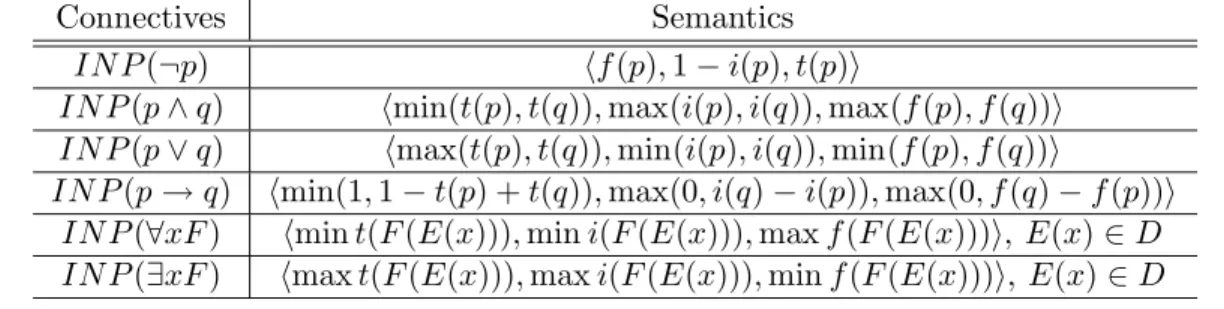
The semantics of four interval neutrosophic propositional connectives is given in Table I. Note that p↔q if and only ifp→q andq →p.
Example 10 IN L(p) = h0.5,0.4,0.7i and IN L(q) = h1,0.7,0.2i. Then, IN L(¬p) = h0.7,0.6,0.5i,
IN L(p∧ ¬p) =h0.5,0.4,0.7i, IN L(p∨q) =h1,0.7,0.2i, IN L(p→q) =h1,1,0i.
A given well-formed interval neutrosophic propositional formula will be called a tautology (valid) if IN L(A) =h1,1,0i, for all interpretation functionsIN L. It will be called a contradiction (inconsistent) if IN L(A) =h0,0,1i, for all interpretation functions IN L.
2.2. INTERVAL NEUTROSOPHIC PROPOSITIONAL CALCULUS 25
Table 2.1: Semantics of Four Connectives in Interval Neutrosophic Propositional Logic
Connectives Semantics
IN L(¬p) hf(p),1−i(p), t(p)i
IN L(p∧q) hmin(t(p), t(q)),max(i(p), i(q)),max(f(p), f(q))i
IN L(p∨q) hmax(t(p), t(q)),min(i(p), i(q)),min(f(p), f(q))i
IN L(p→q) hmin(1,1−t(p) +t(q)),max(0, i(q)−i(p)),max(0, f(q)−f(p))i
Definition 32 Two formulaspandqare said to be equivalent, denotedp=q, if and only if theIN L(p) = IN L(q) for every interpretation function IN L.
Theorem 8 Let F be the set of formulas and∧be the meet and ∨the join, thenhF;∧,∨i is a distributive lattice.
Proof We leave the proof to the reader.
Theorem 9 If p andp→q are tautologies, thenq is also a tautology.
Proof Sincep and p→q are tautologies then for everyIN L, IN L(p) =IN L(p→q) =h1,0,0i, that is t(p) = 1, i(p) = f(p) = 0, t(p → q) = min(1,1−t(p) +t(q)) = 1, i(p → q) = max(0, i(q)−f(p)) = 0, f(p→q) = max(0, f(q)−f(p)) = 0. Hence,
t(q) = 1, i(q) = f(q) = 0. So q is a tautology.
2.2.3 Proof Theory of Interval Neutrosophic Propositional Calculus
Here we give the proof theory for interval neutrosophic propositional logic to complement the semantics part.
Definition 33 The interval neutrosophic propositional logic is defined by the following axiom schema.
p→(q→p)
p1∧. . .∧pm →q1∨. . . qn provided some pi is some qj
p→(q→p∧q) (p→r)→((q →r)→(p∨q→r)) (p∨q)→r iff p→r and q →r p→q iff¬q → ¬p p→q andq →r implies p→r p→q iff p↔(p∧q) iffq →(p∨q)
The concept of (formal) deduction of a formula from a set of formulas, that is, using the standard notation, Γ`p, is defined as usual; in this case, we say that pis a syntactical consequence of the formulas inT.
Theorem 10 For interval neutrosophic propositional logic, we have 1. {p} `p,
2. Γ`p entails Γ∪∆`p,
3. if Γ`p for any p∈∆and ∆`q, then Γ`q.
Proof It is immediate from the standard definition of the syntactical consequence (`).
Theorem 11 In interval neutrosophic propositional logic, we have: 1. ¬¬p↔p
2. ¬(p∧q)↔ ¬p∨ ¬q
3. ¬(p∨q)↔ ¬p∧ ¬q
Proof Proof is straight forward by following the semantics of interval neutrosophic propositional logic.
Theorem 12 In interval neutrosophic propositional logic, the following schema do not hold: 1. p∨ ¬p 2. ¬(p∧ ¬p) 3. p∧ ¬p→q 4. p∧ ¬p→ ¬q 5. {p, p→q} `q 6. {p→q,¬q} ` ¬p 7. {p∨q,¬q} `p 8. ¬p∨q ↔p→q
2.3. INTERVAL NEUTROSOPHIC PREDICATE CALCULUS 27
Example 11 To illustrate the use of the interval neutrosophic propositional consequence relation, let’s consider the following example.
p→(q∧r)
r →s
q→ ¬s a
From p → (q∧r), we get p→ q and p → r. From p→ q and q → ¬s, we get p→ ¬s. From p→ r and
r → s, we get p → s. Hence, p is equivalent to p∧s and p∧ ¬s. However, we cannot detach s from p
nor ¬sfromp. This is in part due to interval neutrosophic propositional logic incorporating neither modus
ponens nor and elimination.
2.3
Interval Neutrosophic Predicate Calculus
In this section, we will extend our consideration to the full language of first order interval neutrosophic predicate logic. First we give the formalization of syntax of first order interval neutrosophic predicate logic as in classical first-order predicate logic.
2.3.1 Syntax of Interval Neutrosophic Predicate Calculus
Definition 34 An alphabet of the first order interval neutrosophic predicate calculus consists of seven classes of symbols:
1. variables, denoted by lower-case letters, sometimes indexed; 2. constants, denoted by lower-case letters;
3. function symbols, denoted by lower-case letters, sometimes indexed; 4. predicate symbols, denoted by lower-case letters, sometimes indexed;
5. Five connectives ∧,∨,¬,→,↔ which are called the conjunction, disjunction, negation, implication, and biimplication symbols respectively;
6. Two quantifiers, the universal quantifier ∀ (for all) and the existential quantifier ∃ (there exists); 7. The parentheses ( and ).
To avoid having formulas cluttered with brackets, we adopt the following precedence hierarchy, with the highest precedence at the top:
¬,∀,∃ ∧,∨ →,↔
Next we turn to the definition of the first order interval neutrosophic language given by an alphabet.
Definition 35 A termis defined as follows: 1. A variable is a term.
2. A constant is a term.
3. If f is an n-ary function symbol and t1, . . . , tn are terms, then f(t1, . . . , fn) is a term.
Definition 36 A (well-formed )formula is defined inductively as follows:
1. If p is an n-ary predicate symbol and t1, . . . , tn are terms, then p(t1, . . . , tn) is a formula (called an
atomic formula or, more simply, an atom).
2. If F andG are formulas, then so are (¬F),(F ∧G),(F ∨G),(F →G) and (F ↔G). 3. If F is a formula and x is a variable, then (∀xF) and (∃xF) are formulas.
Definition 37 The first order interval neutrosophic language given by an alphabet consists of the set of all formulas constructed from the symbols of the alphabet.
Example 12 ∀x∃y(p(x, y)→q(x)),¬∃x(p(x, a)∧q(x)) are formulas.
Definition 38 The scope of ∀x (resp. ∃x) in ∀xF (resp. ∃xF) is F. A bound occurrence of a variable in a formula is an occurrence immediately following a quantifier or an occurrence within the scope of a quantifier, which has the same variable immediately after the quantifier. Any other occurrence of a variable
is free.
Example 13 In the formula ∀xp(x, y)∨q(x), the first two occurrences of x are bound, while the third occurrence is free, since the scope of ∀x isp(x, y) and y is free.
2.3. INTERVAL NEUTROSOPHIC PREDICATE CALCULUS 29
2.3.2 Semantics of Interval Neutrosophic Predicate Calculus
In this section, we study the semantics of interval neutrosophic predicate calculus, the purpose of which is the assignment of a meaning to well-formed formulas. In the interval neutrosophic propositional logic, an interpretation is an assignment of truth values (ordered triple component) to propositions. In the first order interval neutrosophic predicate logic, since there are variables involved, we have to do more than that. To define an interpretation for a well-formed formula in this logic, we have to specify two things, the domain and an assignment to constants and predicate symbols occurring in the formula. The following is the formal definition of an interpretation of a formula in the first order interval neutrosophic predicate logic.
Definition 39 An interpretation function (or interpretation) of a formula F in the first order interval neutrosophic predicate logic consists of a nonempty domain D, and an assignment of “values” to each constant and predicate symbol occurring in F as follows:
1. To each constant, we assign an element in D.
2. To eachn-ary function symbol, we assign a mapping fromDntoD. (Note thatDn={(x
1, . . . , xn)|x1 ∈
D, . . . , xn∈D}).
3. Predicate symbols get their meaning through evaluation functions E which assign to each variable x
an element E(x)∈D. To each n-ary predicate symbol p, there is a function IN P(p) :Dn→N. So
IN P(p(x1, . . . , xn)) =IN P(p)(E(x1), . . . , E(xn)).
That is, IN P(p)(a1, . . . , an) =ht(p(a1, . . . , an)), i(p(a1, . . . , an)), f(p(a1, . . . , an)),
wheret(p(a1, . . . , an)), i(p(a1, . . . , an)), f(p(a1, . . . , an))⊆[0,1]. They are called truth-degree,
indeterminacy-degree and falsity-indeterminacy-degree of p(a1, . . . , an) respectively. We assume that the interpretation function IN P
assigns to the logical truthT :IN P(T) =h1,1,0i, and to F :IN P(F) =h0,0,1i.
The semantics of four interval neutrosophic predicate connectives and two quantifiers is given in Table II. For simplification of notation, we use p to denotep(a1, . . . , ai). Note that p↔ q if and only if p → q
and q→p.
Example 14 Let D = 1,2,3 and p(1) = h0.5,1,0.4i, p(2) = h1,0.2,0i, p(3) = h0.7,0.4,0.7i. Then
IN P(∀xp(x)) =h0.5,0.2,0.7i, and IN P(∃xp(x)) =h1,1,0i.
Definition 40 A formula F is consistent (satisfiable) if and only if there exists an interpretation I such that F is evaluated to h1,1,0i in I. If a formula F is T in an interpretation I, we say that I is a model
of F and I satisfiesF.
Definition 41 A formulaF is inconsistent (unsatisfiable)if and only if there exists no interpretation that
Table 2.2: Semantics of Four Connectives and Two Quantifiers in Interval Neutrosophic Predicate Logic
Connectives Semantics
IN P(¬p) hf(p),1−i(p), t(p)i
IN P(p∧q) hmin(t(p), t(q)),max(i(p), i(q)),max(f(p), f(q))i
IN P(p∨q) hmax(t(p), t(q)),min(i(p), i(q)),min(f(p), f(q))i
IN P(p→q) hmin(1,1−t(p) +t(q)),max(0, i(q)−i(p)),max(0, f(q)−f(p))i
IN P(∀xF) hmint(F(E(x))),mini(F(E(x))),maxf(F(E(x)))i, E(x)∈D IN P(∃xF) hmaxt(F(E(x))),maxi(F(E(x))),minf(F(E(x)))i, E(x)∈D
Definition 42 A formulaF is valid if and only if every interpretation of F satisfies F.
Definition 43 A formulaF is a logical consequenceof formulas F1, . . . , Fn if and only if for every
inter-pretation I, if F1∧. . .∧Fn is true in I, F is also true inI. Example 15 (∀x)(p(x)→(∃y)p(y)) is valid, (∀x)p(x)∧(∃y)¬p(y) is consistent.
Theorem 13 There is no inconsistent formula in the first order interval neutrosophic predicate logic.
Proof It is direct from the definition of semantics of interval neutrosophic predicate logic.
Note that the first order interval neutrosophic predicate logic can be considered as an extension of the interval neutrosophic propositional logic. When a formula in the first order logic contains no variables and quantifiers, it can be treated just as a formula in the propositional logic.
2.3.3 Proof Theory of Interval Neutrosophic Predicate Calculus
In this part, we give the proof theory for first order interval neutrosophic predicate logic to complement the semantics part.
Definition 44 The first order interval neutrosophic predicate logic is defined by the following axiom schema. (p→q(x))→(p→ ∀xq(x)) ∀xp(x)→p(a) p(x)→ ∃xp(x) (p(x)→q)→(∃xp(x)→q)
2.3. INTERVAL NEUTROSOPHIC PREDICATE CALCULUS 31
1. p(x)` ∀xp(x)
2. p(a)` ∃xp(x)
3. ∀xp(x)`p(y)
4. Γ∪ {p(x)} `q, then Γ∪ {∃xp(x)} `q
Proof Directly from the definition of the semantics of first order interval neutrosophic predicate logic.
Theorem 15 In the first order interval neutrosophic predicate logic, the following schemes are valid, where
r is a formula in which x does not appear free: 1. ∀xr↔r 2. ∃xr↔r 3. ∀x∀yp(x, y)↔ ∀y∀xp(x, y) 4. ∃x∃yp(x, y)↔ ∃y∃xp(x, y) 5. ∀x∀yp(x, y)→ ∀xp(x, x) 6. ∃xp(x, x)→ ∃x∃yp(x, y) 7. ∀xp(x)→ ∃xp(x) 8. ∃x∀yp(x, y)→ ∀y∃xp(x, y) 9. ∀x(p(x)∧q(x))↔ ∀xp(x)∧ ∀xq(x) 10. ∃x(p(x)∨q(x))↔ ∃xp(x)∨ ∃xq(x) 11. p∧ ∀xq(x)↔ ∀x(p∧q(x)) 12. p∨ ∀xq(x)↔ ∀x(p∨q(x)) 13. p∧ ∃xq(x)↔ ∃x(p∧q(x)) 14. p∨ ∃xq(x)↔ ∃x(p∨q(x)) 15. ∀x(p(x)→q(x))→(∀xp(x)→ ∀xq(x)) 16. ∀x(p(x)→q(x))→(∃xp(x)→ ∃xq(x)) 17. ∃x(p(x)∧q(x))→ ∃xp(x)∧ ∃xq(x) 18. ∀xp(x)∨ ∀xq(x)→ ∀x(p(x)∨q(x))
19. ¬∃x¬p(x)↔ ∀xp(x)
20. ¬∀x¬p(x)↔ ∃p(x)
21. ¬∃xp(x)↔ ∀x¬p(x)
22. ∃x¬p(x)↔ ¬∀xp(x)
Proof It is straightforward from the definition of the semantics and axiomatic schema of first order interval neutrosophic predicate logic.
2.4
An Application of Interval Neutrosophic Logic
In this section we provide one practical application of the interval neutrosophic logic – Interval Neutro-sophic Logic System (INLS). INLS can handle rule uncertainty as same as type-2 FLS [LM00], besides, it can handle rule inconsistency without the danger of trivialization. Like the classical FLS, INLS is also char-acterized by IF-THEN rules. INLS consists of neutrosophication, neutrosophic inference, a neutrosophic rule base, neutrosophic type reduction and deneutrosophication. Given an input vector x = (x1, . . . , xn),
where x1, . . . , xn can be crisp inputs or neutrosophic sets, the INLS will generate a crisp output y. The
general scheme of INLS is shown in Fig. 2.1.
truth-membership function indeterminacy-membership function falsity-membership function Neutrosophication Neutrosophic Inference Neutrosophic Rule Base Neutrosophic
Type Reduction Deneutrosophication
Crisp Output Input
Figure 2.1: General Scheme of an INLS
Suppose the neutrosophic rule base consists of M rules in which each rule has nantecedents and one consequent. Let the kth rule be denoted by Rk such that IF x
2.4. AN APPLICATION OF INTERVAL NEUTROSOPHIC LOGIC 33
THEN y is Bk. Ak
i is an interval neutrosophic set defined on universe Xi with truth-membership
func-tionTAk
i(xi), indeterminacy-membership funct