Learning for Single/Cross-Modal
Data Retrieval
Yuming Shen
School of Computing Sciences
University of East Anglia
A thesis submitted for the degree of
Doctor of Philosophy
January 2018
c
This copy of the thesis has been supplied on condition that anyone who consults it is understood to recognise that its copyright rests with the author and that no quotation from the thesis, nor any information derived therefrom, may be published without the authors prior written consent.
Parts of this thesis have been taken from certain published/to be pub-lished conference/journal papers. All of these papers were written pri-marily or partially by me, Yuming Shen, during and as a result of my PhD research. These papers are listed below.
• Y. Shen, L. Liu, L. Shao and J. Song. Deep Binaries: Encoding
Semantic-Rich Cues for Efficient Textual-Visual Cross Retrieval. In IEEE International Conference on Computer Vision (ICCV), 2017
• Y. Shen, L. Liu and L. Shao. Unsupervised Deep Generative
Hashing. In British Machine Vision Conference (BMVC), 2017
• L. Liu, F. Shen,Y. Shen, X. Liu and L. Shao. Deep Sketch
Hash-ing: Fast Free-Hand Sketch-Based Image Retrieval. InIEEE
Con-ference on Computer Vision and Pattern Recognition (CVPR), 2017
• Y. Shen, L. Zhang and L. Shao. Semi-Supervised Vision-Language
Mapping via Variational Learning. In IEEE International
I would like to extend my sincerest thanks to the following, who have all helped in the completion of this thesis.
First of all, many thanks to my family for their unconditional support during my PhD studies.
I would like to express my sincere appreciation to my supervisor Prof. Ling Shao for providing me with the opportunity of pursuing this PhD degree. We are allowed to have unprecedented research freedom under his supervision, and he is always willing to offer valuable advice and thorough suggestions on our research works.
I would like to thank Prof. Andy Day for his academic support. I would like to thank the current and former research students, Postdoc researchers and visiting scholars in our lab, including Dr. Li Liu, Dr. Yang Long, Dr. Mengyang Yu, Dr. Heng Liu, Dr. Haofeng Zhang, Dr. Xiaoming Liu, Yi Zhou, Shidong Wang, Bingzhang Hu and Daniel Organisciak, for their helpful discussion and research ideas.
I would also like to thank my co-authors, Prof. Fumin Shen and Prof. Xianglong Liu, who have improved my research outcome from many aspects.
Data similarity search is widely regarded as a classic topic in the realms of computer vision, machine learning and data mining. Providing a cer-tain query, the retrieval model sorts out the related candidates in the database according to their similarities, where representation learning methods and nearest-neighbour search apply. As matching data fea-tures in Hamming space is computationally cheaper than in Euclidean space, learning to hash and binary representations are generally appre-ciated in modern retrieval models. Recent research seeks solutions in deep learning to formulate the hash functions, showing great potential in retrieval performance. In this thesis, we gradually extend our re-search topics and contributions from unsupervised single-modal deep
hashing to supervised cross-modal hashing finally zero-shot hashing
problems, addressing the following challenges in deep hashing.
First of all, existing unsupervised deep hashing works are still not at-taining leading retrieval performance compared with the shallow ones. To improve this, a novel unsupervised single-modal hashing model is proposed in this thesis, named Deep Variational Binaries (DVB). We introduce the popular conditional variational auto-encoders to for-mulate the encoding function. By minimizing the reconstruction er-ror of the latent variables, the proposed model produces compact bi-nary codes without training supervision. Experiments on benchmarked datasets show that our model outperform existing unsupervised hash-ing methods.
The second problem is that current cross-modal hashing methods only consider holistic image representations and fail to model descriptive
handle this problem, we propose a supervised deep cross-modal hashing model called Textual-Visual Deep Binaries (TVDB). Region-based neu-ral networks and recurrent neuneu-ral networks are involved in the image encoding network in order to make effective use of visual information, while the text encoder is built using a convolutional neural network. We additionally introduce an efficient in-batch optimization routine to train the network parameters. The proposed mode successfully out-performs state-of-the-art methods on large-scale datasets.
Finally, existing hashing models fail when the categories of query data have never been seen during training. This scenario is further extended
into a novel zero-shot cross-modal hashing task in this thesis, and a
Zero-shot Sketch-Image Hashing (ZSIH) scheme is then proposed with graph convolution and stochastic neurons. Experiments show that the proposed ZSIH model significantly outperforms existing hashing
algo-rithms in thezero-shot retrieval task.
Experiments suggest our proposed and novel hashing methods outper-form state-of-the-art researches in single-modal and cross-modal data retrieval.
1 Introduction 1
1.1 Research Background . . . 1
1.2 Objective . . . 2
1.3 Contribution . . . 3
1.4 Summary of Remaining Chapters . . . 4
2 Literature Review 6 2.1 Single-Modal Hashing . . . 6
2.1.1 Unsupervised Hashing . . . 7
2.1.2 Supervised Hashing . . . 9
2.2 Cross-Modal Hashing . . . 10
2.2.1 Unsupervised Cross-Modal Hashing . . . 10
2.2.2 Supervised Cross-Modal Hashing . . . 12
2.3 Deep Learning and Neural Networks . . . 13
2.3.1 Convolutional Neural Networks for Images and Texts . . . . 14
2.3.2 Hashing with Deep Neural Networks . . . 15
2.4 Summary . . . 17
3 Unsupervised Deep Hashing for Image Retrieval 18 3.1 Introduction and Motivation . . . 18
3.2 Related Work . . . 21
3.2.1 Shallow Unsupervised Hashing . . . 21
3.2.2 Deep Unsupervised Hashing . . . 22
3.2.3 Auto-Encoding Variational Networks . . . 23
3.3.3 Hashing Objectives . . . 29 3.3.3.1 Quantization Penalty . . . 29 3.3.3.2 Bit Decorrelation . . . 30 3.3.3.3 In-Batch Similarity . . . 30 3.3.4 Network Setup . . . 31 3.3.5 Optimization . . . 31 3.3.6 Out-of-Sample Extension . . . 33 3.4 Experiments . . . 34 3.4.1 Implementation Details . . . 34 3.4.2 Experimental Settings . . . 36 3.4.2.1 CIFAR-10 [84] . . . 36 3.4.2.2 SUN-397 [187] . . . 37 3.4.2.3 NUS-WIDE [22] . . . 37
3.4.3 Comparison with State-of-the-Art Methods . . . 37
3.4.3.1 Baselines . . . 37
3.4.3.2 Quantitative Results with Deep Features . . . 38
3.4.3.3 Quantitative Results with Hand-Crafted Features . 40 3.4.3.4 Efficiency . . . 40
3.4.4 Ablation Study . . . 41
3.4.4.1 Baselines . . . 41
3.4.4.2 Results and Analysis . . . 42
3.4.5 Hyper-Parameters . . . 43
3.4.5.1 Size of Latent Space . . . 44
3.4.5.2 Number of Clustering Centres . . . 44
3.4.6 Qualitative results . . . 44
3.5 Summary . . . 46
4 Supervised Deep Hashing for Image-Sentence Cross Retrieval 47 4.1 Introduction and Motivation . . . 47
4.2 Related Work . . . 51
4.3 Deep Encoding Networks for TVDB . . . 54
4.3.1 Image Binary Encoding Network . . . 56
4.3.1.1 Salient Semantic Region Selection . . . 57
4.3.1.2 Regional Representation and Augmentation . . . . 57
4.3.1.3 Recurrent Network for Encoding . . . 57
4.3.2 Sentence Binary Encoding Network . . . 58
4.4 Stochastic Batch-Wise Code Learning . . . 59
4.4.1 Batch-wise alternating optimization . . . 59
4.4.2 Stochastic-batched training procedure. . . 62
4.4.3 Out-of-Sample Extension . . . 63 4.5 Experiments . . . 63 4.5.1 Implementation Details . . . 63 4.5.2 Experimental settings . . . 66 4.5.2.1 Microsoft COCO [102] . . . 66 4.5.2.2 IAPR TC-12 [45] . . . 66
4.5.2.3 INRIA Web Queries [83] . . . 69
4.5.3 Comparison with Existing Methods . . . 69
4.5.3.1 Baselines . . . 71
4.5.3.2 Results and Analysis . . . 71
4.5.4 Ablation Study of Deep Encoding Network . . . 74
4.5.4.1 Baselines . . . 74
4.5.4.2 Results and Analysis . . . 74
4.5.5 Training Efficiency and Encoding Time . . . 75
4.5.5.1 Baselines . . . 76
4.5.5.2 Results and Analysis . . . 76
4.5.6 Intuitive Results . . . 78
4.5.6.1 Positive Examples . . . 79
4.5.6.2 Failure Cases . . . 79
4.5.7 Hyper-Parameters . . . 80
5.2 Related Work . . . 85
5.3 The Proposed ZSIH Model . . . 87
5.3.1 Network Overview . . . 89
5.3.1.1 Image/Sketch Encoding Networks . . . 89
5.3.1.2 Multi-Modal Network as Code Learner . . . 90
5.3.2 Fusing Sketch and Image with Kronecker Layer . . . 91
5.3.3 Semantic-Relation-Enhanced Hidden Representation with Graph Convolution . . . 92
5.3.4 Stochastic Neurons and Decoding Network . . . 93
5.3.5 Learning Objective and Optimization . . . 95
5.3.6 Out-of-Sample Extension . . . 96
5.4 Experiments . . . 96
5.4.1 Implementation Details . . . 97
5.4.2 Zero-shot experimental settings . . . 97
5.4.2.1 Sketchy Dataset [152] (Extended) . . . 98
5.4.2.2 TU-Berlin Dataset [32] (Extended) . . . 98
5.4.3 Comparison with Existing Methods . . . 98
5.4.3.1 Cross-Modal Hashing Baselines . . . 101
5.4.3.2 Zero-Shot Baselines . . . 101
5.4.3.3 Sketch-Image Mapping Baselines . . . 101
5.4.3.4 Results and Analysis . . . 103
5.4.4 Conventional Fully-Supervised Category-Level SBIR . . . 104
5.4.5 Ablation Study . . . 105
5.4.5.1 Baselines . . . 105
5.4.5.2 Results and Analysis . . . 106
5.4.6 Training Efficiency and Overfitting . . . 107
5.4.6.1 Overfitting . . . 107
5.4.6.2 Training Efficiency . . . 108
5.4.7 Qualitative Results and Failure Cases . . . 109
6.1.1 Unsupervised Deep Image Hashing . . . 111
6.1.2 Image-Sentence Cross-Modal Hashing . . . 111
6.1.3 Zero-Shot Cross-Modal Hashing . . . 112
6.2 Open Questions and Future Work . . . 112
6.2.1 Binary Representations for Video Sequences . . . 112
6.2.2 Improved Reparametrization Tricks for Discrete Variables . . 113
6.2.3 Binary Representations for Fine-Grained Retrieval . . . 113
A Quantitative Retrieval Evaluation Measures 115 A.1 Precision@K . . . 115
A.2 Mean-Average Precision . . . 115
A.3 HD2 Precision and Recall . . . 116
B Qualitative Results of DVB 117
C Qualitative Results of TVDB 120
D Failure Cases of TVDB 129
E Qualitative Comparison between ZSIH and DSH 130
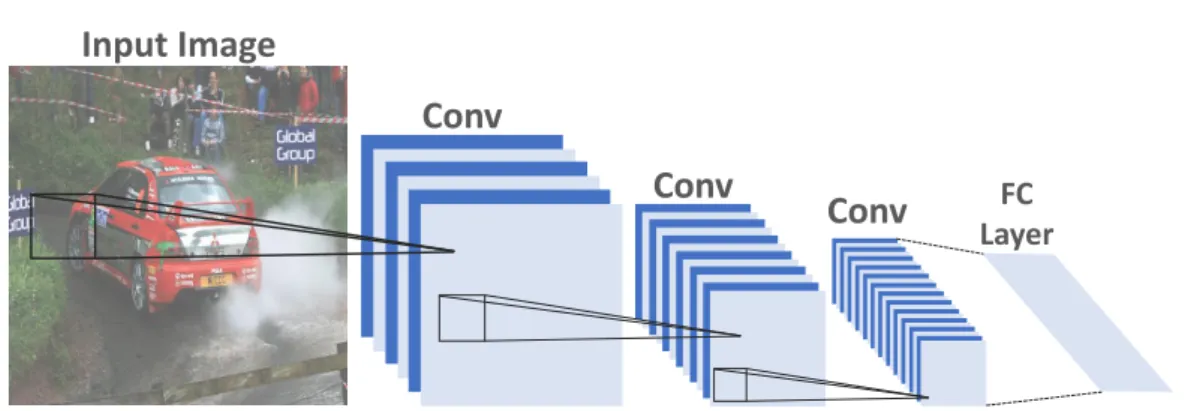
F More Qualitative Results of ZSIH 132
G Failure Cases of ZSIH 135
2.1 A typical structure of an image CNN. Here Conv refers to the
convolutional layer and FC layer refers to the conventional
fully-connected layer. . . 13
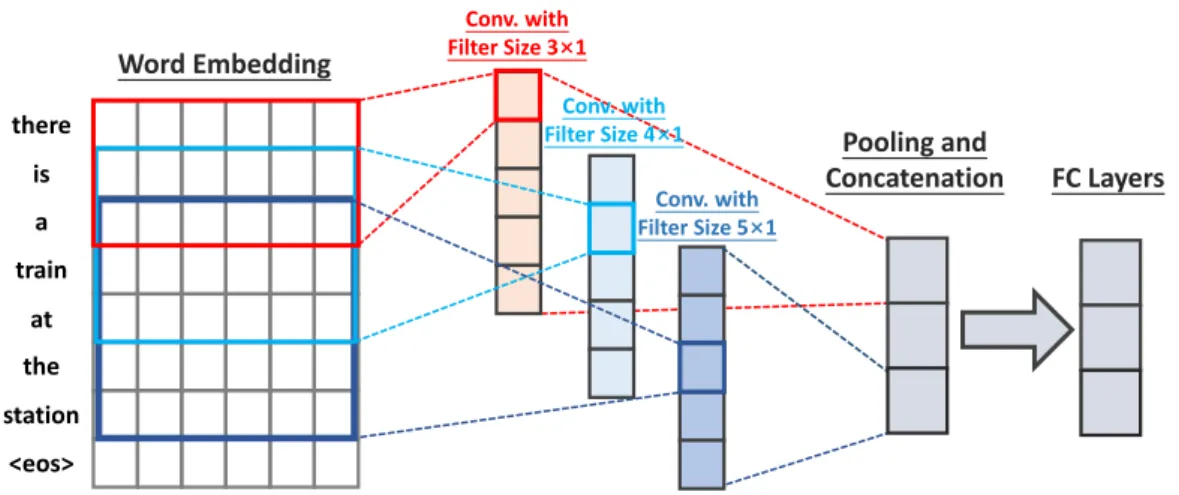
2.2 An illustration of how convolution is performed and computed along
the text sequence. The structure is similar to the one described
in [74]. The kernel numbers are omitted here for the simplicity of
illustration. . . 14 3.1 Conventional unsupervised deep hashing models (a) only regularize
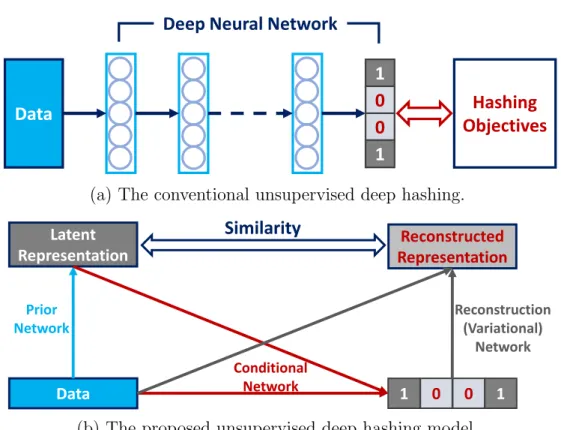
the output binary codes. Contrarily, our proposed method (b) focus on reconstructing the latent representations from the encoded bina-ries and force it to be similar to the ones produced by the original data features. . . 19 3.2 Illustration of DVB as a graphical model. The arrowed full lines
with different colours indicate different probability models
imple-mented with deep neural networks. In particular, pθ(z|x) in blue
acts as the (conditional) prior of the latent variables z; pθ(b|x,z)
refers to the network producingb;qφ(z|x,b) is the variational
pos-terior of z. The component computing data centres assigns a
low-dimensional pseudo centrecto each data pointxusing some
dimen-sionality reduction and clustering methods. Implementation details are given in Section 3.3. . . 25 3.3 Detailed settings of the three networks in DVB, i.e. the prior
net-work pθ(z|x) (left),variational (reconstruction) network qφ(z|x,b)
3.5 Precision@5000 curves for all bits of DVB and several existing
meth-ods with VGG-16 [157] features. . . 34
3.6 16-bit (a), 32-bit (b) and 64-bit (c) image retrieval Precision-Recall
curves (P-R curves) [49, 149] with VGG [157] features. . . 39
3.7 Retrieval performance on CIFAR-10 [84]w.r.t. different size ofl. . . 43
3.8 Retrieval performance on CIFAR-10 [84] (left), NUS-WIDE [22]
(middle) and SUN-397 [187] (right) w.r.t. different settings of K,
where the default values are 20, 100 and 300 respectively. . . 43
3.9 The t-SNE [122] visualization results of DVB on the CIFAR-10 [84]
dataset. . . 45
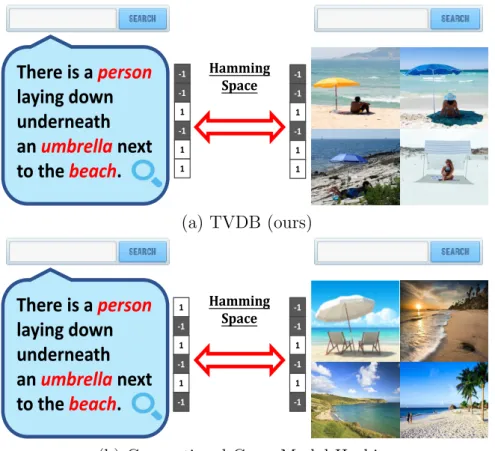
4.1 The proposed model (a) aims at encoding all informative words of
a sentence and all possible attractive regions in an image. Contrar-ily, conventional textual-visual binary encoding methods (b) only utilize simple representations of each modality and discard some
information (e.g. the instances ofperson andumbrella are not
well-encoded), resulting in low matching quality. . . 48 4.2 The network architecture of TVDB. RPN, CNN and LSTM are
uti-lized to form the image encoding functionf (·) (the upper network),
encoding image regions from dominant to minor. The sentence
en-coding network g(·) is built with a text-CNN (the lower network).
The rightmost component refers to abatch-wisecoding procedure.
Here the module Poscomputes the region coordinates discussed in
Subsection 4.3.1, while Word Emb refers to the linear word
embed-ding procedure introduced in Subsection 4.3.2. Note that during training iteration, a batch of images and descriptions are required to be simultaneously rendered to the network. During testing, a single image or sentence can be encoded using the corresponding network without acquiring a batch of data. . . 55 4.3 Cross-modal retrieval P-R curves of TVDB and some existing
methods of which the codes are not available and the Precision-Recall curves on 128 bits have never been reported are not listed here. . . 68
4.5 HD2 precision and recall of TVDB and some baselines on Microsoft
COCO [102] . . . 69
4.6 The 128-bit retrieval mAP of Image Query Sentence (bottom left)
andSentence Query Image (bottom right)w.r.t. training epochs on Microsoft COCO dataset are shown here. The corresponding losses are also given on the top. . . 75
4.7 Hyper Parameter Analysis on Microsoft COCO [102] with coding
lengthM = 128 for different K and η . . . 80
5.1 In conventional SBIR and cross-modal hashing (bottom right),
the categories of training data include the ones of test data, marked
as‘A’ and‘B’. For ourzero-shot task (bottom left), training data
are still subjected to class‘A’ and‘B’, but test sketches and images
are coming from other categories, i.e.‘plane’ and ‘cat’ in this case.
Note that data labels are not used as test inputs and the test data categories shall be unknown to the learning system. . . 83 5.2 The deep network structure of ZSIH. The image (in light blue) and
sketch encoding network (in grey) act as hash function for the
re-spective modality with attention models [162]. The multi-modal
network (in canary yellow) only functions during training.
Sketch-image representations are fused by a Kronecker layer [58]. Graph
convolution [79] and generative hashing techniques are leveraged to
explore the semantic space for zero-shot SIBR hashing. Network
configurationsare also provided here. . . 88
5.3 P-R curves and Precision@100 results of ZSIH and several hashing baselines are shown above. To keep the content concise, only 32-bit precision-recall curves are illustrated here. . . 100
row: 32-bit t-SNE [122] scattering results on the Sketchy dataset of the seen and unseen classes. . . 106
5.5 The 64-bit retrieval performance w.r.t. the training epochs on the
Sketchy dataset [152]. Note that, only in this experiment, we fix
the CNN parameters for a clearer insight into the training efficiency trend. The baselines in Table 5.4 which are not included here do not have any effect on training epochs. . . 108
5.6 The proposed ZSIH model does not involve a trivial alternating
training procedure, while existing supervised [9,11,66,109] or
zero-shot hashing [195, 46] generally require alternating optimization.
Here the Update Codesphase in the second line refers to a
compu-tation step where the binary codes of all data are optimized on the whole training set and then are stored as target codes for the next
training epoch [66,109]. . . 109
B.1 Examples of top-20 32-bit image retrieval results of DVB on
CIFAR-10 [84] dataset. . . 117
B.2 Examples of top-20 32-bit image retrieval results of DVB on
CIFAR-10 [84] dataset (continued). . . 118
B.3 Examples of top-20 32-bit image retrieval results of DVB on
CIFAR-10 [84] dataset (continued). . . 119
C.1 Intuitive 128-bit top-5 Sentence Query Image results (ranked from
left to right) on Microsoft COCO [102]. . . 121
C.2 Intuitive 128-bit top-5 Sentence Query Image results (ranked from
left to right) on Microsoft COCO [102] (continued). . . 122
C.3 Intuitive 128-bit top-5 Sentence Query Image results (ranked from
left to right) on Microsoft COCO [102] (continued). . . 123
C.4 Intuitive 128-bit top-5 Sentence Query Image results (ranked from
left to right) on Microsoft COCO [102] (continued). . . 124
C.5 Intuitive 128-bit top-5 Sentence Query Image results (ranked from
C.7 Intuitive 128-bit top-5 Sentence Query Image results (ranked from
left to right) on Microsoft COCO [102] (continued). . . 127
C.8 Intuitive 128-bit top-5 Sentence Query Image results (ranked from
left to right) on Microsoft COCO [102] (continued). . . 128
D.1 Two failure cases of TVDB with top-10 retrieved candidates on
Microsoft COCO [102]. . . 129
E.1 Top-10 zero-shot SBIR results of ZSIH and DSH [109] are shown
here according to the hamming distances, where the green ticks indicate correct retrieval candidates and red crosses indicate the wrong ones. . . 130
E.2 Top-10 zero-shot SBIR results of ZSIH and DSH [109] are shown
here according to the hamming distances, where the green ticks indicate correct retrieval candidates and red crosses indicate the wrong ones (continued). . . 131
F.1 Successful zero-shot retrieval results on the Sketchy dataset [152] of
ZSIH. . . 132
F.2 Successful zero-shot retrieval results on the Sketchy dataset [152] of
ZSIH (continued). . . 133
F.3 Successful zero-shot retrieval results on the Sketchy dataset [152] of
ZSIH (continued). . . 134
3.1 Image retrieval mean-Average Precision (mAP) on the three datasets
with VGG-16 [157] features. . . 35
3.2 Image retrieval mean-Average Precision (mAP) and Precision@5000
on CIFAR-10 [84] with GIST features. . . 36
3.3 Comparison of training and encoding efficiency on CIFAR-10 [84]
with some deep hashing methods. . . 41
3.4 Ablation study results (mAP) of DVB on CIFAR-10 [84] and
NUS-WIDE [22] with some terms of the learning objective removed. . . . 42
4.1 Configurations of the binary coding networks. . . 56 4.2 Image-query-sentence mAP results of the proposed model compared
with existing methods on the three datasets. . . 64 4.3 Sentence-query-image mAP results of the proposed model compared
with existing methods on the three datasets. . . 65 4.4 Image-sentence cross-modal retrieval Precision@200 Performance. . 70 4.5 Ablation study: cross-modal retrieval mAP comparison of TVDB
with several deep network baselines. . . 73
4.6 Training Time Comparison with DCMH [66] (in Minutes). The first
value of mAP here refers to the one ofImage Query Sentence while
the second refers toSentence Query Image. . . 77
4.7 Query Encoding Time Comparison (in Milliseconds) . . . 77 5.1 zero-shot SBIR mAP comparison between ZSIH and some
cross-modal hashing baselines. . . 99 5.2 Zero-shot sketch-image retrieval performance comparison of ZSIH
are coherent to the ones proposed in [109]. . . 104
AGH Anchor Graph Hashing
BRE Binary Reconstructive Embedding
CCA Canonical Correlation Analysis
CDQ Collective Deep Quantization
CMFH Collective Matrix Factorization Hashing
CM-NN Cross-Modal Neural Network
CMSSH Cross-Modal Similarity Sensitive Hashing
CMT Cross-Modal Transfer
CNN Convolutional Neural Network
CorrAE Correspondence Auto-Encoder
CVAE Conditional Variational Auto-Encoder
CVFL Cross-View Feature Learning
CVH Cross-View Hashing
DBM Deep Boltzmann Machine
DBN Deep Belief Network
DCDH Discriminative Coupled Dictionary Hashing
DGH Discrete Graph Hashing
DH Deep Hashing
DNH Deep Neural Hashing
DSH Deep Sketch Hashing
DVB Deep Variational Binaries
DVSH Deep Visual Semantic Hashing
GCN Graph Convolutional Network
GPU Graphics Processing Unit
HD2 Hamming Distance with radius 2
IAF Inverse Autoregressive Flow
IMH Inter-Media Hashing
IMVH Iterative Multi-View Hashing
ITQ Iterative Quantization
JLSE Joint Latent Similarity Embedding
K-L divergence Kullback-Leibler divergence
KLSH Kernelized Locality Sensitive Hashing
KNN K-Nearest-Neighbour
LCMH Linear Cross-Modal Hashing
LSH Locality Sensitive Hashing
mAP mean-Average Precision
MFB Multi-modal Factorized Bilinear pooling
MSAE Multi-modal Stacked Auto-Encoder
PCA Principal Component Analysis
PLSR Partial Least Square Regression
P-R curve Precision-Recall curve
Precision@100 Precision at top-100 retrieved candidates
Precision@200 Precision at top-200 retrieved candidates
Precision@5000 Precision at top-5000 retrieved candidates
QCH Quantized Correlation Hashing
RNN Recurrent Neural Network
RPN Region Proposal Network
RSH Ranking-based Supervised Hashing
SAE Semantic Auto-Encoder
SaN Sketch-a-Net
SBIR Sketch-Based Image Retrieval
SCM Semantic Correlation Maximization
SDH Supervised Discrete Hashing
SELVE Sparse Embedding and Least Variance Encoding
SH Spectral Hashing
SitNet Similarity-transfer Network
SKLSH Shift-invariant Kernelized Locality Sensitive hashing
SM2H Sparse Multi-Modal Hashing
SpH Spherical Hashing
SSE Semantic Similarity Embedding
SUBIC SUpervised structured BInary Code
SVM Support Vector Machine
t-SNE t-distributed Stochastic Neighbour Embedding
TVDB Textual-Visual Deep Binaries
UN-BDNN Unsupervised Binary Deep Neural Network
VAE Variational Auto-Encoder
ZSH Zero-Shot Hashing
Introduction
1.1
Research Background
Data similarity retrieval plays a role of importance in modern artificial intelli-gence systems. Providing a certain query, the retrieval model sorts out the related candidates in the database according to their similarities, where representation learning methods and approximate nearest-neighbour search apply. Embedding high-dimensional data to low dimensional binary codes, hashing algorithms arouse wide research attention in computer vision, machine learning and data mining. Considering the low computational cost of approximate nearest-neighbour search
in the Hamming space [173, 111], hashing techniques deliver more effective and
efficient large-scale data retrieval than real-valued embeddings, which is more ap-preciated and applicable in real cases.
As a classic but essential research topic, a number of works have been proposed throughout the years, employing a wide range of machine learning techniques, which can be either supervised or unsupervised. These methods typically involves
an embedding functionf : RD → RM, where D and M respectively indicates the
original and targeted representation dimensionality. Therefore, given a single data
point x ∈ RD, the resulting hash code can be obtained by applying an
element-wise sign function to the encoder f(·).1 By tuning the corresponding parameters
of the embedding function, the hash model approaches the optimal representation
that numerically describes the original data x. A typical example of f(·) is the
1The hashed code c is computed by c = sign(f(x;θ))
∈ {0,1}M, where sign(
·) is the
linear projection function.2 The encoder can also be based on other models, e.g.
random projections, and a literature review on the way to build the hash functions is included following this chapter.
Providing a query, the retrieval model performs nearest-neighbour search 3
to find the most related candidate in the data collection as retrieval result. In a real scenario, finding the exact nearest neighbour as the retrieval candidate is usually infeasible as, in large-scale datasets, there can be more than one correct or relevant candidate to the query. Therefore, a conventional generalization of
nearest-neighbour search yieldsK-Nearest-Neighbour (KNN) search, where a total
number of K closest candidates are retrieved.
Existing researches in data hashing apply to several tasks. For instance,
single-modal hashing learns the binary representations of standalone type of data, while cross-modal hashing tackles the problem of retrieving data between different
modalities of data,e.g. images and text documents. Recently, deep learning
tech-nologies have been introduced in formulating the embedding function f(·), and
produce promising encoding and retrieval performance, forming the term of deep hashing.
1.2
Objective
Dramatic progress has been achieved in the past few years, but challenges still remain in deep hashing from several aspects. The objective of this thesis is to solve the following problems by proposing novel hashing models:
1. Although deep learning has been proven to be successful in supervised
hash-ing, existing deep learning based unsupervised hashing techniques still can-not produce leading performance compared with the non-deep methods, as it is hard to unveil the intrinsic structure of the whole sample space in the framework of mini-batch optimization.
2A typical linear projection model can be written asc=xW
θ+bθ. Here Wθ and bθ refer
to the linear transformation parameters.
3Given a queryqand the data collection
X ={x1,x2,x3, . . . ,xN}, nearest-neighbour search is
defined byN earestN eighbour(q) = argminx∈X d(sign(f(q)),sign(f(x))), where d(·) denotes
2. Most of the traditional cross-modal binary encoding methods for textual-visual retrieval only consider holistic image representations and fail to model descriptive sentences. This renders existing methods inappropriate to handle the rich semantics of informative cross-modal data for quality textual-visual search tasks.
3. Providing training and test data subjected to a fixed set of pre-defined
cat-egories, the cutting-edge cross-modal hashing works obtain acceptable re-trieval performance. However, most of the existing methods fail when the categories of query sketches have never been seen during training.
1.3
Contribution
In this thesis, We gradually rise the task difficulty throughout the chapters by extending our research topics from unsupervised single-modal deep hashing to
supervised cross-modal hashing finally zero-shot cross-modal hashing. The
contri-butions of this thesis include handling the above-mentioned challenges and, mean-while, proposing novel deep hashing models with state-of-the-art performance in image retrieval and cross-modal data search, which can be summarized as follows:
• We propose a novel unsupervised image hashing algorithm that differs from
existing deep-learning-based methods, extending the popular variational
auto-encoders [76, 160] to tackle problem 1.
• Problem 2 is improved by designing novel neural network structures as
en-coders. The rich information carried by images and sentences is then effi-ciently encoded in a newly-proposed cross-modal hashing model.
• We finally define a novel zero-shot cross-modal retrieval task and
accord-ingly design a deep hashing algorithm for problem 3. The proposed model
manages to provide accurate retrieval candidates under thezero-shot setting,
outperforming existing hashing works.
In the next section, how the contributions above are distributed into the chap-ters is elaborated.
1.4
Summary of Remaining Chapters
The rest of this thesis consists of three state-of-the-art models in learning deep
binary representations addressing the aforementioned problems 1, 2and 3.
Grad-ually raising the task difficulty, we firstly present a deep unsupervised hashing model for single-modal data retrieval and then introduce a cross-modal deep
hash-ing network. Finally, we extend our research topic to a novelzero-shot cross-modal
retrieval scenario. The remaining chapters are summarized as follows:
Chapter 2: Literature Review. An overview of the state-of-the-art binary
rep-resentation learning algorithms is given in this chapter, including both the traditional shallow models and the deep-learning-based ones.
Chapter 3: Unsupervised Deep Hashing for Image Retrieval. In this
chap-ter, the above-mentioned problem1is considered. We propose a novel
unsu-pervised deep hashing model, named Deep Variational Binaries (DVB). The conditional auto-encoding variational Bayesian networks are introduced in this work as the generative model to exploit the feature space structure of the training data using the latent variables. Integrating the probabilistic in-ference process with hashing objectives, the proposed DVB model estimates the statistics of data representations, and thus produces compact binary codes. Experimental results on three benchmark datasets, i.e. CIFAR-10, SUN-397 and NUS-WIDE, demonstrate that DVB outperforms state-of-the-art unsupervised hashing methods with significant margins.
Chapter 4: Supervised Deep Hashing for Image-Sentence Retrieval. We
move from single-modal hashing to cross-modal hashing in this chapter,
han-dling problem 2. Considering the factor that cross-modal data may contain
semantic-rich cues, we develop a novel integrated deep architecture to effec-tively encode the detailed semantics of informative images and long descrip-tive sentences, named as Textual-Visual Deep Binaries (TVDB). In particu-lar, region-based convolutional networks with long short-term memory units are introduced to fully explore image regional details while semantic cues of sentences are modeled by a text convolutional network. Additionally, we propose a stochastic batch-wise training routine, where high-quality binary
codes and deep encoding functions are efficiently optimized in an alternat-ing manner. Experiments are conducted on three multimedia datasets, i.e. Microsoft COCO, IAPR TC-12, and INRIA Web Queries, where the pro-posed TVDB model significantly outperforms state-of-the-art binary coding methods in the task of cross-modal retrieval.
Chapter 5: Deep Hashing for Zero-Shot Image-Sketch Retrieval. In this
chapter, problem 3 is briefed as a novel but realistic zero-shot hashing task
specified in category-level Sketch-Based Image Retrieval (SBIR). We elabo-rate the challenges of this special task and accordingly propose a zero-shot sketch-image hashing (ZSIH) model. An end-to-end three-network architec-ture is built, two of which are treated as the binary encoders. The third network mitigates the sketch-image heterogeneity and enhances the seman-tic relations among data by utilizing the Kronecker fusion layer and graph convolution, respectively. As an important part of ZSIH, we formulate a generative hashing scheme in reconstructing semantic knowledge representa-tions for zero-shot retrieval. To the best of our knowledge, ZSIH is the first zero-shot hashing work suitable for SBIR and cross-modal search. Compre-hensive experiments are conducted on two extended datasets, i.e. Sketchy and TU-Berlin with a novel zero-shot train-test split. The proposed model remarkably outperforms related works.
Chapter 6: Conclusion and Future Work. A brief summery of the
contribu-tions of this thesis is given in this chapter, followed by an outlook of future research interests.
Literature Review
In this chapter, the articles and works related to this thesis are discussed. We firstly
introduce the single-modal hashing methods in Section 2.1, which are associated
with problem 1 mentioned in Chapter 1. Problem 2 and 3 are related to
cross-modal hashing and retrieval tasks. Therefore, a review on existing cross-cross-modal
hashing methods is also provided in Section 2.2. Since this thesis focuses on
learning deep binary representations, the state-of-the-at deep hashing models are
also discussed in Section2.3.
2.1
Single-Modal Hashing
Single-modal hashing learns the encoding function of a single modality. In general,
it can be either supervised or unsupervised. As problem 1 and Chapter 3 are
re-lated to unsupervised hashing, in this section, we mainly focus on the unsupervised hashing algorithms and then have a quick review on the supervised ones.
Supervised hashing [155,44,86,172, 132,108,106] utilizes data labels or
pair-wise similarities as supervision during parameter optimization. It attains relatively better retrieval performance than the unsupervised models as the conventional evaluation measurements of data retrieval are highly related to the labels. How-ever, due to the cost of manual annotation and tagging, supervised hashing is not always appreciated and demanded. On the other hand, unsupervised
data representations and require no label information, which eases the task of data retrieval where human annotations are not available.
2.1.1
Unsupervised Hashing
Existing research interests on unsupervised hashing involve various strategies to formulate and optimize the encoding functions.
Iterative Quantization (ITQ) [43] aims at minimizing quantization error to
pro-duce binary representations. The computation of ITQ [43] consists of two stages.
In the first stage, the model reduces data dimension using Principal Component
Analysis (PCA) [70]. The second step is to find the target hash codes and an
or-thogonal rotation matrix that minimizes the difference between target codes and
rotated data. The problem of ITQ [43] is that its optimization procedure only
focuses on the second step above and does not cover the dimension reduction step. This means that though an optimal rotation matrix can be found, there is no guarantee that the produced codes best represent the original data.
Weiss et al. [178] propose Spectral Hashing (SH) to learn the hash function
using the eigenfunctions. SH [178] aims at minimizing the weighted pairwise
Eu-clidean distance where weights are determined by data similarities. In addition, the code balance condition is introduced during training, which means the num-ber of data assigned to each code remains the same. Hash codes are obtained by thresholding the Laplacian eigenfunctions with the smallest eigenvalues at zero.
The disadvantage of SH [178] comes from a strong assumption that data
repre-sentations follow a uniform distribution, which does not always hold in a realistic scenario. As a result, it is not suitable for encoding and retrieving informative data such as images and texts.
Known as a typical random projection method for unsupervised hashing,
Lo-cality Sensitive Hashing (LSH) [21] successively applies thresholding mechanisms
on projected data to producing binary codes, which has been further improved by
Kernelized Locality Sensitive Hashing (KLSH) [87]. The aim of KLSH [87] is to
build the locality sensitive hash functions with the pair-wise representation angle determined in the kernel space. Then the projection vector can be constructed
from a Gaussian distribution based on the training data statistics. Random-projection-based encoding methods are not ideal for realistic applications since their performances drop dramatically with the decrease of code length. For
exam-ple, KLSH [87] performs poor when the code length is less than 64, and requires a
code length around 400 to obtain best retrieval performance. This is unappreciated as the state-of-the-art hashing algorithms generally produce reasonable retrieval
performance with short code length,e.g. 16 or 32 bits.
Learning-based projection functions are also widely adopted in unsupervised
hashing. Heoet et al. propose Spherical Hashing (SpH) [54]. Its hash function
is composed of a set of spherical functions and pivots. Hashed codes are deter-mined by thresholding the distance between the data representation and the pivots.
SpH [54] does not directly penalize the similarity disagreement between the code
space and data representation space, and thus is suboptimal for similarity search. Furthermore, the iterative optimization procedure in learning the pivots is time consuming.
Anchor Graph Hashing (AGH) [115] proposed by Liu et al. initially employs
anchor graphs for hashing. An anchor graph represents the similarities between data pairs in the dataset using a small number of data anchors. In this way, the model is able to discover the neighborhood structure inherent in the train-ing data in an efficient way. This design is further extended to Discrete Graph
Hashing (DGH) [113] later on. Instead of thresholding the continuous variables for
hashing in [115], DGH [113] directly produces discrete solutions for graph hashing.
AGH [115] and DGH [113] successfully explore the data structure and therefore
produce compact hash codes. However, their performance largely relies on the quality and quantity of selected anchor points. Bad choices of anchor points skews the data similarities, and thus results in less representative hash code. Finding the anchors that best suit each dataset is computationally expensive and sometimes unrealistic.
Mathematically profound as the above works are, their performance on simi-larity retrieval is still far from satisfying. Despite the disadvantages of these works
discussed above, a key problem is that the shallow encoding functions,e.g. linear
representa-tions, and therefore the generated codes are suspected to be less informative. In this thesis, we utilize deep neural networks to tackle this problem.
2.1.2
Supervised Hashing
Supervised hashing generally attains better retrieval performance than unsuper-vised hashing on most open-sourced datasets.
One classic paradigm of supervised hashing is Binary Reconstructive
Embed-ding (BRE) [86]. Kulis and Darrell [86] aim at minimizing the difference between
the original representation distance in the Euclidean space and the reconstructed distance in the Hamming space. Hash codes are obtained using a kernel-based
hash function with a projection matrix to learn. BRE [86] is hard to train as the
learning objective is non-convex and it is infeasible to accelerate the optimization procedure by parallel computation like deep learning. In addition, its retrieval performance is still far from satisfactory.
Liu et al. [114] propose a kernel-based hashing scenario, namely Kernel-based Supervised Hashing (KSH). By utilizing pair-wise data similarities according to the category information, a learning objective is formulated where the inner-product of binary codes reflects Hamming distance. The hash function is then
sequen-tially trained with low computational complexity. KSH [114] does not consider
intra-class encoding distance during training, and thus fail to produce high-quality binary codes on datasets with large number of categories.
Kulis et al. [88] represent pairwise data relations using angle-based feature
similarities. Then a positive-valued metric is learned, approximating the angle relations between data. The procedure of generating the angle similarities requires single-label data, and it is infeasible to compute the similarities between data with
more than one categories according to [88]. As a result, this design is not working
on multi-label datasets.
Recently, Shenet al.[155] propose Supervised Discrete Hashing (SDH) optimal
for linear classification. The discrete constraints of a trace-like hashing objective is relaxed to continuous space and the targeted binary codes are treated as auxil-iary variables employed in an alternating optimization procedure. SDH produces
acceptable retrieval performance as the learned codes are usually conceptually
dis-tinguishable. The disadvantage of SDH [155] is that it requires training a Support
Vector Machine (SVM) [24] to generate auxiliary binary variables for each training
iteration, which is inefficient for large-scale datasets.
In addition to the label-based and pair-wise-based hashing, several works
lever-age stronger supervision to train the models, e.g. triplet similarities and ranking
lists. Triplet-based hashing [98,171] requires a set of positive-negative data pairs1.
In [98], a column generation scheme is formulated as a convex problem suitable
for large-margin learning. Codes are generated iteratively by selecting the best hash function at each iteration. On the other hand, Ranking-based Supervised
Hashing (RSH) [174] maximizes the ranking quality of the encoded training
sam-ples, where the learning objective optimizing linear transformation parameters is solved by employing augmented Lagrangian multiplier method. The problem of ranking-based and triplet-based hashing techniques lie in labeling and organizing data relations. Such kind of strong supervision is expensive to obtain, requiring considerable manpower and time in model optimization on large-scale datasets. Therefore, these methods are not always appreciated.
2.2
Cross-Modal Hashing
Different from the works discussed in Section2.1, cross-modal hashing handles the
problem of large-scale data retrieval between different modalities, where more than one encoding function is formulated and trained for each modality. In particular, image-text retrieval has become a classic usage scenario. Traditional studies in cross-modal hashing also employ supervised and unsupervised learning schemes, though the unsupervised one generally results in inferior encoding quality.
2.2.1
Unsupervised Cross-Modal Hashing
Typical unsupervised hashing methods include Collective Matrix Factorization
Hashing (CMFH) [28], Cross-View Hashing (CVH) [90], Inter-Media Hashing
1This dataset is typically denoted as O = {(x
i,x+i,x−i )}i. Here Similarity(xi,x+i ) >
(IMH) [163], Linear Cross-Modal Hashing (LCMH) [215], Multi-modal Stacked
Auto-Encoder (MSAE) [176], etc.
CVH [90] can be regarded as an extension of SH [178] on the cross-modal
ap-plication, where hash codes are obtained by thresholding the eigenfunctions of the
heterogeneous data similarities. Similar to SH [178], CVH [90] is
computation-ally simple and efficient. However, it also assumes that all feature representations follow a uniform distribution, which no longer holds for cross-modal data.
CMFH [28] employs a collective matrix factorization procedure with a latent
factor model preserving the data representation similarities. A key assumption of
CMFH [28] is that all modalities of an instance generate identical or similar codes.
This assumption works well when data carry simple concepts. However, it fails to handle information-rich data, as the multiple instances hidden in data confuse the learning objective.
LCMH [215] is advanced in optimization efficiency, where the training time
complexity is linear to the size of the dataset. During training, data from each modality are partitioned into a set of clusters. Intra-modality code similarity is preserved by keeping code distances to the encoded clustering centers.
Neverthe-less, the inter-modality similarity is insufficiently considered in LCMH [215]. A
simple common subspace transformation is not adequate in mitigating the gap between the heterogeneous representations.
MSAE [176] introduces several sets of auto-encoders to formulate the hash
func-tions for heterogeneous data, where a two-phase training procedure is required for pre-training and fine-tuning. The pre-training phase preserves the intra-modality data similarities and the fine-tuning phase mitigates the cross-modal data hetero-geneity. However, this two-phase optimization routine doubles the training time and the intra-modality data similarities are no longer preserved after fine-tuning.
Different from MSAE [176], IMH [163] simultaneously explores the intra-modal
and inter-modal encoding consistency with two linear regression models. This is reached by combining the inter-media consistency and intra-media consistency
together in the learning objective. The problem of IMH [163] is that the differences
of the learned codes are measured in Euclidean distance, which does not fully reflect the Hamming distances, and therefore the encoding quality is limited.
2.2.2
Supervised Cross-Modal Hashing
Similar to single-modal hashing, supervised cross-modal hashing requires labels or pair-wise data relations to train the model and the retrieval performance is in general better than the unsupervised ones.
Cross-Modal Similarity Sensitive Hashing (CMSSH) [7] simply preserves the
inter-modality correlation using label information and does not consider any other cross-modal problems. As a result, CMSSH is not producing outstanding retrieval performance.
Zhang and Li propose the Semantic Correlation Maximization (SCM) [205],
which firstly establishes the cross-modal data affinity matrix according to their semantic labels and then, reconstructs this affinity using the hashed codes. By keeping the orthogonality constraint of the projection function, SCM produces compact binary codes for heterogeneous data retrieval. However, reconstructing the affinity matrix of the training set requires large memory, which is impractical for large-scale datasets.
Semantics-Preserving Hashing (SePH) [103] proposed by Lin et al. treats the
data semantic affinity as a probability distribution model P. The approximated
affinity Q is obtained by computing the code distance in Hamming space. By
minimizing the Kullback-Leibler divergence (K-L divergence) between P and Q,
the produced binary codes are forced to be semantic-aware. Training SePH [103] is
time-consuming since computing the K-L divergence between the two distributions requires vast computational resources.
Quantized Correlation Hashing (QCH) [180] introduces the quantization loss
across the modalities. It simultaneously optimizes inter-modality correlation and quantization error, but does not consider intra-modality data relation and semantic information. As a result, the produced codes are not ideal for similarity search.
Other iconic shallow supervised cross-modal hashing methods include
Discrim-inative Coupled Dictionary Hashing (DCDH) [201], Sparse Multi-Modal Hashing
(SM2H) [181], Iterative Multi-View Hashing (IMVH) [62],etc. Most of these
mod-els are evaluated on image-text datasets. However, they are in lack of considering the modal-specific issues such as dominating objects in an image and how to under-stand combined words within a sentence. The retrieval performance can be further
Input Image
Conv
Conv
Conv
FCLayer
Figure 2.1: A typical structure of an image CNN. Here Conv refers to the
convo-lutional layer and FC layer refers to the conventional fully-connected layer.
improved by proposing better ways to model image and text data, to which one feasible solution is to introduce deep learning techniques to formulate the hash functions. In the next section, we briefly introduce how deep learning currently is applied to data hashing and retrieval.
2.3
Deep Learning and Neural Networks
Known as a fast-growing research sub-branch of machine learning, deep learning techniques have been successfully adopted in several fields. Following the
illu-minating Deep Belief Networks (DBN) [55, 130] and Deep Boltzmann Machines
(DBM) [150], a wide range of deep learning models have been proposed. Among
them, deep neural networks, particularly Convolutional Neural Networks (CNNs) and Recurrent Neural Networks (RNNs), attain state-of-the-art performance in computer vision and natural language processing tasks such as image recognition,
video understanding, document classification, etc. Accelerated by Graphics
Pro-cessing Unit (GPU) parallelization, current computational devices efficiently per-form forward-propagation of a neural network and back-propagation with Stochas-tic Gradient Descent (SGD) on large-scale datasets for training.
there is a train at the station <eos> Conv. with Filter Size 3×1 Conv. with Filter Size 4×1 Conv. with Filter Size 5×1 Pooling and Concatenation Word Embedding FC Layers
Figure 2.2: An illustration of how convolution is performed and computed along
the text sequence. The structure is similar to the one described in [74]. The kernel
numbers are omitted here for the simplicity of illustration.
2.3.1
Convolutional Neural Networks for Images and Texts
As a unique variant of conventional neural networks, CNNs [39,94,95] have been
proven to be an efficient way in modelling images. The core of CNNs is the convolutional layers, where a sliding window of convolutional kernel filters the feature map obtained from the bottom layer. Convolutional layers are usually stacked with different filtering window sizes. In this way, CNNs conserve spatial information of an image from multiple scales. Combining convolutional layers with
pooling [6, 153] and normalization [63, 119] mechanisms, CNNs learn compact
hidden representations of the input data.
Figure 2.1 shows an illustrative example of how CNNs are applied to image
understanding tasks. Popular CNN structures for images include AlexNet [85],
VGG net [157], GoogLeNet [166] and ResNet [52]. The above-mentioned models
obtain state-of-the-art classification performance on the benchmarked ImageNet
challenge [147] and are partially adopted in many cutting-edge researches, e.g.
detection [144, 145], segmentation [50] and super-resolution [96], with pre-trained
network parameters publicly available.
In addition to the success in image-related tasks, CNNs are also able to model
is performed along the word sequence. Figure 2.2 illustrates this procedure.
2.3.2
Hashing with Deep Neural Networks
An early attempt of hashing with deep learning technologies is Semantic
Hash-ing [151], employing a stack of DBMs to build the hash function. Recent years
observe dramatic progressions in learning to hash with deep neural networks. Com-pared with traditional linear or random projection as hash functions, a deep neu-ral network is significantly advanced in its non-linearity and the ability to catch complex information hidden in data. In general, deep hashing can be achieved by topping a shot fully-connected layer on a neural network and then performing thresholding or quantization on the activations of this layer. In image hashing, the corresponding hashing networks are basically prototyped using the aforementioned CNN structures.
A number of supervised deep hashing models [8,10,15,64,97,183,208] highly
improve image retrieval performance, compared with the shallow ones. The recent
SUpervised structured BInary Code (SUBIC) [64] employs the block-softmax
non-linearty on top of the encoding network. Its learning objective is formed by two entropy-based penalties, improving the one-hot block quality of the output codes. However, SUBIC does not fully utilize the code length as the block design does not allow multiple ones to exist in a certain segment of code, resulting in redundant code bins. Some other works seek alternating optimization solutions, iteratively
updating the network parameters and targeted binary codebooks [10], while the
training efficiency is not guaranteed. Alternating training is slow because the codebook updating step can be hardly accelerated by GPU or parallel computation and requires huge memory to load representations for large-scale datasets.
On the other hand, relatively fewer research attention is paid on unsupervised
deep hashing and the retrieval performance is still far from satisfactory. Liong et
al. [104] propose the Deep Hashing (DH) model by introducing quantization loss
and bit decorrelation loss to train an encoding network. The encoder is composed
of a stack of fully-connected layers and the input of DH [104] is heuristic
of data, DH [104] is suboptimal for similarity search and data retrieval.
Deep-bit [101] produced by Linet al. targets on learning compact codes with minimized
quantization error, evenly distributed codes and uncorrelated bits. By augment-ing trainaugment-ing images with a set of rotation angles, the network output is claimed to
be rotation-invariant to the input. Deepbit [101] does not employ any
similarity-based learning objective, and therefore is suboptimal for similarity search. Do
et al. [30] slightly improve the hashing quality with a complex multi-step opti-mization scheme, which is named as Unsupervised Binary Deep Neural Network (UN-BDNN). Training image features are firstly rendered to the encoding network to generate codes. The output codes are updated according to the original fea-ture similarity and then stored as learning target for next training epoch. This
design is also inefficient in optimization. Recently, deep variational models [76]
are employed in deep hashing. Chaidaroon and Fang [18] quantize the latent
vari-ables of a Variational Auto-Encoder (VAE) [76] to hash text documents. However,
simply quantizing the real-valued latent variables with a Gaussian prior is
subop-timal in learning reliable codes. Dai et al. [25] propose the stochastic neurons to
reparametrize the binary variables, allowing back-propagation through layers, but this simple encoder-decoder structure is not suitable for encoding high-dimensional data.
Deep hashing is also applied to cross-modal retrieval. Jianget al. [66] propose
an end-to-end cross-modal hashing network named as Deep Cross-Modal Hashing (DCMH), but they fail to design modality-specific structures in understanding images and texts. Text data are represented using simple word count vectors as text encoding network inputs, which is inadequate in leveraging information carried
by sentences. Similar to [14], DCMH [66] involve alternating training procedure,
which largely influences their training efficiency. On the other hand, though much effort has been devoted to optimizing hash functions, DCMH is still unable to
solve problem 3 described in Section 1.1. When the categories of test data have
not been seen during training phase, DCMH [66] does not produce compact codes
2.4
Summary
In this section, we discussed the state-of-the-art algorithms in single-modal hashing
and cross-modal hashing. These models fail to solve problem 1and 2described in
Chapter1, leading to unsatisfactory retrieval performance. In addition, the
above-mentioned models are not able to handle the train-test category exclusion problem for zero-shot retrieval. In the following chapters, we introduce three novel deep hashing models for similarity retrieval with significant performance improvement in these areas.
Unsupervised Deep Hashing for
Image Retrieval
3.1
Introduction and Motivation
Embedding high-dimensional data representations to low dimensional binary codes, hashing algorithms arouse wide research attention in computer vision, machine learning and data mining. Considering the low computational cost of approxi-mate nearest neighbour search in the Hamming space, hashing techniques deliver more effective and efficient large-scale data retrieval than real-valued embeddings. Hashing methods can be typically categorized as either supervised or unsupervised hashing, while this chapter focuses on the latter.
Supervised hashing [155, 44, 86, 172, 132, 108, 106] utilises data labels or
pair-wise similarities as supervision during parameter optimization. It attains rel-atively better retrieval performance than the unsupervised models as the conven-tional evaluation measurements of data retrieval are highly related to the labels. However, due to the cost of manual annotation and tagging, supervised hash-ing is not always appreciated and demanded. On the other hand, unsupervised
hashing [43, 151, 178, 47, 198, 163, 82, 51, 111, 112, 110, 107] learns the binary
encoding function based on data representations and require no label information, which eases the task of data retrieval where human annotations are not available. Existing research interests on unsupervised hashing involve various strategies to formulate the encoding functions. Mathematically profound as these works are, the performance of the shallow unsupervised hashing on similarity retrieval is
Hashing
Objectives
1
0
0
1
Deep Neural Network
Data
(a) The conventional unsupervised deep hashing.
Data 1 0 0 1 Latent Representation Reconstructed Representation Prior Network Conditional Network Reconstruction (Variational) Network
Similarity
(b) The proposed unsupervised deep hashing model.
Figure 3.1: Conventional unsupervised deep hashing models (a) only regularize the output binary codes. Contrarily, our proposed method (b) focus on reconstructing the latent representations from the encoded binaries and force it to be similar to the ones produced by the original data features.
still far from satisfying. This is possibly due to the fact that the simple encoding
functions,e.g. linear projections, in these works are not capable to handle complex
data representations, and therefore the generated codes are suspected to be less informative.
Recently, deep learning is introduced into image hashing, suggesting an alter-native manner of formulating the binary encoding function. Although supervised
deep hashing has been proven to be successful [14,214,91,184,109], existing works
on unsupervised deep hashing [104,101,30,17] are yet suboptimal. Different from
the conventional shallow methods mentioned above [43, 115, 113], unsupervised
deep hashing models mainly follow the mini-batch SGD routine for parameter op-timization. Consequently, providing no label information, the intrinsic structure
and similarities of the whole sample space can be skewed within training batches by these models.
Driven by the issues discussed above, a novel deep unsupervised hashing algo-rithm is proposed which utilises the structural statistics of the whole training data
to produce reliable binary codes. The auto-encoding variational algorithms [76]
have shown great potential in several applications [193, 89]. The recent
Condi-tional VariaCondi-tional Auto-Encoding networks [160] provide an illustrative way to
build a deep generative model for structured outputs, by which we are inspired to establish our deep hashing model, named as Deep Variational Binaries (DVB).
In particular, the latent variables of the variational Bayesian networks [76] are
leveraged to approximate the representation of the pre-computed pseudo cluster-ing centre that each data point belongs to. Thus the binary codes can be learnt as informative as the input features by maximizing the conditional variational lower bound of our learning objective. It is worth noticing that we are not using the quantized latent variables as binary representations. Instead, the latent variables are treated as auxiliary data to generate the conditional outputs as hashed codes. The main difference between DVB and most existing unsupervised deep
hash-ing is shown in Figure 3.1. DVB employs a data reconstruction procedure to
generate compact codes. The output binaries are used to reconstruct the latent representations (from the reconstruction network) which need to be close to the latent variables produced by the original data feature (from the prior network).
The contribution of this chapter can be summarized as:
• To the best of our knowledge, DVB is the first unsupervised deep hashing
work in the framework of variational inference suitable for image retrieval.
• The proposed deep hashing functions are optimized efficiently, requiring no
alternating training routine.
• DVB outperforms state-of-the-art unsupervised hashing methods by
signifi-cant margins in image retrieval on three benchmarked datasets, i.e. CIFAR-10, SUN-397 and NUS-WIDE.
The rest of this chapter is organized as follows. A short literature review is
provided in Sec. 3.2. We describe the learning framework of the proposed DVB
model in Sec. 3.3. Extensive experiments and results are given in Sec. 3.4.
3.2
Related Work
3.2.1
Shallow Unsupervised Hashing
In general, traditional hashing models employ simple projection functions to
en-code data, e.g. linear projections and eigenfunctions.
Iterative Quantization (ITQ) [43] proposed by Gong et al. is a classic
unsu-pervised hashing method. It aims at refining the initial projection matrix learned
by PCA using an orthogonal rotation function. The hashing quality of ITQ [43]
largely relies on the performance of PCA. As is discussed in Chapter 2, this is
not a desired design for learning compact data representations because the fea-tures produced by PCA cannot be improved during training. Spectral Hashing
(SH) developed by Weiss et al. [178] learns the hash function by preserving the
balanced and uncorrelated constraints of the learnt codes. It assumes that data follow a uniform distribution, but this is not a realistic assumption for large-scale data retrieval.
Locality Sensitive Hashing (LSH) [21] successively applies thresholding
mech-anisms on projected data to producing binary codes. It is theoretically proven that as the code length increases, the value of Hamming distance between two codes will asymptotically approach the Euclidean distance between their original data representations. This design has been further improved by Shift-invariant
Kernelized Locality Sensitive hashing (SKLSH) [141]. Random-projection-based
encoding methods can be suboptimal for realistic applications since their perfor-mances drop dramatically with the decrease of code length. This is unappreciated as the state-of-the-art hashing algorithms generally produce reasonable retrieval performances with short code length.
Anchor Graph Hashing (AGH) [115] proposed by Liu et al. initially
intro-duces the concept of anchor points for graph hashing, and is therefore extended to
neighbourhood structure inhere data. In AGH [115], this neighbourhood struc-ture is reflected in an anchor-based similarity matrix, where the anchors are ob-tained from the clustering centres of training data features. The difference between
AGH [115] and DGH [113] is that DGH [113] additionally introduces the discrete
constraints on output bits in the learning objective, making the produced codes
more compact. The weakness of AGH [115] and DGH [113] is that bad setting of
number of clustering centres influences the choice of anchor points and encoding quality as well. This setting varies from different datasets and requires additional training time to find the best value.
The recent Latent Structure Preserving Hashing (LSPH) [111] combines
unsu-pervised hashing with nonnegative matrix factorization. The aim is to effectively preserve data probabilistic distribution and capture the locality structure from the high-dimensional data. Each bit of the encoded data represents a data-driven latent attribute. However, its multi-layered design with nonnegative matrix fac-torization makes the optimization slow and inefficient.
Despite the drawbacks discussed above, the shallow encoding functions in these works are not able to fully utilize the latent semantics and information hidden
in data, because the quantities of learning parameters are limited [95, 104]. This
influences the retrieval performance of these models. To this end, we seek solutions for unsupervised hashing in deep learning, where the latent information carried by data can be better leveraged.
3.2.2
Deep Unsupervised Hashing
Recently, supervised deep hashing methods have achieved impressive performances
in both single-modal data retrieval [14, 214] and cross-modal retrieval [66, 109].
However, unsupervised deep hashing is still far from satisfactory.
Salakhutdinov et al. [151] introduce DBM into binary representation learning.
A generative model is pre-trained and then fine-tuned to produce semantically representative codes on the top of the DBM. This early attempt in deep learning does not consider data similarities, and thus it underperforms the shallow
Deep Hashing (DH) [104] applies quantization loss on top of a neural network to regularize the output codes. A simple multi-layer perceptron is employed and it merely outperforms existing shallow hashing models with slight margins. The main
idea of DH [104] is to quantize the network output and decorrelate the bits, but,
similar to [151], it also fails to utilize data similarities and semantic information.
DeepBit [101] focuses on assigning the identical code to rotated images with
different rotation angles. Images are firstly rotated and then rendered to a CNN
for encoding. In addition to the hashing learning objective of DH [104], a penalty
of code distances of an image with different rotation angles is introduced in
Deep-Bit [101]. However, the code difference between two images is not considered. So
the encoding quality is not satisfying.
Unsupervised Binary Deep Neural Network (UN-BDNN) [30] becomes one of
the best-performing deep unsupervised methods. A simple multi-layer neural
net-work is involved for encoding. UN-BDNN [30] preserves code similarities according
to the feature distance in Euclidean space. However, its alternating optimization routine limits its training efficiency, since it requires additional computation which currently cannot be accelerated by GPUs.
3.2.3
Auto-Encoding Variational Networks
The variational Auto-Encoder (VAE) [76] proposed by Kingma et al. has become
a popular generative model recently. Combining parametrized latent distributions and sampling methods for lower bound inference, VAE has been applied to many
computer vision and machine learning aspects, e.g. domain adaptation [139], text
modelling [196], tag-image generation [193], conditioned face reconstruction [89]
and many other applications [189,77,36,154]. Sohn et al.[160] extend the vanilla
VAE to a conditional generative model to learning structured outputs, namely Conditional Variational Auto-Encoder (CVAE). In this work, the advances in CVAE are leveraged to formulate our theoretical basis.
By the time of writing, we are aware that Chaidaroon et al. [18] propose a
variational binary encoder for text hashing. However, [18] is not suitable for image
• [18] takes discrete word count vectors as input, while images would have longer and more complex representations. Simply applying the vanilla VAE
framework to image features as [18] may result in a lossy reconstructed
like-lihood distribution from short binary codes. It is hard to directly recon-structing high-dimensional representations from short features with a single decoder.
• In [18], the encoded binary representations are obtained by quantizing the
latent variables, which means the output codes can be extremely intolerant to the randomness introduced by the Monte Carlo sampling procedure on the latent space of VAE.
3.3
Deep Variational Binaries
This work addresses the problem of data retrieval with an unsupervised hashing
procedure. Given a data collection X={xi}Ni=1 ∈Rd
×N consisting N data points
withd-dimensional real-valued representations, the DVB model learns an encoding
function f(·), parametrized by θ, so that each data point can be represented as
bi =sign(f(xi;θ))∈ {−1,1}m. (3.1)
Here m indicates the encoding length and sign(·) refers to the sign function
for quantization. In the following description, index i will be omitted when it
clearly refers to a single data point. In this section, we firstly explain the way to empirically exploit the intrinsic structure of the training set by introducing a
set of latent variables z and then, the encoding function f(·) is formulated by a
Monte Carlo sampling procedure for out-of-sample extension.
3.3.1
The Variational Model
As shown in Figure 3.2, the DVB framework involves three types of variables, i.e.
the data representations x ∈ Rd, the output codes b ∈ {−1,1}m and the latent
representationsz∈Rl as auxiliary variables, whereldenotes the dimensionality of
![Figure 3.5: Precision@5000 curves for all bits of DVB and several existing methods with VGG-16 [157] features.](https://thumb-us.123doks.com/thumbv2/123dok_us/9833512.2475961/55.892.143.760.152.328/figure-precision-curves-bits-dvb-existing-methods-features.webp)
![Figure 3.6: 16-bit (a), 32-bit (b) and 64-bit (c) image retrieval Precision-Recall curves (P-R curves) [49, 149] with VGG [157] features.](https://thumb-us.123doks.com/thumbv2/123dok_us/9833512.2475961/60.892.149.771.279.835/figure-image-retrieval-precision-recall-curves-curves-features.webp)
![Table 3.3: Comparison of training and encoding efficiency on CIFAR-10 [84] with some deep hashing methods.](https://thumb-us.123doks.com/thumbv2/123dok_us/9833512.2475961/62.892.204.697.224.493/table-comparison-training-encoding-efficiency-cifar-hashing-methods.webp)
![Table 3.4: Ablation study results (mAP) of DVB on CIFAR-10 [84] and NUS- NUS-WIDE [22] with some terms of the learning objective removed.](https://thumb-us.123doks.com/thumbv2/123dok_us/9833512.2475961/63.892.149.761.222.373/table-ablation-study-results-cifar-learning-objective-removed.webp)
![Figure 3.7: Retrieval performance on CIFAR-10 [84] w.r.t. different size of l.](https://thumb-us.123doks.com/thumbv2/123dok_us/9833512.2475961/64.892.203.691.155.362/figure-retrieval-performance-cifar-w-r-different-size.webp)