Allianz Life Insurance Company of North America
investment
options profiles
3Q 2015
September 30, 2015
Strength.
Stability.
Service.
At Allianz Life Insurance Company of North America
(Allianz), we provide variable annuities designed to help
meet the challenges of today’s market reality.
We offer a diverse portfolio of variable annuities that
focus on your long-term retirement planning goals and
wealth management needs. Equipped with living and
death benefi ts, our variable annuities may help provide
protection as you plan for your financial future.
Within each of our variable annuities, you have access
to variable investment options from more than 10
highly respected money managers. Using the Allianz
Comprehensive Performance Management process,
• Not FDIC insured • May lose value • No bank or credit union guarantee • Not a deposit • Not insured by any federal
government agency or NCUA/NCUSIF
This material must be preceded or accompanied by a current prospectus for Allianz variable annuities. Call your financial
professional or Allianz Life Financial Services, LLC, member FINRA, at 800.624.0197 to obtain a prospectus about Allianz
variable investment options. The prospectuses contain details on investment objectives, risks, fees, and expenses, as well
as other information about the variable annuity and variable investment options, which you should carefully consider.
Please read the prospectuses thoroughly before sending money.
The investment options described in this brochure are available exclusively with Allianz variable annuity investment products.
They are not available to the general public directly.
our money managers handpick options to offer many
choices for diversification, utilizing asset allocation
strategies from all asset classes and investment styles.
Allianz variable annuities are issued by Allianz Life
Insurance Company of North America, a member
of Allianz SE – one of the world’s largest integrated
financial services organizations. Founded in 1890 in
Germany, Allianz SE has over 78 million customers in
about 70 countries.
Variable annuities and a dynamic investment philosophy to help meet
your long-term retirement goals
Sound financial strength
Allianz variable annuities are issued by Allianz Life
Insurance Company of North America. Allianz has been
assigned financial strength ratings by Standard & Poor’s
and A.M. Best.
These independent agency ratings are based on
an analysis of financial results and evaluation of
management objectives and strategies. The ratings
do not pertain to the investment options, which
fluctuate with market conditions. The ratings do not
indicate approval by the analysts, and are subject to
change. Visit www.standardandpoors.com and
www.ambest.com for current ratings.
What’s inside this brochure?
This brochure offers statistics and performance information you should
find helpful both in selecting investment options and in monitoring your
chosen investment options. You’ll find stated investment objectives,
historical performance, and detailed portfolio manager information.
Access to reputable money managers
Our variable annuities include variable investment
options from some of the most respected money
managers in the industry today. Using the Allianz
Comprehensive Performance Management process,
we actively monitor their performance to ensure they
stay true to their stated objectives.
Responsive customer service
At Allianz, we pride ourselves on providing responsive
customer service. You have a direct line to the latest
information about your variable annuity contract.
Simply call the Allianz Service Center for automated
contract and policy information, or to speak directly
with a customer service representative.
Working to grow your assets
Growth potential through investment options
Market participation might be able to
help you build the assets you’ll need. And
now that you know how important that is,
you’re looking for some options. A variable
annuity has growth potential based
on the performance of its investment
options. Allianz knows how important
those options can be, so we offer you:
• Comprehensive Performance
Management
• The choice to design your portfolio
from over 50 investment options
and over 10 highly respected
money managers
Comprehensive
Performance Management
When it comes to choosing money
managers and investment options,
we don’t simply base our selections
on investment options that have
performed best over the past five or
10 years and then lock them in place.
We rigorously monitor, manage,
and – when necessary – modify our
investment options and money
managers. We call this strict
methodology Comprehensive
Performance Management.
Allianz Investment Management LLC
Build and manage it yourself.
You can actively choose from our wide selection of
investment options covering a broad range of asset
classes to tailor a portfolio that best meets your risk
tolerance, time horizon, and long-term goals.
Let us manage it for you with our
model portfolios.
You can take a managed approach with our
predetermined, “fund-of-funds” AZL FusionPortfolios
SM,
portfolios of strategically selected investment options
designed for conservative, moderate and growth
oriented investors. Allianz Investment Management
LLC works with Wilshire
®as a consultant. Wilshire
supplies research for the FusionPortfolios. Founded in
1972, Wilshire provides investment consulting services,
Choose your retirement,
design your portfolio
analytics, and customized investment solutions to
plan sponsors, investment managers, and financial
intermediaries worldwide. Wilshire currently serves in
excess of 600 organizations in more than 20 countries.
Or, use both approaches with
a combination of managing it yourself
and leaving it to us.
We provide you with the choices. It’s your future, and
you and your financial professional should decide.
You’re going to choose the retirement you envision, and with our
investment options, you can design a portfolio that may help you get
there. Allianz variable annuities provide a wide variety of choices to fit
your financial needs and help you achieve your goals.
Standardized performance information
This book must be accompanied by a product performance summary
containing standardized performance information for an Allianz
variable annuity.
Use the following ordering information and call Allianz Life Insurance
Company of North America at 800.624.0197.
For additional information on price and most recent month-end performance, or to download
standardized performance, please visit our Performance Center at www.allianzlife.com.
Product and feature availability may vary by state and broker/dealer.
Product performance
summary
Literature
order number
Contract
numbers
Allianz Vision
SMVariable Annuity
VSN-026
L40529
L40530
L40534-01
L40535-01
Allianz Connections
SMVariable Annuity
CNT-065
L40529
L40534-01
This material must be preceded or accompanied by a current prospectus for Allianz variable annuities. Call your financial professional or Allianz Life Financial Services, LLC at 800.624.0197 to obtain a prospectus from Allianz Life Insurance Company of North America (Allianz Life®) for the variable annuities and variable investment options. The prospectuses contain details on investment objectives, risks, fees, and expenses, as well as other information about the variable annuity and underlying investment options, which you should carefully consider. Please read the prospectuses thoroughly before sending money.
The advisor or subadvisor of the investment options may have a public mutual fund with an investment objective that is similar to that of the listed investment option. These are separate portfolios that will have different investment performance due to differing fees, expenses, relative cash flows, portfolio sizes, and other factors.
The investment options are available only as investment options in variable annuity contracts and certain other tax-qualified investments. They are not made available to the general public directly.
Allianz Life works exclusively with registered representatives to help them meet their clients’ financial goals. We offer innovative financial products, responsive customer service, and the financial strength of our parent company, Allianz SE. Not FDIC insured • May lose value • No bank or credit union guarantee • Not a deposit • Not insured by any federal government agency or NCUA/NCUSIF
All contract and rider guarantees, including optional benefits and any fixed crediting rates or fixed annuity payout rates, are backed by the claims-paying ability of Allianz Life Insurance Company of North America. They are not backed by the broker/dealer from which this annuity is purchased, by the insurance agency from which this annuity is purchased, or any affiliates of those entities, and none makes any representations or guarantees regarding the claims-paying ability of Allianz Life Insurance Company of North America. Guarantees do not apply to the performance of the variable subaccounts, which will fluctuate with market conditions. Products are issued by Allianz Life Insurance Company of North America and distributed by its affiliate, Allianz Life Financial Services, LLC, member FINRA, 5701 Golden Hills Drive, Minneapolis, MN 55416–1297. www.allianzlife.com Volatility Risk
The term volatility is used to mean standard deviation. Standard deviation of fund returns measures how much a fund’s total returns have fluctuated in the past. Prospectus Net Expense Ratio
This is the percentage of fund assets paid for operating expenses and management fees. The expense ratio typically includes the following types of fees: accounting,
fee waivers in effect during the time period.
Also known as the Total Annual Fund Operating Expense Ratio Net of Reimbursements, Morningstar pulls the prospectus net expense ratio from the fund's most recent prospectus. Prospectus expense ratios reflect material changes to the expense structure for the current period, while annual report expense ratios reflect the actual fees charged during a particular fiscal year.
Overall Morningstar Rating™
Often simply called the Star Rating, the Morningstar Rating brings load-adjustments, performance (returns) and risk together into one evaluation. To determine a fund's star rating for a given time period (three, five, or 10 years), the fund's risk-adjusted return is plotted on a bell curve: If the fund scores in the top 10% of its category, it receives 5 stars (Highest); if it falls in the next 22.5% it receives 4 stars (Above Average); a place in the middle 35% earns 3 stars (Average); those lower still, in the next 22.5%, receive 2 stars (Below Average); and the bottom 10% get only 1 star (Lowest). The Overall Morningstar Rating is a weighted average of the available three-, five-, and 10-year ratings. The Morningstar Rating shown does not include insurance level contract fees, M&E risk charges and surrender fees. Morningstar Return
This statistic is a measurement of a fund's excess return over a risk-free rate (the return of the 90-day Treasury bill), after adjusting for all applicable loads and sales charges. In each Morningstar Category, the top 10% of funds earn a High Morningstar Return, the next 22.5% Above Average, the middle 35% Average, the next 22.5% Below Average, and the bottom 10% Low. Morningstar Return is measured for up to three time periods (three-, five-, and 10-years). These separate measures are then weighted and averaged to produce an overall measure for the fund. Funds with less than three years of performance history are not rated. Morningstar Risk
This statistic evaluates the variations in a fund's monthly returns, with an emphasis on downside variations. In each Morningstar Category, the 10% of funds with the lowest measured risk are described as Low Risk, the next 22.5% Below Average, the middle 35% Average, the next 22.5% Above Average, and the top 10% High. Morningstar Risk is measured for up to three time periods (three-, five-, and 10-years). These separate measures are then weighted and averaged to produce an overall measure for the fund. Funds with less than three years of performance history are not rated.
Investment Risk
* An investment in the fund is neither insured nor guaranteed by FDIC or any other governmental agency. Although the fund seeks to preserve your $1.00 per unit, it is possible to lose money in the fund.
1. Small-cap and mid-cap stocks are more volatile than large-cap or more established companies' securities.
North America and Allianz Life Financial Services, LLC. All are affiliated companies.
4. This investment option is subadvised by the listed firm. The subadvisor may have a public mutual fund with an investment objective that is similar to that of this investment option. These are separate portfolios that will have different performance due to differing fees, expenses, relative cash flows, portfolio sizes, and other factors.
5. International investing involves some risks not present with U.S. investments, such as currency fluctuation and political volatility.
6. High-yield securities inherently have a high degree of market risk in addition to credit risk and potential illiquidity. 7. Bond funds are subject to credit risk and inflation risk. They are also subject to interest rate risk. Generally, when interest rates rise, bond prices fall. Bonds with longer maturities tend to be more sensitive to changes in interest rates.
8. Money invested in a specific sector or industry is subject to a higher degree of risk than money that is diversified. 9. The investment option normally invests in commodity-linked derivative instruments backed by a portfolio of inflation-indexed securities and other fixed income instruments. Neither the current market value of inflation-indexed bonds nor the value of shares of a fund that invests in inflation-indexed bonds is guaranteed. Either may fluctuate as they adjust to the rate of inflation.
Commodity-linked derivative instruments may more volatile than traditional securities. They are affected by changes in overall market movements, changes in interest rates, and other factors such as weather, disease, embargoes, and international, economic, and political developments. 10. This investment option invests in derivative instruments such as futures, options, and swap agreements. Derivatives can increase the investment option's share price volatility and could magnify losses. Certain derivative instruments also involve costs that could reduce returns. Certain derivatives may involve risk of default.
11. This investment option is classified as "nondiversified" within the meaning of the Investment Company Act of 1940. However, these investment options are required, pursuant to the Internal Revenue Code of 1986, to meet certain diversification requirements in order to qualify as regulated investment companies for federal income tax purposes. Investment options that are nondiversified are generally subject to greater risk than investment options that are diversified.
12. Manager Allocation Risk. The risk refers to the possibility that the manager could allocate assets in a manner that will cause the Funds to underperform other funds with similar investment objectives. The manager may have a potential conflict of interest in allocating assets among and between
Disclosure
SmallCap 600," and "S&P MidCap 400" are trademarks of Standard & Poor's Financial Services LLC and have been licensed for use by the Allianz Variable Insurance Products Trust and Allianz Investment Management LLC. The product is not sponsored, endorsed, sold, or promoted by Standard & Poor's and Standard & Poor's makes no representation regarding the advisability of purchasing the product. 14. Because certain investment options are not available with certain optional benefits, the performance of these investment options does not reflect the rider charges associated with these benefits.
15. The Russell 1000® Value Index is a market-capitalization weighted index of those firms in the Russell 1000 with lower price-to-book ratios and lower forecasted growth values. The Russell 1000 includes the largest 1,000 firms in the Russell 3000®, which represents approximately 98% of the investable U.S. equity markets.
16. The Russell 1000® Growth Index is a
market-capitalization weighted index of those firms in the Russell 1000 with higher price-to-book ratios and higher forecasted growth values. The Russell 1000 includes the largest 1,000 firms in the Russell 3000®, which represents approximately 98% of the investable U.S. equity markets. 17. MSCI EAFE® Index is a free float-adjusted market capitalization index that is designed to measure developed market equity performance, excluding the U.S. and Canada. EAFE is a registered service mark of MSCI, Inc.
18. Emerging market securities carry special risks, such as less developed or less efficient trading markets, a lack of company information, and differing auditing and legal standards. The securities markets of emerging market countries can be extremely volatile; performance can also be influenced by political, social, and economic factors affecting companies in emerging market countries.
19. The Portfolio invests in stocks believed to be undervalued, but that may not realize their perceived value for extended periods of time or may never realize their perceived value. The stocks in which the Portfolio invests may respond differently to market and other developments than other types of stocks.
20. Because growth stocks have higher valuations and lower dividend yields than slower-growth or cyclical companies, the share price volatility may be higher. As such, fund prices could decline further in market downturns than
non-growth-oriented funds.
21. The value approach carries the risk that the market will not recognize a security's true worth for a long time, or that a stock judged to be undervalued may actually be appropriately priced. As with all equity funds, the fund’s share price can fall because of weakness in the broad market, a particular industry, or specific holdings.
22. Due to the fund's concentration in health sciences companies, its share price will be more volatile than that of more diversified funds. Further, these firms are often dependent on government funding and regulation and are vulnerable to product liability lawsuits and competition from low-cost generic products.
23. Equity funds are subject generally to market, market sector, market liquidity issuer, and investment style risks, among other factors and to varying degrees.
24. Franklin Rising Dividends Fund invests in value securities, which may not increase in price as anticipated or may decline further in value. While smaller and midsize companies may offer substantial opportunities for capital growth, they also involve heightened risks and should be considered speculative. Historically, smaller- and midsize-company securities have been more volatile in price than larger company securities, especially over the short term. These and other risks are detailed in the fund’s prospectus. 25. Investments in the utilities sector can be very volatile because of supply and/or demand for services or fuel, financing costs, conservation efforts, the negative impact of regulation, and other factors.
Trademarks of Barclays Capital Inc. ("Barclays Capital"). The product is not sponsored, endorsed, sold or promoted by Barclays Capital. Barclays Capital makes no representation or warranty, express or implied, to the owners of the product or any member of the public regarding the advisability of investing in securities generally or in the product particularly or the ability of the Barclays Capital indices, including without limitation, the Barclays capital indices, to track general bond market performance Barclays Capital’s only relationship to Allianz Life Insurance Company of North America ("Allianz") and its affiliates is the licensing of the Barclays Capital indices which are determined, composed and calculated by Barclays Capital without regard to Allianz or the product. Barclays Capital has no obligation to take the needs of Allianz or the owners of the product into consideration in determining, composing or calculating the Barclays Capital indices. Barclays Capital is not responsible for and has not participated in the determination of the timing of, prices at, or quantities of the product to be issued or in the determination or calculation of the equation by which the product is to be converted into cash. Barclays Capital has no obligation or liability in connection with the administration, marketing or trading of the product. BARCLAYS CAPITAL DOES NOT GUARANTEE THE QUALITY, ACCURACY AND/OR THE COMPLETENESS OF THE BARCLAYS CAPITAL INDICES, OR ANY DATA INCLUDED THEREIN, OR OTHERWISE OBTAINED BY ALLIANZ, OWNERS OF PRODUCT, OR ANY OTHER PERSON OR ENTITY FROM THE USE OF THE BARCLAYS CAPITAL INDICES, IN CONNECTION WITH THE RIGHTS LICENSED HEREUNDER OR FOR ANY OTHER USE. BARCLAYS CAPITAL MAKES NO EXPRESS OR IMPLIED WARRANTIES, AND HEREBY EXPRESSLY DISCLAIMS ALL WARRANTIES OF MERCHANTABILITY OR FITNESS FOR A PARTICULAR PURPOSE OR USE WITH RESPECT TO THE BARCLAYS CAPITAL INDICES, OR ANY DATA INCLUDED THEREIN. WITHOUT LIMITING ANY OF THE FOREGOING, IN NO EVENT SHALL BARCLAYS CAPITAL HAVE ANY LIABILITY FOR ANY SPECIAL, PUNITIVE, INDIRECT, OR CONSEQUENTIAL DAMAGES (INCLUDING LOST PROFITS), EVEN IF NOTIFIED OF THE POSSIBILITY OF SUCH DAMAGES.
"FTSE", "FT-SE", "Footsie", "FTSE4Good", and "techMARK" are trademarks jointly owned by the London Stock Exchange Plc and the Financial Times and are used by the FTSE International Limited ("FTSE") under license. "All-World", "All-Share", and "All-Small" are trademarks of FTSE. The
endorse, or promote this product and is not in any way connected to it and does not accept any liability in relation to its issue, operation, and trading.
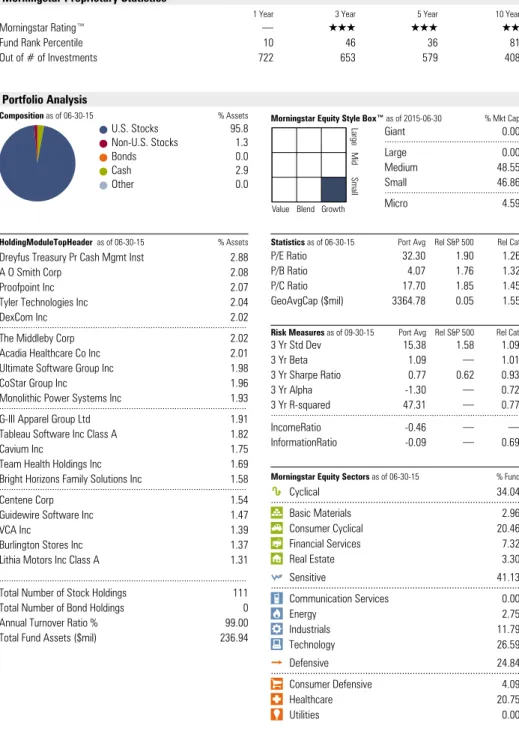
Portfolio Analysis
The weighting of the portfolio in various asset classes, including "Other" is shown in the table. "Other" includes security types that are not neatly classified in the other asset classes, such as convertible bonds and preferred stocks. Morningstar Style Box™
For equity funds the vertical axis shows the market capitalization of the long stocks owned and the horizontal axis shows investment style (value, blend, or growth). For fixed-income funds, the vertical axis shows the credit quality of the long bonds owned and the horizontal axis shows interest rate sensitivity as measured by a bond's effective duration.
Morningstar seeks credit rating information from fund companies on a periodic basis (e.g., quarterly). In compiling credit rating information Morningstar accepts credit ratings reported by fund companies that have been issued by all Nationally Recognized Statistical Rating Organizations (NRSROs). For a list of all NRSROs, please visit
http://www.sec.gov/divisions/marketreg/ratingagency.htm. Additionally, Morningstar accepts foreign credit ratings from widely recognized or registered rating agencies. If two rating organizations/agencies have rated a security, fund companies are to report the lower rating; if three or more organizations/agencies have rated a security, fund companies are to report the median rating, and in cases where there are more than two organization/agency ratings and a median rating does not exist, fund companies are to use the lower of the two middle ratings. PLEASE NOTE: Morningstar, Inc. is not itself an NRSRO nor does it issue a credit rating on the fund. An NRSRO or rating agency ratings can change from time-to-time.
For credit quality, Morningstar combines the credit rating information provided by the fund companies with an average default rate calculation to come up with a weighted-average credit quality. The weighted-average credit quality is currently a letter that roughly corresponds to the scale used by a leading NRSRO. Bond funds are assigned a style box placement of "low", "medium", or "high" based on their average credit quality. Funds with a low credit quality are those whose weighted-average credit quality is determined to be less than "BBB-"; medium are those less than "AA-", but greater or equal to "BBB-"; and high are those with a weighted-average credit quality of "AA-" or higher. When classifying a bond portfolio, Morningstar first maps the NRSRO credit ratings of the underlying holdings to their respective default rates (as determined by Morningstar's analysis of actual historical default rates). Morningstar then averages these default rates to determine the average default rate for the entire bond fund. Finally, Morningstar maps this average default rate to its corresponding credit rating along a convex curve.
For interest-rate sensitivity, Morningstar obtains from fund companies the average effective duration. Generally, Morningstar classifies a fixed-income fund's interest-rate sensitivity based on the effective duration of the Morningstar Core Bond Index (MCBI), which is currently three years. The classification of Limited will be assigned to those funds whose average effective duration is between 25% to 75% of
Disclosure
effective duration is between 75% to 125% of the MCBI will be classified as Moderate; and those that are at 125% or greater of the average effective duration of the MCBI will be classified as Extensive.
For municipal bond funds, Morningstar also obtains from fund companies the average effective duration. In these cases static breakpoints are utilized. These breakpoints are as follows: (i) Limited: 4.5 years or less; (ii) Moderate: more than 4.5 years but less than 7 years; and (iii) Extensive: more than 7 years. In addition, for non-US taxable and non-US domiciled fixed income funds static duration breakpoints are used: (i) Limited: less than or equal to 3.5 years; (ii) Moderate: greater than 3.5 and less than equal to 6 years; (iii) Extensive: greater than 6 years.
Fixed Income Portfolio Statistics:
Average Effective Duration is a measure of a fund's interest-rate sensitivity--the longer a fund's duration, the more sensitive the fund is to shifts in interest rates. Average effective duration is a weighted average of the duration of the underlying fixed income securities within the portfolio. Average Effective Maturity is a weighted average of all the maturities of the bonds in a portfolio, computed by weighting each bond's effective maturity by the market value of the security. Average effective maturity takes into consideration all mortgage prepayments, puts, and adjustable coupons. Longer-maturity funds are generally considered more interest-rate sensitive than their shorter counterparts.
Average Weighted Price is calculated from the fund’s portfolio by weighing the price of each bond by its relative size in the portfolio. This number reveals if the fund favors bonds selling at prices above or below face value (discount or premium securities, respectively). A higher number indicates a bias toward premiums. This statistic is expressed as a percentage of par (face) value.
Statistics
The Price/Earnings Ratio for a fund is the asset-weighted average of the prospective earnings yields of all the domestic stocks in a fund’s portfolio. The P/E ratio of a stock is calculated by dividing the current price of the stock by its trailing 12 months’ earnings per share. The P/E ratio relates the price of the stock to the per-share earnings of the company. A high P/E generally indicates that the market will pay more to obtain the company because it has confidence in the company’s ability to increase its earnings. Conversely, a low P/E indicates that the market has less confidence that the company’s earnings will increase, and therefore will not pay as much for its stock.
The Price/Book Ratio for a fund is the asset-weighted average of the prospective book value yields of all the domestic stocks in the fund’s portfolio. P/B ratio of a company is calculated by dividing the market price of its stock by the company’s per-share book value. A high P/B ratio indicates that the price of the stock exceeds the actual worth of the company’s assets. A low P/B ratio would indicate that the stock is a bargain, priced below what the company’s assets could be worth if liquidated.
The Price/Cash Ratio for a fund represents the weighted average of the price/cash-flow ratios of the stocks
stock fund's portfolio, or the geometric mean of the market capitalization for all of the stocks it owns.
Risk Measures
R-squared reflects the percentage of a fund's movements that are explained by movements in its benchmark index, showing the degree of correlation between the fund and the benchmark. Beta is a measure of a fund's sensitivity to market movements. A portfolio with a beta greater than 1 is more volatile than the market, and a portfolio with a beta less than 1 is less volatile than the market. Alpha measures the difference between a fund's actual returns and its expected performance, given its level of risk (as measured by beta). Sharpe ratio uses standard deviation and excess return to determine reward per unit of risk. Standard deviation is a statistical measure of the volatility of the fund's returns. Sectors
The fixed income sector framework consists of three levels: Super Sector, Primary Sector, and Secondary Sector. There are six Super Sectors, Government, Corporate, Securitized, Municipal, Cash & Equivalents, and Other, which divide into 17 Primary Sectors, which in turn are formed by 72 Secondary Sectors. The Government Super Sector includes Government and Government Related Primary Sectors; Municipal includes Municipal Taxable and Municipal Tax-Exempt sectors; Corporate includes Bank Loan, Convertible, Corporate Bond and Preferred Stock sectors; Securitized includes Agency Mortgage-Backed, Non-Agency Residential Mortgage-Backed, Commercial
Mortgage-Backed, Covered Bond, and Asset-Backed sectors; Cash & Equivalents includes Cash & Equivalents; Other includes Swap, Future/Forward, and Option/Warrant sectors.
Equity sectors are consolidated in three Super Sectors: Cyclical, Defensive and Sensitive. These Super Sectors are a broader representation of Morningstar's 11 equity sectors. The Defensive Super Sector includes Consumer Defensive, Healthcare, and Utilities sectors; Cyclical includes Basic Materials, Consumer Cyclical, Financial Services, and Real Estate sectors; Sensitive includes Communication Services, Energy, Industrials, and Technology sectors.
The Investment Profile Page User’s Guide
This guide will help you use the Morningstar Investment Profile to your advantage. For more information
about each investment, we recommend you read the prospectus before investing.
User’s Guide Overall Morningstar RatingTM Investment Information Category Description Volatility and Risk Operations Morningstar Proprietary Statistics Composition Morningstar Style BoxTM Morningstar Sectors Top 10 Holdings 5 2 3 4 1 7 8 9 12 13
XYZ Equity Fund (Portfolio, Ratings)
Net Annual Fund 0.00% of fund assets Operating Expense
30-Day Yield 0.00% Fund Inception Date 12-31-04 Advisor Xyz Management Company Subadvisor —
Portfolio Manager(s)
John Doe, CFA. Since 09-99. BS, DePaul University 1967. MBA, Northwestern University. 1971.
Jim Doe, CFA. Since 02-00. BS, Cincinnati University 1967. MM, Northwestern University 1971.
Operations
Must be accompanied by a product performance summary containing standardized performance information for an Allianz variable annuity. Past performance is not a guarantee of future results. Performance shown is historical. Investment returns and principal value will fluctuate with market conditions so that units, when redeemed, may be worth more or less than the original cost. This performance information does not reflect contract level expenses. If expenses were applied, performance would be lower.
Current performance may be lower or higher than the performance data quoted. To obtain the most recent performance information, please visit our website www.alianzlife.com <http://www.alianzlife.com> . This page must be accompanied by the Important disclosure pages. Individual profile is not complete without all pages for the most current quarter end Performance Summary for Allianz Life Insurance Company of North America Variable Annuity Products. [ROOM FOR 1150 CHARACTERS AND SPACES MAX]
Important Disclosures Investment Strategy from investment’s prospectus
The investment seeks capital appreciation and current income.
The fund normally invests at least 65% of assets in securities designed to achieve growth and/or income. It invests primarily in common stocks, preferred stocks, and convertibles. The fund may also invest in nonconvertible debt securities rated B or higher; it may invest no more than 10% of assets in securities rated below BBB. The fund may invest up to 20% of assets in foreign securities in the form of American and European Depositary Receipts. [ROOM FOR 650 CHARACTERS AND SPACES MAX]
Past names: XYZ Equity Fund A. Rae numquat quas ilitios ipsa etur simporr ovitiumendit volest fugit nonsed. Morningstar Category: Large-cap Growth
Large-cap growth funds invest in big companies that are projected to grow faster than the overall stock market. Most of these funds focus on companies in rapidly expanding industries, such as technology and health care, or multina-tional companies with a high percentage of earnings coming from sales in foreign markets.
Morningstar Equity Sectors as of 12-31-10 % Fund
h Cyclical 0.0 r Basic Materials 0.0 t Consumer Cyclical 0.0 y Financial Services 0.0 u Real Estate 0.0 j Sensitive 0.0 i Communication Services 0.0 o Energy 0.0 p Industrials 0.0 a Technology 0.0 k Defensive 0.0 s Consumer Defensive 0.0 d Healthcare 0.0 f Utilities 0.0
Top Holdings as of 12-31-10 % Assets
Haliburton 0.00 Sprint 0.00 Conocco CI A 0.00 BP PLC ADR 0.00 Motorola 0.00 Reliant Energy 0.00 Schlumberger 0.00 International Paper 0.00 Sara Lee 0.00
Federated Dept. Stores 0.00
Reliant Energy 0.00
Schlumberger 0.00
International Paper 0.00
Sara Lee 0.00
Federated Dept. Stores 0.00
Reliant Energy 0.00
Schlumberger 0.00
International Paper 0.00
Sara Lee 0.00
Federated Dept. Stores 0.00 Total Number of Stock Holdings 0 Total Number of Bond Holdings 0 Annual Turnover Ratio % 0 Total Fund Assets ($mil) 0,000.00
Portfolio Analysis Composition as of 12-31-10 % Assets U.S. Stocks 0.0 Non-U.S. Stocks 0.0 Bonds 0.0 Cash 0.0 Other 0.0
In the past, this investment has shown a relatively moderate range of price fluctuations relative to other investments. This investment may experience larger or smaller price declines or price increases depending on market conditions. Some of this risk may be offset by owning other investments with different portfolio makeups or investment strategies. Best 3 Month Return
00.00% (Feb ‘01 - Apr ‘01)
Worst 3 Month Return –00.00% (Oct ‘01 - Dec ‘01) Volatility Risk
Low Moderate High Investment Category 1
5
Morningstar Equity Style BoxTM as of 12-31-10 % Mkt Cap
Giant 0.0 Large 0.0 Medium 0.0 Small 0.0 Micro 0.0 Large Mid Small
Value Blend Growth
Overall Morningstar Rating™ Morningstar Return Morningstar Risk
QQQQQ Above Average Average
Out of 220 Fund Category Investments. A fund’s overall Morningstar Rating, based on its risk-adjusted return, is a weighted average of its applicable 3-, 5-, and 10-year Ratings. See disclosure for details. Morningstar Proprietary Statistics
1-Year 3-Year 5-Year 10-Year
Morningstar Rating — QQQ QQQQQ —
Fund Rank Percentile 000 000 000 —
Out of # of Investments 000 000 000 —
XXXXXXXXXXXX ©2011 Morningstar, Inc., Morningstar Investment® ProfilesTM 312-696-6000. All rights reserved. The information contained herein: (1) is proprietary to Morningstar and/ or its content providers; (2) may not be copied or distributed; and (3) is not warranted to be accurate, complete, or timely. Neither Morningstar nor its content providers are responsible for any damages or losses arising from any use of information. Past performance is no guarantee of future performance. Visit our investment web site at www.morningstar.com.
Statistics as of 12-31-10 Port Avg Rel S&P 500 Rel Cat P/E Ratio 0.00 0.00 0.00 P/B Ratio 0.00 0.00 0.00 P/C Ratio 0.00 0.00 0.00 GeoAvgCap ($mil) 0.00 0.00 0.00 Risk Measures as of 12-31-10 Port Avg Rel S&P 500 Rel Cat 3-Yr Std Dev 0.00 0.00 0.00 3-Yr Beta 0.00 0.00 0.00 3-Yr Sharpe Ratio 0.00 0.00 0.00 3-Yr Alpha 0.00 0.00 0.00 3-Yr R-Squared 0.00 0.00 0.00 Income Ratio 0.00 0.00 0.00 Information Ratio 0.00 0.00 0.00 money manager logo Release Date 00-00-00 Portfolio Manager(s) 6 Statistics Risk Measures 10 11
Morningstar Rating
TMSee “How to Use
the Morningstar Rating.”
Investment Information A summary
of the Investment Objectives and Policy section
found in every prospectus. It states the
objective of the fund and how the manager(s)
intend to invest to achieve this objective.
It includes any limitations to the fund’s
investment policies, as well as any share
class structure differences, previous
names, mergers, liquidation, and opening
and closing information.
Category Description Morningstar
assigns each investment option to one
category, based on the stocks and bonds that
have found their way into the portfolio
over the past three years. Here, we describe
that category.
Volatility and Risk We classify
investment portfolios as having one of three
volatility levels relative to all types of mutual
funds: Low, Moderate, and High. Investments
with wider ranges of returns are labeled “high,”
as they are considered riskier than “low”
volatility investments, which have had smaller
ranges of returns. We also show where the
portfolio’s category lands. For portfolios that
haven’t been in existence for three years, we
simply show the category average.
Operations
Learn the inception date of
the strategy and when it incepted into your
plan. Find out the name of the person(s) who
determines which stocks or bonds belong in the
investment portfolio and who is the
manage-ment company and subadvisor(s).
Portfolio Manager(s) The name of the
person who determines which stocks or bonds
belong in the investment portfolio.
Morningstar Proprietary Statistics See
“How to Use the Morningstar Ratings
TM”
Morningstar Style Box
TMSee “How to
Use the Morningstar Style Box.”
Fixed Income Portfolio Statistics
Average Effective Duration: Average Effective
Duration is a measure of a fund’s interest-rate
sensitivity--the longer a fund’s duration, the
more sensitive the fund is to shifts in interest
rates. Average effective duration is a weighted
average of the duration of the underlying fixed
income securities within the portfolio.
Average Effective Maturity
Average Effective Maturity is a weighted
average of all the maturities of the bonds in a
portfolio, computed by weighting each bond’s
effective maturity by the market value of the
security. Average effective maturity takes into
consideration all mortgage prepayments, puts,
and adjustable coupons. Longer-maturity funds
are generally considered more interest-rate
sensitive than their shorter counterparts.
Average Weighted Price
Average Weighted Price is calculated from the
fund’s portfolio by weighing the price of each
bond by its relative size in the portfolio. This
number reveals if the fund favors bonds selling
at prices above or below face value (discount
or premium securities, respectively). A higher
number indicates a bias toward premiums. This
statistic is expressed as a percentage of par
(face) value.
Statistics Price/Earnings Ratio
The Price/Earnings Ratio for a fund is the
asset-weighted average of the prospective earnings
yields of all the domestic stocks in a fund’s
portfolio. The P/E ratio of a stock is calculated
by dividing the current price of the stock by
its trailing 12 months’ earnings per share. The
P/E ratio relates the price of the stock to the
per-share earnings of the company. A high P/E
generally indicates that the market will pay
more to obtain the company because it has
confidence in the company’s ability to increase
its earnings. Conversely, a low P/E indicates
company’s earnings will increase, and therefore
will not pay as much for its stock.
Price/Book Ratio
The Price/Book Ratio for a fund is the
asset-weighted average of the prospective book value
yields of all the domestic stocks in the fund’s
portfolio. P/B ratio of a company is calculated
by dividing the market price of its stock by
the company’s per-share book value. A high
P/B ratio indicates that the price of the stock
exceeds the actual worth of the company’s
assets. A low P/B ratio would indicate that
the stock is a bargain, priced below what the
company’s assets could be worth if liquidated.
Price/Cash Ratio
The Price/Cash Ratio for a fund represents
the weighted average of the price/cash-flow
ratios of the stocks in a fund’s portfolio. Price/
cash-flow represents the amount an investor
is willing to pay for a dollar generated from a
particular company’s operations.
Price/cash-flow shows the ability of a business to generate
cash and acts as a gauge of liquidity and
solvency.
Geometric Average Cap $mil
The Geometric Average Cap ($mil) is the
overall “size” of a stock fund’s portfolio, or the
geometric mean of the market capitalization
for all of the stocks it owns. This number is
different from the fund’s median market cap—
the capitalization of the median stock in its
portfolio. The geometric mean better identifies
the portfolio’s “center of gravity.” That is, it
provides more accurate insight into how market
trends (as defined by capitalization) might affect
the portfolio.
Risk Measures Beta is a measure of a
fund’s sensitivity to market movements.
A portfolio with a beta greater than 1 is more
volatile than the market, and a portfolio
with a beta less than 1 is less volatile than
the market.
9 2 3 1 4 11 10 5 6 7given its level of risk (as measured by beta).
Standard deviation is a statistical measure of
the volatility of the fund’s returns.
Morningstar Sectors Morningstar
determines how much of each stock portfolio
is held in each of Morningstar’s 11 major
indus-trial sectors, which roll up into three broader
categories. A portfolio with 25% or more of
assets in any one sector is almost certainly
taking on more risk than a portfolio that spreads
itself more evenly among sectors.
Equity sectors are consolidated in three Super
Sectors: Cyclical, Defensive and Sensitive.
These Super Sectors are a broader
representa-tion of Morningstar’s 11 equity sectors.
The Defensive Super Sector includes Consumer
Defensive, Healthcare, and Utilities sectors;
Cyclical includes Basic Materials, Consumer
Cyclical, Financial Services, and Real Estate
sectors; Sensitive includes Communication
Services, Energy, Industrials, and Technology
sectors.
The fixed income sector framework consists of
three levels: Super Sector, Primary Sector, and
Secondary Sector. There are six Super Sectors,
Government, Corporate, Securitized, Municipal,
Cash & Equivalents, and Other, which divide
into 17 Primary Sectors, which in turn are
formed by 72 Secondary Sectors.
Credit Analysis (Fixed Income only)
For corporate-bond and municipal-bond funds,
the credit analysis depicts the quality of
US and non-US bonds in the fund’s portfolio.
The analysis reveals the percentage of
fixed-income securities that fall within each
credit-quality rating as assigned by Standard
& Poor’s or Moody’s. At the top of the ratings
are AAA bonds. Bonds with a BBB rating are
the lowest bonds that are still considered to
be of investment grade. Bonds that are rated
at or lower than BB (often called junk bonds
or high-yield bonds) are considered to be quite
speculative. (For municipal bonds, ratings
BBB and below are considered speculative).
Any bonds that appear in the NR/NA category
are either not rated by Standard & Poor’s or
Moody’s, or did not have a rating available.
Morningstar World Regions (International only)
This data set provides a breakdown of the
geographical exposure of a fund’s stock
assets. Regional exposure summarizes a
portfolio’s exposure to geopolitical risk, and
it also provides a reference point for
under-standing fund returns. Morningstar Categories
are assigned based on three years of
regional exposure.
Top Ten Holdings The top holdings are
the stocks or bonds with the most influence
on a portfolio’s returns. Conservative portfolios
typically devote no more than 3% to 4%
of their assets to any one stock or bond.
More daring portfolios may devote 7% or more
to one stock. Add up the weighting of the
top five holdings for another measure of risk.
A conservative option generally bets 15%
or less on the top 5 holdings, while a portfolio
with more than 25% in the top five may be
considered aggressive.
13 12
User’s Guide
How to Use the Morningstar Style Box
TMThe Morningstar Style Box is a visual tool that helps investors see past confusing fund names and
descriptions to better understand the “investment style” of stocks and mutual funds.
We assign each investment into one of
our nine Style Box squares by analyzing its
portfolio and determining the best fit.
Things to Remember About the
Morningstar Style Box
Risk increases as you move down and to
the right of the Morningstar Style Box.
Don’t put all your eggs in one basket. The
returns of investments from different
parts of the Morningstar Style Box probably
won’t move in the same direction at the
same time. By combining investments from
different parts of the Morningstar Style
Box, your portfolio’s overall returns will likely
be more stable.
What the Morningstar Style Box Does
It paints a picture of what’s in an investment’s
portfolio. Are the companies large or
small? Are the stocks cheap or expensive?
Do the bonds have limited or extensive
sensitivity to interest rate changes? Are they
of high or low quality?
The Morningstar Style Box also provides
a basis for our domestic stock fund categories.
Similar investments are categorized
together, then rated on their ability to balance
risk and reward relative to other investments
in that same, fairly narrow category. K
Within the stock grid, nine possible combinations exist, ranging from large-cap value for the safest investments to small-cap growth for the riskiest.
Morningstar Equity Style Box
Within the bond grid, nine possible combinations exist, ranging from limited sensitivity to interest rate changes/high quality for the safest investments, to extensive sensitivity
Morningstar Fixed-Income Style Box
Low
Medium
High
Limited Moderate Extensive
Limited Sensitivity High Quality Moderate Sensitivity High Quality Extensive Sensitivity High Quality Limited Sensitivity Med Quality Moderate Sensitivity Med Quality Extensive Sensitivity Med Quality Limited Sensitivity Low Quality Moderate Sensitivity Low Quality Extensive Sensitivity Low Quality Interest Rate Sensitivity
Quality Low High Risk Small Mid Large
Value Blend Growth Large-cap Value Large-cap Blend Large-cap Growth Mid-cap Value Mid-cap Blend Mid-cap Growth Small-cap Value Small-cap Blend Small-cap Growth Style Size Low High Risk
User’s Guide
The Morningstar Rating, commonly called
the “star rating,” tells you how well an
invest-ment has performed relative to similar
offerings after adjusting for all costs and risk.
It rates investments from one to five stars,
with the best performers receiving five stars
and the worst performers receiving a
single star.
The star rating is best used as an initial
screen to identify investments worthy of further
research, those that have performed well
relative to their peers. It’s a strictly quantitative
measure—a high rating doesn’t imply the
approval or endorsement of a Morningstar
analyst. Keep in mind that the rating is
based solely on historical performance, and
a highly rated offering may no longer
have the portfolio manager responsible for
that performance. Or—conversely—
a lower-rated or non-rated offering might
now employ a manager who produced
excellent results with other managed
invest-ment products.
Also, because ratings are based on
perform-ance within specific categories, it’s
important to note that not all five-star
offerings are equal or even interchangeable.
A five-star sector fund, for example, might
have the best risk-adjusted return within
its specific category, but it’s probably far riskier
than a highly rated diversified offering.
Rather than choosing investments according
to their ratings, investors should first decide
on an overall portfolio strategy and then seek
the best investments for each portion of
their portfolio. The Morningstar Rating can
then be used to identify possible candidates,
but you should never make a buy or sell
decision based solely on the rating. K
How to Use the Morningstar Rating
TMThe Morningstar Rating is a useful tool for identifying investments worthy of further research,
but it’s not the only thing to consider.
The Morningstar Rating is based on risk-adjusted return, which is calculated by subtracting a risk penalty from total return, after accounting for all sales charges, loads, and redemption fees. The penalty is determined by the amount of variation in monthly returns, with an emphasis on downward variation. The greater the variation, the larger the penalty. Investments are ranked within their Morningstar Categories by their risk-adjusted return and assigned stars using the following distribution: the top 10% receive five stars, the next 22.5% four stars, the middle 35% three stars, the next 22.5% two stars, and the bottom 10% receive one star. Ratings are calculated for up to three time periods—three-, five-, and 10 years—and combined to produce an overall rating. Investments with less than three years of performance history are not rated.
Morningstar Rating
Percent of all rated investments
Q
QQQ
QQQQ
QQQQQ
10% 22.5% 35% 22.5% 10% 40% 30% 20% 10%User’s Guide
Morningstar allocates stocks into one of five
asset classes: U.S. Stocks, Non-U.S. Stocks,
Bonds, Cash and Other. For each of these
asset classes, Morningstar calculates portfolio
statistics on the long and short positions
and displays long, short, and net (long minus
short) statistics as appropriate. Calculations are
run on the most-recent portfolio available.
Asset Allocation
The U.S. Stock data point indicates the
percentage of the fund’s assets devoted to
U.S.-domiciled equity investments.
The Non-U.S. Stock data point reflects only
the percentage of a portfolio’s equity
investments that are domiciled outside the
United States.
The Bond data point identifies the percentage
of the fund’s assets held in bonds and bond
exposure gained from derivatives. Bonds
include everything from government notes to
high-yield corporate bonds.
The Cash data point identifies the percentage
of the fund’s assets held in cash. Cash
encom-passes both actual cash and cash equivalents
(fixed-income securities with a maturity
of one year or less) held by the portfolio plus
receivables minus payables.
Lastly, the Other data point includes positions
in preferred stocks (equity securities that pay
dividends at a specific rate) as well as
convertible bonds and convertible preferreds.
Derivatives and unidentified holdings are also
grouped in this asset class.
Using the Bar Chart
The x-axis of this chart represents the
percentage each investment group holds, with
the y-axis representing a zero value. Values to
the right of the y-axis represent positive,
or “long”, security positions, while values to
the left of the y-axis represent negative,
or “short”, security positions. The table to the
right of the bar chart sums these two
values to present the “net” emphasis of
each investment group.
For example, a bar representing Cash
Alloca-tions that extends left of the y-axis indicates
negative percentages of cash in which the
portfolio is leveraged, meaning it has borrowed
against its own assets to buy more securities
or that it has used other techniques to
gain more than 100% exposure to the market.
Over 100%
Long or short positions in any asset class
that are greater than 100% are indicated by a
line break.
Where are the Shorts?
Sometimes the amount of shorts in a portfolio
is so small the bar chart cannot visually
represent the miniscule amount. For example,
if a portfolio has a –0.01% position in Cash,
the bar chart appears, though the green to the
left of the y-axis may not be visible. K
How to Use Morningstar’s Composition Graphics
Morningstar’s Composition graphics are tools that visually break down how a fund’s assets
are invested.
Net % % Assets 100 50 0 –50 –100U.S. Stocks
66.9
Non-U.S. Stocks
00.0
Bonds 169.8
Cash –137.7
Other 1.0
Total 100.0
U.S. Stocks
55.1
Non-U.S. Stocks
12.5
Bonds 19.3
Cash 10.4
Other 2.7
Total 100.0
When Do We Use the Bar Chart or the Pie Graph?
3
3
3
3
Templeton Growth VIP Fund
5Release Date: 09-30-2015
...
Overall Morningstar Rating™ Morningstar Return Morningstar Risk
QQ Average Above Average
Out of 1001 World Stock investments. An investment's overall Morningstar Rating, based on its risk-adjusted return, is a weighted average of its applicable 3-, 5-, and 10-year Ratings. See disclosure page for details. Investment Strategy from investment's prospectus
The investment seeks long-term capital growth.
The fund invests predominantly in the equity securities of companies located anywhere in the world, including developing markets. The equity securities in which the fund primarily invests are common stock. Although the fund seeks investments across a number of countries and sectors, from time to time, based on economic conditions, it may have significant positions in particular countries or sectors. Past name(s) : Templeton Growth Securities Cl2. Morningstar Category: World Stock
World-stock portfolios have few geographical limitations. It is common for these portfolios to invest the majority of their assets in the U.S., Europe, and Japan, with the remainder divided among the globe’s smaller markets. These portfolios typically have 20%-60% of assets in U.S. stocks.
Volatility Risk
Low Moderate High
Investment
Category
In the past, this investment has shown a wide range of price fluctuations relative to other investments. This investment may experience significant price increases in favorable markets or undergo large price declines in adverse markets. Some of this risk may be offset by owning other investments that follow different investment strategies.
Best 3 Month Return Worst 3 Month Return
28.91% -33.53%
(Mar '09 - May '09) (Sep '08 - Nov '08)
Operations Net Annual Fund Operating Expense
1.03
Fund Inception Date 01-06-99
Advisor Templeton Global Advisors Limited
Subadvisor .
Portfolio Manager(s)
James Harper, CFA. M.A., University of Cambridge,. Norman J. Boersma, CFA. B.A., York University,. M.B.A., University of Toronto,.
Morningstar Proprietary Statistics
1 Year 3 Year 5 Year 10 Year
Morningstar Rating™ . QQQ QQ QQ
Fund Rank Percentile 94 68 70 86
Out of # of Investments 1,220 1,001 758 393 Portfolio Analysis Composition as of 06-30-15 % Assets U.S. Stocks 36.0 Non-U.S. Stocks 62.9 Bonds 0.0 Cash 1.1 Other 0.0
Morningstar Equity Style Box™ as of 2015-06-30Large % Mkt Cap
Mid
Small
Value Blend Growth
Giant 59.42 ... Large 31.95 Medium 7.81 Small 0.81 ... Micro 0.00 HoldingModuleTopHeader as of 06-30-15 % Assets Microsoft Corp 3.08 Samsung Electronics Co Ltd 3.06 Citigroup Inc 2.53
Teva Pharmaceutical Industries Ltd ADR 2.41
Comcast Corp Class A 2.11
...
American International Group Inc 2.09
CRH PLC 2.03
Roche Holding AG Dividend Right Cert. 1.92
Amgen Inc 1.89
Pfizer Inc 1.81
...
Medtronic PLC 1.79
Total SA 1.78
JPMorgan Chase & Co 1.77
Credit Suisse Group 1.72
Sanofi 1.70 ... Hewlett-Packard Co 1.68 AXA SA 1.63 Kingfisher PLC 1.58 Telefonica SA 1.51 GlaxoSmithKline PLC 1.49 ...
Total Number of Stock Holdings 91
Total Number of Bond Holdings 0
Annual Turnover Ratio % 17.46
Total Fund Assets ($mil) 1,436.66
Statistics as of 06-30-15 Port Avg Rel S&P 500 Rel Cat
P/E Ratio 13.60 0.80 0.75
P/B Ratio 1.22 0.53 0.52
P/C Ratio 6.66 0.70 0.76
GeoAvgCap ($mil) 48982.70 0.72 1.51
Risk Measures as of 09-30-15 Port Avg Rel S&P 500 Rel Cat
3 Yr Std Dev 12.25 1.26 1.16 3 Yr Beta 0.98 . 1.27 3 Yr Sharpe Ratio 0.60 0.48 0.78 3 Yr Alpha 4.47 . 0.80 3 Yr R-squared 85.78 . 0.99 ... IncomeRatio 2.48 . . InformationRatio 0.98 . 1.03
Top 10 Countries as of 06-30-15 % Assets
United States 36.38 United Kingdom 11.15 France 9.90 South Korea 6.32 Germany 5.74 ... Switzerland 5.12 Ireland 3.07 Netherlands 3.01 Israel 2.44 China 2.15 Important Disclosures
Must be accompanied by a product performance summary containing standardized performance information for an Allianz variable annuity. Past performance is not a guarantee of future results. Performance shown is historical. Investment returns and principal value will fluctuate with market conditions so that units, when redeemed, may be worth more or less than the original cost. This performance information does not reflect contract level expenses. If expenses were applied, performance would be lower.
Current performance may be lower or higher than the performance data quoted. To obtain the most recent performance information, please visit our website www.allianzlife.com.
This page must be accompanied by the Important disclosure pages. Individual profile is not complete without all pages for the most current quarter end Performance Summary for Allianz Life Insurance Company of North America Variable Annuity Products.
Templeton Global Bond Securities Fund
5,6,7Release Date: 09-30-2015
...
Overall Morningstar Rating™ Morningstar Return Morningstar Risk
QQQQ Above Average Above Average
Out of 316 World Bond investments. An investment's overall Morningstar Rating, based on its risk-adjusted return, is a weighted average of its applicable 3-, 5-, and 10-year Ratings. See disclosure page for details. Investment Strategy from investment's prospectus
The investment seeks high current income consistent with preservation of capital; capital appreciation is a secondary objective.
Under normal market conditions, the fund invests at least 80% of its net assets in "bonds." Bonds include debt securities of any maturity, such as bonds, notes, bills and debentures. The fund invests predominantly in bonds issued by governments and government agencies located around the world. Under normal market conditions, the Advisor expects to invest at least 40% of its net assets in foreign securities, and may invest without limit in emerging or developing markets. It is non-diversified.
Past name(s) : Templeton Global Bond Sec Cl2. Morningstar Category: World Bond
World-bond portfolios invest 40% or more of their assets in foreign bonds. Some world-bond portfolios follow a conservative approach, favoring high-quality bonds from developed markets. Others are more adventurous and own some lower-quality bonds from developed or emerging markets. Some portfolios invest exclusively outside the U.S., while others regularly invest in both U.S. and non-U.S. bonds.
Volatility Risk
Low Moderate High
Investment
Category
In the past, this investment has shown a relatively small range of price fluctuations relative to other investments. Based on this measure, currently more than two-thirds of all investments have shown higher levels of risk. Consequently, this investment may appeal to investors looking for a conservative investment strategy.
Best 3 Month Return Worst 3 Month Return
13.32% -7.52%
(Mar '09 - May '09) (Jul '11 - Sep '11)
Operations Net Annual Fund Operating Expense
0.76
Fund Inception Date 01-06-99
Advisor Franklin Advisers, Inc.
Subadvisor .
Portfolio Manager(s)
Michael J. Hasenstab B.A., Carleton College,. Ph.D., Australian National University,. M.A., Australian National University,. Sonal Desai. Ph.D., Northwestern University (Kellogg),. B.A., Delhi University,.
Morningstar Proprietary Statistics
1 Year 3 Year 5 Year 10 Year
Morningstar Rating™ . QQQ QQQ QQQQQ
Fund Rank Percentile 73 32 29 1
Out of # of Investments 370 316 236 137 Portfolio Analysis Composition as of 06-30-15 % Assets U.S. Stocks 0.0 Non-U.S. Stocks 0.0 Bonds 42.9 Cash 55.9 Other 1.2
Morningstar Fixed Income Style Box™ as of 06-30-15
High
Med
Low
Ltd Mod Ext
Avg Eff Duration 0.16
Avg Eff Maturity 2.11
Avg Wtd Price .
HoldingModuleTopHeader as of 06-30-15 % Assets
United Mexican States 7.62435% 12-15-16 3.65
Poland(Rep Of) 4.75% 10-25-16 2.82
Malaysia (Govt Of) 3.394% 03-15-17 1.77
Ireland(Rep Of) 5.4% 03-13-25 1.53
Portugal(Rep Of) 3.875% 02-15-30 1.47
...
Korea Monetary Stab Bond 08-02-16 1.32
Korea(Republic Of) 3% 12-10-16 1.21
Malaysia (Govt Of) 3.172% 07-15-16 1.18
Serbia Rep 7.25% 09-28-21 1.08
Indonesia(Rep Of) 12.8% 06-15-21 1.06
...
Brazil(Fed Rep Of) 10% 01-01-17 0.96
Mexico(Utd Mex St) 7.75% 12-14-17 0.92 India(Govt Of) 8.83% 11-25-23 0.89 Portugal Rep 5.125% 10-15-24 0.89 Bk Of Korea 2.07% 12-02-16 0.88 ... Hungary Rep 5.375% 02-21-23 0.86
Ukraine Cabinet Of Ministers 9.25% 07-24-17 0.84
Indonesia(Rep Of) 11% 11-15-20 0.61
Hungary(Rep Of) 5.75% 06-11-18 0.55
Indonesia(Rep Of) 9.5% 07-15-23 0.55
...
Total Number of Stock Holdings 0
Total Number of Bond Holdings 120
Annual Turnover Ratio % 39.14
Total Fund Assets ($mil) 3,350.15
Risk Measures as of 09-30-15 Port Avg Rel BC Aggr Rel Cat
3 Yr Std Dev 5.14 1.77 1.14 3 Yr Beta 0.52 . 0.59 3 Yr Sharpe Ratio 0.08 0.14 -1.00 3 Yr Alpha -0.46 . 0.16 3 Yr R-squared 8.56 . 0.19 ... IncomeRatio 2.77 . . InformationRatio -0.27 . 0.47
Morningstar F-I Sectors as of 06-30-15 % Fund % Category
⁄ Government 46.26 39.50 › Corporate 1.56 17.74 € Securitized 0.00 7.49 ‹ Municipal 0.00 0.68 fi Cash/Cash Equivalents 52.18 14.58 ± Other 0.00 20.02
Credit Analysis as of 06-30-15 % Bonds
-100 -50 0 50 100 AAA 5 AA 17 A 44 BBB 18 BB 8 B 4 Below B 3 Not Rated 0 Important Disclosures
Must be accompanied by a product performance summary containing standardized performance information for an Allianz variable annuity. Past performance is not a guarantee of future results. Performance shown is historical. Investment returns and principal value will fluctuate with market conditions so that units, when redeemed, may be worth more or less than the original cost. This performance information does not reflect contract level expenses. If expenses were applied, performance would be lower.
Current performance may be lower or higher than the performance data quoted. To obtain the most recent performance information, please visit our website www.allianzlife.com.