REPUBLIC OF THE MARSHALL ISLANDS
OFFICE OF THE AUDITOR-GENERAL
Cooperative Performance Audit on Public Debt
AUDIT NO: 04/12-9999 P.O. BOX 245
MAJURO, MH 96960
REPUBLIC OF THE MARSHALL ISLANDS
Office of the Auditor-General
P.O. Box 245 ~ Majuro ~ Marshall Islands ~ 96960
Phone No. (692) 625-3390 ~ Fax No. (692) 625-5135 ~ Email Address: [email protected]
Honorable Jack Ading Minister of Finance
Republic of the Marshall Islands Dear Minister:
We are pleased to submit our report titled “Cooperative Performance Audit on Public Debt” as part of the collaboration effort with the Pacific Association of Supreme Audit Institution (PASAI).
The objective of our audit was to determine whether Republic of the Marshall Islands (RMI)’s Borrowing Act contains all of the key provisions for issuing and managing long-term debt; and to delong-termine the extent in which RMI has mitigated financial risk when borrowing or providing guarantees on loans entered into by governmental entities. The review was performed pursuant to the authority vested in the Auditor-General as codified under Title 3, Chapter 9, Section 903 of the RMI Revised Code, which states in part:
“The Auditor-General shall from time to time make such other audits of the government agencies, activities, contracts, or grants as are possible within the budget provided for him and he deems to be in the public interests….”
Pursuant to the Audit Act, we discussed our report with the Secretary of Finance and his staff during our exit meeting on December 30, 2014 in which they agreed with our findings and recommendations. We have also included the written comments from the Secretary of Finance in this final report.
We wish to express our appreciation to the Secretary of Finance and Senior officials of the Ministry of Finance for their cooperation during the course of our audit.
Sincerely, Junior Patrick Auditor General CC President Secretary of Finance OAG File
Table of Contents
Executive Summary ... 1 Scope ... 9 Methodology ... 9 Principal Results ... 12 Conclusions ... 23 Recommendations ... 23Appendix A- Management Comments ... 25
Contact and Acknowledgements ... 26
1
Executive Summary
Public long-term debt is often a large financial liability of governments. Debt management is the process of establishing and executing a strategy for managing the government’s debt in order to raise the required amount of funding at the lowest possible cost over the medium to long run, consistent with a prudent degree of risk while supporting government goals and objectives.1
As of September 30th, 2012, Republic of Marshall Island’s (RMI) loan portfolio includes 14 direct loans and another 6 loans and contracts that were backed by the full faith credit of RMI (guarantees) should the original borrower default on the loan or contract. The combined value of the loans and guarantees including interest expenses amount to $142 million. During the period, RMI’s estimated debt service payments and other loan repayments totaling about $6 million equaled 16 percent of the RMI’s General Fund actual revenue.
The purpose of the audit is to determine the capacity of the RMI to minimize the financial burden placed on the general public to finance and guarantee long-term debt. For this review, we determined whether RMI was in the best position to effectively manage debt service payments (e.g. principal, interest expense, or other service fees) by comparing current debt management activities against recommended practices2 and by evaluating current debt management activities performed by the Ministry of Finance (MOF).
1 Revised Guideline for Public Debt Management, April 2014. International Monetary Fund. 2 IMF and WB Guidelines for public debt management: Accompanying Document (2002) in www.imf.orghttp://www.imf.org/
2
This audit was undertaken as part of an initiative developed by the Pacific Association of Supreme Audit Institutions (PASAI) with the support of the Asian Development Bank (ADB) and the INTOSAI Development Initiative (IDI). Eight PASAI member countries in the Pacific, including RMI, are participating in the cooperative audit. Other participating audit offices include: Cook Islands, Federated States of Micronesia – National, Federated States of Micronesia – Pohnpei, Federated States of Micronesia – Kosrae, Fiji, Guam, and Samoa.
Each of the participating audit offices is auditing the same topic of Public Debt within their respective jurisdictions.
Key Results
Public debt management guidelines suggest that the legal framework of countries should clarify the authority to borrow and to issue new debt, to hold assets for cash management purposes, and, if applicable, to undertake other transactions on the government’s behalf. The organizational framework
for debt management should be clearly specified and roles and responsibilities formally defined. Although RMI’s debt management framework is primarily stipulated in the Borrowing Act of 1985, the Act does not contain all of the key provisions for
http://www.imf.org/
The Borrowing Act Does Not Contain All of the Key Provisions for Issuing and Managing Long Term Debt (Details on pgs. 12-16) RMI Has Experienced Challenges at
Mitigating Financial Risk When Borrowing or Providing Guarantees (Details on pgs. 16-20)
RMI Does Not Have a Debt
Management Strategy that Would Help Mitigate Loan Default Risk (Details on pgs. 20-22)
3
issuing and managing long-term debt because the Act has not been updated to reflect current standards and practices for public debt management. Gaps in RMI’s debt management framework structure include the absence of formally establishing an office dedicated to debt management; clearly defining debt management goals and objectives; and including criteria for borrowing purposes. Without these critical components, operational and financial risks increase due to borrowing.
RMI has already experienced challenges in fully mitigating the financial risk of a $142 million direct loan and guarantee portfolio. For example, although information was not available to determine the number of late loan payments, MOF officials reported sending debt service payments late because of cash flow projections not meeting initial government estimates. In addition, for two of five guaranteed loans, RMI had to assume loan payments. RMI assumed the loans without advance notice because no loan monitoring had been performed to detect risk of default. When MOF does not know when guaranteed loans could be nearing default until the loan default occurs, it places added strain on both cash flow levels and budgets.
One mechanism that RMI had implemented to control the financial risks of borrowing was to prohibit borrowing between FY 2011 and FY 20123. However, an alternative mechanism, such as a debt management strategy could provide a roadmap to borrowing that would allow the government to continue to meet government infrastructure goals and objectives by describing required public debt management, monitoring and reporting activities. RMI does not have yet a plan that has been
4
formally approved because the Fiscal Responsibility Bill is currently under deliberation by Parliament.
We conclude in this report that RMI’s older legal framework for debt management and the current debt management activities administered by the MOF does not provide the necessary assurance that additional debt can be incurred without placing RMI at greater financial and economic risk. As a result, we recommend strengthening of the RMI’s legal framework through updating of the Borrowing Act of 1985, aligning it to leading debt management practices. Additionally, MOF should develop a long-term debt management strategy that addresses the protocols, processes and systems of a debt management.
MOF provided written comments to a draft copy of this report in which they agreed with the conclusion and recommendations. In addition, MOF noted the quality and comprehensiveness of the report.
Background
Importance of public debt management
Government experts define public debt management as “the process of establishing and executing a strategy for managing the government’s debt in order to raise the required amount of funding, pursue its cost and risk objectives, and to meet any other public debt management goals the government may have set.”4
5
Public debt management is important in the RMI because public debt is the largest financial liability of the government, and a major contributor to the country’s external debt. Effective public debt management can lower cost and minimize risks to the government.5
Public borrowing process
In September of 1990, the RMI Parliament passed a Resolution to cap public Borrowing at $200 million. Prior to a loan getting processed, the Cabinet receives a Cabinet Paper for approval or disapproval of a loan request either from the government or any of the State Owned Entities (SOEs or governmental entities). If the loan request is approved then the responsibility of the loan is passed onto MOF to pursue the loan. Once an agreement is settled between the borrower and financial institution, the payment is released along with the amortization schedule. If the Loan was taken on by a SOE and guaranteed by the RMI Government, then the loan is managed by that SOE. In the event of loan default by a SOE, the RMI Government will be obligated to pay the principal and interest amount on behalf of the SOE. The Ministry of Finance manages the payment, including budgeting for contingencies to address future loan defaults by the SOEs.
RMI Public Debt Levels
Public debt comprises of direct loans, promissory notes, contract, bonds, or loans that are guaranteed by the government. As of September 30th, 2012, the combined value of RMI loans and guarantees including interest expenses amount to $142 million.
6
RMI’s debt ceiling, the maximum debt level authorized by Parliament is $200 million or 526 percent of the RMI’s General Fund actual revenue during the period.
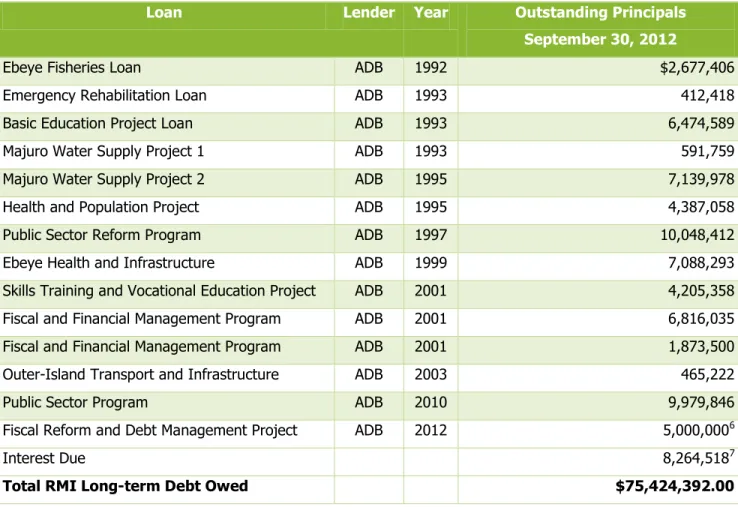
RMI’s loan portfolio primarily comprises of loans and loans guarantees. As of FY 2012, longer term loans directly owed by RMI are $75.4 million as shown in Table 1.1. The Asian Development Bank (ADB) has provided all of the loans borrowed by RMI since 1992. The size of the loans ranged from $412,000 for emergency rehabilitation loans due to severe storms to $10,048,000 to fund RMI’s reduction in workforce (RIF).
Table 1.1: Principal and interest owed by RMI
Loan Lender Year Outstanding Principals
September 30, 2012
Ebeye Fisheries Loan ADB 1992 $2,677,406
Emergency Rehabilitation Loan ADB 1993 412,418
Basic Education Project Loan ADB 1993 6,474,589
Majuro Water Supply Project 1 ADB 1993 591,759
Majuro Water Supply Project 2 ADB 1995 7,139,978
Health and Population Project ADB 1995 4,387,058
Public Sector Reform Program ADB 1997 10,048,412
Ebeye Health and Infrastructure ADB 1999 7,088,293
Skills Training and Vocational Education Project ADB 2001 4,205,358 Fiscal and Financial Management Program ADB 2001 6,816,035 Fiscal and Financial Management Program ADB 2001 1,873,500 Outer-Island Transport and Infrastructure ADB 2003 465,222
Public Sector Program ADB 2010 9,979,846
Fiscal Reform and Debt Management Project ADB 2012 5,000,0006
Interest Due 8,264,5187
Total RMI Long-term Debt Owed $75,424,392.00
6 A new debt issued after September 30, 2012.
7
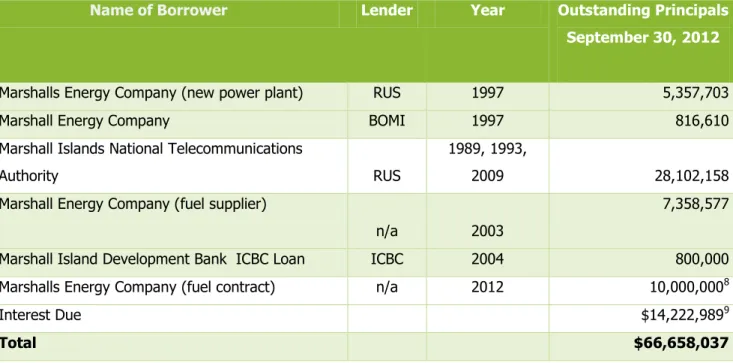
As shown in Table 2.1, RMI has accumulated $66.6 million in the form of government guaranteed debt. Guarantees are loans or contracts by SOEs or other public organizations that are backed by the full faith and credit of RMI to cover debt in the case of default. Should the loans or contracts fall into default, RMI assumes primary responsibility for paying debt service or the contract amount.
Table 2.1: Loans Guaranteed by RMI
Name of Borrower Lender Year Outstanding Principals
September 30,2012
Marshalls Energy Company (new power plant) RUS 1997 5,357,703
Marshall Energy Company BOMI 1997 816,610
Marshall Islands National Telecommunications
Authority RUS
1989, 1993,
2009 28,102,158
Marshall Energy Company (fuel supplier)
n/a 2003
7,358,577 Marshall Island Development Bank ICBC Loan ICBC 2004 800,000 Marshalls Energy Company (fuel contract) n/a 2012 10,000,0008
Interest Due $14,222,9899
Total $66,658,037
When governments borrow money, exposures to seven different types of risk occur. Actual risk exposures to RMI are driven by the composition of the debt portfolio, including allocation of short-term debt versus longer-term debt, the variable interest rate related to fixed rate debt, and borrowings from foreign countries. A key risk is market risk – potential increases in the cost of the debt arising from market fluctuations that raise interest rate. Changes in the interest rate affect debt service
8 A new debt issued after September 30, 2012.
8
costs. Debt servicing costs on principal, interest expense owed, or other fees paid on the loan. The key risks are: (1) exchange rate risk – potential increases in the cost of the debt arising from changes in exchange rates; (2) refinancing risk – potential of debt to be refinanced at an unusually high cost or not at all; (3) liquidity risk - potential of cash flow diminishing quickly as a result of unanticipated cash flow obligations and/or a possible difficulty in raising cash through borrowing in a short period of time; (4) credit risk – potential for default by borrowers on loans or other financial assets; (5) settlement risk – the potential that a counterparty does not deliver a security as agreed in a contract, after the country has already made the payment according to the agreement; (6) operational risk – potential for transaction errors in the various stages of executing and recording transactions; inadequacies or failures in internal controls, or in systems and services; and, (7) reputation risk - potential for legal problems or natural disasters that affect the country’s ability to pursue activities required to meet debt management objectives.
RMI Framework Regarding Public Debt Management
Concerned about the effectiveness of debt management among Pacific Islands, the respective Auditor-Generals of the Pacific Association of Supreme Audit Institutions agreed to collaborate and conduct a performance audit of public debt management. The Office of the Auditor-General (OAG) of RMI was tasked with answering two specific questions:
Audit Questions:
1. Does RMI Borrowing Act have all of the key provisions for issuing and managing long-term debt?
2. To what extent has RMI mitigated financial risk when borrowing or providing guarantees on loans entered into by component units?
9
Scope
We evaluated the debt management function administered by MOF. We examined RMI debt policy, debt management regulations, debt management operations, and information sharing activities. For our debt analysis, we examined only long-term loans RMI directly borrowed from the Asian Development Bank and guarantees RMI authorized for other loans and contracts. We did include unsecured loans borrowed from SOEs. The period of the audit covers from October 1st 2011 to September 30, 2012.
Methodology
To identify whether RMI’s Borrowing Act has all of the key provisions for issuing and managing long-term debt, we performed the following activities:
● Reviewed RMI laws and regulations that pertain to public debt.
● Obtained and compared RMI debt management practices against guidelines established by International Organization of Supreme Audit Institutions (INTOSAI) Development Initiative and Working Group on Public Debt.
● Compared Pacific Economic Management Technical Assistance (PEM TA) Debt Management Strategy and Fiscal Responsibility Bill, IMF Consultation Article IV, and fiscal year 2012 Economic Review and public debt information disclosed in the Single-Audit report.
● Interviewed key personnel - the Secretary of Finance, the Assistant Secretary for Accounting and Administration, the Chief Accountant, and the Accounting Consultant for MOF to discuss how RMI performs debt management and how information is shared.
10
● Reviewed and assessed the Juumemmej10.
To determine the extent that RMI has mitigated financial risk when borrowing or providing guarantees on loans entered into by component units, we performed the following activities:
1. Obtained and compared RMI debt management practices against guidelines established by INTOSAI Development Initiative and Working Group on Public Debt.
2. Interviewed key personnel - the Secretary of Finance, the Assistant Secretary for Accounting and Administration, the Chief Accountant, and the Accounting Consultant for MOF to discuss debt management and monitoring.
3. Reviewed RMI loans and guarantees as of May 2013.
4. Analyzed audited financial statements of the RMI for FY 2012. (Information for fiscal year 2013 was not available at the time of our review and the scope of review was for Fiscal Year 2011-2012).
During the course of the audit, we experienced challenges in conducting a timely audit. Data was not available to comprehensively assess the financial risk of borrowing. For instance, while we requested from MOF their Comprehensive Annual Financial Report, the report was not submitted until nine months later. In other cases, rescheduled meetings did not occur. As a result, we resorted to formally submitting our questions for response, which led to a two-month delay in receiving the
10
11
information. In meetings that did take place with MOF staff, we were able to assess staff capabilities in debt management.
We conducted this audit pursuant to the authority vested in the Auditor-General as codified under Title 3, Chapter 9 Section 903 of the RMI Revised Code, which states in part:
“The Auditor-General shall from time to time make such other audits of the Government agencies, activities, contracts, or grants as are possible within the budget provided for him and he deems to be in the public interest”.
Our review was also conducted in accordance with Generally Accepted Government Auditing Standards issued by the Comptroller General of the United States. Those standards require that we plan and perform the audit to obtain sufficient, appropriate evidence to provide a reasonable basis for our findings and conclusions based on our audit objectives. We believe that the evidence obtained provides a reasonable basis for our findings and conclusions based on our audit objectives.
Agency Comments
MOF provided written technical comments on the draft of this report, which we have incorporated where appropriate. Appendix A attached to this report provides the complete response by MOF.
Prior Year Coverage
This is the first audit conducted by the Office of the Auditor-General on legal and institutional framework for public debt management.
12
Principal Results
International Organization of Supreme Audit Institutions (INTOSAI) Guidelines suggest that legal frameworks for debt management include the following components:
1. Establishment of a Debt Management Unit; 2. Delegation of borrowing authority;
3. Clear definition of RMI borrowing;
4. Development of debt management goals and objectives; 5. Debt reporting obligations.
These components clarify the authority to borrow and to issue new debt, to hold assets for cash management purposes, and, if applicable, to undertake other transactions on the government’s behalf. The organizational framework for debt management should be clearly specified and mandated.
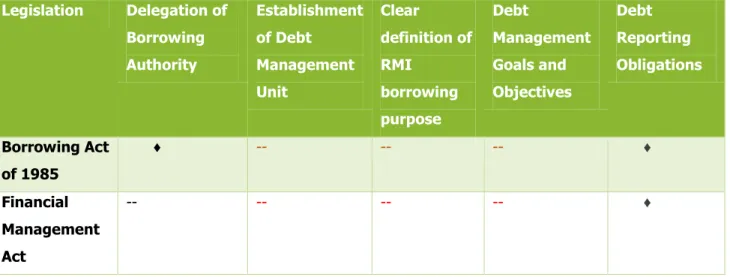
The RMI’s framework for public debt management is stipulated in two key pieces of legislation – the Borrowing Act of 1985 and the Financial Management Act. Collectively, these statutes do not fully address all of the components recommended for debt management by the INTOSAI guidelines. As shown in Table 3.1, the statutes, particularly the Borrowing Act 1985—does not have clear establishment of debt management unit, provide clear definition of RMI borrowing purpose, or establish clear debt management goals and objectives.
The Borrowing
Act Does Not
Include All Key
Provisions for
Issuing and
Managing Long
Term Debt
13
Table 3.1: Recommended Debt Management Components Contained in the RMI’s Legislation
Legislation Delegation of Borrowing Authority Establishment of Debt Management Unit Clear definition of RMI borrowing purpose Debt Management Goals and Objectives Debt Reporting Obligations Borrowing Act of 1985 ♦ -- -- -- ♦ Financial Management Act -- -- -- -- ♦
Available -- Not available
RMI does not have a dedicated debt management unit
A key role of a debt management unit is to provide transparency and accountability regarding public debt management through establishing processes and systems to mitigate public debt management risks. A debt management unit serves as the first point of contact for financial institutions, rating agencies, and key government stakeholders and produces debt management reports and other information relevant to loan portfolio management.
RMI does not have a dedicated and formally established office for debt management as recommended by the INTOSAI guidelines because there are no full-time staffs dedicated to debt management.
In FY 2012, MOF intended to establish a small debt management unit and has drafted legislation to do so. To date, Parliament has yet to consider the proposed public debt
14
management unit reflected both in the Pacific Economic Management Technical Assistance (PEM TA) RMI Debt Management Strategy and Fiscal Responsibility Bill. In the absence of the unit, we could not determine who was formally responsible and held accountable for conducting research and analysis, developing operational procedures to minimize the borrowing costs associated with late repayments, settling borrowing transactions and monitoring control of disbursements. These conditions raise operational risks for RMI. However, we could not determine the extent that operational risks, such as transaction errors, internal controls issues, or other deficiencies are occurring within RMI.
Operational risks could be mitigated with sound business practices, such as monitoring and internal control policies, including clearly establishing roles and responsibilities of staff. Because MOF has responsibility for implementing the Borrowing Act, the Secretary has delegated the implementation of debt management to two senior MOF managers, who are additionally responsible for other financial management activities of RMI. Public debt management requires staff with a combination of financial market skills (such as portfolio management and risk analysis) and public policy skills. The ability to attract and retain skilled debt management staff is crucial for mitigating operational risk. We were not able to obtain sufficient information to assess the sufficiency of the current staff qualification to manage RMI’s debt. Nonetheless, having MOF financial managers responsible for managing public debt creates an operational risk because there is no separation of staff roles between the objectives for debt management and fiscal policies of RMI. As suggested by public debt management guidance, when separation is evident, fiscal policy can be carried out independently from debt management policy, ensuring that debt management
15
decisions are carried out according to the mandates established by clear legal frameworks, and that fiscal decisions are not driven by debt management.
Legal Framework Lacks Clear Definition Guiding Borrowing Purposes
Legal frameworks for debt management generally establish borrowing authority and provide clearly defined goals and objectives. To accomplish appropriate transparency, the objectives should be publicly disclosed, and the measures of cost and risk that are adopted should be explained. Clarity and transparency in debt management enhances government accountability because it reduces uncertainty about government activities.11
While The Borrowing Act authorizes borrowing by the government, RMI’s legal framework for public debt management does not clearly define goals and objectives or the circumstances from which borrowing can occur. Examples of borrowing can include, but not be limited to, financing budgeting deficits, refinancing maturing debt, financing investment projects approved by Parliament, financing guarantee payments in case of default, and adding to foreign currency reserves. The lack of clearly defined borrowing purposes often lead to decisions concerning debt management that result in expensive debt without any benefit realized for the government and the types of debt to issue, particularly during times of market instability, resulting in potentially risky and expensive debt. 12
11Code of Good Practices on Fiscal Transparency (2007, henceforth FT Code), and the Code of Good Practices on
Transparency in Monetary and Financial Policies: Declaration of Principles that pertain to debt management operations.
16
For example, RMI borrowed $12 million to finance a public sector reform program that called for reducing the number of public employees from 1,800 in 1997 to fewer than 1,500 by mid-2000 so that annual payroll expenditures can decline from $16.4 million in 1997 to $15.4 million in 2000. During the period 1997 to 2000, RMI was able to reduce the public employee workforce by 313 and payroll expenditures by $1 million. However, there were no long term savings to RMI as the level of public servants employed rose again to 1,776 between the periods 2001 to 2004. As a result, the payroll expenditures increased to $23.6 million representing a 53 percent growth. RMI continues to pay on the loan principal and interest and had requested that the lender forgive the principal and debt service owed on those loans that did not accomplish their intended purpose.
The Borrowing Act Can Benefit From Updating
The Borrowing Act was adopted in 1985 and has not since been updated to reflect current standards for debt management. The MOF conducted a study that recommended updating of The Borrowing Act when the Government drafts the Fiscal Responsibility Bill and adopts a debt management strategy. To date, MOF has not yet prepared a debt management strategy. In the absence of key components in RMI’s legal structure for debt management, we examined RMI’s effectiveness at managing debt because borrowing can create liquidity risks. For FY 2012, RMI’s estimated debt service payments and other loan repayments totaled about $6 million equaling 16 percent of the RMI’s General Fund actual revenue.
RMI Has Experienced
Challenges at
Mitigating Financial
Risk When
Borrowing or
Providing
Guarantees
17
Debt service coming due is determined by the amortization schedules MOF follows. RMI’s debt to ADB will require RMI to budget a total of about $10 million up to 2017 or an average of $3.3 million annually to pay.
Without assuming additional loans, RMI’s debt service increases slightly in 2018 when RMI will need to budget an average of $3.2 million and $4.2 million annually for the next 15 years.
Most of the ADB loans offered an initial grace period of several years for debt service obligations, but now that principal repayment has become due, the debt servicing has created fiscal strains for RMI. According to MOF officials, RMI had been late in paying principal and interest expense on number of loans because government cash collections did not meet estimated cash flow projections.
We were not able to obtain data from MOF regarding the extent of late payments, however, when payments are late, RMI is at increased risk of default. RMI has refinanced some of its loans to prevent defaults that led to extending the term of the loan and increasing debt interest.
Year Ending September 30,
Principal Interest Total
2015 2,720,209 672,358 3,392,567
2016 2,936,607 611,682 3,548,289
18
Remedies to assess the cash flow issues have not been formalized. The Assistant Secretary of Finance explained that a pending draft Cash Management plan which will address the cash forecast and disbursement on any given period for the General Fund and other funds also has yet to be formalized. 13
Compensating controls can include communication and information sharing activities. However, we determined that SOEs do not routinely provide information about their debt and cash flow needs to MOF. Instead, SOEs provide annual reports as stipulated by the Memorandum of Agreement between an agency and MOF. As a result, MOF does not know when loans could be nearing default until the loan default occurs. For example, in April 2012, Marshall Islands National Telecommunication Authority (MINTA) defaulted on its loan payments to Rural Utility Services or RUS, without warning to MOF officials. As the guarantor, RMI Government was required to make payments on behalf of MINTA in the amount of $0.619M during the period.14
Loan Guarantees Placed Added Strain on Cash Flow Increasing Financial Risks
Effective debt management includes the monitoring and review of potential exposure to credit and liquidity risks that could happen when RMI guarantees the debts of SOEs. Without prior knowledge of pending default, RMI had to assume two of five loans that RMI guaranteed on behalf of two SOEs during FY2012 period alone, which added substantially to RMI’s loan portfolio. In addition to loan default by MINTA, the Air
13
The OAG did not evaluate the effectiveness of the financing forecasting models within the Ministry of Finance. 14 As of September 30, 2013, NTA is in technical default with an amount of $563K putting liability on the RMI Government.
19
Marshalls, Inc.’s loan default added about $0.8M which was also financed by RMI adding to RMI’s financial risks.
Due to absence of information on loan performance from SOEs and other organizations, we could not determine the extent that RMI is at risk of having to assume other loans that it has guaranteed.
For the remaining loan that RMI guaranteed for the Marshalls Energy Company, the Company in 2012 was not in compliance with certain coverage ratio requirements relating to a loan agreement with Rural Utilities Service. Because the notes were unconditionally guaranteed by RMI, RMI could be further liable for the debt service in the event of the default.
We examined whether the RMI could eventually recoup the loan payments from the original borrower on the two of the loans currently in default, but the loan guarantees did not require the original recipient of the loan to reimburse RMI. RMI’s credit and liquidity risks to assume the loans should another organization default can be mitigated if conditions for reimbursements are included with the guarantee. Without these requirements, there is no incentive on the original borrower to either maintain coverage ratio requirements, or to keep up to date on debt service payments.
20
A key tool that aids governments in effectively managing public debt is the development of debt management strategy. A debt management strategy defines the government’s optimal funding sources based on its risk tolerance, the stage of development of domestic financial markets, the ability of a government to obtain external funding, and the country’s stage of economic development. Per the INTOSAI guidelines a debt management strategy should include the following components:
1. Description of the market risks being managed (e.g. currency, interest rate, and refinancing/rollover risks) and the historical context for the debt portfolio. 2. Description of the future environment for debt management, including fiscal
and borrowing projections, assumptions about interest and exchange rates, and constraints on portfolio choice – including those relating to market development and the implementation of monetary policy.
3. Description of the analysis undertaken to support the recommended debt management strategy, clarifying the assumptions used and limitations of the analysis.
4. Adopted strategy and its rationale, with specific targets and ranges for key portfolio risk indicators and the financing programmed over the projected horizon. Strategy documents commonly provide desired qualitative and quantitative targets of key performance indicators (for example, a statement that “the amount of local currency debt maturing within 12 months shall be reduced”). In addition, if one of the debt management objectives is to promote
RMI Does Not Have a
Debt Management
Strategy that Would
Help Mitigate Loan
Default Risks
21
development of the domestic debt market, the strategy would include specific measures to support such development.
We determined the extent that MOF has implemented, in practice, any of the four recommended debt management activities. Our analysis determined that MOF does not implement any of the recommended activities. Any gaps in RMI’s debt management strategy increase the financial risks of borrowing.
On one of the four key debt management strategy components -- how much to borrow, we determined RMI does not have the systems in place to execute the task effectively. Determining borrowing needs is a complex function of the planning cycle of debt management and requires a significant amount of information and coordination within the Government to estimate correctly to avoid over-borrowing. Over-borrowing can be costly and can lead to a deterioration of the government’s fiscal position. RMI should also avoid under-borrowing, which may force governments to alter their budgets, create a liquidity crisis or trigger a debt default. However, efforts to identify RMI borrowing needs are non-existent or do information sharing protocols exist to routinely share borrowing information between RMI and component units.
The Assistant Secretary of Finance further explained there is no proper methodology on how one gauges or identifies the borrowing needs of a requesting/borrowing party, and that the only guidelines and procedures on borrowing that RMI can pursue are established in the Borrowing Act of 1985, Title 11 Chapter 10. As stated in Title 11 chapter 10, “Monies borrowed under Section 1003 of this Act shall be duly applied for
22
such purpose or purposes as may from time to time be approved in relation thereto by the Nitijela in the manner provided in Section 1003 of this Act.”
MOF has developed a debt management strategy, but it has not yet implemented its strategy because the updated Fiscal Responsibility Bill has not yet been passed. The Assistant Secretary of Finance explained that the Fiscal Responsibility Bill remains under deliberation with the Parliamentary Standing Committee pending further debate by Nitijela.
The draft Fiscal Responsibility Bill contains suggested requirements for annual reports on RMI fiscal strategy, including a description of the Government’s long-term objectives for fiscal policy on the level of total debt, and an assessment of short term intentions and long term fiscal position. The report must also display the fiscal forecast that shows the statement of borrowing and any other contingent liabilities (including any guarantees or indemnities).
In the absence of the debt management strategy, RMI approved a freeze for FY 2011 and FY 2012 on new borrowing to fund expenditures of the general government and on non-concessional borrowing by SOEs, and prohibited government lending or loan guarantees to parties outside of the public sector. Moreover, any concessional borrowing by SOEs required prior approval of Cabinet. Although the order mitigated taking on additional risk, the bans and limitations on future borrowing did not address how to currently manage RMI’s public debt portfolio.
23
Conclusions
RMI’s older legal framework for debt management and the limited debt management activities administered by MOF do not provide the necessary assurance that additional debt can be incurred without placing RMI at greater financial and economic risk. To be in a better position to effectively manage the government’s current and future debt, certain mechanisms that we described in this report need to be in place to guide RMI’s current and long-term activities. In particular, a debt management unit should be established to administer and monitor the public debt functions and activities to keep RMI informed of the current debt situation. This unit should ensure the placement of roles and responsibilities for: conducting research and analysis, developing operational procedures to minimize the borrowing costs associated with late repayments, settlement of borrowing transactions, and monitoring control of disbursements.
A debt management strategy could help outline how RMI can effectively manage long-term debt including establishing criteria for managerial decision making on long-long-term debt priorities.
Recommendations
1. To strengthen the RMI legal framework, we recommend that Parliament update the Borrowing Act of 1985 for alignment to leading practices in debt management. Specifically, the Act should: (1) establish clear and measurable goals and objectives; (2) establish a Debt Management Unit whose performance goals are to prevent late loan debt service payments and prevent loan defaults; and, (3) clearly define the purposes for RMI borrowing and criteria from which to guarantee loans.
24
2. To enhance the effectiveness of RMI’s performance on public debt management, we recommend that MOF develop a long-term debt management strategy that addresses the following:
o Protocols, processes and systems that clearly separate the role of financial management and debt management;
o Dedication of full time staff to manage, monitor, and report on debt management activities;
o Issuance of an annual report on debt management activity;
o Description of specific targets and ranges for key portfolio risk indicators and loan financings programmed over the projected horizon;
o Identification of current and future market risks for loans managed; and, o Development and implementation of semi-annual information sharing
requirements on debt management activities of component units and other organizational entities whose loans are guaranteed by RMI.
25
26
Contact and Acknowledgements
OAG Contact
Junior Patrick, Auditor-General Phone (692) 625-3192/3390 Fax (692) 625-5135
Email [email protected]
Website www.rmioag.com
Acknowledgement
The following auditors made key contributions to this report: Atmita Jonathan, Assistant Auditor-General
Maybelline A. Bing, Audit Manager
Victor Garcia, Jr., Audit Supervisor, Auditor-in-Charge (no longer with OAG) Elizabeth Jack, Audit Supervisor, Auditor-in-Charge
Rosie Chong Gum, Audit Supervisor Kyle Peter, Staff Auditor
Lynna Rockyland, Staff Auditor
Special thanks to Denise Callahan, OAG’s Performance Audit
Prevent Fraud, Waste and Abuse in the collection and
expenditure of all public funds
HOTLINE
Telephone Line (692) 625-1155
[The Hotline is a telephone line available Monday through Sunday and you can call us anytime of the day. Calls to this number are anonymous and non-traceable]
You may also contact us by writing to: Facsimile (Fax) (692) 625-1156
[Messages to our fax machine are also anonymous and non-traceable OR
Office of the Auditor-General P.O. Box 245
Majuro, MH 96960
[If you do not want to reveal your identity, do not disclose a return address] OR