ECB crisis response - a view from the engine room
Kansantaloustiede
Maisterin tutkinnon tutkielma Minna Kuusisto 2014 Taloustieteen laitos Aalto-yliopisto Kauppakorkeakoulu Powered by TCPDF (www.tcpdf.org)
ECB crisis response – a view from the
engine room
An overview on unconventional measures and an event
study on announcement effects of 3-year-LTROs and the
OMT
Master’s thesis
Minna Kuusisto
28.2.2014
Economics
Approved by the Head of the Economics Department xx.xx.20xx and awarded the grade _______________________________________________________________________
Abstract – Master’s Thesis
Aalto University School of Business
Minna Kuusisto 28.2.2014
ECB crisis response – a view from the engine room
Objectives of the study
The objective of the study is to discuss the policy options of a central bank in a financial crisis from the viewpoint of monetary policy implementation. The aim is to recognize the scenarios in which a central bank ought to resort to unconventional monetary policy measures. Furthermore, the study pursues to provide a general overview and assessment of the effectiveness of the European Central Bank’s (ECB) crisis response during the financial crisis, mostly from the financial markets’ perspective. Moreover, the paper entails an event study on the market effects of the ECB’s announcements on some of its unconventional monetary policy measures.
Results
The literature review concludes that there are two scenarios under which a central bank should conduct unconventional monetary policy measures. Firstly, unconventional measures are warranted when an economy is heading towards a deflationary spiral or a liquidity trap. Secondly, these measures are warranted when the monetary policy transmission mechanism is impaired. As the transmission mechanism consists of several channels an impairment of any of these channels can require a central bank response.
A general overview of the key measures finds that, during the crisis, the ECB has mainly addressed problems in monetary policy transmission whereas disinflationary pressures have only started to mount recently. In order to support the monetary policy transmission, the ECB has adopted a more passive role in liquidity management by providing liquidity to the banking system in a more flexible manner than before. It has extended the maturities of its refinancing operations and relaxed some eligibility criteria in its collateral framework. The ECB has also provided liquidity in foreign currencies. In addition, it has conducted outright asset purchases and committed to Outright Monetary Transactions (OMT). The event study finds that the OMT announcement had an immediate and significant effect on stabilization of the euro area sovereign bond while the same cannot be said about the three-year longer-term liquidity providing operations. The great success of the OMT shows that a central bank backstop is needed in a financial crisis and that a credible commitment from the central bank to support the financial system can at times have even a larger impact than outright measures.
Keywords
Monetary policy implementation, unconventional monetary policy, monetary policy transmission, enhanced credit support, outright monetary transactions, longer-term refinancing operations
Abstract – Master’s Thesis
Aalto University School of Business
Minna Kuusisto 28.2.2014
EKP:n kriisitoimet – konehuoneen näkökulma
Tutkielman tavoitteet
Tutkielman tavoitteena on käsitellä keskuspankin politiikkavaihtoehtoja finanssikriisin aikana rahapolitiikan toimeenpanon näkökulmasta. Lisäksi tavoitteena on tunnistaa tilanteet, joissa keskuspankin on turvauduttava epätavanomaisiin rahapolitiikkatoimiin. Tutkielma pyrkii antamaan yleiskuvan Euroopan keskuspankin (EKP) kriisitoimista sekä arvioimaan näiden toimien tehokkuutta rahoitusmarkkinoiden näkökulmasta. Tutkielma pitää sisällään myös event study -tutkimuksen, jossa arvioidaan joidenkin EKP:n epätavanomaisten toimien ilmoitusten markkinavaikutuksia.
Tulokset
Kirjallisuuskatsauksessa tunnistetaan kaksi tilannetta, jossa keskuspankin on turvauduttava epätavanomaisiin rahapolitiikkatoimiin. Epätavanomaiset toimet ovat perusteltuja, kun taloutta uhkaa deflaatiokierre tai likviditeettiloukku. Tällaiset toimet ovat myös perusteltuja, mikäli rahapolitiikan välittymismekanismi on rikkoutunut. Välittymismekanismi koostuu useista kanavista, ja minkä tahansa kanavan rikkoutuminen voi edellyttää toimia keskuspankilta.
Yleiskatsaus tärkeimpiin toimiin osoittaa, että kriisin aikana EKP on pääosin vastannut rahapolitiikan välittymismekanismin ongelmiin, kun taas paineet inflaation hidastumisesta ovat kasaantuneet vasta hiljattain. Rahapolitiikan välittymismekanismia tukeakseen EKP on omaksunut passiivisen roolin likviditeetinhallinnassa tarjoamalla likviditeettiä pankeille entistä joustavammin. Se on pidentänyt likviditeettioperaatioidensa maturiteetteja ja helpottanut joitakin vakuuksien kelpoisuusehtoja kehikossaan. EKP on myös tarjonnut pankeille likviditeettiä muissa valuutoissa kuin eurossa. Lisäksi se on tehnyt suoria arvopaperiostoja ja sitoutunut suoriin rahapoliittisiin kauppoihin (eng. OMT). Event study -tutkimus osoittaa, että OMT-ilmoituksella oli välitön ja merkittävä vaikutus euroalueen valtionlainamarkkinoiden vakaantumiseen toisin kuin 3v. pitempiaikaisilla likviditeettioperaatioilla. OMT:n suuri menestys osoittaakin, että keskuspankin ”takaajan” (eng. backstop) roolia tarvitaan finanssikriisissä, ja että keskuspankin uskottavalla sitoutumisella rahoitusjärjestelmän tukemiseen voi ajoittain olla jopa suurempi vaikutus kuin välittömillä toimilla.
Avainsanat
Rahapolitiikan toimeenpano, epätavanomainen rahapolitiikka, rahapolitiikan välittymismekanismi, tehostettu luotonannon tukeminen, suorat rahapoliittiset kaupat, pitempiaikaiset rahoitusoperaatiot
Table of contents
List of acronyms ... 5
List of tables and figures ... 6
Introduction ... 7
1 Central bank policy options ... 9
1.1 When the Taylor rule is not enough ... 9
1.2 Conventional vs. unconventional options ... 13
2 Conventional measures – steering short-term interest rates ... 15
2.1 ECB monetary policy implementation framework ... 16
2.1.1 Minimum reserve requirements ... 18
2.1.2 Open-market operations ... 19
2.1.3 Standing facilities ... 21
2.1.4 Collateral framework ... 22
2.2 ECB conventional measures – historically low policy rates ... 24
3 Unconventional measures – expanding operational targets ... 25
3.1 Classification of unconventional measures ... 28
3.1.1 Quantitative easing ... 28
3.1.2 Credit easing ... 30
3.1.3 Enhanced credit support ... 31
3.2 ECB unconventional measures – enhancing monetary policy transmission ... 33
3.2.1 Fixed rate and full allotment procedure ... 34
3.2.2 Extension of maturities in refinancing operations and emergency lending ... 40
3.2.3 Changes in eligible collateral and risk control framework ... 44
3.2.4 Liquidity provision in foreign currencies ... 50
3.2.5 Asset purchase programs ... 54
3.2.6 Forward guidance ... 61
3.2.7 Emergency lending ... 65
4 Data and methodology ... 66
4.1 Event-study methodology ... 67
4.2 Three-year LTRO ... 69
4.2.1 Event windows ... 69
4.2.2 Hypothesis tests... 71
4.3 Outright monetary transactions ... 73
4.3.1 Event windows ... 73
4.3.2 Hypothesis tests... 76
5 Results ... 76
5.1 Three-year LTROs ... 76
5.2 Outright monetary transactions ... 83
6 Discussion ... 89
7 Conclusions ... 97
List of references ... 100
List of acronyms
ABS Asset-Backed Security
ACC Additional Credit Claims
BIS Bank for International Settlements
CBPP Covered Bond Purchase Program
CDS Credit Default Swap
ECB European Central Bank
EFSF European Financial Stability Facility
ELA Emergency Liquidity Assistance
EMU Economic and Monetary Union
EONIA Euro Overnight Index Average ESCB European System of Central Banks
ESM European Stability Mechanism
ETF Exchange-Traded Fund
EU European Union
FOMC Federal Open Market Committee
IMF International Monetary Fund
LTRO Longer-Term Refinancing Operation
MRO Main Refinancing Operation
NCB National Central Bank
OMT Outright Monetary Transactions PSI Private Sector Involvement
QE Quantitative Easing
SME Small and Medium-sized Enterprises
SMP Securities Markets Program
SRM Single Resolution Mechanism
SSM Single Supervisory Mechanism
TAF Term-Auction Facility
VLTRO Very Long-Term Refinancing Operation
List of tables and figures
List of figures
Figure 1 Balance Sheets of Major Central Banks Figure 2 ECB Monetary Policy Operations
Figure 3 Differences in financial accounts of nonfinancial corporations in euro area, US and Japan Figure 4 Money market risk premium
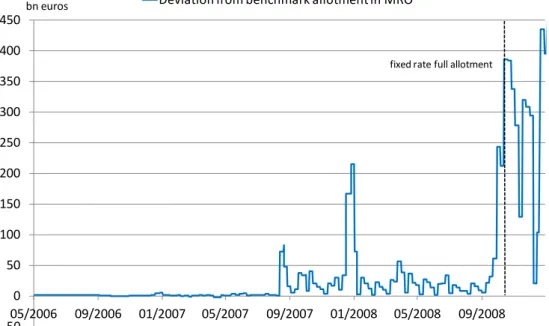
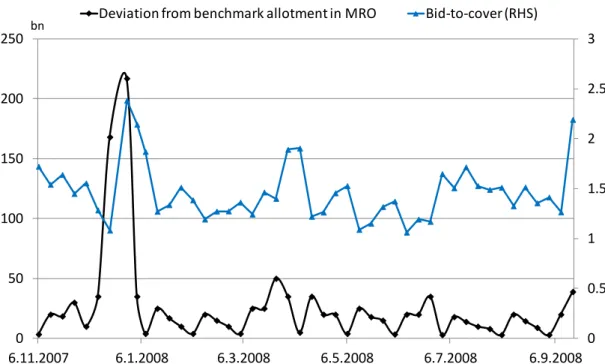
Figure 5 ECB’s deviation from benchmark allotment in refinancing operations Figure 6 Changes in banks’ bidding behavior in refinancing operations
Figure 1 The number of bidders and the spread between the marginal and minimum bid rate Figure 8 Liquidity surplus in the euro area banking system
Figure 9 Outstanding ECB refinancing
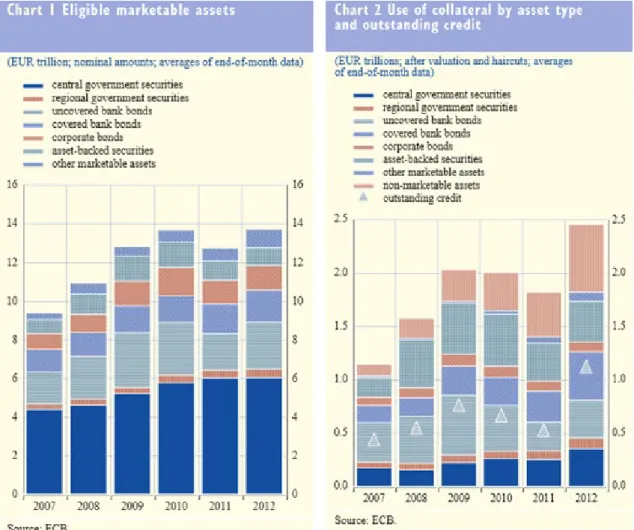
Figure 10 Outstanding amount of eligible marketable assets and use of collateral Figure 11 Net outstanding USD cross-border claims in major economies
Figure 12 ECB liquidity provision in USD and EURUSD 3-month basis swap Figure 13 ECB asset purchase programs
Figure 14 Sovereign risk premiums for Greece, Portugal and Ireland Figure 15 Sovereign risk premiums for Spain and Italy
Figure 16 Risk-neutral probability distributions for 3m Euribor future contract Figure 17 Yield curve steepness in Italy and Spain
Figure 18 Taylor rule calculation for the euro area
List of tables
Table 1 Significant announcements regarding the 3-year LTROs Table 2 Significant announcements regarding the OMT
Table 3 Changes in sovereign risk premiums around 3-year LTRO announcements
Table 4 Average changes in bond spreads and standard deviations for the first event study Table 5 Changes in sovereign risk premiums around OMT announcements
Table 6 Average changes in bond spreads and standard deviations for the second event study Table 7 Snapshot of sovereign bond spreads on event days for the second event study
Introduction
The RMS Titanic was the largest ship afloat at the time it entered service in 1912. As we know, the once state-of-the art passenger liner tragically sank only two and a half hours after colliding with an iceberg during its maiden voyage from Southampton to New York. Perhaps less well-known is the heroic self-sacrifice by the ship engineers. It has been said that by operating the pumps in the forward compartments which were filling with water, the engine room crew delayed the sinking for over an hour which was enough for nearly all the lifeboats to be launched. In addition, they kept the generators running to maintain power and lights throughout Titanic up until two minutes before the ship sank.
Is the European Economic and Monetary Union (EMU) a sinking ship? There have been times when at least the financial markets have perhaps thought so. The viability of the common currency, the euro, was first seriously questioned in 2012 around the partial restructuring of the Greek sovereign debt. At the time, the markets were worried about the debt sustainability of some euro area sovereigns as well as the cross-border exposures of banks in healthier countries to these sovereigns under distress. The ability of some sovereigns to refinance their debt in the market was questioned as the funding costs exploded as a result of rating downgrades and an investor run. Greece, Ireland and Portugal had already lost market access and Spain and Italy were feared to be the next in line. The European banking system was severely fragmented as the perceived risks related to the banks and the respective sovereigns generally walked hand in hand. The market fragmentation and the diverging paths of economic performance posed unprecedented challenges to common monetary policy conducted by the European Central Bank (ECB). The EMU, after little more than ten years of existence and still on its maiden voyage, was in distress.
Could the engine room crew be of any help in the ECB case? In monetary policy theory, a macroeconomic model of the transmission mechanism between short-term interest rates and the ultimate target of monetary policy determines the appropriate level of the policy rate for a central bank. Once the policy rate is set, it is the job of monetary policy implementation experts to conduct operations vis-à-vis the market to achieve the operational target of the monetary policy (Bindseil, 2011). Thus, whereas the monetary policy framework is involved with monetary economics and macroeconomic modeling, the monetary policy implementation framework is the set of tools and procedures that are used to achieve the operational target of monetary policy. One can think of
economists working in macroeconomic modeling as being in the captain’s cabin, setting the direction for the ship, and monetary policy implementation experts as the engine room crew whose job is to ensure that the engines are running and the ship is moving in the first place.
In the storm that hit the financial markets, it was the engine room of the Eurosystem that felt the heat. Policy rates had been cut very close to zero which constrained the room for maneouvre in the conventional monetary policy space. In addition, the transmission mechanism was impaired, meaning that some of the channels through which the monetary policy transmits to the real economy were dysfunctional. There was a need for a broader perspective and a wider range of operational targets. This analysis required the expertise of the engine room, the monetary policy implementation specialists. As the conventional monetary policy was approaching the zero-lower bound and its effectiveness to support the transmission mechanism was limited, the ECB decided to conduct several unconventional measures. These measures were aimed at securing a proper monetary policy transmission mechanism and signaling the desired monetary policy stance.
This paper focuses on the ECB’s monetary policy response to the financial crisis. The emphasis is on the unconventional measures but also the conventional measures are briefly discussed. Moreover, I conduct an event study on the market effects of the ECB’s announcements on the three-year-longer term refinancing operations and the outright monetary transactions (OMT) program. In terms of immediate market reactions, I find that the OMT announcement was very effective and contributed to the stabilization of the sovereign bond market. However, the three-year refinancing operations did not have comparable effects. Rather their effect was dampened by the ongoing political uncertainty in Europe as well as serious fears of a euro break-up.
Regardless of the immediate effects, the euro area financial market, after more than six years of crisis, is currently enjoying a relative calm. It is indisputable that the ECB measures, overall, have at least partially contributed to this stabilization. Even though in terms of growth and economic stability, the euro area still is in a fragile state, the market environment is much less turbulent than two years ago. Future scholars will be able to better assess whether the ECB measures had a crucial role in the stabilization. Currently, it seems that the ECB engine room crew actually managed not only to keep a sinking ship afloat but indeed in buying enough time to repair the leaks and ensure the continuation of a safe journey.
The study is organized as follows. First, Chapter 1 presents the central bank policy options outlining the classification and the main characteristics of conventional and unconventional measures. Subsequently, Chapter 2 discusses the conventional measures and presents the ECB’s crisis response in the conventional monetary policy implementation framework. Thereafter, Chapter 3 outlines the unconventional measures and discusses the ECB’s crisis measures each in turn. Subsequently, Chapter 4 presents the data and the event study methodology and Chapter 5 discusses the main findings of the event study. Chapter 6 pursues a general assessment on the ECB’s response as well as responds to some of the criticism the ECB has faced during the crisis. Finally, Chapter 7 concludes.
1
Central bank policy options
During the last few decades, there has been convergence in approaches among major central banks with respect to conventional monetary policy implementation (Borio C. , 2001) However, the same cannot be said about unconventional monetary policy measures. Since the onset of the financial crisis in 2007, unconventional measures have gained strong interest among economists and scholars. Due to novelty of the conducted measures and scarcity of research, the effectiveness of the unconventional monetary policy measures is still under debate. There is no universal view on the distinction between conventional and unconventional measures or an unambiguous taxonomy for the latter. Hence, in this chapter I will briefly discuss, what motivates central banks to take up hefty arms. I will also discuss some characteristics that distinguish conventional measures from unconventional ones. Section 1.1 gives an introduction on the central bank policy setting in normal times and presents scenarios in which central banks may need to resort to unconventional policy measures. Section 1.2 discusses the classification of conventional and unconventional measures.
1.1 When the Taylor rule is not enough
According to Borio and Disyatat (2009), the implementation of monetary policy has two key elements or objectives: signaling the desired policy stance and making that policy stance effective. For the first one, the major central banks have converged to an approach in which the policy stance is defined exclusively in terms of a short-term interest rate, the “policy rate”.1 Setting the target level for interest rates has been done judgmentally using a wide variety of macroeconomic
1 Various scholars (Joyce;Miles;Scott;& Vayanos, 2012) and (Bindseil, 2004) point out to this type of convergence.
9
indicators but in a manner that could be approximated with reference to the so-called Taylor Principle; interest rates respond more than one on one to changes in inflation and to variations in output gap (Woodford, 2003, pp. 91). Under normal conditions, liquidity management operations are designed to help make that interest rate effective by influencing the scarcity of central bank money. These operations are necessary to achieve the operational target, normally, a level of short-term market rate close to policy rate.
The recent financial crisis, however, proved the conventional monetary policy framework with a policy rate and an implementation framework focusing on the operational target, a short-term rate, inadequate. Indeed, the recession in many economies was so deep that the Taylor rule would have implied negative nominal interest rates. Negative interest rates implied by Taylor rule posed a challenge since nominal interest rates are normally assumed to be bound by zero as agents can always hold non-interest bearing cash. (Joyce;Miles;Scott;& Vayanos, 2012) The zero lower bound
(ZLB) is, thus, generally considered to constrain the conduct of conventional monetary policy. As a response to the crisis, all major central banks cut their policy rates to historical lows and fairly close to zero which roused the question whether these economies were heading towards a “bad” equilibrium.
The Keynesian lesson is that, in a recession, the economy might end up in a deflationary spiral and a liquidity trap. In a liquidity trap, the interest rates, bound by zero, cannot be lowered further and the economic agents are indifferent between holding money in cash and buying bonds, which makes additional monetary stimulus ineffective (Krugman;Dominquez;& Rogoff). Thus, an increase in money base would not lead to lower nominal interest rates. Due to deflation expectations, economic agents would be reluctant to consume because they would expect prices to fall in the future which would make central bank stimulus efforts ineffective. The expectations would then become a self-fulfilling prophecy and, due to the hoarding of liquidity, the economy might plunge into a deflationary spiral in which inflation and output decline over time (Evans;Guse;& Honkapohja, 2008).
Evans et al. (2008) acknowledges the possibility of multiple equilibria when monetary policy is conducted using a Taylor rule and concludes that liquidity trap and deflationary spiral are of a serious concern. The authors find that the steady-state equilibrium targeted by policymakers is locally stable. In other words, in normal times, monetary policy implementation following the 10
Taylor rule will appropriately stabilize inflation, consumption and output. However, the equilibrium is not globally stable and, thus, a large enough pessimistic shock can result in a deflationary spiral. They recommend aggressive monetary policy whenever inflation falls below a certain threshold and add that in case monetary policy alone is inadequate aggressive fiscal policy could be conducted. However, the authors prefer to use fiscal policy only as a last resort.
Another way to escape the liquidity trap is discussed in Eggertson et al. (2003). The authors emphasize the value and effect of a central bank’s management of expectations. They conclude that a commitment by a central bank to keep interest rates low for a time in the future will create subsequent inflation even when deflationary expectations have evolved. In their model, the effect to aggregate demand comes through a change in the expected path of real interest rates. If the public believes in the central bank’s commitment to keep the rates low for long and simultaneously expects inflation, real rates decrease, which would create an incentive to consume. In addition, Eggertson et al. (2003) conclude that open-market operations in the form of asset purchases are ineffective to the extent that they fail to change expectations regarding future policy. Management of expectations is further discussed in Section 3.2.6 which explains the concept of forward guidance.
Joyce et al. detect (2012) another significant challenge for the conventional monetary policy in times of crisis: the impairment of the monetary policy transmission mechanism. Reinhard H. Schmidt (2001) defines transmission mechanism as a formal model of the ways through which monetary policy influences the real economy. These are the i) interest rate channel, ii) the channel of relative prices (or asset price channel), iii) the credit channel and iv) the exchange rate channel2. The exchange rate channel is not discussed in Schmidt (2001). It can be defined as the channel that captures the effect of monetary policy on exchange rate (a policy rate cut would make domestic deposits less tempting). The exchange rate, in turn, has an effect on the price of imports and, ultimately, to price stability (Mishkin, 1996).
As defined in Schmidt (2001), the interest rate channel is based on the conventional IS – LM model, which assumes that with given and unchanged inflation expectations, the central bank can
2 Also, when it comes to unconventional measures, scholars often recognize another important channel, the signaling channel. The signaling channel is discussed in chapter 3 with unconventional measures.
11
affect real long-term rates by determining the short-term rate. For this channel to function, two conditions need to be met. Firstly, the monetary policy must not only affect short-term rates but also medium to long-term rates3. Secondly, investment decisions need to be interest-elastic. The second channel, the one of relative prices, assumes that the central bank can influence the composition and/or prices of the assets which are held in the portfolios of economic agents. An unexpected monetary impulse can induce attempts for agents to adjust their portfolio compositions. This channel, also referred to as the portfolio-balance channel, is further discussed in Chapter 3.
According to Schmidt (2001), the third channel, the credit channel, can be further broken down into two separate but complementary channels. These channels are the balance sheet channel and the bank lending channel. The first one captures the effects of monetary policy to the balance sheets of firms and other borrowers. Since a restrictive monetary policy raises interest rates, it also depresses the net asset values of the borrower’s assets in its portfolio and, thus, the value of their collateral, which restricts the borrower’s financing options and raises the external finance premium4. The bank lending channel, in turn, captures the effect of monetary policy on the quantity of credit which the banking sector can provide to borrowers. An important implication is that these two credit channels reinforce each other, which makes their relevance for the effects of monetary policy all the greater.
Indeed, in the most intense phases of the financial crisis, the monetary transmission mechanism was impaired. Severe mistrust prevailed amongst the financial institutions and agents due to insolvency fears. Banks did not lend each other or the customers and the market liquidity dried out. Monetary stimulus provided by the central bank was no longer transmitted to the real economy because the bank lending channel was not functioning.
Cecioni, Ferrero and Secchi (2011) elaborate that the dysfunction of the transmission mechanism can either appear as the increase in the volatility of the demand for bank reserves (central bank liquidity) and limited redistribution of liquidity among the depository institutions or it may be a result from disruptions in other segments of financial markets. In other words, the problem can originate from the banking sector or from another sector in the economy. During the financial crisis, both of these threats realized. For some part, the impaired transmission mechanism reflected the
3 This is normally done by managing expectations about the future path of interest rates.
4 External finance premium is defined as the cost difference between external and internal financing (Schmidt, 2001).
12
tensions in the sovereign debt market as banks under distressed sovereigns transmitted the cost and risk of their exposure to the customers, but also, it reflected the fragmented banking system as the healthier banks stopped trading with the banks that had large exposures to peripheral sovereign debt. Several channels of monetary policy transmission were not functioning properly credit channel being, perhaps, most severely impaired.
The discussion on central bank policy options can be concluded by acknowledging two shortcomings of conventional monetary policy that justify a central bank intervention. These two are the risk of the economy ending up in a deflationary spiral or a liquidity trap and/or an impairment of the monetary policy transmission mechanism. The first case, a liquidity trap, is only a serious concern once there is no longer room for manoeuvre in the policy rates i.e. when the rates are close to zero and, simultaneously, there is a risk of deflation. The second case, however, can constrain the effectiveness of conventional monetary policy even when the rates are above zero. In this case, the central bank needs to find other ways to signal its monetary policy stance and make that policy stance effective. Chapter 3 will later show how the ECB, indeed, has responded by conducting several unconventional measures. Before going to the actual measures it is, however, necessary to discuss the classification of conventional and unconventional measures and try to draw a line between the two, even if it is a thin one.
1.2 Conventional vs. unconventional options
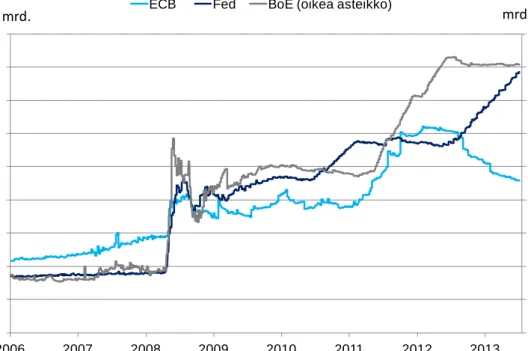
There is no universal classification between conventional and unconventional measures. As Borio and Disyatat (2009) indicate in their paper, it is extremely difficult to draw a line between the two. In addition to conducting unconventional measures, the existing conventional measures can be “stretched”. In other words, they can be intensified in scope, frequency and magnitude. This makes the classification less straight-forward. Some common characteristics can still be recognized. The common denominator for the different unconventional measures conducted in all major central banks during the crisis has been the expansion of balance sheet. In fact, Borio and Disyatat (2009) distinguish the conventional monetary policy to normally target the short-term (typically overnight) interest rate and unconventional monetary policy as active of the central bank’s balance sheet to directly affect market prices and conditions beyond its regular operational target. Figure 1 presents the explosion of the major central bank balance sheets during the crisis. In this paper, I consider all the policies that have led to significant balance sheet expansion or showed a central bank diverging
from its normal operational target, de facto unconventional, even if they as such belong to the conventional monetary policy implementation framework.
Figure 2 Balance sheets of major central banks have expanded due to unconventional monetary policy measures.
Cecioni et al. (2011) point out that in addition to the difficulty in distinguishing conventional measures from unconventional measures, there is also an abundance of taxonomies available in the literature for the grouping of unconventional measures per se. Stone, Fujita and Ishi (2011) base their classification on whether the final objective of the unconventional measure is one of financial or macroeconomic stability. They categorize purchases of government bonds as macroeconomic stability policies and liquidity provisions as financial stability policies. Klyuev et al. (2009) divide unconventional measures into four: an explicit commitment to keep short-term rates low for a prolonged period, the provision of extraordinary amounts of low-cost financing to financial institutions, outright purchases of government securities to lower the long-term rate and outright credit market interventions.
Furthermore, Borio and Disyatat (2009) recommend taxonomy based on the particular financial market targeted by the measures and on their impact on the structure of private sector balance sheets. They distinguish between exchange rate policies, quasi-debt management policies, credit
0 50 100 150 200 250 300 350 400 450 0 500 1 000 1 500 2 000 2 500 3 000 3 500 4 000 4 500 2006 2007 2008 2009 2010 2011 2012 2013
ECB Fed BoE (oikea asteikko)
mrd. mrd.
Lähde: Bloomberg
policies and bank reserves policies. In an exchange rate policy, the central bank alters the net exposure of the private sector to foreign currencies by operating in the foreign exchange market. I will disregard this policy area in my study since, as Borio and Disyatat point out, exchange rate policies have often been used e.g. in emerging economies as conventional measures5. In quasi-debt management policy, the central bank alters the composition of claims on the public sector held by the private sector with an intention to alter the yield on government securities. A credit policy targets specific segments of the private debt and securities market by changing the central bank’s exposure to private sector claims. Finally, in a bank reserves policy the central bank sets a specific target for bank reserves regardless of how this is counter-balanced on the asset side of its balance sheet. This approach, traditionally defined as quantitative easing, is further discussed in Section 3.1.1.
As for Papadia and Välimäki (2011), they distinguish three types of unconventional measures: quantitative easing, credit easing and enhanced credit support. Since their view is based on the terminology applied by the central banks, I will follow the same classification in my thesis. The following two chapters will elaborate the characteristics and instruments in conventional and unconventional monetary policy frameworks. Chapter 2 discusses conventional measures that focus on the short-term interest rate targeting without significant balance sheet expansion. Thereafter, Chapter 3 discusses unconventional measures and elaborates the classification of unconventional measures to quantitative easing, credit easing and enhanced credit support.
2
Conventional measures – steering short-term interest rates
As discussed in Chapter 1, before the crisis, the central banks of almost all advanced economies had arrived at a roughly similar monetary policy framework. During a period of great moderation, the central banks had gained independence in monetary policy and their transparency and accountability had also been enhanced (Stone, Fujita, & Ishi, 2011). Among the developed economies, inflation targeting had become the cornerstone of conventional monetary policy framework.
5 central banks have routinely intervened in the market to attain their exchange rate target but the liquidity effect of these purchases has been sterilized through, for example, issuance of central bank bills
15
Within the conventional monetary policy framework, the setting of interest rates has been done in a manner that could be approximated with reference to the so-called Taylor rule (Woodford, 2003, s. 90). Once the policy rate is set, it is the job of the monetary policy implementation experts to use the right instruments in the chosen operational framework to achieve the operational target of the monetary policy. Normally, this operational target is a short-term market rate which is desired to closely follow the policy rate. According to Bindseil (2011), monetary policy implementation consists of two key elements: first, establishing an operational framework to control the selected operational target (e.g. setting up the instruments) and second, using these instruments on a daily basis to influence the scarcity of central bank money and to achieve the operational target of the central bank (i.e. liquidity management).
Borio & Disyatat (2009) elaborate the concept of scarcity of central bank money. They point out that the market for bank reserves is in the core of the implementation of conventional monetary policy. . In this market, the central bank is the monopoly supplier. The central bank can set the quantity of money and the terms on which it is supplied at the primary market. Thus, the central bank can steer the secondary market price for reserves, the overnight rate, to any particular level by standing ready to buy and sell unlimited amounts of money at the chosen price. Importantly, the central bank can set the interest rate independently of the amount of bank reserves in the system. According to this decoupling principle, the same amount of bank reserves can coexist with different levels of interest rates – and the other way around.
2.1 ECB monetary policy implementation framework
This chapter presents the overall monetary policy implementation framework of the Eurosystem by introducing its main objectives, tasks and instruments. The chapter is organized as follows: after the general overview of the framework, I go through the three main instruments in monetary policy implementation. First, I discuss reserve requirements. Secondly, I outline the open-market operations that divide into five categories. Thirdly, I explain the role of standing facilities in monetary policy implementation. Finally, I outline the main features of the Eurosystem collateral framework.
The ESCB consists of the European Central Bank and the national central banks (NCBs) of the EU Member States that conduct single monetary policy. Those EU Member States whose currency is
not the euro are not involved in the conduct of the single monetary policy. Thus, they are not part of the Eurosystem. The ESCB acts in accordance with the Treaty on the Functioning of the European Union (henceforth called the Treaty) and the Statute of the European System of Central Banks and of the European Central Bank. (ECB, 2011)
The main decision-making body of the ECB is the Governing Council (GC) which is responsible for the formulation of monetary policy. The Executive Board of the ECB implements the monetary policy according to the decisions made and guidelines laid down by the Governing Council (ECB, 2011, p. 9). The Governing Council is comprised of the NCB Governors of the member states6 and the members of the Executive Board. Each GC member has one vote in the GC meetings. Whereas the policy stance is determined by the GC, the operational implementation of the monetary policy is decentralized and carried out in NCBs.
The primary objective of the Eurosystem, stated in the Treaty, is to maintain price stability. (EU, 2012, p. 167) According to the ECB’s monetary policy strategy that was presented in October 1998 and re-evaluated in May 2003, the price stability objective of the ECB is to maintain inflation7 for the euro area below but close to 2 % in the medium term (ECB, 2003). The basic tasks to be carried out through the Eurosystem are: defining and implementing the monetary policy of the currency union, conducting foreign-exchange operations consistent with the provisions of Article 219, holding and managing official foreign reserves of the Member States and promoting the smooth operation of payment systems. (EU, 2012, p. 102)
In order to achieve its objectives, the Eurosystem applies a set of monetary policy instruments. This set includes open market operations, standing facilities and a requirement for credit institutions to hold minimum reserves on accounts with the Eurosystem. (ECB, 2011) These instruments are discussed one by one in the following sections.
The Eurosystem’s operational framework has some unique features in comparison with other major central banks. Cour-Thimann and Winkler (2013, s. 8) take note of the special design of euro area liquidity provision. Indeed, the ECB framework enables a participation of a large number of credit
6
Throughout this document, the term ‘Member State’ refers to a Member State whose currency is the euro. 7 measured by the year-on-year increase in the Harmonised Index of Consumer Prices (HICP) for the euro area
17
institutions. In fact, out of the roughly 6300 credit institutions established in the euro area, around 2200 fulfill the operational criteria for participation in the Eurosystem open-market operations8.
Borio (2001) notes that the ECB has chosen a different type of policy rate than e.g. Federal Reserve and the Bank of Japan. Whereas, for the latter the policy rate is the announced target level for overnight market rate, the ECB’s policy rate is the rate of its main refinancing operation. Importantly, the author points out, that this allows the Eurosystem somewhat greater freedom in tolerating deviations of the overnight rate from the policy rate, if and when required. The ECB, also, has not explicitly stated its operational target. Another unique feature of the Eurosystem is the existence of standing facilities as none of this type of on-demand liquidity facilities exist in US or Japan. Also, the spectrum of eligible collateral is considerably broader in the Eurosystem as it is in the US.
2.1.1 Minimum reserve requirements
The Eurosystem’s minimum reserve system applies to credit institutions in the euro area and pursues two aims: stabilizing short-term money market interest rates and creating or increasing a structural liquidity shortage of the euro area banking sector9. As a result, the banking system in euro area has a structural liquidity deficit, i.e. the banks need central bank funding.
The reserve requirement of a credit institution is determined in relation to elements of its balance sheet, more precisely, in relation to its deposits and short-term debt. In order to pursue the aim of stabilizing interest rates, the Eurosystem’s minimum reserve system enables institutions to make use of averaging provisions. The calendar year is divided into twelve reserve maintenance periods over which the institutions are obliged to, on average; hold the minimum reserve amount on their reserve account at the central bank. Institutions’ holdings of required reserves are remunerated at the rate of the Eurosystem’s main refinancing operations. Thus, in the Eurosystem, the reserve requirement system is not a financial burden to credit institutions. (ECB, 2011, pp. 53-54) Also, the
8 Approximately 200-400 institutions usually participate. There are fluctuations however: for the second 3-year LTRO, for example, 800 banks participated.
9
In addition to minimum reserve requirements, there are other factors that effect on the liquidity position of the banking system vis-a-vis the central bank. These autonomous factors are beyond the steering of the monetary policy and they include e.g. central bank’s foreign reserves and euro-denominated reserves as well as banknotes. The effect of these autonomous factors adds to the liquidity shortage in the banking system.
18
averaging provision enables a bank to optimize on the cost of holding reserves by maintaining them whenever it assumes the cost of it to be the lowest during that averaging period (Välimäki, 2001).
Borio and Disyatat (2009, s. 3) argue that the central bank remuneration scheme is a key issue in the market for bank reserves. Normally, central banks remunerate excess reserve holdings – i.e. holdings over and above any minimum reserve requirement – at a rate that is below the policy rate. As a result, banks seek to economize them, keeping on the reserve (current) account only the amount that corresponds to its settlement purposes. Supplying this amount (the structural liquidity deficit and reserve requirements) is a key task of the central bank. Supplying an excess amount of liquidity, would drive the overnight rate to the floor set by the remuneration on excess reserves. On the other hand, any shortfall in liquidity would drive the overnight interest rates up. This relation between the short-term market rates and central bank liquidity management are further discussed in Section 3.2.1.
The ECB has decided not to remunerate excess reserves but, instead, provides its counterparties with standing facilities which set the corridor for the overnight rates. A counterparty of a Eurosystem central bank can transfer any excess liquidity on a daily basis from the current account to the deposit facility and, thus, get the remuneration rate of the deposit facility on their excess reserves. On the opposite, a counterparty of the Eurosystem can obtain any shortfall in liquidity on a daily basis from the marginal lending facility at the cost of the marginal lending rate against eligible collateral. Hence, in the euro area, the corridor for the market overnight rate is determined by the ECB deposit rate (sets the floor) and the marginal lending rate (sets the ceiling for the market overnight rate).
2.1.2 Open-market operations
The ECB general documentation (ECB, 2011, p. 13) defines the role of open-market operations as steering interest rates, managing liquidity situation and signaling monetary policy stance by affecting the amount of liquidity in the banking system. This is done by either providing liquidity to the system or absorbing liquidity from it.
Market operations can be divided into five instrument groups. First of all, the ECB can conduct
reverse transactions where the it provides loans against eligible collateral for credit institutions that
fulfill the counterparty criteria10. Reverse transactions are the most common instrument for open-market operations. In addition, the ECB can use outright transactions, issue debt certificates, conduct foreign exchange swaps and collect fixed-term deposits. Open-market operations are initiated by the ECB and they can be executed as standard tenders, quick tenders or bilateral procedures. During the crisis, the ECB has utilized a wide range of the instruments presented above.
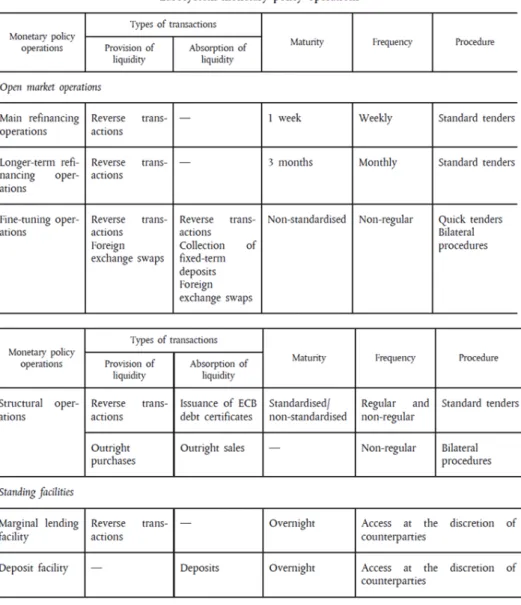
The following list summarizes the basic tender types11. Some of the instruments mentioned in the previous paragraph can be utilized in different types of tenders (figure 2).
i. The main refinancing operations (MROs) are regular liquidity-providing reverse transactions with a weekly frequency and a maturity of normally seven days. The MROs are executed by the NCBs as standard tenders.
ii. The longer-term refinancing operations (LTROs) are liquidity-providing reverse transactions with a monthly frequency and a maturity of normally approximately 3 months. Also these tender operations are executed by the NCBs on the basis of standard tenders. iii. Fine-tuning operations (FTOs) are carried out on an ad-hoc basis with the aim of managing
liquidity situation in the market and steering interest rates, in particular in order to smooth the effects caused by unexpected liquidity fluctuations in the market. (ECB, 2011, p. 14)12 iv. Finally, the ECB can execute structural operations through the issuance of ECB debt
certificates, reverse transactions and outright transactions. In these operations, the ECB wishes to adjust its structural position vis-à-vis the financial sector. The first two are normally carried out by the NCBs through standard tenders, whereas outright transactions
10
The Eurosystem’s monetary policy framework is formulated with a view to ensuring the participation of a broad range of counterparties. Institutions subject to minimum reserve requirements and fulfilling other criteria may, according to Article 19.1 of the Statute of the ESCB, access the standing facilities and participate in open market operations based on
standard tenders as well as outright transactions. Nevertheless, the Eurosystem has limited the number of counterparties that can participate in fine-tuning operations and foreign exchange swaps. For further information about eligibility criteria, see (ECB, The Implementation of Monetary Policy in the Euro Area, 2011).
11
These tender types have been adjusted during the crisis. The ECB has conducted unconventional measures and e.g. extended the maturity of longer-term-refinancing operations, even up to 3 years.
12 During the crisis, these types of tenders were usually conducted on the last day of a reserve maintenance period to counter liquidity imbalances. Also, the ECB has conducted fine-tuning liquidity-absorbing tenders on a weekly basis ever since it launched its Securities Markets Program (SMP) which is discussed later in Section 3.2.5. The purpose of these liquidity-absorbing tenders has been to sterilize the liquidity effect of Eurosystem’s SMP purchases by collecting deposits from credit institutions for an amount that corresponds to the outstanding volume of SMP holdings in
Eurosystem.
20
are executed by the NCBs through bilateral procedures. (ECB, 2011, p. 15) These structural operations have not been conducted in the Eurosystem.
Figure 3 ECB monetary policy operations (ECB, 2011)
2.1.3 Standing facilities
According to the general documentation (ECB, 2011, p. 10), standing facilities are aimed at providing and absorbing overnight liquidity, signal the general stance of monetary policy and bound overnight interest rates. Two standing facilities are available to eligible counterparties on their own initiative, subject to their fulfillment of certain operational access conditions. These are the deposit facility and the marginal lending facility.
i. Deposit facility
Counterparties can use the deposit facility to make overnight deposits with their respective NCBs. Under normal circumstances, there are no deposit limits or other restrictions on counterparties’ access to the facility. The interest rate on the deposit facility sets a floor for the overnight market interest rate since the counterparties always have the option to park their money at the central bank.
ii. Marginal Lending Facility
Counterparties can use the marginal lending facility to obtain overnight liquidity from their respective NCBs against eligible collateral. As for the deposit facility, under regular circumstances, there are no credit limits or other restrictions for counterparties apart from the requirement of sufficient collateral. Opposite to the deposit facility, the marginal lending facility sets the ceiling for the overnight market interest rate since the counterparties always have the option to borrow from the central bank as long as they have adequate collateral.
As the deposit facility sets the floor and the marginal lending facility sets the ceiling for the overnight market rates, together they determine the band in which the overnight market rates can fluctuate. This band is called the interest rate corridor.
2.1.4 Collateral framework
The starting point of the ECB’s liquidity provision is that all the credit operations, be it liquidity-providing tender operations, marginal lending or intra-day credit, are based on adequate collateral. Naturally, the ECB (or the Eurosystem) has several eligibility criteria for the collateral it accepts in its credit operations. Compared to other major central banks, the Eurosystem has, since its inception, been accepting a broad range of assets as collateral. This choice is due to the historical, structural and institutional differences that were in place across national central banks prior to the introduction of the single framework. (ECB, 2013)
The “Single List” was established in 2007 to replace the previous two-tier system that had been in place since the start of the EMU and unified the euro-area wide eligibility criteria. It covers marketable and non-marketable assets that fulfil uniform euro area-wide eligibility criteria specified by the Eurosystem. No distinction is made between marketable and non-marketable assets with regard to the quality of the assets and their eligibility for the various types of Eurosystem monetary policy operations, except that non-marketable assets are not used by the Eurosystem for outright transactions. All eligible assets may be used on a cross-border basis by means of the correspondent central banking model (CCBM) and, in the case of marketable assets, through eligible links between Union securities settlement systems (SSSs). (ECB, 2011)
Bindseil (2011) explains that a collateral framework will have to achieve an optimal balance between three main factors: cost of handling and analyzing collateral, central bank risk-taking and sufficient availability of collateral to allow for a smooth implementation of monetary policy. The author recognizes seven desirable properties on eligible collateral all of which affect the level of haircut that the central bank imposes on an asset that is used as collateral. The first prerequisite is the legal certainty of a claim. It means that the central bank needs to make sure that in case of a default it has the right to appropriate and liquidate the asset. Second, the central bank needs to set a
credit quality threshold because low-rated assets have a higher probability of downwards migration (further downgrades) and because low-rated assets tend to be less liquid. Third, the central bank needs to evaluate the simplicity of the asset as complexities can lead to central bank losses if not properly addressed through haircuts. Fourth, the central bank also needs to address the issues of
market transparency/ price availability as, again, securities that do not have a market price but instead need to be priced theoretically, require more central bank resources. Market liquidity is another issue which is to be addressed since illiquid assets are harder to price and cannot be sold as easily as the liquid ones in the case of a counterparty default. Sixth, the central bank also needs to evaluate the costs ofhandling and settlement of the collateral. Finally, there is the issue of currency denomination. Even though central banks normally limit collateral eligibility to assets denominated in their own currency, the procedure might change in a crisis. Indeed, this is what happened in the Eurosystem. I will return to this issue later in this chapter.
2.2 ECB conventional measures – historically low policy rates
This section outlines the conventional monetary policy measures conducted by the ECB since the onset of the financial crisis in 2007. The timeline of the crisis vaguely follows the presentation by Trichet (2012). I distinguish three phases and discuss them one by one. The first phase, 2007-2009, was the time of extreme financial turbulence with its epicenter in the US. In the second phase, 2010-2011, the focus shifted to the euro area where sovereign insolvency fears destabilized the sovereign debt market. This second phase ended in relative calm after the international bailouts. The third phase, from 2011 onwards, marked the episode of re-escalation in the euro area debt crisis where the future and viability of the Eurosystem and the common currency were seriously questioned. The ECB’s conventional monetary policy responses to these crises are discussed next.
In the course of the financial market crisis that burst in the US in 2007 and culminated in the failure of Lehman Brothers in September 15th 2008, the ECB worked along all other major central banks and lowered its key policy rate (rate of the main-refinancing operation) multiple times. Trichet (2012) defines this approximately two-year period, starting from mid-2007, as an episode of financial turbulence that intensified dramatically after the collapse of Lehman Brothers. During the period of July 2008-May 2009, the ECB lowered its main-refinancing rate by 325 bps to 1 % (ECB, Statistics: Key ECB Interest Rates). In addition, in October 2008 the Governing Council of the ECB decided that the weekly main refinancing operations would be carried out through a fixed rate tender procedure with full allotment13. Furthermore, the ECB reduced the corridor of standing facilities from 200 basis points to 100 basis points around the interest rate on the main refinancing operation (ECB2008c).
Trichet (2012) notes, that from the ECB’s point of view the subsequent phase of the crisis was even more important than the first one. The financial crisis had led to a deep global recession which had revealed severe vulnerabilities in some euro area countries’ fiscal positions. Until 2010, dealing with divergent sovereign bond yields did not represent a challenge for the ECB. However, the perception of all euro area government bonds being equal in terms of risk was no longer valid as the markets started to worry about a possible Greek insolvency.
13 The fixed rate and full allotment procedure will be discussed in further detail in Section 3.2.1.
24
During the first half of 2011, the market turbulence had somewhat abated and as a response to rising inflation expectations, the ECB decided to raise its main-refinancing rate twice (April and July). However, as the crisis intensified again towards the end of the year, the ECB again rebated the main-refinancing rate to 1% by lowering it in November and in December. More interestingly, in December 2011 the ECB made an unprecedented move and lowered the reserve requirement ratio from 2% to 1%, reducing the structural liquidity deficit and freeing an additional €100 billion in banking system liquidity (ECB2011e). The lower need for central bank refinancing could also free collateral for other uses of counterparties. In July 2012, the ECB lowered its main-refinancing rate to a new historical low of 0,75% which meant that, the interest rate corridor being symmetric at 150 bps, the deposit rate was set to zero. In May 2013, the ECB further cut the main refinancing rate by 25 bps to 0,50 % simultaneously narrowing the interest rate corridor to 100 bps and thus reducing the marginal lending rate to 1 % while the deposit rate maintained at 0 %. Furthermore, in November 2013, the ECB cut the main refinancing rate by 25 bps to 0,25 % and, for the first time, applied an asymmetric interest rate corridor as it left the deposit rate unchanged to 0 % but lowered the marginal lending rate by 25 bps to 0,75 %.
In addition to providing stimulus by aggressive lowering of the main policy rate, the ECB conducted several other measures to safeguard the transmission mechanism of its policy stance in years 2007-2009. The bunch of these measures included e.g. the lengthening of maturities in liquidity provision, expansion of the list of assets eligible as collateral, the provision of liquidity in foreign currency and outright asset purchases. Though many of these were only “upgraded” conventional measures in terms of scope and magnitude, they can also be classified as unconventional measures, credit easing or enhanced credit support, as the ECB would say. The next chapter will present all the significant unconventional policy measures or significant changes in the conventional framework conducted by the ECB in years 2007-2013.
3
Unconventional measures – expanding operational targets
Signaling the desired policy stance and making that stance effective are key objectives of monetary policy implementation. The key instrument for signaling is the policy rate. However, the crisis has shown that especially for the achievement of the latter objective the conventional means, sometimes, simply do not suffice. In other words, steering the short-term interest rates may not be enough of an operational target for the central bank when the transmission of the policy rate to the
real economy can be hampered. To cement the desired policy stance and make it effective, it is sometimes necessary to implement further measures. The major central banks have labeled these measures as quantitative easing, credit easing or enhanced credit support. These measures amplify the signaling effect of monetary policy but can also affect through other channels. This chapter will first discuss the three approaches of unconventional monetary policy. I will conclude the chapter by explaining how these unconventional measures transmit to the economy.
In addition to the transmission channels discussed in Chapter 2, scholars14 recognize two channels through which the unconventional monetary policy measures are transmitted to the real economy, the signaling channel and the portfolio-balance channel. Firstly, the signaling channel is activated through central bank’s communications. Its aim is to inform the public about the central bank’s intentions regarding the future development of short-term interest rates [or any other objective the unconventional intervention may have]. In the literature, the signaling channel has been emphasized as the mechanism to escape the zero lower bound on nominal interest rates. Furthermore, exploiting the signaling channel during a time of financial turbulence can reassure the markets on the central bank’s backstop role and thus improve the functioning of the monetary policy transmission mechanism (Cecioni;Ferrero;& Secchi, 2011). It is worthwhile noting that not all forms of exploitation of the signaling channel are unconventional per se. Since the 1990s managing expectations (eg. inflation expectations) has become a crucial task of the central bank and its monetary policy.
Transparency is the key challenge in signaling. Stone et al. (2011) define transparency as the public’s ability to understand the central banks’ motives and actions. They argue that the transparency choice is a trade-off; on one hand, between gaining justification and democratic accountability and thus increasing the effectiveness of the measures and, on the other hand, knowing that there is normally a lot of ex-ante uncertainty regarding the future of the current unconventional measures. A key concept here is forward guidance which has recently gained more attention as major central banks have applied it. Forward guidance is further discussed in Section 3.2.6.
14 Borio and Disyatat (2009) and Cecioni et al. (2011)
26
Secondly, the portfolio-balance channel works through the impact of central bank operations on the composition of private sector portfolios (Borio & Disyatat, 2009). The nature of this mechanism was early described in Money, Capital and Other Stores of Value (Tobin, 1961). Tobin defined the portfolio adjustment as a response to increase in the quantity of money. Central banks could affect asset prices and, thus, real investment decisions by altering the relative supplies of financial claims with different durations (or maturities) and liquidity (Joyce;Miles;Scott;& Vayanos, 2012). Hence, in literature, the portfolio-balance channel is often linked to central bank asset purchases. In fact, e.g. Joyce, Lasaosa and others (2010) conclude in their paper, that the asset purchases conducted by the Bank of England had significant effects on gilt yields and that the impact came mostly through the portfolio balance channel. Imperfect substitutability between assets is a prerequisite for the functioning of the portfolio-balance channel (Borio & Disyatat, 2009 and Cecioni;Ferrero;& Secchi, 2011). For example, in a time of financial tensions, private agents (such as banks) may prefer cash over other assets. They may regard cash and liquid government bonds as imperfect substitutes. By issuing more reserves (money) and buying assets (government bonds) from the market, the central bank alters the composition of the private sector balance sheet. The private sector will end up holding less government bonds and more cash in its portfolio.
IMF staff paper (2013, s. 10) further distinguishes two channels in portfolio balancing; scarcity channel and duration channel. The scarcity channel implies that a very large buyer such as a central bank can reduce the supply of a specific bond available for trading. In that case, the investors who have a particular preference for the bond will bid up its price, as well as its close substitutes. The duration channel works in the way that when the central bank buys very large amounts of long-maturity bonds, investors’ portfolios become safer due to lower exposure to interest rate risk. As a result, investors are willing to accept lower yields to hold all remaining bonds implying a downward shift of the entire yield curve. In other words, by increasing the demand for government bonds, the central bank can, due to maturity mismatch challenge, also encourage demand for other assets that are considered close substitutes to government bonds. For example, pension funds normally match the maturity of their assets and liabilities. If the supply of government bonds decreases (because of central bank purchases), pension funds need to compensate for those assets and perhaps buy other assets with equal maturities (Joyce;Miles;Scott;& Vayanos, 2012).
3.1 Classification of unconventional measures
3.1.1 Quantitative easing
The concept of quantitative easing (QE) has been widely used by the public and the media on a range of measures that the major central banks have conducted during the crisis. Nevertheless, the concept has been steered clear of by the bulk of central banks. In his paper from 2002, Masaaki Shirakawa, who later became the Bank of Japan governor, claims that in 2001 the Bank of Japan (BOJ) had adopted a new framework for monetary easing, so-called ‘quantitative easing’ (Shirakawa, 2002). Other papers have recognized the same official starting point for QE in Japan (Ugai, 2007). However, the action that Shirakawa was referring to was not articulated by the Bank of Japan as ‘quantitative easing’. At the time, the press release from March 2001 that introduces some unprecedented and drastic measures in monetary policy, called the action ‘monetary easing’ not ‘quantitative easing’ (BOJ, 2001). Nevertheless, it is safe to say that even though the concept had already been used by several critics in the late 1990s, it was in the 2000s that quantitative easing really established its status in language and rhetoric of central bankers.
As is the case with several issues regarding unconventional monetary policy measures, there is no consensus about the definition of quantitative easing. According to Ugai (2007), quantitative easing in Japan consisted of three pillars: 1) a new operational target for money market operations i.e. reserve balances held by banks at BOJ instead of the overnight call rate, 2) a conditional commitment to maintain high reserve levels into the future and 3) an increase in the amount of outright purchases of Japanese government bonds to facilitate the attainment of the bank reserves target. Papadia and Välimäki (2011) agree with Ugai about the quantitative easing having bank reserves as its operational target. In other words, quantitative easing distinguishes from other balance sheet expanding policies because it focuses on the liability side of the central bank balance sheet whereas other policies (such as credit easing) focus on the asset side. The chairman of Federal Reserve, Ben Bernanke, adopted the same reasoning in his speech about the central bank’s policy response in early 2009 (Bernanke, 2009). As such, this justification closely resembles the concept of bank reserves policy, introduced in Borio and Disyatat (2009), by which the authors classify it as a policy where the central bank sets a specific target for bank reserves regardless of how this is counter-balanced on the asset side of its balance sheet. Nevertheless, as Borio and Disyatat point out, there are several scholars who conclude that any policy that leads to an expansion of bank reserves should be called quantitative easing.
On contrary to Federal Reserve (Bernanke, 2009) and ECB (Trichet, 2009), that have named their respective crisis responses different from quantitative easing regardless of the increase in bank reserves, Bank of England (BOE) has been very explicit about its quantitative easing policy. However, BoE does not communicate its quantitative easing policy via a target in bank reserves like BOJ. Rather, the central bank articulates its quantitative easing policy as asset purchases financed by central bank money (Joyce, Tong, & Woods, 2011). Thus, the outcome is the same – the bank reserves held at the central bank expand since the central bank funds its purchases by issuing more reserve money. However, unlike Japan, the BoE does not explicitly state that it targets an increase in bank reserves. In April 2013, the BOJ explicitly announced a target for the annual pace of monetary base growth to 60-70 trillion yen which corresponds to 12-14 % of GDP15. (BOJ, 2013).
Regarding the implementation of quantitative easing policies, the BOE and BOJ have mainly exploited asset purchases. In the United Kingdom, the asset purchase program dubbed as quantitative easing has been the backbone of its unconventional monetary policy since it was launched in the beginning of 2009. In May 2013, the BOE had created £375 billion corresponding to 24 % of GDP worth of central bank reserves to finance purchases of assets that are mainly UK government bonds16 (BOE, Asset Purchase Facility Results [online]). After a decades-long battle with deflation and weak economy, the BOJ announced, in April 2013, to enter a new phase of monetary easing in terms of quantity and quality (BOJ, 2013). In an unprecedented announcement of unconventional monetary policy measures, the central bank announced to double the monetary base and the amounts of Japanese government bonds (JGB) as well as exchange-traded funds (ETFs) it holds. In addition, it would more than double the average remaining maturity of JGB purchases.
It is evident that outright government bond purchases have been the key instrument in quantitative easing. However, BOJ and BOE have not been the only major central banks to conduct outright asset purchases. Indeed, also Federal Reserve and ECB have conducted asset purchases. Subsequently, I present a second concept of unconventional monetary policy i.e. credit easing that has been introduced by the Federal Reserve. Though it carries several similar elements with regard to quantitative easing, the starting point and the objectives are different.
15 GDP figures are based on IMF World Economic Outlook Database, end of 2012 figures.
16 The BOE has also bought a relatively small amount of corporate bonds but these purchases constitute 0,5 % of total purchases.
29
3.1.2 Credit easing
Credit easing differs from quantitative easing with respect to its objectives and focus. Policies of credit easing and enhanced credit support channel credit to the most relevant sectors in a targeted manner. The objective is to stimulate the flow of credit beyond what could be achieved by steering short-term interest rates. Thus, the focus of these policies is on the asset side of the central bank’s balance sheet. Furthermore, in the purest form of credit easing or enhanced credit support, the central bank offsets the liquidity injections resulting from the credit operations. (Papadia & Välimäki, 2011: 230.) The term credit easing has been used by Federal Reserve during the financial crisis.
In his speech in London on January 2009, the Fed chairman Bernanke, gives a clear definition to the Federal Reserve’s credit easing policy: “The Federal Reserve's approach to supporting credit markets is conceptually distinct from quantitative easing (QE), the policy approach used by the Bank of Japan from 2001 to 2006. Our approach--which could be described as "credit easing"--resembles quantitative easing in one respect: It involves an expansion of the central bank's balance sheet. However, in a pure QE regime, the focus of policy is the quantity of bank reserves, which are liabilities of the central bank; the composition of loans and securities on the asset side of the central bank's balance sheet is incidental. - - In contrast, the Federal Reserve's credit easing approach focuses on the mix of loans and securities that it holds and on how this composition of assets affects credit conditions for households and businesses.” (Bernanke, 2009.)
The Federal Reserve reasons its approach with the differences in financial and economic conditions between the United States and Japan. According to Bernanke (2009), the credit spreads were much wider and the credit markets more dysfunctional in the US than they were in Japan. The circumstances required differents responses. The challenge in credit easing versus quantitative easing is the lack of a simple numeric measure or policy target which, according to Bernanke (2009), puts further pressure on communication issues and transparency to ensure that the public and the markets will shape their expectations accordingly.
According to official statements by the Federal Reserve (Federal Reserve Monetary Policy Statements [online]), the aims of credit easing have been to lower longer-term interest rates and to ease overall financial conditions. The actions have been divided into three groups: 1) provision of