Determinants the of Micro and Small Enterprises Performance in
Karat town, Konso, Ethiopa
KANBIRO ORKAIDO DEYGANTO
Lecturer, Dilla University, Department Of Accounting and Finance SOLOMON MITIKU MEKONNEN,
Lecturer, Dilla University, Department Of Accounting and Finance DEGENET BUNARO SODANO
Assistant Lecturer, Pharma College Hawassa Campus, Department Of Business Management & Accounting Abstract
The objective of this study was to identify factors affecting the performance of MSEs in Karat town. Mixed research approach was employed in conducting this study. Both primary and secondary data were collected. Simple random sampling technique was employed to select 175 respondents from total 312 MSEs in the town. Ordered logistic regression model was used to analysis the data. Then, the result of the study showed that marketing skill, age entrepreneur, industry experience in years, access to finance, corruption, access to market and government policy were found to be the determinants of MSEs Performance. The MSEs, government and policy makers can use the findings of this study in policy formulation and development of MSE.
Keywords: Micro & Small-Scale Enterprises, Performance, Ordered Logistic Regression, Konso- Karat, Ethiopia
1. INTRODUCTION
The success of the government and a country with regarding to business development is related to small and micro business sustainability since they contribute to economic development of the nation by lowering unemployment as well as generate new sources of employment. This why, small and micro business sectors are recognized as an integral component of economic development and a crucial element in the effort to lift countries out of poverty hole.
The dynamic roles of micro and small enterprises in developing countries as engines through which the growth objectives of developing countries can be achieved have long been recognized. Small businesses play an important role in the development of a country and serve as a means to sustain and grow economies (Ibrahim et al, 2008). According to (Kozan et al., 2006) due to the ease in starting and simplicity in operation, small businesses are initiated for various reasons depending up on entrepreneur motives and traits
In developing countries like Ethiopia, MSEs by virtue of their size, capital investment and their capacity to generate greater employment have demonstrated their powerful continues effect for rapid economic growth and instrumental in bringing the economic transition by providing goods and services that has adequate quality and reasonably priced through effectively using the skills and talents of a large number of people without requiring high-level training and sophisticated technology.
Even though they plays the great role in economic development, the study conducted by Werotaw (2010) showed Micro and small enterprise in Ethiopia is, however, challenged with several factors that affect the performance of MSE. The major factors internal include financial problems, lack of qualified employees, lack of proper financial records, marketing problems and lack of work premises, the person’s individual attitude, training, technical know-how and environmental factor affects the business which includes social, economic, cultural, political, legal and technological factors.
1.1 Statement of the Problem
In most developing countries, small and micro enterprises face constraints both at start up stages and after their establishment. The poor growth and performance of micro and small enterprise, in Africa is affected by multiple factors that inhabited the sectors, included entrepreneurial and managerial capabilities of the owners, mentality skill and motivation in exploring opportunities, access to technology and capital. The regulatory and institutional environment in developing countries was also especially burdensome; that frequently hampered small enterprise (Beck et al, 2003). It is typical of Micro and small-scale enterprises in Africa to be lacking in business skills and collateral to meet the existing lending criteria of financial institutions. This has created finance gap in most markets and MSEs obtain finance mostly from informal sectors like friends and relatives while medium or large enterprises obtain funds from banks. This unequal access to finance by MSEs and medium and large enterprises has undermined the role of MSEs in the economic development in African countries (World Bank, 2004).
When it comes to Ethiopia researchers such as [ Dechasa (2017); Brehanu And Mesfin Gashu (2014); Minilek and Chinnan (2012); Tsega (2014) and Mohammed Getahun (2016) ] have conducted their study in different parties of Ethiopia on related topic using descriptive statistics as method of data analysis and identified the major constraints of micro and small enterprise performance were competition with in the similar industry, failure to analyze financial statements, lack of access to finance due high collateral requirement, absence of access to information, tax system, lack of record keeping and documentation, high cost of raw materials and fixed assets are main factors that affecting the performance of Micro and small-scale Enterprises in Ethiopia without developing any econometric model to regress the impact of listed explanatory variables on performance of MSEs.
The current study is different from the above reviewed studies by developing ordered logistic regression model to predict the impact of explanatory variables such as age, access to external source of finance, marketing skill of owners, corruption, access to market, government policy towards MSEs, education level; experience in doing business activity, tax system, and competition with in the same industry the case of micro and small scale enterprises performance in Karat town of southern Ethiopia region .
The aforementioned problem necessitated to conduct this study. Hence, the objective of this study is to assess the determinants of MSEs Performance in the study area by filling the above listed gaps.
1.2 Objective of the Study
The objective of the study is to examine the determinants the of MSEs Performance in Karat town. 1.3 Research Hypothesis
The paper will try to test the following research tentative statements:
H1: The marketing skill of entrepreneurs (operator) is positively related with performance of small and micro enterprises.
H2: as age of micro and small business increases the performance of the business increases H3: the education level is positively related with performance of small and micro business
H4: less managerial skill through industry experience in doing business is negatively related with performance of small and micro enterprises.
H5: access to external source of finance has positive impact on performance of micro and small-scale business
H6: corruption by micro and small developing body has negative impact on performance of micro and small-scale business
H7: access to market for their product is positively related with business performance of micro and small-scale business
H8: performance of small and micro enterprises is negatively related with government policy of the country H9: current tax system is positively related with business performance of micro and small-scale business H10: Competition in the same industry has positive impact on performance of micro and small business H11: government policies of the country towards micro and small scale are positively related with their performance.
2. LITERATURE REVIEW
2. 1 Definition of Micro and Small Enterprises
The MSE sector everywhere is characterized by highly diversified activities which can create employment opportunities for a substantial segment of the population. This implies that the sector is a quick remedy for unemployment and poverty problem. The realization of a modest standard of living through curbing unemployment and facilitating the environment for new job seekers and self-employment requires a direct intervention and support of the government and other concerned stakeholders (Mulugeta, 2011). Hence, in order to channel all necessary support and facilities to this diversified sector, a definition is needed to categorize the sector accordingly. However, there is no single and universally acceptable definition of a small enterprise (Kayanula and Quartey, 2000).
Firms differ in their levels of capitalization, sales and employment. Hence, definitions that employ measures of size include, number of employees, turnover, profitability, net worth, etc. When these measures are applied to one sector could lead to all firms being classified as small, while the same size definition when applied to a different sector could lead to a different result. The absence of such uniform definition of MSEs has created a difficulty. In line with this, Tegegne and Meheret (2010) argued that the absence of a single or globally applicable definition has made the task of counting the number of MSEs and assessing their impact extremely difficult across countries, though the rationale for most governments to make such definition and categorization is mainly for functional and promotional purposes to achieve the desired levels of development of the sector.
sector. Ministry of Trade and Industry (MoTI) and the Ethiopian Central Statistics Authority (CSA, 2003) has defined MSEs separately. While the definition by MoTI uses capital investment, the CSA uses employment and favors capital intensive technologies as a yardstick. The definition used by MoTI, which uses capital investment as a yardstick, has been developed for formulating MSE development strategy in 2003 (MoTI, 2003).
According to the official definitions of MoTI, micro enterprises are businesses enterprises found in all sectors of Ethiopian economy with a paid up capital (fixed assets) of not more than Birr 20,000, but excluding high technology consultancy firms and other high technology establishments. Small enterprises are business enterprises with a paid up capital of more than Birr 20,000 but not exceeding Birr 50,000 and excluding high technology consultancy firms and other high technology establishments (MoTI, 2003).
The central statistical authority has attached various definitions to enterprises based on capital, level of technical and technological capacities. In 2003 the CSA based its definition of MSEs on the size of employment and extent of automation for small scale enterprises and used a combination of these criteria for defining such enterprises. Accordingly, it has defined small scale manufacturing enterprises as: Establishments engaging less than 10 persons. Enterprises in the micro enterprise category are sub-divided into informal sector operations and cottage industries: cottage and handicraft industries are those establishments performing their activities by hand and using non power driven machines. The informal sector is defined as household type establishments or activities, which are non-registered [enterprises] and cooperatives operating with less than 10 persons (CSA, 2003).
According to FDRE (2011:15–18) small and micro business developing regulation, “micro enterprise” means an enterprise having a total capital, excluding building, not exceeding Birr 50,000 in the case of service sector or not exceeding Birr 100,000 in the case of industrial sector and engages 5 workers including the owner, his family members and other employees (Art. 2(1)). The same regulation defines “small enterprise” as an enterprise having a total capital, excluding building, from Birr 50,001 to 500,000 in the case of service sector or Birr 100,001 to Birr 1,500,000 in the case of industrial sector and engages 6 to 30 workers including the owner his family members and other employees (Art.2(2)). As it can understand from the above definitions, there is no universally acceptable definition of MSE's. Different scholars define MSEs differently based on the level of development of the country under review.
2.2 Factors affecting performance of MSEs
According to Asama et al (2015) the factor that affect the success of small-scale enterprises can be classified as external (political, legal, human resource capability, technological, infrastructural, marketing and access to external finance) and internal Management, experience, entrepreneur characteristics such as age, education and industry experience, marketing skills, record keeping and financial control, business communication strategies and technological capacities of entrepreneurs.
a) External factors
External influences of small scale enterprise success are determinists of external business environment that management has no (little) control over them. According to Asma et al., (2015, 105-107) the small scale enterprises in developing countries were influenced by business environmental factors such as unfair Competition from the Non-official Sector, Access to Industrial Real Estate, Bureaucracy in developing administrative and operational procedures to deal with the requirements of government regulations, such as costly and timely procedures to obtain licenses and permits, register property, and more collateral, Corruption, Tax System, Access to external Finance and Human Resources Capacities. Besides, (Osotimehin et al., 2012) and (Brehanu and Mesfin Gashu (2014); find out that lack access to external Finance is the major external factor that determines the performance of micro and small scale enterprises.
b) Internal external
The internal factors include those variables that are specifically related to the owner of the small business (Characteristics of Entrepreneurs). These encompass variables such as age of owner, education, management experience of owner, prior business and industry experience of owner, lack of training, lack of technological capabilities and marketing skills of the owner.
With regards of education, People without any college education who start a business have a greater chance of failing than people with one or more years of college education.
In other way, Younger people who start a business have a greater chance to fail than older peoplestarting a business. Concerning Industry Experience of the owner, businesses managed by people with prior industry experience have a greater chance of success than firms managed by people without prior industry experience.
Management Experience as one of the factors influencing MSEs proves Businesses managed by people with prior management experience have a greater chance of success t ha n firms that are managed by people without prior management experience (Osotimehin et al., 2012).
When it comes to marketing skill of entrepreneurs,business owners without marketing skills have a greater chance of failure than owners with marketing skills (Fikirte, 2017: 10-11). Besides Asma et al. (2015: 107-108)
in addition to the serious business environment challenges to the success of small-scale business, it also influenced by the firm-specific factors such as entrepreneur characteristics, poor management competence, lack of skilled managers, deficiencies in marketing strategies, low efforts of R&D and low technological capacities are also prominent factors that determine the success of small scale business.
2.3. Conceptual framework of the study
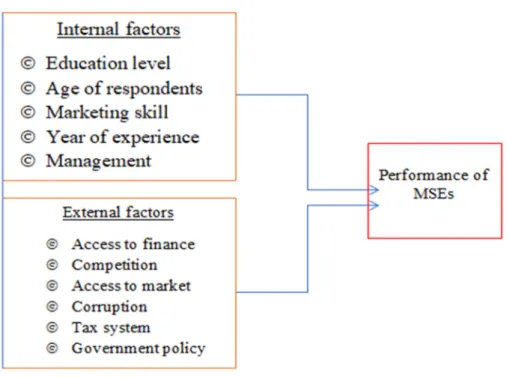
Figure 2.1.The conceptual frame work of the study Source: researcher own constructs (2018)
Note that variables in the two rectangles at the left side are independent variables and variable in the square at the right side of the figure is dependent variable of the study respectively.
3. METHODOLOGY
3.1. Description of the study area
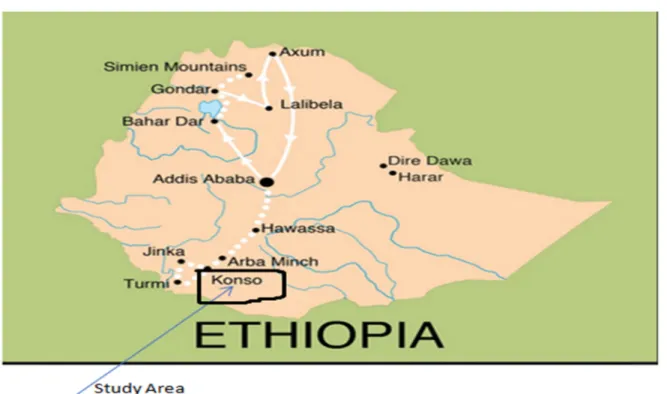
The current research paper was focused on investigating factors affecting the performance of small and micro enterprises in Karat town, which located in Konso Woreda. Konso woreda is one of 135 woredas in Southern Ethiopian Region with its town administration named Karat. Karat town is found south-east 595 kilometers far from Addis Ababa - capital city of the Ethiopia, 365 kilometers far from Hawassa – seat of SNNPRs. The town also found at the center of the roads from Addis Ababa, Soyama town of Burji Worea, Moyale and Yavello towns of Borana Zone and Jinka town of South Omo Zone. Konso people were known by their terracing systems that help to save the land erosion due to different natural disasters and other factors. Konso cultural landscape was officially recognized and registered as 35th, 9th and 3rd world, Ethiopian and Southern Ethiopian heritage respectively by United Nations Educational Science and Cultural Organization (UNESCO) on June, 2011. According to UNESCO, "Konso Cultural Landscape is a 55km2 arid properties of stone walled terraces and fortified settlements in the Konso highlands of Ethiopia. It constitutes a spectacular example of a living cultural tradition stretching back 21 generations (more than 400 years) adapted to its dry hostile environment. The landscape demonstrates the shared values, social cohesion and engineering knowledge of its communities. The site also features anthropomorphic wooden statues - grouped to represent respected members of their communities and particularly heroic events - which are an exceptional living testimony to funerary traditions that are on the verge of disappearing. Stone steles in the towns express a complex system of marking the passing of generations of leaders." It is one of the areas that attract domestic and outside tourists and investment in Ethiopia. The map of konso was shown in following page:
Fig 2 Map of the study area
3.2 Research approach and Design
According to (Saunders et al., 2009) mixed research approach is the general term for when both quantitative and qualitative data collection techniques and analysis procedures are used in research design. It is subdivided into two types. Mixed method research uses quantitative and qualitative data collection techniques and analysis procedures. This means that, although mixed method research uses both quantitative and qualitative world views at the research methods stage, quantitative data are analyzed quantitatively. In light of the research objective, this study has been adopted mixed approach to identify determinant factors of the MSEs. A research design is the arrangement of conditions for collection and analysis of data in a manner that aims to combine relevance to the research purpose with economy in procedure (Kothari, 2004). It gives the procedure necessary for obtaining the information needed to solve the research problems. Therefore, this study has been adopted an explanatory research design to realize the stated objective. Explanatory research design examines the cause and effect relationships between dependent and independent variables. Thus, it is the most appropriate research design for identifying the cause and effect relationships between the MSEs performance and ten explanatory variables representing age, education level, access to finance, corruption, access to market, government policy, marketing skill of entrepreneurs, competition in market, managerial skill of the owners and attitude level on current tax system.
3.3 Data type and Methods of data collection
In this research, the author used both primary and secondary data. To collect primary data structured questionnaires and direct personal interview were used. The questionnaire was prepared in both Amharic and English languages that helps to reduce language understanding barriers by respondents.
3.4 Target population, Sampling Technique and Sample Size
According to karat town small scale business developing body third quarter report (June, 2018) there are 312 micro and small business in Karat town. The researchers have used them as target population of the study.
To determine the sample size from total Entrepreneurs of the sub city, mathematical formula of Yamane (1967) was used by taking in to account the total population, the sampling error and the level of reliability. It is assumed that the sample would have 95% reliability about population and a sampling error was 5%. This simplest formula is:
/1 ∗
Where N= study population, n = sample size and e = error margin
Accordingly, sample was first determined from total target population by formula of Yamane (1967) as follow:
Therefore, the maximum sample size was 175 small and micro enterprises. The probability sampling technique is used to select sample form 312 micro and small scale enterprises to give equal chance to the all small and micro and to select representative sample for the study.
3.5 Ordered logit model specification:
Use of applicable model is usually determined by the nature of the dependent variable. Now in this study the dependent variable has categorical or ordered nature. Then ordinary linear regression is not appropriate because of the non-interval nature of the variable and the spacing of the outcome choices cannot be assumed to be uniform. Consequently, (Liao, 1994) argued that Ordinal logit and probit models have been widely used to analyze such types of data. Even if the outcome is discrete, the multinomial logit or probit model would fail to account for the ordinal nature of the dependent variable (Greene, 2008). Hence, this study applied ordered logit model instead of ordered probit simply because of simplicity of interpretation of parameters. Hence, ordered logit model was used to analyze factors that influence performance of small scale enterprises having three distinct sorts that is low, medium and high performance categories. Succeeding Greene (2008) and Liao (1994) the functional form of ordered logit model is stated as follows:
Y* = is unobserved and thus can be thought of as the underlying tendency of an observed phenomenon and I have assumed it follows a certain symmetric distribution with zero mean such as logistic distribution. What can be observed is that:
Where y is observed in j number of ordered categories, µs are unknown threshold parameters separating the adjacent categories to be estimated with βs. The overall form for the probability that the observed y falls into category j and the µs and the βs are to be estimated with an ordinal logit model is that:
Where L (·) represents cumulative logistic distribution and µ sample mean. 3.6. Description of variables and their scale of measurement
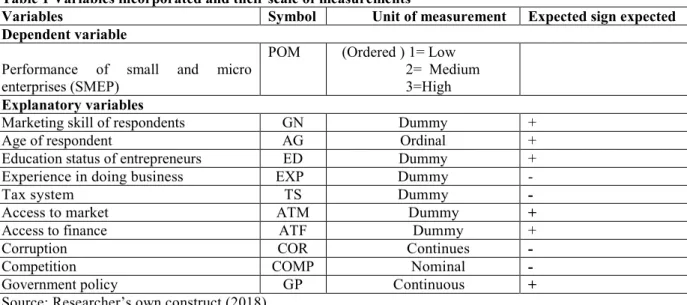
From the theoretical and empirical literature, traditional observable characteristics that may influence the performance of SME were summarized with their respective unit of measurement in table 1 below.
Table 1 Variables incorporated and their scale of measurements
Variables Symbol Unit of measurement Expected sign expected
Dependent variable
Performance of small and micro enterprises (SMEP)
POM (Ordered ) 1= Low 2= Medium 3=High Explanatory variables
Marketing skill of respondents GN Dummy +
Age of respondent AG Ordinal +
Education status of entrepreneurs ED Dummy +
Experience in doing business EXP Dummy -
Tax system TS Dummy -
Access to market ATM Dummy +
Access to finance ATF Dummy +
Corruption COR Continues -
Competition COMP Nominal -
Government policy GP Continuous +
Source: Researcher’s own construct (2018)
3.7 Methods of data Analysis and Ethical considerations
After accomplishment of data collection procedure, it should have classified as per each variable, the qualitative data was coded to be measured quantitatively. In this research data, were analyzed by inferential statistics
(logistic regression) through of STATA Software package version 12 in order to get the reliable finding.
The following ethical considerations have given attention by the researcher and enumerators while conducting the research or collecting the data: conserving the Voluntary participation of respondents, no participants was forced to take part in the research and participants were free to withdraw from the research at any moment. With regarding to harm to participants [the researchers ensured that there is no any physical or psychological harm done to the participants as a result of the study. When it comes to Anonymity and confidentiality, all information gathered during the study has been handled confidentially and permission from the participants was obtained for all information to be shared publicly. Not deceiving the subjects since participants have informed clearly about the aim, purpose and procedures of the study and was not deceived in any way. Finally Privacy of participants the privacy of the participants have been respected.
4. Result and Discussion
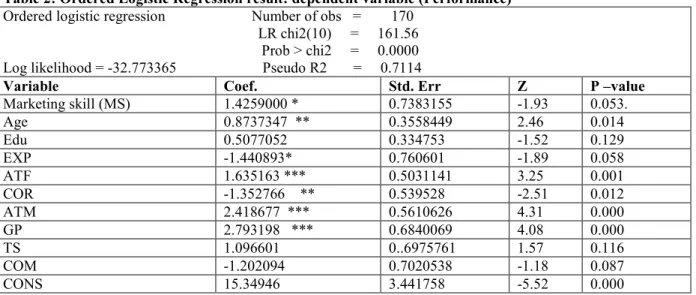
Table 2: Ordered Logistic Regression result: dependent variable (Performance) Ordered logistic regression Number of obs = 170
LR chi2(10) = 161.56 Prob > chi2 = 0.0000 Log likelihood = -32.773365 Pseudo R2 = 0.7114
Variable Coef. Std. Err Z P –value
Marketing skill (MS) 1.4259000 * 0.7383155 -1.93 0.053. Age 0.8737347 ** 0.3558449 2.46 0.014 Edu 0.5077052 0.334753 -1.52 0.129 EXP -1.440893* 0.760601 -1.89 0.058 ATF 1.635163 *** 0.5031141 3.25 0.001 COR -1.352766 ** 0.539528 -2.51 0.012 ATM 2.418677 *** 0.5610626 4.31 0.000 GP 2.793198 *** 0.6840069 4.08 0.000 TS 1.096601 0..6975761 1.57 0.116 COM -1.202094 0.7020538 -1.18 0.087 CONS 15.34946 3.441758 -5.52 0.000
Note: - ***, ** and * are represents statistically significance at 1%, 5% and 10% level of significance, respectively. Source: personal survey (2018)
The result on Table 2 shows that the Pseudo R-square with a value of 0.7114 implies that about 71.14 percent of the changes in performance of micro and small-scale business (POM) could only be explained by independent variables such as Marketing skill of respondents (MS), age of the respondent (AG), year of experience in doing business (EXP), access to finance (ATF), corruption (COR), access to market (ATM), Government policy (GP), and tax system of the country (TS). While 28.86 percent of the changes in Performance of micro and small enterprises (POM) could be explained by other exogenous factors that are not incorporated in the model. The likelihood ratio chi-square of 161.56 with a p-value of 0.0000 tells us that the model as a whole is statistically significant.
Consequently, the regression result of this study, shows that marketing skill of business manager with calculated Z value (Z =1.93) has significant relationship with performance of micro and small business because it is more than table Z value which is (Z=1.67) at 10% significance level with positive regression coefficient of (ß= 1.4259). Hence, hypothesis (H1) that stated marketing skill of entrepreneurs (operator) is positively related with performance of small and micro enterprises is accepted.
With regards to age of the respondents calculated Z value (Z =2.46) has significant relationship with performance of micro and small business because it is more than table Z value which is (Z=1.96) at 5% significance level with positive regression coefficient of (ß= 0.8737347). Hence, hypothesis (H2) that stated as increase in age has positive influence on performance of micro and small-scale business is accepted. The researcher conducted direct personal interview with MSEs developing body by asking how you compare the performance of less aged enterprise operator from (15-17) with high aged with in age group of from (18-34) one and concluded the performance of high aged (18-34) MSEs operators is more better than the performance of less aged (15-17) due to fact that high aged people equipped more experience in doing business, youth age makes them productive, and popularity of their products for the customers. This implies that increase in age of micro and small business owner leads to increase in the performance of the enterprises. This is due to fact that as age of the MSEs lengthens the entrepreneurs learn more marketing skills from different business activities up and down situations. Therefore, the researcher recommended that the respective micro and small- scale business developing bodies should provide support for aged MSEs in order to sustain the performance and to upgrade them to medium sized business.
When it comes to the influence of experience of business manager , the result of this shows that access to external source of (Z =1.89) has negative and significant relationship with performance since it is more than table Z value which is (Z=1.96) at 5% significance level with positive regression coefficient of (ß = -1.440893). Hence, hypothesis (H4) that stated less managerial skill through industry experience in doing business is negatively related with performance of small and micro enterprises is accepted.
When it comes to the impact of access to external source of finance, the result of this shows that access to external source of (Z =3.25) has positive and significant relationship with performance since it is more than table Z value which is (Z=1.96) at 5% significance level with positive regression coefficient of (ß =1.635163). Hence, hypothesis (H5) that stated as access to external source of finance has positive impact on performance of micro and small-scale business is accepted. This result is consistent with finding of other studies results (Osotimehin et al., 2012). As per interview developed with MSEs in the Karat town, micro and small scale enterprises has accessed to external source of finance mostly from informal financial institutions or indigenous capital accumulating institutions like Equb and Arad (private lenders) but less access to external source of finances from formal financial institutions such as banks and micro finance institutions due to collateral requirement; group requirement, high interest rate, fear due to cultural backwardness that lending money form formal institutions will leads people to go to jail, lack of awareness on how to ask and obtain loan from formal financial institutions.
With regarding to impact of corrupted government officials that supporting small and micro enterprises on performance the calculated Z value (Z =-2.51) in absolute is more than Z table value (Z =1.96) with coefficient of ordered logistic model (ß= -1.352766) which is negative and statistically significant. Therefore, hypothesis H6 that stated as corruption of government body that establishing has negative impact on micro and small scale Enterprises is accepted. The researcher intervened micro and small scale enterprises representatives and MSEs supporting body about their attitudes on corruption of MSEs development body and they responded that bureaucracy in obtaining license and corruption of MSE developing body is one of the key factors that hinder the performance of Enterprises in the Karat town. This consistent with study contacted by H/Michael (2014) that find out that political factors such as regulatory compliance and the cost of formulations and the bureaucracy in company registration and licensing was the major obstacle for the startup, expansion and the performance of micro and small-scale business enterprises in Yeka sub city of Addis Ababa. Therefore, it the researcher concluded that bureaucracy in registration and licensing is the major factors that affect the performance of micro and small enterprise in Karat town.
Concerning the impact that access to market for products produced by micro and small business, the calculated Z value (Z = 4.31) is more than Z table value (Z =1.96) with coefficient of ordered logistic model (ß= 2.418677) which is positive and most statistically significant. Therefore, hypothesis H7 that stated access to market has positive impact on micro and small scale Enterprises is accepted. This finding is consistent with result of Mohamed (2016) and Dechasa (2017) that have used descriptive and find out that marketing problem is one of the factors affecting in Adis Ababa and Shashamene Cities respectively. Besides, Andualem et al., (2015) in their find out that access to market has statistically significant impact on performance of micro and small scale business in Arbamnich town. According to interview conducted with MSE,s representatives’ revealed that most of the marketing factors affect performance of the MSE’s in study areas were manufacturing and construction than service sectors. This means the sectors does not have selling and display places in areas close to working area and there are not enough Linkage of the MSEs with other private contractors in promoting their products in wider range and less enough market exhibition. Besides the MSEs establishing body (government) does not facilitate the market accesses for MSE operating in the study area.
Finally, the finding of this study with regard to government policy towards micro and small business has calculated table value of (Z = 4.08) is more than Z table value (Z =1.96) with coefficient of ordered logistic model (ß= 2.793198) which is positive and most statistically significant. Therefore, hypothesis H8 that stated access to market has positive impact on micro and small scale Enterprises is accepted. As per interview conducted with MSEs developing body, the government policy towards MSEs is good but lack of location facility and fluctuation in electric power were major factors affecting performance of MSEs in the study area.
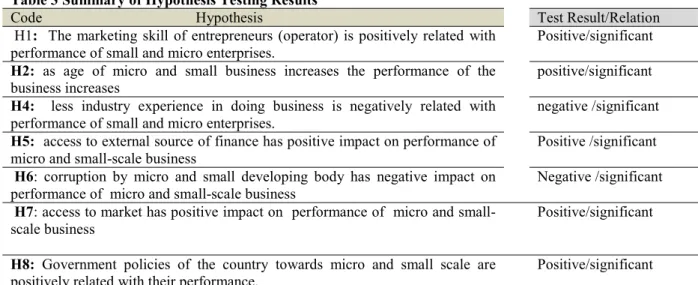
Table 3 Summary of Hypothesis Testing Results
Code Hypothesis Test Result/Relation H1: The marketing skill of entrepreneurs (operator) is positively related with
performance of small and micro enterprises. Positive/significant H2: as age of micro and small business increases the performance of the
business increases positive/significant
H4: less industry experience in doing business is negatively related with performance of small and micro enterprises.
negative /significant H5: access to external source of finance has positive impact on performance of
micro and small-scale business Positive /significant
H6: corruption by micro and small developing body has negative impact on
performance of micro and small-scale business Negative /significant H7: access to market has positive impact on performance of micro and
small-scale business
Positive/significant H8: Government policies of the country towards micro and small scale are
positively related with their performance. Positive/significant Source: personal own survey (2018)
5. Conclusion
The result of ordered logistic regression analysis (see Table 2.) suggested that the performance of micro and small scale enterprises is significantly influenced by marketing skill, age, year of experience, access to external source of finance, corruption, access to market and government policy towards MSEs. This study similarly evidenced that, other variables such as education level, tax system, and competition with in the same industry were not significant determinants of micro and small scale enterprises performance in Karat town.
6. Directions for Further Research
It obvious that any study cannot be free from limitations, accordingly there are some limitations in current study. It was focused only on determinants of MSEs in Karat town of Konso. Consequently, the findings of this study may be difficult to generalize about all micro and small-scale enterprises at national, regional and Zonal level.
Hence, this study can be improved if it is done at regional and national level by comparing determinants of MSEs Performance of different business sectors by increasing sampling.
Further researchers can also include other MSE performance determinants that were not included in this study since current study only testes ten factors on the same area, at other zones, national and regional level.
Finally, other researchers can also make comparative study enterprises participated in different business activities. For instance manufacturing with service delivering organizations, urban agriculture with trading, and food processing service sector with other service delivering activities such as IT, tourism and transportation at woreda, zonal, regional and National level in order to improve the findings of the study to make generalization for all micro and small-scale enterprises in the country. Acknowledgement
The authors would like to thanks the editor and the anonymous reviewers for their guidance in developing this manuscript.
REFRENCES
Andualem Gezahegn, Shimelis Zewdie and Chalchissa Amentie (2015); Factors Determining the Success of Micro and Small Enterprises in Ethiopia (The Case of Arbaminch Town):Journal of Social and basic Science research review : Volume 3, Issue 2 Pages: 69-76. Available on www.absorbonline.org/journal. Asma Benzazoua Bouazza, Diabate Ardjouman and Othman Abada (2015). Establishing the Factors Affecting
the Growth of Small and Medium-sized Enterprises in Algeria: American International Journal of Social Science: Vol. 4, issue No. 2;
Brehanu And Mesfin Gashu (2014); Factors Affecting Access To Finance With Reference To Micro And Small Enterprise In Dilla Town, Ethiopia: International Journal of Applied Financial Management Perspectives © Pezzottaite Journals Volume 4, Number 2 pp. (1680-1887)
Beck, Thornsten, Asli Demirguc-Kunt, and Ross Levine. 2003. SMEs, Growth and Poverty
The World Bank. Dia, M. (1996). African management in the 1990s and beyond: Reconciling indigenous and transplant institutions. Washington, D.C.: The World Bank
publishers
Dechasa Seifu (2017) Prospects and challenges of Micro and Small Scale Enterprises (MSEs): A Study on Shashemene City, Ethiopia. International Journal for Research in Business, Management and Accounting Volume-3 Issue-8 pp. (1-15)
FDRE. (2011). Revised micro and small scale enterprises growth stage guideline. Addis Ababa: Federal Micro and Small Enterprises Agency.
Federal Democratic Republic of Ethiopia (FDRE), Central Statistical Authority. (2003). Report on Bi-Annual Employment Unemployment Survey, 1st year Round 1, statistical Bulletin 319.
Federal Micro and Small Enterprise Development Agency Establishment Council of Ministry .(2011: 576 ). Federal NegraritGazeta of Federal Democratic Republic of Ethiopia , Regulation NO.201/2011 , Addis Abeba.
Fikirte Abreham (2017). Finance as a success or failure factor of micro and small business enterprises in Dilla town. The seinor essay submitted to the deparment of Accounting and Finance for Partial fulfillments of BA degree in Accounting and Finance, Dill University Unpublished research. Available at the library.
Greene, W.H., 2008. Econometric Analysis. 6th edition, Prentice-hall Inc. Upper Saddle River, New Jersey.
Hailemichael Mulugeta (2014), Assessing the factors Affecting the performance of micro and small enterprises the case of Yeka sub-city, Addis Abeba, Ethiopia
Ibrahim, Angelidis and parsa, F (2008) Strategic management of family business
Kimuyu, P. (2004). Transformation of Small Firms and its Productivity Implication: Insights from Small Manufacturers in Kenya, Nairobi. University of Nairobi Working Paper, Economics Department and Institute for Development Studies.
Kozan (2006) Growth plans of small business in Turkey; Individual and environmental Influences. Journal of small business management, 44(1), 114-129).
Kothari (2004) Research methodology methods and techniques 2nd ed, New age international
Liao, T. F., 1994. Interpreting Probability Models. Logit, Probit and Other Generalized Linear Models. Sage University Paper Serious on Qualitative Applications in the Social Sciences.U.S.
Minilek Kefale and K. P. M Chinnan (2012). Employment growth and challenges in small and micro enterprises Woldiya, North East Amhara region, Ethiopia Educational Research and Essays Vol. 1(2), pp. 21 - 26, Available online at http://www.wudpeckerresearchjournals.org/ERE 2012 Wudpecker Research Journals Full Length Research Paper
Mulugeta chane (2010) Factors affecting the performance of Women Entrepreneurs in Micro and small enterprises (the case of Dessie Town).
Mohammed Getahun (2016) the Challenge and Prospects of Small Scale Enterprise in Ethiopia: A Survey of Some Selected Small Scale Enterprise in Addis Ababa City: International Journal of Scientific and Research Publications, Volume 6, Issue 5, (217-226).
(Tsega Adego Abebe 2014) Challenges and Prospects of Women Operated Micro and Small Enterprises: A Case Study of Aksum City Administration, Ethiopia: European Journal of Business and Management Vol.6, No.28 pp.143-155
Karat town Administration document (2018). Profile of the town Micro and small –scale enterprise body, unpublished material available in the office.
Yamane, T., 1967. Statistics: An Introductory Analysis. 2nd Ed ed.
Osotimehin, K.O., Jegede, Charles, Akinlabi, Babatunde, Olajide, Ojo, (2012). An Evaluation of the Challenges and Prospects of Micro and Small Scale Enterprises Development in Nigeria, American International Journal of Contemporary Research Vol. 2 No. 4; April 2012
Saunders M. Plewis P. Thorhill A, 2009. Research methods for Business Students. 5th edition ed. FT Prentice Hall: Mark Saunders, Philip Lewis and Adrian Thornhill.
Werotew Bezab. (2010): Entrepreneurship: An Engine for Sustainable Growth, Development, prosperity and Good Governance; Genius Training and Consultancy Service, Addis Ababa, Ethiopia.
World Bank (2004). Small and Micro Enterprises ‘’World Bank Group Review of Small Business Activities, Washington, DC, World Bank