THE COLLAPSE OF THE SOVIET UNION AND THE PRODUCTIVITY OF AMERICAN MATHEMATICIANS George J. Borjas Kirk B. Doran Working Paper 17800 http://www.nber.org/papers/w17800
NATIONAL BUREAU OF ECONOMIC RESEARCH 1050 Massachusetts Avenue
Cambridge, MA 02138 February 2012
We are grateful to Graeme Fairweather, Patrick Ion, Erol Ozil, and Norm Richert from the American Mathematical Society for extensive collaboration and support in preparing the data. This project profited from the excellent programming of Andrew Stellman of Stellman and Greene Consulting. We have benefited from comments made by many economists and mathematicians, including Ran Abramitzky, Orley Ashenfelter, Pierre Azoulay, Robert Barro, Witold Biedrzycki, Brent Doran, Charles Doran, David Ellwood, William Evans, Henry Farber, Richard Freeman, John Friedman, Joshua Goodman, Daniel Hamermesh, Arthur Jaffe, Lawrence Katz, Petra Moser, Michael Rothschild, Lawrence Shepp, Fabian Waldinger, Bruce Weinberg, Heidi Williams, numerous seminar participants, and three referees. The authors are grateful to the Upjohn Institute, the Kauffman Foundation, and the Sloan Foundation for their financial assistance. The views expressed herein are those of the authors and do not necessarily reflect the views of the National Bureau of Economic Research.
NBER working papers are circulated for discussion and comment purposes. They have not been peer-reviewed or been subject to the review by the NBER Board of Directors that accompanies official NBER publications.
© 2012 by George J. Borjas and Kirk B. Doran. All rights reserved. Short sections of text, not to exceed two paragraphs, may be quoted without explicit permission provided that full credit, including © notice, is given to the source.
February 2012 JEL No. J61,O31
ABSTRACT
It has been difficult to open up the black box of knowledge production. We use unique international data on the publications, citations, and affiliations of mathematicians to examine the impact of a large post-1992 influx of Soviet mathematicians on the productivity of their American counterparts. We find a negative productivity effect on those mathematicians whose research overlapped with that of the Soviets. We also document an increased mobility rate (to lower-quality institutions and out of active publishing) and a reduced likelihood of producing “home run” papers. Although the total product of the pre-existing American mathematicians shrank, the Soviet contribution to American mathematics filled in the gap. However, there is no evidence that the Soviets greatly increased the size of the “mathematics pie.” Finally, we find that there are significant international differences in the productivity effects of the collapse of the Soviet Union, and that these international differences can be explained by both differences in the size of the émigré flow into the various countries and in how connected each country is to the global market for mathematical publications.
George J. Borjas
Harvard Kennedy School 79 JFK Street Cambridge, MA 02138 and NBER [email protected] Kirk B. Doran 438 Flanner Hall
University of Notre Dame Notre Dame, IN 46556 [email protected]
The Collapse of the Soviet Union
and the Productivity of American Mathematicians* George J. Borjas and Kirk B. Doran
I. Introduction
Many economists believe that knowledge production is central to long-‐term
economic growth. Nevertheless, it has been difficult to document the factors that enter the production function of knowledge. The difficulty arises for many reasons. For example, knowledge production is both social and reciprocal (Lucas 2009), in that the ideas of one researcher influence and are, in turn, influenced by the ideas of others.Similarly, basic knowledge production can be difficult to observe and measure at the individual level, so that we do not have a well-‐developed set of facts that can help guide our thinking on a theoretical framework. Finally, we do not understand why knowledge in some fields progresses at a remarkable rate in a short-‐lived burst, yet stagnates for decades in other areas.1
Despite these difficulties, it is clear that there are countless possibilities for
spillovers when producing knowledge: the knowledge produced by one researcher is both
* We are grateful to Graeme Fairweather, Patrick Ion, Erol Ozil, and Norm Richert from the American Mathematical Society for extensive collaboration and support in preparing the data. This project profited from the excellent programming of Andrew Stellman of Stellman and Greene Consulting. We have benefited from comments made by many economists and mathematicians, including Ran Abramitzky, Orley
Ashenfelter, Pierre Azoulay, Robert Barro, Witold Biedrzycki, Brent Doran, Charles Doran, David Ellwood, William Evans, Henry Farber, Richard Freeman, John Friedman, Joshua Goodman, Daniel Hamermesh, Arthur Jaffe, Lawrence Katz, Petra Moser, Michael Rothschild, Lawrence Shepp, Fabian Waldinger, Bruce Weinberg, Heidi Williams, numerous seminar participants, and three referees. The authors are grateful to the Upjohn Institute, the Kauffman Foundation, and the Sloan Foundation for their financial assistance.
1 Jones (2005, p. 1107) succinctly summarizes the difficulties: “While we have made much progress in understanding economic growth in a world where ideas are important, there remain many open, interesting research questions. The first is, ‘What is the shape of the idea production function?’ How do ideas get
produced?...The current research practice of modeling the idea production function as a stable Cobb-‐Douglas combination of research and the existing stock of ideas is elegant, but at this point we have little reason to believe that it is correct.” See also Lucas (1988), Romer (1986), Romer (1990), and Jones and Romer (2010).
an output and an input into another researcher’s production function. As Newton said, “If I have seen further it is by standing on the shoulders of giants.”
But even if the ideas of a highly qualified single worker spill over to other workers with whom they interact, the overall effect of the interaction can still be deleterious to the productivity of other workers. In particular, in a world with constraints on the funding and dissemination of ideas (e.g., a limit on the number of faculty slots, or, more abstractly, a limit on the attention span of the potential audience), large and sudden increases in the population of producers of knowledge can result in diminishing marginal productivity for a pre-‐existing worker. As an example, a young academic might appreciate the hiring of a new illustrious colleague in, say, mathematics because it may improve his own ideas. At the same time, the young academic realizes that in a world with limited funding and limited research opportunities, his own services and research now become relatively less important to his own department and to the field in general.
A number of recent empirical studies have attempted to quantify the net impact of the presence of a highly skilled worker on the ideas and output of other workers. For example, Waldinger (2009) examines the productivity of the doctoral students who were left behind when superstar German scientists left Germany during the Nazi era. He finds that these students suffered in the absence of their highly skilled mentors. In more recent work, however, Waldinger (2011) finds that the coauthors left behind in Nazi Germany did not experience a loss in productivity when the superstars left. Finally, Azoulay, Zivin, and Wang (2010) document the decreased output suffered by the co-‐authors of superstar scientists after the superstars die. They find that the coauthors become much less productive when the superstar is no longer able to collaborate. In concluding, they note:
“Although we measure the impact of losing a star collaborator, a full accounting of knowledge spillovers would require information on the benefits that accrued to the field while the star was alive. We can think of no experiment, natural or otherwise, that would encapsulate this counterfactual” (Azoulay, Zivin, and Wang 2010, p. 580).2
This paper attempts to measure the productivity effects of the entry of highly skilled scientists in a context where we can observe the counterfactual of no entry. In particular, we examine the impact of the influx of renowned Soviet mathematicians into the global mathematics community. In the period between the establishment and fall of communism, Soviet mathematics developed in an insular fashion and along very different specializations than American mathematics. As a result, some mathematicians experienced few potential insights from Soviet mathematics after the collapse of the Soviet Union, while other fields experienced a flood of new mathematicians, theorems, and ideas.
We have constructed a data set that contains information on the authorship of every paper published in mathematics over the past 70 years.3 These data allow us to document
the location, affiliation, and complete publication and citation records of mathematicians who were active in the Soviet Union and around the world for the past few decades.
Prior to the collapse of the Soviet Union, there was little collaboration and only infrequent exchanges between Soviet and Western mathematicians. In fact, every written
2 Related research on knowledge production includes Furman, Kyle, Cockburn, and Henderson (2005) and Hunt and Gauthier-‐Loiselle (2010).
3 Mathematical research plays a fundamental role in technological progress. In fact, recent applications of modern academic research papers in mathematics and related fields (such as theoretical computer science and mathematical physics) to our broader economy are so numerous and diverse that it is impossible to characterize them briefly. For a few examples, consider the Rivest-‐Shamir-‐Adleman algorithm that forms the backbone of Internet encryption; the Reed–Solomon error correction that makes possible compact disks, deep-‐space communication, error-‐free bar codes, and DSL television; and Claude Shannon’s information theory, which has been applied everywhere from gambling and investing, to bioinformatics and music, and even to the discovery of new oil fields with seismic oil exploration.
communication with an American mathematician was opened and read by the authorities, and special permission was required to publish outside the Soviet Union. Depending on the era in the Cold War, Soviet violators could be imprisoned (Polyak 2002). After the collapse of the Soviet Union, over 1,000 Soviet mathematicians migrated to other countries, with a large fraction settling in the United States. In addition, the mathematicians who remained in the Soviet Union became part of the globalized publications market in mathematics.4
Our empirical analysis demonstrates that the American mathematicians whose research programs most overlapped with that of the Soviets experienced a reduction in productivity after the entry of Soviet émigrés into the U.S. mathematics market. This effect is observed at both tails of the quality distribution of mathematicians. First, the likelihood of a competing mathematician producing a “home run” paper fell significantly. Similarly, marginal mathematicians became much more likely to move to lower-‐quality institutions and to exit knowledge production altogether. We also find evidence that the students of the Soviet émigrés had higher lifetime productivity than other students from the same
institution who had non-‐émigré advisors. However, this gain was more than offset by the productivity loss suffered by students who had American advisors with Soviet-‐like research programs.
On aggregate, based on the pre-‐1992 age-‐output profile of American
mathematicians, we find that the actual output of mathematicians with a Soviet-‐like
research program is far below what one would have expected. Even though there was a net
4 Abramitzky and Sen (2011) provide a detailed analysis of how the collapse of Soviet communism led to a diffusion of knowledge to and from the West and the former Soviet Union.
loss in total output for American mathematicians, this loss was approximately made up by the published output of the Soviet émigrés in the United States.
Our analysis also directly confronts a related issue in the knowledge production literature. Knowledge producers interact in both a job market (i.e., the market for selling human capital), and in a publications market (i.e., the market for selling codified
knowledge, such as journal articles). The collapse of the Soviet Union provides a unique opportunity to empirically examine the relative importance of each market for determining the net productivity effect on knowledge producers.
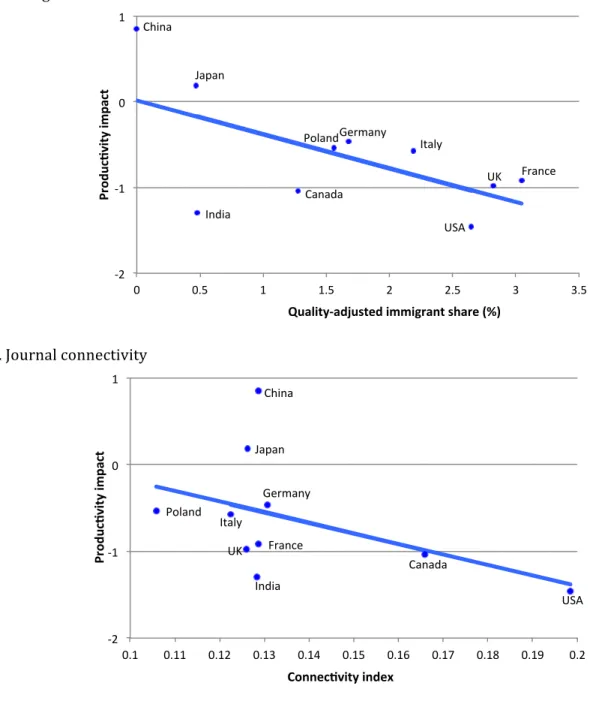
After all, the collapse of the Soviet Union induced many Soviet mathematicians to move to some countries, but not to others, creating competitive pressures in some job markets, but not in others. At the same time, the market for journal space has some segments that are country-‐specific, but other segments that cross over geographic
boundaries. As a result, mathematicians in countries that did not physically receive many Soviet émigrés may have experienced competition in the journal market, while
mathematicians in still other countries did not experience increased competition in either market. The international differences in the post-‐1992 productivity of mathematicians reveals that competitive pressures in both the job market and in the market for codified knowledge are important determinants of productivity and of crowd-‐out effects.
II. Historical Context
After the establishment of the Soviet Union in 1922, Soviet mathematics entered a long period of development independent from mathematics in the West. To varying
scientists could communicate with Western peers, on the parameters of scientific travel, on the acceptable outlets for publication, and on access to Western materials.5 Just as speakers
of one language, when separated geographically for many generations, eventually develop separate and different dialects through natural changes over time, so Western and Eastern mathematicians, separated by Stalinist and Cold War political institutions, developed under different influences to the point of achieving very different specializations across the fields of mathematics.
An important event that cemented the isolation of Soviet mathematicians was the “Luzin affair.” In 1936, Nikolai Luzin, a mathematician at Moscow State University and a member of the USSR Academy of Sciences, became the target of a political campaign. The allegations included not only the usual charge of promoting anti-‐Soviet propaganda, but also the specific accusation that Luzin saved his main academic results for publications in foreign outlets. Although Stalin eventually spared Luzin’s life, the impact on Soviet
mathematics was swift and dramatic: “The main visible consequence of the Luzin affair was
5 Polyak (2002, p. 2) gives a firsthand account of the life of mathematicians behind the Iron Curtain. Polyak writes: “’The iron curtain’ was not only a metaphor, it was a real obstacle to international contacts…When Professor Ya.Z. Tsypkin received a letter in the late 1940s from an American reader of his paper, he was summoned by the KGB and underwent a long investigation there, tottering at the edge of arrest. . . Another source of difficulties for researchers was the mania for secrecy. . . Nobody was allowed to publish any paper without special permission confirming that the publication does not contradict numerous security
restrictions. All letters abroad (as well as letters from abroad) were opened and inspected. Everybody must have special permission, and a full text of the talk had to be approved if you were going to an international conference. And working in a classified institution (which was the case for many experts in mathematical programming), complicated the situation drastically. . . The situation in the 1940s to mid-‐1950s was the worst. Malevolent intent by the authorities could lead a researcher to the GULAG. The period 1955–1970 was the least oppressive, it was a ‘golden age’ of Soviet mathematics. . . The years 1970 to 1985 were a period of stagnation in political, social, economic, and scientific life. All the troubles I have mentioned above played a more and more significant role in the development of Soviet science and thus led to its degradation.”
that, from this precise moment, Soviet mathematicians began to publish almost exclusively in Soviet journals and in Russian.”6
Figure I illustrates the dramatic differences in specializations between Soviet and American mathematics. In particular, the figure gives the number of papers published before 1990 by Soviet mathematicians in a particular field relative to the number of papers published by American mathematicians in that field. Despite the fact that, on aggregate, Americans published about three times as many papers as the Soviets, Soviet
mathematicians published 1.4 papers per American paper in Integral Equations. In contrast, Soviet mathematicians published only 0.06 papers per American paper in
Statistics. In fact, the two most popular Soviet fields were Partial Differential Equations and Ordinary Differential Equations, and these two fields accounted for 17.8 percent of all publications. In contrast, the two most popular American fields were Statistics and
Operations Research, Mathematical Programming, and these two fields accounted for 15.6 percent of all American publications.7
The primary influences behind the development of both Soviet and Western mathematics were history dependence and, to a lesser extent, state funding. In the Soviet Union, for example, the mathematical genius Andrey Kolmogorov developed important results in the area of Probability and Stochastic Processes beginning in the 1930s. In a scenario common throughout Soviet mathematical history, he then established a “school”
6 O’Connor and Robertson (1999). The charges against Luzin were published in Pravda in a series of articles beginning on July 3, 1936. The Luzin affair involved intrigue, blackmail, and betrayal—even Andrey
Kolmogorov played a non-‐trivial role in the play (Graham and Kantor 2009); see also Smithies (2003). 7 The third most popular field, Quantum Theory, was the same in both countries, accounting for 6.8 percent and 5.9 percent of publications in the USSR and the United States, respectively. The fourth and fifth most popular fields in the Soviet Union were Probability Theory and Stochastic Processes (6.1 percent) and Global Analysis, Analysis on Manifolds (4.8 percent). The respective fields in the United States were Computer Science (4.5 percent) and Numerical Analysis (4.3 percent).
at Moscow State University, attracting some of the best young minds over the next four decades, such as the teenage prodigy Vladimir Arnold in the 1950s. Arnold himself quickly solved Hilbert's famous “Thirteenth Problem,” and initiated the field of symplectic
topology. The large amount of Soviet work in these areas even in the 1980s can be seen in Figure I under the subject headings “Mechanics of Particles and Systems,” “Global Analysis, Analysis on Manifolds,” and “Ordinary Differential Equations.” Since the United States did not have the unique Kolmogorov-‐Arnold combination, the amount of work done by American mathematicians in these subfields was far less than would have been expected given the size and breadth of the American mathematics community.
In the United States, however, researchers like John Milnor at Princeton University and Raoul Bott at Harvard University developed key ideas in the topology of manifolds in the 1950s. Their students and collaborators produced an enviable body of research in Manifolds and Cell Complexes, which, because of the lack of a similar chance originator in their country, was never replicated in the Soviet Union.8
Finally, Soviet funding was limited (in comparison to the U.S.) in fields requiring experiments or equipment (Howe 1990). Figure I also demonstrates that as late as the 1980s, this resulted in a large discrepancy between American and Soviet specialization in computer science and related fields.9
8 Algebraic Geometry, a field of relative U.S. excellence, provides another example of the persistence of history dependence. The Summary Report of the Panel on Soviet Mathematics (Lefschetz 1961, p. IV-‐2) explains that: “in no part of mathematics is the Soviet Union weaker than in algebraic geometry. No significant contributions have ever . . . come from there.” This was not only true in 1961, but, as Figure I demonstrates, it remained true in the 1980s.
9 Personal communication with Professor Lawrence Shepp, who during a long career at Bell Labs was in contact with some Soviet mathematicians as early as 1964, suggests that the fact that Soviet mathematicians avoided the most popular American field (Statistics) had little to do with funding. Specializing in statistics was politically dangerous in the USSR, as it would require a great deal of massaging of sensitive data.
We exploit the fact that Soviet and American mathematicians did not choose their specializations in the 1970s and 1980s in the belief that they would soon have an
opportunity to co-‐author papers, compete for pages in the same journals, and apply for jobs at the same universities. The consensus among both Soviet and American experts almost immediately before the collapse of communism was that the political system of the existing Soviet state was not ripe for a sudden change. Walter Laqueur (1996, p. 65) describes how in the Soviet Union itself, “most believed the system was so strong that it would never essentially change. Others, more optimistic, thought that change was perhaps possible over a long period—decades, or more likely, generations.” In the West, Laqueur (1996, p. 99) reports that Sovietologists were taken by surprise: “The U.S. government (like most others) had enormously overrated Soviet economic performance. . .According to a study published as late as 1988 by a well-‐known Western economist specializing in the Soviet Union, Soviet citizens enjoyed ‘massive economic security’ . . . the consensus was that the Soviet Union was not on the verge of economic bankruptcy and political disintegration.”
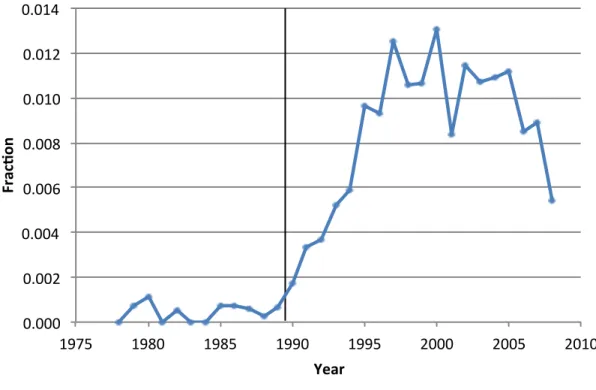
Thus, the divergent interests and capabilities of Soviet and American mathematics that had emerged in earlier decades were not likely to have been modified in the 1980s by any serious belief that the Soviet isolation would soon end. As Figure II shows, the
negligible pre-‐1990 rate of co-‐authorship between mathematicians reporting Soviet research addresses and mathematicians reporting U.S. addresses does not engender the hope that the number of such collaborations would suddenly explode.
Around 1990, as the political situation changed in the Soviet Union, a large number of Soviet mathematicians began to come into regular contact with Western mathematicians through visits and immigration. According to American mathematicians who witnessed this
sudden increase in contact opportunities, the effect on American mathematics was immediate. In 1990, the New York Times reported (Kolata 1990):
“American scientists say they have benefited immensely from the [recent] Soviet visitors. . . Persi Diaconis, a mathematician at Harvard, said: ‘It's been fantastic. You just have a totally fresh set of insights and results.’ Dr. Diaconis said he recently asked [Soviet mathematician] Dr. Reshetikhin for help with a problem that had stumped him for 20 years. ‘I had asked everyone in
America who had any chance of knowing’ how to solve a problem . . . No one could help. But . . . Soviet scientists had done a lot of work on such problems. ‘It was a whole new world I had access to,’ Dr. Diaconis said. ‘Together, we'll be able to solve the problem.’”
Inevitably, the American mathematical community also experienced increased
competition in hiring.10 The American Mathematical Society’s 1991-‐1992 Academic Hiring
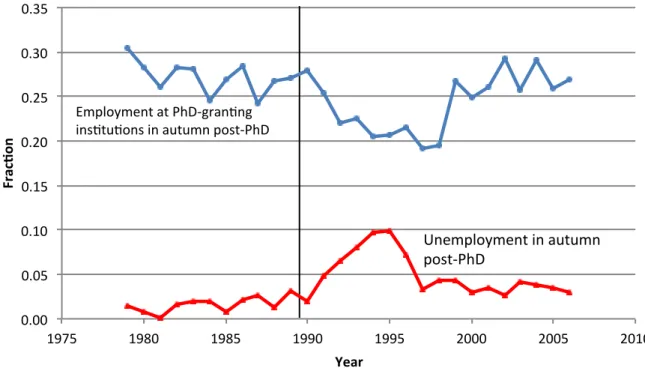
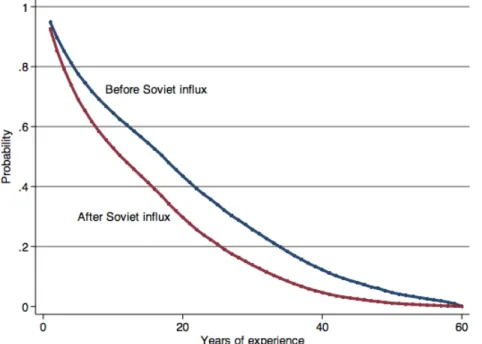
Survey reports that: “Citizens of Eastern European countries and the former Soviet Union accounted for 13% of all newly-‐hired faculty and 15% of the tenured and tenure-‐eligible new hires” (McClure 1992, p. 311). The report also identifies “increased numbers of highly qualified recent U.S. immigrants seeking employment in academia” as a leading cause of the unprecedented 12 percent unemployment rate of new American mathematics Ph.Ds. in 1991 (McClure 1992, p. 312).11 Figure III illustrates the employment trends of newly
minted doctorates from North American institutions. It is evident that there was a dramatic increase in the unemployment rate (as well as a dramatic decrease in the probability of
10 For example, Soviet mathematician Nicolai Reshetikhin not only helped Professor Diaconis with his puzzle, but also accepted a job as a Visiting and Assistant Professor at Harvard from 1989 through 1991.
11 At the same time that the unemployment rate of newly minted mathematicians was rising rapidly in the early 1990s, the economy-‐wide unemployment rate for college graduates was falling from 3.2 to 2.2 percent between 1992 and 1996.
obtaining a position in research universities) at the same time that the Soviet influx was occurring.12
It is clear that the ability to communicate and collaborate on a one-‐to-‐one basis (and especially emigrate) increased greatly after the collapse of the Soviet Union. As Diaconis discovered, ideas and knowledge became much easier to share. The economics of
innovation literature distinguishes between two broad types of knowledge: codified knowledge and tacit knowledge. Codified mathematical knowledge is recorded in journal articles and books, while tacit knowledge is part of the un-‐codified human capital of mathematical practitioners.13
Both codified and tacit mathematical knowledge were costly to share during the Soviet era, even though translations of Soviet papers in academic journals were often available.14 Moreover, some of the codified knowledge remained un-‐translated. Soviet
scientists often published their best work in books: “The Russians are prolific producers of books . . . and the consensus of experts is that the best Russian authors reserve some of their best work for books which often constitute first publication of important research
12 The exodus of key scientific personnel from the former Soviet Union to the West led George Soros to establish a program that provided research funds to those scientists who chose to remain; see Ganguli (2010) for an analysis of the impact of this program on career choices.
13 “Typically, new knowledge and expertise have a broad tacit dimension, meaning that they are neither articulated nor codified. Tacit knowledge resides in people, institutions, or routines” (Foray 2004, pp. 17-‐18). 14 The National Science Foundation, American scientific societies, and private businesses had begun
translating Soviet scientific journals from Russian into English as far back as 1949 (O’Dette 1957). It would seem, therefore, that the collapse of the Soviet Union represents but a trivial change in the cost of obtaining access to the specific type of codified knowledge contained in journal articles. But the citations results described below suggest that Americans may not have read as much Soviet work as would be expected, and history records famous examples of American unfamiliarity with important Soviet journal articles that were available during the Cold War: “…Even when high-‐quality translations are readily available, the information can still be lost if they are not read. . . . In January 1962, the National Aeronautics and Space Administration announced that Explorer XII, a satellite launched in August 1961, had discovered a new radiation belt with an 'unexpected boundary' at 40,000 miles from the earth. In fact, the same belt was discovered by Soviet rockets in 1959 and this was reported in translations of Soviet Physics Dolkady in 1960 and Soviet Astronomy AJ in 1961” (Tybulewicz 1970, pp. 55-‐56).
information” (O’Dette 1957, p. 581). But even though mathematics books contained some of the most important Soviet results, Abramitzky and Sen (2011) report that the translation rate of hard-‐science Eastern Bloc books into English was extremely low. After the collapse of the Soviet Union, tacit mathematical knowledge and an easy introduction to the codified knowledge were as close as a phone call, an unobstructed correspondence, or even a knock on the office next door.15
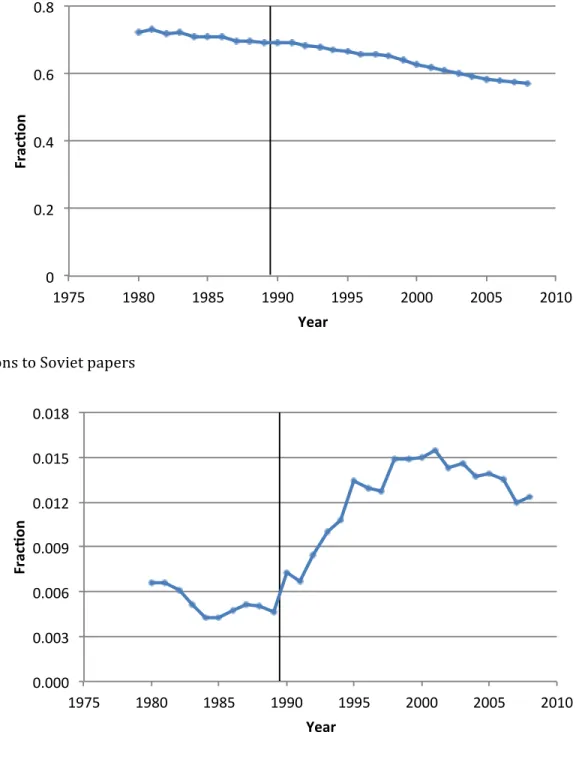
Evidence of this knowledge shock is apparent in the citation trends of American mathematicians to Soviet and American articles. Figures IVa and IVb show the number of citations that American mathematicians made to other American papers during the period, as well as the citations Americans made to Soviet papers (defined as papers published by an author using a Soviet affiliation).16 Both before and after the collapse of the Soviet
Union, most American mathematicians exhibit “home bias,” preferring to cite results in other American papers. Considering that the total number of American papers was only three times that of the Soviet Union, this home bias is extreme. Nevertheless, there is a substantial increase in the number of citations to Soviet papers after 1990. In fact, the share of American citations to Soviet research approximately tripled. It is remarkable that
15 The inadequacy of the international phone infrastructure during the Soviet era is legendary, making scientific collaboration harder, but undoubtedly making the KGB’s job of hampering such collaboration easier: “The international telephone transit center in Moscow . . . has a capacity of 1,500 circuits . . .This exchange has to handle all the international calls from the RSFSR [Russian Republic], as well as calls in transit from the other republics and from a number of Eastern European and other socialist countries. Since it allows a maximum of around 800 outgoing calls at any one time, it constitutes a major bottleneck in communications between the USSR and the rest of the world. Moreover, most circuits are dedicated to links with Eastern European and other socialist countries; there are, for example only 40 circuits for calls to the United Kingdom, 25 to France and 16 to the United States” (IMF 1991, p. 128).
16 Since an author’s geographic location is only rarely available before 1978, we construct the statistic as follows. The numerator is the number of citations to American (or Soviet) papers written between 1978 and year t made by American papers written between 1978 and t. The denominator is the total number of citations to papers with a valid research address written between 1978 and t made by American papers written during that time.
Soviet papers should become much more cited since many of the Soviet Union’s best mathematicians had emigrated, and many of them were in the United States. It is equally remarkable that there was also an increase in citations to “old” Soviet work (i.e., papers written before the fall of communism). Relative to its pre-‐treatment trend, the citation share of “old” Soviet papers out of the citations to all papers became 40 percent higher after the fall.17
In sum, the collapse of the Soviet Union was associated with a decrease in the cost of accessing both codified and tacit knowledge, and the resulting diaspora of Soviet
mathematicians after 1992 led to both a mathematical labor supply shock and a mathematical knowledge shock in many countries.
III. Data and Summary Statistics
Our data are drawn from three distinct, but related sources. The Supplementary Data Appendix gives a more detailed description of the data sets and the construction of the samples.
First, the American Mathematical Society (AMS) provided us with a database that reports the number of papers published by every mathematician, by field and year.18 In
addition to the information on the number of papers, the AMS data reports the
17 To calculate the frequency of citations made by American papers to pre-‐1990 Soviet papers, we calculated the following fraction: the denominator is citations made by American papers published each year to any papers with identifiable research addresses written between 1978 and 1989; the numerator is the number of such citations to papers that had at least one author in the Soviet Union. We then estimated a simple
regression of the log citation share on: year, year squared, and a post-‐1990 indicator variable. The model’s fit is improved substantially by the inclusion of the post-‐1990 dummy variable, and its coefficient implies a 40 percent increase in American attention to pre-‐1990 Soviet work after the collapse of the Soviet Union, 18 The AMS file provided to us contains information for all mathematicians who have published at least one paper since 1939.
mathematician’s institutional affiliation at the time the paper was published, as well as the location of the affiliation. The AMS, however, only began to collect the affiliation
information on a systematic basis around 1984, so that affiliation and location are not typically available for earlier papers. The AMS database also contains information on the number of citations received by the papers, but the AMS citation data is incomplete. In particular, it only counts citations in a limited number of journals (which include the most important journals in mathematics), and only reports the post-‐2000 citations received by a paper (regardless of when the paper was published).
The AMS database has two features that make it invaluable for the type of empirical analysis that we conduct in this paper. First, the AMS devotes significant resources to ensure that every person who has ever published in mathematics is assigned a unique numerical ID that allows him to be distinctly identified even from other mathematicians who share the same name.19 Second, the editors of Mathematical Reviews assign each
publication in mathematics to one of the many fields that make up the study of
mathematics. The AMS provided us with the author-‐year-‐field information at the two-‐digit field level, identifying publications by each mathematician in each of 63 different fields. In short, the AMS data gives us a complete history of a mathematician’s publications,
affiliations (since around 1984), and fields.
Our second data source is the Thomson Reuters’ Institute for Scientific Information (ISI) Web of Science archive. This archive records the titles, publication source, author
19 As an example of this precision, we learned from personal communication with Professor Victor Kac of MIT that after he defected from the Soviet Union in 1977, he had to publish his work with his Soviet advisor (who remained in the USSR) under the Italian pseudonyms Gatti and Viniberghi, since otherwise the paper would need special permission from the authorities to be published abroad. Despite the difference in names between Gatti and Kac, the AMS database correctly lists the article under the unique author identifier for Victor Kac.
names, references, and citations of millions of articles from thousands of journals
worldwide. For many articles, the database reports research and reprint addresses for each author (and the location information is systematically available since around 1978). Most important, the ISI database contains complete citation information for each article in a primary set of over 7,000 journals, selected to include all of the most important journals in each field. Articles in marginal journals also appear in the database if they either cite an article in the primary database or are cited by such an article.
We purchased the records of all 1.2 million articles in the primary ISI Web of Science database between 1970 and 2009 for the following categories: Mathematics,
Applied Mathematics, Interdisciplinary Applications of Mathematics, Mathematical Physics, and Statistics and Probability. We also purchased the records of the additional 4.4 million articles that are either referenced by these main articles or that cite these main articles. The American Mathematical Society then gave us permission to conduct a paper-‐by-‐paper match of our ISI database with the AMS internal archives. We obtained 882,088 matches out of the 1,753,148 journal articles in the AMS database for the relevant period, or just slightly over a 50 percent match rate.
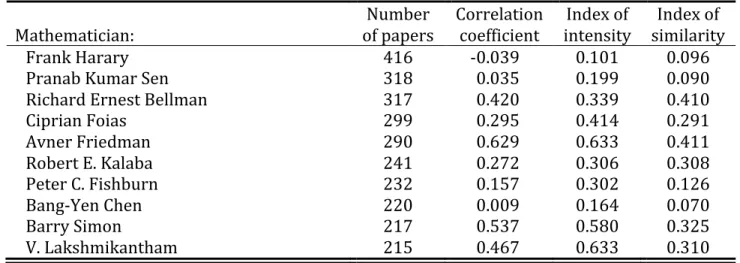
The AMS/ISI databases provide two alternative measures of citation counts for mathematicians. Neither measure is perfect. The AMS citation data is limited in scope; it canvasses only a select number of journals and only includes the post-‐2000 citations made to mathematical papers. The ISI citation data has a much broader scope (many more journals) and counts all citations to a paper (not just those made after 2000). However, ISI citation counts are the result of an imperfect matching process that may be missing a
sizable number of mathematicians and papers.20 In fact, the matching process is
particularly problematic for foreign countries where the spelling of authors’ names creates matching difficulties (in particular, the Soviet Union). Not surprisingly, the match rate for papers written between 1984 and 1989 by an author using an American affiliation is 59 percent, while the respective match rate for papers written for authors using a Soviet affiliation is 16 percent. Our empirical evidence is robust to the citation measure we use. Nevertheless, we will generally use the ISI citations data when we examine the productivity of American mathematicians, and use the AMS data when we make international
comparisons.
Finally, the Mathematics Genealogy Project (MGP) gave us access to their entire archives. The MGP provides detailed information on doctoral degrees awarded in
mathematics since the 14th century. The record for each degree contains the name of the
mathematician, the name of the advisor, the title of the dissertation, and the name and location of the institution granting the doctoral degree.
The MGP data, of course, allow a detailed construction of the genealogical tree in the development of mathematics since it can completely link any given mathematician to all his intellectual ancestors and descendants. Equally important, the AMS and MGP have worked jointly to ensure that the unique author ID developed by the AMS can identify
mathematicians in the MGP database. By using this unique identifier, we then matched
20 There is a steady increase in the match rate over time, from about 40 percent for journal articles published in the late 1970s to around 75 percent for articles published after 2002. We are able to match over 90 percent of the papers for the most prolific mathematicians during the period, suggesting that some of the missing articles are in marginal journals not covered by the ISI database. As a result, the citation-‐weighted count of the number of missing articles is likely to be low.
every single advisor and student in the MGP data to their publication histories in the AMS data (and to their citations history in the ISI).
We use these data to construct samples of “active” American mathematicians and Soviet émigrés. The population of mathematicians who were active prior to the collapse of the Soviet Union is given by the sample of persons who published at least one paper between 1970 and 1989.21 We use the AMS or ISI data to establish the location of the
affiliations associated with the various publications in the mathematician’s history. A “predominantly” American mathematician is someone who used an American affiliation more than half the time in the pre-‐1990 period.22 If the AMS/ISI data do not contain any
usable information on the mathematician’s affiliations, we then use the MGP data to
determine the country where the mathematician received his or her doctoral degree. Prior to 1978, over 85 percent of mathematicians who received their doctoral degrees from an American institution were either American citizens or permanent residents. Moreover, 65.3 percent of the small group of doctoral recipients who were temporary residents stated that they intended to stay in the United States.23 Hence we supplement the sample of
predominantly American mathematicians by also including persons who, in the absence of any specific affiliation information between 1978 and 1989, received their doctoral degree from an American institution between 1960 and 1978.
21 In addition, we restrict the sample to mathematicians whose first publication appeared in print in or after 1940.
22 More precisely, the mathematician used an American affiliation in more than half of the papers published prior to 1990.
23 These statistics are calculated using the NSF Survey of Earned Doctorates, an annual survey that contains demographic information for the recipient of every doctoral degree awarded in the United States since 1957.
The definition of the universe of Soviet mathematicians follows analogously. We first use the AMS or ISI data to determine if the mathematician reports a Soviet affiliation. We classify anyone who used a Soviet affiliation more than half the time prior to 1989 as a “Soviet mathematician.” In the absence of any affiliation data, we again supplement the sample by including all the mathematicians who received their doctoral degree from a Soviet institution between 1960 and 1989. From this universe, we then define the subsample of Soviet émigrés as the group whose modal affiliation after 1992 was in a country outside the geographic boundaries of the former Soviet Union.24
These definitions yield a pre-‐existing population of 29,392 predominantly American mathematicians and 12,224 Soviet mathematicians. We also estimate that 1,051 of these Soviet mathematicians emigrated after the collapse of the Soviet Union, with 336 of the émigrés moving to the United States.
Figure Va illustrates the frequency distribution of publications for the sample of predominantly American mathematicians, conditional on the mathematician having
published at least one article between 1978 and 2008. Not surprisingly, the modal number of publications is only one paper for the entire period. Similarly, Figure Vb shows that the modal number of citations for mathematicians who have published at least one paper is zero. The modal outcome for active mathematicians, therefore, is to publish one paper over a long career span, and for that paper to go unread or, at least, un-‐cited.
Table I reports summary statistics for the samples of predominantly American mathematicians, Soviet mathematicians who emigrated to the United States, Soviet
24 By construction, an émigré must have published after 1992 (otherwise, we would never observe his post-‐ 1992 affiliation).
mathematicians who emigrated to other countries, and the residual group of Soviets who remained within the geographic boundaries of the former Soviet Union. The data reported in Table 1 can be used to contrast the productivity of Soviet émigrés in the United States to that of other Soviet mathematicians and to that of pre-‐existing American mathematicians. The most striking finding is the very large degree of positive selection that characterizes the group of Soviet émigrés in the United States.
Prior to their migration to the United States, the future émigrés were significantly more productive in terms of the number of papers published and citations received. For example, before 1992 the average (future) émigré had published 10 more papers and received 66 more citations (in the AMS data) than the typical Soviet who remained in the Soviet Union. He had also published 3 more papers than the Soviets who emigrated
elsewhere, and had received over 40 more citations. After 1992, the émigrés’ productivity in the United States far surpassed that of the pre-‐existing American mathematicians. Between 1992 and 2008, the average Soviet émigré published 20 more papers than the average American, and those papers received 143 more citations. In short, the Soviet émigrés originated in the upper tail of the skill distribution of mathematicians in the Soviet Union and quickly moved into the upper tail of the skill distribution in the American
mathematics community.
Table I also documents that the Soviet émigrés differ in other dimensions. Consider, for example, the breadth of a mathematician’s interests, as defined by the number of fields in which the mathematician has published over his or her career. The median number of fields of publication for both the American mathematicians and the Soviet mathematicians who remained in the Soviet Union is 2.0. In contrast, the median number of fields for Soviet
émigrés in the United States is 5.5. It is very unusual for a mathematician to publish in more than 5 distinct fields, and only a small (and select) group of American mathematicians do it.25
The Soviet émigrés in the United States are also somewhat older. Nearly 40 percent of the émigrés received their degree after 1980. In contrast, 45 to 50 percent of American and other Soviet mathematicians received their degree after 1980.
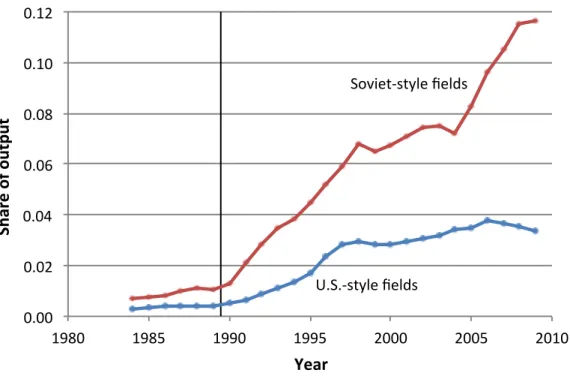
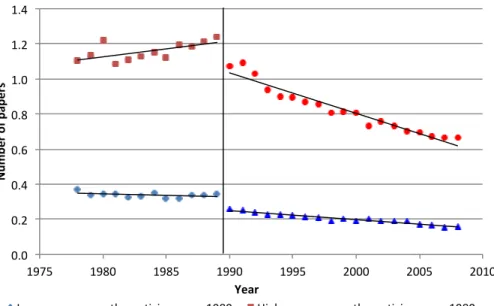
Finally, Figure VI illustrates how the entry of the émigrés into the American mathematics community affected the supply of pre-‐existing mathematicians in different fields differently. The “supply shock” is calculated separately for two different types of fields: Soviet-‐style and American-‐style fields. Soviet-‐style fields are the 10 most relatively popular fields in the Soviet Union (i.e., the 10 fields at the top of Figure 1), while American-‐ style fields are the 10 most relatively popular fields in the United States (i.e., the 10 fields at the bottom of Figure 1). We then estimated the output share of Soviet papers in each of these categories by year.26
Figure VI shows that the supply shock, as defined by the fraction of total papers published by Soviet émigrés, was very large for the fields emphasized by pre-‐shock Soviet mathematicians, and was very small for the fields that were dominated by American
25 American mathematicians who publish in many fields are far more prolific than those who specialize in a small number of fields. On average, mathematicians who published in only one or two fields published a total of 6.1 papers between 1978 and 2008. The average total number of papers for mathematicians who
published in at least 10 fields is 92.2.
26 Specifically, the denominator of each fraction is the number of papers in the given subfields published in the United States by authors who were active before 1990, but never had a Soviet affiliation. The numerator of each fraction is the number of papers in the given subfield published in the United States by authors who were active before 1990 and had a former Soviet affiliation. A small group of “defector” Soviets arrived before 1990, mostly in the late 1970s to early 1980s. This group was only about one-‐tenth the size of the group of émigrés who arrived after the collapse of the Soviet Union. Figure 6 includes the paper-‐weighted impact of these defectors during their time in the United States, confirming that the paper-‐weighted size of the influx of Soviet émigrés after the fall of communism was far greater than that of the prior arrivals of defectors.
mathematicians. The fraction of papers published in the United States by Soviet émigrés in “Soviet-‐style” fields rose from a negligible fraction before 1992 to about 12 percent. In contrast, the fraction of papers published by the Soviet émigrés in “American-‐style” fields was below 4.0 percent throughout the post-‐1992 period. In sum, not all American
mathematicians were equally affected by the Soviet influx, and it is this differential shock that provides the strategy for identifying the productivity impact of the collapse of the Soviet Union on American mathematics.
IV. Measuring the Productivity Impact
We now examine the extent to which “field overlap” between Soviet and American mathematicians altered the productivity of the latter after the émigrés arrived.
There are many channels through which such productivity effects can arise. The flood of new ideas and theorems could perhaps have spawned a new “Golden Age” as the pre-‐existing American mathematicians digested and incorporated the new knowledge into their research agendas. At the same time, however, the total number of mathematics faculty jobs, as well as the fraction of resources that deans and administrators allocate among the various subfields of mathematics, is likely constrained and relatively inelastic. The sudden presence of experienced and highly productive Soviet émigrés who may compete for jobs with newly minted doctorates would then almost certainly have a “crowd-‐out” effect on the paid research jobs that American mathematicians would have otherwise filled.27
27 There are other sources of scarcity that can create crowd-‐out effects, such as the limited attention span of field leaders. There are insurmountable constraints on how much new knowledge a scientist can absorb, so that the location of the “marginal” article that gets ignored moves upwards in the distribution of publications after the influx of Soviet mathematicians. Reasonably good articles that would otherwise have generated some attention will then remain unread and un-‐cited.