December 13, 2016
Geo-Restricted In-Video Annotations
Justin Lewis Joseph Cohen
Follow this and additional works at:http://www.tdcommons.org/dpubs_series
This work is licensed under aCreative Commons Attribution 4.0 License. Recommended Citation
Lewis, Justin and Cohen, Joseph, "Geo-Restricted In-Video Annotations", Technical Disclosure Commons, (December 13, 2016)
GEO-RESTRICTED IN-VIDEO ANNOTATIONS
ABSTRACT
Disclosed herein are systems and methods for video annotation that allow a content creator to specify whether a video annotation appears or changes based on the viewer’s
geolocation to provide relevant content. The system uses four core components viz. video
annotation editing tool, annotation storage mechanism, video metadata serving system and
conversion mechanism. When a user clicks on media in a client application to view a video,
the conversion mechanism converts the profile data of the user into geographic data using
GPS or other methods. The metadata server then applies the geographic restrictions (step F)
and shows the video with the annotations appropriate to the geolocation. The client
application could provide the user with a manual override to specify viewing annotations of a
different geolocation. The system of video annotations gives content creators and publishers
the ability to create interactive elements within their videos to merchandise, thereby
providing significant monetization opportunities.
BACKGROUND
Content creators are constantly seeking additional ways to increase monetization of
their online media channels. As a result, online media remains vulnerable to competitors who
can offer creators higher monetization through traditional means, as well as new ways to
monetize their content. One significant way of monetizing content is through merchandise
sales. Many creators offer merchandise to supplement their online media income. However,
the physical merchandise they offer often contains language-specific text and shipping of the
Often 80% of online media watch time comes from a different country than the
content is created in. Currently creators geotag their content, but do not allow targeting
annotations to their viewers based on geolocation. So when a creator has a product that is
available in multiple languages, for example, the creator must pop up an annotation in a
single language to the most popular version, or to all the versions. The creator cannot pop up an annotation in the user’s language to the version most likely to appeal to the user.
Additionally, if the creator has a product that is only available in certain countries, the creator
may annoy users who cannot purchase the merchandise with the annotation or leave the
annotation out completely which may cause people to stumble across the merchandise in their
online store. Therefore, the existing annotation system reduces cost of creator revenue. Thus
there is a need for a better method to allow a creator to restrict video annotations by the viewer’s geolocation to merchandise their product effectively.
DESCRIPTION
This disclosure presents a video annotation system and a method to allow a content
creator to specify whether a video annotation appears or changes based on the viewer’s
geolocation. Video annotations with a user facing feature may be used to give content
creators and publishers the ability to make interactive elements within their videos to
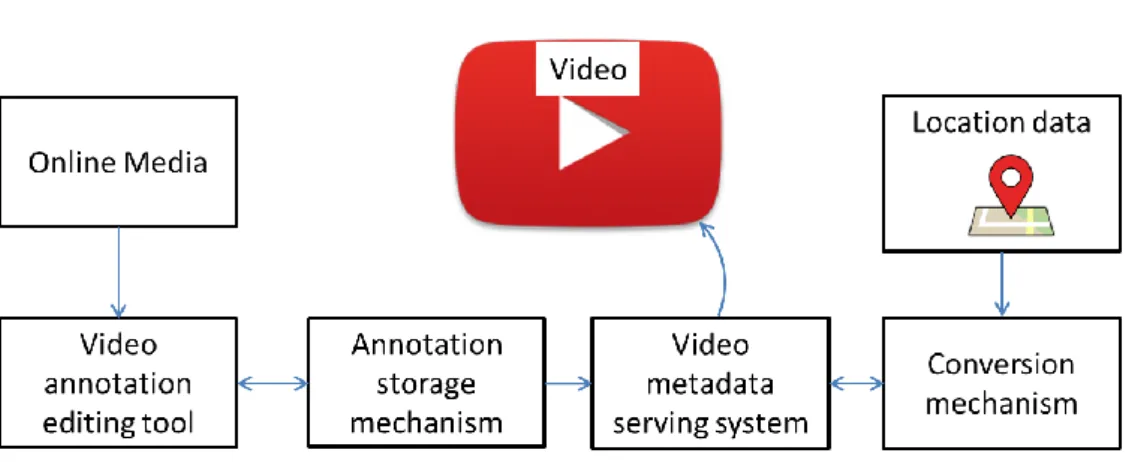
merchandise. The system depicted in FIG. 1 identifies specific geo-restricted location for
displaying a video annotation by using four core components viz. video annotation editing
tool, annotation storage mechanism, video metadata serving system and conversion
mechanism. The method creates a substantial alternative monetization strategy for online
FIG. 1: System for geo-restricted in-video annotation
Video annotation editing tool – This tool helps the content creator specify which countries
the annotation will appear on the video in.
Annotation storage mechanism –This mechanism stores the annotation details alongside the
video. The video metadata payload which includes annotation data is created on the server
side via remote procedure call (RPCs) stored in a video metadata service. Alternatively the
video metadata payload or annotation payloads may be created on the client side and stored
via an RPC.
Video metadata serving system – This system serves metadata for a video and includes the
player configures which houses all of the streaming urls and annotation payloads. This
system will reference the stored metadata and build an appropriate player configuration for
the client.
Conversion mechanism –The conversion mechanism will typically use the IP address of the
client device to determine the geo location. This mechanism would also provide a feature for
users to specify within their client application a geolocation override so they can view the
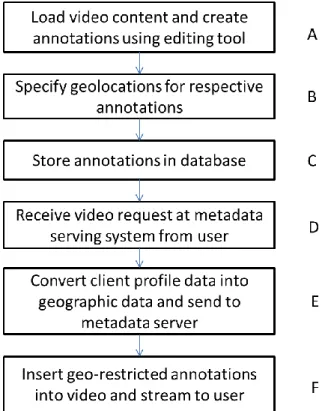
The method for specifying a specific geolocation restriction for a video annotation
illustrated in FIG. 2 is implemented in steps A through F. In the first step (A) the video
content is loaded onto the annotations editing tool and annotations are created. In step B, the
countries or geolocations where the respective annotations are required to be shown are
specified. In step C, the annotations and the specified location conditions are stored in a
database or metadata serving system. When a user clicks on media in a client application to
view a video (step D), the metadata serving system receives the request and invokes the
conversion mechanism to convert the profile data of the user into geographic data (step E)
using GPS or other methods. The metadata serving system references the stored annotation
metadata and build an appropriate player configuration for the user. As part of this process it
will loop through all of the annotations from the stored metadata and include in the player
configuration only those annotations whose geographic restrictions are met by the user
profile. The client application could provide the user with a manual override to specify
viewing annotations of a different geolocation, if required. In the final step, the metadata
server applies the geographic restrictions (step F) and shows the video with the annotations
FIG. 2: Method of geo-restricted in-video annotations
The method allows the creator to insert geolocation-specific annotations at the points
in a video that are most relevant to users in that location, with the merchandise likely to
appeal to users in that location. Therefore, the method does not force users to view potentially
unrelated advertisements every time an annotation appears that might appeal to users in a
specific location.
In-video annotations as disclosed here are different from simple links on websites
because they provide a substantially better user experience by appearing only at relevant
times and in relevant locations within the media. Further video annotations function on a
variety of platforms including not only the embeddable video player on web properties, but
to cover advertising costs. It also assures creators that their merchandise annotations may be
displayed at the appropriate times to the appropriate users regardless of what the ad algorithm
considers the appropriate ad should be.
The merchandise critical implementation requires creators to specify countries for the
annotation to show up in the video. The content creator may make separate annotations for
each variant of the annotation. The content creators could also specify unique annotations
based on the viewer's language. Alternatively, content creator can specify multiple variants
of the same annotation for each country or local region.
Content creators can specify unique annotations based on the viewer's language. For
example, a content creator may use different web or deep links depending on the language of
the viewer so the site link appears in the correct language or the product has the correct
language variant such as books. Some of the most popular music is bilingual usually 50/50
Spanish and English, and this music content might include unique annotations for each
language of the viewers.
Online media has improved monetization features for creators including features for
selling merchandise within their videos. Selling and linking to merchandise is critical because
physical goods often have limited availability geographically and often 80% of online media
watch time comes from a country different from the country where the video is originally
implemented.
Social networking or music streaming sites may use this system to encourage creators
by offering them an additional revenue stream not currently available on other platforms.
Music streaming websites could offer geo-targeted annotations at specific points in a song.
For example, if a song mentions a luxury item, such as a purse, this could provide a way for
the artist to place a link for users to purchase that item in their country. Other online media
example, if an episode of a show spawns a pop culture phrase, such as Joey saying “How you doin?”, an annotation could be displayed when the catch phrase is said offering merchandise
with the catchphrase translated to various languages.
News broadcasters may use this system to offer merchandise related to topics being
discussed in a given broadcast. For example, if an author is interviewed regarding his book,
an annotation can be displayed with the location-specific version of the book to help users
quickly locate it on any shopping site. Movie studios and other media creators can use this to
take media product placement to a whole new level.
Currently brands pay creators to place their products in media in exchange for a set
fee. That model will evolve into a cost per impression or percentage of sales model once
media creators can directly sell products by embedding the sales information in their media.
This may also allow smaller creators of online media to monetize their videos with brands
that would otherwise be too large to sponsor them. Thus the system has a user facing feature