The Validity Issue in Mixed Research
Anthony J. Onwuegbuzie
University of South Florida
R. Burke Johnson
University of South Alabama
This paper is focused on validity in mixed methods
research or what we refer to more broadly as mixed
research. However, to understand the validity issue (i.e., quality) in mixed research, a brief review of some related discussions in quantitative and qualitative research will be helpful for orientation. Because these issues have been discussed elsewhere in great detail, we provide only brief summaries of those literatures, but first we want to make a few introductory comments about our general approach to research validity or quality.
We try to take a “middle of the road” position, seeing some truth and insight to be gained from multiple perspectives. Our approach is only one among many, and we recommend that readers examine additional perspectives as more work is carried out in this emerging area in mixed methods research as well as in the more traditional areas of qualitative and
quantitative research quality. The “validity” issue, at least as we use the term, is not about singular truths, and it certainly is not limited to quantitative measurement; rather, by validity we mean that a research study, its parts, the conclusions drawn, and the applications based on it can be of high or low quality, or somewhere in between. Research needs to be defensible to the research and practice communities for whom research is produced and used. The arbiters of research quality will be the research stakeholders, which means that the quality or validity issue can have subjective, intersubjective, and objective components
and influences.At the same time, research is something
about which we can “rationally” speak, and usually, after considering our external and our internal or epistemic standards, we can meaningfully assert that some research is of higher quality for certain purposes than is other research (Longino, 1990). Anthropology, sociology, and psychology teach us that communities, cultures, and various kinds of groupings (including
communities of researchers) have some shared norms,
practices, values, and beliefs.
We aim our sense of justification at the research
community that sees many advantages to sometimes
using both qualitative and quantitative research in their single or highly related sets of research studies. One of the exciting results of much mixed research is that in a
In quantitative research, the importance of validity has been long accepted. In qualitative research, discussions of validity have been more contentious and different typologies and terms have been produced. In mixed methods research, wherein quantitative and qualitative approaches are combined, discussions about “validity” issues are in their infancy. We argue that because mixed research involves combining complementary strengths and nonoverlapping weaknesses of quantitative and qualitative research, assessing the validity of findings is particularly complex; we call this the problem of integration. We recommend that validity in mixed research be termed legitimation in order to use a bilingual nomenclature. Tashakkori and Teddlie’s (2003, 2006) evaluation criteria frameworks involving the concept of inference quality are summarized. Although providing a framework for assessing legitimation in mixed research always will be incomplete, it is important to address several legitimation types that come to the fore as a result of combining inferencesfrom the quantitative and qualitative components of the study into the formation of meta-inferences. Nine types of legitimation are described here in order to continue this emerging and important dialogue among researchers and methodologists.
Correspondence should be addressed to Anthony J. Onwuegbuzie, Dept. of Educational Measurement and Research, College of Education, University of South Florida, 4202 East Fowler Ave., EDU 162, Tampa, Florida 33620.
single study practical questions can be addressed, different perspectives can be examined, and if well documented, practitioners can obtain some sense of what might be useful in their local situations. We do
not want to oversell mixed research, however; the
evidence will be in the results. If mixed research produces useful results over time, as well as useful theory, then progress will have been made. We agree with Kurt Lewin’s statement that “There is nothing so practical as a good theory” (Lewin, 1952, p. 169), and we hope that all researchers, including mixed
researchers, will attempt to produce good theories and
other research works.
Validity in Quantitative Research
In quantitative research, discussions of “validity” have been common and the importance of validity has been long accepted, and this is well documented in the literature. Building on the seminal works of Campbell and Stanley (Campbell, 1957; Campbell & Stanley, 1963), and many others, Onwuegbuzie (2003)
presented 50 different threats to internal and external
validity that might occur at the research design/data collection, data analysis, and/or data interpretation stages of the quantitative research process. These threats are presented in Figure 1, in what was later
called the Quantitative Legitimation Model. As
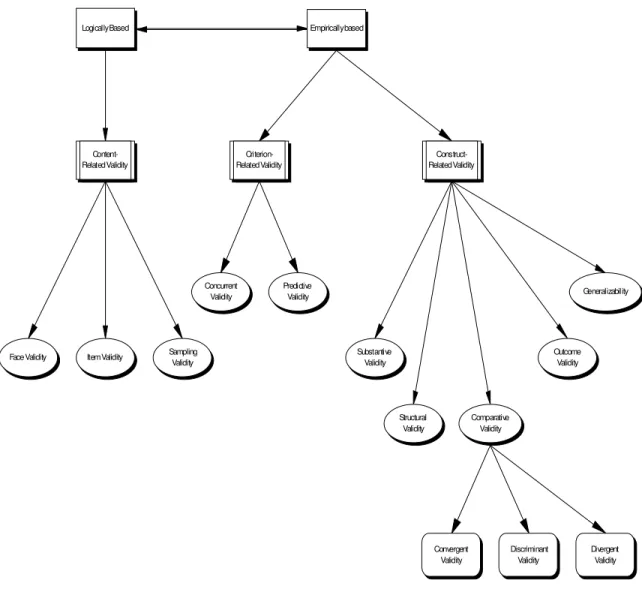
illustrated in Figure 1, Onwuegbuzie identified 22 threats to internal validity and 12 threats to external validity at the research design/data collection stage of the quantitative research process. At the data analysis stage, 21 and 5 threats to internal validity and external validity were conceptualized, respectively. Finally, at the data interpretation stage, 7 and 3 threats to internal validity and external validity were identified, respectively. In Figure 2, Onwuegbuzie, Daniel, and Collins’ (in press) have presented a schematic representation of instrument score validity, which also is provided here for review by interested readers.
Another very important work in validity in quantitative research is found in Shadish, Cook, and Campbell (2001). These authors continue to build on Campbell’s earlier work and classify research validity into four major types: statistical conclusion validity, internal validity, construct validity, and external validity. Other selected seminal works showing the historical development of validity in quantitative research are summarized in the following references: American Educational Research Association, American Psychological Association, and National Council on Measurement in Education (1999), Bracht and Glass (1968), Campbell (1957), Campbell and Stanley (1963), Cook and Campbell (1979), Messick (1989, 1995), and Smith and Glass (1987).
Validity in Qualitative Research
In the qualitative research paradigm, a primary focus is for researchers to capture authentically the lived experiences of people. As noted by Denzin and Lincoln (2005), “Such experience, it is argued, is created in the social text written by the researcher. This is the representational problem. It confronts the inescapable problem of representation, but does so within a framework that makes the direct link between
experience and text problematic” (p. 19). 2 Denzin and
Lincoln (2005) also argue for “a serious rethinking of
such terms as validity, generalizability, and reliability,
terms already retheorized in postpositivist…,
constructivist-naturalistic…, feminist…, interpretive…,
poststructural…, and critical…discourses. This
problem asks, ‘How are qualitative studies to be
evaluated in the contemporary, poststructural
moment?’” (pp. 19-20). 3, 4 Part of their solution to the
“validity issue” has been to reconceptualize traditional quantitative validity concepts and to use labels that are more acceptable to qualitative researchers (Lincoln & Guba, 1985, 1990). One set of criteria (Lincoln & Guba, 1985) includes the following types: credibility (replacement for quantitative concept of internal validity), transferability (replacement for quantitative
concept of external validity), dependability
(replacement for quantitative concept of reliability), and confirmability (replacement for quantitative concept of objectivity).
Another useful classification for validity in qualitative research was provided by Maxwell (1992), who identified the following five types of validity in qualitative research: descriptive validity (i.e., factual accuracy of the account as documented by the researcher), interpretive validity (i.e., the extent to which an interpretation of the account represents an understanding of the perspective of the underlying group and the meanings attached to the members’ words and actions), theoretical validity (i.e., the degree to which a theoretical explanation developed from research findings is consistent with the data), evaluative validity (i.e., the extent to which an evaluation framework can be applied to the objects of study, as opposed to a descriptive, interpretive, or explanatory one), and generalizability (i.e., the extent to which a researcher can generalize the account of a particular situation, context, or population to other individuals, times, settings, or context). With regard to the last validity type, Maxwell differentiates internal generalizability from external generalizability, with the former referring to the generalizability of a conclusion within the underlying setting or group, and the latter pertaining to generalizability beyond the group, setting, time, or context. According to Maxwell, internal
generalizability is typically more important to qualitative researchers than is external generalizability (see also, Maxwell, 2005).
Onwuegbuzie and Leech (in press-a)
conceptualized what they called the Qualitative
Legitimation Model, which contains 29 elements of legitimation for qualitative research at the following three recursive stages of the research process: research design/data collection, data analysis, and data
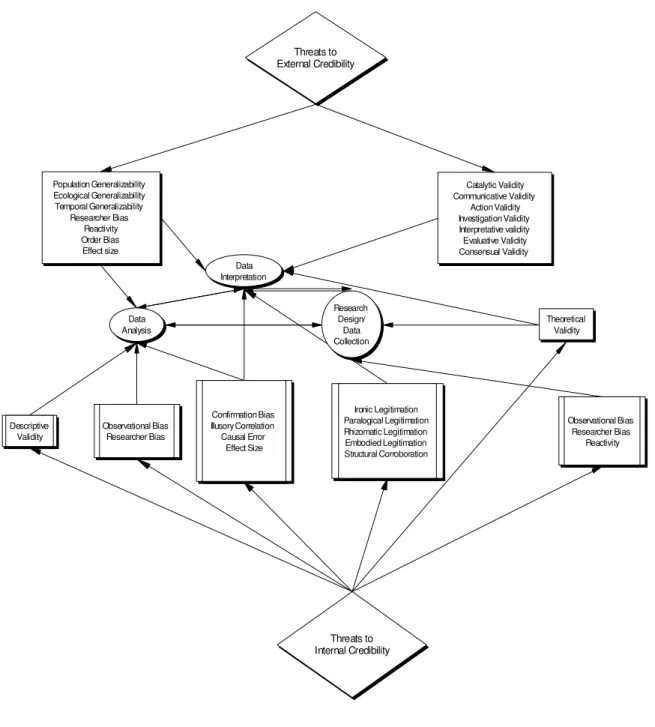
interpretation.1 As illustrated in Figure 3, the following
threats to internal credibility are viewed as pertinent to qualitative research: ironic legitimation, paralogical legitimation, rhizomatic legitimation, voluptuous (i.e.,
embodied) legitimation, descriptive validity, structural corroboration, theoretical validity, observational bias, researcher bias, reactivity, confirmation bias, illusory correlation, causal error, and effect size. Also in this model, the following threats to external credibility were identified as being pertinent to qualitative research: catalytic validity, communicative validity, action validity, investigation validity, interpretive validity, evaluative validity, consensual validity, population generalizability, ecological generalizability, temporal generalizability, researcher bias, reactivity, order bias, and effect size.
Res e arch Desig n/Data Co llectio n Data Analysi s Data Interpretatio n His tory Matu ratio n Te s tin g Instru m entatio n Sta tistica l Regre ss io n D ifferen tial Sele cti on o f Partici pant s
Mortal ity Selectio n In teractio n Effects
Im ple mentatio n Bia s Sa m ple Aug m entatio n Bia s
Beha vi or Bia s Ord er Bia s Observat iona l Bia s
Rese arch er Bia s Matchin g Bia s Treat ment Repli cation Error
Evalu atio n An xi ety Mul tipl e-Trea tm en t In terfe rence
Reactive Arrange ments Trea tmen t Diffusio n Time x Trea tm en t In teractio n History x Trea tm en t In teractio n
Popu lati on Valid ity Ecolo gic al Valid ity Tempo ral Valid ity Mul tipl e-Trea tm en t In terfe rence
Rese arch er Bia s Reactive Arrange ments
Ord er Bia s Matchin g Bia s Sp eci ficity of Vari able s
Trea tmen t Diffusio n Pre test x Trea tm en t In teractio n Se lection x Trea tmen t In teractio n
Sta tistica l Regre ssio n Restri cte d Rang e
Mortal ity Non-In teractio n See kin g Bia s
Type I - Typ e X Error Observationa l Bia s Res e arch er Bia s
Matchin g Bia s Treatment Repli cation Error
Vio late d As sum p tion s Mu lticoll inea rity Mi s-Specifi cation Error
Effe ct Size Co nfirm atio n Bia s Sta tistica l Regre ssio n
Di stort ed Grap hics Illu sory Correl atio n
Crud Factor Posi tive Man ifol d
Cau sal Error Popu lati on Valid ity
Res e arch er Bia s Sp eci fic ity of Vari able s
Matchin g Bia s Mi s-Specifi cation Error
Popu lati on Valid ity Ecolo gical Valid ity Tempo ral Valid ity Th reats to Ext ernal
Val idity/External R ep licatio n
Threats to Internal Va lidi ty/Internal
Rep licatio n Figure 1. Threats to Internal and External Validity
Because of the association with the quantitative conceptualization of the research process, the term validity has generally been replaced by the term trustworthiness within qualitative research. The vast and important literature on trustworthiness is exemplified and discussed in the following references from the qualitative research literature: Creswell (1998), Glaser and Strauss (1967), Kvale (1995), Lather (1986, 1993), Lincoln and Guba (1985, 1990), Longino (1995), Maxwell (1992, 1996), Miles and Huberman (1984, 1994), Onwuegbuzie and Leech (in press-a), Schwandt (2001), Strauss and Corbin (1998), and Wolcott (1990).
Validity in Mixed Research
Mixed research involves the mixing of quantitative and qualitative methods or paradigm characteristics into research studies (Johnson & Onwuegbuzie, 2004; Onwuegbuzie & Johnson, 2004; Tashakkori & Teddlie,
1998, 2003). According to the fundamental principle of
mixed research, it often should involve the combining of quantitative and qualitative methods, approaches, and concepts that have complementary strengths and nonoverlapping weaknesses (Brewer & Hunter, 1989; Johnson & Turner, 2003). This principle is meant to be
viewed broadly; it is not limited to triangulation or
corroboration. The words “complementary strengths” are meant to include all of the strengths of qualitative
Logically Based Empirically based
Content-Related Validity Criterion-Related Validity Construct-Related Validity
Face Validity Item Validity Sampling Validity Concurrent Validity Predictive Validity Substantive Validity Structural Validity Comparative Validity Outcome Validity Generalizability Convergent Validity Discriminant Validity Divergent Validity
and quantitative research. Therefore, the principle can be used for the five traditional purposes of mixed research identified by Greene, Caracelli, and Graham (1989). By “complementary strengths” we are implying a putting together of different approaches, methods, and strategies in multiple and creative ways.
Mixed research still is plagued by the problems of
representation, integration, and legitimation
(Onwuegbuzie, in press). The problem of
representation refers to the difficulty in capturing (i.e., representing) lived experiences using text in general
and words and numbers in particular. The problem of
legitimation refers to the difficulty in obtaining findings and/or making inferences that are credible,
trustworthy, dependable, transferable, and/or
confirmable. Indeed, in many instances, these problems are exacerbated in mixed research because both the quantitative and qualitative components of studies bring into the setting their own problems of representation and legitimation, likely yielding either an additive or a multiplicative threat—hence the
problem of integration.
Mixed research can be conceptualized as combining quantitative or qualitative research in a
Threats to External Credibility Threats to Internal Credibility Data Analysis Research Design/ Data Collection Data Interpretation Population Generalizability Ecological Generalizability Temporal Generalizability Researcher Bias Reactivity Order Bias Effect size Catalytic Validity Communicative Validity Action Validity Investigation Validity Interpretative validity Evaluative Validity Consensual Validity Ironic Legitimation Paralogical Legitimation Rhizomatic Legitimation Embodied Legitimation Structural Corroboration Descriptive Validity Theoretical Validity Confirmation Bias Illusory Correlation Causal Error Effect Size Observational Bias Researcher Bias Observational Bias Researcher Bias Reactivity
concurrent, sequential, conversion (Tashakkori & Teddlie, 2003; Teddlie & Tashakkori, 2006), parallel (Onwuegbuzie & Leech, 2004a), or fully mixed (Leech & Onwuegbuzie, 2005; Teddlie & Tashakkori, 2006) manner. Quantitative and qualitative approaches can be combined in these ways whether the study represents primary research (Johnson & Onwuegbuzie, 2004; Teddlie & Tashakkori, 2006) or a mixed synthesis of the extant literature (i.e., integrating the findings from both quantitative and qualitative studies in a shared area of empirical research; Sandelowski, Voils, & Barroso, 2006). Further, quantitative and qualitative approaches can be combined in these ways regardless of which approach has priority in the study (cf. Creswell, Shope, Plano Clark, & Green, 2006). In basic concurrent mixed designs, the following three conditions hold: (a) both the quantitative and
qualitative data are collected separately at
approximately the same point in time, (b) neither the quantitative nor qualitative data analysis builds on the other during the data analysis stage, and (c) the results from each type of analysis are not consolidated at the
data interpretation stage, until both sets of data have
been collected and analyzed separately, and (d) after collection and interpretation of data from the quantitative and qualitative components, a meta-inference is drawn which integrates the meta-inferences made from the separate quantitative and qualitative data and findings.
In basic sequential mixed designs, data collected and analyzed from one phase of the study (i.e., quantitative/qualitative data) are used to inform the
other phase of the investigation (i.e.,
qualitative/quantitative data). Here, the data analysis
begins before all the data are collected. At the highest
level of integration, referred to as sequential mixed model studies, “multiple approaches to data collection, analysis, and inference are employed in a sequence of phases. Each phase, by itself, may use a mixed
approach and provide conceptual and/or
methodological grounds for the next one in the chain” (Tashakkori & Teddlie, 1998, pp. 149-150). Sequential mixed designs also can be applied when conducting what Chen (1990, 2006) conceptualizes as theory-driven evaluations, via the following two strategies: (a) switch strategy (e.g., first applying qualitative methods to illuminate program theory of stakeholders and then use quantitative methods to assess the program theory) and (b) contextual overlaying strategy (e.g., utilizing qualitative approaches to collect contextual information for facilitating the interpretation of quantitative data or reconciling findings).
Conversion mixed designs involve data
transformation wherein one data form is converted into the other and then subsequently analyzed (Teddlie & Tashakkori, 2006). That is, the other data type evolves from the original data type either by converting the
data from quantitative to qualitative or from qualitative to quantitative. Moreover, conversion occurs via techniques such as quantitizing data (i.e., transforming the qualitative data to a numerical form; Tashakkori & Teddlie, 1998) or qualitizing data (i.e., converting quantitative data into data that can be analyzed qualitatively; Tashakkori & Teddlie, 1998). Both data types are analyzed/re-analyzed, and inferences are made based on both sets of analyses.
In parallel mixed designs, the data are collected and analyzed separately. In this respect it is similar to concurrent designs. However, while inferences are made in concurrent designs on both sources of data in an integrated manner, in parallel mixed designs, each data source leads to its own set of inferences, and no attempt is made to reach what Tashakkori and Teddlie (2003) refer to as a “meta-inference” (p. 686), in which both sets of inferences are combined into a coherent whole. Such designs lead either to (a) two separate reports that would be presented or published separately or (b) two separate write-ups that are presented in two distinct sections of the same report. Whereas some researchers do not consider these designs as representing mixed research (e.g., Yin, 2006) but rather quasi-mixed designs (e.g., Teddlie & Tashakkori, 2006), other researchers do (e.g., Onwuegbuzie & Leech, 2004a). Given the formative stage of mixed research, we see, as does Greene (2006), these current disagreements as being good for the field as it continues to develop through hard conceptual and empirical work.
Fully mixed research designs (Leech &
Onwuegbuzie, 2005), also known as fully integrated mixed research designs (Tashakkori & Teddlie, 2003; Teddlie & Tashakkori, 2006), involve mixing quantitative and qualitative approaches in an interactive way at all stages of the investigation (i.e., research objective, type of data/operations, type of analysis/inference; Onwuegbuzie & Johnson, 2004) such that at each stage, one approach (e.g., quantitative) influences the formulation of the other approach (e.g., qualitative). We agree with Teddlie and Tashakkori (2006) that fully mixed (and nearly fully mixed designs) are attractive because of the multiple points of integration.
Because of the complexity involved in combining qualitative and quantitative studies either in a concurrent, sequential, conversion, parallel, or fully mixed manner, mixed research gives rise to what we call the problem of integration. Surrounding this problem is the extent to which combining quantitative and qualitative approaches can address each of Greene et al. (1989) five empirically derived, general purposes
of mixed-methodological research studies: (a)
triangulation (i.e., seeking convergence and
corroboration of findings from different methods that study the same phenomenon); (b) complementarity
(i.e., seeking elaboration, illustration, enhancement, and clarification of the findings from one method with results from the other method); (c) development (i.e., using the findings from one method to help inform the other method); (d) initiation (i.e., discovering paradoxes and contradictions that lead to a re-framing of the research question); and (e) expansion (i.e., seeking to expand the breadth and range of inquiry by
using different methods for different inquiry
components). More generally, the problem of integration pertains to the extent to which combining quantitative and qualitative research techniques addresses one or more of Collins, Onwuegbuzie, and Sutton’s (2006) four rationales for mixing or combining qualitative and quantitative approaches: participant enrichment (i.e., mixing quantitative and qualitative techniques to optimize the sample using
techniques that include recruiting participants,
engaging in activities such as Institutional Review Board debriefings, and ensuring that each participant selected is appropriate for inclusion), instrument fidelity (e.g., assessing the appropriateness and/or
utility of existing instruments; creating new
instruments; performance of human instruments),
treatment integrity (i.e., assessing fidelity of
intervention), and significance enhancement (e.g., facilitating thickness and richness of data; augmenting interpretation and usefulness of findings).
The problem of integration motivates us to ask questions such as the following: Is it misleading to triangulate, consolidate, or compare quantitative findings and inferences stemming from a large random sample on equal grounds with qualitative data arising from a small purposive sample? How much weight should be placed on quantitative data compared to qualitative data? Are quantitatively confirmed findings more important than findings that emerge during a qualitative study component? When findings conflict, what is one to conclude?
Before discussing the issue of integration more carefully, we will point out that we do not believe that the goal of mixed research is to replace either quantitative or qualitative research. Rather, the goal of this third type of research is to utilize the strengths of two or more approaches by combining them in one study, and by attempting to minimize the weaknesses of approaches in mixed designs. Philosophically, mixed research generally follows philosophical and methodological pragmatism (with a very broad and
inclusive ontological realism where virtually
everything a qualitative or quantitative researcher deems to be real can be considered, in some sense, to be real, including subjective realism, intersubjective realism, and objective realism). (See Johnson & Onwuegbuzie, 2004 for more discussion on the role of pragmatism in mixed research, and Sanders, 1997 for more discussion about inclusive ontology.) By
pragmatism, we mean to search for workable solutions through the practice of research (e.g., follow the fundamental principle of mixed research, including the use of designs and criteria that are situation and context appropriate) to help answer questions that we value and to provide workable improvements in our world (i.e., help in bringing about desired outcomes). Our pragmatism includes a healthy dose of pluralism by which we mean that it is not logically contradictory to claim that quantitative and qualitative research are both useful, even if, at times, they appear to be contradictory; perhaps what is seen as contradictory are different perspectives that are complementary and enable one to more fully to see his or her world. Further, different standards of quality will be useful for different people in different contexts (see Patton’s, 2002, five different sets of criteria for judging the quality of qualitative research), which is reasonable as long as one makes these standards clear to avoid arguments based on equivocation (which can produce misunderstandings based on nothing more than different meanings of terms being used by different people because they “talk past” one another). Clarity of language use is especially important when people from different communities are the interlocutors. Arguments about values can be healthy, and at this time more discussion among qualitative, quantitative, and mixed researchers about values needs to take place in order to understand better each other. Different researchers have different values and beliefs about research approaches for addressing important questions, and this diversity when put together is not a problem; we see it
as a potential strength of research and practice,
especially when simple and clear solutions are not readily forthcoming. In short, diversity of this sort is not a problem needing to be fixed by someone. Our pragmatism also is eclectic, by which we are referring to the inclusion of multiple quantitative and qualitative techniques in one’s briefcase and then selecting combinations of assumptions, methods, and designs that best fit one’s research questions of interest.
In every mixed research study researchers must deal with the problems of representation, legitimation, and integration but discussions about validity issues that characterize these problems are still in relative infancy. Developing justified inferences is at the center of many problems in mixed research. In fact, Teddlie and Tashakkori (2003) and Tashakkori and Teddlie (2003) identified drawing inferences as one of the six unresolved issues and controversies in mixed research. The purpose of the remainder of this paper is to contribute to the present dialogue about validity (trustworthy or defensibility or quality) issues in mixed research. We will discuss the following three unresolved and, at times, contentious issues in the domain of validity in mixed research:
(a) Labels for criteria for assessing mixed research studies;
(b) conceptualization of legitimation in mixed research studies; and
(c) identifying some types of legitimation for mixed research.
Label for Criteria for Assessing Mixed Research Studies
As noted by Teddlie and Tashakkori (2003), a primary decision that confronts the field of mixed research is what to call the concept of validity in mixed research. Although the term “validity” is routinely used in quantitative research, this term is disliked by many qualitative researchers. In fact, as noted by Schwandt (2001), some qualitative researchers object to the concept of validity based on their rejection of the correspondence theory of truth. They argue that because validity is the test of this correspondence, validity does not exist because there simply is no single reality, with truth being partially arbitrary as
individuals interact with their worlds. These
researchers also believe in fallabilism (i.e., all
procedures for establishing legitimation represent “fallible means of making a case for a plausible and credible account”; Schwandt, 2001, pp. 268-269). Some qualitative researchers, although they believe that some validities are useful, contend that validity is always relative to a particular context, situation, language system, or worldview (Schwandt, 2001).
These researchers refer to contextualization (i.e.,
legitimation represents the standards set by a particular community at a specific time and place). Some qualitative researchers refute any relationship between validity and objectivism, the latter of which is viewed as foundational. These researchers are referred to as
representing strong orradical relativism (i.e., no single
account can be judged as being superior to any other). Some qualitative researchers (i.e., postmodernists) view the concept of validity (and the word) as representing a debunked modernist perspective that champions universal rationality, rules, order, logic, and the like. Thus, we conclude that use of the word
validity in mixed research can be counterproductive. One attractive solution to this problem is for mixed researchers to use an alternative word that is more acceptable to both quantitative and qualitative researchers. This solution involves what Teddlie and Tashakkori (2003) refer to as “using a bilingual nomenclature” (p. 12). In this respect, a possible term that might be acceptable to both quantitative and
qualitative investigators is legitimation. This would be
consistent with its use in the Onwuegbuzie (2003)
Quantitative Legitimation Model and the Onwuegbuzie
and Leech (in press-a) Qualitative Legitimation Model
presented in Figures 1 and 3. That is not to suggest that quantitative researchers should refrain from using the
term validity or that qualitative researchers should cease using terms such as trustworthiness, credibility, plausibility, and dependability. It only is to suggest that in the context of discussing the overall criteria for assessment of mixed research studies, we recommend that the term legitimation, or a similarly descriptive and inclusive term, be used.
Conceptualization of Legitimation in Mixed Research Studies
In one of the very few essays written on the topic of validity or quality criteria in mixed research, Teddlie and Tashakkori (2003) stated that mixed methods researchers “should adopt a common nomenclature transcending the separate QUAL and QUAN orientations when the described processes (QUAL and QUAN) are highly similar and when appropriate terminology exists” (p. 12). Because inferences are made in research studies regardless of whether the associated interpretation is inductive or deductive in nature, these authors contended that the concept of “inference” transcends quantitative and qualitative
research and they recommended that inference quality
be used as the mixed research term for validity. This use has much merit, and we attempt to build on it below.
Teddlie and Tashakkori (2003) conceptualized inference quality as being associated with the following two research components: design quality and interpretive rigor. Design quality refers to the standards used for the evaluation of the methodological rigor of the mixed research study, whereas interpretive rigor pertains to the standards for evaluating the validity of conclusions. Teddlie and Tashakkori also presented the
term inference transferability to denote the
generalizability of the findings (for both quantitative and qualitative research), which comprises population transferability (i.e., transferability to other individuals, groups, or entities), ecological transferability (i.e., transferability to other contexts or settings), temporal transferability (i.e., transferability to other time
periods), and operational transferability (i.e.,
transferability to other methods of measuring behaviors). Teddlie and Tashakkori appropriately differentiated data quality from inference quality. What also is appealing about Teddlie and Tashakkori’s conceptualization of inference quality is their identification of the following four (non-exhaustive and not mutually exclusive) criteria for evaluation: (a) within-design consistency (i.e., “consistency of the procedures/design of study and from which the inference emerged”; p. 40); (b) conceptual consistency (i.e., “degree to which the inferences are consistent with each other and with the known state of knowledge and theory”; “consistency of inferences with each other within a study [cross-inference consistency]”; and “consistency of inference with current state of
knowledge and theory [theoretical consistency]”; p. 40); (c) interpretive agreement (or consistency) (i.e., “consistency of interpretations across people”; p. 40); and (d) interpretive distinctiveness (i.e., the “degree to which the inferences are distinctively different from other possible interpretations of the results and rival explanations are ruled out” p. 40).
Building on the work of Teddlie and Tashakkori (2003), Tashakkori and Teddlie (2006) proposed an integrative model of quality that also comprises design quality and interpretive rigor. According to their model, design quality comprises (a) within-design consistency (as defined earlier), (b) design suitability (i.e., whether the methods of the study are appropriate for addressing the research question(s); and the design is consistent with the research question), (c) design fidelity (i.e., whether the procedures are implemented with quality and rigor; the methods are capable of capturing meaning, associations, or effects; and the components of the design such as sampling and data collection procedures, are implemented adequately); and (d) analytic adequacy (i.e., whether the data analysis techniques are appropriate for addressing the research question(s)). Interpretive rigor consists of (a) interpretive agreement (as defined earlier), (b) interpretive distinctiveness (as defined earlier), (c) interpretive consistency (i.e., whether the inferences closely follow the relevant findings in terms of type, intensity, and scope; and the multiple inferences made on the basis of the findings are consistent with each other), (c) theoretical consistency (i.e., whether the inferences are consistent with theory and the state of knowledge in the field), and integrative efficacy (i.e., whether the meta-inference adequately incorporates the inferences stemming from quantitative and qualitative phases of the study).
Teddlie and Tashakkori’s (2003) and Tashakkori and Teddlie’s (2006) conceptualizations present inference as an outcome. However, as appealing and useful as their conceptualization is, we believe it needs some elaboration and extension. We see useful extensions of their model in two ways. First, we view legitimation as a process, not just an outcome. Indeed, we believe that legitimation checks should occur at each stage of the mixed research process. Thus, the Quantitative Legitimation Model and Quantitative Legitimation Model, shown earlier, can be used for assessing legitimation of the quantitative and qualitative components of the study, respectively. While, clearly, making inferences is a vital part of the research process, giving inference quality primary emphasis could give the false impression that one does not have to scrutinize as carefully some of the other steps of the research process. Also, it is not clear yet what role the validity types presented in this paper (and in the selected references) will play in the evaluation process. Moreover, legitimation in mixed research
should be seen as a continuous process rather than as a fixed attribute of a specific research study. Mixed research tends to be iterative and interactive (Onwuegbuzie & Johnson, 2004) such that, in a sense,
inference closure (i.e., being able to make definitive statements about the quality of inferences made) might never be fully reached within a particular study or even over a series of systematically linked studies. We look forward to future dialogue about these issues as we all try to advance the field forward.
Some Types of Legitimation for Mixed Research
As noted earlier, the problems of representation and integration in mixed research suggest the need to identify specific legitimation issues that are not associated with monomethod designs. However, these legitimation issues are not addressed fully in Teddlie and Tashakkori’s (2003) and Tashakkori and Teddlie’s (2006) inference quality frameworks, nor do these issues appear to have been addressed, to date, in any other framework. Thus, we now will outline a new typology of legitimation types in mixed research for consideration, dialog, and refinement. Our typology currently is in its infancy, and it contains nine legitimation types. These legitimation types are summarized in Table 1. Each of these types of legitimation is discussed next.
Sample integration legitimation. This legitimation type applies to situations in which a researcher wants to make statistical generalizations from the sample participants to a larger target population. Unless exactly the same individuals or groups are involved in both the qualitative and quantitative components of a study, constructing meta-inferences by pulling together the inferences from the qualitative and quantitative phases can be problematic. For example, a researcher might conduct a concurrent design in which inferences made from quantitative data yielded by a large random sample were integrated (i.e., into a meta-inference) with inferences made from qualitative data arising from a smaller subset of this sample or from an entirely different group of people. However, if this meta-inference was generalized to the underlying population from which the large random sample was selected, it may not be justified for this inference to include inferences from the qualitative component, especially if the associated subsample is very small or if it forms a separate group of people. That is, because of the unrepresentative sample from the qualitative phase, the ensuing meta-inference might be poor (statistically speaking), which, in turn, would affect statistical generalizability (i.e., population transferability). To the degree to which the qualitative participants are similar a quantitative random sample, the problem will be reduced.
Both the inference quality and generalizability are even poorer if the quantitative sample is nonrandom, as
is the case in the vast majority of empirical research studies (Onwuegbuzie & Leech, 2004b), and/or small. Even if the qualitative sample represented a random subset of the quantitative sample, as might be the case in a sequential mixed design, the meta-inference quality might still be poor. As such, when the researcher’s goal is to make a statistical generalization we would urge caution in considering Teddlie and Tashakkori’s (2003) contention that “in evaluating the quality of inferences in mixed research, the issue of dominance or priority of one methodological approach (e.g., QUAL-quan, qual-QUAN) over another is not very important” (p. 41). Specifically, the use of a dominant-less dominant design is more likely to lead to
the combining of a strong inference (dominant phase) with a weak inference (less dominant design). If the inferences stemming from the quantitative and qualitative phases were consistent, then the meta-inference quality likely would be higher. However, a mixed methods researcher should not assume that this will always be the case. Regardless, criteria are needed to be developed to identify the range of conditions under which combining inferences from the qualitative and quantitative components of a study leads to meta-inference quality. Indeed, as noted by Collins, Onwuegbuzie, and Jiao (in press) and Onwuegbuzie and Collins (in press), the relationship between the quantitative and qualitative sampling designs (i.e.,
Table 1
Typology of Mixed Methods Legitimation Types
Legitimation Type Description
Sample Integration The extent to which the relationship between the quantitative and qualitative sampling designs yields quality meta-inferences.
Inside-Outside The extent to which the researcher accurately presents and appropriately utilizes the insider’s view and the observer’s views for purposes such as description and explanation.
Weakness Minimization The extent to which the weakness from one approach is compensated by the strengths from the other approach.
Sequential The extent to which one has minimized the potential
problem wherein the meta-inferences could be affected by reversing the sequence of the quantitative and qualitative phases.
Conversion The extent to which the quantitizing or qualitizing
yields quality meta-inferences.
Paradigmatic mixing The extent to which the researcher’s epistemological, ontological, axiological, methodological, and rhetorical beliefs that underlie the quantitative and qualitative approaches are successfully (a) combined or (b) blended into a usable package.
Commensurability The extent to which the meta-inferences made reflect a mixed worldview based on the cognitive process of Gestalt switching and integration.
Multiple Validities The extent to which addressing legitimation of the quantitative and qualitative components of the study result from the use of quantitative, qualitative, and
mixed validity types, yielding high quality meta-inferences.
Political The extent to which the consumers of mixed methods
research value the meta-inferences stemming from
both the quantitative and qualitative components of a study.
sampling scheme, sample size) is crucial to assessing meta-inference quality. Additional considerations regarding sample quality also should be considered when examining this type of legitimation. For example, in a qualitative sample, sometimes saturation is a useful criterion with regard to the conclusions (Guest, Bunce, & Johnson, 2006; Onwuegbuzie & Leech, 2005, in press-b; Strauss & Corbin, 1998; Teddlie & Yu, 2006). Sometimes theoretical generalizations can be made even in the absence of statistical sampling methods; for example, Yin (1994) has demonstrated this with some of the classic sociological community studies conducted in the twentieth century. In sum, it is essential that the way individuals and groups are
selected be considered, and that additional
consideration be made on how to combine legitimately different sets of people for use in making quality meta-inferences.
Inside-outside legitimation. As noted by Currall and Towler (2003), “etic refers to the trained observer’s analysis of ‘raw’ data, whereas emic refers to how those data are interpreted by an ‘insider’ to the system or organization (Pike, 1967)” (p. 522). In other
words, the emic viewpoint is the viewpoint of the group
member, the insider. The etic viewpoint is that of the
“objective” outsider looking at and studying the group. One can even speak of emic terms (language used by the group members) and etic terms (the language used by the outsider researcher) (Johnson & Christensen, 2004). Along the same lines as sample integration
legitimation, when making meta-inferences by
combining inferences from the qualitative and quantitative phases of a study, there are times when researchers should assess insider-outsider legitimation. This refers to the degree to which the researcher
accurately presents and utilizes the insider’s view and
the observer’s view. The ability to do this can be compromised when a researcher is ethnocentric or, on the other hand, when a researcher becomes so involved with the group that he or she “goes native.”
A strategy for obtaining a justified etic viewpoint is for the researcher to use peer review; that is, the research can have another (disinterested and trained in
social research) outsider/researcher examine the
interpretations being made, the conceptualizations, and the relationship between the data and the conclusions. An important strategy for obtaining a justified insider viewpoint is member checking or participant review (i.e., have group members or participants assess the researcher’s interpretations). A strategy for obtaining a justified meta-inference typically will be for everyone on the research team as well as some researchers outside of the team and participants inside the group under study to review the data and integration. In other words, the researcher should seek insider-outsider legitimation for the qualitative part of a study, for the quantitative part, and when the parts are put together or
integrated (e.g., by maintaining a well informed and balanced perspective when collecting, analyzing, and interpreting what the whole set of qualitative and quantitative data mean). One might be able to make the case that quantitative research often seeks the objective outsider view, that qualitative research often seeks the insider’s view, and that mixed research seeks to balance fully these two viewpoints.
Weakness minimization legitimation. Mixed research is in the optimal position for maximizing this form of legitimation simply because the researcher is able systematically to design a study that combines two or more methods. The key, however, is that the researcher must consciously and carefully assess the extent to which the weakness from one approach can be compensated by the strengths from the other approach and then plan and design the study to fulfill this potential; the researcher also must use this
knowledge when combining, weighting, and
interpreting the results. We refer to this process as
weakness minimization legitimation. The greater the extent that the weakness from one approach is compensated by the strengths from the other approach, the more likely that combining a weak inference with a strong inference will lead to a superior or high quality meta-inference.
Sequential legitimation. When a sequential mixed research design is used, it is possible that the meta-inference that arises is solely or largely the effect of the sequencing itself. For example, if the results and interpretations would have been different if the order the quantitative and qualitative phases originally presented had been reversed, then this would indicate that the sequencing itself was a threat to legitimation. One method of assessing this is by changing the sequential design to a multiple wave design, in which the quantitative and qualitative data collection and data analysis phases oscillate multiple times (Sandelowski, 2003).
Conversion legitimation. All inferences or meta-inferences that are made after qualitizing and/or quantitizing the data must be scrutinized. The extent to which these data conversion techniques lead to interpretable data and high inference quality is called conversion legitimation. For example, a popularized way of quantitizing data is by counting. Obtaining counts of the themes present in qualitative data can prevent researchers from over-weighting or under-weighting emergent themes (Sandelowski, 2001). Also, qualitative researchers can sometimes obtain more meaning by obtaining counts of observations in addition to their narrative descriptions (Johnson & Christensen, 2004; Onwuegbuzie & Leech, 2004a; Onwuegbuzie & Teddlie, 2003; Sandelowski, 2001) because counting can provide additional useful information about how often or how many or how much. However, counting is not appropriate for some
types of qualitative data and contexts. As noted by Sandelowski (2001), researchers should avoid the problems associated with verbal counting, misleading counting, over-counting, and acontextual counting.
Such problems would affect the meta-inference quality.
Similarly, a common method of qualitizing data is via narrative profile formation (i.e., modal profiles, average profiles, holistic profiles, comparative profiles, normative profiles). Such profiles involve constructing narrative descriptions from quantitative data. However, these descriptions can represent an over-generalization of the observed numeric data. Further, it is possible that a profile that emerges from qualitizing (e.g., via average profiles) yields a representation of people that is unrealistic.
Paradigmatic mixing legitimation. Combining quantitative and qualitative approaches is sometimes considered to be tenuous because of competing
dualisms: epistemological (e.g., objectivist vs.
subjectivist), ontological (e.g., single reality vs. multiple reality), axiological (e.g., value free vs. value-bound), methodological (e.g., deductive logic vs. inductive logic), and rhetorical (e.g., formal vs. informal writing style) beliefs. One solution is to use both viewpoints in a study (e.g., have a pure qualitative part and a pure quantitative part each based on the pure assumptions), and then attempt to make meaning from consideration of the two pure components of the study. Another solution is to think in terms of continua rather than dualisms and then take more moderate positions on each continuum: ontological (recognition of
multiple affordances, levels of analysis, and
disciplinary perspectives about what is studied; recognizing subjective, intersubjective, and objective types of reality; recognizing internal reality, external reality, and most importantly the interaction between the two), epistemological (intersubjective approach to knowledge generation), axiological (distinguishing between internal and external values, admitting and describing the value ladeness of the research; stating one’s use of values in setting standards, determining what outcomes are to be valued, interpreting the data, making recommendations, and making explicit how one judged one’s own study), and rhetorical (e.g., use of formal and informal writing styles using both impersonal and personal voices). When making meta-inferences, there are times when a researcher should evaluate the extent to which her or his epistemological, ontological, axiological, methodological, and rhetorical beliefs that underlie the quantitative and qualitative
approaches are treated as separate but complementary
or are used in less extreme forms and treated as being compatible. Legitimation comes from the researcher making the use of paradigm assumptions explicit and conducting research that fits with the stated assumptions.
Commensurability legitimation. This type of
legitimation is based on a rejection of Kuhn’s and
Quine’s (and others’) concept of incommensurability of findings, theories, language, and worldviews. In order to meet this type of legitimation, the mixed researcher must learn to make Gestalt switches from qualitative lens to a quantitative lens, going back and forth, again and again. We believe this is possible through cognitive and empathy training. (If one believes this is not possible, then one can ignore
“commensurability legitimation.”) Throughan iterative
process, a third viewpoint is created, a viewpoint that is informed by, is separate from, and goes beyond what is provided by either a pure qualitative viewpoint or a pure quantitative viewpoint. To the extent that the researcher is able to negotiate cognitively this important Gestalt switch, the meta-inferences will provide a more fully mixed worldview; it will go beyond the provision of both traditional viewpoints by offering a third, well-informed viewpoint based on consideration of both qualitative and quantitative thinking. This argument takes seriously what has been
called the compatibility thesis (Howe, 1988; Reichardt
& Rallis, 1994).
Multiple validities legitimation. This legitimation type, which is pertinent in virtually every mixed research study, refers to the extent to which all relevant research strategies are utilized and the research can be considered high on the multiple relevant “validities.” For example, when addressing legitimation of the quantitative component, the relevant quantitative validities are addressed and achieved; when addressing legitimation of the qualitative component, the relevant qualitative “validities” are addressed and achieved; and during integration and to allow strong meta-inferences, the relevant mixed legitimation types are addressed and achieved. Relatedly, one should ask to what extent is the whole (i.e., meta-inference quality) greater than the sum of its parts (i.e., inferences arising from each component)?
Political legitimation. Onwuegbuzie (in press) has identified four challenges that researchers face when undertaking mixed methods research. One of these challenges is the challenge of politics. This challenge refers to power and value tensions that come to the fore as a result of combining quantitative and qualitative approaches. These tensions include any value or ideologically based conflicts that occur when different researchers are used for the quantitative and qualitative phases of a study, as well as differences in perspectives about contradictions and paradoxes that arise when the quantitative and qualitative findings are compared and contrasted. The challenge of politics also includes the difficulty in persuading the consumers of mixed
methods research, including stakeholders and
policymakers, to value the meta-inferences stemming
of a study. In traditional quantitative research, decision making and power over the research process is fully in the hands of the centralized researcher in a top down manner. In postmodern qualitative research, much power is placed in the research participants themselves, and the researcher takes the role of collaborator and facilitator. In mixed research, the researcher or research team sometimes will take multiple roles; consequently, mixed researchers will need to deal with issues surrounding multiple or distributed power in the planning, conduct, and the use of research (Fetterman, 2000). A strategy for achieving this form of legitimation is to advocate pluralism of perspectives and to strive to generate practical theory or results that
consumers naturally will value because the results
answer important questions and help provide workable solutions.
Summary and Conclusions
The purpose of this paper has been to contribute to the present dialogue about validity issues in mixed research. We first overviewed the ways validity is viewed and defined in quantitative and qualitative research, and we pointed out that there has been a problem of legitimation in both of these paradigms.
Second, we contended that there is also a problem of
representation and problem of legitimation in mixed research. We argued that because mixed research involves combining complementary strengths and nonoverlapping weaknesses of quantitative and qualitative research methods, assessing the validity of findings can be particularly complex—yielding a
problem of integration. We recommended that validity in mixed research be termed legitimation in order to use a bilingual nomenclature that can be used by both quantitative and qualitative researchers. We briefly summarized Teddlie and Tashakkori’s (2003) and Tashakkori and Teddlie’s (2006) interesting, emerging evaluation criteria frameworks involving the concept of inference quality. We identified nine new types of legitimation that come to the fore as a result of combining inferences from the quantitative and qualitative components of a mixed research study to form meta-inferences. These nine types of legitimation were sample integration legitimation, insider-outsider legitimation, weakness minimization legitimation,
sequential legitimation, conversion legitimation,
paradigmatic mixing legitimation, commensurability legitimation, multiple validities legitimation, and political legitimation. These types of legitimation need to be studied more closely in order to determine when and how they operate and how they can be maximized or made to occur. Mixed methods researchers should keep in mind that legitimation represents a process that is analytical, social, aesthetic, emic, etic, political, and ethical, and which must involve the community of
quantitative and qualitative scholars alike who are committed to addressing the multiple problems that can occur in mixed research. This is the only way that the promise of mixed research can be realized in research practice.
We are grateful to Dr. Abbas Tashakkori for his constructive feedback on earlier versions of this manuscript.
References
American Educational Research Association, American
Psychological Association, & National
Council on Measurement in Education (1999).
Standards for educational and psychological testing (rev. ed.). Washington: American Educational Research Association.
Bracht, G. H., & Glass, G. V. (1968). The external
validity of experiments. American
Educational Research Journal, 5, 437-474.
Brewer, J., & Hunter, A. (1989). Multimethod
research: A synthesis of styles. Newbury Park, CA: Sage.
Campbell, D. T. (1957). Factors relevant to the validity
of experiments in social settings.
Psychological Bulletin, 54, 297-312.
Campbell, D. T., & Stanley, J. C. (1963). Experimental
and quasi-experimental designs for research.
Chicago: Rand McNally.
Chen, H. T. (1990). Theory-driven evaluations.
Newbury Park, CA: Sage.
Chen, H. T. (2006). A theory-driven evaluation perspective on mixed methods research.
Research in the Schools, 13(1), 75-83. Collins, K. M. T., Onwuegbuzie, A. J., & Jiao, Q. G.
(in press). Prevalence of mixed methods sampling designs in social science research.
Evaluation and Research in Education.
Collins, K. M. T., Onwuegbuzie, A. J., & Sutton, I. L. (2006). A model incorporating the rationale and purpose for conducting mixed methods research in special education and beyond.
Learning Disabilities: A Contemporary Journal, 4, 67-100.
Cook, T. D., & Campbell, D. T. (1979).
Quasi-experimentation: Design and analysis issues for field settings. Chicago: Rand McNally.
Creswell, J. W. (1998). Qualitative inquiry and
research design: Choosing among five traditions. Thousand Oaks, CA: Sage.
Creswell, J. W., Shope, R., Plano Clark, V. L., & Green, D. O. (2006). How interpretive qualitative research extends mixed methods
Currall, S. C., & Towler, A. J. (2003). Research methods in management and organizational research: Toward integration of qualitative and quantitative techniques. In A. Tashakkori
& C. Teddlie (Eds.), Handbook of mixed
methods in social and behavioral research
(pp. 513-526). Thousand Oaks, CA: Sage. Denzin, N. K., & Lincoln, Y. S. (2005). The discipline
and practice of qualitative research. In N. K.
Denzin & Y. S. Lincoln (Eds.), Handbook of
qualitative research (3rd ed; pp. 1-32). Thousand Oaks, CA: Sage.
Fetterman, D. M. (2000). Empowerment evaluation.
Newbury Park, CA: Sage.
Glaser, B. G., & Strauss, A. L. (1967). The discovery of
grounded theory: Strategies for qualitative research. Chicago: Aldine.
Grenne, J. C. (2006). Toward a methodology of mixed
methods social inquiry. Research in the
Schools, 13(1), 93-98.
Greene, J. C., Caracelli, V. J., & Graham, W. F. (1989). Toward a conceptual framework for
mixed-method evaluation designs.
Educational Evaluation and Policy Analysis,
11, 255-274.
Guest, G., Bunce, A., & Johnson, L. (2006). How many interviews are enough? An experiment
with data saturation and variability. Field
Methods, 18(1), 59-82.
Howe, K. R. (1988). Against the quantitative-qualitative incompatibility thesis or dogmas
die hard. Educational Researcher, 17(8),
10-16.
Johnson, B., & Christensen, L. (2004). Educational
research: Quantitative, qualitative, and mixed approaches (2nd ed.). Needham Heights, MA: Allyn & Bacon.
Johnson, R. B., & Onwuegbuzie, A. J. (2004). Mixed methods research: A research paradigm whose
time has come. Educational Researcher,
33(7), 14-26.
Johnson, B., & Turner, L. A. (2003). Data collection strategies in mixed methods research. In A.
Tashakkori, and C. Teddlie (Eds.), Handbook
of mixed methods in social and behavioral research (pp. 297-319). Thousand Oaks, CA: Sage.
Kvale, S. (1995). The social construction of validity.
Qualitative Inquiry, 1, 19-40.
Lather, P. (1986). Issues of validity in openly ideological research: Between a rock and a
soft place. Interchange, 17, 63-84.
Lather, P. (1993). Fertile obsession: Validity after
poststructuralism. Sociological Quarterly, 34,
673-693.
Leech, N. L., & Onwuegbuzie, A. J. (2005, April). A
typology of mixed methods research designs.
Invited James E. McLean Outstanding Paper presented at the annual meeting of the American Educational Research Association, Montreal, Canada.
Lewin, K. (1952). Field theory in social science:
Selected theoretical papers by Kurt Lewin.
London: Tavistock.
Lincoln, Y. S., & Guba, E. G. (1985). Naturalistic
inquiry. Beverly Hills, CA: Sage.
Lincoln, Y. S., & Guba, E. G. (1990). Judging the
quality of case study reports. International
Journal of Qualitative Studies in Education, 3, 53-59.
Longino, H. (1990). Science as social knowledge:
Values and objectivity in scientific inquiry.
Princeton, NJ: Princeton University Press. Longino, H. (1995). Gender, politics, and the
theoretical virtues. Synthese, 104, 383-397.
Maxwell, J. A. (1992). Understanding and validity in
qualitative research. Harvard Educational
Review, 62, 279-299.
Maxwell, J. A. (1996). Qualitative research design.
Newbury Park, CA: Sage.
Maxwell, J. A. (2005). Qualitative research design: An
interactive approach (2nd. ed.). Newbury Park, CA: Sage.
Messick, S. (1989). Validity. In R. L. Linn (Ed.),
Educational measurement (3rd ed., pp. 13-103). Old Tappan, N.J.: Macmillan.
Messick, S. (1995). Validity of psychological assessment: Validation of inferences from persons' responses and performances as
scientific inquiry into score meaning.
American Psychologist, 50, 741-749.
Miles, M. B., & Huberman, A. M. (1984). Qualitative
data analysis: A sourcebook of new methods.
Beverly Hills, CA: Sage.
Miles, M., & Huberman, A. M. (1994). Qualitative
data analysis: An expanded sourcebook (2nd ed.). Thousand Oaks, CA: Sage.
Onwuegbuzie, A. J. (2003). Expanding the framework of internal and external validity in quantitative
research. Research in the Schools, 10(1),
71-90.
Onwuegbuzie, A. J. (in press). Mixed methods research in sociology and beyond. In G. Ritzer (Ed.),
Encyclopedia of sociology. Cambridge, MA: Blackwell Publishers Ltd.
Onwuegbuzie, A. J., & Collins, K. M. T. (in press). A typology of mixed methods sampling designs
in social science research. The Qualitative
Report.
Onwuegbuzie, A. J., & Daniel, L. G., & Collins, K. M. T. (in press). A meta-validation model for assessing the score-validity of student
teaching evaluations. Quality & Quantity: