Website Usage Information for Rural-based
E-Commerce Start-ups
Susan E. Watson
Dept. of Agricultural Sciences Louisiana Tech University Ruston, LA 71272
318-257-3275 [email protected] Gary A. Kennedy
Dept. of Agricultural Sciences Louisiana Tech University Ruston, LA 71272
318-257-3275
[email protected] O. John Nwoha Program Associate
Department of Agricultural Economics and Agribusiness Agricultural Building, Room 217
University of Arkansas Fayetteville, AR 72701 479-575-2073
[email protected] Kenneth Rea
Center for Rural Development PO Box 3188
LA Tech University Ruston, LA 71272 318-257-2919 [email protected]
Selected Paper prepared for presentation at the American Agricultural Economics Association Annual Meeting, Long Beach, California, July 23-26, 2006.
Copyright by Susan Watson, Gary Kennedy, John Nwoha, and Kenneth Rea. All rights reserved. Readers may make verbatim copies of this document for non-commercial purposes by any means, provided that this copyright notice appears on all such copies.
Website Usage Information for Rural-based
E-Commerce Start-ups*
*The authors would like to thank the USDA Fund for Rural America for supporting the Delta E-Commerce Connection and this project.
ABSTRACT:
Usage patterns for start-up agricultural and non-agricultural websites, as well as product and service oriented websites, were studied to determine differences in the number of unique visitors, usage based on the day and time of the week, total time spent on the website, and how the visitor found the website.
Website Usage Information for Rural-based
E-Commerce Start-ups
E-commerce is defined as the “value of goods and services sold online… including the use of the internet, intranet, extranet, as well as proprietary networks that run systems such as Electronic Data Interchange (EDI)” (U.S. Census Bureau 2005). Buying and selling online furthers globalization and the ability to perform transactions from almost anywhere in the world. This increased flexibility can help traditionally underserved areas improve and develop economically. According to the U.S. Rural Policy Research Institute (2005), 82% of the persistently poor counties are in the rural South. The South has historically been known for lower income and higher
unemployment rates as compared to non-rural areas (Rural Policy Research Institute 2005). Therefore, the potential of e-commerce to overcome these geographic handicaps offers a source of hope for those desiring to remain in their locations and not contribute to further rural outmigration.
E-commerce offers benefits to consumers. Online shoppers enjoy better selections, the avoidance of crowds, the comfort of shopping from their own home (Schimmel and Nicholls 2003), avoidance of impulse buying, and the ability to find bargains in less time (Roberts, Xu, and Mettos 2003). E-commerce offers businesses the ability to be open all the time with virtually unlimited market access. For a seller, once the website is built, there is little additional cost to reach another customer as in
traditional marketing where marginal costs accrue for each promotional item sent, for example, catalogs (Lal and Sarvary 1999). Sellers also enjoy the ability to appear larger online through a professionally designed website than they may be in reality.
Consumers do have barriers to purchasing online. Consumers are not able to touch, taste, feel, or try on products and they miss out on the social aspects of shopping (Roberts, Xu, and Mettos 2003). Additionally, there is still much consumer concern about internet security and providing credit card information (Schimmel and Nicholls 2003).
E-commerce adoption is largely influenced by four factors: organizational readiness, external pressure, perceived ease of use, and perceived usefulness (Grandon and Pearson 2004). Sambrook (2003) states that businesses must overcome barriers such as lack of time, financial resources, expertise, and employer attitudes. Pease and Rowe (2003) cite the main reasons for lack of e-commerce adoption internally as: technology anxiety, concerns with security, cost of implementation, the high failure rate of new e-commerce businesses, lack of awareness of e-e-commerce, and shortage of time and skills to learn new processes. Pease and Rowe (2003) also cite external reasons for the
reluctance to adoption including: lack of help with the start-up, insufficient bandwidth capacity, absence of enabling infrastructure, and electronic authentication issues. Rural businesses face additional challenges as they must be able to find affordable high-speed internet services in remote locations (Grimes 2003).
There are numerous studies outlining what businesses need to do to be successful online. Consumers identified features of websites that they found most critical. These included: privacy, ability to check stock availability, detailed product descriptions, customer service, website interactivity, and website attractiveness (Abate and Moser 2003; Auger 2005; Post et al. 2002). These factors are critical as online shoppers are getting more sophisticated. Cervini (2005) found that 20% of instore purchases were
influenced by the stores’ website. Additionally, 86% of online sales were planned and researched where the consumer made multiple visits to the website before purchase (Cervini 2005). Pease and Rowe (2003) contend that success in e-commerce is not due to understanding technology alone, but in integrating technology into management and marketing strategies to fully encompass e-commerce in business planning.
This study focuses on start-up rural business websites and how potential customers used the websites for the first year the business was online. The rural
businesses studied were established through the Delta E-Commerce Connection (DECC) project. The DECC was a project funded by the USDA Fund for Rural Development with the goal of taking on rural businesses as clients for a one year period of time to help them gain a web presence. Only agricultural based or businesses in rural areas were taken on as clients.
Potential clients were recruited through the help of the Small Business
Development Centers in the Delta region. These businesses attended a DECC seminar that provided information on the potential of e-commerce, costs of hardware, software, and services, advantages and disadvantages to an online presence, marketing strategies, and specific features to include on a business website. After the seminar, interested clients applied to the program for technical support. The applications were evaluated to determine that the businesses met the eligibility criteria and that the business could benefit from establishing an e-commerce presence. Once clients were chosen they entered a one-year period of technical help to get their businesses online. Technical help offered through the project included the design of a professional e-commerce website, domain name registration, and web hosting for one year. Businesses could be as active as
they desired in learning about website design and maintenance procedures. Clients were provided software, access to a website designer, and space on a secure server for one year at no cost to the business. This allowed the rural businesses the opportunity to try out e-commerce for a twelve month trial period with no cost other than time. After the one year period, the business had to take over financial responsibility or discontinue their website.
Materials and Methods
Businesses supported through the DECC project were under contract to allow DECC managers access to their website usage statistics. During the course of the one-year of technical support, the DECC tracked website usage statistics for the rural business websites. The raw server log that records every visit to a website is first summarized using the AWStat1 software installed on the BellSouth web host application servers. The summarized data were then analyzed with SPSS version 12.0 (SPSS Inc. 2005). A one-way ANOVA with a Scheffe post-hoc test was used to determine if there were
differences in usage pattern between agricultural and non-agricultural websites and between product and service oriented websites. Post-hoc test are typically used when ANOVA tests are statistically significant and there are more than two groups. The
Scheffe procedure was chosen because it allows one to look beyond whether something is simply statistically significant, but where specifically these differences arise. For
example, if there are three groups; two, or three means could be different. The Scheffe
1 “AWStats is a free powerful and featureful tool that generates advanced web, streaming, ftp or mail server statistics,
graphically. This log analyzer works as a CGI or from command line and shows you all possible information your log contains, in few graphical web pages. It uses a partial information file to be able to process large log files, often and quickly. It can analyze log files from all major server tools like Apache log files (NCSA combined/XLF/ELF log format or common/CLF log format), WebStar, IIS (W3C log format) and a lot of other web, proxy, wap, streaming servers, mail servers and some ftp servers.” (Available online at http://awstats.sourceforge.net/. Accessed January 20, 2006.)
procedure is one of the most flexible, conservative, and robust post-hoc tests as compared to alternative testing (Homack 2001). The conservative nature comes from an increase in the critical value (Hinkle et al. 1998).
The data was used to determine if there were statistical differences in usage patterns among agricultural and non-agricultural websites, as well as product and service oriented websites with respect to the number of unique visitors, usage based on the day of the week, usage based on the time of day, total time spent on the website, and how the visitor found the start-up rural business website. Additionally, summary and frequency data was collected to develop a complete picture of the profile of the users of these start-up rural business websites.
Results
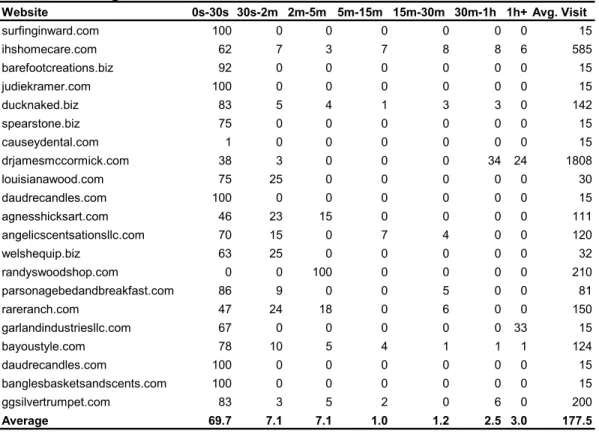
The start-up rural businesses had an average of 20 unique visitors the first year of operation with 367 hits on the average. Most start-ups websites require time to be found in the search engines and require time to build a loyal customer base that will return to the websites. Approximately 70% of visitors were on the website for 30 seconds or less, with 3% visiting for one hour or more. This is important for businesses to understand because they have a short time to try and sell their products or services. Consumers must be able to purchase a product without having to navigate through the entire website to figure out how to make a purchase. The agricultural websites had fewer visitors on the average than non-agricultural websites.
Overall, the rural based websites received more traffic early in the week (Monday and Tuesday) that the rest of the week, however, there were no statistical differences
between traffic based on the day of the week for product versus service oriented websites or agricultural versus non-agricultural websites (Table 1, Figure 1). The websites were also analyzed by the time of the day that they were accessed. There were statistically fewer hits (p<.001) between 7:00 a.m. and 11:00 a.m. and between 1:00 p.m. (p<.001) than the average for the rest of the day. There were also more users on service-oriented websites at 10:00 a.m. than product-oriented websites (p<.10) (Table 2, Figure 2). The average length of visit was 177 seconds or just under three minutes, with most visits under 30 seconds (Figure 3).
Visitors to the service-oriented websites were online longer than visitors to product-oriented websites, with average visits 420 and 81 seconds, respectively (p<.10). The service-oriented websites usually require more explanation because a visual picture will not work. For instance, a consultant would need to explain what types of services they provide as well as provide examples of past work. Visitors to agricultural websites found the websites more through internal pages than non-agricultural websites (p<.10). Overall, most users found the rural business websites through internal pages or addresses (Figure 4). This is not surprising for new websites as it takes time to move up in the search engine rankings. Most advertising for these rural businesses will be printing the web address on marketing paraphernalia such as business cards, banners, vehicle magnets, and product labels.
Conclusions and Implications for Agricultural and Rural Based Businesses Understanding how consumers navigate websites can help a business to format or reformat their existing website to better meet the customer’s needs. For example, if you
know that most of your hits are coming early in the week you can promote a sale later in the week to generate more web traffic to your site during off peak demand days.
Additionally, if most of your customers are locating your site by typing in the direct address, the business could decide how much they would be willing to invest to expand into search engine rankings or link exchanges with complementary websites. Also, due to the short time span that consumers spend on a website, the ability to purchase without navigating through several pages first is imperative. The percentage of repeat visitors can also indicate the degree of customer loyalty and if there should be more of a marketing effort to retain current customers.
As rural communities continue to expand into new marketplaces they will need to adopt new marketing approaches which begins by understanding the customer. User profiles and characteristics of customers can assist rural businesses in managing the marketing aspects of their website. These businesses can use the information to develop new strategies to increase sales. The businesses in this study were largely successful in their first year online and will continue to grow and expand by continuing to understand just who their customers are and how they navigate through the complexities of
References
Abate G. and C. Moser. 2003. “E-Commerce and Internet Use in Small Businesses: Trends and Issues,” Working Paper, Dept. of Agricultural Economics, Michigan
State University.
Auger, P. 2005. “The Impact of Interactivity and Design Sophistication on the
Performance of Commercial Websites for Small Businesses,” Journal of Small Business 43(2):119-137.
Cervini, L. 2005. “Shoppers Flock to Internet, Driving Sales, Earnings, Share,” This Week in Consumer Electronics, 20(13):18.
Grandon, E. and J.M. Pearson. 2004. “Electronic Commerce Adoption: An Empirical Study of Small and Medium US Businesses,” Information and Management, 42(1):197-216.
Grimes, S. 2003. “The Digital Economy Challenge Facing Peripheral Rural Areas,”
Progress in Human Geography, 27(2):174-193.
Homack, S. 2001. Understanding what ANOVA Post-hoc Tests Are, Really. Proceedings of the Southwest Educational Research Association. Available on-line:
http://www.edrs.com/Webstore/Download2.cfm?ID=474540&PleaseWait=OK. September 15, 2005.
Lal, R. and M. Sarvary. 1999. “When and How is the Internet Likely to Decrease Price Competition,” Marketing Science, 18(4):485-503.
Pease, W. and M. Rowe. 2003. “E-Commerce and Small and Medium Enterprises (SMEs) in Regional Communities,” Proceedings of the Chartered Institute of Marketing Inaugural Conference, Sydney, Australia, August.
Post, G., A. Kagan, T. Burkink, and T. Schmitz. 2002. “Analyzing Consumers’
Preferences on Commercial Website Attributes,” Quarterly Journal of Electronic Commerce, 3(2):111-123.
Rural Policy Research Institute. 2005. Available online: http://www.rprconline.org/.
Accessed 9-29-05.
Roberts, M., M. Xianzhong, and N. Mettos. 2003. “Internet Shopping: The Supermarket Model and Consumer Perceptions,” Journal of Electronic Commerce in
Organization, 1(2):32-43.
Sambrook, S. 2003. “E-learning in Small Organizations,” Education and Training, 45(8/9):506-516.
Schimmel, K. and J. Nicholls. 2003. “Gender Differences and E-commerce Behavior and Perceptions,” Journal of Internet Banking and Commerce, 8(1):4.
SPSS for Windows, Rel. 12.0 (2005) SPSS Inc., Chicago, IL.
U.S. Census Bureau. 2005. Available online: http://www.census.gov/eos/www/faq.html.
Table 1. Website Hits by Day of the Week for Rural Businesses
Website Unique Number
Visitors of Visits Mon. Tues. Wed. Thurs. Fri. Sat. Sun. Total
surfinginward.com 3 3 2 0 0 0 0 1 0 2 ihshomecare.com 68 104 429 318 197 236 254 171 145 1749 barefootcreations.biz 11 12 13 1 4 2 5 1 2 27 judiekramer.com 4 4 0 14 0 0 0 1 0 15 ducknaked.biz 64 75 56 142 28 37 25 43 27 357 spearstone.biz 4 4 32 8 0 0 0 0 6 46 causeydental.com 2 2 0 1 0 0 0 0 1 1 drjamesmccormick.com 9 146 38 28 23 24 43 28 24 207 louisianawood.com 3 4 4 0 1 0 0 0 3 7 daudrecandles.com 1 1 0 0 0 0 1 0 0 1 agnesshicksart.com 13 13 15 51 20 1 43 17 0 145 angelicscentsationsllc.com 22 27 41 81 73 164 6 2 19 385 welshequip.biz 8 8 6 0 11 1 2 6 0 25 randyswoodshop.com 1 1 8 0 0 0 0 0 0 8 parsonagebedandbreakfast.com 22 22 0 39 0 2 54 0 0 94 rareranch.com 16 17 35 13 30 0 56 22 83 238 garlandindustriesllc.com 3 3 1 1 0 0 1 0 0 2 bayoustyle.com 123 149 143 69 54 86 98 107 144 700 daudrecandles.com 2 2 0 1 0 2 0 0 0 3 banglesbasketsandscents.com 6 6 0 0 1 1 0 0 1 3 ggsilvertrumpet.com 31 66 8 12 38 22 9 24 20 132 AVERAGE 19.8 31.9 39.3 36.9 22.7 27.4 28.4 20.0 22.5 197.2 Hits
Table 2. Visiting Time for Rural Business Websites
Website 0s-30s 30s-2m 2m-5m 5m-15m 15m-30m 30m-1h 1h+ Avg. Visit
surfinginward.com 100 0 0 0 0 0 0 15 ihshomecare.com 62 7 3 7 8 8 6 585 barefootcreations.biz 92 0 0 0 0 0 0 15 judiekramer.com 100 0 0 0 0 0 0 15 ducknaked.biz 83 5 4 1 3 3 0 142 spearstone.biz 75 0 0 0 0 0 0 15 causeydental.com 1 0 0 0 0 0 0 15 drjamesmccormick.com 38 3 0 0 0 34 24 1808 louisianawood.com 75 25 0 0 0 0 0 30 daudrecandles.com 100 0 0 0 0 0 0 15 agnesshicksart.com 46 23 15 0 0 0 0 111 angelicscentsationsllc.com 70 15 0 7 4 0 0 120 welshequip.biz 63 25 0 0 0 0 0 32 randyswoodshop.com 0 0 100 0 0 0 0 210 parsonagebedandbreakfast.com 86 9 0 0 5 0 0 81 rareranch.com 47 24 18 0 6 0 0 150 garlandindustriesllc.com 67 0 0 0 0 0 33 15 bayoustyle.com 78 10 5 4 1 1 1 124 daudrecandles.com 100 0 0 0 0 0 0 15 banglesbasketsandscents.com 100 0 0 0 0 0 0 15 ggsilvertrumpet.com 83 3 5 2 0 6 0 200 Average 69.7 7.1 7.1 1.0 1.2 2.5 3.0 177.5
Website Access by Day of Week
Monday Tuesday Wednesday Thursday Friday Saturday SundayWebsite Access by Hour 0 5 10 15 20 25 30 35 1:00 A M 2:00 AM3:00 AM 4:00 AM 5:00 A M 6:00 AM 7:00 AM 8:00 A M 9:00 AM 10:00 AM 11:00 AM12:00 P M 1:00 PM 2:00 PM 3:00 P M 4:00 PM 5:00 PM 6:00 P M 7:00 P M 8:00 PM 9:00 P M 10:00 P M 11:00 PM 12:00 AM
Average Length of Website Visit
0s-30s 30s-2m 2m-5m 5m-15m 15m-30m 30m-1h 1h+How was the Website Found?
address search engine external page internal page