EPRU Working Paper Series
2010-12
Economic Policy Research Unit Department of Economics University of Copenhagen
Øster Farimagsgade 5, Building 26 DK-1353 Copenhagen K
DENMARK
Tel: (+45) 3532 4411 Fax: (+45) 3532 4444
Web: http://www.econ.ku.dk/epru/
Taxing the Financially Integrated Multinational Firm
Niels Johannesen
Taxing the …nancially integrated multinational …rm
Niels Johannesen
Department of Economics,
University of Copenhagen
July 2010
AbstractThis paper develops a theoretical model of corporate taxation in the presence of …nancially integrated multinational …rms. Under the assumption that multinational …rms at least partly use internal loans to …nance foreign investment, we …nd that the optimal corporate tax rate is positive from the perspective of a small, open economy. This …nding contrasts the standard result that the optimal source based capital tax is zero. Intuitively, to the extent that multinational …rms …nance investment in country i with loans from a¢ liates in country j, the burden of corporate taxes in the latter country partly fall on investment and thus workers in the former country. This tax exporting mechanism introduces a scope for corporate taxes, which is not present in standard models of international taxation. Accounting for the internal capital markets of multinational …rms thus represents a way to resolve the tension between standard theory predicting zero capital taxes and the casual observation that countries tend to employ corporate taxes at fairly high rates.
Keywords: Corporate taxation, Tax exporting, Multinational …rms, Internal capital markets,
1
Introduction
Multinational …rms account for a large and increasing share of world output and have been the object of much recent research. Key insights concern the multiple purposes served by internal capital markets. Firstly, several papers demonstrate that internal capital markets may substitute for dysfunctional exter-nal capital markets. For instance, there is evidence that multinatioexter-nal …rms extend more interexter-nal loans to foreign a¢ liates in countries with weak creditor rights where the cost of external loans is higher (Desai
et al., 2004). Also, it has been shown that internal capital markets allow a¢ liates of foreign multina-tionals to expand in the aftermath of currency crises where local …rms are constrained by scarce external …nancing (Desaiet al. 2007). Secondly, a series of papers point to the role of internal capital markets as a pro…t shifting instrument. Speci…cally, it has been shown that multinational …rms provide more internal loans and less equity to foreign a¢ liates when the corporate tax rate facing the foreign a¢ liate is high (Desaiet al., 2004; Buettneret al., 2009). Finally, it has been argued that internal capital markets serve to mitigate disadvantages associated with the multinational organizational form. For instance, there is
evidence that pro…table foreign a¢ liates of US multinationals provide capital directly to other foreign a¢ liates, which allows for a deferral of the US tax on repatriations to the parent company (Altshuler and Grubert, 2002).
Importantly, internal capital markets give rise to …nancial linkages within the multinational …rm in the sense that the di¤erent entities of the …rm are tied together by internal loans and equity stakes. A detailed dataset on German inbound and outbound foreign direct investment collected by the German Central Bank provides a rare opportunity to assess the nature and size of these …nancial linkages. For a sample of German multinational …rms, Buettner and Wamser (2009) report an average ‘internal debt-asset ratio’of foreign a¢ liates of around 25%. Roughly half of the internal loans was granted by German parent companies whereas the remaining half was provided by other foreign a¢ liates. As shown in the next section, these …gures are largely consistent with available data on the capital structure of US and other multinationals.
This paper develops a model of capital taxation in the presence of …nancially integrated multinational …rms. The model makes two key assumptions. Firstly, it is assumed that multinational …rms at least partly use internal loans to …nance foreign investment. This assumption is in line with the empirical evidence on the capital structure of multinational …rms, which suggests that internal loans typically …nance 25-30% of the assets of foreign a¢ liates. Secondly, it is assumed that internal loans serve other purposes than pro…t shifting. This assumption is consistent with the empirical literature on internal capital markets, which identi…es several important motives for internal …nancing unrelated to pro…t shifting. It is also supported by the fact that German parent companies provide foreign a¢ liates with a substantial amount of internal loans. As noted by Buettner and Wamser (2009), these loans cannot be rationalized within a pro…t shifting framework since the German corporate tax rate is very high by international standards.
The main …nding of the paper is that internal loans introduce a tax exporting mechanism that causes the optimal corporate tax rate to be positive from the perspective of a small, open economy. This contrasts the standard result that the optimal source based capital tax is zero (Gordon, 1986). In the standard model with only domestic …rms, small, open economies are facing a perfectly elastic supply of capital, hence the entire burden of capital taxes is shifted to domestic workers. By distorting the labor supply to the same extent as labor taxes and adding a distortion of the capital-labor ratio, capital taxes are thus strictly dominated by labor taxes. In our model, multinational …rms operate in two countries
AandB and partly …nance a¢ liates in countryAwith internal loans from a¢ liates in countryB. As in the standard model, taxes raising the cost of investment in countryAare fully shifted to workers in this country. However, under the usual rules of corporate taxation with full deduction for interest expenses and full taxation of interest income, the internal loans shift tax base from countryAto country B and the e¤ective tax rate on investment in countryAis thus partly determined by the corporate tax rate in countryB. Hence, by raising the e¤ective tax rate on capital in country A, corporate taxes in country
Bare partly exported to workers in countryA. This provides a motive for using capital taxes in country
Our …nding may be reconciled with the standard result that the optimal source based capital tax is zero by noting that in the presence of intra-…rm …nancial linkages the corporate tax is no longer a pure source tax. Since investment is partly …nanced with internal loans from entities located in other countries, the tax base generated by investment in any given jurisdiction is e¤ectively shared between several jurisdictions.
By accounting for the internal capital markets of multinational …rms, our model resolves the tension between the standard result that the optimal source based capital tax is zero and the casual empirical observation that most countries employ corporate taxes at fairly high rates. A number of alternative explanations have been put forward to explain the fact that countries raise considerable revenue with source based capital taxes. Wildasin (2003) shows that under imperfect capital mobility, optimal capital taxes are positive and inversely related to the speed with which the capital stock adjusts in response to changes in the local return to capital. Gordon and MacKie-Mason (1994) argue that income shifting between di¤erent tax bases introduces a scope for using a capital income tax since the latter works as a back-stop for the personal income tax. Gordon and Varian (1989) show that country-speci…c productivity shocks resurrect the case for positive capital taxes because the desire of foreign investors to hedge risk implies that the demand for domestic capital is imperfectly elastic with respect to the net-of-tax return. A few existing papers analyze capital taxation in the presence of …nancially integrated multinational …rms while focusing exclusively on …nancial strategies that allow multinational …rms to shift corporate tax base between jurisdictions. Huizingaet al. (2008) present a model of debt shifting where multinational …rms - like domestic …rms - choose the optimal leverage by trading o¤ agency costs against tax bene…ts but - unlike domestic …rms - are able to allocate more debt to subsidiaries facing high corporate tax rates. Other papers develop models of pro…t shifting where internal loans from a¢ liates in tax havens to other a¢ liates reduce the global tax liabilities of the multinational …rm (Fuest and Hemmelgarn, 2005; Johannesen, 2010). Generally, tax motivated …nancial strategies like debt shifting and pro…t shifting tend to increase the tax sensitivity of capital tax bases and reinforce the race-to-the-bottom in capital tax rates. The present paper shows that the use of non-tax motivated …nancial strategies may generate just the opposite result.
Finally, the tax exporting mechanism, which is at the heart of the model, relates our work to Huizinga and Nielsen (1997). The key assumptions of the latter paper are foreign ownership of …rms and existence of pure economic rents. Under these assumptions, taxes on the normal return to capital are partly shifted to foreign owners of domestic …rms through a reduction in rents. Clearly, this is akin to our model where capital taxes are partly shifted to foreign workers through a reduction in foreign wages.
The remainder of the paper is structured as follows. Section 2 discusses the use of internal loans within multinational …rms. Section 3 develops a model of optimal capital taxation in the presence of …nancially integrated multinational …rms. Section 4 presents an extended model with endogenous …nancial structure. Section 5 presents a crude empirical test of the model. Section 6 concludes.
2
The use of internal loans by multinational …rms
Internal loans play a crucial a role in our model. This section therefore provides a thorough discussion of the use of loans within multinational …rms. Firstly, we brie‡y review existing empirical evidence on the size and structure of internal loans. Secondly, we o¤er some explanations for the apparent puzzle that …rms in many cases resort to internal loans although equity investments would be more favorable from a corporate tax perspective.
The leading empirical evidence on the capital structure of multinational …rms is summarized in Table 1. The MiDi dataset collected by the German Central Bank is a unique data source containing very detailed …nancial information on virtually all German inbound and outbound foreign direct investment since 1996. Two recent papers provide summary statistics from this dataset. Buettner and Wamser (2009) report an average ‘internal debt-asset ratio’of foreign a¢ liates of German …rms of around 24%. The ‘internal debt-asset ratio’is decomposed into a ‘parent debt-asset ratio’of 13% and an ‘other a¢ liate debt-asset ratio’ of 11%. Ramb and Weichenreider (2005) report an average ‘internal debt-asset ratio’ of German a¢ liates of non-German …rms of around 29%. Two papers provide evidence on the use of parent debt by US multinational …rms using two distinct data sources. Altshuler and Grubert (2002) report an average ‘parent debt-asset ratio’of foreign a¢ liates of around 11% based on data collected by the US Internal Revenue Service. Desai et al. (2004) report a slightly lower average ‘parent debt-asset ratio’ of around 9% drawing on a dataset from the US Bureau of Economic Analysis. The US data sources do not distinguish between loans from other a¢ liates than the parent company and loans from third parties and, hence, do not contain su¢ cient information to compute the total ‘internal debt-asset ratio’of foreign a¢ liates.
This empirical evidence lends strong support to the two key assumptions of the theoretical model to be developed in the next section. Firstly, the model assumes that internal loans play a signi…cant role in …nancing cross-border investment. The two papers reporting average ‘internal debt-asset ratios’ on the basis of microdata …nd that internal loans account for as much as 25-30% of the …nancing of foreign a¢ liates.1Secondly, the model assumes that internal loans are not exclusively motivated by pro…t shifting in the sense that even if the corporate tax rate in countryiis (moderately) higher than the corporate tax rate in countryj, some entities in countryj receive loans from a¢ liates in countryi. This assumption is clearly consistent with the empirical evidence since parent companies in both Germany and the US are important providers of internal loans to foreign a¢ liates despite the relatively high corporate tax rates in these countries.2
1This …nding is also consistent with macrodata. In the sectoral breakdown of national accounts, the external loans of multinational …rms generally appear as interest expenses in the non-…nancial corporate sector whereas internal loans appear both as interest income and interest expenses. According to Eurostat, the interest income and interest expenses of non-…nancial corporations resident in the EU amounted toe280 billion ande470 billion respectively in 2007. The fact that interest income amounts to almost 60% of interest expenses is suggestive of an important role for internal loans.
2Another …nding indicating that internal loans serve other purposes than pro…t shifting is due to Gopalan et al. (2007) who document large ‡ows of internal loans within Indian business groups. Clearly, such ‡ows do not have a pro…t shifting motive since the borrowing and lending entities face the same corporate tax rate.
While the German and US data provide strong evidence that …rms use internal loans for other purposes than pro…t shifting and this …nding is consistent with the literature on internal capital markets stressing the non-tax motives for intra-…rm capital ‡ows, the prevalence of internal loans from parent companies in high-tax countries to a¢ liates in low-tax countries represents a puzzle in the sense that internal loans are dominated by equity investments from a corporate tax perspective. Loans from a parent company in a high-tax country to an a¢ liate in a low-tax country transfers taxable pro…ts from the low-tax to the high-tax country. Alternatively, the parent company could provide funds in the form of equity, in which case the full investment return would be subject to corporate taxation in the low-tax country. It is not immediately clear why …rms in many cases choose the mode of …nancing associated with the larger corporate tax burden. In the remainder of this section, we explore a number of explanations for this puzzle.
Chowdry and Coval (1998) present an explicit treatment of the choice between internal debt and equity within multinational …rms. The paper models a parent company …nancing a foreign subsidiary with either internal debt or equity in an environment with uncertainty about future earnings. The main …nding is that under a typical corporate tax system with imperfect carry-forward of tax losses, the optimal capital structure involves a mix of internal debt and equity. Intuitively, the possibility that the parent company will be loss-making in future periods introduces an incentive to use debt …nancing even when the parent company faces a higher corporate tax rate than the subsidiary since interest income at the level of the parent company in some states of the world are shielded by losses. Similarly, the possibility that the subsidiary will be loss-making in future periods limits the incentive to use debt …nancing even when the parent company faces a lower corporate tax rate than the subsidiary since interest expenses at the level of the subsidiary in some states of the world do not shield pro…ts.
Another strand of literature that may shed light on the choice between internal debt and equity focuses on the principal-agent problems inherent to the corporate organizational form where managers (agents) conduct business on behalf of shareholders (principals). Jensen (1986) argues that if managers are self-interested and tend to engage in empire building, debt may increase e¢ ciency by reducing the free cash ‡ow available for unpro…table investment. While the original formulation of the theory is concerned with the merits of external loans, a similar reasoning may arguably be applied to internal loans. Within the multinational …rm, local managers of foreign subsidiaries (agents) conduct business on behalf of the central management of the …rm (principal). Assuming that local managers tend to be concerned with the growth of the speci…c subsidiary that they operate whereas the objectives of the central management relate to the performance of the entire …rm, …nancing in the form of internal loans represent an instrument to prevent excessive growth in subsidiaries with a large cash ‡ow. Moreover, interest payments speci…ed ex ante in a loan agreement are arguably a superior means to achieve this end than dividend payments decidedex post on the basis of available accounting pro…ts, the size of which is at least partly controlled by the local management.
Less theoretically founded but nevertheless potentially important explanations for the prevalence of internal loans revolve around the fact that loans constitute a ‡exible and cost e¢ cient way to transfer
funds within the …rm.
Firstly, from a corporate law perspective, debt is a much more ‡exible …nancial instrument than equity. When a parent company injects capital into a subsidiary in the form of equity, a number of formal requirements must be observed. The legal details vary across countries, however, typically a decision to issue new shares must be adopted by the general assembly or the board of directors of the subsidiary, the decision needs the attestation of a notary public, the statutes of the subsidiary must be modi…ed to re‡ect the higher share capital of the …rm and the new statutes of the …rm must be published in the o¢ cial gazette. Similarly, repatriation of pro…ts in the form of dividends is subject to a number of legal requirements and restrictions. The decision to pay dividends must be adopted by the general assembly or the board of directors, interim accounts need to be drawn up and approved by an external auditor unless the distribution coincides with the closing of the annual accounts and dividends cannot be paid out of capital, reserves or unrealized pro…ts. By comparison, debt …nance is very straightforward. Essentially, the transfer of funds from one a¢ liate to another in the form of a loan merely requires that the managers of the two entities conclude a loan agreement, which also speci…es the size and timing of the interest payments.
Secondly, other taxes than the corporate tax may in‡uence the choice between …nancing with equity or internal loans. A number of countries levy capital duties, which are taxes on the transfer of capital to corporations in the form of equity. Currently, seven EU member states levy capital duties at rates ranging from 0.5% to 1% and similar taxes have only recently been abolished in a number of other EU countries.3 Capital transfers in the form of loans are not subject to capital duty, which constitutes a clear advantage of internal debt …nancing over equity …nancing. Also, cross-border dividends and interest payments may be subject to withholding taxes at di¤erential rates. Although withholding taxes in the source country can often be credited against tax liabilities in the residence country, there are a number of instances where withholding taxes a¤ect the level of e¤ective taxation and thus in‡uence the choice between equity or internal loans.4
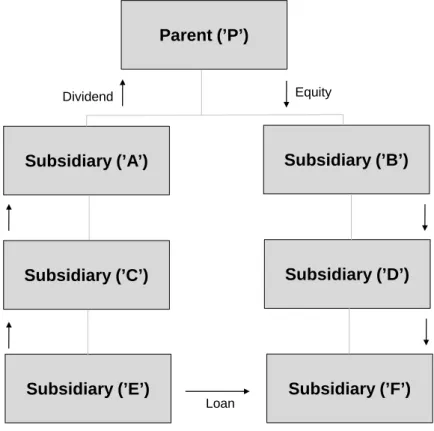
Finally, when …rms are organized with chains of ownership, as is often the case with large multi-national …rms, the two above mentioned disadvantages of equity …nancing are exacerbated. This is illustrated in Figure 1, which depicts the holding structure of a stylized multinational …rm. The …rm wishes to transfer funds from the pro…table subsidiary E to the cash-strapped subsidiary F. To complete the transfer without the use of internal loans and without changes in the holding structure, funds need to pass along existing ownership chains, that is as dividend payments from E to C, from C to A and from A to P and, then, as contributions of equity from P to B, from B to D and from D to F. Each step is
3European Commission (2006) reports that capital duties are levied at the rate of 0.5% in Poland and Portugal, 0.6% in Cyprus and 1% in Greece, Spain, Austria and Luxembourg. Moreover, capital duties were abolished in Ireland in 2005 and in Belgium and Netherlands in 2006.
4Huizinga et al. (2008) report that 31 (26) out of 32 European countries in their sample grant tax credits for foreign taxes paid on foreign source interest income when the source country is a treaty partner (non-partner). The relief for foreign taxes provided by tax credits is only partial when when the foreign withholding tax rate exceeds the domestic corporate tax rate and when the receiving company has no tax liabilities against which foreign taxes can be credited.
associated with administrative costs and possibly tax costs in the form of withholding taxes on dividend payments or capital duties on contributions of equity. A loan from E to F achieves the same end as the chain of dividend payments and equity contributions but arguably at a lower level of administrative and tax costs.
3
The basic model
3.1
Assumptions
The model considers two countriesAandB. Each country is inhabited by a single representative agent endowed withS units of capital andLunits of labor. We adopt the standard assumptions that capital is perfectly mobile across countries whereas labor is immobile. Both countries are small in the sense that policy decisions have a negligible impact on the required return to capitalrwhich is determined on international capital markets. The representative agent is characterized by the standard utility function
U(C; X; G)where Cis private consumption,X is leisure andGis public expenditure. We letLdenote labor supply and thus establish the following identity: L = X +L. Firms produce according to the standard production functionF(K; L) with constant returns to scale. There is free entry of …rms, hence …rms earn zero pro…ts in equilibrium.
Governments are benevolent and have access to two tax instruments: a tax on labortL and a source
tax on capitaltK. For expositional simplicity, we assume that taxes fall directly on production factors
and not on the income they generate. The tax base of the labor tax is thus L. The tax base of the capital tax is K reduced by …nancial liabilities and augmented by …nancial assets. Since …rms earn no pure pro…ts, the capital tax is equivalent to a standard corporate tax on pro…ts net of labor costs and interest expenses. Importantly, we adopt the standard assumption that governments are unable to enforce a residence based capital tax, for instance, due to imperfect information about foreign source income.
The main departure from the standard model of tax competition is the introduction of multinational …rms with stocks of intra-…rm debt and equity. We assume that multinational …rms consist of three types of entities: the parent company, subsidiaries operating production plants (i.e. ’operating subsidiaries’) and subsidiaries holding …nancial assets (i.e. ’…nance subsidiaries’). The …nancial structure has two distinct dimensions: the leverage of the …rm as a whole and the intra-…rm distribution of …nancial assets and liabilities. We letq denote the debt-asset ratio of the …rm as a whole and sA and sB denote the
debt-asset ratio of operating subsidiaries in countries A and B respectively. We assume throughout the paper thatsA q and sB q, which imposes that operating subsidiaries are partly …nanced with
internal debt. Firm allocate a fractionzAof the intra-…rm debt claims to …nance subsidiaries in country
A and a fraction zB to …nance subsidiaries in country B where zA+zB = 1. Figure 2 illustrates the
capital structure of a multinational …rm. For each unit of real capital required in a operating subsidiary in country i, the parent company raises a fraction (1 q) as equity in international capital markets. A fraction (1 si) is injected into operating subsidiaries as equity. The remaining fraction (si q) is
injected into the …nance subsidiaries as equity in proportions given by zAand zB and passed on to the
operating subsidiary as loans. Finally, the operating subsidiary raises a fractionqas debt in international capital markets. For future reference, we de…ne s (sA; sB)and z (zA; zB). The …nancial structure
of a multinational …rm thus characterized by the vector(q;s;z).5
The most crucial assumption embedded in this construction is that …rms make use of cross-border internal loans. Speci…cally, it is implied that each unit of real capital in country i is …nanced with a fractionzj(si q)of loans from a¢ liates in countryj. More technically, it is an important assumption
that multinational …rms based in countriesA andB have identical …nancial structures. A ’home bias’ in …nancial policies would change the nature of the policy game considerably.6
The remainder of the section analyzes the following two-stage game: In the …rst stage, governments set taxes so as to maximize the welfare of the representative agent while correctly anticipating behavioral responses of …rms and individuals and taking the tax rates of other countries as given. In the second stage, the representative agents optimally choose their labor supply taking wages and the level of public expenditure as given whereas …rms hire production factors and produce. Section 3.2 characterizes labor and capital market equilibrium in the second stage conditional on tax policies. Section 3.3 derives conditions for optimal policies. Throughout section 3, we impose the assumption that the …nancial structure of multinational …rms is …xed. This simpli…cation allows us to clearly expose the tax exporting mechanism, which is the key insight of the paper. Section 4 shows that under relatively mild assumptions the main result of the analysis carries over to an extended framework where the …nancial structure is chosen optimally and thus responds to changes in tax policy.
3.2
Capital and labor market equilibrium
We …rst consider the pro…t maximization problem of the multinational …rm. Since this basic version of the model is holding the …nancial structure …xed, pro…ts are simply maximized with respect to labor and capital inputs in the two countries:
max
LA;LB;KA;KB
= X
i=A;B
fF(Ki; Li) Liwi (r+ i)Kig
5A feature of the …nancial structure that may seem peculiar is the exclusive use of …nance subsidiaries for the holding of …nancial assets. While it is well-known that multinational …rms rely heavily on specialized corporate vehicles for …nancial transactions, the empirical literature reviewed in section 2 showed that also parent companies are important providers of internal loans. In an equivalent formulation of the model, parent companies in countryiallocate a fractionzjof the debt claims on operating subsidiaries to a …nance subsidiary in countryjand hold the remaining fractionziitself.
6If, for instance, …rms were identical except that …rms based in countryiallocated a larger fraction of …nancial assets to …nance subsidiaries in country ithan …rms based in country j, the former …rms would be more pro…table than the latter iftK
i < tKj. Under the assumptions of free entry and constant returns to scale, asymmetric tax policies would thus give rise to a market equilibrium with all …rms based in the country with the lowest capital tax rate. In other words, parent companies would constitute a perfectly mobile tax base, which would induce countries to engage in cut-throat tax competition. Since this type of interaction reduces comparability with the standard framework and obscures the impact of …nancial linkages on optimal tax policy, which is the key innovation of the paper, we assume throughout the paper that that …rms based in countriesAandBhave identical …nancial structures.
where i denotes the e¤ective tax rate on investment in countryigiven by:
i = (1 si)tKi + (si q)(zitKi +zjtKj ) (1)
The e¤ective tax rate i gives theglobal tax burden associated with investment in countryi given the
…nancial structure (q;s;z). The …rst term re‡ects taxes at the level of the operating subsidiary falling on the part of the investment(1 si)…nanced with equity whereas the second term represents taxes at
the level of the …nance subsidiaries falling on the part of the investment(si q)…nanced with internal
loans. It is useful to note already at this stage that i depends on the capital tax rates in both countries
iandj. To highlight this property, we rewrite i in the following way:
i= iitKi + ijtKj
where ii is the fraction of the capital invested in country i, which is taxed in countryi, and ij is the
fraction of the capital invested in countryi, which is taxed in countryj:
ii (1 si) + (si q)zi (2)
ij = (si q)zj (3)
The fact that operating subsidiaries in countryiare partly …nanced with loans from …nance subsidiaries in country j thus implies that countries i and j e¤ectively share the capital tax base generated by operating subsidiaries in country i. It should be noted that ii + ij = (1 q), which re‡ects that
a fraction q of the capital stock is e¤ectively untaxed. This corresponds to the usual tax advantage of external debt …nancing when interest expenses are deductible from the corporate tax base and the corresponding interest income is not e¤ectively taxed at the investor level.
We de…ne the capital-labor ratio k K=Land the functionf(k) F(k;1). Using these de…nitions and the assumption of constant returns to scale in the production technology, we restate the pro…t maximization problem of the …rm in the following way:
max
LA;LB;kA;kB
= X
i=A;B
Liff(ki) wi ki(r+ i)g
The …rst-order conditions for pro…t-maximization with respect toki andLi read:
FOCki: f0(ki) =r+ i (4)
FOCLi: f(ki) wi ki(r+ i) = 0 (5)
Equation (4) implicitly de…nes the optimal capital-labor ratioki as a decreasing function of the cost of capitalr+ i and may thus be interpreted as a capital demand function. Equation (5) determines the
equilibrium wage ratewi for a given optimal capital-labor ratioki:
wi =f(ki) ki(r+ i) (6)
It is easy to see that any wage rate higher (lower) than wi would induce …rms to contract (expand) the scale of their operations in…nitely, hence wi is the unique wage rate compatible with equilibrium. Equation (6) may thus be interpreted as (the inverse of) the labor demand function.
The representative agent in countryimaximizes utility by choosing the optimal labor supply given the wage ratewi, the tax rate on labortLi, public expenditureGi and non-labor incomerS. The …rst-order
condition states:
UXi = (wi t L
i)UCi (7)
Equation (7) implicitly determines the labor supply. We impose throughout the paper that the labor supply is positively related to the net-of-tax wage (wi tLi). Together (6) and (7) determine the labor
market equilibrium(wi; Li). The equilibrium capital stock Ki follows directly from ki and Li giving rise to the capital market equilibrium(r; Ki).
3.3
Optimal tax policy
We now turn to the …rst stage of the game and determination of optimal policy. The government in countryi maximizesU(Ci; Xi; Gi) while correctly anticipating how capital and labor market outcomes
respond to taxes. Private consumption and public expenditure are given by the following expressions:
Ci=Li(wi tLi) +Sr (8)
Gi =LitLi + iiKitKi + jiKjtKi (9)
It should be noted that the last term of Gi represents a link between investment in country j and
government revenue in countryisince the tax base in countryiincludes loans from …nance subsidiaries in countryito operating subsidiaries in country j.
Before solving the government problem, it is useful to see how the equilibrium wage rate is related to tax policy and we therefore di¤erentiatewi with respect to tax ratestK
i ,tKj , tLi andtLj:
dwi = ki( iidtKi + ijdtKj ) (10)
This equation is key to our model. Firstly, it shows that labor taxes have no bearing on the equilibrium wage rate, hence suppliers of labor bear the full burden of labor taxes. Secondly, it shows that the equilibrium wage rate in countryiis negatively related to the capital tax rate in countryjthus exposing the channel through which tax exporting occurs in the model. Due to the intra-…rm …nancial linkages, higher capital taxes in countryj raises the e¤ective tax rate on capital employed in countryi. The full burden of capital taxes is shifted to suppliers of labor through a decline in the equilibrium wage rate, hence a part of the burden of capital taxes in countryj is exported to workers in countryi.
To ease comparison with previous work, we …rst consider the special case where sA =sB =q = 0
corresponding to the assumptions of the standard model where …rms are completely equity …nanced both internally and externally. In this special case, we have ii = 1and ji= 0, hence there are no intra-…rm
…nancial linkages and the scope for tax exporting is e¤ectively eliminated. Inserting (8) and (9) into the utility function and using (10) and (7), we derive the following …rst-order conditions for maximization ofU(Ci; Xi; Gi)with respect to the labor tax ratetLi and the capital tax ratetKi respectively:
FOCtL i: UG 1 +" L i +"Liki tKi tL i ) UC= 0 (11)
FOCtK i : UG 1 +" L i +"Liki tK i tL i +"ki UC= 0 (12)
where "Li is the elasticity of the labor supplyLi with respect to the labor tax ratetLi and"ki is the elasticity of the capital-labor ratio ki with respect to the e¤ective capital tax rate i, which in this
special case equalstK
i . It is easy to see that (11) and (12) require that "Ki = 0, which only holds when
tK
i = 0. We summarize this result in the following proposition:
Proposition 1 When …rms are fully equity-…nanced both internally and externally (sA=sB =q= 0)
the optimal tax rate on capital tax is zero.
This proposition restates the result derived by Gordon (1986) as a special case where …rms are fully equity-…nanced.7 It is instructive to inspect the …rst-order conditions in more detail. The expressions in curly brackets in (11) and (12) capture the inverse marginal cost of public funds for each of the two tax instruments, that is the amount of public revenue raised with the labor tax and the capital tax respectively for each unit of private consumption foregone. For tL
i, the marginal deadweight loss has
two terms, both related to labor supply responses and thus proportional to the tax elasticity of the labor supply. The …rst term "L
i represents changes in the labor tax revenue whereas the second term
"L
ikitKi =tLi represents changes in the capital tax revenue. The latter e¤ect owes itself to the fact that
changes in the labor supply Li produce proportional changes in the capital tax base Ki for a given capital-labor ratioki. For tK
i , the marginal deadweight loss has the same two terms and an additional
term"k
i. The …rst two terms re‡ect that capital taxes reduce the net-of-tax wage (wi tLi) by exactly
the same amount as labor taxes per dollar of revenue raised where capital taxes work through changes in the gross wage ratewi. The third term captures the distortion of the capital-labor ratio introduced by the capital tax. It follows directly that labor taxes raise more revenue than capital taxes per unit of private consumption foregone and that capital taxes should therefore not be employed. In brief, capital taxes distort the labor supply to the same extent as labor taxes and moreover distort the capital-labor ratio of …rms, hence they are inferior to labor taxes.
We now turn to the more general case where multinational …rms have a …xed …nancial structure with
si q 0. Inserting (8) and (9) into the utility function and using (10) and (7), it is straightforward to
show that the …rst-order conditions for maximization ofU(Ci; Xi; Gi)with respect to the labor tax rate
tL
i and the capital tax ratetKi are:
FOCtL i: UG 1 +" L i +"Li iiki tKi tL i UC= 0 (13) FOCtK i : UG ( 1 +"Li +"Li iiki tK i tL i +"ki ii tK i i + ji ii Kj Ki + 2 ji ii Kj Ki " L j tK i tL j kj +"kjt K i j !) UC= 0 (14)
7Proposition 1 may easily be generalized to any set of parameterss
A =sB =q 0where operating subsidiaries are partly …nanced with a positive fraction of external debt and zero internal debt.
As before, the expressions in curly brackets express the inverse marginal cost of public funds. For
tLi, the marginal cost of public funds is identical to the case of fully equity-…nanced …rms except for the factor ii on the last term, which re‡ects that behavioral responses reducing the capital stockKi (i.e.
reductions in Li or ki) now have a smaller revenue e¤ect since only a fraction ii ofKi is e¤ectively
taxed in countryi. FortK
i , the marginal cost of public funds includes the same terms as fortLi and four
additional terms. We consider these terms in turn: The …rst term"k
i iitKi = i is the equivalent of the last
term in (4) and captures the marginal deadweight loss associated with distortions of the capital-labor ratioki. The second term jiKj= iiKi is the tax exporting e¤ect, which re‡ects that capital taxes in
country i are partly borne by workers in country j. Intuitively, the tax exporting e¤ect is increasing in the foreign capital stock e¤ectively subject to domestic capital taxation jiKj and decreasing in the
domestic capital stock e¤ectively subject to domestic capital taxation iiKi. The …nal two terms capture
behavioral responses in countryj that erode capital tax revenues in countryi. Intuitively, capital taxes in country iraise e¤ective capital taxation in country j and thus lower the capital stockKj, which is partly subject to taxation in countryi, through reductions in bothLj andkj.
Equations (13) and (14) imply that an optimal tax mix in country i must satisfy the following equation: "ki ii tKi i + ji ii Kj Ki + 2 ji ii Kj Ki " L j tKi tL j kj +"kjt K i j ! = 0 (15)
It is easy to verify that jiKj= iiKi is positive whereas all other terms are proportional to tKi . It
follows that only a tax vector(tK
i ; tLi)withtKi >0 can satisfy equations (13) and (14). We summarize
this result in the following proposition:
Proposition 2 When …rms have a …xed …nancial structure involving some internal debt …nancing(si>
q)and some diversi…cation of …nancial assets(0< zi<1), the optimal capital tax rate is strictly positive.
The result reported in proposition 2 is driven by tax exporting. Capital taxes in country iraise the cost of capital in both countries i and j and part of the tax burden is therefore borne by workers in country j through a reduction in wj. Capital taxes still have the undesirable e¤ect of distorting the capital-labor ratio in countriesiandj, however, the marginal deadweight loss is zero when evaluated at
tK
i = 0. Intuitively, the marginal deadweight loss associated with an increase in tKi equals the marginal
revenue loss due to behavioral responses and starting from a policy vector with tK
i = 0, the marginal
revenue loss caused by an erosion of the capital tax base is zero.
4
An extended model with endogenous capital structure
4.1
Further assumptions
The purpose of this section is to show that proposition 2, which was derived under the assumption of a …xed …nancial structure, extends to a more realistic setting where the …nancial structure responds to changes in the tax environment. Instead of explicitly modelling the multitude of determinants of the
optimal capital structure, we adopt the following reduced form speci…cation: A target capital structure
(q;ees;ez)represents the optimal capital structure absent tax considerations and tax motivated deviations from the target capital structure are associated with real costs. Firms make optimal choices in the three dimensions of the …nancial structure and thus choose: (i) qand incur a cost proportional to g(q)
whereg(qe) = 0,g0(q)(q eq) 0 andg00(q) 0implying that costs are (weakly) convex in the distance jq qej; (ii)(sA;sB)and incur costs proportional tob(si)whereb(se) = 0,b0(si)(si es) 0andb00(si) 0
implying that costs are (weakly) convex in the distancejsi esj; (iii)(zA;zB)and incur costs proportional
toh(zi)where hi(zei) = 0, h0i(zi)(zi zei) 0andh00i(zi) 0 implying that costs are (weakly) convex in
the distancejzi zeij. Moreover, we assume that costs related toq are proportional to the total capital
stock of the …rm, costs related to si are proportional to the capital stock in countryiand costs related
to z are proportional to the size of intra-…rm loans. These speci…cations seem reasonable and ensure that constant returns to scale is retained. Finally, cost functions are scaled so that costs are expressed in units of output.
It is useful to brie‡y lay out mechanisms that support this reduced form. Starting with q, it is a standard presumption in the corporate …nance literature that leverage is associated with non-tax costs in terms of a higher probability of costly bankruptcy procedures and suboptimal risk-taking. This assumption implies thatqe= 0, however, we adopt a slightly more general speci…cation by assuming that
e
q 0. Turning to s, it was suggested in section 2 that agency problems at the level of the operating subsidiaries may be alleviated by debt. We thus assume that sei > eq re‡ecting that agency problems
are su¢ ciently strong to ensure that the target leverage at the operating subsidiary level exceeds the target leverage at the …rm level. Finally, we assume that 0 <zei <1 implying that the target capital
structure involves some diversi…cation of …nancial assets on entities in di¤erent countries. This would be true if the cost of capital raised in external capital markets to …nance operating subsidiaries in country
idepends on the consolidated leverage of a¢ liates in countryi(i.e. the asset-weighted average leverage of operating and …nance subsidiaries in countryi), for instance, because foreign assets are more costly to seize than domestic assets in the event of bankruptcy.
The structure of the game analyzed in this section closely follows the game analyzed in section 3 except that …rms choose the optimal …nancial structure (q ;s ;z ) simultaneously with the optimal capital and labor inputs. Section 4.2 characterizes the labor and capital market equilibria for given policies whereas section 4.3 derives conditions for optimal policies.
4.2
Capital and labor market equilibrium
With the additional assumptions introduced in the previous subsection, the pro…t function of the multi-national …rm may be stated as follows:
= X
i=A;B
fF(Ki; Li) Liwi (r+ i)Kig
The …rst line reiterates the pro…t function of the basic model. The second line summarizes the cost terms associated with the debt-asset ratios at the operating subsidiary levelsi, the debt-asset ratio at
the …rm levelqand the distribution of …nancial assetszi. Pro…ts are maximized over capital and labor
inputs in each of the two operating subsidiaries as well as the …ve dimensions of the …nancial structure. The pro…t maximization problem is solved in the Appendix. The properties of the optimal …nancial structure may be summarized as follows: (i)q >qeexcept whentK
i =tKj = 0in which caseq =qe. These
properties derive from the tax advantage of external debt over equity, which vanishes as corporate tax rates are approaching zero; (ii) si >sei is possible only iftKi > tKj . Intuitively, …nancing the subsidiary
in country i with intra-…rm debt involves some shifting of tax base from country i to country j; (iii)
zi >zei if and only iftKi < tKj . Moreover, it is shown that changes in the optimal …nancial structure is
related to changes in tax rates in the following intuitive way: zi increases with tKj and decreases with
tKi , q increases with tKi and tjK, and si increases with tKi and decreases with tKj . This implies that multinational …rms respond to a tax increase in countryiby adjusting all dimensions of their …nancial structure with the aim of reducing the tax base in countryi.
Utility maximization of the representative agent leads to a …rst-order condition identical to (7), which implicitly de…nes labor supply as a function of the net-of-tax wage rate. The pro…t maximization problem gives rise to a uniquely determined equilibrium wage rate:
wi =f(ki) [r+ i+b(si) +g(q ) + h(zi) +h(zj) (si q )]ki
Together, the labor supply function and the equilibrium wage rate de…ne the labor market equilibrium
(wi; Li). The equilibrium capital stock Ki follows directly from ki and Li giving rise to the capital market equilibrium(r; Ki).
4.3
Optimal tax policy
Private consumption and government expenditure are given by (8) and (9) respectively with the single quali…cation that ii and jiare endogenous in the present setting. Di¤erentiating the equilibrium wage
rate with respect totL
i, tKi and tKj yields an expression for dw, which is identical to (10). Intuitively,
…rms respond to tax changes with adjustments in the …nancial structure, however, the e¤ects of the adjustments on pro…ts and wages are second-order since the …nancial structure is initially optimized. This is an application of the envelope theorem.
Using the expressions forCi,Gianddw, we derive the following …rst-order conditions for
maximiza-tion ofU(Ci; Xi; Gi)with respect to tLi andtKi respectively:
UG 1 +"Li +"Li iiki tK i tL i UC= 0 (16) UG ( 1 +"Li +"Li iiki tK i tL i +"ki ii tK i i + ji ii Kj Ki + 2 ji ii Kj Ki " L j tK i tL j kj +"kjt K i j ! +AitKi ) UC= 0 (17)
where A 1 ii dsj dtK i Kj Ki zi dsi dtK i zj+ dzi dtK i (si q ) +Kj Ki(sj q ) dq dtK i zi(1 +Kj Ki)
Whereas (16) is identical to the equivalent in the simple model, (17) has an additional termAitKi , which
represents the revenue e¤ect of the adjustments to the optimal …nancial structure induced by a marginal increase intK
i . We note thatAis unambiguously negative, which derives from the fact that multinational
…rms respond to tax increases in countryiby adjusting all dimensions of their …nancial structure in order to reduce the tax base in countryi.
It follows from (16) and (17) that the following expression needs to be satis…ed by an optimal tax mix(tLi; tKi ). "ki ii tK i i + ji ii Kj Ki + 2 ji ii Kj Ki " L j tK i tL j kj+"kjt K i j ! +AitKi = 0
This is the equivalent of (15) and a similar argument applies: Assuming that A is bounded, all terms except jiKj= iiKi are proportional to tKi , which implies that only a tax vector(tKi ; tLi)withtKi >0
can satisfy equations (16) and (17). It may easily be veri…ed using the expressions for dzi, dq anddsi
derived in the Appendix that the boundedness ofAis ensured if the second-order derivatives of the cost functions h( ),g( )andb( )are strictly positive. Essentially, strict convexity of cost functionsh( ), g( )
andb( )implies that the elasticity of all dimensions of the capital structure with respect to taxes is …nite so that marginal tax changes induce marginal behavioral responses. We summarize this analysis in the following proposition:
Proposition 3 When …rms optimally choose their …nancial structure, the optimal capital tax rate is strictly positive provided that h( ),g( )andb( )are strictly convex functions.
Intuitively, capital taxes in country i trigger adjustments of the …nancial structure that erode the capital tax base in country i, however, evaluated attK
i = 0, the marginal revenue loss - and thus the
marginal deadweight loss - associated with these responses is zero. Since the tax exporting property of capital taxes is still at play, the optimal capital tax rate is strictly positive.
5
A crude empirical test
This section investigates the empirical relevance of the model on the basis of the following observations: On one hand, pro…t maximization implies that …rms should allocate less …nancial assets to jurisdictions with relatively high corporate tax rates. In a cross-country context, this suggests anegative correlation between the amount of interest income earned by …rms and the corporate tax rate where causality goes from taxes to interest income. On the other hand, the reasoning underlying the model implies that countries to which …rms allocate relatively large amounts of interest income optimally set higher capital tax rates. Intuitively, the tax exporting e¤ect derives from the share of the capital invested in foreign countries that is subject to domestic taxation. This suggests a positive correlation between
interest income earned by …rms and the corporate tax rate where causality goes from interest income to taxes.8 As a crude test of the empirical relevance of the model, we thus estimate the empirical correlation between the interest income component of corporate pro…ts and corporate tax rates across countries. If the tax exporting mechanism highlighted in this paper is insigni…cant, we should expect that the negative correlation deriving from the pro…t maximizing behavior of …rms dominates. If the tax exporting mechanism is su¢ ciently strong, we should expect that the positive correlation deriving from governments exploiting the potential for tax exporting dominates.
We estimate the empirical correlation between the share of interest income in corporate pro…ts and corporate tax rates for a sample of 27 European countries using sectoral account data collected by Eurostat, the o¢ cial statistical bureau of the European Union. An important merit of this sample is that the common data source ensures that measures are comparable across countries. The sectoral account data include a direct measure of gross interest income in the non-…nancial corporate sector.9 As a measure of corporate pro…ts, we use ’gross operating surplus’, de…ned as total output less the cost of labor inputs and intermediate goods and services, in the non-…nancial corporate sector.10 Finally, we use statutory corporate tax rates combining federal and local taxes reported by ZEW (2008) as a measure of the corporate tax level.11
Figure 3 plots corporate tax rates against the ratio of interest income to gross operating surplus in non-…nancial corporations in 2007. There is considerable cross-country variation in both variables with the interest income component in corporate pro…ts ranging from 0.02 (Lithuania) to 0.29 (Sweden) and corporate tax rates ranging from 0.1 (Bulgaria and Cyprus) to 0.39 (Germany). As indicated by the estimated trend line, the correlation between the two variables is moderately positive, which is consistent with the hypothesis that countries exploit the tax exporting potential introduced by internal capital markets within multinational …rms. We emphasize, however, that the estimated coe¢ cients reported in the …gure should not be interpreted as an estimate of the causal e¤ect. Clearly, this simple empirical framework su¤ers from issues of reverse causality and omitted variables that make it unsuitable for providing reliable estimates of causal e¤ects.
8A formal derivation of this result would require an analysis of the equilibrium of an asymmetric model where
ij6= ji. This is beyond the scope of this paper.
9Ideally this measure would be re…ned to include only interest payments from foreign a¢ liates since interest income from other sources (e.g. bank deposits and domestic a¢ liates) do not create a scope for tax exporting, however, the dataset does not provide a decomposition on the source of the interest income.
1 0Arguably, ’net operating surplus’, which excludes consumption of …xed capital, would be a better measure of pro…ts, however, this income category is only reported by a subset of countries.
1 1While the statutory corporate tax rate is typically the e¤ective tax rate applying to the interest income earned by corporations, there are exceptions to this principle: Loss-making …rms face a lower e¤ective tax rate on interest income if (i) there is imperfect carry-forward of tax losses or (ii) there is a positive probability that the …rm will never make enough pro…ts to use the tax losses. Moreover, some countries maintain special tax regimes that reduce the e¤ective taxation of internationally mobile …nancial income.
6
Concluding remarks
This paper has developed a model of corporate taxation in the presence of …nancially integrated multi-national …rms. The two key assumptions of the model - and the main departure from standard models of international taxation - relate to the internal capital markets of multinational …rms. Speci…cally, it was assumed that multinational …rms partly …nance foreign investment with internal loans and that internal loans are not entirely driven by a pro…t shifting motive. The main …nding is that the presence of internal loans introduces a tax exporting motive for corporate taxes. Intuitively, to the extent that multinational …rms …nance investment in countryiwith loans from a¢ liates in countryj, the burden of corporate taxes in the latter country partly fall on investment and thus workers in the former country. Our model thus represents a way to resolve the tension between the standard result that the optimal source based capital tax is zero and the casual observation that most countries employ corporate taxes at non-negligible rates.
In general terms, the analysis suggests that drawing on the sophisticated theories of the …rm developed in recent decades may lead to important new insights in the …eld of international taxation. It is striking that most models of taxation make highly simplistic assumptions about …rm behavior and largely ignore interactions and transactions taking place within the boundaries of the …rm. Embedding a more elaborate modelling of the …rm in theories of capital taxation thus appears to be a promising avenue for further research.
References
Altshuler, R., Grubert, H., 2002. Repatriation Taxes, Repatriation Strategies and Multinational Finan-cial Policy. Journal of Public Economics 87, 73-107.
Buettner, T., Overesch, M., Schreiber, U., Wamser, G., 2009. Taxation and Capital Structure Choice - Evidence from a Panel of German Multinationals. Economics Letters 105(3), 309-311.
Buettner, T., Wamser, G., 2009. Internal Debt and Multinationals’ Pro…t Shifting - Empirical Evidence from Firm-Level Panel Data. Working Paper 09/18. Oxford University Centre for Business Taxation.
Chowdry, B., Coval, J., 1998. Internal Financing of Multinational Subsidiaries: Debt vs. Equity. Journal of Corporate Finance 4, 87-106.
Desai, M.A., Foley, F., Forbes, K.J., 2007. Financial Constraints and Growth: Multinational and Local Firm Responses to Currency Depreciations. Review of Financial Studies 21(6), 2857-2888.
Desai, M.A., Foley, F., Hines, J.R., 2004. A Multinational Perspective on Capital Structure Choice and Internal Capital Markets. Journal of Finance 59(6), 2451-2488.
European Commission, 2006. Proposal for a Council Directive Concerning Indirect Taxes on the Raising of Capital. COM(2006) 760 …nal.
Capital-ization. Regional Science and Urban Economics 35, 508-526.
Gopalan, R., Nanda, V., Seru, A., 2007. A¢ liated Firms and Financial Support: Evidence from Indian Business Groups. Journal of Financial Economics 86, 759-785.
Gordon, R., 1986. Taxation of investment and savings in a world economy. American Economic Review 76, 1086-1102.
Gordon, R., MacKie-Mason, J. K., 1994. Why Is There Corporate Taxation In a Small Open Econ-omy? The Role of Transfer Pricing and Income Shifting. NBER Working Papers, 4690.
Gordon, R., Varian, H. R., 1989, Taxation of Asset Income in the Presence of a World Securities Market. Journal of International Economics 26, 205-226.
Huizinga, H., Laeven, L., Nicodeme, G., 2008. Capital structure and international debt shifting. Journal of Financial Economics 88, 80-118.
Huizinga, H., Nielsen, S.B., 1997. Capital income and pro…t taxation with foreign ownership of …rms. Journal of International Economics 42, 149-165.
Jensen, M.C., 1986. Agency Costs of Free Cash Flow, Corporate Finance and Takeovers. American Economic Review 76(2), 323-329.
Johannesen, N., 2010. Optimal Fiscal Barriers to International Economic Integration in the Presence of Tax Havens. Unpublished paper. University of Copenhagen.
Ramb, F., Weichenreider, A.J., 2005. Taxes and the Financial Structure of German Inward FDI. Review of World Economics 141(4), 670-692.
Wildasin, D.E., 2003. Fiscal competition in time and space. Journal of Public Economics 87, 2571-2588.
ZEW (Zentrum für Europäische Wirtschaftsforschung), 2008. E¤ective Levels of Company Taxation within an Enlarged European Union. Project for the European Commission TAXUD/2005/DE/3 10.
Appendix
Analogously to the simple model, we rewrite the pro…t function in the following way:
= X
i=A;B
Liff(ki) wi [r+ i+b(si) +g(q) +fh(zA) +h(zB)g(si q)]kig
Multinational …rms maximize overzi; q; si; kiandLifori=A; Band we state the …rst-order conditions
below: FOCzi:h0(zj) h0(zi) =t K i tKj (18) FOCq: g0(q) =zitKi +zjtKj +h(zi) +h(zj) (19) FOCsi:b0(si) = (1 zi) t K i tKj h(zi) h(zj) (20) FOCki: f0(ki) =r+ i+b(si) +g(q) +fh(zA) +h(zA)g(si q) (21) FOCLi: f(ki) wi f0(ki)ki= 0 (22)
where it should be noted that the identity zA+zB = 1 implies that the choice (zA;zB) is e¤ectively
one-dimensional. The set of …rst-order conditions can be solved sequentially: The optimal distribution of …nancial assetszAandzB is uniquely determined by (18). Conditional on(zA;zB), the optimal leverage ratio of the …rm as a wholeq is determined by (19) and the optimal leverage of each operating subsidiary
sAandsB are determined by (20). Conditional on the optimal …nancial structure of the …rm, the optimal capital-labor ratios kA and kB are determined by (21). Finally, (22) determines the equilibrium wage ratewi:
wi =f(ki) [r+ i+b(si) +g(q ) + h(zi) +h(zj) (si q )]ki
where we have used (21). Di¤erentiating (18)-(20) and assuming interior solutions, it is easy to show that the optimal …nancial structure responds to tax changes in the following way:
dzi = dt K j dtKi h00(z i) +h00(zj) dq = zidt K i +zjdtKj g00(q ) dsi = zj(dt K i dtKj ) b00(s i)
Table 1: Empirical evidence on multinational firm capital structure
Buettner and Wamser (2009) Ramb and Weichenreider (2005) Desai et al (2004) Altshuler and Grubert (2003)
Data source Bundesbank Bundesbank BEA survey Interna l Revenue
Sample Foreign affiliates of German firms German affiliates of non-German firms Foreign affiliates of US firms Foreign affiliates of US firms
Year 1996-2005 2001* 1994 1996
Total debt- asset ratio 0.586 0.529 0.545 0.539
Internal debt -asset ratio 0.241 0.296 -
- from parent company 0.135 - 0.085 0.110
-Figure 1: Debt versus equity financing with chains of ownership
Parent (’P’)
Subsidiary (’A’)
Subsidiary (’B’)
Subsidiary (’C’)
Subsidiary (’D’)
Subsidiary (’E’)
Subsidiary (’F’)
Equity Equity Equity Dividend Dividend Dividend Loan
Figure 2: The capital structure of the multinational firm
Parent
Finance sub
(country A)
Finance sub
(country B)
1-q equityOperating sub
(country i)
External
capital
markets
q loanz
A(s
i-q)
equity
z
A(s
i-q)
debt
z
B(s
i-q)
equity
z
B(s
i-q)
debt
Figure 3: A crude empirical test
BE BU CZ DK DE EE IR GR ES FR IT CY LV LT HU NL AT PL PT RO SI SK, FI SE UK NO CH y = 0,3619x + 0,2058 0 0,1 0,2 0,3 0,4 0 0,1 0,2 0,3Corporate tax rate
Interest income / Gross operating surplus
Note: The sample consists of Switzerland, Norway and the 27 EU member states excluding Luxembourg and Malta for which data on interest income and gross operating surplus in the non-financial corporate sector are unavailable.