This is a repository copy of
A note on the relationship between high-frequency trading and
latency arbitrage
.
White Rose Research Online URL for this paper:
http://eprints.whiterose.ac.uk/117919/
Version: Accepted Version
Article:
Manahov, Viktor (2016) A note on the relationship between high-frequency trading and
latency arbitrage. International Review of Financial Analysis. pp. 281-296. ISSN
1057-5219
https://doi.org/10.1016/j.irfa.2016.06.014
[email protected] https://eprints.whiterose.ac.uk/
Reuse
This article is distributed under the terms of the Creative Commons Attribution-NonCommercial-NoDerivs (CC BY-NC-ND) licence. This licence only allows you to download this work and share it with others as long as you credit the authors, but you can’t change the article in any way or use it commercially. More
information and the full terms of the licence here: https://creativecommons.org/licenses/
Takedown
If you consider content in White Rose Research Online to be in breach of UK law, please notify us by
1 | P a g e
A note on the Relationship between High-Frequency Trading and Latency
Arbitrage.
Abstract
We develop three artificial stock markets populated with two types of market participants – HFT scalpers and aggressive high frequency traders (HFTrs). We simulate real-life trading at the
millisecond interval by applying Strongly Typed Genetic Programming (STGP) to real-time data from Cisco Systems, Intel and Microsoft. We observe that HFT scalpers are able to calculate NASDAQ NBBO (National Best Bid and Offer) at least 1.5 milliseconds ahead of the NASDAQ SIP (Security Information Processor), resulting in a large number of latency arbitrage opportunities. We also demonstrate that market efficiency is negatively affected by the latency arbitrage activity of HFT scalpers, with no countervailing benefit in volatility or any other measured variable. To improve market quality, and eliminate the socially wasteful arms race for speed, we propose batch auctions in every 70 milliseconds of trading.
---
Keywords: Agent-Based Modelling, High Frequency Trading, Algorithmic Trading, Market Regulation, Market Efficiency, Genetic Programming.
2 | P a g e
1.Introduction
Wissner-Gross and Freer (2010) suggest that the time light travels between antipodal points on the surface of the Earth takes 67 milliseconds, while recent computational advances transform HFT latencies below 500 microseconds (Bhupathi, 2010). Many HFT strategies are designed to exploit advantages in latency – the time it takes to access and respond to market information (Wah and Wellman, 2013). Schneider (2012) estimates that trading on latency advantages account for $21 billion profit each year. HFTrs are able to obtain such speed advantages over institutional investors by developing sophisticated trading algorithms combined with co-located computer systems, directly linked with trading venues. At the same time, market structure issues due to speed competition among HFTrs create the unintended consequence of allowing faster traders to gain revenue from trading with slower traders (McInish and Upson, 2013). The practice of HFT has generated several public
controversies regarding its transparency and the fairness of market operations, as well as its implications for market quality (Wah and Wellman, 2013).
However, most of the empirical work on the topic lacks the ability to identify which trades and quotes come from HFT, making it difficult to examine how HFT affects the market and other market
participants (Egginton et al., 2012; Hirschey, 2013; Goldstein et al., 2014). This is due to the fact that no publicly available dataset, including NASDAQ 120, allows researchers to directly identify all HFT (Baron et al., 2012). Egginton et al., (2012) argue that is hardly possible to identify orders generated by computer algorithms in the U.S. equities markets, with all previous studies using proxies to measure the level of algorithmic trading and HFT1. The huge number of variables and very
complicated cause-effect relationships among these variables and potential outcomes imposes another research obstacle (Felker et al., 2014). Furthermore, empirically measuring informational differences between different investors represents a difficult task as investors’ information sets are unobservable (Ding et al., 2014).
1 Hendershott et al. (2011) and Viljoen et al. (2014) implement the rate of electronic message traffic normalised by trading volume as proxies to identify specific HFT in the dataset. Brogaard et al. (2014) use proprietary data to detect specific HFT activity. Hendershott and Riordan (2013), Brogaard et al. (2013), and Baron et al. (2012) extract account- level trade-by trade data related to different contracts for grouping traders into different high frequency categories; these are, based on the level of their trading volume as well as inventory management.
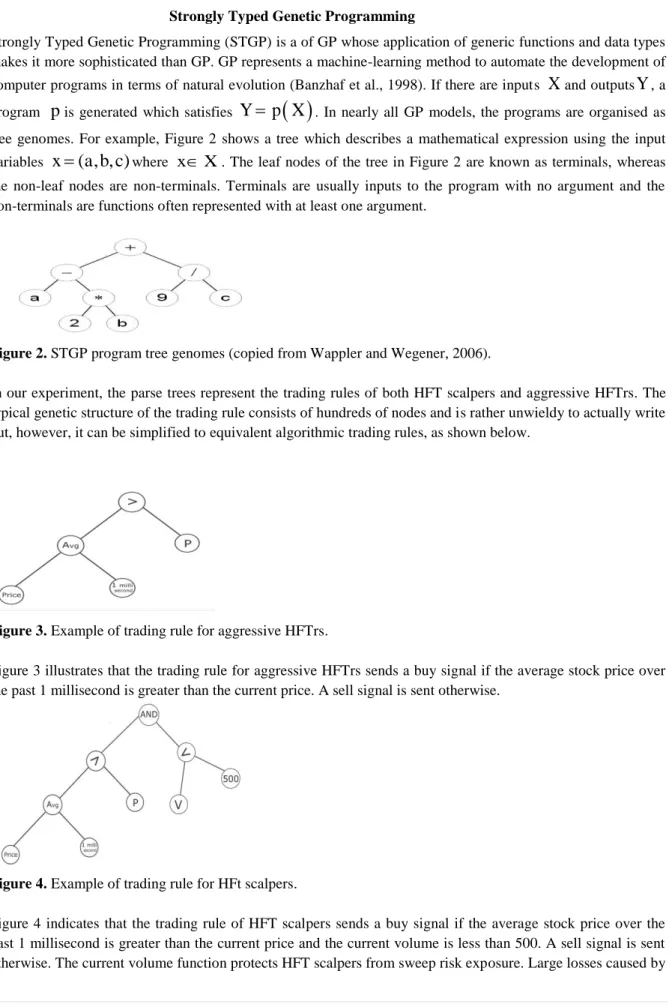
3 | P a g e In contrast, this study uses a special adaptive form of Strongly Typed Genetic Programming (STGP) and real-time millisecond data from Cisco Systems, Intel and Microsoft to demonstrate the process of latency arbitrage in HFT. The STGP (described in Appendix B) is a sophisticated and extremely suitable trading algorithm that successfully replicates HFT scalping strategies. Wah and Wellman (2013) argue that questions about HFT implications are inherently computational in nature due to the fact that the speed of trading reveals details of internal market activities and the structure of
communication channels. We subscribe directly to NASDAQ’s Security Information System (SIP), which is called the Unlisted Trading Privileges Quote Data Feed in order to reproduce the HFT scalping strategies in an artificial stock market environment. Here, the impact of these strategies can be examined and new regulations evaluated to maintain the overall health of the financial system. Using STGP, we replicate the interactions between HFT scalpers and aggressive HFTrs and compare their performance under the same underlying trading order streams. In other words, we simulate real-life trading sessions, which allow us to avoid the obstacles in the studies discussed above. HFT scalping strategies originated as relatively simple spread detecting tools that came to understand the order book depth, posted on the best bid/ask and then moved quickly to the other side (Patterson, 2012). These straightforward flipping strategies evolved over time to become the modern HFT scalping strategies that nowadays dominate electronic exchanges, gaining favourable queue positions and generating a huge amount of cancelled orders. The aim of HFT scalping strategies is to gain a favourable queue position – any particular scalping strategy must have a high probability of entering the trade and an equally high probability of either exiting for spread or, if the spread cannot be gained, of immediately exiting in order to avoid losses (Bodek, 2013).
To summarise, the contribution of this study is three-fold. First, this is the first study to use an innovative trading algorithm and real-time millisecond data to provide empirical evidence of how HFT scalping strategies are able to calculate NASDAQ NBBO (National Best Bid and Offer) at least 1.5 milliseconds ahead of the NASDAQ SIP, creating a large number of latency arbitrage
4 | P a g e The Securities and Exchange Commission (SEC) developed the Regulation National Market System (Reg NMS) in 2007 in order to protect fair access to the best stock price for traditional investors. According to Reg NMS rules, trading venues are required to provide trading messages to the primary exchanges such as NASDAQ and NYSE. The SIPs for NASDAQ, which are called Unlisted Trading Privileges Quote Data Feed, along with NYSE’s Consolidated Quotation System, collect all relevant data and calculate the respective NBBO. Consequently, stock brokers are required to execute trading orders at NBBO prices or better (Ding et al.,2014). However, considering trading order information from all exchanges, the SIPs take some finite time, let us say
milliseconds, to calculate and for the NBBO to be distributed. Computationally sophisticated traders equipped with front-running scalping strategies such as HFT scalpers can process the order flow in less than
milliseconds and out- compute the SIP to calculate the NBBO. Under trading conditions of superhuman speed, quotes within an exchange could update faster than the exchange is able to distribute its new prices to other trading venues for NBBO evaluation. Our experiment detects the processing and calculation of both best bid and ask orders; it does this by simulating the communication patterns between HFT scalpers, aggressive HFTrs, NASDAQ SIPs and NASDAQ NBBO. Our empirical results demonstrate that the ability of HFT scalpers to create latency arbitrage opportunities makes trading more difficult and more costly for those traditional investors who lack access to sophisticated trading platforms.Second, this study provides the first real-life trading evidence whereby direct access to exchanges and appropriate trading software could generate profitable opportunities for HFT companies. We
demonstrate that HFTrs equipped with scalping trading mechanisms are capable of capturing
substantial risk-free profits at the expense of institutional investors. We also measure the precise level of profits generated by HFT scalpers and the exact costs of latency arbitrage for other market
participants. Our findings suggest that there is an arms race in speed and how fast market participants have to be to capture profit opportunities. The size of the arbitrage opportunity, and hence the harm to institutional investors, may depend on the magnitude of speed and the cost of cutting-edge speed improvements.
5 | P a g e Third, we provide clear evidence of the implications of latency arbitrage for market quality and the relationship between market fragmentation and latency arbitrage strategies.
Our empirical findings indicate that latency arbitrage not only reduces the profits of other market participants, but harms market efficiency. We observe that HFT scalpers’ latency arbitrage activity has negative implications on market efficiency as intraday volatility increases and market depth decreases. We propose an alternative financial market mechanism such as a batch auctioned market, which successfully eliminates latency arbitrage opportunities and improves efficiency. We suggest the implementation of batch auctions once every 70 milliseconds, that is 334,285 times per 6.5-hour trading day for each financial instrument. If trading orders are bunched together every 70
milliseconds, HFT scalpers could face a queuing risk leading to a less harmful market quality effect.
Our study is particularly timely as policymakers around the world are still debating as to whether HFT is beneficial or harmful to market efficiency (Manahov et al., 2014). To a certain extent this study can be seen as a tool assisting regulators in the more rigorous evaluation of the financial market.
The remainder of this paper is organised as follows: Section 2 comprises the literature review on the topic. Section 3 presents the experimental design of the three artificial stock markets and data description. In Section 4, we examine the HFT scalpers’ latency arbitrage activity and profitability and investigate the implications of HFT scalpers on market quality and the associated regulatory measures. Finally, Section 5 concludes the paper. Additional clarifying and technical material can be found in Appendix A.
6 | P a g e
2.Related literature
While Ready (1999) and Stoll and Schenzler (2006) perform empirical analysis to show how slow traders’ orders provide a free trading option for fast traders, Cohen and Szpruch (2012) consider a single asset market model of latency arbitrage with one limit order book and two traders possessing different speeds of trade execution. This is to demonstrate that the fast trader employs a front-running strategy to capture the quantity that the slower trader intends to trade and generate a risk-free profit. However, the authors suggest that these profits cannot be scaled and the introduction of a ‘Tobin Tax’ on financial transactions could lead to the elimination of profits from pre-emptive strategies. In contrast, our study measures the exact level of profit that HFTrs gain from latency arbitrage.
Hirshleifer et al. (1994) examine trading behaviour and equilibrium information acquisition whereby some investors receive common private information before others. Their model implies that under some conditions better informed investors equipped with profit-taking strategies will focus only on a subset of securities, while ignoring other securities with similar characteristics. In a similar fashion, Foucault et al. (2013), model the strategic behaviour of a trader trading in public information faster than other traders, demonstrating that with a speed advantage, the informed trader’s order flow is much more volatile, accounts for a much bigger fraction of trading volume, and forecasts very short run price changes. In a rather different laboratory experiment, Wah and Wellman (2013) adopted an agent-based approach to simulate the interactions between high-frequency and zero-intelligence agents at the millisecond level. Similar to our empirical findings, the authors reported that market fragmentation and the presence of a latency arbitrageur reduces total surplus, leading to negative implications for liquidity.
On 10th of March, 2008, the NYSE implemented a system upgrade designed to reduce its latency by 600 milliseconds. McInish and Upson (2013) use this event to investigate the implications of the reduction in latency for trading quality. They observe that for trades executed at NBBO prices, order execution quality improves significantly but faster markets reduce the ability of fast liquidity suppliers to execute the quote-arbitrage strategy.
7 | P a g e Easley et al. (2014), examine a different upgrade within the NYSE’s trading system which was implemented to reduce the latency of off-floor traders and show that this reduction improves liquidity, raising stock prices in comparison to that of on-floor traders. A portfolio consisting of long stocks that is undergoing the upgrade has a return of approximately 3 percent over the first 20 days of the
upgrade. In another NBBO experiment, Ding et al. (2014), provide evidence as to the benefits of obtaining faster proprietary data feeds from stock exchanges over the regulated public consolidated data feeds. They measure and compare NBBO prices from each data feed to discover price
dislocations in the NBBO that occur several times a second and last one to two milliseconds presenting opportunities for HFT latency arbitrage. The relatively short duration of dislocations is associated with small cost for infrequent traders but prove costly for frequent traders.
Easley et al. (2012) argue that allowing exchanges to directly sell trade and quote data to some traders increases the cost of capital and worsens market liquidity in comparison to trading where all market participants freely observe previous prices. Moreover, allowing exchanges to sell price information is undesirable because it has negative implications on market quality, therefore such practice should be restricted.
However, most of the studies on the topic rely on empirical tests and statistical evaluation of historical datasets. In contrast, we develop a more realistic scenario by simulating real-life trading with real-time millisecond data in order to investigate the relationships between fast and slow traders and the implications for market quality.
8 | P a g e
3.Experimental design
Due to advances in technology and the rapid growth of high frequency trading, financial markets have eliminated human intermediation in the trading process and replaced them with electronic limit order books, which have led to the growth of trading algorithms as one of the main investment tools. Some of the trading algorithms generated imitate the behaviour of humans in the trading process, while over the last few years, these trading algorithms have substantially improved their speed to match bid and ask orders.
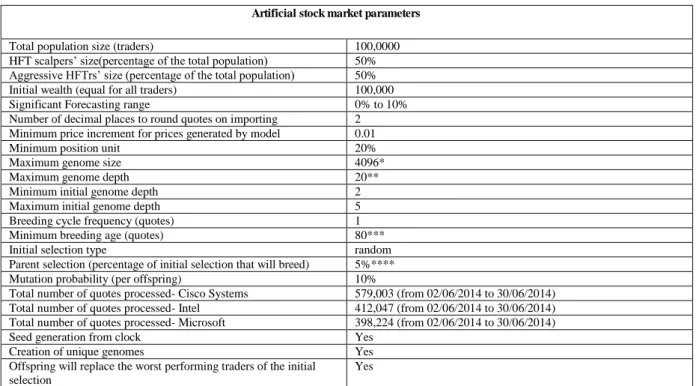
We use a special adaptive form of Strongly Typed Genetic Programming (STGP), which enables us to choose and adjust different parameters to suit our specification, such as the minimum price increment, number of participants and their wealth, the level of transaction costs, and different trading preferences. The exact number of evolutionary parameters that we can specify is listed in Table 1. Each market participant represents an artificial trader who is equipped with their own trading rule; the selection of best performing traders and the production of new genomes is conducted through the recombination of the parent genomes by crossover and mutation operations, which are further elaborated upon in Appendices A and B. The basic idea is that the trader’s trading rule will improve by a natural selection process based on the survival of the fittest (Witkam, 2014).
Therefore, the evolutionary nature of the trading process and the price dynamics enable the artificial traders to recognise, learn and exploit profit opportunities while continually adapting to changing market conditions. Consequently, the STGP trading algorithm evolves the model step-by-step, feeding it with real-time millisecond quotes from Cisco Systems, Intel and Microsoft stocks; therefore the forecasting models evolve mimicking the actual markets studied. Model evolution doesn’t end when disconnected from the data feeder or when the quote file ends. It continues when new quotes are added to the database and there is no difference between the way historical quotes and new quotes are processed.
9 | P a g e
3.1. The process of developing initial trading rules
Each individual trader has only one trading rule which is created randomly, enabling the whole range of possible trading rules to be studied (examples of trading rules can be found in Appendix B). To create later generations, we apply the crossover recombination technique and mutation operation, where the crossover recombination technique randomly chooses parts of two trading rules to exchange in order to create two new trading rules; the mutation operation randomly changes a small part of a trading rule. This process is repeated until at least one trading rule in the population achieves the desired level of fitness, which is measured by a trader’s investment return over a specified period. It should be noted that this initial random nature can result in the creation of meaningless trading rules or trading rules which cannot be evaluated thoroughly since they do not return the value that the function needs. Nevertheless, as Montana (1995) notes, these programming issues can be resolved by the introduction of STGP, where the process requires the definition of a specific set to fit the problem. Each trading rule in our artificial stock market setting takes real-time millisecond prices from Cisco Systems, Intel and Microsoft and generates advice consisting of the desired position, estimated as a percentage of the trader’s wealth, and an order limit price for buying and selling the financial instrument2. The trading rules’ logic comprises of information on price and volume, minimum, maximum and average functions related to millisecond price and trading volume data, as well as different logical and comparison operators.
Moreover, traders are not allowed to directly communicate with each other in order to avoid herding behaviour that occurs when copying the trading activity of other traders. However, traders are able to indirectly exchange information through the artificial stock market and also through the breeding process.
In the conventional Genetic Programming (GP) procedure, described in Appendix A, trading rules are evaluated by the same fitness function in each generation. In contrasts, the STGP evaluates the fitness of traders through a dynamic fitness function, which enables the return estimation period to move forward and include the most recent quotes in the market.
10 | P a g e Also, while GP replaces the entire genetic population through crossover and mutation techniques at one time, STGP only replaces a small proportion of the entire population, which ensures a gradual change in population and thus greater model stability (Witkam, 2014). Another important feature of STGP is that each trader discovers the intrinsic value of the three stocks individually without any communication between traders, ensuring individuality and that the level of intelligence of each artificial trader is not affected by other traders. This allows the development of more meaningful trading rules for both HFT scalpers and strategic informed traders.
3.2. Structure of the artificial stock market and the differences between HFT scalpers
and aggressive HFTrs.
We examine the profitability of HFT strategies within the context of a number of markets, each populated by up to 100,000 boundedly rational traders. None of the artificial traders in the model are orientated towards a predetermined formation of strategy and so are therefore free to develop and continually evolve new and better trading rules over time. We develop three different artificial stock markets for each of the three financial instruments under investigation. Each market is populated by 50,000 aggressive HFTrs and 50,000 HFT scalpers (50 per cent of the total population based on the continuous Breeding Fitness Return). Both HFT scalpers and aggressive HFTrs are created using the STGP programming technique explained in Appendix A. In terms of aggressive HFtrs’ design there is an important difference between two features: the horizon or holding period, measured by the length of time for which a position (long or short) is a financial instrument is held; and the trading costs measured by the bid-ask spread that must be crossed by trading orders.
In order to generate profits, aggressive HFTrs must hold their positions for a sufficient period of time in order to overcome the transaction cost. Hence, the shorter the holding period, the more extreme the movements of price must be to ensure profitability. However, the main difference between the two trading groups is that the HFT scalpers’ group consists of the traders who momentarily perform best in terms of the continuous Breeding Fitness Return; these, therefore possess lower latency. The Breeding Fitness Return is a trailing return of a wealth moving average which determines the fitness rules of traders.
11 | P a g e This return is calculated over the last n quotes of data of an exponential moving average of traders’ wealth, where n is set to the minimum breeding age with a maximum of 250. In the case where the age is less than n, no value is calculated. This particular type of return is used to measure the fitness criterion for the selection of traders to breed. Breeding is, in essence, a process of creating new artificial traders to replace poor performing ones based on the values derived from Equation (1) below. HFT scalpers and aggressive HFTrs process millisecond trading messages using direct data feed from the NASDAQ SIP. Although HFT scalpers and aggressive HFTrs both observe the same millisecond data from the three financial instruments and also generate trading orders, HFT scalpers are able to access and process the data first due to their low latency features. In other words, HFT scalpers are able to foresee the quotes of the three financial instruments and submit trading orders before the contribution of aggressive HFTrs. Both HFT scalpers and aggressive HFTrs operate in the same market and accumulate wealth by investing in two financial instruments that are available on the artificial stock market; the three risky financial instruments and the risk-free instrument represented by cash. Because the three artificial stock markets continuously evolve, traders with trading rules that perform well become wealthier, positively influencing the forecasting accuracy of the model. In each period, an artificial trader’s wealth can be shown by the following formula:
(1)
where is the wealth accumulated by trader in period ; and represents the money and
amount of security held by artificial trader , in period ,and is the price of the asset in period .
3.3. Clearing mechanism and order generation for the three artificial stock markets.
The three artificial stock markets are simulated double auction markets where all the buy and sell orders from artificial traders are collected. The traders receive real-time quotes from Cisco Systems, Intel and Microsoft, before evaluating their trading rule and subsequently calculating the number of shares that need to be purchased or sold. In the case that shares need to be purchased or sold, an order is generated to buy or sell the required amount of shares determined by the specified limit price.
, , , i t i t t i t
W
M
P h
, i tW
i
t
M
i t,h
i t,i
t
P
tt
12 | P a g e For example, if a trader holds 1,000 shares of Intel priced at $38.50 and $80,000 in cash, his wealth will be $118,500 and his position will be 32.5%. The trading rule generates advice of a position of 50% and a limit price of $38.50. Therefore a limit order will be produced to purchase 539
(=50%*118,500/38.50-1000) additional Intel shares with a price of $38.50 each. Each of the three artificial stock markets then calculates the clearing price and all trading orders are executed at that price. At the same time, the clearing price is the price which can match the highest trading volume from limit orders.
In cases when the same highest trading volume can be matched at multiple price levels, then the clearing price will be represented as the average of the lowest and the highest of those prices. The number of shares purchased by traders is always equal to the number of shares sold by traders. If the total number of shares offered (at or below clearing price) exceeds the total number of shares asked for (at or above clearing price) or vice versa, the remaining orders will not be executed in full (partial execution of trading orders). Under such conditions, orders at the clearing price will be selected for execution with priority given to market orders over the limit orders and then on a first-in-first-out (FIFO) basis (Witkam, 2014).
3.4. Description of data and transaction costs.
HFTrs mainly trade the most liquid stocks (Brogaard et al. 2014) because this translates into narrower bid-ask spreads. According to Picardo (2014), low volatility and low stock price are the two additional stock attributes uniquely suited for HFT. While traditional traders like high volatility, because large price fluctuations provide more profit opportunities, HFTrs prefer low volatility securities because their strategies are based on generating very small amounts of profit thousands of times each day. Stock price is an important factor for choosing the appropriate financial instruments for HFT. This is because HFT rebates are based on the number of shares traded, and therefore for the same amount of money involved in a trade, HFTrs are capable of producing a larger total rebate on a lower-priced asset than on a higher-priced asset.
13 | P a g e In order to determine which stocks to include in this study, we examine the Russell 3000 Index and the following three selective criteria: stock price below $50 (benchmark for identification of low-priced stocks), beta of less than 1.5 (benchmark for identification of stocks with volatility less than 50% higher than the market), and market capitalisation of at least $50 billion (benchmark for identification of blue chip liquid stocks). We find that Cisco Systems, Intel and Microsoft (all traded on NASDAQ) satisfy all the selection criteria. We subscribe directly to NASDAQ’s SIP, which is called the Unlisted Trading Privileges Quote Data Feed, from 2nd of June, 2014 to 30th of June, 2014. Our real-time data is delivered via the NxCore platform which allows transmission of 4,500,000 quotes per second or 8 billion quotes per trading day. The STGP trading algorithm processes 579,003 trading messages stamped at the millisecond interval for Cisco Systems; 412,047 trading messages at the same frequency for Intel; and 398,224 millisecond trading messages for Microsoft. We also use NASDAQ NBBO data from 2nd of June, 2014 to 30th of June, 2014 to compare the HFT scalpers and aggressive HFTrs’ activity with the best bid and ask prices in order to determine the presence of latency arbitrage opportunities. Narang (2013) reports that the US Securities and Exchange Commission (SEC) impose typical round trip transaction costs of $0.003 per share. We employ transaction costs of $0.004 for our profit calculations. Although slightly higher than the current standards, the level of transaction costs takes into account the operational costs of HFT companies such as investments in technology, data and collection fees, and salaries. Also included are software platforms and, labour and risk management systems, but the co-location of servers is not included.
14 | P a g e
4.Experimental results.
4.1.High-frequency trading and latency arbitrage.
First, we examine what happens to the trading orders of Cisco Systems, Intel and Microsoft after being submitted to the three artificial stock markets3. Jarnecic and Snape (2014) examine the order submission strategies of HFTs and traditional traders in the limit order book and observe that high-frequency participants cancel orders of all durations from around the best quotes. This thereby reduces the certainty of execution prices, making trading more difficult for non-HFT participants, causing prices to be more transient. Let denote the time between order submission and cancellation. The probability of cancellation in the interval is represented by the distribution function:
P
Cancel
t
Pr
t
(2)We extract all trading activity generated by the STGP trading algorithm for the three financial instruments to estimate the distribution function separately for each of the three stocks using the life-table method, and taking execution as the censoring event.
In contrast to all other studies, we are able to directly observe the number of executed and cancelled orders by extracting generated data from the STGP trading algorithm (reported in Table 2).
Interestingly, a very large number of limit orders submitted by HFT scalpers are cancelled within a very short interval of order submission. According to Table 2,
P
Cancel
70
, the probability of a cancellation within 70 milliseconds is 0.933. By the time 250 milliseconds has elapsed, this probability substantially decreases to 0.051. At the same time the probability of cancellation for aggressive HFTrs measured at 70 milliseconds is 0.019 increasing to 0.087 at 250 milliseconds.A comparison of cancelled orders by HFT scalpers and aggressive HFTrs indicates that HFT scalpers cancel a significantly larger proportion of orders after a very short duration.
3
All trading volumes, latency arbitrage opportunities, profits and latency arbitrage costs are comparable within artificial stock market settings.
15 | P a g e Table 2 suggests that although HFT scalpers cancel a large number of trading orders within 70 milliseconds to position themselves at the top of the order book, between 0 and 70 milliseconds, their execution rate is also quite high. At the same time, the aggressive HFTrs’ orders reach the market at a later stage and the orders are executed at worse prices due to the increasing steep pricing schedule. Lower latency demonstrated by the HFT scalpers provides them with a large number of latency arbitrage opportunities. Moreover, HFT scalpers purchasing the three stocks that aggressive HFTrs intend to buy could increase asset prices before aggressive HFTrs submit trading orders, thereby increasing their costs. In real-life trading many market participants are not equipped with powerful computers and sophisticated trading algorithms and they usually update their trading positions with delays. During periods of delays their orders become stale and faster traders quickly capture them. Li (2014) examines the strategic interactions of HFTs with different speeds and concludes that front- running HFTs should impose a speed tax on normal traders, making markets less liquid and prices less informative.
We subscribe directly to the NASDAQ SIP feed, which provides the NBBO for all stocks listed on NASDAQ to estimate the actual latency magnitude between the two groups of artificial high frequency traders and NASDAQ NBBO using the following equations:
Latency
HFTscalpers
Timestamp
HFTscalpers i t( , )
Timestamp
NBBO (3)
Latency
aggressiveHFTrs
Timestamp
aggressiveHFTrs i t( , )
Timestamp
NBBO (4) whereTimestamp
HFTscalpers i t , measure the trading messages processes by HFT scalpers directly from the NASDAQ SIP for securityi
at time t,Timestamp
aggressiveHFTrs i t . measures the trading message processes by aggressive HFTrs directly from the NASDAQ SIP for securityi
at time t,NBBO
Timestamp
represents NASDAQ NBBO data from 2nd of June, 2014 to 30th of June, 2014.We extract the generated data from the three artificial stock markets to compare the performance of HFT scalpers and aggressive HFTrs with NASDAQ NBBO for the period under investigation.
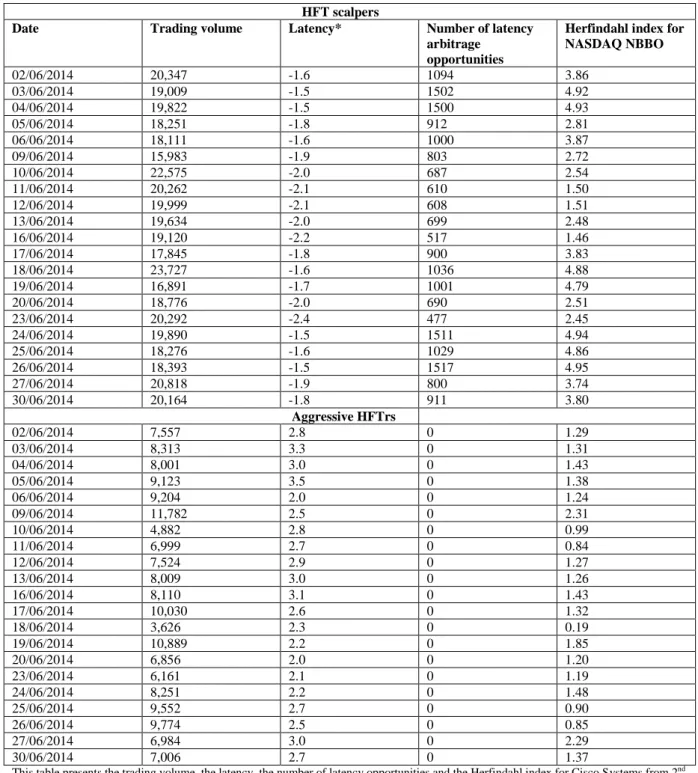
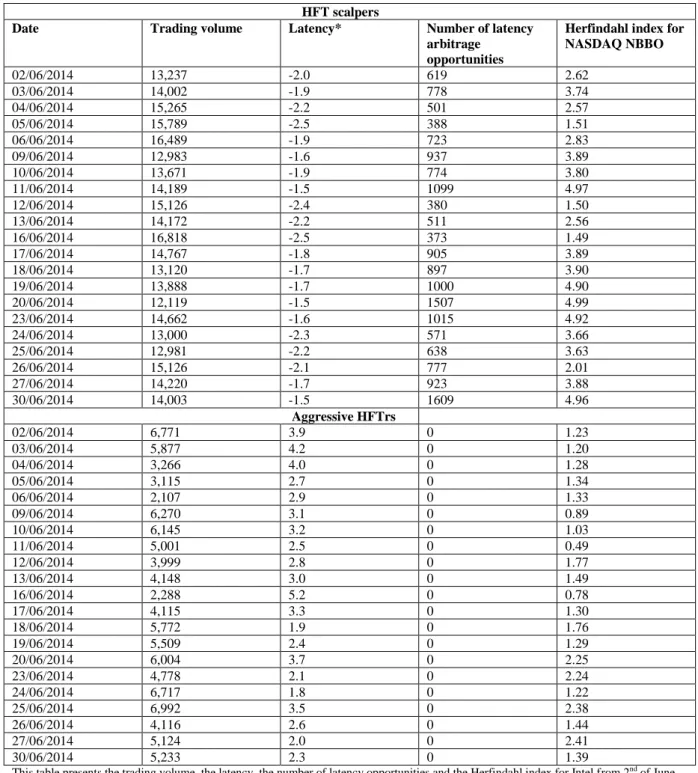
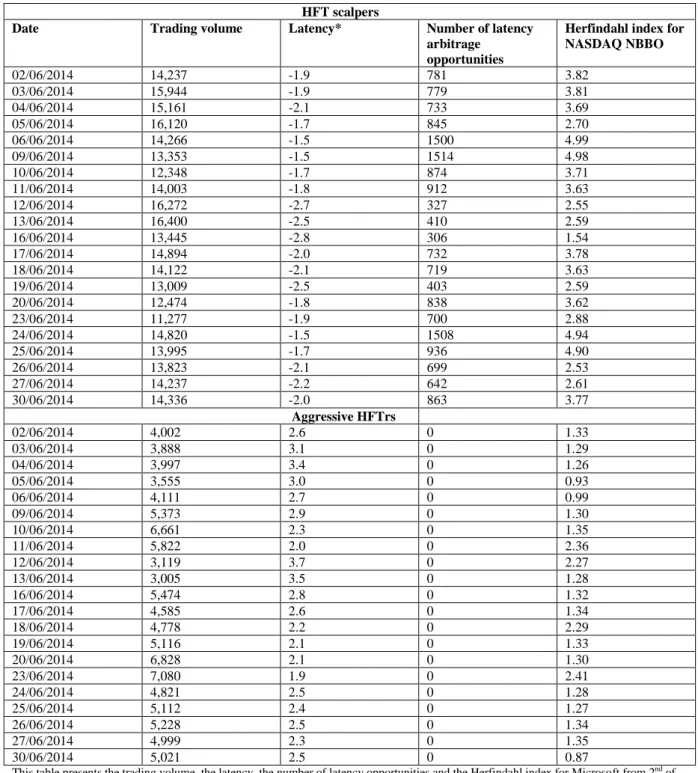
16 | P a g e Negative latency values of Equations (3) and (4) indicate that HFT scalpers and aggressive HFTrs are able to calculate NASDAQ NBBO faster than the NASDAQ SIP. Tables 3, 4, and 5 illustrate that while HFT scalpers generate negative latency values between 1.5 and 2.8 milliseconds, aggressive HFTrs generate positive latency values between 1.8 and 5.2. This finding suggests that HFT scalpers are capable of calculating NASDAQ NBBO at least 1.5 milliseconds ahead of the public NASDAQ SIP feed for the three financial instruments. Our empirical results demonstrate that negative latency values are associated with a number of latency arbitrage opportunities. HFT scalpers’ ability to calculate NASDAQ NBBO between 1.5 and 2.8 milliseconds ahead of the public NASDAQ SIP provides them with latency arbitrage opportunities. Tables 3, 4 and 5 show that the number of latency arbitrage opportunities vary between 306 and 1,609 per day per stock.
While the SEC’s 2010 concept of equity market structure suggests that latency for the SIPs is about 5 milliseconds, the average latency of HFT scalpers for the Cisco Systems is 1.81 milliseconds,1.92 milliseconds for Intel, and 1.99 milliseconds for Microsoft. As a comparison, the average time it takes to execute a trading order is about 300 microseconds (Ding et al., 2014). Hence, those other market participants who are waiting for trading messages from NASDAQ NBBO in order to decide at what price to place their trading orders for Cisco Systems, Intel and Microsoft, can face disadvantages. One example of latency arbitrage includes dark pools that implement NASDAQ NBBO as a reference price for matching trading orders can be matched. Assuming that NASDAQ updates Cisco Systems’ bid price from $27 to $28, and the ask price is still $29, the mid-price will change from $28 to $28.5. In the first 1.5 to 2.8 milliseconds, slower traders such as aggressive HFTrs are not aware of the price change and if they place trading orders at mid-price in a dark pool, faster traders such as HFT scalpers can purchase the stock at $28. This will allow HFT scalpers to sell Cisco Systems in the dark pool for $28.50 after 2.8 milliseconds have elapsed.
Next, we calculate the daily Herfindahl trading concentration index for NASDAQ NBBO, which includes data from different U.S exchanges. The relatively large variation in the Herfindahl index values reported in the last column of Tables 3, 4 and 5 suggest that the NASDAQ NBBO dataset
17 | P a g e represent the true fragmentation of trading at the best bid and best offer collected from a number of different trading venues.
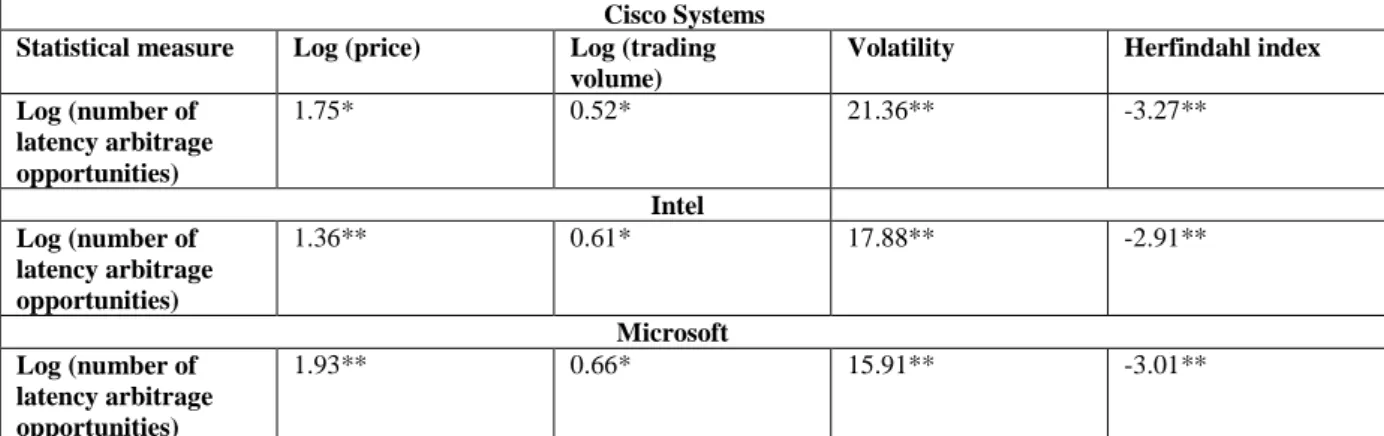
Table 6 illustrates the correlations between HFT scalpers’ variables in the form of univariate
regressions with security fixed effects. The correlations are very useful for evaluating the implications of latency arbitrage opportunities on stock properties. We estimate the statistical significance,
controlling for heteroskedasticity by using the following regression:
Number of latency arbitrage opportunitiesi,t=
i
x
i t,
i t, (5)where the number of latency opportunitiesi,t measure the latency opportunities for security
i
on day t, i
represents the fixed security effect, and xi t, is the characteristic for securityi
on day t. We have taken logarithms of price, trading volume, and the number of latency opportunities in order to account for the substantial cross-sectional heteroskedasticity of the variables.Table 6 reports that correlations between the number of latency arbitrage opportunities, price, volatility and trading volume are all positive and statistically significant at 0.95 and 0.99 levels of significance. As the coefficients on volatility are positive and statistically significant for the number of latency arbitrage opportunities, the more the prices of the three stocks change, the more often latency arbitrage opportunities will occur.
Volatility can potentially act as another generator of latency arbitrage opportunities because it can force liquidity providers to adjust their trading orders more frequently. Although trading volume is positively correlated with the number of latency arbitrage opportunities, the Herfindahl trading concentration index is negatively correlated with the number of latency arbitrage opportunities.
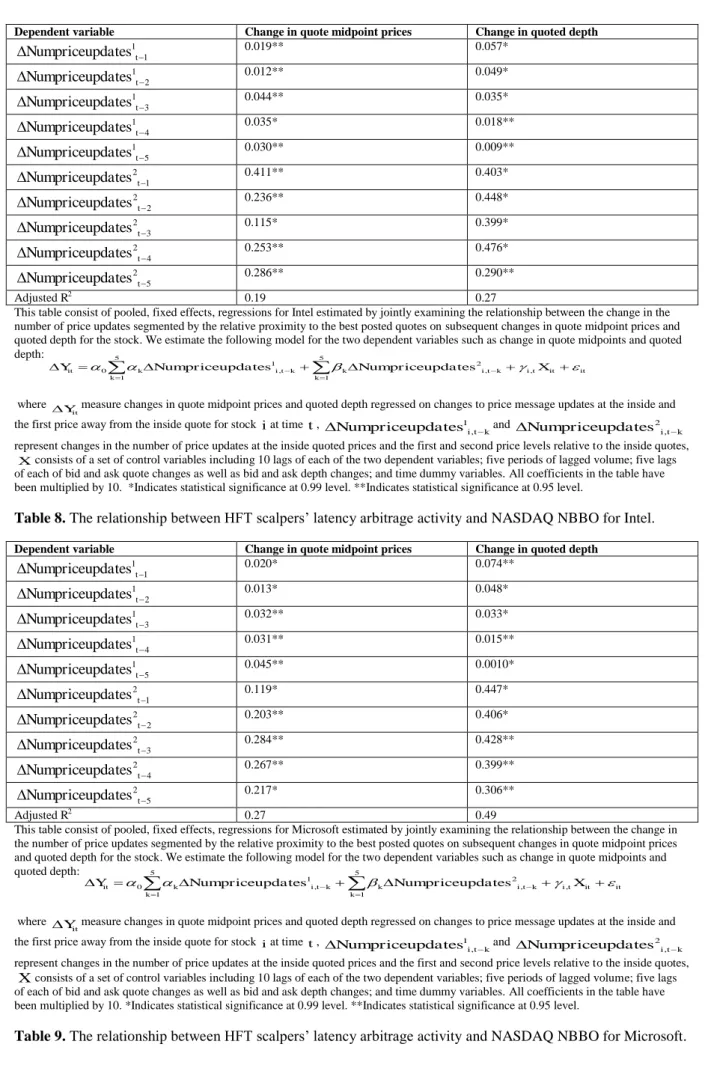
To further investigate the relationship between HFT scalpers’ latency arbitrage activity and NASDAQ NBBO, we estimate pooled, fixed effect regressions of changes to price updates at two price levels relative to the inside on changes in quote midpoint prices and quoted depth.
18 | P a g e Our analysis is limited to two price levels because day traders usually use level two quotes to access bids and offers for a particular financial instrument. We estimate the following model for the two dependent variables such as a change in the quote midpoint prices and the quoted depth:
5 5 1 2 0 , , , 1 1 it k i t k k i t k i t it it k k
Y
Numpriceupdates
Numpriceupdates
X
(6)where
Y
itmeasure changes in quote midpoint prices and quoted depth regressed on changes to price message updates at the inside and the first price away from the inside quote for stocki
at time t,1 , i t k
Numpriceupdates
and
Numpriceupdates
2i t k, represent changes in the number of priceupdates for the inside quoted prices and the first and second price levels relative to the inside quotes,
X
consists of a set of control variables including 10 lags of each of the two dependent variables: five periods of lagged volume, five lags of each bid and ask quote changes, as well as bid and ask depth changes and time dummy variables.We follow Harris and Saad (2014) to estimate the changes in quoted midpoint prices:
5 , 1 it i k i t k it it it k
Midprices
Messages
X
(7)where
Messages
consists of five independent variables such as
Numpriceupdates
,Numdepthupdates
,
Numreserveupdates
(changes in the number of nonvisible depth updates),Totalmessageupdates
(changes in every message sent),
Newmessagearrivals
(changes in newmessages that do not change displayed prices),
X
measures the same set of controlling variables as in Equation (6).The physical proximity to the trading venue and the technology of the trading system both contribute to latency. Hence, we take into account the physical as well as wire distance between the NASDAQ SIP and our processing server by implementing a separate lag adjustment. For comparison purposes, we select the quote lag that maximizes the number of trades that execute at NASDAQ NBBO for each
19 | P a g e stock day. In other words, for each day and each of the three stocks there is an individual lag
adjustment. Tables 7, 8 and 9 show that changes in the NASDAQ SIP quote midpoint prices at all lags and all price levels generated by HFT scalpers’ latency arbitrage activity, are jointly and significantly related to changes in NASDAQ NBBO for Cisco Systems, Intel and Microsoft. We also observe that changes in quoted depth for all lags and all price levels generated by HFT scalpers’ latency arbitrage activity are jointly and significantly related to changes in NASDAQ NBBO for each of the three financial instruments.
These findings confirm the assumption that HFT scalpers are able to calculate NASDAQ NBBO ahead of the NASDAQ SIP, providing them with the opportunity of latency arbitrage (this is evident by their ability to presage the advent of midpoint price changes up to 2.8 milliseconds in advance). Our empirical results are consistent with Narang (2010) and McInish et al. (2014) who argue that HFT strategies are able to jump ahead of trading orders placed by other investors via Intermarket Sweep Orders (ISOs) and thus earn substantial profits. Patterson et al. (2013) observe that HFTrs profit by exploiting a hidden loophole in the Chicago Mercantile Exchange (CME). This loophole allows HFTrs with a direct connection to the CME to know of their own trade executions 10 milliseconds before informing the other market participants about the trade; this enables HFTrs to submit other orders and use this information for trading purposes ahead of the rest of the market.
By anticipating future NBBO, HFT scalpers can capitalise on cross-market disparities prior to their reflection in the public price quote, in effect front-running incoming trading orders to earn a small but sure profit.
20 | P a g e
4.2.High-frequency trading profitability.
We will now quantify the latency arbitrage opportunities for our HFT scalpers. Ding et al. (2014) suggest that the average price difference between the NASDAQ SIP and the NBBOs for Intel is $0.0107 per share. We follow Ding et al. (2014) to estimate that the average price difference for Cisco Systems is $0.0201 per share (average share price of Cisco Systems in June 2014 multiplied by the percentage of average arbitrage opportunities) and $0.0083 per share for Microsoft. For a more realistic trading scenario we employ appropriate transaction costs. Narang (2013) reports that the US Securities and Exchange Commission (SEC) impose typical round trip transaction costs of $0.003 per share, while we employ transaction costs of $0.004 for our profit calculations. Although slightly higher than the current standards, the level of transaction costs take into account the operational costs of HFT companies such as investments in technology, data and collection fees, as well as salaries. These include software platforms, labour and risk management systems but do not include the co-location of servers. Multiplying the average price difference following transaction costs by the trading volume of the three financial instruments reported in column 2 of Table 10 yields the profits
accumulated by HFT scalpers on each trading day for each stock. We find positive relationship between trading volume generated by our artificial stock market traders and HFT scalpers’ profits. The lowest risk-free profit generated by HFT scalpers was $48.49 for Microsoft on 23rd of June, 2014, while the highest risk-free profit of $382.00 was recorded for Cisco Systems on 18th of June, 2014. The average risk-free profit per day for trading Cisco Systems in June 2014 was $312.94; $104.42 for trading Intel; and $61.13 for trading Microsoft. Brogaard et al. (2013) can be seen to examine 26 high frequency trading companies trading on NASDAQ between 2008 and 2009, reporting that they earn an average profit of $30 per day, per company for small stocks, $174 for medium and $6,651 for large. However, the authors report substantially high trading volumes for all stocks traded by the 26 high frequency firms.
21 | P a g e Considering the fact that that the average price difference between the NASDAQ SIP and the
NASDAQ NBBOs is $0.0201 per share for Cisco Systems, $0.0107 for Intel, and $0.0083 for
Microsoft, we calculate the cost of HFT scalpers’ latency on institutional investors submitting random market orders. We estimate that there are 1,094 latency arbitrage opportunities for Cisco Systems on 2nd of June, 2014 during the 6.5-hour trading day (approximately 0.047 latency arbitrage opportunities per second). Considering the latency of 1.6 milliseconds for HFT scalpers for this particular day, implies that for 0.0752 (0.047 multiplied by 1.6) milliseconds of each second the NASDAQ SIP and the NASDAQ NBBO differ. This could result in a buy or sell order heading to the wrong trading exchange half that often: 0.038%. We multiply the average price difference of $0.0201 by the
percentage of the time latency arbitrage opportunities occur (0.038%), to estimate an expected latency arbitrage opportunity of $0.00076 per 100 shares for a market order submitted randomly during trading time. We then multiply this amount of money by Cisco Systems’ trading volume of 20,347 for 2nd of June, 2014 to find out that the cost of latency arbitrage for that day was $0.15.
Table 11 indicates that the lowest cost of HFT scalpers’ latency arbitrage on institutional traders was $0.02 for Microsoft on 12th,16th and 19th of June and the highest latency arbitrage cost was $0.19 for Cisco Systems on 4th and 24th of June. The average cost of latency arbitrage for Cisco systems was $0.13; $0.04 for Intel; and $0.04 for Microsoft. Although these numbers suggest that market
participants submitting random market orders are unlikely to experience significant latency arbitrage costs, investors trading when latency opportunities occur are facing substantial costs. This is
especially valid in real-life trading, where all HFT companies generate a huge trading volume resulting in high levels of latency arbitrage costs. However, one of the shortcomings of our cost of latency estimations is that NASDAQ NBBO is updated many times per second (artificial stock market traders also submit trading orders many times per second) resulting in more than 0.047 latency
22 | P a g e
4.3.High-frequency trading and market quality
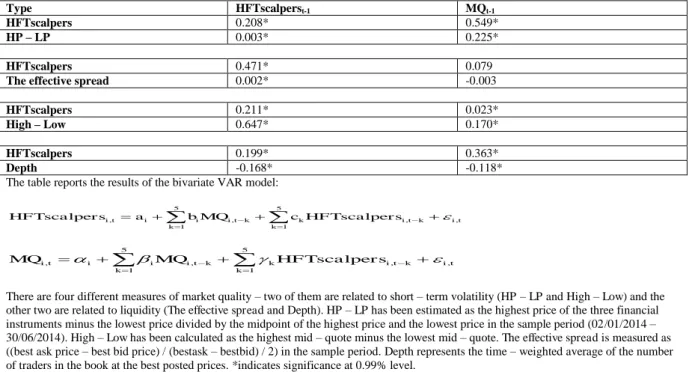
Biais et al. (2011), Budish et al. (2013), Schwartz and Wu (2013), and Menkveld (2014) argue that the superhuman speed of trading and a continuous limit order book could lead to a socially wasteful arms race amongst HFTrs, imposing severe disadvantages on traditional investors. Narang (2010) reports that the current rebate stock market structure based on volume unfairly benefits HFTrs over ordinary traders. To test these arguments empirically we examine the implications of HFT scalpers’ latency arbitrage activity on market quality by defining several measures of market quality: two measures of liquidity and two measures of short-term volatility . The first measure of liquidity is the Effective Spread ((best ask price – best bid price) / (bestask + bestbid) / 2). Depth represents the second measure of liquidity and is estimated as the time-weighted average of the number of trades in the book at the best posted prices in the sample period. The first measure of short-term volatility (HP
– LP) is defined as the highest price minus the lowest price divided by the midpoint of the highest price and the lowest price in the sample. High-Low represents the second measure of short-term volatility and is defined as the highest mid-quote minus the lowest mid-quote. While HFT scalpers’ trading volume and market quality are dependent variables in our experiment, five lags of the two dependent variables act as explanatory variables. The bivariate VAR model of HFT scalpers’ trading volume and market quality for each day from 2nd of June, 2014 to 30th of June, 2014 has been designed to capture the trading activity for each stock and each day in the sample:
(8)
(9)
where is the total volume for the period, and is the market quality variable. There are four measures as a proxy for market quality: The Effective Spread, Depth, HP-LP and High-Low. 5 5 , , , , 1 1 i t i i i t k k i t k i t k k
HFTscalpers
a
b MQ
c HFTscalpers
5 5 , , , , 1 1 i t i i i t k k i t k i t k kMQ
MQ
HFTscalpers
, i t HFTscalpers MQi t,23 | P a g e The results reported in Table 12 demonstrate the negative implications of HFT scalpers’ latency arbitrage activity on market quality. A comparison between HFT scalpers and HP- LP indicates that HFT scalpers are significantly affected by intra-day volatility, and volatility is increased as a result of the activity of HFT scalpers. We examine the effect of HFT scalpers on High- Low and observe that, as with HP-LP, the volatility has an effect on HFT scalpers and HFT scalpers increase intraday volatility. After analysing the effect of HFT scalpers on the Effective Spread and finding that the coefficients 0.079 and (-0.003) for the first lagged HFT scalpers are insignificant, we conclude that HFT scalpers’ activity does not significantly narrow the subsequent effective spread for the three stocks within the artificial stock market settings. Finally, we examine the relation between HFT scalpers and Depth and find that a higher level of HFT scalpers’ activity is associated with lower levels of market depth. Our empirical findings show that market efficiency is negatively affected by the trading activity of HFT scalpers, with no countervailing benefit in volatility or any other measured variable. These findings are in line with Lee (2014) but counter to the results of Brogaard (2010), Hansbrouck and Saar (2009) and Hendershott and Riordan (2011).
4.4 High-frequency trading and market regulation.
Trading at superhuman speeds poses potential regulatory questions, including whether such rapid trading has negative implications on a broker’s ability to perform affirmative obligations, such as execution at NBBO prices. Considering the fact that HFT scalpers are already much faster than other market participants, their ability to invest in the latest software technology to shave a few
milliseconds off creates the conditions of an arms race. Our experimental results suggest that HFT scalpers’ latency arbitrage activity precipitates an arms race, as even faster traders can calculate NASDAQ NBBO to see the future NASDAQ NBBO, and so on. The speed race could lead to a classic prisoner’s dilemma: HFT scalpers invest in speed to try to capture as many as possible latency arbitrage opportunities, aggressive HFTrs should invest in speed to match HFT scalpers’ trading activity; and all market participants should be better off if they collectively decide not to invest in speed, but it is each market participant interest to continue to invest in speed. Similar to Budish et al. (2013), we observe that the latency arms race is a result of continuous trading.
24 | P a g e Budish et al. (2013) argue that the HFT arms race is a result of the continuous operation of current financial markets and propose the introduction of frequent batch auctions. These batch auctions represent uniform-price sealed-bid double auctions performed at frequent but also discrete time intervals. The auction takes the form of a sealed bid not visible to other traders during the batch interval and the exchange collects all receive orders at the end of each batch interval, estimating the aggregate of demand and supply functions out of all bid and ask orders. The market should clear at the point where supply equals demand, with all transactions occurring at the same price, which is the uniform price. Trading orders are not visible to other traders and the exchange distributes the aggregate supply and demand functions at the end of each batch interval. The authors suggest that frequent batch auctions can eliminate the arms race by significantly reducing the value of a tiny speed advantage. The current continuous order book process allows latency arbitrage and front-running of trading orders due to the serial sequence of market orders. In contrast, under the conditions for batch auctions, multiple traders observe the same information at the same time enhancing price rather than speed competition. Budish et al. (2013) suggest that in equilibrium of the batch auctions, bid-ask spreads are narrower and markets are deeper providing greater social welfare. Moreover, batch auctions provide exchanges, with longer periods of time for processing orders before the next queue of batch orders. This could ease the computational process in all trading venues world-wide, making financial markets less vulnerable to crises like the Flash Crash in 2010. The authors propose batch auctions at intervals such as once per second (23,400 times per day per security). Although, Menkveld (2014) claims that batch auctions should be scheduled at a rate of 10 auctions per second, enabling traders to see the prices in the last auction before conducting the next auction, our empirical results illustrate that HFT scalpers generate large profits and cancel a large number of orders in very short intervals, that is, between 0 and 70 milliseconds (reported in Table 2). Introducing batch auctions at frequencies such as 10 per second could prove inefficient, so, we therefore recommend the
implementation of batch auctions once per 70 milliseconds (334,285 times per 6.5 – hour trading day per security) based on the distribution of cancelled orders in Table 2. Bunching together incoming trading orders every 70 milliseconds would impose a queuing risk for HFT scalpers, leading to positive implications for market quality.
25 | P a g e
5.Conclusions
The application of sophisticated computational trading strategies at very low latency has increased over time. Significant trading software improvements are constantly introduced, raising operating costs and increasing competitive advantage among market participants. As communication and trading speed in financial markets has decreased over time, regulators face additional challenges in terms of addressing the speed differentials of market participants.
In this study, we simulate real-life trading within artificial stock market settings and observe that HFT scalpers are able to calculate NASDAQ NBBO at least 1.5 milliseconds ahead of the NASDAQ SIP, creating a large number of latency arbitrage opportunities. We also measure the precise level of profits generated by HFT scalpers and the exact costs of latency arbitrage to other market participants. Moreover, we observe that HFT scalpers’ latency arbitrage activity accumulates a large number of cancelled orders in a very short period of time, which may make trading more difficult and costly for traditional investors who lack access to sophisticated trading platforms. If one group of market participants such as HFT scalpers is able to calculate NASDAQ NBBO ahead of the NASDAQ SIP, those participants with lower latency would have an unfair advantage in the marketplace creating socially wasteful arms race for speed. We observe that the size of the arbitrage opportunity, and hence the harm to traditional investors, may depend on the magnitude of speed and the cost of cutting-edge speed improvements.
In terms of market quality, we have found that HFT scalpers’ latency arbitrage activity has negative implications on market efficiency, as intraday volatility increases and market depth decreases.
Nearly all financial markets around the world operate on a continuous trading basis, allowing
computationally advantaged traders such as HFT scalpers to generate risk-free profits. We propose an alternative financial market mechanism such as the batch auctioned market, which successfully eliminates latency arbitrage opportunities and improves efficiency. A batch auctioned financial market could prevent HFTrs from gaining an advantage in terms of latency, thereby increasing surplus for ordinary traders.
26 | P a g e We suggest the implementation of batch auctions once in every 70 milliseconds, that is 334,285 times per 6.5-hour trading day per financial instrument. If trading orders are bunched together every 70 milliseconds, HFT scalpers could face a queuing risk, leading to a less harmful market quality effect.
Perhaps the main practical implication of our study comes from our demonstrating that market regulators and operators can apply artificial intelligence tools such as STGP to conduct trading behaviour-based profiling, as well as capture the occurrence of new HFT strategies and examine their impact on the financial markets. However, a possible limitation of this study is that all trading volumes, latency arbitrage opportunities, profits and latency arbitrage costs are comparable within artificial stock market settings. In comparison with real-life investors, artificial traders are
programmed to obey orders and perform certain tasks lacking feelings and emotions. In any case, trading at superhuman speeds is likely to remain a major field of interest for researchers as well as a concern for market regulators over the next few years.
27 | P a g e
Appendices
Artificial stock market parameters Total population size (traders) 100,0000 HFT scalpers’ size(percentage of the total population) 50%
Aggressive HFTrs’ size (percentage of the total population) 50% Initial wealth (equal for all traders) 100,000 Significant Forecasting range 0% to 10% Number of decimal places to round quotes on importing 2 Minimum price increment for prices generated by model 0.01
Minimum position unit 20%
Maximum genome size 4096*
Maximum genome depth 20**
Minimum initial genome depth 2
Maximum initial genome depth 5
Breeding cycle frequency (quotes) 1
Minimum breeding age (quotes) 80***
Initial selection type random
Parent selection (percentage of initial selection that will breed) 5%**** Mutation probability (per offspring) 10%
Total number of quotes processed- Cisco Systems 579,003 (from 02/06/2014 to 30/06/2014) Total number of quotes processed- Intel 412,047 (from 02/06/2014 to 30/06/2014) Total number of quotes processed- Microsoft 398,224 (from 02/06/2014 to 30/06/2014)
Seed generation from clock Yes
Creation of unique genomes Yes
Offspring will replace the worst performing traders of the initial selection
Yes
*Maximum genome size measure the total number of nodes in an trader’s trading rule. A node is a gene in the genome such as a function or a value.
**Maximum genome depth measures the highest number of hierarchical levels that occurs in an trader’s genome (trading rule). The depth of a trading rule can be an indicator of its complexity.
***This is the minimum age required for agents to qualify for potential participation in the initial selection. The age of a trader is represented by the number of quotes that have been processed since the trader was created. This measure also specifies the period over which agent performance will be compared. Our minimum breeding age is set to 80, which means that the trader’s performance over the last 80 quotes will be compared.
****5% of the best performing traders of the initial selection that will act as parents in crossover operations for creating new traders.
Table 1. Artificial Stock Market Parameter Settings.
HFT scalpers
Time (milliseconds) Cancellation Execution
0-70 0.933 0.064 71-100 0.762 0.049 101-150 0.399 0.033 151-200 0.201 0.007 201-250 0.051 0.003 Aggressive HFTrs 0-70 0.019 0.078 71-100 0.025 0.082 101-150 0.037 0.088 151-200 0.056 0.153 201-250 0.087 0.160
This table presents a histogram of cancellation and execution within the millisecond interval (data has been generated and extracted from the STGP trading algorithm from 2 June, 2014 to 30 June, 2014). The probabilities are estimated as 1 S t , where S t represent the survival function of cancellation and execution. In order to calculate the survival function we extracted all trading activity for Cisco Systems, Intel and Microsoft generated by STGP trading algorithm and used the life-table method.
Table 2. Histogram of cancellation and execution of limit orders by HFT scalpers and aggressive
28 | P a g e
HFT scalpers
Date Trading volume Latency* Number of latency arbitrage
opportunities
Herfindahl index for NASDAQ NBBO 02/06/2014 20,347 -1.6 1094 3.86 03/06/2014 19,009 -1.5 1502 4.92 04/06/2014 19,822 -1.5 1500 4.93 05/06/2014 18,251 -1.8 912 2.81 06/06/2014 18,111 -1.6 1000 3.87 09/06/2014 15,983 -1.9 803 2.72 10/06/2014 22,575 -2.0 687 2.54 11/06/2014 20,262 -2.1 610 1.50 12/06/2014 19,999 -2.1 608 1.51 13/06/2014 19,634 -2.0 699 2.48 16/06/2014 19,120 -2.2 517 1.46 17/06/2014 17,845 -1.8 900 3.83 18/06/2014 23,727 -1.6 1036 4.88 19/06/2014 16,891 -1.7 1001 4.79 20/06/2014 18,776 -2.0 690 2.51 23/06/2014 20,292 -2.4 477 2.45 24/06/2014 19,890 -1.5 1511 4.94 25/06/2014 18,276 -1.6 1029 4.86 26/06/2014 18,393 -1.5 1517 4.95 27/06/2014 20,818 -1.9 800 3.74 30/06/2014 20,164 -1.8 911 3.80 Aggressive HFTrs 02/06/2014 7,557 2.8 0 1.29 03/06/2014 8,313 3.3 0 1.31 04/06/2014 8,001 3.0 0 1.43 05/06/2014 9,123 3.5 0 1.38 06/06/2014 9,204 2.0 0 1.24 09/06/2014 11,782 2.5 0 2.31 10/06/2014 4,882 2.8 0 0.99 11/06/2014 6,999 2.7 0 0.84 12/06/2014 7,524 2.9 0 1.27 13/06/2014 8,009 3.0 0 1.26 16/06/2014 8,110 3.1 0 1.43 17/06/2014 10,030 2.6 0 1.32 18/06/2014 3,626 2.3 0 0.19 19/06/2014 10,889 2.2 0 1.85 20/06/2014 6,856 2.0 0 1.20 23/06/2014 6,161 2.1 0 1.19 24/06/2014 8,251 2.2 0 1.48 25/06/2014 9,552 2.7 0 0.90 26/06/2014 9,774 2.5 0 0.85 27/06/2014 6,984 3.0 0 2.29 30/06/2014 7,006 2.7 0 1.37
This table presents the trading volume, the latency, the number of latency opportunities and the Herfindahl index for Cisco Systems from 2nd
of June, 2014 to 30th of June, 2014 generated by STGP.
* We estimate the actual latency magnitude between the two groups of artificial high frequency traders and NASDAQ NBBO using the following equations:
( , )
HFTscalpers HFTscalpers i t NBBO
Latency Timestamp Timestamp
( , )
aggressiveHFTrs aggressiveHFTrs i t NBBO
Latency Timestamp Timestamp
Negative latency values indicates that HFT scalpers and aggressive HFTrs are able to calculate NASDAQ NBBO faster than NASDAQ SIP.
Table 3. Statistical measures for Cisco Systems from 2nd of June, 2014 to 30th of June, 2014 generated by HFT scalpers and aggressive HFTrs.
29 | P a g e
HFT scalpers
Date Trading volume Latency* Number of latency arbitrage
opportunities
Herfindahl index for NASDAQ NBBO 02/06/2014 13,237 -2.0 619 2.62 03/06/2014 14,002 -1.9 778 3.74 04/06/2014 15,265 -2.2 501 2.57 05/06/2014 15,789 -2.5 388 1.51 06/06/2014 16,489 -1.9 723 2.83 09/06/2014 12,983 -1.6 937 3.89 10/06/2014 13,671 -1.9 774 3.80 11/06/2014 14,189 -1.5 1099 4.97 12/06/2014 15,126 -2.4 380 1.50 13/06/2014 14,172 -2.2 511 2.56 16/06/2014 16,818 -2.5 373 1.49 17/06/2014 14,767 -1.8 905 3.89 18/06/2014 13,120 -1.7 897 3.90 19/06/2014 13,888 -1.7 1000 4.90 20/06/2014 12,119 -1.5 1507 4.99 23/06/2014 14,662 -1.6 1015 4.92 24/06/2014 13,000 -2.3 571 3.66 25/06/2014 12,981 -2.2 638 3.63 26/06/2014 15,126 -2.1 777 2.01 27/06/2014 14,220 -1.7 923 3.88 30/06/2014 14,003 -1.5 1609 4.96 Aggressive HFTrs 02/06/2014 6,771 3.9 0 1.23 03/06/2014 5,877 4.2 0 1.20 04/06/2014 3,266 4.0 0 1.28 05/06/2014 3,115 2.7 0 1.34 06/06/2014 2,107 2.9 0 1.33 09/06/2014 6,270 3.1 0 0.89 10/06/2014 6,145 3.2 0 1.03 11/06/2014 5,001 2.5 0 0.49 12/06/2014 3,999 2.8 0 1.77 13/06/2014 4,148 3.0 0 1.49 16/06/2014 2,288 5.2 0 0.78 17/06/2014 4,115 3.3 0 1.30 18/06/2014 5,772 1.9 0 1.76 19/06/2014 5,509 2.4 0 1.29 20/06/2014 6,004 3.7 0 2.25 23/06/2014 4,778 2.1 0 2.24 24/06/2014 6,717 1.8 0 1.22 25/06/2014 6,992 3.5 0 2.38 26/06/2014 4,116 2.6 0 1.44 27/06/2014 5,124 2.0 0 2.41 30/06/2014 5,233 2.3 0 1.39
This table presents the trading volume, the latency, the number of latency opportunities and the Herfindahl index for Intel from 2nd of June,
2014 to 30th of June, 2014 generated by STGP.
* We estimate the actual latency magnitude between the two groups of artificial high frequency traders and NASDAQ NBBO using the following equations:
( , )
HFTscalpers HFTscalpers i t NBBO
Latency Timestamp Timestamp
( , )
aggressiveHFTrs aggressiveHFTrs i t NBBO
Latency Timestamp Timestamp
Negative latency values indicates that HFT scalpers and aggressive HFTrs are able to calculate NASDAQ NBBO faster than NASDAQ SIP.
Table 4. Statistical measures for Intel from 2nd of June, 2014 to 30th of June, 2014 generated by HFT scalpers and aggressive HFTrs.
30 | P a g e
HFT scalpers
Date Trading volume Latency* Number of latency arbitrage
opportunities
Herfindahl index for NASDAQ NBBO 02/06/2014 14,237 -1.9 781 3.82 03/06/2014 15,944 -1.9 779 3.81 04/06/2014 15,161 -2.1 733 3.69 05/06/2014 16,120 -1.7 845 2.70 06/06/2014 14,266 -1.5 1500 4.99 09/06/2014 13,353 -1.5 1514 4.98 10/06/2014 12,348 -1.7 874 3.71 11/06/2014 14,003 -1.8 912 3.63 12/06/2014 16,272 -2.7 327 2.55 13/06/2014 16,400 -2.5 410 2.59 16/06/2014 13,445 -2.8 306 1.54 17/06/2014 14,894 -2.0 732 3.78 18/06/2014 14,122 -2.1 719 3.63 19/06/2014 13,009 -2.5 403 2.59 20/06/2014 12,474 -1.8 838 3.62 23/06/2014 11,277 -1.9 700 2.88 24/06/2014 14,820 -1.5 1508 4.94 25/06/2014 13,995 -1.7 936 4.90 26/06/2014 13,823 -2.1 699 2.53 27/06/2014 14,237 -2.2 642 2.61 30/06/2014 14,336 -2.0 863 3.77 Aggressive HFTrs 02/06/2014 4,002 2.6 0 1.33 03/06/2014 3,888 3.1 0 1.29 04/06/2014 3,997 3.4 0 1.26 05/06/2014 3,555 3.0 0 0.93 06/06/2014 4,111 2.7 0 0.99 09/06/2014 5,373 2.9 0 1.30 10/06/2014 6,661 2.3 0 1.35 11/06/2014 5,822 2.0 0 2.36 12/06/2014 3,119 3.7 0 2.27 13/06/2014 3,005 3.5 0 1.28 16/06/2014 5,474 2.8 0 1.32 17/06/2014 4,585 2.6 0 1.34 18/06/2014 4,778 2.2 0 2.29 19/06/2014 5,116 2.1 0 1.33 20/06/2014 6,828 2.1 0 1.30 23/06/2014 7,080 1.9 0 2.41 24/06/2014 4,821 2.5 0 1.28 25/06/2014 5,112 2.4 0 1.27 26/06/2014 5,228 2.5 0 1.34 27/06/2014 4,999 2.3 0 1.35 30/06/2014 5,021 2.5 0 0.87
This table presents the trading volume, the latency, the number of latency opportunities and the Herfindahl index for Microsoft from 2nd of
June, 2014 to 30th of June, 2014 generated by STGP.
* We measure the latency by estimating the amount of time between the HFT scalpers and aggressive HFTrs time stamps at SIP and the NBBO as follows:
( , )
HFTscalpers HFTscalpers i t NBBO
Latency Timestamp Timestamp
( , )
aggressiveHFTrs aggressiveHFTrs i t NBBO
Latency Timestamp Timestamp
Negative latency values indicates that HFT scalpers and aggressive HFTrs are able to calculate NASDAQ NBBO faster than NASDAQ SIP.
Table 5. Statistical measures for Microsoft from 2nd of June, 2014 to 30th of June, 2014 generated by HFT scalpers and aggressive HFTrs.