POLICY
RESEARCH
WORKING
PAPER
2019
The Effects on Developing
Developing countries-bothimporters and
exporters-Countries
of
the Kyoto
could in fact benefit fromProtocol and Carbon
carbon dioxide emissionstrading to achieve tagets
Dioxide
Emissions Trading
mandated by the KyotoProtocol.
A. Denny Ellerman Henry D. Jacoby Annelene Decaux
The World Bank
Development Research Group
Infrastructure and Environment
H
December 1998
Public Disclosure Authorized
Public Disclosure Authorized
Public Disclosure Authorized
The trading of rights to emit carbon dioxide has not The authors also consider what might happen if
officially been sanctioned by the United Nations developing countries were to voluntarily accept caps
Framework Convention on Climate Change, but it is of equal to Business as Usual Emissions and were allowed to
interest to investigate the consequences, both for sell emission reductions below these caps to Annex B
industrial (Annex B) and developing countries, of countries. The gains from emissions trading could be big
allowing such trades. Ellerman, Jacoby, and Decaux enough to give buyers and sellers incentive to support
examine the trading of caps assigned to Annex B the system. Indeed, a global market for rights to emit
countries under the Kyoto Protocol and compare the carbon dioxide could reduce the cost of meeting the
outcome with a world in which Annex B countries meet Kyoto targets by almost 90 percent, if the market were to
their Kyoto targets without trading. Under the trading operate competitively. The division of trading gains,
scenario the former Soviet Union is the main seller of however, may make a competitive outcome unlikely:
carbon dioxide permits and Japan, the European Union, Under perfect competition, the vast majority of trading
and the United States are the main buyers. Permit trading gains go to buyers of permits rather than to sellers. Even
is estimated to reduce the aggregate cost of meeting the markets in which the supply of permits is restricted can,
Kyoto targets by about 50 percent, compared with no however, substantially reduce the cost to Annex B
trading. Developing countries, though they do not trade, countries of meeting their Kyoto targets, while yielding
are nonetheless affected by trading. For example, the profits to developing countries that elect to sell permits.
price of oil and the demand for other developing country exports are higher with trading than without.
This paper - a product of Infrastructure and Environment, Development Research Group - is part of a larger effort in
the group to examine the impact on developing countries of programs to correct global environmental problems. Copies of the paper are available free from the World Bank, 1818 H Street NW, Washington, DC 20433. Please contact Tourya Tourougui, room MC2-521, telephone 202-458-7431, fax 202-522-3230, Internet address [email protected]. Denny Ellerman may be contacted at [email protected]. December 1998. (43 pages)
The Policy Research Working Paper Series disseminates the findings of work in progress to encourage the exchange of ideas about development issues. An objective of the series is to get the findings out quickly, even if the presentations are less than fully polished. The papers carry the names of the authors and should be cited accordingly. The findings, interpretations, and conclusions expressed in this paper are entirely those of the authors. They do not necessarily represent the view of the World Bank, its Executive Directors, or the countries they represent.
A. Denny Ellerman, Henry D. Jacoby and Annelene Decaux'
Joint Program on the Science and Policy of Global Change Massachusetts Institute of Technology
Ellerman is Senior Lecturer at the Sloan School of Management and Executive Director of the Joint Program; Jacoby is the William F. Pounds Professor of Management at the Sloan School and Co-Director of the Joint Program; and Decaux is a candidate for a Master's degree from MIT's Technology and Policy Program and a Research Assistant with the Joint Program. Funding for this paper from the World Bank is gratefully acknowledged. We are also very much indebted to Ian Sue Wing for modeling support and to the following individuals for comment on earlier versions of the paper: at MIT, Richard Eckaus, David Reiner and Mustafa Babiker; and at the World Bank, Zmarak Shalizi, Ken Chomitz and Maureen Cropper.
TABLE OF CONTENTS ... 1
1. INTRODUCTION ... ... 2
2. THREE BASIC CASES: NO TRADING, ANNEX B TRADING AND FULL GLOBAL TRADING ... 5
a) The Autt..kic, No-Trading Case (Fig. 1, Table A) . ... S b) Annex B Trading (Figs. 2 and 3, Table B) ... S5 c) Full Global Trading (Fig. 4, Table C) ... 6
d) Effect of Higher and Lower Economic Growth (Figs. 5 and 6, Tables A' to C, A " to C") ... 7
e) Per Capita Emissions (Fig. 7) ... 8
3. IMPORT LIMITATIONS (FIG. 8, TABLES D TO F) ... 9
4. CDM "SURCHARGES" AND CARTELIZATION OF SUPPLY ... 11
a) CDM Surcharges (Fig. 9, Tables G to 1) ... 11
b) Cartelization of Supply (Tables J to L) ... 12
5. INEFFICIENT SUPPLY (FIGS. 10 AND 11, TABLES M TO Y) ... 14
6. INTERNATIONAL TRADE IN ENERGY AND NON-ENERGY GOODS ... 15
a) Trade in Goods with No Emissions Trading ... 16
b) Comparing the No- Trading Case with Full Global Trading ... 17
c) Summary ... 18
7. CONCLUDING OBSERVATIONS ... 19
FIGURES ... 20
REFERENCES ... 26
APPENDIX A: MARGINAL ABATEMENT CURVES ... A 1
a) What are Marginal Abatement Curves and What Do They Represent? (Fig. A l) ...A I b) How can MACs be Usedfor Trade Studies? (Fig. A2) ... A I c) How are MACs Generatedfrom CGE Models? (Fig. A3, A4 and A5) ... A 2 d) Assessing the "Robustness" of MACs with Regard to the Policy Applied (Fig. A6) ... A 4 e) Analytical Approximations: a Simple Tool for Trade Studies (Fig. A 7) ... A 4
]) Construction of Aggregate Supply and De)mand Curves (Figs. A8, A9) ... A 6 g) Figures ... A 7
1. INTRODUCTION
The Kyoto Protocol recognizes a strong linkage between C02 emission reduction goals, emissions trading, and the role of developing economies. Annex B parties, generally the industrialized nations, have set targets that, for most, imply a significant reduction of C02-equivalent emissions by 2010. The ability and even willingness of Annex B parties to achieve these targets will depend on the cost of abatement. The cheapest sources of CO2emission reductions are found, not in the Annex B countries, but in the developing economies (or non-Annex B parties), which for historic and equity reasons are not expected to contribute to the global emissions reduction in the near term. Since the location of C02 emissions does not matter from a global warming perspective, the achievement of the Kyoto targets will depend in large part upon the ability of Annex B countries to substitute cheaper emission reductions in non-Annex B regions for equivalent abatement at home. In providing a mechanism for this exchange, emissions trading not only reduces the cost of meeting the Kyoto goals for Annex B parties, but also provides a new source of export earnings for non-Annex B parties.
Developing country interest in emissions trading is not limited to the potential for new export earnings. Achieving the goals set at Kyoto will change patterns of consumption and production within Annex B nations; and these changes will have inevitable effects on the flows of internationally traded goods. As a result, developing countries will be affected through conventional trade linkages with the Annex B countries; however, these effects, both favorable and unfavorable, will be diminished to the extent that emissions trading reduces the cost of achieving the Kyoto targets.
In examining the effects of the Kyoto Protocol upon non-Annex B parties, we assume that the Annex B goals are met, and we focus in particular on how emissions trading would affect the developing countries. We refer to emissions trading generically, to include bubbles, joint implementation, allowance or credit systems, and perhaps other forms yet to be devised. The chief practical distinction among these forms concerns the transaction cost involved in effecting an individual trade.
The paper relies heavily upon the use of marginal abatement curves (MACs). These curves represent the marginal cost of reducing carbon emissions by different amounts within an economy. The details of their construction, and the elaboration of the aggregate demand and supply curves for carbon permits which are drawn from them, are explained in Appendix A. The MACs used here are generated using MIT's Emissions Prediction and Policy Assessment (EPPA) model (Yang et al. 1996). This is a multi-sectoral, multi-regional, computable general equilibrium (CGE) model of global economic activity, energy use and carbon emissions. The underlying model simulates real emission reductions, so that our analysis implicitly assumes that the "additionality" criterion established in the Kyoto Protocol [Arts. 6.1(b) and 12.5(c)] is satisfied. We do not attempt to address the considerable political and practical problems of measurement and verification that are associated with this criterion, but we will account for the effect of these problems in a subsequent
section.2
The main body of the paper consists of five sections. Section 2 uses the MACs to analyze three basic cases: no emissions trading, emissions trading limited to Annex B parties (including the Former Soviet Union), and full global trading. Results are presented in graphical form in the text,
and the regional detail--in terms of abatement, costs, emission permit trade and prices for all the cases discussed--is presented in tabular form in Appendix B.
The next three sections address the effects of various departures from the three basic cases. The first departure, in Section 3, is the effect of limitations on imports of emission permits, as might correspond to the "supplementarity" criterion included in the Kyoto Protocol [Arts. 6.1(d) and 17] or to the recent call by the EU environmental ministers for a "concrete ceiling" on emissions trading.
Section 4 evaluates the effect of surcharges on emission permits generated under the Clean Development Mechanism (CDM), as also provided in the Kyoto Protocol [Art. 12.8], and of non-competitive pricing. The third departure, discussed in Section 5, is the effect of a smaller supply of permits from the non-Annex B regions than is indicated by EPPA's assumptions of complete economic rationality and zero transaction costs, which we term "inefficient supply."
In Sections 2 through 5, the measure of welfare used is the total direct resource cost required to meet the emissions constraint. As explained in Appendix A, for any country this cost is the area under its marginal abatement curve up to any point of constraint, corrected for any purchase or sale of emissions permits. This is the conventional measure which is generated using the MAC approach. However, because the MACs are generated at the country level, they are not able to take account of effects that are mediated through international trade in energy or other goods. As shown in Appendix A, the MAC results themselves are not sensitive to trade effects. Nevertheless, these effects will influence sub-national details, such as patterns of trade in particular goods and activity at the sectoral level. To explore these effects, we depart from the MAC analysis in Section 6, and present results taken directly from the EPPA model.
In Section 7 we offer some concluding observations.
In conducting our analysis, we will make frequent reference to the twelve regions represented in EPPA, which are listed below with the model's acronyms.
ANNEX B REGIONS: NON-ANNEx B REGIONS:
USA: USA EEX: Energy Exporting Countries
JPN: Japan CHN: China
EEC: European Union (12 countries) IND: India
OOE: Other OECD Countries DAE: Dynamic Asian Economies EET: Eastern Economies in Transition BRA: Brazil
FSU: Former Soviet Union ROW: Rest Of World
Definition of Regions in the EPPA Model
The C02 emission reductions required of Annex B regions are calculated as the differences between EPPA's predicted emissions for these regions in 2010 and the goals established at Kyoto
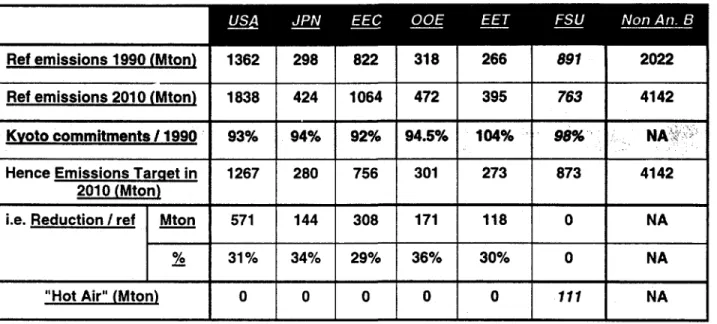
for the constituent parties, which are generally stated as a percentage of 1990 emissions, as indicated in Table 1 below.34
USA JPN EEC OOE EET FSU Non An. B
Ref emissions 1990 (Mton) 1362 298 822 318 266 891 2022
Ref emissions 2010 (Mton) 1838 424 1064 472 395 763 4142
Kvoto commitments I 1990 93% 94% 92% 94.5% 104% 98% NA>.
Hence Emissions Tar-et in 1267 280 756 301 273 873 4142
2010 (Mton)
i.e. Reduction I ref Mton 571 144 308 171 118 0 NA
% 31% 34% 29% 36% 30% 0 NA
"Hot Air" (Mton) 0 0 0 0 0 111 NA
Table 1: Emissions Levels Corresponding to Kyoto Commitments
Only five of the six EPPA regions encompassing Annex B countries are constrained by the commitment made at Kyoto5 and these five will subsequently be termed the Kyoto-constrained regions. For the sixth Annex B region, the FSU, emissions are predicted to be below the aggregate level to which the principal nations constituting the FSU-Russia, the Ukraine, and the Baltics-committed at Kyoto. The difference between the FSU commitment and predicted emissions is controversially called "hot air," but in our analysis we assume that it constitutes a "right to emit" that can be exported. For the non-Annex B regions, as well as for the FSU, any reduction from 2010 reference emissions also generates a permit for export to the Kyoto-constrained regions.
3 Under Kyoto Protocol accounting, as best it is understood, this procedure involves the implicit assumption that all
other GHGs are also reduced by the same percentage below the appropriate baseline value for each. No costs are included for these controls in our study, nor is any account taken of possible carbon sinks.
4 The correspondence between regional aggregates in EPPA and Annex B parties is not exact. For instance, Turkey is
included in OOE (Other OECD), but it is not an Annex B party. Similarly EET includes all of the former Yugoslavia, but only Slovenia and Croatia are Annex B parties. Likewise, the Central Asian Republics are included in the FSU, but they also are not Annex B parties. Furthermore, the Kyoto commitments indicated for these EPPA regions depend upon our weighting of various constituent Annex B countries. Finally, the Annex B countries constituting the EET committed to targets at Kyoto that were from 5% to 8% below baseline emissions; however, these countries were allowed to choose an alternative to 1990 as the baseline year. Based on the national communications to date, the change of baseline year appears to translate into a limitation that is 4% above 1990 emissions for this region as a whole. The term 'hot air' refers to the amount by which any country's emissions are expected to be below the Kyoto Commitment, which is widely expected to be the case for the FSU.
5 The Kyoto Protocol refers to the targets established for Annex B parties as "legally binding commitments," although
neither the legal structure nor the sanctioning mechanism are evident. In this paper, we use the terms "goals," "targets," and "commitments" more or less interchangeably.
2. THREE BASIC CASES: NO TRADING,
ANNEX B TRADING
AND FULL
GLOBAL
TRADING
Three basic cases are used to illustrate the effects of the Kyoto Protocol and the role of emissions trading. The first case is an autarkic one in which Annex B parties meet their Kyoto commitments without any emissions trading. As a result, the FSU and non-Annex B regions are affected only through the prices and quantities of goods traded with the Kyoto-constrained regions. In the second case, Annex B parties (including the FSU) trade emission permits among themselves. Emissions trading within Annex B reduces the costs of the Kyoto commitment for the constrained regions, and the FSU finds a new source of export revenue; but non-Annex B countries will continue to be affected only through conventional trade linkages. The third basic case examines emissions trading on a global scale in which non-Annex B countries join the FSU in earning export revenue from supplying permits to Annex B countries. Further variations of these basic cases will be developed in subsequent sections, but these three frame the salient alternatives.
a) The Autarkic, No-Trading Case (Fig. 1, Table A
Fig.
1 presents the MACs and the costs associated with the carbon emission reductions required of each of the Kyoto-constrained regions (excluding the FSU) when there is no emissions trading.6 The black diamonds on the MACs indicate, on the horizontal axis, the quantity of abatementrequired of each region (cf. Table 1), and, on the vertical axis, the shadow price of carbon for the region. The shadow price is the marginal cost for the last ton abated. The autarkic marginal cost of abatement for Japan ($584/ton) is much higher than the marginal costs for the EEC ($273), the OOE ($233), the USA ($186), or the EET ($116). The areas under the curves represent the total costs of abatement for each region, which sum to $120 billion.7 The details are shown in Appendix B, Table A.
With no emissions trading, there are no export earnings for the FSU or the non-Annex B regions. None of these regions would have any incentive to abate in order to generate "rights to emit" for export; and, of course, the FSU would not be able to export its "hot air."
b) Annex B Tradina (Figs. 2 and 3, Table B)
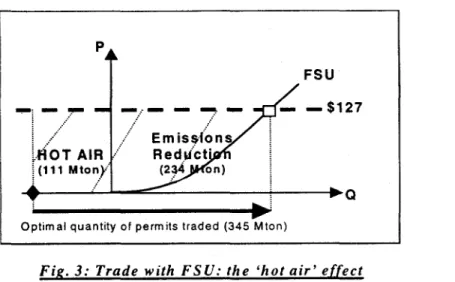
Fig 2 shows the effect of Annex B trading on the Kyoto-constrained regions. At the market clearing price of $127/ton, the OECD regions (USA, EEC, JPN, OOE) are importers of permits and the EET and FSU are exporters. As an unconstrained Annex B party, the FSU accounts for virtually all of the exports (98%). As shown in Fig. 3, about a third of these consist of "hot air," with a cost of zero; but the remaining exports are generated by abatement undertaken to earn additional export
profits up to the point where marginal abatement cost equals the market price. It costs the FSU $10 billion to abate 234 megatons (Mton), but the permits can be sold for $30 billion for a net gain of $20 billion. When added to the $14 billion earned for exporting 111 Mton of the unused Kyoto entitlement, the FSU's total gain from emissions trading is $34 billion.
6 The MACs for the OOE and EET are virtually identical and are therefore superimposed in Fig. 1.
-~~~
p A
FSU
_.. _ _ _ ---- --
$127
Emissions
:..lOT AIR Red ict'
.(111 Mtony ( on)
-, a
Optimal quantity of permits traded (345 Mton)
Fig. 3: Trade with FSU: the 'hot air' effect
For the five Kyoto-constrained regions depicted on Fig 2, the cost of meeting the Kyoto commitment is reduced by $32 billion. This is the area of the hatched triangles, which represent costly domestic abatement avoided by importing permits for the four OECD regions and the export earnings for the EET. From the standpoint of world resource use, the aggregate cost of meeting the Kyoto commitments is much lower with Annex B trade ($54 billion) than without ($120 billion). The total gains from emissions trading are $66 billion, split about evenly between the FSU ($34 billion) and the OECD + EET ($32 billion).
The distribution of the reduction in costs (that is, the gains from emissions trading for the Kyoto-constrained regions) is distributed roughly in proportion to autarkic marginal cost. The two regions with the highest autarkic marginal costs, Japan and the EEC, benefit the most from traded permits. Japan imports 66% of its reduction requirement and reduces its cost by $19 billion. The EEC imports 350Y of its reduction requirement and reduces its cost by $7 billion. These two regions account for about one-third of the total emission reduction requirement for the five Kyoto-constrained regions, and about five-sixths of the gains from emissions trading for these regions accrue to them. The other three regions are characterized by autarkic marginal costs much closer to the Annex B market price; consequently, they trade much less. The USA and OOE are importers for 19% and 25% of their respective requirements, and the EET reduces emissions by 5% more than required in order to export permits. The gains for these regions, which account for two-thirds of the total reduction requirement, total $5 billion, about a sixth of the gains from trading for the Kyoto-constrained regions.
This distribution of the gains from trade reflects an important feature of emissions trading. Regions with autarkic marginal cost farther from the trading equilibrium will import or export more (and benefit more) than those regions with autarkic marginal cost closer to the trading equilibrium. Thus, Japan and the EEC benefit most from emissions trading among the importers, as does the FSU, not just because of the "hot air," but also because its autarkic marginal cost ($0/ton) is far from the market price.
c) Full Global Tradina (Fig. 4, Table C)
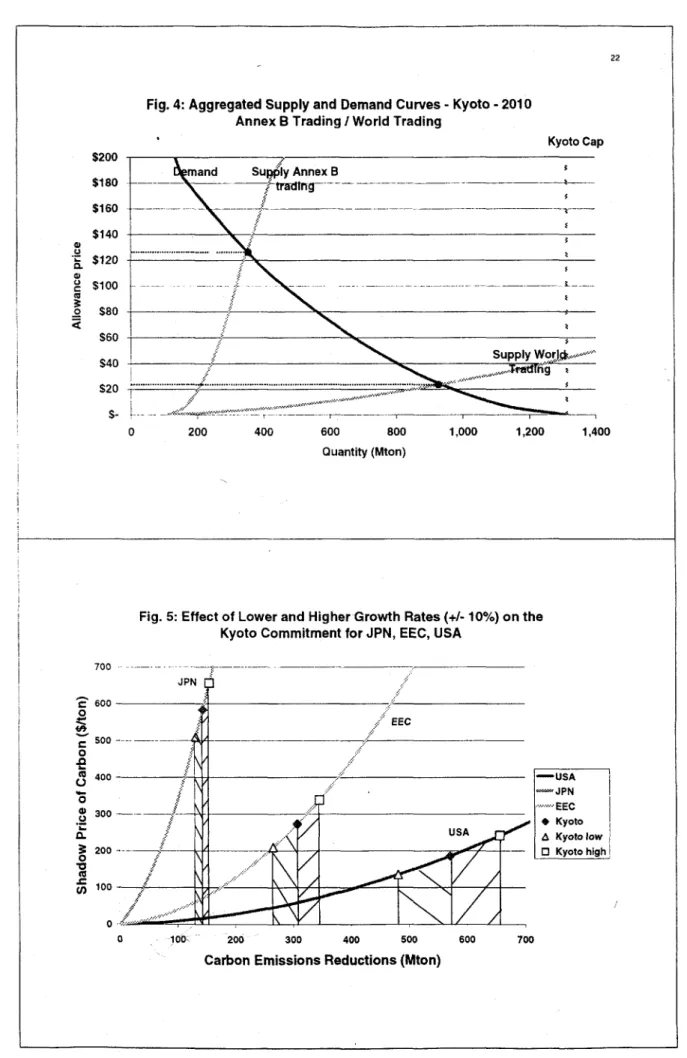
To illustrate full global trading, we rely on aggregate supply and demand curves for emissions permits (not abatement), as explained in the Appendix A and illustrated in Fia. 4. These curves indicate the total quantities of permits that would be supplied or demanded at various price levels in a given market. In Figure 4, there is only one demand curve because the Kyoto-constrained
regions are the same in both the Annex B and the global markets. Only the supply changes, reflecting the large amount of low-cost carbon abatement that becomes potentially available with the shift to global trading. The ample supply of permits from non-Annex B regions results in a market price that is much lower ($24tton) than in the Annex B trading case. The total cost of reducing global C02 emissions to achieve the Kyoto goals is reduced dramatically: $11 billion vs.
$54 billion or $120 billion in the other two cases!
At this price, the Kyoto-constrained regions depend far more on imports than when trading was restricted to Annex B regions only. In the aggregate, 71% of OECD + EET commitments are met by importing emission permits from non-constrained regions; and the percentage reliance upon imports reflects autarkic marginal cost: Japan, 92%; EEC, 76%; USA, 68%; OOE, 66% and EET, 56%. On the suppliers' side, three countries account for the bulk of exports: China (47%), the FSU (23%) and India (11%), hence 81% altogether. Whether because of relatively small size or high relative abatement costs, the remaining four non-Annex B regions are small suppliers of emission permits to the Annex B regions.
With full global trading, the gains from emissions trading are much greater for the Kyoto-constrained regions ($94 billion vs. $32 billion with Annex B trading). The non-An iex B regions gain $10 billion by exporting permits, but their gains are markedly less than those .A the Kyoto-constrained regions. The FSU is the only party that is made worse off by this widening of the market. At $24/ton, the FSU abates about half as much as before, (101 Mton), and the "hot air" is worth much less. As a result, the FSU's net gain ($4 billion) in the global market is much less than its $34 billion gain when it does not compete with the non-Annex B regions.
The distribution of the gains from emissions trading in the global market illustrates again the feature of emissions trading we just noted: regions whose autarkic marginal cost is further from the equilibrium price benefit more than regions whose marginal cost is closer to that price. In this global trading case, the clearing price is much closer to the suppliers' autarkic marginal cost ($01ton) than it is to the autarkic marginal cost of any of the importers.
di) Effect of Higher and Lower Economic Growth (Figs. 5 and 6, Tables A' to C, A" to C'"
The three basic cases, and those to be presented hereafter, provide point estimates of prices, quantities and costs. In this section, we briefly note the effect of different assumptions about economic growth, namely, that it is 10% higher and 10% lower than in the reference EPPA projection for all regions. Fig. 5 shows the effect of higher and lower growth rates for illustrative Kyoto-constrained regions (JPN, EEC and USA), and Fiq. 6 shows the effects on aggregate supply and demand for permits in the Annex B and full global markets.
The effects of higher or lower growth on emissions is typically fairly small, always less than ± 5%, but the Kyoto commitment is fixed so that the effect on the required reduction is amplified. For instance, for the Kyoto-constrained regions, the variation in total required emission is ± 13-14%. Finally, the change in total costs, without trading, is even greater (± 31-36%), because the most expensive abatement, that on the margin, represented by the hatched area in Fig. 5, is what is being increased or decreased by the variation in economic growth.
When aggregated into demand and supply curves for permits, the variation in economic growth has a large effect on demand, but not much on supply since most of the supply comes from unconstrained regions, the FSU or the non-Annex B countries. The chief effect upon supply within
the relevant price range is through the influence on hot air. Higher growih reduces hot air and shifts the supply curve inward; and conversely, for lower economic growth.
The effect of higher or lower economic growth on the price and quantities of traded permits is very different in the Annex B and full global trading markets. In the former, the volumes traded change very slightly (± 12 Mton), but the price varies greatly (± $40). In a market limited to Annex B regions, most of the incremental effort required by higher or lower growth translates into more or less domestic abatement. In contrast, for full global trading, the aggregate supply curve is flatter, so that the variation in the volume of traded permits is greater (± 120 Mton) but the variation in price much less (± $6).
The variation in total cost for the Kyoto-constrained regions is slightly greater in the trading cases than in the non-trading case (+ 36-42% vs. ± 31-36%) because with lower or higher growth, greater or smaller amounts of hot air from the FSU enter the trading system.
e) Per Capita Emissions (Fiq. 7)
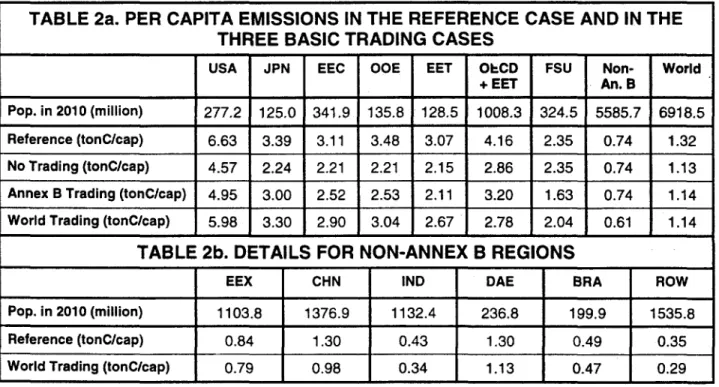
As a further summary statistic, the effect of the Kyoto commitment and of the scope of trading can be shown in per capita terms. Table 2 below provides full regional detail, but the essential features can be grasped by reference to Fia 7, where per capita emissions in 2010 are shown for the USA, the five Kyoto-constrained regions as a group, the FSU, the Non-Annex B regions, and the world.
TABLE 2a. PER CAPITA EMISSIONS IN THE REFERENCE CASE AND IN THE THREE BASIC TRADING CASES
USA JPN EEC OOE EET OtCD FSU Non- World + EET An. B
Pop. in 2010 (million) 277.2 125.0 341.9 135.8 128.5 1008.3 324.5 5585.7 6918.5
Reference (tonClcap) 6.63 3.39 3.11 3.48 3.07 4.16 2.35 0.74 1.32
No Trading (tonC/cap) 4.57 2.24 2.21 2.21 2.15 2.86 2.35 0.74 1.13
Annex B Trading (tonC/cap) 4.95 3.00 2.52 2.53 2.11 3.20 1.63 0.74 1.14
World Trading (tonClcap) 5.98 3.30 2.90 3.04 2.67 2.78 2.04 0.61 1.14
TABLE 2b. DETAILS FOR NON-ANNEX B REGIONS
EEX CHN IND DAE BRA ROW Pop. in 2010 (million) 1103.8 1376.9 1132.4 236.8 199.9 1535.8
Reference (tonC/cap) 0.84 1.30 0.43 1.30 0.49 0.35
World Trading (tonC/cap) 0.79 0.98 0.34 1.13 0.47 0.29
The Kyoto commitment reduces per capita emissions in all the Kyoto-constrained regions; however, the reduction is less severe, the greater the scope of trading. In full global trading, as an example, per capita emissions are reduced by 14% on a global scale, but by a greater percentage in the non-Annex B regions since the share of the global emission reduction in the non-Annex B regions is greater than their share of emissions: the aggregate OECD+EET reduction is 9%, while the FSU reduction is 13% and the non-Annex B reduction is 18%.
Within the Kyoto-constrained regions, the reduction in per capita emissions varies considerably depending on the extent to which the region imports permits. At one extreme is Japan, where per capita emissions would be less by only 2.7% because it imports 92% of its emission reduction obligation. The greater percentage reductions in the other constrained regions reflect their lesser dependence on permit imports: EEC, -6.7%; USA, -9.8%; OOE, -12.6%; and EET, -13.0%. Finally, as shown in the figure, neither the Kyoto commitments nor the scope of trading do much to change the ratio of emissions per capita between the industrialized and developing economies of the world.
3. IMPORT LIMITATIONS
(Fig. 8, Tables D to F)
The three illustrative cases presented above are based on several assumptions:
* Potential participants in emissions trading are not impeded by restrictions on trading, * All parties participate to the extent warranted by the economics,
, Trading is conducted efficiently with low or non-existent transactions costs, and T There is no monopolistic behavior.
Such assumptions simplify exposition and the analysis of emissions trading, but they are not necessarily realistic. One of the possible departures from this theoretical ideal is a limit on the extent to which an Annex B party can rely on emission permits to reduce what otherwise would be its domestic abatement requirement. The "supplementarity" provisions of the Kyoto Protocol suggest such a limit, although no specific number has been agreed upon. More recently, the EU environmental ministers have called for a "concrete ceiling" on permit imports.
To illustrate the implications of such a restriction, we consider limits of 75%, 50% and 25% on any Annex B party's ability to meet its emission reduction requirement through imported permits.8 From the full global trading case without restrictions, we know that Japan would optimally realize 92% of its Kyoto commitment through imports, so that with a 75% limit, it would have to abate more domestically. The EEC would also be affected, but to a very slight extent since it would otherwise import 76% of its emission reduction requirement; but none of the other importing regions would be affected. With a 50% limit, all regions would be limited and forced to abate more domestically at higher cost; and at a 25% limit, the reliance on higher cost domestic abatement would be even greater.
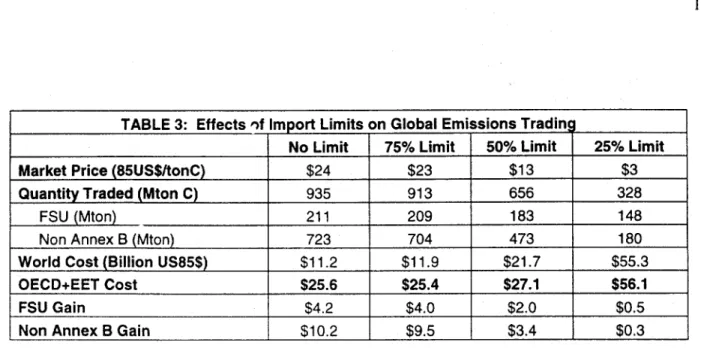
[ia.j8 shows how the demand curve is shifted inward by such limitations, and Table 3 summarizes the effects on prices, quantities and costs. The "No Limit' case is the same as full global trading, and it is provided for comparison.
8 The Kyoto Protocol spccifies only that "trading shall be supplemental to domestic actions." We define this potential
limitation as a percentage rclative to the emissiotn reduction implied by the Kyoto commitment without trading, given EPPA's prediction of reference emissions.
TABLE 3: Effects of Import Limits on Global Emissions Trading
No Limit 75% Limit 50% Limit 25% Limit
Market Price (85US$/tonC) $24 $23 $13 $3
Quantity Traded (Mton C) 935 913 656 328
FSU (Mton) 211 209 183 148
Non Annex B (Mton) 723 704 473 180
World Cost (Billion US85$) $11.2 $11.9 $21.7 $55.3
OECD+EET Cost $25.6 $25.4 $27.1 $56.1
FSU Gain $4.2 $4.0 $2.0 $0.5
Non Annex B Gain $10.2 $9.5 $3.4 $0.3
The effect of import limits upon the exporting regions is predictable. With less demand, the market price falls, fewer "rights to emit" are produced and exported, and there is a drop in the gains to exporters. The effects on importers are twofold. Importers that are not affected by the limitation
import more, and at a cheaper price; thus they realize more savings. They are better off because the limitation removes some of the demand by higher cost abaters from the market. Importers who are affected by the limitation also benefit from this lower market price on their imports, but they also incur higher domestic abatement cost.9 For instance, with the 75% limit, the net balance between these two opposing effects is positive for the EEC (+1.14% gains) but negative for Japan (-1.94%).
The overall effect of the 75% limit is relatively slight: the world cost increases slightly (6.5%), the quantity traded is 2% less, the price falls by 4.1%, and the cost to the Kyoto-constrained regions is reduced slightly. With a 50% or 25% limit on imported permits, all the importing regions are restricted, and the price of imports is much lower, $13 and $3, respectively. Among the importing regions, the effects of this tighter limit depend upon the balance between higher domestic abatement costs and cheaper import costs. At 50%, this balance is now negative for both EEC and Japan, but the benefit of the much cheaper imports continues to outweigh the higher domestic abatement costs for the other three importing regions. With a 25% limit, all the importing regions are worse off than they would be without any limit on imports, and the percentage increases in cost are greatest for the higher cost producers of abatement among the importing regions (JPN, +425%; EEC, +123%; OOE, +73%; USA, +58%; EET, +5%).
From the standpoint of the suppliers, the effect of a limitation on imports is to skew the distribution of gains from trading even more heavily in favor of the importing regions. It can be seen in Table 2 that, as the limit becomes more stringent, greater domestic abatement by the importing regions causes world cost.' to rise, but at least up to the 50% limit, the total cost for the importing regions remains relatively constant, at $25-27 billion. In contrast, for the exporting regions, the gains from emissions trading diminish markedly. The global efficiency losses due to the import limit are
9 Consumers will not receive the benefit of cheaper imports since the discrepancy between the internal marginal
abatement cost and the world market price creates a rent for the allowed imports that will be collected somehow, perhaps through a government auction of the rights to import permits. Since this sum is a internal transfer, we do not count it as a resource cost. We are indebted to Ken Chomitz of the World Bank for pointing out this feature of our analysis.
effectively shifted to the exporting regions through the lower price of imported permits. Only when the limit becomes very tight and the price of permits is very low, for instance within 25% limit, do the increases in domestic abatement costs outweigh the benefits of cheaper imports, and the
importing regions start to absorb the efficiency losses.
The effect of a quantitative limit on imports can be summarized quickly. To the extent that it is binding, it redistributes the gains from trading among the importing regions from those facing the highest abatement costs to those facing the lowest costs. Furthermore, and at least initially, it shifts the increase in global cost caused by a binding import limit onto the suppliers.
4. CDM "SURCHARGES"
AND CARTELIZATION
OF SUPPLY
Departures from the theoretical ideal can also arise on the supply side. The Kyoto Protocol provides for a Clean Development Mechanism (CDM) by which non-Annex B emissions reductions would be certified and made available as emission permits for Annex B countries. The exact role of the CDM has yet to be defined, but the Protocol does provide that the CDM would apply a surcharge to cover its administrative expense and to collect funds to assist countries "to meet the cost of adaptation" (Article 12.8). Also, because of the inelasticity of demand at low market prices, there is a possibility that suppliers could increase their gains significantly by colluding to limit supply, instead of competing among themselves.
a) CDM Surcharaes (Fia. 9. Tables G to 1)
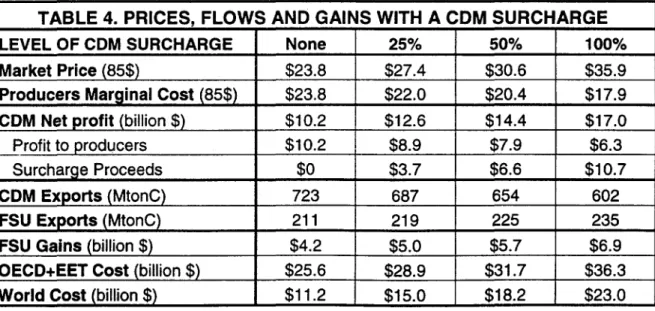
CDM surcharges would create a wedge between the price paid by consumers and that received by producers, as illustrated in Fiq. 9 for surcharges of 25%, 50% and 100% of the marginal cost of supply. Table 4 provides details concerning prices, quantities and gains. Surcharges of 50% or 100% are beyond any level being discussed currently, but they do illustrate the effects of inelastic demand. Since FSU exports would not be surcharged, we treat the FSU as a competitive supplier in all these cases.
TABLE 4. PRICES, FLOWS AND GAINS WITH A CDM SURCHARGE
LEVEL OF CDM SURCHARGE None 25% 50% 100%
Market Price (85$) $23.8 $27.4 $30.6 $35.9
Producers Marginal Cost (85$) $23.8 $22.0 $20.4 $17.9
CDM Net profit (billion $) $10.2 $12.6 $14.4 $17.0
Profit to producers $10.2 $8.9 $7.9 $6.3
Surcharge Proceeds $0 $3.7 $6.6 $10.7
CDM Exports (MtonC) 723 687 654 602
FSU Exports (MtonC) 211 219 225 235
FSU Gains (billion $) $4.2 $5.0 $5.7 $6.9
OECD+EET Cost (billion $) $25.6 $28.9 $31.7 $36.3
The most notable feature of Table 4 is that CDM net profit, defined as revenue minus abatement cost, increases as the surcharge is raised even though importers reduce demand in response to the higher prices. This phenomenon reflects the price inelasticity of demand over this portion of the aggregate demand curve. As would be true of any tax, there is a welfare loss, equal to the increase in world cost as a result of the more expensive abatement undertaken by importers. The second notable feature of Table 4 is that producer profit decreases on the assumption that surcharge revenue goes to the CDM. Of course, the distribution of the proceeds raised by the surcharge would be a matter for the producers to decide. With inelastic demand, it would be theoretically possible to devise distributions that would keep producers whole and still make funds available for other purposes such as adaptation. Nevertheless, any redistribution of funds for such purposes will reduce what the non-Annex B producers might otherwise receive.
The implicit conflict between producer interests and re-distributive goals has larger implications for the evolution of the global climate regime. It will be readily evident to all non-Annex B producers that the greatest beneficiary from CDM surcharges is the FSU. As a competitive supplier, the FSU benefits directly from the increase of the market price and the increase of its exports. It is able to benefit doubly because, having accepted an Annex B limit on emissions, its exports are not surcharged. The example will be compelling for many non-Annex B producers, who will come to see Annex B accession as a way to by-pass the CDM. Proponents of the CDM will not be pleased, but such action is essential both to the creation of a more efficient global trading system and to achieving the stabilization of atmospheric concentrations of GHGs.'°
Accession logically implies a transitional role for the CDM. So long as the CDM provides an essential service-recordation, certification and verification-for converting non-Annex B emission
reductions into tradable emission perrrits, a reasonable fee can be charged. But that service, and the attendant role for the CDM, would no longer be needed as non-Annex B parties accept limits and arrange for their own certification and verification as part of the global emissions trading
regime.
b) Cartelization of Supply (Tables J to L)
The ability to raise surcharges without diminishing net profit to non-Annex B producers may inspire thoughts of a cartel, not so much because of the CDM, which might serve as a coordinating
mechanism, but because of the inelasticity of demand that characterizes the global emissions market."' This potential is explored in Table 5. which compares the effects, under full global trading, for a fully competitive market and two alternative assumptions about non-competitive behavior:
1) A CDM cartel in which the FSU is a competitive supplier, and
2) A full supplier monopoly in which the FSU and the non-Annex B countries cooperate through the CDM or an alternative mechanism.
In calculating the gains for the FSU and the non-Annex B regions, we assume that the monopoly rent, the difference between market price and marginal cost, is shared in proportion to the quantity
'° See Yang and Jacoby (1997) and Jacoby, Prinn and Schmalensee (1998).
11 In contrast, there is little potential for non-competitive behavior in the Annex B case because of the higher price and more price elastic demand, as discussed in Ellerman and Decaux (1998).
of abatement provided at marginal cost. In doing so, we also assume a highly efficient cartel in which only the lowest cost sources of permits are produced (including the FSU's hot air).
TABLE 5. EFFECT OF NON-COMPETITIVE BEHAVIOR ON
GAINS FROM TRADE, COSTS AND PRICES
Competitive Non-Annex B Non-Annex B
case cartel + FSU
monopoly
Market Price ($/metric ton C) $23.8 $62.7 $108.2
World Cost (billion 85US$) $11.2 $20.0 $32.2
Non-Annex B Gains (billion $) $10.2 $22.4 $30.1
FSU Gains (billion $) $4.2 $13.8 $17.4
OECD+EET Gains (billion $) $94.2 $63.6 $39.2
Successful monopolization has the expected effects: the market price is higher, as is world resource cost, and the gains from trade are shifted substantially to the suppliers. In the case of the 0DM cartel for example, the importing regions lose $32 billion: the $9 billion increase in global costs plus a $23 billion transfer of income to tne suppliers. With the full supply monopoly, the importing regions lose another $25 billion, $12 billion in increased resource cost and another $13 billion transfer to the suppliers. Even though this is a dramatic change in the distribution of the gains from permit trade, the Kyoto-constrained regions are still better off (by $7 billion) than if there were no supply at all from the non-Annex B regions. The FSU is, however, always worse off, even when the suppliers successfully create an efficient monopoly.
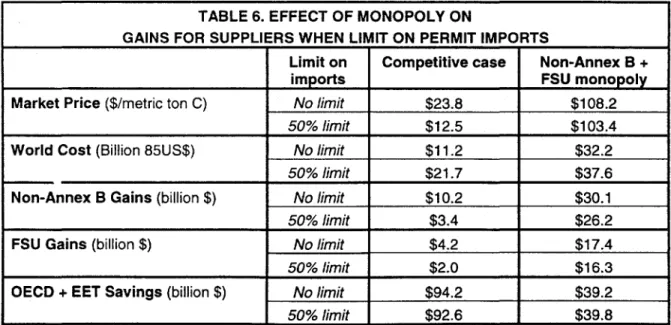
The incentive to collude would be even greater if limits were placed simultaneously on import demands, since the effect of such limits is to make demand more inelastic. Table 6 makes the point. It shows the effect of the full monopoly on price, world cost and gains when there is no limit on permit imports and when a 50% limit is set.
TABLE 6. EFFECT OF MONOPOLY ON
GAINS FOR SUPPLIERS WHEN LIMIT ON PERMIT IMPORTS
Limit on Competitive case Non-Annex B +
imports FSU monopoly
Market Price ($/metric ton C) No limit $23.8 $108.2
50% limit $12.5 $103.4
World Cost (Billion 85US$) No limit $11.2 $32.2
50% limit $21.7 $37.6
Non-Annex B Gains (billion $) No limit $10.2 $30.1
50% limit $3.4 $26.2
FSU Gains (billion $) No limit $4.2 $17.4
50% limit $2.0 $16.3
OECD + EET Savings (billion $) No limit $94.2 $39.2
The effect of successful monopoly is much the same whether or not there are import limits. The market price rises to about the same level, $103 vs. $108, world cost increases, and the exporting regions gain significantly Et the expense of the importing regions. The effect of a 50% import limit is also much the same whether a competitive market or a monopoly is assumed. The market price is reduced, world cost increases, and producer gains are diminished, but by less when there is a monopoly.
5. INEFFICIENT SUPPLY (Figs. 10 and 11, Tables M to Y)
Full global trading is an appealing prospect, to importers for the great reductions in cost and to exporters for the possibilities of non-competitive pricing, but both importers and exporters should remember that the potential trading gains shown by CGE models assume complete economic rationality and negligible transactions cost.12 The more likely contour of global emissions trading is that this potential will not spring forth full blown once trading is allowed, but that it will develop only slowly as experience is gained. Fig 10 depicts several possibilities for less than fully efficient supply in which it is assumed that 5%, 10%, 15%, 25%, and 50% of the supplies from the FSU and
non-Annex B regions are available at every price.13The lowest line, corresponding to 100%, is fully efficient global trading.
Inefficient supply could result from several causes. The most serious and most likely is the influence of transaction cost, particularly that involved in meeting the "additionality" criterion. Past experience with credit-based emissions trading systems applied to other environmental problems and with Joint Implementation pilot projects has shown these costs to be large and the quantities traded to be small.14 Alternatively, a general failure to take full advantage of economic opportunities presented by emissions trading would also limit the amount of credits available from the non-Annex B regions and the FSU. Finally, some non-Annex B countries have expressed considerable antipathy to emissions trading as a concept; and they may decide not to participate in an emissions trading regime, whether through the CDM or otherwise, for political reasons. It is not possible to assess beforehand to what extent these causes might operate in a global market, but they will certainly be present.
If the supplies from the global market are very small initially, say 5% of the full global potential, then the market price for permits would be relatively high ($181) and the quantities traded small (170 Mton). As experience is gained and supplies become more ample, the quantities traded would increase and prices fall. The gains from emissions trading increase with improved efficiency of supply and they become quite large well before attaining 100% efficiency. As shown in Fig 11,
12 EPPA 2.6 is not alone in making such forecasts. The recent -i1alysis provided by the U.S. Council of Economic Advisors to support Chairman Janet Yellen's earlier testimony, USG/EOB (1998), obtains a similarly low permit price for a comparable market.
13 Expansion in the scope of trading would occur in periods after 2010, when permit demands and supplies might vary
depending on growth and subsequent climate agreements. This illustration, using a static 2010 picture, shows the nature and approximate magnitude of the changes over time.
14 See UNCTAD (1998) for a discussion of the relative efficiency of allowance and credit based trading systems. These
costs will be greatly reduced to the extent that non-Annex B regions accept emission caps that remove the concern about additionality and the necessity to establish a counterfactual baseline. Curiously, the Kyoto Protocol also asserts "additionality" as a criterion for joint implementation projects within Annex B countries (cf. Art. 6).
total gains increase steadily, but those for exporters increase only up to a point a little abovel5%. Thereafter, the relatively inelastic demand causes the gains to exporters to decline, while those to the importers increase dramatically.
When supply is very inefficient, the market distortions considered earlier have little effect. For example, as severe a limitation on demand as a 25% ceiling would affect only Japan if supplies from the FSU and non-Annex B regions were only 5% of the full potential. And at the prices reflecting very inefficient supply, there would be no gain to monopoly. Nevertheless, as supply becomes more efficient and prices decrease, a limitation on imports would become more binding; and as the market clearing price moved into the inelastic range (below about $110), non-competitive pricing could become more of a concern.
With inefficient supply, the effect of CDM surcharges will also depend on the elasticity of demand. In the inelastic range (low price, large quantity), corresponding to greater supply from the non-Annex B regions, the surcharge can result in greater gains for exporters, so that it is at least possible to keep producers whole (compared to no surcharge) and generate funds for other purposes. However, in the inelastic range (high price, small quantity), any surcharge will reduce the total gain to be shared between producers and other claimants.
As would be expected, inefficient supply implies a higher market price, greater world cost and fewer gains from trade, but the gains will still be substantial and decidedly worth pursuing. The effects of distortions, such as import limitations and non-competitive pricing, are the same as with fully efficient supply, but the magnitude of the effect is less because there is less to lose. Perhaps the most notable feature of inefficient supply is that the gains to early entrants in the global emissions market will be very large. Thereafter, as is true for any innovator, the large initial reward will dissipate as imitators follow.
6. INTERNATIONAL
TRADE IN ENERGY AND NON-ENERGY GOODS
MACs provide a simple and direct way to study emissions trading, but they do not indicate the effect of abatement actions on the prices and quantities of goods in international trade. The effects of emissions reductions may not be restricted to the countries undertaking the abatement actions. Through trade they may be transmitted to countries that made no commitment. In this section, we depart from the use of MACs and examine these other effects using the EPPA results directly. The central feature driving these trade-in-goods effects is the shadow price for carbon that is faced by the Kyoto-constrained regions, and the effect of that shadow price on the world price for oil and natural gas. Table 7 provides a quick summary of those prices for the 2010 reference case and our three basic emissions trading scenarios. Carbon prices are shown in 1985 dollars; oil and gas
prices are shown as an index with the 2010 price in the reference case set to 1.0.
TABLE 7. CARBON AND ENERGY PRICES IN 2010 for Kyoto-constrained regions
Reference No Trading Annex B Global
Carbon Price $0 $116-584 $127 $24
Oil Price 1.0 0.90 0.95 0.99
Oil and natural gas are treated as Hecksher-Ohlin goods in EPPA, which means that there is complete freedom of trade among regions and a single world price. As a result, restrictions on carbon emissions in Annex B countries lead to lower oil and natural gas prices for producers and consumers throughout the world. In contrast, coal is an Armington good, which means that there is no single world price but a series of regional prices that can be affected by changes in trade flows. Consequently, actions by the Annex B regions will affect coal prices in these regions, but generally not elsewhere, or only through the quantities traded (which are not great.)
As the scope of emissions trading expands and the price of carbon declines, the effect of Kyoto commitments on energy prices diminishes. This effect occurs because one of the cheapest forms of carbon abatement is the reduction of and substitution away from the use of coal. Emissions trading makes it possible to substitute reduced coal use in non-Annex B regions for more expensive abatement that reduces oil and natural gas use in Annex B regions.
The effects on trade patterns of the Kyoto commitments and emissions trading are most usefully observed by comparing the no trading case with full global trading. The former can be viewed as a relatively inefficient way of achieving the goals set at Kyoto, while the latter represents the most efficient way. Emissions trade limited to Annex B is an intermediate case, which we omit because its effects lie between what occurs with no emission trading and with full global trading.15
a) Trade in Goods with No Emissions Tradinq
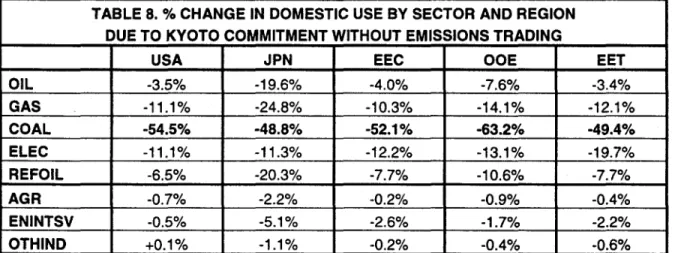
The starting point for the no emissions trading case is the effect of the carbon price on domestic demand in the Kyoto-constrained regions. Table 8 provides the percentage change from the reference prediction for domestic use of sectoral output (production less exports plus imports) by each Kyoto-constrained region. The sectoral breakdown in EPPA includes five energy sectors (oil, gas, coal, electricity and refined oil) and three non-energy sectors (agriculture, energy intensive industries, and other industries).
TABLE 8. % CHANGE IN DOMESTIC USE BY SECTOR AND REGION
DUE TO KYOTO COMMITMENT WITHOUT EMISSIONS TRADING
l____ USA JPN EEC OOE EET
OIL -3.5% -19.6% -4.0% -7.6% -3.4% GAS -11.1% -24.8% -10.3% -14.1% -12.1% COAL -54.5% -48.8% -52.1% -63.2% -49.4% ELEC -11.1% -11.3% -12.2% -13.1% -19.7% REFOIL -6.5% -20.3% -7.7% -10.6% -7.7% AGR -0.7% -2.2% -0.2% -0.9% -0.4% ENINTSV -0.5% -5.1% -2.6% -1.7% -2.2% OTHIND +0.1% -1.1% -0.2% -0.4% -0.6%
With one insignificant exception, all the signs are negative, and they are greatest in magnitude for the energy sectors. Coal is hit hardest with domestic use declining by about half in all regions.
15 The FSU is the one exception. With Annex B trading, its demand for energy declines in the same manner as the
However, coal, like electricity and refined oil, is mostly a domestic good so that the international trade effect of this reduction in demand is not particularly great. Oil and gas are more heavily traded internationally, and the effect of the reduction in Annex B demand is a world-wide fall in the price of oil and gas: by 10% and 17%, respectively, as was shown above in Table 6.16 This reduction in price reduces the income of oil and gas producers throughout the world; and the effect will be particularly large on the two oil and gas exporting regions, the EEX and the FSU. Interestingly, the quantities of oil and gas traded internationally do not change much, but there is a shift in the destination of energy exports away from the Kyoto-constrained regions towards the
non-constrained regions, as illustrated next, through trade in energy-intensive goods.
The domestic use of energy-intensive goods declines in all Kyoto-constrained regions; however, the most significant effects show up in the trade balances and domestic output for these goods, as
shown in Table 9.
TABLE 9. CHANGES IN EXPORT, IMPORT AND OUTPUT OF ENERGY INTENSIVE GOODS: NO EMISSIONS TRADING
Absolute USA JPN EEC OOE EET FSU EEX CHN IND DAE BRA ROW
Change in:
1
.Net trade -2.57 -30.96 -26.20 -6.29 -1.61 +7.93 +22.8 +6.78 +1.13 +6.07 +1.86 +21.1
Out Ut -6.90 -61.68 -42.25 -9.31 -499 +9.81 +21.1 +15.3 +2.74 +15.8 +3.46 L +22.9
The patterns are very clear. The Kyoto-constrained regions reduce production and net exports of energy-intensive goods, while the non-constrained regions increase output and net exports of them. The Kyoto-constrained regions increase imports of these goods, and of the non-taxed carbon that is embodied in them.
b) Comparing the No-Trading Case with Full Global Tradina
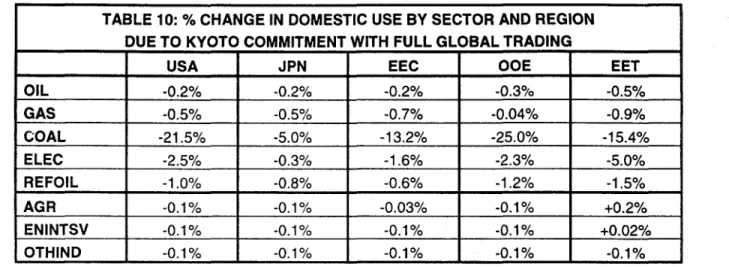
Meeting the Kyoto commitments with full global trading has much less effect on Ani.ex B demand for oil and gas and on the trade in energy-intensive goods than was the case with no emissions trading, as shown in Table 10 and Table 11.
16 The greater effect upon natural gas results from the greater responsiveness to price changes in the industrial and
residential sectors, where natural gas is mostly used, than in the transportation sector, where petroleum products dominate. Both oil and natural gas gain share in electricity generation at the expense of coal, but electricity demand also shrinks. In the end, the balance between the losses in non-electricity sectors and the gains in electricity generation are less favorable for natural gas than for oil.
TABLE 10: % CHANGE IN DOMESTIC USE BY SECTOR AND REGION
DUE TO KYOTO COMMITMENT WITH FULL GLOBAL TRADING
USA JPN EEC OOE EET
OIL -0.2% -0.2% -0.2% -0.3% -0.5% GAS -0.5% -0.5% -0.7% -0.04% -0.9% COAL -21.5% -5.0% -13.2% -25.0% -15.4% ELEC -2.5% -0.3% -1.6% -2.3% -5.0% REFOIL -1.0% -0.8% -0.6% -1.2% -1.5% AGR -0.1% -0.1% -0.03% -0.1% +0.2% ENINTSV -0.1% -0.1% -0.1% -0.1% +0.02% OTHIND -0.1% -0.1% -0.1% -0.1% -0.1%
The effects of the Kyoto Protocol remain negative, but the magnitudes are much attenuated. Coal use is reduced by at most a quarter; and the effect on other goods is generally less than 1%. The world prices for oil and natural gas are reduced by only 1.3% and 3.5%, respectively, instead of 1 0% and 17% in the no trading case.
TABLE 11. CHANGES IN EXPORT, IMPORT AND OUTPUT
OF ENERGY INTENSIVE GOODS: FULL GLOBAL TRADING
Absolute USA JPN EEC OOE EET FSU EEX CHN IND DAE BRA ROW
Change in:
Net trade +0.37 +0.30 -0.09 +0. 16 +0. 19 -.71 +1.61 -2.60 -0.94 +0.53 -0.02 +1.22
Output -0.59 -0.18 -0.93 -0.02 +0.21 L.81 +0.45 -8.90 -2.25 +0.10 -0.01 +1.24 The changes in trade and output of energy-intensive goods are all relatively small; and there is no consistent pattern as in Table 9, because the price of carbon is the same in all countries. Output and the net trade position is most adversely affected in China, India and FSU because their production of energy intensive goods is more dependent on coal, which is the fuel most strongly affected by any positive price on carbon emissions.
c) Summary
The effects of the Kyoto Protocol and of emissions trading on non-Annex B regions consist of three analytically separate elements, which can be summarized by the following simple matrix.
TABLE 12: EFFECT OF KYOTO AND EMISSIONS TRADING
KYOTO EFFECT No Emissions Global Emissions
Trading Trading
Permit Revenues 0 +
Oil & Gas Export Revenue
Whether there is emissions trading or not, the effect of the Kyoto commitments on non-Annex B countries is mixed. Without emissions trading, there will be no permit exports, but an increase in the production and export of energy intensive goods can be expected, assuming no protective trade measures are enacted by the Kyoto-constrained regions. With global emissions trading, there will be permit export revenues, but no significant increase in production and exports of energy intensive goods. The revenues of Non-Annex B regions that export oil and gas will be adversely affected in either case, but much less so with the lower carbon price associated with a broadened market for emissions permits. In effect, oil and gas exporters benefit as emissions trading makes it possible for Kyoto-constrained regions to substitute reduced coal use in non-Annex B regions for reduced oil and natural gas use at home.
7. CONCLUDING
OBSERVATIONS
The effect on developing countries of Annex B actions to comply with the Kyoto Protocol will depend on the particular country and on the success of emissions trading. All developing economies will have an interest in emissions trading as a source of new export earnings, but their interest will extend beyond this new commercial possibility. In particular, oil and gas exporters will have a strong interest in emissions trading as a means to reduce the cost for Annex B parties generally, and specifically to allow Annex B parties to substitute reduced coal emissions abroad for reduced oil and gas emissions at home. It is possible that some countries and sectors would be adversely affected by emissions trading. For instance, the advantage enjoyed by producers of energy-intensive goods will be greater with no emissions trading, assuming that importing embodied carbon is permitted by the Annex B regions. The net balance will be different for various countries, but in general it seems likely that developing countries will benefit from emissions trading.
The gains from emissions trading are potentially very large, fully sufficient to give potential buyers and sellers an economic incentive to support such a system. Most studies of permit trade suggest ample supplies would be offered by non-Annex B regions, at commensurately low prices, yielding large cost reductions for the Kyoto-constrained regions and substantial benefits to non-Annex B regions. The actual supply is likely to be somewhat less, at least initially, due to transactions cost and less than complete participation in the market by non-Annex B regions. Nevertheless, whatever the initial extent of the market and its subsequent development, both importing and exporting parties will gain.
As in any market, the potential for welfare-damaging distortions is always present. Given the undefined meaning of "supplemental" in the Kyoto Protocol, a particularly alarming distortion from the developing country standpoint is a limitation on Annex B imports of emission permits. Not only will such limits depress permit prices and the export earnings of non-Annex B parties, but they will have perverse effects on importing countries. Annex B parties with relatively high domestic abatement costs, and thus higher imports, would be penalized, while those with relatively low domestic abatement costs, and fewer imports, would find the cost of meeting their Kyoto commitments reduced.
The ability of the CDM to impose surcharges to help countries meet the costs of adaptation will depend upon the elasticity of demand, which depends in turn on the supply available from non-Annex B regions. The greater the supply and the lower the price, the greater the ability to impose surcharges without fear of losing revenue. Still, there is an unavoidable conflict between the
interests of the producers of the permits and redistributive goals, since whatever is redistributed could as well be kept by the producers.
The FSU and the non-Annex B countries appear as clear rivals to each other in the stylized cases we have presented, but casting this rivalry in geopolitical terms obscures a more practical aspect. Neither the Annex B nor the global market will spring into life full blown as soon as the appropriate institutional arrangements are made; instead these markets will develop slowly over time. The stylized Annex B market should be thought of as illustrating the potential gains for first entrants of whatever provenance into a new and expanding market. Those gains will inevitably be dissipated
as others follow, so that the conflict, which appears here as one between the FSU and non-Annex B regions, is really one between the early entrants and later followers.
The FSU does however have one large advantage. Assuming effective accounting and enforcement, its acceptance of an Annex B emission limitation removes the high costs of establishing additionality, which will be required of projects in non-Annex B countries. This example will encourage the most enterprising non-Annex B countries to accede to Annex B to capture more of the large gains of early emissions trading. In doing so, these parties will foster more efficient emissions trading and promote the ultimate goals of the Kyoto Protocol, but they will also necessarily reduce the ability of the CDM to act as a re-distributive mechanism.
Abatement Cost 'batement Cost $ bllion
Abj it\ .Ttatement CostCEEC
D
A300 bate _ _ / X 1 Abatement Cost
B ________ 200______ /38 bill n b
0
Q 100\ M
ta0 100 200 300 400 500 600 700
Carbon Emissions Reductions (Mton)
[ ~~~~Fig. 2: Annex B Meeting their Kyoto Commitment, No Trading I
I ~~~~~~~~~~Trading
700 . JTta5avingsfor yotG
l I ~~~~JPN OOE EET .^ constrained regions. ! ~~~~Savings. * Savings: fSavings: Y. S32 billion
600 $2 billion S0 billion iiiion
O f. 0 |500 9o\ Savings: $w: 400 - billionS7 ./ o 200- ;7
4
( 100 0 300? .sav Cngs: 0 100 200 300 400 Soo 600 700Car,bon Emissions Reductions (Mton)
700
60010 20 30 40 0 00
Annex B Trading I World Trading Kyoto Cap $200 S180- ~ - Xndn $160 ___ __- -$140 . ... ... $ $120 $80 s60o S40 ______ Supply Work' i'g ... .... ... \ S20 - . -e -0 200 400 600 800 1,000 1,200 1,400 Quantity (Mton)
Fig. 5: Effect of Lower and Higher Growth Rates (+/-10%) on the Kyoto Commitment for JPN, EEC, USA
700- - -___ - .- _ _ -JPN c600 0 EEC ,500 LX, 3500 ---- gs- __--- ___-_______ \ 7 - __________ o 4 400 .- USA "'JPN a 300- 200 300_400_500 _600 _700
Carbon Emissions Kyoto
_ a Koto low
0 20- Kyoto high!
100
0-0 100 200 300 400 500 600 700
low Kyoto Cap high $180 't% Supply Annex B $160low I rading $140 CL Demandsv5'i \ s, CU6 $1200\ f _ ___ hig o $80 $60 -T _in $40 $20 $-~~~~~~ 0 200 400 600 800 1,000 1,200 1,400 Quantity (Mton)
Fig. 7: Per Capita Carbon Emissions
7 ... . ... ... ... ... ...
i f - ~~~~~~~~~~~~~El Reference 6 e . 2. _ j il3~~~~~~~ NoTrading
s - _ - | D~~~~~~~~~~OAnnex B Trading _
O lllC 0; Full Global Trading
0
2 3
-62
Limitations on Demand: 75%, 50%, 25% Kyoto Cap $140 $t120 ' : Diemand $100 Supply Annex I X. $80 Trading I U S:t $60 _ et . s ~~~ " ~ ~~~I upyW>,,rl $40 Sl . . .. I ... I... . $20 ________- R ... ;'... ... $0 >? , ^<a _ ___._ __ 0 200 400 600 800 1,000 1,200 1,400 Quantity (Mton) Figure 9: CDM Surcharges: 25%, 50%, 100% Kyoto Cap $50
I
Demand to Supply from Non /$45 -- Non Annex Anrougn ts Wm
$40 \ _ _ _ _ _ $3 ... ... --- . ... --- $30-... a' $25 o $20 $15 $10 $5 $0 -" 0 200 400 600 800 1,000 1,200 Quantity (Mton)
S200 $200 F 6% 0/ 5 Kyoto Cap $180
L
____________15,Yo____ ... ... -.-7.. ...spl=5 $160 | ;_of Totals S140 |; $140 ;..* ,' Supply=50. ... * ---- S120 ,--ot Total $120 C)$100-. __ ...--. ... .,....Demand O $80 $60 supply ... ... $40 $20 .- , . .. R $0 - =- 0 200 400 600 800 1,000 1,200 1,400 Quantity (Mton)Fig. 11: Gains from More Efficient Global Trading
100 - U Importers ISl Exporters 80 4 0o 20 -0 5% 10% 15% 25% 50% 100% % of Full Potential
REFERENCES
Ellerman, A. Denny and Annelene Decaux, 1998, "Analysis of Post-Kyoto Emissions Trading Using Marginal Abatement Curves," MIT Joint Program Report No. 40, October 1998, Cambridge, MA. Jacoby, H.D., R.G. Prinn and R. Schmalensee 1998. "Kyoto's Unfinished Business," Foreign Affairs 77/4, 54-66, July/August.
Prinn, R.G. et al. 1998. "Integrated Global System Model: Feedbacks and Sensitivity Studies,"
Climatic Change, forthcoming.
United Nations Conference on Trade and Development (UNCTAD) 1998, "Greenhouse Gas Emissions Trading: Defining the Principles, Modalities, Rules and Guidelines for Verification,
Reporting and Accountability," Geneva, Switzerland, Draft of July 1998.
United Nations Framework Convention on Climate Change, Kyoto Protocol, 1997.
United States Government, Executive Office of the President, "The Kyoto Protocol and the President's Policies to Address Climate Change: Administration Economic Analysis," July 1998. Yang et al.1996. 'The MIT Emissions Prediction and Policy Analysis (EPPA) Model," MIT Joint
Program on the Science and Policy of Global Change, Report No. 6, Cambridge, MA.
Yang, Zili and Henry D. Jacoby 1997, "Necessary Conditions for Stabilization Agreements," MIT Joint Program on the Science and Policy of Global Change, Report No. 26, Cambridge, MA.
APPENDIX
A: MARGINAL
ABATEMENT
CURVES
17a) What are Marginal Abatement Curves and What Do They Represent? (Fig. Al) A CGE model will produce a shadow
price for any constraint on carbon
emissions for a given region R at time
T. An example would be a 10% Shadowpriceofcarbon Re2tonR timeT reduction below the reference case for *
USA in 2010. This price indicates the m Total cost of abatement / marginal cost of reducing the last ton I. 1 under constraint: q abated of carbon required to meet the
constraint. As might be expected in a P . .MAC
proper CGE model, the shadow prices
corresponding to constraints of plot /
increasing severity rise as an increasing function of emissions reduction.
A Marginal Abatement Curve is
described by generating the plots of .- -'
the shadow prices corresponding to q C02 abated
constraints of increasing severity at time T, then drawing a line joining the
plots, as in Fig. Al. Each plot on the Fig. Al: Marginal Abatement Curves curve for region R at time T represents
the marginal cost (p) of abating an
additional unit of carbon emissions at quantity q. The integral under the curve (hatched area) represents the total abatement cost associated with each level of abatement, that is, the resources re-allocated to abatement because of the constraint.
b) How can MACs be Used for Trade Studies? (Fig. A2)
If several regions commit to achieve emission reductions at the same time and there is some prediction of what emissions would be without the commitment, the abatement required can be represented as a point on each region's marginal abatement curve. Moreover, if the marginal costs associated with those reductions are different across regions, the aggregate cost of meeting the commitments will be less to the extent that a region with higher marginal costs can induce a region with lower marginal costs to abate more on its behalf.'8 By abating more, the lower cost region produces "rights to emit," or emission permits, which it can sell to the higher cost region which would thereby avoid a like amount of higher cost domestic abatement. Thus, the difference in the
17 This appendix draws heavily on Ellerman and Decaux, 1998.
18 As is typically assumed in such analyses, and as is the case here, the environmental goal pursued - reducing
atmospheric concentration of a long-lived, well-mixed greenhouse gas like CO2 is not affected by the location of the