Is
su
e
B
r
Ie
f
CA L I FOR N I A HEALTHCARE FOUNDATIONCreating EHR Networks in the Safety Net
Introduction
The adoption of electronic health records (EHRs) has the potential to help medical practitioners raise the quality of their care, increase patient safety, improve efficiency, and even produce cost savings. However, despite the increasing evidence for such benefits, most community clinics and health centers have yet to embrace the technology. Studies indicate that the adoption rate for EHRs among these safety-net providers is less than 10 percent, compared to 52 percent for large medical practices.1,2
Three major studies have found cost to be the
number one barrier to EHR adoption.3 However,
it is important to note that any successful adoption requires other significant direct and indirect investments beyond the price of the software. These typically range from planning and preparation to implementation and optimization. The majority of community clinics and health centers are small, independent entities that often lack the financial and staffing resources available to larger organizations, such as integrated medical practices and health systems, to fund and sustain these requirements.
This issue brief explores the network approach to EHRs and its potential to increase EHR adoption among community clinics and health centers. For the purposes of the analysis presented here, an EHR network is defined as a health information technology partnership focused on community clinics and health centers that provides services to support the adoption of EHRs and other
The goals of the analysis include:
K Defining the value of an EHR network;
K Understanding how an EHR network differs
from a standard vendor offering;
K Identifying the considerations that safety-net
providers are likely to take into account when selecting an EHR network; and
K Evaluating the future of EHR networks.
In developing this issue brief, Manatt Health Solutions employed a variety of primary and secondary research techniques, including: in-depth interviews with three existing EHR networks; interviews with the networks’ clinic members; industry research; conversations with industry and
EHR Networks and the HRSA
The Health Resources and Services
Administration (HRSA) refers to EHR networks as “Health Center Controlled Networks
(HCCNs).” Specifically, HRSA defines HCCNs as a network of public or private non-profit health centers who come together to form a network to plan, develop and implement health IT systems (primarily EHRs), among other services that:
• Improve access to care;
• Increase efficiency, revenue, and productivity; and
• Improve clinical quality and patient health status.
In addition, HCCNs have historically provided a wide range of services within the core areas of administration, finance, information technology, clinical and managed care, and are clinician/ member driven.
academic experts; and the firm’s own field experience. The authors concluded that a network approach can provide California’s community clinics and health centers with the infrastructure and support that they need to efficiently implement EHR systems, ensuring that they have the tools and knowledge to remain at the forefront of delivering quality care to the safety net.
The Challenge: Difficulties with Adoption
of EHRs among Community Clinics and
Health Centers
EHR software often requires customization beyond the vendor’s offering to support health management functions for particular populations, unique billing requirements, and multiple language patient education tools for the safety net. These requirements demand additional time, technical expertise, safety-net experience and a level of sophistication not often available or affordable to community clinics and health centers.4
Given the complexities of adoption and limited resources, it is not uncommon for safety-net providers to overlook or underestimate demands associated with adoption beyond hardware, software, and implementation components. While these components are certainly crucial, they are not sufficient to ensure success. Successful EHR adoption also requires:
K Executive and staff commitment. Alignment across departments and key stakeholders is necessary to develop and promote an effective organizational strategy for quality improvement. Commitment and buy-in across the organization are necessary for effective implementation and use of health information technology (HIT).
K Care process assessment. Systematic workflow evaluation and redesign throughout the organization are necessary and require the commitment of all staff
K Quality improvement. “You can’t improve what you can’t measure”is a popular management adage, and is a concept that builds the case for EHRs and other health information technology as an effective vehicle for quality improvement (QI).5 While the EHR will
provide data to inform measurement, additional attention to data cleanliness, aggregation, analysis, and application are necessary to improve quality and access to care. This not only necessitates more specialized staff, but also often requires integration with other technology platforms and vendor software customizations.
K Hardware and technology operations. From a technology standpoint, successful EHR operation requires more consideration than simply loading software onto a server. Because an EHR alters virtually every process and workflow, from patient scheduling to billing, the operation and integration of other technology applications are also affected. In addition, all clinical care providers rely on the EHR, making its availability and reliability essential to avoid an adverse impact on operations. An EHR requires the existence and continual support of a robust technology infrastructure, a complex environment that demands dedicated personnel familiar with its hardware, software, operating systems, security, backup and recovery, and disaster recovery components.
Many community clinics and health centers individually adopt EHRs directly through a vendor without significant consideration of alternative approaches. With half of EHR implementations ending in failure or disappointing results,one might question whether this is a viable strategy for members of the safety-net community.6 In
an attempt to improve the odds, the New York City Department of Health and Mental Hygiene is spending over $30 million on a group purchasing, quality-improvement customization, and service infrastructure
adopting EHRs hosted by their local hospital in order to make use of its technical and quality improvement experience and infrastructure. For instance, The
Children’s Clinic in Los Angeles is partnering with Long Beach Memorial Hospital to adopt its existing EHR. Alternative EHR adoption solutions, such as large-scale group purchasing and hospital-based partnerships, are primarily a result of two market realities:
K Few community clinics or health centers have access to the in-house clinical, quality improvement, and technical experience needed to navigate the complexities of EHR adoption.
K Vendors are in the business of selling technology products and do not typically provide assistance for EHR use beyond the software itself, the initial implementation, and basic user training. Many vendors understate additional fees required to customize a system to fit the needs of an individual provider. As a result, community clinics and health centers must turn to external consulting resources or additional in-house staff for support, a time-consuming and expensive strategy that they often cannot afford or sustain.
The consequences of these realities can range from long-drawn out implementations that diminish
organizational stamina and morale to pulling the plug and taking a loss.
Despite a high degree of discontent with these market dynamics, continued increase in safety-net demand has catalyzed a growing interest in a more comprehensive approach to EHR adoption, specifically an EHR network approach. Although they may sound similar to other multi-clinic consortia or networks in California, these EHR networks are differentiated by their strong focus on HIT implementation and support services for — and beyond — their geographically defined membership base.
Understanding the Value of an EHR
Network
Just as information technology is a tool to support an organizational strategy or process, the typical EHR vendor can be thought of as providing the core components necessary to achieve the broader goal. EHR networks deliver additional value by providing strategies for building capacity and setting expectations that recognize the individual circumstances among community clinics and health centers. They also offer the operational and technical infrastructure, support services, educational resources, stability and economies of scale that help alleviate the burden that small safety-net providers face in pursuing EHR adoption alone.
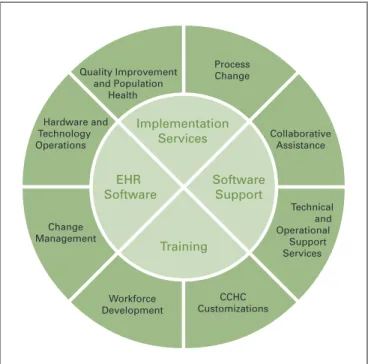
Figure 1 illustrates the core approach of the typical EHR vendor encircled in the additional services that an EHR network can provide.
EHR Software Training Implementation Services Quality Improvement and Population Health Process Change Collaborative Assistance Technical and Operational Support Services CCHC Customizations Workforce Development Change Management Hardware and Technology Operations Software Support
Source: Manatt Health Solutions
While EHR networks may have their own unique technology platforms, products, services, approaches and areas of expertise, they have demonstrated that they can develop a targeted, more comprehensive solution designed to meet the specific needs of community clinics and health centers. Common characteristics of an EHR network include:
A focus on safety-net providers. EHR networks provide customized templates and workflow designs that are preconfigured to meet the unique processes and staffing models of safety-net providers. Through repeated work with community clinics and health centers of varying readiness and capacities, EHR networks have built systems tailored to serve particular patient populations, as well as administrative, operational, and integration requirements necessary to implement a particular clinic’s strategy.
“ You need the experience and resources
to do a sustainable implementation. If
I didn’t have anyone to talk to, I would
have felt lost. But as part of an EHR
network, I can pick up the phone and
call.”
— MARGARET MARTINEz, CHIEF ExECUTIVE OFFICER COMMUNITY HEALTH ALLIANCE OF PASADENA
Collaborative approach. EHR networks offer a collaborative approach to HIT adoption by creating a community of clinics and health centers. Through a long-term partnership and periodic interaction with their members, EHR networks are able to better take into account the dynamics and capacities unique to each provider and supply targeted services and guidance.
Vendor management. As many small health care providers can attest, vendor management is often time-consuming and challenging. From selection, contracting and issue resolution to system upgrades and maintenance, EHR networks are an alternative to self-managing vendor relations. In addition, EHR networks have the operational and technical expertise necessary to communicate more efficiently and effectively with vendors, saving precious time and resources for community clinics and health centers.
Economies of scale. As a multi-entity organization, EHR networks can increase the value of an individual EHR investment by employing bargaining power, minimizing infrastructure redundancy, and drawing upon operational and technical efficiencies.
“ Aside from the technical support and
knowledge base that an EHR network
offers, costs were a big factor for us. We’re
a small clinic and we couldn’t have done
it alone. Through an EHR network, we
were able to share hardware, licensing,
customization, and maintenance costs
across clinics.”
— WILL RAJ, CHIEF TECHNOLOGY OFFICER HOWARD BROWN HEALTH CENTER
Quality improvement and population-based services. EHR networks understand that EHRs alone are not sufficient to achieve quality of care improvement for patients. Community clinics and health centers need HIT applications that enable necessary data collection, analysis, and reporting, as well as support services to interpret and
are better positioned to move from patient-specific to population-specific disease management by taking advantage of EHR networks’ data aggregation services, which are essential for advanced analysis and management of patient populations.
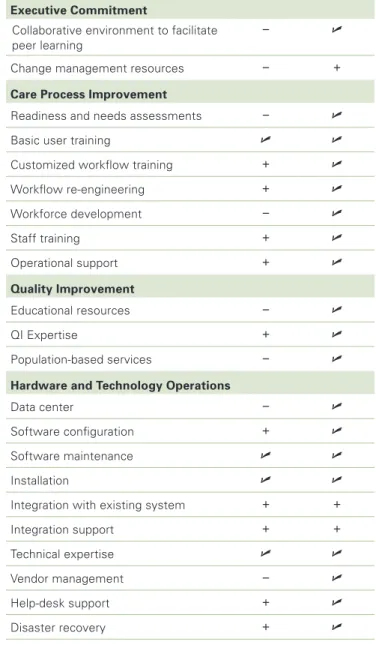
Training/workforce development. While vendors offer product training, it is typically limited to the basics of EHR use in a generic, unconfigured environment. With their specific focus on the needs of safety-net providers, EHR networks can offer more customized training and services in both QI and technical components, augmenting an organization’s ability to make full use of its capabilities. Building capacity among community clinics and health centers is a core tenet among EHR networks because of the potential disruptions that can result from turnover among trained staff. EHR networks are more likely to develop creative training programs and capacity building models that avoid continuous onsite training. Support services. In addition, EHR networks can provide ancillary services such as 24-hour help desk support, claims management, accounting services, disaster preparedness, integration support, and reporting functions, all staffed by specialists with a safety-net focus. Table 1 provides a more detailed comparison of products and services typically provided by vendors and EHR networks.
Since vendors usually provide only a portion of the overall services (and in some cases, functionality) necessary for successful EHR adoption, a vendor may be able to offer a lower up-front cost than an EHR network. However, the EHR network is able to offer a higher level of services and support customized to the safety net, as well as a long-term commitment to the successful adoption of an EHR system. Consequently, some community clinics and health centers have considered the EHR network more of a long-term investment partnership rather than a one-time technology purchase.
Table 1. Comparison of Vendor and EHR Network Products and Services
N E C E S S A R y S E R V I C E S F o R
E H R A D o P T I o N V E N D o R
E H R N E T w o R k
Executive Commitment
Collaborative environment to facilitate peer learning
! U
Change management resources ! ~
Care Process Improvement
Readiness and needs assessments ! U
Basic user training U U
Customized workflow training ~ U
Workflow re-engineering ~ U Workforce development ! U Staff training ~ U Operational support ~ U Quality Improvement Educational resources ! U QI Expertise ~ U Population-based services ! U
Hardware and Technology operations
Data center ! U
Software configuration ~ U
Software maintenance U U
Installation U U
Integration with existing system ~ ~
Integration support ~ ~
Technical expertise U U
Vendor management ! U
Help-desk support ~ U
Disaster recovery ~ U
legend: U Typically provided in a basic service
~ May require additional cost
! Typically not provided in a basic service Source: Manatt Health Solutions
“ When pursuing an EHR through either a
network approach or a vendor approach...
the issue is not just which services are
provided, but their quality... A network
has the opportunity to provide more and
better quality services because it can afford
to hire and train specialized staff that can
learn from each implementation, apply
those lessons to other community health
centers, and generally get better and better
at providing EHR services to members.
(With a vendor approach), individual
community health centers must depend
on vendors that often provide insufficient
services and on staff or consultants that
are not as specialized...”
— ROBERT MILLER, PROFESSOR OF HEALTH ECONOMICS UNIVERSITY OF CALIFORNIA, SAN FRANCISCO (UCSF)
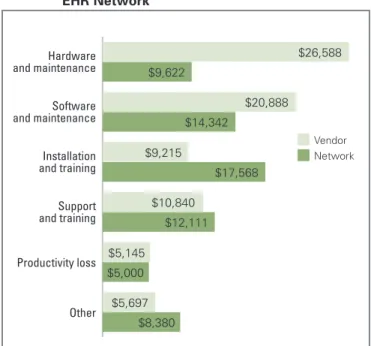
Figure 2 shows the average initial and operating costs for six community clinics and health centers from 2004-2005, using the results of a study published in Health Affairs that compared high-level EHR adoption costs.6 The study highlights the difference in EHR
adoption cost allocations between a vendor and an EHR network approach, or “what” and “how much” these safety-net providers typically incurred for specific EHR adoption services. The results reveal that those that pursued EHR adoption through a vendor approach spent a higher percentage of their expenses on hardware and software purchases. This difference reflects the economies of scale, volume discounts, and shared data centers that allow EHR networks to offer lower marginal prices for hardware and software. In addition, EHR networks
not-for-profit business model, allowing them to reinvest funds to reduce member costs or add necessary services. As a result, community clinics and health centers that use an EHR network may be better positioned to allocate a significantly higher percentage of expenses to the installation, training, long-term support, and other elements that are crucial to the successful adoption of an EHR system, including quality improvement, population-based services, care process redesign, and workforce development. This also implies that a greater amount of investment may be available for further infrastructure development to achieve quality-related strategies through EHR adoption.
The current state of the vendor market — notably its lack of focus on the safety net and limited service offerings — has driven community clinics and health centers to procure and organize their own resources. Recognizing the value an intermediary organization can bring to this problem, several vendors have partnered
Other Productivity loss Support and training Installation and training Software and maintenance Hardware and maintenance $26,588 $9,622 $20,888 $14,342 $9,215 $17,568 $10,840 $12,111 $5,145 $5,000 $5,697 $8,380 Vendor Network
Source: Miller, R.H. and C. West. “The Value of electronic Health Records in Community Figure 2. EHR Adoption Costs Incurred for Vendor versus
with EHR networks and other value-added resellers to assist them in customizing their product and promoting adoption within the safety net. For example, EPIC, an EHR vendor that typically works only with large organizations, has partnered with the Our Community Health Information Network (OCHIN) to provide a more tailored product by drawing upon an EHR network’s safety-net expertise and implementation
knowledge. Similarly, in addition to its VAR relationships, GE Centricity has a partnership with Alliance of
Chicago Community Health Services that provides a robust QI-focused EHR with data and workflow services designed to advance care improvement. Another prominent player in the EHR market, eClinical Works (more commonly known as eCW), is a key partner of both the New York City Department of Health and Mental Hygiene initiative and the Health Choice Network, a Florida-based EHR network. These three examples are but a sampling of such partnerships, and it is likely that other EHR network opportunities will continue to develop around the country.
Is an EHR Network the Right Approach?
Before purchasing an EHR, community clinics and health centers should have a strategic plan, a full assessment of their requirements, and a clear sense of their capabilities. This plan should take into consideration important factors such as available financial resources and operational and technical capacity in order to determine whether an EHR network is a sound approach.For those who fit one or more of the following high-level characteristics, an EHR network may be more suitable: K Organizations seeking products and services
tailored to the safety net without need for extensive customization;
K Small or mid-sized organizations without a strong technical or quality improvement infrastructure; K Community clinics or health centers that cannot
divert a substantial amount of time from clinical,
operational, and technical resources to the EHR implementation;
K Those with an interest in working with and learning from other clinics or health centers that have already adopted an EHR system; and
K Organizations that want to implement disease management and QI programs predicated upon an EHR system.
On the other hand, there are several types of safety-net providers for which an EHR network approach may not be the best option. These include:
K Organizations that already have robust technology and QI expertise, maturity, and infrastructure; K Those with customized requirements that may differ
from the average community clinic or health center; K Providers with sufficient financial and/or staff
resources and consulting relationships to assist in all phases of EHR adoption; and
K Organizations which have implemented sophisticated disease and QI applications that would require extensive custom development before they could be integrated with an EHR system.
These considerations provide a starting point for
determining if an EHR network may be the best option. Community clinics and health centers should also
consider the financial impact of adopting an EHR system. With limited financial resources, the temptation to select an EHR with the lowest price tag is strong. However, considering the full breadth of components necessary for successful adoption, it is vital to analyze the total cost to help identify the best solution. What resources are required for success and at what additional cost? What is the impact on productivity and staff? Potential purchasers should perform due diligence to understand what
services are included and available both during and after implementation to limit the risk of unforeseen expenses.
“ You have to think about both your direct
and indirect costs. Our costs right now
are about 6 percent, but as we grow, we’ll
probably bring it down to 4 percent of
operating costs. This may seem high to
some people only spending 1 percent or
2 percent for their IT. But the question
is, what are you getting for that 1 or
2 percent? How often is the system down?
How much data are you getting? Are you
getting on-going training for your staff?
Do you have a robust disaster recovery
plan? Do you get the support you need? If
we’re serious about our mission, then we
should be willing to spend what it takes.
IT is a part of that.”
— RICHARD TAAFFE, ExECUTIVE DIRECTOR WEST HAWAII COMMUNITY HEALTH CENTER
Looking Forward: The Future of EHR
Networks
The health care landscape is an increasingly complex and competitive field. With growing pressure to control costs, increase market share, improve profit margins, and provide high-quality and customized services, there is persisting concern that not all vendors will meet these challenges, leaving many community clinics and health centers to fend for themselves.
How are EHR networks, most of which are directly linked with vendors, prepared for this scenario? In cases where a vendors has gone out of business, many have contractually agreed to make their source code available
does not have dedicated development resources familiar with the code used by the vendor. Community clinics and health centers can reduce this risk through an EHR network. While most of the clinics and centers will not have access to the necessary development resources, an EHR network likely will. In such cases, or in the event of a vendor acquisition, EHR networks are better positioned and motivated to help these providers make the transition to a new platform, rather than figure out how to continue to support an abandoned platform from a defunct vendor. Federal and state governments and funding organizations are giving substantial attention to supporting a
collaborative EHR network approach. At the Federal level, the Health Resources and Services Administration allocated $27M to “support implementation of EHRs at health centers and in networks that link multiple health center grantees.”8 A total of 25 grants were given to build
or augment EHR networks to create market alternatives for community clinics and health centers across the country, signaling their confidence in more established EHR networks such as OCHIN, Health Choice Network, and Alliance of Chicago — three of the several EHR networks operating in the country.
In 2005, the California EHR network for EHR Adoption (CNEA), co-funded by Community Clinics Initiative, a joint program of Tides and The California Endowment, the California HealthCare Foundation, and the Blue Shield of California Foundation, began to explore collaborative approaches to facilitating the access and use of EHRs for the safety net. Recently, CNEA provided significant funding to support the development of a new EHR network in California, and continues to seek ways to support California community clinics and health centers working to successfully adopt EHRs. Although non-recurring capital infusions do not ensure stability, significant federal and regional alignment provides a promising foundation to assist EHR networks in helping
Case Studies
Community clinics and health centers across the nation have partnered with EHR networks in adopting EHRs as well as other HIT systems. Here is a summary of their experiences:
Community Health Alliance of Pasadena (CHAP) is a single-site primary care clinic offering medical and dental services to children and adults. It has four physicians, one nurse practitioner, and two physician assistants and has been a member of Our Community Health Information Network (OCHIN) since 2005. CHAP went live with a practice management system in 2005 and completed its rollout of an EHR system in November 2007.
Benefits of an EHR Network
• An application service provider (ASP) model;
• A well-developed, detailed implementation plan including role-based descriptions customized to safety-net providers and their training process;
• Robust support and help-desk services; and
• An ability to respond to clinic needs such as providing CHAP with a portable system to aid in CHAP’s field work as well expanding functionality of the EHR system to meet specific clinic needs and reporting requirements.
Advice to Others
• “Understand that productivity hits can occur before implementation.”
• “Don’t underestimate the support that you will need. Don’t do it alone.”
West Hawaii Community Health Center (WHCHC) is a single site rural health center in Kailua, Kona. It has two family practice physicians, one nurse practitioner, several psychologists who saw approximately 4,250 patients in 2007. WHCHC has been a member of the Health Choice Network since 2006.
Benefits of an EHR Network
• Support services;
• Sustainability and dependability;
• Responsiveness to clinic concerns;
• Member leverage with EHR network versus a vendor; and
• Access to training to meet concerns about staff turnover.
Advice to Others (from executive director Richard Taaffe)
• “It shouldn’t be about individual egos, but about the organization and services for patients. Get someone else who knows what they’re doing and has a vested interest in your organization.”
• “Remember that many clinics are going to have turnover. You need to have continuity for the
organization and support. Being part of an EHR network is the best way of doing that”
• “In an EHR network, you can bring your concerns and know that they’ll listen. It’s about their members; it's about us. You can’t do that with a vendor and that’s something to consider.”
St. Anthony’s Free Clinic in San Francisco is a single-site clinic that provides primary and urgent care services to children and adults who have no health insurance or limited access to care. It has nine providers who offer clinical services part time from 20 to 36 hours per week and see approximately 3,500 patients a year. St. Anthony’s Free Clinic recently joined the Alliance of Chicago network and expects to implement an EHR in March 2008.
Benefits of an EHR Network
• A focus on quality improvement, including integration of guidelines and clinical expertise;
• An EHR product and services developed and customized for clinics;
• Robust technical and operational support; and
• An organization created for safety-net providers in support of their mission.
Advice to Others (from medical director Ana Valdés)
• “If you have a lot of IT support and limitless amount of money, a vendor may be a better option. But for us, a network provided the support and expertise we needed. There are not a lot of clinics using an EHR, so there was a lot of hesitation. When you think about all the things that you need to think about, it can be very daunting. I feel like we’ve come a long way with the help of a network.”
• “In my experience, EHR networks are much easier to work with and are there to support your organization. When you send them an email, they get back to you and are very responsive to your needs. With vendors, we just didn’t get that kind of service — and when you’re server is down, you need someone who will be there.”
A
u t h o r sJulie V. Murchinson, M.B.A., Joseph D. Ray, and Christine E. Sison, M.S., of Manatt Health Solutions.
A
c k n ow l e d g m e n t sThe authors would like to acknowledge contributions by Laura D. Jantos of ECG Management Consultants and Cheryl Austein-Casnoff of Health Resources and Services Administration.
A
b o u t t h eF
o u n d At i o nThe California HealthCare Foundation, based in Oakland, is an independent philanthropy committed to improving California’s health care delivery and financing systems. Formed in 1996, our goal is to ensure that all Californians have access to affordable, quality health care. For more information about the foundation, visit us online at
www.chcf.org.
e
n d n ot e s1. Dutton, M., and P. Epp, “Supporting Health-Center IT Investments Through Medicare And Medicaid” Health Affairs Blog December 5, 2007. (healthaffairs.org/
blog/2007/12/05/health-it-supporting-health-center-it-investments-through-medicare-and-medicaid)
2. Simon, S., et al. “Correlates of Electronic Health Record Adoption in Office Practices: A Statewide Survey.” Journal of the American Medical Informatics Association October 26, 2006. (www.jamia.org/cgi/content/
abstract/14/1/110)
3. California HealthCare Foundation, The State of Health Information Technology in California, 2008. January, 2008. (www.chcf.org/topics/chronicdisease/index.
cfm?itemID=133552)
4. www.nhpf.org/pdfs_bp/BP_HealthCenterIT_07-23-07.pdf
5. Morris Cohen, “‘You Can’t Manage What You Can’t Measure:’ Maximizing Supply Chain Value.” Knowledge@ Wharton, December 6, 2006. (knowledge.wharton.upenn. edu/articlepdf/1546.pdf?CFID=963296&CFTOKEN=923
87275&jsessionid=a830d3617f20734f401a)
6. David Brailer, M.D., Ph.D. speech to America’s Health Insurance Plans audience, January 5, 2005, Washington, D.C.
7. Miller, R.H. and C. West. “The Value of Electronic Health Records in Community Health Centers: Implications for Policy” Health Affairs January/February 2007 26(1):206 – 214.
8. U.S. Health Resources and Services Administration press release, August, 2007. (newsroom.hrsa.gov/releases/2007/