EVERY IT ORGANIZATION NEEDS
TO CONSIDER OFFSHORE
OUTSOURCING
123In the last several years, offshore outsourcing of soft-ware development has grown considerably. As just
1 Jeanne Ross was the accepting Senior Editor for this article. 2 The authors would like to thank the staff of the companies who par-ticipated in the research for their generous time and insight into the uncharted territory of offshore software development. We would espe-cially like to thank the Vice President of Information Systems who facilitated entrée, spent countless hours, read many drafts, and offered expertise as a coauthor would. The comments of Jack Rockart, Jeanne Ross, and anonymous reviewers helped develop this article and are greatly appreciated.
3 The data for this article is based mainly on structured interviews with 13 IT executives in both firms, enhanced by a document and literature review. The interviews included Offsource staff who have spent years onsite at FISC and FISC IT staff who spent months in India. Some participants were interviewed multiple times over a 15-month period.
one example, Accenture has tripled its staff in India in the last two years.4 The current 20% annual growth rate in offshore IT work is expected to continue, if not increase,5 propelled by managerial needs to cut costs, stories in the popular press, and the upcoming presi-dential election in the U.S.
All executives need to explore offshore outsourcing. Competitors’ use, or perceived use, makes evaluation inevitable. Even IT organizations that choose not to use offshore companies must be able to convince their senior management that they have carefully consid-ered the option. Those who do choose to outsource need to decide how they want to work with an
4 Outsourcing Institute, “Accenture to Double Staff,” 1(4), Winter 2003,
http://www.outsourcing.com/content.asp?page=02i/other/oe/q403/acce nture.html&nonav=true, viewed April 29, 2004.
5 NASCOMM, http://www.nasscom.org/artdisplay.asp?cat_id=408, viewed May 20, 2004.
E
VOLUTION OF
O
FFSHORE
S
OFTWARE
D
EVELOPMENT
:
F
ROM
O
UTSOURCING TO
C
OSOURCING
1Executive Summary
Kate M. Kaiser Marquette University Stephen Hawk University of Wisconsin-Parkside“Financial Insurance Services Company” (FISC) (a pseudonym) is a major U.S. financial services company with thousands of representatives across the country. “Offsource” (a pseudonym) is a leading India-based company providing consulting and IT services to clients globally. This paper tells how their eight-year alliance has evolved. The relationship began as a simple pilot of offshore application development outsourcing, aimed at reducing development costs and supplementing in-house IT staff knowledge. It has evolved into a vastly more complex “cosourcing” model, where work is shared.
To achieve cosourcing, the two firms had to resolve two major issues. The first was how to keep IT skills and knowledge from draining from FISC. This issue has been resolved by formally linking career development to project assignments and to outsourcer-to-client mentoring. The second issue is how to share work. It has been resolved by creating a dual project management hierarchy, where leadership at each level of a project can be either by FISC or Offsource, depending on the need.
Their experiences provide five recommendations for others on structuring offshore outsourcing relationships: (1) understand where cosourcing is applicable, (2) define and develop the appropriate in-house IT competencies, (3) build trust but avoid building a binding relationship, (4) foster mutual understanding of ethnic and corporate cultures, and (5) map out a progression to cosourcing.2,3
shore organization. This article describes one evolving eight-year experience.
THE EVOLUTION OF THE
RELATIONSHIP BETWEEN FISC
AND OFFSOURCE
FISC offers a variety of financial services throughout the U.S. The company regularly earns accolades for its financial performance, industry ratings, and work en-vironment. Turnover in the firm and in IT is mostly due to attrition. FISC was one of the first companies to computerize and own its mainframe. It has one of the largest IT staffs in its state and has never had an IT layoff.
Offsource, which specializes in consulting and IT ser-vices, has experienced exponential growth since the late 1980s and has offices worldwide. It has earned Capability Maturity Model (CMM) level 5 certifica-tion for its core processes, and it uses Six Sigma Cross Functional Process Mapping (CFPM) for its cross-functional processes and the Malcolm Baldrige quality framework for its management processes. Its hiring is very selective, and it has an attrition rate significantly lower than India’s software industry average.
FISC and Offsource describe their current relationship as “cosourcing,” which they derived partly from the term “outsourcing.” Outsourcing traditionally has meant having work performed by an outside party.
Cosourcing, on the other hand, has been defined as an
Figure 1: Cosourcing Steps
1
2
3
4
5
Projects Engagement Commitment Interchange Cosourcing Alignment
IT strategy Scorecard
alignment
SEC Mandate Vendor project co-lead
Disability Ini-tiative
Dual project manage-ment hierarchy Vendor participates in
client staff evaluation Contract includes client
career development and knowledge trans-fer by vendor Visual Basic
conversions
Client works in India Cultural exchange
workshops
Primary project staffing
Universal Life
Onsite vendor an-chors and Relation-ship Manager Vendor has
client-user contact
Vendor mentors client staff Sales compen-sation Critical system maintenance Vendor onsite Y2K Pilot Code offshore
Time & ex-pense
Fixed bid
outsourcer and client melding their human resources to accomplish the client’s work.6 It requires a long-term relationship and an emphasis on values tradition-ally associated with partnerships. The vendor works so closely with client employees that it becomes im-mersed in the client’s way of doing business. We de-fine IT cosourcing as when the vendor and client col-laborate so closely that the vendor can replace or augment the client’s IT competencies. Project teams are mixed. And leadership can come from either one. Effectively, both organizations’ resources become part of a single team aimed at accomplishing the client’s needs.
For FISC and Offsource, the move toward cosourcing took time and progressed through five steps. Over that time, several critical problems arose. Their solutions resulted in a unique organizational structure, described shortly.
Figure 1 illustrates the five steps through seven exem-plar IT projects. The projects are listed by their begin-ning date.
Step 1: Engagement
In 1996, when FISC began its Year-2000 (Y2K) com-pliance work, IT management realized that extra staff would be needed to handle the volume of work. The executives believed the current contractors would not be able to handle the workload and foresaw costs ris-ing as the millennium approached. To solve the skills shortage and the cost increases, management decided to outsource with an offshore IT firm.
FISC began cautiously, initially engaging Offsource in assisting only with a small Y2K pilot. But manage-ment was pleased enough with the results that it in-volved Offsource in more Y2K projects. Offsource delivered well and trust grew between the two organi-zations.
As shown in Figure 1, in this step Offsource staff worked offshore, the work was considered a pilot pro-ject, and the contract was for time-and-expense bill-ing.
To step up. To move beyond pilot offshore outsourc-ing, FISC would need to actually rely on Offsource in a meaningful way. This change became reflected in contract negotiations, where time-and-expense billing on Y2K projects became fixed bids.
6 IT vendor firms besides Offsource use the term “cosourcing.” Other uses are described in Thomas, C.W., and J.T. Parish, “Cosourcing: What’s in it for Me?” Journal of Accountancy, 187(5), (1999) , pp. 85-88.
Step 2: Commitment
The mode of operating in the early Y2K projects was traditional outsourcing, with primarily all the work offshore. As trust built, both firms viewed contract negotiations differently, with some of the later Y2K projects becoming fixed bids.
In 1999, FISC committed to the concept of offshoring by giving Offsource its first opportunity to maintain a mission-critical legacy system—the sales representa-tive compensation system for agents built in the 1970s. Management would not allow vendors to touch the production data so Offsource had to work onsite at FISC. Furthermore, this onsite support was to be purely technical; the staff would not interact with FISC users.
The two IT organizations worked separately, but side-by-side. The FISC assistant support director, who managed the application, had direct contact with her onsite peer, the onsite team leader, which Offsource referred to as an “anchor.” But this assistant support manager did not have direct contact with Offsource’s onsite or offshore staff—only the anchor did.
Unfortunately, this work initially did not go well. In fact, it started out badly because the anchor was “too much of a techie guy.” Once Offsource learned of the communication and personality problem, its manage-ment responded quickly, and the relationship im-proved and grew.
From an onsite support team of 7-8 in 2000, Off-source’s presence grew to 35 (of 45 total staff support-ing the system) in 2003. Offsource also handled other projects during this time, but its increasing onsite sup-port of this critical system was a significant step up in its relationship with FISC from the pilot Y2K projects. The onsite support work continues in 2004. As shown in Figure 1, the sales compensation system represents FISC’s commitment to offshoring by enlisting Off-source’s help on maintaining a critical system.
To step up. Having made the commitment to out-sourcing, to gain more value FISC would need to in-crease interaction with Offsource both onsite and off-shore. FISC’s management determined that under-standing Offsource’s corporate and ethnic culture would improve team performance.
Step 3: Interchange
The FISC-Offsource relationship moved up a step when some members of FISC’s IT staff worked at an Offsource location such as Offsource had been doing at FISC. This interchange began with Offsource’s work on Universal Life (U-Life), a
multi-million-dollar initiative that encompassed multiple projects underway at the same time.
Offsource’s work on U-Life began as supplementing FISC’s IT staff onsite, in combination with offshore staff for much of the implementation work. Billing was for time and expenses. The Offsource staff con-centrated on technical design and implementation be-cause they had little understanding of insurance, in general, or U-Life in particular. To fill this knowledge gap, Offsource taught these employees the insurance business at classes outside normal business hours. As a result, Offsource began assuming responsibility for a wider range of development tasks, including interfac-ing with users and defininterfac-ing requirements.
Early in this work, some Offsource senior leaders came onsite to FISC. The most important was Off-source’s 1997 Y2K project manager. In 2000, he be-came a dedicated onsite Relationship Manager and a peer of FISC’s Vice President of Information Systems. According to this Vice President, this was a critical move:
“The presence and expertise of the relation-ship manager really facilitated managing the process. He and I worked very hard on ad-dressing problems right away. We grew to know each other’s style and appreciate the constraints and opportunities that both firms brought to the table.”
Concurrent with the U-Life initiative, several Visual Basic conversion projects were launched. Offsource won the bid to manage these projects as turnkey ef-forts. For this work, some FISC IT staff traveled to India to work more closely with the offshore staff; some stayed three months.
Another development was the offering of cultural workshops. These two-day events presented ethnic differences and similarities to help build rapport and understanding between the teams. Topics ranged from arranged marriages to baseball and cricket to cuisine to geography and politics. Both FISC’s and Off-source’s staff attended and participated in presenting the workshop.
FISC and Offsource had a closer relationship due to Offsource’s increased onsite presence at FISC, espe-cially of its dedicated higher-level managers, and be-cause Offsource had become responsible for the turn-key project, with FISC staff going to India for ex-tended stays. Yet, the relationship was still not cosourcing.
To step up. This interchange step brought out four personnel issues that FISC and Offsource needed to resolve to gain more value from their relationship. First, the presence of the Indian workers onsite was somewhat disquieting to FISC’s IT staff. The Indians tended to work much longer days than their FISC counterparts. FISC’s employees often noted, “Work is their life.” This situation is not unusual for contrac-tors displaced from their home. But it may have been more intense for Offsource’s employees whose per-manent home was halfway around the globe and whose temporary home was an unfamiliar culture. Offsource’s staff members also worked off-hours at home and often on weekends, which did move the projects forward more quickly—but disturbed FISC’s staff.
Second, as Offsource’s staff took on more high-level project work, FISC’s IT employees became concerned that Offsource’s staff would end up with the “juicy roles,” such as deriving requirements and learning new tools. FISC’s policy of not outsourcing more than 30% of IT staffing, coupled with its no-layoff history, removed its employees’ concerns about losing their job, but they did voice concern about not getting the interesting work.
Third, due to Offsource’s expanded role in this inter-change step, FISC’s employees were not developing certain skills. For example, Offsource took on so much of the technical work that some FISC employees on U-Life projects did not have the opportunity to develop these capabilities.
Fourth, FISC was potentially becoming dependent on Offsource because Offsource’s staff increasingly un-derstood the applications better than FISC’s employ-ees, particularly the U-Life systems. If the relationship was terminated, FISC had less knowledge to maintain the systems. The switching costs of moving the work in-house, or to another outsourcer, would be signifi-cant—even though outsourcing is supposed to in-crease flexibility, not dein-crease it. Although this prob-lem did not appear likely to occur, FISC’s manage-ment became concerned about its diminishing in-house IT skills and knowledge.
Step 4: Cosourcing
As noted earlier, we define IT cosourcing as an out-sourcer and client melding their IT competencies to accomplish the client’s work. That is the approach the two took in this step to address the people concerns raised in the interchange step. Two of the major changes were to:
• Formalize knowledge transfer from Offsource to FISC, and
• Create a dual project management hierarchy.
Formalizing knowledge transfer. FISC first made changes on the U-Life work that moved it closer to the current cosourcing model. FISC’s employees were increasingly assigned to work with particular Off-source staff, to learn from them. Previously, learning occurred more or less happenstance from working side-by-side. The new approach was to match FISC employees with Offsource employees who could men-tor and transfer the needed IT knowledge and skills. However, employee development needs were only used informally in making the team assignments. So this initial approach to cosourcing had a limited effect on employee development.
The process of joint teaming, though, led to an unex-pected side-effect. Sometimes, Offsource team mem-bers were the only ones in a position to evaluate some FISC employees. Thus, FISC began to need Off-source’s involvement in FISC employee evaluations as well as development—an unusual role for an out-sourcer. So FISC and Offsource adjusted the statement of work that Offsource staff would perform.
Once FISC’s senior IT executives realized how out-sourcing could degrade the staff’s IT competencies, they adopted changes to preserve and develop the competencies. Management believed it was important for the staff to have good technical skills and a solid understanding of both the applications and the busi-ness the applications supported.
Managing an IT initiative was viewed as making a series of decisions involving trade-offs in four areas: time-to-deliver, cost, scope, and system quality. Mak-ing these tradeoffs required the skills FISC was losMak-ing. As one director stated:
“Any of these factors could be adjusted, but might necessitate adjustments in the other fac-tors. For instance, a delivery schedule could be
accelerated by increasing costs or decreasing system scope or quality. Making these trade-off decisions requires both a good understanding of the business and of the technology and methods for delivering solutions.”
In negotiating redesign of the Disability Income (DI) legacy applications, FISC and Offsource formalized the learning-oriented processes and structures begun in the U-Life projects. The changes were intended to ensure that FISC’s managers would have the skills and knowledge to make decisions that best served FISC’s business interests.
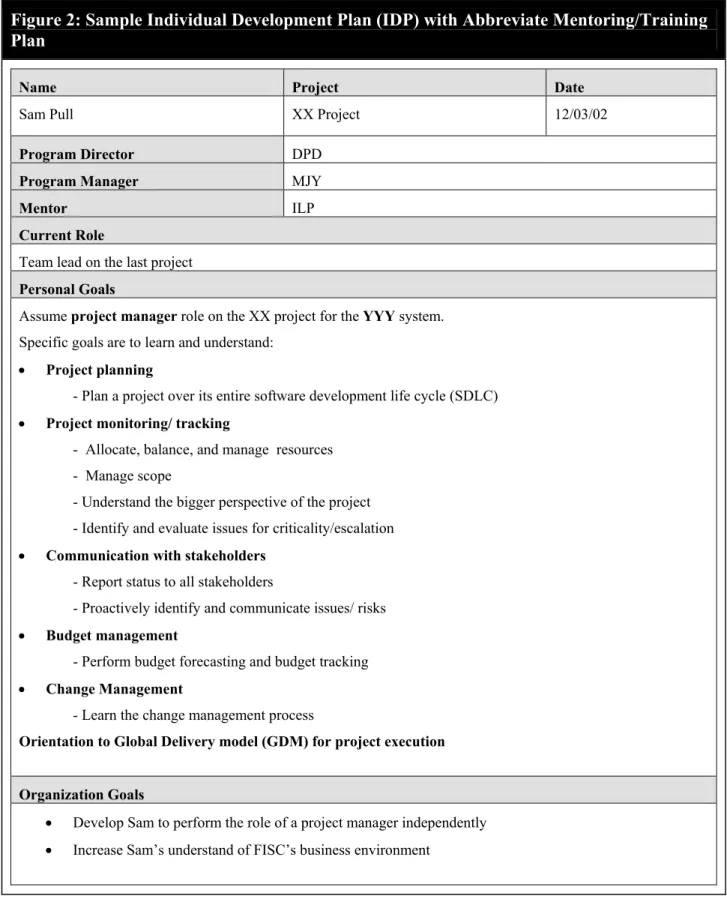
Formerly, FISC created an Individual Development Plan (IDP) for each IT employee, combining the em-ployee’s career goals with the skills FISC needed. Employees chose their own career path, and FISC’s managers made sure that skills important to FISC were considered. The resulting plan laid out steps for developing the needed skills.
The change made in the DI initiative was for the IDPs to include activities specifically aimed at retaining the needed IT competencies, often by exploiting Off-source’s expertise. Thus, one pillar of the cosourcing model—knowledge transfer—was formally instituted. Plans often involved assignments to specific duties on a cosourced team, along with career development ob-jectives needed for that assignment. Offsource team members often mentored FISC employees to achieve their development goals.
Figure 2 shows a condensed example of one team leader’s IDP. The first page states personal and organ-izational goals for the project manager role using a global delivery model for project execution. The Tools/Mechanisms column indicates responsibility for carrying out various activities. The mentor noted in this column refers to an Offsource team member. Off-source personnel consider mentoring part of their re-sponsibility and reportedly take pleasure in sharing their knowledge with FISC’s employees.
Creating a dual project management hierarchy. The second important element of cosourcing introduced during the DI initiative was a collaborative model of shared project leadership. At all levels, FISC or Off-source personnel took on greater project leadership
roles. It is certainly not unusual for an offshore out-sourcing staff to lead at lower, more technical levels. However, in the DI initiative, Offsource managers took the lead at higher levels, such as systems analysis and project management.
Figure 2: Sample Individual Development Plan (IDP) with Abbreviate Mentoring/Training
Plan
Name Project Date
Sam Pull XX Project 12/03/02
Program Director DPD
Program Manager MJY
Mentor ILP
Current Role
Team lead on the last project
Personal Goals
Assume project manager role on the XX project for the YYY system. Specific goals are to learn and understand:
• Project planning
- Plan a project over its entire software development life cycle (SDLC)
• Project monitoring/ tracking
- Allocate, balance, and manage resources - Manage scope
- Understand the bigger perspective of the project - Identify and evaluate issues for criticality/escalation
• Communication with stakeholders
- Report status to all stakeholders
- Proactively identify and communicate issues/ risks
• Budget management
- Perform budget forecasting and budget tracking
• Change Management
- Learn the change management process
Orientation to Global Delivery model (GDM) for project execution Organization Goals
• Develop Sam to perform the role of a project manager independently
Mentoring/ Training Plan Training
Phase
Training/On-the-Job Activities
Tools/Mechanisms When Measurements/
Deliver-ables
Project Plan-ning
Mentoring on
- How to plan for the various phases and activities of the pro-ject
- How to identify syn-ergies and dependen-cies
¾ Initial planning by Sam
¾ Discuss/ review and feedback by mentor
¾ Perform ongoing plan-ning by Sam and weekly review with mentor
11/18/02 - 01/31/03
¾ Work plan for solu-tion definisolu-tion
¾ Sam to maintain the work plan Project Monitoring and Track-ing Mentoring on - How to proactively identify issues, evaluate their critical-ity, and escalate them - How to proactively
identify risks, create a risk mitigation plan, and address the risks
¾ Initial mentoring by the mentor
¾ Sam to come up with the initial issues and risks for system
¾ Discuss, review, and feedback by mentor
¾ Perform ongoing issue and risk identification by Sam; weekly review with mentor
¾ Interface with PMO
11/18/02 - 12/22/02
¾ Issue management by Sam–how many is-sues not identified by Sam were identified by mentor/project coach?
¾ Risk management by Sam–how many risks not identified by Sam were identified by the mentor/project coach? Communi-cation to stakeholders Mentoring on
- The status reporting process including familiarization with templates for weekly and high-level status reports, etc.
- Proactive communi-cation of issues/risks, etc.
¾ Initial mentoring by the mentor
¾ Sam to come up with the status reports for system
¾ Discuss, review, and feedback by mentor ¾ Ongoing activities 11/18/02 - 12/22/02 ¾ Status reporting by Sam Orientation to Global Delivery model Mentoring on - What is GDM? - How does it work? - What are the different
models? - Fixed Bid vs. T&M
- Contract finalization process
- Effort estimation and cost estimates for the entire SDLC
¾ Mentoring by the
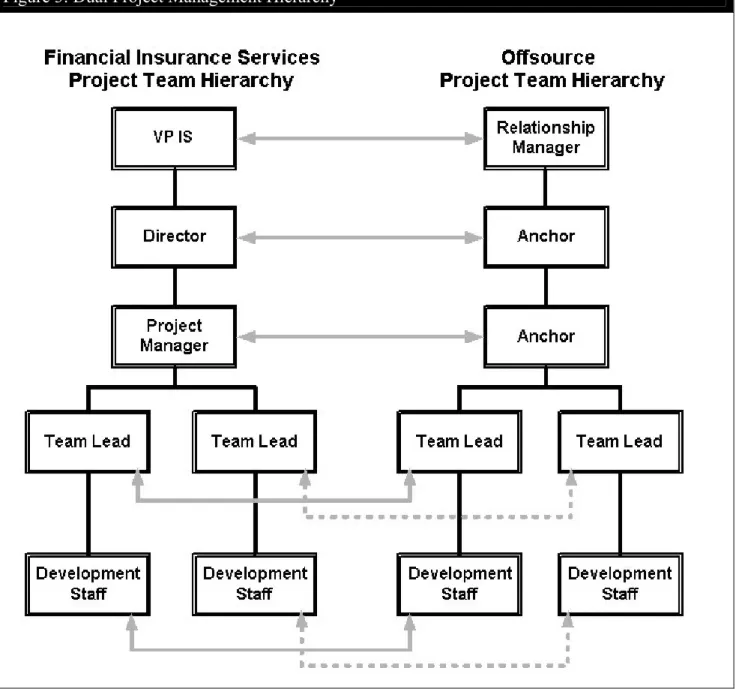
As Offsource took on more responsibility, it became clear that communications between the two organiza-tions needed to improve. To achieve this, the two for-malized the shared leadership model, which they called Dual Project Management Hierarchy (DPMH). Using DPMH, the hierarchies of FISC and Offsource mirrored each other.
DPMH serves several purposes. It keeps communica-tion open at all levels. Project overviews are joint. And FISC or Offsource staff can assume the lead on any role, as needed.
Figure 3 shows a simple form of DPMH. Reporting to
the project manager on the FISC side are team leads responsible for a significant portion of the project. Reporting to these team leads are development staff, such as systems analysts and technical designers. The Offsource “anchor” role corresponds to the FISC project manager, with corresponding team leads and development staff underneath. Offsource’s develop-ment staff can include a mix of onsite and offshore personnel. Also shown in Figure 3 are similar pairings above the project manager. Directors, who are respon-sible for overseeing multiple projects, have an Off-source peer who also goes by the title of anchor. At
Figure 3: Dual Project Management Hierarchy
Note: Multiple directors report to the VP of IS. In most cases, multiple project managers report to
a director. Offsource has a similar reporting hierarchy.
the top of the hierarchies, FISC’s VP of IS interacts most closely with Offsource’s relationship manager. This shared-leadership approach works because Off-source’s anchors, team leads, and systems analysts are onsite. While other firms may not use a DPMH struc-ture, cosourcing requires a close working relationship. At lower levels, where responsibilities are technical design, implementation, and testing, FISC relies more on Offsource’s offshore staff.
Shared leadership exists between peers within the hi-erarchy. On some projects, FISC managers lead; on others, Offsource leads—often for the purpose of ca-reer development. When an Offsource person takes the lead, the FISC counterpart takes a “shadow” role—that is, following the Offsource team lead around to learn the competencies and skills stated in the IDP.
Although some information exchange and shared leadership occurred on U-Life projects, the formal adoption of DPMH on the DI initiative represented a significant improvement. DPMH clarified the IT competencies needed to lead at every level, which proved useful in creating employees’ individual de-velopment plans and in keeping FISC from becoming dependent on Offsource.
Formalizing Offsource’s role in development and evaluation also became part of the negotiated contrac-tual agreements. For fixed-bid projects, the costs of training, mentoring, and providing evaluations of FISC employees became part of the services Off-source provided and were reflected in the bid. For time-and-expense projects, these expectations were part of the billed time. While formalizing these fea-tures is not essential in cosourcing, they have ensured that Offsource understands and agrees to taking on these expanded duties.
Not all projects are managed in this cosourced man-ner, though. Some are managed internally, some in a traditional outsourcing mode, and some cosourced. In 2003, as a result of the accounting scandals, the U.S. Security and Exchange Commission (SEC) required new reporting of financial institutions. This project began at the same time the cosourcing model was formalized, but given the urgency and short time frame, FISC needed to ramp up fast and get the job done. The work was essentially outsourced; cosourc-ing occurred only at the senior levels.
To step up. The U-Life and the DI initiatives represent FISC’s typical approaches of working with Offsource. U-Life represents FISC’s early experiences with cosourcing; DI represents the current approach.
In addition to intangible benefits, the U-Life partner-ship has reaped IT staff resource benefits of 28% and 34% in two years, excluding 10% overhead.7 DI pro-ject savings were approximately 30%, excluding overhead. The two-year SEC project cost millions of dollars. Outsourcing to Offsource saved 22% in de-velopment staff costs.
In all these initiatives, Offsource’s quality and timeli-ness measures replicated its track record of delivering on time with few or no errors in the production code base.
To move such a healthy relationship up a notch, and increase its value still more, would require working side-by-side on higher-value work.
Step 5: Alignment
Alignment in outsourcing means alignment between the two firms in commitment and values. The ap-proach FISC has taken in this step is to ask for Off-source’s input on FISC IT strategy on future projects and on how to manage and integrate IT core compe-tencies to contribute to the firm’s success. Offsource’s participation in senior decision-making is a significant criterion to warrant a more sophisticated step in the cosourcing model. This level of involvement has come only after many years of increasing trust and commit-ment.
One manifestation of this step is becoming evident this year: Offsource is aligning its balanced business scorecard with FISC’s balanced scorecard.8 Planning
for this effort began in 2003. This project is one more step toward the two companies working together as cooperatively as possible.
RECOMMENDATIONS ON
COSOURCING
Based on this research, here are five recommendations for other firms considering cosourcing with an off-shore outsourcer:
• Understand where cosourcing is applicable
• Define and develop the appropriate in-house IT competencies
7 It is important to pull out overhead as it will vary by firm more than other costs
8 For a description of the business balanced scorecard approach, see Kaplan, R.S. and D.P. Norton, “The Balanced Scorecard: Measures that Drive Performance,” Harvard Business Review, January-February 1992, pp. 71-79, and Kaplan, R. S. and D.P. Norton, “Using the Bal-anced Scorecard as a Strategic Management System,” Harvard Busi-ness Review, January, 1996, pp. 75-85.
• Build trust but avoid building a binding rela-tionship
• Foster mutual understanding of ethnic and corporate cultures
• Map out a progression to cosourcing
Understand Where Cosourcing Is
Applicable
Cosourcing is not without its costs. Understanding where and when to apply it requires weighing its costs versus its benefits. On the cost side, FISC’s dual pro-ject management hierarchy requires more onshore staff from Offsource than if most of the work was per-formed in India. Hence, cosourcing incurs a higher overhead, much of it in the form of onsite mentoring of FISC IT staff.
The usual range for offshore outsourcing is one person onsite to anywhere from 10 to 20 offsite. The DPMH model has a 1-1 ratio onsite, because of the higher analysis level, and a one-to-10-20 ratio only at the lower levels doing technical work. The associated overhead for cosourcing differentiates it from fee-for-service outsourcing.
On the benefits side, having Offsource at higher levels allows FISC to (1) outsource a greater range of devel-opment work, including work on core systems, and (2) allow Offsource to delegate work from analysts to technical designers, thereby making communications between the levels smoother and more efficient. Also, information exchange and personal contacts between client and outsourcer exist at multiple levels, which allow common shared knowledge and the abil-ity to manage and resolve conflicts in a timely man-ner.9
Furthermore, FISC considers the additional costs worthwhile because its IT employees receive skills development, which FISC values highly.
In outsourcing it development work on core systems, FISC moves from the Stage 3 “Proactive Cost Focus” in the Sourcing of IT Work Offshore (SITO) model to the Stage 4 “Proactive Strategic Focus” stage.10 Firms take a cost focus in Stage 3 and tend to outsource rou-tine development of non-core activities, such as
9 A similar approach is recommended in Quinn, J.B., “Strategic Out-sourcing: Leveraging Knowledge Capabilities,” Sloan Management Review, 40(4), 1999, pp. 9-21.
10 See Carmel, E. and R. Agarwal, “The Maturation of Offshore Sourc-ing of Information Technology Work,” MIS Quarterly Executive, 1(2), 2002, pp. 65-77, for a detailed description of the four stages: (1) Off-shore Bystander, (2) OffOff-shore Experimenter, (3) Proactive Cost Focus,
tems maintenance or porting existing systems to new platforms. Those in Stage 4 take a proactive strategic focus. For them, offshore outsourcing tends to have greater impact on strategic advantage by spurring in-novation, helping to develop new products, and accel-erating time-to-market. Cosourcing is the approach used by FISC to achieve this fourth, and most ad-vanced, stage of offshore outsourcing.
In 2002, Carmel and Agarwal estimated that only 10% of Fortune 500 firms using offshorers had achieved this fourth stage.11 They argue that the costs of im-plementing the needed administrative mechanisms are justified when IT provides competitive advantage. This is the case for FISC because IT is integral to all its products and services.
Even at FISC, however, cosourcing is not applied uni-formly to all development efforts. There are still some projects with well-defined coding requirements that Offsource could complete offshore, but FISC has cho-sen not to do so. Even though cosourcing is widely used on Offsource projects, FISC still uses judgment in determining where and when to use it.
Define and Develop the Appropriate
In-house IT Competencies
Though the specific capabilities needed to excel at IT vary from firm to firm, IT management needs to de-cide which need to be kept in-house before designing measures to preserve and enhance them. At FISC, these IT competencies are those that
• Empower senior IT managers who oversee multiple projects to set the strategic direction of IT, and
• Ensure there is alignment between those who define needs (the business) and those who implement the IT solutions (often, the out-sourcer).
To make these judgment calls, FISC IT management has decided that its high-level IT managers need the expertise to make informed tradeoffs among project cost, time, scope, and system quality in ways that best serve FISC. The needed competencies fall broadly into two categories: IT expertise and business domain knowledge.
The IT expertise needed by FISC’s senior IT managers begin with project management and development methodologies. But they also need technical knowl-edge because, although many technical decisions are made by implementers (in-house or an outsourcer), the
senior IT managers need technical knowledge to make informed tradeoffs on technical design and implemen-tation issues. Business domain knowledge generally comes from user managers, but still, senior IT execu-tives are expected to be more business-knowledgeable than the vendors. This business knowledge includes industry expertise as well as business-process exper-tise in specific applications.
To maintain both types of knowledge, FISC recently grouped its IT staff into two business lines: insurance and investment. The specific technical and business domain competencies required by senior IT managers differ between these two groups, due to the technolo-gies used and the business domains served. Its sea-soned high-level IT managers have developed enough understanding of the relevant technologies and busi-ness domains to make the tradeoffs. The subdivision of IT aims to sustain that expertise.
Historically, FISC’s senior IT executives have gained their expertise over time. Employees have been hired at lower levels and progressively assumed more ad-vanced responsibilities, receiving mentoring from su-pervisors and taking training to advance. But exten-sive outsourcing of virtually the entire range of system development activities, across a large number of ap-plication areas, threatens this approach to gaining ex-pertise because it removes the opportunities to de-velop competencies.
FISC, however, has implemented cosourcing to main-tain these opportunities, for the express purpose of retaining and developing its IT competencies. Beyond preserving responsibilities at different levels for FISC employees, the cosourcing relationship presents new opportunities for their development. Offsource’s per-sonnel possess an impressive reservoir of knowledge which FISC’s employees now benefit from, thereby giving them the knowledge to advance further than they might have otherwise.
FISC’s two mechanisms—the Individual Develop-ment Plans (IDP) and the Dual Project ManageDevelop-ment Hierarchy (DPMH)—serve as models for how IT competencies can be retained and enhanced in-house, while outsourcing. Both mechanisms should have fairly wide applicability in other organizations. IDP provides a formal mechanism for defining develop-ment objectives and plans for meeting them. FISC uses the IDP to identify threatened IT competencies and then involves Offsource personnel in mentoring FISC IT employees in these areas. When retaining specific IT competencies is important to a client, one of the selection criteria for choosing an outsourcer could be predisposition toward mentoring.
The DPMH aims to preserve leadership capabilities. Offsource has also used it to identify mentors. Beyond learning and knowledge transfer, though, this multi-level contact structure can also keep client managers alert and informed, and it can improve communica-tions between employees and external vendors or part-ners.12 FISC has found that this structure allows its IT
employees to operate at all project levels because they have both a good understanding of the business appli-cations and the technical aspects of the system under development.
Build Trust But Avoid Creating a
Binding Relationship
The more work outsourced to a particular vendor, the greater the potential cost of switching vendors. By awarding Offsource such a large share of its develop-ment work, FISC has potentially exposed itself to con-siderable risk were this relationship to end. But Off-source has garnered much responsibility because it has shown itself trustworthy. A constant refrain of FISC managers is that Offsource consistently strives to en-sure “satisfaction and delight.” There are no indica-tions that this situation will not continue.
But client and vendor firms have different motiva-tions,13 and unexpected circumstances can cause a relationship to change. No matter how remote the pos-sibility, clients should retain some independence and flexibility in order to minimize costs and the potential for disruption were the relationship to fall apart. One way to avoid lock-in is to use several outsourcers without giving any one of them a large share of the outsourced work. Risk increases the more deeply in-grained the vendor. A partial solution is to retain IT competencies so that important systems knowledge and IT competencies do not disappear if the vendor does.
FISC has also maintained a career ladder for compe-tency development, so that its IT employees can as-sume responsibility for critical tasks, if necessary. To date, capable internal employees have been involved in most activities on cosourced projects. The retained
12 Henderson, J.C., “Plugging into Strategic Partner-ships: The Critical IS Connection,” Sloan Management Review, 31(3), (1990) , pp. 71-18, and Quinn, J.B., “Strategic Outsourcing: Leveraging Knowledge Capa-bilities,” Sloan Management Review, 40(4), (1999), 9-21.
13
Lacity, M., D. Feeny, L. Willcocks, “Transforming a
Back-Office Function: Lessons From BAE Systems’ Experience with an Enterprise Partnership,” MIS Quarterly Executive, 2(2), (2003), pp. 86-103.
IT competencies and familiarity with systems would likely ease FISC’s transition to another vendor. On the positive side, through its status as a trusted vendor, Offsource is viewed almost as an extension of FISC’s internal IT department. Offsource personnel are familiar with the technologies, the current systems, and the business domains of new applications. So they can become productive immediately on new projects. Other vendors would have a slower learning curve. Thus, projects progress faster.
Foster Mutual Understanding of Ethnic
and Corporate Cultures
Creating successful strategic partnerships requires both parties to learn about each other’s tasks, con-cepts, and the critical business issues, as well as be-come familiar with each other’s culture.14 When a “partner” comes from halfway around the world, achieving this understanding can be difficult. The in-tense collaboration needed on cosourced IT projects can run into difficulty unless both parties understand each other’s backgrounds, motivations, and communi-cation styles.
The differences in time zones, language, technical training, and ethnic and corporate cultures create a layer of work not necessary with domestic outsourc-ers. Organizations that choose to work with an off-shore software developer in other than a factory mode (where all the work is performed offshore) need to understand the costs and benefits of allocating time, training, and a commitment to cultural interaction. At a minimum, the client needs to have confidence that the offshore firm will work on overcoming barriers that ensue from different corporate and ethnic cul-tures.
Alternatively, a client can select a vendor based on cultural compatibility, to lessen the need for extensive education.15
To foster cultural understanding, FISC and Offsource took numerous approaches, some formal, some infor-mal. They held formal workshops about each other’s culture at two levels: beginner and advanced. One workshop, for instance, helped FISC employees un-derstand that telling an Offsource employee to do something “as soon as possible,” would be interpreted as “whenever you get done doing everything else.”
14 Henderson (1990) op.cit.
15 This position is in contrast to the recommendation of Lacity et al (2003),who recommend choosing a vendor that is culturally incom-patible from a corporate culture perspective. Their discussion focuses on an enterprise partnership for a back-office function. Their recom-mendation may be effective in that setting, but may not apply to other
Appreciating each others culture also helps employees build personal relationships. Informal means to this end have been a variety of social activities, such as a Mardi Gras lunch (where Indians brought their own cuisine), cricket matches, football games, and outings to baseball games.
To minimize areas where differences can cause prob-lems, Offsource has also taken some steps. One is in communications. Its onsite staff, rather than FISC staff, handles most communications with the offshore staff in India.
The hundreds of Outsource employees displaced from their home and family appreciated the warmth tended by the FISC staff. The same gratitude was ex-pressed by the FISC staff who went to Bangalore. Off-source’s employees take positions with the firm know-ing they will travel for months, and that this travel is most likely to the U.S. or Europe. Their expectations help them adjust. But FISC learned that the same kind of adjustment needs to be made by its employees, both those asked to work in India for a while and those staying home but needing to work with a large group of people from another culture.
Map Out a Progression to Cosourcing
Moving from outsourcing to cosourcing took FISC and Offsource several years of trial-and-error; they had no role model. Others might be able to bypass much of this trial-and-error by understanding how they can apply the cosourcing model. But it is a ma-ture form of offshore outsourcing, so most firms will need to go through a maturation process that begins with offshore experimentation followed by more widespread use of offshore outsourcing. Only after such experience are most firms ready to move to a strategic form of offshore outsourcing, such as cosourcing.Even so, a firm mature in offshore outsourcing can still face risks attempting to cosource with an unfamil-iar offshore outsourcer, without first gaining experi-ence with the firm because trust is essential for the close collaboration in cosourcing.
To build a track record of successful collaborations that instill trust, clients can start a new vendor on smaller-scale, non-critical projects, or projects aimed at reducing costs—the traditional focus in outsourc-ing. Such experience can help build mutual trust, knowledge, and cultural understanding, and can pro-vide a better basis for judging whether the vendor should be involved on a cosourcing basis. As shown by FISC’s experience, it is possible to gradually intro-duce elements of cosourcing to make such an assess-ment.
CONCLUSION
Offshore software development will continue to in-crease, for reasons beyond cost reduction. Client and vendor organizations will have to consider whether or not to engage in the practice, being aware of their competition’s offshore participation. If they choose to outsource, they need to determine which organiza-tional model to use for each project and how intense an effort is realistic and beneficial.
Knowledge transfer does not translate to a pure eco-nomic decision. Measuring its value is difficult. The more critical decision is what to transfer. FISC chose to retain business knowledge, recognizing that Off-source staff need basic insurance knowledge to be valuable. Offsource therefore trained its staff on insur-ance and also assigned onshore and offshore staff to FISC who understood the insurance industry. Off-source’s work depends on the project. Team leaders depend on expertise—those who have it and those who can gain it through mentoring. Despite the inabil-ity to measure knowledge transfer in financial terms, client firms need to be aware of its intangible costs in contract negotiations.
FISC’s experience with cosourcing may also be in-structive to domestic software vendors that are estab-lishing offshore offices to remain competitive. Al-though price was important, it was not the sole reason Offsource has become a key vendor at FISC. Other factors have been the quality of its work, its focus on customer satisfaction, and its willingness to accom-modate FISC’s needs as the relationship evolved to-ward cosourcing. Domestic vendors may benefit by learning from Offsource’s example of how to deal with clients.
Cosourcing has benefited both FISC and Offsource. Their journey offers a viable alternative to viewing offshoring as a threat to client employees. Their con-tinual striving for increase the value of the relationship on both sides is paying off for employees of both companies.
The cosourcing model that resulted from these changes is especially important at this time when many firms are concerned about the loss of skill sets to and dependencies on outsourcers. The experiences of FISC and Offsource provide arguments against lay-ing off onshore employees, and, instead, exploitlay-ing an outsourcer’s expertise to enrich the domestic staff’s careers.
ABOUT THE AUTHORS
Kate M. Kaiser ([email protected]) is Associate
Professor of IT in the College of Business Administra-tion at Marquette University. Her relevant research areas include project management, user involvement, IT recruitment and retention, and offshore software development. Current offshore research focuses on liaison project management skills for importers and exporters. She has published in MIS Quarterly Execu-tive, MIS Quarterly, Communications of the ACM, Academy of Management Journal, the Journal of High Technology Research, Information and Management,
Datamation, and a book chapter on offshore software development, among others. She is facilitating the Society for Information Management (SIM) e-community on IT outsourcing and won a 3M Founda-tion grant to hold an outsourcing forum to help de-velop curriculum recommendations as a result of out-sourcing’s impact on placement. Her B.A. and M.B.A. are from Kent State University, and her Ph.D. is from the University of Pittsburgh.
Stephen Hawk ([email protected]) is Associate
Pro-fessor of MIS in the School of Business at Technol-ogy at the University of Wisconsin-Parkside. His re-cent publications include articles on e-commerce in Russia, e-commerce in developing countries, and a book chapter on offshore software development. He is currently involved in a study on the Russian offshore software development industry. He has published in
Decision Sciences, Electronic Commerce Research, Journal of Business Ethics, IEEE Transactions on Engineering Management, Information and Manage-ment, Information Technology for DevelopManage-ment, agement Decision, and International Journal of Man-Machine Studies. His Ph.D. is from the University of Wisconsin-Madison.