Vol.10 (2020) No. 3
ISSN: 2088-5334
Face Recognition System Based on Gabor Wavelets Transform,
Principal Component Analysis and Support Vector Machine
Salar J. Rashid
a, Abdulqadir I. Abdullah
b, Mustafa A. Shihab
c aComputer Centre, Northern Technical University, Mosul, Iraq E-mail: [email protected]
b
Department of Computer Science, College of Science, Knowledge University, Kurdistan Region, Iraq E-mail: [email protected]
c
Department of Computer Science, College of Science, Tikrit University, Tikrit, Iraq E-mail: [email protected]
Abstract—Face Recognition is a well-known image analysis application in the branches of pattern recognition and computer vision. It
utilizes the uniqueness of human facial characteristics for personnel identification and verification. For a long time, the recognition of facial expressions by using computer-based applications has been an active area of study to recognize face scheme through a face image database. It is used in a variety of essential fields of modern life such as security systems, criminal identification, video retrieval, passport and credit cards. In general, face recognition process can be summarized in three distinct steps: preprocessing, feature extraction, and classification. At first, histogram equalization and median filter are applied as preprocessing methods. Secondly, Gabor wavelets transform extracts the features of desirable facial characterized by, orientation selectivity, spatial locality, and spatial frequency to keep up the variations caused by the varying of facial expression and illumination. In addition to that, Principal Component Analysis methodology (PCA) is used in dimensionality reduction. At last, Support vector machine (SVM) is applied in classifying the feature of the image according to the classis of every mage. In order to test the approach used in this research, experiments were running on Yale database of 165 images from 15 individuals in MATLAB environment. The results obtained from the experiments confirmed the accuracy and robustness of the proposed system.
Keywords— face recognition; gabor wavelets transform; principal component analysis; support vector machine.
I. INTRODUCTION
Face Recognition deals with the unique facial characteristics of humans; it is a job of recognizing a detected face and identifying exactly who the person is through involving image processing and pattern recognition. It can be used in several important areas, such as identity authentication, video recovery, and security services. Face recognition is a biometric software application. Biometric can be defined as the series of steps used to measure the physical and behavioral characteristics of a person for verification and identification. The dimensions of the facial images are higher and thus need a large amount of computing time. The recognition and classification time can be minimized by reducing the aspects of the image data. These factors affect the quality and performance of the recognition and make it harder to apply [1]–[4].
Principal Component Analysis Method (PCA) employs eigenfaces for adjusting the mouth and eyes of the face
during scanning of the image. To do that, all the images must be the same size and to be normalized. After that, a method is used in reducing the dimensions of the image data by using image compression basics to provide a structure of the most effective low dimension of facial pattern. Useful information is dropped after this reduction, and the structure of the face is decomposed into uncorrelated components (orthogonal) called eigenfaces. A vector of the weighted sum feature of eigenfaces is used to represent each face image that is saved in a one-dimensional matrix. A gallery image is compared with the probe image by computing the distance between their respective feature vectors; then, the matching result will be disclosed. This linear approach is widely used in appearance-based approaches for face recognition. This approach aims to solve the problem of recognition within an image space of a higher dimension of the representation space [5].
Gabor wavelet [6] was presented in 1946 by David Gabor. The Gaussian envelope is used to modulate the Gabor
wavelet with a specific orientation and frequency in a wave of the sinusoidal plane. It can illustrate the structure of spatial frequency, whereas preserving the spatial relations information, so, is appropriate for evolving the contents of the pattern of orientation-dependent frequency. Gabor features could efficiently extract the face local features at multiple directions and multiple scales; however, this may lead to a sharp rise in data volumes. In Gabor filter, a rectangular graph is used in characterizing faces with local features extracted at deformable nodes using Gabor wavelets [7]. The technique can effectively collect several features of the human face and make it very easy to describe and recognize all kinds of information [8]. Support vector machine (SVM) verified to attain better recognition performance than many other generative classifiers, due to the fewer amounts of needed training data. It also concentrates on the field of machine learning, and it is the newest part of the statistical learning theory and still is in the stage of development [3].
Vinay, A., Shekhar, V.S., Murthy, K.B., and Natarajan, S., [9] presented an in-depth comparison of Gabor-PCA and Gabor-KPCA techniques on ORL database. They showed that the Gabor-PCA variant is better suited for face recognition tasks when Gabor is employed as the feature extractor. B.S. Oh, K.A. Toh, A. Teoh, et al. [10] proposed a face recognition based single hidden layer analytic Gabor feedforward network. They trained the network model analytically using a single sample per identity on five face datasets. They showed that the obtained solution is globally optimal with respect to the classification total error rate. Cament LA, Galdames FJ, Bowyer KW, Perez CA [11] proposed a new Gabor-based method that modifies the grid using a mesh to model face deformations produced by varying pose. They improved recognition performance by using a statistical model of the scores computed by using the Gabor features. They tested the method on the CMU-PIE and FERET databases and concluded that the performance obtained in the CMU-PIE database is best, among other methods published.
II. MATERIALS AND METHOD
The design of the system can be described in three steps: Pre-processing features extraction and classification. Histogram equalization and median filter are used in the first step in filtering noise and adjusting image intensities. In the second step, the PCA method is used to extract image features. In the final step, SVM is used to classify the extracting features. The three steps are explained in the figure below:
Fig.1 System Design Scheme
A. Pre-Processing
Pre-processing is the initial and most important step in recognition of face because the results of the next steps depend on it. Two common techniques are used: a histogram equalization that is applied to improve the contrast of the image and a median filter that is used to remove the noise from the image.
B. PCA
PCA extracts feature using eigenfaces, let an image of face ( , ) be two-dimensional by array of 8-bit intensity values. PCA main idea is to find the vectors within the space of the entire image. Let the face images training set
be Γ , Γ , Γ … … Γ , the = ∑ Γ can be defined as the
average set, each face varies from this average by the
Φ = Γ − . then PCA searches for a set of uncorrelated
vectors, , which defines the distribution of data. The kth vector is chosen such that:
= ∑ ( Φ ) (1)
Is the maximum dependent on
= = 1 !" # = $0 &'ℎ)*+!,)- (2)
The scalers and vectors are the eigenvalues and eigenvectors, respectively, of the covariance matrix.
. = ∑ Φ Φ (3)
= // (4)
Where the array / = 0Φ Φ … . . Φ 2. however, the array . is by , and determining the eigenvalues and eigenvectors is an intractable task for the sizes of typical image, then the appropriate linear combinations of the face image Φ, is taken, by considering the eigenvectors 3 of // such that:
/ /3 = 4 3 (5)
multiplying both sides by /
// /3 = 4 /3 (6)
Then the /3 are the eigenvectors of . = // , following this analysis the by matrix 5 = / / can be constructed where 56 = Φ6Φ and find the eigenvectors 3 of 5. these vectors calculate linear combinations of the training set of face images to form the eigenfaces 3:
= ∑ 3 Φ # = 1, 2, … … . (7)
The calculations are greatly reduced with this analysis, form the order of of images pixels to the order of of the images training set [12].
Fig.3 Gabor Filter Kernel
C. Gabor Wavelets
Gabor Wavelets are used for analyzing images due to their computational properties and biological relevance. The Gabor wavelets, with kernels that are like the two-dimensional receptive area profiles of the mammalian cortical simple cells, offer strong features of orientation selectivity and spatial locality and are best centralized in the frequency and space domains [10]. The Gabor filter-based features can be extracted from the gray-level images. a 2-D
Gabor filter can be represented by a Gaussian kernel function in the spatial domain and can be modulated by a complex sinusoidal plane wave, defined as:
8( , ) = ;<=9: exp A−BC:D<F::EC:G exp(H2I" J+ L) (7)
J= cos P + sin P (8)
Where " is the sinusoid frequency, L is the offset of phase, S is the standard deviation of the Gaussian envelope, T is the spatial aspect ratio which specifies the ellipticity of the support of the Gabor function and P represents the normal orientation to the parallel stripes of a Gabor function [14], [15].
D. SVM
SVM consider separating of data into two different categories with points such that: U( , )VW and ∈
U−1, +1V. Where represent dimensional vector whereas
represent the label of class of the vector. In SVM the hyperplane is used to separate the points of the two categories:
Y + Z = 0 (10)
where + is an adaptive vector weight, represents the vector, and Z refers to the bias, the functional margin can be illustrated as:
Y[ + Z[≥ +1 → = +1 (11)
Y[ + Z[≤ −1 → = −1 (12)
by taking one point Y[ and Z[, the geometrical distance of a point can be represented as:
_(+[, Z[, ) =|a‖abBDcb‖b| (13)
Fig.4 SVM Stage
SVM tries to maximize the distance between the closest point of these two categories with the hyperplane. thus, the best separation of the data is the one that minimized:
∅(Y) = ‖Y‖ = (Y. YJ) (14)
The problem optimization can be attained by maximizing the dual Lagrange formula:
f(g) = ∑ gW − ∑ ∑ g g
h hi . hj W
h
W (15)
Lagrange multiplier must subject to the constraints:
g ≥ 0, ∑ gW = 0 (16)
Only a small number of g is none zero, which corresponds to one training data point that lies on the border of the margin and is called Support Vectors [16], [17].
III.RESULTS AND DISCUSSION
The proposed approach implemented uses MATLAB 2018a. The Image processing toolbox, computer vision system toolbox, and statistics and machine learning toolbox are used to build the program. All simulated experimentation used a personal computer with Core i5-2540M CPU 2.6 GHz
and 8 GB of memory running under the Windows 7 operating system.
The proposed system is made up of three steps: Pre-processing features extraction and classification. Gabor wavelet is used in extracting features. PCA is used in reducing the dimension of the image, and SVM is used in classifying the extracted features. The first two principal components are shown in figure 5.
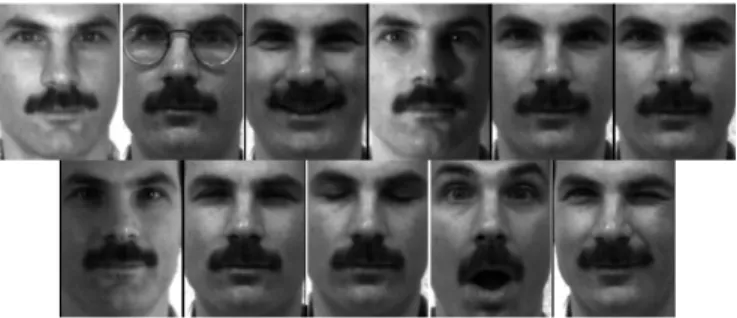
Experiments using Gabor wavelet method are implemented on the Yale database to calculate the performance of the system. The Yale database involves 165 individual images of 15 different persons with 11 different images under different exposure, light, and perspective for each person. The resolution of the images is 243 x 320 pixels of 265 gray levels per pixel; samples of the images are shown in the Figure below.
Fig.6 Samples of Face Image
The database is divided into train and test sets. In the train, seven images of class one (S1) to class thirteen (S13) are taken. On the other hand, the remaining four images of class one (S1) to class thirteen (S13), in addition to all eleven images in class fourteen (S14) and fifteen (S15), are selected as test images. In this way, 91 images have been used for training, and 74 images have been used for the test. In the testing process, the methodology of face recognition run on some test images where the results are known previously. Then the same method is tested on some new images to consider the robustness, accuracy, and speed of the methodology. The testing proved that the accuracy is acceptable, with a percentage of above 98.7% of success. Table I. presents a comparison between our proposed method with the others implemented in the literature review.
TABLEI
COMPARISON OF ACCURACY BETWEEN DIFFERENT METHOD
No. Method Accuracy 1 Our proposed method 98.7% 2 Gabor-PCA 87.5% 3 Gabor-KPCA 86.67%
4 ACFN 96%
5 LMG 96.4%
IV.CONCLUSION
As a result of the method and design of the face recognition system described in this research paper, a robust and accurate system was developed for face recognition. Our experiments outperformed the methods used in a literature review by 11.2% compared with Gabor-PCA, 12.03%, 2.7%, and 2.3% with Gabor-KPCA, ACFN, and LMG, respectively. We can conclude that combining the methods used in preprocessing, feature extraction, classification, and
recognition can produce better results. The aggregation of Gabor wavelet transforms, Principal Component Analysis (PCA), and Support Vector Machine (SVM) is effective in this face recognition system.
REFERENCES
[1] Yukti Bakhshi, Sukhvir Kaur, and Prince Verma, "An Efficient Approach in Face Recognition for Invariant Faces using SIFT, SURF, and PCA," International Journal of Signal Processing, Image
Processing and Pattern Recognition, Vol.9, No.5, pp. 99-108, 2016.
[2] S. Sharma, “Face Recognition using PCA and SVM with Surf Technique,” International Journal of Computer Applications, vol. 129, no. 4, pp. 41–46, 2015.
[3] W. Wang, X. Sun, S. Karungaru, and K. Terada, "Face Recognition Algorithm Using Wavelet Decomposition and Support Vector Machines," IEEE International Symposium on Optomechatronic
Technologies (ISOT), pp. 1-6, Oct. 2012.
[4] Alpa Choudhary and Rekha Vig, "Face recognition using multiresolution wavelet combining discrete cosine transform and Walsh transform," Proceedings of the 2017 International Conference
on Biometrics Engineering and Application, 2017, pp.33-38.
[5] Priyanka, Dr. Yashpal Singh, “A Study on Facial Feature Extraction and Facial Recognition Approaches,” International Journal of
Computer Science and Mobile Computing, vol. 4, pp. 166-174, 2014.
[6] D. Gabor, “Theory of communication,” J. Inst. Elect. Eng., vol. 93, no. 26, pt. III, pp. 429–457, 1946.
[7] S. Linlin, and L.Bai. "A review on Gabor wavelets for face recognition." Pattern analysis and applications, vol. 9, no. 2-3, pp. 273-292, 2006.
[8] S. Tang, "Face recognition method based on Gabor wavelet and memetic ecological algorithm," Biomedical Research, vol. 29, no. 0, pp. 1-1, 2017.
[9] A. Vinay, V. S. Shekhar, K. N. B. Murthy, and S. Natarajan, "Face Recognition Using Gabor Wavelet Features with PCA and KPCA - A Comparative Study," Procedia Computer Science, vol. 57, pp. 650-659, 2015.
[10] B.S. Oh, K.A. Toh, A. Teoh, and Z. Lin., "An analytic Gabor feedforward network for single-sample and pose-invariant face recognition." IEEE Trans. Image Process. Vol. 27 no. 6, pp. 2791– 2805, 2018.
[11] L. A. Cament, F. J. Galdames, K. W. Bowyer, and C. A. Perez, "Face recognition under pose variation with local Gabor features enhanced by active shape and statistical models," Pattern Recognition, Vol. 48, no. 11, pp. 3371-84, Nov. 2015.
[12] M.Turk and A. Pentland, "Eigenfaces for Recognition", Journal of
Cognitive Neuroscience, Vol. 3, pp. 71-. 86, 1991.
[13] C. Liu and H. Wechsler, “Independent component analysis of Gabor features for face recognition,” IEEE Trans. Neural Networks, vol. 14, no. 4, pp. 919-928, 2003.
[14] M. Haghighat, S. Zonouz, M. Abdel-Mottaleb, "CloudID: Trustworthy cloud-based and cross-enterprise biometric identification," Expert Systems with Applications, vol. 42, no. 21, pp. 7905-7916, 2015.
[15] Bayezid Islam, Firoz Mahmud, Arafat Hossain, Md. Sumon Mia, Pushpen Bikash Goala, "Human Facial Expression Recognition System Using Artificial Neural Network Classification of Gabor Feature Based Facial Expression Information," IEEE 4th
International Conference on Electrical Engineering and Information & Communication Technology (iCEEiCT), 13-15 September 2018.
[16] Zhifeng Li and Xiaoou Tang, "Bayesian face recognition using support vector machine and face clustering," Proceedings of the 2004
IEEE Computer Society Conference on Computer Vision and Pattern Recognition, 2004, Vol. 2, pp. II-374-II-380.
[17] Mustafa Zuhaer AL-Dabagh, Dr. Firas H. ALMukhtar." Breast Cancer Diagnostic System Based on MR images Using KPCA-Wavelet Transform and Support Vector Machine", International
Journal of Advanced Engineering Research and Science (ISSN: 2349-6495(P) | 2456-1908(O)), vol.4, no. 3, pp.258- 263, 2017.