
MORTEZA DIANATFAR
SAFETY ANALYSIS ON HUMAN-ROBOT COLLABORATION IN
HEAVY ASSEMBLY TASKS
Master of Science Thesis
Examiner: Professor Minna Lanz, D.Sc. (Tech) Borja Ramis Ferrer Examiner and topic approved on 26 September 2018
ABSTRACT
Morteza Dianatfar: Safety analysis on human-robot collaboration in heavy as-sembly tasks
Tampere University of Technology Master of Science Thesis, 79 pages
Master’s Degree Programme in Automation Engineering Major: Factory Automation and Industrial Informatics
Examiner: Professor Minna Lanz, Doctor of Science in Technology Borja Ramis Ferrer
Keywords: Human-Robot Collaboration, Industrial Robot, Human-Robot Interac-tion Levels, Laser Scanner, ABB SafeMove
Manufacturing assembly industry has traditionally utilized human labor to perform assembly tasks manually. With the introduction of industrial robots, fully auto-mated solutions have provided an opportunity to perform complex and repetitive tasks and assist in the assembly of heavy components. In recent years, improve-ment in robot technologies and changes in safety legislation have enabled new hurobot collaboration (HRC) concepts which have drawn attention of man-ufacturers. HRC uses characteristics of dexterity and flexibility of human and re-peatability and precision of robots to increase the flexibility of the system, de-crease the cost of labor in production and improve ergonomics in the design of shared workspace.
The operator safety is one of the challenges inside the HRC environment. The safety concerns could be altered with different levels of physical interactions be-tween robot and human. This thesis aimed to develop solution for analyzing the safety functions on different human-robot interaction (HRI) levels. The approach was started with the classification of tasks between human and robot. In this the-sis, assembly sequences were designed to fulfill the requirements of each inter-action levels of HRI. These experiments were providing evaluation tables for an-alyzing the safety functions in HRI levels.
The primary objective of this thesis is to design the HRC system with suitable safety functions. The safety of the workstation was developed using a combination of hardware and software. Laser scanners employed to detect the presence of a human in hazard areas and ABB SafeMove add-on were config-ured to exploit safety signals to the robot controller for adopting safety functions such as safety-rated monitored stop, and speed and separation monitoring. In this thesis, time work study analysis was demonstrated that the implementation of HRC decreases the fatigue and the injury risks of the operator and enhances the ergonomics for the operators. The study of safety functions through different HRI levels proved that with an increase of physical interactions it was necessary to employ multiple safety functions to prohibit collisions between robot and hu-man.
PREFACE
The study presented in this thesis has been carried out at the Mechanical Engineering and Industrial System (MEI) department of Tampere University of Technology (TUT). Firstly, I would like to express my gratitude to Professor Minna Lanz for providing me the opportunity to work in her team and her endless support for performing this experi-ment. I am also thankful to my supervisor D.Sc. (Tech) Borja Ramis Ferrer for his sup-ports throughout this thesis. Furthermore, I am grateful to my colleagues Jyrki Latokar-tano, Alireza Changizi, Mehdi Mahmoodpour, Joe Samuel David for their assistance at different stages of implementation of this thesis.
I owe my gratitude and special thanks to Saeid HeshmatiSafa for supporting and motivat-ing me in all the stages of my thesis.
Finally, I appreciate my parents blessing and encouragement during my whole career.
Tampere, November 12, 2018 Morteza Dianatfar
CONTENTS
1. INTRODUCTION ... 1
1.1 Research Gap... 2
1.2 Research Objectives and Outline of the Thesis ... 2
1.3 Research Questions and Limitations ... 3
1.4 Research Methodology ... 3
2. LITERATURE REVIEW ... 5
2.1 Assembly systems in the manufacturing industry ... 5
2.1.1 Flexible manual assembly ... 7
2.1.2 Flexible Automated Systems: ... 10
2.1.3 Hybrid Assembly Systems: ... 11
2.2 Industrial Robotics History ... 12
2.3 Human-Robot Collaboration ... 14
2.3.1 Industrial Robotics Markets ... 15
2.3.2 Industrial Robotics Applications ... 17
2.4 Machine Directive and Safety Standards ... 20
2.4.1 Machine Directive ... 20
2.4.2 EN ISO 12100 ... 24
2.4.3 ISO 10218 ... 28
2.4.4 ISO-TS 15066 ... 31
2.5 Review and Classification of Safety in HRC ... 32
2.6 Literature Review Summary ... 34
3. DEVELOPMENT / EXPERIMENT ... 36
3.1 Experiment’s Equipment and design ... 36
3.2 Engine Components Analysis ... 39
3.3 Task Allocation ... 40
3.4 Cell Design and Simulation... 44
3.5 Assembly Sequence based on Interaction Level ... 46
3.5.1 First Interaction Level Scenario ... 47
3.5.2 Second Interaction Level Scenario ... 50
3.5.3 Third Interaction Level Scenario ... 54
3.6 Safety Implementation ... 59
3.6.1 Laser Scanners ... 59
3.6.2 ABB SafeMove ... 62
4. RESULTS ... 64
4.1.1 Time Work Study Analysis ... 64
4.1.2 Task Allocation Results ... 67
4.1.3 Safety Function Analysis ... 67
5. CONCLUSION ... 71
LIST OF FIGURES
Figure 1. Research Methodology Diagram ... 4
Figure 2. Utilization area for manual, hybrid and automated assembly [16] ... 6
Figure 3. Classification of assembly system based on output and complexity [16] ... 7
Figure 4. Assembly station with set-wise sequencing for an electrical componentry [16] ... 8
Figure 5. One-piece flow assembly station with different part supplies [16] ... 9
Figure 6. Assembly layout for a various number of products [16] ... 9
Figure 7. Modular system for linear transfer assembly lines [16] ... 10
Figure 8. Extension stages of linear transfer assembly lines [16] ... 11
Figure 9. Yumi robot from ABB [34] ... 13
Figure 10. Baxter from Rethink Robotics [36] ... 13
Figure 11. Estimated annual worldwide supply of Industrial robots 2008-2016 and 2017-2020 [42] ... 16
Figure 12. Major industries usage [42] ... 16
Figure 13. Global markets of the industrial robot by countries [42] ... 17
Figure 14. KR Quantec PA series from KUKA for palletizing [44] ... 18
Figure 15. KUKA Spot Welding [46] ... 19
Figure 16. Assembly Application of Industrial Robot [49] ... 19
Figure 17. Painting Application of Industrial Robots [29] ... 20
Figure 18. Workplace accidents in Europe in 2012 [52] ... 21
Figure 19. Machinery safety standards based on their categories [54] ... 24
Figure 20. Representation of the risk reduction process including iterative three-step method [55] ... 26
Figure 21. The element of risk [55] ... 27
Figure 22. Definition of shared workspace areas [57] ... 30
Figure 23. Collaborative workspace Example [5] ... 31
Figure 24. Product: Diesel Engine ... 36
Figure 25. ABB IRB 4600-60 [80] ... 37
Figure 26. Motor Frame and Head Cover Jigs ... 37
Figure 27. From Top Left: First Design, Improved Design, Final Implementation ... 38
Figure 28. Left: SCHUNK PGN-plus-P 100-1 [81], Right: SCHUNK PGN-plus-P 80-2 [82] ... 38
Figure 29. Left: Fingers Designed for the motor frame and headcover, Right: Fingers Designed for pushrods and rockershaft ... 39
Figure 30. Multi-gripper Final Design ... 39
Figure 31. Assembly Stage Decomposition Model for Engine Components ... 40
Figure 32. Cell Design in MEI Laboratory ... 44
Figure 33. Layout Simulation in Visual Components ... 45
Figure 34. Cell Workspaces ... 45
Figure 36. Timing Diagram of Second Interaction Level Sequence ... 54
Figure 37. Timing Diagram for Third Interaction Level Sequence ... 58
Figure 38. SICK S3000 Laser Scanner ... 59
Figure 39. Laser Scanners Set Up in Workstation ... 60
Figure 40. Protective and Warning Definition for Wall Mounted Scanner ... 60
Figure 41. Protective and Warning Definition for Robot Mounted Scanner ... 61
Figure 42. Safety Range Axis Properties from ABB SafeMove ... 63
LIST OF TABLES
Table 1. Summary of reviewed methods ... 33
Table 2. List of assembly components ... 40
Table 3. Task Allocation analysis ... 43
Table 4. Primary of Task Allocation ... 46
Table 5. First Interaction level Assembly Sequence ... 47
Table 6. Second Interaction Level Assembly Sequence ... 51
Table 7. Third Interaction Levels Assembly Sequence ... 55
Table 8. Time Study of Manual Assembly Sequence ... 64
Table 9. Time Study of First Interaction Level of HRC Sequence ... 65
Table 10. Time Study of Second Interaction Level of HRC Sequence ... 65
Table 11. Time Study of Third Interaction Level of HRC Sequence ... 66
Table 12. Total Amount of Human Working Time in Different Assembly Sequence ... 66
LIST OF SYMBOLS AND ABBREVIATIONS
CAD Computer Aided Design
CE Conformité Européene
Cobots Collaborative Robots
DOF Degree of Freedom
EHSR Essential Health and Safety Requirements GMAW Gas-shielded Metal Arc Welding
HRC Human-Robot Collaboration
HRI Human-Robot Interaction
ISO International Organization for Standardization IFR International Federation of Robotics
MEI Mechanical Engineering and Industrial System OSHA Occupational Safety & Health Department PLC Programmable Logic Controller
SCARA Selective Compliance Articulated Robot Arm
TCP Tool Center Point
1. INTRODUCTION
In the last decade, the human-robot interaction (HRI) and human-robot collaboration (HRC) topics have gained the significant interests among researchers in manufacturing assembly process. Traditionally, assembly process was performed by the operator in a workstations that results in massive injuries and ergonomic issues leading to a social cost of labor in the factory [1]. By introducing the industrial robots with repeatability, precision, and high payload characteristics, new opportunities emerged to adopt robots in assembly workstations. However, this trend brought some issues such as positioning robots inside workstation with barriers such as fences and safeguarding walls. Robots with low intelligence (manually programmed by the expert) cannot operate with the complexity of products and sufficient flexibility during the assembly process.
Therefore, with adopting human cognitive capabilities such as dexterity and flexibility and robot’s characteristics mentioned above, there is a possibility to create flexible workstations, decrease the cost of manufacturing and provide a better ergonomic solution for operators. The increased interaction between human and robot is expected to enhance the assembly process in shared workspace. In this case operator may guide robot by hand and robot bring power assistance to the operator [1]. With the help of semi-automated assembly workstation industrial robots can cooperate with the operator as a team to take advantge of their combination capabilities [2].
The HRC concepts have been implemented mainly in academia, but unfortunately, there are only few implementations in industrial premises. The challenge is on ensuring human safety inside shared workspace at all times. The most common existing solution is to monitor the operator’s position in a shared workspace and continuous assessment of movement speed. Recently, the International Organization for Standardization (ISO) has published standards to provide safety requirements and guidance for industrial robots inside HRC application. Standards such as ISO 10218-1/2 [3],[4] provide outline safety requirements of industrial robot and robot system integration for the collaborative workplace, and ISO/TS 15066 [5] grant additional guidelines for implementing safety in HRI.
On this thesis, HRC application in industrial cases is examined where operator and industrial robot together assemble the diesel engine’s components. Assembly tasks are classified with proposed factors for each assembly task between human and robot. Afterward, scenarios of assembly respected to the fourth interaction levels [6] are created to analyze smoothness of workflow inside HRC based on different interaction levels. Later on, the safety of the operator is concerned by using two SICK laser scanners [7] and
ABB Safemove feature [8]. The study is repeated for each interaction levels, the results of the safety analysis for selecting suitable safety function, and time work study analysis are presented in the resulting chapter.
1.1 Research Gap
Recently, research in the field of HRC in assembly has been focused on inherently safe robots such as KUKA iiwa [9],[10], ABB Yumi [11],[12], and Baxter [13],[14] with small payloads. The current applications for these type of collaborative robots (cobots) are relating primarily for assisting the operator to hand-over the small tools or light-weight components. However, the needs in the industry are also for handling mid and/ or heavy-weight components. The industrial robots can have high payload capability and with good reachability. Due to the safety reasons, industrial robots are seperated from human operators by fences or barriers in the factory floor. The technological changes as well as changes in standardization are expected to allow HRC implemented in mid and/ or heavy assembly tasks. The indentified research gap relates to use of industrial robot experiments in HRC tasks. There are less studies about how to employ industrial robots in HRC shared workspace with heavier parts, due to the fact that implementation of safety for the bigger robot is challenging and dangerous.
Other problem that is addressed here is that in the research field of HRC, there is quite a few cases where researchers consider the interaction levels between the robot and human inside HRC shared workspace. In this thesis, the interaction levels between industrial robot and operator for the assembly process is studied, and their impacts on safety implementation are analyzed.
1.2 Research Objectives and Outline of the Thesis
On this thesis, implementing a hybrid assembly workstation for assembly process of product is investigated. Hence, the objectives of the thesis are following:
- Detection of the factors that are suitable for task allocation between robot and operator - Selection and implementation of the safety devices which is suitable for each
interaction level safety based on standards guideline
- Determination of the scenarios that match with interaction levels and create smooth workflow inside the shared workspace
The thesis includes following chapters and sections. In the chapter 2, an overview of manufacturing assembly, HRC and industrial robot markets are discussed. Next, the current studies in the field of robotics safety are reviewed. The details of the use case development such as design of workstation, design of tools, task allocation and safety implementation are provided in the chapter 3. Finally, the results related to the implemented solution is explained in the chapter 4.
1.3 Research Questions and Limitations
The research questions of this thesis can be listed as follows:RQ1: How to allocate task between the robots and human in HRI levels?
RQ2: What kind of safety functions should be implemented for workstation based on the HRI levels?
RQ3: Is it possible with proper resource allocation to enhance productivity? During the research of this thesis, the emerged limitations are as following:
- Due to the recent development of classification of HRI level, there has been a gap between scholar researches and practical studies.
- There is a limitation to access all of the engine components due to the method of manufacturing of the engine which made the disassembly of all the components chal-lenging. Therefore, defining tasks related to interaction levels are limited to specific components.
- Lack of access to a tool changing systems, only two grippers were selected for assem-bly tasks which decreased the flexibility of choosing the components for robot’s task. - The focus of thesis was not on the layout design, gripper or feeder strategies, thus the
existing available equipment was used.
1.4 Research Methodology
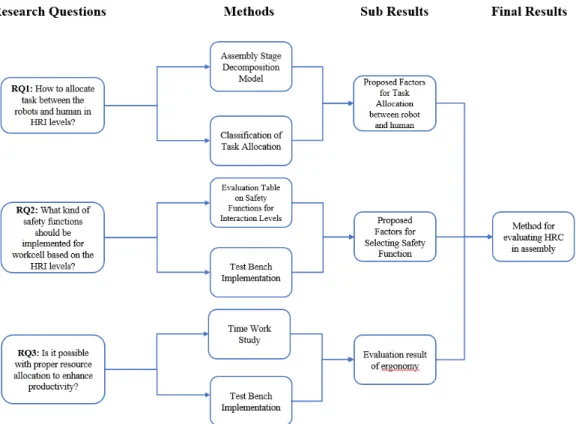
Based on the research questions mentioned in the previous subsection; different methods have been tested to fulfill the research outcomes. The Figure 1 demonstrates the research questions and utilized methods for each one and ultimately the results and outcomes are presented.
Figure 1. Research Methodology Diagram
Two methods have been employed, “Assembly Stage Decomposition Model” and “Classification of Task Allocation” in the chapters 3.2 and 3.3, for the first reseach question to investigate the subject. With the help of the assembly stage decomposition model [15], assembly sequences are identified and workstation tasks has been allotted by classification of task allocation method. The outcome of these two methods provides tasks allocation between robot and human based on four factors: task complexity, ergonomic, payload, repeatability.
To explore the reseach question number two, the method of Evaluation Table on Safety Functions for Interaction Levels (in the chapter 4.1.3) is used to identify the required safety functions and Test Bench Implementation (in the chapter 3.5) is applied in the experiment section to test the outcomes of the previous method. Ultimately, the outcomes (4) of the mentioned methods resulted in satisfaction of safety requirement of three of HRI levels.
The Time Work Study (in the chapter 4.1.1) and Test Bench Implementation (in the chapter 3.5) methods are used to in parallel to scrutinize the productivity between manual assembly and HRC system to observe the results.
Finally, the method is proposed for evaluating HRC safety in assembly systems with considering different HRI levels.
2. LITERATURE REVIEW
In this chapter, the state of art of different type of assembly in the manufacturing industry will be reviewed. Then, the introduction to the human-robot collaboration will be discussed and also industrial robots history and applications will be explained. Afterwards, the essence of machine directive and related standards for human-robot collaboration will be explained and overview of standards related to the industrial robot safety will be addressed.
2.1 Assembly systems in the manufacturing industry
The industrial assembly is affected by elements such as rapid product changes, growing number of variants and short planning time of the client. In the particular the workload of manual work in the factories can affect the cost pressure within low-wage countries. In practice, the mentioned challenges can occur, through a rationalization approach to the industrial assembly, flexible assembly technology and highly trained staff. There are dif-ferent existing concepts that are suitable for competing productivity demand and flexibil-ity; however, these concepts rely on the product complexity, variant diversity and output rate which has to be considered [16].
Within sufficient technology in industrial assembly, the assembly of products take from 15 to 70 % of total manufacturing time [16],[17]. The varying volume of products and an increasing number of variants can be hard to manage. Since products have a small period of usage on the market due to the rapid technology change, the funding for the variant dependant part and product of assembly system can decrease. There are numbers of ideas to satisfy these requirements in the industry.
The classification of assembly systems in the manufacturing domain used in this thesis, is provided by [16] and explained in this section. Figure 2 demonstrates the three most vital assembly systems for utilization area in the industry, the following systems are man-ual assembly, hybrid assembly and automated assembly [18].
Figure 2. Utilization area for manual, hybrid and automated assembly [16]
Figure 2 depicts the fact while the assembly design is changed from manual to automated assembly system; the productivity of the system increases. With considering variant di-versity and quantity factors such as sales duration, production rate per unit and the
mar-ket’s demand it is shown that hybrid assembly has higher flexibility compared to the au-tomated assembly system. Manual flow assembly, manual single place assembly, one-piece-flow assembly, hybrid assembly, automated single place assembly and automated flow assembly are six basic types (depicted in Figure 3) which have been made to en-counter the diversity of jobs during the development of industrial assembly systems [19]. Rigid and flexible assembly system are two classifications that are demonstrated in Figure 3. Afterwards, two categories are defined based on product output (pieces/hour) and their complexity (expressed in number of assembled pieces). The essential contrast could be observed between two groups where in the rigid automated system, the concentration is on technical design and in the flexible manual system, the arrangement of workers is more important [16].
Figure 3. Classification of assembly system based on output and complexity [16]
2.1.1 Flexible manual assembly
The core of this kind of assembly system is operator, where operator uses the intelligence and speed skills of their hand beside aid such as tools, jigs, fixtures, gauges etc., to per-form the assembly procedure. In this system, the output rate relies on the ergonomic de-sign of the workplace, environments, light, and etc [19]. Workplace dede-sign that does not follow ergonomic concepts such as bending and standing up repetitively should come up with a better solution to prohibit fatigue and assembly errors. Moreover, these solutions will improve the level of efficiency in workstation and create an environment suitable for an elder worker or for the ones with reduced performance [16]. However, if a design is created for a small work place with correct ergonomically solution then these solutions are suitable for assemblies of small goods with less complexity [20]. Therefore, complex goods can be assembled in a workstation that is divided to smaller sections. These work-station can be linked together. It worth mentioning that there is another solution called set-wise assembly flow which would be explained. Three forms of manual assembly in manufacturing systems are as following [16]:
- Single Station Assembly with Set-Wise Assembly Flow
- Single Station Assembly According to the One-Piece-Flow Principle - Multi-Station Assembly According to the One-Piece-Flow Principle
In Single Station Assembly with Set-Wise Assembly Flow, the product is assembled step by step before the next product is started. In set-wise assembly flow, the first item will be assembled for the whole production set, the second item for the entire product set and so on [18]. For this purpose, there is an idea to use two turntables (such as Figure 4), one for the products and one for items need to be assembled on the product in the set of ware bins. Therefore, each item that need to be assembled will be rotated to the area that is ergonomic and close to the worker [21],[16]. The forced repetitiveness of movements, a short distance for grasping items can be an advantage of this arrangement. In addition, each part is supplied equivalent to the pattern of assembly. Therefore the total assembly time will be declined about 30-50%. However, there is a limitation for use of this method based on a number of variants, and the size of tables [19].
Figure 4. Assembly station with set-wise sequencing for an electrical componentry [16] Principle in assembly lines with a various number of components and product variants, it requires to provide unique parts and tools accessible. One of the rational methods for this purpose is a single workstation with one-piece flow concept (Figure 5). In this method, the worker will walk along the line and use number of supply bins to assemble part piece by piece and finalize it at the end of workstation [21],[16].
When the product variant is growing and product amount escalates to the 100000 pieces/year and the demands for the delivery lot are from 1 to 100 pieces, then the previous solution cannot be used. The solution suggested here is to divide the supply of variant dependent pieces from variant independent pieces [16].
Figure 5. One-piece flow assembly station with different part supplies [16]
This strategy Multi-Station Assembly According to the One-Piece-Flow can be used. The suitable design for this solution would be dividing section into two sections: commissioning area and assembly line itself (Figure 6). The variant dependent parts are preserved in commissioning area such as supermarkets and variant independent pieces are accessible along assembly line [21],[16].
2.1.2 Flexible Automated Systems:
The automatic assembly can be recalled in the application of indexing tables and feeder in a fixed or hard automation. Briefly, soft automation utilizes programmable assembly machines in parallel with robotic assembly cells such as single or a multi-station robotic where all movement sequences of robot’s system are controlled by a programmable logic controller (PLC) or computer system [22].
Recently, the main factors for applying automation are technological practicality and cost. In addition, automation can accomplish a function more efficiently, reliably, or accurately than the operator, or further exchange the operator at a lower cost [23]. Another study from an industrial Delphi survey [24] demonstrates that the top three answers based on the advantages of automation are cost savings, achieving higher efficiency and increasing competitiveness.
Figure 3 depicts that in a system with output rate over 720 pieces per hour, there are demands for an automated system. Linear transfer assembly lines are suitable for assem-bly of product with 20 kg and surface area of 300x400 mm, which employs standardize necessary modules. This will create a platform called process modules where you behave operations such as screwing, welding or testing. If a linkage can be created between process module and basic module, an automated station can be shaped. The process mod-ule contains a variety of product from basic platform or customized product. Based on the movability of process modules, changing the layout of the assembly process can finish in less than an hour. In comparison, modifying a rigid system can occupy time more than a couple of days. Other components such as manual modules can be combined within the system [16].
Figure 7. Modular system for linear transfer assembly lines [16]
As Figure 7 demonstrates, a system comprise of different modules make the manual and automated stations able to merge. Depending on relative high capital cost, customers can
state increase or decrease of the system with a change in demand along lifecycle. Hence, the growing phase of new good can initiate with small system layouts such as one or two manual modules and one automated workstation. If the production increases during the next period, the assembly system could be integrated other extension modules to their system as shown in Figure 8.
The capability of change based on production rate is assured by modifying manual sta-tions to automatic and/or adding or removing the modules. There might be disadvantages caused by the high price of process modules if they will not be needed later on. However, if the span of products is shorter than a practical span of the modules using the modules will be troublesome[16].
Figure 8. Extension stages of linear transfer assembly lines [16]
2.1.3 Hybrid Assembly Systems:
As mentioned before when the number of parts is growing, the manual workstations have not enough capacities. Before encountering a fully automated system, another layout needs to be discussed called a mixed manual assembly or hybrid systems. In this system, the assembly units from automated workstations are mixed with manual workstation, based on a number of items, variant diversity, productivity and flexibility they would be
placed between the two mentioned systems [25]. Building a hybrid system begins with complete manual assembly and regarding the degree of automation of each assembly task, the operation will be allocated to the manual or automated workstation. For instance, for assembly operation which required high flexibility level, it will be wise to allocate it to the manual workstation [18].
Another advantage of the hybrid system is that by utilizing the number of extension work-stations, the degree of automation of system can modify within product rate in the period of the total service life. The further extensions could be implemented on real sales number while the total potential of one stage is worn out. It is vital to produce neutral products for the hybrid systems, so rising the ratio of system modules that could be usable after the end of product lifespan [16].
2.2 Industrial Robotics History
In 1954, George Devol invented the first industrial robots for part handling application. This invention led to acquiring their robots in General Motors company in 1961 [26]. The company ASEA (nowadays called ABB) built their own industrial robot named IRB6, which consist of a microcomputer controller in 1973. This robot employed continuous path motioning which provide applications in the automotive industry for welding and material handling [27]. In 1978, Makino from Yamanashi University of Japan invented the four-axis robot arm called Selective Compliance Articulated Robot Arm (SCARA) which was suitable for fast assembly of small components that mostly used in electrical manufacturing [28].
By optimization of robot dynamics and accuracy of SCARA robot, they were able to build AdeptOne robot in 1984 [29]. During recent years, a hot topic emerged for researchers to decrease the mass and inertia of serial robots. KUKA introduced their 7- Degree of Free-dom (DOF) robot arm prototype in 2006 which included torque-control capabilities in its joints to increase performance and safety in industrial robot application [30]. One of significant differences between industrial robots and human was human’s dexterity.
Ro-bot manufacturers in years introduced roRo-bots to compensate human dexterity in their per-formance. This aspect motivated manufacturers to develop two-arm robots where it could increase productivity, capabilities and ergonomic quality to manual workstations [31][32].
Dual arm robot such as Yumi from ABB was built for small parts assembly solution such as electronic part assembly, toy industry and watch industry that could work side by side with a human because of forcing sensor as an inherent safety feature (Figure 9). Each arm of Yumi had a payload of 0.5 kg, and it had an integrated vision with the product itself [33].
Figure 9. Yumi robot from ABB [34]
Another example was Baxter from Rethink Robotics, which was the world’s first two -arm collaborative robot in 2012. It had a wide range of applications like line loading, machine tending, packaging, and material handling. Against conventional industrial ro-bots that was costly in safeguarding, programming and integrating to a single task, Baxter could be trained by programming and installation was quickly and fast. Therefore, it was suitable for lower volume and higher mix environment where determined the vast part of the manufacturing task nowadays. This robot was fulfilled safety by inherent design with power and force limited compliant arm (Figure 10) that contained elastic actuators and embedded sensors [35].
2.3 Human-Robot Collaboration
Regard to a significant number of customized products in the assembly lines, the need of adjustment of assembly tasks based on maximizing flexibility and adaptability are in-creasing. Ergo, human-robot collaboration has numerous advantages over full-automated processes [37]. The complexity of processes decreases while worker guide the robot and the robot bring power aid to the labor [1].Hybrid assembly lines keep pace with industrial demands for advanced production solutions, improvement of quality of the product, in-crease the flexibility of production, reduce the costs and enhancement of ergonomics [38]. In general, labors and robot have their own advantages in assembly processes. The robot can perform tasks without break, fatigue and operate simple task more productive. Alt-hough the robot faces restrictions such as cumbersome programming, dealing with com-plex shape components. However, a human can handle comcom-plex parts and quickly adapt to the new task. But, a human has a lack of sufficient force and precision [1].
Nowadays, weight compensator or balancers are employed for the assembly of heavy components. Due to lack of inertial force compensator in such systems, injuries can occur by slight mistakes [39]. According to statistics published by the Occupational Safety & Health Department (OSHA) of the US Department of labor [40], over 30 % of European manufacturing labors face significant consequences such as social and economic cost with lower back pain injuries.
Due to the significant investment in hybrid and automated assembly, the demands for employing robotics in manufacturing processes is increasing. Industrial robots play a big role in satisfying the mentioned demands. Robots are used in large volume in automotive, electronics and electric product industries [29]. Generally, a robot workstation contains one or more robots with their controllers and other relevant tools such as grippers, sensors, safety devices and material handling components for transferring the parts inside work-station between different stages of manufacturing.
During recent years, numerous scientists and researchers studied on implementation of industrial applications focused on human and robots. They aimed to come up with a so-lution upon a shared workspace where human and robots can work together in a safe environment without barriers such as fences and cooperate to gain high product custom-ization by implementing flexible and reconfigurable production system.
Several ISO standards have been published in recent years to accomplish the safe shared workspace. ISO 10218-1/2 cover safety requirements of human-robot collaboration work-spaces to help acquire further collaboration between industrial robots with humans. Tra-ditionally the direct interaction between human and robots was prohibited. In 2016, ISO/TS 15066 introduced additional guides and numerous safe methods as a supplement to the previous standard [6].
along with the need to reduce the stress level of human and its workload, would make the improvement of HRI obligatory [41]. HRI systems have been classified into “workspace
sharing,”and “time-sharing” by earlier studies depending on their functionality [6],[1]. In workspace sharing HRI system, robot and human both are working in the same work-place and both responsible for handling and assembly task. The interaction between them is restricted to the collision avoidance of the robot with a human where the robot will stop moving if the distance between human and robot is lower than secure distance [5]. In a time-sharing interaction system, the task is shared between human and robot to accom-plish the shared task at the same time, the interaction of the robot with a human is more important than just avoid collision between them [5]. Bdiwi [6], proposed a new classification method for interaction levels between human and robot in industrial application which divided into four sections:
a) Shared workspace without shared task: in this level of interaction, human and robot do their own task separately, and there is no interference between each other’s task by the opponent. Based on the physical limitation or process flow, the environment uses the fenceless workstation. Workspace is defined in two zones, one related to the human and one related to the robot. A human can freely move in the human workspace, but if a human wants to enter the robot workspace, the robot shall be stopped.
b) Shared workspace, shared task without physical interaction: in this level, a task will be shared between human and robot, but there is no direct contact be-tween them. Furthermore, another zone will be added to the workspace as a “co-operate zone” where the robot could assist the human just by holding the part so the human can operate on it; as an example the human do the assembly on the part. If human works in the cooperate zone, the robot shall decrease its speed re-gard to the distance between human and robot.
c) Shared workspace, shared task “handing-over”: in this level, the shared task between robot and human includes the direct handing-over. For example, the ro-bot will pick a component from the assembly line and hand it to human directly.
d) Shared workspace, shared the task with physical interaction: here a complete physical interaction happens between robot and human. For instance, the robot could pick up a heavy part from the line and bring it to the point near assembly line and then a human can use hand-guiding devices to move the robot to the pre-cise position for assembly and release the part [6].
2.3.1 Industrial Robotics Markets
International Federation of Robotics (IFR) publishes a report of robotics market annually. A recent report on industrial robotics market in September of 2017 [42], announced that robotics turnover during 2016 was about 40 billion dollars. They estimated that by 2020 there would be 1.7 million new industrial robots in the market. In 2016, 294 thousand units acquired in the industry in global markets (Figure 11). The major industries that
employ the industrial robot were automotive industry and electrical/electronics. The au-tomotive industry had 6 percent growth in 2016, and the electrical industry had 41 percent growth within one year (Figure 12).
Figure 11. Estimated annual worldwide supply of Industrial robots2008-2016 and 2017-2020 [42]
Figure 12. Major industries usage [42]
It is predicted that by 2020 there will be 3 million industrial robots in operation compared to 2016 where 1.8 million industrial robots operated by industries. Total supply market within the top 15 countries in 2016 is depicted in Figure 13; China exploited around 87 thousand units only by itself and took the first place among other countries. China, Re-public of Korea, Japan, United States and Germany in overall include 74 percent of total supply. The estimation for global supply concludes that China will have 40 percent of global supply by 2020.
Figure 13. Global markets of the industrial robot by countries [42]
2.3.2 Industrial Robotics Applications
From industrial application perspective, there are many solutions to employ industrial robotics in factories. The report from IFR [42] stated that most application of industrial robots is in the automotive and electronic industries. The typical industrial robot application are reviewed with their majority usage as following:
a) Handling: One of the enormous usages is in handling of the component in factory layout. It includes vast processes such as grasping, transporting, packaging, palletizing and picking. These processes have been used in most of the workstations and specifically in logistics. The main challenge in this domain are designing the gripper and related grasping strategies. However, it remarkably depends on the geometry property of workpieces and their location in workstation [29]. Currently, the most applicable potential for the industrial robot is palletizing and lifting components to reduce ergonomic issues for operator and the existing limitation due to payload by load handling regulations [43](Figure 14). For designing gripper, additive manufacturing and 3D printing technology provide an easy solution to implement a reliable solution for complicated grippers.
Figure 14. KR Quantec PA series from KUKA for palletizing [44]
b) Welding: welding process play an important role in car body assemblies where two material can join by applying heat or pressure (Figure 15). Typically, workpieces melt at contact locations with another filler material. Spot welding and gas-shielded metal arc welding (GMAW) are common robot-based welding use cases. Fumes, ergonomic working position issues, heat, and noise are common hazardous risks in manual GMAW welding processes [29]. Based on industrial robot advantages such as high repeatability and position accuracy, experts exchange human operator with industrial robots even in smaller lot sizes to prevent risks in workstation. Through modern robot calibration methods, repeatability reaches ± 0.05mm, and position accuracy gained better values than ± 1.0mm [45].
Figure 15. KUKA Spot Welding [46]
c) Assembly: the assembly process is one of the most practical applications in fac-tory floor that consists up to 80 % of product’s manufacturing cost [47]. The as-sembly process is defined as a combination of subasas-sembly component to other components of the system through joining [48]. For instance, in the automotive industry, there are many applications where industrial robots assemble compo-nents or handle heavy compocompo-nents to a precise position for operator to finalize assembly by joining processes such as screwing. Industrial robots specially em-ploy in high-throughput manufacturing lines to provide flexible workstation and versatile tools for the operators [29] (Figure 16). Traditionally, these robots oper-ated with fences all around the workstation to equip safety environment for human workers, but collaborative robots paved the path to be utilized in shared workspace without fences to create human-robot collaboration workspace.
d) Painting: one of the other applications that implemented in the automotive indus-try to reduce hazardous working conditions for the operator is painting. This pcess initially developed by a Norwegian company called Trallfa in 1969. The ro-bots spray paint for bumpers and other car body parts, nowadays it is employed to paint the whole body of the car to substitute the traditional way of paint bath [50] (Figure 17). Today’s industrial robot’s design provide electrical robots which prevents the explosion in painting workstation, robots are designed with custom gripper to open and close hoods and door while painting the body. The movement of the robots is replicated from operators, and the robot programming of the process is done by offline simulations to enhance paint deposition, thickness, and coverage area [29].
‘
Figure 17. Painting Application of Industrial Robots [29]
2.4 Machine Directive and Safety Standards
2.4.1 Machine Directive
Today’s machinery sector plays a significant role in the engineering industry and consists of various assembly processes in the factory layout; the power of these machineries come from sources other than human or animal effort. Meanwhile, in decades engineering in-dustry faced many accidents regarding operating machinery by a human. Some of these accidents were so hazardous that in some cases led to the death of a person. There are a couple of accidents that operator stuck between robot and the wall and crushed the person and resulted to fatality. Another unfortunate example, is an industrial robot malfunctioned
and started to move outside of its safe area and loaded a massive car part onto the head of the operator [51].
‘
Figure 18. Workplace accidents in Europe in 2012 [52]
Figure 18 Depicts a workplace accidents in Europe in 2012 [52]. In Finland, there were 32 fatal accidents; the report also showed that manufacturing sector had 17% of fatal accidents and 22% of non-fatal injuries. These social costs of the numerous accident could decrease by implementing the safe design of machinery and also by proper installation and maintenance procedure. Therefore, the EUROPEAN PARLIAMENT and the COUNCIL of the EUROPEAN UNION provided Machinery Directive 89/392/EEC in 1989 for the first time, the latest version of the directive was 2006/42/EC, which was published on 9 June of 2006 and became applicable on 29 December of 2009 [53]. According to Machine Directive [53], this directive targets on the market of industrial machinery to provide Essential Health and Safety Requirements (EHSR) of general ap-plication of machinery. The goals of machinery directive are to ensure free movement of machinery on the EU market, to assure the safety of operators against the risk of machin-ery and to ensure safety by design consideration of system. The scope of this directive
applies to products such as “a) machinery, b) interchangeable equipment, c) safety com-ponents, d) lifting accessories, e) chains, ropes, and webbing, f) removable mechanical transmission devices and g) partly completed machinery for example industrial robots”
[53]. Some exceptions are mentioned in the directive, for instance, a) equipment that de-signed to use in amusement parks, b) weapons, c) machinery that produced for military or police purposes, d) machinery that designed for research goals, etc.
According to the directive, the manufacturer was defined as any natural or legal person who was responsible for designing and/or producing machinery or partly completed machinery. The manufacturer should provide the conformity of the machinery with this directive wherever aimed to put the product on the market based on his/her name or trade-mark. In the absence of a person any natural or legal person who wanted to employ ma-chinery into the service should cover this directive for the mama-chinery. For this purpose, the manufacturer should provide Conformité Européene (CE) marking label on his/her machinery as a guarantee of that machinery conforms to the requirements of machine directive. Therefore, it was the requirement to obtain three steps consist of risk assess-ment, risk reduction and proof before conformity assessment. Consequently, the manu-facturer should define which essential health and safety requirements were suitable to his/her machinery and depending on that, what kind of measure should be taken into the account.
There were multiple annexes alongside this directive and most of the important ones re-lated to industrial robots were:
- Annex I: Essential health and safety requirements relating to the design and construc-tion of machinery
- Annex III: CE Marking
- Annex V: indicative list of the safety components
- Annex VI: assembly instructions for partly completed machinery
According to Annex I [53], the manufacturer or authorized representative was responsible for ensuring to do the following steps:
- Distinguish the boundary of product whether it is intended for use or any other rea-sonable foreseeable misuse of the machinery
- Recognize the hazardous risk that produced by the machinery and other dependent hazardous situation
- Evaluate the severity of possible harm and the possibility of the occurrence caused by risk
- Regarding the directive, measure the existing risk require the risk reduction process - With the use of protective measures mention in the directive, remove the hazards and
For ensuring the Essential Health and Safety Requirements regarding Annex I, There were standards to help the manufacturer to fulfill these requirements, perform risk assess-ment, and employ safety components in the machinery. These safety standards were cat-egorized into three types:
- Type A standards: there are basic standards that determine the fundamental principle to attain the safety of machinery
- Type B standards: there are universal standards that give guidelines about specific safety aspects such as safety distances and separating distances, protective devices like laser scanners or light curtains
- Type C standards: there are machine standards that clarify in-depth safety require-ments for special machinery such as industrial robots.
Figure 19, It demonstrated the related standards to use alongside machine directive; it depicted the essential standards for manufacturer to ensure essential health and safety requirements.
Figure 19. Machinery safety standards based on their categories [54]
2.4.2 EN ISO 12100
One of the vital tasks of the manufacturer for conducting CE marking for machinery is risk assessment and risk reduction. This procedure of these aspects is described in EN ISO 12100 [55]. To do a risk assessment and risk reduction the manufacturer shall take
consider the following steps in order to understand how to implement safety for his ma-chinery:
- Regarding intended use and any reasonable foreseeable misuse of his machinery, he should define the limits of his machinery
- Recognize the hazardous and associated hazardous risk due to machine situations - Calculate the risk level of each identified hazard risk
- Assess the identified risk and make decision based on the need of risk reduction - Remove the hazard risk or decrease the associated risk with the help of protective
measures
Action A to D is related to risk assessment, and E is based on risk reduction. In general, risk assessment consists of logical steps to analyze and evaluate the risks that exists with the current state of machinery. If there is a need to reduce risk after a risk assessment, this process can be iterated until the risk level is decreased to a practicable level in order it can be implemented. In Figure 20, the process of risk assessment and risk reduction is represented; it starts by determination of limits that exist in the machinery, continues to the process of hazard risk identification and estimation of the level of risk. Afterwards, with risk analysis, it concludes the risks that can be avoided by changing in design or structure of machinery. Otherwise, it enters to the risk reduction phase to find suitable protective measures for the machinery.
Determination of machinery limitation is divided to use limits, space limits, time limits and other limits relevant to properties of the material that should be processed, such as level of cleanliness and environmental conditions. Use limits consist of the intended use and the reasonably foreseeable misuse of machinery by operators, maintenance personnel, trainees and other attendees in the working area of machinery. Space limits take into ac-count the range of movement, space required by the operator to interact with the machin-ery during machine process and maintenance period, human interaction with the machine and the power supply of the machinery. Time limits consider the lifetime of machinery and its components as well as service intervals.
In order to identify hazards, the risk assessment is the essential step of machinery after determining the limits. It is mandatory to identify all operations of machinery and all the tasks that the operator should perform with the machine and consider the parts, mecha-nism or all the functions of the machine that is interacting with an operator. The hazards that manufacturer shall consider in the risk assessment process consist of a) operator in-teraction in the whole life cycle of the machine b) possible state of the machine c) reasonable foreseeable misuse of the machine.
Figure 20. Representation of the risk reduction process including iterative three-step method [55]
Risk estimation shall be done after hazard identification for each hazard situation by de-fining the elements of the risk. The risk of the hazard situation depends on: a) severity of harm b) the probability of occurrence of that harm which is a function of the exposure of a person to hazard, the possibility of occurrence of a hazardous situation and the possi-bility of avoiding or limiting the harm by technical solution or human caution. The pro-cedure of this evaluation is depicted in Figure 21.
Figure 21. The element of risk [55]
Ultimately, the risk reduction is an essential part of risk analysis. The objective of risk reduction can accomplishe by removing the risks. There are three-step methods for im-plementing protective measures for reducing risk.
- Step 1: Inherent safe design measures: this process, ensure the possibility to reduce risk by implementing a suitable choice of design features of the machine itself. - Step 2: Safeguarding and/or complementary protective measures: Considering
the intended use and the reasonably foreseeable misuse, safeguarding and protective measures can reduce hazard when it is not practicable to remove hazard by the previous step.
- Step 3: Information for use: even after implementing the first two steps, there are still hazards that remain in the system. Thus, the solution for this is to provide infor-mation about hazards and risks for the operators of the machine. This inforinfor-mation can include, information about operating procedure for the use of the machinery, recom-mended safety practices and training to demonstrate how to use the machinery, warn-ing sign and information for all phases of machinery life cycle and the instruction about what kind of protective equipment that the operator should use in the machine process.
2.4.3 ISO 10218
In this part, ISO 10218 [3], [4] will be explained which is related to the safety of industrial robots. This standard is part of type C standards, describes the hazards that exist within the use of industrial robots and industrial robot systems. There is a difference between the provision of type C standard with type A or type B standards, therefore “the provisions of the type C standard take precedence over the provisions of other standards for machines that have been designed and built in accordance with the provisions of type C standard.”
[3].
Hazards that rely on the robots are well known in the industry, but the source of these risks depends on the particular use case of the robot system. Based on the character of
automation process and difficulty of the robot’s installation, the number, and type of haz-ard are dependent on these two factors. But the hazhaz-ards that rely on these system changes with the different types of robot are used in workstation.
ISO 10218 is divided into two parts; first, supply the guidance to ensure safety in the design and production of robots. Second, provides the guidance about safeguarding for personnel while working with robots inside shared workspace. ISO 10218-1 [3], provides requirements and guidelines for inherent safe design, protective measures, and infor-mation for the use of industrial robots. It demonstrates the primitive hazards while em-ploying industrial robots and how to eliminate or decrease these hazards. One of the most critical section of this standard is about requirements of collaborative operation.
Robots that work in collaborative operation shall provide a visual indication when a robot operates in collaborative operation and shall fulfill one or more of below requirements:
a) Safety-rated monitored stop: This situation happens when human enters the col-laborative workspace then robots shall stop its movement. For this purpose, the robot would start to decrease its speed and lead to a category two, stop, by IEC 60204-1 [56]. Meanwhile, if human exits the collaborative workspace, the robot may resume its automatic operation. It worth to mention that if there is fault hap-pens in safety-rated monitored stop function, the robot shall stop in a category 0. b) Hand-guiding: robots that provide the requirement of hand-guiding function for
their movement shall locate the hand-guiding equipment near to the end-effector and shall be equipped with an emergency stop and an enabling device.
c) Speed and separation monitoring: in this set-up whenever human wants to get near to the robot, robot shall maintain a determined speed and separation distance from the human. In the case of failure robot shall result in a protective stop. The robot itself inside shared workspace is just a component, and safety of robot only cannot fulfill the safety of whole system where during collaborative operation there are dynamic task happens inside the collaborative workspace. Therefore the risk assessment shall be done during the design of the system. In addition, it is
vital to notify personnel by information for use about implementing speed values and separation distances.
d) Power and force limiting by inherent design or control: During contacts be-tween the robot and human, the robot can only impart limited static and dynamic forces to avoid any harm to the human, if any of these parameters exceed their limits, robots shall result in a protective stop.
As mentioned above, through the implementation of some of the collaborative workspace there is a need to identify the hazard and perform a risk assessment. The risk assessment shall provide particular consideration to the following objective:
- The intended use of the robot, including teaching, maintenance, setting and cleaning - Unexpected starting of the robot
- Consider the possibility of personnel access from any direction - Reasonably foreseeable misuse of the robot
- Take consideration of system failure during operation - Hazards that associated based on specific robot application
These risk shall be removed or decreased by design or substitution in design, and afterwards if it is needed safeguarding and other protective measures shall be used. Also, another residual risk shall be reduced by information use such as warnings, signs or train-ing. In Annex I of ISO 10218-1, there is a list of possible hazards with different categories such as mechanical, electrical, thermal, noise, vibration, material substances, ergonomics hazards or combination of them.
According to ISO 10218-2 [4], Safety requirements for industrial robots is about specify-ing the safety requirements for the integration of industrial robots and industrial robot system. This integration consist of the following sections:
- the design, manufacturing, installation, operation, maintenance and decommissioning of the industrial robot system or cell;
- mandatory information needed for all processes above - Component devices of the industrial robot system or cell.
ISO 10218 discuss the possible hazardous situation related to the industrial robot system and provide requirement on how to reduce these hazards. It worth to mention, cause the robot by itself produce noises in workstation. Therefore, a noise hazard is removed from the risk assessment process.
The layout design of these system workstation is playing a significant role to reduce haz-ard risk. For this purpose, it needs to consider the following factors while designing the robot systems, a) set-up the physical limits of workstation, b) identify the workspaces, access, and clearance, c) providing manual access control outside of safeguarding, d) considering the ergonomics and human interface with equipment, e) considering
environmental conditions, f) the process of changing tools or workpieces, g) take into account perimeter safeguarding, h) consider the requirement to install the emergency stops in the location that needed, i) provide enabling device near to the robots, j) consider the intended use of all equipment.
Based on the ISO 10218 standard, we can define spaces in shared workspace as follows: - Maximum Space: it demonstrates the workspace that the robot can reach to the area. - Operating Space: the workspace that the operation is done and the robot is not in its
safe limitation.
- Restricted Space: it demonstrates the safe workspace of the area where the robot uses it as a mechanical limitation on its axis 1, 2 or 3. Also, it can be achieved by software limitation, for example, the Safemove from ABB robots.
- Safeguarded Space: the area, which designed to have safety component such as safe-guarding or light curtains.
All of these spaces are depicted in Figure 22.
Figure 22. Definition of shared workspace areas [57]
Safeguarding implements in the case that the hazard risk cannot be eliminated by design, so safeguards such as guards, fences and protective devices shall protect the hazardous area in station like the light curtains. The sensitive protective devices are usually utilized when an operation requires frequent access to the operator, operator interacts with the machinery or more importantly while it is not ergonomic to use fix guarding such as fences.
2.4.4 ISO-TS 15066
Besides ISO 10218 part I and II, there is one technical specification that recently has been published, ISO-TS 15066 [5]. This technical specification determines the safety require-ments for the collaborative industrial robots and workspaces. It is a complement to the guidelines of ISO 10218 about safety requirements and safety integration of industrial robots and industrial robot systems. Some relevant terms and definition in HRC based on this technical specification are:
- Collaborative operation: it is a condition where the industrial robot and human work together inside the collaborative workspace.
- Collaborative workspace: a workspace near to the robot workspace where a human can also perform the tasks at the same time the robot works.
- Quasi-static contact: it defines the contact that happens between the human and ro-bot system and leads to human clamped between the roro-bot and another fix or moving part of shared workspace.
- Transient contact: it defines contact between operator and robot’s system where a human can retract from moving components of the robot system.
Generally, the difference between collaborative operation and traditional robotcell is where in collaborative operation human can perform the associated tasks in close distance
with robot system and also has direct contact with the robot while robot’s actuator is still active (Figure 23).
To ensure safety for collaborative robot system, it is needed to utilize the system with proper protective measure while the operator works inside collaborative workspace all the time. Therefore, a risk assessment shall be done to recognize all possible hazards re-lated to the collaborative operation and afterward the suitable risk reduction can be picked.
The following factor shall be considered while designing the collaborative application that can help for reducing the hazard inside shared workspace:
- set-up the physical limits of workstation - identify the workspaces, access, and clearance
- considering the ergonomics and human interface with equipment - declaring the use limits for the operator
- determine the transition or time limits of collaborative operation
The minimum factors that shall be considered during the hazard identification process are robot related hazards, hazards depend on the robot systems and hazards that depend on the application of operation by itself. The robot related hazards consist of robot charac-teristics, quasi-static contact situation in the robot system and operator distance from ro-bot workspace. As a process of identifying hazards depends on roro-bot system, following elements can be noticed such as hazards related to the end-effector and workpiece, oper-ator movements regard to the location of components and orientation of structures, and specifying the type of contact between human body and parts.
Finally, after all of the hazards are determined, the risks related to the collaborative robot system shall be assessed before considering the risk reduction measures. These measures are achieved from the ISO 10218 part II: firstly, remove hazards by applying the essential safe design. Secondly, using protective measures to prohibit access of personnel to danger zone or control the hazards before the operator enters the hazards environment. Thirdly, providing complementary protective measures such as information for use, training or personal protective devices, etc.
2.5 Review and Classification of Safety in HRC
In this subchapter, challenges in the research field of safety systems is mentioned and current trend of the subject is reviewed for better understanding of existing methods and safety measures applied in other studies. The Table 1 illustrates the trend of methods and provide a comprehensive references for further investigation of outcomes and challenges of the methods and sensor types in different fields.
One of the major issues in robot workstations is when presence of multiple persons or large components lead to situation where human in shared workspace cannot be detected. This can lead to critical problem about safety of operator with harmful injuries. Several
author on their researches have demonstrated that these risks of occlusion can be reduced by employing several sensors. For instance, 2D vision cameras have studied and shown that their capability for component detection and identification in shared workspace. But some environmental conditions such as dust and light will cause disturbance in the detec-tion of objects. Therefore, there were some authors studied the possibility of multiple camera usage (e.g. Multiple Kinects).
Laser scanners or light curtains are monitored planes in the defined zones, the challenges raised with these sensors are where operator or other worker obstruct the beams for car-rying out their daily work. In another hand, 3D cameras, such as SafetyEYE are studied to protect the access of operator or objects with 3D scanning of danger zones. The ad-vantage can be mentioned as this three-dimensional sensor is capable of scanning differ-ent zones simultaneously. In addition, there are limitation for use of this sensor, the zones are defined for workstation is not dynamic and for reconfiguration of zone it is needed to redo whole process from beginning. Other issue is about the location of sensor for setup which with changes in the workstation it should be relocated again and calculate the zones and also environmental elements such as light have effect on the precision of its camera. Then, other investigation is projector and safety system where the zone of workspace is projected on surface and with depth camera sensor the presence of human or object can be detected. The challenge for this system is that in industrial application there can be disturbances such as tables, fences, components, etc. for projection on the surface. Plus, the resolution of depth camera is low for such large work area. The some of these studies is summarized in Table 1.
In the majority of studies, the tool center point (TCP) collision with human body part or
object is investigated. For such system, vision cameras and force sensor for robot’s
grip-per are used. There is lack of research about collision of human or components with other robot joints. In addition, there is demand to more detailed implementation of real-time collision avoidance and motion planning. Heavy industrial robots cause latencies between control system and delays in motion, also there is a gap of safety system implementation for such robots.
Table 1. Summary of reviewed methods
Method Reference Sensor
type Safety- function
Safety EYE Michalis et al 2015 [58], Jalba et al 2017 [59], Vivo et al 2017 [60],
3D
cam-era Safety-rated monitored stop Safety EYE Thomas et al [61] 3D cam-era
Safety-rated monitored stop, Robot speed control ( dis-tance between robot and
Projector and safety system Vogel et al. 2017, 2013, 2011 [62],[63],[64], Leso et al 2015 [65], Hietanen et al 2017 [66] 2D
cam-era Safety-rated monitored stop Depth space distance calcu-lation Flacco et al 2017, 2014,2012 [67],[68],[69] Multiple RGBD
Robot speed control ( dis-tance between robot and
hu-man) real-time
hu-man tracking Morato et al [70] Multiple Kinects
Safety-rated monitored stop, Robot speed control ( dis-tance between robot and
hu-man) Collision avoidance in an augmented environment Mohammed et al. 2017 [71], Schmidt et al. 2014 [72],[73], Wang et al. 2013 [74] RGBD
Safety rated monitored stop, robot position control, robot speed control (distance
be-tween robot and human) Triple
stereo-vision system and colour
markers
Tan and Arai [75]
Multiple stereo camera
Near field vision system : Monitoring upper body function, wrist function Sensor for
de-tecting human presence Zaeh et al [76] SICK Laser scanner and pres-sure mat
robot speed control (dis-tance between robot
and-human)
Multi-Objec-tive Convolu-tional Neural
Networks
Miseikis et al [77] 2D cam-era Robot position estimation
Level 3 of HRI Bdiwi et al [6]
RGBD and ste-reo cam
All (Robot position, Robot speed, Near field vision sys-tem, Detection of faulty
events) Presence of
human in the HRC area
Antonelli et al 2017 [78] SICK Laser scanner
robot speed control (dis-tance between robot
and-human) Hand safety in
assembly phase
Cherubini et al. 2016[79] 2D cam-era
Near field vision system:
hand function
2.6 Literature Review Summary
In this chapter, the three types of assembly in the manufacturing industry, manual assem-bly, fully automated assembly system, and hybrid assembly system are explained. In ad-dition to this, the history of the development of industrial robots and their market share until 2020 is reviewed. Then, most used applications of the industrial robot such as han-dling, welding, assembly, and painting are discussed. In the next, the essence of machine
directive is addressed and afterwards the harmonized standards for industrial robots ISO 10218, ISO/TS 15066 are shortly specified. Finally, the challenges of employing different safety system in current trend of researches are explained.
![Figure 2. Utilization area for manual, hybrid and automated assembly [16]](https://thumb-us.123doks.com/thumbv2/123dok_us/1495758.2700274/14.892.185.802.123.469/figure-utilization-area-manual-hybrid-automated-assembly.webp)
![Figure 3. Classification of assembly system based on output and complexity [16]](https://thumb-us.123doks.com/thumbv2/123dok_us/1495758.2700274/15.892.180.803.117.595/figure-classification-assembly-based-output-complexity.webp)
![Figure 4. Assembly station with set-wise sequencing for an electrical componentry [16]](https://thumb-us.123doks.com/thumbv2/123dok_us/1495758.2700274/16.892.265.717.381.741/figure-assembly-station-set-wise-sequencing-electrical-componentry.webp)
![Figure 5. One-piece flow assembly station with different part supplies [16]](https://thumb-us.123doks.com/thumbv2/123dok_us/1495758.2700274/17.892.288.736.106.421/figure-piece-flow-assembly-station-different-supplies.webp)

![Figure 9. Yumi robot from ABB [34]](https://thumb-us.123doks.com/thumbv2/123dok_us/1495758.2700274/21.892.194.786.106.399/figure-yumi-robot-from-abb.webp)
![Figure 13. Global markets of the industrial robot by countries [42]](https://thumb-us.123doks.com/thumbv2/123dok_us/1495758.2700274/25.892.172.810.108.352/figure-global-markets-industrial-robot-countries.webp)
![Figure 14. KR Quantec PA series from KUKA for palletizing [44]](https://thumb-us.123doks.com/thumbv2/123dok_us/1495758.2700274/26.892.224.817.104.502/figure-kr-quantec-pa-series-from-kuka-palletizing.webp)
![Figure 15. KUKA Spot Welding [46]](https://thumb-us.123doks.com/thumbv2/123dok_us/1495758.2700274/27.892.261.772.104.416/figure-kuka-spot-welding.webp)