Koen Jonkers & Thomas Zacharewicz
Research
Performance
Based
Funding Systems: a Comparative
Assessment
<Main title, Verdana 28, line spacing 32 pt>
2016
This report builds on the working paper "Jonkers, K. & Zacharewicz, T., Performance based funding: a comparative assessment of their use and nature in EU Member States – a working paper". This publication is a Science for Policy report by the Joint Research Centre, the European Commission’s in-house science service. It aims to provide evidence-based scientific support to the European policy-making process. The scientific output expressed does not imply a policy position of the European Commission. Neither the European Commission nor any person acting on behalf of the Commission is responsible for the use which might be made of this publication.
JRC Science Hub
https://ec.europa.eu/jrc
JRC101043 EUR 27837 EN
PDF ISBN 978-92-79-57732-1 ISSN 1831-9424 doi:10.2791/659483 LF-NA-27837-EN-N
© European Union, 2016
Reproduction is authorised provided the source is acknowledged.
How to cite: Jonkers, K. & Zacharewicz, T., Research Performance Based Funding Systems: a Comparative Assessment; EUR 27837 EN; doi:10.2791/659483
All images © European Union 2016 Abstract
Performance based funding is used by most EU Member States to increase the performance of their public research system. This report analyses the different nature of systems in EU Member States, selected associated and third countries. It aims to inform Member States which are in a process of mutual learning to improve the design of their allocation systems.
Title Research Performance Based Funding Systems: a Comparative Assessment
Research Performance based funding systems provide incentives to increase scientific performance and concentrates resources in well performing organisations
Novel quantitative data on project vs institutional funding by Member State The nature of systems in place differs widely
The specific features of RPBF assessment designs can generate unintended consequences The assessment suggests RPBF as a potential avenue for several Member States
The choice for specific designs, taking into accounts costs and potential benefits, should take into account the national context
Table of contents
Acknowledgements ... 5
Executive summary ... 6
1. Introduction ... 8
2. Brief review of the literature ... 10
3. Methods, definitions and sources: ... 12
4. Public funding allocation ... 16
4.1 Performance based funding models ... 18
4.1.1 Funding allocation formula based on quantitative indicators ... 23
4.1.1.1 Education and PhD awards based formula ... 23
4.1.1.2 RPBF based on Journal based impact assessments ... 24
4.1.1.3 RPBF based on citation based impact assessments ... 25
4.1.2 RPBF based on peer review assessments ... 27
4.2 Taking into account disciplinary differences ... 28
4.3 Current developments in assessment models ... 28
4.4 Research Information Systems ... 28
4.5 Performance contracts and the steering of research ... 29
5 Trends in publication output ... 31
6. Discussion ... 36
6.1 Strengths and drawbacks of peer review ... 36
6.2 Advantages and disadvantages of bibliometric approaches ... 37
6.3 Bibliometrics informed peer review ... 38
6.4 University autonomy ... 38
6.5 Costs of RPBF ... 39
7. Conclusions ... 41
Annex 1 Country descriptions of RPBF funding systems ... 44
1. Austria ... 44 2. Belgium ... 45 3. Bulgaria ... 48 4. Croatia ... 50 5. Cyprus ... 52 6. Czech Republic ... 53 7. Denmark ... 54 8. Estonia ... 56 9. Finland ... 57 10. France ... 59 11. Germany ... 60
4 12. Greece ... 62 13. Hungary ... 63 14. Ireland... 64 15. Italy ... 65 16. Latvia ... 67 17. Lithuania ... 69 18. Luxembourg ... 70 19. Malta ... 71 20. The Netherlands ... 72 21. Poland ... 74 22. Portugal ... 76 23. Romania ... 78 24. Slovakia ... 80 25. Slovenia ... 81 26. Spain ... 82 27. Sweden ... 83
28. The United Kingdom ... 84
29 Norway ... 86
30 Switzerland ... 88
31 Iceland ... 89
32 United States of America ... 90
33 Mexico ... 91 34 Australia ... 92 35. China ... 93 References ... 95 List of figures ... 104 List of tables ... 105
5
Acknowledgements
This report draws among other sources on the RIO Country Reports 2015 which were drafted by a network of experts following a template prepared by DG JRC J6. The country specific information has been reviewed and supplemented in close coordination with the country and statistical analysts of DG JRC J6: Robert Gampfer, Hristo Hristov, Jessica Mitchell, Giovanni La Placa, Milena Slavcheva, Maren Sprutacz, Blagoy Stamenov, Katarzyna Szkuta, Jana Zifciakova, Peter Fako and Athina Karvounaraki. The quantitative data on public funding allocation is derived from the results of the PREF study coordinated by Emanuela Reale. She and Benedetto Lepori (also part of the PREF consortium) have provided comments on the report at different stages. The report benefitted from further comments from Vera Calenbuhr and Gemma Derrick. The following experts provided input to the annexes and table 2: Susan Alexander, Liviu Andreescu, Vladimir Balaz, Pierre Bitard, Paul Cunningham, Tibor Dory, Ana Fernández Zubieta, Radu Cristian Gheorghiu, Christoph Grimpe, Kimmo Halme, Pim Den Hertog, Can Huang, Merle Jacob, Matthijs Janssen, Stijn Kelchtermans, Gundars Kulikovskis, Kzrysztow Klincewicz, Tom Martin, Manuel Mira Godinho, Leopoldo Nascia, Agne Paliokaite, Domagoj Račić, Ruuta Ruttas-Kuttim, Veli-Pekka Saarnivara, Klaus Schuch, Vitor Simoes, Hulda Skogland, Wolfgagng Sofka, Espen Solberg, Martin Srholec, Angelina Todorova, Lena Tsipouri, and Brian Warrington. Finally we would like to thank Xabier Goenaga Beldarrain for asking us to write this report.
6
Executive summary
Policy context
The introduction of performance based funding systems is one of the central mechanisms through which many EU Member States have tried to increase the effectiveness and performance of their Public Sector Research systems (ERA priority 1). In the EC communication on "Supporting Growth and Jobs – An Agenda for the Modernisation of Europe's Higher Education Systems" the Commission recommends the introduction of funding mechanisms linked to performance which introduce an element of
competition. The Council Conclusions of November 2011 also recommend the introduction of mechanisms linked to performance and competition to improve the governance of the higher education system. The initial aim of this report is to provide an input to a DG RTD managed Mutual Learning Exercise on performance based funding in the framework of the Horizon 2020 Policy Support Facility1. To do so, it presents an analysis of the different approaches taken by EU Member States to use performance based allocation of organisational level public R&D funding. In addition this paper identifies a number of issues which Member States should take into account when evaluating/implementing these type of funding allocation mechanisms.
Main Findings
Most EU Member States have implemented Research Performance Based Funding systems. The rationales for the implementation of RPBF systems include 1) providing incentives for improving research performance, and 2) the concentration of resources in the best performing organisations. Research performance based funding systems differ widely in nature and in terms of the type of assessments they use. Many countries use a funding formula partially based on the quantitative assessment of research outputs. Another set of countries base their funding formulae instead on evaluations of research output through peer review. A subset of the latter uses quantitative assessments of research outputs to inform their peer review process.
The report contains a brief overview of the ongoing debate regarding the benefits and disadvantages of peer review and of different types of bibliometric assessment approaches. While RPBF aimed to increase the quality of research outputs, they have also the potential to generate perverse incentives. The costs involved in setting up different types of assessment, is also a factor to consider.
The available evidence on the effect of this funding mechanism is mixed. Some systems without a clear RPBF system perform very well, probably in part because they have an alternative way of concentrating resources in top performing organisations: e.g. the binary university systems in place in The Netherlands and Switzerland. All the EU Member States which did not experience a consistent improvement in impact scores over the decade studied, did not have a RPBF system in place. This may explain why the European Commission and the World Bank recommended these countries to implement RPBF. It is important to acknowledge that there are other factors that can explain the differential increase in performance. Some systems suffer from relative underfunding and/or the outbound mobility of their scientists.
RPBF systems vary considerably between Member States. Differences include the share of organisational level funding which is allocated through RPBF, the speed within which the system is introduced, the degree of stakeholder involvement, the impact different systems have on the autonomy of research performers, the criteria on which research
7
outputs are assessed as well as the other missions and behaviours which the government wants to promote in these organisations.
In view of supporting mutual learning between the Member States this report presents an analysis of the different assessment and allocation systems in use in the Member States. The analysis and the annexes provide examples of relevant practices such as the way RPBF was gradually introduced in Denmark, the sophisticated bibliometric approach in use in Flanders and the successful, though relatively costly, peer review approach in place in the UK. Much can be learned from the experiences of countries which have had RPBF systems in place for a longer time and especially from the rationale for the changes in RPBF design which they have implemented over the course of the past decade. This is true both for the fine-tuning of policies which took place in e.g. Belgium and Denmark as well as the rationales for more radical system overhauls planned in Sweden and the Czech Republic.
Related and Future JRC work
It is the intention to build upon this report in future publications which will complement the qualitative analysis, with newly collected quantitative data for the EU member states. These future analyses will include assessments of the impact of differences in funding allocation systems on the performance of research systems.
8
1. Introduction
The introduction of performance based funding systems is one of the central mechanisms through which many EU member states have tried to increase the effectiveness and performance of their Public Sector Research systems (ERA priority 1). Already in 2010, OECD Member States indicated their interest to engage in mutual learning on this topic. Given its prominence among ERA priorities and the fact that different EU Member States have implemented RPBFs with different characteristics, it is an important potential topic for Mutual Learning among EU member states as well. The main aim of this report is to provide an input to an RTD PSF Mutual Learning Exercise on performance based funding. To do so, it presents an overview of the different approaches taken by EU member states to use performance based allocation of organisational level public R&D funding. In addition it aims to identify a number of issues which should be taken into account when implementing and evaluating these funding allocation mechanisms.
With direct public funding constituting around 35% of total R&D spending in European countries, public spending to research and development is widely considered as one of the main mechanisms for orienting science, technology and innovation policies (OECD, 2002; Cruz Castro et al, 2011). For more than thirty years, EU Members States have been seeking a consistent policy strategy to ensure an efficient allocation of public funding (Lepori, 2007a; 2007b). The focus on efficiency is central to the new public management approaches with its stress on monitoring and evaluation of policies and funding, which has influenced policy makers in many member states. Austerity induced public budget restrictions have further increased the emphasis on efficiency also in the public research system. A widely held assumption is that enhancing competitive allocation mechanisms can lead to improvements in research performance by facilitating a more efficient use of the funding resources, by selecting the best research groups, promoting cooperation and competition among them, promoting research themes and supporting structural changes in the modes of knowledge production with the aim to increase societal impact (Geuna, 2001; Braun, 2003). This approach received support from the European Commission, which invites MS to "introduce or enhance competitive funding through calls for proposals and organisational assessments as the main modes of allocating public funds to research and innovation, introducing legislative reforms if necessary" (EC, 2012). Yet, national policy frameworks are still fragmented and the empirical evidence supporting competitive allocation mechanisms as a tool to enhance an efficient allocation of funding is mixed (Abramo, Cicero, & D'Angelo, 2012; Auranen & Nieminen, 2010; Sandström, Heyman, and Van den Besselaar, 2014; Geuna and Pozziolato, 2015, Sivertsen & Schneider, 2012 and Larsen & Ingwesen, 2014).
The efficiency and performance effects generated by competitive funding are not homogenous between countries due to the differences in the quality levels of public research systems and of national research performers. Countries with different administrative traditions also tend to implement competitive funding instruments in different ways (Bleiklie & Michelsen, 2015). Universities are the prime target for performance based funding systems in most countries. In some systems research performance based funding allocation extends to other important research performing actors, such as Public Research Centres.2 Where this is the case this will be flagged in this report. Another important distinction between higher education systems is whether countries have binary systems of research universities and universities of applied science, such as the Netherlands, Germany, Belgium, Norway, Denmark, Finland and
2 Public research centres are public research organisations which play an important role in the performance of scientific research, PRCs include the academies of sciences in the Central and Eastern European countries and the research councils in Italy, Spain and France (Cruz Castro et al, 2011)
9
Ireland or systems in which all universities are in theory treated alike as is the case in most large European research systems except from Germany (Jongbloed et al., 2015; Kyvik, 2004).
Performance based funding mechanisms are among the central ways to include competitive elements in the allocation of organisational level funding. In the EC communication on "Supporting Growth and Jobs – An Agenda for the Modernisation of Europe's Higher Education Systems" (EC, 2011) the Commission recommends the increase of "funding mechanisms linked to performance" which "introduce an element of
competition". The Council Conclusions of November 2011 recommend the introduction of mechanisms linked to performance and competition to improve the governance of the higher education system (EU Council, 2011). As a further indication of the importance EU Commission R&D policy makers attach to the introduction of Performance Based Funding it is illustrative to read the very specific Country Specific Recommendations which the European Commission gave to the Czech Republic in the European Semester Reports:
(2011) "Establish a transparent system of quality evaluation of academic institutions and link it to its funding in order to improve the performance of tertiary education"
(2012) "Adopt the necessary legislation to establish a transparent and clearly defined system for quality evaluation of higher education and research institutions. Ensure that the funding is sustainable and linked to the outcome of the quality assessment"
(2013) "Adopt measures to enhance accreditation and funding of higher education. Increase the share of performance- based funding of research institutions"
(2014) "Accelerate the development and introduction of a new methodology for evaluating research and allocating funding in view of increasing the share of performance-based funding of research institutions."
While many EU member states have adopted performance based funding mechanisms albeit to different extents, the nature and methodologies adopted by MS differ widely. It is the aim of this report to provide a comparative overview and analysis of the different types of research performance based funding mechanisms in the EU Member States. This is accompanied by a reflection on the advantages and drawbacks of the different methodological approaches to performance based funding.
10
2. Brief review of the literature
One of the main rationales for introducing performance based funding is to increase the accountability of universities over their spending of public R&D funding (Frølich, 2008; Hicks, 2012). Among the main motivations for moving from a block funding system towards the implementation of performance based funding mechanisms is to give governments, as a "principal", greater leverage over their "agents": research performing organisations in their public research systems. Research performance based funding can be used to stimulate research organisations to increase the volume or quality of their output, to prioritise certain fields of research, develop greater interaction with industry and other ways to increase their socio-economic impact, internationalisation etc (EC, 2010; Geuna & Martin, 2003; Hicks, 2012; Marginson, 1997; Tapper and Salter, 2003). Competition for resources between research performing organisations, in itself, is furthermore believed to increase efficiency and performance. Not only is it thought to stimulate organisations to perform better on specific tasks of their missions, but also from a systemic perspective, it allows for the allocation of resources to the actors that make most productive use of them. In doing so, the efficiency and performance of the system as a whole may improve (see also Herbst, 2007; Hicks 2012; OECD, 2011; Moed, 2008).
Even in cases where the share of funding involved is small, organisations can be sensitive to the gains/loss of reputation to which their degree of success in research performance based assessments gives rise. The susceptibility of universities to factors that influence their relative degree of prestige has been observed over the past decades in relation to the importance given by university administrators to the performance of their organisations in the various university rankings (Hazelkorn, 2010). Among the underlying reasons why universities are motivated by these effects, is that their reputation has an influence on their future access to resources (attractiveness to students, staff, collaborators, the acquisition of project funding etc) and the influence they can project in the scientific and societal realm. The reputational effect can even have a stronger impact on the strategic behaviour of universities than the effects of changes in the funding allocation (Hicks, 2012). An assessment of the weight of this effect in EU Member States requires further empirical analysis.
Analyses of the impact of RPBF systems indicate that the incentive system should be carefully thought through as the effect may not be the one desired. Butler (2003) for example found how an earlier iteration of the Australian performance based funding system which stressed the volume of publications had led to an increase in the number of Web of Science (WoS) indexed publications. However she observed that this came at the expense of the average impact of these papers. Sivertsen & Schneider (2012) and Larsen & Ingwesen (2014) argued that the design of the Norwegian and Danish system have had both a positive impact on the output and a positive or neutral influence on the impact of the Norwegian and Danish system respectively. Most of the countries which have implemented a RPBF in the past decades include incentives which promote an increase in output and an increase in impact, either directly or by promoting the publication of articles in higher impact journals.
The incentives which research performance based funding places on public research performing organisations are frequently "translated" by these organisations to incentives at the level of departments, research groups and the individual researchers that make up these professional work organisations (Whitley, 2000). Incentives for behaviour which results in an improved outcome in performance based evaluations, such as the publications of high impact publications or successful collaboration with industry, can include promotion opportunities, recruitment, salary increases, bonuses or access to resources to do research. For example, some Danish universities provide direct financial incentives to researchers who engage in high impact publishing (Andersen and Pallesen, 2008) and UK universities are known to recruit staff which can improve their evaluation output prior to the research evaluation exercises (Cruz-Castro et al, 2011).
11
Over the years, there have also been detractors of RPBF mechanisms arguing for example that due to their frequently imperfect design and implementation they create perverse incentives and end up stimulating "gaming" behaviour such as salami style publishing strategies 3 as well other undesirable behaviour (scientific fraud, self-plagiarism etc) (Hazelkorn, 2010; Talib and Stelee, 2000). The prioritisation of certain fields or disciplines by policy makers also means that others get a smaller share of the "public funding pie". By design not all universities and/or research organisations can compete equally on the basis of the performance based measures favoured. Both dynamics therefore often raise a degree of institutional resistance from actors/groups who lose out in this redistribution – or from actors who feel forced to change their behaviour to conform to the indicators on which their behaviour will be assessed (e.g. Good et al, 2015; Sorlin, 2007; Tsipouri, 2015). Other potential adverse effects of performance based funding regimes include a negative impact on staff morale and a perceived inducement of gender bias (against female researchers) in staff selection (McNay, 1997 and Baty, 2004 in Geuna and Piolatto, 2016).
Depending on its implementation, RPBF and the increase in competitive funding in general, is also sometimes considered to increase short-termism by reducing the certainties required by organisations and individual researchers to engage in long term, risky research and investment in research infrastructures. Others argue that performance based funding approaches risk disadvantaging non-orthodox or multi-disciplinary research in the face of dominant mainstream approaches – an argument which could be made for both peer review and bibliometrics based approaches (see also Hicks 2012; Rafols et al, 2012; Wilsdon et al, 2016). Unless countervailing incentives are in place, performance based funding systems may also reduce university efforts in applied research or e.g. in social science and humanities research to grapple with local or regional issues in order to focus on topics that can be more easily published in international journals (Hazelkorn, 2010). Finally there are the not unsubstantial costs involved in setting up and running the assessments on which performance based approaches to the allocation of organisational funding are based. Several experts and analysts raise the question whether these costs yield sufficient benefits (e.g. Boer et al, 2015; Hicks, 2012; Martin 2011; OECD 2010;), though Geuna and Piolatto (2015) indicate that at least in the short term the benefits outweight the costs in the case of the UK and Italy
3 In case a RPBF provides incentives on output indicators only, researchers can be incentivised to "slice up" their results and publish several papers rather than a single one.
12
3. Methods, definitions and sources:
This section defines how performance based funding is understood in this report by building upon the definitions developed by the OECD NESTI for "project funding" and "institutional funding” as well as on Hick's (2012) work on performance based funding. While we base ourselves largely on the van Steen (2012) definitions, which are also employed by Eurostat (see next paragraph), we make an adaptation in the label of organisational level funding which is generally referred to as institutional funding. The reason for doing so is that "institutions" refer to "rules, norms, habits and ways of doing things" as distinct from organisations (See also Edquist, 1997; North, 1990). We therefore refer to organisational level instead of institutional funding4. In order to analyse the relationship between RPBF systems and university autonomy we consider the strategic actor-hood of universities and make a distinction between "internal autonomy" and "external autonomy" (Whitley, 2007; Cruz-Castro, Jonkers, & Sanz Menendez, 2016;). The analysis of organisational actorhood is more compatible with the understanding of universities as organisations rather than institutions.
Public research funding is generally allocated in two main ways, through project funding and through organisational level funding. Project funding is defined as "the total of national budgets in a given country, attributed to a group or an individual to perform an R&D activity limited in scope, budget and time, normally on the basis of the submission of a project proposal describing the research activities to be done." (Van Steen, 2012). Since the 1980s the importance of project funding has increased in many European Member States. The other traditional way of providing public support to research is through organisational level funding of universities and public research organisations. Organisational level funding is defined as "the total of national budgets in a given country, attributed to a research performing organisation (university or PRO), with no direct selection of R&D project or programmes and for which money the organisation has more or less freedom to define the research activities to be performed." (Van Steen, 2012). Organisational level funding can be allocated in the form of non-competitive Block funding. To a large extent this block funding may be earmarked for particular expenditures such as infrastructure or researcher's salaries, especially in research systems where permanent researchers are civil servants. The university may, however, also have its own discretion in allocating a non-earmarked part of this block funding to research activities. Organisational funding may also be allocated in a variable/competitive manner tied e.g. to ex post assessments of the output and performance of universities (Cruz Castro et al, 2010). It is this latter type of competitively allocated organisational level funding which we consider as performance based funding. As indicated in the introduction, many EU member states have implemented some form of performance based funding over the past decade(s) and the share of organisational level funding which is allocated competitively on the basis of performance assessments has increased in many MS.
Analysts and policy makers have used different understandings of Performance Based Funding. It is therefore useful to further define what we mean in this paper by this funding allocation system by building on the definition developed by Diana Hicks (2012). Doing so will allow us to assess whether Member States have implemented a research performance based funding system for the allocation of organisational research funding. In order to be considered as RPBF, Member States funding allocation systems must have the following characteristics:
4 Since organisational level funding tends to be allocated on the basis of a set of institutions (rules) an alternative argument could be made for retaining this label . In case this is done, however, the definition should be adapted and it would be a challenge to distinguish it from project funding which is also allocated within an institutional framework.
13
"- Research must be assessed. Evaluations are a necessary but not a sufficient criterion to qualify as an RPBF system. Evaluations of the output of degree programmes alone will not be considered as RPBF. This excludes many of the RPBF systems in the US states as well as a number of EU member states funding systems. These will be touched upon but not considered as RPBF.
- Research evaluation must be ex post. Evaluations of project proposals or the evaluations of organisational proposals for excellence initiatives are ex ante evaluations and are therefore not considered as RPBF.
- Research output and/or impact must be evaluated. Research systems which distribute funding on the basis of PhD numbers alone are not considered to be performance based by Hicks (2012). In this report they will be considered as such since PhD theses/Defences are considered research outputs.
-Part of the governmental allocation of university research funding must depend on the outcome of the evaluation. Ex post evaluations which are solely intended to provide feedback to universities or governmental actors will not be considered Performance Based Funding Systems.
- The performance based funding system must be a national or regional system: intra-organisational funding allocation rules are not considered RPBF, (Adapted from Hicks, 2012).
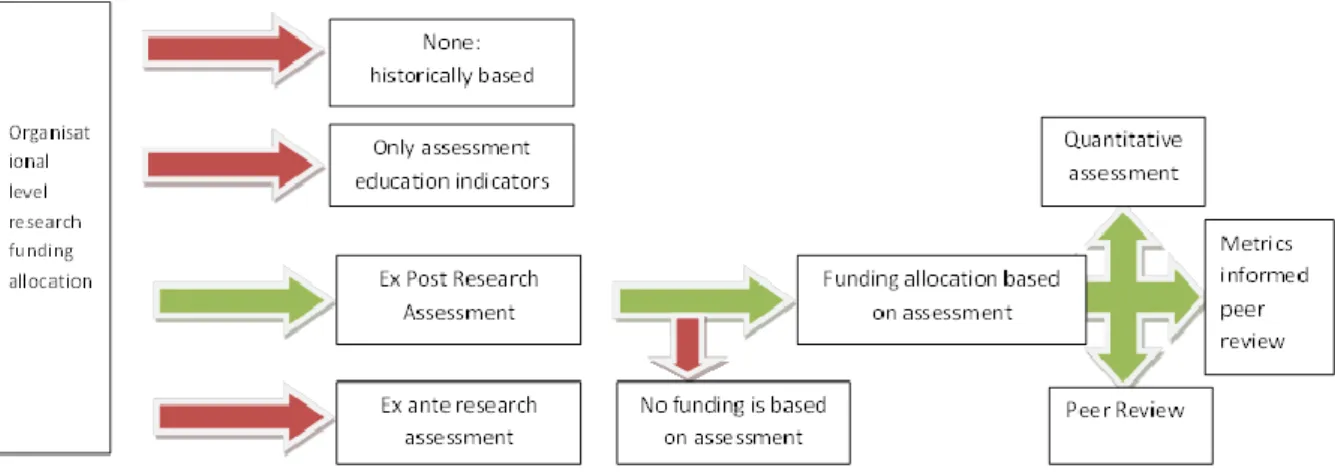
In this report, countries will be classified according to the type of Performance Based Funding System they have in place, distinguishing between:
1) countries who have no performance based elements in their university funding allocation system and countries which allocate funding solely on the basis of education related metrics or assessments (without research output considerations),
2) countries which based their funding allocation formula on quantitative metrics highlighting those who use different types of bibliometric approaches and
3) countries which allocate funding on the basis of peer review based assessment exercises. The latter category can be separated into metrics based peer review and “pure peer review”.
Formulae are generally used in the allocation of organizational funding and can be applied to the total amount of public funding transferred to the organizations or only to a part of it. An alternative approach is the signing of performance contracts between universities and ministries in order to agree ex ante on a set of targets that the universities need to achieve in order to be eligible for part of the organisational level funding. Considering its close link to RPBF, some discussion of such performance contracts will be provided in this report. Figure 1 below gives a graphical representation of this definition of performance based funding.
14
Figure 1. Research Performance-Based Funding Systems
This report includes an analysis of trend data of the research output in the systems concerned. Performance of a country on the basis of output and impact measures is influenced by other factors than the absolute public investments in publicly performed R&D such as the scientific human capital base, the stock of tacit scientific knowledge, the institutional set up of the research system and their pre-existing scientific research infrastructure. What is important in assessing the effect of the introduction of an RPBF on output and impact measures is to take into account the evolution of public R&D investments in publicly performed R&D in the period under study. A large increase in output (and impact) may also be partially due to an expansion of the system associated with a substantial funding increase over a sustained period, rather than being the effect of institutional changes such as the introduction of an RPBF. Likewise relative drops in output and impact or a failure to improve on these indicators may be related to sudden funding shocks or sustained underfunding of the public R&D system. An analysis of the impact of different funding systems is planned for a future paper. In order to assess the relative performance of EU Member States, we present the evolution in the number of publications and the share of (field weighted) 10% highly cited publications which is a measure of the extent to which research systems succeed in producing high impact scientific results. Considering differences in institutional set up and public R&D funding levels there are limits to the extent that meaningful comparisons can be made between North Western European Countries, Southern European and Central and Eastern European Member States. The institutional and organisational structure, including e.g. the funding system, was probably relatively similar in the EU13 countries in the early 1990s. Since then they have evolved in different directions and it may therefore no longer be possible to refer to a single type of EU13 funding model even if they do still share similar feature such as the important role of the Academies of Sciences (Radosevic & Lepori, 2009). Nonetheless comparisons between e.g. the EU 13 Member States may be meaningful to assess potential differences in output and impact which may be partially related to differences in funding models. Comparisons between some countries, such as Czech Republic, Poland, Hungary and Slovakia may be especially useful, considering similarities in their public R&D intensity and institutional structures. Likewise comparisons between North Western European Countries or between South European countries can be the most appropriate.
15
Sources:
This report is based on a comparative qualitative analysis of recent trends in and current use of performance based funding instruments in the EU Member States. An extensive knowledge of 35 national R&I systems is required which may be too much for an individual analyst to possess. This analysis is therefore based on two types of information. The first are the RIO Country Reports 2014/2015 which have been drafted by JRC J.6 and a network of national experts in national R&I systems. These reports have been reviewed by National Contact Points appointed by ERAC. In order to cross check and supplement these sources we have also built on collected national policy documents and the results of analyses and assessments published in the academic literature and further contacts with research policy experts in several of the countries under consideration. The resulting annexes and the classification in table 2 have been reviewed by the individual national experts. For the national level bibliometric data, use is made of a data collection that was carried out by ScienceMetrix for DG RTD (Campbell et al, 2013). For quantitative data on project vs organisational level funding use is made of data collected in the framework of the Public Funding of Research (PREF) project carried out by a consortium led by CNR CERIS on behalf of DG JRC of the European Commission. This project aims at providing a comprehensive analysis of public research funding with a focus on the allocation mechanisms adopted in different countries. This analysis is broadly consistent with EUROSTAT statistics on Global Budgetary Allocations for R&D (GBARD), but provides a more fine-grained disaggregation by mode of allocation, managing organizations and funding flows to performers. Definitions and categories correspond to those adopted in the 2015 edition of the Frascati Manual. For a more detailed description the reader is referred to the PREF handbook.
16
4. Public funding allocation
This section provides a synthetic analysis of the performance based funding systems for competitively allocated organisational funding which are adopted in the different European Member states. It is based on brief national case studies which are described in annex 1 where the reader can find more detailed information on the systems in place in each of EU member states.
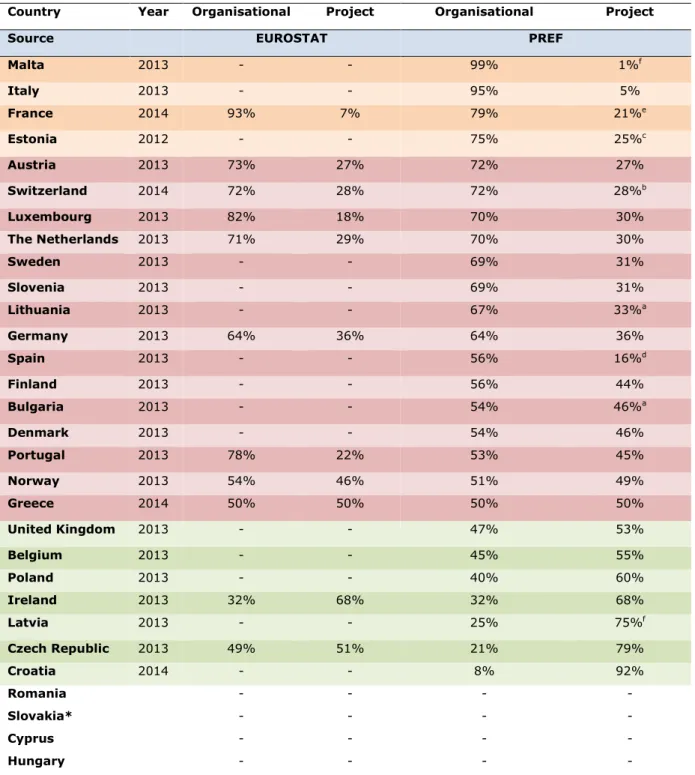
In order to gain an understanding of prevailing funding systems in the Member States, table one first provides an overview of the relative important of project versus organisational level funding. Project funding is by its nature competitive funding. However, it is based on ex ante evaluations of research proposals, rather than on ex post assessments of outcome. The table does not make a distinction between organisational block funding and performance based organisational level funding, but when countries implement Research Performance Based Funding Systems it implies that part of the organisational level funding is allocated in a competitive manner. The share of organisational level funding thus provides a certain indication of the potential for performance based funding in a system if such a change is to be budget neutral (ERAC Peer Review Spain, 2014).5
Table 1 is based on data collection through the PREF study. On the basis of the available data we can make a provisional distinction between a few different groups of Member States according to the relative importance of project versus organisational level funding. For the sake of comparison, available data from Eurostat are also presented. For most countries, the data only show a slight deviation with the PREF study. For a small set of countries (e.g. France, Portugal, Czech Republic), more significant discrepancies appear which need to be explored further in consultation with the PREF team, national authorities and/or Eurostat. A first group of countries is characterised by a high level of organisational funding. A second group of countries shows a greater balance between organisational level and project funding. The qualitative analysis of the evolution of funding mechanisms in the different member states presented in the next section will provide greater insight in the extent to which this is allocated competitively through RPBF. There is a third group of countries which is characterised by relatively high shares of project funding in comparison to block funding. It is relevant to know that some of the countries in this third group also make intensive use of performance based funding such as the UK (Cunningham 2015), thus increasing the share of "competitively allocated funding". For a few remaining countries quantitative data is not yet available. The PREF project will in the future also provide data on the share of competitively allocated organisational level funding of which RPBF is an important subset (others include e.g. centres of excellence and performance contracts) From the ordering of the table it emerges that it is not easy to make a direct link between the relative balance between project and organisational funding and the level of development of the respective system.
5 Academic stakeholder organisations argue that RPBF should, instead of being sliced from the core funding, should include additional funding (EUA, 2015). This approach is not always followed by the Member States.
17
Table 1. The share of project vs organisational level funding
Country Year Organisational Project Organisational Project
Source EUROSTAT PREF
Malta 2013 - - 99% 1%f Italy 2013 - - 95% 5% France 2014 93% 7% 79% 21%e Estonia 2012 - - 75% 25%c Austria 2013 73% 27% 72% 27% Switzerland 2014 72% 28% 72% 28%b Luxembourg 2013 82% 18% 70% 30% The Netherlands 2013 71% 29% 70% 30% Sweden 2013 - - 69% 31% Slovenia 2013 - - 69% 31% Lithuania 2013 - - 67% 33%a Germany 2013 64% 36% 64% 36% Spain 2013 - - 56% 16%d Finland 2013 - - 56% 44% Bulgaria 2013 - - 54% 46%a Denmark 2013 - - 54% 46% Portugal 2013 78% 22% 53% 45% Norway 2013 54% 46% 51% 49% Greece 2014 50% 50% 50% 50% United Kingdom 2013 - - 47% 53% Belgium 2013 - - 45% 55% Poland 2013 - - 40% 60% Ireland 2013 32% 68% 32% 68% Latvia 2013 - - 25% 75%f Czech Republic 2013 49% 51% 21% 79% Croatia 2014 - - 8% 92% Romania - - - - Slovakia* - - - - Cyprus - - - - Hungary - - - - Methodological notes
a) Deviation from GBARD still to be checked b) Year 2014- R&D questionnaire only in pair years c) Only 2012 available
d) Shares do not yet add up to 100% due to regional funding which can't be classified as project or institutional funding
e) Only 2014 available f) Excluding structural funds
Highlighted in orange: countries above 75% of organisational funding; Highlighted in pink: countries between 50% and 75% of organisational funding; Highlighted in green: countries below 50% of organisational funding; No highlight: NA. Source: ongoing PREF study.
18
4.1 Performance based funding models
As shown in table 2 many European countries have implemented some form of performance based funding. The exceptions are Bulgaria, Cyprus, Greece, Hungary, Ireland, Luxembourg, Latvia6, Malta, Romania, Slovenia and Spain7 (Alexander, 2015; Tsipouri, 2015; Warrington, 2015). In the cases of Malta, Cyprus and Luxembourg, this is probably a partial consequence of the relatively small size of the system (Malta and Luxembourg only count one single university). In other instances, i.e. Greece, the absence of performance based funding may be due to resistance from the academic community which has protested heavily against suggestions to introduce performance based evaluation and allocation models (Tsipouri, 2015). This group also includes countries that allocate funding on the basis of education/training based metrics (student inputs, number of graduates etc) and related metrics only.8 For example most US states9 allocate their organisational funding for universities on the basis of a formula which takes into account the output of the university in terms of the number of graduated students alongside other indicators. Most of these states do not consider research output performance based metrics. We refer to this category in this report to explain the differences in funding systems and to highlight the fact that many other approaches also include education based metrics in complement to the research output based metrics in their research funding allocation systems. Another traditional metric is to base funding allocation decisions on the number of research staff in the organisation. This criterion is not performance based and while most countries base part of their funding allocation on the basis of this indicator it is considered part of non-competitively allocated block funding rather than performance based funding – since some countries include this criterion in more complex funding models it will nonetheless be mentioned in some of the sections below.
Countries like Spain, Slovenia, Hungary and Germany have pursued some of the goals of performance based funding, such as international excellence, by awarding centres or units of excellence to universities based on the assessment of proposals (CHEPS Germany 2006 in Hicks, 2012; MINECO, 2015; Dory, 2015; Fernandez Zubieta, 2015). Since these initiatives are based on voluntary ex ante selections of proposals they are not considered as performance based funding systems in this report. Many of the countries that did implement Performance Based Funding have also engaged in the set up of centres of excellence type funding programmes, including Norway with its Centres of Excellence, Poland (KNOW), Finland (Centres of Excellence in Research), France
6 Latvia has recently introduced a performance based funding system which is described in more detail in the annex. It is not yet reflected in the overview table.
7 Institutional funding of universities in Spain is a regional competence. There is at least one region (Catalonia) which has introduced some form of Performance Based Funding system.
8 It is relevant to note that some countries do not distinguish between R&D budgets of higher education organisations and the education budgets in the calculation of HERD as prescribed by the Frascati manual. In Poland, neither scholarships for doctoral students nor the salaries of academics working in HEI or PROs are considered in HERD/GOVERD. The R&D expenditures in these sectors therefore appears relatively small in comparison to other countries where this is done. This may also affect the relative share of project and institutional funding though the exact nature of this effect is unclear as the inclusion of doctoral grants would increase project funding whereas the inclusion of salary expenditures would increase institutional funding. Salaries and scholarship are paid from a different budget line which is not so strictly linked to performance as the part of the research budget linked to RPBF.
9 see annex 1 for brief reports of the EU Member States as well as Switzerland, Norway, Australia, Mexico and the US
19
(IDEX), Denmark, Sweden10 and Austria (Institute of Science and Technology) (Jacob,
2015; Klincewicz, 2015; Bitard, 2015; Cuntz, 2015; Saarnivaara, 2015).
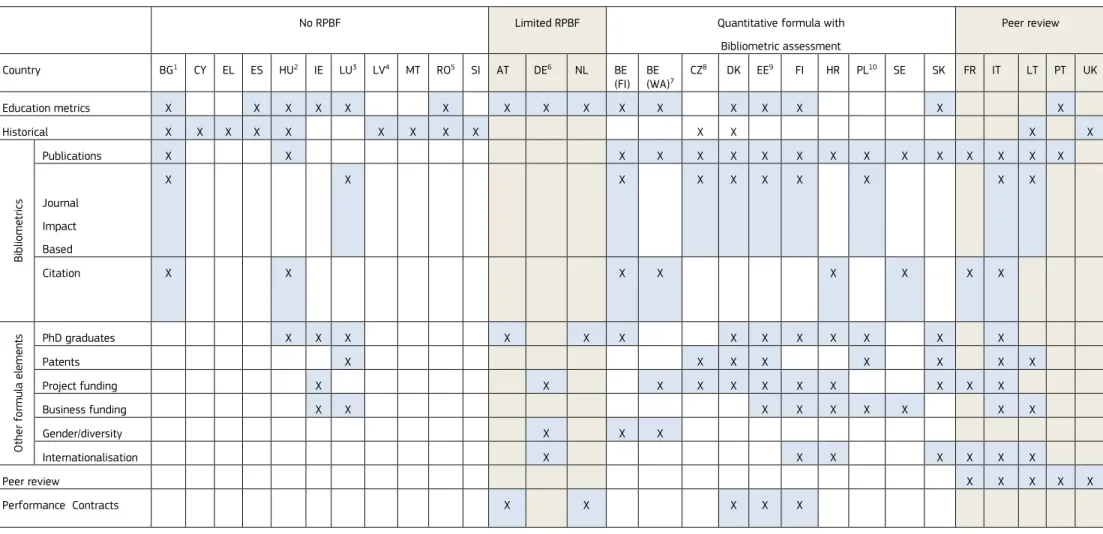
Table 2 provides a classification of the organisational level funding allocation systems in place in the Member States according to the model described in the methodological section. A distinction is made between three different systems: those that are considered to have no research performance based system in place, those who have implemented a limited RPBF and those which are considered to have implemented a performance based system. In the latter case a distinction is made between those systems which rely primarily on the peer review of research units/organisations and those systems in which the assessment of research performance is primarily based on quantitative assessments of research output. As indicated previously the funding formulae used to allocate organisational level research funding, in addition to assessment of research also tend to take into account a number of other variables, including for example education or diversity related metrics. An overview of the main criteria on which such assessments are based is provided below.
The first criteria which many systems use to allocated not only education but also research funding are "education metrics".11 These metrics can involve both input (students enrolled) and output (BSc and MSc graduates). A related metric refer to PhD degrees awarded. The latter is considered a research output measure as a PhD thesis is considered a substantive research output. "Historical" refers to the practice in many systems to base the allocation of organisational level funding (partially) on the funding allocation distribution that was used in preceding years.
Bibliometric indicators refer to indicators for scientific publications in academic journals and monographs from leading publishers. In this table, bibliometric indicators are separated into three categories. The first refers to counts of publications. Often the mere counting of publications contained in bibliometric databases is considered insufficient and a measure of scientific impact is taken into account as well. The first approach to tackle this is to weight the publications on the basis of the impact of the journal in which it was published. This may be based on various forms of the Journal Impact Factor. Another approach is to construct custom made lists in which journals are classified by national expert commissions according to quality profiles. Apart from journal weighting, another indicator for the impact of publications is to engage in publication level citation analysis – which, as in the case of journal impact measures, tends to involve field normalisation.
Apart from the number of PhDs awarded, other (input or output) indicators frequently used in research performance assessments are classified here as "other formula elements". They include the number of patents, which may be restricted to e.g. PCT and EPO patents or may also involve patent filings at national patent offices. One indicator which could be considered an input rather than an output metric is the amount of funding which is generated by participation in national or international research projects. External funding generated by contract research for companies or public administrations, income from Knowledge Transfer activities and spin off companies generated is another variable that is considered in many systems. Two other indicators included in table 2 are diversity measures, which refer e.g. to the gender composition of staff and internationalisation indicators e.g. referring to the degree of international experience of staff, the attraction of foreign PhD researchers and/or the engagement in
10 See e.g. http://www.nifu.no/files/2012/11/NIFUarbeidsnotat2012-4.pdf
11 Most systems use education metrics in the allocation of higher education funding to universities. What is referred to in table 2B-2E refers to systems which (partially) use education metrics to also allocate research funding.
20
other international activities. Since participation in international projects was already considered in the preceding category it is not counted here.
In the systems which are considered to be based on a peer review assessment variables such as the impact of the research output, number of PhDs, patenting behaviour etc can also be considered. Since the dominant assessment mode is qualitative we group them together under this heading however.
Several systems are experimenting with including assessments of societal impact in their funding allocation formulae (e.g. UK, France and Australia). This is not captured in the table but considering that it is one of the major novel developments in performance based funding we do discuss it in the text and the accompanying annexes.
Apart from the indicator based or peer review assessments, some information is also provided on the systems which engage in the signing of performance contracts. The latter can involve a number of issues on which research performers agree with their principal (ministry), e.g. research or education reform to attain critical mass or quality thresholds, objectives set in the strategic plan, the extent to which university plans contribute to other policy objectives etc. Not included in the table are a number of criteria which are used in only some systems, including e.g. community outreach and the quality of research staff.
The (limited or large) number of indicators considered should not necessarily be taken as an indicator of the level of sophistication of the system. For example the UK REF system is one of the oldest and most developed RPBF systems, however in the table it is not considered to include many indicators in its funding formula.
21
No RPBF Limited RPBF Quantitative formula with
Bibliometric assessment Peer review Country BG1 CY EL ES HU2 IE LU3 LV4 MT RO5 SI AT DE6 NL BE (FI) BE (WA)7 CZ 8 DK EE9 FI HR PL10 SE SK FR IT LT PT UK Education metrics X X X X X X X X X X X X X X X X Historical X X X X X X X X X X X X X Biblio m et ric s Publications X X X X X X X X X X X X X X X X Journal Impact Based X X X X X X X X X X Citation X X X X X X X X O th er f orm ula el em en ts PhD graduates X X X X X X X X X X X X X Patents X X X X X X X X Project funding X X X X X X X X X X X Business funding X X X X X X X X X Gender/diversity X X X Internationalisation X X X X X X X Peer review X X X X X Performance Contracts X X X X X
22
1Bulgaria did have a RPBF system in its education law for several years, but this appears not to
have been implemented. In the new law however, a RPBF system has been introduced again (see Annex).
2Hungary The introduction of a RPBF system in Hungary is foreseen (see annex)
3 Luxembourg has only a single university, it was not considered to have a RPBF system to
allocate organisational level funding between universities. However its performance contract has many of the trappings of RPBF systems.
4 Latvia has used assessments to change the allocation of its funding of PROs. For universities it
has recently implemented a RPBF system, this is not yet reflected in this overview table but annex 1 provides more detail.
5 In Romania some steps have been taken to design an institutional funding system linked to performance assessment, in practice this is not yet implemented. (see also country annex). 6 In Germany the organisational level funding of universities is mainly provided at the regional (Laender) level. These have increasingly included quantitative assessment criteria and/or performance contracts, but the nature of their funding allocation procedures differ from state to state (Van Daalen, 2014)
7 Belgium (Wallonia): for the Special Research Funds, the education-metrics based system will
still be partially linked to the historical distribution among universities during a transition period (2014-2016). For the concerted research actions, there is also a transition period with performance criteria being gradually introduced into the funding allocation formula from 2016 onwards.
8 In 2009, Czech Republic introduced a research performance-based methodology to allocate research funding. This methodology, based exclusively on quantitative indicators, was modified for the period 2013-2015 and introduced some peer review assessment elements.. After 2016, bibliometric informed peer review should become the main mode of assessment (Shrolec &Szkuta, forthcoming)
9Estonia does have performance contracts for universities for which universities are assessed on a
number of education metrics. This does not concern the allocation of research funding.
10Poland used to base its funding formula partially on historical considerations. Since 2015
however, this variable has been removed (Klincewicz, forthcoming). See annex for more detail. In addition to the countries without any RPBF system, three categories have been identified. The first one is composed of Austria, Germany and the Netherlands. Hicks (2012) did not include the Netherlands and Austria among the countries which have implemented RPBF systems because they do not base their funding allocations on assessments of research outputs. However since successfully defended PhD theses could be considered a research output, this report includes the countries that include this indicator as an element in their funding allocation systems as the first category of research performance based systems. As will be highlighted in the results and discussion section, the incentives which these systems generate are expected to be different from the systems that include publication output assessments.
The second RPBF category bases organisational funding allocation mechanisms on assessments of research outputs as assessed through quantitative bibliometrics. This group comprises of Belgium, Czech Republic, Denmark, Estonia, Finland, Croatia, Poland, Sweden and Slovakia. The third group, consisting of the France, Italy, Lithuania, Portugal and UK takes a different approach. These countries have opted for a funding allocation system which is based on peer assessment of universities and/or university groups: in most cases these peer review assessment are heavily based on bibliometrics and other metrics and thus approach the second category in nature. Czech Republic had introduced in 2009 a research assessment system exclusively based on quantitative bibliometrics. This system is currently evolving towards a bibliometric informed peer review that should be fully implemented after 2016 (Srholec & Szkuta, forthcoming). There are also exceptions such as the UK in which bibliometrics play a lesser role. There are strong variations in the nature of the performance based funding systems between these countries: especially the United Kingdom stands out as a country with a long tradition of research performance based funding allocation on the basis of an elaborate
23
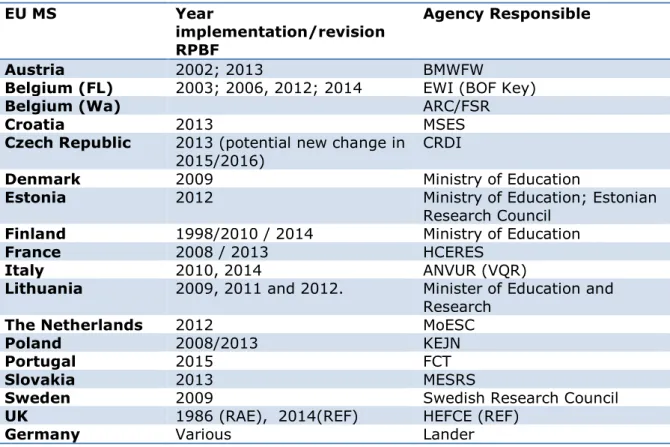
peer review system. The nature of the funding formulae and the criteria used differ considerably between these countries. Governments are still changing and fine-tuning their approaches to formula based funding as will be described in the analysis that follows. Table 3 provides an overview of the timing at which RPBF systems were implemented and the agencies responsible (adapted from Hicks, 2012).
Table 3Overview of Performance Based Funding Systems in several EU member states
EU MS Year
implementation/revision RPBF
Agency Responsible
Austria 2002; 2013 BMWFW
Belgium (FL) 2003; 2006, 2012; 2014 EWI (BOF Key)
Belgium (Wa) ARC/FSR
Croatia 2013 MSES
Czech Republic 2013 (potential new change in 2015/2016)
CRDI
Denmark 2009 Ministry of Education
Estonia 2012 Ministry of Education; Estonian
Research Council
Finland 1998/2010 / 2014 Ministry of Education
France 2008 / 2013 HCERES
Italy 2010, 2014 ANVUR (VQR)
Lithuania 2009, 2011 and 2012. Minister of Education and Research
The Netherlands 2012 MoESC
Poland 2008/2013 KEJN
Portugal 2015 FCT
Slovakia 2013 MESRS
Sweden 2009 Swedish Research Council
UK 1986 (RAE), 2014(REF) HEFCE (REF)
Germany Various Lander
4.1.1 Funding allocation formula based on quantitative indicators
4.1.1.1 Education and PhD awards based formulaThe Netherlands bases the allocation of part of its organisational funding to universities on a set of education and research related indicators. The education part mainly revolves around student and graduation numbers. The research part however also includes a component on PhD defences. A remaining substantial share of the research part is allocated on the basis of historical/political considerations (Janssen and Den Hertog, 2015). Austria also takes into account a number of education and research related metrics. As in the case of the Netherlands, publication based output assessments/indicators are not included in the funding allocation model. However, as in the case of some other systems, input based metrics such as the volume of project funding are included in the formulae (Cuntz, 2015). In Germany, in addition to the Excellenz Initiativ described earlier, many of the states (Länder) have implemented a form of performance based funding on the basis of both teaching and research performance. The weighting differs by type of university: for the universities of applied science (hochschule) teaching indicators carry a greater weight than for research universities. The indicators used differ by state, with all Länder using measures of third party funding and number of completed doctorates, and individual Länder incorporating further indicators as deemed appropriate. At least in 2010, none of the Länder studied included assessments of publication output (Gläser et al, 2002; OECD, 2010; Van Dalen et al, 2014 ). While in contrast to Hicks (2012) we include the Netherlands, Austria and Germany as performance based funding systems it is clear that they are border-line cases distinct from the formula based allocation models which are based on a (bibliometric or peer review based) assessment of publication output. The next
24
paragraphs will mainly discuss the use of Performance Based Funding allocation which is (partially) based on assessments of the research output.
Bulgaria states in legal documents that it considers the R&D output in the formula based allocation of its university funding (see annex 1). However, some analysts (Todorova, 2015) argue that in practice Bulgaria does not have a performance based system as the relative funding levels of its universities have remained (completely) stable in the past years (see annex 1). Recently, analysts and international organisations argued that a performance based funding system (or alternative approaches to increase competitively allocated funding) needs to be implemented in Bulgaria to improve the quality and relevance of its research output (Todoreva, 2015; Worldbank, 2013; Soete et al, 2015). Latvia has used some performance based elements in the restructuring of its system of Public Research Organisations. For universities, however, no RPBF system is in place, though it is being considered for the near future (see annex 1). Bulgaria and Latvia are therefore grouped in table 2 among the countries which at present have not yet implemented a Research Performance Based System.
4.1.1.2 RPBF based on Journal based impact assessments
A number of countries (e.g. BE, CZ, DK, EE, FI, HR, PL, SE, SK), have introduced bibliometric based formulae. The simplest approach used in these countries consists of counting publications in international journals as was done in some assessment exercises in the past. However, this practice was shown to encourage publication in lower impact journals to boost output (Butler, 2003).
In the Norwegian system (see annex 1) (Sivertsen, 2009; Fosse Hansen 2009) journals are therefore ranked to weight publications of higher impact/quality. The Danish system drew inspiration from the Norwegian system (Fosse Hansen, 2009). It is journal based: publications are counted in around 20,000 peer reviewed journals and publishing houses. The journals and publishers have been selected by sixty eight panels of researchers. The journals and book publishers are divided into two groups, where publications in the top 20% receive a higher weight than publications in the other outlets (Fosse Hansen, 2011; Grimpe, 2015; DASTI, 2009, 2014). Australia came back from its own approach of using ranked journal lists in 2012 (see annex 1). Poland has a RPBF tradition that goes back into the 1990s. It underwent an evaluation of its RPBF system in 2008 and revised the evaluation process for its 2013 evaluation, for which it uses the journal impact factor (Klincewicz, 2015). Here the KEJN conducts detailed assessments on the basis of the following criteria: counts of publications taking into account impact factors of specific academic journals, patents, revenues from industry co-operation and external R&D funding normalized by numbers of R&D employees of an organization, scientific awards of researchers, patents, and financial results of commercialization of research results. In 2013, the evaluation criteria were substantially modified to further promote organizations conducting world-class research. Journal impact factor based assessments are also used in the Czech Republic, though the government has implemented measures to attempt to address the problems in assessing social science and humanity research bibliometrically (Malek et al., 2014). In Finland around 90% of organisational level university funding is allocated on the basis of completed qualifications and credits as well as scientific publications and success in attaining competitive project funding (Saarnivaara, 2015)..12
12 Spain is a special case as at the national level it uses individual level assessment on the basis of self-reported data, to give researchers a (modest) variable bonus to their fixed salaries (Osuna et al, 2011; Cruz-Castro and Sanz, 2007). This system is not used to allocate competitive organisational level funding and we therefore did not include Spain as one of the RPBF systems. However, higher education funding in Spain is a regional level competence and it is possible that some regions have implemented RPBF
25
In Slovakia a considerable share of the organisational level research funding allocation is based on evaluation carried out by the Accreditation commission and the share of a HEI in the national research output (see annex). This Commission approved new, more stringent, rules on 15 April 2013. The new rules put more emphasis on (simple) bibliometric assessments of research excellence in terms of scientific papers published in journals listed in international bibliometric databases (WOS, SCOPUS), research monographs published with high-quality publishers and international patents. The last evaluation took place in 2009-2010 (Balaz, 2015). In the Czech Republic initial reform plans were to allocate almost the full amount of organisational level funding using performance-based formulae. However, a medium term modification of the evaluation methodology, called Metodika 2013, has been introduced for the period 2013-2015, (CRDI, 2013). On the base of this methodology organisational level funding is going to be allocated until 2016 (Srholec, 2015). The first part of this assessment is based on an assessment of research output of publications in indexed journals.13 A second part of the evaluation is based on high impact results/inputs, including ERC grants. Each organisation selects a number of high quality results in each scientific field under consideration. These results are peer reviewed and compared for every organisation. A third part of the evaluation concerns non-scientific outputs of R&D, including patents and plant varieties. The remaining points in this part of the assessment exercise are allocated on the basis of an assessment of income generated through applied projects and collaboration with industry. The whole assessment relies on panels of experts to make the assessment for each field. The funding allocation decisions are based for 75% of the assessment of the scientific output, for 10% on the evaluation of high impact research outputs and for 15% on the assessment of applied research (Malek, 2014). According to Good et al (2015) the result is a system that is primarily quantitative in nature.
4.1.1.3 RPBF based on citation based impact assessments
Whereas the previous countries based their bibliometric assessment of counts of publications, potentially weighted on the basis of the quality of journals, Belgium and Sweden have explicitly introduced a combination of output and publication level citation based impact metrics to take into account both the volume as well as the actual impact of the research output. In Belgium, (Flanders) the share of the competitively allocated organisational research funding (the BOF- Key) which is based on bibliometric assessments of the research output has increased from 10% when it was first introduced in 2003 (DeBackere and Glanzel, 2004) to 36% in 2008. In the latest revision in 2012, the weight of the social sciences and humanities have increased on the basis of a specially developed publication database made for this purpose (DeBackere and Veugelers 2015). In addition to citation based impact assessments Flanders also considers a journal based indicators in its formulae. Sweden has implemented a sophisticated field weighted impact measurement system to assess university output (Hicks , 2012; Jacob, 2015; Sivertsen, 2015).
As discussed in more detail in the country based Annex 1 the formulae used in bibliometrics based funding allocation tend to take into account many other factors than publication and citation metrics alone. These can include employment of graduates; external research funding; faculty characteristics and qualifications; faculty size; student enrolment, graduate students graduated; PhD defences, impact of research; type funding systems: a recent report from the European University Association indicates that Catalonia has used performance based funding to allocate organisational level funding to universities but it is unclear whether this is research or education based. 13 Peer review is used more in assessing the publication output in the social sciences and humanities. In the natural science fields the assessments are mainly based on journal (impact factor) based bibliometrics