AUTHORS’ INFORMATION Name
Lucas Thulani Khoza
Company / institution / affiliation and address University of Johannesburg
PO Box 524 Auckland Park
2006 South Africa
E-mail address & work telephone [email protected] & (011) 559 1581
Cell phone number 076 745 3646
EXPLORING KNOWLEDGE SHARING AND KNOWLEDGE LEAKAGE IN SOFTWARE DEVELOPMENT ORGANISATIONS
ABSTRACT
Knowledge leakage is the loss of knowledge. Staff turnover causes many knowledge leakages. Internal and external knowledge leakage in software development organisations lowers the organisations’ competitive advantage. Knowledge sharing is a process of innovation and value creation that leads to competitive advantage. Innovation is a result of effective knowledge sharing process. Knowledge can be shared internally and externally, however, not all knowledge can be shared externally due to some confidentiality. Some organisations do not promote knowledge sharing in order to avoid knowledge leakage. This study broadens our knowledge on understanding knowledge leakages and knowledge sharing in software development organisations. A structured questionnaire was used to collect data from IT professionals to explore knowledge sharing and knowledge leakages. A response rate of 52% were received. The results indicate that people always move from one organisation to the other resulting in an increased knowledge leakage as people will always share whatever they have learnt in the new organisation. Three key critical findings that cause staff turnover are management and citizenship, organisational culture and employee morale.
Keywords: knowledge sharing, knowledge leakage, staff turnover, software development organisations.
INTRODUCTION
Knowledge leakage is when employees accidental or purposeful share internal organisation’s critical knowledge to external organisations (Ritala, Olander, Michailova & Husted, 2015: 22; Frishammar, Ericsson & Patel, 2015:75). Knowledge leakage in software development organisations causes some predicaments more especially for organisations that are competing with each other (Frishammar et al., 2015:76), and lowers their competitive advantage (Koriat & Gelbard, 2014:578; Ritala et al., 2015:23). Employees who move from one organisation to the other or staff turnover has a negative impact to knowledge leakage as employees tend to share whatever they have learnt or the skills they have acquired in the new organisation (Ritala et al., 2015:23). Hence, staff turnover leads to “undesirable knowledge leakage”. Some organisations are limited in their innovation as they don’t share their knowledge externally due to unintentional knowledge leakage (Ritala et al., 2015:22). In order for software development organisations to be innovative in their performance, external knowledge sharing is important. There are times when employees accidentally or purposefully leak knowledge obtained from one organisation to another organisation after resigning and this process influences the innovation performance negatively in that organisation that lost knowledge (Ritala et al., 2015:29; Frishammar et al., 2015:76). Collaborations among organisations doing similar business is important in the knowledge sharing. It facilitates the sharing of resources and aids benefits of knowledge integration and specialisation. This raises a question of competitive advantage, how do organisations compete with other organisations that has all the skills and knowledge in running similar business? (Ritala et al., 2015:22, 23; Frishammar et al., 2015:85). There is a risk involved in sharing organisational critical knowledge, “the undesired knowledge sharing”, and this can be a major factor hindering external knowledge sharing. Major challenges exist because of cross business knowledge sharing (Ritala et al., 2015:23, 28; Frishammar et al., 2015:76).
PROBLEM INVESTIGATED
For organisations to survive today’s competitive edge of learning processes, knowledge sharing is vital, and therefore, projects should concentrate on strategies that enable knowledge sharing and creation (Pemsel, Wiewiora, Müller, Aubry & Brown, 2014:1411; Chatterjee, 2014). In the process of knowledge sharing, knowledge leakages, “the undesired knowledge sharing”, occurs and this affects the organisation in the market place (Ritala et al., 2015:23; Frishammar et al., 2015:86). There are a number of publications focusing on knowledge sharing in software
development organisations, however, few studies focus on knowledge leakages in the process of knowledge sharing during staff turnover. This research study focuses mainly on knowledge sharing and employee motivation, knowledge sharing and organisational learning and lastly staff turnover and knowledge leakages.
RESEARCH OBJECTIVES AND QUESTIONS
The main objective of this research study is to investigate how knowledge sharing leads to knowledge leakage during staff turnover in organisations and the impact of knowledge leakage in organisation that accidentally lost their knowledge. In order to unpack the research objective, three research questions were asked which are:
What are the factors that contribute to staff turnover?
What are the factors contributing to staff retention?
How to minimise knowledge leakages during staff turnover?
LITERATURE REVIEW
This section consist of three subsections. Subsection 1 addresses factors contributing to staff turnover, subsection 2 focuses on factors contributing to staff retention and subsection 3 focuses on knowledge leakages during staff turnover and how to minimise them.
Factors contributing to staff turnover
Employees need to be motivated and encouraged to share knowledge (Koriat & Gelbard, 2014:586; Ritala et al., 2015:24; Lee, Shiue & Chen, 2016:465; Khoza & Pretorius, 2017:3). It has been revealed that any discernments that could help in understanding the factors motivating knowledge sharing in software development teams are likely to improve software project success and the organisation’s performance in general (Koriat & Gelbard, 2014:578). Knowledge belongs to employees, and thus knowledge sharing in virtual communities can be hindered by lack of trust (Chang & Chuang, 2011:10; Koriat & Gelbard, 2014:588). With no rewards to compensate employees, the objective to share knowledge will automatically degenerate (Chang & Chuang, 2011:11; Khoza & Pretorius, 2017:7). Knowledge contributors benefit from showing others that they possess valuable expertise, their self-image is improved, and they receive recognition as experts (Ritala et al., 2015:25). As a result, these personal benefits are the key motivational factors for individuals to share knowledge (Chang & Chuang,
2011:11). Organisational learning and knowledge sharing make the organisation to face the market dynamics and the changes in technology as current knowledge is acquired and shared among employees (Chatterjee, 2014; Almeida & Soares, 2014:770). Top management support with proper employee incentive mechanisms facilitate knowledge sharing and motivate employees to share their knowledge, which in turn may contribute to project success and thus putting an organisation at a good competitive advantage (Lee, Shiue & Chen, 2016:466; Khoza & Pretorius, 2017:3). The effective knowledge sharing among project team members make the organisation to be at the competitive advantage. Literature reveals that there is still a challenge around the willingness of employees to share their knowledge (Ritala et al., 2015:25; Khoza & Pretorius, 2017:5). Hence, organisations' employees often feel unwilling to share their knowledge because they fear that they might lose their jobs or that their status in the organisation might be jeopardised because of their knowledge sharing (Khoza & Pretorius, 2017:2). Many challenges such as job security, lack of motivation, work overload, lack of communication, psychological factors, and resistance to change are key factors hindering people from sharing knowledge (Khoza & Pretorius, 2017:2-3). Past research has found that employees’ sense of wellbeing is strongly linked with monetary value (Lin, Wu & Lu, 2012: 753-754; Hau, Kim, Lee & Kim, 2013:357; Llopis & Foss, 2016:139). Moreover, it is important to share the knowledge that exists among the members of different organisations because it is through such knowledge sharing that organisations can increase their profile in gaining market opportunities, enhancing performance and competing in an uncertain environment (Chumg, Seaton, Cooke & Ding, 2016:432). Some factors causing employees want to leave companies are employee attitude, organisational culture, job performance, industrial relations, work environment, employee morale, personnel management, industrial psychology, work ethic, management, and citizenship (Koriat & Gelbard, 2014:580; Khoza & Pretorius, 2017:3-4).
Factors contributing to staff retention
Knowledge leakage refers to the undesirable, unwanted, loss of knowledge within the boundaries of an organisation causing harm to that organisation as it loses its position of competitive advantage (Frishammar et al., 2015:75; Ritala et al., 2015:22). As IT professionals possess different skills and knowledge that can enhance the success of software projects, it is therefore crucial to motivate the project teams to share their knowledge among each other (Koriat & Gelbard, 2014:577). If project team members are not motivated to share what they know, the organisation might be affected during staff turnover. Staff turnover may cause
project delays and competitive loss due to new staff that comes in and require training (Durst & Ferenhof, 2014). Internal full time employees are employed by organisations and paid internally. Agents sometimes pay contractors and a high risk of knowledge leakages occurs with contractors as they come to do the work they have been hired to do and then they leave when the contract ends and they tend to share the knowledge they have gained with other organisations. Even though contractors pose high knowledge leakages as they share the knowledge gained in other organisations, they can still bring some advantages like flexibility employment strategies and support organisational performance (Koriat & Gelbard, 2014:577-578). Efforts are needed to hire skilled employees and this is the reason some employees are rehired because of their skills and expertise (Pemsel et al., 2014:1414).
The question maybe would be what makes employees want to stay in one organisation? Employee retention is important. Literature on knowledge sharing reveals that though knowledge belongs to the organisation, it remains in the minds of employees if not documented. This is the same even for organisations that store their knowledge within their databases; employees will always go with what they know (Ritala et al., 2015:25). There are factors that make employees want to stay in one organisation, these include being paid well, mentored, challenged, promoted, involved, appreciated, valued, being on a mission, empowered, and trusted (Kovach, 1987; Harrell, 2015). External knowledge sharing might be subject to high risks and high benefits depending on what kind of knowledge is being shared and who shares it for what purpose. Some benefits of external knowledge sharing is to explore the value it can bring to the organisation and the potential markets where the knowledge would be useful. Some organisations desist from external knowledge because of potential risks that are involved and they cannot see the potential and the benefits of external knowledge sharing (Ritala et al., 2015:28). Once knowledge is shared externally with partners, the organisation that shared the knowledge have no control on what happens with the knowledge shared. Management needs to adhere and have a policy to govern their employees on the kind of knowledge that can be shared and with whom to share such knowledge.
There are challenges in protecting existing knowledge with partners or other industries performing similar business during collaborations. Knowledge sharing, whether internally or externally, might improve the organisation performance irrespective of the risks involved (Frishammar et al., 2015:75; Khoza & Pretorius, 2016). Research has put more emphasis on documenting lessons learned in organisations to ensure that their IT systems become the centre of an organisation’s competitive advantage (Koriat & Gelbard, 2014:577). All projects and IT
infrastructure must drive the economy of the organisation for better competitive advantage. Software organisations must encourage teamwork where knowledge is shared among team members to utilise their capability to benefit the organisation (Carmeli, Gelbard & Goldriech 2011; Khoza & Pretorius, 2016; Khoza & Pretorius, 2017:3). Employees will always share their knowledge while performing their task and demonstrate commitment to the employer and the project they are working on, if there is a good relationship with managers and the organisation itself (Lee & Bruvold, 2003:982; Koriat & Gelbard, 2014:580).
Knowledge consist of experience acquired, values, relevant information, and insights acquired through experience. These all serve as a basis for evaluation and integration of new knowledge (Chang & Chuang, 2011:10; Koriat & Gelbard, 2014:570; Khoza & Pretorius, 2017:8). Organisations should store their knowledge in databases or documents for future use. Knowledge can either be explicit or tacit (Becerra-Fernandez & Sabherwal, 2014). Explicit knowledge is objective, and is communicated with words, figures or formulas. It is context free and easy to encode and store. Explicit knowledge is shared routinely among the employees of an organisation while working in teams or across teams. Tacit knowledge is employee owned. It is difficult to discern and express with words, figures or formulas. The sharing of tacit knowledge between employees is the challenge. In software development, knowledge sharing helps to minimise mistakes, reducing reliance on project team members who own critical knowledge, increasing integration of individual competencies and improving project success (Lee, Shiue & Chen, 2016:462). Organisational culture as supported by top executives or management determine project teams’ knowledge sharing. For the effective performance by software development organisations, the management of knowledge and the sharing thereof is important, hence, the foundation of knowledge management within organisations (Becerra-Fernandez & Sabherwal, 2014; Chumg et al, 2016:432).
Knowledge leakages during staff turnover and how to minimise them
Software development organisations pose multifaceted problems for information and knowledge management due to lack of standardisation of organisational structures, processes, practices, and technologies (Almeida & Soares, 2014:770). Hence, the standardisation of organisational processes and practices is crucial. The ineffectiveness of knowledge sharing over time, between project teams, is perhaps the critical issue that software development organisations are dealing with (Almeida & Soares, 2014:770). This strongly affects organisational learning (Chatterjee, 2014). Knowledge sharing supports organisational
learning. Hence, it is crucial for all project team members to engage in this process. In order to improve the performance of software development organisations, there is a need for organisations to keep on learning and ensure that all knowledge, experiences and new skills learned in projects are documented for future use (Chatterjee, 2014). Building relationships and trust among project team members helps in knowledge sharing and learning. Khoza and Pretorius (2017:3) argue that people do not share knowledge with people they do not have a good relationship with or they do not trust. Organisational culture and project team members’ culture sometimes are conflicting and this leads to difficulty in knowledge sharing and learning. Therefore, top management needs to build a culture that will enable learning and knowledge sharing. The project team need to be given enough time to document all lessons learnt after each project (Chatterjee, 2014; Almeida & Soares, 2014:776).
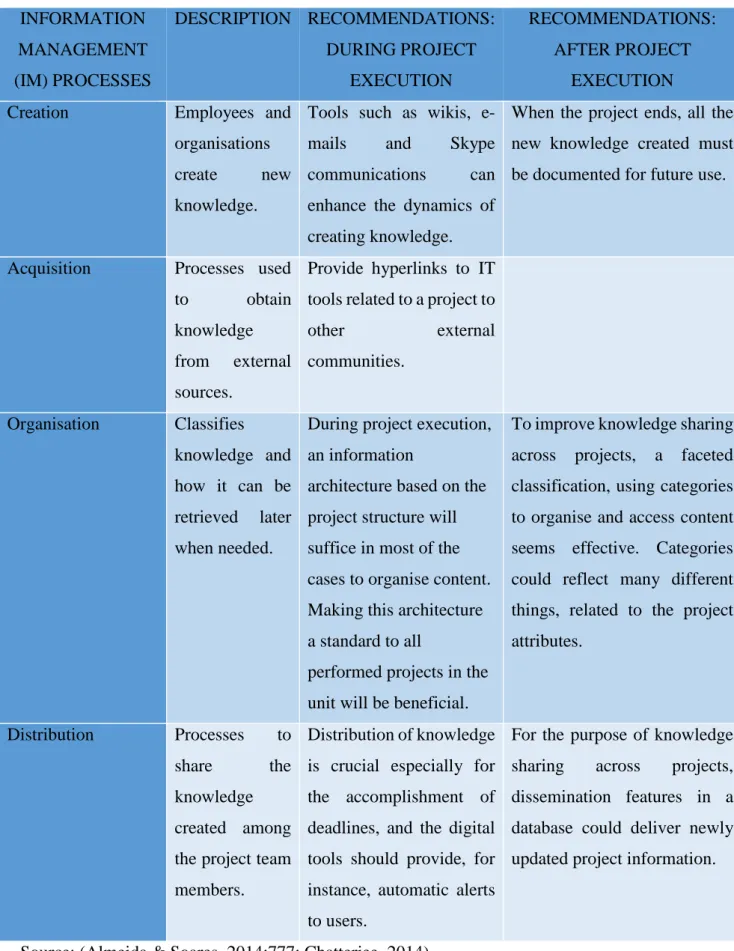
If knowledge remains within the brains of employees or project team members, the knowledge will result in knowledge leakage when employees resign and leave with the knowledge and it is a loss to the organisation (Almeida & Soares, 2014:770). Therefore, it is advised that at the end of each project, the knowledge created should then be transferred to the organisation as a whole for organisational learning (Chatterjee, 2014), and contributing in this way for a common knowledge-basis across projects. Khoza and Pretorius (2017:3) state that knowledge sharing mechanisms can be used to enable proper knowledge sharing across projects and this process helps in learning. IT platforms and their components help people to communicate their knowledge, supporting the organisation to focus on the dialog between individuals and not knowledge objects in a database, helping to transfer knowledge using for instance, brainstorming sessions and one-on-one conversations. Moreover, this builds the trust and relationships between project members (Almeida & Soares, 2014:776), and thus enables proper organisational learning (Chatterjee, 2014). Table 1 discusses the recommendations for organisational learning during and after project execution.
Table 1: Recommendations for organisational learning INFORMATION MANAGEMENT (IM) PROCESSES DESCRIPTION RECOMMENDATIONS: DURING PROJECT EXECUTION RECOMMENDATIONS: AFTER PROJECT EXECUTION Creation Employees and
organisations create new knowledge.
Tools such as wikis, e-mails and Skype communications can enhance the dynamics of creating knowledge.
When the project ends, all the new knowledge created must be documented for future use.
Acquisition Processes used to obtain knowledge from external sources.
Provide hyperlinks to IT tools related to a project to other external communities. Organisation Classifies knowledge and how it can be retrieved later when needed.
During project execution, an information
architecture based on the project structure will suffice in most of the cases to organise content. Making this architecture a standard to all
performed projects in the unit will be beneficial.
To improve knowledge sharing across projects, a faceted classification, using categories to organise and access content seems effective. Categories could reflect many different things, related to the project attributes.
Distribution Processes to share the knowledge created among the project team members.
Distribution of knowledge is crucial especially for the accomplishment of deadlines, and the digital tools should provide, for instance, automatic alerts to users.
For the purpose of knowledge sharing across projects, dissemination features in a database could deliver newly updated project information.
Documenting knowledge of lessons learnt help organisations to reuse the knowledge without contacting the person who originated the knowledge (Almeida & Soares, 2014:776). The employee’s expertise and knowledge in their brain does not benefit the organisation after they have resigned unless the knowledge was documented. The creation of new knowledge is vital. Organisations can use knowledge sharing mechanisms and tools to improve their performance and increase customer value (Lee, Shiue & Chen, 2016:464). Knowledge sharing can also be linked to learning and improvements in markets as well as innovation (Wang & Wang, 2012:8899; Chatterjee, 2014). Durst and Ferenhof (2014) propose programs that can be used in organisations to minimise knowledge leakage, these programs include: making use of global skills resource management, employee rotational programs, sharing case studies of lessons learned, using communities of practice, storytelling, training and educating programs, strengthening recruiting relationships, creating a knowledge manager position, hiring retirees, and using mentoring programs.
RESEARCH DESIGN AND METHODOLOGY
When considering that this research study focuses on exploring knowledge sharing and knowledge leakages in software development organisations, a quantitative approach was deemed fit for this research. A structured questionnaire consisting of four sections was used for this study. Section 1 looking for bibliographic information, section 2 addresses factors contributing to staff turnover, section 3 focuses on factors contributing to staff retention, and section 4 focuses on knowledge leakages during staff turnover and how to minimise them. Respondents were asked to respond by indicating level of agreement on a 5-point Likert scale ranging from ‘Strongly Agree’ to ‘Strongly Disagree’. Data used in this research study was collected from four software development organisations listed in the Johannesburg Stock Exchange (JSE) in South Africa. A total number of 360 questionnaires were sent to the four organisations and a total number of 186 (52%) questionnaires were returned. The population for this study consisted mainly of IT professionals within the selected software development organisations. Expert sampling was used as a sampling method since the interest was to get insights from professionals within the field. SPSS version 20 was then used to analyse the collected data. Lastly, tests for internal consistency was used to increase the reliability and the validity of the results.
RESULTS
Demographic profile of respondents
The demographic profile of respondents is only limited to gender, position, years of experience, and highest qualification. IT specialists who participated in this research study are business analysts, system testers, database administrators, project managers and programmers. Only people who had an experience of more than a year were eligible to participate. The majority of the respondents in software development organisations who participated in this research study were mostly male (66.67%), while 33.33% were female. Most respondents were systems testers (25.64%), 24.79% were programmers, 18.80% were business analysts, 17.09% were database administrators, 8.55% were project managers and 5.12% accounts for all others. It was noted that respondents with experience of 6-10 years amounted to (34.19%), followed by those with experience between 1–5 years (28.21%), thereafter those with experience between 11-20 (24.79%) years, and lastly those with 21 or more years of experience (12.82%). It is reflected that the majority of the respondents have degrees/diplomas (58.97%), followed by post graduate qualifications (34.19%). Few have only matriculation (5.98%). Others account for 0.85%.
Factors contributing to staff turnover
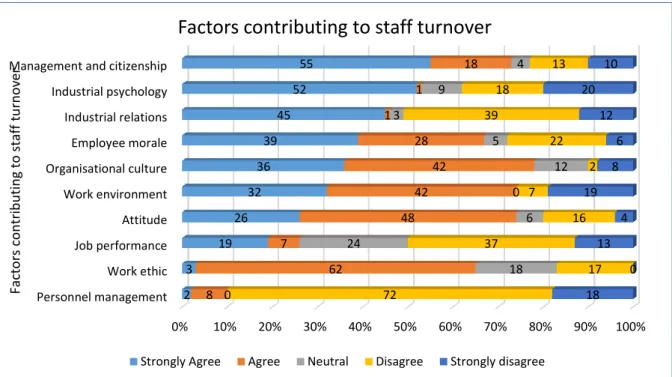
This research study discussed briefly that staff turnover results in knowledge leakages. Figure 1 shows the different factors contributing to staff turnover. Management and citizenship contribute 55% towards staff turnover. These results could mean that people are not leaving the organisations but their managers. Industrial psychology and industrial relations contributed 52% and 45% respectively. The results are confirmed by studies by Koriat and Gelbard (2014:580). Employee morale and organisational culture also contribute to staff turnover. It is important for organisations to create a good working environment with a good organisational culture to create employee morale. If all these factors contributing to staff turnover are not addressed, organisations will lose their knowledge and forfeit their positions in the market.
Figure 1: Factors contributing to staff turnover
Factors contributing to employee retention
Employees will always want stay in organisations when the employer meets their expectations. This paper revealed several factors that make employees want to stay. Figure 2 shows the results of what employees really expect from organisations. It is clear from the results that employees stay when they are paid well (82%), mentored (64%), valued (60%), promoted (59%), and trusted (53%). These top five factors if they can be considered and taken serious, they can attract good employees within the organisations and can also be a good way for staff retention. Kovach (1987) and Harrell (2015) argue that employees can do anything when they are paid well and it will be easy for them to even share their knowledge. Khoza and Pretorius (2017:8) further argue that people will always share their knowledge with people they trust, hence, trust is important.
0% 10% 20% 30% 40% 50% 60% 70% 80% 90% 100% Personnel management Work ethic Job performance Attitude Work environment Organisational culture Employee morale Industrial relations Industrial psychology Management and citizenship
2 3 19 26 32 36 39 45 52 55 8 62 7 48 42 42 28 1 1 18 0 18 24 6 0 12 5 3 9 4 72 17 37 16 7 2 22 39 18 13 18 0 13 4 19 8 6 12 20 10 Facto rs con trib u tin g to staff tu rn o ve r
Factors contributing to staff turnover
Figure 2: Factors making employees want to stay in organisations.
Table 2 indicates the latent construct (factors making employees want to stay in organisations) and the test for internal consistency. Factors are measured reliable when the Cronbach’s alpha values are 0.7 or higher. Cronbach’s alpha, with a cut-off point of 0.7, was used to test for internal consistency. These results shows that these factors are key drivers for employees to stay in organisations.
Table 2: Test for internal consistency
Factors making employee want to stay Cronbach’s alpha
Paid well 0.8915 Mentored 0.8917 Valued 0.8974 Promoted 0.8853 Trusted 0.8894 Involved 0.8881 Being on a mission 0.8874 Appreciated 0.8872 Challenged 0.9324 Empowered 0.9353 0 20 40 60 80 100 82 64 60 59 53 34 21 20 17 12 5 3 30 25 12 40 41 37 20 51 0 8 2 5 0 0 9 29 15 17 7 9 6 6 24 13 17 0 12 14 6 16 2 5 11 13 12 14 36 6 Per ce n tag e (% )
Factors making employees want to stay in
organisations
How much effort does it take to replace experienced staff members? It cost a company to drop from their competitive position in the market due to staff turnover and therefore, staff retention is crucial. Management should always try to meet the expectations of their employees. Figure 3 shows the relationships between retired/resigned staff, newly hired, rehired staff from 2007 to 2017. The results pose an interesting argument, the level of staff turnover is high and increased from 2016 to 2017. These results also shows that people who either resign or retire in 2009, 2010, 2012, 2014, 2016 and 2017 are more compared to newly hired employees. These results could be an indication of lacking the elements of staff retention in software development organisations. It is difficult and time consuming to hire new skilled and experienced employees than to retain employees. Another interesting argument to be noted is that some employees are rehired after they have resigned or retired. Khoza and Pretorius (2017:8) indicated that some employees do not share their knowledge due to job security as they always want to retain their positions, hence, the results shows that some people come back to organisations as consultants to make more money.
Figure 3: Relationship between employees resigning, hired, and rehired
Knowledge leakages during staff turnover and how to minimise them
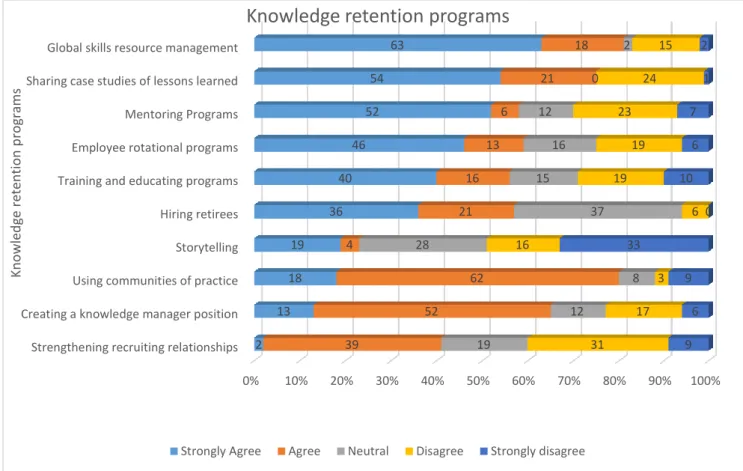
There are different ways to minimise knowledge leakages to ensure that knowledge remains within the organisation. The critical thing is to ensure that knowledge does not only reside in the brains of employees but within the organisations. Figure 4 shows different knowledge retention programs. Looking at the top five employee retention programs, global skills resource
6 8 12 8 7 13 8 8 9 7 16 7 8 10 5 7 8 9 4 12 6 6 2 0 0 1 2 0 0 0 0 0 0 0 5 10 15 20 2007 2008 2009 2010 2011 2012 2013 2014 2015 2016 2017 N o o f em p loy ee s
Relationship between employees resigning, hired, and
rehired
management (63%) where companies hire highly skilled consultants to work in critical projects and also share their expertise and knowledge to the internal full time employees, sharing case studies of lessons learned (54%), this process will help the entire team to learn from each team member on what they have learnt and the important thing is to documents all lessons learnt to benefit the organisation, mentoring programs (52%), employee rotational programs (46%) and training and education programs (40%) .
Figure 4: Knowledge retention programs
MANAGERIAL IMPLICATIONS AND FUTURE RESEARCH DIRECTIONS
Some employees resign from one organisation to the other organisation and cause knowledge leakages not because they hate the organisations they are working for but because managers do not motivate them to stay. Managers should create a good working environment to make all employees feel valued, welcomed and being part of the organisation. To hire a skilled employee is more difficult than to retain an existing skilled employee. In order to avoid staff turnover and knowledge leakages, managers should retain and meet the needs of their employees. Future study can focus on the refinement of the questionnaire and hypothesise the results to find the relationship between employee retention and staff turnover. Lastly, future studies can
0% 10% 20% 30% 40% 50% 60% 70% 80% 90% 100%
Strengthening recruiting relationships Creating a knowledge manager position Using communities of practice Storytelling Hiring retirees Training and educating programs Employee rotational programs Mentoring Programs Sharing case studies of lessons learned Global skills resource management
2 13 18 19 36 40 46 52 54 63 39 52 62 4 21 16 13 6 21 18 19 12 8 28 37 15 16 12 0 2 31 17 3 16 6 19 19 23 24 15 9 6 9 33 0 10 6 7 1 2 Kn o w le d ge re ten tio n p ro grams
Knowledge retention programs
investigate at the efforts of hiring skilled employees after staff turnover and how organisations can maintain their position in the market.
CONCLUSION
This study has revealed several factors on how knowledge leakages can jeopardise the position of the organisation in the market. It was discussed that knowledge leakages are results of staff turnover. Results revealed some retention methods for organisations to use in order to retain key employees, for example, employees stay when they are paid well, mentored, involved, valued and promoted. It was also noted that employees do not share knowledge because of job security, after retirement they are then rehired as consultants because of their skills as those skills were never documented in systems. Organisations need to implement global skills resource management, mentoring programs and documentation of lessons learned in order to retain knowledge. Good management strategies should be applied to create a good working environment and organisational culture to retain employees.
REFERENCES
Almeida, M.V. and Soares, A.L., 2014. Knowledge sharing in project-based organizations: Overcoming the informational limbo. International Journal of Information Management, 34(6), pp.770-779.
Becerra-Fernandez, I. and Sabherwal, R., 2014. Knowledge management: Systems and processes. Routledge.
Carmeli, A., Gelbard, R. and Goldriech, R., 2011. Linking perceived external prestige and collective identification to collaborative behaviors in R&D teams. Expert systems with applications, 38(7), pp.8199-8207.
Chumg, H.F., Seaton, J., Cooke, L. and Ding, W.Y., 2016. Factors affecting employees' knowledge-sharing behaviour in the virtual organisation from the perspectives of well-being and organisational behaviour. Computers in Human Behavior, 64, pp.432-448.
Chang, H.H. and Chuang, S.S., 2011. Social capital and individual motivations on knowledge sharing: Participant involvement as a moderator. Information & management, 48(1), pp.9-18.
Chatterjee, S., 2014. Managing constraints and removing obstacles to knowledge management.
Durst, S. and Ferenhof, H.A., 2014. Knowledge leakages and ways to reduce them in small and medium-sized enterprises (SMEs). Information, 5(3), pp.440-450.
Frishammar, J., Ericsson, K. and Patel, P.C., 2015. The dark side of knowledge transfer: Exploring knowledge leakage in joint R&D projects. Technovation, 41, pp.75-88.
Hau, Y.S., Kim, B., Lee, H. and Kim, Y.G., 2013. The effects of individual motivations and social capital on employees’ tacit and explicit knowledge sharing intentions. International Journal of Information Management, 33(2), pp.356-366.
Harrell, J, 2015. What makes employees to stay? [Online]. Available at: https://www.linkedin.com/pulse/employees-stay-when-jason-harrell/ (Accessed: 08 February 2018)
Kovach, K.A., 1987. What motivates employees? Workers and supervisors give different answers. Business Horizons, 30(5), pp.58-65.
Koriat, N. and Gelbard, R., 2014. Knowledge sharing motivation among IT personnel: Integrated model and implications of employment contracts. International Journal of Information Management, 34(5), pp.577-591.
Khoza, L.T. and Pretorius, A.B., 2017. Factors negatively influencing knowledge sharing in software development. South African Journal of Information Management, 19(1), pp.1-9. Khoza, L.T. and Pretorius, A.B., 2016, October. Knowledge sharing in software development projects. In International Conference on Intellectual Capital and Knowledge Management and Organisational Learning (p. 143). Academic Conferences International Limited.
Lee, J.C., Shiue, Y.C. and Chen, C.Y., 2016. Examining the impacts of organizational culture and top management support of knowledge sharing on the success of software process improvement. Computers in Human Behavior, 54, pp.462-474.
Lin, T.C., Wu, S. and Lu, C.T., 2012. Exploring the affect factors of knowledge sharing behavior: The relations model theory perspective. Expert Systems with Applications, 39(1), pp.751-764.
Llopis, O. and Foss, N.J., 2016. Understanding the climate–knowledge sharing relation: The moderating roles of intrinsic motivation and job autonomy. European Management Journal, 34(2), pp.135-144.
Pemsel, S., Wiewiora, A., Müller, R., Aubry, M. and Brown, K., 2014. A conceptualization of knowledge governance in project-based organizations. International Journal of Project Management, 32(8), pp.1411-1422.
Ritala, P., Olander, H., Michailova, S. and Husted, K., 2015. Knowledge sharing, knowledge leaking and relative innovation performance: An empirical study. Technovation, 35, pp.22-31. Wang, Z. and Wang, N., 2012. Knowledge sharing, innovation and firm performance. Expert systems with applications, 39(10), pp.8899-8908.