HOW DIGITAL EQUITY AND WORKPLACE LEARNING INFLUENCE ACCEPTANCE OF A KNOWLEDGE SHARING TECHNOLOGY IN THE
HIGHER EDUCATION WORKPLACE
BY JULIA A. HART
DISSERTATION
Submitted in partial fulfillment of the requirements
for the degree of Doctor of Education in Curriculum & Instruction in the Graduate College of the
University of Illinois at Urbana-Champaign, 2014
Urbana, Illinois
Doctoral Committee:
Professor Sarah McCarthey, Chair
Associate Professor Wen-Hao Huang, Director of Research Associate Professor Jessica Li
ABSTRACT
How organizations share knowledge is very important. Research has shown that organizations are implementing knowledge sharing technologies, but employees are not using them. This study used an extended Unified Theory of Acceptance and Use of Technology (UTAUT) model to explain to what extent and under what conditions employees accept and use a knowledge sharing technology, Microsoft SharePoint (SharePoint), in the higher education workplace. In an effort to understand the complexities of employee acceptance and use of technology in the higher education workplace two additional moderators were incorporated into the context of UTAUT – digital equity (i.e., individual level) and workplace learning climate (i.e., organizational level) factors.
The rollout of SharePoint as a knowledge sharing technology at the University of Illinois provided the opportunity for this study. Using a mixed-methods approach, data was collected from 390 survey respondents and 18 focus group participants from three campuses at the
University of Illinois. Using multiple regression analysis, this data was examined to answer three research questions: To what extent and under what conditions do digital equity factors influence predictors (i.e., performance expectancy, effort expectancy, and social influence) of intent to use a knowledge sharing technology (SharePoint) in the higher education workplace? To what extent and under what conditions does workplace learning climate affect predictors (i.e., performance expectancy, effort expectancy, and social influence) of intent to use a knowledge sharing technology (SharePoint) in the higher education workplace? Which moderator (digital equity factors or workplace learning factors) would better influence the use of a knowledge sharing technology (SharePoint) in the higher education workplace?
The results suggested that gender, job position, and workplace learning climate factors influenced employees’ acceptance and use of a knowledge sharing technology in the higher education workplace. Specifically as moderators to effort expectancy and social influence. Focus group participant responses provided a more in-depth understanding of these quantitative data results. These results provided contributions to both research and practice. With digital equity in the workplace being primarily overlooked in the literature, this study attempts to fill in this gap and provide a quantitative as well as contextual analysis of how factors of digital equity impact technology acceptance and use in the workplace. Likewise, the interaction between individual and organizational-level factors and technology acceptance and use provides a framework that researchers can use for future studies.
Employers wanting to implement a knowledge sharing technology in their organization can benefit from the results in this study. Specifically the challenges and benefits noted by focus group participants are invaluable insights into a successful implementation of SharePoint.
Keywords: digital equity, workplace learning climate, UTAUT, SharePoint, knowledge sharing, knowledge management
ACKNOWLEDGEMENTS
I would first like to thank my dissertation committee—Dr. Sarah McCarthey, Dr. Wen-Hao Huang, Dr. Jon Gant, and Dr. Jessica Li—for their continued support and guidance for this research study. Additionally, I would like to thank Jenna Venker Weidenbenner for volunteering to assist with moderation of focus group sessions and inter-coder reliability. I would also like to thank the pilot study subject matter experts as well as the volunteers who participated in both the online survey and focus group sessions.
I would like to give a special thank you to my family and friends for their constant support throughout the phases of this journey. This dissertation is dedicated to my grandma, Beatrice Corrine Cobble, who always told me I could do whatever I put my mind to. She was my best friend and I miss her every day. “Grandma, I did it!”
TABLE OF CONTENTS PAGE CHAPTER 1—INTRODUCTION ...1 Digital Equity ...3 Workplace Learning...5 Context of Study ...7 Conceptual Framework ...8
Statement of the Problem ...9
Research Questions ...11
Significance of Study ...12
CHAPTER 2—REVIEW OF THE LITERATURE ...14
Knowledge Management ...14
Knowledge Sharing ...16
Microsoft SharePoint ...25
Digital Equity ...29
Workplace Learning...37
The Unified Theory of Acceptance and Use of Technology (UTAUT) Model ....42
Relationship between Digital Equity, UTAUT, and Workplace Learning ...54
CHAPTER 3—METHODOLOGY ...56
Overview ...56
Research Setting and Participants ...57
Resulting Sample ...58
Incentives ...58
Data Collection ...60 Research Questions ...68 Data Analysis ...69 Resources ...75 CHAPTER 4—RESULTS ...76 Demographics ...76
Exploratory Factor Analysis and Reliability...81
Correlations, Multicollinearity, Normality, and Linearity Analysis ...92
Multiple Regression Analysis ...95
Research Question One ...97
Research Question Two ...122
Research Question Three ...136
CHAPTER 5—DISCUSSION AND CONCLUSION ...152
Findings...152 Conclusion ...168 Contributions to Research ...171 Contributions to Practice...173 Future Studies ...174 Limitations of Study ...175 REFERENCES ...177 APPENDIX A ...208 APPENDIX B ...214 APPENDIX C ...218
APPENDIX D ...220 APPENDIX E ...223 APPENDIX F...225 APPENDIX G ...230 APPENDIX H ...234 APPENDIX I ...237 APPENDIX J ...337
CHAPTER 1—INTRODUCTION
Knowledge is the most important asset in organizations today and is critical to achieving a competitive advantage (Chi & Holsapple, 2005; Han & Anantatmula, 2007; Ipe, 2003; Lin & Tseng, 2005; Papadopoulos, Stamati, & Nopparuch, 2013; Paroutis & Saleh, 2009; Rah, Gul, & Wani, 2010; Song, 2002; Tohidinia & Mosakhani, 2010; Van Den Hooff & De Ridder, 2004; Yi, 2009). Organizational knowledge management is a complex and multi-faceted concept.
Specifically, knowledge sharing is crucial for organizations to sustain competitiveness (Han & Anantatmula, 2007). In efforts to improve knowledge sharing and increase workplace learning, knowledge sharing technologies are being implemented in the workplace (Alavi & Leidner, 2001; Chi & Holsapple, 2005; Flanagin, 2002). Knowledge management (KM) literature shows the importance of knowledge sharing technologies for facilitating this advantage, prompting many organizations to find tools to increase employees’ knowledge sharing skills (Bansler & Havn, 2003; Han & Anantatmula, 2007; Hendriks, 1999; Mladkova, 2007).
While the literature uses KM and knowledge sharing interchangeably, there are
differences. Tiwana (2002) classified KM as three separate processes: knowledge acquisition, knowledge sharing, and knowledge utilization where knowledge sharing is defined as “the act of disseminating and making available knowledge that is already known” (Sohail & Daud, 2009, p. 129). Therefore, knowledge sharing is part of the KM process (Sohail & Daud, 2009). This study focused on knowledge sharing as an important component of the KM process.
While many organizations have developed and are continuing to develop knowledge sharing technologies, employees are not using them (Butler, Heavin, & O’Donovan, 2007; Hwang, 2008; Rizzi, Ponte, & Conifacio, 2009; Wang & Noe, 2010; Yang & Wu, 2008). According to Westland and Clark (2000), over 50 percent of organizations expressed employee
resistance when new technologies were implemented. Resistance to change is a universal workplace challenge and many workers are not comfortable with dramatic changes of
information technology (IT) tools. Quite often management explains resistance by the cliché that “people resist change” and never looks further into the knowledge sharing technology area. In their studies, Hendriks (1999), Hung, Lai, and Chang (2011), and Mtega, Dulle, and Ronald (2013) indicated that acceptance of KM tools is required for knowledge sharing in which technology also plays a vital role.
In order for new technologies to be effective, an organization must create a knowledge sharing climate where the employees within the workplace are able and willing to use these new systems. Building a knowledge sharing climate will allow individuals to interact willingly between themselves and the knowledge sharing process, as indicated by Mtega et al. (2013). Such organizational climate will facilitate the efficient acceptance of new technologies, which in turn creates a competitive advantage for the organization (Hetland, Skogstad, Hetland, &
Mikkelsen, 2011; Jeng, Avery, & Bergsteiner, 2011; Patterson et al., 2005). However, simply using a knowledge sharing technology does not mean knowledge sharing is taking place; thus acceptance in this instance refers to the use of a knowledge sharing technology which produces a result apparent to both the knowledge owner and the recipient of knowledge by its reusability (Wang & Wei, 2011).
Many research studies have sought to examine factors that influence technology acceptance in the workplace and to what extent employees accept and use technology systems (Alge, 2001; Venkatesh, Morris, Davis, & Davis, 2003; Westland & Clark, 2000; Zweig & Webster, 2003). These studies showed that the influencing factors affecting the acceptance of new technology are determined by several factors, notably individual, organizational, and
technological characteristics (Hung, Lai, & Chang, 2011). Lin (2007) and Mtega et al. (2013) also agreed on these factors influencing knowledge sharing in the workplace.
The review of the literature revealed several deficiencies that have limited the
understanding of individual and organizational level factors impacting knowledge sharing in technologically-enabled organizations, such as a university. The lack of consideration of digital equity and workplace learning is a deficiency in the conceptual framework of the relationships between individual level (i.e., digital equity) and organizational level (i.e., workplace learning) factors and acceptance of a knowledge sharing technology in the higher education workplace (Cooke & Greenwood, 2007; Kyndt, Dochy, Onghena, & Baert, 2013).
Digital Equity
Digital equity is defined by the National Institute for Community Innovations (2001) as ensuring that everyone in society has equal access to technology tools and has the knowledge and skills to use them. Digital equity in the workplace can then be defined as all employees, regardless of race, gender, socioeconomic status (SES), or computer experience, having equal opportunity to use and benefit from technology in the workplace. The benefit from technology means the ability to receive a positive effect from utilizing technology. While there is continued concern for lack of acceptance and use of technology in the workplace, little to no research has been done on the effects of digital equity on technology acceptance and use in the workplace (Moody, Beise, Woszczynski, & Myers, 2003). Little research has examined the role digital equity plays in the acceptance of a knowledge sharing technology in the workplace.
However, ample data has been published about the formal education sector, in particular how students are affected by digital equity factors in schools. Digital equity in formal education, K-12, clearly highlights students as the subject in its definition, “equal access and opportunity to
digital tools, resources, and services to increase digital knowledge, awareness, and skills…a fair distribution based on student needs” (Davis, Fuller, Jackson, Pittman, & Sweet, 2007, p. 1). This definition is similar to one by Judge, Puckett, and Bell (2006) as “ensuring that all students have access to information and communication technologies for learning, regardless of socioeconomic status (SES), disability, language, race, gender, or any characteristics that have been linked with unequal treatment” (p. 52).
Traditional factors impacting digital equity in formal education are centered on gender, race, and SES (Boonaert & Vettenburg, 2011). These individual factors contribute to gender bias and stereotyping of girls’ and boys’ abilities using technology in the classroom, leading to a decline of girls going into technology-related fields (Bhargava, 2002; Cunningham, 2011; Plumm, 2008; Robertson, 2012; Sheldon, 2004; Shores & Smith, 2011). Issues of race and SES lead to inequity of resources in low-income schools with schools in inner cities having a shortage of technology resources in comparison with schools in white suburban neighborhoods utilizing computers and software more frequently (Banister & Reinhart, 2011; Judge et al., 2006;
Kalyanpur & Kirmani, 2005). The correlation between students’ use of technology at home and their proficiency using technology at school was also noted to be high in a study by Hohlfeld, Ritzhaupt, Barron, and Kemker (2008) showing that students who did not have computer access at home were not as competent using computers at school and vice versa. Gorski (2008) posed the following questions:
Who has the easiest, most consistent access to resources? How are educators using technology differently with different populations of students? Who stands to gain the most—economically, politically, and so on—from the growing urgency to technologize
schools and classrooms? What are the equity and social justice implications of this educational technology craze? (p. 350)
In a study by Facer and Furlong (2001), the diversity of adults was noted as being equally as important as the diversity of students in the following:
Consequently, we would argue that we need to recognize that childhood is socially and culturally situated, and that different children, like different adults, will have diverse experiences of and attitudes towards new technologies, experiences that need to be identified and catered for. (p. 467)
As students go from kindergarten through high school and into the workforce, socially and culturally created contexts result in specific experiences that may become barriers to utilizing technology in both formal and informal education. These experiences become the foundation of attitudes and beliefs which need to be considered when assessing users’ acceptance and use of technology in the workplace.
Do these same questions addressing digital equity in formal education also influence acceptance of knowledge sharing technologies in the workplace? Does the effort in promoting digital equity stop at formal education? This study seeks to determine whether the same factors are salient in both formal education and the workplace. These individual factors need to be examined in the context of the workplace so that organizations are better prepared to create strategies to increase knowledge sharing among all employees using a knowledge sharing technology.
Workplace Learning
While many knowledge researchers have explored the relationship between KM and organizational factors, like organizational climate, there is a lack of studies regarding the
influence of workplace learning on acceptance of a knowledge sharing technology in the workplace. Workplace learning refers to all training and development activities related to the workplace, outside of formal education (Li et al., 2009). This type of learning is the opposite of formal education, which is hierarchically delivered and an organized set of activities, and it is more social and cultural in context (Eraut, 2004; Tynjala, Valimaa, & Sarja, 2003). According to O’Donoghue and Maguire (2005), workplace learning is not something that is taught, but
develops based on social interaction and workplace culture. This is supported by a further definition of workplace learning as being experience-based learning (Bauer, Festner, Gruber, Harteis, & Heid, 2004) associated with the workplace that changes employees’ skills,
knowledge, or attitudes (Griffin, 2011). The core aspect of workplace learning is “collective learning by members of the organization” (Hetland et al., 2011, p. 171).
Acceptance of workplace learning delivery methods is critical to successful
implementation of technology in the workplace (Greengard, 1998). With the increased use of knowledge sharing technologies for knowledge sharing today, employers are faced with creating strategies to increase employees’ knowledge and skills in an effort to increase employee
acceptance and use of technology (Ipe, 2003; Kim & Lee, 2006). In an effort to offer training to employees quickly, organizations have implemented e-learning and m-learning systems as delivery methods of training into the workplace (Yoo, Huang, & Lee, 2012). Understanding how organizational factors (i.e., workplace learning) impact employees’ intent to accept and use a knowledge sharing technology to share knowledge is an important research area (Bansler & Havn, 2003; Li et al., 2009; Van Den Hooff & De Ridder, 2004).
Do digital equity factors and workplace learning influence the acceptance of a knowledge sharing technology in the higher education workplace? This research study investigated
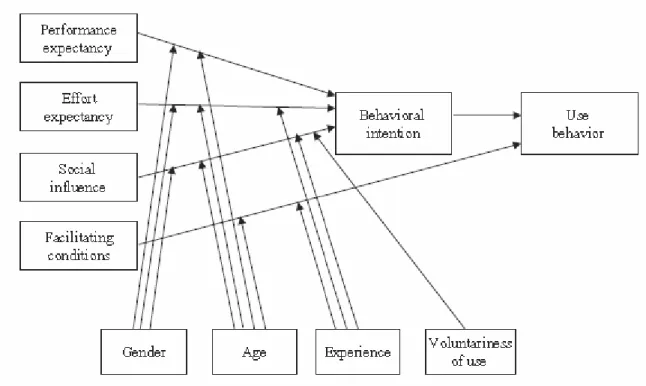
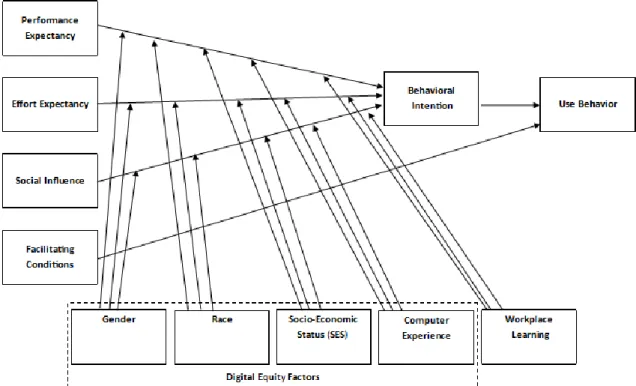
technology acceptance in the workplace using an extended Unified Theory of Acceptance and Use of Technology (UTAUT) framework, adding digital equity and workplace learning as moderators of technology acceptance to reveal the individual and organizational conditions under which employees are most likely to accept and use a knowledge sharing technology for knowledge sharing in the higher education workplace. By examining digital equity and workplace learning as moderators, the relationship between the predictive and outcome constructs of the UTAUT model (i.e., performance expectancy, effort expectancy, social influence, facilitating conditions, behavioral intent, and use behavior) were addressed.
Context of Study
The similarity between KM in the business environment and the higher education workplace environment is poorly recognized (Tippins, 2003). While differences may exist in organizational business processes (Li et al., 2009), industry and higher education work environments are faced with similar challenges of user acceptance of technology in the workplace (Brewer & Brewer, 2010; Gorry, 2008; Kumaraswamy & Chitale, 2011). Business organizations are constantly upgrading IT to enhance their knowledge management in order to remain competitive; and higher education institutions are doing the same (Brewer & Brewer, 2010; Mohd, Ahmad, Samsudin, & Sudin, 2011). Therefore the popularity of knowledge management has increased in both business and education (Brewer & Brewer, 2010). However, in higher education most studies are focused on students (Chen, Yang, Shiau, & Wang, 2005), with few dealing with the work environment in general (Sohail & Daud, 2009). The synergy between technology acceptance success factors in the business work environment and the higher education work environment is important to recognize as KM can lead to strategic, tactical, and
operational benefits for both contexts (Gorry, 2008; Kumaraswamy & Chitale, 2011; Tippins, 2003).
KM is a business-driven collection of tools required to help a user turn information into organizational knowledge, thus empowering employees and achieving business objectives of the organization. Knowledge sharing technologies include computer hardware and software, with resources like intranets, wikis, blogs, and knowledge repositories (Hedgebeth, 2007; Hendriks, 1999; Hung et al., 2011; Papadopoulos et al., 2013; Sampson & Zervas, 2013). One such
technology is Microsoft SharePoint (SharePoint). Through SharePoint, people are able to capture and share ideas (Dahl, 2012; Diffin, Chirombo, Nangle, & DeJong, 2010; Herrera, 2008;
Weldon, 2012). This type of enterprise-wide solution is meant to be used by the entire organization.
Conceptual Framework
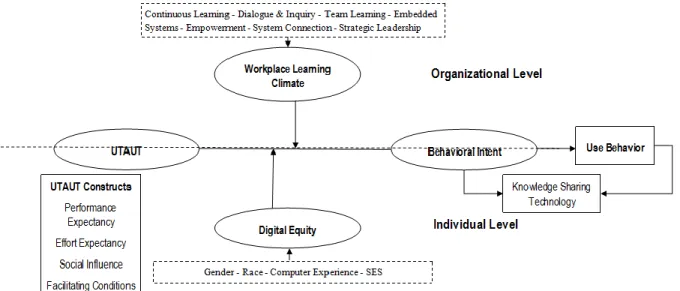
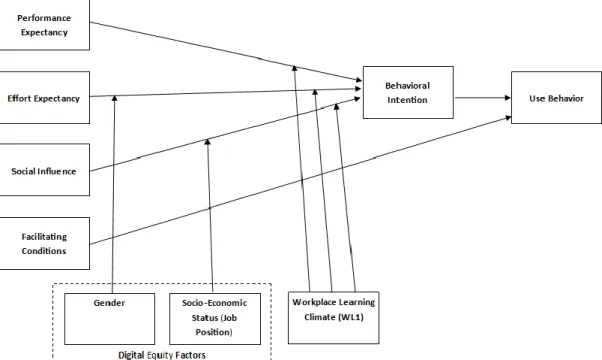
This study integrated UTAUT with digital equity and workplace learning factors in determining employees’ acceptance of a knowledge sharing technology in the workplace. The extended model is comprised of explanatory constructs (i.e., performance expectancy, effort expectancy, social influence, and facilitating conditions), with the addition of external individual (i.e., digital equity) and organizational (i.e., workplace learning climate) moderating factors (Rahman, Jamaludin, Mahmud, 2011). The primary dependent construct for this study is participants’ behavioral intention (i.e., acceptance) of a knowledge sharing technology in the
Figure 1.The Conceptual Model. This figure illustrates the conceptual model including the UTAUT constructs that guided the study of the moderating relationships (i.e., digital equity and workplace learning climate factors) influencing the behavioral intention and use of a knowledge sharing technology in the higher education workplace. The dotted line through the middle of the diagram represents the division between individual and organizational level factors.
Statement of the Problem
The purpose of this study was to examine the factors that affect employees’ acceptance of a knowledge sharing technology (i.e., SharePoint) in the higher education workplace. This
research is based on several research questions focused on the effects of individual factors (i.e., digital equity) and organizational factors (i.e., workplace learning) on predictors of employees’ intent to use a knowledge sharing technology in the higher education workplace.
Knowledge is a critical resource for organizations with the goal of getting the right knowledge to the right people at the right time (He & Wei, 2008; Li et al., 2009; Yi, 2009). In a technology-based environment, it logically follows that KM explicitly helps organizations improve organizational performance. However, research showed employee reluctance in using knowledge sharing technologies resulting in these tools not being used in the workplace. Many KM systems have failed to facilitate knowledge sharing based on individual and organizational
factors (Yang & Wu, 2008). Yang and Wu (2008) referred to these factors as social and complex between individuals and organizations. No studies have been conducted assessing the influence of digital equity and workplace learning factors on employees’ acceptance of a knowledge sharing technology in the higher education workplace. With the projection that more employers will be faced with using technology in the workplace for knowledge sharing (Hedgebeth, 2007), it is important to investigate these factors.
To understand further the importance of this concept and how it relates directly to the workplace today, this research study examined acceptance and use of a knowledge sharing technology focusing on use of SharePoint at the University of Illinois. SharePoint has commonly been used as a knowledge sharing technology in the workplace. In November 2012, an
administrative IT department at the University of Illinois implemented SharePoint as a shared service, which was made available to all departments on three campuses. There were three primary goals of this shared service: (1) to save money on hardware, software, and resources by centralizing services; (2) to use technology to streamline business processes; and (3) to enhance communication and knowledge sharing between employees across all campuses. The University of Illinois has locations in Urbana, Chicago, and Springfield; therefore, it was very important to provide a knowledge sharing technology that could bridge the gap not only within departments, but between geographic locations. However, SharePoint is a fairly new technology to most workgroups at the University of Illinois. Therefore, the attitude of build it and they will come cannot be an assumption the project sponsor could make to guarantee use of SharePoint for knowledge sharing and collaboration. Based on the research, many factors need to be considered at the individual, organizational, and technological levels for this knowledge sharing technology to be successful university-wide.
Questions exist about what makes it easier for employees to collaborate and share knowledge and how a knowledge sharing technology can be accepted successfully and used in all departments. The decision to implement SharePoint as a knowledge sharing technology is made on a departmental basis, driven by business needs. By examining employee perceptions of implementation of this knowledge sharing technology at the University of Illinois, the practical value of this research will provide guidance for future departments wanting to implement SharePoint. Additionally, by investigating how individual and organizational level factors may influence the UTAUT model of technology acceptance as moderators, future research may adopt this modified framework to gain a further understanding of technology acceptance in the higher education workplace.
It is crucial to merge individual level (i.e., digital equity) and organizational (i.e.,
workplace learning) factors that could influence the use of knowledge sharing technologies in the workplace with a technology acceptance model. In doing so, an integration and collaboration of external factors influencing technology acceptance and the technology acceptance process can be obtained. This provided new approaches to knowledge sharing which can be planned to provide improved productivity and efficiency in organizations.
Research Questions
The following research questions will help answer the bigger question for this study, which is, under what conditions will employees accept and use a knowledge sharing technology (SharePoint) in the higher education workplace?
1. To what extent and under what conditions do digital equity factors influence predictors (i.e., performance expectancy, effort expectancy, and social influence) of intent to use a knowledge sharing technology (SharePoint) in the higher education workplace?
2. To what extent and under what conditions does workplace learning climate affect predictors (i.e., performance expectancy, effort expectancy, and social influence) of intent to use a knowledge sharing technology (SharePoint) in the higher education workplace?
3. Which moderator (digital equity factors or workplace learning factors) would better influence the use of a knowledge sharing technology (SharePoint) in the higher education workplace?
Significance of Study
As technology continues to transform the workplace, this study signified the importance to understand further the predictors of acceptance of knowledge sharing technology. Many gaps in the literature are noted, from individual characteristics to an organizational context. In 2010, Wang and Noe performed an extensive literature review on knowledge sharing, noting seventy-six qualitative and quantitative studies published between 1999 and 2008. The areas of focus ranged from environmental factors, individual characteristics, and motivational factors to knowledge sharing perceptions. Twenty percent of these studies reviewed were not grounded in theory (Wang & Noe, 2010). While there is a growing literature on successful IT-mediated knowledge sharing (He & Wei, 2008), most research studies have focused on enterprise-wide knowledge management system (KMS) implementations in organizations as a whole and not on knowledge sharing technologies.
This study contributes to the body of knowledge sharing research and also has practical implications. The focus of this study is somewhat different from prior studies using the UTAUT model in that in addition to evaluating UTAUT constructs and moderators of user behavioral intention and use, digital equity factors and factors of workplace learning are also moderating
variables. The goal was to have a better understanding and make applicable use of under what conditions make it easier for employees to collaborate and share knowledge. The results will benefit organizations wanting to implement knowledge sharing technologies in their
organizations. Before an organization invests funding and time into complex KM systems, it is important that it is able to anticipate and account for the factors that influence employees’ technology acceptance. Wang and Noe (2010) encouraged more research to understand better how knowledge sharing can be tested to promote and benefit individual employees and the workplace.
CHAPTER 2—REVIEW OF THE LITERATURE
This chapter discusses four key areas related to this study: (1) KM, including knowledge sharing and knowledge sharing technologies; (2) individual level factors (i.e., digital equity); (3) organizational level factors (i.e., workplace learning); and (4) an extended UTAUT model as a theoretical framework. First, KM is introduced as a means to support managing knowledge in an organization. Then followed by knowledge sharing and details on how specific knowledge sharing technologies should be explored for understanding knowledge sharing activities related to employee technology acceptance in the workplace. Specifically, this review examined implementation of SharePoint as a knowledge sharing technology. Second, digital equity difference factors are discussed as an external moderator associated with individual behavioral intent to accept a knowledge sharing technology in the workplace. Third, workplace learning is introduced as an external moderator associated with organizational behavioral intent to accept a knowledge sharing technology in the workplace. Additionally, the concepts of organizational climate and learning organization, which impact workplace learning, are reviewed and discussed. Finally, the UTAUT theory is discussed in detail. The review provides the characteristics of user acceptance and use of technology integration in the context of an extended UTAUT model.
Knowledge Management (KM)
The sharing of knowledge is critical to success in an organization (Ipe, 2003) and was first recognized by Nonaka and Takeuchi (1995) in their work The Knowledge Creating Company. Knowledge, however, is an intangible resource (Lin & Tseng, 2005; McDermott, 1999), is intuitive and hard to define (Akhavan, Jafari, & Fathian, 2006), and is based on experience. Knowledge exists at multiple levels in an organization—individual, group, and organizational (DeLong and Fahey, 2000; Dignum, Dignum, & Meyer, 2004)—and is broken
down into two types: tacit and explicit (Adhikari, 2010; Brewer & Brewer, 2010; Gottschalk, 2006; Kuo & Lee, 2009). Tacit knowledge is defined as what a person knows, coming from experience (Flanagin, 2002; Marwick, 2001) and making it difficult to formalize (Lin & Tseng, 2005). While explicit knowledge is represented by an artifact (Marwick, 2001) and is precise and formally articulated (Lin & Tseng, 2005). An example of an artifact is a document that is utilized for collaboration between multiple people (Marwick, 2001). In order to be of most benefit, KM needs to be instituted to manage this organizational knowledge (Alavi & Leidner, 2001).
KM has been defined by some researchers (Alavi & Leidner, 2001; Psarras, 2006; Yang & Wu, 2008) as an information system which manages organizational knowledge and focuses on processes which acquire, create, and share knowledge across all levels of an organization.
Dignum, Dignum, and Meyer (2004) further defined KM as a “systematic, holistic approach to the sustainable improvement of the handling of knowledge at all levels of an organization” (p. 148). This definition is supported by Akhavan, Jafari, and Fathian (2006) who defined KM as “an integrated, systematic approach to identify, manage, and share all of the department’s
information assets, including databases, documents, policies and procedures, as well as
previously unarticulated expertise and experience resident in individual officers” (p. 97). Both of these definitions confirm one of the main goals of KM to be increasing knowledge sharing across an organization (Yang & Wu, 2008).
In the 1990s KM became “industry’s golden child,” according to Seng, Zannes, and Pace (2002, p. 142). Corporations such as Chrysler, Monsanto, Hewlett-Packard, and IBM along with government agencies embraced KM systems in an effort to keep tacit knowledge from leaving their organizations (Seng, Zannes, & Pace, 2002). Additionally, in the last decade there has been an increase in the number of academic publications focusing on the importance of KM. Between
the years 2002-2010 Ergazakis, Metaxiotis, and Askounis (2013) reported fifty-nine different journals publishing KM papers, with the Journal of Knowledge Management having the most significant number of papers, followed by the International Journal of Knowledge-Based Development.
KM is as vital in higher education as it is in the corporate sector, according to Omerzel, Biloslavo, and Trnavcevic (2011). As we know, higher education institutions are characterized by being knowledge experts (Omerzel, Biloslavo, & Trnavcevic, 2011), however they recognize the need for effective KM and are finding it difficult to achieve (Grossman, 2007; Tippins, 2003). Barriers identified in the literature included cultural and bureaucratic factors, lack of interest, individual skill level differences, time and resource constraints, unwillingness to share, and unawareness of a KM system (Tippins, 2003). These individual, organizational, and technological barriers are a common thread throughout the literature as barriers for knowledge sharing and will be discussed next.
Knowledge Sharing
Knowledge sharing has been defined by many researchers. Riege (2005) referred to knowledge sharing as the cornerstone of organizational KM strategies. Knowledge sharing is defined as the “know-how to help others and to collaborate with others to solve problems, develop new ideas, or implement policies or procedures” (Wang & Noe, 2010, p. 127). Lin (2007) further defined knowledge sharing as using knowledge networks in an organization. Knowledge sharing includes both the ideas and the intersection of users (Wang & Noe, 2010). Knowledge sharing is a complex process that contributes to both individual and workplace learning (Ipe, 2003; Lin, 2007).
Knowledge Sharing Success Factors
The literature showed motivation, transparent organizational structures, and modern technology to be critical success factors of knowledge sharing in an organization (Riege, 2005). Additional success factors included incentives, culture and leadership (Bock & Kim, 2002), flexibility of individual and organizational requirements (Dignum et al., 2004), reputation, reciprocity, and altruism (Hung et al., 2011).
Knowledge sharing plays an important role in the ongoing success of KM. In a study on IT continuance intention and continued behavior, He and Wei (2008) made a distinction between knowledge contribution and knowledge seeking behaviors in knowledge sharing. Their study revealed users’ intentions and facilitating organizational conditions predicted knowledge sharing behavior; but continuance intention was determined by users’ beliefs and attitudes (He & Wei, 2008). It is within an organizational climate where users are not afraid to share their knowledge and ideas that a safe environment for knowledge sharing exists (Hendriks, 1999). Individual and organizational goals should match for successful knowledge sharing to take place in the
workplace (Hendriks, 1999). Knowledge Sharing Barriers
The literature showed there are three main knowledge sharing barriers: individual, organizational, and technological (Lin, 2007; Riege 2005; Yang & Wu, 2008). Several individual, organizational, and technological barriers were noted in the literature, including inadequate organizational structures, denominational segregation, unfriendly organizational cultures, lack of motivation, and lack of training (Han & Anantatmula, 2007; Hendriks, 1999; Kim & Lee, 2006; Lin, 2007; Riege, 2005; Yang & Wu, 2008). This is further supported in an extensive literature review by Riege (2005) which uncovered dozens of knowledge sharing
barriers. Riege (2005) categorized these barriers into three main areas: individual, organizational, and technological, as shown in Table 1.
Table 1
Summary of Knowledge Sharing Barriers
Categories Barriers
Individual Lack of time to share
Apprehension or fear sharing may reduce job security Low awareness of knowledge value to others
Dominance in sharing explicit vs. tacit knowledge Use of power or position-based status
Insufficient communication Level of experience
Lack of interaction
Poor communication and interpersonal skills Age differences
Gender differences Lack of social network Educational level differences Lack of trust
Cultural differences
Organizational Unclear integration strategy Lack of leadership
Shortage of formal and informal spaces to share Corporate culture
Low priority of knowledge retention Lack of supported infrastructure Poor resources
External competitiveness Restricted communication
Physical work environment not conducive to sharing Internal competitiveness
Organizational structure Size of business unit
Technological Lack of integration of IT systems Lack of technical support
Unrealistic expectations
Table 1 Continued
Categories Barriers
Mismatch between user needs and IT Lack of familiarity and experience with IT Reluctance to use IT
Lack of communication and demonstration
Note. Adapted from “Three-Dozen Knowledge-Sharing Barriers Managers Must Consider,” by A. Riege, 2005. Journal of Knowledge Management, 9(3), pp. 23, 25-26, 29-30.
This list of barriers is meant to be a starting point for researchers, according to Riege (2005). Riege (2005) encouraged more empirical research be done to understand these barriers on different organizations. Therefore, this list provides a foundation for future research
examining the individual, organizational, and technological barriers to acceptance of a knowledge sharing technology in the workplace.
Knowledge Sharing Technologies
As information technology has evolved so have organizational needs to keep pace with technology. As we know, KM is a process about creating and maintaining organizational intelligence by improving the way users capture, share, and utilize knowledge. To facilitate this process knowledge sharing technologies are used (Alavi & Leidner, 2001), and often referred to as “knowledge management enablers” (Hedgebeth, 2007, p. 49). In 1966, Kaufman’s visionary work identified extra-corporate systems and computer time-sharing when he discussed
interorganizational systems. Since that time, the U.S. General Services Administration, U.S. Army Corps of Engineers, and U.S. Navy and Transportation Departments have all implemented knowledge sharing utilizing different types of technology (Kim & Lee, 2006). Many researchers wrote about the use of conventional software in knowledge sharing (Edwards, Shaw, & Collier, 2005), including discussion forums, document management, and workflow management. Some popular knowledge sharing applications are from SalesForce.com, BMC software, DCASoft, and
Atlassian (Hedgebeth, 2007). Since 2006, Shell has used wikis for all operational information and acknowledged them to be a knowledge sharing enabler (Ligdas, 2009). Shell identified success being built on a robust KM strategy addressing corporate culture and behaviors (Ligdas, 2009).
Some other common knowledge sharing technologies include tools such as web-based portals, databases, teleconferencing, and wikis (Flanagin, 2002; Hedgebeth, 2007; Ligdas, 2009; Masrek, Shahriza, Karim, & Hussein, 2007; Ranjan, 2011). Song (2002) also included data warehousing, groupware, and intranets as supported knowledge sharing technologies for
companies such as Dell, HP, and GE. Additionally, intranets provided a centralized location for knowledge sharing and retention (Seng et al., 2002). This type of technology provided a single point of access via a web browser allowing employees to collaborate and share information. Masrek, Shahriza, Karim, and Hussein (2007) investigated corporate intranet effectiveness creating a model of predictors for use including individual, organizational, and technological factors. Their findings showed intranets provided the ability to improve internal
communications, to distribute information, and to allow access to legacy systems thereby making them a success (Masrek et al., 2007). Seng et al. (2002) expanded on intranet effectiveness by identifying several intranet features aiding in KM initiatives in organizations; these include: consistency in organization and structure, indexing and search capabilities, single point of access, access to relevant links and information quickly, and single sign-on. Masrek et al. (2007) concluded further research is needed to give organizations a clearer understanding of what is needed for intranets to be effective and successful.
Knowledge sharing technology implementation factors. The primary goals of introducing technology into an organization are to: remove barriers, provide access to
information, improve processes, and locate knowledge carriers or seekers (Hendriks, 1999). However, numerous research studies suggested factors associated with using knowledge sharing tools prohibit technology use.Factors identified include lack of knowledge of features,
complexity of technology, and time required for training (DeJonge & Rodger, 2006; Riege 2005). A lack of incentives, environmental factors, individual characteristics, and motivation are also identified factors (Hendriks, 1999; Hwang, 2008; Jahani, Ramayah, & Effendi, 2011; Kaiser, Kansy, Mueller-Seitz, & Ringlstetter, 2009; Wang & Noe, 2010; Yang & Wu, 2008).
An underlying concept organizations may assume is that when a knowledge sharing technology is in place, people will automatically use the technology. Unfortunately, this is not the case, as the research showed there are many factors to consider when implementing a knowledge sharing technology into the workplace. In a conceptual framework developed by Stankosky and Baldanza (2000) technology was considered equally as important as organization, learning, and leadership. These were considered pillars forming the foundation of any KM system, arguing that without them a KM system could not exist (Mohamed, Stankosky, & Murray, 2006). Mohamed, Stankosky, and Murray (2006) compared technology and KM as being two separate paradigms that cannot be forced into the other, further discussing that technology can accelerate knowledge sharing capabilities only if properly balanced and integrated with these other components (Mohamed et al., 2006). This is further described as a “one-size-fits-all” approach that does not work (Mohamed et al., 2006). The importance of acknowledging external moderating variables in regard to technology acceptance is important to understand the big picture. Mohamed et al. (2006) referred to “arteries” when speaking about bridging the gap between KM and IT. By examining digital equity and workplace learning in this research study, individual and organizational level factors will go outside the boundaries of KM
and IT to explain under what conditions users accept and use a knowledge sharing technology in the higher education workplace.
Knowledge sharing technology success factors. Practitioners must look carefully at knowledge sharing technologies, examining benefits for implementation and measuring knowledge gained. Butler, Heavin, and O’Donovan (2007) listed having a high degree of IT participation and user participation as two key factors for success. Taylor (2004) explored how to motivate people to use KM systems effectively by studying the effects of individual user
differences on usage and perceived usefulness by focusing on gender and cognitive style. Taylor (2004) found that these individual differences need to be accounted for when implementing a KM system. To provide a better understanding of conditions of use, Bansler and Havn (2003) focused on use after implementation of a corporate intranet. Through a series of interviews and observation of documentary materials, Bansler and Havn (2003) studied the introduction of a knowledge sharing system through its inception to its abandonment three years later. This methodology was designed in hopes of finding the shortcomings of the KM system in facilitating knowledge sharing in the organization.
Although, there is a debate between researchers on whether knowledge sharing initiatives are successful with or without using technology tools (Marwick, 2001; McDermott, 1999;
Mohamed et al., 2006). Evans (2012) reinforced the importance of human intervention when she stated, “technology makes things possible; people collaborating makes it happen” (p. 177). Ipe (2003) and Rah, Gul, and Wani (2010), on the other hand, made the claim that knowledge is more complex than the technological systems supporting it. In some organizations information technology leads knowledge sharing, and in others it facilitates knowledge sharing (Xu & Quaddus, 2004). Loermans (2002) and Stewart (1998) believed technology provided a
framework for KM, noting how technology facilitates the knowledge network by providing a means for knowledge transfer among employees.
Knowledge sharing technology barriers. Research has shown that knowledge sharing technologies may not always be adopted (Taylor & Wright, 2004) and may be going unused (Yang & Wu, 2008). This may be due to the problems facing organizations implementing these tools. Several studies have revealed barriers to knowledge sharing technologies in an
organization. Butler et al. (2007) identified ease of use as a critical success factor for information technology-related knowledge sharing implementation in the following quote.
[A] key limitation on the potential effectiveness of any IT-based system is its ease of use…it follows that one reason why analysts may not source knowledge from a repository is that the technology is not sufficiently easy to use—that is, it may be awkward, slow, or difficult enough to use that analysts may believe that the benefits do not outweigh the costs. (p. 184)
Rah et al. (2010) also recognized barriers of knowledge sharing technologies in their study of a web-based KM system implementation at a university library aimed to improve staff professionalism and coordination with other library systems. Barriers noted by staff included ignorance, lack of time, lack of relationship to knowledge, and length of time to implement across departments (Rah et al., 2010). In another study on business schools’ use of technology for knowledge sharing, Ranjan (2011) found that technology implementation does not always improve outcomes. Lastly, the use of UTAUT to identify factors of web-based question and answer services was the approach Deng, Liu, and Yuanyuan (2011) took in their study which identified facilitating conditions, performance expectancy, and effort expectancy as driving
factors of technology adoption. These studies highlight the barriers of knowledge sharing technology adoption in the workplace.
Summary
Knowledge is continuously being created, shared, and applied (Choy, Yew, & Lin, 2006) with knowledge sharing being the focus of this research study. A 2008 survey of organizations representing the Henley Knowledge Management Forum noted significant focus on collaboration initiatives in KM and growth in KM teams over a one-year time period (Van Winkelen, 2009). Since 1998 Kumar (2012) noted more than sixty-thousand artifacts with the keyword KM as being indexed in the Web of Science database. This data showed a six-fold increase since 1998 (Kumar 2012). What does this information mean for the acceptance and use of knowledge sharing technologies in organizations today?
This research showed that the KM literature is growing and that there is a need for continuous research on new knowledge sharing technologies and the successes and challenges facing user acceptance and use (Choy et al., 2006). Several research studies showed KM system implementation is challenging and that more failed than succeeded (Butler et al., 2007). Akhavan et al. (2006) completed a longitudinal study focusing on the critical success factors of KM
implementation in six organizations (i.e., Ernst & Young, HP, BusinessEdge Solutions, Microsoft, Teltech, and Siemens) and found four key success factors: organizational culture, KM strategy, systems and IT infrastructure, and effective and systematic processes and measures. In a study of web-based KM systems from 1997-2000, Bansler and Havn (2003) reported time, incentives, bragging, relevance, and quality as factors of failure. More researchers (Kuo & Lee, 2009; Xu & Quaddus, 2004) identified perceived usefulness and perceived user-friendliness based on the Technology Acceptance Model (TAM) as primary influencing factors
critical to the acceptance and use of a KM system in an organization. In a review of forty-two journals spanning from 1982 through 2009, OuYang, Yeh, and Lee (2010) suggested four key areas of concern with KM system adoption: individual factors, organizational factors, KM capability, and organizational performance. Yang and Wu (2008) broke down individual level barriers as motivation, trust, social capital, self-efficacy, outcome expectation, and absorptive capability. Organizational level barriers were identified as culture, power, technology,
organizational capability, organizational climate, and social structure (Yang & Wu, 2008). Kim and Lee (2006) identified accepted IT systems and software as being easy to use and addressing user needs. Other researchers (Liebowitz & Frank, 2011; Nevo & Chan, 2007) identified ease of use, value and quality of the knowledge, system accessibility, user involvement, integration, top management support/commitment, project manager and team skills, incentives, interpersonal trust and respect, reciprocity, shared values, and a convenient knowledge transfer mechanism to be criteria for acceptance.
Numerous studies highlighted the critical success factors of KM implementations, but none of these studies mentioned digital equity or workplace learning. Additionally, few researchers have tested acceptance and use of knowledge sharing technologies on solid theoretical backgrounds (Bock & Kim, 2002).
Microsoft SharePoint
In 2001, SharePoint was created for information technology administrators’ use, called SharePoint Team Services. In 2003, commonly called WSS 3.0, SharePoint became a
comprehensive solution for knowledge sharing and included an easy-to-use interface, allowing users to add and contribute new data easily for content and document management. Microsoft Office SharePoint Server (MOSS) 2007 improved upon the SharePoint 2003 version and brought
with it additional collaboration and sharing features. SharePoint 2010 has already been updated with the release of SharePoint 2013 in January 2013. Now, the latest version of SharePoint is more robust and scalable than all previous versions, providing a platform for capturing and sharing tacit knowledge and collaboration.
SharePoint as a Knowledge Sharing Platform
The following section of the literature review reveals several library case studies which examined SharePoint implementation focusing on the organization, social factors of adoption, and knowledge sharing. When an organization implements SharePoint, features specific to its needs are activated on the system. Some common knowledge sharing features of SharePoint include wikis, blogs, discussion boards, calendars, and document libraries. Since SharePoint is a platform, features can be utilized in many different ways. For example, by using a sandboxed knowledge base template site hosted on SharePoint, staff could capture and manage tacit
knowledge from program directors of a non-profit organization through an automated workflow routing process (Weldon, 2012). Some additional examples of SharePoint feature use follow.
University of Mississippi. In an implementation of SharePoint 2003 at the University of Mississippi library, key points from preparation, setup and training were documented along with benefits, barriers, and the future of SharePoint in the library (Herrera, 2008). The library replaced its outdated intranet and within weeks users from a number of departments were sharing and collaborating with the tool. The quick response rate was due to the ease of use “out-of-the-box” states Herrera (2008, p. 82). Users were given broad permissions and ready-to-use SharePoint sites. This enhanced communication across the libraries by providing a department blog, wiki, and document libraries for full-time employees and projects. Training was provided at the manager level first, followed by departmental training sessions.
Benefits and barriers were noted in the implementation by Herrera (2008). The greatest benefit was the “immediacy of the information with the ability for users to post their own content” (Herrera, 2008, p. 92). While the implementation of SharePoint was a success, Herrera (2008) noted a few negatives including the problem with browsers not working well, specifically the ability to manage documents in a document library in browsers other than Internet Explorer. The 2003 and 2007 versions of SharePoint did not work well with alternative browsers such as Firefox, Opera or Safari. Herrera (2008) also noted problems with wikis and blog entries in alternative browsers. That being said, Herrera (2008) stated the future of SharePoint at the University of Mississippi library was solid. “The collaborative nature of the software combined with the immediacy of the content makes this an effective internal software package that we can build on as we work to strengthen our libraries” (Herrera, 2008, p. 94). This implementation did not reveal individual or organizational variables impacting users’ acceptance or use of
SharePoint at the library. Since this implementation was replacing an existing intranet infrastructure, the assumption of user buy-in was already there.
University of Maryland University College (UMUC). The Access Services
Department at UMUC chose Microsoft’s SharePoint product as an internal information sharing solution (Diffin et al., 2010) to combine its intranet with cloud computing. The department was looking for a collaborative space and after reviewing the features and functionality of SharePoint decided to move forward with the implementation. With change-over happening in its staff, the University thought the SharePoint approach would limit knowledge liability and minimize effects of attrition (Diffin et al., 2010). The main features used by the Access Services Department at UMUC were the wiki, document library, and calendar (Diffin et al., 2010).
Diffin, Chirombo, Nangle, and DeJong (2010) reported the implementation had both benefits and barriers. While the average number of site visits to the intranet increased from ten to one hundred forty per day in nine months (Diffin et al., 2010) several barriers were still noted, including lack of IT support, restricted tool functionality, and lack of training and
documentation. The potential complexity of SharePoint was also a barrier, as the number of features and customizations available could be a possible deterrent to the user (Diffin et al., 2010).
Towson University. The Albert S. Cook Library at Towson University implemented an intranet using SharePoint Services 3.0 as its platform (Dahl, 2012). The implementation was successful and has been readily adopted. A variable that increased this early acceptance, according to Dahl (2012), was integration of the department’s tracking system into SharePoint. By forcing staff to login to the tracking system on a regular basis it encouraged staff to use other features of the tool. Several months after implementation, data were collected from staff to note their comfort levels and satisfaction with the portal (Dahl, 2012).Ten of thirteen staff eligible to take the survey responded indicating SharePoint had potential and was an important tool for the department (Dahl, 2012). A major barrier to using the tool was lack of training. While the tool was noted as being user friendly, users were uncomfortable not knowing whether they could make an irreversible error (Dahl, 2012). “The success of the intranet is dependent on the contributions of its users. If nobody contributes, the information provided…becomes stagnant and outdated” (Dahl, 2012, p. 219).
Summary
SharePoint was used to facilitate knowledge sharing and collaboration by organizations in all industries, according to Perez (2013). Perez (2013) called it the “centerpiece” of many
collaboration strategies. While SharePoint is fast becoming the knowledge sharing technology of choice, Perez (2013) suggested SharePoint faces a challenging future due to the adoption
challenges, a poor user experience, and a preference for other knowledge sharing technologies. The case studies in the literature focused on library implementations of SharePoint without any theoretical grounding. Diffin et al. (2010), Herrera (2008), and Dahl (2012) reported barriers in their studies; some of these barriers were redundant, while others were specific to the research setting. An important research area to understand is why these barriers exist by utilizing an information technology theory that analyzes the predictors and moderators to investigate users’ acceptance of a knowledge sharing technology in the workplace. This lack of practical and theoretical research creates a gap for practitioners wanting to strategize on best practices for a sustainable technology solution to knowledge sharing and collaboration in their organizations. The literature showed that simply having access does not mean the technology is being accepted and used for knowledge sharing.
Digital Equity
There is an assumption once formal education (K-12) is complete, no further training or skills were needed to achieve digital equity (Ashton, 2004; Duqaine-Watson, 2006). Digital equity in context with education was prevalent in the literature. However, digital equity in the context of the workplace is not. Davis, Fuller, Jackson, Pittman, and Sweet (2007) defined digital equity as “equal access and opportunity to digital goods, resources, and services to increase digital knowledge, awareness, and skills” (p. 1). Cooke and Greenwood (2008) added to this definition stating, “… [all] users need to be able to locate, make sense of, and evaluate
appropriate resources, and therefore attention needs to be paid to the development of information literacy skills” (p. 145). This reflected the difference and importance between having access to
technology, which is commonly referred to as the digital divide (Campbell, 2001; Rye, 2008; Van Dijk & Hacker, 2000), and being able to make use of the technology (Middleton & Chambers, 2010). The main indicators for identifying and measuring differences in the digital divide have been owning a computer and having access to the Internet (Rye, 2008). Therefore, digital divide addressed the disconnect between those with access and those without, impacting the equality of technology use (Benson, Johnson, & Kuchinke, 2002; Davis et al., 2007). Research confirmed that access and skills are linked together in a “vicious” circle (Cooke & Greenwood, 2008). Accordingly, it became clear that computer ownership does not guarantee usage, making the use results highly variable (Rye, 2008). Without access, users cannot develop skills, and without skills they cannot benefit from access (Cooke & Greenwood, 2008; Sipior, Ward, & Connolly, 2011; Rye, 2008). This is supported in Van Dijk’s (1999, 2000) claim that “access problems gradually shift from motivation and material access to skills and use” (Rye, 2008, p. 181).
Technology in the workplace can create barriers, reinforcing existing inequalities present in society today, including lack of democratic participation and social inclusion (Cooke & Greenwood, 2008). Previous research suggested demographic variables along with technology experience are related to the digital divide (Middleton & Chambers, 2010), thus impacting digital equity. Rye (2008) suggested social features impact digital equity more than the technology itself. These individual differences can lead to issues impacting employees’ acceptance of technology in the workplace.
Factors Impacting Digital Equity in Formal Education
Digital equity in the context of formal education has been studied for many years where several barriers have been identified (Cooke & Greenwood, 2008; Pynoo et al., 2011; Ritzhaupt,
Dawson, & Cavanaugh, 2012). Various education studies noted barriers facing students such as gender, race, SES, (Boonaert & Vettenburg, 2011) and barriers facing teachers such as attitudes, resources, and skills (Ertmer, Ottenbreit-Leftwich, Sadik, Sendurur, & Sendurur, 2012).Teachers as well as students face digital equity barriers in formal education. The role teachers’ play in formal education is crucial to student achievement. With fast moving technological changes happening in today’s world, schools must be prepared to provide equal learning opportunities for all students, and it is the teacher’s role that is majorly impacted with an expectation to assume integrating technology in the classroom. In addition to the barriers facing teachers, the
traditional factors of individual students, including gender differences, race, and SES status (Boonaert & Vettenburg, 2011), play a role in digital equity in the classroom. We live in a time when students are being required to research information online and type reports on a computer and students are being “constructed as a homogeneous group” (Boonaert & Vettenburg, 2011, p. 61). Students are not all the same and bring diverse experiences with them to the classroom. To understand the factors impacting digital equity in formal education, a review of the technology integration barriers teachers’ face will be discussed first followed by the barriers students face.
Teachers’ barriers. In 2006, Hew and Brush provided a report on the technology integration barriers teachers faced based on the analysis of forty-eight empirical studies. Six categories of barriers were identified, including resources, institution, subject culture, and assessment (Ertmer et al., 2012; Hew & Brush, 2006; Karaca, 2011). From these six categories, three were cited most frequently—resources, teachers’ knowledge and skills, and teachers’ attitudes and beliefs (Ertmer et al., 2012). Ertmer, Ottenbreit-Leftwich, Sadik, Sendurur, and Sendurur (2012) categorized resources as first order (external) barriers and teachers’ knowledge and skills as well as attitudes and beliefs as second order (internal) barriers. These barriers have
not changed according to studies done in the early 1990s, when computers were just being introduced to the classroom. This is due to the continual change in technology. According to Lu and Overbaugh (2009) the same barriers were identified by Hasselbring (1991) and Scheingold and Hadley (1990) labeling these barriers as “theoretical forerunners of more recent empirical constructs of school environment and context” (p. 90). These early researchers recognized the school environment was changing due to the introduction of computers in the classroom. Like today, teachers in the ‘90s were faced with new constraints and encountered barriers while trying to integrate computers into their teaching (Lu & Overbaugh, 2009) making this research still relevant today.
Different barriers affect digital equity to different degrees. In general the research seems to follow this pattern with one article specifically reporting specific degrees of impact: 40 percent resources, 23 percent teachers’ knowledge and skills, and 13 percent teachers’ attitudes and beliefs (Ertmer et al., 2012).
Student barriers. The discussion up to this point has focused on the main barriers impacting digital equity from a teacher’s perspective. There are additional factors that impact digital equity in the classroom, which are equally important to examine. These are commonly referred to as traditional factors (Boonaert & Vettenburg, 2011) and are centered on gender, race, and SES of students.
Gender bias. Gender bias has been a subject of research for many years and is noted in the literature as the most important traditional factor impacting digital equity (Plumm, 2008). Gender bias in software programs was reflected in the characters, content, and reward systems (Bhargava, 2002). This can be seen in educational software where there are generally more male than female characters, suggesting that girls are not of as much value as boys. Teachers often
promoted computer use to boys more often than to girls, resulting in stereotyping girls’ abilities with digital technologies (Plumm, 2008). Stereotype threat plays a role in gender socialization, especially in math and science where boys are more involved and received more attention than girls from teachers (Neuburger, Jansen, Heil, & Quaiser-Pohl, 2012). Teachers may give students the impression that boys are better at computers than girls, letting boys have priority over girls using computers in the classroom. This lack of access to computers and experience using technology has led to a decline of women going into technology-related fields, specifically math and science (Cunningham, 2011; Plumm, 2008; Shores & Smith, 2011). Female teachers may not be using technology as frequently as male teachers based on their own attitudes and beliefs (Plumm, 2008). This lack of leadership by a female teacher reinforced the stereotype of gender difference, which has a strong influence on the success of females in technology-related fields (Shores & Smith, 2011).
Race and Socioeconomic Status (SES). Issues of race and SES continue to be a factor impacting digital equity. Access to technology resources is a digital equity issue, which is primarily related to inequity of resources in SES schools. The largest group it affects is students from low-income, minority families (Banister & Reinhart, 2011) as these groups are primarily those who attend low SES schools. Kalyanpur and Kirmani (2005) explained schools in inner cities and rural areas often have a shortage of technology resources. Schools in white suburban neighborhoods are more likely than schools with low-income minority students to utilize application packages and software programs (Kalyanpur & Kirmani, 2005). Judge, Puckett, and Bell (2006) revealed that high poverty schools had an average of one hundred twenty-five computers per school with the low poverty schools having an average of one hundred fourteen computers per school. Differences also existed in home use with high SES children 2.78 times
more likely to have a computer at home than their low SES counterparts (Hohlfeld, Ritzhaupt, Barron, & Kemker, 2008). The lack of digital resources in the home can be attributed to how well a student uses technology in school were the findings of a study investigating low and high SES K-12 schools in Florida (Hohlfeld et al., 2008). The results showed a correlation between a student’s use of technology at home and his/her proficiency using technology at school (Hohlfeld et al., 2008).
Digital Equity in the Workplace
In contrast to research on digital equity in formal education, the study of digital equity in the context of the workplace has been largely overlooked (Cooke & Greenwood, 2008; Smith, 2005). Indeed, digital equity in the context of the workplace is a social justice goal (Solomon, 2002). The prospect of digital exclusion of individual learners was behind the move to digital equity and was a source of concern in a knowledge-based society (Resta & Laferriere, 2008). There is a lack of theoretical models, metrics, and empirical research on digital equity in the workplace. There were only a few significant articles in the literature that discussed digital equity factors in the context of the workplace (Middleton & Chambers, 2010). Quazi and Talukder (2011) investigated the impact of demographics on individuals’ perceptions and acceptance of technology (Microsoft Outlook) in the workplace in Australia. The specific
demographics investigated by Quazi and Talukder (2011) were age, educational background, and training status. Relevant literature presented by Quazi and Talukder (2011) found these variables to have an impact on acceptance of technology in the workplace. Specifically, the review showed people with a higher level of education had a tendency to adopt technology quickly; whereas people with low levels of education had more uncertainty in technology acceptance (Lerouge, Newton, & Blanton, 2006; Porter & Donthu, 2006; Rogers, 2003). To this author’s knowledge
no research specifically investigated the impact of digital equity factors as a whole on users’ acceptance and use of a knowledge sharing technology in the workplace.
Factors impacting digital equity in the workplace. The same digital equity factors identified in formal education were factors identified in employee and organizational
performance in the digital workplace (Benson et al., 2002). These included attitude, knowledge and skills (Hacker, Mason, & Morgan, 2009), gender differences (Middleton & Chambers, 2010; Smith, 2005), race, and SES (Middleton & Chambers, 2010; Moody et al., 2003). Some of these factors were referred to as demographic variables (i.e., ethnicity and age) by Coleman (2005) and demographic and situation variables (i.e., gender, ethnicity, age, education, and experience) by Middleton and Chambers (2010). Some examples of studies examining relationships between these variables and technology acceptance are noted below.
Knowledge and skills. With the digital workplace being built around employees and technology, the need to have skilled workers becomes more prevalent, creating challenges for organizations. Internet skill has been noted in several studies as a factor to technology
acceptance in the workplace. Sipior, Ward, and Connolly (2011) identified Internet skill and competence as individual variables of acceptance of technology in electronic-government (e-government). Four key challenges identified by Benson, Johnson, and Kuchinke (2002) were access, skills, abilities and attitudes, and training. First, variables determining technical access were identified as availability of hardware and software, cost, connectivity speed, technical support, and availability of time to learn and upgrade (Benson et al., 2002). Second, without efficient skills, both in hardware and software as well as cognitive abilities, an opportunity to exclude and marginalize people was created (Benson et al., 2002). Third, the ability to discern