Procedia - Social and Behavioral Sciences 197 ( 2015 ) 1936 – 1946
1877-0428 © 2015 The Authors. Published by Elsevier Ltd. This is an open access article under the CC BY-NC-ND license (http://creativecommons.org/licenses/by-nc-nd/4.0/).
Peer-review under responsibility of Academic World Education and Research Center. doi: 10.1016/j.sbspro.2015.07.575
ScienceDirect
7th World Conference on Educational Sciences, (WCES-2015), 05-07 February 2015,
Novotel Athens Convention Center, Athens, Greece
The Effect Of School Administrators’ Decision-Making Styles On
Teacher Job Satisfaction
Dincer Olcum
a*, Osman Titrek
b aAdatepe Secondary School, Karasu/Sakarya 54500, Turkey bSakarya University Education Faculty, Hendek/Sakarya 54300, TurkeyAbstract
This study, conducted using a correlational method, determines the relationship between school administrators’ decision-making styles and teachers’ job satisfaction levels. In total, 483 teachers and 167 administrators from primary schools in Sakarya Province, Turkey, were surveyed. The short form Minnesota Satisfaction Questionnaire and Decision-Making Styles Questionnaire were used. The results show that the job satisfaction levels of teachers and administrators who participated in the survey were high. We conclude that administrators mostly use rational decision-making style, and they rarely use avoidant decision-making style. Regression analysis results showed that teacher job satisfaction levels were predicted significantly by administrators’ decision-making styles.
© 2015 The Authors. Published by Elsevier Ltd.
Peer-review under responsibility of Academic World Education and Research Center.
Keywords: decision-making style, job satisfaction, teacher, school administrator, educational administration
1.Introduction
Most of us undeniably spend a large part of our lives working. Therefore, understanding the factors that influence wellbeing in the workplace has become more important for scientists. In fact, research shows that job satisfaction (JS) is at the center of employee behavior and practice. It is important for administrators to consider as many factors as possible that affect employee job satisfaction and efficiency. The decisions of administrators can have positive or negative impacts on all components of an organization and the decision-making styles (DMS) of administrators are important. School administrators can make decisions rationally or intuitively, or they can try to avoid them,
* Dincer Olcum. Tel.:+90-50-922-04-94. E-mail address:[email protected]
© 2015 The Authors. Published by Elsevier Ltd. This is an open access article under the CC BY-NC-ND license (http://creativecommons.org/licenses/by-nc-nd/4.0/).
however, their decisions ultimately affect teacher motivation and job satisfaction. This research is aimed at determining the effect of the DMS of school administrators on teacher job satisfaction.
2.Decision-making
A decision is not a simple, unitary event, but the product of a complex social process generally extending over a considerable period of time (Simon, 1965). The decision process can be look at as a set of actions and dynamic factors that begin with the identification of a stimulus for action, and end with the specific commitment to action (Mintzberg et al., 1976). Decision processes aim to change organizations, to prevent or solve a problems, and to affect the personnel (Bursalioglu, 2011). According to Henry, Mintzberg, Duru, Raisinghani, and Theoret (1976), the decision process includes recognition, improvement, and choosing phases. Adair (2000) thinks that the decision process involves determining the problem, gathering the data, creating suitable alternatives, making decisions, practicing the decision, and evaluating the results. A good decision, while subject to the constraints of knowledge and resources, maximizes the well-being of those affected by it (Dietz, 2003). It is also based on the information, values, and preferences of the decision-maker (Howard, 1983).
Decision-making is selecting the most suitable choice from among the probable alternatives to the solution of a problem (Aydin, 2010); a process of choosing between alternative courses of action in order to attain goals and objectives (Forman & Selly, 2002); a synthesis of a society’s beliefs, an epitome of its ideology, and the actionable product of its thinking (Kerlinger, 1951); a commitment to take action (Mintzberg, Raisinghani & Theoret, 1976); a course of action chosen from among a set of alternatives based on certain criteria (Wang & Ruhe, 2007). Decision-making is a flexible behavior, which means that individuals may act and decide differently from each other in similar cases. The activity of decision-making is a process involving several phases, including the following (Kocoglu, 2010): (a) Determining the aim and the problem, (b) Gathering the data, (c) Determining the possible solutions, (d)
Evaluating the alternatives, (e) Choosing and evaluating the best alternative, (f) Practicing the Decisions and Evaluating the Results.
2.1.Decision-making styles
According to Nas, (2006) DMS is a learnable, teachable, and acquirable habit. Thunholm (2004) defines DMS as the response pattern exhibited by an individual in a decision-making situation. This response pattern is determined by the decision-making situation, the decision-making task, and by the individual decision maker. Individual differences between decision makers include differences in habits but also differences in basic cognitive abilities such as information processing, self-evaluation and self-regulation, which have a consistent impact on the response pattern across different decision-making tasks and situations.
2.1.1Dinklage approach:
Dinklage (1968) categorized decision-making behavior into eight trait-like ways of approaching decisions. These DMS were defined as follows: the planning style, the agonizing decider, the delaying style, the paralysis style, the impulsive decision maker, intuitive decision maker, the fatalistic style, and the compliant decider (Philips & Pazienza, 1988)
2.1.2.Harren approach:
Another theoretical framework used to analyze respondents’ DMS was Harren’s (1979) model, developed on the basis of career decision-making by college students. Harren categorizes DMS according to two criteria: degree of active information seeking, and degree of reliance on cognitive or intuitive (emotional) processes to make decisions. Harren’s categories are: rational , intuitive , and dependent (Julien, 1999).
Arroba’s taxonomy was derived by interviewing subjects regarding recent decisions that they had made; six styles of decision-making emerged. These were emotional, intuitive, rational, hesitant, compliant, and no-thought (Elander & Wilding, 1993).
2.1.4.Driver approach:
Using the two criteria of information, use and focus, we created a matrix that identifies four styles of decision-making as follows: decisive (little information, one course of action); flexible (little information, many options); hierarchic (ample data, one course of action); and integrative (ample data, many options) (Brousseau, Driver, Hourihan, & Larsson, 2006).
2.1.5.Kuzgun approach
Kuzgun (2012) determines the following decision styles according to these criteria: Intuitive, Dependent, Logical, Impatient and Indecision.
2.1.6.Scott and Bruce approach
Scott and Bruce (1995) pointed out that prior theorizing and empirical research was only dealing with the structure of the decision, and not the decision maker’s personality. They identified four decision styles from earlier research and defined them in the following behavioral terms:
a)Rational decision-making style: rational decision makers use logical methods when gathering information, determining alternatives and evaluations, and acting on the chosen decision (Yildiz, 2012).
b)İntuitive decision-making style: Intuitive decision makers take ideas and events together with their relations and interactions. On account of this situation, they may lose their productivity and find trouble dealing with the system involved in the decision-making process (Yaslioglu, 2007).
c) Dependent decision-making style: Dependent decision makers avoid taking responsibility and need a lot of social support (Girgin and Kocabiyik, 2003). They often require and trust the ideas of others in place of their own. Dependent Decision makers generally ask questions such as: “what do you think?”; “what should I do?”; or “if you were me what would you do?”
d) Avoidant decision-making-style: when a decision maker is at the point of deciding, he/she may postpone the task, or delegate the responsibility of making a choice to someone else. If the risks are very high, and individuals need to make decisions under time pressure, they may display high stress levels (Colakkadioglu, 2013).
e)Spontaneous decision-making style: impatient and indecisive people can avoid exploring alternatives, and they might settle on the most immediately pleasing choice rather than taking time to think through the process decision-making in a logical way (Sardogan, Karahan, and Kaygusuz, 2006).
3.Job Satisfaction
Locke (1976) defines JS as a “satisfactory or positive emotional state arising from a person’s evaluation of their work, or work experience.” Moreover, JS can be seen as a feeling linked to the performance of an employee’s individual objectives and activities in their organizational environment, while also performing the functions of the organization. JS is an employee’s satisfaction with their work (Kayikci, 2005). When looking into the historical development and definition of JS, we can say that it combines the two following dimensions: internal qualities like personality, age, gender, education level, marital status, and external qualities like organizational culture, salary, supervision, organizational communication.
3.1. Job satisfaction theories
Scientific management and human interaction studies have led to the discovery of many useful theories that are helping us to understand the motivations of employees (Dedebali, 2010). These theories can be summarized under the two headings of “scope” and “process.” While scope theories focus on the internal factors that motivate individuals, process theories highlight the external influences.
3.1.1. Scope theories
Maslow's Hierarchy of Needs: Maslow classifies all of human striving as an attempt to fill one of five needs. The first need he labels as physiological, involving elements such as air, water, and the sufficient calories and nutrients we need to live. The second need is safety, including safety from assault, murder, and forms of chaos. He describes the third as the need to belong with and love friends, family and community, and to “have roots.” The fourth need is esteem, where a person is valued as a wise decision-maker, and has a certain status and confidence. The final need according to Maslow is self-actualization, where each individual makes maximum use of his or her individual gifts and interests “to become everything that one is capable of becoming” (Hagerty, 1999).
Alderfer’s ERG(Existence, Relatedness, and Growth) Theory: a common starting point for understanding the behavior of individuals in organizations is human needs, and a wide range of experiences in organizations can be understood in terms of the operation of needs. ERG, a theory especially relevant to behavior analysis in organizations, contains three categories of human needs: existence, relatedness, and growth, and suggests experiences resulting from desires for these needs and their satisfaction or frustration (Alderfer & Guzzo, 1979)
Herzberg's Motivation-Hygiene Theory: Herzberg (1959) questioned the effects of certain factors on the job satisfaction or dissatisfaction of employees. Researchers created two groups of factors, with one group called
Motivators (e.g. challenging work, recognition, responsibility) giving positive satisfaction, and the second group known as Hygiene (e.g. status, job security, salary, fringe benefits, work conditions) causing the opposite dissatisfactory effect.
McClelland’s Three Needs Theory: the motivational conditions for JS where placed into three groups of needs: the need for achievement, the need for affiliation, and the need for power. If an individual’s dominant motivator is achievement, he/she has a strong need to accomplish goals, takes moderate risks, likes to get regular feedback, and does not like to work for others. If affiliation is the main motivation, the person will want to work with a group, likes collaboration, and avoids high risk or uncertainty. When power is the dominant motivator, the individual wants to control and influence others, and likes competition, winning, status, and acceptance.
3.1.2. Process theories
Vroom's Expectancy Theory: According to Vroom (1964), two factors motivate individuals to expend effort at work. These are Valance and Expectancy. Valance is the intensity of an individual’s desire to get a result, and the importance of the goal for an individual (Koca, 2010). Expectancy is the perception of an individual about the possibility of getting a certain award for work done (Kaplan, 2007).
Motivation in turn is hypothesized to be a function of the multiplicative interaction of the valance of one’s performance goal, and the subjective probability or expectancy that one’s efforts will result in the attainment of that performance goal. Thus, Motivation= Valance X Expectancy (Oliver, 1974).
Adam’s Equity Theory: developed by J.S Adams, equity theory was founded on the thesis that employee
perception regarding the amount of pain and gain they experience in an organization affects organizational behavior (Basaran, 2008). There are three main notions involved in this theory including input, output (reward or result), and the feeling of equity. Inputs are the qualities and skills that individuals bring to organizations, such as intelligence, experience, mastery, age, and status. Outputs refer to the expectancies individuals have for their inputs such as pay, awards, working conditionals, and assurance (Onaran, 1981). Equity is the equality of individuals’ inputs and outputs (Basaran, 2008).
Locke’s Goal Setting Theory: goal-setting theory states that goals are the immediate precursors and regulators of much, if not most of human behavior. The theory does not imply that a person must always be fully consciously
aware of a goal for it to regulate behavior. It does however state that given that there is commitment to a goal, it remains in the periphery of consciousness as a reference point for guiding and giving meaning to subsequent psychological and physiological actions that lead to goal attainment (Rogelberg, 2007).
Researchers found significant correlation between DMS and other areas, such as the following: self-esteem (Mann et al. 1998); problem-solving skills (Deniz 2004); self-efficacy (Nygren and White 2005); locus of control (Coban and Hamamci 2006); social skills (Cetin 2009); emotional intelligence (Di Fabio and Blustein 2010); leadership styles (İlmez 2010); job satisfaction (Hariri 2011); self-consciousness and self-esteem (Titrek, Konak and Titrek. 2013). The following researchers have also found significant relationships between the subject of JS and other areas, for instance: emotional intelligence (Meisler 2013; Mousavi, et al. 2012; Shetty and Gujaratthi 2013; Tram and O’Hara 2006); self-efficacy (Judge and Bono 2001; Klassen and Chiu 2010; Shoemaker 1999; Telef 2011; Yakin and Erdil 2012; Gamsiz, et al. 2013); locus of control (Judge and Bono 2001; Organ and Green 1974; Akbolat, et al. 2011; Cayli 2013; Muhonen and Torkelson 2004; Kirkcaldy, et al.2002); leadership styles (Tas and Onder 2010; Aydin, et al. 2010; Bogler 2001; Morrison, et al. 1997; problem-solving skills (Cetin, et al. 2011; Kocak and Eves 2010; Ayres and Malouff 2007). Based on the researchs, we also thought that there could be a significant relationship between JS and DMS. In this context, we attempted to answer to the following questions:
a) What are the JS levels of teachers and administrators? b) What are the DMS of school administrators?
c) Is there a significant relationship between teacher JS and administrator DMS? d) Are administrators’ DMS predicated on teacher JS?
4.Method
This study is a quantitative research. A relational model was applied to one of the correlational survey methods.
4.1. The target population, sampling method and sample size
The target population in this research consisted of the teachers and the school administrators who work in Sakarya Province. Via a simple random sampling method, 483 teachers and 167 administrators from primary schools were deemed to be representative of the defined target population.
4.2. Data collection and measuring instrument
To enable data collection, the short form Minnesota Satisfaction Questionnaire (MSQ) and the General Decision Making Styles Questionnaire (GDMSQ) were used. The MSQ was first developed by Weiss, Davis, and England in 1967 and translated into Turkish by Baycan in 1985, while the GDMSQ was developed by Scott and Bruce in 1995 and adapted to Turkish by Tasdelen in 2001. The MSQ has two sub-sections titled intrinsic job satisfaction (IJS) and extrinsic job satisfaction (EJS). The GDMSQ aims to determine personal differences in the individual decision-making process. As a result of factor analysis applied to scales, the questions with low factor load, communality or total item correlation, were kept out of the evaluation. According to the results of reliability analysis, the reliability coefficient for Cronbach α=.815, and for the MSQ Cronbach α=.898 for the GDMSQ. DMS and OJS were measured on a five-point Likert Scale as: 1) Strongly Disagree; 2) Somewhat Disagree; 3) Indecisive; 4) Somewhat Agree; 5) Strongly Agree.
5.Analysis and Results
5.1. Findings related to job satisfaction levels of participants.
Table 1. Mean and standard deviation values of the participants’ responses to the MSQ
Dimension Questions SD
Intrinsic Job Satisfactio
n
1 This job always provides me with activities that keep me fresh. 3.78 1.044 2 This job provides me with the opportunity to work alone (independent). 3.35 1.108 3 This job gives me the chance to do different things occasionally. 3.56 1.012 4 This job gives me the chance to become a respected person in society. 3.28 1.152 9 This job gives me an opportunity to do something useful for others. 4.25 .845 10 I do not have enough chances to tell other people what to do in this job. 2.81 1.057 11 I have the chance to do something using my skills in this job. 3.76 .986 15 In this job, I do not have enough freedom to enact my own decisions. 3.15 1.165 16 While doing this job I do not have enough opportunities to use my own methods and creativity. 2.70 1.127 20 Working in this profession gives me a sense of accomplishment. 3.70 .971
Total intrinsic Job Satisfaction. 3.50 .610 Extrinsic
Job Satisfactio
n
5 Social relationships between the manager and the employees are not at a satisfactory level. 2.44 1.209 6 My manager’s guidance and support are provided to me are at a satisfactory level. 3.52 1.142 12 I’m not satisfied with the manager’s management style and practices. 2.29 1.129
13 My salary doesn’t satisfy me. 3.36 1.273
14 I do not have enough opportunity to be promoted in this job. 3.40 1.211 17 I’m not satisfied with the working conditions. 2.85 1.222
19 I’m not appreciated enough in this job. 3.06 1.144
Total extrinsic job satisfaction. 3.16 .699 Overall job satisfaction 3.36 .559
The mean of intrinsic dimensions such as creativity, achievement, responsibility, being independent, promotion, recognition and appreciation, scored (ܺ= 3.50; SD= .610). Based on this result it can be said that teachers and administrators have high levels of intrinsic job satisfaction.
The mean of extrinsic dimensions such as supervision, management, working conditions, organizational policy and communication, scored (ܺ= 3.16; SD= .699). This result suggests that teachers and administrators have mid-level extrinsic job satisfaction.
After examining the sum of intrinsic and extrinsic job satisfaction, the teachers and administrators of the primary schools in Sakarya Province showed mid-level overall job satisfaction levels, with a score of (ܺ= 3.36; SD= .559).
5.2. Findings related to general decision-making styles of administrators.
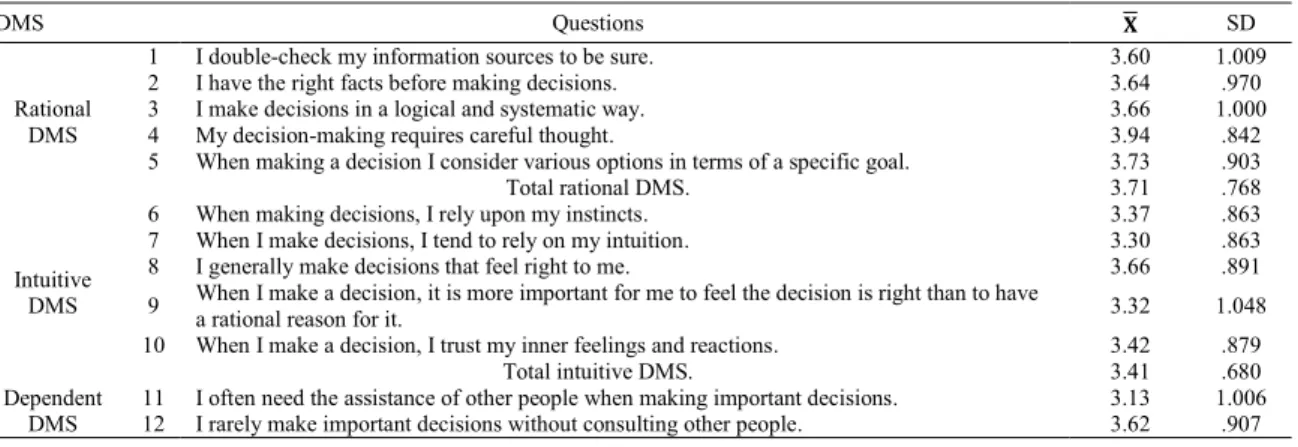
Table 2. Mean and standard deviation values of the participants’ responses to the General Decision Making Styles Questionnaire
DMS Questions ܆ SD
Rational DMS
1 I double-check my information sources to be sure. 3.60 1.009 2 I have the right facts before making decisions. 3.64 .970 3 I make decisions in a logical and systematic way. 3.66 1.000 4 My decision-making requires careful thought. 3.94 .842 5 When making a decision I consider various options in terms of a specific goal. 3.73 .903
Total rational DMS. 3.71 .768
Intuitive DMS
6 When making decisions, I rely upon my instincts. 3.37 .863 7 When I make decisions, I tend to rely on my intuition. 3.30 .863 8 I generally make decisions that feel right to me. 3.66 .891 9 When I make a decision, it is more important for me to feel the decision is right than to have a rational reason for it. 3.32 1.048 10 When I make a decision, I trust my inner feelings and reactions. 3.42 .879
Total intuitive DMS. 3.41 .680
Dependent
13 I use the advice of other people in making my important decisions. 3.63 .908 14 If I have the support of others, it’s easier for me to make important decisions. 3.34 .938 15 I like to have someone to steer me in the right direction when I am faced with important decisions. 3.12 1.004
Total dependent DMS. 3.36 .673
Avoidant DMS
16 I avoid making important decisions until the pressure is on. 2.71 1.033 17 I postpone decision-making whenever possible. 2.30 .912 18 I often procrastinate when it comes to making important decisions. 2.38 .955 19 I generally make important decisions at the last minute. 2.36 .998 20 I put off making many decisions because thinking about them makes me uneasy. 2.30 .960
Total avoidant DMS. 2.41 .815
Spontaneous DMS
21 I generally make snap decisions. 2.40 .970
22 I often make decisions at the spur of the moment. 2.46 .972
23 I make quick decisions. 2.76 .997
24 I often make impulsive decisions. 2.23 .968
Total spontaneous DMS. 2.46 .793
As shown in Table 2, mean of the rational DMS was highest (ܺ=3.71; SD=.768), followed by the mean of the intuitive DMS (ܺ=3.41; SD= .680), Dependent DMS (ܺ= 3.36; SD= .673), Avoidant DMS (ܺ= 3.36; SD .673) and Spontaneous DMS (ܺ=2.46; SD= .793). The scores ranged from 1 to 5.
5.3. Relationship between Teachers’ Job Satisfaction and Administrators’ Decision-Making Style Table 3. Correlation analysis results of between job satisfaction and decision-making styles
OJS RDMS IDMS DDMS ADMS SDMS
OJS 1 RDMS .439* 1 IDMS .182* .360* 1 DDMS .260* .487* .379* 1 ADMS -.403* -.522* -.156* -.152* 1 SDMS -.346* -.494* -.106* -.259* .628* 1 *p<.01
Table 3 shows a significant positive mid-level correlation between JS and RDMS (r=0.439; p< .01); according to this data it can be said that the use of the RDMS by administrators increased teachers’ job satisfaction. It was found that a significant positive low-level correlation exists between JS and IDMS (r=0.182; p< .01). This result demonstrates that the use of the IDMS by administrators increases teachers’ job satisfaction. A significant positive mid-level correlation was found between JS and DDMS (r=0.260; p< .01), according to which, the use of the DDMS by administrators increases teachers job satisfaction. A significant positive mid-level correlation was also identified between JS and ADMS (r= -0.403; p< .01), which indicates that the use of the ADMS by administrators decreases teachers job satisfaction. Significant positive midlevel correlation was discovered between JS and SDMS (r= -0.346; p< .01). Therefore, the use of the SDMS by administrators decreases teacher job satisfaction.
5.4. Prediction levels of decision-making style on teachers’ job satisfaction
Table 4. The effects of administrators’ decision-making styles on teachers’ job satisfaction
Predictive B SD β t p binary r partial r
Constant 2.884 .183 - 15.801 .000 - - RDMS .178 .035 .244 5.133 .000 .439 .198 IDMS 017 .031 .021 .544 .586 .182 .021 DDMS .069 .034 .083 2.024 .043 .260 .079 ADMS -.151 .032 -.221 -4.683 .000 -.403 -.181 SDMS -.044 .032 -.063 -1.365 .173 -.346 -.054 R= 0.493 R2=0.243 F (5-644)=41.433 p=0.000
According to the result of the multivariate linear regression analysis it was found that a positive mid-level relationship exists between job satisfaction levels and decision-making styles (R=0.493, R2=0.243, p<0.001). When we observed bilateral and partial correlations between predictor variables and the dependent variable, the following results were shown: a positive mid-level relationship between JS and RDMS (r=0.439) [(r=0.198) if other variables are controlled]; a positive low-level relationship (r=0.182) between JS and IDMS [(r=0.021) if other variables are controlled]; a positive low-level relationship between JS and DDMS (r=0.260) [(r=0.079) if other variables are controlled]; a negative mid-level relationship between JS and ADMS (r=-0.403) [(r=-0.181) if other variables are controlled]; and a negative mid-level relationship between JS and SDMS (r=-0.346) [(r=-0.054) if other variables are controlled]. These five variables explain 24.3% of the total variance related to JS. According to the standardized regression coefficient (β), the order of importance of the predictor variables on JS are RDMS, ADMS, DDMS, SDMS, and IDMS. In the light of these findings, the equation of regression that predicts job satisfaction levels is as follows:
Job satisfaction= 2.884 + 0.178 RDMS + 0.017 IDMS + 0.069 DDMS – 0.151 ADMS – 0.044 SDMS.
6.Discussion and Suggestions
Initially the job satisfaction levels of the participants were determined. In regard to IJS, it was observed that teacher’s jobs always provide them with activities that keep them invigorated, and opportunity to do something useful for others. Teachers also felt that they could utilize their skills and that they had a sense of accomplishment at the end of the working day. Based on data, teachers’ and administrators’ job satisfaction levels are generally high. The results for EJS showed that teachers were satisfied with the guidance and support of their administrators, but unfortunately they also thought that opportunities for promotion were limited, and that their salaries were insufficient. These results suggest that the extrinsic job satisfaction levels of teachers are in the mid-level range. Participants’ overall job satisfaction levels were determined by the combined average of the questionnaire. In regard to this, it can be concluded that, overall, teachers and administrators have mid-range JS levels. External factors played a major role in adversely effecting overall JS results. Moreover, teachers’ intrinsic JS levels were seen to be higher than their extrinsic JS levels. Teachers appear to internalize their jobs, and they believe that they are doing something useful for others; on the other hand, extrinsic factors affect them negatively. Similarly, Karatas and Gules (2010) concluded that teachers’ intrinsic JS levels are higher than their extrinsic JS levels. Furthermore, studies by Kilic, Tanrikulu & Ugur (2013), Athanasios (2001), and Huysman (2007), show similar teacher JS levels.
In the second part of the paper, we saw that the DMS of administrators was determined by participants’ opinions. According to the results of the research, administrators mostly use RDMS. They occasionally use IDMS and DDMS. The questionnaire also showed that administrators rarely used ADMS and SDMS. In light of these findings, we can say that administrators are more likely to make decision rationally, and their feelings. However, we cannot say that administrators are independent decision makers because the research results also show that they often use the advice of other people in making decisions. The use of RDMS by administrators may depend on strict laws and have little to do with individual discretion. In addition, managers’ DDMS scores were high, which may be due to the fear of making mistakes. Alver, Ada and Cakici (2006), concluded that administrators often use logical DMS and rarely use intrinsic DMS and indecision DMS. Hansson and Andersen (2007) concluded that 38% of administrators use intuitive DMS and 29% of administrators use emotional DMS. İlmez (2010) concluded that administrators who work at public corporations mostly use Avoidant and Spontaneous DMS and rarely use Rational and Intuitive DMS. The reason for these different results may be due to the use of the research methods and applications at different times and institutions.
In the final part of the paper, the relationship between overall job satisfaction levels and decision-making styles were examined. According to the results of the research, a significant positive mid-level correlation was found between JS and DMS. Regression analysis showed that JS is positively affected by RDMS, IDMS, and DDMS, while it is negatively affected by ADMS and SDMS. All of these variables together explain 24.3% of total variance related to teacher job satisfaction. These findings enable us to say that the use of RDMS, IDMS or DDMS by administrators in the decision-making process may increase teacher job satisfaction. Inversely, teacher job satisfaction levels may decrease when ADMS and SDMS are used by school administrators.
These findings show that the ways administrators make decisions have important effects on teacher JS. When at the point of deciding, school administrators, who act rationally, take account the values, ethics, events, and make logical and reasoned decisions, can help increase teacher JS levels substantially. If they act intuitively and take the advice of others during the decision-making process, administrators can also increase the teacher JS levels, albeit to a lesser extent. School administrators who avoid or postpone making decisions, or decide without thinking things through, decrease teachers’ job satisfaction levels. Teachers who may have difficulties adapting to new situations could be particularly affected by poor DMS, and display increased stress levels, lack of productivity, absenteeism, and so on. The findings of Dinhamm and Scotts (1988) show that the leadership, communication skills, and DMS of administrators have positive effects on JS, while and Stewart et al. (1986) showed that persuasive and participative DMS increases employees’ JS. These findings are also supported by the research of Russ, McNeilly and Comer (1996), who revealed that employees whose managers use RDMS have higher job satisfaction and organizational loyalty, but lower stress levels.
Due to the results of this research the following suggestions can be can:
x The intrinsic JS levels of teachers are higher than their extrinsic JS levels. To help increase overall teacher JS, external factors such as working conditions and payment should be improve.
x In-service education about the decision-making process and different DMS should be provided to school administrators responsible for increasing teachers’ JS.
x Leadership programs, and problem solving skills training, should be offered to school administrator candidates.
References
Adair, J. (2000). Decision making and problem solving. (N. Kalayci, trans.). Ankara: Gazi Printing.
Akbolat, M., Isik, O. & Ugurluoglu, O. (2011). Comparison of locus of control, job satisfaction, role ambiguity and role conflict of health employees. Hacettepe University/Journal of Economics and Administrative Sciences, 29(2), 23-48.
Alderfer, C. P., & Guzzo, R. A. (1979). Life Experiences and Adults' Enduring Strength of Desires İn Organizations. Administrative Science Quarterly, 347-361.
Alver, B., Ada, S. & Cakici, D. (2006). Examining the decision-making strategies of the administrators according to some variables. Journal of Kazim Karabekir Education Faculty, 13, 55-70.
Athanasios D. K. (2001). Personal Characteristics And Job Satisfaction Of Greek Teachers. International Journal of Educational Management, 15(7), 354 – 358.
Aydin, M. (2010). Education Management. (9th Edition).Ankara: Hatiboglu Printing
Aydin, A., Sarier, Y. & Uysal, S. (2013). The effect of the school managers’ leadership styles on teachers’ organizational loyalty and job satisfaction. Educational Sciences: Theory & Practice, 13(2), 795-811.
Ayres, J. & Malouff, J. M. (2007). Problem-solving training to help workers increase positive affect, job satisfaction, and life satisfaction. European Journal of Work and Organizational Psychology, 16(3), 279-294.
Basaran, İ. E. (2008). Organizational Behavior - Production Power of Human. Ankara: Ekinoks Publishing.
Bogler, R. (2001). The influence of leadership style on teacher job satisfaction. Educational Administration Quarterly, 37(5), 662-683. Brousseau, K. R., Driver, M. J., Hourihan, G. & Larsson, R. (2006). The seasoned executive's decision-making style. Harvard Business Review,
84(2), 110-121.
Cayli, B. (2013). The relationship between locus of control, job satisfaction and mediating effect of organizational justice. Unpublished master thesis. Balikesir University. Social Sciences Institute, Balikesir.
Cetin, F., Basim, H. N. & Karatas, M. (2011). The roles of organizational justice perception and job satisfaction on the problem solving abilities of the employees. Journal of Management & Economics, 18(1), 71-85.
Coban, A.E., & Hamamci, Z. (2006). Investigation of decision strategies of high school students who have different locus of control. Kastamonu Education Journal, 14(2),393-402.
Colakkadioglu, O. (2013). The reliability and validity study of adolescent decision making questionnaire for the high school students. Mustafa Kemal University Journal of Social Sciences Institute, 9(19), 387-403.
Dedebali, K. (2010). In-service training of police officer job satisfaction and performance effects of staff. Unpublished master thesis. Kirikkale University, Social Sciences Institute, Kirikkale.
Deniz, M. E. (2004). Investigation of the relation between decision self-esteem, decision making style and problem solving skill of the university students. Eurasian Journal of Educational Research, 4(15), 23-35
Dietz, T. (2003). What is a good decision? Criteria for environmental decision making. Human Ecology Review, 10(1), 33-39.
Di Fabio, A., Blustein ve D. L. (2010). Emotional intelligence and decisional conflict styles some empirical evidence among Italian high school students. Journal of Career Assessment, 18(1), 71-81.
Dinham, S., & Scott, C. (1998). A three domain model of teacher and school executive career satisfaction. Journal of Educational Administration, 36(4), 362-378.
Erdogan, İ. (2010). Education and school management.. (8th Edition). İstanbul: Alfa Publihing.
Forman, A., & Selly, M.A. (2002). Decision by objectives: How to convince others that you are right. (Second Edition). Singapore: World Scientific Publishing. Retrieved February 14, 2014, from http://professorforman.com/DecisionByObjectives/DBO.pdf.
French, D. J., West, R. J., Elander, J. & Wilding, J. M. (1993). Decision - making style, driving style, and self - reported involvement in road traffic accidents. Ergonomics, 36(6), 627-644.
Gamsiz, S., Yazici, H. & Altun, F. (2013). Type A personality, stress resources, self-efficacy and job satisfaction among teachers. Electronic Turkish Studies, 8(8), 1475-1488. Retrieved from DOI:http://dx.doi.org/10.7827/TurkishStudies.5328.February 02, 2014.
Girgin, V., & Kocabiyik, A. (2003). Is described the "predisposed to traffic accidents", who are the risky drivers?. Dusunen Adam The Journal of Psychiatry and Neurological Sciences, 16(1), 35-38.
Hagerty, M. R. (1999). Testing Maslow's hierarchy of needs: National quality-of-life across time. Social Indicators Research, 46(3), 249-271. Hariri, H. (2011). Leadership styles, decision-making styles, and teacher job satisfaction: an Indonesian school context. Unpublished doctoral
dissertation. James Cook University, School of Business, Australia.
Hicks, M. J. (2005). Problem solving and decision making: Hard, Soft, and Creative Approaches. Belmont, CA: Cengage Learning. Howard, R. A. (1983). The evolution of decision analysis. Readings on the principles and applications of decision analysis, 1, 5-16
Huysman, J.T. (2007). Rural teacher satisfaction: an analysis of beliefs and attitudes of rural teachers’ job satisfaction. Unpublished doctoral disseertation. Department of Educational Research, Technology and Leadership University of Central Florida, Orlando, USA.
İlmez, M. (2010). Determine the relationship between leadership styles and making a decision styles of manager and employee in the public organization. Unpublished master thesis. Ufuk University Social Sciences Institute, Ankara
Judge, T. A., & Bono, J. E. (2001). Relationship of core self-evaluations traits-self-esteem, generalized self-efficacy, locus of control, and emotional stability-with job satisfaction and job performance: A meta-analysis. Journal of applied Psychology, 86(1), 80-92
Julien, H. E. (1999). Barriers to adolescents' information seeking for career decision making. Journal of the American Society for Information Science, 50(1), 38-48.
Kaplan, M. (2007). Motivation theories under the application of special program and equipments to measure performance of employer and a case study. Unpublished master thesis. Atilim University Social Sciences Institute, Ankara
Karatas, S., ve Gules, H. (2010). The relationship between primary school teachers' job satisfaction and organizational commitment. Usak University, Journal of Social Sciences, 3(2), 74-89.
Kayikci, K. (2005). Professional contentment and discontentment of the education supervisors. Educational Administration: Theory and Practice,11(4), 507-527.
Kerlinger, F.N. (1951). Decision-making in Japan. Social Forces,30(1),36-41.
Kilic, S., Tanrikulu, T., & Ugur, H. (2013). Comparison of the level of job satisfaction between at private and state primary school teachers. International Journal of Human Sciences, 10(1), 760-779.
Kirkcaldy, B. D., Shephard, R. J. & Furnham, A. F. (2002). The İnfluence of type: A behaviour and locus of control upon job satisfaction and occupational health. Personality and Individual Differences, 33(8), 1361-1371.
Klassen, R. M., & Chiu, M. M. (2010). Effects on teachers' self-efficacy and job satisfaction: Teacher Gender, Years Of Experience, And Job Stress. Journal of Educational Psychology, 102(3), 741-756.
Koca, B. (2010). Motivation. Journal of Inonu University Health Services Vocational School, 1(1), 23-35.
Kocak, R., & Eves, S. (2010). The relationship between problem-solving and job satisfaction of school administrators. International Journal of Human Sciences, 7(1), 193-212.
Kocoglu, E. (2010). Decision-making period of administrators in business enterprises and usage of informatics during this period: Sample of Ankara province.Unpublished master thesis. Atilim University Social Sciences Institute, Ankara.
Kuzgun, Y. (2012). Decision Strategies Scale. Scales The Scales used in the Guidance and Counseling. Y. Kuzgun & F. Bacanli (Editors). (4th Edition), p. 9-22. Ankara: Nobel Publishing.
Locke, E.A. (1976). The Nature and Causes of Job Satisfaction. Marvin Dunnette (Editor), Handbook of Industrial and Organizational Psychologys. s.1297-1350. Chicago: Rand McNally.
Mann, L., Radford, M., Burnett, P., Ford, S., Bond, M., Leung, K., Yang, K. S. (1998). Cross̺cultural differences in self̺reported decision̺
making style and confidence. International Journal of Psychology, 33(5), 325-335.
Meisler, G. (2014). Exploring emotional intelligence, political skill, and job satisfaction. Employee Relations, 36(3), 280-293.
Mintzberg, H., Raisinghani D. & Theoret, A. (1976). The structure of "unstructured" decision processes. Administrative Science Quarterly, 21(2), 246-275.
Morrison, R. S., Jones, L. & Fuller, B. (1997). The relation between leadership style and empowerment on job satisfaction of nurses. Journal of Nursing Administration, 27(5), 27-34.
Mousavi, S. H., Yarmohammadi, S., Nosrat, A. B. ve Tarasi, Z. (2012). The relationship between emotional intelligence and job satisfaction of physical education teachers. Annals of Biological Research, 3(2), 780-788.
Muhonen, T., & Torkelson, E. (2004). Work locus of control and its relationship to health and job satisfaction from a gender perspective. Stress and Health, 20(1), 21-28.
Nas, S. (2006). Analysis of ship masters’ individual decision making process for the management of ship operations and application of an integrated model. Unpublished doctoral dissertation. Dokuz Eylul University Social Sciences Institute, İzmir.
Nygren, T. E., & White, R. J. (2005). Relating decision making styles to predicting selfefficacy and a generalized expectation of success and failure. In Proceedings of the Human Factors and Ergonomics Society Annual Meeting, 49(3), 432-434.
Oliver, R.L. (1974). Expectancy theory predictions of salesmen's performance. Journal of Marketing Research,11(3), 243-53. Onaran, O. (1981). Motivation Theories at the Work. Ankara: Sevinc Publishing.
Organ, D. W., & Greene, C. N. (1974). Role ambiguity, locus of control, and work satisfaction. Journal of Applied Psychology, 59(1), 101-102. Philips, S.D., & Pazienza, N.C. (1988). History and theory of the assessment of career development and decision making. Career Decision
Making. 1-131,Hilsdale, NJ:Erlbaum.
Walsh W.B, Asipov, S.H. (Editorrs). p. 1-32. New Jersey, USA: Lawrence Erlbaum Associates Inc.
Russ, F. A., McNeilly, K. M. & Comer, J. M. (1996). Leadership, decision making and performance of sales managers: a multi-level approach. Journal of Personal Selling & Sales Management, 16(3), 1-15.
Sardogan, M. E., Karahan, T. F. & Kaygusuz, C. (2006). An investigation of university students' indecisiveness strategies in level of the problem solving skill, gender, level of class, and kind of the faculty. Mersin University Journal of the Faculty of Education, 2(1), 78-97.
Scott, S. G., ve Bruce, R. A. (1995). Decision-making style: the development and assessment of a new measure. Educational and Psychological Measurement, 55(5), 818-831.
Shetty, B., & Gujaratthi, R. (2013). Doctor’s emotional intelligence and its impact on doctor’s job satisfaction and patient satisfaction with reference to Mumbai City. Intercontinental Journal of Human Research Review, 1(9), 21-33
Simon, H. (1965). Administrative decision making. Public Administration Review, 25(1), 31-37.
Shoemaker, M. E. (1999). Leadership practices in sales managers associated with the self-efficacy, role clarity and job satisfaction of individual industrial salespeople. Journal of Personal Selling & Sales Management, 19(4), 1-19.
Stewart, L. P., Gudykunst, W. B., Ting̺Toomey, S. & Nishida, T. (1986). The effects of decision̺making style on openness and satisfaction within japanese organizations. Communications Monographs, 53(3), 236-251.
Sy, T., Tram, S. & O’hara, L. A. (2006). Relation of employee and manager emotional intelligence to job satisfaction and performance. Journal of Vocational Behavior, 68(3), 461-473.
Tas, A., & Onder, E. (2010). The effect of administrator’s leadership behaviors on staff job satisfaction. Electronic Journal of Social Sciences, 9(32), 17-30.
Telef, B.B.(2011). The study of teachers’ self-efficacy, job satisfaction, life satisfaction and burnout. Elementary Education Online, 10(1), 91-108.
Thunholm, P. (2004). Decision-making style: Habit, style or both? Personality and İndividual Differences, 36(4), 931-944.
Titrek, 0., Konak, H. & Titrek, A. (2013). Determining the relations between the self-awareness of pre-service teachers and their decision-making styles. This paper presented at VI. National Postgraduate Education Symposium, Retreived from http://egitim.sakarya.edu.tr/sites/egitim.sakarya.edu.tr/file/ULES-Lisansustu_egitim_cilt21.pdf at 20.01.2015, p. 76-84.
Wang, Y., & Ruhe, G. (2007). The cognitive process of decision making. Int’l Journal of Cognitive Informatics and Natural Intelligence, 1(2), 73-85.
Yakin, M., ve Erdil, O. (2012). Relationships between self-efficacy and work engagement and the effects on job satisfaction: a survey on certified public accountants. Procedia-Social and Behavioral Sciences, 58, 370-378
Yaslioglu, M.M. (2007). Biases in decision making process and a research. Unpublished master thesis.İstanbul University Social Sciences Institute, İstanbul.
Yildiz, K. (2012). Primary school principals decision making styles. Sakarya University Journal of Educational Faculty, 24(1-7), 104-133. Yilmaz, M., & Talas, M. (2010). Decision-making process in information center. Zeitschrift fur die Welt der Turken, 2 (1), 197-216.