This is an Open Access document downloaded from ORCA, Cardiff University's institutional repository: http://orca.cf.ac.uk/65689/
This is the author’s version of a work that was submitted to / accepted for publication. Citation for final published version:
Edwards, John Richard 2015. The method of book-keeping, deduced from clear principles. Accounting and Business Research 45 (2) , pp. 256-277. 10.1080/00014788.2014.978255 file
Publishers page: http://dx.doi.org/10.1080/00014788.2014.978255 <http://dx.doi.org/10.1080/00014788.2014.978255>
Please note:
Changes made as a result of publishing processes such as copy-editing, formatting and page numbers may not be reflected in this version. For the definitive version of this publication, please refer to the published source. You are advised to consult the publisher’s version if you wish to cite
this paper.
This version is being made available in accordance with publisher policies. See
http://orca.cf.ac.uk/policies.html for usage policies. Copyright and moral rights for publications made available in ORCA are retained by the copyright holders.
The method of book-keeping, deduced from clear principles
Abstract
James Dodson FRS devised a new way of teaching double entry bookkeeping based on deductive logic, and he employed this method of scientific analysis to require
recognition of assets and changes in their value in the absence of prior market transactions. This paper is designed to advance knowledge of accounting history by demonstrating diversity in the history of accounting thought and by revealing how it can be influenced by new ways of thinking gaining credence within the wider
contemporary environment. Understanding of the history of double entry bookkeeping is broadened and deepened by locating Dodson s treatise within the context of the scientific revolution; a time when complete obedience to the scriptures and classical authorities came under challenge from the systematic pursuit of knowledge based on reasoning, critical questioning, and the establishment of clear relationships between cause and effect.
Keywords: Accounting history; James Dodson; mathematical reasoning; scientific
revolution.
1. Introduction
The principles versus rules debate today pervades the accounting arena (e.g. Institute of Chartered Accountants of Scotland 2006, International Federation of Accountants 2005). Interest in the relative merits of principles and rules as the basis for financial reporting, for example, accelerated following revelations associated with the collapse of the Enron Corporation in 2001. The present-day search for a better framework of financial reporting attempts to combine principles and rules in the endeavour to
achieve the advantages of each approach and to avoid their individual shortcomings. To do this, conceptual frameworks supply the theoretical principles (the fundamental and enhancing characteristics) which, by applying notions of deductive reasoning, are given practical effect though financial reporting standards. As Macve (2014, p. 1) recently explained: The standard setters version is that increasingly F[inancial] A[ccounting] T[heory] is rationally derived from a basically coherent conceptual framework .1 This
1 Macve (2014) also draws attention to the inability of the Financial Accounting Standards Board and the International Accounting Standards Board to develop a
paper engages with the accountant, mathematician and actuary James Dodson (c. 1705-1757) whose approach to teaching accounting based on deductive reasoning may be seen as a harbinger of the present-day focus on the intertwining of principles and rules in the endeavour to construct better ways of doing things within the accounting domain.
In a recent paper lamenting the lack of attention to normative research, Glover
(2014) notes Ross Watts concern that a lack of understanding about accounting history and evolution is a likely source of problems , and he encourages accounting academics to be better students of accounting history and thought . This is not a new concern; a third of a century ago Parker (1980) drew attention to the lack of biographical studies of British accountants. Notable contributions since then include collections of articles on accounting pioneers and thinkers (Kitchen and Parker 1980, Bywater and Yamey 1982) and stand-alone studies such as Parker s analysis of the contribution to
accounting thought made by the early seventeenth-century gentleman, accountant and lexicographer, Roger North. In-depth studies of the role of the individual in
accounting s past nevertheless remain thin on the ground, and this is a lacuna which, in Carnegie and Napier s , p. estimation, needs to be addressed: Accounting is a human construction. Contemporary accounting cannot be understood without reference to the key personalities who have contributed to accounting development . Likewise, Lee (2002, p. 124, emphasis added) believes that: In order to explain and understand accounting practices, developments, failures and successes, we need to know more about the accounting actors who were present . The study of Dodson s life and works fulfils these criteria.
The inter-related purposes of this paper are addressed in three main sections which, first, introduce James Dodson FRS as an actor in the history of accounting worthy of study, second, show how Dodsons text on double entry bookkeeping (Dodson 17502) was influenced by the scientific revolution that was in full swing at the time he wrote and, third, explain and evaluate Dodson s contribution to the development of ideas on asset recognition and profit measurement.
conceptual framework which ensures consistent accounting standards, while Nobes (2014) provides specific examples of accounting standards which deviate from the framework s definition of a liability.
2 This and other eighteenth century treatises cited in this paper have been sourced from Eighteenth Century Collections Online.
2. James Dodson FRS
James Dodson was born c. 1705, the son of a tailor. Dodson therefore hailed from a relatively modest background although, as a citizen and freeman of the Merchant Taylors Company (Gray 2004), John Dodson appears to have been sufficiently well off to arrange a good education for his son. James was tutored by the celebrated
mathematician Abraham De Moivre, who has been acclaimed one of the great pioneers of classical probability theory … [and] who also made seminal contributions in analytic geometry, complex analysis and the theory of annuities (Bellhouse and Genest 2007, p. 109).3 The young Dodson was one of De Moivre s many tutor-student relationships [that] turned into life-long friendships (Bellhouse 2011, p. 42). They were working together as consultants in the valuation of annuities and games of chance at the time of De Moivre s death in (Bellhouse 2011, p. 212).
It seems fairly clear that Dodson s education did not immediately pave the way for a financially rewarding career: as a young man he devoted himself to the unremunerative task of calculating antilogarithms (Gray 2004). In 1735, he married Elizabeth Goodwin, the ward of Sir John Chesshyre (Lemmings 2004). Elizabeth and James had three
children – James, Thomas and Elizabeth. The eldest served as actuary for the Equitable Life Assurance Society 1764-1767 (de Morgan 1867-1869, p. 354; Gray 2004). Dodson's granddaughter, another Elizabeth, married Colonel James De Morgan and their son Augustus became a distinguished mathematician Stephen . Augustus
biographical study of his great grandfather was published in the 1867-1869 edition of the Journal of the Institute of Actuaries.
As a young married man Dodson taught Young Gentlemen writing, arithmetic, merchants accompts, algebra, geometry and measuring at the (and and Pen in
Warwick Lane, London (London daily post and general advertiser, April 19, 1738, Issue 10834). He continued to teach throughout his career, while also practising as an actuary and as an accountant. He died on 23 November 1757 when about 52 years of age.
3 De Moivre was a close friend of luminaries of the scientific revolution such as Isaac Newton and Edmond Halley (Jardine 1999) and was elected a Fellow of The Royal Society in 1697 (Schneider 2004).
4 This and other eighteenth century newspaper material cited in this paper has been sourced from 17th and 18th Century Burney Collection Newspapers.
2.1 Mathematician, actuary and accountant
The Royal Society was created on 28 November 1660 as a Fellowship of the world's most eminent scientists and is the oldest scientific academy in continuous existence (Royal Society 2012). Just four accountants were admitted during the first 140 years of its existence. John Collins gained entry seven years after the Society's formation
(Scriba 2004). Dodson was next in 1755 (Gray 2004), followed by Charles Hutton in 1778 (Guicciardini 2004) and John Seally in 1791 (Goodwin 2004). In each case the basis for admission was the entrant s contribution to the science of mathematics.
The evidence suggests that it was De Moivre who helped to develop Dodson s
mathematical skills and also defined some of the practical issues that Dodson sought to address. De Moivre, himself, was preoccupied with the question of how mathematics might be applied to the resolution of matters concerning the conduct of a capitalist society, such as interest, loans, mortgages, pensions, reversions or annuities (Schneider 2004). He encouraged in his students a wide-ranging response to the problems of quantity, both scientific and practical, of the early eighteenth century (Jungnickel and McCormmach 1996, p. 51), and there can be little doubt that he helped provide the inspiration for Dodson s innovative contributions in the spheres of accounting, mathematics and actuarial science. Dodson s The mathematical repository (three volumes: 1748, 1753, 1755) is dedicated to De Moivre and explicitly acknowledges his former teacher s influence.
The mathematical repository is considered a classic of actuarial science that displayed Dodson s mastery of algebra and his knowledge of the subject of annuities (Gray 2004), and it was that treatise which earned him election to The Royal Society in January 1755. Later that year, Dodson was appointed Master of the Royal Mathematical School and Stone s School, both of which were institutions within Christ s (ospital (Gray 2004). De Morgan (1867-1869, p. 345) believes that Dodson owed his admission to The Royal Society to the influence exerted by its president, the Earl of Macclesfield, who was a fellow student of De Moivre and, as we shall see, became acquainted with Dodson in a professional capacity. Admission to The Royal Society preceded Dodson s appointment as Master of the Royal Mathematical School, and De Morgan (1867-1869, p. 345) considers the events to be connected:
The Royal Society was somewhat exclusive during the last [eighteenth] century, and rather averse to admit men in trade. But we must infer that Dodson was not elected because his new post made him grand enough, but that he might become grand enough for the (probably) promised post.
Dodson was by no means unknown to The Royal Society at the time of his admission having previously published in Philosophical transactions5 on three occasions (Dodson 1751-1752, 1753-1754a, 1753-1754b). There, his concern was to address the lack of attention devoted to the value of an annuity for life (secured by land), and the
probability of survivorship, between two persons of given ages (Dodson 1753-1754a, p. 487).6
Dodson gave further practical effect to his knowledge of probability theory just a year before his death when, in 1756, the Amicable Society, in conformity with its age limit of 45 on admissions, refused to assure him.7 This motivated Dodson to develop more rational principles and practices for the operation of a life assurance business. His
First lecture on insurances (Gray 2004) sets out the operating system for mutual life assurance, showing how premiums should be calculated [depending of life expectancy], and worked some examples to show how the fund would be maintained (Gray 2004). Dodson brought together a group of people for the purpose of securing a charter for a new life office to function on the basis of his calculations (Ogborn 1956, p. 235).
Following a number of unsuccessful initiatives, the Equitable Life Assurance Society was established in 1762, five years after Dodson s death.8
5The inaugural issue of the world s first scientific journal, which was the venue where new scientific ideas could be made available for expert scrutiny (Jardine 1999, pp. 318-319), was published by The Royal Society on 6 March 1665.
6 He returned to this theme following election to The Royal Society (Dodson 1755-, also publishing papers that made the case for periodic revisions of (alley s measurements of the magnetic needle; the latter joint-authored with the teacher and writer on mathematics and navigation, William Mountaine FRS (Mountaine and Dodson 1753-1754, 1757-1758).
7The Amicable s policy of charging all policy holders the same premium caused it to impose a cut-off age for admission.
8The Society awarded Dodson s children £ for his plans and trouble in planning the said Society, and making the necessary calculations (De Morgan 1867-1869, p. 353, p. 354).
Today, the website for The Actuarial Profession which represents the members of the Institute and Faculty of Actuaries acknowledges the pioneering role played by Dodson in the development of their profession.
James Dodson's First Lecture on Insurances is a landmark original text that first set down the actuarial basis for a mutual life assurance company to operate
demonstrating how a Corperation for Insuring Lives could be created and sustain a profitable business that would deliver claim payments to beneficiaries of
policyholders paying level premiums for the whole of life or for limited terms (Actuarial Profession 2010).
Turning to Dodson s career as an accountant, an advertisement inserted in his treatise entitled The Accountant; or, the method of book-keeping, deduced from clear principles tells us about the services he supplied to the business community. There, he informed readers that Accounts, are examined, stated, and settled, by the Author (Dodson 1750, preface p. xii9). He also offered to install new accounting systems and clearly did not wish to put off potential clients by insisting that they adopt the exact system outlined in his book: such Persons, whose particular Business may require their Books to be kept in a different Manner from those contained in the above Work, may be assisted by him, in contriving such a Form as shall be convenient for them (Dodson 1750, preface p. xii). Post-installation, Dodson remained available to supervise the Execution thereof, until their Servants are sufficiently expert therein .
Accounting historians have acknowledged Dodson as author of The Accountant (e.g. Parker 1968, p. 61; Chambers 1994, p. 83), but few have said much more. Attention has been drawn to the fact that Dodson is unusual among writers on double entry
bookkeeping, prior to the late-nineteenth century, in including some focus on accounting for manufacturing activities (Edwards 1937, pp. 226-227; Bywater and Yamey 1982, pp. 169-170) and for landed estates (Edwards 2009, p. 245). Dodson is also an early writer who recognised the potential for an accounting system to help
9 The page contents of Dodson (1750) are not uniquely numbered. Separate sequences of Roman numerals are used for each of the dedication, the preface and the narrative exposition of double entry bookkeeping, while separate runs of Arabic numerals are employed for each type of business activity (estate, merchant, manufacturing) and for each stage of record keeping inventory, journal and ledger . )n citations of Dodson s text Roman numerals are therefore preceded by the words dedication , preface or
narrative and Arabic numerals by wordings which identify the activity and related record, e.g. estate ledger p. 2).
management to assess performance and make decisions as well as fulfilling the narrower stewardship role of tracking rights and obligations (Edwards et al. 2009).
Dodson made heavy use of the press to broadcast the availability of his many publications. An advert placed in the London daily post and general advertiser on 19 April 1738 (Issue 1083) announced The anti-logarithmic canon10 as Just Publish d. The title page reveals that Dodson then styled himself Writing-Master and Accomptant . An October 1749 edition of the London evening post (October 7, 1749 - October 10, 1749, Issue 3423), by which time Dodson described himself as a Teacher of the Mathematics , informed readers that Next Month will be publish d The Accountant; or, the method of book-keeping, deduced from clear principles. A month later, the Whitehall evening post or London intelligencer (November 28, 1749 - November 30, 1749, Issue 594) reports that this promise had been kept.11 Dodson (1751) styled himself Accomptant and Teacher of the Mathematics when presenting himself as the author of the enlarged 18th edition of Wingate s A plain and familiar method for attaining the knowledge and practice of
common arithmetic (London advertiser and literary gazette, April 17, 1751, Issue 39). As with Dodson s other texts, the eighteenth century literary community is then
bombarded with regular reminders of its availability.12
The next section locates Dodsons treatise on accounting within the general history of double entry bookkeeping and, more particularly, within the context of the scientific revolution.
3. Contextualising The Accountant
Surviving didactic treatises on accounting date from the twelfth century, starting with Richard fitz Nigel s Dialogus de scaccario (The dialogue of the Exchequer) (1177-1179)
10 It has proved possible to track the existence only of a 1742 version of that text (Dodson 1742).
11 Its publicised price was 4s 6d, which would equate to £30.88 in terms of today s purchasing power or £396.10 in terms of the relative wage today s worker would need to earn to acquire the book (Officer and Williamson 2014). Pre-decimalization of the British currency on February , there were old pence d to the shilling s and 20 shillings to the pound sterling (£).
12 Dodson also authored at least two books not captured by advertisements appearing in broadsheets covered by the th and th Century Burney Collection Newspapers . In 1746 Mountaine and Dodson published an updated version of Edmond Halley's isogonic magnetic chart, and a year later Dodson (1747) made available a book of tables for business and personal use.
whose purpose was to explain how the accounts of the sheriffs were audited and enrolled by the Exchequer (Douglas and Greenaway 1981, p. 523). Towards the end of the following century appeared Sir Walter of Henley s Husbandry13 which offered advice on thirteenth century estate management including the use of charge and discharge accounting (Parker 1999, Jones 2008). The focus of accounting instruction broadened over the centuries to reflect the wider range of activities that needed to be recorded and reported as the British economy diversified. An initial focus on government and landed estates was extended to incorporate retailing, wholesaling and trading activities by the end of the seventeenth century. Fundamental transformations were also made to the structure and format of instructional treatises in the endeavour to make them more effective aids to learning. One important innovation was the growing use of worked examples to illustrate how narrative explanations of bookkeeping practice should be applied to business situations. Following fitz Nigel, the teaching method employed in accounting/bookkeeping texts sometimes took the form of a discourse between master and student in the endeavour to replicate the classroom situation.
Initially accounting practices were presented as a great mass of rules for readers to learn and apply (Jackson 1956, p. 288), with rhymes sometimes composed as aide-mémoires. To the extent that an attempt was made to supply some kind of coherent explanation for the enumerated accounting practices, and thereby enable reasoning to replace rote learning, it was based on what became known as personification theory; an approach later lampooned by Jeremy Bentham: Wine is said to be debtor to cloth. To what use this absurd falsehood? What explanation of anything, does it give? (Bentham 1830, p. 10). Personification remained the dominant explanatory framework until the formulation of the proprietary and entity theories during the nineteenth and twentieth centuries (Mattessich 2003). Previts and Merino (1979, p. 165, see also Jackson 1956) described these approaches as conceptual framework[s] based upon logic that were needed to replace rationalization as used in personification of accounts . As early as the eighteenth century, however, some authors had attempted to do more, and
Hustcraft Stephens (1735) is credited with extricating himself from the quagmire of personification by focusing on the effect of transactions on the balance sheet (Jackson 1956, p. 307; see also Edwards 2014).
13 Oschinsky (1947, p. 54) estimates that Husbandry was written pre-1270. The original together with a translation appears in Lamond (1890).
To further improve the effectiveness of instructional texts, innovation in ways of teaching bookkeeping was accompanied by transformations in how the material was presented. Tebeaux (2000, p. 338) explains how some of the ideas of the French humanist, logician, and educational reformer, Pierre de la Ramée (anglicised to Peter Ramus) whose principal writings spanned the period 1543-1576 (Ong 1958), were employed to improve the communicative effectiveness of double entry bookkeeping treatises from the second half of the seventeenth century onwards:
Ramus showed the importance of the summary, but his method led to format strategies that are still used today: consistent use of font, use of lists to highlight important concepts, centred and extended headings, use of highlighting strategies – based on font and white space – to emphasise classification and organization (Tebeaux 2000, p. 338).
The outcomes were that Meaning was captured with the purpose of eliminating ambiguity. Accounting books could be skimmed through,14 seen, as they captured transactions in ways that incunabular texts could not (Tebeaux 2000, p. 339).15
3.1 The scientific revolution
Miller (1991, p. 735) highlights the need to study the broader vocabularies, arguments and rationales in relation to which accounting technologies can be given meaning and accounting innovation promoted . Dodson endorsed pedagogic innovation by
demonstrating how double entry bookkeeping might be more effectively taught through the application of scientific/mathematical methods of argument. The historical milieu for this new way of learning was the scientific revolution that was in full swing by the middle of the eighteenth century.
Hall (1962) dates the start of the scientific revolution as c. 1500, while the Age of Enlightenment (or Age of Reason) which ran from the late seventeenth century through
14 The full application of Ramusian notions of textual brevity enabled the rules of double entry bookkeeping to be presented in the form of a diagram on a single sheet of paper. Quattrone (2009, pp. 102-103) has drawn attention to the use of this approach by Thomas Brown (1673), with Handson (1669) another contemporary example of this genre (Edwards 2011a, p. 49).
15 For a meticulous study of the development of double entry bookkeeping in terms of textual innovation, see Hoskin and Macve (1986).
much of the eighteenth (Headrick 2000, p. 8)16 is credited with having adopted,
extended, and completed [that] intellectual and social project (Reill 2003, p. 23). It was a period when thinkers began to privilege reason and science against religion and superstition, tolerance against prejudice (Headrick 2000, p. 9). As Ray (2008) put it:
At its core was the questioning of traditional institutions, morals, and customs which had previously upheld the supremacy of the church in the intellectual sphere, and feudal relations in the social sphere. In this intellectual atmosphere, science, the process of systematic pursuit of knowledge, underwent a huge qualitative change from its earlier reliance on scriptures and classical Greek authorities like Aristotle, into a methodology dependent on reason, critical questioning, and establishment of clear relationship between cause and effect by direct observation.
Institutional forums were created for the furtherance of science, with their members encouraged to undertake research and report their findings through public lectures and in written form. Predominant among these scientific institutions in Britain was The Royal Society which, as we have seen, was created in 1660 and, from 1665, published the world s first scientific journal to which Dodson, consistent with the paraphernalia that helped define the scientist, contributed on a number of occasions.
The development of the discipline of mathematics played an important role in the transformation of the intellectual landscape during the Age of Enlightenment. One of the creators of the scientific revolution was the Italian physicist, mathematician,
astronomer, and philosopher, Galileo Galilei17 (1564-1642): By revealing the value of mathematics as a logical instrument in scientific reasoning, he transformed, if he did not actually create, an important method of inquiry (Hall 1962, p. 218). With the work of Isaac Newton – a close friend of Dodson s tutor Abraham De Moivre (Schneider 2014) –
the scientific revolution reached its climax so far as the physical sciences are
concerned (Hall 1962, p. 244, see also Shapin 1996, p. 61, Reill 2003, p. 23). Newton combined mathematics of axiomatic proof [based on deductive reasoning] with mechanics of physical observation (Age of Enlightenment, n.d.), and is judged to have
16 Mepham (1988) explores some connections between the writings of four Scottish authors on double entry bookkeeping and the Scottish Enlightenment .
17 For a fascinating account of the philosophical tightrope that early scientists had to navigate in the endeavour to avoid confrontation with religious doctrine see Galileo’s Daughter (Sobel 1998).
had a tremendous influence on English science through his position as president of The Royal Society 1703-1727 (Burns 2003, p. 214).
The scientific revolution also created a bigger role for evidence acquired through observation and experiment in the endeavour to produce useful and reliable models of nature and natural phenomena. In devising new ways of thinking inductive reasoning now played a prominent part, though the essential character of the new scientific method remained in some respects elusive: The one remaining quarrel was about whether the method was primarily deductive as Descartes , chiefly Continental followers believed) or inductive (as upheld, particularly in the Anglo-Saxon world, by Baconists Cohen , p. . Dodson employed both deductive and inductive logic in his writings on bookkeeping and life annuities.
3.2 Science and accounting
There is evidence of scientists and mathematicians turning their attention to accounting during the scientific revolution. Simon Stevin (1548/49-1620) was born in Bruges at a time when leading scientists were already challenging the generally accepted ideas and theories ... and were not content to repeat what had been handed down and made authoritative by the approval of the Church ten (ave , p. . Stevin s (1607) bookkeeping text employs the system of questions and answers between student and teacher that remained in vogue in treatises during the seventeenth century (ten Have 1956, p. 242). ten Have (1956, p. 242, emphasis added) nevertheless judges Stevin s book to be superior to that of his contemporaries:
Most writers on book-keeping in the sixteenth and seventeenth centuries attempted to deal with the subject by explaining and illustrating the appropriate entries for each of the many possible kinds of business transactions. Stevin, on the other hand,
attempted to explain the more general principles for analysing transactions into debit and credit, so that the pupil or reader himself could arrive from first principles at the book-keeping solution to each practical problem.
Later in the scientific revolution Dodson, with his background in mathematics and membership of The Royal Society, also endeavoured to apply scientific method to the teaching of bookkeeping. In doing so, he explored the interdisciplinary potential of his knowledge-base by applying modes of thinking from mathematics to better explain the fundamental character of bookkeeping and accounting. Recent research has revealed
that Dodson was not the only English author, or even the first, to engage with the process of deductive reasoning for that purpose. Edwards (2014 reveals that Dodson s contemporary, John Clark (1738), employed a priori reasoning based on the known truth today expressed as Capital = Assets – Liabilities,18 to help expedite the teaching of double entry bookkeeping. Also, that Clark did so 80 years before the previous, earliest known exponent of this algebraic approach, Frederick William Cronhelm (1818), and nearly a century and a half before Charles Ezra Sprague (1880) began to draw its
potential to the attention of a US readership. The balance sheet approach was of course increasingly adopted as a pedagogic tool for instruction in double entry bookkeeping during the twentieth century. )n contrast, Dodson s work is of interest because, as a mathematician, he attempted to teach double entry bookkeeping through a system of deductive reasoning that instead employed a narrative exposition based on a range of identified axioms and precepts.
It is of course important that historical studies give words their contemporary meaning (Miller and Napier 1993). In his famous Dictionary of the English language, Dr. Samuel Johnson (1755-1756) defined an axiom as A proposition evident at first sight and a precept as A rule authoritatively given . These are entirely consistent with current-day definitions, with that provided for axiom explaining more fully its role in mathematical reasoning: a statement or formula that is stipulated to be true for the purpose of a chain of reasoning: the foundation of a formal deductive system (Collins English dictionary 2003). Thus precepts within a system of deductive reasoning comprise a consistent body of propositions which are derived from a priori known truths. Clearly the validity of inferences arrived at by deduction depend on the
soundness of the axioms themselves. Provided one is correct in assuming the validity of the axioms, the precepts will represent irrefutable truths.
The next sub-section begins to examine how Dodson applied these ideas and tools to teach bookkeeping procedures.
18 These were not terms used in the eighteenth century (Parker 1994). The
corresponding words employed by Clark were: Value of his Estate or sometimes simply Stock , Total of all his Effects and Debts owing by him Edwards , p. 239).
3.3 Dodson’s deductive reasoning
The Preface to The Accountant (Dodson 1750, preface p. v) reports that The Reader is here presented with the result of many Years Experience in keeping, examining, and stating accounts of various kinds . Dodson claims to present the Theory and Practice of bookkeeping and describes his approach as follows:
The Author, in compiling this Theory, has endeavoured to render it scientific; he has therefore defined all the Terms used in the Method, [and] has made Use of several known Truths, equivalent to Axioms, and has desired one Thing to be granted; which done, the Precepts given for conducting the operative Part are shewn to be founded on the above Principles, and the whole Process from the [opening] Inventory to the [closing] Balance [Sheet], will appear to be the result of sound Reason and Judgment (Dodson 1750, preface p. vi).
Drawing on his mathematical background, Dodson s Theory is presented in a
systematic manner, commencing with 19 separate paragraphs (which he often refers to as Articles rather than Axioms) that supply the several known Truths (Dodson 1750, preface p. vi). This is followed by Precepts I-X that are cross-referenced, in the main, to the Articles. Also, some of the later Precepts are cross referenced to earlier ones. The message is that, as Dodson proceeds with his narrative, Precepts are logically derived from the preceding material.
The transaction which has to be entered in the books at the beginning of any accounting period is used here to illustrate Dodson s pedagogical method based on deductive argument. It comprises the debit and credit entries in the owner s capital ( Stock ) account together with the contra entries recorded in a range of individual asset and liability accounts. Dodson refers to the owner as the Accountant based on the idea that the merchant, as accountant, maintains a record of the relationship between himself and all other business parties (persons and otherwise). The Articles and
Precepts guiding the accounting treatment of this transaction are reproduced as Figure 1 in the same order that they appear in Dodson s text. Throughout, we can see the use of Ramusian ideas, as epitomised by listings, classifications and highlighting strategies, to organise the material. It is an example of how, as Quattrone (2009, p. 102) puts it,
Ramism influenced the way in which books were structured and their content visually represented, and thus relates visualisation to issues in the organisation of thinking .
The accounting treatment of the assets and liabilities that must be recorded When a Set of Books are to be opened (Precept I) is deduced from Articles 4, 14 and 16. As the
Accountant (i.e. the owner) is the central actor, one might have expected the opening record to be made in his name. However, Stock is substituted in the Place of the Accountant [himself] because, according to Article 16, the Account of Stock being his proper Account, with all the Persons, and Things, with whom, or which, he has any concern . Second, the Accountant is treated as Debtor, to all those Persons to whom he owes Money (i.e. each of his creditors is listed on the debit side of the Stock account) consistent with the self-evident statement, known to be true, presented as Article 4. Finally, the Value of his Cash, Goods, &c. Due to him are credited to the Stock account in accordance with Article 14 which makes it clear that the Terms Debtor and Creditor, may be applied to THINGS as well as PERSONS .
[Figure 1 about here]
Dodson s exposition of double entry bookkeeping procedures (see further below) does not, in this writer s estimation, result in a fundamental departure from the familiar rules-based narrative employing the concept of personification. Dodson undoubtedly provides the rules with a more coherent structure but, in the final analysis, it remains a directive-based exposition which may not have significantly advanced student
understanding of double entry bookkeeping. Certainly, as the next sub-section reveals, it did not form part of any major revision of the way in which that the subject was taught.
3.4 Scientific terminology in early accounting treatises
A full text search of the Eighteenth Century Collections Online database for the words book-keeping and precept appearing in the same text produced 286 hits , but the latter term featured rarely in bookkeeping manuals. When it did appear, the term usually received a single mention as a synonym for rule which of course it is. For example, Lazonby (1757, preface) commented: Their task more difficult, when only the memory is loaded with stiff rule and precept, than when the judgment is called in . A search which connected the words book-keeping and axiom (or axioms ) produced 98 hits , with its appearance usually confined to books on mathematics and, in a few cases, the arithmetical section of treatises that combined the study of that subject with bookkeeping (e.g. Hatton 1701). The following bookkeeping texts contain a single mention of the term axiom. The Teacher of mathematics , Benjamin Donn (1765, title
page), in the section of his book entitled Of Balancing , observed: for it is an Axiom, that the Difference of any two Quantities being added to the lesser, is equal to the greater Quantity (Donn 1765, p. 35). Fitzgerald (1771, p. 34) advised: The whole may be answered by the following axiom, or general rule. ... What you receive is debtor to what you deliver . And finally Quin (1776, p. xi): as Simplicity in Axioms cannot be
considered Defects, knowing that naked Truth is more availing, than when robed in the supposed Decorations of elaborate Skill .
A further search of the database connected book-keeping with the terms science and scientific . Numerous authors described bookkeeping as a science, such as Clare (1758, p. v): Book-keeping; a Science so universally useful , and Dilworth (1777, preface): a Science which all Men ought to be acquainted with . Drummond (1718, p. 2) attributes its scientific character to its association with mathematics: Merchant-Accompts being a Branch of the Mathematicks, are so much improved, that a perfect Knowledge of them is almost become a Science, because every Thing terminates in a clear Demonstration . Many more authors described double entry bookkeeping as an art, though some kept their options open. London (1758, p. iii, see also p. 35) encourages its study for the Benefit to be reaped from this Art and Science. Similarly Mair (1736, p. vi): I shall only add, That the Theory of this Art or Science [of Italian book-keeping] is beautiful and curious, very fit for improving the Minds of Youth, exercising their Wit and Invention, and disposing them to close and accurate way of thinking .
We can therefore see that Dodson is worthy of study as someone who made a
distinctive contribution to the bookkeeping literature but not as someone who was part of a more general, new way of looking at how accounting should be taught. Dodson tellingly admits that It is a Maxim, that Example is preferable to Precept (Dodson 1750, preface p. v),19 and it is his illustrations of accounting practice that might have proved more useful to students and businessmen. Certainly they are of interest to the historian. His deductive reasoning concerning the fundamental accounting issues of asset
recognition and profit measurement, and how it connects with the content of the numerical illustrations contained in The Accountant, are next examined.
19 It is perhaps for this reason that just 11 pages are devoted to the deductive framework compared with the 221 pages occupied by examples of how to do
bookkeeping. However, one would not necessarily expect a principles-based exposition to occupy a great deal of space. In general the reader is left to make connections
4. Asset recognition and profit measurement
It is known that some writers of early accounting treatises favoured recognition of unrealised profits (Edwards et al. 2009, p. 562). Dodsons distinctive contribution is his attempt to provide a logical justification for the idea that a profit or loss should be recognised when a change in the value of an asset occurs irrespective of whether a sale has taken place. Profit recognition procedures are dictated by Precepts V-VIII which, in turn, are based on specific Articles (Axioms) and previously identified Precepts. The method of argument employed takes the form outlined in section 3.3 above entitled
Dodson s deductive reasoning.
Where a sale has taken place, Dodson (1750, narrative p. v) deduces that the value of the item sold (whether for cash or on credit) must be offset against the initial purchase price plus any additions (e.g. freight) to the Prime cost , producing the following logical observation: If Goods are sold for more than the Prime Cost, and Charges [i.e. total cost], [owner s] Stock is thereby increased; but if for less, diminished (Dodson 1750,
narrative p. v). He then goes on to make the following further statement concerning unsold merchandise: (ence, altho the Goods are not actually sold, yet if their Value or Market-Price be increased, or diminished; Stock is likewise affected thereby .
It is not immediately obvious how changes in the market price of goods at the end of an accounting period require recognition based on prior propositions. There is, for example, no Article which explicitly states that changes in asset values should be recognised as and when they occur as well as when a sale takes place. The justification for recognising unrealised profits is however implied by Article 14. Consistent with the notion of personification, Article 14 (Figure 1) contains the following known truth :
Cash, or any Species of Goods, may be considered as owing, their Value, to the Person whose Property they are (Dodson 1750, narrative p. ii). So if all types of assets owe their Value to the owner, changes in that value, whether realised or not, would logically require recognition.
The numerical examples supplied by Dodson show how he gives practical effect to his ideas about asset recognition and profit measurement but, as we shall see, they do not contain quite the level of consistency with the narrative exposition that one might expect from someone committed to the strict regime of mathematical logic. It will be revealed that market values appear to be widely used to enable recognition of assets
created rather than acquired, and when resources are transferred from one use to another. In contrast, the remeasurement of assets at the end of an accounting period, although sometimes based on market buying price or market selling price, is more often founded on historical cost.
As noted earlier, Dodson (1750) is unusual in demonstrating the application of accounting technique to three types of business activity – farming, trading and manufacturing.20 Pre-1800, Merchants accounts or Merchants accompts were the entire focus of many texts on double entry bookkeeping with, sometimes, a small amount of attention devoted to farm accounting (Edwards 2011b)21 and, exceptionally, manufacturing activities (Boyns and Edwards 2012, p. 123). Dodson devoted most space to farm and estate accounting and the measurement challenges these activities create for the accountant are first considered. In so doing, the paper focuses on assets that are currently the subject of International accounting standard (IAS) 41 entitled Agriculture. )AS deals with the treatment of biological assets which comprise i living animals and plants, and ii agricultural produce which consists of items
harvested from biological assets (International Accounting Standards Board 2008, para 5). IAS 41 requires such assets to be accounted for at fair value which is, ideally, the quoted price in an active market. If unavailable, present value or, in some
circumstances, cost are allowed to serve as acceptable alternatives (International Accounting Standards Board 2008, paras 10-25). There is no attempt here to judge Dodson s text in the light of current ideas about how agricultural assets should be measured; such an approach would be correctly dismissed as anachronistic. However, the study of Dodson s text reveals a concern to address measurement issues that continue to produce challenges for today s regulators and, as we shall see, his
recommended system of estate accounting, consistent with IAS 41, required the initial recognition of biological assets and agricultural produce which had not been the subject of market transactions and that he sometimes also finds a role for fair value in their periodic remeasurement.
20Dodson s treatise also illustrates how to account for partnerships and the way in which bankers should keep their books.
21 There were also texts devoted entirely to farm accounting based on charge and discharge accounting (Edwards 2011b).
4.1 Farming
Dodson complains that contemporary writers on accounting generally confined their examples to the Affairs of Trade whereas it is absolutely necessary for Persons of large Fortunes … to keep a regular Account of their Effects; [and] among these the Proprietor of an Estate in Land deservedly claims the Preference (Dodson 1750, preface p. vii). Here, two alternative arrangements require accounting treatment: (i) where the landlord rents out property to tenant farmers and (ii) where one or more Farms are untenanted, in which Circumstance the Gentleman is obliged to turn Farmer, or intirely lose the Profits of his Land (Dodson 1750, preface p. vii). The latter scheme – called direct farming22– is judged to create the great Disadvantage for the landlord of having to engage, and rely on, servants to manage his estate. This causes Dodson (1750, preface p. vii) to advocate the operation of a wide-ranging system of accountability
in which, a very circumstancial Account of a Farm in Hand is introduced with the above [farms rented to tenants], and the whole is supposed to be kept by a Steward who has also the Management of the (ousehold Affairs, at the Gentleman s Country Seat.
There is some suggestion that the system of estate accounting which Dodson advocates had been put into practice (Bywater and Yamey 1982, p. 168). The Accountant is dedicated to George, Earl of Macclesfield, and the following comment indicates that Dodson had installed the system he describes on the Earl s estate:
The Manner of applying the Method of Book-keeping to the Business of a Farm and an Estate in Land, might have still remained unthought of, or at least unconsidered by me; if I had not been so happy as to be employed in your Lordship s Service and to receive your Instructions concerning it (Dodson 1750, dedication p. iii).23
The example of estate accounting presented in The Accountant comprises a record of the accountability of Mr. Faithful Reeve to Mr. Traffick Sealand whose agricultural domain consists of Commerce Hall, where he lives, and four farms. Of these, Home Farm is farmed directly while the others are rented to tenants. Where farms were let to
22 For a review of the relative popularity of leasing compared with direct farming, see Edwards (2011b, p. 7).
23 The known archives for George Parker, 2nd Earl of Macclesfield, contain no accounting records.
tenants, assessment of the rental charge was an important and time consuming procedure (Laurence 1727, p. 95). In contrast, the measurement issues that had to be resolved for the purpose of preparing periodic accounts were of a fairly routine character. Specifically, it might be necessary to assess the allowance to be made for work done by a tenant that benefited the landlord (e.g. improvements made to the farm), to agree costs paid on behalf of the landlord (e.g. taxes) and, sometimes, to assess the credit worthiness of the tenant. The need to account for direct farming operations gave rise to more challenging measurement issues which are now considered.
[Figure 2 about here]
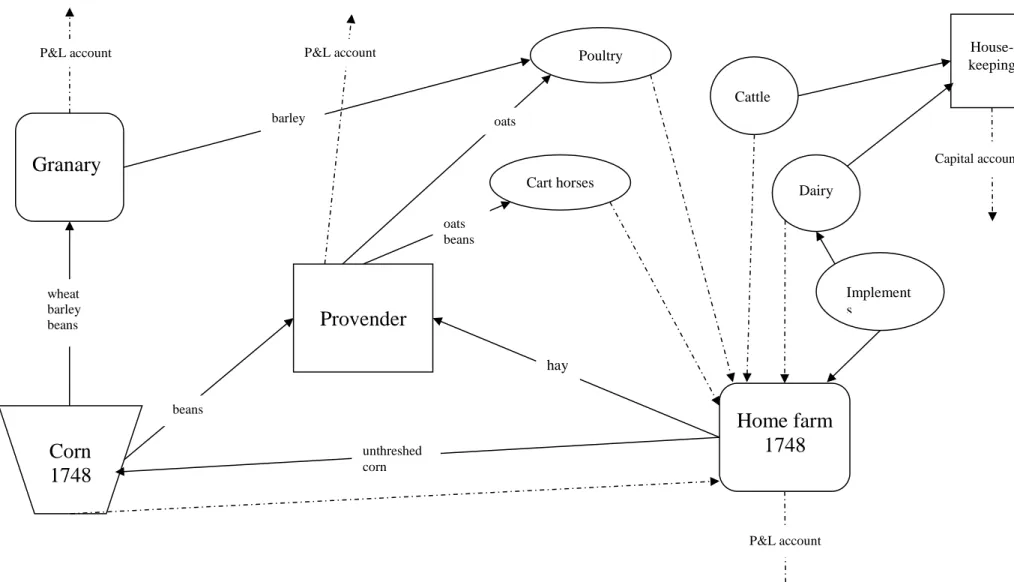
The direct farming activities described by Dodson encompass a range of operating units with numerous transfers of goods and services made between them (see Figure 2). The Home Farm account 1748 serves as the fulcrum for recording the financial effects of the fictitious Traffick Sealand s farming operations for that year. Two types of activity which are not undertaken by merchants whose businesses, as noted above, are the focus of most contemporary treatises, have significant accounting implications: (i) the creation of assets, e.g. crops and newborn livestock, and (ii) transfers of assets between operating units. The way in which Dodson tackles the measurement issues arising from these arrangements is illustrated by examining in some detail the contents of the Home Farm accounts.
A Home Farm account was opened for each year (ended 25 December) and remained accessible until all the corn24 farmed during the year had been winnowed25 and fully accounted for. The outcome is that the accounting model demonstrated by Dodson required a Home Farm account for each of the two prior years (1746 and 1747), the current year (1748), and the forthcoming year (1749).26
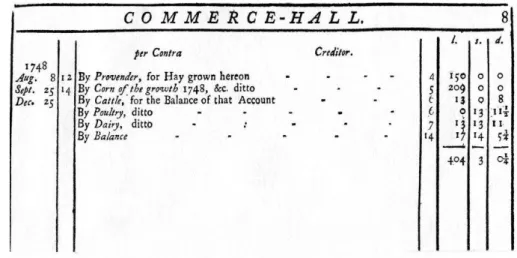
An examination of the content of the Home Farm 1748 account (estate ledger, p. 8) demonstrates the financial effects of much of the range of transactions arising from
24 Corn is the generic term used by Dodson to cover wheat, barley and beans. The term grain (see grainary below) is also used to describe cereal products.
25 Winnowing involves the separation of grain from chaff. Threshing (see below) results in the separation of grain or seeds from the husks and straw, and is the step in the chaff-removal process that comes before winnowing. The terms winnowing and threshing are however used interchangeably by Dodson.
26 The 1749 Home Farm account accumulates payments made, during the autumn of , for the labour of workers and cart horses and the feed Wheat required to prepare the fields for the 1749 harvest (Dodson 1750, estate ledger p. 7).
direct farming. This ledger account (and all others) provides, in the conventional
manner, cross references to the ledger account where the corresponding debit or credit entries are located (Figure 3, cols 4 and 9). Also to the journal where a full description of the transaction is narrated (Figure 3, cols 2 and 7). The date provided for each
transaction also enables the event to be traced to the journal, as well as to the
memorandum inventory of transactions entered into during the accounting year to 25 December 1748.
[Figure 3 about here]
As is commonly the case in accounting treatises, the numerical examples provided by Dodson do not categorically explain how assets owned at the end of the year are valued, and the procedures used must be inferred from information provided in the examples, and from other sources, concerning the cost and sales price of assets bought and sold. This process must inevitably involve a degree speculation. In the case of assets created on the farm, as noted above, values had to be attached in order for recognition to take place. Accordingly, the Home Farm account (Figure 2) receives credit for values placed on hay (debited to the Provender account, Dodson 1750, estate ledger p. 4) and
unthreshed corn (debited to the Corn account 1748, Dodson 1750, estate ledger p. 4) harvested during the year. The accounting prices used are:
Hay, £150 – 30s. for each of 100 loads;
Corn, £209, comprising: 30s. for each of 70 quarters of wheat; 16s. for each of 80 quarters of barley; and 16s. for each of 50 quarters of beans.
Information on mid-eighteenth century agricultural prices is scarce, but Mingay (1989) gives the following figures for corn produced in the vicinity of Gloucester in 1749-1750: wheat 27.21s. per quarter, barley 14.63s., and beans 19.08s. Mitchell (1988, p. 755) supplies figures for wheat in 1750 for three geographic locations which range from 26.96s. to 31.92s. per quarter. Batchelor (1813, p. 60) gives prices for a quarter of barley in Bedfordshire in the years 1748-1750 which range from 14s. to 17s. On the basis of these statistics, it seems reasonable to surmise that the accounting numbers created by Dodson to recognise corn harvested during the year were intended to approximate current market prices.
The Home Farm 1748 account also collects together the residual balances of profit from each of the cattle, poultry and dairy accounts. Focussing on the operation of the first of these for illustrative purposes, the Cattle account (Dodson 1750, estate ledger p.
6) contains entries for a bull and for several cows, calves and sheep.27 The debit entries consist of the opening balances of cows, calves and sheep together with the purchases of a bull, three cows and 30 sheep during the year. Credits to the Cattle account are made for (i) items killed for consumption, with value of the meat (computed on a per lb. basis28) charged to the Housekeeping account, and (ii) proceeds from the sale of
residual skins, offal and tallow (Dodson 1750, estate journal pp. 14-15). Taking sheep as an example, meat is charged at 3d per lb. One can reasonably infer that this figure was the estimated selling price of meat given that Batchelor (1813, p. 51, p. 68; see also Hart 2011, p. 54) reports the selling price of mutton as 2½d in 1745 and 3d in 1756). The four sheep donated to the poor are valued in the same way as those consumed on the estate, with the corresponding debit to the account of Traffick Sealand (Dodson 1750, estate journal p. 11).
The bull and the cows in stock at the year-end (there were no sales of these items) are valued at the cost of items purchased during the year whereas the stock of sheep is valued at a figure which is between purchase and sales prices.29 It is perhaps most likely that sheep are valued at replacement cost price (13s compared with most recent
purchase price during the year of 12s 6d), with another possibility being cost plus subsequent outlays involved in feeding the animals.
Turning attention to the debit entries in the Home Farm Account, these comprise: An opening balance representing payments made in 1747 in preparation for the
1748 agricultural year, i.e. the values attached to the labour provided by workers and cart horses and to the cost of seeds.
Payments during the year to labourers and to the supplier of barley.
The annual rental charge for the farm of £200. This is a substantial sum compared with most figures in the accounts and represents the amount (i.e. opportunity cost) that Traffick Sealand would have collected if he had chosen (or been able) to rent Home Farm to a tenant.
Wages paid to the manager of the farm by the Faithful Reeve.
Tax levied on the value of the farm to help provide relief for the poor.
27 The ledger account contains extra columns that provide a record of the number of each type of livestock on hand.
28 One pound-mass (lb.) = 0.45 kilogram. 29 There is no closing stock of calves.
Losses (debits) arising from use on the farm of cart horses and Implements of Husbandry (see below).
Having considered the operation of the Home Farm account in some detail, and given space limitations, the content of the other principal operating accounts is presented in summarised form. Reference may be made to Figure 2 which depicts the movement of goods and services on Home Farm in terms of their effect on the content of relevant ledger accounts.
Grainary account (Dodson 1750, estate ledger p. 5) records, in both quantity and value, the movement of threshed corn (from the Corn account), in the form of wheat, barley and beans, into and out of the granary together with related expenses.
Transfers inwards are made at the figures constructed to enable corn products to be initially recognised in the books, with charges made to the account for payments to labourers and the imputed value of services provided by cart horses. The Grainary account is credited with sales of barley and quantities consumed by poultry; the latter at figures which approximate prices charged to customers.
Provender account (Dodson 1750, estate ledger p. 4) records arrangements made to ensure adequate provision of food for livestock kept on the farm for use or sale. Provisions consist of hay and beans sourced from Home Farm (the latter via the Corn account) while oats are purchased from outside suppliers. The input prices are used to record consumption of these products by cart horses and poultry.
Cart Horses account contains debit entries for the cost of their feed (from the Provender account), while credits entries are made for [the imputed value of] their labour (Dodson 1750, estate ledger p. 6) in ploughing, harrowing and the
transportation of corn from one location to another.
Two types of equipment are accounted for. Implements of husbandry (farming utensils) are stated at the beginning and end of the year at what is described as
present Value (Dodson 1750, estate ledger p. 7). Given this wording, it is reasonable to speculate that these are the amounts the implements were estimated to be
currently worth. Repairs to implements are debited to the account so that the charge to the Home Farm 1748 account – captioned Wear to them during the year (Dodson 1750, estate ledger p. 7) – consists of revenue expenditure and the estimated decline in the capital value of farming utensils. Implements used in the dairy are similarly stated at present Value , and this account benefits from charging the Housekeeping
account 7d per lb. for Butter, made and used (Dodson 1750, estate journal p. 15). Prices for agricultural produce in Nottinghamshire in 1766 show butter at 6d per lb. (Hart 2011, p. 54) while Batchelor (1813, p. 48) reports figures for Bedfordshire which range from 5d to 7d per lb in 1745.
The widespread use of fair values to recognise the creation of assets and the financial implications of non-market transactions is likely to have produced, for Traffick Sealand, more useful measures of the profits or losses arising from a range of farming activities than would have been achieved by confining the accounts to a record costs incurred. Also, it might be expected to have enabled him to better measure the clear Value of my Estate (Dodson 1750, merchant ledger p. 16).
4.2 Trading
The study of trading activities in Dodson s text is also based on the affairs of Traffick Sealand who transacts business both home and overseas (in Amsterdam, Oporto, Madeira, Jamaica and Virginia). The accounts reveal that four (broad cloth, linen cloth, cutlery and rum) out of the five categories of unsold merchandise are stated at most recent purchase price in the closing balance sheet (Dodson 1750, trading ledger pp. 5-6). Port wine is valued at 33l. per pipe which is just below the most recent selling price of 33l. 15s. and well above cost which is 16l. 10s. (Dodson 1750, merchant ledger p. 7). However, there are a number of incidental acquisition costs (customs, freight and cooperage) which produce a cost per unit calculation of approximately 321. 14s., so the basis of valuation remains uncertain. A new valuation is placed on furniture owned at the year-end (Dodson 1750, merchant ledger p. 4), while the substantial holdings of Old South Sea Annuities and New South Sea Annuities (Dodson 1750, merchant ledger pp. 6-7) are stated at what it is reasonable to assume is market price given the significant divergence from cost, and the treatment unequivocally prescribed by Precept VIII (Dodson 1750, narrative p. v).30
4.3 Manufacturing
Although unusual in addressing manufacturing activities, Dodson s focus is on the processing of goods by workmen (Dodson 1750, manufacturing inventory p. 3) within
30 The conclusions are derived from an analysis of the figures contained in the relevant ledger accounts (Dodson 1750, merchant ledger pp. 4-7).
the domestic system rather than by employees assembled in a factory, which latter arrangement remained in its infancy in 1750. Hugh Crispin is the fictitious shoemaker who trades in a range of different types of shoes for men, women and children. Crispin purchases leather hides and leather skins for cutting out into, respectively, soles and upper leathers that are then delivered to Journeymen to be manufactured into shoes (Dodson 1750, preface p. viii . The outputs from Crispin s cutting work are assigned transfer prices which, in the example, generate a profit (Dodson 1750, manufacturing ledger p. 1). It is not known whether the transfer value approximates market price, but it is certainly the case that an increase in value is recognised which shows that Dodson expects the accounting system to supply figures which go beyond the tracking of rights and obligations.
When work is complete, Crispin records repossession of the finished articles at an accounting number which remunerates the artisans for work performed. Sales of shoes are made partly Wholesale for Exportation, partly on Credit to particular Customers, and partly retail in his Shop (Dodson 1750, preface p. viii). Profits on sale (Dodson 1750, manufacturing ledger pp. 1-2), together with the value added from cutting the leather, are transferred to the profit and loss account. Closing stocks of shoes are valued at the figure created when repossession from artisans took place. The accounting
system therefore generates figures for profit on cutting, production labour costs and a combined profit figure on trading and manufacturing.
This section has shown that Dodson made extensive use of market values to recognise the creation of valuable assets such as hay and corn which would otherwise remain hidden and to record the transfer of foodstuffs and shoes between different locations for further processing, external sale or consumption (by farm animals or members of the household). Often, most recent cost figures were employed to value closing stock, and their use might reflect recognition of the fact that it did not
significantly undermine the utility of periodic financial reports. In doing so, Dodson may have been bowing to existing practice. Certainly, it is reasonable to conclude that
Dodson recognised the validity of a variety of profit and asset measurement procedures as does today s )nternational Accounting Standard Board s Conceptual Framework for Financial Reporting and, in appropriate circumstances, accounting standards based on that framework such as IAS 41.
5. Concluding remarks
Vigorous discussion of how assets and liabilities should be measured for financial reporting purposes took centre stage during the 1950s and 1960s; an era which has been described by Nelson (1973, p. 4) as the golden age of a priori research in accounting. Accounting thinkers such as Raymond A. Chambers, Richard Mattessich, Maurice Moonitz, David Solomons, George J. Staubus and Robert R. Sterling explored ways in which measurement bases might be radically revised to provide more meaningful inputs for decision-useful accounting reports. In doing so, they employed deductive reasoning (Gaffikin 1988) in the endeavour to create a postulational or axiomatic basis for a new way of financial reporting (Mattessich 1996, p. 10).
This paper has located the actuary, mathematician and accountant James Dodson FRS within the history of accounting by focusing on a much earlier endeavour to integrate principles and rules, based on deductive reasoning, to improve the accounting craft. As was the case with his mentor, Abraham De Moivre, Dodson sought to explore how mathematics might be applied to the resolution of matters concerning the conduct of a capitalist society (Schneider 2004).
Dodson was a man of intellect, making valuable contributions to the literatures on mathematics and actuarial science. Given his association with trade, Dodson s
admission as a Fellow of The Royal Society is compelling testimony to his standing within the scientific community. The highly acclaimed Mathematical repository (1748, 1753, 1755) displayed Dodson s mastery of algebra (Gray 2004), and it is therefore perhaps surprising that he made no attempt to employ that mathematical technique to explain causal relationships between balance sheet magnitudes. One can only assume either that he did not visualise the balance sheet in terms of the algebraic formula Capital = Assets – Liabilities, as did his contemporary John Clark (1738), or, if he did, that he failed to recognise its pedagogic potential.31
The scientific revolution, under the influence of such luminaries as Isaac Newton, provided intellectuals with new methods of inquiry and a new language in which to communicate their ideas to each other and to the public. The role of mathematics within
31 Dodson was fully aware of the idea that assets less liabilities equals stock or capital (see Dodson, 1750, p. 2, Article 12 and p. iii, Precept 1 (reproduced as part of Figure 3 of this paper), as quoted in Chambers 1995, p. 398), as were some of his contemporaries (Edwards 2014, pp. 229-230),
the scientific revolution has been described as follows by one of Dodson s
contemporaries: Mathematics derives its accuracy, its method of reasoning, with all its force and strength, from logic (Man 1755, p. . Dodson s contribution to accounting thought is that he exploited his knowledge of mathematical reasoning to craft his sole contribution to the accounting literature, published in 1750: The Accountant; or, the method of book-keeping, deduced from clear principles. There, he theorised double entry bookkeeping based on the method of deductive reasoning from settled general
principles, considered true in their own right, to enable the explication of a particular way of keeping the books.
Why did Dodson s method of teaching double entry bookkeeping not find its followers? There are possibly other explanations, but the lack of student training in deductive reasoning might have added to their learning difficulties rather than to have reduced them. Certainly nascent bookkeepers learning their craft in the workplace may have found it easier to consult examples of how to record this or that rather than to make the effort required to understand an underlying theory. Indeed, as noted above, Dodson acknowledged the fact that It is a Maxim, that Example is preferable to Precept (Dodson 1750, preface p. v)
)n terms of the logical implications of Dodson s theorisation of the bookkeeping process, the following inference that he makes is of particular interest: (ence, altho the Goods are not actually sold, yet if their Value or Market-Price be encreased, or
diminished; Stock is likewise affected thereby (Dodson 1750, narrative p. v, emphasis added). The examples that he supplies give a fair degree of effect to this conviction, with its usefulness in terms of asset recognition as well as profit measurement particularly evident when applied to direct farming activities.
There is no evidence that Dodson changed significantly accounting s pathway through to the present day, but this does not make him unusual among serious accounting thinkers. Nor does it mean that his story is unimportant. Thoughtful and carefully articulated attempts by accounting history s early authors to change things, whether successful or not, need to be recognised (Lee 2002). Not least because most writers on double entry bookkeeping pre-1800 did little more than repeat the
approaches, if not copy the content, of prior publications.32 There is the possibility that,
32 John Clark (Edwards 2014), Benjamin Donn (Baigent 2004), Edward Thomas Jones (Yamey 1944), Robert Hamilton (Mepham 1988), Alexander Malcolm (Mepham 1988),
as a practising accountant, Dodson gave his ideas practical effect. Certainly he claims to have done so on the Earl of Macclesfield s estate but, even if the procedures he
advocates were not fully put into practice by him or anyone else (at least in the eighteenth century), his ideas remain a distinctive contribution to the history of accounting thought.
References
17th and 18th Century Burney Collection Newspapers. Available from:
http://find.galegroup.com/bncn/start.do?prodId=BBCN&userGroupName=ucw_itc [Accessed 5 August 2013].
Actuarial Profession, The, 2010. James Dodson's first lecture on insurances , . Available from: http://www.actuaries.org.uk/research-and-resources/pages/james-dodsons-first-lecture-insurances-1756 [Accessed 5 August 2013].
Age of Enlightenment, n.d. New world encyclopaedia. Available from:
http://www.newworldencyclopedia.org/entry/Age_of_Enlightenment [Accessed 5 August 2013].
Baigent, E., 2004. Donn, Benjamin (1729-1798). Oxford dictionary of national biography. Oxford: Oxford University Press. Available from:
http://www.oxforddnb.com/view/article/7815 [Accessed 5 August 2013]. Batchelor, T., 1813. General view of the agriculture of the county of Bedford. London:
Sherwood, Neely, & Jones.
Bellhouse, D. R., 2011. Abraham De Moivre: setting the stage for classical probability and its applications. Boca Raton, Fl.: Taylor & Francis.
Bellhouse, D. R. and Genest, C., 2007. Maty s biography of Abraham De Moivre, translated, annotated and augmented. Statistical science, 22 (1), 109-136. Bentham, J., 1830. On public account keeping. In: J. Bentham, Official aptitude
maximized: expense minimized: as shewn in the several papers comprised in this volume. London: Robert Heward.
Boyns, T. and Edwards, J. R., 2012. A history of management accounting. The British experience. London & New York: Routledge.
Browne, T., 1673. The absolute accomptant and London-merchant. London. Burns, W. E., 2003. Science in the enlightenment, Santa Barbara, Ca.: ABC-CLIO.
Bywater, M. F. and Yamey, B. S., 1982. Historic accounting literature: A companion guide. London: Scolar Press.
Carnegie, G. D. and Napier, C. J., 1996. Critical and interpretive histories: insights into accounting s present and future through its past. Accounting, auditing &
accountability journal, 9 (3), 7-39.
Chambers, R., 1994. Historical cost—tale of a false creed. Accounting horizons, 8 (1), 76-89.
Chambers, R. J., 1995. An accounting thesaurus: 500 years of accounting. Oxford: Pergamon.
Clare, M., 1758. Youth’s introduction to trade and business, 8th edn. London.
Clark, J., 1738. Lectures on accompts, or book-keeping; after the Italian manner. London. Roger North (Parker 1997) and Hustcraft Stephens (Jackson 1956) are among those who might also be absolved from this negative generalisation.