Organizational Commitment in The Banking Sector: A Case of Private Sector Bank in East Blacksea RegionBankacılık
Sektöründe Örgütsel Bağlılık:
Doğu Karadeniz Bölgesinde Özel Bir Banka Örneği
Ayşe ASİLTÜRK
Dr. Öğretim Üyesi, Avrasya Üniversitesi,
İktisadi ve İdari Bilimler Fakültesi, İşletme Bölümü
Assistant Professor of Management&Organization, AvrasyaUniversity, Faculty of Economics and Administrative Sciences,
Department of Business Administration Trabzon / TURKEY
[email protected] ORCID ID:https://orcid.org/0000-0002-6221-6208
Mesut Esat ULUSOY
KOBİ Bankacılığı Satış Yönetmeni, Kuveyt Türk Katılım Bankası
SME Banking Sales Executive, Kuveyt Turk Participation Bank
Trabzon /TURKEY [email protected] ORCID ID:orcid.org/0000-0001-7963-8944
Eda ULUSOY
Uzman Doktor, İshakoğlu Çayeli Devlet Hastanesi
Specialist Doctor, İshakoğlu Çayeli State Hospital Rize / TURKEY
[email protected] ORCID ID:orcid.org/0000-0002-7993-1582 DOI: 10.5281/zenodo.3463829
Makale Bilgisi | Article Information
Makale Türü / Article Type: Araştırma Makalesi / Research Article Geliş Tarihi / Date Received: 26 Mart / March 2019 Kabul Tarihi / Date Accepted: 9 Mayıs / May 2019 Yayın Tarihi / Date Published: 30 Eylül / September 2019
Yayın Sezonu / Pub Date Season: Eylül / September
Atıf / Citation:ULUSOY, M. E., ASİLTÜRK, A., ULUSOY, E. (2019).Organizational Commitment in The Banking Sector: A Case of Private Sector Bank in East Blacksea Region. Mevzu: Sosyal Bilimler Dergisi, 2 (Eylül
2019):65-91.
İntihal: Bu makale, ienticate yazılımınca taranmıştır. İntihal tespit edilmemiştir. Plagiarism: is article has been scanned by ienticate. No plagiarism detected. web: http://dergipark.gov.tr/mevzu
| mailto: [email protected]
Copyright © Bütün hakları saklıdır. / All right reserved. CC BY-NC-ND 4.0
Abstract
The concept of organizational commitment is defined as employees's strong belief in accepting organizational goals and values; a strong desire to spend high-level effort taking into account the benefit of the organization and to maintain membership in the organization. Although there are different classifications related to organizational commitment in the literature, affective commitment, continuance commitment and normative commitment sub-dimensions were emphasized. This study is intended to contribute to the lite-rature of participation banking in Turkey. It includes the implementation of an organizational commitment questionnaire developed by Allen and Meyer (1990) and adapted to Turkish by Wasti (2000) on a total of 53 bank staff in a participation bank operating in the East Black Sea Region. As a result of the study, no statistically significant relationship was found between the organi-zational commitment levels of the bank employees and the variables of mari-tal status, gender, lenght of work, job title, income level. When the organizati-onal commitment score means of the employees were evaluated, it was seen that the average scores of affective commitment were higher than continuance and normative commitment.
Keywords: Organizational Commitment, Human Resources, Continu-ance Commitment, Affective Commitment, Normative Commitment, Banking Sector
Öz
Örgütsel bağlılık kavramı, çalışanların örgütsel amaç ve değerleri kabul etmede güçlü bir inanca sahip olması; örgüt yararını dikkate alarak üst düzey çaba harcama arzusu ve örgüt üyeliğini sürdürme yönünde güçlü bir istek
duyması olarak tanımlanmaktadır. Literatürde örgütsel bağlılık ile ilgili değ
i-şik sınıflandırmalar yapılmış olmaklabirlikte duygusal bağlılık, zorunlu
bağ-lılık ve normatif bağlılık alt boyutları üzerinde durulmuştur. Bu çalışma Tü
r-kiye'deki katılım bankacılığı literatürüne katkı sağlamak amacıyla hazırla
n-mıştır. Çalışma, Doğu Karadeniz Bölgesinde faaliyet gösteren özel bir katılım bankasındaki toplam 53 banka çalışanı üzerinde Allen ve Meyer (1990)
geliş-tirdiği ve Wasti (2000) tarafından Türkçe’ye uyarlanan örgütsel bağlılık ank
r-ma sonucunda banka çalışanlarının örgütsel bağlılık düzeyleri ile medeni d
u-rum, cinsiyet, çalışma süresi, unvan, gelir düzeyi değişkenleri arasında istati
s-tiksel olarak anlamlı bir ilişki bulunamamıştır. Çalışanların örgütsel bağlılık puan ortalamaları değerlendirildiğinde duygusal bağlılık puan ortalamaları-nın, zorunlu ve normatif bağlılık puan ortalamalarına göre daha fazla olduğu görülmüştür.
Anahtar Kelimeler: Örgütsel Bağlılık, İnsan Kaynakları, Zorunlu
Bağlı-lık, Duygusal BağlıBağlı-lık, Normatif BağlıBağlı-lık, Bankacılık Sektörü
Introduction∗
Today's organizations must operate in a sharp competitive environment. While globalization and technological developments lead to changes in both the structure of the markets and the characteristics of customers, the need to direct the resources of the organizations in the most efficient manner is in-creasing. In this context, human resources are undoubtedly the most im-portant resource owned by organizations. The issue of reaching the right hu-man resources, employing them and keeping them in the organization by providing the organizational commitment of the human resource is gaining value day by day.
One of the development indicators of world economies is the service sector. On the other hand, it can be said that the banking sector has become an important subcomponent of the service sector. As a matter of fact, according to the Banking Regulation and Supervision Agency data, the total assets of the Turkish banking sector reached 4 trillion 138 billion 992 million TL in March 2019 (BDDK, 2019).
Banking services can be defined as all services provided by banks that can be called pure service enterprises operating in accordance with the prog-rammed demand within the scope of financial services. Considering its place in the service sector and the economy, the issue of maintaining banks' assets comes to the agenda. Banks have the potential to face operational risk in terms
∗ This article has been prepared by using the results of the field research within the scope of the project study submitted to the Graduate Program in Business Administration of the Avrasya University Institute of Social Sciences.
of human resources. In other words, the fact that banks are labor intensive can mean finding qualified human resources, high education and adaptation costs. On the other hand, operational risk may occur depending on the size of the human resources employed (Sayım and Aydın, 2011). As human resources are a strategic resource in the banking sector, it encourages managers and human resources experts to increase the organizational commitment of bank employees. Although there are various classifications related to banks, banks are grouped as “state banks, private sector banks, mixed capital banks”, banks established with foreign capital and banks with foreign-Turkish partners ac-cording to capital sources. The field research of this study was conducted on the employees of a participation (interest-free) bank within the scope of priva-te sector banks.
The literature shows that various researches were conducted on private bank employees; but, there is not enough study on participation banks and especially on human resources and organizational behavior topics in Turkey. However, it can be said that this limitation is related to the establishment date and development of participation banks. Because of the historical develop-ment of the participation banking in Turkey began with the 1984 Albaraka Turk.
This study is descriptive and quantitative. It aims to answer the follow-ing questions: What is the organizational commitment level of participation
bank employees? Do the types of organizational commitment among partic
i-pation bank employees differ according to demographic variables such as gender, marital status, job title and income? In this study, firstly, the concept and scope of organizational commitment will be discussed, organizational commitment classifications will be presented and the factors that affect orga-nizational commitment will be explained. Afterwards, the analysis and fin-dings of the data obtained from the field research and literature studies rela-ted to organizational commitment in the banking sector will be included.
Organizational Commitment Concept and Scope
As with many other concepts in the field of social sciences, there is no consensus on the concept of organizational commitment. Therefore, there are different definitions in the literature developed by researchers from different
perspectives such as sociology, psychology, social psychology and organiza-tional behavior (Keleş, 2006).
The researches related to organizational commitment are chronological-ly listed as follows: Becker (1960); Grusky (1966); Kanter (1968); Brown (1969); Hall, Schneider ve Nygren (1970); Sheldon (1971); Hall ve Schneider (1972); Hrebiniak & Alutto (1972); Buchanan (1974); Mowday, Porter ve Dubin (1974);
Porter, Steers, Mowday ve Boulian (1974); Etzioni (1975); Kanter (1977); Sala
n-cik (1977); Steers (1977); Weiner ve Gechman (1977); Mowday, Steers ve Porter
(1979), O’Reilly ve Chatman (1986), Penley ve Gould (1988), Allen ve Meyer
(1990).
Mowday et al. (1979, p. 226) defined organizational commitment as an individual's the relative strength of involvement and identity to an organiza-tion. In the same study, organizational commitment was characterized by at least three factors: 1) a strong belief and acceptance of the organization's aims and values; (2) considerable effort on behalf of the organization; and (3) a strong desire to maintain membership in the organization. When defined in this way, organizational commitment represents, beyond passive loyalty, a situation in which the employee and the organization are actively involved. So much so that individuals are willing to give them something to contribute to the good of the organization.
Etzioni (1975) model consists of three dimensions: moral commitment, calculative commitment and alienative commitment. When it is evaluated in terms of the convergence of employees to the organization, there is moral convergence (moral commitment) at the most positive end, neutral accountant convergence (calculative commitment) in the middle and alienative conver-gence at the most negative end (Etzioni, 1975). Moral commitment is based on internalizing the aims, values and norms of the organization and identifica-tion with authority. Accordingly, employees are more attached to their orga-nizations when they pursue useful goals for society. Calculative commitment is based on the shopping relationship between the organization and the emp-loyees. Employees are committed to the awards they receive in return for their contribution to their organization. Alienative commitment refers to a negative orientation towards the organization when behaviors are limited. In this case,
employees do not feel psychologically committed to the organization but con-tinue to be members for reasons such as not wanting to be unemployed (Bay-ram, 2005: p. 129-130).
There is no organization without human element. According to Barnard (1938), who described the organization as an open system, three basic ele-ments must exist for an organization to emerge: people who can communicate with each other, a common goal and the willingness to achieve this goal (Alıç, 1995: p.3). As Barnard emphasizes, the most important factor that constitutes the dynamic aspect of the organization is the human factor. For this reason, the formation of organizations and their survival depends on people who ha-ve the ability to manage and direct the organization's resources. Keeping qua l-ified human resources in the organization and ensuring their commitment to the organization is vital to the survival of the organization.
Factors Affecting Organizational Commitment
Factors affecting organizational commitment are examined under three headings as “personal, organizational and non-organizational factors” in the literature (İnce & Gül, 2005, p. 59):
Personal factors: gender, marital status, age, working time and seniority, educational status, personality traits, job expectations, personal characteristics and psychological contract.
Organizational factors: organizational structure, organizational culture, quality and importance, organizational justice, role uncertainty, income level, need for belonging, management style, communication and organizational rewards.
Non-organizational factors: alternative job opportunities, professiona-lism, sector status, socio-economic status of the country and unemployment rate.
Research findings in the literature on whether organizational commit-ment levels differ according to the gender of the employees are gathered around two different views. The first group studies advocate that the level of organizational commitment of female employees is lower than that of men due to the role of women in the family and obstacles to labor force
participa-tion. The second group studies claimed that women's organizational commit-ment levels are higher than men because of high motivation and stability in working life and organization (Seyhan, 2014: p. 45-47). Küçüközkan (2015), in his research on hospital workers, found that female's levels of affective com-mitment and normative comcom-mitment were higher than male's levels of affecti-ve commitment and normatiaffecti-ve commitment; howeaffecti-ver, it was found that the continuance commitment levels of female were lower than the continuance commitment levels of male.
According to the marital status of employees, Mathieu & Zajac (1990) found that marriage positively affected organizational commitment; because it suggests that married employees may have higher organizational commit-ment compared to single employees because of their responsibilities towards their families.
According to the age status of the employees, the researches showed that there is a linear relationship between age variable and organizational commitment levels. As the age progresses, work experience increases, on the other hand, organizational commitment increases because alternative cost increases in case of leaving the organization (Seyhan, 2014: p. 43). According to Pala et al. (2008: p. 58), the fact that older workers do not prefer to change their employment necessarily makes them conservative and this situation de-velops a reluctant attitude towards changing organization. In other words, age can contribute to the formation of a natural sense of commitment based on both experience and the conservative attitude it produces. According to Varol et al. (2017) findings of the research conducted on the pharmaceutical sector employees operating in Konya province, a significant relationship is found between normative commitment and age groups. There is a significant rela-tionship between all components of organizational commitment and income level.
It is seen that there is a positive linear relationship between the working time of the employees and organizational commitment. Moreover, it has been suggested that leaving the organization has become more costly as the emplo-yee's investment in the organization has increased (İnce & Gül, 2005, p. 67). For example; if the employee leaves his / her organization after working for a
while, it will cause him / her not to receive the severance pay accumulated. This may have a positive effect on organizational commitment.
In the studies examining the organizational commitment levels of the employee according to the education level, it was found that there is a nega-tive relationship between the level of education and organizational commit-ment. Accordingly, employees with high levels of education expect more from the organization than those with low levels of education. Therefore, if they want to quit their job, they may not feel connected to the organization due to the existence of job alternatives and prioritizing their professional develop-ment rather than the organization (Pala et al., 2008: p. 58-59). Some studies support this situation and show that the higher the education level of the employees, the greater the possibility of taking personal initiative, taking res-ponsibility, and making more independent decisions (Çolakoğlu et al., 2009: p. 80).
Especially wages, for senior employees, are among the most important factors affecting organizational commitment. In addition, as well as ordinary and routine rewards, external rewards are important for organizational com-mitment (Cohen, 1992, p. 539).
Organizational Commitment in Banking Sector
Kartal (2018) analyzed 20 doctoral theses and 131 master's theses on
in-terest-free banking between 1986-2017 in Turkey. Most of these theses (35) have been prepared for the comparison of interest-free banks and deposit banks in various aspects such as about efficiency, performance, profitability issues. However, it is seen that a total of 4 theses are prepared in the field of human resources and training topics, and 3 theses are prepared about organizational culture, customer loyalty and so-cial responsibility. In this context, it can be asserted that there is little focus on human resource management and organizational behavior topics on partici-pation banking researches in Turkey. As of July 16, 2019, there are 76 theses about bank employees in the National Thesis Center. 11 of these theses were prepared on organizational commitment and related topics. As of 16 July 2019, there are 81 participation banking theses in the National Thesis Center. Only one of these theses is about organizational commitment.
Emhan and Gök (2011) conducted a study on public and private sector
bank branch employees operating in the central districts of Diyarbakır (Tu
r-key). According to the results of this research, there is no difference between sectors in terms of organizational commitment dimensions and organizational commitment does not differ according to gender. According to research on employees working in banks with special status in Denizli, Kök & Uçar (2018) found that organizational commitment did not differ according to gender, but differed according to marital status, age, education, title and working time.
In the light of all these explanations, the model and hypotheses of the research are as follows:
Hypothesis about affective commitment (AC) dimension
H1: AC levels of the employees in the participation bank vary according to marital status.
H2: AC levels of the employees in the participation bank vary according to gender.
H3: AC levels of the employees in the participation bank vary according to the length of service.
H4: AC levels of the employees in the participation bank vary according to the job title.
H5: AC levels of the employees in the participation bank vary according to the income level.
Hypothesis related to continuance commitment (CC) dimension
H6: CC levels of employees in the participation bank vary according to marital status.
H7: CC levels of the employees in the participation bank vary according to gender.
H8: CC levels of the employees in the participation bank vary according to the length of service.
H9: CC levels of the employees in the participation bank vary according to the job title.
H10: CC levels of the employees in the participation bank vary accor-ding to the income level.
Hypothesis about normative commitment (NC) dimension
H11: NC levels of employees in the participation bank vary according to marital status.
H12: NC levels of the employees in the participation bank vary accor-ding to gender.
H13: NC levels of the employees in the participation bank vary accor-ding to the length of service.
H14: NC levels of the employees in the participation bank vary accor-ding to the job title.
H15: NC levels of the employees in the participation bank vary accor-ding to the income level.
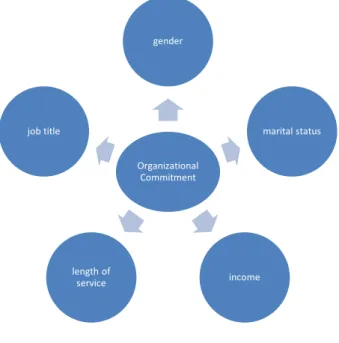
Figure 1. The research model
Organizational Commitment gender marital status income length of service job title
Purpose of the Research
Although participation banks and deposit banks are functionally simi-lar, the methods of fund collection and allocation of these two types of ban-king are completely different from each other. The main characteristics of par-ticipation banks are “collecting funds on a profit-loss basis; providing funds on trade, partnership, leasing basis; do not include interest in any of the tran-sactions, prohibition of uncertainty, prohibition of excessive risk and specula-tion, application of payment of money to the seller in exchange for invoice instead of customer in the purchase of goods and services, provision of finan-cing for a good or service”. In view of these characteristics, it is considered that the institutional structures and business understanding of participation banks may be different and should be investigated.
The aim of this research is to determine whether organizational com-mitment levels differ according to demographic characteristics of participation bank employees.
The limited number of studies on participation banks in the literature has been a source of motivation for this research. Although there are many studies on the effects of organizational commitment on employees in the liter-ature, studies on the banking sector are limited. Most of the current studies have been conducted with deposit banks and there are not enough studies about participation banks.
Universe and Sample of the Research
There are five participation banks in the Eastern Black Sea Region (ap-proximate total number of employees is 250). One of these banks was chosen as the universe of the research. One of the researchers is currently working in a managerial position in a participation bank. Prior to the research, this man-ager was consulted to determine the universe and sample of the research.
It has been decided to carry out the research in the branches of a single participation bank considering the corporate culture of the bank, the employ-ees' goals and social conditions. Although these five banks operate as a partic-ipation bank, human resources practices, employee targets and social condi-tions vary. In this case, even though the same statements were asked in the
survey, it was considered that there would not be a reliable comparison since the reasons for the employees' responses could be different considering their own conditions.
In descriptive studies, a minimum of 10% sample is taken and in small universes 20% is needed. Correlation studies require at least 30, and causal comparisons require at least 30 members from each group (Arlı & Nazik, 2001:77).
The universe of the research is a private participation bank selected by researchers. This research was conducted on the employees of 7 branches of this private participation bank operating in the Eastern Black Sea Region. D u-ring the interviews conducted with the managers of the bank, it was determi-ned that there were 62 employees in 7 branches. In this context, the population of the research consists of 62 employees working in the relevant bank. 62 questionnaires were distributed to the employees, 53 of which were returned. It can be said that the number of returned surveys is capable of representing the universe.
Research Methods and Data Collection Tools
In the first part of the research scale, questions about “age, gender, edu-cational status, marital status, job title, the length of service and income level” were included in order to evaluate the demographic characteristics affecting organizational commitment. The second part of the scale consists of 25 state-ments. 24 statements were taken from the three-dimensional organizational commitment questionnaire developed by Allen & Meyer (1990) and adapted to Turkish by Wasti (2000). 1 statement was added by the researchers as to whether the employees in the participation banks would like to work in depo-sit banks if they were free to worship.
The organizational commitment questionnaire, which consists of 24 sta-tements, is divided into 3 sections. These three groups were formed to assess the affective, normative and continuance commitment of the participants.
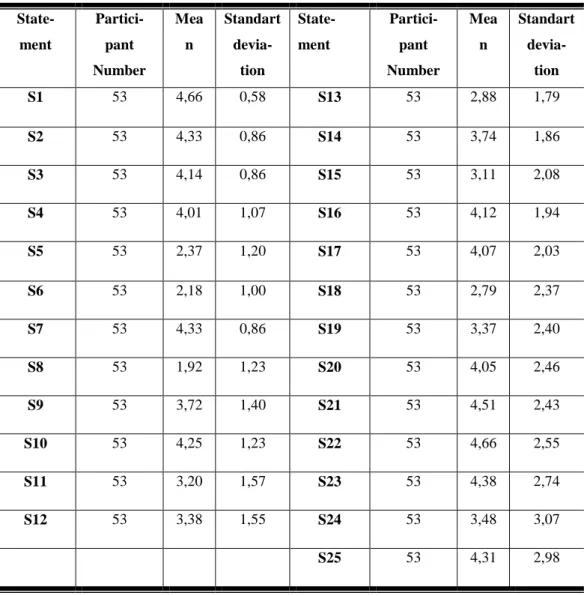
Table 1 shows the results of factor analysis showing the mean, standard deviation and number of respondents of statements. The averages of
com-mitment dimensions were determined as follows: Affective Comcom-mitment 3.49, Continuance commitment 3.55, Normative commitment 3.91.
Table 1.
Descriptive statistics of statements
State-ment Partici-pant Number Mea n Standart devia-tion State-ment Partici-pant Number Mea n Standart devia-tion S1 53 4,66 0,58 S13 53 2,88 1,79 S2 53 4,33 0,86 S14 53 3,74 1,86 S3 53 4,14 0,86 S15 53 3,11 2,08 S4 53 4,01 1,07 S16 53 4,12 1,94 S5 53 2,37 1,20 S17 53 4,07 2,03 S6 53 2,18 1,00 S18 53 2,79 2,37 S7 53 4,33 0,86 S19 53 3,37 2,40 S8 53 1,92 1,23 S20 53 4,05 2,46 S9 53 3,72 1,40 S21 53 4,51 2,43 S10 53 4,25 1,23 S22 53 4,66 2,55 S11 53 3,20 1,57 S23 53 4,38 2,74 S12 53 3,38 1,55 S24 53 3,48 3,07 S25 53 4,31 2,98
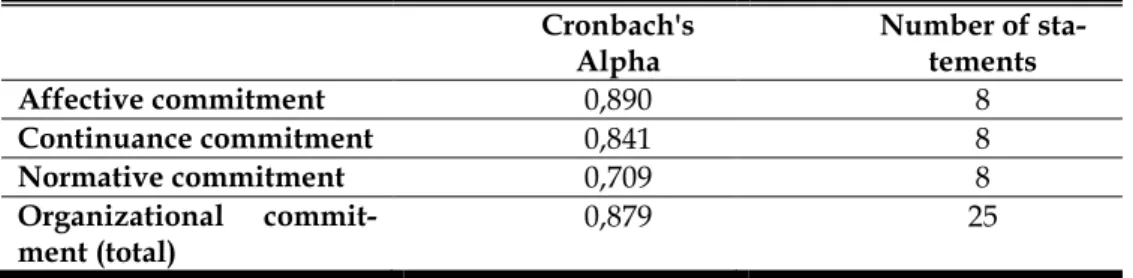
The reliability coefficients of the organizational commitment question-naire and its sub-dimensions are shown in Table 2:
Table 2. Reliability Statistics
Cronbach's
Alpha Number of sta-tements
Affective commitment 0,890 8
Continuance commitment 0,841 8
Normative commitment 0,709 8
Organizational
commit-ment (total) 0,879 25
The first 8 questions are aimed at measuring the level of affective com-mitment of the participants. Statements such as “I will be happy to spend the rest of my career in this organization”, “I do not feel a strong sense of belon-ging to my organization” are included in this group. Among the statements that measure affective commitment are 4th, 5th, 6th and 8th reverse score expressions. For example, “I do not feel affective commitment to this organi-zation”. The next 8 statements (9-16) were used to measure the continuance commitment of the participants. Statements such as “I'm not afraid of what might happen if I quit my job without setting up another job”, and “I feel that I have very few options to consider and leave this organization” are included in this group. 2 of these statements (9th and 12th) are reverse score expressi-ons. For example, “Right now, leaving my organization won't cost me a lot”. The last 8 statements are intended to measure the normative commitment le-vels of the participants. Statements such as “These days I think people move from one organization to another very often” and “I don't think it's reasonable to make sense to want to be a company man” are included in this group. Three of the statements in this group (18th, 19th and 24th) are reverse score expressions. For example, “I do not believe that a person should always be loyal to his organization”.
Limitations of Research
The research covers the employees of the branches of a private partici-pation bank operating in the Eastern Black Sea Region. Therefore, it was not possible to compare the organizational commitment of the employees of more than one participation bank. Some personnel at the participation bank could not participate in the study due to various reasons (for example, vacation lea-ve). It is assumed that all employees participated in the survey correctly answered the questionnaire statements. Due to time constraints, the survey could not be carried out in the entire Black Sea Region.
General Characteristics of Participants
This study was conducted on 53 employees in 7 branches of a private participation bank in the Eastern Black Sea region. Ten (18.9%) of the pants were female and 43 (81.1%) were male. The average age of the partici-pants was 31.7. While the mean age of female participartici-pants was 29.5, the mean age of male participants was 32.3. Of the participants, 42 (79%) were married and 11 (21%) were single. There are no divorced and widowed participants. While 8 (80%) of the women were married and 2 (20%) were single, 34 (79%) of the male participants were married and 9 (21%) were single. 2 (4%) of the participants had a master's degree, while 51 (96%) had a bachelor's degree. Participants’ job titles: 16 (30%) operating personnel, 1 (2%) assistant experts, 13 (24%) experts, 19 (36%) directors, 4 (8%) managers. Looking at the working time (lenght of service) of the participants; 28 (53%) employees with 1-5 years of employment, 16 (29%) employees with 6-10 years of employment, 7 (15%) employees with 11-15 years of employment, and 2 (3%) employees with more than 15 years of employment. When the sub-dimensions of organizational commitment were examined, the mean scores of affective commitment were 3.90, 3.17 for continuance commitment and 3.69 for normative commitment.
Organizational Commitment According to Gender
The distribution of organizational commitment scores according to gen-der was examined. The mean scores of affective commitment were 3.88 for females and 3.91 for males. The difference was not statistically significant (p: 0.55). The mean scores of continuance commitment were 3.13 for females and 3.19 for males. The difference was not statistically significant (p: 0.55). The
mean scores of normative commitment were 3.75 for females and 3.67 for ma-les. The difference was not statistically significant (p: 0.64) (Table 3) The hy-potheses H2, H7, H12 were rejected.
Table 3. Mann-Whitney U Test Results for Organizational
Commit-ment Dimensions and Gender
Organizational commitment Gender n Average rating x̄ ∑ U p
Affective commitment Female 10 3,88 Male 43 3,91 24.4 244 27.6 1187 189 .55
Continuance commitment Female 10 3,13 Male 43 3,19 24.4 244 27.6 1187 189 .55
Normative commitment Female 10 3,75 Male 43 3,67 29.05 290.5 194.5 .64 26.52 1140.5
Organizational Commitment According toMarital Status
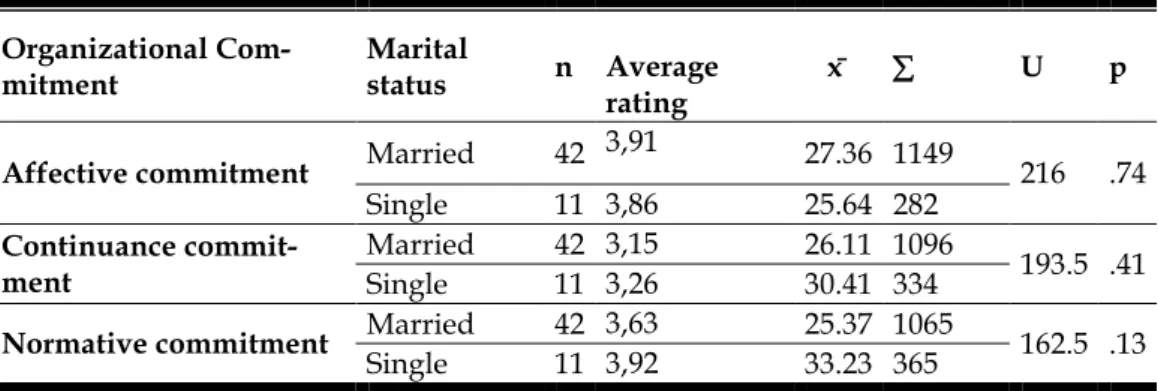
The distribution of organizational commitment scores according to ma-rital status was examined. As a result, the mean scores of affective commit-ment were 3.91 in married and 3.86 in single employees. The difference was not statistically significant (p: 0.74). The mean scores of compulsory commit-ment were 3.15 in married and 3.26 in single employees. The difference was not statistically significant (p: 0.41).The mean scores of normative commit-ment were 3.63 in married and 3.92 in single employees. This difference was not statistically significant (p: 0.13) (Table 4). The hypotheses H1, H6, H11 were rejected.
Table 4. Mann-Whitney U Test Results for Organizational Commitment Scale Dimensions and Marital Status Variable
Organizational
Com-mitment Marital status n Average rating
x̄ ∑ U p
Affective commitment Married 42 3,91 27.36 1149 216 .74
Single 11 3,86 25.64 282
Continuance
commit-ment Married Single 42 3,15 11 3,26 26.11 1096 30.41 334 193.5 .41
Normative commitment Married Single 42 3,63 11 3,92 25.37 1065 33.23 365 162.5 .13
Organizational Commitment According toJob Title
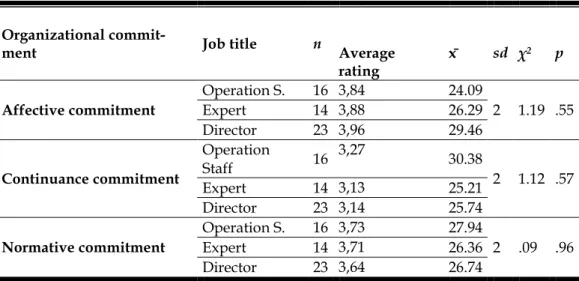
The distribution of organizational commitment scores by job title was examined. As the number of assistant experts and managers was not sufficient in terms of statistical analysis, assistant experts and experts, on the other hand managers and directors were combined and analyzed. According to this, the mean scores of affective commitment were 3.84 for operation staff, 3.88 for experts, 3.96 for directors. The difference was not statistically significant (p: 0.55). The mean scores of continuance commitment is 3.37 for operation staff, 3.13 for experts and 3.14 for directors. The difference was not statistically sig-nificant (p: 0.57). The mean scores of normative commitment were 3,73 for operation staff, 3,71 for experts, 3,64 for directors. The difference was not sta-tistically significant (p: 0.96) (Table 5). The hypotheses H4, H9, H14 were re-jected.
Table 5. Kruskal-Wallis H Test Results for Organizational Commitment Scale Dimensions and Job Title Variable
Organizational
commit-ment Job title n Average
rating
x̄ sd χ2 p
Affective commitment Operation S. Expert 16 3,84 14 3,88 24.09 26.29 2 1.19 .55
Director 23 3,96 29.46 Continuance commitment Operation Staff 16 3,27 30.38 2 1.12 .57 Expert 14 3,13 25.21 Director 23 3,14 25.74
Normative commitment Operation S. Expert 16 3,73 14 3,71 27.94 26.36 2 .09 .96
Director 23 3,64 26.74
Organizational Commitment According to Income Level
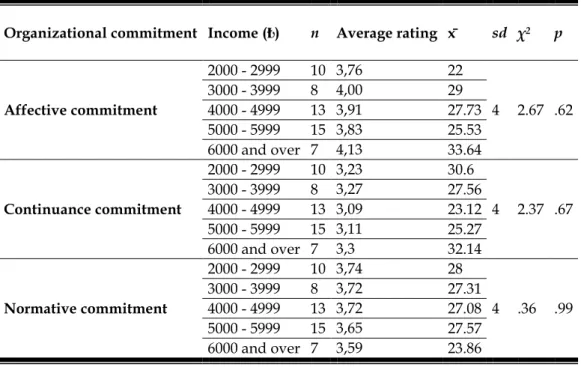
The distribution of organizational commitment scores according to in-come status was examined. According to this, the mean scores of affective commitment are as follows: 3,76 for 2000-2999 ₺; 4,00 for 3000-3999 ₺; 3,91 for 4000-4999₺; 3,83 for 5000-5999 ₺; 4,13 for 6000₺ and over. The difference was not statistically significant (p: 0.62). The mean scores of continuance commit-ment are as follows: 3,23 for 2000-2999 ₺; 3,27 for 3000-3999 ₺; 3,09 for 4000-4999₺; 3,11 for 5000-5999₺; 3,3 for 6000 ₺ and over. The difference was not statistically significant (p: 0.67). The mean scores of normative commitment are as follows: 3,74 for 2000-2999₺; 3,72 for 3000-3999₺; 3,72 for 4000-4999 ₺; 3,65 for 5000-5999₺; 3,59 for 6000₺ and over. This difference was not statisti-cally significant (p: 0.99) (Table 6). The hypotheses H5, H10, H15 were rejec-ted.
Table 6. Kruskal-Wallis H Test Results for Organizational Commitment Scale Dimensions and Income Status Variable
Organizational commitment Income (₺) n Average rating x̄ sd χ2 p
Affective commitment 2000 - 2999 10 3,76 22 4 2.67 .62 3000 - 3999 8 4,00 29 4000 - 4999 13 3,91 27.73 5000 - 5999 15 3,83 25.53 6000 and over 7 4,13 33.64 Continuance commitment 2000 - 2999 10 3,23 30.6 4 2.37 .67 3000 - 3999 8 3,27 27.56 4000 - 4999 13 3,09 23.12 5000 - 5999 15 3,11 25.27 6000 and over 7 3,3 32.14 Normative commitment 2000 - 2999 10 3,74 28 4 .36 .99 3000 - 3999 8 3,72 27.31 4000 - 4999 13 3,72 27.08 5000 - 5999 15 3,65 27.57 6000 and over 7 3,59 23.86 Organizational Commitment According toLength of Service
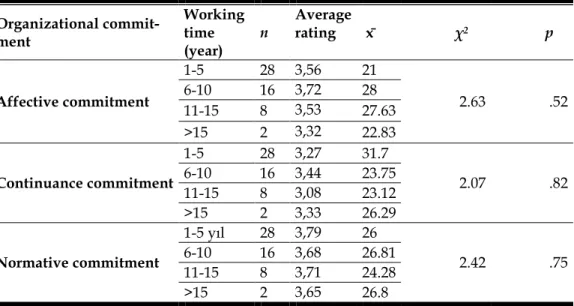
The distribution of organizational commitment scores according to wor-king time was examined. The mean scores of affective commitment are as fol-lows: 3.56 for those with 1-5 years working time; 3.72 for those with 6-10 years working time; 3,53 for those with 11-15 years working time; 3,32 for those with >15 years working time. The difference was not statistically significant (p: 0.52). The mean scores of continuance commitment are as follows: 3,27 for those with 1-5 years working time; 3,44 for those with 6-10 years working ti-me; 3,08 for those with 11-15 years working titi-me; 3,33 for those with >15 years working time. The difference was not statistically significant (p: 0.82). The mean scores of normative commitment are as follows: 3,79 for those with 1-5 years working time; 3,68 for those with 6-10 years working time; 3,71 for those
with 11-15 years working time; 3,65 for those with >15 years working time. This difference was not statistically significant (p: 0.75) (Table 7). The hypoth-eses H3, H8, H13 were rejected.
Table 7. Kruskal-Wallis H Test Results for Organizational Commitment Scale Dimensions And Working Time Variable
Organizational commit-ment Working time (year) n Average rating x̄ χ2 p Affective commitment 1-5 28 3,56 21 2.63 .52 6-10 16 3,72 28 11-15 8 3,53 27.63 >15 2 3,32 22.83 Continuance commitment 1-5 28 3,27 31.7 2.07 .82 6-10 16 3,44 23.75 11-15 8 3,08 23.12 >15 2 3,33 26.29 Normative commitment 1-5 yıl 28 3,79 26 2.42 .75 6-10 16 3,68 26.81 11-15 8 3,71 24.28 >15 2 3,65 26.8 Discussion and Conclusion
As global competition and technological developments are increasing rapidly, it is very difficult for businesses to maintain their assets. The prerequ-isite for all organizations to achieve their goals depends on the awareness of the impact of human resources. Raising awareness on this issue increases the efforts of organizations to concentrate on their employees.
The concept of organizational commitment is defined as the integration of the aims, values of the organization and the aims, values of the members of the organization, voluntarily spending extra effort for the benefit of the orga-nization and maintaining the membership of the orgaorga-nization. With these fea-tures, organizational commitment contributes to the solidification of the
orga-nization. Although there are many factors affecting organizational commit-ment; these factors may vary from person to person, from organization to or-ganization and from sector to sector.
It is very difficult for employees with low organizational commitment to ensure customer satisfaction and continuity in the service sector. Therefore, organizational commitment is an important factor for service quality and or-ganizational success in the banking sector, where employees are in direct con-tact with customers.
Between April 2018 and April 2019, the number of bank branches and employees decreased in the entire banking sector, while the number of branc-hes of participation banks decreased and the number of employees increased (Capital, 2018).
The staff who continued to work with the downsizing of banks became more burdened. They also had to deal with the anxiety of losing their jobs at
any moment. Ergeneli&Arı (2005) found that the organizational commitment
of the bank managers who experienced layoffs in their bank was statistically lower than the organizational commitment of the bank managers where there were no layoffs.
In this study, it was investigated whether demographic variables such as gender, marital status, working time, job title and income level of a bank employees differ in terms of organizational commitment and sub-dimensions of commitment.
According to this research results, while the rate of female employees was 18.9%, no statistically significant relationship was found between gender and organizational commitment. When the organizational commitment sub-dimensions are examined, it is seen that the average organizational commit-ment of males is higher in terms of affective commitcommit-ment and continuance commitment, and the average organizational commitment of females is higher in normative commitment.
Supporting this finding, İnce & Gül (2005) suggest that women have lower organizational commitment than men because of their importance to family roles and the barriers to their participation in the labor force.
In this study, the rate of married employees was 79%, but no statistically significant difference was found between marital status and organizational commitment. When the organizational commitment sub-dimensions were examined, the average of the organizational commitment of the married emp-loyees was found to be higher in the affective commitment dimension. In the continuance commitment and normative commitment dimension, it was seen that the average organizational commitment of the single employees were higher. As a matter of fact, when the effect of marital status on organizational commitment is examined; it is stated that married employees cannot afford to lose their investments and become unemployed because they have financial responsibilities towards their families.
In this study, while the average age was 31.7 years, the working age range was 22-45 years. The average age of the bank's employees is low. Since there was no distribution in different age groups, age factor was not included in the analysis.
In many studies that deal with the age variable with organizational commitment, it is concluded that age is in a linear relationship with commit-ment and employee loyalty increases with increasing age. When the relation-ship between working time and seniority with organizational commitment; It has been stated that "satisfaction level increased as a result of the increase in status due to time spent in the organization" has a positive relationship be-tween organizational commitment and seniority. It is argued that working time increases the amount of investment invested in the organization and makes it more costly to leave the organization (Meyer et. al., 1993).
In this study, the relationship between working year and organizational commitment was not significant. When the relationship between the job title and the institution was evaluated, the average organizational commitment of the director was found to be high in the dimension of affective commitment. In the continuance and normative commitment dimensions, the average orga-nizational commitment of the operation staff was found to be higher.
Some studies on the relationship between education level and job satis-faction have found a negative relationship between education and job
satisfac-tion. It is thought that the employees with higher education level are more difficult to satisfy because they have higher expectations.
In this study, since 96.2% of the participants were university graduates, no analysis could be made in terms of the relationship between educational level and organizational commitment.
Sönmez (2017) conducted a survey to measure the job satisfaction and
organizational commitment levels of employees at İller Bankası A.Ş. Acco
r-ding to this study, organizational commitment was found to be related to age, marital status, working time and job title variables of the bank, and not to the variables of gender and educational status.
Erbay (2009) examined whether there is a significant relationship between affective, normative and continuance commitment levels of emplo-yees and their demographic characteristics and organizational citizenship be-havior in the banking sector. As a result of the survey conducted on 122 bank employees, it was determined that the continuance commitment of the emp-loyees to their organizations was high. It was concluded that continuance commitment of the employees showed a statistically significant difference according to education level variable; on the other hand normative commit-ment showed a statistically significant difference according to both education level and total working time in the profession. In addition, there was a signifi-cant positive relationship between affective commitment, normative commit-ment and organizational citizenship behavior, but there was no significant relationship between continuance commitment and organizational citizenship behavior.
In this study, it was found that the employees with an income of 6000 or higher has higher affective and continuance commitment.
Emhan and Gök (2011) conducted a study on public and private sector
bank branch employees operating in the central districts of Diyarbakır (Tu
r-key). According to the results of this research, there is no difference between sectors in terms of organizational commitment dimensions and organizational commitment does not differ according to gender.
According to research on employees working in banks with special sta-tus in Denizli, Kök & Uçar (2018) found that organizational commitment did not differ according to gender, but differed according to marital status, age, education, title and working time.
The banking sector experiences the effects of globalization and the libe-ral economy more intensely than other sectors. Employees in the banking sec-tor act under intense competitive conditions according to different working principles and have a decisive role in attracting the customer to the bank. Due to the rapid labor circulation, the maintenance of organizational culture and organizational commitment is becoming increasingly important in this sector. For this reason, necessary measures should be taken in order to decrease the labor circulation in the sector and increase the organizational commitment.
The following suggestions have been developed for future studies and managers:
• Further research might compare employees’ commitment of deposit banks and participation banks.
• Sample size can be increased by involving employees from multiple participation banks.
• Qualitative research methods such as in-depth interviews can be used to minimize measurement errors that may arise from the specific institutional structure and characteristics of each bank.
• An organizational commitment survey specific to participation bank employees can be redesigned and implemented.
• In order to increase the organizational commitment of the employees, demographic characteristics should be taken into consideration and human resources policies should be established accordingly.
• The results of this research were presented to the managers of the participation bank where the research was conducted. In order to contribute to the sector, it will be beneficial to share the results of future research with bank managers.
References
Alıç, M. (1995). Örgütler. Eğitim Yönetimi Dergisi, 1, 6-39.
Allen N. J. &Meyer J. P. (1990). The measurement and antecedents of affective, continuance and normative commitment to the organization. Journal of Occupational Psychology, 63 (1), 1-18.
Arlı, M. & Nazik, H. (2001). Bilimsel araştırmaya giriş.Ankara: Gazi Kitabevi.
Barnard, C. (1938). The functions of the executive. Cambridge: Harvard Univer-sity Press.
Bayram, L. (2006). Yönetimde yeni bir paradigma: örgütsel bağlılık. Sayıştay
Dergisi, 59, 125-139.
BDDK (2019).Türk bankacılık sektörünün konsolide olmayan ana göstergel
e-ri raporu, rete-rieved from web: www.bddk.org.tr/BultenAylik/tr/Home/HaberBulteni,23.07.2019.
Capital (2018). Banka şubelerinde çalışan sayısı azalıyor, retrieved from web:
https://www.capital.com.tr/finans/bankacilik/banka-subelerinde-calisan-sayisi-azaliyor, 13.09.2019.
Cohen, A. (1992). Antecedents of organizational commitment across occupati-onal groups: a meta-analysis. Journal of Organizational Behavior, 13, 539-554.
Çolakoğlu İ., Ayyıldız, T. & Cengiz, S. (2009). Çalışanların demografik özelli
k-lerine göre örgütsel bağlılık boyutlarında algılama farklılıkları: Kuşad
a-sı’ndaki beş yıldızlı konaklama işletmeleri örneği. Anatolia: Turizm
Araş-tırmaları Dergisi, 20 (1), 77-89.
Emhan, A. & Gök, R. (2011). Bankacılık sektöründe personel memnuniyeti ve
örgütsel bağlılık arasındaki ilişkilerin araştırılması, Muhasebe ve
Finans-man Dergisi, 51, 157-174.
Etzioni, A. (1975). A comparative analysis of complex organizations, The Free Press A division of Macmillan Publishing Co.Inc., USA: NewYork.
Erbay, A. (2009). Örgütsel bağlılık ile banka çalışanlarının demografik özellikleri ve örgütsel vatandaşlık davranışları arasındaki ilişkilerin belirlenmesine yönelik
bir alan araştırması. Yayınlanmamış yüksek lisans tezi, Bolu: Abant İzzet Baysal Üniversitesi, Sosyal Bilimler Enstitüsü.
Ergeneli, A. & Arı, G.S. (2005). Krizde işten çıkarmaların banka yöneticileri
üzerine etkileri: örgütsel bağlılık, güven ve güçlendirme algıları. Ankara
Üniversitesi SBF Dergisi,60 (01), 121-148.
İnce, M. ve Gül, H. (2005). Yönetimde yeni bir paradigma: örgütsel bağlılık. Konya:
Çizgi Kitabevi.
Kartal, M. T. (2018). Türkiye’de Faizsiz Bankacılık Alanında Yayınlanmış Te
z-lerin Analizi. Maliye ve Finans Yazıları, 110, 175-198.
Keleş, H.N.Ç. (2006). İş tatmininin örgütsel bağlılık üzerindeki etkisine ilişkin ilaç
üretim ve dağıtım firmalarında yapılan bir araştırma. Yayımlanmamış do k-tora tezi, Konya: Selçuk Üniversitesi, Sosyal Bilimler Enstitüsü.
Küçüközkan, Y. (2015). Örgütsel bağlılık ile cinsiyet arasındaki ilişki: hastan
e-lerde çalışan sağlık personeli üzerinde bir araştırma. Uluslararası
Akade-mik Yönetim Bilimleri Dergisi, 1 (1), 14-37.
Kök, S.B. & Uçar, P. (2018). Özel banka çalışanlarının örgütsel bağlılık düze
y-leri. Asia Minor Studıes, 6 (AGP Sempozyum Özel Sayısı 1), 234-245.
Mathieu, J.E. & Zajac, D.M. (1990). A review and meta-analysis of the
antece-dents, correlates, and consequences of organizational commit-ment. Psychological Bulletin, 108(2), 171-194.
Meyer J.P., Allen N.J. & Smith C. (1993). Commitment to organizations and occupations: extension and test of a three-component conceptualization. Journal of Applied Psychology, 78, 538-551.
Pala, F., Eker, S. & Eker, M. (2008). The effects of demographic characteristics on organizational commitment and job satisfaction: an empirical study on Turkish health care staff. Isguc The Journal Of Industrial Relations And Human Resources, 10 (2), 54-75.
Seyhan, M. (2014). İşletmelerde örgütsel bağlılık ve örgütsel bağlılığı etkileyen fak-törler: gümrük memurları üzerine bir araştırma. Yayımlanmamış yüksek l i-sans tezi, Edirne: Trakya Üniversitesi Sosyal Bilimler Enstitüsü.
Saldamlı, A. (2009). İşletmelerde örgütsel bağlılık ve işgören performansı. Ankara: Detay Yayıncılık.
Sayım, F. & Aydın, V. (2011). Hizmet sektörü özellikleri ve sistematik olm
a-yan risklerin sektör menkul kıymetleri ile etkileşimine dair teorikbir ç
a-lışma, Dumlupınar Üniversitesi Sosyal Bilimler Dergisi, 29, 245-262.
Sönmez, M. (2017). Örgütsel bağlılık ve iş tatmini üzerine bir araştırma ve İller
Bankası A.Ş.’de bir uygulama, Uzmanlık Tezi, Ankara: İller Bankası.
Varol F., Karaer M., Ortakarpuz M. (2017). İlaç mümessillerinin örgütsel
bağ-lılığının, iş tatmininin ve işten ayrılma niyetinin demografik faktörler
bağlamında incelenmesi. Journal of Turkish Studies, 12 (31), 279-302.
Wasti, S. A. (2000). Meyer ve Allen’in üç boyutlu örgütsel bağlılık ölçeğinin
geçerlilik ve güvenilirlik analizi. 8. Ulusal Yönetim ve Organizasyon