Signal Processing for Radar-Based Gait Analysis
Seifert, Ann-Kathrin
(2020)
DOI (TUprints):
https://doi.org/10.25534/tuprints-00014228
License:
CC-BY-SA 4.0 International - Creative Commons, Attribution Share-alike
Publication type:
Ph.D. Thesis
Division:
18 Department of Electrical Engineering and Information Technology
A N N-K AT H R I N S E I F E R T
S I G N A L P R O C E S S I N G F O R R A D A R - B A S E D G A I T A N A L Y S I S
Dem Fachbereich Elektrotechnik und Informationstechnik
der Technischen Universität Darmstadt
zur Erlangung des akademischen Grades eines
Doktor-Ingenieurs (Dr.-Ing.)
genehmigte Dissertation von
A N N
-
K AT H R I N S E I F E R T,
M.
S C.
Erstgutachter: Prof. Dr.-Ing. Abdelhak M. Zoubir
Zweitgutachter: Prof. Dr. Moeness G. Amin
Seifert, Ann-Kathrin –Signal Processing for Radar-Based Gait Analysis Darmstadt, Technische Universität Darmstadt
Jahr der Veröffentlichung der Dissertation auf TUprints: 2020 URN:urn:nbn:de:tuda-tuprints-142281
Tag der mündlichen Prüfung: 17.09.2020 Veröffentlicht unter CC BY-SA 4.0 International https://creativecommons.org/licenses/
A C K N O W L E D G M E N T S
I would like to thank everyone who contributed to the success of this work and supported me during the time of my doctoral studies.
First of all, I sincerely thank my supervisor Prof. Dr.-Ing. Abdelhak M. Zoubir for giving me the opportunity to pursue my Ph.D. at the Signal Processing Group. Thank you for your guidance and support, and for giving me the chance to work with so many outstanding people throughout the last five years.
Further, my deepest gratitude to my co-supervisor Prof. Dr. Moeness G. Amin. Thank you for always providing valuable feedback on my work, whether through discussions or in written form. Thank you for inviting me to you lab, the Center for Advanced Communications at Villanova University, USA, where I could collect my first experimental data. It has been truly inspiring to work with you.
I also would like to thank Prof. Dr. mont. Mario Kupnik, Prof. Dr.-Ing. Anja Klein, and Prof. Dr. rer. nat. Sascha Preu for being on my committee.
A huge thank you goes to all current and former members of the Signal Processing Group who made the last few years most enjoyable. It has been a pleasure working with Dr.-Ing. Sara Al-Sayed, Jack Dagdagan, Dr.-Ing. Christian Debes,1Dr.-Ing. Nevine Demitri,1Mahmoud El-Hindi, Dr.-Ing. Michael Fauss,1 Dr. Stefano Fortunati,1Dr.-Ing. Lala Khadidja Hamaidi,1Prof. em. Dr.-Ing. Eber-hard Hänsler, Dr. Roy Howard, Huiping Huang,1Amare Kassaw,1Dr.-Ing. Sahar Khawatmi,1Dr.-Ing. Mark Ryan Leonard,1Toufik Mouchini, Dr.-Ing. Michael Muma,1Afief Dias Pampudi,1Prof. Dr.-Ing. Henning Puder,1Ziliang Qiao, Chris-tian Schroth, Sergey Sukhanov,1Dr.-Ing. Wassim Suleiman, Dr.-Ing. Christian Weiss, Ing. Wenjun Zeng. I thank Ing. Tim Schäck, Patricia Binder, Dr.-Ing. Freweyni Kidane Teklehaymanot,1Aylin Ta¸stan, and Jasin Machkour for the interesting conversations and wonderful time that we had in our office. A very special thanks to Dr.-Ing. Jürgen Hahn,1Di Jin,1Dr.-Ing. Simon Rosenkranz,1 and Dr.-Ing. Adrian Šoši´c1for the most memorable c(h)onference trip ever. Thanks a lot to Martin Gölz1and Dominik Reinhard1for valuing (regular) cof-fee breaks as much as I do – even in home office times (thanks also to David Schenck1).
A special thanks goes to Renate Koschella and Hauke Fath for their help and support regarding administrative, technical and all other issues throughout all these years.
I would also like to thank everybody from the Center for Advanced Communi-cations at Villanova University, USA, who supported and inspired me in various ways. Thank you for welcoming me so warm-heartedly in your group when I visited in spring 2016. A special thanks to Prof. Dr. Fauzia Ahmad and Dr. Baris Erol1for helping me with the experiments, even when I was back in Germany already. Thanks a lot to Janice Moughan for taking care of the arrangements for my stay as well as various conference visits. Thanks to Dr. Xiangrong Wang1 and Dr. Maryam Hajebi for being so kind to let me stay with you. Thanks to my sister-in-mind Dr. Branka Jokanovi´c1for being so much fun.
I sincerely thank Dr. Martin Grimmer from the Institute of Sport Science at Technische Universität Darmstadt for collaborating and for providing the Loco-motion Laboratory that made it possible to conduct a gait study. In particular, I
1 with these persons I had the pleasure to travel to or meet at various conferences in China, USA, Italy, and Spain – thanks for all the great memories!
thank you for your open-mindedness, the enriching discussions, and the help with the data collection.
Thanks a lot to everyone who took the time and participated in my experi-ments (most of which are mentioned above). Without you this research could not have been possible. In this context, I would also like to thank Prof. Dr. Suzanne Smeltzer from the Center of Nursing Research at Villanova University, USA, who helped to get in touch with individuals with diagnosed gait disorders. Finally, I would like to thank my family and friends for always being there for me during this challenging time. Thanks to my parents, Berthold and Hildegard, and my brother, Philipp, for always supporting me and never having any doubts in me achieving my goals. Thank you, Basti, for encouraging me to pursue a Ph.D. in the first place. Thank you, Laura, for always having a good advice (also beyond design issues). Thank you, Caro, for encouraging me to do so much more.
Last but not least, I would like to thank Jonas for always supporting me and being so patient with me.
Darmstadt, October 2020
K U R Z F A S S U N G
In dieser Dissertation werden Signalverarbeitungsmethoden für die radar-basierte Ganganalyse entwickelt. Analysiert man die von einem sich bewe-genden, nicht starren Objekt zurückgestreuten Hochfrequenzwellen im Zeit-Frequenz-Bereich, sind sogenannte Mikro-Doppler-Signaturen erkennbar. Be-trachtet man eine laufende Person, besteht eine Beziehung zwischen den Mikro-Doppler-Signaturen und den kinematische Informationen des Gangs, da Geschwindigkeit, Beschleunigung und Rotation der einzelnen Körperteile erfasst werden. Demnach können diese Radar-Mikro-Doppler-Signaturen zur allgemeinen Gangklassifikation und zur grundlegenden Ganganalyse herange-zogen werden.
Im Bereich der Radar-basierten Gangklassifizierung wird ein Signalverar-beitungskonzept entwickelt, um zwischen fünf Laufstilen zu unterscheiden, darunter anormaler Gang und das Gehen mit einem Gehstock. Dazu wer-den verschiewer-dene mehrdimensionale Signaldarstellungen, einschließlich des Spektrogramms und des sogenannten Kadenz-Geschwindigkeits-Diagrams, berücksichtigt. Diese Darstellungen werden zur Ermittlung physikalisch inter-pretierbarer Merkmale und als Ausgangspunkt für das automatisierte Lernen von Merkmalen mit Hilfe der Hauptkomponentenanalyse verwendet. Die so erhaltenen Merkmalssätze werden bezüglich ihrer entsprechenden Klassifizie-rungsleistung bewertet und verglichen. Zusätzlich wird ein Gangasymmetrie-Detektor vorgestellt, um Unterschiede zwischen den Bewegungen des linken und rechten Beins anhand von Radar-Mikro-Doppler-Signaturen zu erkennen. Die Bewertung der entwickelten Methoden erfolgt auf der Grundlage realis-tischer experimenteller Radardaten von zehn gesunden Personen und vier Personen mit diagnostizierten Gangstörungen.
Im Hinblick auf eine Radar-basierte Ganganalyse demonstriert die vorliegen-de Arbeit vorliegen-den Nutzen vorliegen-des Doppler-Radars zur Messung einer Reihe medizinisch relevanter Gangparameter, einschließlich der Schrittzeit und der maximalen Geschwindigkeiten der unteren Extremitäten. Hierbei wird eine neue Metho-de zur Messung Metho-der Flugzeit mittels Radar vorgestellt. Insgesamt werMetho-den elf biomechanische Gangparameter extrahiert und mit Hilfe Marker-basierter Motion-Capture-Daten qualitativ und quantitativ evaluiert. Darüber hinaus werden parametrische Modelle für die Radialgeschwindigkeiten der unteren Extremitäten während des Gehens entwickelt. Diese Modelle werden dann verwendet, um die Gelenkwinkel der unteren Extremitäten, d.h. den Hüft- und Kniewinkel, aus Radar-Mikro-Doppler-Schrittsignaturen zu bestimmen. Die entwickelten Methoden werden anhand experimenteller Daten von neunzehn gesunden Testpersonen, die auf einem Laufband gehen, evaluiert. Dabei wird eines der Knie durch eine verstellbare Orthese systematisch eingeschränkt, um verschiedene Grade von Ganganomalie zu simulieren.
Die Ergebnisse dieser Arbeit zeigen die Leistungsfähigkeit von Radar, Gang-unterschiede zu erfassen. Insbesondere ermöglichen die entwickelten Signal-verarbeitungsmethoden die Unterscheidung zwischen verschiedenen Gehsti-len, sowie die Messung medizinisch relevanter Gangparameter anhand von Radar-Rückstreuungen. Damit wird gezeigt, dass die Hochfrequenzsensorik eine geeignete Technologie für die unauffällige Ganganalyse im häuslichen Umfeld darstellt. Die vorliegende Arbeit leistet somit einen Beitrag zum immer
wichtiger werdenden Anwendungsbereich des Radars für die Beobachtung von Menschen in Innenräumen mit Anwendung z.B. im Bereich der Telemedizin und des betreuten Wohnens.
A B S T R A C T
In this PhD thesis signal processing methods are developed for radar-based gait analysis. Analyzing the backscattered radio frequency waves from a mov-ing non-rigid target in the time-frequency domain, reveals so-called micro-Doppler signatures. In the case of a walking person, these micro-micro-Doppler signatures relate to gait kinematics by capturing velocity, acceleration, and rotation of individual body parts. Hence, they can be exploited for general gait classification and basic gait analysis.
In the area of radar-based gait classification, a signal processing framework is developed to discriminate between five walking styles, including abnormal and cane-assisted gait. Toward this end, different joint-variable signal represen-tations, including the spectrogram and the so-called cadence-velocity diagram, are adapted. These representations are used to identify physically interpretable features, and as input to automatic feature learning using principal component analysis. The thus obtained feature sets are evaluated and compared in terms of their corresponding classification performance. Additionally, a gait asymmetry detector is presented to identify differences between the left and right leg’s motions from radar micro-Doppler signatures. The evaluation of the devel-oped methods is based on realistic experimental radar data of 10 able-bodied individuals, and four persons with diagnosed gait disorders.
Toward radar-based gait analysis, the thesis demonstrates the use of Doppler radar for measuring a set of medically relevant gait parameters, including stride time and maximal lower limb velocities. Here, a new method is presented for measuring the flight time through a radar device. In total, 11 biomechanical gait parameters are extracted and qualitatively and quantitatively assessed by using marker-based motion capture data. Further, parametric models for the radial velocities of the lower limbs during walking are developed. These models are then employed to estimate lower limb angular kinematics, namely, the hip and knee angle, from radar micro-Doppler step signatures. The developed methods are evaluated based on experimental data of 19 able-bodied test persons walking on a treadmill. Here, one of the knees was systematically restricted through an adjustable orthosis to simulate different degrees of gait abnormality.
The results of this thesis demonstrate the capabilities of radar to capture differences in gait patterns. In particular, the developed signal processing frameworks allow for discriminating between different walking styles and the measurement of medically relevant gait parameters based on radar backscat-terings. Thus, it is shown that radio frequency sensing is a viable technology for unobtrusive in-home gait analysis. As such, this thesis contributes to the growing field of radar for indoor human monitoring with application to, e.g., telemedicine and assisted living.
C O N T E N T S
List of Figures xiv
List of Tables xv
Acronyms xvi
1 I N T R O D U C T I O N 1
1.1 Motivation . . . 2
1.2 State of the Art and Contributions . . . 5
1.2.1 Radar-Based Gait Classification . . . 6
1.2.2 Toward Radar-Based Gait Analysis . . . 7
1.2.3 Additional Contributions . . . 8 1.3 Thesis Overview . . . 9 1.4 Publications . . . 10 R E F E R E N C E S 11 I F U N D A M E N TA L S 2 R A D A R M I C R O-D O P P L E R S I G N AT U R E S 23 2.1 Radar Signal Model and Doppler Effect . . . 23
2.2 Micro-Doppler Signatures of Human Gait . . . 24
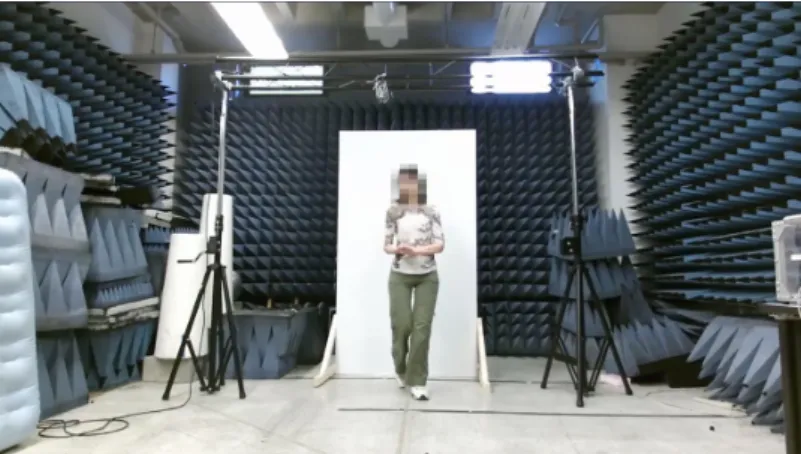
3 G A I T A N A LY S I S 27 3.1 Spatiotemporal Parameters . . . 27 3.2 Kinematic Parameters . . . 28 R E F E R E N C E S 32 II R A D A R-B A S E D G A I T C L A S S I F I C AT I O N 4 S Y S T E M D E S C R I P T I O N A N D D ATA C O L L E C T I O N 37 4.1 Experimental Setup . . . 37
4.2 Subject Information and Experimental Protocol . . . 37
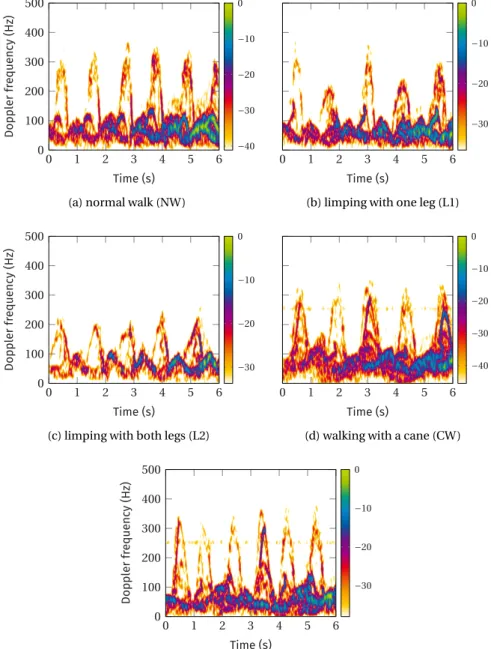
5 R A D A R D ATA R E P R E S E N TAT I O N S 39 5.1 Spectrogram . . . 39
5.1.1 Biomechanical Interpretation . . . 39
5.1.2 Signals Derived From the Spectrogram . . . 46
5.2 Cadence-Velocity Diagram . . . 47
5.2.1 Signals Derived From the Cadence-Velocity Diagram . 48 6 C L A S S I F I C AT I O N O F A B N O R M A L A N D C A N E-A S S I S T E D G A I T 53 6.1 Feature Extraction . . . 53 6.1.1 Physical Features . . . 54 6.1.2 Subspace-Based Features . . . 59 6.2 Experimental Results . . . 60 6.2.1 Methodology . . . 60 6.2.2 Physical Features . . . 62 6.2.3 Subspace-Based Features . . . 64 6.2.4 Discussion . . . 68 7 D E T E C T I O N O F G A I T A S Y M M E T R Y 71 7.1 Proposed Framework . . . 71 7.1.1 Preprocessing . . . 71
7.1.2 Extraction of Micro-Doppler Step Signatures . . . 71
7.1.3 Feature Extraction . . . 73
xii C O N T E N T S
7.1.4 Model for Gait Asymmetry Detection . . . 74
7.2 Experimental Results . . . 75
7.2.1 Experimental Data Set . . . 75
7.2.2 Model Selection . . . 75
7.2.3 Gait Asymmetry Prediction . . . 76
7.2.4 Discussion . . . 78 8 S U M M A R Y 79 R E F E R E N C E S 80 III T O W A R D R A D A R-B A S E D G A I T A N A LY S I S 9 S Y S T E M D E S C R I P T I O N A N D D ATA C O L L E C T I O N 85 9.1 Experimental Setup . . . 85
9.2 Subject Information and Experimental Protocol . . . 86
10 E X T R A C T I O N O F B I O M E C H A N I C A L PA R A M E T E R S 89 10.1 Methods . . . 89
10.1.1 Radar Signal Processing . . . 89
10.1.2 Extraction of Micro-Doppler Envelope Signals . . . 91
10.1.3 Extraction of Gait Cycles . . . 92
10.1.4 Definition of Flight Time . . . 94
10.1.5 Extraction of Gait Parameters . . . 95
10.1.6 Hypothesis Testing . . . 96
10.2 Experimental Results . . . 97
10.3 Discussion . . . 98
11 E S T I M AT I O N O F L O W E R L I M B A N G U L A R K I N E M AT I C S 103 11.1 Signal models . . . 103
11.1.1 Radar Signal Model . . . 103
11.1.2 Boulic Global Human Walking Model . . . 104
11.1.3 Angular Kinematics of Lower Limbs . . . 105
11.2 Methodology . . . 106
11.2.1 Experimental Data Set . . . 106
11.2.2 Step Time Spectrograms . . . 106
11.2.3 Gait Parameter Extraction via Hough Transform . . . . 107
11.2.4 Hip-Knee Cyclograms . . . 108
11.3 Experimental Results . . . 109
11.3.1 Validation of Hip and Knee Angle Models . . . 109
11.3.2 Validation of Boulic’s Global Walking Model . . . 112
11.3.3 Hip-knee Cyclogram Estimation . . . 112
11.4 Discussion . . . 113
12 S U M M A R Y 115 R E F E R E N C E S 116 IV C O N C L U S I O N S A N D O U T L O O K 13 S U M M A R Y A N D C O N C L U S I O N S 121 13.1 Radar-Based Gait Classification . . . 121
13.2 Toward Radar-Based Gait Analysis . . . 122
14 F U T U R E R E S E A R C H D I R E C T I O N S 123 14.1 Exploitation of Radio-Frequency Sensing Capabilities . . . 123
14.2 Sensor Fusion . . . 123
14.3 Deep Learning Approaches . . . 124
14.4 Additional Applications . . . 124
C O N T E N T S xiii
A A P P E N D I X 129
A.1 Fundamentals . . . 129
A.1.1 Estimation of Noise Level in the Spectrogram . . . 129
A.2 Radar-Based Gait Classification . . . 130 A.2.1 Cadence-Velocity Diagrams of Persons With Diagnosed
Gait Disorders . . . 130
A.2.2 Eigenimages Obtained Through Principal Component Analysis of Cadence-Velocity Diagrams . . . 132
A.2.3 Differently Preprocessed Cadence-Velocity Diagrams . 133 A.2.4 Receiver Operating Characteristics for Gait Asymmetry
Detection . . . 134
A.3 Toward Radar-Based Gait Analysis . . . 135
A.3.1 Effect of Knee Angle Confinement on the Analyzed Gait Parameters . . . 135
A.3.2 Inter-Person Variability in Lower Limb Angular Kine-matics . . . 135
L I S T O F F I G U R E S
Figure 1.1 Aging population . . . 1
Figure 1.2 Overview of non-wearable ambient solutions . . . 3
Figure 1.3 Overview of radar for indoor human motion sensing with applications . . . 5
Figure 1.4 Overview of the thesis structure . . . 9
Figure 2.1 Example of micro-Doppler gait signature . . . 25
Figure 3.1 Gait cycle phases . . . 27
Figure 3.2 Spatiotemporal gait parameters . . . 28
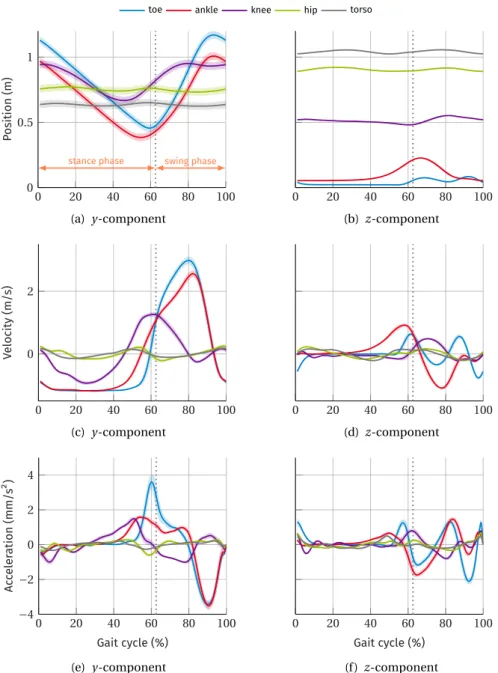
Figure 3.3 Position, velocity, and acceleration trajectories for dif-ferent body parts . . . 29
Figure 3.4 Definition of hip and knee angles . . . 30
Figure 3.5 Examples of hip and knee angle trajectories . . . 30
Figure 3.6 Example of hip-knee cyclogram . . . 31
Figure 4.1 Experimental radar setup for overground walking . . 37
Figure 4.2 Experimental radar setup for overground walking at Villanova University, PA, USA . . . 38
Figure 5.1 Difference in micro-Doppler signatures for toward and away from radar motions . . . 40
Figure 5.2 Simulated micro-Doppler signature of human gait . . 41
Figure 5.3 Examples of spectrograms for different walking styles (toward the radar) . . . 42
Figure 5.4 Examples of spectrograms for different walking styles (away from the radar) . . . 43
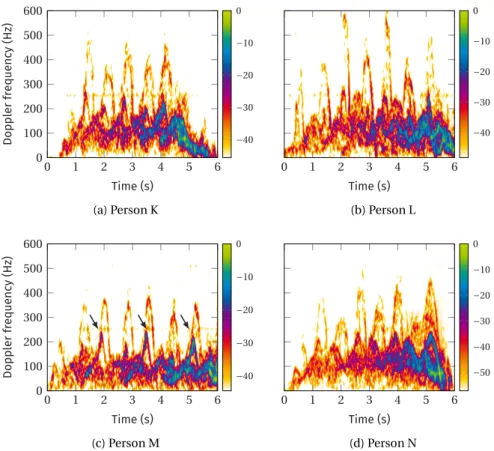
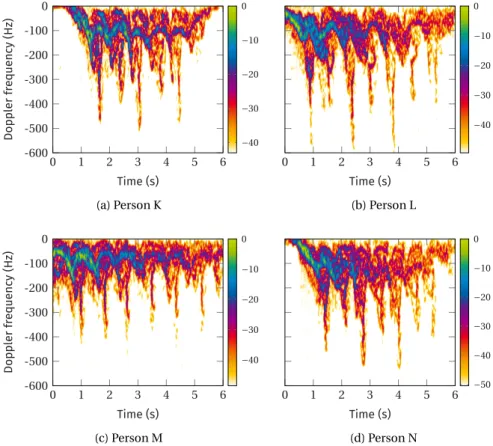
Figure 5.5 Example micro-Doppler signatures of individuals with diagnosed gait disorders (toward the radar) . . . 44
Figure 5.6 Example micro-Doppler signatures of individuals with diagnosed gait disorders (away from the radar) . . . . 45
Figure 5.7 Example micro-Doppler signature of Person M walk-ing with a cane . . . 46
Figure 5.8 Envelope and short-time energy signal . . . 47
Figure 5.9 CVDs for walking toward the radar system . . . 49
Figure 5.10 CVDs for walking away from the radar system . . . 50
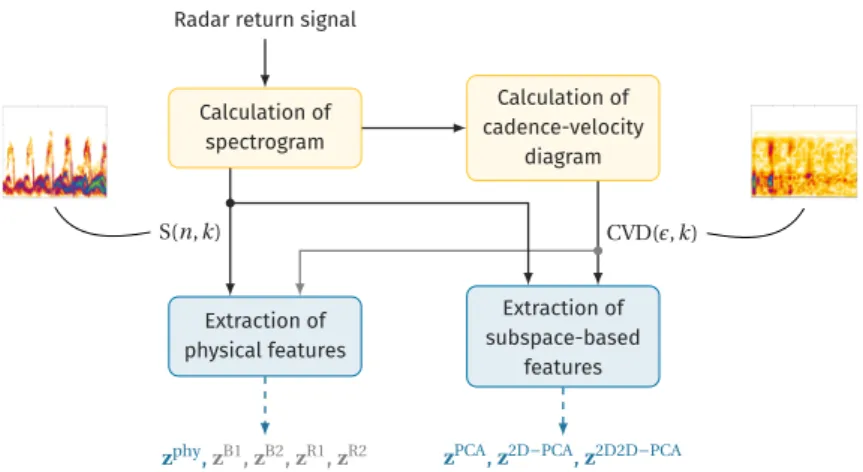
Figure 6.1 Overview of feature extraction processes . . . 54
Figure 6.2 Scatter plots of physical features . . . 55
Figure 6.3 Classification accuracy for differently preprocessed CVDSusing PCA-based features . . . 64
Figure 6.4 Classification accuracy for different radar data repre-sentations using PCA-based features . . . 65
Figure 6.5 Optimizing the number of nearest neighbors and num-ber of principal components for gait classification . . 65
Figure 6.6 Comparison of different PCA-based feature extraction methods . . . 66
Figure 7.1 Overview of processing steps to detect asymmetric gait from a radar return signal . . . 72
Figure 7.2 Extraction of micro-Doppler step signatures . . . 73
Figure 7.3 Model order selection for gait asymmetry prediction . 76 Figure 7.4 Example of ROC for gait asymmetry prediction . . . . 76
Figure 9.1 Experimental setup at the Locomotion Laboratory, Technische Universität Darmstadt, Germany . . . 85 Figure 9.2 Photos of the experimental setup for simultaneous
radar and MOCAPdata recording . . . 86 Figure 10.1 Overview of processing steps for the extraction of
biome-chanical parameters . . . 90 Figure 10.2 Examples of micro-Doppler signatures and extracted
envelope signals . . . 91 Figure 10.3 Example of vertical GRFS . . . 92 Figure 10.4 MOCAPand radar data of the right leg for one individual 93 Figure 10.5 Average differences between the time instant of
max-imal knee velocity from MOCAPdata and the toe-off time from GRFS . . . 95 Figure 10.6 Median of differences for the analyzed gait parameters 99 Figure 10.7 Decreasing maximal knee velocity for increasing knee
angle confinement . . . 101 Figure 11.1 Definition of hip and knee angles . . . 105 Figure 11.2 Flow diagram for the estimation of biomechanical
pa-rameters . . . 106 Figure 11.3 Examples of step time spectrograms . . . 107 Figure 11.4 Examples of hip-knee cyclograms . . . 108 Figure 11.5 Average MOCAPhip and knee angle trajectories for
each test subject . . . 109 Figure 11.6 Average MOCAPhip and knee angle trajectories for
different knee angle restrictions . . . 110 Figure 11.7 Comparison of measured and modeled lower limb
radial velocities . . . 112 Figure 11.8 Boxplots of the RMSE between MOCAP-based and
es-timated hip and knee angle trajectories . . . 113 Figure 11.9 Examples of estimated hip-knee cyclograms . . . 114 Figure A.1 Estimation of noise threshold . . . 129 Figure A.2 CVDs for walking toward the radar system (diagnosed
subjects) . . . 130 Figure A.3 CVDs for walking away from the radar system
(diag-nosed subjects) . . . 131 Figure A.4 Eigenimages for PCA-based feature extraction . . . . 132 Figure A.5 Examples of preprocessed CVD images . . . 133 Figure A.6 ROCSfor gait asymmetry prediction (Persons K–N) . 134 Figure A.7 Average MOCAPhip and knee angle trajectories for
each test subject . . . 137
L I S T O F T A B L E S
Table 6.1 Results gait classification using only the gait harmonic feature . . . 57 Table 6.2 Radar data representations and their dimensions . . . 61 Table 6.3 Results gait classification using physical features . . . 63 Table 6.4 Results gait classification using subspace-based features 67
Table 6.5 Results gait classification using PCA-based features and LOSOCV . . . 67 Table 6.6 Comparison of different gait classification algorithms 68 Table 7.1 Features of micro-Doppler step signatures used for
gait asymmetry detection . . . 73 Table 7.2 Overview of the experimental data set for gait
asym-metry detection . . . 75 Table 7.3 Logistic regression models for predicting the
proba-bility of asymmetric gait . . . 77 Table 7.4 Probability of detecting the asymmetric gait of Persons
K–N . . . 78 Table 10.1 Results for the extraction of biomechanical parameters 98 Table 11.1 Estimated hip and knee angle parameters from MOCAP
data . . . 111 Table 11.2 RMSE between the modeled and MOCAP-based hip
and knee angles . . . 111 Table A.1 RMSE between MOCAP-based and modeled velocities
of the knee and ankle joint . . . 135 Table A.2 Effect of knee angle confinement on the analyzed gait
parameters . . . 136
A C R O N Y M S
2D two-dimensional
2D-PCA two-dimensional principal component analysis
2D2D-PCA two-directional two-dimensional principal component analysis
3D three-dimensional
10FCV 10-fold cross-validation ACC classification accuracy ADL activities of daily living
BIC Bayesian information criterion CVD cadence-velocity diagram
CW walking with a cane in sync with one leg CW/OOS walking with a cane out of sync with any leg
EM electromagnetic
FNR false negative rate FPR false positive rate FT Fourier transform
FF fundamental frequency
FMCW frequency modulated continuous wave GAN generative adversarial network
GRF ground reaction force
A C R O N Y M S xvii
HAR human activity recognition IF instantaneous frequency
LOSOCV leave-one-subject-out cross-validation L1 limping with one leg
L2 limping with both legs LOS line-of-sight
LLS linear least squares MAE mean absolute error MCS mean cadence spectrum MOCAP motion capture
MSE mean squared error
MSSIM mean structural similarity index NN nearest neighbor
NLS nonlinear least squares
NW normal walking
NOH number of harmonics PIR passive infrared sensor PCA principal component analysis RCS radar cross section
RF radio frequency
RMSE root mean squared error
ROC receiver operating characteristic SD standard deviation
STFT short-time Fourier transform SVD singular value decomposition SSIM structural similarity
SOH sum-of-harmonics
SVM support vector machine TFR time-frequency representation TPR true positive rate
1
I N T R O D U C T I O NWorld-wide, the population aged over 60 years is growing [Wor18]. As shown in Fig. 1.1, the proportion of this age group to the total population is predicted to nearly double between 2015 and 2050, from 12 % to 22 % [Wor18;Uni19a]. As such, the growth in proportion of the elderly is increasing more dramatically compared to previous decades [Wor18]. This phenomenon is also known as
population aging [Wor18]. In Germany and the USA, the percentages of popu- population aging lation aged 60 years or over have already reached 29 % and 23 %, respectively,
in 2020 [Uni19a]. 1950 1960 1970 1980 1990 2000 2010 2020 2030 2040 2050 10 20 30 40 Year Per centage of popul ation aged 60+ WorldGermany USA
Figure 1.1:The percentage of population aged 60 years or over. From 2020 onward, the graphs show the median of predicted proportions along with the 95 % confidence intervals. [Uni19a;Uni19b]
The quality of life, which often goes along with good health, is a key factor for the elderly to actually benefit from the extra years of life. Measures for support-inghealthy aginginclude the development of people-centered and integrated health services1[Wor18]. To this end, ambient assisted living technologies have become the focus of many research activities to provide seamlessin-home health monitoring [BMB+16]. Seniors desire to live independently in their own homes as long as possible. This is not only understandable, but also from a
clinical point of view,aging in placehas been shown to be advantageous over aging in place moving to assisted living facilities or nursing homes [MPP+05]. Further, people
with disabilities and individuals living in geographically isolated communities benefit from remote health services.
One way to assess the general state of individual health is through gait
analy-sis. The human gait is a complex motion and requires the concerted interac- gait analysis tion between many systems, including strength, sensation and coordination
[LRW12]. Gait analysis encompasses the measurement and assessment of
quan-tities that characterize human locomotion. For a variety of diseases, clinical research has shown that gait analysis can facilitate diagnosis and enhance
1 the termintegrated health servicesrefers to “the organization and management of health services so that people get the care they need, when they need it, in ways that are user-friendly, achieve the desired results and provide value for money.” [Wor08]
2 I N T R O D U C T I O N
patient treatment. Pathologies affecting the gait include, e.g., neurodevelop-mental disorders (e.g. cerebral palsy and Down syndrome) and neurodegen-erative disorders (e.g. Parkinson’s and Alzheimer’s disease) [JPL+18;GTK+17;
CLLY16;WBH+15]. Thus, gait analysis is, e.g., employed in geriatrics (e.g. fall
risk assessment), orthopedics, prosthetics, and rehabilitation (e.g. post stroke)
[JPL+18;CLLY16;GRWS19;BWH06;PK17]. Further, gait analysis is important
in the areas of biomechanical research, sports medicine and athletic training. This thesis is concerned with signal processing for radar-based gait analy-sis. In so doing, the doctoral research contributes to the need for innovative technological solutions for remote health services.
In the following,Section 1.1elaborates on the motivation for using radio fre-quency (RF) sensing for human gait analysis. The state of the art and the thesis’ contributions in the area of signal processing for radar-based gait analysis are summarized inSection 1.2. Finally,Section 1.3gives an overview of the thesis structure, whileSection 1.4lists the publications that have been produced during the period of doctoral candidacy.
1.1 M O T I VAT I O N
Thorough clinical gait studies are often time-consuming, costly and lack re-producibility [Sim04]. For this reason, numerous ongoing research efforts aim at developing cost-efficient technologies for unobtrusive and long-term gait analysis. A great variety of sensors have been proposed for analyzing the gait. mobile gait
analysis Here, we focus on systems that are capable of providing pervasive locomotion monitoringin home, e.g., to support aging in place and enable independence in assisted living [DMS+16]. These systems can broadly be categorized into wearable2(direct) and non-wearable (indirect) solutions [MGM14]. While wear-able sensors are typically directly attached to a person or to their clothes, non-wearable sensors are deployed (stationary) within the home. However, non-wearable sensors require precise placement, necessitate the user’s cooperation and can be uncomfortable to wear. For these reasons, non-wearable technologies are desirable.
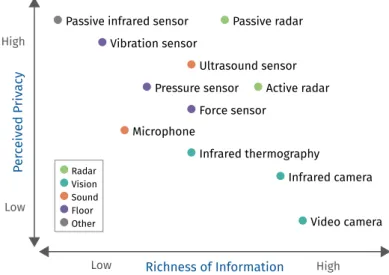
The diagram inFig. 1.2gives an overview of state-of-the-art non-contact sens-ing modalities for gait recognition and analysis. Typically, there is a trade-off non-wearable
sensors between therichness of informationprovided by the sensor, and theperceived
privacy by the user. In particular for in-home scenarios, the latter typically defines the user’s acceptance of the device.
The least informative sensors to be used for gait analysis are passive infrared sensors (PIRS). Designed as motion detectors, they operate a near infrared
passive infrared
sensors light3and recognize motions in their field of view. Using multiple PIR sensors, the average gait velocity can be calculated based on the detection times of the individual sensors [RAJ+16;KMD+12;HAH+10].
Another cheap and non-intrusive way to analyze the walking pattern of a person, is to use microphones. The sound of the feet while walking can be used sound-based
systems to infer spatiotemporal gait parameters for basic gait analysis [UBJ15]. Also, the acoustic gait information can enrich gait analysis systems when combined with other sensors [HGB+14]. However, the performance of audio-based systems can easily be affected by ambient noise, footwear and floor cover material. Operating at frequencies higher than the upper audible limit of human hearing,
2 for reviews on wearable technologies for gait analysis see e.g. [JPL+18;ELB+17;CLLY16;TLZF12] 3 electromagnetic (EM) waves with wavelengths in the range of 0.72µm to 1.3µm [CW11]
1.1 M O T I VAT I O N 3 Per ceiv ed Priv acy Richness of Information High Low Low High
Passive infrared sensor
Infrared thermography Infrared camera Video camera Force sensor Pressure sensor Vibration sensor Microphone Ultrasound sensor Passive radar Active radar Radar Vision Sound Floor Other
Figure 1.2:Overview of non-wearable ambient solutions for in-home gait analysis. Typically, there is a trade-off between the richness of information provided by the sensor, and the perceived privacy by the user. (adapted from [DMS+16])
the use of active ultrasound sensors have been investigated for gait recognition
[GCBS17;DBMS13;BCW11;MSBE10;KR07]. However, it is currently not
possi-ble to separate motions of several people in the field of view of the sensor, e.g., by exploiting range information.
For the measurement of spatiotemporal gait parameters, instrumented
walk-ways with integrated force platforms or pressure sensors have been employed floor sensors
[DMP+17;GZA09]. While the use of so-called ground reaction forces (GRFS)
is well established in clinical gait analysis [Kir06], portable gait mats have the disadvantages that they are of limited size and the person has to walk on a predefined course [MGM14]. More recently, less intrusive low-cost vibration sensors have been studied for indoor human motion sensing [CLVS20]. Being placed on the floor throughout a home along usual pathways, they capture the vibrations in the floor caused by a walking person.
The most widely studied marker-less motion capture systems4for gait
analy-sis are cameras.5Operating at visible light [CHSW17;WSS+13] or near-infrared vision-based sensors light,3,6[LCAL19;GTK+17;XMC+15;EG15;PWBN14;SS13] they provide frontal
or sagittal views on a person’s gait in form of videos. Utilizing long-wavelength infrared radiation,7infrared thermography provides silhouette information based on the contrast between the person’s surface temperature, and that of other objects and the background. Thus, basic gait patterns can be recognized from the infrared thermography images [XMS+10]. However, despite recent advances in vision-based marker-less gait monitoring systems, their perfor-mance is still limited to laboratory conditions and using a large number of cameras [CECS18]. Typically, this type of sensor requires the entire body to be in the field of view to extract and track the silhouette of the subject accurately. Then, the human posture is modeled by locating a finite number of points on the skeleton. In practical scenarios, vision-based systems are easily affected by distance, lighting conditions, shadowing and clothing. While depth cameras
4 "standard" motion capture systems operate with multiple infrared cameras and passive reflec-tivemarkersthat are attached to the test subject; hence, they are notmarker-less
5 for a review on vision-based motion analysis see e.g. [CECS18] 6 this includes the use of the Microsoft Kinect
4 I N T R O D U C T I O N
utilizing (structured) infrared light are generally considered unobtrusive, the perceived privacy of video cameras is low, and thus they are less accepted as an in-home modality.
In this thesis, the applicability of radio frequency (RF)8sensing for gait anal-ysis is investigated. Since it is contact-less, privacy-preserving, and does not radio-frequency
sensors require any instrumentation on the user, it is a viable technology for continuous and unobtrusive in-home gait monitoring. Further, radar9systems can be used in conjunction to other wearable and non-wearable sensors. The advantages of RF sensing are that it is not sensitive to lighting conditions, clothing and background complexity, that usually affect vision-based systems. Further, RF sensors can be installed discretely, since radio waves can penetrate common materials [CW11]. While in this thesis only active radar systems are considered, it is noted that passive RF modules have been used for human activity clas-sification [LTP18]. Passive radar systems do not send EM waves but exploit signals of opportunityby, e.g., leveraging existing communication signals, such as Wi-Fi [JCM+18].
Human activities may be recognized using radar by exploiting features caused by the so-called micro-Doppler effect [Che19]. In the Doppler domain, the re-micro-Doppler
effect sulting micro-Doppler signatures occur as modulations around the carrier frequency of the transmitted EM wave. Representing them in a joint time-frequency domain provides an additional time dimension which accounts for the time-varying nature of the observed motions. These micro-Doppler signatures are characteristic for targets’ motions, and, thus, are the basis of discriminating movements. Specifically, in the case of a walking human, the micro-Doppler signatures describe gait kinematics by capturing velocity, accel-eration, and rotation of individual body parts.
Throughout the last two decades, RF sensing has gained much attention in radar for indoor
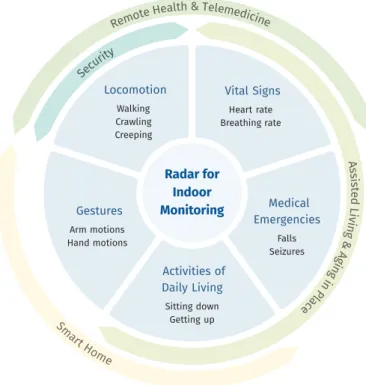
monitoring the field of human activity recognition (HAR) for indoor human monitoring.10 Figure 1.3illustrates various applications of radar for indoor monitoring and corresponding motion classes, along with some examples of motions.
Remote healthandtelemedicinedescribe the service of long-distance diagno-sis and monitoring via telecommunication technologies. In this context, the RF sensing technology, through active or passive radar devices, has gained much attention in the recent past [SF19;FLS19]. Here, radar has been employed for non-contact vital sign monitoring, with application to the detection of, e.g., sudden infant death syndrome or sleep apnea [ZHM+18;HZG+18;LZS+17;
SIT+16;WSRC14].
Closely related to remote health and telemedicine are the concepts ofassisted living andaging in place, which have the goal to empower seniors to live independently and safely in their own homes as long as possible. Besides vital sign monitoring, radar has been successfully applied for the detection of medical emergencies such as falls [JA18;AZAH16;JAA16;SHRS15]. Another important concept in ambient assisted living is monitoring activities of daily livings (ADLS), which helps to assess a person’s functional status, and, thus, the ability to live independently [DMS+16]. In case of radar-based recognition, these activities are often considered in combination with other motions, such as walking [EGA20;EA19;SÖG18;JAE17;BPH15;KL09].
8 the RF spectrum comprises EM waves with wavelengths in the range of 1 mm to 100 km [Ell16] 9 the wordradaris an acronym for radio dection and ranging and "as a palindrome, this name
also evokes the basic send/echo idea behind these measurement systems" [CB09] 10 for an overview see e.g. [GA19;LFD+19;MPGL17;Ami17;LPH+17]
1.2 S TAT E O F T H E A R T A N D C O N T R I B U T I O N S 5 Locomotion Walking Crawling Creeping Vital Signs Heart rate Breathing rate Medical Emergencies Falls Seizures Activities of Daily Living Sitting down Getting up Gestures Arm motions Hand motions Radar for Indoor Monitoring
Remote Health & Telemedicine
Secur ity As siste d Liv ing & Ag ing in Pla ce Sm art Home
Figure 1.3:Overview of radar for indoor human motion sensing, where applications can broadly be categorized into remote health & telemedicine, assisted living & aging in place, smart home, and security. In practice, neither motion classes nor applications are strictly distinct and often overlap. (adapted from [GA19])
Beyond health-related applications, locomotion recognition, in general, is key tosecurityapplications such as intruder detection. In this regard, RF sens-ing has been employed for the detection [KM16;KHK15] and identification
[VKJ+18;CLFG18;KM16;RB15] of individuals.
Finally, radar has recently become of increased interest forsmart home ap-plications to automatically control lighting scenes and appliances based on ADLS, or to facilitate man-machine interaction via hand gesture [AZS19;GL17] or arm motion recognition [ZAS20].
1.2 S TAT E O F T H E A R T A N D C O N T R I B U T I O N S
The main contributions of this thesis fall into two areas. In the field of Radar-Based Gait Classification, the aim is to distinguish between different walking styles within the class of human gait. As such, we deal with anintra-motion cat-egoryclassification problem. In this context, also the influence of walking aids on the radar backscatterings is considered. Since, in practice, gait classes are neither distinct nor always known, the next step is to moveToward Radar-Based Gait Analysis. Using RF sensing, the aim is to provide medical practitioners and physiotherapists with commonly accepted gait parameters to assist in therapy. In the following, the state of the art is separately reviewed for the respective areas, and corresponding contributions in this thesis are summarized.
6 I N T R O D U C T I O N
1.2.1 Radar-Based Gait Classification
Human gait has first been studied using radar in, e.g., [Che08;CLHW06;GMG01]. Early investigations focused on extracting basic gait parameters, such as the stride rate, stride length and walking speed to detect a person’s presence and to discern human walking patterns from animal ones [TS09;HD08;Ote05]. More advanced radar-based gait classification methods were concerned with dis-criminating between walking with and without arm swinging [TPB15;TBA10;
LIA10;OSA11;WF11;MA09], walking while holding an object [CLFG18;FRG15;
LPTB12], or different walking speeds [RB15;CPM+15].
More recently, radar-based detection of walking aids has gained increased in-terest, but has not been widely examined yet. Aminet al.[AAZB15b;AAZB15a] were first to show that walking aids, such as a cane or a walker, can be de-tected by carefully analyzing the back-scattered radar signal. Later, Gürbüz et al.[GCBS17] investigated the effect of various walking aids on the charac-teristics of radar return signals. Different degrees of mobility were examined, namely, unaided walking, simulated limping, walking with a cane/tripod or a walker, and using a wheelchair. More recently, Seyfiouˇgluet al.[SÖG18] used a deep convolutional autoencoder for discriminating 12 classes of aided and unaided indoor human activities, whereof half were gait motions including walking with a cane or a walker.
While all of the above works considered gait motions, none of them focused solely on the differences in micro-Doppler signatures due to altered lower limb motions or the use of walking aids. Considering medical applications of radar-based gait analysis, a deepened understanding of these effects is required before RF sensing can be employed in practical in-home gait monitoring sys-tems. In this regard, it is noted that only few works have considered human movements with the radar having a back-view on the person, see e.g. [BPH15;
WSRC14]. However, none of them elaborates on the possible differences in
micro-Doppler gait signatures when receding from or approaching the radar system.
In terms of radar-based gait classification, the original contributions of this thesis are constituted by:
• Detailed analysis and biomechanical interpretation of radar micro-Doppler gait signatures:Through extensive experiments, it is shown
Section 5.1.1
that radar backscatterings of human locomotion are distinctively differ-ent when observing the motion from the front compared to from behind. This behavior can be exploited for the detection of abnormal steps and
cane motions. [SAZ17a]
• Extraction of physically interpretable features:By utilizing different
Section 6.1.1
joint-variable radar signal representations pertinent features that have a physical meaning, such as the step rate, are obtained from experimental radar data. Here, the spectrogram, the so-called cadence-velocity dia-gram (CVD), and signals derived from these are considered.
[SZA17;SAZ18;SAZ19]
• Extraction of subspace-based features:By using automated data-driven
Section 6.1.2
feature learning techniques, namely, principal component analysis (PCA) and its extensions, the offerings of two-dimensional (2D) radar signal representations are examined for the classification of different walking
1.2 S TAT E O F T H E A R T A N D C O N T R I B U T I O N S 7
styles. Here, the spectrogram, the CVD, and signals derived from these
are considered. [SZA17;SSAZ18;SAZ19]
• Evaluation and comparison of different feature sets for the
classifica-tion of five walking styles:Novel and state-of-the-art feature sets are Section 6.2
compared by means of their ability to discern between five different gait classes, including normal walking, simulated limping and assisted gait. The performance of the proposed framework is evaluated using experi-mental radar data of 10 able-bodied test subjects and four individuals
with diagnosed gait disorders. [SAZ19]
• Development of a framework for automated gait asymmetry
detec-tion:Micro-Doppler step signatures are automatically extracted from Chapter 7
radar measurements of short duration. Then, image-based features and physical features are calculated to quantify the (dis)similarity between consecutive steps. Based on these features, a subsequent detector is designed to recognize gait asymmetry at a limited rate of false alarms. The performance of the proposed framework is evaluated based on ex-perimental radar data of 10 able-bodied volunteers and four individuals
with diagnosed gait disorders. [SZA19]
1.2.2 Toward Radar-Based Gait Analysis
In order to employ radar systems as medical tools, the aim is to capture spa-tiotemporal and kinematic gait parameters, such as the flight time or the swing velocity of the feet, since they are valuable to clinicians for assessing the gait (see e.g. [SMF+17;SCC+19;WBH+15] as well as references in [JPL+18]). In this regard, relevant prior research on radar-based gait analysis includes the work of Wanget al.[WSRC14], who employed pulse-Doppler radar to estimate the step time and the walking speed of 13 volunteers. Further, based on radar micro-Doppler signatures of 74 seniors, Sahoet al.[SUSM19] showed that not only the walking speed, but also leg and foot velocities are indicative for lower cognitive functions in the elderly.
A way to objectively assess the capabilities of RF sensing for basic gait anal-ysis is to compare radar-based gait parameters to simultaneously recorded marker-based motion capture (MOCAP) data. The latter have previously been utilized for interpreting and simulating micro-Doppler gait signatures [RGC17;
Che19]. For example, in automotive scenarios, Heldet al. [HSK+18] used
MOCAPdata for analyzing micro-Doppler signatures of human gait for en-hanced pedestrian detection and early movement prediction. Karabacaket al.
[KGG+15] utilized MOCAPdata and the commonly used global human
walk-ing model by Boulic, Magnenat-Thalman and Thalman [BTT90] to simulate micro-Doppler gait signatures and validated their use for classification. By use of motion capturing, Abdulatifet al.[AAKS17] developed an improved motion model for tracking individual body components based on radar measurements. However, most of these works merely qualitatively discuss the consistency between radar measurements and (simultaneously) recorded MOCAPdata.
Eventually, for a more advanced gait analysis, one would like to move beyond discrete biomechanical measures in order to gain insights into the underlying gait mechanisms. Analyzing the time-varying gait kinematics over an entire gait cycle allows for better identification of subtle changes in the gait profile. In this regard, e.g., the lower limb joint velocities and angles are of interest. The former
8 I N T R O D U C T I O N
are revealed by time-frequency analysis of the backscattered radar signals, since the measured Doppler shift is directly proportional to the velocities of the body parts.
Here, the global human walking model by Boulicet al.[BTT90] has also been used for describing the lower limb joint kinematics. For example, in [vDG03;
vDG08], van Dorp and Groen exploited this relation and presented
model-and feature-based approaches to estimate the gait cycle frequency model-and length from experimental micro-Doppler signatures with the goal to minimize the difference between simulated and measured data.
In this research area, the thesis advances the state of the art as follows: • Extraction of biomechanical gait parameters:Novel and existing
meth-Chapter 10
ods are employed to extract 11 spatiotemporal and kinematic parameters from radar micro-Doppler signatures. Based on experimental data of 19 able-bodied test subjects walking on an instrumented treadmill, the accuracy of the extracted gait parameters is assessed through simulta-neously recorded marker-based motion capturing utilizing GRFS. Five degrees of gait abnormalities are investigated, which were introduced by an adjustable orthosis, such that one of the knees could not be fully
bent. [SGZ20]
• Formulation of parametric models for lower limb joint velocities:By
Section 11.1
combining the global human walking model by Boulic, Magnenat-Thal-mann, and Thalmann [BTT90], describing the positioning of lower limb joints during walking, and the bilateral symmetric model for the angular kinematics of the lower limb joints [YNC04], models for the radial knee and ankle velocities are formulated. The models’ parameters directly reflect biomechanical gait characteristics and thus allow to account for gait abnormalities.
• Estimation of lower limb angular kinematics:Using the above
para-Section 11.2
metric models for the lower limb joint velocities, the corresponding angular kinematics, namely, the time-varying hip and knee angles, are estimated from micro-Doppler step signatures via Hough transform. Ex-perimental data of 19 able-bodied test subjects are used to assess the accuracy of estimated angle trajectories in comparison to simultaneously recorded marker-based motion capturing utilizing GRFS.
1.2.3 Additional Contributions
In cooperation with colleagues, three conference papers have been published during the period of doctoral candidacy. The respective achievements will not be detailed in this thesis, but are summarized below:
• Unsupervised person enumeration and labeling:Based on experimen-tally assessed micro-Doppler stride signatures of four persons, an un-supervised clustering enumeration and labeling algorithm is employed to first estimate the numbers of clusters in the data set, i.e., the number of individuals observed by the radar, and then identify individuals by assigning distinct labels to the clusters. In addition, the performance of the cluster enumeration and labeling algorithm is evaluated in a sequen-tial manner: whenever new radar measurements become available, the number of clusters is re-estimated. It is shown that the proposed method
1.3 T H E S I S O V E R V I E W 9
is able to correctly estimate the number of persons, and track the change in the number of individuals as we observe more data. [TSM+18] • Robust and sequential detection of gait asymmetry:Combining ideas of robust statistics and sequential analysis, an online approach for radar-based gait analysis is proposed. To this end, the radar micro-Doppler signatures are analyzed and salient features are extracted, which quantify the (dis)similarity between consecutive steps, and, thus, gait (a)symmetry. The distributions of these features under each gait class are obtained by means of kernel density estimation. To account for the inaccuracies of the density estimation, an uncertainty model is used to obtain a set of most similar distributions. These distributions are then employed to construct a sequential probability ratio test to render a fast and reliable decision about the underlying gait class. Based on real radar data, it is shown that the proposed approach can achieve high detection
rates at reduced measurement durations. [SRZA19]
• Robust genetic algorithm for the prediction of the maximal knee an-gle during walking:Given a set of radar features, the maximal knee angle during walking is predicted using a new robust genetic algorithm based nonlinear regression method. It simultaneously performs feature selec-tion, parameter optimization for the support vector machine and outlier rejection by encoding these aspects into the chromosome design. Using experimental radar data, it is shown that the proposed algorithm signifi-cantly outperforms competing methods in terms of prediction accuracy.
[DSMZ19]
1.3 T H E S I S O V E R V I E W
Following this introduction, the doctoral thesis is organized into four parts, as illustratedFig. 1.4, where the main contributions are detailed inParts IIandIII.
S I G N A L P R O C E S S I N G F O R R A D A R - B A S E D G A I T A N A L Y S I S Part II Radar-Based Gait Classification Part III Toward Radar-Based Gait Analysis Part I
Fundametals ConlusionsPart IV
and Outlook Exp. Data Set I
Overground Walking Treadmill WalkingExp. Data Set II
Figure 1.4:Overview of the thesis structure.
First,Part Iprovides the fundamentals of radar micro-Doppler signatures and briefly introduces basic gait analysis terminology.
Part IIdeals with radar-based gait classification and the presented methods are evaluated based on experimental radar data from overground walking. First, different radar data representations are introduced, namely, the spectrogram and the cadence-velocity diagram (CVD). To further the understanding of micro-Doppler signatures of human gait, a detailed biomechanical interpreta-tion is given. Then, a classificainterpreta-tion framework for discriminating five different
10 I N T R O D U C T I O N
walking styles based on radar backscatterings in presented, where different fea-ture sets are used. Finally, a radar-based gait asymmetry detector is developed and evaluated based on realistic radar measurements of four individuals with diagnosed gait disorders.
Going beyond discriminating between a finite number of distinct gait classes, Part IIIfocuses on assessing the capabilities of RF sensing for gait analysis. In this context, a variety of discrete biomechanical gait parameters as well as time-varying gait kinematics are extracted from experimental radar data from treadmill walking. The performance of the developed signal processing methods is assessed by the use of simultaneously recorded motion capture (MOCAP) data utilizing ground reaction forces (GRFS).
Finally, a summary and conclusions of the presented work as well as an outlook for future research are given inPart IV.
1.4 P U B L I C AT I O N S
The following publications have been produced during the period of doctoral candidacy:
B O O K C H A P T E R:
[SAZ17b] A.-K. Seifert, M. G. Amin, and A. M. Zoubir, “Radar monitoring of humans with asistive walking devices,” inRadar for Indoor Monitoring: Detection, Classifica-tion, and Assessment, M. G. Amin, Ed., Boca Raton, FL, USA: CRC Press, 2017, ch. 12, pp. 271–300.
I N T E R N AT I O N A L LY R E F E R E E D J O U R N A L A R T I C L E S:
[SAZ19] A.-K. Seifert, M. G. Amin, and A. M. Zoubir, “Toward unobtrusive in-home gait analysis based on radar micro-Doppler signatures,”IEEE Transactions on Biomedical Engineering, vol. 66, no. 9, pp. 2629–2640, Sep. 2019.DOI:10.1109/ TBME.2019.2893528.
[SGZ20] A.-K. Seifert, M. Grimmer, and A. M. Zoubir, “Doppler radar for the extraction of biomechanical parameters in gait analysis,”IEEE Journal of Biomedical and Health Informatics, 2020, (to be published).DOI:10.1109/JBHI.2020.2994471.
I N T E R N AT I O N A L LY R E F E R E E D C O N F E R E N C E PA P E R S:
[SAZ17a] A.-K. Seifert, M. G. Amin, and A. M. Zoubir, “New analysis of radar micro-Doppler gait signatures for rehabilitation and assisted living,” inIEEE International Con-ference on Acoustics, Speech and Signal Processing, 2017.DOI:10.1109/ICASSP. 2017.7952908.
[SZA17] A.-K. Seifert, A. M. Zoubir, and M. G. Amin, “Radar-based human gait recognition in cane-assisted walks,” inIEEE Radar Conference, 2017.DOI:10.1109/RADAR. 2017.7944431.
[SAZ18] A.-K. Seifert, M. G. Amin, and A. M. Zoubir, “Radar classification of human gait abnormality based on sum-of-harmonics analysis,” inIEEE Radar Conference, 2018.DOI:10.1109/RADAR.2018.8378687.
[SSAZ18] A.-K. Seifert, L. Schäfer, M. G. Amin, and A. M. Zoubir, “Subspace classifica-tion of human gait using radar micro-Doppler signatures,” inEuropean Signal Processing Conference, 2018.DOI:10.23919/EUSIPCO.2018.8553592.
R E F E R E N C E S 11
[TSM+18] F. K. Teklehaymanot, A.-K. Seifert, M. Muma, M. G. Amin, and A. M. Zoubir, “Bayesian target enumeration and labeling using radar data of human gait,” in European Signal Processing Conference, 2018.DOI:10.23919/EUSIPCO.2018. 8553444.
[DSMZ19] L. Dawel, A.-K. Seifert, M. Muma, and A. M. Zoubir, “A robust genetic algorithm for feature selection and parameter optimization in radar-based gait analysis,” inIEEE International Workshop on Computational Advances in Multi-Sensor Adaptive Processing, 2019.DOI:10.1109/CAMSAP45676.2019.9022515.
[SZA19] A.-K. Seifert, A. M. Zoubir, and M. G. Amin, “Detection of gait asymmetry using indoor Doppler radar,” inIEEE Radar Conference, (Best Student Paper Award, 1st prize), 2019.DOI:10.1109/RADAR.2019.8835611.
[SRZA19] A.-K. Seifert, D. Reinhard, A. M. Zoubir, and M. G. Amin, “A robust and sequential approach for detecting gait asymmetry based on radar micro-Doppler signa-tures,” inEuropean Signal Processing Conference, 2019.DOI:10.23919/EUSIPCO. 2019.8902343.
W O R K S H O P C O N T R I B U T I O N:
[ZS17] A. M. Zoubir and A.-K. Seifert, “Signal processing and time-frequency analysis of radar data for indoor human monitoring,” inEuropean Radar Conference, Oct. 2017.
O T H E R P U B L I C AT I O N:
[ZS18] A. M. Zoubir and A.-K. Seifert, “Radar for diagnosis, rehabilitation, and assisted living,”SciTech Europe Quarterly, pp. 64–65, Dec. 2018.
R E F E R E N C E S
[AAKS17] S. Abdulatifet al., “Real-time capable micro-Doppler signature decomposition of walking human limbs,” inIEEE Radar Conference, 2017.DOI:10.1109/RADAR. 2017.7944367(cit. on p.7).
[AZS19] M. G. Amin, Z. Zeng, and T. Shan, “Hand gesture recognition based on radar micro-Doppler signature envelopes,” inIEEE Radar Conference, 2019.DOI:10. 1109/RADAR.2019.8835661(cit. on p.5).
[AAZB15a] M. G. Aminet al., “Human gait recognition with cane assistive device using quadratic time-frequency distributions,”IET Radar, Sonar and Navigation, vol. 9, no. 9, pp. 1224–1230, Dec. 2015.DOI:10.1049/iet-rsn.2015.0119(cit. on p.6). [AZAH16] M. G. Aminet al., “Radar signal processing for elderly fall detection: The future
for in-home monitoring,”IEEE Signal Processing Magazine, vol. 33, no. 2, pp. 71– 80, Mar. 2016.DOI:10.1109/MSP.2015.2502784(cit. on p.4).
[Ami17] M. G. Amin, Ed.,Radar for Indoor Monitoring: Detection, Classification, and Assessment. Boca Raton, FL, USA: CRC Press, 2017 (cit. on p.4).
[AAZB15b] M. G. Aminet al., “Micro-Dppler characteristics of elderly gait patterns with walking aids,” inSPIE Defense and Security, 2015.DOI:10 . 1117 / 12 . 2178398
(cit. on p.6).
[BCW11] A. Balleri, K. Chetty, and K. Woodbridge, “Classification of personnel targets by acoustic micro-Doppler signatures,”IET Radar, Sonar and Navigation, vol. 5, no. 9, pp. 943–951, Dec. 2011.DOI:10.1049/iet-rsn.2011.0087(cit. on p.3). [BWH06] Y. Barak, R. C. Wagenaar, and K. G. Holt, “Gait characteristics of elderly people
with a history of falls: A dynamic approach,”Physical Therapy, vol. 86, no. 11, pp. 1501–1510, Nov. 2006.DOI:10.2522/ptj.20050387(cit. on p.2).
[BPH15] S. Björklund, H. Petersson, and G. Hendeby, “Features for micro-Doppler based activity classification,”IET Radar, Sonar and Navigation, vol. 9, no. 9, pp. 1181– 1187, Dec. 2015.DOI:10.1049/iet-rsn.2015.0084(cit. on pp.4,6).
[BMB+16] S. Blackmanet al., “Ambient assisted living technologies for aging well: A scoping review,”Journal of Intelligent Systems, vol. 25, no. 1, pp. 55–69, Jan. 2016.DOI: 10.1515/jisys-2014-0136(cit. on p.1).
[BTT90] R. Boulic, N. M. Thalmann, and D. Thalmann, “A global human walking model with real-time kinematic personification,”The Visual Computer, vol. 6, no. 6, pp. 344–358, Nov. 1990.DOI:10.1007/BF01901021(cit. on pp.7,8).
[CHSW17] X. Caiet al., “Single-camera-based method for step length symmetry measure-ment in unconstrained elderly home monitoring,”IEEE Transactions on Biomed-ical Engineering, vol. 64, no. 11, pp. 2618–2627, Nov. 2017.DOI:10.1109/TBME. 2017.2653246(cit. on p.3).
[CW11] J. B. Campbell and R. H. Wynne,Introduction to Remote Sensing, 5th ed. New York, NY, USA: Guilford Publications, 2011 (cit. on pp.2–4).
[CLLY16] S. Chenet al., “Toward pervasive gait analysis with wearable sensors: A system-atic review,”IEEE Journal of Biomedical and Health Informatics, vol. 20, no. 6, pp. 1521–1537, Sep. 2016.DOI:10.1109/JBHI.2016.2608720(cit. on p.2).
[Che08] V. C. Chen, “Doppler signatures of radar backscattering from objects with micro-motions,”IET Signal Processing, vol. 2, no. 3, pp. 291–300, Sep. 2008.DOI:10. 1049/iet-spr:20070137(cit. on p.6).
[CLHW06] V. C. Chenet al., “Micro-Doppler effect in radar: Phenomenon, model, and simulation study,”IEEE Transactions on Aerospace and Electronic Systems, vol. 42, no. 1, pp. 2–21, Jan. 2006.DOI:10.1109/TAES.2006.1603402(cit. on p.6). [Che19] V. C. Chen,The Micro-Doppler Effect in Radar, 2nd ed. Norwood, MA, USA: Artech
House, 2019 (cit. on pp.4,7).
14 R E F E R E N C E S
[CLFG18] Z. Chenet al., “Personnel recognition and gait classification based on multistatic micro-Doppler signatures using deep convolutional neural networks,”IEEE Geo-science and Remote Sensing Letters, vol. 15, no. 5, pp. 669–673, May 2018.DOI: 10.1109/LGRS.2018.2806940(cit. on pp.5,6).
[CB09] M. Cheney and B. Borden,Fundamentals of radar imaging. Philadelphia, PA, USA: Society for Industrial and Applied Mathematics, 2009 (cit. on p.4). [CPM+15] C. Clementeet al., “A novel algorithm for radar classification based on Doppler
characteristics exploiting orthogonal pseudo-Zernike polynomials,”IEEE Trans-actions on Aerospace and Electronic Systems, vol. 51, no. 1, pp. 417–430, Jan. 2015.
DOI:10.1109/TAES.2014.130762(cit. on p.6).
[CLVS20] J. Clementeet al., “Smart seismic sensing for indoor fall detection, location, and notification,”IEEE Journal of Biomedical and Health Informatics, vol. 24, no. 2, pp. 524–532, Feb. 2020.DOI:10.1109/JBHI.2019.2907498(cit. on p.3).
[CECS18] S. L. Colyeret al., “A review of the evolution of vision-based motion analysis and the integration of advanced computer vision methods towards developing a markerless system,”Sports Medicine - Open, vol. 4, no. 24, pp. 1–15, Jun. 2018.
DOI:10.1186/s40798-018-0139-y(cit. on p.3).
[DBMS13] T. Damarlaet al., “Classification of animals and people ultrasonic signatures,” IEEE Sensors Journal, vol. 13, no. 5, pp. 1464–1472, May 2013.DOI:10.1109/JSEN. 2012.2236550(cit. on p.3).
[DMS+16] C. Debeset al., “Monitoring activities of daily living in smart homes: Understand-ing human behavior,”IEEE Signal Processing Magazine, vol. 33, no. 2, pp. 81–94, Mar. 2016.DOI:10.1109/MSP.2015.2503881(cit. on pp.2–4).
[DMP+17] E. Dolatabadiet al., “Mixture-model clustering of pathological gait patterns,” IEEE Journal of Biomedical and Health Informatics, vol. 21, no. 5, pp. 1297–1305, Nov. 2017.DOI:10.1109/JBHI.2016.2633000(cit. on p.3).
[Ell16] S. Ellingson,Radio Systems Engineering. Cambridge, UK: Cambridge University Press, 2016 (cit. on p.4).
[EG15] B. Erol and S. Z. Gürbüz, “A Kinect-based human micro-Doppler simulator,” IEEE Aerospace and Electronics Systems Magazine, vol. 30, no. 5, pp. 6–17, May 2015.DOI:10.1109/MAES.2015.7119820(cit. on p.3).
[EGA20] B. Erol, S. Z. Gürbüz, and M. G. Amin, “Motion classification using kinematically sifted ACGAN-synthesized radar micro-Doppler signatures,”IEEE Transactions on Aerospace and Electronic Systems, 2020, to be pusblished.DOI:10.1109/TAES. 2020.2969579(cit. on p.4).
[EA19] B. Erol and M. G. Amin, “Radar data cube processing for human activity recogni-tion using multisubspace learning,”IEEE Transactions on Aerospace and Elec-tronic Systems, vol. 55, no. 6, pp. 3617–3628, Apr. 2019.DOI:10.1109/TAES.2019. 2910980(cit. on p.4).
[ELB+17] B. M. Eskofieret al., “An overview of smart shoes in the internet of health things: Gait and mobility assessment in health promotion and disease monitoring,” Applied Sciences, vol. 7, no. 10, p. 986, Sep. 2017.DOI:10.3390/app7100986(cit.
on p.2).
[FLS19] F. Fioranelli, J. Le Kernec, and S. A. Shah, “Radar for health care: Recognizing human activities and monitoring vital signs,”IEEE Potentials, vol. 38, no. 4, pp. 16–23, Jul. 2019.DOI:10.1109/MPOT.2019.2906977(cit. on p.4).
[FRG15] F. Fioranelli, M. Ritchie, and H. Griffiths, “Aspect angle dependence and multi-static data fusion for micro-Doppler classification of armed/unarmed person-nel,”IET Radar, Sonar and Navigation, vol. 9, no. 9, pp. 1231–1239, Dec. 2015.
DOI:10.1049/iet-rsn.2015.0058(cit. on p.6).
[GMG01] J. L. Geisheimer, W. S. Marshall, and E. Greneker, “A continuous-wave (CW) radar for gait analysis,” inIEEE Asilomar Asilomar Conference on Signals, Systems, and Computers, 2001.DOI:10.1109/ACSSC.2001.987041(cit. on p.6).
[GTK+17] F. Gholamiet al., “A Microsoft Kinect-based point-of-care gait assessment frame-work for multiple sclerosis patients,”IEEE Journal of Biomedical and Health Infor-matics, vol. 21, no. 5, pp. 1376–1385, Sep. 2017.DOI:10.1109/JBHI.2016.2593692 (cit. on pp.2,3).
R E F E R E N C E S 15
[GZA09] U. Givon, G. Zeilig, and A. Achiron, “Gait analysis in multiple sclerosis: Charac-terization of temporal–spatial parameters using GAITRite functional ambulation system,”Gait & Posture, vol. 29, no. 1, pp. 138–142, Jan. 2009.DOI:10.1016/j. gaitpost.2008.07.011(cit. on p.3).
[GRWS19] M. Grimmeret al., “Mobility related physical and functional losses due to aging and disease - a motivation for lower limb exoskeletons,”Journal of NeuroEngi-neering and Rehabilitation, vol. 16, no. 2, pp. 1–21, Jan. 2019.DOI:
10.1186/s12984-018-0458-8(cit. on p.2).
[GL17] C. Gu and J. Lien, “A two-tone radar sensor for concurrent detection of absolute distance and relative movement for gesture sensing,”IEEE Sensors Letters, vol. 1, no. 3, pp. 1–4, Jun. 2017.DOI:10.1109/LSENS.2017.2696520(cit. on p.5). [GA19] S. Z. Gürbüz and M. G. Amin, “Radar-based human-motion recognition with
deep learning: Promising applications for indoor monitoring,”IEEE Signal Pro-cessing Magazine, vol. 36, no. 4, pp. 16–28, Jul. 2019.DOI:10.1109/MSP.2018. 2890128(cit. on pp.4,5).
[GCBS17] S. Z. Gürbüzet al., “Micro-Doppler-based in-home aided and unaided walking recognition with multiple radar and sonar systems,”IET Radar, Sonar and Nav-igation, vol. 11, no. 1, pp. 107–115, Apr. 2017.DOI:10.1049/iet-rsn.2016.0055
(cit. on pp.3,6).
[HAH+10] S. Hagleret al., “Unobtrusive and ubiquitous in-home monitoring: A method-ology for continuous assessment of gait velocity in elders,”IEEE Transactions on Biomedical Engineering, vol. 57, no. 4, pp. 813–820, Apr. 2010.DOI:10.1109/ TBME.2009.2036732(cit. on p.2).
[HSK+18] P. Heldet al., “Radar-based analysis of pedestrian micro-Doppler signatures using motion capture sensors,” inIEEE Intelligent Vehicles Symposium, 2018, pp. 787–793.DOI:10.1109/IVS.2018.8500656(cit. on p.7).
[HGB+14] M. Hofmannet al., “The TUM gait from audio, image and depth (GAID) database: Multimodal recognition of subjects and traits,”Journal of Visual Communication and Image Representation, vol. 25, no. 1, pp. 195–206, Jan. 2014.DOI:10.1016/j. jvcir.2013.02.006(cit. on p.2).
[HZG+18] H. Honget al., “Noncontact sleep stage estimation using a CW Doppler radar,” IEEE Journal on Emerging and Selected Topics in Circuits and Systems, vol. 8, no. 2, pp. 260–270, Jun. 2018.DOI:10.1109/JETCAS.2017.2789278(cit. on p.4). [HD08] C. Hornsteiner and J. Detlefsen, “Characterisation of human gait using a
contin-uous–wave radar at 24 GHz,”Advances in Radio Science, vol. 6, pp. 67–70, May 2008.DOI:10.5194/ars-6-67-2008(cit. on p.6).
[JPL+18] D. Jarchiet al., “A review on accelerometry-based gait analysis and emerging clinical applications,”IEEE Reviews in Biomedical Engineering, vol. 11, pp. 177– 194, Feb. 2018.DOI:10.1109/RBME.2018.2807182(cit. on pp.2,7).
[JCM+18] H. Jianget al., “Smart home based on WiFi sensing: A survey,”IEEE Access, vol. 6, pp. 13 317–13 325, Mar. 2018.DOI:10.1109/ACCESS.2018.2812887(cit. on p.4). [JA18] B. Jokanovi´c and M. Amin, “Fall detection using deep learning in range-Doppler
radars,”IEEE Transactions on Aerospace and Electronic Systems, vol. 54, no. 1, pp. 180–189, Feb. 2018.DOI:10.1109/TAES.2017.2740098(cit. on p.4).
[JAA16] B. Jokanovi´c, M. Amin, and F. Ahmad, “Radar fall motion detection using deep learning,” inIEEE Radar Conference, 2016.DOI:10.1109/RADAR.2016.7485147 (cit. on p.4).
[JAE17] B. Jokanovi´c, M. Amin, and B. Erol, “Multiple joint-variable domains recognition of human motion,” inIEEE Radar Conference, 2017.DOI:10.1109/RADAR.2017. 7944340(cit. on p.4).
[KR07] K. Kalgaonkar and B. Raj, “Acoustic Doppler sonar for gait recogination,” inIEEE International Conference on Advanced Video and Signal Based Surveillance, 2007.
DOI:10.1109/AVSS.2007.4425281(cit. on p.3).
[KGG+15] C. Karabacaket al., “Knowledge exploitation for human micro-Doppler classifica-tion,”IEEE Geoscience and Remote Sensing Letters, vol. 12, no. 10, pp. 2125–2129, Oct. 2015.DOI:10.1109/LGRS.2015.2452311(cit. on p.7).
![Figure 3.2: A right and left step constitute a stride, which defines the gait cycle. (illustra- (illustra-tions adapted from [Lip06], labels modified)](https://thumb-us.123doks.com/thumbv2/123dok_us/343265.2537692/47.892.305.688.93.289/figure-constitute-stride-defines-illustra-illustra-adapted-modified.webp)