This is a repository copy of
An Empirical Study on Large-Scale Multi-Label Text
Classification Including Few and Zero-Shot Labels
.
White Rose Research Online URL for this paper:
http://eprints.whiterose.ac.uk/166699/
Version: Submitted Version
Article:
Chalkidis, I, Fergadiotis, M, Kotitsas, S et al. (3 more authors) An Empirical Study on
Large-Scale Multi-Label Text Classification Including Few and Zero-Shot Labels.
[email protected] https://eprints.whiterose.ac.uk/ Reuse
Items deposited in White Rose Research Online are protected by copyright, with all rights reserved unless indicated otherwise. They may be downloaded and/or printed for private study, or other acts as permitted by national copyright laws. The publisher or other rights holders may allow further reproduction and re-use of the full text version. This is indicated by the licence information on the White Rose Research Online record for the item.
Takedown
If you consider content in White Rose Research Online to be in breach of UK law, please notify us by
An Empirical Study on Large-Scale Multi-Label Text Classification
Including Few and Zero-Shot Labels
Ilias Chalkidis† ‡ Manos Fergadiotis† ‡ Sotiris Kotitsas†
Prodromos Malakasiotis† ‡ Nikolaos Aletras∗ Ion Androutsopoulos† ‡ †Department of Informatics, Athens University of Economics and Business
‡Institute of Informatics & Telecommunications, NCSR “Demokritos” ∗Computer Science Department, University of Sheffield, UK [ihalk,fergadiotis,kotitsas,rulller,ion]@aueb.gr
Abstract
Large-scale Multi-label Text Classification (LMTC) has a wide range of Natural Language Processing (NLP) applications and presents in-teresting challenges. First, not all labels are well represented in the training set, due to the very large label set and the skewed label dis-tributions of LMTC datasets. Also, label hi-erarchies and differences in human labelling guidelines may affect graph-aware annotation proximity. Finally, the label hierarchies are periodically updated, requiringLMTC models capable of zero-shot generalization. Current state-of-the-art LMTC models employ Label-Wise Attention Networks (LWANs), which (1) typically treat LMTC as flat multi-label clas-sification; (2) may use the label hierarchy to improve zero-shot learning, although this prac-tice is vastly understudied; and (3) have not been combined with pre-trained Transformers (e.g.BERT), which have led to state-of-the-art results in severalNLPbenchmarks. Here, for the first time, we empirically evaluate a battery of LMTC methods from vanilla LWANs to hi-erarchical classification approaches and trans-fer learning, on frequent, few, and zero-shot learning on three datasets from different do-mains. We show that hierarchical methods based on Probabilistic Label Trees (PLTs) out-perform LWANs. Furthermore, we show that Transformer-based approaches outperform the state-of-the-art in two of the datasets, and we propose a new state-of-the-art method which combinesBERT withLWAN. Finally, we pro-pose new models that leverage the label hier-archy to improve few and zero-shot learning, considering on each dataset a graph-aware an-notation proximity measure that we introduce.
1 Introduction
Large-scale Multi-label Text Classification (LMTC) is the task of assigning a subset of labels from a large predefined set (typically thousands) to a given document. LMTC has a wide range of ap-plications in Natural Language Processing (NLP),
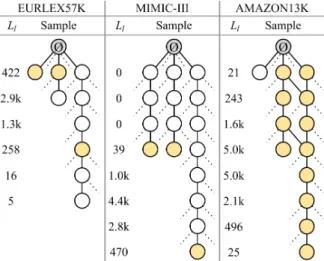
Figure 1: Examples from LMTC label hierarchies. ∅ is the root label. Ll is the number of labels per level. Yellow nodes denote gold label assignments. In EURLEX57K, documents have been tagged with both leaves and inner nodes (GAP: 0.45). InMIMIC-III, only leaf nodes can be used, causing the label assignments to be much sparser (GAP: 0.27). InAMAZON13K, doc-uments are tagged with leaf nodes, but it is assumed that all the parent nodes are also assigned, leading to dense label assignments (GAP: 0.86).
such as associating medical records with diagnos-tic and procedure labels (Mullenbach et al.,2018;
Rios and Kavuluru,2018), legislation with relevant legal concepts (Mencia and F¨urnkranzand,2007;
Chalkidis et al., 2019b), and products with cate-gories (Lewis et al.,2004;Partalas et al.,2015).
Apart from the large label space,LMTCdatasets often have skewed label distributions (e.g., some labels have few or no training examples) and a la-bel hierarchy with different lala-belling guidelines (e.g., they may require documents to be tagged only with leaf nodes, or they may allow both leaf and other nodes to be used). The latter affects graph-aware annotation proximity (GAP), i.e., the proximity of the gold labels in the label hierar-chy (see Section4.1). Moreover, the label set and the hierarchies are periodically updated, thus re-quiring zero- and few-shot learning to cope with
newly introduced labels. Figure1 shows a sam-ple of label hierarchies, with different label assign-ment guidelines, from three standardLMTC bench-mark datasets: EUR-LEX(Chalkidis et al.,2019b), MIMIC-III (Johnson et al., 2017), and AMAZON
(McAuley and Leskovec,2013)).
Current state-of-the-artLMTCmodels are based
on Label-Wise Attention Networks (LWANs) ( Mul-lenbach et al.,2018), which use a different atten-tion head for each label. LWANs (1) typically do
not leverage structural information from the label hierarchy, treating LMTCas flat multi-label clas-sification; (2) may use the label hierarchy to im-prove performance in few/zero-shot scenario, but this practice is vastly understudied; and (3) have not been combined with pre-trained Transformers. We empirically evaluate, for the first time, a battery of LMTC methods, from vanilla LWANs to hierarchical classification approaches and trans-fer learning, in frequent, few, and zero-shot learn-ing scenarios. We experiment with three standard
LMTC datasets (EURLEX57K; MIMIC-III; AMA
-ZON13K). Our contributions are the following: • We show that hierarchical LMTC
ap-proaches based on Probabilistic Label Trees (PLTs) (Prabhu et al., 2018; Khandagale et al.,2019;You et al.,2019) outperform flat neural state-of-the-art methods, i.e., LWAN
(Mullenbach et al.,2018) in two out of three datasets (EURLEX57K,AMAZON13K). • We demonstrate that pre-trained
Transformer-based approaches (e.g., BERT) further im-prove the results in two of the three datasets (EURLEX57K, AMAZON13K), and we pro-pose a new method that combinesBERTwith
LWANachieving the best results overall.
• Finally, following the work ofRios and Kavu-luru(2018) for few and zero-shot learning on
MIMIC-III, we investigate the use of structural
information from the label hierarchy inLWAN. We propose newLWAN-based models with im-proved performance in these settings, taking into account the labelling guidelines of each dataset and a graph-aware annotation proxim-ity (GAP) measure that we introduce.
2 Related Work
2.1 Advances and limitations in LMTC
In LMTC, deep learning achieves state-of-the-art results withLWANs (You et al.,2018;Mullenbach
et al.,2018;Chalkidis et al.,2019b), in most cases comparing to naive baselines (e.g., vanillaCNNs or vanillaLSTMs). The computational complexity of
LWANs, however, makes it difficult to scale them
up to extremely large label sets. Thus, Probabilistic Label Trees (PLTs) (Jasinska et al.,2016;Prabhu et al.,2018;Khandagale et al.,2019) are preferred in Extreme Multi-label Text Classification (XMTC), mainly because the linear classifiers they use at each node of the partition trees can be trained inde-pendently considering few labels at each node. This allowsPLT-based methods to efficiently handle ex-tremely large label sets (often millions), while also achieving top results inXMTC. Nonetheless, previ-ous work has not thoroughly comparedPLT-based methods to neural models inLMTC. In particular,
onlyYou et al.(2018) have comparedPLTmethods to neural models inLMTC, but without adequately tuning their parameters, nor considering few and zero-shot labels. More recently,You et al.(2019) introduced ATTENTION-XML, a new method pri-marily intended forXMTC, which combinesPLTs withLWANclassifiers. Similarly to the rest ofPLT -based methods, it has not been evaluated inLMTC.
2.2 The new paradigm of transfer learning
Transfer learning (Ruder et al.,2019;Rogers et al.,
2020), which has recently achieved state-of-the-art results in severalNLPtasks, has only been consid-ered in legalLMTCbyChalkidis et al.(2019b), who experimented withBERT(Devlin et al.,2019) and ELMO (Peters et al.,2018). OtherBERTvariants, e.g. ROBERTA (Liu et al., 2019), or BERT-based models have not been explored inLMTCso far. 2.3 Few and zero-shot learning in LMTC
Finally, few and zero-shot learning in LMTC is mostly understudied. Rios and Kavuluru (2018) investigated the effect of encoding the hierarchy in these settings, with promising results. How-ever, they did not consider other confounding fac-tors, such as using deeper neural networks at the same time, or alternative encodings of the hierarchy.
Chalkidis et al.(2019b) also considered few and zero-shot learning, but ignoring the label hierarchy. Our work is the first attempt to systematically com-pare flat, PLT-based, and hierarchy-aware LMTC
methods in frequent, few-, and zero-shot learning, and the first exploration of the effect of transfer learning inLMTCon multiple datasets.
3 Models
3.1 Notation for neural methods
We experiment with neural methods consisting of: (i) atoken encoder(Ew), which makes token
em-beddings (wt) context-aware (ht); (ii) adocument
encoder(Ed), which turns a document into a
sin-gle embedding; (iii) an optionallabel encoder(El),
which turns each label into a label embedding; (iv) adocument decoder (Dd), which maps the
docu-ment to label probabilities. Unless otherwise stated, tokens are words, andEwis a stackedBIGRU.
3.2 Flat neural methods
BIGRU-LWAN: In this model (Chalkidis et al.,
2019b),1 Ed uses one attention head per label to
generateLdocument representationsdl:
alt= exp(h⊤t ul) P t′exp(h⊤t′ul) , dl= 1 T T X t=1 altht (1)
T is the document length in tokens,htthe
context-aware representation of the t-th token, and ul
a trainable vector used to compute the attention scores of thel-th attention head; ul can also be
viewed as a label representation. Intuitively, each head focuses on possibly different tokens of the document to decide if the corresponding label should be assigned. In this model, Dd employs
Llinear layers withsigmoidactivations, each op-erating on a different label-wise document repre-sentationdl, to produce the probability of the
cor-responding label.
3.3 Hierarchical PLT-based methods
InPLT-based methods, each label is represented as the average of the feature vectors of the training documents that are annotated with this label. The root of the PLT corresponds to the full label set. The label set is partitioned intoksubsets usingk -means clustering, and each subset is represented by a child node of the root in thePLT. The labels of each new node are then recursively partitioned intoksubsets, which become children of that node in the PLT. If the label set of a node has fewer than m labels, the node becomes a leaf and the recursion terminates. During inference, the PLT
is traversed top down. At each non-leaf node, a multi-label classifier decides which children nodes 1The original model was proposed byMullenbach et al.
(2018), with a CNNtoken encoder (Ew). Chalkidis et al.
(2019b) show thatBIGRUis a better encoder thanCNNs. See also the supplementary material for a detailed comparison.
(if any) should be visited by considering the feature vector of the document. When a leaf node is visited, the multi-label classifier of that node decides which labels of the node will be assigned to the document.
PARABEL, BONSAI: We experiment with PARA -BEL(Prabhu et al.,2018) andBONSAI(Khandagale et al.,2019), two state-of-the-artPLT-based meth-ods. PARABELemploys binaryPLTs (k= 2), while
BONSAIuses non-binaryPLTs (k >2), which are shallower and wider. In both methods, a linear classifier is used at each node, and documents are represented byTF-IDFfeature vectors.
ATTENTION-XML: Recently, You et al. (2019)
proposed a hybrid method that aims to leverage the advantages of both PLTs and neural models. Similarly toBONSAI,ATTENTION-XMLuses
non-binary trees. However, the classifier at each node of thePLTis now anLWANwith aBILSTMtoken en-coder (Ew), instead of a linear classifier operating
onTF-IDFdocument representations.
3.4 Transfer learning based LMTC
BIGRU-LWAN-ELMO: In this model, we use
ELMO (Peters et al., 2018) to obtain context-sensitive token embeddings, which we concatenate with the pre-trained word embeddings to obtain the initial token embeddings (wt) ofBIGRU-LWAN.
Otherwise, the model is the same asBIGRU-LWAN.
BERT,ROBERTA:FollowingDevlin et al.(2019), we feed each document toBERTand obtain the
top-level representationhCLSofBERT’s specialCLS to-ken as the (single) document representation.Ddis
now a linear layer withLoutputs andsigmoid acti-vations which operates directly onhCLS, producing a probability for each label. The same arrangement applies toROBERTA(Liu et al.,2019).2
BERT-LWAN: Given the large size of the label set in LMTC datasets, we propose a combination of
BERTandLWAN. Instead of usinghCLSas the doc-ument representation and pass it through a linear layer withLoutputs (as withBERTandROBERTA),
we pass all the top-level output representations of
BERTinto a label-wise attention mechanism. The entire model (BERT-LWAN) is jointly trained, also
fine-tuning the underlyingBERTencoder. 2Unlike
BERT,ROBERTAuses dynamic masking, it elimi-nates the next sentence prediction pre-training task, and uses a larger vocabulary.Liu et al.(2019) reported better results in
3.5 Zero-shot LMTC
C-BIGRU-LWANis a zero-shot capable extension
of BIGRU-LWAN. It was proposed by Rios and Kavuluru(2018), but with aCNNencoder; instead, we use aBIGRU. In this method,El createsulas
the centroidof the token embeddings of the cor-responding label descriptor. The label representa-tionsulare then used by the attention heads.
vt= tanh(W ht+b) (2) alt= exp(v⊤t ul) P t′exp(vt⊤′ul) , dl= 1 T T X t=1 altht (3)
Herehtare the context-aware embeddings ofEw,
altis the attention score of thel-th attention head
for thet-th document token, viewed asvt(Eq. 2),dl
is the label-wise document representation for thel -th label.Ddalso relies on the label representations
ulto produce each label probabilitypl.
pl = sigmoid(u⊤l dl) (4)
The centroid label representations ul of both
en-countered (during training) and unseen (zero-shot) labels remain unchanged, because the token embed-dings in the centroids are not updated. This keeps the representations of unseen labels close to those of similar labels encountered during training. In turn, this helps the attention mechanism (Eq.3) and the decoder (Eq.4) cope with unseen labels that have similar descriptors with encountered labels.
GC-BIGRU-LWAN: This model, originally pro-posed byRios and Kavuluru(2018), applies graph convolutions (GCNs) to the label hierarchy.3The in-tuition is that theGCNs will help the representations of rare labels benefit from the (better) representa-tions of more frequent labels that are nearby in the label hierarchy.Elnow creates graph-aware label
representations u3l from the corresponding label descriptors (we omit the bias terms for brevity) as follows: u1l=f(Ws1ul+ X j∈Np,l W1 puj |Np,l| +X j∈Nc,l Wc1uj |Nc,l| ) (5) u2l=f(Ws2u1l +X j∈Np,l Wp2u1j |Np,l| +X j∈Nc,l Wc2u1j |Nc,l| ) (6) u3l= [ul;u2l] (7)
3The original model uses a
CNN token encoder (Ew), whereas we use aBIGRUencoder, which is a better encoder. See the supplementary material for a detailed comparison.
whereulis again the centroid of the token
embed-dings of the descriptor of thel-th label; Wi s,Wpi,
Wciare matrices for self, parent, and children nodes of each label;Np,l,Nc,lare the sets of parents and
children of the thel-th label; andf is thetanh ac-tivation. The label-wise document representations
dlare again produced byEd, as inC-BIGRU-LWAN
(Eq.2–3), but they go through an additional dense layer withtanhactivation (Eq.8). The resulting document representationsdl,oand the graph-aware
label representationsu3
l are then used by Dd to
produce a probabilityplfor each label (Eq.9).
dl,o= tanh(Wodl+bo) (8) pl = sigmoid (u3l)⊤dlo (9)
DC-BIGRU-LWAN:The stack ofGCNlayers inGC
-BIGRU-LWAN(Eq.5–6) can be turned into a plain
two-layer Multi-Layer Perceptron (MLP), unaware of the label hierarchy, by settingNp,l = Nc,l =
∅. We callDC-BIGRU-LWANthe resulting (deeper
thanC-BIGRU-LWAN) variant ofGC-BIGRU-LWAN. We use it as an ablation method to evaluate the impact of theGCNlayers on performance.
DN-BIGRU-LWAN: As an alternative approach to exploit the label hierarchy, we used a recent im-provement ofNODE2VEC (Grover and Leskovec,
2016) byKotitsas et al.(2019) to obtain alternative hierarchy-aware label representations.NODE2VEC
is similar to WORD2VEC (Mikolov et al.,2013), but pre-trains node embeddings instead of word embeddings, replacingWORD2VEC’s text windows
by random walks on a graph (here the label hier-archy).4 In a variant ofDC-BIGRU-LWAN, dubbed
DN-BIGRU-LWAN, we simply replace the initial
centroid ul label representations of DC-BIGRU
-LWANin Eq.5and7by the label representations
glgenerated by theNODE2VECextension.
DNC-BIGRU-LWAN: In another version of DC
-BIGRU-LWAN, called DNC-BIGRU-LWAN, we
re-place the initial centroidullabel representations of
DC-BIGRU-LWANby the concatenation[ul;gl].
GNC-BIGRU-LWAN: Similarly, we expand GC
-BIGRU-LWANwith the hierarchy-aware label repre-sentations of theNODE2VECextension. Again, we replace the centroidullabel representations ofGC
-BIGRU-LWANin Eq.5and7by the label representa-tionsglof theNODE2VECextension. The resulting
4The
NODE2VECextension we used also considers the tex-tual descriptors of the nodes, using anRNNencoder operating on token embeddings.
model,GNC-BIGRU-LWAN, uses bothNODE2VEC
and theGCNlayers to encode the label hierarchy, thus obtaining knowledge from the label hierarchy both in a self-supervised and a supervised fashion.
4 Experimental Setup
4.1 Graph-aware Annotation Proximity
In this work, we introducegraph-aware label prox-imity(GAP), a measure of the topological proximity (on the label hierarchy) of the gold labels assigned to documents. GAP turns out to be a key factor
in the performance of hierarchy-aware zero-shot capable extensions ofBIGRU-LWAN. LetG(L, E) be the graph of the label hierarchy, whereLis the set of nodes (label set) and E the set of edges. Let Ld ⊆ L be the set of gold labels a
partic-ular document d is annotated with. Finally, let
G+d(L+d, Ed+) be the minimal (in terms of |L+d|) subgraph of G(L, E), with Ld ⊆ L
+
d ⊆ L and
Ed+⊆E, such that for any two nodes (gold labels)
l1, l2 ∈Ld, the shortest path betweenl1, l2 in the
full graphG(L, E)is also a path inGd+(L+d, Ed+). Intuitively, we extendLdtoL+d by including
ad-ditional labels that lie between any two assigned labelsl1, l2on the shortest path that connectsl1, l2
in the full graph. We then define GAPd = |Ld|
|L+d|. By averagingGAPdover all the documentsdof a dataset, we obtain a singleGAPscore per dataset
(Fig. 1). When the assigned (gold) labels of the documents are frequently neighbours in the full graph (label hierarchy), we need to add fewer la-bels when expanding theLdof each document to
L+d; hence,GAP → 1. When the assigned (gold)
labels are frequently remote to each other, we need to add more labels (|L+d| ≫ |Ld|) andGAP→0.
GAP should not be confused with label den-sity (Tsoumakas and Katakis, 2009), defined as D = 1
N
PN d=1
|Ld|
|L|, whereN is the total number of documents. Although label density is often used in the multi-label classification literature, it is graph-unaware, i.e., it does not consider the positions (and distances) of the assigned labels in the graph.
4.2 Data
EURLEX57K (Chalkidis et al., 2019b) contains 57k English legislative documents from EUR -LEX.5 Each document is annotated with one or more concepts (labels) from the 4,271 concepts of EUROVOC.6 The average document length is
5http://eur-lex.europa.eu/ 6http://eurovoc.europa.eu/
approx. 727 words. The labels are divided in fre-quent(746 labels),few-shot(3,362), andzero-shot (163), depending on whether they were assigned ton >50,1< n≤50, or no training documents. They are organized in a 6-level hierarchy, which was not considered in the experiments ofChalkidis et al. (2019b). The documents are labeled with concepts from all levels (Fig.1), but in practice if a label is assigned, none of its ancestor or descendent labels are assigned. The resultingGAPis 0.45.
MIMIC-III(Johnson et al.,2017) contains approx.
52k English discharge summaries fromUS hospi-tals. The average document length is approx. 1.6k words. Each summary has one or more codes (la-bels) from 8,771 leaves of the ICD-9 hierarchy, which has 8 levels (Fig. 1).7 Labels are divided infrequent(4,112 labels),few-shot(4,216 labels), andzero-shot(443 labels), depending on whether they were assigned ton > 5, 1 < n ≤ 5, or no training documents. All discharge summaries are annotated with leaf nodes (5-digit codes) only, i.e., the most fine-grained categories (Fig.1), causing the label assignments to be much sparser compared toEURLEX57K(GAP0.27).
AMAZON13K(Lewis et al.,2004) contains approx. 1.5M English product descriptions from Amazon. Each product is represented by a title and a de-scription, which are on average 250 words when concatenated. Products are classified into one or more categories (labels) from a set of approx. 14k. Labels are divided infrequent(3,108 labels), few-shot(10,581 labels),zero-shot(579 labels), depend-ing on whether they were assigned to n > 100,
1 < n ≤ 100, or no training documents. The
la-bels are organized in a hierarchy of 8 levels. If a product is annotated with a label, all of its ances-tor labels are also assigned to the product (Fig.1), leading to dense label assignments (GAP0.86).
4.3 Evaluation Measures
The most common evaluation measures inLMTC
are label precision and recall at the top K pre-dicted labels (P@K,R@K) of each document, and nDCG@K(Manning et al.,2009), both averaged over test documents. However, P@K and R@K unfairly penalize methods when the gold labels of a document are fewer or more thanK, respectively. R-Precision@K(RP@K) (Chalkidis et al.,2019b), a top-K version of R-Precision (Manning et al.,
ALLLABELS FREQUENT FEW
RP@K nDCG@K RP@K nDCG@K RP@K nDCG@K
EURLEX57K(LAV G= 5.07, K= 5)
FLAT NEURAL METHODS
BIGRU-LWAN(Chalkidis et al.,2019b) 77.1 80.1 81.0 82.4 65.6 61.7
GC-BIGRU-LWAN(Rios and Kavuluru,2018) 76.8 80.0 80.6 82.3 66.2 61.8
HIERARCHICAL PLT-BASED METHODS
PARABEL(Prabhu et al.,2018) 78.1 80.6 82.4 83.3 59.9 57.3
BONSAI(Khandagale et al.,2019) 79.3 81.8 83.4 84.3 65.0 61.6
ATTENTION-XML(You et al.,2019) 78.1 80.0 81.9 83.1 68.9 64.9
TRANSFER LEARNING
BIGRU-LWAN-ELMO(Chalkidis et al.,2019b) 78.1 81.1 82.1 83.5 66.8 61.9
BERT-BASE(Devlin et al.,2019) 79.6 82.3 83.4 84.6 69.3 64.4
ROBERTA-BASE(Liu et al.,2019) 79.3 81.9 83.4 84.4 67.5 62.4
BERT-BASE-LWAN(new) 80.3 82.9 84.3 85.4 69.9 65.0
MIMIC-III(LAV G= 15.45, K= 15)
FLAT NEURAL METHODS
BIGRU-LWAN(Chalkidis et al.,2019b) 66.2 70.1 66.8 70.6 21.7 14.3
GC-BIGRU-LWAN(Rios and Kavuluru,2018) 64.9 69.1 65.6 69.6 35.9 21.1
HIERARCHICAL PLT-BASED METHODS
PARABEL(Prabhu et al.,2018) 58.7 63.3 59.3 63.7 9.6 6.0
BONSAI(Khandagale et al.,2019) 59.4 64.0 60.0 64.4 11.8 7.9
ATTENTION-XML(You et al.,2019) 69.3 73.4 70.0 73.8 26.9 19.5
TRANSFER LEARNING
BIGRU-LWAN-ELMO(Chalkidis et al.,2019b) 66.8 70.9 67.5 71.3 21.2 13.0
BERT-BASE(Devlin et al.,2019) 52.7 58.1 53.2 58.4 18.2 10.0
ROBERTA-BASE(Liu et al.,2019) 53.7 58.9 54.3 59.2 18.1 10.9
BERT-BASE-LWAN(new) 50.1 55.2 50.6 55.5 15.3 9.1
AMAZON13K(LAV G= 5.04, K= 5)
FLAT NEURAL METHODS
BIGRU-LWAN(Chalkidis et al.,2019b) 83.9 85.4 84.9 86.1 80.0 73.6
GC-BIGRU-LWAN(Rios and Kavuluru,2018) 77.4 79.8 79.1 81.0 53.7 45.8
HIERARCHICAL PLT-BASED METHODS
PARABEL(Prabhu et al.,2018) 85.1 86.7 86.3 87.4 76.8 71.9
BONSAI(Khandagale et al.,2019) 85.1 86.6 86.2 87.3 78.3 73.2
ATTENTION-XML(You et al.,2019) 84.9 86.7 86.0 87.4 76.0 69.7
TRANSFER LEARNING
BIGRU-LWAN-ELMO(Chalkidis et al.,2019b) 85.1 86.6 86.2 87.4 79.9 73.5
BERT-BASE(Devlin et al.,2019) 86.8 88.5 88.5 89.6 70.3 62.2
ROBERTA-BASE(Liu et al.,2019) 84.1 85.9 85.7 87.0 70.6 61.3
BERT-BASE-LWAN(new) 87.3 88.9 88.8 90.0 77.2 68.9
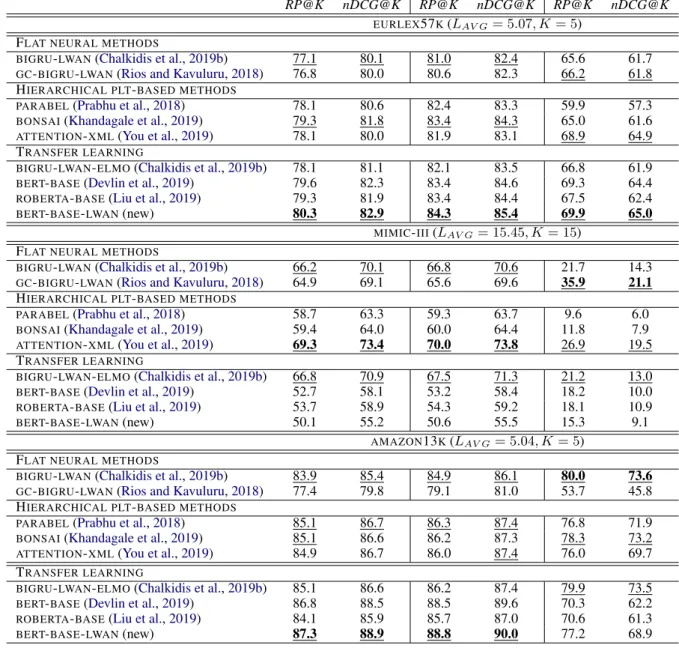
Table 1: Results (%) of experiments across base methods for all, frequent, and few label groups. All base methods are incapable of zero-shot learning. The best overall results are shown in bold. The best results in each zone are shown underlined. We show results forKclose to the average number of labelsLAV G.
2009), is better; it is the same asP@Kif there are at leastKgold labels, otherwiseKis reduced to the number of gold labels. When the order of the top-K labels is unimportant (e.g., for smallK),RP@Kis more appropriate thannDCG@K.
4.4 Implementation Details
We implemented neural methods inTENSORFLOW
2, also relying on the HuggingFace Transformers library forBERT-based models.8We use theBASE
versions of all models, and the Adam optimizer (Kingma and Ba,2015). All hyper-parameters were tuned selecting values with the best loss on the 8Consult https://tersorflow.org/ and http: //github.com/huggingface/transformers/.
development data.9 For allPLT-based methods, we used the code provided by their authors.10
5 Results
5.1 Overall predictive performance
PLTs vs.LWANs:Interestingly, the TF-IDF-based
PARABEL and BONSAI outperform the best
pre-viously published neuralLWAN-based models on
EURLEX57KandAMAZON13K, while being com-parable toATTENTION-XML, when all or frequent
9
See the appendix for details and hyper-parameters.
10
PARABEL: http://manikvarma.org/code/
Parabel/download.html; BONSAI: https: //github.com/xmc-aalto/bonsai; ATTENTION
labels are considered (Table 1). This is not the case with MIMIC-III, where BIGRU-LWAN and
ATTENTION-XML have far better results for all and frequent labels. The poor performance of the twoTF-IDF-basedPLT-based methods onMIMIC
-III seems to be due to the fact that their TF-IDF
features ignore word order and are not contextual-ized, which is particularly important in this dataset. To confirm this, we repeated the experiments of
BIGRU-LWAN on MIMIC-III after shuffling the
words of the documents, and performance dropped by approx. 7.7% across all measures, matching the performance of PLT-based methods.11 The
dom-inance ofATTENTION-XML inMIMIC-IIIfurther supports our intuition that word order is particularly important in this dataset, as the core difference of
ATTENTION-XML with the rest of thePLT-based methods is the use of RNN-based classifiers that use word embeddings and are sensitive to word order, instead of linear classifiers withTF-IDF fea-tures, which do not capture word order. Mean-while, in bothEURLEX57KandAMAZON13K, the performance of ATTENTION-XMLis competitive with both TF-IDF-basedPLT-based methods and
BIGRU-LWAN, suggesting that the bag-of-words as-sumption holds in these cases. Thus, we can fairly assume that word order and global context (long-term dependencies) do not play a drastic role when predicting labels (concepts) on these datasets.
Effects of transfer learning: Adding context-awareELMOembeddings toBIGRU-LWAN(BIGRU
-LWAN-ELMO) improves performance across all datasets by a small margin, when considering all or frequent labels. For EURLEX57K and AMA
-ZON13K, larger performance gains are obtained by fine-tuning BERT-BASE and ROBERTA-BASE.
Our proposed new method (BERT-BASE-LWAN) that employsLWANon top ofBERT-BASEhas the best results among all methods on EURLEX57K
and AMAZON13K, when all and frequent labels are considered. However, in both datasets, the re-sults are comparable toBERT-BASE, indicating that
the multi-head attention mechanism ofBERTcan effectively handle the large number of labels.
Poor performance ofBERTonMIMIC-III:Quite surprisingly, all threeBERT-based models perform
poorly on MIMIC-III (Table 1), so we examined two possible reasons. First, we hypothesized that this poor performance is due to the distinctive 11By contrast, the drop was less significant in the other
datasets (4.5% inEURLEX57Kand 2.8% inAMAZON13K).
Method Tˆ Fˆ nDCG@15
ATTENTION-XML(You et al.,2019) full-text - 73.4
BERT-BASE(Devlin et al.,2019) 512 1.51 58.1 ROBERTA-BASE(Liu et al.,2019) 512 1.45 58.9 CLINICAL-BERT(Alsentzer et al.,2019) 512 1.60 58.6 SCI-BERT(Beltagy et al.,2019) 512 1.35 60.5
HIER-SCI-BERT(new) 4096 1.35 61.9
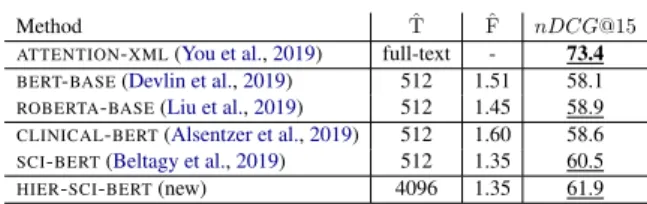
Table 2: Performance of BERT and its variants com-pared toATTENTION-XMLonMIMIC-III.Tˆis the max-imum number of (possibly sub-word) tokens used per document.Fˆis the fragmentation ratio, i.e., the number of tokens (BPEs or wordpieces) per word.
writing style and terminology of biomedical doc-uments, which are not well represented in the generic corpora these models are pre-trained on. To check this hypothesis, we employedCLINICAL
-BERT(Alsentzer et al.,2019), a version ofBERT
-BASEthat has been further fine-tuned on
biomed-ical documents, including discharge summaries. Table 2 shows that CLINICAL-BERT performs slightly better than BERT-BASE on the
biomedi-cal dataset, partly confirming our hypothesis. The improvement, however, is small and CLINICAL
-BERT still performs worse than ROBERTA-BASE,
which is pre-trained on larger generic corpora with a larger vocabulary. Examining the token vocab-ularies (Gage, 1994) of the BERT-based models
reveals that biomedical terms are frequently over-fragmented; e.g., ‘pneumonothorax’ becomes [‘p’, ‘##ne’, ‘##um’, ‘##ono’, ‘##th’, ‘##orax’], and ‘schizophreniform becomes [‘s’, ‘##chi’, ‘##zo’, ‘##ph’, ‘##ren’, ‘##iform’]. This is also the case withCLINICAL-BERT, where the original
vocabu-lary ofBERT-BASEwas retained. We suspect that such long sequences of meaningless sub-words are difficult to re-assemble into meaningful units, even when using deep pre-trained Transformer-based models. Thus we also report the performance of
SCI-BERT(Beltagy et al.,2019), which was pre-trained from scratch (including building the vo-cabulary) on scientific articles, mostly from the biomedical domain. Indeed SCI-BERT performs better, but still much worse thanATTENTION-XML.
A second possible reason for the poor perfor-mance ofBERT-based models onMIMIC-IIIis that
they can process texts only up to 512 tokens long, truncating longer documents. This is not a problem inEURLEX57K, because the first 512 tokens con-tain enough information to classifyEURLEX57K
documents (727 words on average), as shown by
Chalkidis et al.(2019b). It is also not a problem in
AMAZON13K, where texts are short (250 words on average). InMIMIC-III, however, the average docu-ment length is approx. 1.6k words and docudocu-ments
EURLEX57K(K= 5) MIMIC-III(K= 15) AMAZON13K(K= 5) FEW(n <50) ZERO FEW(n <5) ZERO FEW(n <100) ZERO
BIGRU-LWAN(Chalkidis et al.,2019b) 61.7 - 14.3 - 73.6
-C-BIGRU-LWAN(Rios and Kavuluru,2018) 51.0 33.5 15.0 31.5 9.9 20.8
DC-BIGRU-LWAN(new) 62.1 41.5 19.3 39.3 39.0 48.9
DN-BIGRU-LWAN(new) 52.2 23.8 10.0 22.3 20.4 27.2
DNC-BIGRU-LWAN(new) 62.0 39.3 23.8 33.6 41.6 47.6
GC-BIGRU-LWAN(Rios and Kavuluru,2018) 61.8 42.6 21.1 35.2 45.8 46.1
GNC-BIGRU-LWAN(new) 62.6 36.3 18.4 34.2 45.3 51.9
Table 3: Results (%) of experiments performed with zero-shot capable extensions ofBIGRU-LWAN. All scores are nDCG@K, with the sameKvalues as in Table1. Best results shown in bold. Best results in each zone shown underlined.nis the number of training documents assigned with a label. Similar conclusions can be drawn when evaluating withRP@K(See the appendix).
are severely truncated.12 To check the effect of text truncation, we employed a hierarchical version ofSCI-BERT, dubbedHIER-SCI-BERT, similar to
the hierarchicalBERTofChalkidis et al.(2019a).13 This model encodes consecutive segments of text (each up to 512 tokens) using a sharedSCI-BERT
encoder, then applies max-pooling over the seg-ment encodings to produce a final docuseg-ment repre-sentation.HIER-SCI-BERToutperformsSCI-BERT,
confirming that truncation is an important issue, but it still performs worse thanATTENTION-XML. We believe that a hierarchicalBERTmodel pre-trained
from scratch on biomedical corpora, especially dis-charge summaries, with a newBPEvocabulary, may perform even better in future experiments.
5.2 Zero-shot Learning
In Table1 we intentionally omitted zero-shot la-bels, as the methods discussed so far, exceptGC
-BIGRU-LWAN, are incapable of zero-shot learning. In general, any model that relies solely on trainable vectors to represent labels cannot cope with unseen labels, as it eventually learns to ignore unseen la-bels, i.e., it assigns them near-zero probabilities. In this section, we discuss the results of the zero-shot capable extensions ofBIGRU-LWAN(Section3.5).
In line with the experiments ofRios and Kavu-luru(2018), Table3shows thatGC-BIGRU-LWAN
(withGCNs) performs better thanC-BIGRU-LWAN
in zero-shot labels on all three datasets. These two zero-shot capable extensions ofBIGRU-LWANalso
obtain better few-shot results onMIMIC-III com-paring toBIGRU-LWAN;GC-BIGRU-LWANis also comparable toBIGRU-LWANin few-shot learning
12In
BPEs, the average document length is approx. 2.1k, as many biomedical terms are over-fragmented, thus only the 1/4 of the document actually fit in practice inBERT-based models.
13This model is ‘hierarchical’ in the sense that a first layer
encodes paragraphs, then another layer combines the repre-sentations of paragraphs (Yang et al.,2016). It does not use the label hierarchy.
onEURLEX57K, butBIGRU-LWANis much better than its two zero-shot extensions onAMAZON13K. The superior performance ofBIGRU-LWANonEU -RLEX57KandAMAZON13K, compared toMIMIC
-III, is due to the fact that in the first two datasets few-shot labels are more frequent (n ≤ 50, and
n≤100, respectively) than inMIMIC-III(n≤5).
Are graph convolutions a key factor? It is un-clear if the gains ofGC-BIGRU-LWANare due to theGCNencoder of the label hierarchy, or the in-creased depth of GC-BIGRU-LWAN compared to
C-BIGRU-LWAN. Table3 shows that DC-BIGRU
-LWANis competitive toGC-BIGRU-LWAN, indicat-ing that the latter benefits mostly from its increased depth, and to a smaller extent from its awareness of the label hierarchy. This motivated us to search for alternative ways to exploit the label hierarchy.
Alternatives in exploiting label hierarchy: Ta-ble3shows thatDN-BIGRU-LWAN, which replaces
the centroids of token embeddings of the label de-scriptors of DC-BIGRU-LWAN with label embed-dings produced by the NODE2VEC extension, is
actually inferior toDC-BIGRU-LWAN. In turn, this suggests that although theNODE2VEC extension we employed aims to encode both topological infor-mation from the hierarchy and inforinfor-mation from the label descriptors, the centroids of word embeddings still capture information from the label descriptors that theNODE2VEC extension misses. This also indicates that exploiting the information from the label descriptors is probably more important than the topological information of the label hierarchy for few and zero-shot learning generalization.
DNC-BIGRU-LWAN, which combines the cen-troids with the label embeddings of theNODE2VEC
extension, is comparable to DC-BIGRU-LWAN, while being better overall in few-shot labels. Com-bining the GCNencoder and the NODE2VEC ex-tension (GNC-BIGRU-LWAN) leads to a large
im-provement in zero-shot labels (46.1% to 51.9% nDCG@K) on AMAZON13K. On EURLEX57K, however, the original GC-BIGRU-LWAN still has the best zero-shot results; and on MIMIC-III, the
best zero-shot results are obtained by the hierarchy-unawareDC-BIGRU-LWAN. These mixed findings seem related to theGAPof each dataset (Fig.1). The role of graph-aware annotation proximity:
When gold label assignments are dense, neighbour-ing labels co-occur more frequently, thus models can leverage topological information and learn how to better cope with neighbouring labels, which is what bothGCNs andNODE2VECdo. The denser the gold label assignments, the more we can rely on more distant neighbours, and the better it be-comes to include graph embedding methods that conflate larger neighbourhoods, likeNODE2VEC
(included inGNC-BIGRU-LWAN) onAMAZON13K
(GAP0.86), when predicting unseen labels. For medium proximity gold label assignments, as inEURLEX57K(GAP0.45), it seems preferable
to rely on closer neighbours only; hence, it is better to use only graph encoders that conflate smaller neighbourhoods, like theGCNs which apply
convo-lution filters to neighbours up to two hops away, as inGC-BIGRU-LWAN(excl.NODE2VECextension).
When label assignments are sparse, as inMIMIC -III(GAP0.27), where only non-neighbouring leaf labels are assigned in the same document, leverag-ing the topological information (e.g., knowleverag-ing that a rare label shares an ancestor with a frequent one) is not always helpful, which is why encoding the label hierarchy shows no advantage in zero-shot learning inMIMIC-III; however, it can still be use-ful when we at least have few training instances, as the few-shot results ofMIMIC-IIIindicate.
Overall, we conclude that theGCNlabel hierarchy encoder does not always improveLWANs in
zero-shot learning, compared to equally deepLWANs, and that depending on the proximity of label assign-ments (based on the label annotation guidelines) it may be preferable to use additional or no hierarchy-aware encodings for zero-shot learning.
6 Conclusions
We presented an extensive study of LMTC meth-ods in three domains, to answer three understudied questions on (1) the competitiveness ofPLT-based methods against neural models, (2) the use of the label hierarchy, (3) the benefits from transfer learn-ing. A condensed summary of our findings is that
(1)TF-IDF PLT-based methods are definitely worth
considering, but are not always competitive, while
ATTENTION-XML, a neuralPLT-based method that captures word order, is robust across datasets; (2) transfer learning leads to state-of-the-art results in general, butBERT-based models can fail spectacu-larly when documents are long and technical terms get over-fragmented; (3) the best way to use the label hierarchy in neural methods depends on the proximity of the label assignments in each dataset. An even shorter summary is that no single method is best across all domains and label groups (all, few, zero) as the language, the size of documents, and the label assignment strongly vary with direct implications in the performance of each method.
In future work, we would like to further inves-tigate few and zero-shot learning in LMTC, espe-cially inBERTmodels that are currently unable to
cope with zero-shot labels. It is also important to shed more light on the poor performance ofBERT
models inMIMIC-IIIand propose alternatives that
can cope both with long documents (Kitaev et al.,
2020;Beltagy et al.,2020) and domain-specific ter-minology, reducing word over-fragmentation. Pre-trainingBERTfrom scratch on discharge summaries with a newBPEvocabulary is a possible solution. Finally, we would like to combinePLTs withBERT,
similarly to ATTENTION-XML, but the computa-tional cost of fine-tuning multipleBERTencoders, one for eachPLTnode, would be massive,
surpass-ing the trainsurpass-ing cost of very large Transformer-based models, likeT5-3B(Raffel et al.,2019) and
MEGATRON-LM(Shoeybi et al.,2019) with billions
of parameters (30-100x the size ofBERT-BASE).
References
Emily Alsentzer, John Murphy, William Boag, Wei-Hung Weng, Di Jin, Tristan Naumann, and Matthew McDermott. 2019.Publicly available clinical BERT embeddings. InProceedings of the 2nd Clinical Nat-ural Language Processing Workshop, pages 72–78, Minneapolis, Minnesota, USA.
Iz Beltagy, Kyle Lo, and Arman Cohan. 2019. Scibert: A pretrained language model for scientific text. In EMNLP. Association for Computational Linguistics. Iz Beltagy, Matthew E. Peters, and Arman Cohan. 2020. Longformer: The Long-Document Trans-former.arXiv:2004.05150.
Ilias Chalkidis, Ion Androutsopoulos, and Nikolaos Aletras. 2019a. Neural legal judgment prediction in
English. InProceedings of the 57th Annual Meet-ing of the Association for Computational LMeet-inguis- Linguis-tics, pages 4317–4323, Florence, Italy. Association for Computational Linguistics.
Ilias Chalkidis, Emmanouil Fergadiotis, Prodromos Malakasiotis, and Ion Androutsopoulos. 2019b.
Large-Scale Multi-Label Text Classification on EU Legislation. In Proceedings of the 57th Annual Meeting of the Association for Computational Lin-guistics, pages 6314–6322, Florence, Italy.
Jacob Devlin, Ming-Wei Chang, Kenton Lee, and Kristina Toutanova. 2019. BERT: Pre-training of Deep Bidirectional Transformers for Language Un-derstanding. Proceedings of the Annual Conference of the North American Chapter of the Association for Computational Linguistics: Human Language Technologies, abs/1810.04805.
Philip Gage. 1994. A new algorithm for data compres-sion.C Users J., 12(2):23–38.
Aditya Grover and Jure Leskovec. 2016. node2vec: Scalable Feature Learning for Networks. In Pro-ceedings of the 22Nd ACM SIGKDD International Conference on Knowledge Discovery and Data Min-ing, KDD ’16, pages 855–864, New York, NY, USA. ACM.
Kalina Jasinska, Krzysztof Dembczynski, R´obert Busa-Fekete, Karlson Pfannschmidt, Timo Klerx, and Eyke H¨ullermeier. 2016. Extreme F-measure Max-imization Using Sparse Probability Estimates. In Proceedings of the 33rd International Conference on International Conference on Machine Learning -Volume 48, ICML’16, pages 1435–1444. JMLR.org. Alistair EW Johnson, David J. Stone, Leo A. Celi, and Tom J. Pollard. 2017. MIMIC-III, a freely accessi-ble critical care database.Nature.
Sujay Khandagale, Han Xiao, and Rohit Babbar. 2019.
Bonsai - Diverse and Shallow Trees for Extreme Multi-label Classification.CoRR, abs/1904.08249. Diederik P. Kingma and Jim Ba. 2015. Adam: A
method for stochastic optimization. In Proceed-ings of the 5th International Conference on Learn-ing Representations.
Nikita Kitaev, Lukasz Kaiser, and Anselm Levskaya. 2020.Reformer: The efficient transformer. In Inter-national Conference on Learning Representations. Sotiris Kotitsas, Dimitris Pappas, Ion Androutsopoulos,
Ryan McDonald, and Marianna Apidianaki. 2019.
Embedding Biomedical Ontologies by Jointly En-coding Network Structure and Textual Node De-scriptors. InProceedings of the 18th BioNLP Work-shop and Shared Task, pages 298–308, Florence, Italy.
David D. Lewis, Yiming Yang, Tony G. Rose, and Fan Li. 2004. RCV1: A New Benchmark Collection for Text Categorization Research. J. Mach. Learn. Res., 5:361–397.
Yinhan Liu, Myle Ott, Naman Goyal, Jingfei Du, Man-dar Joshi, Danqi Chen, Omer Levy, Mike Lewis, Luke Zettlemoyer, and Veselin Stoyanov. 2019.
RoBERTa: A Robustly Optimized BERT Pretrain-ing Approach.CoRR, abs/1907.11692.
Christopher D. Manning, Prabhakar Raghavan, and Hinrich Sch¨utze. 2009. Introduction to Information Retrieval. Cambridge University Press.
Julian McAuley and Jure Leskovec. 2013. Hidden Factors and Hidden Topics: Understanding Rating Dimensions with Review Text. In Proceedings of the 7th ACM Conference on Recommender Systems, RecSys ’13, pages 165–172, New York, NY, USA. ACM.
Ryan McDonald, George Brokos, and Ion Androut-sopoulos. 2018. Deep Relevance Ranking Using En-hanced Document-Query Interactions. In Proceed-ings of the 2018 Conference on Empirical Methods in Natural Language Processing (EMNLP).
Eneldo Loza Mencia and Johannes F¨urnkranzand. 2007. An Evaluation of Efficient Multilabel Clas-sification Algorithms for Large-Scale Problems in the Legal Domain. InProceedings of the LWA 2007, pages 126–132, Halle, Germany.
Tomas Mikolov, Ilya Sutskever, Kai Chen, Greg Cor-rado, and Jeffrey Dean. 2013. Distributed Represen-tations of Words and Phrases and their Composition-ality. In26th Int. Conf. on Neural Information Pro-cessing Systems, Stateline, NV.
James Mullenbach, Sarah Wiegreffe, Jon Duke, Jimeng Sun, and Jacob Eisenstein. 2018. Explainable Pre-diction of Medical Codes from Clinical Text. In Pro-ceedings of the 2018 Conference of the North Amer-ican Chapter of the Association for Computational Linguistics: Human Language Technologies, pages 1101–1111. Association for Computational Linguis-tics.
Ioannis Partalas, Aris Kosmopoulos, Nicolas Baskiotis, Thierry Arti`eres, Georgios Paliouras, ´Eric Gaussier, Ion Androutsopoulos, Massih-Reza Amini, and Patrick Gallinari. 2015. LSHTC: A Bench-mark for Large-Scale Text Classification. CoRR, abs/1503.08581.
Jeffrey Pennington, Richard Socher, and Christopher D. Manning. 2014. GloVe: Global Vectors for Word Representation. In Proceedings of the 2014 Con-ference on Empirical Methods in Natural Language Processing (EMNLP), pages 1532–1543.
Matthew E. Peters, Mark Neumann, Mohit Iyyer, Matt Gardner, Christopher Clark, Kenton Lee, and Luke Zettlemoyer. 2018. Deep contextualized word rep-resentations. InConf. of NA Chapter of the Associ-ation for ComputAssoci-ational Linguistics, New Orleans, Louisiana, USA.
Yashoteja Prabhu, Anil Kag, Shrutendra Harsola, Rahul Agrawal, and Manik Varma. 2018. Parabel: Partitioned Label Trees for Extreme Classification with Application to Dynamic Search Advertising. In Proceedings of the 2018 World Wide Web Confer-ence, WWW ’18, pages 993–1002, Republic and Canton of Geneva, Switzerland.
Colin Raffel, Noam Shazeer, Adam Roberts, Katherine Lee, Sharan Narang, Michael Matena, Yanqi Zhou, Wei Li, and Peter J. Liu. 2019. Exploring the limits of transfer learning with a unified text-to-text trans-former.arXiv e-prints.
Anthony Rios and Ramakanth Kavuluru. 2018. Few-Shot and Zero-Few-Shot Multi-Label Learning for Struc-tured Label Spaces. InProceedings of the 2018 Con-ference on Empirical Methods in Natural Language Processing, pages 3132–3142. Association for Com-putational Linguistics.
Anna Rogers, Olga Kovaleva, and Anna Rumshisky. 2020. A Primer in BERTology: What we know about how BERT works.ArXiv, abs/2002.12327. Sebastian Ruder, Matthew E. Peters, Swabha
Swayamdipta, and Thomas Wolf. 2019. Trans-fer learning in natural language processing. In Proceedings of the 2019 Conference of the North American Chapter of the Association for Computa-tional Linguistics: Tutorials, pages 15—-18. Mohammad Shoeybi, Mostofa Patwary, Raul Puri,
Patrick LeGresley, Jared Casper, and Bryan Catan-zaro. 2019. Megatron-lm: Training multi-billion pa-rameter language models using model parallelism. arXiv e-prints.
Grigorios Tsoumakas and Ioannis Katakis. 2009.
Multi-Label Classification: An Overview. Inter-national Journal of Data Warehousing and Mining, 3:1–13.
Zichao Yang, Diyi Yang, Chris Dyer, Xiaodong He, Alex Smola, and Eduard Hovy. 2016. Hierarchical Attention Networks for Document Classification. In Proceedings of the 2016 Conference of the North American Chapter of the Association for Computa-tional Linguistics: Human Language Technologies, pages 1480–1489. Association for Computational Linguistics.
Ronghui You, Suyang Dai, Zihan Zhang, Hiroshi Mamitsuka, and Shanfeng Zhu. 2018. Atten-tionXML: Extreme Multi-Label Text Classification with Multi-Label Attention Based Recurrent Neural Networks.CoRR, abs/1811.01727.
Ronghui You, Zihan Zhang, Ziye Wang, Suyang Dai, Hiroshi Mamitsuka, and Shanfeng Zhu. 2019. Atten-tionXML: Label Tree-based Attention-Aware Deep Model for High-Performance Extreme Multi-Label Text Classification. InAdvances in Neural Informa-tion Processing Systems 32, pages 5812–5822. Cur-ran Associates, Inc.
A Additional Implementation Details
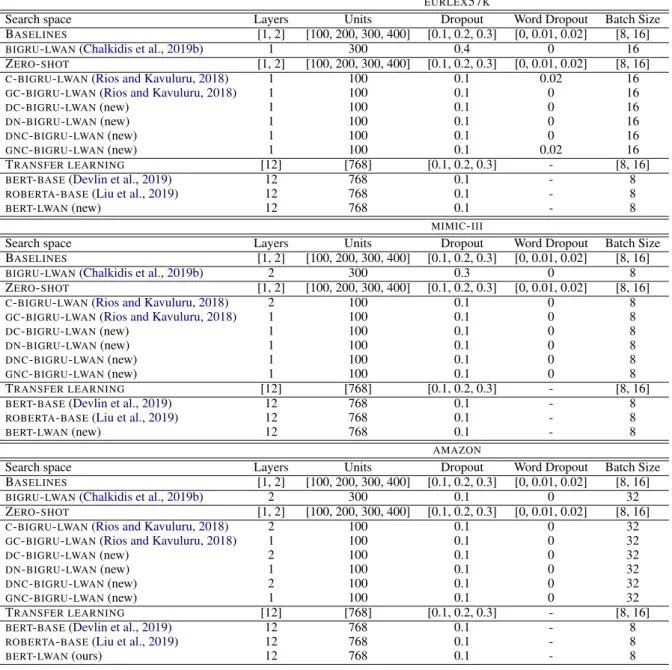
All experiments were deployed in NVIDIA GT1080TI GPU cards, in a single GPU fashion. In Table6, we report the size of the models and the elapsed training time. Hyper-parameters were tuned using HYPEROPT,14 selecting values with the best loss on development data. Table4shows the hyper-parameters search space and the selected values. We use 200-D pretrainedGLOVE embed-dings (Pennington et al., 2014) for EURLEX57K
andAMAZON13K, and 200-DWORD2VEC embed-dings pretrained onPUBMED15(McDonald et al.,
2018) forMIMIC-III. ForBERT-based methods we
tuned only the learning rate, considering the values
{2e-5,3e-5,5e-5}, selecting2e-5forEURLEX57K
andAMAZON13K, and5e-5forMIMIC-III. Finally,
for PARABELand BONSAI we tuned then-gram order in the range{1, 2, 3, 4, 5}, and the number ofn-gram features in the range{100k, 200k, 300k, 400k}. Whenn >1we usen-grams up to order
n, e.g. forn = 3we use 1-grams, 2-grams and 3-grams. In all datasets the optimal values were 200k features forn= 5.
B BIGRUs vs. CNNs
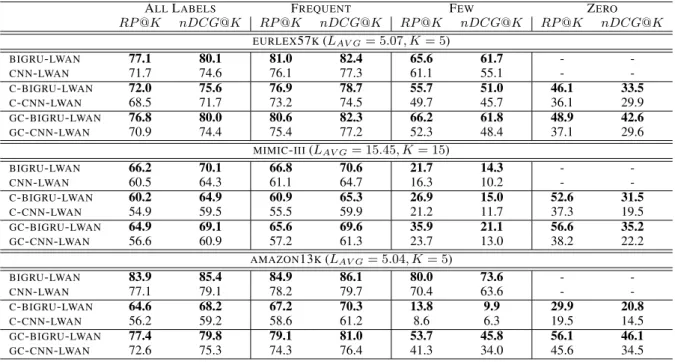
Chalkidis et al.(2019b) showed that BIGRUs are better encoders than CNNs in EURLEX57K. We confirm these findings across all datasets (Table5).
BIGRU-LWAN, C-BIGRU-LWAN and GC-BIGRU
-LWANoutperformCNN-LWAN,C-CNN-LWANand
GC-CNN-LWANby 3.5 to 16.5 percentage points.
C Additional Results
Table7showsRP@K results of the zero-shot ca-pable methods. As withnDCG@K, we conclude that theGCNlabel hierarchy encoder ofRios and Kavuluru(2018) does not always improveLWANs in zero-shot learning, compared to equally deep
LWANs, and that depending on the proximity of label assignments, it may be preferable to use ad-ditional or no encodings of the hierarchy for zero-shot learning. Also, the zero-zero-shot capable methods outperformBIGRU-LWANin all, frequent, and few labels, but no method is consistently the best.
14https://github.com/hyperopt/hyperopt 15https://www.ncbi.nlm.nih.gov/pubmed/
EURLEX57K
Search space Layers Units Dropout Word Dropout Batch Size
BASELINES [1, 2] [100, 200, 300, 400] [0.1, 0.2, 0.3] [0, 0.01, 0.02] [8, 16]
BIGRU-LWAN(Chalkidis et al.,2019b) 1 300 0.4 0 16
ZERO-SHOT [1, 2] [100, 200, 300, 400] [0.1, 0.2, 0.3] [0, 0.01, 0.02] [8, 16]
C-BIGRU-LWAN(Rios and Kavuluru,2018) 1 100 0.1 0.02 16
GC-BIGRU-LWAN(Rios and Kavuluru,2018) 1 100 0.1 0 16
DC-BIGRU-LWAN(new) 1 100 0.1 0 16
DN-BIGRU-LWAN(new) 1 100 0.1 0 16
DNC-BIGRU-LWAN(new) 1 100 0.1 0 16
GNC-BIGRU-LWAN(new) 1 100 0.1 0.02 16
TRANSFER LEARNING [12] [768] [0.1, 0.2, 0.3] - [8, 16]
BERT-BASE(Devlin et al.,2019) 12 768 0.1 - 8
ROBERTA-BASE(Liu et al.,2019) 12 768 0.1 - 8
BERT-LWAN(new) 12 768 0.1 - 8
MIMIC-III
Search space Layers Units Dropout Word Dropout Batch Size
BASELINES [1, 2] [100, 200, 300, 400] [0.1, 0.2, 0.3] [0, 0.01, 0.02] [8, 16]
BIGRU-LWAN(Chalkidis et al.,2019b) 2 300 0.3 0 8
ZERO-SHOT [1, 2] [100, 200, 300, 400] [0.1, 0.2, 0.3] [0, 0.01, 0.02] [8, 16]
C-BIGRU-LWAN(Rios and Kavuluru,2018) 2 100 0.1 0 8
GC-BIGRU-LWAN(Rios and Kavuluru,2018) 1 100 0.1 0 8
DC-BIGRU-LWAN(new) 1 100 0.1 0 8
DN-BIGRU-LWAN(new) 1 100 0.1 0 8
DNC-BIGRU-LWAN(new) 1 100 0.1 0 8
GNC-BIGRU-LWAN(new) 1 100 0.1 0 8
TRANSFER LEARNING [12] [768] [0.1, 0.2, 0.3] - [8, 16]
BERT-BASE(Devlin et al.,2019) 12 768 0.1 - 8
ROBERTA-BASE(Liu et al.,2019) 12 768 0.1 - 8
BERT-LWAN(new) 12 768 0.1 - 8
AMAZON
Search space Layers Units Dropout Word Dropout Batch Size
BASELINES [1, 2] [100, 200, 300, 400] [0.1, 0.2, 0.3] [0, 0.01, 0.02] [8, 16]
BIGRU-LWAN(Chalkidis et al.,2019b) 2 300 0.1 0 32
ZERO-SHOT [1, 2] [100, 200, 300, 400] [0.1, 0.2, 0.3] [0, 0.01, 0.02] [8, 16]
C-BIGRU-LWAN(Rios and Kavuluru,2018) 2 100 0.1 0 32
GC-BIGRU-LWAN(Rios and Kavuluru,2018) 1 100 0.1 0 32
DC-BIGRU-LWAN(new) 2 100 0.1 0 32
DN-BIGRU-LWAN(new) 1 100 0.1 0 32
DNC-BIGRU-LWAN(new) 2 100 0.1 0 32
GNC-BIGRU-LWAN(new) 1 100 0.1 0 32
TRANSFER LEARNING [12] [768] [0.1, 0.2, 0.3] - [8, 16]
BERT-BASE(Devlin et al.,2019) 12 768 0.1 - 8
ROBERTA-BASE(Liu et al.,2019) 12 768 0.1 - 8
BERT-LWAN(ours) 12 768 0.1 - 8
ALLLABELS FREQUENT FEW ZERO RP@K nDCG@K RP@K nDCG@K RP@K nDCG@K RP@K nDCG@K EURLEX57K(LAV G= 5.07, K= 5) BIGRU-LWAN 77.1 80.1 81.0 82.4 65.6 61.7 - -CNN-LWAN 71.7 74.6 76.1 77.3 61.1 55.1 - -C-BIGRU-LWAN 72.0 75.6 76.9 78.7 55.7 51.0 46.1 33.5 C-CNN-LWAN 68.5 71.7 73.2 74.5 49.7 45.7 36.1 29.9 GC-BIGRU-LWAN 76.8 80.0 80.6 82.3 66.2 61.8 48.9 42.6 GC-CNN-LWAN 70.9 74.4 75.4 77.2 52.3 48.4 37.1 29.6 MIMIC-III(LAV G= 15.45, K= 15) BIGRU-LWAN 66.2 70.1 66.8 70.6 21.7 14.3 - -CNN-LWAN 60.5 64.3 61.1 64.7 16.3 10.2 - -C-BIGRU-LWAN 60.2 64.9 60.9 65.3 26.9 15.0 52.6 31.5 C-CNN-LWAN 54.9 59.5 55.5 59.9 21.2 11.7 37.3 19.5 GC-BIGRU-LWAN 64.9 69.1 65.6 69.6 35.9 21.1 56.6 35.2 GC-CNN-LWAN 56.6 60.9 57.2 61.3 23.7 13.0 38.2 22.2 AMAZON13K(LAV G= 5.04, K= 5) BIGRU-LWAN 83.9 85.4 84.9 86.1 80.0 73.6 - -CNN-LWAN 77.1 79.1 78.2 79.7 70.4 63.6 - -C-BIGRU-LWAN 64.6 68.2 67.2 70.3 13.8 9.9 29.9 20.8 C-CNN-LWAN 56.2 59.2 58.6 61.2 8.6 6.3 19.5 14.5 GC-BIGRU-LWAN 77.4 79.8 79.1 81.0 53.7 45.8 56.1 46.1 GC-CNN-LWAN 72.6 75.3 74.3 76.4 41.3 34.0 45.6 34.5
Table 5: Results (%) of experiments performed to compareGRUvs.CNNencoders. Best results in each zone shown in bold. We show results forKclose to the average number of labelsLAV G.
Methods Parameters Trainable Parameter Train Time
BASELINES
BIGRU-LWAN(Chalkidis et al.,2019b) 86 6 14h
ZERO-SHOT
C-BIGRU-LWAN(Rios and Kavuluru,2018) 80.2 0.2 9.3h GC-BIGRU-LWAN(Rios and Kavuluru,2018) 80.5 0.5 18.5h
DC-BIGRU-LWAN(new) 81.3 1.3 11.2h
DN-BIGRU-LWAN(new) 80.2 0.2 9.5h
DNC-BIGRU-LWAN(new) 81.6 1.6 10.1h
GNC-BIGRU-LWAN(new) 80.5 0.5 20.2h
TRANSFER LEARNING
BERT-BASE(Devlin et al.,2019) 110 110 9.5h
ROBERTA-BASE(Liu et al.,2019) 110 110 9.5h
BERT-LWAN(new) 119 119 11h
Table 6: Number of parameters (trainable or not) in millions and training time for a single run reported for all examined methods.
EURLEX57K(K= 5) MIMIC-III(K= 15) AMAZON13K(K= 5) FEW(n <50) ZERO FEW(n <5) ZERO FEW(n <100) ZERO
BIGRU-LWAN(Chalkidis et al.,2019b) 65.6 - 21.7 - 80.0
-C-BIGRU-LWAN(Rios and Kavuluru,2018) 55.7 46.1 26.9 52.6 13.8 29.9
DC-BIGRU-LWAN(new) 66.8 53.9 33.6 63.9 47.0 57.1
DN-BIGRU-LWAN(new) 56.9 34.3 19.5 43.9 27.1 36.9
DNC-BIGRU-LWAN(new) 66.9 51.7 41.3 59.4 50.2 59.6
GC-BIGRU-LWAN(Rios and Kavuluru,2018) 66.2 48.9 35.9 56.6 53.7 56.1
GNC-BIGRU-LWAN(new) 67.7 49.4 31.6 57.5 53.8 63.4
Table 7: Results (%) of experiments performed with zero-shot capable extensions ofBIGRU-LWAN. All scores areRP@K, with the sameK values as in Table 1 of the main paper. Best results of zero-shot capable methods (excludingBIGRU-LWAN) shown in bold. Best results in each zone shown underlined.nis the number of training documents assigned with a label.