Supplemental Information
Mechanistic Insight into a Novel Ultrasensitive Nicotine Assay Base
on High-Efficiency Quenching of Gold Nanocluster Cathodic
Electrochemiluminescence
Zhongnan Huang,† Zhenglian Li,† Luyao Xu,† Chaoguo Wei,† Chenting Zhu,† Haohua Deng,† Huaping Peng,*, † Xinghua Xia,‡ and Wei Chen*,†
†Higher Educational Key Laboratory for Nano Biomedical Technology of Fujian
Province, Department of Pharmaceutical Analysis, Fujian Medical University, Fuzhou 350004, China
‡State Key Laboratory of Analytical Chemistry for Life Science and Collaborative
Innovation Center of Chemistry for Life Sciences, School of Chemistry and Chemical Engineering, Nanjing University, Nanjing 210093, China
Zhongnan Huang and Zhenglian Li contributed equally to this work.
*Corresponding author. E-mail address: [email protected] (H.P. Peng); [email protected] (W. Chen)
Table of contents
1. Synthesis of NAC-AuNCs ... S3 2. Fabrication of CR-AuNC/GCE ... S3 3. The mechanism of CR-AuNCs/K2S2O8 ECL system ... S3
4. The stability of CR-AuNC/GCE………..S4 5. UV-visible absorption spectrum of nicotine and ECL spectrum of AuNCs modified
GCE... S4 6. HPLC of standard niacin solutions and treated nicotine solution ... S4 7. Cyclic voltammogram of nicotine ... S5 8. Optimization of pH ... S6 9. Stability evaluation of the ECL sensor. ... S6 10. Table of analytical performance for the detection of nicotine. ... S7 11. References. ... S8
Synthesis of NAC-AuNCs. The NAC-AuNCs were prepared through a hydrothermal method according to our previous work.1 In brief, 0.6 mL of NaOH (0.5 M) and 0.4
mL of HAuCl4 (48.56 mM) were added to 4 mL of 0.08 M N-acetyl-L-cysteine. The
mixture was incubated at 37 °C for 2.5 h, and the resulting solution was dialyzed for more than 24 h to remove all small-molecular impurities. The purified AuNCs were stored in the dark at 4 °C when not use.
Fabrication of CR-AuNC/GCE. The CR-AuNC/GCE was prepared through chemical reduction method according to our previous work.1 The glassy carbon electrode (GCE) was sequentially polished with 0.3 and 0.05 μm of alumina for 3 min and ultrasonically cleaned for 3 minutes in HNO3 solution (VHNO3:VH2O=1:1), ethanol
and deionized water, respectively. Then, NAC-AuNC/GCE was obtained by rapid drop-casting 5 μL NAC-AuNCs solution onto the surface of cleaned GCE and dried in air at room temperature. After that, the NAC-AuNC/GCE was immersed in a 0.1 M sodium borohydride (NaBH4) solution for 5 min to obtain chemically reduced (CR)
electrode, which was recorded as CR-AuNC/GCE. This resulting electrode was rinsed with water to remove the excess of the physical adsorption and stored at 4 °C for the further ECL detection.
The mechanism of CR-AuNCs/K2S2O8 ECL system. Based on the previous work
on CR-AuNCs/K2S2O8 ECL system,1 AuNCs were immobilized on the GCE and
converted to AuNC•− at negative potential (Eq. (S1)), while the peroxydisulfate could be electro-chemically reduced to sulfate radical anion (SO4•−) (Eq. (S2)). Then the
strong oxidant SO4•− undergoes an electron transfer reaction with the reduced species
of AuNCs (AuNC•−) to generate light (Eq. (S3)-(S4)).
AuNC + e− →AuNC•− (S1) S2O82− + e− → SO42− + SO4•− (S2)
AuNC•−+ SO4•− → AuNC* + SO42− (S3)
AuNC* → AuNC + hν (S4)
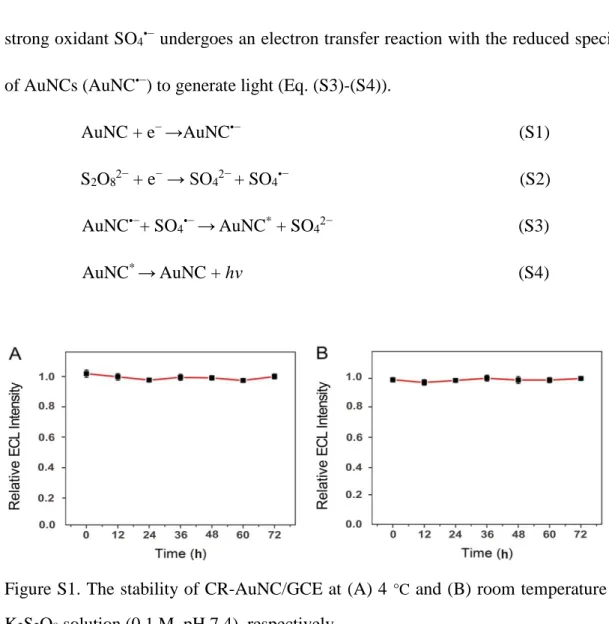
Figure S1. The stability of CR-AuNC/GCE at (A) 4 °C and (B) room temperature in K2S2O8 solution (0.1 M, pH 7.4), respectively.
Figure S2. UV-visible absorption spectrum of nicotine (red curve) and ECL spectrum of CR-AuNC/GCE in 0.1 M K2S2O8 (black curve).
Figure S3. HPLC of standard niacin solutions.
Figure S4. HPLC of nicotine standard sample treated with CR-AuNC/GCE by SP method in air-saturated aqueous solution without K2S2O8.
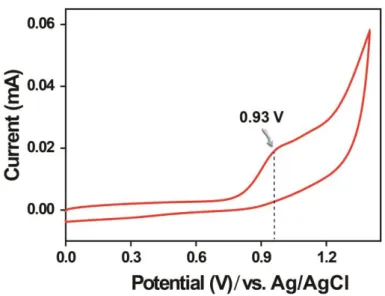
The E0(niacin/nicotine) was measured by cyclic voltammogram (CV) of bare GCE in 0.1 M PBS containing 1 mM nicotine with the potential cycled between 0 and +1.4 V at a scan rate of 100 mV⋅s−1. In this process, the conventional three-electrode system was used for detection: a bare GCE was used as the working electrode, Pt wire was used as the auxiliary electrode, and an Ag/AgCl (saturated KCl solution) was used as the reference electrode, respectively. As shown in Figure S5, the anodic peak at 0.93 V versus Ag/AgCl was corresponding to the oxidation of nicotine. Thus, the
Epa, nicotine was 0.93 V versus Ag/AgCl.
Figure S5. Cyclic voltammogram of 1 mM nicotine in 0.1 M PBS solution at a scan rate of 100 mV s-1.
Optimization of pH in the proposed ECL system. pH can not only interfere with the signal intensity of the CR-AuNCs/S2O82-system, but also can affect the ECL
inhibition efficiency of nicotine.With the aim of realizing the ultrasensitive detection of nicotine, the optimal pH of this system was explored. Taking the ECL intensity change of I0 - I as the function of the concentration of nicotine, I0 was the initial
intensity and I was the ECL intensities of CR-AuNC/GCE in K2S2O8solution in the
presence of nicotine, the nicotine-induced decrease in ECL intensity is given as I0 - I.
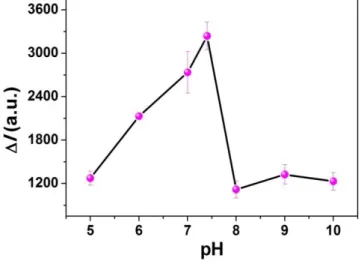
As shown in Figure S6, the ECL quenching effect elevated significantly with an increase in the pH value and the maximum value of ΔI appeared at pH of 7.4. With a further increase in the pH value, however, resulted in a dramatically decrease in the ECL quenching effect. Nicotine is a moderately strong base with pKa1=8.0 and
pKa2=3.0. When pH is more basic than 8.0, the neutral molecule in solution is the
predominant existence form of nicotine2. However, this molecule is fairly volatile3
leads to decreased the concentration of nicotine and weaken the quenching effect. Thus, 7.4 was chosen as an optimal pH for nicotine detection and this pH was also favorable for the applications in biological sample analysis.
Figure S6. Effects of pH on ECL intensity difference (ΔI). (ΔI=I0-I, I0 stand for the
ECL intensity of CR-Au NCs/GCE, I stand for the ECL intensity of CR-Au NC/GCE in the presence of nicotine)
Figure S7. Stability evaluation of the purposed biosensor for three days.
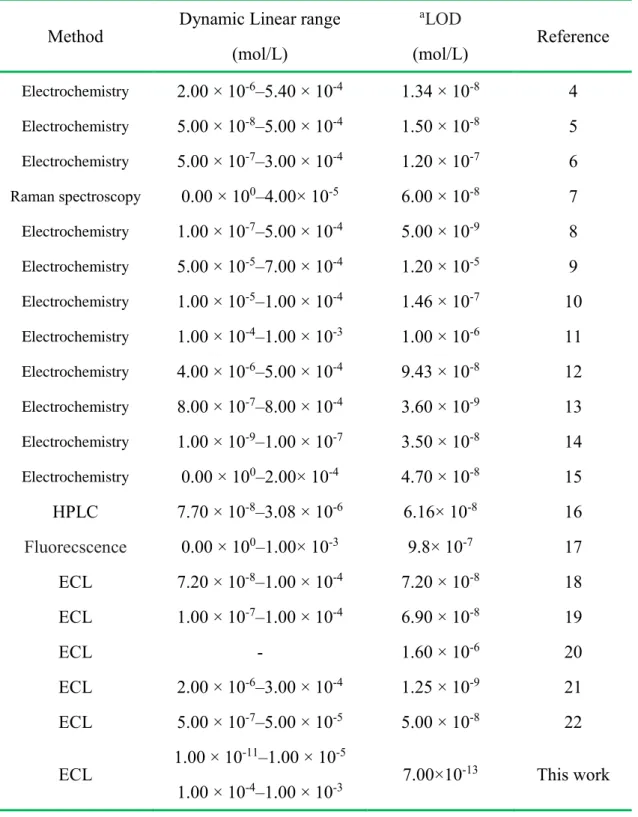
Table S1. Comparison of the analytical performance of different methods in determination of nicotine.
Method Dynamic Linear range (mol/L) aLOD (mol/L) Reference Electrochemistry 2.00 × 10⁻⁶–5.40 × 10⁻⁴ 1.34 × 10⁻⁸ 4 Electrochemistry 5.00 × 10⁻⁸–5.00 × 10⁻⁴ 1.50 × 10⁻⁸ 5 Electrochemistry 5.00 × 10⁻⁷–3.00 × 10⁻⁴ 1.20 × 10⁻⁷ 6 Raman spectroscopy 0.00 × 100–4.00× 10⁻⁵ 6.00 × 10⁻⁸ 7 Electrochemistry 1.00 × 10⁻⁷–5.00 × 10⁻⁴ 5.00 × 10⁻⁹ 8 Electrochemistry 5.00 × 10⁻⁵–7.00 × 10⁻⁴ 1.20 × 10⁻⁵ 9 Electrochemistry 1.00 × 10⁻⁵–1.00 × 10⁻⁴ 1.46 × 10⁻⁷ 10 Electrochemistry 1.00 × 10⁻⁴–1.00 × 10⁻³ 1.00 × 10⁻⁶ 11 Electrochemistry 4.00 × 10⁻⁶–5.00 × 10⁻⁴ 9.43 × 10⁻⁸ 12 Electrochemistry 8.00 × 10⁻⁷–8.00 × 10⁻⁴ 3.60 × 10⁻⁹ 13 Electrochemistry 1.00 × 10⁻⁹–1.00 × 10⁻⁷ 3.50 × 10⁻⁸ 14 Electrochemistry 0.00 × 100–2.00× 10⁻⁴ 4.70 × 10⁻⁸ 15 HPLC 7.70 × 10⁻⁸–3.08 × 10⁻⁶ 6.16× 10⁻⁸ 16 Fluorecscence 0.00 × 100–1.00× 10⁻³ 9.8× 10⁻⁷ 17 ECL 7.20 × 10⁻⁸–1.00 × 10⁻⁴ 7.20 × 10⁻⁸ 18 ECL 1.00 × 10⁻⁷–1.00 × 10⁻⁴ 6.90 × 10⁻⁸ 19 ECL - 1.60 × 10⁻⁶ 20 ECL 2.00 × 10⁻⁶–3.00 × 10⁻⁴ 1.25 × 10⁻⁹ 21 ECL 5.00 × 10⁻⁷–5.00 × 10⁻⁵ 5.00 × 10⁻⁸ 22 ECL 1.00 × 10 -11–1.00 × 10⁻⁵ 1.00 × 10⁻⁴–1.00 × 10⁻³ 7.00×10 -13 This work
aLOD, limit of detection (S/N=3). HPLC, high performance liquid chromatography; ECL,
REFERENCES
(1) Peng, H.; Jian, M.; Deng, H.; Wang, W.; Huang, Z.; Huang, K.; Liu, A.; Chen, W., Valence states effect on electrogenerated chemiluminescence of gold nanocluster. ACS Appl. Mater. Interfaces2017, 9, 14929-14934.
(2) Ault, A. J., The acid-base chemistry of nicotine: extensions, analogies, and a generalization. Chem. Educ.2001, 78, 500.
(3) Zander, Å.; Findlay, P.; Renner, T.; Sellergren, B.; Swietlow, A., Analysis of nicotine and its oxidation products in nicotine chewing gum by a molecularly imprinted solid-phase extraction. Anal. Chem.1998, 70, 3304-3314.
(4) Shehata, M.; Azab, S. M.; Fekry, A. M.; Ameer, M. A., Nano-TiO2 modified
carbon paste sensor for electrochemical nicotine detection using anionic surfactant.
Biosens. Bioelectron.2016, 79, 589-592.
(5) Jing, Y.; Yuan, X.; Yuan, Q.; He, K.; Liu, Y.; Lu, P.; Li, H.; Li, B.; Zhan, H.; Li, G., Determination of nicotine in tobacco products based on mussel-inspired reduced graphene oxide-supported gold nanoparticles. Sci. Rep.2016, 6, 29230.
(6) Jing, Y.; Lin, E.; Su, X.; Liu, Y.; Li, H.; Yuan, X.; Ping, L.; Fan, Y., Electrodeposition of Au nanoparticles on poly(diallyldimethylammonium chloride) functionalized reduced graphene oxide sheets for voltammetric determination of nicotine in tobacco products and anti-smoking pharmaceuticals. RSC Adv. 2016, 6, 26247-26253.
(7) Itoh, N.; Bell, S. E. J., High dilution surface-enhanced Raman spectroscopy for rapid determination of nicotine in e-liquids for electronic cigarettes. Analyst 2017,
142, 994-998.
(8) Mersal, G. A. M.; Mostafa, N. Y.; Omar, A.-E. H., Hydrothermal synthesis and processing of hydrogen titanate nanotubes for nicotine electrochemical sensing. Mater. Res. Express2017, 4, 085031.
(9) Huynh, T. P.; B, K. C. C.; Sosnowska, M.; Sobczak, J. W.; Nesterov, V. N.; D'Souza, F.; Kutner, W., Nicotine molecularly imprinted polymer: synergy of coordination and hydrogen bonding. Biosens.Bioelectron.2015, 64, 657-663.
(10) Acar, E. T.; Atun, G., Sensitive Determination of nicotine on polyNiTSPc electrodeposited glassy carbon electrode: investigation of reaction mechanism.
Electroanalysis2018, 30, 2994-3002.
(11) Goodarzi, Z.; Maghrebi, M.; Zavareh, A. F.; Mokhtari-Hosseini, Z.-B.; Ebrahimi-hoseinzadeh, B.; Zarmi, A. H.; Barshan-tashnizi, M., Evaluation of nicotine sensor based on copper nanoparticles and carbon nanotubes. J. Nanostruct. Chem.
2015, 5, 237-242.
(12) Fekry, A. M.; Azab, S. M.; Shehata, M.; Ameer, M. A., A novel electrochemical nicotine sensor based on cerium nanoparticles with anionic surfactant. RSC Adv.2015,
5, 51662-51671.
(13) Ameer, M. A.; Fekry, A. M.; Azab, S. M.; Shehata, M., Synthesis of a simply modified electrochemical nicotine sensor based on silver nanoparticles. Can. J. Chem.
2018, 96, 821-827.
(14) Karthika, A.; Karuppasamy, P.; Selvarajan, S.; Suganthi, A.; Rajarajan, M., Electrochemical sensing of nicotine using CuWO4 decorated reduced graphene oxide
immobilized glassy carbon electrode. Ultrason. Sonochem.2019, 55, 196-206.
(15) Li, X.; Zhao, H.; Shi, L.; Zhu, X.; Lan, M.; Zhang, Q.; Hugh Fan, Z., Electrochemical sensing of nicotine using screen-printed carbon electrodes modified with nitrogen-doped graphene sheets. J. Electroanal.Chem.2017, 784, 77-84.
(16) Page-Sharp, M.; Hale, T. W.; Hackett, L. P.; Kristensen, J. H.; Ilett, K. F., Measurement of nicotine and cotinine in human milk by high-performance liquid chromatography with ultraviolet absorbance detection. J. Chromatogr. B 2003, 796, 173-180.
(17) Yan, D.; Lou, Y.; Yang, Y.; Chen, Z.; Cai, Y.; Guo, Z.; Zhan, H.; Chen, B., Dye-modified metal-organic framework as a recyclable luminescent sensor for nicotine determination in urine solution and living cell. ACS Appl. Mater. Interfaces
2019, 11, 47253-47258.
(18) Zhou, Z.; Guo, W.; Xu, L.; Yang, Q.; Su, B., Two orders-of-magnitude enhancement in the electrochemiluminescence of Ru(bpy)32+ by vertically ordered
silica mesochannels. Analytica Chimica Acta2015, 886, 48-55.
(19) Kim, Y.; Kim, J., Modification of indium tin oxide with dendrimer-encapsulated nanoparticles to provide enhanced stable electrochemiluminescence of Ru(bpy)32+/tripropylamine while preserving optical transparency of indium tin oxide
for sensitive electrochemiluminescence-based analyses. Anal. Chem. 2014, 86, 1654-1660.
(20) Chang, P. L.; Lee, K. H.; Hu, C. C.; Chang, H. T., CE with sequential light-emitting diode-induced fluorescence and electro-chemiluminescence detections
for the determination of amino acids and alkaloids. Electrophoresis 2007, 28, 1092-1099.
(21) Lin, M. S.; Wang, J. S.; Lai, C. H., Electrochemiluminescent determination of nicotine based on tri(2,2′-bipyridyl) ruthenium (II) complex through flow injection analysis. Electrochim. Acta2008, 53, 7775-7780.
(22) Sun, J.; Du, H.; You, T., Determination of nicotine and its metabolite cotinine in urine and cigarette samples by capillary electrophoresis coupled with electrochemiluminescence. Electrophoresis2011, 32, 2148-2154.