Distribution Free Prediction Intervals for Multiple Functional Regression
by Ryan Kelly
B.A. in Mathematics and Biology, Washington University in St. Louis, 2015 M.A. in Statistics University of Pittsburgh, 2017
Submitted to the Graduate Faculty of
the Dietrich School of Arts and Sciences in partial fulfillment of the requirements for the degree of
Doctor of Philosophy
University of Pittsburgh 2020
UNIVERSITY OF PITTSBURGH
DIETRICH SCHOOL OF ARTS AND SCIENCES
This dissertation was presented by
Ryan Kelly
It was defended on July 31st, 2020 and approved by
Kehui Chen, Department of Statistics at University of Pittsburgh Yu Cheng, Department of Statistics at University of Pittsburgh Satish Iyengar, Department of Statistics at University of Pittsburgh
Distribution Free Prediction Intervals for Multiple Functional Regression Ryan Kelly, PhD
University of Pittsburgh, 2020
My research aims to establish a method of constructing prediction intervals for a scalar response of interest when predictors are functional data, with minimal distribu-tional and modeling assumptions. To accommodate flexible regression relationships, we integrated nonparametric functional regression based on functional principal com-ponent analysis into our conformal prediction method, and we developed nonpara-metric functional regression approaches based on the signature method, which is a mathematical tool to represent the information contained in the functions by a col-lection of iterated integrals. The prediction intervals constructed by the conformal method have guaranteed coverage (confidence) without the heavy restrictions on the error distribution and on the regression function, while the efficiency (implied by the length of the intervals) will depend on the representation and information compres-sion of the functional predictors. Conditions necessary for efficiency and contiguity of the prediction set are discussed. Finally, our methods are illustrated using simulated and real data examples.
Keywords: Multiple Functional Regression, Prediction Intervals, Conformal Pre-diction, Multiple Functional Principal Components Analysis, Signature Expan-sion.
Table of Contents
1.0 Introduction . . . 1
2.0 Conformal Prediction Background . . . 4
2.1 Motivation for Conformal Prediction . . . 4
2.2 Properties of Conformal Prediction . . . 6
3.0 Conformal Prediction in Multiple Functional Regression . . . 9
3.1 Multiple Functional PCR-based Conformity Scores . . . 10
3.1.1 Linear Multiple Functional Regression . . . 10
3.1.2 Nonparametric Multiple Functional Regression . . . 14
3.2 Partial Linear Conformity Score based on Signature . . . 17
3.2.1 Properties of the Signature in Functional Regression Setting . . 20
3.3 Theoretical Results . . . 26 4.0 Simulations . . . 33 4.1 Univariate Simulations . . . 33 4.2 Multivariate Simulations . . . 42 5.0 Public Datasets . . . 48 5.1 PM 2.5 Dataset . . . 48
5.2 Crop Yield Dataset . . . 53
6.0 Conclusions . . . 56
7.0 Supplemental Material . . . 59
7.1 Additional Results . . . 59
7.2 Additional Simulations . . . 60
List of Tables
1 Linear Relationship with Modified Trig Basis: we report the mean cov-erage from 1000 simulations for linear mFPCA conformity score, local linear FPCA conformity score, partial linear signature conformity score, naive “oracle”, and split sample conformity score. . . 37 2 Linear Relationship with B-Spline Basis: we report the mean coverage
from 1000 simulations for linear mFPCA conformity score, local linear FPCA conformity score, partial linear signature conformity score, naive “oracle”, and split sample conformity score. . . 37 3 Quadratic Relationship with Modified Trig Basis: we report the mean
coverage from 1000 simulations for linear mFPCA conformity score, local linear FPCA conformity score, partial linear signature conformity score, naive “oracle”, and split sample conformity score. . . 38 4 Quadratic Relationship with B-Spline Basis: we report the mean coverage
from 1000 simulations for linear mFPCA conformity score, local linear FPCA conformity score, partial linear signature conformity score, naive “oracle”, and split sample conformity score. . . 38 5 Linear Relationship with Modified Trig Basis: we report the median
length of the constructed intervals from 1000 simulations for linear mF-PCA conformity score, local linear FmF-PCA conformity score, partial linear signature conformity score, naive “oracle”, and split sample conformity score. . . 39
6 Linear Relationship with B-Spline Basis: we report the median length of the constructed intervals from 1000 simulations for linear mFPCA confor-mity score, local linear FPCA conforconfor-mity score, partial linear signature conformity score, naive “oracle”, and split sample conformity score. . . . 40 7 Quadratic Relationship with Modified Trig Basis: we report the median
length of the constructed intervals from 1000 simulations for linear mF-PCA conformity score, local linear FmF-PCA conformity score, partial linear signature conformity score, naive “oracle”, and split sample conformity score. . . 40 8 Quadratic Relationship with B-Spline Basis: we report the median length
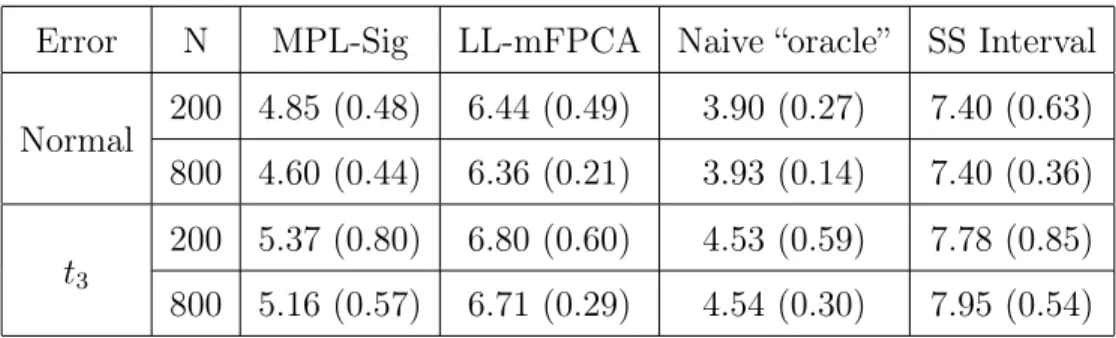
of the constructed intervals from 1000 simulations for linear mFPCA con-formity score, local linear FPCA concon-formity score, partial linear signature conformity score, naive “oracle”, and split sample conformity score. . . . 41 9 mFPCA Based Linear Relationship: We report the mean coverage (SD)
of the constructed intervals from 1000 simulations for signature-based multiple partial linear conformity score, mFPCA-based local linear con-formity score, naive “oracle”, and split sample interval. . . 44 10 mFPCA Based Additive Relationship: We report the mean coverage (SD)
of the constructed intervals from 1000 simulations for signature-based multiple partial linear conformity score, mFPCA-based local linear con-formity score, naive “oracle”, and split sample interval. . . 45 11 mFPCA Based Linear Relationship: We report the median length (MAD)
of the constructed intervals from 1000 simulations for signature-based multiple partial linear conformity score, mFPCA-based local linear con-formity score, naive “oracle”, and split sample interval. . . 46
12 mFPCA Based Additive Relationship: We report the median length (MAD) of the constructed intervals from 1000 simulations for signature-based multiple partial linear conformity score, mFPCA-signature-based local linear
conformity score, naive “oracle”, and split sample interval. . . 46
13 Classification Accuracy of Point Prediction . . . 52
14 Classification Accuracy of 95% Conformal Interval . . . 52
15 Classification Accuracy of 80% Conformal Interval . . . 53
16 Classification Accuracy of 50% Conformal Interval . . . 53
17 Linear FPCA based Algorithm . . . 60
18 Linear FPCA based Algorithm . . . 60
19 Local Linear FPCA based Algorithm . . . 61
20 Local Linear FPCA based Algorithm . . . 61
21 Partial Linear Signature based Algorithm . . . 61
List of Figures
1 Geometric intuition of second order signature . . . 19
2 Examples ofX(t)functions generated from modified trigonometric basis (left) and B-spline basis (right) . . . 35
3 β(t) . . . 36
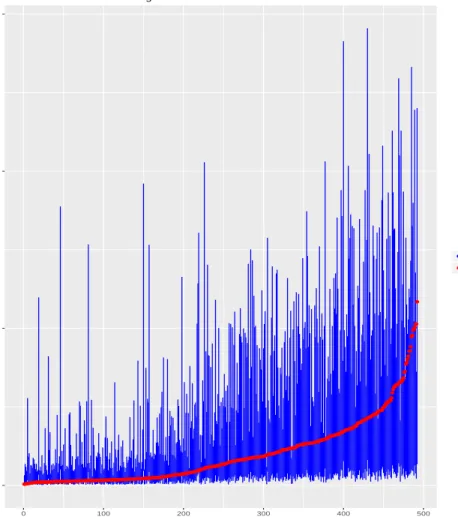
4 Plot of 95% prediction intervals vs. actual PM2.5 values . . . 50
5 Plot of 50% prediction intervals vs. actual PM2.5 values . . . 51
6 Daily minimum (blue) and maximum (red) temperatures for 4 randomly selected observation sites. Actual corn yield in bushels per acre reported alongside 95% out of sample prediction interval. . . 55
1.0 Introduction
My research aims to establish a method of constructing prediction intervals for a scalar response of interest when multiple predictors are functional data, with minimal distributional and modeling assumptions. With advancements in technology, it has become far easier and more common to continuously or repeatedly measure a variable over an interval in time to track how it changes. If we record one or more curves for each subject in our sample of interest, these data are referred to as functional data. The term is quite general, as even shapes, images, and surfaces may be considered specific types of functional data.
One area of research in functional data analysis is the seemingly simple task of using functional data to make predictions. Construction of prediction intervals in regression settings is a classical problem in statistics with wide ranging applications. From neuroscience to climatology, researchers wish to use the multiple sources of functional data they have collected to estimate the unknown value of some other variable. Moreover, it is often valuable to obtain a prediction interval for this vari-able rather than a single “most likely” estimate. The research on model free or distribution free prediction intervals has gained increasing interest in recent years, because it becomes more challenging to specify a correct model or rigorously check the modeling assumptions when the data are so complex. Few methods to create these intervals exist in functional data analysis, and those that do exist require fairly strict conditions on the true nature of the data. In this research, we focused on developing computationally efficient methods for conformal prediction intervals in functional regression settings. The prediction intervals constructed by the confor-mal method have guaranteed coverage (confidence) without heavy restrictions on
the error distribution and on the regression function, while the efficiency (implied by the length of the intervals) will depend on the representation and information compression of the functional predictors. To accommodate flexible regression rela-tionships, we integrated nonparametric functional regression based on multivariate functional principal component analysis into our conformal prediction method, and we developed nonparametric functional regression approaches based on the signature method, which is a mathematical tool to represent the information contained in the functions by a collection of iterated integrals.
We then ran numerous simulations to confirm the general efficacy of the algo-rithms under a variety of settings. We also applied the method to a publicly available meteorological dataset related to air particulate matter (PM) levels in China and an agricultural dataset concerning the effects of temperature and precipitation on crop yield. High PM levels generated via fuel combustion are understood to have signifi-cant adverse effects on mortality, and various Chinese cities are infamous for dense smog. Using weather data from the previous day, the algorithms were able to clas-sify the PM levels during rush hour in Beijing, which would allow for citizens and authorities to take necessary precautions on particularly severe days. In the other example, better prediction of the range of likely crop yields can allow farmers to prepare for the likely worst-case and best-case scenarios.
The rest of the thesis is organized as follows. Chapter 2 introduces the con-formal prediction method, and describe several of its properties which make it a desirable method for constructing prediction intervals. Chapter 3 derives algorithms for constructing prediction intervals for functional regression based on the conformal prediction method. Additionally, relevant theoretical results are discussed at the end of the chapter. Chapter 4 focuses on application of these algorithms in simulated data settings. Chapter 5 applies these algorithms to both aforementioned publicly
available data sets. We finish with a brief discussion of the results in this paper, and include some supplementary material at the end.
2.0 Conformal Prediction Background
2.1 Motivation for Conformal Prediction
To understand the appeal of the conformal prediction method, let us first look at the prediction problem in general. In the prediction problem, i.i.d. (X, Y) pairs of data are observed. A new Xn+1 is then obtained, and we wish to predict a range of likely values for Yn+1. More precisely, we would like to construct a prediction set C which contains Yn+1 with probability at least 1−α, for some given α∈ (0,1).
In the simplest case, Y = βX +, X ∈ Rp, Y ∈
R, ∼ N(0, σ2), this pro-cess results in the standardt interval: Yˆ ±tn−p,α/2
p
M SE(1 +Xn+10 (X0X)−1Xn+1). Among other nice properties, this interval is easy to calculate and has correct finite sample coverage, which makes it a natural choice in this setting.
These properties start to disappear once we begin generalizing the model. If we instead consider the modelY =f(X) +,f unknown,X ∈Rp,Y ∈
R, ∼N(0, σ2), then we must first use some nonparametric method to estimate f, then construct an interval based on the residuals and normal quantiles. If we further generalize to a symmetric, but not necessarily normal , then we must additionally estimate this distribution using nonparametric methods. Not only do these methods only provide asymptotic coverage rather than finite sample coverage, but estimatingf is difficult when p is larger than 2 or 3, and even more challenging when we consider one or more functional predictors.
Other methods of approaching this problem include nonparametric conditional distribution or density estimation ofY givenX (Fan et al. (1996), Hall et al. (1999)), or nonparametric quantile regression (Koenker et al. (2005)) in the form offτ(x). If
quantile regression assumptions hold for both τ = α/2 and τ = 1−α/2, one can have asymptotically valid prediction intervals ( ˆfα/2(x),f1ˆ−α/2(x)). However, these nonparametric methods are difficult to generalize to functional data, where X itself is in a functional space. There are a few methods in functional data setting (Cardot et al. (2005), Chen and Müller (2012)), but all of them need modeling assumptions on the true relationships and can be difficult to extend to multiple functional predictors. Vovk et al. (2005) introduced the idea of conformal prediction as a method of generating prediction intervals with finite sample coverage with minimal assump-tions. Conformal prediction is based on the simple observation that if U1, . . . , Un+1 is a sequence of i.i.d. random variables, then the rank of Un+1 will be uniform over {1, 2, . . . , n+1}. Therefore, P(rank(Un+1) ≤ d(n + 1)(1−α)e) ≥ 1−α for any α ∈ (0,1) and we can define the sample quantile based on the order statistics U(1) ≤U(2) ≤ · · · ≤U(n) as ˆ q1−α = U(d(n+1)(1−α)e), if d(n+ 1)(1−α)e ≤n, ∞, otherwise
By this definition P(Un+1 ≤qˆ1−α)≥1−α for all α.
Returning to our goal of constructing prediction intervals, let
σi(y) = σ({(X1, Y1), . . . ,(Xn+1, Yn+1 =y)},(Xi, Yi)), i= 1, . . . ,(n+ 1) be a conformity score, whereσ is some function symmetric in the entries in its first argument. This conformity score measures how similar (Xi, Yi) is to the rest of the data. Although there are many reasonable choices forσ, in the context of a regression problem a natural choice of conformity score would be based on residuals from the regression model. For the rest of the section, we letσi(y) =|Yi−mˆ(Xi)|, wheremˆ is
some regression function trained on the augmented data{(X1, Y1), . . . ,(Xn+1, Yn+1 = y)}. Note that a larger σi indicates a less similar observation. Using the idea from above, we can say if(Xn+1, y)is from the same distribution as(X1, Y1), . . . ,(Xn, Yn) then P(σn+1 ≤ σ(d(n+1)(1−α)e)) ≥ 1 −α. We omit the argument y for notation simplicity, but remember the conformity scores σ are functions of y. Thus, our prediction set C(Xn+1) of level 1−α consists of all values of y such that
n+1 X i=1
1[σi ≤σn+1]≤ d(n+ 1)(1−α)e (1)
2.2 Properties of Conformal Prediction
In addition to making minimal assumptions about the data, conformal inference has a few useful properties. Perhaps most important among them is the finite sample coverage guarantee. Lei et al. (2018) not only showed that P(Yn+1 ∈ C(Xn+1)) ≥
1−α, but also thatP(Yn+1 ∈C(Xn+1))≤1−α+n+11 under the weak assumption that the residuals have a joint continuous distribution. Crucially, this result holds even when the model mˆ(x)is not the true form of the data. Therefore, regardless of choice of the regression model, we are guaranteed that the prediction set is neither too conservative nor anti-conservative.
In general, a grid search must be used to construct the conformal prediction in-terval C(Xn+1) as defined in Equation (1). One has to check every potential value y and the pair (Xn+1, y) to determine if its conformity score meets the cutoff. Such an approach would be unusable in most real world applications. To address this problem, Lei et al. (2018) proposes a split conformal prediction method which
re-duces computational cost by dividing the data into a training set and a ranking set. However, this algorithm often results in larger intervals than the exact prediction set. Fortunately, a closed form expression for the prediction set may be obtained with appropriate choice of conformity score. For example, if the conformity score is linear in y, then it is possible to solve for y and calculate the exact prediction set without searching over all values of y.
Even when an exact prediction set can be calculated directly, there is a possibility this set is not a single contiguous interval. In the regression setting, this happens when the observation Xn+1 has high leverage relative to the rest of the data. While this is not always a problem, it is still of value to develop a set of conditions under which the prediction set will be an interval.
The finite sample coverage guarantee mentioned earlier P(Yn+1 ∈ C(Xn+1)) ≥ 1−α is over the joint distribution of (X1, Y1), . . . ,(Xn+1, Yn+1) (we will call this type of coveragemarginal coverage). A stronger claim of interest would beP(Yn+1 ∈
C(x)|Xn+1 = x) ≥ 1−α (we will call this type of coverage conditional coverage). Unfortunately, Lei and Wasserman (2014) showed a non-trivial (not infinite length) finite sample guarantee for conditional coverage is impossible in the nonparametric setting. At best, we can achieve asymptotic conditional validity:
sup
x
[P(Yn+1 ∈/ C(x)|Xn+1 =x)−α]+ p
→0
In their two papers, Lei et al. explore a couple different approaches to achiev-ing this goal. Lei and Wasserman (2014) describes an approach to locally estimate the conditional density of the residuals and use that to construct conditionally valid sets. Lei et al. (2018) later shows that for i.i.d. (Xi, Yi) with homogenous and sym-metric noise, and a base estimator mˆ(x) which is consistent and stable under small
perturbations, an asymptotically conditionally valid prediction set can be obtained. Politis (2015) also describes a method of forming distribution free prediction sets with asymptotic conditional validity, although this too requires a consistent estimator of the mean.
Even if marginal coverage is sufficient for the analysis, the above results are important due to what they tell us about the efficiency of the prediction sets. In the 2017 paper, Lei shows that under the same regularity assumptions the prediction sets will have near optimal length and location. These results will be extended to cover the new developments in this paper, and practical performance will be explored.
3.0 Conformal Prediction in Multiple Functional Regression
In the multiple functional regression setting we observe i.i.d. pairs
(X1, Y1), . . .(Xn, Yn), where Xi = {Xij(t), t ∈ T ⊂ R}j=1,...,p are multiple func-tional predictors andY1, . . . , Yn are scalar responses. We are provided new observed functions Xn+1 and wish to predict the value of Yn+1. The basic model for this setting is Y = f(X1, . . . , Xp) +, with unknown f and minimal assumptions on . The estimation of the nonparametric regression function f(X1, . . . , Xp) is itself a challenging problem due to the curse of dimensionality. Jiang et al. (2018) considers the functional single index model Yi = g(
R1 0(
Pp
j=1βjXji(t))α(t)dt) +i, where βj are predictor weights, and α(t) is the coefficient function. Meanwhile, Wong et al. (2019) extends the functional additive model originally developed by Müller and Yao (2008) to the multiple functional predictor caseYi =PKk=1gk(ζki) +i, where ζki are standardized principal component scores from multivariate functional principal com-ponent analysis. That said, few (if any) of the multiple functional regression models in the literature provide a method by which one can calculate a prediction interval. As such, we will explore linear and nonlinear methods based on functional principal component analysis, as well as a method based on signature extraction. We then integrate these nonparametric regression approaches with the conformal method. We derive close form solutions for conformal prediction intervals based on carefully chosen conformity scores in the functional regression setting, where the residuals are obtained from linear functional principal component regression, nonparametric functional principal component regression, and nonparametric functional regression based on signature extraction. Given the finite sample coverage guarantee, all of the algorithms will produce intervals with the desired coverage regardless of the true
relationship. The algorithms based on nonparametric regressions retain efficiency in various regression settings.
3.1 Multiple Functional PCR-based Conformity Scores
3.1.1 Linear Multiple Functional Regression
Many common approaches to the univariate functional regression problem are based on functional principal components analysis (FPCA) (see Silverman et al. (1996), Hall et al. (2006)). Multivariate FPCA (mFPCA) is a natural extension to the multiple predictor setting. As with multivariate PCA, mFPCA aims to identify the strongest sources of variation between observations, except that the observations are now functions. Formally, consider a set of random functionsX ={Xj(t)}j=1,...,p, t∈
T ⊂ R in Hilbert space H, with each Xj square integrable, means µ1(t). . . µp(t) and covariance function G(s, t) = {Gkl(s, t)}1≤k,l≤p, Gkl(s, t) = cov(Xk(s), Xl(t)), Gk= (Gk1, . . . , Gkp)T. The autocovariance operator is
(Af)(t) = Z s∈T f(s)G(s, t)ds = hG1(s,·),fiH .. . hGp(s,·),fiH
with orthonormal eigenfunctionsφk = (φ1k, . . . , φpk)T, j ≥1and ordered eigenvalues λ1 ≥ λ2 ≥ . . .. Then for k > 1, the k-th functional principal component score is ξk =
Pp j=1
R
t∈T(Xj(t)− µj(t))φjk(t)dt. Note that for each observation Xi, this
method produces a single principal component score ξki associated with the k-th principal component φk, rather than the p scores obtained from performing FPCA
on each predictor individually. In practice, we observe our functions Xi at discrete time points t1, . . . , td, for i= 1, . . . , n (assume that they are centered to have mean zero), and we may estimate the covariance function by the sample covariance matrix
ˆ
G=n−1XTX. Existing methods for multivariate PCA may then be used to obtain discrete approximations for the eigenfunctionsφˆk(t), and principal component scores
ˆ
ξik are obtained from numerical integration.
The first conformity score we wish to examine will be based on the natural extension of univariate linear principal components regression (see Hall et al. (2007)). This model assumes that the data pairs (Xi, Yi) have the relationship
Yi =α+
Z
βj(t)Xi(t) +i
As the principal component functions{φk(t)}k≥1 form a complete orthonormal basis forL2(T), we may write β(t) = P
∞
k=1bkφk(t) for any set of functionsβ(t)∈L2(T), and therefore: Yi =α+ Z ∞ X k=1 bkφk(t) ∞ X k=1 ξikφk(t)dt+i Since φk(t) are orthonormal, we can simplify this to:
Yi =α+
∞
X k=1
bkξik+i
In practice, we may truncate the infinite sum at a finite order K, and regress Y on the firstK principal component scores ξk,1≤k ≤K.
If we define the matrix ξ such that the i, k-th entry is ξik and the matrix ξ =
[1 ξ], then the estimator for the mean function m(x) is the OLS solution mˆ(Xi) =
ξi(ξ0ξ)−1ξ0Y.
Using the notation above, our conformity score for the first algorithm will be σi =|Yi−mˆ(Xi)|. We would now like to derive a closed-form algorithm for producing
a conformal prediction set. This means that we would like to derive inequalities equivalent to Equation (1) which depend solely on X1, . . . ,Xn+1, Y1, . . . , Yn. In the linear regression case, this is relatively easy to do. For example, Vovk et al. (2005) has used the closed-form solution for ridge regression, including the special case of OLS. We here include the derivation for completeness.
Notation: if T is a statistic based on the augmented data
(X1, y1), . . . ,(Xn+1, yn+1), letTnbe the same statistic based on(X1, y1), . . . ,(Xn, yn). Applying the Sherman-Morrison formula to βˆn = (X0X −xn+1x0n+1)−1Xn0Yn, we find βˆ−βˆn = (X0X)−1x
n+1rn+1
1−hn+1,n+1 . From there, we find ri = r
n i −
hi,n+1rn+1
1−hn+1,n+1, where
hij is the i, j-th entry of the standard hat matrix H = X(X0X)−1X0. Using the leave-one-out residual equality,ri(i)=ri/(1−hii), we have
ri =rin−hi,n+1rnn+1
As per Equation (1), we wish to include in our prediction set every y for which Pn+1
i=1 1[σi ≤ σn+1] ≤ d(n + 1)(1 −α)e, or equivalently
Pn+1
i=1 1[|ri| ≤ |rn+1|] ≤
d(n+ 1)(1−α)e. From above,|rn+1|>|ri| ⇔ |(1−hn+1,n+1)rn+1n |>|rni −hi,n+1rnn+1| Solving this inequality leads to the following four inequalities:
Inequalities to determine upper bound: (1−hn+1,n+1+hi,n+1)rnn+1 > rin (1−hn+1,n+1−hi,n+1)rn+1n >−rin (2)
Inequalities to determine lower bound: (1−hn+1,n+1+hi,n+1)rnn+1 < rin (1−hn+1,n+1−hi,n+1)rn+1n <−rin (3)
This results in the following algorithm for constructing conformal prediction in-tervals based on functional PCR linear regression conformity score:
Algorithm 1
1. Calculate the K eigenfunctions φˆ1, . . .φˆK of XTX corresponding to the K largest eigenvalues where 1≤K ≤rank(X). Let φ= ( ˆφ1, . . . ,φˆK)T.
2. Calculate ξ = ( ˆξ1, . . . ,ξˆK)T =XφT, the scores of X1, . . . ,Xn+1 with respect to the basis φˆ1, . . . ,φˆK. Append a column of 1 to the matrix ξ to form ξ. Any linear covariates may be appended to this matrix.
3. Calculate the residuals rn
i for each point (ξi, Yi) using the linear regression esti-mates from the data (ξ1, Y1),(ξ2, Y2), . . . ,(ξn, Yn).
4. Calculate the hat matrix H =ξ(ξ0ξ)−1ξ0.
5. Calculate ai =
rn i
1−hn+1,n+1+hi,n+1 and an+i =
−rn i
1−hn+1,n+1−hi,n+1 for i= 1,2, . . . , n.
6. Order these values from smallest to largest. Denote the ordered values a(1), a(2), . . . , a(2n).
7. Calculate yˆn
n+1 = ξn+1βˆ using the OLS estimates from the data
(ξ1, Y1),(ξ2, Y2), . . . ,(ξn, Yn).
8. Construct the100(1−α)%prediction interval forYn+1 = (ˆynn+1+a(b(n+1)αc),yˆn+1n + a(d(2−α)(n+1)−1e))
This algorithm makes the assumption that 1 − hn+1,n+1 ± hi,n+1 > 0 ∀i (Contiguity Condition 1) to ensure the resulting set is a contiguous interval. If this condition is not satisfied, a conformal prediction set may still be constructed (see supplemental section).
3.1.2 Nonparametric Multiple Functional Regression
The main problems with the functional linear regression approach above occur when the model is misspecified. While marginal coverage is always obtained, if the true relationship between Xi and Yi is not linear, then these prediction sets may be extremely large and have no guarantee of conditional coverage. The natural next step is to consider a nonparametric approach.
In the setting with a single functional predictor, work by Ferraty and Vieu (2006) and Geenens et al. (2011) focused on the Nadaraya-Watson type estimator
ˆ m(x) = Pn k=1K(((x−Xk))/h)Yk Pn k=1K(((x−Xk))/h) , where ((·)) is a semi-metric on L 2(T), K is a univariate kernel, and h a scalar bandwidth. Many potential kernels K may work, includ-ing the standard Gaussian kernel K(t) = p2/πe−t2/2
for t ∈ (0,∞). This model may additionally be viewed as a local constant model which minimizes the weighted square error Pni=1(Yi−a)2K(((x−Xk))/h)over a. Crucially, Geenens showed that if e1, e2, . . . form an orthonormal basis of L2(T), then the function
((X))p = v u u t p X j=1 hX, eji2
with p a fixed positive integer, is a semi-norm on L2(T). Given that the univariate principal component functionsφj form an orthonormal basis, the function
((x−Xk))p = v u u t p X j=1 hx−Xk, φji2
is a semi-norm. This function is simply the Euclidean distance between the first p FPC scores of xand Xk.
Baíllo and Grané (2009) extended the model to the local linear model minimizing the weighted square error Pni=1(Yi−a− hβ, x−Xii)2K(((x−Xi))/h) over a and
β ∈ L2. We can express β and x−X
i in terms of univariate principal component functions φj and coefficients bk or FPC scores ξik −ξk respectively, and truncate the infinite sum after K terms. This results in us having to minimize the sum Pn
i=1(Yi−a− PK
k=1bk(ξik−ξk))
2K(((x−Xi))/h) over a, b1, . . . , bK.
In the natural extension to the multiple functional regression setting, one would first apply mFPCA to your observations Xi and the new observation x to ob-tain the principal component scores ξˆi and for ξˆx, respectively. Then construct the matrices Zx = [1 ξi −ξx] and Wx = diag(K(||ξi −ξx||/h)). Then mˆ(x) =
e1(Zx0WxZx)−1Zx0WxY, where e1 is the K + 1 dimensional vector with a 1 followed byK zeroes. This will be the estimated mean function used in the next conformity scoreσi =|Yi−mˆ(x)|. In the functional linear regression based conformity score, we were able to express thisσ in terms of residuals from the un-augmented model. That is not easy to do in this case; instead, we separate the formula for mˆ(x) into terms depending onYn+1 and terms not depending on Yn+1. Then we can solve directly for Yn+1. We can write ri =Yi−e1(Zx0iWxiZxi) −1(Zn0 xiW n xiY n+Z xi,n+1Wxi,n+1Yn+1) =Yi−e1(Zx0iWxiZxi) −1Zn0 xiW n xiY n−e 1(Zx0iWxiZxi) −1Z xi,n+1Wxi,n+1Yn+1 =Yi−Ai−BiYn+1
where neither Ai nor Bi depend on Yn+1.
Again, as per Equation (1), we wish to include in our prediction set every y for which Pn+1i=1 1[σi ≤σn+1]≤ d(n+ 1)(1−α)e, or equivalently Pn+1i=1 1[|ri| ≤ |rn+1|]≤
d(n+ 1)(1−α)e. As we just derived, |rn+1| > |ri| ⇔ |Yn+1−An+1−Bn+1Yn+1| >
Inequalities to determine upper bound: (1−Bn+1+Bi)Yn+1 < Yi−Ai+An+1 (1−Bn+1−Bi)Yn+1 <−Yi+Ai+An+1 (4)
Inequalities to determine lower bound: (1−Bn+1+Bi)Yn+1 > Yi−Ai+An+1 (1−Bn+1−Bi)Yn+1 >−Yi+Ai+An+1 (5)
This results in the following algorithm for constructing conformal prediction in-tervals based on the local linear regression conformity score:
Algorithm 2
1. Calculate the K eigenfunctions φˆ1, . . . ,φˆK of XTX corresponding to the K largest eigenvalues where 1≤K ≤rank(X). Let φ= ( ˆφ1, . . . ,φˆK)T.
2. Calculate ξ = ( ˆξ1, . . . ,ξˆK)T = XφT, the scores of X1, . . . ,Xn+1 with respect to the basis φˆ1, . . . ,φˆK. Any covariates may be appended to this matrix.
3. Using the above notation, calculate Ai and Bi for all i. 4. For all i∈1,2, . . . , n, calculate Li =min(yi−Ai+An+1
1−Bn+1+Bi, −yi+Ai+An+1 1−Bn+1−Bi ) and Ui =max(yi −Ai+An+1 1−Bn+1+Bi, −yi+Ai+An+1 1−Bn+1−Bi ).
5. Construct the 100(1 − α)% prediction interval for Yn+1 = (L(b(n+1)αc), U(d(1−α)(n+1)e))
Similarly to Algorithm 1, this algorithm makes the assumption that 1−Bn+1± Bi >0, ∀i (Contiguity Condition 2) in order to guarantee contiguous prediction intervals. Again, check supplemental section 7.1 for instructions on modifying this algorithm if this condition is not satisfied.
3.2 Partial Linear Conformity Score based on Signature
The major issue facing the previous algorithm is the so-called “curse of dimension-ality”. This term refers to the poor performance of nonparametric methods caused by the sparsity of data in more than 2 or 3 dimensions. As a result, applying Al-gorithm 2 to more principal component scores can often result in large prediction sets with inconsistent conditional coverage that often are not even contiguous. This practical restriction to only a few principal components limits the ability of FPCA to capture the true nature of the relationship, since mFPCA tends to require slightly more principal components to capture most of the information contained in the mul-tiple functional predictors. We want to find another regression model to describe nonlinear relationships without encountering this same issue.
While functional PCA is a natural choice, other methods of extracting feature sets exist. The signature method, one such approach first described by Chen (1958), has recently been applied to rough path theory in areas of machine learning by Hambly and Lyons (2010). However, very little work has been done to apply this method to functional data analysis despite the obvious similarities.
In this area of research, ad-dimensional path is defined as a continuous mapping from[a, b]to Rd. A function X(t), t∈[0,1] can be considered a specific case of a 2 -dimensional pathXt={Xt1, Xt2}={t, X(t)}. For example, the functionX(t) = 2t2, t ∈ [0,1] is equivalent to the 2-dimensional path Xt = {Xt1, Xt2} = {t,2t2}, t ∈ [0,1]. Note that a 1-dimensional path alone is insufficient to capture the in-formation contained within X(t), as it will be clear later that the signature of the 1-path dimensional path only depends on the image of the mapping. Similarly, the p functions X1(t), X2(t), . . . Xp(t) can be considered a p+ 1-dimensional path Xt ={t, X1(t), . . . , Xp(t)}.
Before defining the signature of a path, we will first define the path integral as described by Chevyrev and Kormilitzin (2016). The path integral of a1-dimensional path Yt against another 1-dimensional path Xt is defined as the integral
Z b a YtdXt= Z b a Yt dXt dt dt.
Now we can define the signature of ad-dimensional path. For alli∈ {1,2, . . . , d}: S(Xt)ia,t=
Z a<s<t
dXsi
For i, j ∈ {1,2, . . . , d}, the double-iterated integral is defined as: S(Xt)i,ja,t= Z a<s<t S(Xt)ia,sdX j s = Z a<r<s<t dXridXsj
In general, for i1, i2, . . . , ik ∈ {1,2, . . . , d}, the k-fold iterated integral is defined as: S(Xt) i1,i2,...,ik a,t = Z a<s<t S(Xt)ia,s1,i2,...,ik−1dX ik s
Defining S(Xt)0a,b to be 1, the signature of a d-dimensional pathXt, denoted by S(Xt)a,b is the sequence
S(Xt)a,b= (1, S(Xt)a,b1 , . . . , S(Xt)da,b, S(Xt) 1,1
a,b, S(Xt) 1,2 a,b, . . .)
where all dk k-fold iterated integrals with unique superscripts are included for k =
1,2, . . .. Chen (1958) provides a derivation and analysis of iterated integrals, while Hambly and Lyons (2010) shows how this definition of the signature naturally arises from the study of controlled differential equations.
Furthermore, define the k-th order signature [S(Xt)]ka,b to be the sequence
{S(Xt) 1,...,1
a,b , . . . , S(Xt) d,...,d
a,b } of all d
k k-fold iterated integrals with unique super-scripts. Then the signature S(Xt)a,b= (1,[S(Xt)]1a,b,[S(Xt)]2a,b, . . .).
Although it may be difficult to intuit the meaning of higher order terms in the signature, the terms of order 1 and 2 have fairly straightforward geometric inter-pretations. The first order terms S(Xt)ia,b are simply the displacement Xbi−Xai in each dimension. The second order terms S(Xt)i,ia,b are half the square displacement
(Xi
b −Xai)2/2 in each dimension. The cross second order terms S(Xt)i,ja,b satisfy the equation A = (S(Xt)1,2a,b −S(Xt)2,1a,b)/2, where A is the Lévy Area of the path. The
Lévy Area of a path is the signed area enclosed by the path and the chord connecting the endpoints. In the example in Figure 1, theLévy Area is calculatedA=A+−A−
0
1
2
3
4
5
0
1
2
3
4
A
−A
+X
t1X
t23.2.1 Properties of the Signature in Functional Regression Setting Without loss of generality, we will consider functions on the domain [0,1]. For convenience, we will ignore the domain and path and write a signature term S(Xt)
i1,...,ik
a,b as S
i1,...,ik when there is no confusion. Also, we use [S(X
t)]ka,b or[S] k to represent all k-th order signature terms.
Immediately clear from its definition is that the signature is invariant under trans-lation. The following corollary was first shown by Chen (1958) for all continuously differentiable functions and later expanded to paths of bounded variance by Hambly and Lyons (2010).
Corollary: If, for two piecewise regular continuous paths Xt and Yt in Rd,
S(Xt)a,b = S(Yt)a,b then the irreducible path of Yt can be obtained from the ir-reducible path of Xt by translation and change of parameter.
In the context of functional regression, our functions X(t) cannot cross them-selves; therefore the corresponding paths are irreducible. Furthermore, change of a path’s parameter does not change the function. Thus, each unique signature corre-sponds to a unique family of functions which only differ by vertical and horizontal translation. If the domain of each predictor is the same for all observations, then vertical location is the only information lost.
The shuffle property is another reason why the signature method is a promising
approach for functional nonparametric regression. First proved by Ree (1958), the shuffle property states that any product of two termsS(Xt)ia,b1,i2,...,ik andS(Xt)ja,b1,j2,...,jn can be expressed as the sum of terms of S(Xt)a,b determined entirely by the multi-indices i1, i2, . . . , ik, j1, j2, . . . , jn. Specifically, for I = (i1, i2, . . . , ik) and J = (j1, j2, . . . , jn),
S(Xt)Ia,bS(Xt)Ja,b= X K∈IJ
whereI J is the set of all (k+n)!k!n! ways to interleave the elements of I and J. This result allows us to express any nonlinear function of the signa-ture as a linear combination of the signasigna-ture instead. Consider a set-ting with two functional predictors X1(t) and X2(t) on t ∈ [0,1]. The first two orders of our 3 dimensional path’s signature would be the sequence
{1, S1, S2, S3, S1,1, S1,2, S1,3, S2,1, S2,2, S2,3, S3,1, S3,2, S3,3}. This shuffle property states that, for example:
S1,2∗S2,3 =S1,2,2,3+S1,2,2,3+S1,2,3,2+S2,1,2,3+S2,1,3,2 +S2,3,1,2
= 2S1,2,2,3+S1,2,3,2+S2,1,2,3+S2,1,3,2+S2,3,1,2,
where indices corresponding to those from the first term are bolded in the top equality to help demonstrate an interleaving of superscripts.
The signature as defined above is an infinite sequence, which is not practical for regression problems. In the context of (non)linear controlled differential equations (see section 3.3 for more details), Lyons (2014) shows that the truncated signature uniformly converges to the signature, but does not generalize this result to other settings. Nevertheless, we build the regression function based on a finite order of signature terms. As higher order signature terms in some sense correspond to more complex features of the original function, this choice seems reasonable. If the response indeed only depends on the a finite order of signature terms, the produced prediction interval will have conditional coverage and efficiency in addition to the finite sample marginal coverage guarantee.
In functional data regression settings in which observations are recorded on the same domain, we can further make use of the shuffle property to reduce the number of terms needed for regression. Since the i-th sample predictor Xi(t) is represented
as a path Xit = {t, X1i(t), . . . , Xpi(t)}, the signature terms Si1, Si11, Si111, . . ., which only depend on the first 1-dimensional path will take the same value for all sample functions. Based on theshuffle property, we can express all signature terms of order k as linear combinations of signature terms of order k+ 1. For example, the shuffle property states S1S2 = S12+S21. Since S1 ≡ c, we can rearrange the equation to say S2 = S12+Sc 21. Therefore, in our regression, we only need to include the dk−1
non-S11...1 terms of order k, i,e., [S]k \ S1,1,...,1, rather than all dk+1 − 1 terms of orders1,2, . . . , k, where pis the dimension of the multiple functional predictors and d=p+ 1 is the dimension of the path.
To summarize, we have the following (approximate) equalities f(X1(t), X2(t), . . . , Xp(t))
= ˜f(S(Xt)), by uniqueness of the signature
=L(S(Xt)), by the shuffle property
≈L([S(Xt)]1,[S(Xt)]2, . . . ,[S(Xt)]k), by the finite order approximation
=L([S(Xt)]k\S(Xt)1,1,...,1), by the shuffle property in the functional data context Of course, the first equality above ignores the issue of vertical translation. Any dependence the response has on vertical location of the predictors will not be cap-tured by this feature set. As such, additional variables representing the vertical location of each predictors should be added to the signature expansion. However, there is no reason to assume that the response linearly depends on these terms. Therefore, it is natural to consider a semiparametric model.
One possibility for the semiparametric model would be a multiple index model. In this model, we have Y =f([S]kβ, Z
1, . . . , Zp) +, where f is an unknown function,
predictors which capture the vertical location of each predictor function Xj(t). For example,Zj can be the average value of Xj(t)over allt. This model is very flexible, but models of this sort are often fit iteratively, and we could not find a closed-form solution for conformal prediction interval. One could combine this model with the sample-splitting method described in Lei et al. (2018) to obtain an approximate conformal prediction set based on this model.
We propose using the signature-based multiple partial linear model
Yi = [Si]kβ+ p X
j=1
gj(Zji) +i, (6)
wheregj,1≤j ≤p, are unknown functions to be estimated nonparametrically. This model makes the additional assumption that the vertical locations Z have additive effects on the response. We view this model as a balance between model flexibility and simplicity.
To derive the conformal prediction interval, we need to fit the model Equa-tion (6) on the augmented data set {(X1(t), Y1), . . . ,(Xn+1(t), Yn+1)}, and obtain the residuals {r1, . . . , rn+1}. Let Y = (Y1, . . . , Yn+1)T and [S]k = ([S]k1, . . . ,[S]kn+1)T. Extending the work of Robinson (1988), we first fit the additive models Yi ∼ α1+gy1(Z1i)+gy2(Z2i)+· · ·+gyp(Zpi)and[Si]k∼α2+gs1(Z1i)+gs2(Z2i)+· · ·+gsp(Zpi) using the local constant approach with an exact equation derived by Opsomer (2000). These residuals will retain their linear relationship while having no remaining depen-dence on Z. Thus, we can use OLS to regress the residuals from the first regression on the residuals from the second. Using the notation from the Opsomer (2000), the equations for theY-residuals and S-residuals are:
ˆ ryi =Yi−ˆgy(Zi) = Yi−WMi,Y =Yi− Pn j=1WMi,jYj −WMi,n+1Yn+1 ˆ rsi = [Si]k−ˆgs(Zi) = [Si]k−WMi,[S] k,
As defined by Opsomer (2000),WM is the smoother matrix satisfyinggˆy =WMY in the regression ofY on Z and ˆgs =WM[S]k in the regression of [S]k onZ. Here, WMi, denotes the i-th row of WM and WMi,j denotes the entry of WM in the i-th
row andj-th column, andrsiˆ is a vector as [Si]k is a vector. Our estimate for β in Equation (6) is
ˆ β = ( n+1 X i=1 ˆ rsiˆrsi0 ) −1 n+1 X i=1 ˆ rsirˆyi = ( n+1 X i=1 ˆ rsiˆrsi0 ) −1 n+1 X i=1 ˆ rsi(Yi− n X j=1 WMi,jYj−WMi,n+1Yn+1) = ( n+1 X i=1 ˆ rsiˆrsi0 ) −1 n X i=1 ˆ rsi(Yi− n X j=1 WMi,jYj)−( n+1 X i=1 ˆ rsirˆ0si) −1rˆ sn+1 n X j=1 WMn+1,jYj −( n+1 X i=1 ˆ rsirˆ0si) −1 n X i=1 ˆ rsiWMi,n+1Yn+1+ ( n+1 X i=1 ˆ rsirˆ0si) −1ˆr sn+1(1−WMn+1,n+1)Yn+1 =c1+c2Yn+1
wherec1 and c2 are terms not dependent oni orYn+1. Thus, the equation for the ith residual is
ri =Yi−Yiˆ =Yi−rˆsiβˆ−ˆgy(Zi) =Yi−rsiˆ (c1+c2Yn+1)−( n X j=1 WMijYj +WMi,n+1Yn+1) =Yi−ai−biYn+1 (7)
whereai and bi are terms not dependent on Yn+1.
We wish to include in our prediction set every y for which Pn+1i=1 1[σi ≤σn+1]≤
derived, |rn+1| > |ri| ⇔ |Yn+1−an+1 −bn+1Yn+1| > |Yi−ai−biYn+1|. Solving this inequality leads to the following four inequalities:
Inequalities to determine upper bound: (1−bn+1+bi)Yn+1 < Yi−ai+an+1 (1−bn+1−bi)Yn+1 <−Yi+ai+an+1 (8)
Inequalities to determine lower bound: (1−bn+1+bi)Yn+1 > Yi−ai+an+1 (1−bn+1−bi)Yn+1 >−Yi+ai+an+1 (9)
This results in the following algorithm for constructing the exact conformal pre-diction intervals using the signature-based multiple partial linear conformity score:
Signature-based MPL Algorithm (Algorithm 3)
1. Calculate the k-th order signature [Si]k of each Xi, i= 1, . . . , n+ 1. Construct the matrix [S]k = ([S1]k, . . . ,[Sn+1]k)T. Any linear covariates may be appended to this matrix.
2. CalculateZij, for eachXij(t),i= 1, . . . , n+ 1, j = 1, . . . , p. Construct the matrix Z = (Z1, . . . ,Zn+1)T. Any additive nonlinear covariates may be appended to this matrix.
3. Calculate rˆyi, ˆrSi, β, andˆ ai,bi as described in Equation (7).
4. For eachi∈ {1,2, . . . , n}, calculateUi= max((Yi−ai+an+1)/(1−bn+1+bi),(−Yi+
ai+an+1)/(1−bn+1−bi)) and Li= min((Yi−ai+an+1)/(1−bn+1+bi),(−Yi+ ai+an+1)/(1−bn+1−bi))
5. Construct the 100(1 − α)% prediction interval for Yn+1 =
To ensure the resulting set is a contiguous interval, this algorithm assumes a Contiguity Condition 3
1−bn+1±bi >0,∀i. (10)
It is obvious from Equation (7) thatbi is the degree to which the value ofYn+1 affects riand thereforeyˆi. Thus, this condition (along with the previous two) is a restriction on theperturb one sensitivity, similar to Assumption 3 in Section 3.3. The restriction roughly translates into a requirement that Xn+1 not be “too far” away from the rest of the Xi.
3.3 Theoretical Results
In this section, we first list Properties 1 - 4 for conformal prediction intervals. These properties have been proved in previous papers under a list of assumptions (Lei et al., 2018). and we include that here for completeness. We then discuss some of assumptions in the functional data context, and with respect to the specific conformity scores we proposed. Then we discuss the contiguity property of the constructed prediction intervals.
Property 1 (Finite Sample Coverage): If (Xi, Yi), i = 1,2, . . . , n+ 1 are i.i.d., then P(Yn+1 ∈C(Xn+1))≥1−α, whereC(Xn+1) is the conformal prediction interval produced by algorithm 1, 2, or 3.
Property 2 (Finite Sample Accuracy): Under the same conditions as Theo-rem 1, with the additional assumption that for ally∈R, the fitted absolute residuals Ry,i have a continuous joint distribution, then P(Yn+1 ∈C(Xn+1))≤1−α+n+11 .
The following four assumptions are necessary to establish properties 3 and 4 regarding conditional coverage and efficiency:
Assumption 1: (Xi, Yi) are sampled i.i.d. from a distribution P on RR ×R, with mean function m(x) =E(Y|X =x),x∈RR.
Assumption 2: The noise =Y −m(X) is independent of X, and the density of is symmetric about 0 and nonincreasing on [0,∞).
As noted in the source paper, this assumption is weak, and can even be dropped, but is included for convenience.
Assumption 3: Letmˆnbe the estimated regression function from the originaln observations, mˆn,(X,y) be the estimated regression function from the augmented data with(n+ 1)st observation(X, y), andY be compact interval of fixed length. Then for large enough n,
P sup y∈Y ||mˆn−mˆn,(X,y)||∞≥ηn ≤ρn for some sequences satisfying ηn =o(1), ρn =o(1) as n→ ∞.
This assumption requires the fitted regression function does not change too much as we vary the y value of the(n+ 1)st observation.
Assumption 4: For n large enough,
P EX( ˆmn(X)−m(X))2|mˆn
≥ηn
≤ρn for some sequences satisfying ηn =o(1), ρn =o(1) as n→ ∞. This is a condition on the consistency of the estimator m.ˆ
Property 3 (Conditional Coverage of the Conformal Prediction Set): Under assumptions 1-4, then the sequence Cn of (possibly) random prediction sets have asymptotic conditional coverage at the level (1−α). Specifically, there exists a sequence of (possibly) random sets Λn ⊆RR such that P(X ∈Λn|Λn) = 1−oP(1) and
inf
x∈Λn
|P(Y ∈Cn(x)|X =x)−(1−α)|=oP(1).
Property 4 (Efficiency of the Conformal Prediction Set): Under the same assumptions as in Theorem 4, the Lebesgue measure of the symmetric difference betweenCn,conf(X) and Cs∗ isoP(1), where C
∗
s is the “super oracle” interval [m(x)− qα, m(x) +qα], and qα is the α upper quantile of L(||). This super oracle interval has the shortest length among all bands with conditional coverage, and the shortest average length among all bands with marginal coverage.
Assumption 4 is an important assumption to verify. While conformal sets have guaranteed marginal coverage regardless, we would like to claim that the conditional coverage and length of the prediction interval approaches optimality in some respect. Of initial interest is the FPCA based local linear conformity score. Lei notes that the standard multivariate local polynomial regression satisfies this assumption, but that doesn’t have an obvious extension to the functional case. Similarly, Ferraty and Vieu (2006) was able to prove pointwise almost complete convergence for his Nadaraya-Watson type estimator, but did not extend this to a functional local linear model.
Baíllo and Grané (2009) was able to determine the convergence rate of the func-tional local linear regression when the basis{φj}j≥1 is the trigonometric basis under the following conditions:
cI1[0,1] ≤K ≤CI1[0,1]
• For any >0, the small ball probability ϕx() := P(||X−x||< ) = O(τ) for some τ >0 is strictly positive.
• With probability one, any trajectory X(·, ω) of X has derivative of ν-th order which is uniformly bounded on [0,1]by a constant independent of ω.
• The element xhas derivative of ν-th order which is uniformly bounded on [0,1].
• The bandwidth h=O(n−1/(4+τ)), and the number of principal component scores K =O(h−2/ν)
If these conditions are satisfied, then E[( ˆm(x)−m(x))2|X] =O
P(n−4/(4+τ)). In particular, the requirement that the basis {φj}j≥1 be the trigonometric basis was used to show thatmaxi=1,...,n|m0x(Xi−x)−PKj=1m0x,jcij|=O(K−ν), a bound on the basis approximation of the derivative of m(X). To extend this result for a generic FPCA basis, a similar result will need to be shown.
As mentioned earlier, there are not many results concerning the consistency of the signature as a feature set in the functional regression setting. The few results which do appear are within the context of Controlled Differential Equations. Expanding on earlier work in Levin et al. (2013), focusing only on Linear Controlled Differential Equations, Boedihardjo et al. (2015) studied Controlled Differential Equations of the form
dYt =f(Yt)dXt Y0 =y0
In other words, the responseY is also a function oft and the change in the value of Y at time t is equal to the product of some function of Yt and the change in
the predictor X at time t. In this context, Boedihardjo showed that there exists a constant Cp depending only on p such that
Yt−Ys− bγc X k=1 f◦k(Ys)Xs,tk ≤ 1 bγc p ! βbγcCpMp,γ||f||◦γ||X||γp−var,[s,t]
where X = (1, X1, . . . , Xbpc) is a p-weak geometric rough path for p ≥ 1, f is a
Lip(γ−1)vector field withγ > p, andMp,γ, ||f||◦γ, andβ are complex functions of pand γ (see reference for details).
In the functional regression setting, this result implies that the difference Y1−
h[ai]1:K,[S]1:Ki for some coefficients [ai]1:K is approximately proportional to K!1 for largeK. Therefore, if we allowK to grow slowly with n, the resulting approximation should converge.
Unfortunately, this model is not always appropriate, including situations in which Y cannot meaningfully be thought of as a function of t. In these situations, there are no results regarding the consistency of the truncated signature.
Property 5 (Contiguity of Conformal Prediction Sets): The prediction sets C(Xn+1) generated by algorithms 1, 2, and 3 will be contiguous if Contiguity Conditions 1, 2, or 3 are satisfied respectively.
Proof: For convenience, we will prove this result only for algorithm 1. The
proofs for algorithms 2 and 3 follow analogously. Assume Contiguity Condition 1 holds. Thus the n regions from step 5 of algorithm 1.1b (see Section 7.1) will all take the form [min(ai, bi),max(ai, bi)]. Every union of d(n + 1)(1 − α)e of these sets will take the form [mini∈p(min(ai, bi)),maxi∈p(max(ai, bi))], where p is any selection of d(n + 1)(1 − α)e unique elements from {1,2, . . . , n} (Note that in this case, every region will necessarily contain 0, meaning that no two sets may be disjoint). Finally, the intersection of these sets will take the form
[maxp∈P(mini∈p(min(ai, bi))),minp∈P(maxi∈p(max(ai, bi)))], where P is the set of all unique p. This set is a contiguous interval.
Let us consider the actual meaning of these conditions. Contiguity Condition 1 states that 1−hn+1,n+1 ± hi,n+1 > 0 ∀i. In the linear regression model, Yˆ =
HY. Thus, hn+1,n+1 is the amount that Yˆn+1 will change given a one unit increase in the value of Yn+1. In other words, hn+1,n+1 represents the sensitivity of Yn+1ˆ to a perturbation of Yn+1. Similarly, hi,n+1 represents the sensitivity of Yˆi to a perturbation of Yn+1. This condition therefore plays a similar role to assumption 3 by bounding the change in fitted regression function after a change in Yn+1.
Now consider Contiguity Conditions 2 and 3. Through our notation, we have made it obvious that theBi in condition 2 and thebi in condition 3 fully capture the degree to which the value of Yn+1 affects ri and thereforeyi. Thus, these conditionsˆ
are also limits on the perturb one sensitivity.
To understand what these conditions entail in practice, start with the simple linear model: Y =β0+β1X+,X, Y ∈R. To further simplify the math, assume Xi are centered such that Pni=1Xi = 0. In this case, Contiguity Condition 1 simplifies to the inequality for all i= 1,2, . . . , n:
max(−n+ 1 nXi n X i=1 Xi2,n−1 nXi n X i=1 Xi2)< Xn+1 < min(− n+ 1 nXi n X i=1 Xi2,n−1 nXi n X i=1 Xi2)
If we make the approximations thatPni=1X2
i ≈nVar(X), andn−1≈n≈n+ 1, then this makes the the system of inequalities approximately equivalent to:
− nVar(X) max(|Xi|)
< Xn+1 <
nVar(X) max(|Xi|)
This condition boils down to a weak restriction on the valuesXn+1 may take. In the case whereX are i.i.d. N(0,1), the expected value of max(|Xi|)isO(√logn), so the bounds on Xn+1 for the resulting prediction set to be a contiguous interval are on the order of±√n
logn.
Extending this to the case where Xi ∈ Rd is relatively straightforward con-ceptually, even if it is a bit more complicated mathematically. The restriction
1−hn+1,n+1 ±hi,n+1 > 0 ∀i translates into a requirement that Xn+1 not be “too far” away from the rest of theXi, where the precise meaning depends on the spread of Xi and n.
In local linear regression, this condition requires Xn+1 be sufficiently close to other points relative to the bandwidth. If this condition cannot be satisfied, lowering the dimension and increasing the bandwidth will both help meet this condition. In the partial linear regression, this condition requires that the (n+ 1)-th residual of the regression ofX onZ be near the other residuals.
Of course, we ultimately wish to use these algorithms in the functional regression problem. Therefore, it must be the feature set ofX that satisfies the conditions, as opposed to X itself. It is difficult to translate these restrictions into restrictions on the actual functionsXn+1.
4.0 Simulations
4.1 Univariate Simulations
To test the performance and robustness of the three algorithms, we performed multiple simulations under a variety of conditions. There were a couple main goals with these simulations. Foremost, we wanted to empirically confirm the finite sample marginal coverage guarantee. To accomplish this, we performed 1000 simulations at each combination of settings and recorded the exact coverage of the prediction interval constructed at a randomXn+1 for each simulation. Note that in simulations, we know the theoretical conditional distribution ofYn+1 given Xn+1, so that we can compute the exact coverage for a prediction interval constructed by our proposed algorithms. In the tables below are the average coverage under each combination of settings.
The second goal was to explore the efficiency of the algorithms’ resulting in-tervals. As noted previously, the algorithms will produce near-optimally efficient intervals under certain conditions. To measure efficiency, the lengths of the predic-tion intervals were recorded. The following tables include median interval length for each combination of settings.
The final goal was to compare the performance of the proposed algorithms 1-3 under different settings. To accomplish this, we performed simulations using dif-ferent bases to generate X, using linear and quadratic functions for the relation-ship between Y and X, using different sample sizes, and using different error dis-tributions. As a benchmark, we also included the asymptotic prediction interval
were estimated as if we knew the simulation settings. Therefore, we call this a naive “oracle”. We also compared the results to intervals generated via the sample splitting method shown by Lei et al. (2015) to have valid finite sample coverage. Specifically, we split the original sample into equally-sized training and testing sets, estimated the local linear mFPC model on the training set, then used the fitted model to obtain residuals for each observation in the testing set. These residuals were then used to construct the conformal prediction set for the new observation.
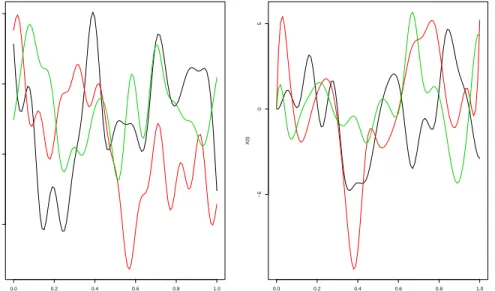
We generated X according to Xi(t) = PKk=1ξikφk(t). In the first simulation setting,K = 22, and the basis functions{10,10t,10 sin(2πit), 10 cos(2πit)} (orthog-onalized by Gram-Schmidt algorithm). The scores ξik are i.i.d N(0, k−1.2). In the second setting, we used the cubic B-Spline basis with 18 knots. Scores were gener-ated from the standard normal distribution, and the resulting functions were scaled by a factor of 4 to produce a similar range of values as the modified Trigonometric basis. Figure 2 displays example X functions from each of the bases.
Our response Y was calculated as Yi = R
Xi(t)β(t)dt +i, i = 1, . . . , n, in the linear settings and Yi = 1001 (R Xi(t)β(t)dt)2 +i in the quadratic settings, where i ∼N(0,0.5) or i ∼ t3/
√
2 in the heavy-tail setting. The function β, as shown in Figure 3, was generated asP4k=1bkφk(t), where φk(t)are the four modified Trigono-metric basis mentioned above, and bk = (−1)bk/2ci−1, k = 1,2,3,4.
We note that when X(t) is generated from the modified Trigonometric basis, the relationship between Y and X is completely determined through the first four functional principal component components of X, and indeed mostly captured by the first two or three components. So this is a low dimensional case for function principal component based nonparametric regression. WhenX(t)are generated from the cubic B-Spline basis, the relationship betweenY and X can not be well captured if we only represent X using the first few functional principal components, and the
nonparametric regression based on FPCA may not work. 0.0 0.2 0.4 0.6 0.8 1.0 −2 0 2 4 t X(t) 0.0 0.2 0.4 0.6 0.8 1.0 −5 0 5 t X(t)
Figure 2: Examples of X(t) functions generated from modified trigonometric basis (left) and B-spline basis (right)
0.0 0.2 0.4 0.6 0.8 1.0 0.0 0.5 1.0 1.5 2.0 2.5 t B(t) Figure 3: β(t)
Bandwidths and number of predictors for the algorithms were chosen via 10-fold cross validation. The one standard error rule was utilized to prevent overfitting, thereby reducing the frequency of the contiguity conditions being violated.
The results of the simulations are displayed in the following tables. Tables 1-4 display the mean coverage of the intervals produced by the specified algorithm in the given setting. Tables 5-8 display the median length of these interval. The naive “oracle” predictions are constructed as follows. In the linear relationship settings, the residuals are derived from the linear FPCA regression model, while in the quadratic relationship settings, they are derived from the local linear FPCA regression model. In the settings with normal error, the critical values are calculated using the residual standard deviation and normal quantile, while the empirical percentiles are used in the t3 error settings. While these oracle intervals have asymptotic coverage at the
95% level, they may tend to undercover in practice. However, they still perform well as a baseline for comparison.
Table 1: Linear Relationship with Modified Trig Basis: we report the mean coverage from 1000 simulations for linear mFPCA conformity score, local linear FPCA conformity score, partial linear signature conformity score, naive “oracle”,
and split sample conformity score.
Error N Lin-FPCA LL-FPCA PL-Sig “Oracle” SS Interval
Normal 200 0.950 0.950 0.951 0.944 0.947
500 0.951 0.950 0.951 0.947 0.949
t3
200 0.950 0.951 0.950 0.952 0.947
500 0.950 0.951 0.951 0.951 0.953
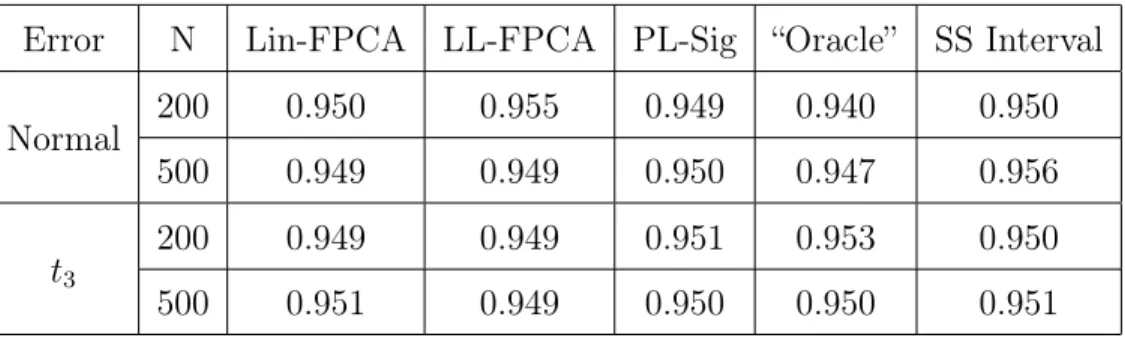
Table 2: Linear Relationship with B-Spline Basis: we report the mean coverage from 1000 simulations for linear mFPCA conformity score, local linear FPCA conformity score, partial linear signature conformity score, naive “oracle”, and split
sample conformity score.
Error N Lin-FPCA LL-FPCA PL-Sig “Oracle” SS Interval Normal 200 0.950 0.955 0.949 0.940 0.950 500 0.949 0.949 0.950 0.947 0.956 t3 200 0.949 0.949 0.951 0.953 0.950 500 0.951 0.949 0.950 0.950 0.951
Table 3: Quadratic Relationship with Modified Trig Basis: we report the mean coverage from 1000 simulations for linear mFPCA conformity score, local linear FPCA conformity score, partial linear signature conformity score, naive “oracle”,
and split sample conformity score.
Error N Lin-FPCA LL-FPCA PL-Sig “Oracle” SS Interval
Normal 200 0.953 0.951 0.954 0.922 0.948
500 0.956 0.950 0.956 0.930 0.944
t3
200 0.947 0.951 0.950 0.937 0.948
500 0.947 0.948 0.949 0.946 0.948
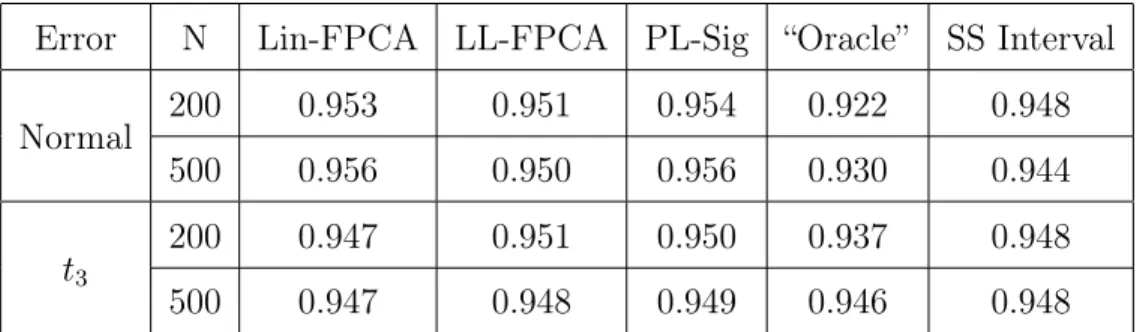
Table 4: Quadratic Relationship with B-Spline Basis: we report the mean coverage from 1000 simulations for linear mFPCA conformity score, local linear FPCA conformity score, partial linear signature conformity score, naive “oracle”, and split
sample conformity score.
Error N Lin-FPCA LL-FPCA PL-Sig “Oracle” SS Interval Normal 200 0.955 0.957 0.952 0.943 0.952 500 0.957 0.947 0.951 0.944 0.951 t3 200 0.951 0.950 0.956 0.958 0.949 500 0.953 0.955 0.950 0.946 0.955
From tables 1-4, we find that the mean coverage of all 3 algorithms is approxi-mately 0.95 in every setting, even when the model on which the algorithm is based
is not correct (such as the linear model in the quadratic relationship). This is one of the main benefits to using a conformal prediction method. The mean coverage of the naive “oracle” interval is a bit worse in smaller sample sizes as they rely on asymptotic properties.
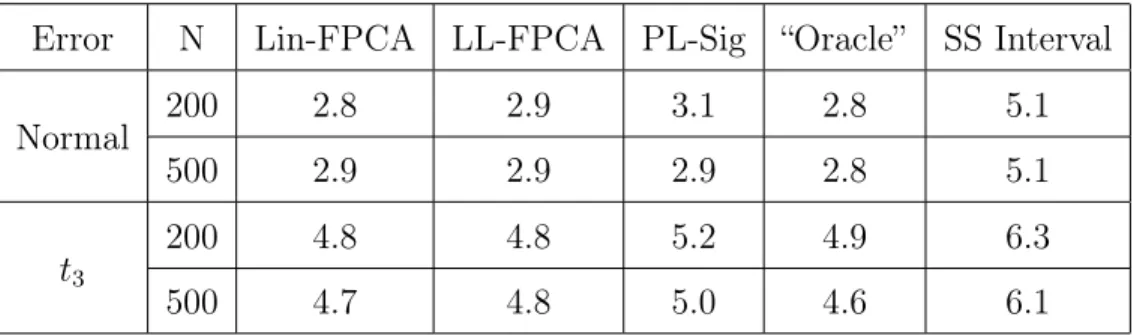
Table 5: Linear Relationship with Modified Trig Basis: we report the median length of the constructed intervals from 1000 simulations for linear mFPCA conformity score, local linear FPCA conformity score, partial linear signature
conformity score, naive “oracle”, and split sample conformity score.
Error N Lin-FPCA LL-FPCA PL-Sig “Oracle” SS Interval Normal 200 2.8 2.9 3.1 2.8 5.1 500 2.9 2.9 2.9 2.8 5.1 t3 200 4.8 4.8 5.2 4.9 6.3 500 4.7 4.8 5.0 4.6 6.1
Table 6: Linear Relationship with B-Spline Basis: we report the median length of the constructed intervals from 1000 simulations for linear mFPCA conformity score, local linear FPCA conformity score, partial linear signature conformity score,
naive “oracle”, and split sample conformity score.
Error N Lin-FPCA LL-FPCA PL-Sig “Oracle” SS Interval
Normal 200 3.6 4.3 3.1 3.3 4.8
500 3.1 3.9 3.0 3.1 4.8
t3
200 5.6 5.3 5.2 5.6 5.9
500 4.8 5.5 4.8 4.7 5.9
Table 7: Quadratic Relationship with Modified Trig Basis: we report the median length of the constructed intervals from 1000 simulations for linear mFPCA conformity score, local linear FPCA conformity score, partial linear signature
conformity score, naive “oracle”, and split sample conformity score.
Error N Lin-FPCA LL-FPCA PL-Sig “Oracle” SS Interval
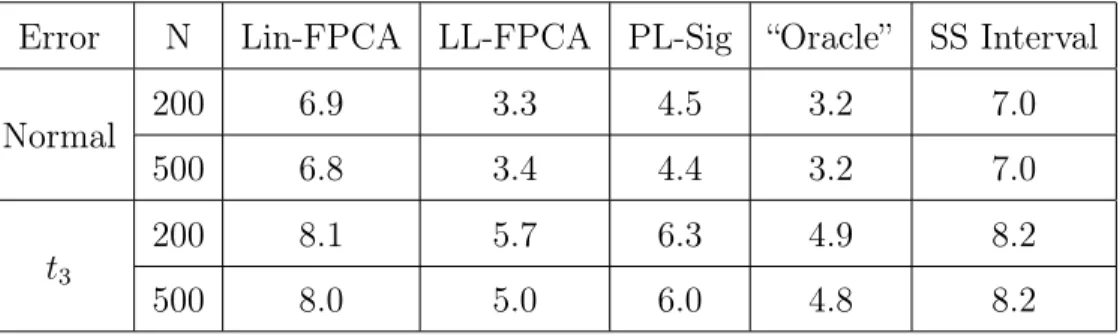
Normal 200 6.9 3.3 4.5 3.2 7.0
500 6.8 3.4 4.4 3.2 7.0
t3
200 8.1 5.7 6.3 4.9 8.2
Table 8: Quadratic Relationship with B-Spline Basis: we report the median length of the constructed intervals from 1000 simulations for linear mFPCA conformity score, local linear FPCA conformity score, partial linear signature conformity score,
naive “oracle”, and split sample conformity score.
Error N Lin-FPCA LL-FPCA PL-Sig “Oracle” SS Interval
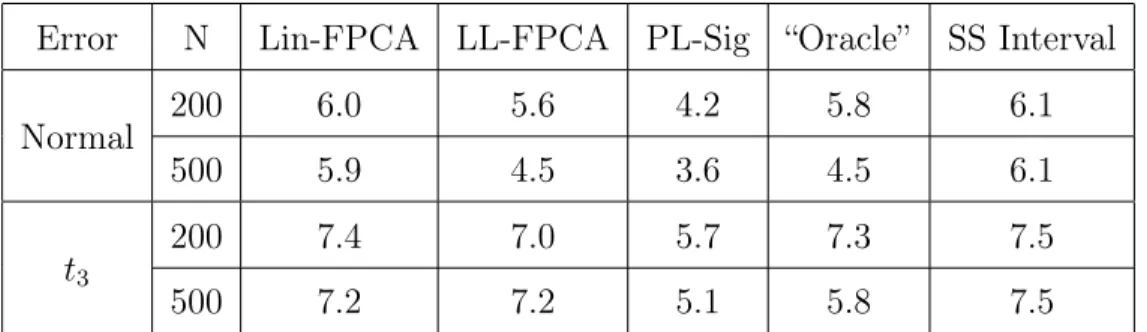
Normal 200 6.0 5.6 4.2 5.8 6.1
500 5.9 4.5 3.6 4.5 6.1
t3
200 7.4 7.0 5.7 7.3 7.5
500 7.2 7.2 5.1 5.8 7.5
From tables 5-8, we find that Algorithm 1, based on a linear conformity score, produces nice results when the true relationship is linear, but is inefficient (larger intervals than other algorithms) in cases the true relationship is non-linear. This result is as expected.
The other two algorithms based on nonparametric functional regressions produce intervals with reasonable length. A closer look reveals that Algorithm 2, based a on local linear FPCA conformity score, performs worse in the cases that the predictor functions X are generated from B-Spline basis, especially in the quadratic case. This is also as expected, since in these cases the regression relationship need to be characterized using a relatively large number of principal components, which leads to unstable fitting in a local linear approach. The naive “oracle” has a similar problem as the fitting of the mean function is based on functional principal components regression. Meanwhile, Algorithm 3, based on a partial linear signature conformity score, produces reasonably good results in all settings. Finally, we see that the
split sample method tends to produce overly-large intervals, regardless of simulation setting. This is likely related to the large variance associated with out-of-sample evaluation.
The basis used to generateX and the type of relationship obviously had a large and varying impact on performance of the three algorithms. The effects of sam-ple size and error distribution were smaller and more consistent. Overall we saw a small reduction in interval size when increasing n, which likely corresponds to more accurately estimating the mean function mˆ(x). Some results for α = 0.1 are in the supplementary chapter, which show no difference in performance based on significance level.
4.2 Multivariate Simulations
To example the performance of the MPL-Sig and LL-mFPCA algorithms in a multivariate predictors setting, we extended the simulation setting from Wong et al. (2019) to a setting with 4 functional predictors. The predictor X consisted of the following four functions:
Xi1 =t+ sin(t) + 20 X k=1 ξikψ (1) k (t), Xi2 =t+ cos(t) + 20 X k=1 ξikψ (2) k (t), Xi3 =−t+ sin(t) + 20 X k=1 ξikψ (3) k (t),