UNESCO – EOLSS
SAMPLE CHAPTERS
INSTITUTIONAL AND INFRASTRUCTURE SYSTEM
DEVELOPMENT INFORMATION AND KNOWLEDGE
M. Ruth
School of Public Affairs, University of Maryland, USA
Keywords: Infrastructure, institution, knowledge system, life support system, health, well-being, stakeholders, modeling, planning, transportation, energy use, environmental quality, climate change, resource use, development, urban systems.
Contents
1. Introduction
2. Roles of Infrastructure and Institutions 2.1 Infrastructure
2.2 Institutions
3. Interrelationships among Institutions, Infrastructure, and Knowledge 3.1 Quantitative Modeling for Decision-making
3.2 Stakeholder Involvement
3.3 Institutions at the Nexus of Stakeholder Involvement and Knowledge Generation 4. Urban Institutions, Infrastructure and Sustainability
4.1 Urban Sustainability
4.2 Urban Transport, Energy Use and Emissions 4.3 Urban Infrastructure and Global Climate Change 5. Conclusions
Glossary Bibliography
Biographical Sketch
Summary
Institutions and infrastructure systems are expressions of the ways by which a socioeconomic system organizes itself and its relations to its environment. As a consequence, changes in institutions and infrastructure affect a society’s ability to achieve socioeconomic and environmental sustainability. This article explores the role that institutions and infrastructure have played in the past, and can play in the future, to foster sustainable development. Special attention is given to methods used for modeling economy-environment interactions and stakeholder involvement in knowledge generation and decision-making, and to issues surrounding urban institutions, urban infrastructure and the sustainability of cities.
1. Introduction
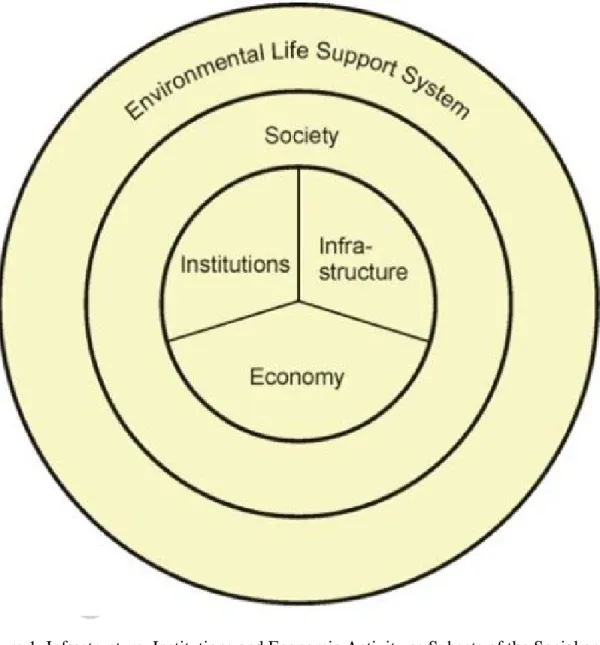
This article identifies interrelationships among institutions, infrastructure and sustainable development. The argument is made that institutions, infrastructure, and economic activity are mutually interdependent components of a society whose activities are embedded within a larger environmental life support system (Figure 1). Changes at one level of system organization can induce a complex set of adjustments throughout
UNESCO – EOLSS
SAMPLE CHAPTERS
the system. For example, the advent of steel-beam construction has made possible the spatial agglomeration of office and residential units, and required building of transport networks, parking garages, sewage systems and other infrastructure to accommodate a high concentration of office workers and households. Being able to improve our knowledge of interrelationships among adjustments in infrastructure systems and the services they provide is vital for the promotion of sustainability of each component and the system as a whole.
Figure 1. Infrastructure, Institutions and Economic Activity as Subsets of the Social and Environmental Life Support Systems.
This article is organized into five Sections. Section 2 reviews the role that infrastructure and institutions have in maintaining a high level and diversity of economic activities, and in coordinating and reconciling economic activities with performance criteria for social and biophysical systems. Section 3 expands the discussion to address interrelationships among institutions, infrastructure and knowledge, and identifies their role in promoting sustainable development. Special attention is given to the role of
UNESCO – EOLSS
SAMPLE CHAPTERS
(quantitative) modeling and stakeholder involvement in charting a course towards sustainability, and to issues that need to be addressed by institutions in order to effectively build on models and stakeholder knowledge to foster sustainable infrastructure development. Since the majority of people around the world live in urban areas, Section 4 concentrates on urban institutions, urban infrastructure and the sustainability of cities.
The article closes in Section 5 with a summary and directions for future research, and with suggestions for policy and planning.
2. Roles of Infrastructure and Institutions 2.1 Infrastructure
Infrastructure systems provide services that maintain and enhance economic activity. Roads, ports and airports offer producers access to resources and markets for their products. People use transport systems to gain access to work and recreation. Communication and information systems, such as telephone lines and data storage devices help exchange and retain information. Water supply, drainage, flood management and wastewater treatment systems provide water to agriculture, industry and residential consumers, protect homes and businesses from flooding, and ensure treatment of effluents to minimize environmental harm and adverse human health effects. Energy systems, such as power plants, and their associated distribution networks, provide energy on which the economy runs. Constructed facilities, such as residential and commercial buildings provide space for families and businesses. In short, all facets of an economy are affected by the availability and reliability of its infrastructure system. And in turn, the extent and reliability of infrastructure systems is closely related to the performance of an economy and its institutions—those institutions that directly regulate maintenance, expansion and use of infrastructure, and those that directly and indirectly place demand on the services provided by infrastructure systems. Infrastructure reduces constraints imposed by the environment on economic activity. For example, transportation and communication networks help reduce the effects of distance on spatial interaction. Drainage and flood management alleviate undesired impacts of water on economic activity, while water supply and wastewater treatment locally increase water availability and quality. Similarly, energy systems help transform fossil fuels, biomass, wind, solar and other energy sources into forms that are more readily useful to human activities. Constructed facilities, such as residential and office buildings, protect those activities from “the elements.” Infrastructure is thus in many ways the conduit through which an economy interacts with its physical and biological environment.
Adequacy and reliability of infrastructure depend on society’s demand for infrastructure services, such as transportation, and environmental impacts on infrastructure systems themselves, such as flooding of streets. In the short-run, the design of infrastructure systems and the extent to which their services are available is typically fixed. To maintain an adequate and reliable supply of infrastructure services therefore requires a minimum redundancy of the system. For example, alternate routes may channel traffic
UNESCO – EOLSS
SAMPLE CHAPTERS
flow around a bottleneck. In the long run, the design and availability of infrastructure systems may change. Those changes are typically driven by one or more of the following:
(a) Past and current inadequacies in supply of infrastructure services: Changes in environmental conditions, the level of economic activity, or the structure of the socioeconomic system may render current infrastructure inadequate and require investments in expansion, upgrade or replacement. For example, increased drought or water logging of soils may require changes in irrigation systems; economic and population growth may require investment in ports and roads; expansion of an economy’s service sector may require extended communication and data storage systems.
(b) Perceived future inadequacies in supply of infrastructure services: Anticipated environmental and economic change may lead to infrastructure investment today to meet future demands. Since the process of infrastructure expansion is itself an economic activity, it is likely to stimulate the very processes that require expansion. Forecasts of higher productivity in a region may be used to justify expansion of regional roadworks. The employment and revenue generated by the construction process, and the location of businesses and households to take advantage of the newly available infrastructure services may lead to growth of the economy and to increased shipment of goods and movement of people. Induced demand has often quickly overwhelmed the infrastructure system that has been newly put in place. Investment in infrastructure can also mean disturbance of local and regional ecosystems and trigger further investment to deal with environmental repercussions. For example, building dikes and levies to reduce flooding often destroys the flood management capabilities of natural ecosystems and requires further investments in drainage and flood control infrastructure.
(c) Changes in technology: The advent of new technologies frequently makes development of new infrastructure systems possible. For example, satellite technology boosted the advent of wireless, long-distance communication. The reverse trend can sometimes also be observed—the process of putting a new infrastructure system in place can trigger development of new technologies and processes. Large-scale public works projects, such as high-speed rail and tunnel systems, are often justified by the technological spin-offs and subsequent economic competitiveness those projects may cause.
Once put in place, infrastructure becomes part of the legacy of a society. The lifetime of transportation, waste management, water supply, flood control and drainage systems is often in the order of decades if not centuries. Not only does infrastructure lay the footprint for future development—if misconceived it can also stymie development. Being able to maximize the positive, long-term contributions of infrastructure to society requires anticipation of future economic and environmental consequences. The following section addresses the roles institutions have in contributing to infrastructure system development, and how changes in infrastructure change the role of institutions in infrastructure and socioeconomic development. The following subsection will then describe how these changes are related to information and knowledge systems.
UNESCO – EOLSS
SAMPLE CHAPTERS
2.2 Institutions
It is the role of institutions, such as government and planning agencies, markets and non-government organizations to anticipate and assess the adequacy of existing infrastructure and the desirability of new infrastructure, to facilitate decision-making, and to oversee implementation, operation, maintenance, and decommissioning of infrastructure systems. Challenges in fulfilling that mission include:
(a) Securing funds: Typically, large-scale infrastructure investments are undertaken by government to provide public goods. Examples include the building of large dams, wastewater collection and treatment systems, ports, and roads. However, investment by private enterprises in infrastructure systems should not be overlooked. Examples range from the establishment by small farms, of terraces on steep slopes to limit soil erosion, to investments in communication and data storage capacity that made possible the explosion in Internet commerce. While public investments are typically funded with long-term bonds or loans and with the goal of providing public goods, private infrastructure investments are usually made with much shorter time periods in mind, and with a heightened attention towards pay-off to the investing party. While some public infrastructure investments stimulate private investment, a risk exists for public investments to compete with or crowd out private initiatives. Increasingly, public-private partnerships are used to leverage access to capital with clear profitability goals in mind, while at the same time, creating synergistic effects among infrastructure investments, regional competitiveness, and larger-scale socioeconomic development. For example, funding for transportation networks or wastewater treatment may come in part from private enterprises which may in return, receive revenues from user fees. Local authorities may help support the development of ecoindustrial parks, so that a range of diverse businesses can locate in close vicinity to each other in order to close material cycles, reduce cost of material inputs and minimize effluents while at the same time offering centralized employment opportunities and improved environmental quality. The reduction in investment risk is spread across different parties, allowing for longer planning horizons than would be typically chosen by private enterprises. However, under either model—purely public, purely private, or public-private partnerships—few if any provisions are typically made to deal with the cost associated with decommissioning infrastructure at the end of its useful lifetime or cost of retrofitting after expiration of bonds or loans used to finance the infrastructure. As a result, the burden to deal with the legacy of obsolete infrastructure is often placed on future generations. Given the right legislative framework, those externalities could be internalized at the point of investment decision-making, for example, by requiring the endowment of a trust to deal with the legacy of obsolete infrastructure, by establishing a refund system into which payments are made to cover cost of retrofits and decommissioning, and from which payments are dispersed to the original investors to the extent that costs are lower than their payments into the refund system, or by requiring insurance to cover future cost.
(b) Guaranteeing equitable access to infrastructure systems and services: Criteria for equality and fairness must include the needs of current businesses and households at different locations in the economic landscape. While their needs for infrastructure services will influence the choice of location and type of infrastructure systems, the
UNESCO – EOLSS
SAMPLE CHAPTERS
reverse holds as well—once put in place, infrastructure will affect economic performance of businesses and income of households, and their need for infrastructure services. As a consequence, equality and fairness in space is closely related to equality and fairness through time and across different parts of the socioeconomic system (small and large producers, households from different income groups etc.). These interrelationships are particularly pronounced in the development of urban, relative to rural infrastructure. With rates of urbanization increasing across the globe, the danger exists to concentrate infrastructure development in urban areas at the expense of their surroundings. For example, enlarged transportation networks require dealing with drainage of water from impervious surfaces, handling construction waste and managing a larger volume of traffic. The presence or enlargement of one type of infrastructure system begets investments in another. Increased economic activity in cities and suburbs promotes attraction of urban areas to companies and consumers alike. Several consequences may be felt. Enlarging the urban-rural divide, with growing income differentials, may reduce the sustainability of rural life—its cultural and socioeconomic integrity. Conversely, high concentrations of people and economic activities may result in diseconomies of agglomeration, such as congestion, social friction, and consequently unsustainability of the urban system itself. The rate of change in urban densities themselves can make it virtually impossible for planners and investors to take a long view on infrastructure development—current efforts to provide infrastructure may be too low to keep up with current growth in population and economic activity, let alone be able to adequately address future needs or long-term environmental concerns. Those problems are exacerbated by the fact that the very activity of constructing new infrastructure disrupts the performance of already existing systems. Expanding or building a new transportation route will almost certainly affect accessibility and operation of existing routes.
(c) Dealing with indivisibilities, complementarities and irreversibilities in investment: Infrastructure systems, such as water supply, flood control and transportation networks are typically large and often either function as a whole or not at all. A break in a water main, dike or bridge can render the respective system incapable of providing a service. Investment in redundancy is key to being prepared for disruptions. For example, having well-developed private transportation, bus and rail systems in place can help cut down on traffic jams in case one of the three is disrupted. Investing in redundancies, however, is costly. Similarly, ensuring adequate and reliable performance of one kind of infrastructure system often requires coordination with other infrastructure systems. Smooth operation of highways, for example, may require development of drainage and flood management systems. Not only are there opportunity costs of sinking large investments in complementary infrastructure systems, but such investments can cause irreversible environmental degradation—in addition to degradation caused by putting the primary system in place. Developing complementary infrastructure systems can also lead to technology lock-in. With few exceptions, urban transport systems around the world are directly or indirectly fossil-fuel based. The ease and reliability of movement that they guarantee have spawned suburbanization in much of the Western hemisphere, and have led to an increase in private car ownership, use of buses and rail. With the enlarged role of these systems in modern day-to-day life, institutions have developed to manage these systems and to meet the needs of their
UNESCO – EOLSS
SAMPLE CHAPTERS
constituents, and as a result have furthered the lock-in of existing infrastructure. As a consequence, institutional development adds to the inertia that makes “adaptive management” of infrastructure systems difficult, in the light of changing environmental conditions or technologies.
(d) Properly incorporating risk, uncertainty, and surprise in the planning and management of infrastructure systems: Since infrastructure systems typically have a long life-time their presence reflects the knowledge and perceptions that decision-makers have about the physical, biological and economic environment and their expectations for the future. Capacity and design criteria for infrastructure systems are typically based on historic observations and extrapolations into the future. Planners ask themselves: What will be the size and income of the population over the next 20 years? What will be the rate of car ownership and travel demand? What are likely changes in land use, industrial and residential location? How rapidly will the relative employment and output shift among sectors of the economy? Answers to such questions are typically found on the basis of economic and planning models, most of which base their projections on an analysis of historic data. Safety margins are introduced into the projections to deal with risk and uncertainty. Yet, since planners and decision-makers deal with socioeconomic systems that coevolve in close relationship to other socioeconomic systems and their environment, there is ample room for surprises to occur and projections to fail. Few investments in sea and airports, tunnels, and roadways reflect the impacts that climate change may have for sea level rise or increased adverse weather conditions, and therefore a need for better drainage and flood management. Current investments in transport infrastructure may also be misplaced if telecommuting and Internet commerce gain in economic importance—those investments are too high if the advent of new communication technology leads to a reduction in transport demand, or too low or geographically misplaced, if new communication technology boosts economic activity and requires increased (long-distance) transport of goods, services and people.
The size of capital requirements, long lifetime, pivotal role in socioeconomic development, and environmental impacts of infrastructure require institutions to take the long view.
At times of rapid change in population size, economic activity or technology, traditional methods of forecasting future demands for infrastructure systems and services on the basis of past trends is likely to be inadequate.
By the same token, climate change at global and local scales requires that current design criteria are revisited, and that existing and new infrastructures are (re-)built to withstand, for example, higher wind, snow and ice loads, higher surface temperatures, increased drought and precipitation, or elevated sea levels.
Interrelationships among institutional, infrastructure and knowledge systems development which are necessary for the sustainability of the combined social and environmental life support system are discussed in more detail in the following section.
UNESCO – EOLSS
SAMPLE CHAPTERS
-- -
TO ACCESS ALL THE
21 PAGES
OF THIS CHAPTER,
Visit: http://www.eolss.net/Eolss-sampleAllChapter.aspx
Bibliography
Capello R. Nijkamp P. and Pepping G. (1999). Sustainable Cities and Energy Policies, 282 pp. Heidelberg, Germany: Springer-Verlag. [This book addresses the constraints on, and conditions for an expansion of more sustainable energy use in the urban context. An in-depth look at the political and legal settings that promote or impede adoption of sustainable energy systems in The Netherlands, Italy and Greece helps substantiate the discussion, and a comparison of energy supply systems across 12 cities further illustrates the key issues surrounding sustainable urban energy policies.]
Hannon B. and Ruth M. (2000). Dynamic Modeling, Second Edition, 409 pp. New York: Springer-Verlag. [This book provides an introduction to state-of-the-art modeling of social and environmental systems. The methods developed in this book are highly versatile and can be applied to engage and empower stakeholders to effectively share knowledge and assess implications of alternative management measures for a system’s sustainability.]
Jenks M. Burton E. and Williams K. (eds.) (1996). The Compact City: A Sustainable Urban Form? 350 pp. London, UK: E&FN Spon. [This book provides a comprehensive overview over the main arguments in the recent debate about sustainable urban systems, with several chapters concentrating on institutional and infrastructure systems, the roles of modeling, measurement and monitoring in urban planning and decision-making, and implementation of sustainable urban policies.]
Kibert C. J. (ed.) (1999). Reshaping the Built Environment: Ecology, Ethics and Economics, 362 pp. Washington, DC: Island Press. [The chapters of this book address sustainability criteria for the planning, design, management, use and decommissioning of infrastructure.]
Lemons J. and Brown D. A. (eds.) (1995). Sustainable Development: Science, Ethics, and Public Policy, 281 pp. Dordrecht, The Netherlands: Kluwer Academic Publishers. [The book’s organizing theme is Agenda 21 of the United Nations Conference on Environment and Development, held in Rio de Janeiro in June of 1992. Each of the chapters can be read as a stand-alone piece, yet is woven into a well thought-through text that covers a diversity of topics surrounding the issue of sustainability—ranging from ethics to law and economics, from biodiversity conservation to climate change and international policy.]
Biographical Sketch
Dr. Matthias Ruth is the Director of the Environmental Policy Program at the School of Public Affairs, University of Maryland and Professor of Environmental Economics and Policy. His research focuses on dynamic modeling of non-renewable and renewable resource use, industrial and infrastructure systems analysis, and environmental economics and policy. Over the last decade, Professor Ruth has published five books and approximately 50 papers and book chapters in the scientific literature. He collaborates extensively with scientists and policy makers in the US, Canada, Europe, Asia and Africa.
Professor Ruth’s most recent interdisciplinary research projects include an assessment of impacts of climate change policies on selected industries, their technology choice, resource use and emissions, and an integrated assessment of climate change impacts on infrastructure systems and services with specific focus on the Boston Metropolitan Area. The former project is targeted towards an identification of “smart” industrial, energy and climate change policies—policies that promote significant efficiency improvements in industry without jeopardizing economic performance. The latter project involves collaboration with more than 20 researchers from the social and engineering sciences, planners, policy