Web Based e-Commerce Shopping System
Problem Statement
DesignFest
OOPSLA 2002
Yun Feng
Kurt Weiss
Mohamed Fayad, PhD
Abstract
Doe’s Electronics was founded in the rural town of Burwell, NE and currently serves the electronics needs of the local community, ranchers and farmers. Customers have been known to travel up to 100 miles to shop at the store. The store has very few employees and handles all operations in house. Computer information systems are currently being used for bookkeeping and inventory.
To eliminate the disadvantages (far away store, very few employees to handle all operations) and increase its business, Doe’s Electronics decides to build an e-Commerce shopping system.
Domain
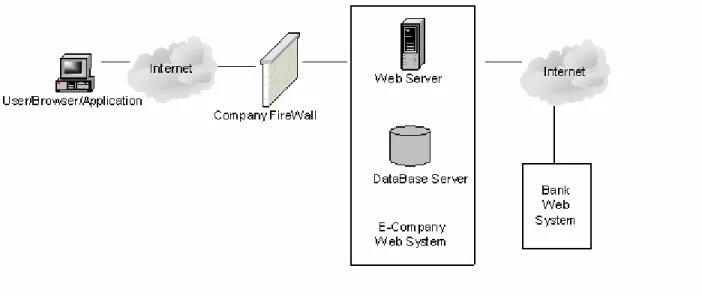
Figure 1. e-Commerce System on Internet.
There are four actors for the proposed system: customer, sales person, shipping clerk, and Credit Verification Company. Figure 1 shows the relationships among the customer (user/Browser/Application), E-company system and Bank. The Customer interacts directly to the system via the Doe’s Electronics website when connecting to the Internet. The internal part of the e-Commerce system has two roles, the sales person and the shipping clerk. The Sales Person is in charge of updating the product information while the shipping clerk is in charge of product shipments. The Credit Verification Company’s responsibility is to ensure that credit cards used in purchase are valid.
Description of the desired program
The e-Commerce shopping system that is desired by Doe’s Electronic should meet the following System and information Requirements:
System Requirements
• Allow customers to view products from their home
• Allow customers to make purchases and receive products from their home
• Customers are able to make payments from credit card
• Product descriptions must be easily maintained and updated by store employees
• Fast distribution of product descriptions so that customers have accurate portrayal of what Doe’s Electronics has to offer
• Inexpensive distribution of product descriptions
• Fast customer ordering system that is as simple as possible Information Requirements
• Information needed to created order form
• Product selections
• Customer information
• Billing information (credit card)
• Shipping information (if different from customer)
Interfaces
Customer accesses the e-Commerce shopping system via Internet. So the Website of Doe’s Electronics, which hosts the e-Commerce shopping system, must be able to be accessed via Internet. The e-Commerce shopping system needs an interface to the Credit Verification Company’s system. If Doe’s Electronics Company uses extra systems to manage its finance or accounting, the e-Commerce shopping system may need interfaces to these systems too.
Use Cases and User Context
User ContextUsers are in an agricultural area, farmers, ranchers, and those who support farm and ranch businesses. Burwell is also a hunting and fishing destination. The users are in remote locations, sometimes many (as in 50 or more) rural miles (dirt roads) from any population center. A
population center in rural Nebraska may be as few as 100 people, with a gas station, a bar, and if lucky a grocery store.
Do not make the mistake of thinking these people are backward. All of them keep up on current world events, and can articulately discuss international issues. Some of these farmers and
ranchers use the very latest technology in running their businesses. They use computer controlled machinery on a daily basis. Some equipment requires wireless (radio or satellite)
communication, and many of them can fix the equipment themselves. They are, by necessity, an independent and self reliant bunch.
They regularly use sophisticated futures markets to lock it profits. These guys sell hog belly futures when they have the hogs, and intend to deliver the bellies. The users will obviously have internet access. That access may be quite slow and unreliable if via phone lines, or quite fast and reliable if via satellite.
It is a diverse group not easily generalized. Shipping Clerk
The shipping clerk receives the order form after a purchase has taken place. The shipping must be able to update the inventory to reflect the shipment of products. The shipping clerk is also responsible of shipping the ordered products to the customer.
Sales Person
When a purchase is finished, the sales person needs to process the order form to shipping Clerk.
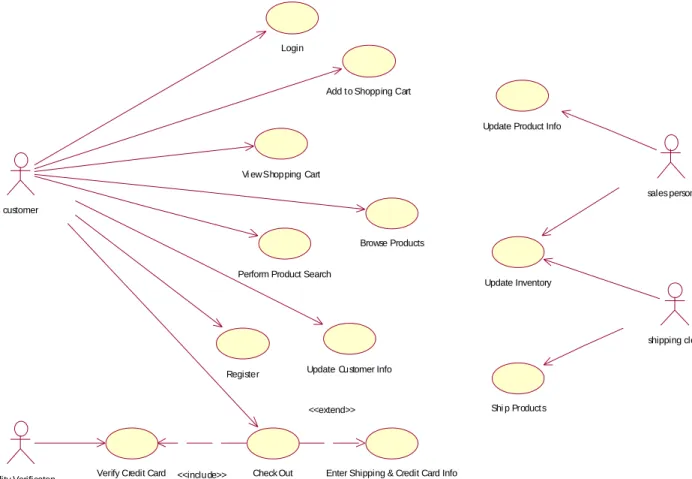
Use cases diagram
Update Product Info
sales person
Update Inventory
Shi p Products
shipping clerk Update Customer Info
Login
Add to Shopping Cart
Register
Check Out Perform Product Search
Browse Products Vi ew Shopping Cart
customer
Verify Credit Card Credity Verificaton
Company
<<include>> Enter Shipping & Credit Card Info <<extend>>
Use Cases Description Login
The customer can login to the e-Commerce shopping system by enter his user name and
password. The system will verify that the login name matches the login password. If they do not match, error message will be indicated to the customer.
Add to Shopping Cart
When the customer finds the products he wants, he adds them to the shopping carts. The system will store and keep track the information of the products that have been added into shopping cart. View Shopping Cart
The customer can request to view the contents of the shopping cart. The system will return the contents of the shopping cart to the customer; the unit price and total price will be shown as well. Update Customer Info
The customer can request to update their customer info. Customer information includes the relative information of customer such as username, password, address, etc. The system will display the current customer info to the customer. The customer updates the customer
information and the system will store the updated customer info in the system database. After one successful purchase, the payment information is also stored in customer information. Register
If the customer is a new user, he can request to register with the system. The system displays a registration page and asks the customer to choose a login name (email address of the customer) and password. The customer is also required to enter their name and address. Shipping
information and credit card information are optional entries at this point. Enter Shipping & Credit Card Info
When the customer requests to checkout and he does not have credit card information stored at this point (system can not find his payment information), the system will prompt credit card information page. The customer will be given a choice on whether he wants the item shipped to his stored address or to an alternative address. The input payment information will be save into the order form.
Verify Credit Card
When the customer checks out, the credit verification company validates the customer’s credit card when given the customers name, credit card number, and expiration date, and then returns the validation result to checkout department (sales person). If the response shows that the credit card is invalid, the customer will be asked to re-input his payment information.
Update Product Info
The sales clerk requests to update products information. This includes the products price,
description, brand, title, or number. The system will save the updated product information in the database.
Update Inventory
The sales clerk or shipping clerk requests to update inventory. The system will update the product information in the database.
Ship Products
After getting the order request, the sales clerk ships the order products to the customer within three to five business days.
Checkout
When the customer finishes shopping, he requests to checkout. If the payment information of this customer already exists, the system prompts the customer to review or input a new one. The system then forwards the credit card information to credit Verification Company. If the credit card is invalid, the customer is given the option to use another credit card or just cancel the order. If the credit card is valid, the order form will be processed by the system and checkout is
complete.
Browse Products
The customer requests to view the products in a product category. The system will display the product information of the selected category.
Perform Products Search
The customer enters product search parameters and requests a product search. The system will search through the products category in its database and return the matches to the customer. If there are no matches, the system will display a fail message.
References for further study
Riel, Arthur J., Object-Oriented Design Heuristics, Addison Wesley Longman, Inc. 1996. Oestereich, Bernd, Developing Software with UML, Addison Wesley Longman Ltd, 2001. Mohamed E. Fayad, Douglas C. Schmidt, Ralph E. Johnson, Building Application Frameworks: Object-Oriented Foundations of Framework Design, New York: John Wiley & Sons, September 1999
Mohamed E. Fayad, Douglas C. Schmidt, Ralph E. Johnson, Implementing Application
Frameworks: Object-Oriented Frameworks at Work, New York: John Wiley & Sons, September 1999
Mohamed E. Fayad, Ralph E. Johnson. Domain-Specific Application Frameworks: Experience by Industry, New York: John Wiley & Sons, October 1999
Mohamed E. Fayad, L. Hawn, M. Roberts, and J. Klatt. "Using The Shlaer-Mellor Object-Oriented Analysis Method," IEEE Software, March 1993, pp. 43-52
Mohamed E. Fayad and Marshall Cline. "Managing Object-Oriented Software Developments,"
IEEE Computer, September 1996, pp. 26-31.
Jacobson, Ivar, Magnus Christerson, Patrik Jonsson, Gunnar Overgaard. Object Oriented Software Engineering: A Use Case Driven Approach, Addison-Wesley, 1995.
Jacobson, Ivar, Maria Ericsson, Agneta Jacobson. The Object Advantage: Business Process Re-Engineering with Object Technology, Addison-Wesley, 1995.
Jacobson, Ivar. “The Confused World of OOA & OOD,” J. Object-Oriented Programming, Sigs Publications, September 1995.