© 2010 World Scientific Publishing Company
Institute for Advanced Research in Asian Science and Medicine
Effect of Acupressure and Trigger
Points in Treating Headache: A
Randomized Controlled Trial
Lisa Li-Chen Hsieh,∗,§Horng-Huei Liou,‡,∗∗Liang-Huei Lee,†
Tony Hsiu-Hsi Chen¶,//and Amy Ming-Fang Yen¶,//
∗Department of Rehabilitation,College of Health Science Kaohsiung Medical University, Kaohsiung, Taiwan
†Kaohsiung Chang Gang Memorial Hospital Kaohsiung,Taiwan
‡Department of Neurology,National Taiwan University Hospital Taipei, Taiwan
§Institute of Prevention Medicine
¶Division of Biostatistics, Graduate Institute of Preventive Medicine
//Centre of Biostatistics Consultation,College of Public Health
∗∗Department of Pharmacology,College of Medicine National Taiwan University, Taipei, Taiwan
Abstract: The efficacy of acupressure in relieving pain has been documented; however, its effectiveness for chronic headache compared to the muscle relaxant medication has not yet been elucidated. To address this, a randomized, controlled clinical trial was conducted in a medical center in Southern Taiwan in 2003. Twenty-eight patients suffering chronic headache were randomly assigned to the acupressure group (n=14) or the muscle relaxant medication group (n = 14). Outcome measures regarding self-appraised pain scores (measured on a visual analogue scale; VAS) and ratings of how headaches affected life quality were recorded at baseline, 1 month after treatment, and at a 6-month follow-up. Pain areas were recorded in order to establish trigger points. Results showed that mean scores on the VAS at post-treatment assessment were significantly lower in the acupressure group (32.9±26.0) than in the muscle relaxant medication group (55.7±28.7) (p= 0.047). The superiority of acupressure over muscle relaxant medication remained at 6-month follow-up assessments (p= 0.002). The quality of life ratings related to headache showed similar differences between the two groups in the post treatment and at six-month assessments. Trigger points BL2, GV20, GB20, TH21, and GB5 were used most commonly for etiological assessment. In conclusion, our study
Correspondence to: Dr. Tony Hsiu-Hsi Chen, Division of Biostatistics, Graduate Institute of Epidemiology/Centre of Biostatistics Consultation, College of Public Health, National Taiwan University, Room 533, No. 17, Hsuchow
Road, Taipei, Taiwan. Tel: (+886) 2-3366-8033, Fax: (+886) 2-3366-8042, E-mail: [email protected]
suggests that 1 month of acupressure treatment is more effective in reducing chronic headache than 1 month of muscle relaxant treatment, and that the effect remains 6 months after treatment. Trigger points help demonstrate the treatment technique recommended if a larger-scale study is conducted in the future.
Keywords: Acupressure; Alternative Medicine; Headache; Pain; Randomized Controlled Trial;
Trigger Point.
Introduction
Headache disorders are remarkably common. A headache is a symptom with a broad range of possible causes. The diagnosis of primary headache disorders depends on systematic exclusion of secondary disorders and systematic identification of the specific features of the primary disorders (Albert Einstein College of Medicine, 1999). About 40% of people in the population experience a severe headache annually (Rowland, 1995). Chronic headache is one of the predominant complaints presented in primary care clinics. Of these, 95.5% are tension-type headaches, and 4.5% are common migraine headaches (Sebit, 1996). The 1-year prevalence rate for chronic headache is about 3% in women and 1.5% in men (Rasmussen and Olesen, 1994; Schwartz et al., 1998). In Taiwan, the lifetime prevalence of stress-related headaches among university students is about 4.5% (6.5% in females and 3.5% in males; Liaw, 1997). Tension headaches often occur every day or nearly every day in individuals who seek treatment (Holroyd et al., 2000; Jensen and Sandrini, 2000; Schoenen and Wang, 1997). Tension headaches can be classified as episodic or chronic. The International Headache Society’s diagnostic criteria for a chronic (rather than an episodic) tension headache are that the headache occurs on 15 or more days per month for at least 6 months (Olesen, 1998).
A meta-analysis reviewing 78 articles with 175 treated and non-treated conditions revealed that the outcomes for headaches treated with cognitive therapy, relaxation, or elec-tromyelographic biofeedback alone or in combination with relaxation were superior to no treatment and/or to pseudo/placebo therapy. Pharmacological and other therapies were more effective than no treatment (Bogaards and ter Kuile, 1994). Various studies reported that mus-cle relaxants were effective in reducing headaches (Friedel and Fitton, 1993; Saper et al., 2001; Spira and Beran, 2003). Alternative medicine, relaxation techniques, and cognitive training have also been shown to be helpful (Ludin, 1997). One study showed that adding a muscle relaxant to a compound analgesic achieved satisfactory pain relief (Atkinson, 1979).
Extensive studies have investigated the use of acupuncture and related techniques that involve the stimulation of anatomical locations on the skin for treating chronic pain of the head, neck, and face. Acupuncture has performed favorably in comparison trials to the stan-dard therapy, sham acupuncture, or mock transcutaneous electrical nerve stimulation for the treatment of tension headaches, migraine, and headaches arising from various other causes, (Ahonen, 1983; Chen, 1997; Dowson et al., 1985l; Kubiena, 1992; Liu, 1997; Loh et al., 1984; Tavola et al., 1992; Vincent, 1989; Weinschutz, 1994; Xu, 1993). A randomized,
placebo-controlled study showed that needle acupuncture was an effective treatment but only provided a weak improvement in quality of life (Karst et al., 2001). Acupressure, a technique derived from acupuncture, is another treatment modality of traditional Chinese medicine and has been used for centuries in Asian areas including China, Japan, and Korea and other countries for relieving pain, illness, and injury (Mills, 2001). Acupressure, which uses fingers instead of needles at the acupoints, is an effective, non-invasive, supportive treatment for multiple clinical complaints, and has limited side effects. Its effectiveness in reducing lower back pain has been documented (Hsieh et al., 2004). However, the efficacy of acupressure in reducing headache has never been demonstrated by a randomized con-trolled clinical trial. Therefore, the aim of this study was to compare the efficacy of acupres-sure with that of a muscle relaxant together with analgesic medication in reducing chronic headache.
Materials and Methods Participants
The study was conducted from 12 March 2003 to 10 May 2003 at Kaoshiung Chang Gung Memorial Hospital, a medical center in Southern Taiwan. Participants were recruited from outpatients seeking clinical management of chronic headache, as diagnosed by a senior neurological specialist. Eligibility criteria for participants in this study were as follows: (1) patients were aged 18 years or older; (2) patients had experienced chronic headache for over 6 months, with an episode frequency of more than 4 a month; (3) the chronic headache was not caused by systematic or organic disease; (4) the headache was not caused by cancer or psychiatric diseases; (5) female participants were not pregnant; (6) patients were not experiencing acute severe headache that required immediate treatment; (7) patients had no contraindications to acupressure; and (8) patients were not allergic to the muscle relaxant. We screened 79 patients and found 28 subjects, aged between 24 and 83 years, who met our eligibility requirements and agreed to give informed consent and follow the treatment protocol. This number was determined to be sufficient in light of the sample size described below.
Randomization
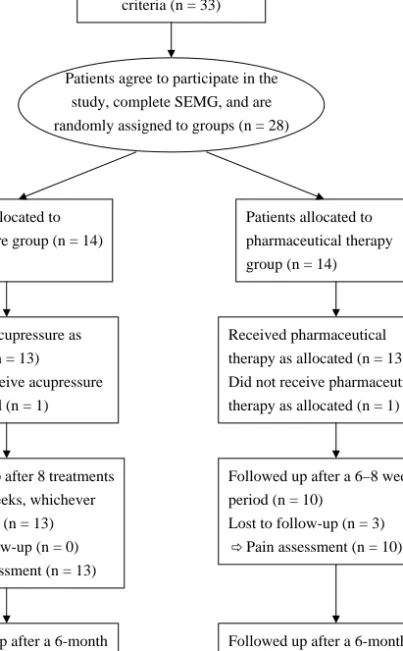
Upon recruitment, an independent research assistant used a pre-determined random table to assign 14 participants to the acupressure group and the other 14 to the muscle relaxant med-ication group. The diagram in Fig. 1 illustrates the randomization and follow-up procedure. In the acupressure group, 13 patients received acupressure as allocated, but one refused the traditional treatment. Similarly, in the muscle relaxant group, 13 patients received pharma-ceutical therapy as allocated, but one refused the medication. At the end of the treatment and at the six-month follow-up assessment, all 13 patients in the acupressure group and 10 of 13 patients in the muscle relaxant group were still available for the outcome measurement part of the study.
Patients screened (n = 79)
Patients met the eligible criteria (n = 33)
Patients agree to participate in the study, complete SEMG, and are randomly assigned to groups (n = 28)
Patients allocated to acupressure group (n = 14) Patients allocated to pharmaceutical therapy group (n = 14) Received acupressure as allocated (n = 13) Did not receive acupressure as allocated (n = 1)
Received pharmaceutical therapy as allocated (n = 13) Did not receive pharmaceutical therapy as allocated (n = 1)
Followed up after 8 treatments or in 6–8 weeks, whichever came earlier (n = 13) Lost to follow-up (n = 0)
Pain assessment (n = 13)
Followed up after a 6–8 week period (n = 10)
Lost to follow-up (n = 3) Pain assessment (n = 10)
Followed up after a 6-month period (n = 13)
Pain assessment (n = 13)
Followed up after a 6-month period (n = 10)
Pain assessment (n = 10)
Figure 1. Flow diagram of randomized, controlled clinical trial on chronic headache.
Sample Size Determination
To determine the appropriate sample size for this study, we searched the relevant literature to estimate the pretreatment means and standard deviations of pain scores assessed by visual analogue scale (VAS) (D’Andrea et al., 1995; Franke et al., 2000; Irnich et al., 2002). In order to detect the difference between two means of 4.50 and 2.04 with a common standard
deviation (2.48) by means of an independent t-test, fourteen participants were required in each arm to achieve 80% statistical power, given type I error of 5%.
Interventions
The duration of each intervention was set at 1 month. During this period, participants in the muscle relaxant medication group received Dorsiflex (Mephenoxalone, a muscle relaxant) plus analgesics if needed, at the discretion of the senior neurologist, for 1 month. Participants in the acupressure group received eight sessions of acupressure treatment plus vitamin B complex as a placebo medication in place of muscle relaxant for 1 month. The dose of B2 (riboflavin) in the B complex vitamin was 15 mg/day. Patients were requested to maintain good medication compliance. The neurologist was responsible for administering the trial and managing complaints from patients. The intervention was further arranged as follows. In phase 1, after randomization, participants in the acupressure group received six 10-min treatments, spread across 4 weeks and performed by the same senior acupressure therapist in order to render uniform technique and to ensure consistent experience for all patients. The muscle relaxant medication group was prescribed a single type and standard dose of Dorsiflex for 2–4 weeks. In phase 2, after the first two weeks, patients in either group who experienced no pain relief received the other treatment for another two weeks, with a 3 day break between the two forms of treatments (3 days reflects the half life of the Dorsiflex; the effect of the acupressure normally lasts for less than two days); the others remained in their original groups until they were satisfied that they required no more treatment.
Blinding to Pre-Treatment Score
In order to reduce the Hawthorne effect (whereby knowledge of pain scores prior to inter-vention might influence the degree of effort made by the therapist), the neurologist and acupressure therapist were blind to pre-treatment assessment results, but were required to write down the dates of medication or treatment given to each participant. Patients were requested to assess their post-treatment pain and rate the impact their headache had on their life quality without reference to their pre-treatment assessment results. They did this after a 1-month period in the muscle relaxant medication group or upon completion of six treatment sessions or a 1-month period, whichever came sooner, in the acupressure group. Patients who were unable to come to the hospital for post-treatment assessment were followed up by tele-phone. The research assistant who conducted the post treatment and the 6-month follow-up interviews was also blind to pre-treatment assessment results and was instructed beforehand not to ask the participants for details about the intervention they had received.
Outcomes Measures
Participants were asked to provide baseline information and to complete the ‘headache qual-ity of life’ questionnaire when they enrolled in the study. Baseline information included date of birth, gender, marital status, level of education, occupation, income, and VAS pain
score. They were also asked about the nature of their headache experience; these related to sleep quality, neck pain, and eye pain. The ‘headache quality of life’ questionnaire, com-monly used in the center for evaluating the effectiveness of pharmaceutical interventions, was used to rate the impact of patients’ headaches on their life quality both before and after treatment. The ‘headache quality of life’ questionnaire consists of 14 items. Each item is rated on a 6-point scale from ‘not a problem’ to ‘a continuous problem.’ Items cover family and social activities, daily life activities, workdays and working, assistance from oth-ers, and psychophysical experiences. Fresh copies of the questionnaire were used for the pre and post-treatment assessments and the 6-month follow-up, and only participants’ names and reference numbers were carried over to each new form to avoid revealing the pre-treatment pain assessment scores on later assessments.
Statistical Analysis
Analysis of data followed the intention-to-treat principle. The Wilcoxon rank sum test was used to compare continuous variables between the two groups, and Fisher’s exact test was used to compare categorical variables. To assess the efficacy of the two treatments, two sets of questions were used to examine differences in VAS pain score, headache related symptoms, and ratings on the ‘headache quality of life’ questionnaire. The first set of ques-tions was used to compare outcomes between the two groups at the end of treatment and at 6-month follow-up. The second was used to assess the change in these outcomes from the baseline after treatment and at the 6-month follow-up between the two groups. All statistical analyses were performed with standard statistical software, SAS for Windows version 9.
Results
Table 1 shows the baseline characteristics of the participants in the two groups. No signifi-cant differences were observed between the two groups with respect to any of the baseline variables.
A comparison between the two groups post-treatment and the 6-month follow-up assess-ment in terms of VAS pain score is shown in Table 2. The mean VAS pain score at 1 month after treatment was significantly lower in the acupressure group (32.9) than in the muscle relaxant group (55.7) (p = 0.047). The mean change of score from the baseline was also statistically remarkable in the acupressure group (−31.1) compared to the mus-cle relaxant group (−8.1) (p = 0.033). The acupressure group also showed substantial improvements from baseline in two headache related symptoms, namely sleeping distur-bance (p=0.045) and neck pain (p<0.001), however no significant reduction in the eye pain (p=0.088). The improvement in eye pain was of borderline significance (p<0.001). At the 6-month follow-up assessments, the mean value of VAS scores in the acupressure group was still significantly lower than that in the muscle relaxant medication group (11.5 vs. 57.5, p=0.002). A similar trend was found for the mean change of score from the baseline (p=0.007).
Table 1. Baseline Comparison between Muscle Relaxant Group and Acupressure Group Variable Muscle Relaxant nnn===141414 Acupressure nnn===141414 p-Value∗
Age 0.627 Range y/o 27–83 24–64 Mean (SD) y/o 48.5 (16.4) 44.1 (12.6) Sex 0.440 Male 4 7 Female 10 7 Marriage 0.724 Single 2 3 Married 11 9 Divorced 1 2 Education 1.000 College 10 10 High school 4 4 Occupation 0.385 Labor 2 5 Non-Labor 12 9 Income 0.596 High Income 11 13 Low Income 3 1 Sleeping Quality 0.695 Well 8 10 Poor 6 4
Neck Pain Involved 0.326
No 1 4
Yes 13 10
Eye Pain Involved 1.000
No 7 8
Yes 7 6
VAS Pain Score (0–100) 0.963
Range 10–100 3–100
Mean (SD) 63.8 (29.2) 64.1 (27.1)
∗Wilcoxon rank-sum test was applied to the comparison of continuous variables between the
two groups, and Fisher’s exact test to categorical variables.
Table 3 shows the differences between the two groups in ratings on 14 items from the ‘headache quality of life’ questionnaire. At baseline, no significant difference was observed between the two groups in terms of the impact of headaches on their quality of life. In the post- treatment assessment, responses to six of the fourteen items, mainly relating to work and activities, had improved more in the acupressure group than in the muscle relaxant group. At the 6-month follow-up assessments, all 14 items showed more improvement in the acupressure group than in the muscle relaxant group.
When comparing changes from the baseline, subjects in the acupressure group showed a significant improvement in post-treatment in items related to daily and social activities (Table 4). For some items, the changes from the baseline became insignificant by the time of the 6-month follow-up.
Table 2. Comparison of Post-Treatment and 6-Month Follow-Up Assessments between Muscle Relaxant Group and the Acupressure Group
VAS Pain Scale (0-100) Muscle Relaxant Acupressure p-Value∗
Post-Treatment Assessments n=14 n=14
Total VAS Pain Score 0.047
Range 10–100 4–85
Mean (SD) 55.7 (28.7) 32.9 (26.0)
Change in VAS Pain Score 0.033
Range –64–0 –84–12
Mean (SD) −8.1(17.7) −31.1(29.7)
Sleeping Quality 0.045
Well 7 12
Poor 7 2
Neck Pain Involved <0.001
No 1 11
Yes 13 3
Eye Pain Involved 0.088
No 8 12
Yes 6 2
Six-Month Follow-Up Assessments n=10 n=13
Total VAS Pain Score 0.002
Range 0–90 0–60
Mean (SD) 57.5 (31.7) 11.5 (17.6)
Change in VAS Pain Score 0.007
Range –70–30 –100–2
Mean (SD) −11.5(28.9) −53.6(31.5)
∗By Wilcoxon two-sample test.
Table 5 compares pain areas, trigger points used, and etiological causes by acupres-sure in each patient. Among the etiological causes, there were three cases resulting from trauma, three from temporal-mandibular joint disorder, and one from both. In these seven cases, patients reported a history of previous injury. Etiological causes for another four cases resulted from prolonged muscle tension; chronic neck over-flexion, neck stiffness, and persistent mental stress and related ache were much relieved after acupressure treatment.
Discussion
This study demonstrated that acupressure is more efficacious than the muscle relaxant Dor-siflex combined with analgesics in reducing chronic headache. The mean reduction in VAS pain score in the acupressure group (31.1) was significantly greater than that in the muscle relaxant medication group (8.1) (p=0.033). The scores for sustained effects 6 months after treatment were also more substantial in the VAS pain scores for the acupressure group (11.5) than those in the muscle relaxant medication group (57.5) (p=0.007).
Vitamin B given to patients in the acupressure group was intended as a counterpart to the analgesics provided to those in the muscle relaxant group, to reduce any possible negative
T a ble 3 . C omparis o n o f ‘H eadache Q u ality o f L ife’ Ra tings P re -T re atment and P os t-T re atment by G roups Life Q u ality Items (1–14) P re-T reatment A ss es sm ents P o st-T re atment As se ss m ents 6-M o nth F ollo w-Up As se ss m ents Musc le Ac upr essur e p M usc le A cupr essur e p M usc le A cu pr essur e p Relaxant n = 14 n = 14 n = 14 Va lu e ∗ Relaxant n = 14 n = 14 n = 14 Va lu e ∗ Relaxant n = 13 n = 13 n = 13 Va lu e ∗ n = 14 n = 14 n = 14 n = 14 n = 14 n = 14 n = 10 n = 10 n = 10 1. Af fecting fam ily gatherings 2. 57 2. 79 0. 742 2. 36 1. 64 0. 095 2. 70 1. 31 0. 007 2 A ff ecting leis u re acti v ities 3 .5 7 3 .6 4 1 ,000 3. 29 1. 86 0. 010 2. 80 1. 38 0. 004 3. D if fi culty w ith daily acti v ities 3 .2 1 3 .0 0 0 .655 3. 07 1. 79 0. 014 3. 20 1. 62 0. 011 4. Unable to perform us ual tas ks 3. 43 3. 14 0. 405 3. 00 1. 86 0. 023 3. 40 1. 54 0. 004 5. Ha ving lim ited concentration 3 .7 9 3 .0 0 0 .200 3. 36 1. 86 0. 007 3. 60 1. 46 0. 003 6. Feeling too tired to com p lete tas k s 3 .2 9 3 .5 0 0 .811 3. 14 2. 21 0. 049 3. 70 1. 92 0. 010 7. L im iting w or king days 3. 36 2. 86 0. 270 3. 21 2. 14 0. 072 3. 20 1. 54 0. 007 8. Cutting w or king days 2. 93 2. 79 0. 926 2. 79 1. 93 0. 234 3. 70 1. 23 0. 001 9. Needing h elp w ith daily tas k s 2 .2 9 2 .7 9 0 .307 2. 21 1. 64 0. 365 3. 50 1. 31 0. 002 10. Stopping w o rk in progres s 3 .0 7 3 .0 0 0 .981 3. 14 1. 71 0. 023 3. 30 1. 23 0. 002 11. Unable to join in so cial m eetings 3. 00 3. 00 1. 000 2. 86 1. 64 0. 079 2. 70 1. 15 0. 004 12. Feeling bored and set back 3. 36 3. 50 0. 833 3. 07 2. 07 0. 078 3. 30 1. 31 0. 005 13. Becom ing a b urden 2 .4 3 2 .7 1 0 .559 2. 29 1. 71 0. 324 2. 90 1. 15 0. 003 14. Dis appointing o thers 2 .3 6 2 .0 0 0 .586 2. 14 1. 43 0. 142 2. 80 1. 15 0. 003 ∗By W ilcoxon rank su m tes t.
T a b le 4 . C omp a ris o n o f C h a n g es on ‘H ead a ch e Q u a lit y o f L if e’ Q u es ti on n a ir e b y G ro u p s Life Q u ality Items (1–14) Chan ges b etween P re-and C hanges between P o st-T re atment and P o st-T re a tm ent Asse ssm en ts 6 -Mo nth F o ll o w-Up Asse ssm en ts M u sc le Relaxant A cupr es su re p M us cle R elaxant A cupr es su re p n = 14 n = 14 n = 14 n = 14 n = 14 n = 14 Va lu e ∗ n = 10 n = 10 n = 10 n = 13 n = 13 n = 13 Va lu e ∗ 1. A ff ecting fam ily gather ings − 0 . 21 − 1 . 14 0. 035 0 . 10 − 1 . 46 0. 058 2. A ff ecting leis u re acti v ities − 0 . 29 − 1 . 79 0. 009 − 1 . 00 − 2 . 31 0. 061 3. D if fi culty w ith daily acti v ities − 0 . 14 − 1 . 21 0. 020 0 . 10 − 1 . 38 0. 071 4. Unable to perform us ual tas ks − 0 . 43 − 1 . 29 0. 051 0 . 10 − 1 . 62 0. 019 5. H aving lim ited concentr ation − 0 . 43 − 1 . 14 0. 138 − 0 . 40 − 1 . 54 0. 079 6. F eeling too tir ed to com p lete tas k s − 0 . 14 − 1 . 29 0. 015 0 . 50 − 1 . 62 0. 006 7. L im iting w or king days − 0 . 14 − 0 . 71 0. 133 − 0 . 30 − 1 . 31 0. 154 8. Cutting w or king days − 0 . 14 − 0 . 86 0. 124 0 . 40 − 1 . 54 0. 021 9. N eeding h elp w ith daily tas k s − 0 . 07 − 1 . 14 0. 021 1 . 00 − 1 . 54 0. 011 10. Stopping w o rk in progres s 0 . 07 − 1 . 29 0. 007 0 . 10 − 1 . 85 0. 020 11. U n able to join in so cial m eetings − 0 . 14 − 1 . 36 0. 020 − 0 . 50 − 1 . 92 0. 031 12. F eeling bor ed and set back − 0 . 29 − 1 . 43 0. 020 − 0 . 20 − 2 . 31 0. 008 13. Becom ing a b urden − 0 . 14 − 1 . 00 0. 034 0 . 30 − 1 . 62 0. 013 14. Dis appointing o thers − 0 . 21 − 0 . 57 0. 258 0 . 50 − 0 . 92 0. 020 ∗By W ilcoxon rank su m tes t.
Table 5. Pain Areas Complained by Each Patient and Trigger Points Used in the Acupressure Group
Pt Pain Areas History Trigger Points in Etiological Causes
Standard Nomenclature
1 Unspecified Unknown BL2, GV20, GB20,
TH21, GB5
*
2 Bilateral temporal areas Head contusion Ah Shi, TH21, GB5 Right temporal area
trauma
3. Unspecified Unknown BL2, GV20, GB20,
TH21, GB5
*
4 Bilateral temporal and
occipital
Occupation injury Ah Shi, TH21, GB5,
GB20,
Right temporal/ear/neck trauma
5 Right temporal, occipital
and auricular Unknown Ah Shi, TH17, 21, GB5, GB20, Chronic right neck/auricular area stiffness
6 Right temporal and
bilateral auricular
Teeth problems Ah Shi, TH17, 21, GB5,
GB20,
Right TM joint disorder
7 Anterior frontal and
occipital
Unknown BL2, GB19, KI27 Chronic neck over flexion
8 Frontal, temporal,
occipital and auricular
Unknown BL2, TH17, 21, GB5,
GB20
**
9 Unspecified Unknown BL2, GV20, GB20,
TH21, GB5
Mental stress/TM joints disorder
10 Anterior frontal, temporal
and ocular
Unknown BL2, GB20, GB5, BL1 Chronic neck over flexion
to left side
11 Bilateral temporal and
occipital
Jaw disorder SI19, TH17, GB5 Bilateral TM joint
disorder
12 Parietal and occipital Head contusion GV20, GB20 Parietal area trauma/
right TM joint disorder
13 Anterior half of whole
head
Head contusion GV20, GB5, GB20 Frontal/parietal area
trauma
14 Unspecified Unknown BL2, GV20, GB20,
TH21, GB5
*
∗Number of treatments not sufficient for identifying etiological cause.
∗∗Patient refused acupressure treatment.
feelings for not being treated with medicine. B2 (riboflavin) was subsequently reported to have a prophylactic effect on migraine and tension headache when given at a dose of 400 mg/day for 3 months (Maizels et al, 2004; Woolhouse, 2005). However, the dose used in the present study was only 15 mg/day, which is considered insufficient to alter the treatment results.
It has been argued that pain relief may result from the psychological impact of receiving treatment from a therapist. However, this factor should not be seriously impacted in our study outcomes for the following reasons. First, the participants in this study were Chinese who had abandoned traditional Chinese medicine and had visited the medical center to seek Western medication. They were in open communication with medical doctors and were unlikely to be influenced by a short-term doctor-patient relationship with an acupressure therapist. Second,
the substantial differences in headache-related symptoms and the results of the six-month follow-up assessment, which revealed the long-term effectiveness of acupressure, suggest that any psychological effect is minimal. Third, in the ‘headache quality of life’ assessment, those items showing significant improvement in post treatment and the 6-month follow-up assessments were mainly related to activities rather than to psychosocial conditions.
The better treatment effects of acupressure are attributed to a four-step treatment process: 1. using trigger points to locate the etiological causes of illness; 2. treating damaged or injured tissue; 3. dredging focal lesions by necessary pressure; and 4. helping the holistic healing processes. Headache is better treated when the etiological cause is found and removed. The finding of etiological causes by trigger points is a crucial step leading to a successful treatment. In our study, two types of trigger points were used to trace the etiological causes of headache: common trigger points and specific trigger points in particular areas. Trigger points for the musculoskeletal system are similar to those for myofacial pain syndromes, as stated by Hong (2002). For systems other than the musculoskeletal, trigger points can be located on bones, tendons, or ligaments. The successful search for etiological causes using trigger points depends upon the level of Qi channeled by the therapist through the acupoints, reflecting pain held by each acupoint that, in turn, reflects each patient’s specific body condition. More Qi received by patients from the therapist helps the holistic healing process.
The effects of acupressure, therefore, vary by therapist. In our study, we used one ther-apist to avoid variation in technique and to enhance the internal validity of the study. This has significant implications for providing alternative treatments to patients with pain syn-dromes. Since the efficacy of acupressure is highly dependent on the therapist’s technique and experience, the treatment effect should be very carefully assessed.
In conclusion, a randomized, controlled clinical trial demonstrated that therapeutic acu-pressure is more effective for relieving pain in patients with chronic headache than the muscle relaxant in combination with analgesic medication. It is worth noting that proper identifica-tion of trigger points and acupressure technique are important for successful outcomes.
References
Ahonen, E. Acupuncture and physiotherapy in the treatment of myogenic headache patients: pain relief and EMG activity. Adv. Pain Res. Ther. 5: 571–576, 1983.
Albert Einstein College of Medicine. Classification and Epidemiology of Headache. Clinical Corner-stone, Bronx, New York, 1999, Vol. 1, pp. 1–10.
Atkinson, D. A single dose placebo-controlled study to assess the effectiveness of adding a muscle relaxant to a compound analgesic in the treatment of tension headache. J. Int. Med. Res. 7: 560–563, 1979.
Bogaards, M.C. and M.M. ter Kuile. Treatment of recurrent tension headache: a meta-analytic review.
Clin. J. Pain 10: 174–190, 1994.
Chen X.S. Observation of penetrating acupuncture treatment of migraine in 45 cases. Shanxi J. Tradit.
Chin. Med. 13: 32–33, 1997.
D’Andrea, G., F. Perini, F. Granella, A. Cananzi and A. Sergi. Efficacy of transdermal clonidine in short-term treatment of cluster headache: a pilot study. Cephalalgia 15: 430–433, 1995.
Dowson, D.I., G.T. Lewith and D. Machin. The effects of acupuncture versus placebo in the treatment of headache. Pain 21: 35–42, 1985.
Franke, A., S. Gebauer, K. Franke and T. Brockow. Acupuncture massage vs. Swedish massage and individual exercise vs. group exercise in low back pain sufferers-a randomized controlled clinical trial in a 2x2 factorial design. Forsch Komplementarmed Klass Naturheilkd 7: 286–293, 2000. Friedel, H.A. and A. Fitton. A review of its pharmacological properties, and therapeutic efficacy in
pain states. Drugs 45: 548–569, 1993.
Holroyd, K.A., M. Stensland, G.L. Lipchik, K.R. Hill, F.S. O’Donnell and G. Cordingley. Psychosocial correlates and impact of chronic tension-type headaches. Headache 40: 3–16, 2000.
Hong, C.Z. New trends in myofascial pain syndrome. Chin. Med. J. (Taipei) 65: 501–512, 2002. Hsieh, L.L., C.H. Kuo, M.F. Yen and T.H. Chen. A randomized controlled clinical trial for low back
pain treated by acupressure and physical therapy. Prev. Med. 39: 168–176, 2004.
Irnich, D., S. Winklmeier, A. Beyer and K. Peter. Electric stimulation acupuncture in peripheral neu-ropathic pain syndromes. Clinical pilot study on analgesic effectiveness. Schmerz 16: 114–120, 2002.
Jensen, R. and G. Sandrini. Symptomatology of Chronic Tension-Type Headache. Lippincott Williams & Wilkins, Philadelphia, 2000, pp. 627–634.
Karst, M., M. Reinhard, P. Thum, B. Wiese, J. Rollnik and M. Fink. Needle acupuncture in tension-type headache: a randomized, placebo-controlled study. Cephalalgia 21: 637–642, 2001.
Kubiena, G. Acupuncture treatment of migraine. Dtsch Z Akunpunk 35: 140–148, 1992.
Liaw, Y.G. The prevalence rate and clinical presentation of migraine and tension-type headaches among students in a university. Master thesis, Institute of Public Health, Kaohsiung Medical College, 1997.
Liu, A. Three scalp needles in the treatment of migraine. New Tradit. Chin. Med. 29: 25–26, 1997. Loh, L., P.W. Nathan, G.D. Schott and K.J. Zilkha. Acupuncture versus medical treatment for migraine
and muscle tension headaches. J. Neurol. Neurosurg. Psychiatry 47: 333–337, 1984. Ludin, H.P. Tension-type headache-diagnosis and therapy. Ther. Umsch. 54: 59–63, 1997.
Maizels, M., A. Blumenfeld and R. Burchette. A combination of riboflavin, magnesium, and feverfew for migraine prophylaxis: a randomized trial. Headache 44(9): 885–890, 2004.
Mills, S.Y. Regulation in complementary and alternative medicine. Br. Med. J. 322: 158–160, 2001. Olesen, J. Classification and diagnostic criteria for headache disorders, cranial neuralgias and facial
pain. Headache Classification Committee of the International Headache Society. Cephalalgia 8: 1–96, 1998.
Rasmussen, B.K. and J. Olesen. Epidemiology of migraine and tension-type headache. Curr. Opin.
Neurol. 7: 264–271, 1994
Rowland, L.P. Merritt’s Textbook of Neurology. A Waverly Company, 1995.
Saper, J.R., P.K. Winner and A.E. Lake 3rd. An open-label dose-titration study of the efficacy and tolerability of tizanidine hydrochloride tablets in the prophylaxis of chronic daily headache.
Headache 41: 357–368, 2001.
Schoenen, J. and W.T. Wang. Tension-Type Headache. Butterworth-Heinemann, Boston, Mas-sachusetts, 1997, pp. 177–200.
Schwartz, B.S., W.F. Stewart, D. Simon and R.B. Lipton. Epidemiology of tension-type headache.
J. Am. Med. Assoc. 279: 381–383, 1998.
Sebit, M.B. Tension headache in a primary health care setting. East Afr. Med. J. 73: 463–464, 1996. Spira, P.J. and R.G. Beran. Gabapentin in the prophylaxis of chronic daily headache: a randomized,
placebo-controlled study. Neurology 61: 1753–1759, 2003.
Tavola, T., C. Gala, G. Conte and G. Invernizzi. Traditional Chinese acupuncture in tension-type headache: a controlled study. Pain 48: 325–329, 1992.
Vincent, C.A. A controlled trial of the treatment of migraine by acupuncture. Clin. J. Pain 5: 305–312, 1989.
Weinschutz, T. Neuroregulatory action of acupuncture in headache patients. 37: 106–117, 1994. Woolhouse, M. Migraine and tension headache: a complementary and alternative medicine approach.
Aust. Fam. Phys. 34(8): 647–650, 2005.
Xu, Z. Treatment of migraine by qi-manipulating acupuncture. Shanghai J. Acupunct. Moxibust. 12(3): 97–100, 1993.